Key Takeaways:
-
HIPAA-compliant AI platforms require PHI discovery, risk analysis, and secure cloud or private model hosting.
-
PHI tokenization, role-based access control, encryption, and audit logging are non-negotiable architecture requirements.
-
BAA-ready vendor workflows, model governance, and SOC 2 or HITRUST readiness ensure enterprise compliance.
-
Narrow internal platforms cost $70,000 to $120,000 while multi-workflow platforms reach $180,000 to $300,000.
-
How Intellivon builds HIPAA-compliant AI platforms as compliance-first infrastructure, rather than retrofitted security add-ons.
A standard AI platform build and compliant AI platform development are priced differently, even when vendors quote them the same way. The real number sits between $70,000 and $300,000, and where you land depends on how early compliance gets folded into the architecture. Where you fall in that range depends on how early compliance gets built into the architecture, not bolted on afterward. Several teams treat HIPAA compliance as a final checklist, and as something to run through right before launch. That approach works for a basic website, but it does not work once protected health information(PHI) starts moving through a model.
Here is the architecture decision that actually drives cost: where does the model run, and who controls that environment? Without private model hosting, like a VPC-isolated endpoint or a dedicated tenancy under your BAA, every vendor touching PHI becomes a new compliance liability. In fact, healthcare breaches averaged $7.42 million in 2025, the highest of any industry for the fourteenth year running. They also took an average of 279 days to detect and contain. Hence, getting the hosting architecture right at the start is what keeps your platform out of that statistic.
Intellivon designs that hosting and access control layer before a single model gets trained, not after a security review flags it. This post breaks down every phase of compliant AI platform development, from PHI architecture and BAA structuring to private hosting, audit logging, and certification. By the end, you will know exactly where your budget needs to go first.

What Counts As A HIPAA-Compliant Enterprise AI Platform?
A HIPAA-compliant enterprise AI platform is not just an AI tool with encryption. It is a controlled system that protects PHI across data ingestion, prompts, embeddings, model inference, outputs, logs, integrations, vendor access, and user workflows.
At the same time, it must combine HIPAA safeguards, AI governance, human review, and audit-ready evidence from the first architecture decision to prevent data leaks.
The global healthcare compliance software market is undergoing a rapid structural shift as regulatory scrutiny intensifies and AI becomes central to governance frameworks. The market reached USD 3.35 billion in 2024 and is projected to grow to USD 11.88 billion by 2034, advancing at a steady 13.5% CAGR.
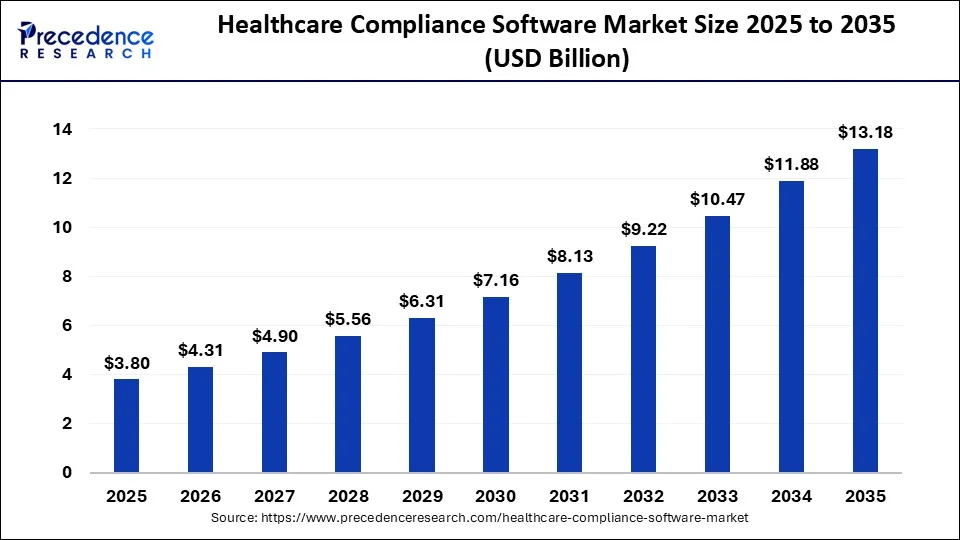
This surge reflects rising enterprise demand for platforms that enforce privacy, automate compliance, and align with evolving mandates, including the 2025 updates to the HIPAA Security Rule. As digital health ecosystems grow more interconnected, organizations now favor compliance-first AI platforms to proactively reduce regulatory, operational, and reputational exposure.
1. PHI Workflows: The Platform Must Control
To pass an audit, your platform must actively track and govern every single piece of protected health information (PHI) moving through your ecosystem.
- Structured Data: Seamless ingestion of EHR data, claims data, and patient portal messages.
- Unstructured Data: Processing of clinical notes, call transcripts, documents, and imaging metadata.
- Downstream Data: Governance over vector embeddings, analytics exports, and model inputs.
For a deeper breakdown of structured and unstructured clinical workflows, see our guide on Cost To Build An AI Healthcare App. Intellivon implements strict gateway interceptors to tag and sanitize these formats before they ever touch an LLM. This ensures that no raw data leaks into untrusted environments.
2. Why Prompts And Logs Can Become Compliance Assets
Prompts and vector representations are legally considered ePHI if they are derived from patient records.
- Vector Embeddings: Generated vectors retain semantic meaning and must be encrypted at rest.
- Prompt Retention: Prompts must be saved in immutable audit trails to prove compliance.
- Traceability: System logs must track which user generated specific model responses.
3. HIPAA Rules That Shape The Architecture
Three primary regulatory pillars dictate how you must construct your cloud environment.
- Privacy Rule: Enforces the minimum necessary standard for data access and user permissions.
- Security Rule: Mandates specific administrative, physical, and technical ePHI safeguards.
- Breach Notification Rule: Requires automated detection and reporting systems for data exposure.
4. Where AI Governance Begins
Compliance must extend to how the model behaves and makes decisions.
- Model Risk Management: Continuous AI bias testing and versioning control.
- Explainability: Implementation of features that explain how an output was generated.
- Human Override: Mandatory human review protocols before clinical deployment.
True compliance requires end-to-end data control, turning potential liabilities like logs and embeddings into auditable security assets. Therefore, navigating these requirements demands a shift from generic software architecture to specialized healthcare AI engineering.
Since this blog is focused more on the cost side of HIPAA-compliant healthcare platform development, you can read more about the platform itself and the ROI it can generate for your organization in our detailed post on How to Build a HIPAA-Compliant Healthcare Data Platform
How Much Does Compliant AI Platform Development Cost?
Compliant AI platform development usually costs $70,000 to $300,000 for a HIPAA-ready first release, depending on PHI volume, AI workflow complexity, private model hosting, integration depth, audit logging, and certification readiness.
A focused internal platform costs less, while multi-site enterprise platforms need higher budgets for security, governance, and evidence management.
1. Phase-by-Phase Capital Expenditure Breakdown
To budget accurately, you must view the engineering process through distinct, sequential development phases. The table below outlines the realistic capital requirements for each architectural milestone.
| Cost Phase | Estimated Cost | What It Covers |
| Discovery and HIPAA risk assessment | $8,000–$18,000 | PHI mapping, risk analysis, compliance scope, workflow inventory |
| Security architecture design | $10,000–$25,000 | RBAC, MFA, encryption, network segmentation, key management |
| PHI pipeline and de-identification | $12,000–$35,000 | PHI tokenization, de-identification, anonymization, consent logic |
| AI model and inference layer | $18,000–$55,000 | LLM orchestration, private endpoints, RAG, model isolation |
| Platform development | $25,000–$80,000 | APIs, dashboards, workflows, admin controls, review queues |
| Audit logging and SIEM integration | $10,000–$30,000 | Immutable audit trails, monitoring, alerting, log retention |
| Compliance testing and validation | $8,000–$25,000 | Pen testing, vulnerability scans, model validation, bias checks |
| SOC 2/HITRUST readiness support | $10,000–$40,000 | Evidence collection, policy mapping, control documentation |
| Launch and staff training | $5,000–$15,000 | Training, admin guides, incident drills, go-live support |
2. MVP Cost Range: $70,000–$120,000
This baseline budget applies when your organization needs to validate a single AI workflow using a limited stream of protected health information.
Because the scope is tightly contained, engineers focus entirely on setting up a foundational, BAA-ready cloud infrastructure with basic audit logging.
- Scope Constraints: Single clinical workflow utilizing one structured data source.
- Infrastructure Baseline: Standard BAA-compliant cloud deployment with core network isolation.
- Governance Depth: Basic model prompt monitoring and automated log retention policies.
3. Production Cost Range: $120,000–$220,000
When your application moves beyond a pilot program, the financial investment rises to accommodate multi-workflow builds and deep electronic health record integration.
At this level, the platform must actively sanitize incoming data through automated PHI de-identification and tokenization pipelines.
- System Integrations: Bi-directional connections with EHRs and insurance claims systems.
- Identity & Access: Advanced role-based access control, multi-factor authentication, and centralized SIEM logging.
- Data Safeguards: Real-time PHI de-identification engines and immutable audit trails.
4. Enterprise Cost Range: $220,000–$300,000
The highest pricing tier reflects the extreme security needs of multi-site hospital networks, large health systems, and global digital health applications.
Because these organizations handle massive volumes of sensitive data, they must completely bypass public internet routing.
- Isolation Strategy: Private model hosting inside VPC-isolated infrastructure or AWS GovCloud.
- Audit Readiness: Complete evidence collection mapping for HITRUST CSF or SOC 2 Type II audits.
- Resiliency Layer: Automated breach notification workflows and multi-region disaster recovery pipelines.
5. Ongoing Maintenance Cost: 15%–25% of Initial Build Per Year
Building a compliant AI platform development environment is a major milestone, but maintaining that compliant state requires dedicated, predictable annual funding.
Specifically, you should expect to allocate a fixed percentage of your original software development cost each year to handle routine operational upkeep.
- Security Cadence: Continuous vulnerability scanning, annual penetration testing, and access reviews.
- Model Lifecycles: Ongoing model validation, bias checks, and prompt engineering updates.
- Documentation Upkeep: Dynamic policy mapping modifications and compliance documentation refresh.
For a deeper breakdown of how system governance metrics and administrative oversight frameworks impact long-term operational budgets, see our guide on the Development Cost for Enterprise AI Governance Framework.
Budgeting for a HIPAA-compliant platform requires balancing upfront engineering costs with long-term maintenance realities. By breaking down your project into distinct phases, your leadership team can make highly informed, predictable financial choices.
The HIPAA AI Architecture Layers That Drive Cost
HIPAA AI platform cost rises when architecture must protect PHI across multiple layers instead of one application screen. The most expensive layers are secure ingestion, PHI tokenization, private inference, policy enforcement, audit logging, SIEM integration, disaster recovery, and model governance.
Each layer adds cost because it must be testable, traceable, and audit-ready.
1. Engineering Complexity Across System Layers
To manage deployment budgets effectively, technical teams must analyze expenses across specific functional boundaries. The table below outlines how each layer impacts your bottom line.
| Layer | Cost Driver | Budget Impact |
| Data ingestion | HL7, FHIR, X12, EHR exports, documentation APIs | Medium to high |
| PHI protection | Tokenization, masking, cryptographic de-identification | High |
| Identity and access | RBAC, ABAC, multi-factor authentication, enterprise SSO | Medium |
| Model layer | Hosted LLMs, private inference endpoints, VPC deployment | High |
| Audit layer | Immutable logs, SIEM integrations, compliance reviews | High |
| Governance layer | Model validation, bias testing, active model cards | Medium |
| Resilience layer | Multi-region backup, disaster recovery, incident plans | Medium |
2. Secure Data Ingestion Layer
The data ingestion layer serves as the primary gateway where raw clinical information enters your computing environment. Consequently, engineers must write custom handlers to securely ingest, validate, and parse highly diverse data formats.
- Protocols: Integration with legacy HL7 feeds and modern FHIR REST APIs.
- Formats: Processing of complex insurance X12 claims transactions and flat CSV exports.
- Unstructured Inputs: Secure upload endpoints for clinical documentation and audio call transcripts.
3. PHI Tokenization And De-Identification Layer
This layer acts as an automated cryptographic boundary that systematically strips or replaces identifiers before data hits your language models.
Because raw text frequently contains hidden patient names or medical record numbers, engineers must build intensive, multi-stage processing pipelines.
- PHI Tokenization Implementation Cost: Real-time generation of random surrogate keys to replace direct patient identifiers.
- PHI De-Identification Pipeline Cost: Integrating natural language processing models to locate and mask unstructured text identifiers.
- Data Anonymization Cost AI Platform: Implementing irreversible hashing and k-anonymity algorithms for secondary research datasets.
4. Access Control And Identity Layer
Enforcing a strict zero-trust posture means your system must verify every user and application request explicitly.
As a result, software developers spend significant time implementing granular permission logic that restricts visibility based on specific organizational roles.
- Role-Based Access Control Cost: Writing policy enforcement code that links specific model tasks to user credentials.
- Multi-Factor Authentication Cost: Integrating mandatory cryptographic key or app-based validation steps for all administrative accounts.
- Zero-Trust Architecture Implementation Cost: Deploying micro-segmentation policies that prevent unauthenticated internal network movement.
5. Audit, SIEM, And Incident Response Layer
The platform must maintain full operational visibility to satisfy the stringent requirements of the HIPAA Security Rule. Therefore, your development team must design an immutable logging layer that captures detailed system telemetry without introducing processing lag.
- Audit Logging Implementation Cost: Creating cryptographically signed, write-once logs that track every model prompt and output.
- Immutable Audit Trail Cost: Utilizing write-once-read-many storage buckets to prevent log modification.
- SIEM Integration Cost Healthcare AI: Writing custom log forwarders to stream real-time events into enterprise monitoring systems.
- Intrusion Detection System Cost: Deploying automated host and network monitoring agents to flag anomalous API patterns.
Building a legally defensible platform requires allocating resources across every tier of the technology stack. Neglecting even a single layer like audit logging or tokenization can completely invalidate your broader compliance investments.
Phase-By-Phase HIPAA AI Platform Implementation Roadmap
A compliant AI platform should be built in phases because security, AI behavior, and workflow value need separate validation gates. The safest roadmap moves from PHI discovery to architecture, then infrastructure, model development, compliance testing, rollout, and monitoring. This prevents teams from discovering audit gaps after the AI workflow is already live.
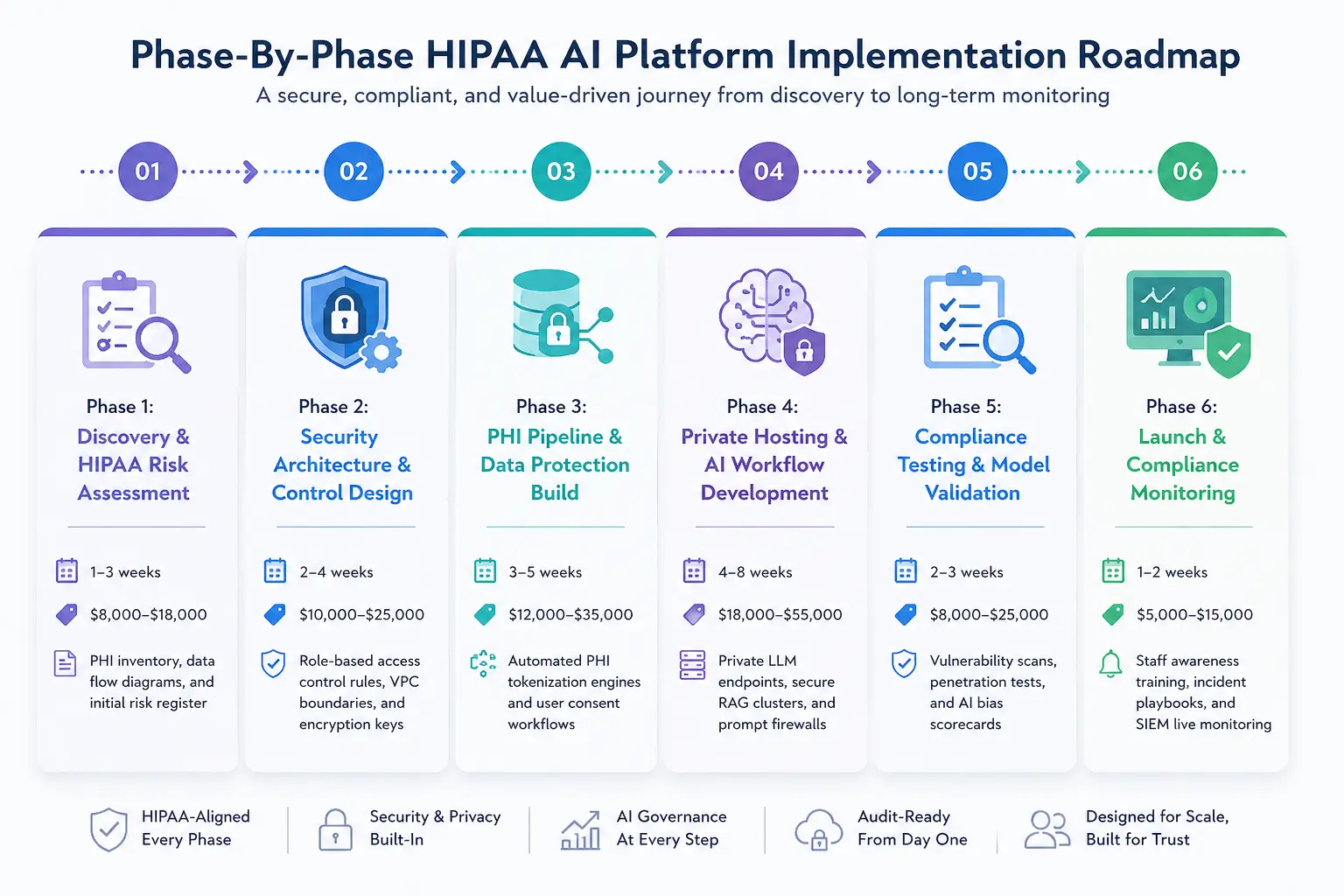
Phase-by-Phase Roadmap Summary
To visualize how these development milestones align chronologically and financially, the table below consolidates the estimated timelines, budgets, and primary deliverables for each project phase.
| Implementation Phase | Estimated Timeline | Cost Range | Primary Phase Deliverable |
| Phase 1: Discovery & HIPAA Risk Assessment | 1–3 weeks | $8,000–$18,000 | PHI inventory, data flow diagrams, and initial risk register |
| Phase 2: Security Architecture & Control Design | 2–4 weeks | $10,000–$25,000 | Role-based access control rules, VPC boundaries, and encryption keys |
| Phase 3: PHI Pipeline & Data Protection Build | 3–5 weeks | $12,000–$35,000 | Automated PHI tokenization engines and user consent workflows |
| Phase 4: Private Hosting & AI Workflow Development | 4–8 weeks | $18,000–$55,000 | Private LLM endpoints, secure RAG clusters, and prompt firewalls |
| Phase 5: Compliance Testing & Model Validation | 2–3 weeks | $8,000–$25,000 | Vulnerability scans, penetration tests, and AI bias scorecards |
| Phase 6: Launch & Compliance Monitoring | 1–2 weeks | $5,000–$15,000 | Staff awareness training, incident playbooks, and SIEM live monitoring |
Phase 1 — Discovery And HIPAA Risk Assessment
Discovery usually costs $8,000 to $18,000 and takes 1 to 3 weeks. This phase maps where PHI enters, moves, transforms, and exits the AI platform before any model or workflow is built.
- PHI Inventory & Mapping: Documenting every clinical data element, including data flow diagrams and Covered Entity/Business Associate reviews.
- Risk Mitigation: Establishing a formal risk register alongside detailed minimum necessary analysis and data retention needs.
- Scope Definition: Building a comprehensive vendor map to isolate where third-party APIs interact with patient records.
Intellivon starts by mapping PHI exposure across workflows, integrations, model calls, logs, and third-party services so the build scope matches real compliance risk. Once PHI movement is visible, the next decision is how to secure the platform boundary.
Phase 2 — Security Architecture And Control Design
Security architecture usually costs $10,000 to $25,000 and sets the control foundation for the full build. This phase defines access, encryption, segmentation, key management, logging, and incident response before developers connect live healthcare data.
- Identity Foundations: Implementing role-based access control (RBAC), attribute-based access control (ABAC), multi-factor authentication (MFA), and enterprise single sign-on (SSO).
- Network Guardrails: Configuring virtual private cloud (VPC) isolation and strict network segmentation.
- Cryptographic Security: Deploying customer-managed keys with a dedicated hardware security module (HSM) implementation cost framework to secure data encryption at rest and in transit.
Intellivon designs security controls as reusable platform services, not scattered feature-level permissions. After the security model is approved, the build can safely handle PHI pipelines.
Phase 3 — PHI Pipeline And Data Protection Build
PHI pipeline development usually costs $12,000 to $35,000 because AI systems need controlled data transformation before inference. This phase builds tokenization, de-identification, consent checks, retention rules, and deletion workflows around protected data.
- Transformation Engines: Constructing real-time PHI tokenization, de-identification, and data anonymization workflows.
- Consent Frameworks: Engineering a dedicated consent management implementation with clear patient consent workflow cost tracks.
- Lifecycle Management: Enforcing data retention policy implementation cost parameters and automated data deletion workflows.
Intellivon builds PHI pipelines that reduce model exposure by sending only task-relevant context into AI workflows. Once PHI is controlled, the team can choose the right model deployment pattern.
Phase 4 — Private Model Hosting And AI Workflow Development
AI model and workflow development usually costs $18,000 to $55,000 for the first governed release. Costs rise when the platform needs private model hosting, on-premise LLM deployment, VPC isolated infrastructure, dedicated cloud tenancy, or private inference endpoints.
- Orchestration & RAG: Building secure Retrieval-Augmented Generation (RAG) data links and model isolation architecture.
- Edge Defense: Deploying a dedicated prompt firewall to filter inbound text queries.
- Sovereign Hosting: Utilizing private inference endpoint cost models within AWS GovCloud healthcare cost or Azure Government healthcare cost options.
Intellivon selects model hosting based on PHI exposure, workflow risk, latency, auditability, and long-term platform ownership. After AI behavior works, the platform needs evidence that it works safely.
Phase 5 — Compliance Testing, Model Validation, And Audit Evidence
Compliance testing usually costs $8,000 to $25,000 before launch. This phase verifies that security controls, model outputs, logs, access rules, and incident workflows perform as documented under HIPAA and enterprise security review expectations.
- Infrastructure Scans: Running formal vulnerability scanning, cost AI platform protocol and penetration testing cost HIPAA platform exercise.
- Model Assessment: Undertake programmatic model validation cost compliance routines and rigorous AI bias testing cost HIPAA modules.
- Output Transparency: Implement explainability compliance layers to generate audit trails for model rationale.
Intellivon documents model behavior, access events, review actions, and evidence artifacts so compliance teams can review the system without reverse-engineering it.
For a deeper breakdown of how complex system validation frameworks map to highly secure, automated transactional workflows, see our guide on Fintech Platform Development Cost. Once controls pass testing, the platform still needs operational governance after launch.
Phase 6 — Launch, Training, And Ongoing Compliance Monitoring
Launch and monitoring usually cost $5,000 to $15,000 upfront, then 15% to 25% of the initial build yearly. This phase keeps the platform compliant through access reviews, audit preparation, model monitoring, staff training, and security updates.
- Operational Oversight: Allocating ongoing compliance monitoring cost funds and preparing for structural compliance audit preparation cost milestones.
- Workforce Readiness: Administering staff training cost HIPAA AI programs and interactive security awareness training cost modules.
- Emergency Infrastructure: Deploying a functional incident response plan cost workflow alongside a technical disaster recovery cost HIPAA platform setup.
Intellivon treats go-live as the beginning of compliance operations, not the end of development.
Executing a structured roadmap ensures that data safety, model tuning, and cloud network design are addressed before operations begin. A phase-by-phase development approach keeps engineering costs entirely predictable while maintaining a strong security posture.
PHI Security Controls That Increase Platform Cost
PHI security controls increase platform cost because they must protect data before, during, and after AI processing. The main budget drivers are encryption, identity management, access control, data minimization, tokenization, audit logging, intrusion detection, backups, retention policies, and breach notification workflows. These controls reduce downstream legal, operational, and procurement risk.
1. Capital Requirements for Regulatory Guardrails
Implementing compliant safeguards requires targeted investments across specific technical domains. The table below details the real-world engineering cost ranges required to secure an enterprise AI environment.
| Security Control Category | Implementation Cost Range | Architectural Scope and Deliverables |
| Encryption & Key Management | $12,000–$28,000 | AES-256 at-rest encryption, TLS 1.3 transit tunnels, and dedicated HSM cluster setups |
| Identity & Access Management | $8,000–$18,000 | Multi-factor authentication pipelines, identity providers, and granular RBAC schemas |
| Network & Isolation Controls | $15,000–$32,000 | Zero-trust subnet isolation, dedicated policy proxies, and explicit egress routing |
| Audit Logging & Incident Response | $10,000–$26,000 | Immutable write-once audit rails, SIEM integration pipelines, and breach notifications |
2. Encryption, Key Management, And HSM Decisions
Securing data states requires deploying robust cryptographic standards at every point of the infrastructure lifecycle. Consequently, teams must fund specialized engineering time to manage keys without introducing system bottlenecks.
- Data Encryption at Rest Cost: Implementing automated AES-256 encryption across all storage volumes, vector databases, and cache layers.
- Data Encryption in Transit Cost: Enforcing TLS 1.3 tunnels for all internal microservices and external API endpoints.
- Key Management Infrastructure Cost: Designing centralized key rotation policies and configuring customer-managed master keys.
- HSM Implementation Cost: Integrating physical or virtual hardware security module cost frameworks to isolate cryptographic operations from the main compute layer.
3. RBAC, MFA, And Minimum Necessary Access
Enforcing strict administrative boundaries ensures that users only interact with data required for their specific assignments. Therefore, developers must construct an access layer that explicitly evaluates administrative permissions on every model request.
- Role-Based Access Control: Writing programmatic authorization checks that control which clinical roles can trigger specific model inferences.
- Multi-Factor Authentication: Implementing mandatory token-based verification steps for all system users, data engineers, and compliance administrators.
- Minimum Necessary Standard Implementation Cost: Engineering dynamic context-filtering tools that programmatically clip extraneous patient details before text passes to the LLM.
4. Network Segmentation And Zero-Trust Controls
Isolating your processing environment prevents unauthorized lateral movement in the event of an external security perimeter compromise. As a result, the cloud architecture must rely on micro-segmented boundaries rather than generic firewall rules.
- Zero-Trust Architecture Implementation Cost: Deploying continuous verification hooks that validate every connection within the computing ecosystem.
- Network Segmentation Cost Healthcare AI: Segmenting training pipelines, inference endpoints, and web applications into completely separate private subnets.
- Egress Control: Configuring strict internet gateways that block all unapproved outbound model data transfers.
5. Audit Logging, Monitoring, And Breach Notification
The system must maintain an unalterable history of operations to satisfy both internal risk managers and external federal regulators. Thus, your infrastructure layer must collect detailed telemetry files and process them through automated safety watchdogs.
- Immutable Audit Trails: Directing user activities, prompt variables, and model adjustments into write-once-read-many cloud storage buckets.
- SIEM Integration: Formatting system logs to stream cleanly into centralized enterprise threat detection applications.
- Breach Notification System Cost: Building automated alerting logic that activates pre-configured incident response plan cost protocols during anomalous data events.
For a deeper breakdown of how to structure compliant automated processes around complex workflows, see our guide on AI Healthcare Claims Processing Software Development.
PHI protection is an active architectural requirement that spans cryptography, access layers, and network design. Investing in comprehensive security controls upfront removes structural vulnerabilities and streamlines technical evaluation cycles during vendor procurement.
Private Model Hosting Choices And Their Budget Impact
Private model hosting can move a HIPAA AI platform from a $90,000 build to a $250,000-plus build because infrastructure, isolation, latency, monitoring, and compliance evidence become more complex. The right choice depends on whether PHI enters prompts, whether outputs affect care or billing, and whether hospital buyers require dedicated environments.
1. Infrastructure Cost Multipliers by Hosting Choice
Selecting a hosting deployment topology directly dictates your initial capital requirements and your long-term infrastructure overhead. The table below correlates each model hosting pattern with its associated engineering budget impact.
| Hosting Model | Typical Budget Impact | Primary Security and Infrastructure Characteristics |
| BAA-covered managed API | +$5,000–$20,000 | Shared public cloud compute with zero data retention and strict vendor contractual BAAs |
| Private inference endpoint | +$15,000–$45,000 | Segregated compute instances, private network routing, and customer-managed encryption keys |
| VPC isolated infrastructure | +$20,000–$60,000 | Complete virtual network perimeter containment with no external internet route endpoints |
| Dedicated cloud tenancy | +$35,000–$90,000 | Single-tenant physical hardware layers deployed within sovereign compliance government clouds |
| On-premise LLM deployment | +$60,000–$150,000 | Complete physical hardware asset management, data sovereignty, and zero cloud dependencies |
2. BAA-Covered Cloud LLM APIs
Utilizing managed application programming interfaces with signed business associate agreements represents the lowest entry-cost option for deploying intelligent software features.
This configuration shifts the massive burden of physical server infrastructure upkeep entirely onto a compliant third-party cloud vendor.
- Workflow Match: Best for lower-risk workflows with strong vendor terms, no training on customer data, clear retention, and auditable usage.
- Cost Efficiency: Avoids complex graphics processing unit hardware configurations, reducing upfront setup fees.
- Compliance Bounds: Requires verification that the vendor enforces zero data retention policies on your inbound API data payloads.
3. Private Inference Endpoints
Deploying dedicated prediction endpoints allows your software engineering team to run large language models on isolated virtual machine clusters.
This middle tier establishes a clean boundary around model serving logic without requiring you to build custom deep learning containers from scratch.
- Workflow Match: Best for enterprise workflows that need stronger isolation, private networking, customer-managed keys, and more control over logs.
- Network Security: Restricts model call traffic to explicit internal virtual networks, blocking standard public web paths.
- Data Control: Provides complete administrative authority over model event logging, preventing accidental telemetry leaks to upstream developers.
4. VPC-Isolated Or Dedicated Cloud Tenancy
Constructing an entire machine learning ecosystem within an isolated virtual private cloud prevents external software elements from accessing sensitive data processing zones.
This macro-level isolation strategy is highly favored by compliance officers auditing complex software pipelines.
- Workflow Match: Best for hospital networks, healthcare SaaS vendors, and AI platforms handling high-volume PHI.
- Infrastructure Design: Leverages dedicated cloud tenancy or specialized environments like AWS GovCloud healthcare cost and Azure Government healthcare cost options.
- Regulatory Alignment: Simplifies corporate data residency compliance and data sovereignty implementation reviews by locking compute zones to specific geographic locations.
On-Premise LLM Deployment
Running open-source foundation models on physical server hardware located within an organization’s secure data center offers the ultimate level of systems control. This approach completely decouples your predictive workflows from external service providers, giving your security team complete visibility into physical data movement.
- Workflow Match: Best when data residency, sovereignty, or strict internal security policies prevent external model calls.
- Capital Demands: Drives up high upfront private model hosting cost parameters due to specialized server acquisition and power configurations.
- Operations Burden: Demands significant ongoing compliance maintenance cost allocations to handle internal hardware security audits.
Hybrid AI Architecture
A hybrid deployment model blends managed public services with isolated local resources to balance technical performance, security boundaries, and engineering budgets. This strategy helps optimize financial outlays by matching processing requirements to explicit risk thresholds.
- Workflow Match: Best when low-risk workloads use managed APIs while high-risk PHI workflows stay inside isolated infrastructure.
- Optimization Layer: Directs non-sensitive analytical calculations through public endpoints while routing core clinical patient notes through private inference endpoint cost environments.
- Integration Needs: Demands careful design of data routers to maintain a clear model isolation architecture between cloud boundaries.
For a deeper breakdown of how single-tenant hosting models impact core application budgets, see our guide on the. For a deeper breakdown of how single-tenant hosting models map to high-throughput secure processing clusters, see our guide on Fintech Payment Gateway Cost.
Model hosting choices dictate the ultimate financial boundaries of your infrastructure project. By selecting a placement strategy that directly matches your explicit risk tier, you can protect patient information without over-allocating your development capital.
BAA, Vendor Risk, SOC 2, And HITRUST Cost Planning
BAA, vendor risk, SOC 2, and HITRUST planning can add $15,000 to $80,000 to a compliant AI platform budget before formal certification costs. These costs cover legal review, third-party risk management, subprocessor checks, control documentation, evidence collection, audit preparation, policy development, and remediation work required by enterprise healthcare buyers.
1. Third-Party Risk and Certification Cost Ranges
Navigating third-party compliance requires dedicating clear financial resources to administrative frameworks and external evaluation pathways. The table below details the necessary budgets for these oversight activities.
| Governance Domain | Estimated Cost Range | Scope and Operational Deliverables |
| Business Associate Agreements | $4,000–$12,000 | Legal negotiation, subprocessor validation, and liability structures |
| Vendor Risk Management | $3,000–$10,000 | Third-party risk profiles, data residency logs, and pipeline audits |
| SOC 2 Type II Readiness | $15,000–$35,000 | Control mapping, continuous evidence collection, and gap remediation |
| HITRUST CSF Prep Planning | $20,000–$55,000 | Core inheritance mapping, assessment scoping, and buyer reviews |
| Policy & Documentation | $5,000–$15,000 | Security manual drafting, risk analyses, and operational playbooks |
2. Business Associate Agreement Cost
Securing valid legal commitments ensures that every upstream service provider assumes appropriate responsibility for handling protected health information. Therefore, your corporate legal counsel must spend focused time reviewing the data terms of your software partners.
- BAA Negotiation Cost AI Vendors: Customizing liability clauses and setting explicit reporting timelines for potential data events.
- Business Associate Agreement Cost: Formally executing core legal documents that establish permitted data uses and clear breach duties.
- Subcontractor BAA Cost: Verifying that downstream cloud providers sign complementary agreements to eliminate structural legal gaps.
3. Vendor Risk Assessment Cost
Your compliance officer must systematically evaluate the data handling practices of every external component integrated into your machine learning environment. This review process prevents unapproved tracking scripts or external training processes from accessing patient text.
- Vendor Risk Assessment Cost: Programmatically scoring the security capabilities of third-party software tools and application endpoints.
- Third-Party Risk Management Cost AI: Auditing complete subprocessor lists to confirm where information travels across the network.
- Data Restrictions: Verifying explicit “no training” terms to guarantee that your proprietary data payloads never influence external models.
4. SOC 2 Type II Audit Readiness
Establishing an unalterable history of operational security proves to large health networks that your application safely handles daily transaction volumes. Consequently, software developers must write automated scripts to collect infrastructure evidence continuously.
- SOC 2 Compliance Implementation Cost: Mapping existing network configurations to the explicit trust services criteria defined by auditors.
- Evidence Collection: Automating regular access reviews, employee background checks, and system change logs.
- SOC 2 Type II Audit Cost: Budgeting for formal CPA examination cycles once your internal controls operate smoothly for several months.
5. HITRUST Readiness And Certification Planning
Large enterprise healthcare buyers increasingly demand specialized frameworks that combine multiple security mandates into a single auditable scorecard. Because this assessment features hundreds of rigid criteria, your team must carefully organize its infrastructure layers beforehand.
- HITRUST CSF Assessment Cost: Scoping the regulatory requirements based on your specific organization size and data volume metrics.
- Control Inheritance: Lowering engineering friction by inheriting foundational security credits from major cloud hosting providers.
- HITRUST Certification Cost: Managing the ultimate multi-year administrative and validation outlays required to maintain active certificate standings.
6. Policy Development And Compliance Documentation
Your operational workflows must match your technical realities to withstand close scrutiny from corporate procurement departments. As a result, technical writers must convert your automated cloud configurations into explicit, structured rulebooks.
- Policy Development Cost HIPAA AI: Designing baseline administrative procedures covering password policies, encryption standards, and workplace security rules.
- Compliance Documentation Cost: Assembling clean system architecture diagrams, data dictionaries, and employee training completion charts.
- Risk Analysis Documentation Cost: Publishing comprehensive security risk assessment reviews to satisfy the core mandates of the HIPAA Security Rule.
For a deeper breakdown of how system validation frameworks map to broader infrastructure shifts and corporate evaluation timelines, see our detailed schedule on What’s The Development Timeline For Cloud EHR Migration.
Corporate procurement requirements demand thorough legal agreements, clear documentation, and formal safety frameworks. Managing these administrative milestones systematically ensures that your software moves smoothly through complex institutional review cycles.
AI Governance And Model Validation Costs For HIPAA Platforms
AI governance costs matter because HIPAA compliance alone does not prove that a model is safe, explainable, fair, or reliable. Enterprise healthcare AI platforms need model validation, bias testing, explainability, human review, prompt monitoring, version control, drift detection, and model risk documentation. These controls usually add $15,000 to $50,000 to the first build.
1. Financial Allocations for Algorithmic Integrity
Safeguarding the reasoning engine of your platform requires targeted software engineering tasks. The table below outlines the upfront budget expectations needed to build a verifiable model governance tier.
| Governance Element | Cost Range | Engineering Deliverable |
| Model Validation Testing | $4,000–$12,000 | Programmatic golden dataset regression suites and error threshold monitors |
| Explainability Pipelines | $5,000–$14,000 | Integrated token-weight rationales, confidence scoring, and review interfaces |
| Bias & Fairness Scans | $3,000–$10,000 | Demographic parity matrices, data drift alerts, and linguistic checks |
| Risk & Lifecycle Systems | $3,000–$14,000 | Centralized model registries, automated rollback triggers, and model cards |
2. Model Validation Cost Compliance Leaders Should Expect
Building a dependable AI interface requires evaluating behavioral outcomes against concrete clinical and administrative data baselines. Consequently, developers must programmatically verify that updates never degrade accuracy or exceed defined error thresholds.
- Validation Datasets: Structuring curated, expert-labeled regression test beds that mirror exact production tasks.
- Error Thresholds: Engineering hard programmatic cutoff filters that instantly reject outputs falling below predetermined precision baselines.
- Operational Review: Conducting formal blinded evaluations where clinical staff score model text before pipeline deployment.
3. Explainability And Human Review Workflows
Enterprise software leads must provide clear transparency into how an algorithm assembles its structural conclusions. Therefore, your development team must design secondary visualization tools that allow human operators to audit model reasoning effortlessly.
- Confidence Scores: Attaching explicit statistical certainty metrics to every text chunk or code output.
- Source Traceability: Linking generated text highlights directly back to specific raw source data records.
- Override Tracking: Constructing administrative dashboards to capture reviewer approvals, modifications, and manual human overrides.
4. AI Bias Testing And Fairness Checks
Preventing systematic performance drops across patient demographics is essential for ethical data use and regulatory safety. As a result, your software architecture must run automated evaluations to isolate unintended algorithmic skews.
- Patient Group Testing: Evaluating performance metrics across diverse age groups, ZIP codes, and baseline health profiles.
- Claims Outcome Bias: Scanning prior authorization and billing models to ensure parity in denial recommendations.
- Linguistic & Specialty Bias: Monitoring output validation scores across varied clinical vocabularies and distinct medical specialties.
5. Model Risk Management For Healthcare AI
Managing complex software lifecycles demands maintaining strict structural control over every active machine learning configuration. Thus, your infrastructure must utilize a central repository that catalogs every iteration of your processing tools.
- Model Inventory: Hosting a secure, centralized model registry that tracks exact weights, parameter bounds, and asset lineages.
- Model Cards: Automatically generating detailed metadata files specifying the training scope, limitations, and intended uses of each version.
- Rollback Workflows: Deploying automated scripts that instantly restore previous safe configurations if production metrics degrade.
6. Ongoing Model Monitoring
A platform’s compliance state degrades rapidly if the underlying machine learning layers change their behavior after launch. For this reason, engineers must deploy real-time monitoring tools to continuously analyze live query strings.
- Drift & Hallucination Tracking: Configuring statistical watchdogs to flag divergence in output distributions or structural text formats.
- PHI Leakage Detection: Deploying heuristic filters that scan outbound model payloads for accidental exposure of direct identifiers.
- Prompt Abuse Controls: Building runtime token firewalls to intercept adversarial prompt injections or malicious input patterns.
For a deeper breakdown of governed healthcare AI workflows, see our guide on the Enterprise AI Revenue Cycle Management Platform Guide.
Model governance ensures your processing layers remain auditable, transparent, and accurate over time. Embedding strict verification loops directly into your engineering roadmap protects your infrastructure from unexpected behavioral failures and simplifies administrative procurement reviews.
Healthcare Integrations That Change Total Cost Of Ownership
Healthcare integrations often decide whether HIPAA AI platform total cost of ownership stays near $120,000 or moves toward $300,000.
EHR, claims, payer, imaging, identity, analytics, and document integrations increase cost because each connection introduces PHI movement, access rules, logging requirements, validation needs, and vendor review obligations.
1. Integration Architecture and Capital Allocation
Connecting an artificial intelligence engine to foundational medical and administrative databases requires targeted backend engineering. The table below details the specific cost parameters involved in establishing secure, compliant data linkages.
| Integration Boundary | Cost Range | Primary Architectural Deliverables |
| EHR & EMR Integrations | $15,000–$40,000 | Bidirectional HL7/FHIR pipes, sandbox validation, and credential sync |
| Claims & Clearinghouse Pipes | $12,000–$30,000 | X12 electronic data interchange translation, validation engines, and RCM paths |
| Unstructured Data Ingestion | $10,000–$28,000 | Labeled DICOM routing, optical character recognition pipelines, and call audio processing |
| Identity & Access Directory Sync | $5,000–$15,000 | Enterprise SSO configuration, token mapping, and unified audit tracking |
| SIEM & Compliance Telemetry | $8,000–$22,000 | Automated log aggregation, telemetry streams, and evidence dashboard views |
2. EHR And EMR Integrations
Linking your machine learning engine directly to a health network’s core medical records infrastructure demands highly specialized formatting and strict protocol adherence. Because minor structural data variations can interrupt clinical data flows, developers spend extensive time testing message schemas.
- Systems Covered: Configuring interfaces for major systems like Epic, Oracle Health, Meditech, and athenahealth.
- Modern Formats: Writing custom microservices to parse modern HL7 and FHIR message schemas securely.
- Embedded Applications: Deploying SMART on FHIR protocols to embed your interactive AI features directly inside the native clinician web interface.
3. Claims, Clearinghouse, And RCM Integrations
Automating administrative billing workflows requires establishing secure connections with clearinghouses and insurance payer networks. Consequently, engineers must build translation pipelines that convert flexible LLM text outputs into rigid, regulated transactional documents.
- EDI Standards: Mapping machine learning observations to standardized X12 financial transaction formats, specifically 837 claims and 835 payment files.
- Payer Validations: Engineering real-time eligibility checks and automated payer rules validation layers to verify data completeness.
- Denial Management: Constructing structured denial workflows that systematically feed rejected claims data back into the AI model for automated appeals generation.
4. Document, Voice, And Imaging Data Integrations
Processing unorganized clinical data formats forces developers to build multi-stage preprocessing pipelines before any text can safely enter an LLM prompt. Because unstructured patient files frequently contain hidden patient data, these ingestion channels require intensive parsing guardrails.
- Text Extraction: Deploying advanced optical character recognition engines to extract readable text from scanned documents and fax feeds.
- Audio Pipelines: Building specialized voice AI processing clusters to handle unstructured patient portal audio messages and clinical call transcripts.
- Medical Imaging: Interfacing with enterprise PACS/RIS systems using native DICOM routing protocols to securely parse and catalog imaging metadata fields.
5. Identity, SSO, And Admin Integrations
Enforcing consistent access parameters across an enterprise platform requires anchoring your software directly to the client’s existing corporate identity provider. This structural alignment eliminates the massive security liability of hosting separate user credential databases.
- Authentication Standards: Deploying production-ready SAML 2.0 and OAuth 2.0 configuration points across the backend ecosystem.
- Directory Sync: Interfacing directly with enterprise identity management utilities like Okta and Azure AD to govern user provisioning.
- Audit Linkage: Programming internal database triggers to automatically attach full corporate identity records to every single immutable system audit log event.
6. Analytics, SIEM, And Compliance Reporting
The platform must continuously broadcast its internal operational logs to the central security team to satisfy corporate governance mandates. Therefore, your development team must design outbound data routers that format telemetry files without introducing operational latency.
- Threat Detection Tools: Writing custom data forwarders to stream real-time operational events into Splunk, Datadog, CloudWatch, or Microsoft Sentinel.
- Executive Dashboards: Building separate administrative dashboard interfaces that visualize system uptime, processing volumes, and data residency compliance metrics.
- Audit Automation: Engineering programmatic evidence exports that allow your compliance staff to generate complete user access and query histories with a single click.
For a deeper look into how these clinical data streams are managed across automated operational infrastructures, see our detailed guide on How to Build an AI Healthcare Automation Platform.
Healthcare data connections dictate the true total cost of ownership of an enterprise platform. By building isolated, standardized integration layers from day one, your engineering team can avoid expensive custom code work and speed up technical validation rounds during corporate procurement reviews.
Build vs Buy HIPAA Compliant AI Platform Cost Decision
Build vs buy HIPAA compliant AI platform cost decisions should follow data risk, workflow depth, integration needs, and ownership requirements. Buying works for narrow, standard workflows with limited customization.
Building makes more sense when PHI logic, private infrastructure, custom governance, deep integrations, and enterprise audit evidence must match your operating model.
1. Comparative Strategy Analysis Matrix
Selecting an execution path requires balancing immediate deployment speed against long-term architectural flexibility. The table below outlines how standard healthcare scenarios dictate your engineering choices.
| Scenario | Buy | Build | Hybrid |
| Basic admin chatbot | Yes | No | Sometimes |
| PHI-heavy workflow automation | No | Yes | Yes |
| Hospital-grade audit evidence | Sometimes | Yes | Yes |
| Multi-tenant healthcare SaaS | Rarely | Yes | Yes |
| Fast pilot without EHR integration | Yes | No | Yes |
| Private model hosting | Rarely | Yes | Yes |
2. When Buying A HIPAA AI Tool Makes Sense
Purchasing a pre-built software-as-a-service solution represents the fastest path to production for non-clinical operational tasks. Because the vendor manages the underlying infrastructure compliance, your engineering team avoids complex cloud configuration cycles entirely.
- Target Use Cases: Deploying narrow AI scribes, general support automation, automated scheduling assistants, and administrative FAQ bots.
- Operational Scope: Managing non-core workflows where the software does not directly process complex, multi-system patient profiles.
- Cost Predictability: Utilizing fixed monthly subscription fees to validate basic user adoption metrics without massive upfront capital outlays.
3. When Custom HIPAA-Compliant AI Platform Cost Is Justified
Constructing a proprietary software architecture becomes necessary when your core value proposition relies on unique data processing pipelines or specialized clinical logic. At this tier, standard third-party tools cannot accommodate the granular isolation controls required by hospital security teams.
- Target Use Cases: Building custom HIPAA-compliant AI platform cost models for PHI-heavy workflow automation, multi-system database orchestration, and clinical decision reviews.
- Proprietary Value: Developing custom large language models, localized retrieval-augmented generation clusters, and specialized payer logic engines.
- Enterprise Scaling: Creating a multi-tenant healthcare SaaS product line where your brand must completely control data positioning and intellectual property.
4. Hidden SaaS Costs Buyers Miss
Procurement leads frequently evaluate software platforms based entirely on baseline subscription fees while ignoring expensive operational add-ons. Over time, these unbundled technical requirements can drive up your recurring expenses significantly past initial expectations.
- License Overhead: Managing aggressive per-user pricing tiers that penalize internal organizational scaling.
- Compliance Surcharges: Funding expensive compliance add-ons, dedicated physical tenancy layers, and custom business associate agreement legal negotiations.
- Integration Bottlenecks: Paying steep electronic health record connection fees, data export limits, and unexpected charges to access raw system audit log files.
5. Hybrid Build-Buy Strategy
A hybrid deployment framework blends managed vendor components with proprietary data controls to balance speed, control, and engineering capital. This approach allows developers to exploit advanced public model intelligence while strictly keeping data processing inside a secure perimeter.
- Architecture Design: Deploying pre-certified cloud infrastructure layers or BAA-covered managed language model application programming interfaces.
- Custom Layers: Writing an in-house custom workflow layer, localized model governance modules, and specialized data minimization tools.
- Financial Efficiency: Lowering your ultimate HIPAA AI platform total cost of ownership by eliminating custom foundational compute engineering while retaining deep operational flexibility.
Evaluating a build vs buy HIPAA compliant AI platform cost structure requires matching execution paths directly to your explicit data risk profile. Purchasing tools works well for administrative tasks, but core clinical automation requires a dedicated or hybrid custom architecture to pass institutional procurement audits.
Compliance Platform ROI And Breach Cost Avoidance
Compliance platform ROI comes from faster security reviews, fewer manual audit tasks, safer PHI handling, lower rework, faster enterprise procurement, and reduced breach exposure.
The strongest ROI case does not depend only on labor savings. It also includes avoided retrofit costs, regulatory penalty avoidance, audit readiness cost savings, and vendor review acceleration.
1. Capital Optimization and Risk Mitigation Metrics
Investing in a secure architectural foundation yields quantifiable returns by speeding up sales cycles and eliminating unexpected liabilities. The table below outlines the primary financial recovery vectors for an enterprise deployment.
| ROI Vector | Primary Financial Driver | Measurable Business Impact |
| Procurement Velocity | Pre-packaged SOC 2/HITRUST evidence packets | Shortens enterprise sales cycles by 40% to 60% |
| Engineering Rework Avoidance | Secure data pipelines designed from day one | Eliminates costly backend structural retrofits |
| Risk Mitigation Value | Automated breach notification and access controls | Minimizes structural exposure to multi-million dollar fines |
| Audit Prep Efficiency | Cryptographically signed, centralized log systems | Reduces internal compliance staff audit workloads |
2. Faster Enterprise Procurement
Large hospital systems and healthcare SaaS buyers maintain highly rigid technical evaluation cycles before approving new platform vendors. Consequently, if your system lacks pre-configured security assets, your product will likely stall indefinitely inside corporate procurement queues.
- Evidence Packages: Providing enterprise buyers with immediate access to structured control documentation, signed subprocessors BAAs, and active SOC 2 Type II or HITRUST readiness reports.
- Vetting Acceleration: Eliminating tedious, manual security questionnaires by presenting an instantly auditable virtual private cloud environment.
- Time-to-Revenue: Transforming your security stance from a legal bottleneck into a competitive differentiator that drastically shortens contract signing timelines.
3. Lower Compliance Rework
Attempting to paste privacy boundaries onto a production-ready artificial intelligence application forces engineering teams to completely rebuild fundamental system layouts. These delayed code adjustments disrupt live operations and waste expensive development sprints on database refactoring.
- Pipeline Cleanliness: Isolating vector databases, tokenization modules, and model prompt histories correctly during the initial design phase.
- Vendor Lock-In Avoidance: Establishing clear abstraction boundaries around your machine learning models so you can swap language model vendors without breaking your primary compliance posture.
- Asset Protection: Ensuring that your initial software engineering investment remains highly stable and scalable over multi-year deployment periods.
4. Breach Cost Avoidance ROI
The financial consequences of data exposure within medical software environments have escalated to unprecedented levels. Therefore, technical leaders must structure their development budgets by evaluating upfront engineering expenses against the catastrophic costs of a data leak.
- Breach Cost Avoidance ROI: Setting up automated token firewalls and immutable log repositories to structurally eliminate the threat of unencrypted patient details leaking into public model logs.
- Regulatory Penalty Avoidance ROI: Deploying real-time host intrusion detection and automated access controls to prevent massive Office for Civil Rights financial sanctions.
- Brand Value Preservation: Mitigating long-term reputational damages and avoiding expensive mandatory patient notification campaigns through proactive perimeter design.
5. Audit Readiness Cost Savings
Preparing for an external regulatory inspection manually forces data engineers to abandon their core product tasks to hunt down historic cloud logs. By transforming evidence generation into a continuous, automated background process, your platform eliminates this seasonal operational drag.
- Audit Readiness Cost Savings: Utilizing write-once-read-many storage buckets that gather immutable system access histories continuously without human intervention.
- Policy Mapping: Linking cloud configuration parameters directly to specific HIPAA Security Rule clauses to generate instantaneous compliance gap analyses.
- Staff Efficiency: Allowing compliance managers to extract complete user, model, and application audit summaries via automated dashboard interfaces within minutes.
5. Operational ROI From AI Workflows
Beyond simply minimizing corporate risk, a highly compliant processing system unlocks significant operational efficiencies across administrative and clinical environments. These platform-level capabilities allow health organizations to confidently automate high-volume transaction tasks.
- Administrative Speed: Driving rapid processing returns across insurance claims indexing, automated clinical coding, and medical documentation formatting.
- Clinical Triage: Enabling fast, secure data lookups within localized retrieval-augmented generation databases to assist with complex utilization reviews.
- Enterprise Scaling: Providing non-technical internal staff with conversational access to secure data stores without risking underlying data privacy.
Evaluating compliance ROI requires looking past basic developer hour savings to analyze procurement acceleration, rework avoidance, and risk mitigation value. Building your platform defensively from day one safeguards your capital investment and removes institutional friction from your enterprise expansion strategy.
Build A HIPAA-Compliant Enterprise AI Platform With Intellivon
Choosing the right development partner matters because a HIPAA-compliant AI platform is not a normal software build. It must protect PHI, control model behavior, pass security review, connect with healthcare systems, and produce audit evidence from day one. Intellivon helps healthcare teams build this foundation with compliance-ready architecture, enterprise AI engineering, and production-focused delivery.
For CTOs, CISOs, compliance leaders, and AI program owners, this reduces one major risk: building an impressive AI prototype that cannot pass procurement, security, or hospital compliance review.
1. Choose Intellivon For Compliance-First AI Architecture
Intellivon designs HIPAA AI platforms around PHI protection before model selection begins. The team maps where protected health information enters, moves, transforms, and exits the platform so security controls are built into the core architecture, not added after development.
This includes PHI inventory, HIPAA risk analysis, BAA review, data flow mapping, access control planning, and platform scope definition. As a result, healthcare teams get a clearer build plan before spending heavily on AI models, integrations, or cloud infrastructure.
This matters because many AI builds fail at the compliance layer, not the model layer. Intellivon reduces that risk by treating compliance as part of the engineering system.
2. Choose Intellivon For Secure PHI Infrastructure
Intellivon builds the security foundation needed for HIPAA-regulated AI workflows. This includes RBAC, MFA, encryption, network segmentation, PHI tokenization, audit logging, private hosting, secure APIs, and controlled model access.
The platform is designed to protect PHI across prompts, embeddings, model outputs, logs, dashboards, integrations, and user actions. This gives healthcare organizations stronger control over how sensitive data flows through the AI system.
For enterprise teams, this means fewer security gaps during buyer review, fewer expensive rebuilds after launch, and a clearer path toward SOC 2 or HITRUST readiness.
3. Choose Intellivon For Governed AI Workflows
Intellivon does not treat AI outputs as final answers. The team builds governed workflows with human review, confidence scoring, explainability, override tracking, model monitoring, and escalation rules for uncertain outputs.
This is especially important for healthcare AI platforms that support documentation, claims review, triage, care coordination, patient communication, or internal knowledge search. Every AI suggestion must be traceable, reviewable, and safe enough for regulated workflows.
With this approach, healthcare teams can use AI to reduce workload while keeping clinical, compliance, and operational control in human hands.
4. Choose Intellivon For Healthcare System Integration
A HIPAA-compliant AI platform only creates value when it works inside the systems healthcare teams already use. Intellivon integrates AI workflows with EHRs, RCM platforms, payer APIs, claims systems, imaging systems, document repositories, analytics tools, and SIEM environments.
This helps healthcare organizations avoid disconnected AI tools that create new data silos. Instead, the AI platform becomes part of the existing workflow layer.
For hospitals, healthcare SaaS companies, and digital health teams, this means the platform can support real operational use cases, not just isolated demos.
5. Choose Intellivon For Audit-Ready Platform Delivery
Intellivon prepares HIPAA AI platforms for long-term compliance, not only first launch. The team builds evidence exports, access logs, policy documentation, staff training workflows, incident response plans, model monitoring, and compliance reporting into the operating layer.
This gives teams the documentation they need for security reviews, vendor assessments, internal audits, and enterprise buyer due diligence. It also helps compliance leaders prove how PHI is protected across the platform.
That difference matters when the platform moves from pilot to production. A working AI feature may impress users, but an audit-ready AI platform earns enterprise trust.
6. Why Enterprises Choose Intellivon
Healthcare organizations choose Intellivon when they need more than AI development capacity. They need a team that understands secure infrastructure, regulated data, enterprise integrations, model governance, and production reliability.
Intellivon brings:
- 500K+ engineering hours across complex software systems
- Ex-MAANG engineering experience
- 500+ AI and healthcare project delivery experience
- HIPAA, SOC 2, and GDPR-aligned development practices
- Deep experience with AI agents, LLMs, MLOps, and workflow automation
- Strong delivery capability across healthcare and fintech integrations
- Production-first engineering, not demo-first AI prototyping
This makes Intellivon a strong fit for teams that need to build a HIPAA-compliant enterprise AI platform within a controlled $70,000 to $300,000 roadmap.
If you are planning compliant AI platform development, Intellivon can help you define the right scope, design secure PHI architecture, choose the right model infrastructure, and build a platform that is ready for real healthcare workflows, security review, and long-term scale.
Conclusion
Implementing a compliant AI platform requires shifting from basic software configuration to strict, multi-layered healthcare engineering. Successfully balancing initial development phases, private model hosting, and integrated security controls ensures your architecture remains thoroughly defensible under regulatory scrutiny.
Ultimately, treating HIPAA safeguards and automated model governance as foundational infrastructure assets protects your long-term capital investment, accelerates corporate procurement, and allows your enterprise to scale clinical automation with complete operational confidence
Things To Know About HIPAA-Compliant AI Platform Cost
Q1. How much does a HIPAA-compliant AI platform cost?
A1. A HIPAA-compliant AI platform usually costs $70,000 to $300,000 for a controlled first release. Specifically, a focused MVP with one workflow starts near $70,000 to $120,000. Alternatively, a production enterprise platform with private model hosting, SIEM integration, and audit logs usually falls between $180,000 and $300,000.
Q2. How long does compliant AI platform development take?
A2. Compliant AI platform development usually takes 10 to 20 weeks for a focused first release. For instance, a narrow build can launch in 10 to 12 weeks if vendors are clear. However, a broader enterprise platform with private inference, EHR integration, and audit evidence usually needs 16 to 24 weeks.
Q3. What makes HIPAA-compliant AI infrastructure cost more?
A3. HIPAA-compliant AI infrastructure costs more because PHI must be protected across prompts, embeddings, logs, model outputs, and backups. Consequently, the expensive parts are private hosting, encryption, key management, access control, de-identification, audit trails, and SIEM integration. Therefore, protecting data points across multiple layers drives up engineering complexity.
Q4. Can a HIPAA-compliant LLM platform development cost stay under $100,000?
A4. Yes, a HIPAA-compliant LLM platform can stay under $100,000 if the first release uses one workflow, one data source, and a BAA-covered model provider. Nevertheless, costs rise quickly when teams add EHR integration, private inference, multi-site access, HITRUST readiness, and advanced model monitoring to the core infrastructure.
Q5. Is build vs buy better for HIPAA-compliant enterprise AI?
A5. Buying is better for standard workflows like basic note drafting, appointment support, or internal knowledge search. On the other hand, building is better when the AI platform must process PHI across custom workflows, connect to EHR systems, enforce internal governance, and produce audit evidence for hospital procurement teams.
To Sum Up:
- A HIPAA AI platform does not become compliant because the model provider signs a BAA. Compliance depends on how PHI moves through prompts, embeddings, outputs, logs, vendors, and users.
- The safest first build usually costs $70,000 to $120,000 only when the workflow is narrow, the data sources are limited, and private model hosting is not required.
- Private inference, SIEM integration, immutable audit logs, and SOC 2/HITRUST readiness are the cost drivers that push HIPAA AI platforms toward $180,000 to $300,000.
- Teams that design PHI controls after model development usually pay twice: once for the prototype and again for the compliance rebuild.
- Build vs buy should not be decided by software price. It should be decided by PHI exposure, workflow ownership, audit evidence, and integration depth.