Key Takeaways:
- Agentic AI is already being used in hospitals, even if it’s mainly involved in specific workflows.
- The most evident changes are taking place in the areas of notes, orders, discharge, and care coordination.
- The doctors remain informed in case the decision has an impact on patient care.
- Such systems function properly only if the links to hospital data and the EHR are reliable.
-
Learn how Intellivon designs its hospital agents with the workflow in mind first and then incorporates the AI.
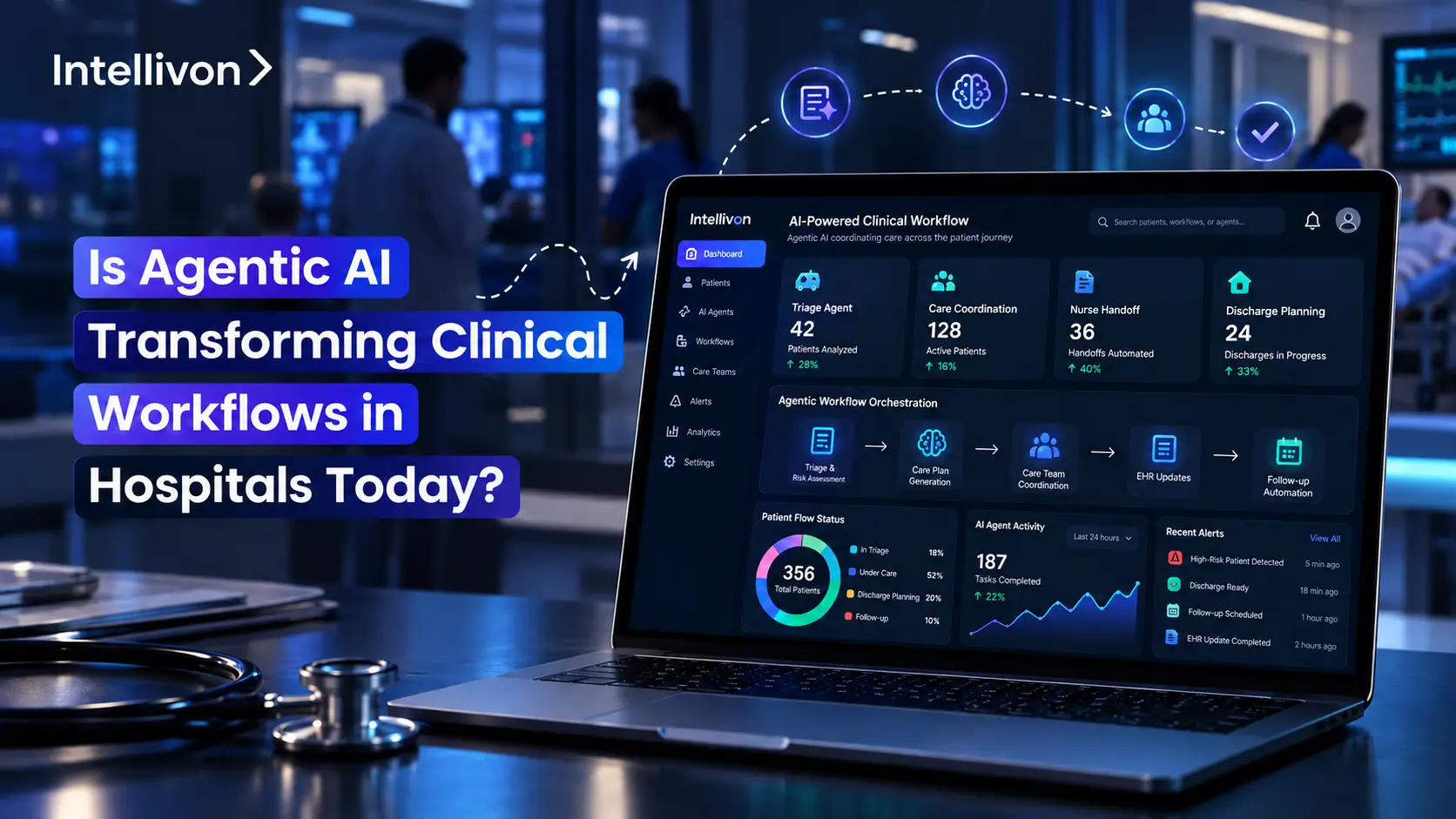
Yes, agentic AI is transforming clinical workflows in hospitals today. It does this by drafting prior authorization appeals, flagging early sepsis risk, and writing clinical documentation in real time, all without a person starting each step by hand. For example, it prepares prior authorization appeals while the pharmacist is waiting.
It is not the case that all hospital workflows currently have an agent carrying them out. For instance, documentation and prior authorization are ahead of all the other processes. Autonomous diagnosis, however, is still very far from being implemented, and this is entirely reasonable since no hospital is willing to have an AI system making a call that a doctor should be making.
This is particularly important when you are currently developing solutions for hospitals rather than just observing from the side. Before committing any budget to it, you have to establish which workflows have been proven, which are still in the experimental stage, and where the actual risks lie. In order to achieve that, Intellivon develops these systems for hospitals and health platforms, so this is something that we are currently seeing in practice. That is precisely what the rest of this blog looks at next: what is currently in operation, what the data really shows, and where the limitations are.
What Agentic AI Means Inside a Hospital
Agentic AI is software that completes a task on its own. It doesn’t just answer a question about a patient.
Instead, it reads the chart, decides what happens next, and acts within limits a human already set.
1. How Agentic AI Is Different From Regular Healthcare AI
Several types of hospital software fall into three older categories. Traditional AI predicts something, like a risk score, then stops. Generative AI writes content, like a summary, but never acts on it. RPA follows a fixed script and breaks the moment anything changes. Agentic AI, however, decides what permitted step comes next.
- Traditional AI: gives a prediction, nothing more
- Generative AI: creates content, like a note or summary
- RPA: follows fixed rules, with no judgment involved
- Agentic AI: chooses the next allowed action, then acts on it
2. A Simple Example of an Agentic Clinical Workflow
Picture one patient visit, start to finish. A doctor finishes the consultation. From there, the workflow moves on its own.
- It drafts the visit note automatically
- Then it identifies relevant tests from that note
- Next, it prepares orders and queues them in the right system
- It schedules a follow-up appointment
- Finally, it sends patient instructions in plain language
Even so, the clinician still approves anything that matters. The agent prepares the work. The person signs off on it.
3. What Makes a Workflow Truly Agentic
Not every automated task qualifies. A workflow only counts as agentic once it does all of the following, not just one or two.
- Has a clear goal to work toward
- Reads the current context before acting
- Chooses the next permitted action on its own
- Uses tools or APIs to carry out that action
- Checks its own results before moving forward
- Escalates to a person when something looks off
- Keeps going until the workflow is finished
That’s the baseline. Once a system does all seven, it’s ready to run real hospital work. The rest of this guide builds directly on that.
Hospitals Are Starting to Use Agentic AI in 2026
Yes, hospitals are starting to use agentic AI in 2026, though not at the scale the headlines suggest. According to Microsoft and The Health Management Academy, 43% of health system leaders report piloting or testing agentic AI. However, only 3% have deployed an agent inside a live clinical or operational workflow. So interest is real, but production use is still rare.
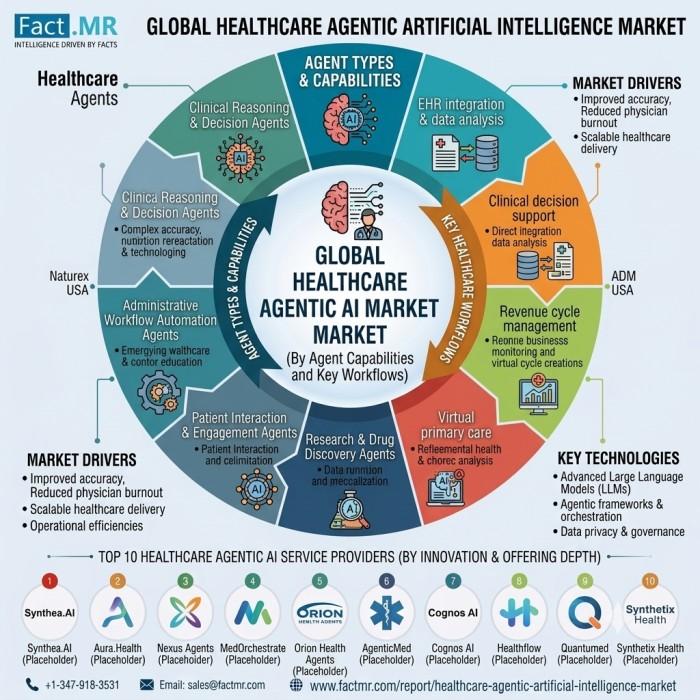
The market backs this up. Fact.MR estimates the healthcare agentic AI market at $3.9 billion in 2026, growing to $24.6 billion by 2036. That’s a 20.2% CAGR, driven mostly by hospitals moving past isolated pilots toward systems that coordinate real work.
1. Hospital Adoption Is Real but Still Early
Not every hospital in the conversation is at the same stage. Some are simply evaluating vendors. Others are running small pilots. Very few have agents touching live patient workflows today. That gap is the real story here, not the headline number.
- Organizations evaluating agents: exploring vendors, no live deployment yet
- Hospitals running pilots: testing agents in controlled, low-risk workflows
- Agents in live workflows: only 3% of surveyed health systems, per Microsoft and THMA
So the takeaway is simple. Interest is running far ahead of full production adoption, and that gap won’t close overnight.
2. Why Hospitals Are Moving Beyond AI Assistants
An assistant that answers questions well isn’t enough anymore. Hospitals need help finishing work, not just understanding it faster. That work spans far more systems than one chatbot can reach.
- Electronic health records (EHRs)
- Scheduling systems
- Labs
- Pharmacy
- Care coordination
- Billing
- Patient communication
Because these systems rarely talk to each other cleanly, hospitals need something that can move across all of them and still get a task done.
3. Why 2026 Is Different From Earlier Healthcare AI Adoption
Healthcare has tried AI adoption waves before, and most stalled. This time, several things have actually changed at once, not just one.
- Healthcare APIs have matured significantly
- FHIR adoption is now widespread across major EHRs
- Underlying models are more capable and more reliable
- Models can now call tools and take real actions, not just generate text
- Hospitals already have hands-on experience from ambient documentation AI
- Administrative workload keeps rising, and the pressure to cut it keeps growing too
Put together, these shifts explain why 2026 feels different from earlier hype cycles. The foundation finally exists to move past isolated pilots, and the next section shows exactly where that’s already happening.
The Hospital Workflows Where Agentic AI Is Already Live
Agentic AI is already live today in documentation, prior authorization, sepsis detection, care coordination, and patient scheduling. These aren’t roadmap promises, either. Each one is already running inside a real hospital, doing real work on real patients.
1. Ambient Clinical Documentation and Nursing Notes
Ambient documentation, for instance, has already moved past simple scribing. Cedars-Sinai runs agentic documentation today, and meanwhile, Nuance’s Dragon Copilot has extended the same approach into nursing workflows.
- Ambient agents now draft full visit notes, not just raw transcripts
- Epic’s Cosmos foundation model, in addition, adds scale few competitors can match
- Even so, one study found hallucinations in 31% of ambient AI notes
2. Prior Authorization and Revenue Cycle Follow-Up
Agents, in fact, already draft prior auth appeals today. Beyond that, they also track denials and follow up automatically, rather than simply flagging them for a human to chase down.
3. Sepsis Detection and Early Deterioration Alerts
Here, however, autonomy narrows considerably. NYUTron at NYU Langone, for example, predicts readmission risk, length of stay, and in-hospital mortality, yet a clinician still makes the final call before anything changes for the patient.
4. Care Coordination and Discharge/Transition Workflows
Across a discharge handoff, an agent typically pulls records from every department involved, then drafts the transition plan for a human to review and release.
5. Patient Scheduling and Access Workflows
Scheduling, by contrast, still leans heavily on rule-based bots today. Agent-run scheduling exists, but it remains the least mature workflow on this list so far.
So across all five, the pattern holds steady: agents act, but a person still signs off wherever the stakes are highest. That balance, in turn, sets up the next question directly, namely, where the real risk still sits.
Where Agentic AI Hasn’t Reached Hospital Workflows Yet
Agentic AI still hasn’t reached autonomous diagnosis, full governance maturity, or standardized data across most health systems. That’s true no matter what a vendor’s demo shows. Each gap carries real risk, and each one explains why hospitals move slower here than in other industries.
1. Autonomous Diagnostic and Treatment Decisions
Diagnosis, in particular, remains firmly off-limits for autonomous action. Even the most aggressive hospital deployments still keep a clinician in the loop at this stage, and for good reason.
- At a HIMSS AI Forum panel, Dr. Jonah Feldman of NYU Langone said physicians need to “keep some weight” in decisions, even with AI assistance
- Liability, therefore, still sits with the physician, not the agent
- So no health system today lets an agent finalize a diagnosis on its own
2. Governance and Access-Control Maturity
Meanwhile, governance is the real bottleneck behind slower adoption, not the technology itself. An Imprivata survey backs this up clearly.
- 72% of organizations report AI tools deployed without formal IT approval, at least occasionally
- 57% cite excessive access permissions as a top concern
- 49.6% flag compliance or regulatory violations as a leading risk
As a result, hospitals aren’t blocked by what agentic AI can do. They’re blocked by whether they can control it once it’s live.
3. Data and Workflow Standardization Gaps
Even so, technology and governance aren’t the only obstacles. Messy data creates its own problem entirely.
Rushing agentic AI onto unstandardized workflows doesn’t fix inefficiency. Instead, it automates the chaos that was already there, just faster and at greater scale. So instead of smoothing out a broken process, an ungoverned agent can make its flaws harder to catch.
Altogether, these three gaps explain why full-scale agentic deployment remains rare. However, this doesn’t mean the approach is broken. It means hospitals still have real, addressable barriers to work through.
How Agentic AI Differs From the Chatbots and RPA Hospitals Already Use
What separates agentic AI from a chatbot or an RPA bot, ultimately, comes down to one thing: agentic AI decides what happens next, while the other two simply follow instructions. A chatbot, for instance, answers a question, then stops there. RPA, similarly, follows a fixed script, and it breaks the moment anything changes.
Agentic AI, by contrast, chooses the next permitted action, and then it carries that action out on its own.
Comparing Automation Types in a Hospital Setting
| Chatbot / AI Assistant | RPA | Agentic AI | |
| Decision-making | Answers a question, but makes no real decision | Follows a fixed rule, so it makes no decision either | Chooses the next permitted step, based on the context in front of it |
| System reach | Usually just one interface or knowledge base | Typically one system, and rarely more than that | Multiple systems at once, including EHRs, labs, and billing |
| Oversight model | A human reads and acts on every single response | A human sets the rules once, then monitors for failures | A human sets boundaries once, then approves exceptions as they come up |
| Typical hospital use case | Answering a clinician’s question about a lab value | Auto-filling a scheduling form with fixed fields | Drafting a prior auth appeal, then tracking it through to approval |
So, in the end, the real difference isn’t raw intelligence at all. Rather, it’s whether the system can act across more than one step, in more than one system, without waiting on a person at every single point along the way.
That’s precisely what makes something agentic, and not just another automation tool wearing an AI label.
What Results Are Hospitals Seeing From Clinical AI Agents?
Hospitals are already seeing measurable gains from clinical AI agents, though the numbers are modest. Documentation time drops by minutes per encounter, rather than hours.
Administrative workflows run faster, but savings still land in single digits. So the honest picture, backed by published studies, is real progress, not the dramatic claims vendors often lead with.
1. Documentation Time Is One of the Clearest Gains
A JAMA study across five academic medical centers, tracking 1,800 clinicians, found the clearest evidence so far. Documentation time, specifically, fell by 16 minutes per encounter.
- Total EHR time dropped by 13.4 minutes per encounter
- Clinicians added 0.49 more patient visits per week, on average
- Even so, a UCLA randomized trial found results varied sharply by tool, with one showing no significant effect at all
2. Administrative Work Can Fall Across Multi-Step Workflows
Beyond documentation, some platforms now touch several administrative steps at once. ViClinic, built on IBM watsonx Orchestrate, runs agents across intake, coding, prior authorization, and billing in a single connected workflow.
- Potential revenue capture improved by 1% to 2%
- Admin inefficiency dropped by 10% to 20%, according to IBM’s case study
3. Faster Workflow Completion Can Improve Care Coordination
Turnaround time matters just as much as raw hours saved. At St. Luke’s Health System, for instance, after-hours documentation time fell 35%, while face-to-face patient time rose 15%.
4. ROI Should Be Measured Per Workflow
Because results vary this much by tool and workflow, one blended ROI number rarely tells the full story. Instead, each workflow needs its own scorecard.
- Minutes saved per task
- Completion rate
- Escalation rate
- Correction rate
- Clinician override rate
- Time to discharge
- Authorization turnaround
- Workflow cost
So, altogether, the data supports real value, just not evenly across every workflow. That unevenness, in turn, is exactly why founders should evaluate ROI per workflow, not by category.
Hospital Agents Need EHR Access to Be Useful
An agent that can’t reach a hospital’s EHR isn’t much use, no matter how good its reasoning is. Without that access, it can’t read a patient’s history, check a lab result, or write anything back.
So EHR access, in effect, is the foundation everything else in this guide depends on, not an optional add-on.
1. FHIR Gives Agents Access to Structured Patient Data
FHIR, put simply, is a standard format for patient data. Instead of guessing how a record is structured, an agent can pull it in a predictable, consistent shape.
- Patient demographics, encounters, and conditions all follow the same structure
- Medications, lab results, and observations follow that same pattern too
- As a result, an agent doesn’t need custom code for every hospital it connects to
2. HL7 Still Connects Many Hospital Systems
Even so, founders shouldn’t assume every hospital already runs modern APIs. Plenty still lean on older HL7 messaging underneath their newer systems, and that layer isn’t going away soon.
- Admissions and transfers often still flow through HL7 feeds
- Orders and results, likewise, frequently still travel the same route
- So an agent built only for FHIR may not work everywhere it’s deployed
3. SMART on FHIR Controls Application Access
Meanwhile, structured data alone isn’t safe without access control attached to it. SMART on FHIR, therefore, handles authentication and permissions specifically.
- It confirms who the agent is acting on behalf of
- It also scopes exactly what that agent is allowed to see or touch
4. CDS Hooks Can Bring Agents Into Clinical Decisions
CDS Hooks, in turn, let an agent surface inside the clinician’s actual workflow, not in a separate app they have to open. It fires automatically at defined points during an encounter, right when it’s useful.
5. Epic and Oracle Health Integration Changes Project Scope
Because Epic and Oracle Health dominate the EHR market, vendor-specific work becomes unavoidable, and it shapes both timeline and cost significantly.
For the full breakdown of how these integrations actually work in practice, see Intellivon’s guide to connecting AI agents with EHRs and healthcare systems.
So together, these five pieces form the access layer every hospital agent needs before it can act. Get this foundation right, and the workflows covered earlier in this guide become possible to build.
Clinical Agentic AI Still Has Major Safety Limits
Clinical agentic AI still carries real safety limits, and no hospital deployment gets around them. Data is often incomplete. Errors can spread across systems, not just one chat window. PHI moves through more places than most teams expect.
So none of this makes the technology unsafe by default, but it does mean every limit here needs a deliberate answer, not an assumption.
1. Healthcare Data Is Often Incomplete
To start, an agent is only as reliable as the data feeding it, and hospital data is rarely clean. Missing fields, fragmented records, and conflicting entries are the norm, not the exception.
- A field left blank in one system may sit filled in another
- Records split across departments rarely reconcile automatically
- Conflicting entries, therefore, force an agent to guess unless it’s designed to pause instead
2. Agent Errors Can Travel Across Multiple Systems
Unlike a chatbot mistake, which mostly stays contained to one conversation, an agent error can ripple outward. Because an agent acts across several systems, a single wrong decision doesn’t just sit there quietly.
- A bad classification can trigger a wrong tool call downstream
- That wrong action, in turn, can create rework across more than one department
3. PHI Can Move Through More Systems Than Expected
Meanwhile, PHI exposure isn’t limited to the system an agent reads from. It also passes through prompts, tool calls, responses, logs, and whatever the model holds in context along the way.
4. Clinical Validation Must Happen Inside the Real Workflow
Even a model that performs well on a benchmark hasn’t proven itself yet. Real validation, instead, has to happen inside the actual clinical workflow, under real conditions, not a controlled test set.
5. Audit Trails Must Record Every Important Agent Action
Finally, every meaningful action needs a complete trail behind it, or none of this holds up under review.
- Data accessed
- Tool called
- Decision made
- Action attempted
- Human approval
- Final outcome
So together, these five limits explain why caution here isn’t optional. Addressed properly, though, they’re exactly what makes an agentic system something a hospital can actually trust in production.
HIPAA and FDA Rules Shape Hospital Agent Design
HIPAA and FDA rules shape hospital agent design from day one. Therefore, HIPAA governs how PHI moves through the system. FDA oversight, meanwhile, depends on what the agent actually does clinically.
So regulation here isn’t one rule to check off, but a set of constraints that shape the architecture itself.
1. HIPAA Applies Across the Complete Agent Workflow
Practically speaking, HIPAA doesn’t stop at the database an agent reads from. Instead, it follows the data through every step the agent takes.
- Every system touching PHI needs a signed BAA in place
- Access should stay limited to what each agent’s task actually requires
- Logs, prompts, and outputs all count as PHI too, not just the source record
2. FDA Oversight Depends on the Agent’s Clinical Function
Even so, not every agent falls under the same regulatory bar. FDA oversight, instead, depends heavily on what the software is actually doing clinically.
- An agent that summarizes or drafts generally carries lower regulatory exposure
- An agent that influences a diagnosis or treatment decision, however, moves into far stricter territory
- So the agent’s function, not its underlying technology, determines which rules apply
3. Hospitals Need Governance Before Increasing Autonomy
Before any agent earns more autonomy, governance has to be in place first, not added after something goes wrong.
- Validation under real clinical conditions, not just a benchmark
- Access controls scoped tightly to each agent’s role
- Ongoing monitoring for drift, errors, and unusual behavior
- A clear incident response process when something fails
- Defined human ownership over every consequential decision
For a deeper walkthrough of how these controls get built into a live system, see Intellivon’s guide to HIPAA and PHI safeguards for healthcare agentic AI.
So together, HIPAA and FDA requirements aren’t obstacles bolted onto a finished system. They’re the framework that decides how much autonomy a hospital agent earns, and how fast.
A Hospital Agentic AI Platform Costs $70K to $300K
A hospital agentic AI platform costs $70,000 to $300,000 to build, and that full range depends mostly on workflow complexity and EHR integration depth. Below that, though, is where the real planning happens, phase by phase. So the table below breaks down exactly where that budget goes, and why.
Cost Breakdown by Phase
| Phase | Estimated Cost | What It Covers |
| Discovery and Workflow Planning | $7,000 – $15,000 | Mapping the target workflow, data sources, and success criteria before any build starts |
| Architecture and Compliance Design | $10,000 – $30,000 | Designing the system around HIPAA, access controls, and audit requirements from the start |
| Agent Development | $20,000 – $65,000 | Building the reasoning, tool calls, and task logic for the agent itself |
| EHR and System Integration | $20,000 – $80,000 | Connecting to FHIR, HL7, or vendor-specific EHR APIs, usually the widest cost range |
| Security and Clinical Validation | $8,000 – $45,000 | Testing under real clinical conditions, not just benchmark performance |
| Deployment and Production Setup | $5,000 – $65,000 | Rolling out to production with monitoring and rollback in place |
| Total Initial Build | $70,000 – $300,000 |
1. Maintenance Usually Adds 15% to 25% Each Year
Beyond the initial build, though, spending doesn’t stop at launch. Plan for 15% to 25% of the build cost annually, covering the work that keeps an agent trustworthy over time.
- Ongoing monitoring for drift and unusual behavior
- Regular evaluations against real outcomes, not just uptime
- Security updates as threats and regulations evolve
- Model changes as underlying AI systems improve
- Integration maintenance as EHR vendors update their APIs
- Workflow changes as hospital processes shift
2. EHR Complexity Is Often the Biggest Cost Variable
More than feature count, EHR complexity is usually what pushes a project toward the top of the range.
A single, modern FHIR connection stays lean. Multiple EHRs, legacy HL7 systems, or vendor-specific Epic and Oracle Health work, however, add cost fast, and that’s exactly where founders tend to underestimate scope going in.
So altogether, the range tracks directly with how much the platform touches and how mature the target EHR environment already is, not with how many features sit on a roadmap.
How Intellivon Builds Agentic Hospital Workflows
We build agentic hospital workflows through eight steps, moving from one narrow, well-defined problem toward broader autonomy over time, never the other way around. This order matters more than it might seem.
In a regulated environment, after all, skipping ahead usually costs more time than it saves, so our process is built around getting the sequence right first.
1. Choose One Workflow With a Measurable Problem
Every engagement starts with one workflow, not a platform-wide rollout across the hospital. So the first real decision, therefore, is picking a workflow that actually earns the effort of building an agent for it.
- Business value gets mapped against how hard the workflow is to implement
- The people who actually touch this workflow every day get identified, not just who owns it on paper
- Existing risks in the process get flagged before automation adds anything on top
- Workflows that sound promising but are still too undefined to automate safely get ruled out
Because a poorly chosen starting workflow tends to sink a project’s credibility fast, real time gets spent here before any architecture gets decided.
2. Map Every System and Human Handoff
Once the workflow is set, the next step is understanding exactly what it touches, both technically and humanly. Since agent scope should follow that map, not the other way around, this mapping happens before a single agent role gets defined.
- Every EHR, API, and database the workflow actually relies on gets identified
- Human handoff points along the way get located too, not just the systems involved
- PHI entry and exit points get flagged precisely
- Read access and write access needs get documented separately
This step also tends to surface integration risk early, which matters, since integration timelines usually drive the real launch date more than engineering effort does.
3. Define What the Agent Can and Cannot Do
With that map in hand, the next question becomes one of scope: how much should this agent actually be allowed to do on its own?
- Single-agent or multi-agent design gets chosen based on how complex the workflow really is
- What the agent can and cannot do gets defined precisely before any code gets written
- Autonomy limits get set conservatively at first, by design, not by default
- Clear ownership gets assigned for every sub-task inside the workflow
Even here, expanding permissions later beats walking them back after something’s already gone live.
4. Design the EHR and FHIR Integration Layer
From there, those boundaries turn into an actual integration layer, one built around FHIR first and HL7 where it’s still needed underneath.
- The FHIR resources the workflow actually requires get mapped
- Legacy HL7 messaging still sitting beneath the modern layer gets identified
- SMART on FHIR permissions get scoped tightly, matched to the agent’s defined role
- Epic or Oracle Health-specific work gets flagged early, since it shapes both timeline and cost
So this layer becomes the foundation everything downstream depends on, and getting it wrong here is expensive to fix later.
5. Build the Agent and Tool Connections
Once the integration layer is designed, the agent itself gets built, along with every tool connection it needs to actually complete the task.
- Reasoning and planning logic get built around the specific workflow, not a generic template
- The tools and APIs the agent needs to act get connected, one at a time
- Each connection gets tested in isolation before they’re ever chained together
This is also where domain-specific judgment gets encoded directly into the agent’s instructions, which is often what separates a useful agent from a generic one.
6. Add Approval Gates and Clinical Guardrails
Even with the agent working, nothing moves toward production without guardrails layered on top first.
- Approval gates get built in for anything clinically consequential
- Hard boundaries get set around high-risk actions the agent should never take alone
- Validation checks get added before any tool call actually runs
- Abstention gets built in, so the agent pauses instead of guessing when data is unclear
This step also tends to surface gaps in the original scope decisions, which is exactly why it happens before the pilot, not during it.
7. Validate the Workflow With Real Scenarios
Before anything touches real patients at scale, the workflow runs through a structured pilot using real scenarios, not synthetic demos.
- Full workflow completion gets tested under realistic, messy conditions
- Hallucinations, permission violations, and edge cases get checked closely
- The human override path gets confirmed to actually work when someone needs it
- Escalation rates get measured against what was actually expected going in
Clinical and compliance reviewers sign off here too, since their approval is what clears a workflow for production, not engineering testing alone.
8. Launch Gradually and Measure Every Agent Action
Finally, once a workflow is validated, it gets expanded gradually, one step at a time, never all at once.
- The proven workflow moves into full production first, before anything else gets touched
- New agents only get added once the first one is stable
- Autonomy expands incrementally, based on evidence, not optimism
- Permissions get reassessed continuously as new workflows get layered on
So altogether, this eight-step process is what keeps a hospital agentic AI build from becoming either a stalled science project or a rushed system that fails an audit.
Intellivon runs it the same way for every engagement, because the sequence itself is what earns trust from clinical and compliance teams, and that trust, ultimately, is what determines whether an agent keeps doing real work.
Why Healthcare Teams Partner With Intellivon
A hospital agentic AI platform only earns its cost when it’s built around a proven workflow, not stretched from a generic template. So the real question, at this point, isn’t whether agentic AI works. It’s whether your team knows exactly which workflows are ready, and which ones aren’t, before any budget gets committed.
By now, this should be clear:
- Agentic AI is already live in hospitals today, but only in specific, proven workflows
- Documentation, prior auth, and sepsis alerts lead adoption, while autonomous diagnosis stays firmly off-limits
- Real gains show up in minutes saved and admin efficiency, not dramatic overnight transformation
- Governance, not technology, is the actual bottleneck holding back scaled deployment
- EHR access through FHIR, HL7, and SMART on FHIR shapes both timeline and cost
- Autonomy has to be earned gradually, gated by clinician approval at every consequential step
- HIPAA and FDA requirements shape the architecture from day one, not after launch
- Costs run $70,000 to $300,000, driven mostly by workflow complexity and EHR integration depth
Intellivon has built exactly this kind of system for regulated hospital environments, including FHIR-based integrations and clinical escalation logic that holds up under real compliance review. Book a scoping call and leave with a phased build plan mapped to your actual workflow, not a generic estimate.
Conclusion
So, in the end, agentic AI is transforming clinical workflows in hospitals today, just not evenly across every task. Documentation, prior auth, and early sepsis detection are already live and delivering measurable gains. Autonomous diagnosis, however, remains firmly off-limits, and for good reason.
Therefore, the real opportunity isn’t chasing every use case at once. Instead, it’s picking the one proven workflow that solves an actual problem, then earning autonomy gradually from there, one validated step at a time.
FAQs
Q1. Is Agentic AI Already Being Used in Hospitals?
A1. Yes, agentic AI is already live in hospitals today, though only in specific workflows. Documentation, prior auth, and sepsis alerts lead adoption. However, only 3% of health systems report agents running in live workflows, so most activity still sits at the pilot stage, not full production.
Q2. How Is Agentic AI Different From Generative AI?
A2. Generative AI, essentially, creates content, like a note or summary, then stops there. Agentic AI, by contrast, goes further. It reads context, decides the next permitted step, and then carries that action out, instead of simply handing the output back to a person.
Q3. Can AI Agents Place Clinical Orders Automatically?
A3. Not without human sign-off, no. Agents can draft an order based on the context they’ve gathered, but a clinician still has to review and approve it first. That approval gate, therefore, stays in place for any action carrying real clinical consequence.
Q4. Can Agentic AI Work With Epic and Oracle Health?
A4. Yes, though it takes vendor-specific integration work. Since Epic and Oracle Health dominate the EHR market, agents typically connect through FHIR APIs first, then layer in vendor-specific access. As a result, this step often shapes both timeline and cost significantly.
Q5. What Hospital Workflow Should Be Automated First?
A5. Start with one workflow that has a clear, measurable problem behind it, not a broad platform rollout. Documentation and prior auth, for instance, tend to be the safest starting points. From there, autonomy can expand gradually, once that first workflow proves itself.