Key Takeaways:
-
Legacy scrubbers cannot read unstructured clinical notes, where 80% of claims information lives.
-
AI claims platforms must predict denials, extract documents, validate codes, and support appeals automatically.
-
Payer-specific training data and specialty clinical text are required for production-grade AI accuracy.
-
Development costs range from $60,000 for focused MVPs to $300,000 for enterprise SaaS platforms.
-
Intellivon builds claims processing software around real payer workflows, not generic automation templates.
The loss of revenue from old claims processing software that is not regulated or automated is increasing, with the overflow of denied claims in hospital systems. This is because the software that is in place is not capable of aligning with current payer-specific rules, annually updated coding requirements, and authorization workflows that vary by plan, procedure, and geography. This infrastructural lag is why healthcare enterprises are losing out on ROI and user trust.
This consequence is exactly what AI healthcare claims processing software is designed to address. When claims intelligence is embedded directly into intake, coding validation, payer-rule checking, denial prevention, adjudication support, and payment reconciliation, revenue cycle teams start making solution-led decisions. This software, when built with the necessary pain points in mind, can fix this issue singlehandedly.
This blog covers what building that software requires, and by the end, you will be able to decide whether a custom build is the right move or not for your enterprise. At Intellivon, we have built healthcare AI systems where claims logic, payer rules, compliance architecture, and enterprise integrations need to work together rather than in isolation.
Why Existing Claims Processing Tools Are Hitting a Performance Ceiling
Rules-based claims scrubbers and legacy billing tools were built for a simpler payer environment. They cannot adapt to payer-specific policy changes, cannot learn from denial patterns, cannot process unstructured clinical documentation, and cannot predict adjudication outcomes. AI claims processing software exists because the old tools have stopped being enough.
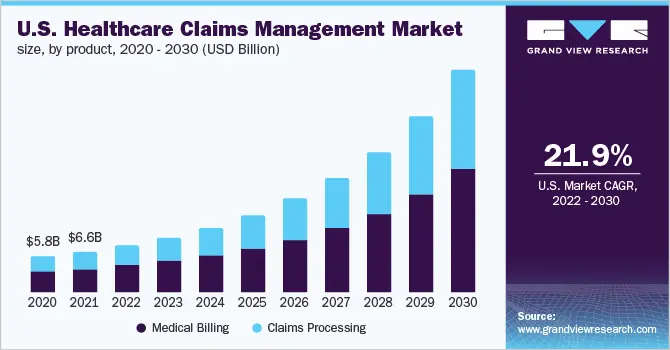
AI-powered segments are expanding considerably faster as platforms like Innovaccer, Waystar, Experian Health, and Goml demonstrate measurable denial reduction at scale.
1. The Static Rules Engine Problem
Legacy systems use rigid if-then statements to validate billing data before submission. However, insurance carriers modify their payer contract logic and medical necessity policies quarterly, meaning static scrubbers do not update automatically.
This gap causes denial rates to creep up silently because the software operates on outdated validation parameters.
2. The Unstructured Data Problem
Traditional billing platforms only process highly structured data fields found in standard medical billing formats.
In contrast, up to 80% of clinically relevant claims information lives in free-text clinical notes, complex discharge summaries, and prior authorization letters.
Rules engines cannot read or parse this unstructured text, which leads healthcare organizations to now address by deploying custom NLP claims processing software built on architectures.
3. The Reactive Denial Management Problem
Medical providers and healthcare facilities discover critical denial patterns weeks after the financial damage is already done.
This occurs because legacy reporting software looks backward rather than predicting transaction outcomes before submission. Consequently, organizations remain trapped in an expensive cycle of re-work and appeals rather than deploying forward-looking claims denial prevention software development strategies.
4. The Integration Fragmentation Problem
The average healthcare organization uses 4 to 7 disconnected software systems across billing, claims management, EHR networks, and clearinghouse applications.
This fragmentation creates severe data silos, limits end-to-end visibility, and introduces human error during manual data entry.
According to industry metrics, the national denial rate benchmark has reached 11% even though 85% of these denials are completely avoidable. This is a considerable opportunity gap for healthcare enterprises to get claims processing software customized.
Off-the-shelf tools may solve earlier claims problems, but custom AI claims processing software is built around your specific payer mix, claim types, and denial patterns, which is where the performance difference compounds.
What Is AI Healthcare Claims Processing Software?
AI healthcare claims processing software is a system that uses machine learning, natural language processing, computer vision, and predictive analytics to automate the validation, clinical coding, and adjudication of medical transactions.
This software replaces traditional static billing scrubbers by dynamically extracting data from clinical notes, predicting payer behavior, and preventing denials before submission while strictly maintaining HIPAA-compliant AI claims processing software architectures.
Software Products vs. Internal Platforms
We build both commercial software products and enterprise-grade internal platforms to address distinct technical use cases.
Choosing the correct path depends on whether your organization intends to monetize the software externally or optimize internal operational workflows.
| Feature / Dimension | Commercial Software Product | Internal Operational Platform |
| Primary Target Audience | External buyers, health insurance companies, and external TPAs. | Internal developers, clinical billing teams, and operations staff. |
| Core Architecture Focus | Multi-tenant SaaS isolation, public API gateway claims, and global scale. | Microservices healthcare frameworks, deep EHR integrations, and internal data pipelines. |
| Monetization & Value | Direct revenue generation via software licensing or usage-based pricing models. | Cost reduction via straight-through processing rate optimization and lower denial rates. |
| Security & Compliance | Strict PHI tokenization, public-facing RBAC, and SOC 2 Type II validation. | Zero-trust architecture, internal audit trail immutability, and BAA requirements. |
| Maintenance Model | Continuous public model versioning, feature roadmap updates, and external documentation. | MLOps retraining pipelines, payer rule decay monitoring, and internal tool stability. |
Ultimately, commercial products maximize market reach and direct software revenue through standardized distribution.
In contrast, custom internal platforms drive massive ROI efficiency by removing single points of failure within your existing tech stack.
Layers in Claims Processing Software
An enterprise AI claims management software platform requires a modular, layered stack to move an invoice from creation to payment reconciliation. Engineering these interconnected layers properly prevents data silos and ensures high processing throughput.
- Data Ingestion Layer: This infrastructure ingests electronic data interchange formats like EDI 837 alongside HL7 v2 and FHIR R4 resources.
- AI Extraction Layer: This engine handles unstructured clinical documentation, medical charts, and prior authorization letters using advanced computer vision and OCR tools.
- Coding Intelligence Layer: This module validates submitted medical billing details using custom-trained AI medical coding software development methodologies.
- Payer-Rule Validation Layer: This layer matches the extracted medical data against dynamic contract logic, NCCI edits, and updated LCD/NCD rules.
- Denial Prediction Model: Operating before submission, this predictive model calculates a real-time risk score for every transaction payload.
- Adjudication Support Layer: This layer maps clinical arguments directly to specific insurance guidelines for cases requiring custom AI claims adjudication software development.
- Human-in-the-Loop Review: Low-confidence invoices drop automatically into a secure workflow interface based on pre-set confidence scoring limits.
- Payment Posting Layer: This module reads incoming EDI 835 files and automates electronic remittance advice (ERA reconciliation) tasks.
- Analytics and Intelligence Platform: This final layer tracks macro business metrics, including clean claim rate improvement, days in AR, and overall cost per claim processed.
Integrating these 9 independent layers creates a resilient microservices healthcare framework that scales alongside transaction volumes.
This technical architecture ensures your platform continuously detects underpayment patterns and maintains maximum operational efficiency.
For a deeper breakdown of building the underlying automation infrastructure, see our guide on Medical Claims Automation Platform Development.
What the AI Layer of a Claims Processing System Must Do
Apart from automation, the AI layer of a healthcare claims processing system must extract meaning from unstructured clinical text, predict payer adjudication behavior, flag documentation gaps before submission, learn from denial responses, and support human reviewers with explainable recommendations, all within PHI-safe model boundaries.
To build a truly intelligent healthcare claims processing system development project, engineering teams must deploy advanced deep learning networks.
These mathematical models process multi-modal administrative data and medical documentation simultaneously to optimize your financial yields.
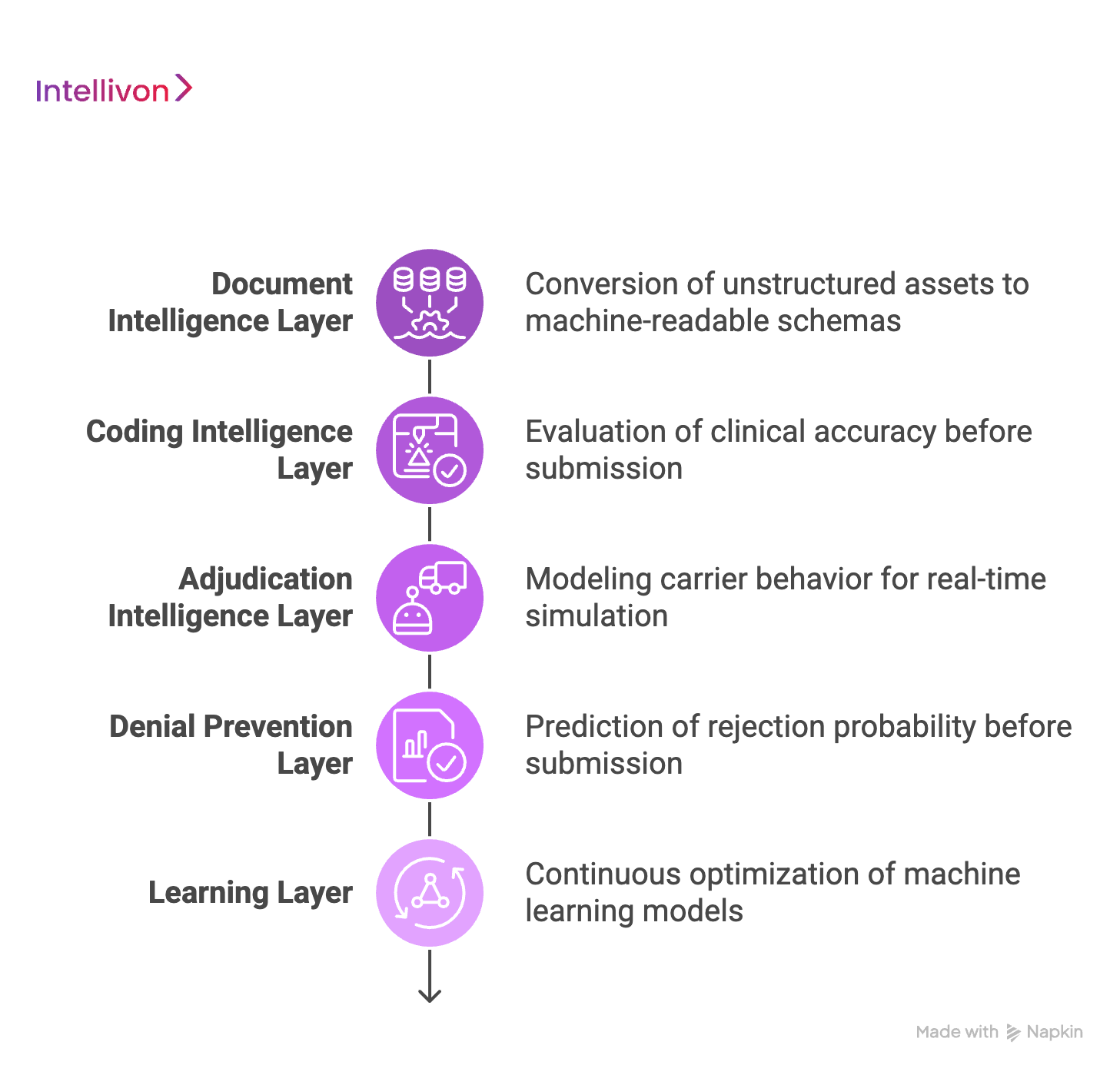
1. Document Intelligence Layer
This component handles the conversion of unstructured inbound assets into machine-readable transactional schemas. It prevents manual data indexing by establishing automated extraction pipelines.
- Multimodal OCR: Ingests low-resolution scanned claims, paper Explanation of Benefits (EOB) documents, and complex physical medical records.
- Classification Engines: Automatically identify claim types, clinical specialties, historical payers, and operational processing priority.
- Granular Field Extraction: Captures critical data fields, including diagnosis codes, CPT codes, provider NPI numbers, modifiers, and authorization IDs, complete with dynamic confidence scoring.
- Unstructured Text Parsing: Uses custom NLP claims processing software to build protocols to read physician notes, complex discharge summaries, and historical medical necessity letters.
2. Coding Intelligence Layer
This framework evaluates clinical accuracy before transactions route to the clearinghouse or payer network. It eliminates compliance vulnerabilities by continuously verifying billing choices against national rules.
- Automated Code Suggestion: Recommends appropriate ICD-10-CM, CPT, and HCPCS codes directly from the underlying clinical documentation.
- NCCI Edit Checking: Validates transactions against the Correct Coding Initiative bundling logic to eliminate unbundling penalties.
- LCD/NCD Compliance: Automatically runs Local Coverage Determinations and National Coverage Determinations checks to secure medical necessity compliance.
- Coding Optimization Logic: Assesses proper modifier applications and executes accurate Evaluation and Management (E&M) level validation.
3. Adjudication Intelligence Layer
This decision engine models carrier behavior by running real-time internal simulation passes. It identifies transactional discrepancies by analyzing active provider-payer contract parameters.
- Contract Logic Application: Maps specific payer benefit rule logic directly across complex claims payloads.
- Coordination of Benefits: Automatically determines primary, secondary, and tertiary insurance positioning to prevent duplicate filings.
- Pre-Submission Risk Scoring: Calculates an aggregate financial risk metric using custom AI claims adjudication software development models.
4. Denial Prevention Layer
This predictive asset focuses on protecting revenue velocity by neutralizing transaction risks before submission. It converts past payment rejections into active diagnostic criteria.
- Denial Probability Prediction: Flags the specific probability of a rejection based on the unique combination of provider, payer, and procedure.
- Root Cause Identification: Labels exact vulnerabilities, including registration errors, eligibility limits, coding flaws, or timely filing risks.
- Pre-Submission Alerts: Generates real-time, explainable UI notifications for billing managers while invoices remain editable.
5. Learning Layer
This continuous optimization pipeline keeps machine learning models aligned with changing market environments. It protects the core software from performance degradation over time.
- Remittance Feedback Loops: Extracts financial insights directly from EDI 835 remittance data and physical denial letters.
- MLOps Retraining Triggers: Monitors the architecture for model drift and automatically schedules retraining passes when confidence scores drop.
- Payer Behavior Monitoring: Detects subtle policy shifts by tracking sudden variations in historical adjudication responses.
Systems that automate data entry but cannot predict denial risk save staff time without protecting revenue. The ROI difference between shallow and deep AI claims software is measurable within 90 days of production deployment.
Core Features of an AI Healthcare Claims Processing Software
Enterprise AI claims processing software must cover five capability domains: intelligent claim intake and extraction, payer-rule validation and coding support, denial prevention and adjudication intelligence, human review and exception management, and analytics with audit-ready reporting. Missing any domain creates workflow gaps that undermine the ROI of the others.
To protect revenue margins, digital health startups and enterprise hospital networks require comprehensive operational visibility.
Consequently, deploying custom enterprise AI claims management software ensures all transactional features operate within a single secure ecosystem.
1. Claim Intake and Processing Features
This foundational infrastructure accelerates transactional data velocity from the moment an asset enters your network. It streamlines administrative workflows by establishing a unified gateway for varying transmission methods.
- Multi-Format Claim Ingestion: Accepts real-time data payloads including EDI 837, direct API calls, web portals, unstructured PDF files, and HL7 v2 transmissions.
- Intelligent Routing: Executes automatic document classification and applies priority routing protocols based on contract urgency.
- Pre-Flight Verification: Performs real-time eligibility verification checks alongside automated prior authorization status tracking.
2. AI Coding and Validation Tools
This layer protects compliance by cross-referencing clinical choices with active national billing guidelines. It reduces administrative strain by automating structural validation before final transmission.
- Code Automation: Generates automated ICD-10-CM, CPT, and HCPCS code suggestions directly from clinical text.
- Regulatory Checking: Runs integrated NCCI edit validation, applies modifier logic, and flags documentation gaps.
- Medical Necessity Matching: Evaluates medical necessity matching parameters across active Local Coverage Determinations (LCD rules) and National Coverage Determinations (NCD rules).
3. Denial Prevention and Adjudication Support
This predictive engine acts as an internal simulator to catch submission vulnerabilities. It evaluates operational risk parameters before claims reach external clearinghouse networks.
- Pre-Submission Scoring: Generates a real-time pre-submission denial risk score for every invoice payload.
- Mismatch Alerts: Isolates authorization mismatch alerts and flags coding inconsistency parameters automatically.
- Appeal Architecture: Supplies appeal preparation support workflows driven by historical denial pattern analysis.
4. Human Review and Exception Management
This interface balances automated processing with clinical oversight for low-confidence data payloads. It enforces operational guardrails based on user access levels.
- Configurable Queues: Sorts items into targeted review queues based on confidence scoring metrics, claim types, or payers.
- Action Logging: Implements thorough reviewer action logging alongside override tracking with mandatory reason capture.
- SLA Monitoring: Tracks real-time processing benchmarks via proactive SLA monitoring per claim category.
5. Integration, Data Exchange, and Analytics
This connectivity framework establishes communication lines between internal databases and external partners. It uses standardized data models to move information without system-locked-in risks.
- Standardized Interoperability: Uses FHIR R4 Claims resource schemas alongside ExplanationOfBenefit FHIR structures to bridge EHR networks.
- Clearinghouse Autonomy: Establishes multi-clearinghouse routing protocols to avoid single-point-of-failure risks.
- Performance Dashboards: Tracks real-time operational metrics including clean claim rate improvements, first-pass yield, and days in AR.
6. Compliance and Security Architecture
This protective shield ensures all data operations comply with federal mandates and enterprise security frameworks. It enforces a strict zero-trust architecture across all microservices.
- Data Security: Implements role-based access control (RBAC), multi-factor authentication (MFA), PHI tokenization, and PHI masking.
- Regulatory Guardrails: Enforces the HIPAA Security Rule and HIPAA Privacy Rule using audit trail immutability and strict BAA requirements.
A balanced feature set ensures your software platform scales efficiently without creating technical debt. Incorporating these interconnected capability groups allows hospital networks to achieve sustainable first-pass acceptance rate increases.
AI Healthcare Claims Processing Software Architecture
AI healthcare claims processing software requires a layered architecture connecting a claim intake layer, AI processing layer, payer-rule engine, human review workflow, integration infrastructure, compliance controls, and analytics, all operating as an event-driven, audit-ready system.
The architecture must support high claim volumes, real-time processing, PHI security, and integration with existing healthcare systems.
| Architecture Layer | Core Strategic Objective | Primary Technology Options |
| Frontend Layer | Deliver high-density, low-latency interfaces for billing staff. | React.js, TypeScript, Next.js, Tailwind CSS |
| Backend Layer | Orchestrate transactional state machine logic and manage queues. | Node.js, Go, Python, Apache Kafka, FastAPI |
| AI and ML Layer | Run computer vision, text mining, and risk calculations. | PyTorch, Hugging Face, Triton Inference Server, BERT |
| Data Layer | Maintain transactional records, documents, and vector embeds. | PostgreSQL, AWS S3 (PHI-encrypted), pgvector, Qdrant |
| Integration Layer | Parse medical communication protocols and route payloads. | Apache Camel, Mirth Connect, Hapi FHIR, Custom Go Parsers |
| Security Layer | Enforce network boundaries and obscure sensitive customer details. | HashiCorp Vault, AWS KMS, Auth0, OpenPolicyAgent |
| MLOps Layer | Manage model decay, code deployments, and training feedback loops. | MLflow, Kubeflow, Prometheus, Grafana |
1. Frontend Layer
This visual interface serves as the command center for medical billing specialists and operations supervisors. It prioritizes scannability to accelerate manual exception handling workflows.
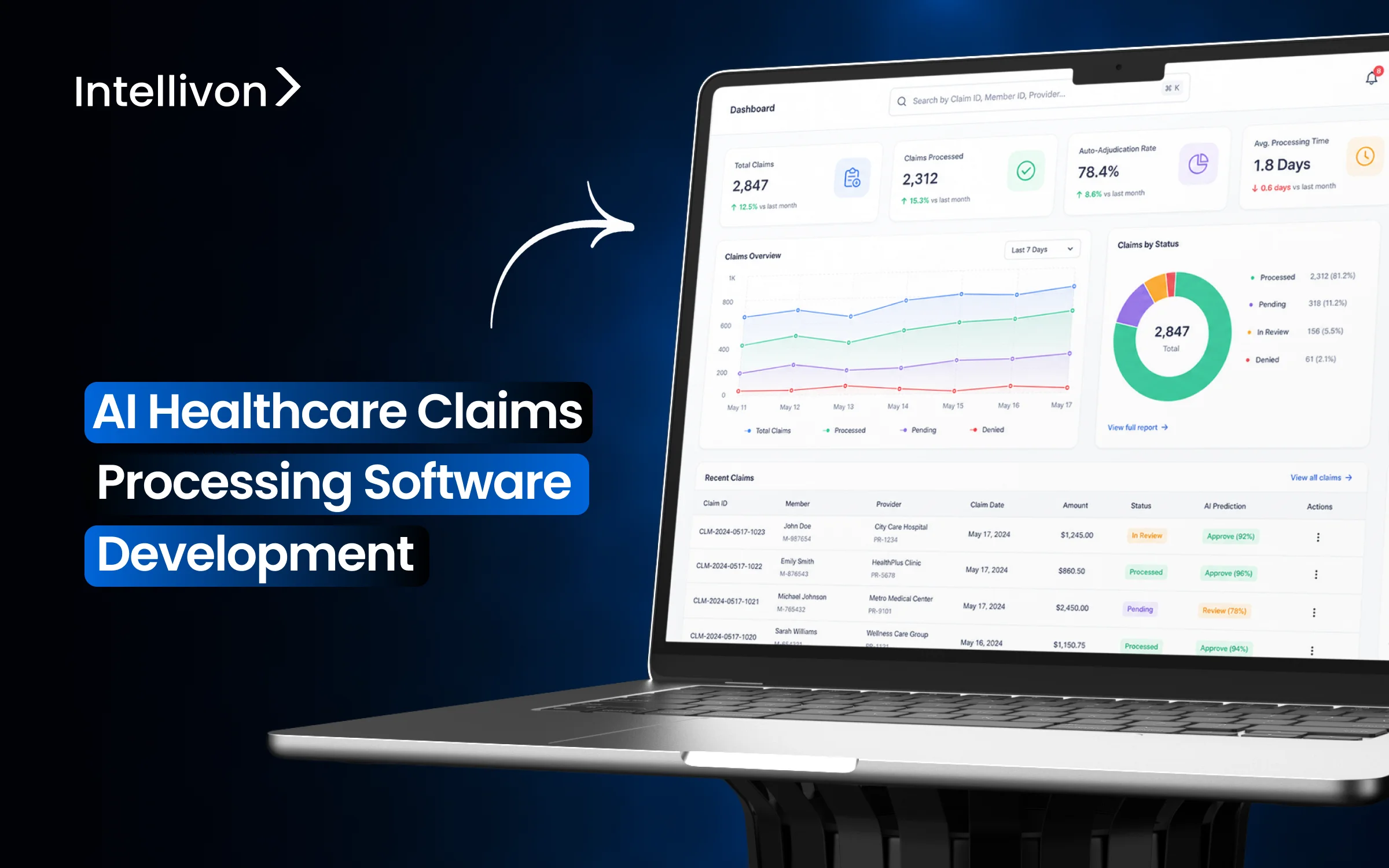
- Operational Modules: Includes a real-time claims dashboard, an interactive coding review interface, and an optimized denial management queue.
- Strategic Insights: Provides comprehensive payer performance analytics, administrator configurations, and fine-grained user management controls.
2. Backend Layer
This layer handles the core business logic using a microservices healthcare approach to ensure independent scalability. It prevents system lockups by processing transactional states asynchronously.
- Process Ingestion: Employs a central API gateway claims router coupled with a distributed event queue like Kafka for high-volume message handling.
- Task Management: Utilizes a custom task routing engine to allocate flagged claims to specific human reviewer buckets.
3. AI and ML Layer
This engine drives the core prediction and language processing capabilities of the entire system. It combines specialized neural networks with advanced validation pipelines.
- Document Parsing: Powers the OCR service, NLP pipeline, and custom coding intelligence models for automated field reading.
- Risk Engineering: Coordinates live denial prediction models alongside a confidence scoring service to evaluate transaction viability.
4. Data Layer
This storage layer separates active transaction states from analytical historical data warehouses to maintain maximum responsiveness. It safeguards data integrity by separating system access tokens.
- Transactional Systems: Employs an ACID-compliant PostgreSQL database alongside an append-only, immutable audit event log.
- Unstructured Asset Vaults: Stores raw medical documentation inside secure S3-equivalent buckets while managing high-dimensional vector databases.
5. Integration Layer
This communication infrastructure bridges internal systems with external healthcare ecosystem clearinghouses and payer portals. It translates varying administrative file formats dynamically.
- Standardized Interoperability: Implements an EDI transaction processor for EDI 837 and EDI 835 structures alongside an HL7 interface engine.
- Modern API Routing: Deploys a FHIR API gateway containing direct payer adapters alongside multi-clearinghouse connectivity bridges.
6. Security and MLOps Layers
The security and MLOps operational frameworks maintain compliance standards while managing model drift over time. They establish protective perimeters around model inference endpoints.
- Data Protection: Restricts data environments via PHI tokenization, PHI masking, role-based access control (RBAC), and multi-factor authentication (MFA).
- Model Governance: Orchestrates model versioning pipelines, performance monitoring alerts, and automated retraining triggers to maintain baseline accuracy.
The Imperative for Event-Driven Architecture
Claims processing involves hundreds of distinct state transitions per claim, moving from submitted, acknowledged, and pended, to denied, appealed, or adjudicated.
A synchronous request-response architecture cannot handle this at enterprise volume without performance degradation and lost state visibility.
Utilizing an event-driven model guarantees that every state transition is logged permanently, ensuring transaction delivery even during regional network dropouts.
AI Healthcare Claims Processing Step-by-Step Build Process
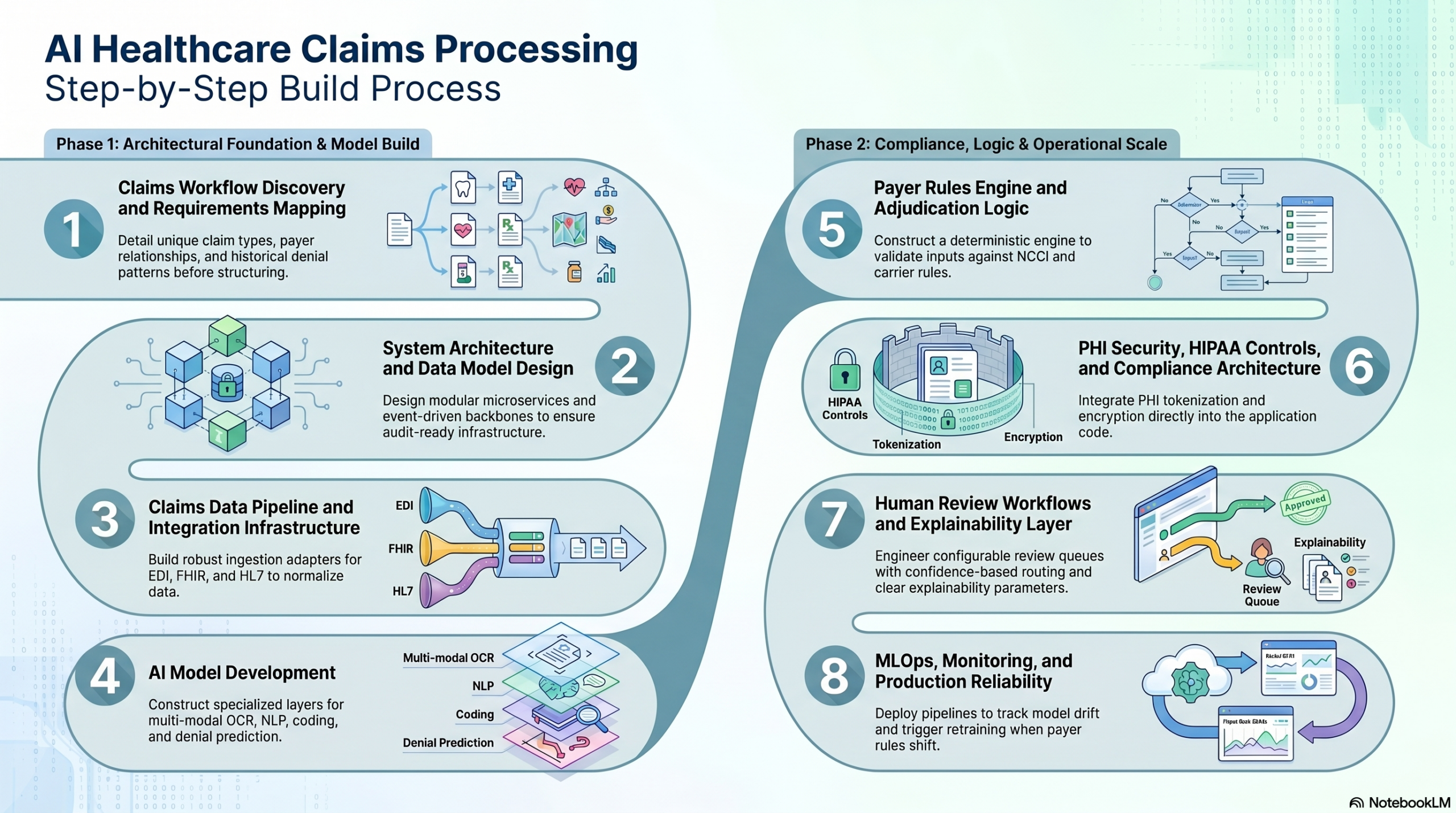
Building AI healthcare claims processing software requires eight sequential stages: requirements discovery, architecture design, data pipeline development, AI model development, integration build, compliance controls implementation, MLOps setup, and phased deployment.
Each stage has specific dependencies, and skipping any creates compounding technical debt that is expensive to fix in production.
Executing this build sequence correctly demands a balance between deterministic processing logic and probabilistic machine learning models. The following deployment framework details how Intellivon engineers enterprise-grade transaction platforms.
Step 1 — Claims Workflow Discovery and Requirements Mapping
This initial stage focuses on detailing every unique claim type, active payer relationship, coding exception workflow, historical denial pattern, and compliance requirement before structuring your platform.
- The Execution Strategy: We interview billing teams, review past payer dispute data, and catalog existing EHR integration touchpoints.
- The Downstream Risk: Skipping this mapping phase causes teams to build generic, rigid software that fails to accommodate real-world payer behavior or variable hospital billing rules.
- The Intellivon Approach: We execute cross-functional discovery sessions with billing, clinical, compliance, and IT stakeholders to establish an accurate operational blueprint before defining system requirements.
Step 2 — System Architecture and Data Model Design
This stage establishes the structural blueprint of your software, outlining microservices boundaries, asynchronous data flows, AI inference zones, and immutable logging nodes.
- The Execution Strategy: We design a modular microservices architecture utilizing an event-driven backbone (like Apache Kafka) to manage rapid transaction state changes cleanly.
- The Downstream Risk: Engineering without a unified design creates disconnected automation scripts instead of an integrated platform, resulting in fragile integrations and unauditable AI decisions.
- The Intellivon Approach: We implement an architecture-first strategy, deploying isolated, scalable services that guarantee your underlying infrastructure is audit-ready from day one.
Step 3 — Claims Data Pipeline and Integration Infrastructure
This step focuses on building the ingestion pipelines required to parse and normalize conflicting healthcare data formats safely.
- The Execution Strategy: We build robust ingestion adapters for EDI 837/835, FHIR R4 resources, HL7 v2 messages, and direct payer API connections.
- The Downstream Risk: Submitting un-normalized or malformed data feeds into your AI layer causes models to yield inconsistent, low-confidence predictions that corrupt downstream workflows.
- The Intellivon Approach: We deploy pipeline reliability controls and automated data-quality validation layers to cleanse transaction data completely before any machine learning evaluation begins.
Step 4 — AI Model Development (OCR, NLP, Coding, and Denial Prediction)
This core development phase builds the four specific machine learning layers required to interpret complex administrative and clinical payloads.
- The Execution Strategy: We train multi-modal OCR for scanned assets, NLP pipelines for parsing clinical text, neural coding models for ICD-10-CM mapping, and gradient-boosted trees for denial prediction.
- The Downstream Risk: Relying on a single generic model or open-source LLMs without domain training leads to high error rates and severe hallucination risks during field extraction.
- The Intellivon Approach: We construct separate, specialized model layers trained on payer-specific data and validate their outputs against verified, historical claims adjudication outcomes.
Step 5 — Payer Rules Engine and Adjudication Logic
This step develops the deterministic validation layer designed to execute non-negotiable compliance rules and specific carrier contract terms.
- The Execution Strategy: We construct an execution engine that checks inputs against NCCI edits, active LCD/NCD rules, modifier application logic, and coordination of benefits rules.
- The Downstream Risk: Allowing probabilistic AI models to handle absolute billing rules creates explainability gaps, compliance errors, and unnecessary regulatory exposure.
- The Intellivon Approach: We use a hybrid architecture where machine learning models handle predictive tasks while a deterministic rules engine validates absolute billing constraints.
Step 6 — PHI Security, HIPAA Controls, and Compliance Architecture
This layer builds security barriers around your data pipelines, enforcing strict compliance parameters directly within the application code.
- The Execution Strategy: We integrate PHI tokenization databases, end-to-end encryption protocols, role-based access control (RBAC), and multi-factor authentication (MFA).
- The Downstream Risk: Retrofitting compliance safeguards after launching an application increases development costs threefold, delays deployment, and triggers enterprise procurement blocks.
- The Intellivon Approach: We integrate compliance frameworks directly into the initial system design phase, ensuring all model inference calls remain completely isolated and secure.
Step 7 — Human Review Workflows and Explainability Layer
This phase builds the graphical interfaces and explainability pipelines that enable medical coders to manage low-confidence automated outputs.
- The Execution Strategy: We engineer configurable review queues that leverage confidence-based routing, comprehensive override tracking, and automated appeal preparation tools.
- The Downstream Risk: Deploying unexplainable, “black box” AI models erodes clinician trust and leads to immediate failure during external healthcare compliance audits.
- The Intellivon Approach: We provide clear explainability parameters; every AI-generated recommendation surfaces alongside its source data inputs, confidence score, and specific validation rule.
Step 8 — MLOps, Monitoring, and Production Reliability
The final stage establishes continuous operational oversight to defend your deployed models against accuracy degradation over time.
- The Execution Strategy: We deploy MLOps pipelines to monitor model versioning, track drift metrics, and trigger automated retraining passes when payer rules shift.
- The Downstream Risk: Neglecting live performance tracking allows your models to decay silently as payers quietly update their policy guidelines and adjudication criteria.
- The Intellivon Approach: We embed automated drift alerts, schedule quarterly model evaluations, and deploy active payer behavior monitoring directly into your live production environment.
This structured build methodology ensures your enterprise platform balances machine intelligence with predictable validation logic. Following these sequential phases allows you to lower maintenance overhead and maximize long-term clean claim rate improvements.
Why Generic AI Models Are Underperforming in Healthcare Claims
AI claims processing models trained on generic datasets or small internal samples produce unreliable outputs in production. Effective claims intelligence requires payer-specific training data, specialty-specific clinical text, denial reason distributions, and adjudication outcome labels, none of which come pre-packaged.
Data acquisition and preparation are typically the longest and most expensive phase of AI claims software development.
To achieve high automation rates, your training pipelines must focus directly on the specific variables that govern insurance decisions.
1. The Payer-Specific Logic Divergence
Insurance carriers do not judge incoming claims using a single, unified standard. For example, UnitedHealthcare’s internal adjudication logic and medical necessity interpretations differ significantly from Aetna’s or Cigna’s parameters.
Consequently, a machine learning model trained heavily on one carrier’s data will underperform when evaluating transactions destined for another, causing denial rates to rise.
2. What High-Quality Claims Data Requires
Every individual layer within your automated billing stack requires highly specialized information to achieve production-grade stability.
- The Ingestion Layer: Computer vision and OCR engines need diverse, multi-format documents containing scanned distortions, handwriting, and low-resolution artifacting to build real-world resilience.
- The Language Layer: NLP systems require specialty-specific clinical notes, such as oncology-specific treatment flows or orthopedic operative summaries, rather than generic medical dictionaries.
- The Predictive Layer: Denial prediction algorithms require millions of historical rows mapped explicitly to standardized denial reason codes, corresponding appeal records, and final adjudication outcome labels.
3. Overcoming Data Volume and Accuracy Hurdles
Achieving the accuracy threshold required for autonomous straight-through processing is a steep engineering challenge.
We combat these data limitations by building proprietary data bootstrapping strategies and deploying payer-specific model variants for every client project.
This is because we validate these custom configurations against real, historical payer adjudication outcomes before any model takes over a live production workflow.
How to Secure PHI in AI Healthcare Claims Processing Software
Securing PHI in AI claims processing software requires protection at seven distinct touchpoints: data ingestion, AI model inference, API transmission, human review interfaces, third-party integrations, audit storage, and vendor access.
Each touchpoint has different exposure profiles, and a security architecture that misses any one of them creates a breach surface that HIPAA enforcement and enterprise procurement will find.
Enforcing data security within automated billing pipelines means moving beyond basic database encryption. Consequently, development teams must treat security as an active software constraint rather than a static configuration step.
1. Ingestion and AI Inference Isolation
This dual-layer framework sanitizes incoming medical documentation before it touches your prediction models. It neutralizes the vulnerability of exposing raw patient records during the automated parsing phase.
- Active Ingestion Layer: Implements PHI tokenization and strict PHI masking before data enters your core AI pipelines. The system applies minimum necessary data principles, ensuring models receive specific transaction fields rather than complete charts.
- Model Inference Protections: Runs locally hosted or private cloud configurations for all heavy machine learning tasks. This methodology ensures you never transmit raw text payloads to public LLM inference PHI endpoints, while dedicated prompt injection controls stop unauthorized input manipulation.
2. Integration and Human Review Guardrails
This layer monitors data exchange points where internal system components interact with external partners or billing teams. It prevents accidental data leaks by enforcing strict visibility controls.
- Encrypted Integration Transport: Mandates encrypted API transmission using TLS 1.3 protocols at a minimum. Every outbound payload requires scoped credentials per integration, supported by fully signed BAA requirements for all external partners.
- Screen-Level Human Governance: Enforces rigid role-based access control (RBAC) across every administrative user interface. The system masks highly sensitive text fields automatically on screen unless a specific task requires full visibility.
3. Audit Immutability and Network Resilience
This final defensive ring guarantees that your processing data remains traceable for regulatory evaluations. It isolates the platform against external environmental threats and systemic partner failures.
- Immutable Tracking: Records every application event inside append-only, immutable audit event logs. Each transactional modification logs a permanent timestamp, specific user identifier, and the exact data fields accessed to maintain RAC audit readiness.
- Defensive Network Segmentation: Implements distinct network segmentation and independent claim event queue configurations. This engineering design prevents downstream clearinghouse disruptions, like the historic Change Healthcare cyberattack, from cascading into total platform downtime.
Maintaining a zero-trust architecture across these operational layers safeguards sensitive patient data while accelerating your regular compliance approvals.
This rigorous approach satisfies enterprise procurement reviews and protects your platform from costly federal data breach liabilities.
Cost to Develop AI Healthcare Claims Processing Software
Developing AI healthcare claims processing software typically costs between $60,000 and $300,000+, depending on AI model complexity, payer integration scope, compliance requirements, specialty coverage, and whether you are building an internal platform or a commercial SaaS product.
At Intellivon, we break the cost into practical development phases. This helps founders and CTOs see where the budget goes, what each phase delivers, and which areas need deeper investment based on claim volume, payer complexity, and AI automation goals.
| Development Phase | Estimated Cost | What It Includes |
| Discovery, Requirements, And Architecture Planning | $8,000–$20,000 | Claims workflow mapping, payer-rule documentation, data assessment, architecture blueprint, and MVP scope definition |
| UI/UX And Workflow Design | $10,000–$25,000 | Claim review dashboards, coding interfaces, denial queues, analytics screens, and admin configuration |
| Core Backend And Claims Processing Infrastructure | $25,000–$80,000 | Claim intake, workflow orchestration, rules engine, audit infrastructure, and event processing |
| AI Model Development | $25,000–$100,000 | OCR, NLP, coding intelligence, denial prediction, LLM assistant, confidence scoring, and model validation |
| Integration Development | $15,000–$70,000 | EDI 837/835, FHIR APIs, HL7 interfaces, clearinghouse connectivity, EHR/EMR connectors, and payer APIs |
| HIPAA Security, QA, And Production Deployment | $12,000–$40,000 | PHI controls, encryption, RBAC, compliance documentation, testing, deployment, and launch support |
Ongoing annual maintenance usually costs 15–25% of the initial build cost. This covers cloud infrastructure, model monitoring, retraining, integration updates, security reviews, compliance audits, and performance optimization.
Want a phased cost estimate for your specific claims processing software scope? Intellivon’s solution architects can model development cost against your claim volume, payer mix, and AI requirements before any commitment.
Build vs Buy (Choose Custom Claims Processing Software)
Buy off-the-shelf when your payer mix is standard, your claim types are limited, and you need a working system quickly without proprietary AI.
Build custom when your business requires payer-specific AI models, complex integration architecture, compliance controls for enterprise procurement, or when you are building claims processing as a revenue-generating SaaS product.
Evaluating this technical milestone requires clear organizational decision boundaries. Consequently, engineering teams can use a distinct criteria framework to select the correct path forward.
1. The Technology Choice Matrix
Balancing immediate deployment speed against long-term operational autonomy dictates your software sourcing strategy. This structural layout clarifies which operational environments suit each path.
- Choose Off-the-Shelf Packages When: You manage standard payer integrations and limited claim types. This direction serves teams prioritizing fast deployment over unique workflow requirements or direct software monetization plans.
- Choose Custom Development Engineering When: Your operation requires proprietary, payer-specific machine learning models and multi-system integration layers. You must choose this path if you require custom denial prediction logic, specialty-specific coding workflows, or direct API architectures designed for enterprise procurement compliance.
2. The Phased Integration Methodology
Building a platform from scratch does not require an immediate, all-or-nothing software deployment. Instead, enterprise hospital networks and digital health startups lower their project risk by pursuing a staged implementation model.
- The Minimum Viable Product Phase: We build a focused custom MVP covering your highest-volume claim types and your most critical payer integrations first.
- The ROI Validation Milestone: This initial setup validates measurable financial yields within 90 days of live production exposure.
- The Phased Expansion Strategy: Your system expands to encompass full platform feature groups in controlled, budget-safe iterations based on verified operational performance.
For a detailed comparison of automation platforms versus AI software builds, see our guide on [LINK: Medical Claims Automation Platform Development] to determine which framework fits your internal tech stack constraints.
Why Build Claims Processing Software With Intellivon
At Intellivon, we help healthcare SaaS founders, CTOs, RCM companies, TPAs, insurtech teams, and enterprise healthcare businesses build AI-powered claims processing platforms around real operational needs.
With 500K+ engineering hours, ex-MAANG engineers, and deep experience across AI, SaaS, healthcare platforms, API integrations, and enterprise software development, we help teams move from claims bottlenecks to scalable claims infrastructure.
A. We Help You Define The Right Claims Processing Scope
Before development starts, we map your claims workflow, user roles, payer touchpoints, document flow, denial patterns, and integration needs.
This helps us define what your platform should solve first.
We help you plan:
- Claims intake workflows
- AI automation opportunities
- MVP feature scope
- Payer rule requirements
- EDI and clearinghouse needs
- Compliance controls
- Platform roadmap
This keeps the first version focused, practical, and tied to measurable claims outcomes.
B. We Build AI Workflows Around Real Claims Operations
AI should support claims teams, not create another system they have to fight with.
Intellivon builds AI workflows that help teams review claims faster, detect missing data, flag denial risks, route exceptions, and prioritize high-value work.
Your platform can include:
- AI claims intake
- OCR-based document extraction
- NLP for claim notes and documents
- Claim validation rules
- Denial risk scoring
- Smart work queues
- Exception routing
- Appeal support workflows
- Revenue and claims analytics
Every workflow is designed around how claims teams actually work.
C. We Integrate With Healthcare And Payer Systems
Claims processing software depends on accurate data movement.
That is why Intellivon plans integrations early. We help connect your platform with the systems needed to process, validate, submit, and track claims.
We support integrations across:
- EHR and EMR systems
- Practice management systems
- Clearinghouses
- Payer APIs
- EDI 837 and 835 workflows
- HL7 and FHIR interfaces
- Payment systems
- ERP and finance platforms
- Document storage systems
These integrations help your platform move claims from intake to adjudication support, denial prevention, payment tracking, and reporting.
D. We Design Claims Platforms With Security From Day One
Claims software handles PHI, payer data, financial data, and sensitive operational records. Security cannot be treated as a final-stage checklist.
Intellivon designs claims platforms with healthcare-grade controls from the start.
This can include:
- PHI protection
- Data encryption
- Role-based access control
- Secure authentication
- Audit trails
- User activity tracking
- Admin permissions
- Secure cloud deployment
- Compliance-ready documentation
This helps your platform support enterprise buyers, healthcare teams, and regulated claims workflows with confidence.
Ready To Build AI Claims Processing Software?
If you are planning to build AI healthcare claims processing software, Intellivon can help you define the right roadmap before development begins.
We will help you identify the best AI use cases, map payer and EDI workflows, plan integrations, design secure architecture, and build a scalable platform around real claims processing outcomes.
Conclusion
Three strategic decisions determine whether AI claims processing software delivers lasting financial value. First, the underlying system architecture must prioritize long-term resilience over superficial features. Second, machine learning models require rigorous training on payer-specific data rather than generic datasets.
Finally, compliance frameworks must be engineered directly into your source code from day one. Organizations getting these three choices right build systems that compound in value as they gather more data.
Things To Know About AI Claims Processing Softwares
Q1. How much does it cost to develop AI healthcare claims processing software?
A1. Development costs typically range from $60,000 to $300,000+. An internal platform MVP costs $60,000 to $120,000, a full enterprise platform ranges from $120,000 to $250,000, and commercial SaaS products exceed $250,000. Total costs depend heavily on AI model complexity, payer integration count, compliance scope, and ongoing maintenance.
Q2. How long does it take to build AI claims processing software?
A2. Building an operational system requires three to five months for a baseline MVP. Expanding the framework into a full production enterprise platform takes six to twelve months, while a multi-payer SaaS product requires twelve to eighteen months. Timelines are driven by data readiness, integration counts, and compliance documentation scope.
Q3. What AI models are used in healthcare claims processing software?
A3. The architecture combines multimodal OCR for document extraction, NLP for clinical text parsing, and machine learning for predictive denial scoring. Furthermore, it incorporates neural coding models for ICD-10-CM/CPT suggestions, LLMs for summarization, and deterministic rules engines to validate strict, non-negotiable carrier billing logic.
Q4. How does AI claims processing software reduce denial rates?
A4. Pre-submission models calculate risk scores to flag high-risk invoices before they reach clearinghouses. The software identifies root causes, including eligibility gaps, authorization mismatches, and coding errors. Industry metrics confirm that this automated pre-submission review reduces avoidable medical billing denials by 20% to 40%
Q5. Can AI claims processing software be HIPAA compliant?
A5. Yes, compliance is achieved when data protections are engineered directly into the application code from day one. This requires end-to-end encryption, role-based access control (RBAC), immutable audit logs, and secure model inference pipelines.