Key Takeaways:
-
Building AI insurance verification software requires five stages, from eligibility mapping to deployment.
-
The platform checks coverage, deductibles, copays, and authorization flags before patients are seen.
-
Clearinghouses, FHIR Coverage APIs, and 270/271 transactions power real-time eligibility verification workflows.
-
HIPAA security controls, audit logging, and encrypted payer connections are non-negotiable compliance requirements.
-
How Intellivon builds AI insurance verification systems from payer mapping through full production deployment.
Insurance verification sits at the foundation of every clean claim a healthcare organization submits. When coverage status, benefits, and prior authorization flags are confirmed before care is delivered, the entire revenue cycle downstream runs cleaner, faster, and with fewer exceptions to manage.
AI insurance verification software is the infrastructure that makes this possible at scale. It connects to payers in real time, parses FHIR Coverage APIs, processes 270/271 transactions, and applies AI-driven document extraction to handle the coverage complexity that enterprise-level healthcare data demands. The result is a verification layer that catches revenue leakage at the front end of the claims cycle, before it becomes a denial problem.
At Intellivon, we build AI insurance verification systems around real revenue cycle operations, from payer connectivity mapping through production deployment. This blog post walks through everything needed to build that software, like architecture, integrations, AI models, compliance, cost, and when a custom build makes sense over buying off the shelf.
What Is AI Insurance Verification Software?
AI insurance verification software is a healthcare system that automates eligibility and benefits checks before care is delivered. It connects to payers in real time and validates coverage status, deductibles, and copay details. It also flags prior authorization requirements at registration, giving billing teams a complete coverage picture before a claim enters the billing cycle.
A. Where the Verification Engine Sits in the Revenue Cycle
The automation engine acts as a front-end gateway that secures the revenue cycle across five critical operational touchpoints:
- Scheduling: The system initiates an automated insurance discovery sweep the moment a patient schedules an appointment to confirm the active coverage status.
- Registration and Intake: It executes a real-time eligibility check during patient onboarding to capture changes in secondary payer verification.
- Pre-Visit Checks: The software runs batch eligibility processing 48 hours before an appointment to catch sudden policy terminations or updates.
- Billing Readiness: It normalizes payer data payloads into the electronic health record (EHR) system, which prevents registration-related denials.
B. Core Technical Infrastructure: Beyond OCR and Chatbots
This software is not a basic optical character recognition (OCR) tool or a customer service chatbot. It is an algorithmic data pipeline built on core healthcare interoperability standards that communicates directly with insurance databases.
The software relies on two main infrastructure mechanisms:
- EDI 270/271 Transactions: The system generates an X12 270 electronic file, which is the official industry format to request eligibility. The insurance company then returns an X12 271 file, which provides the formal payer eligibility response regarding benefits details.
- FHIR Coverage APIs: Modern platforms use Fast Healthcare Interoperability Resources (FHIR) APIs to pull live coverage status validation directly from insurance databases in secure JSON format.
Core Technical Infrastructure: Beyond OCR and Chatbots
This software is not a basic optical character recognition (OCR) tool or a customer service chatbot. It is an algorithmic data pipeline built on core healthcare interoperability standards that communicates directly with insurance databases.
The software relies on two main infrastructure mechanisms:
- EDI 270/271 Transactions: The system generates an X12 270 electronic file, which is the official industry format to request eligibility. The insurance company then returns an X12 271 file, which provides the formal payer eligibility response regarding benefits details.
- FHIR Coverage APIs: Modern platforms use Fast Healthcare Interoperability Resources (FHIR) APIs to pull live coverage status validation directly from insurance databases in secure JSON format.
Our engineering teams at Intellivon build custom data pipelines that map these complex electronic payloads directly into production workflows. This deep systems integration ensures your front-end teams receive accurate, actionable data before care begins.
Why Healthcare Teams Build AI Insurance Verification Software
Healthcare teams build AI insurance verification software because manual eligibility workflows leak revenue even when basic electronic tools exist. The global healthcare automation market reflects this shift, growing at an estimated 13.5% CAGR to hit $11.5 billion by 2030. (Source: Grand View Research, 2024).
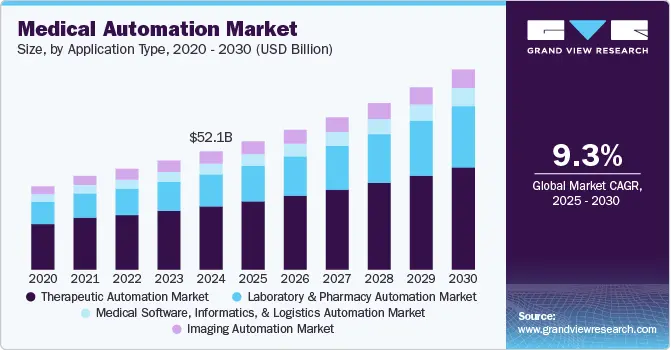
This growth is driven by hospital leaders who need instant front-end decisions to stop registration-related denials before care occurs.
1. Manual Portals and Electronic Validation Failures
Traditional electronic eligibility checks do not solve front-end administrative friction. Staff still spend hours logging into individual payer portals, interpreting raw text, and manually confirming benefits line by line.
These legacy tools fail to process complex data, which creates several operational risks:
- Unstructured Payloads: Standard clearinghouse tools return a raw payer eligibility response that staff must read and interpret manually.
- Missing Details: Basic electronic checks often miss out-of-network status or secondary payer verification data.
- Operational Delays: Manual review causes long queues at registration desks and delays patient intake.
2. Closing the Front-End Revenue Cycle Gap
Custom benefits verification software turns raw data into structured operational decisions at the point of scheduling. The software extracts coverage status validation, deductibles, copay, and coinsurance check details, and coordination of benefits rules immediately.
| Verification Feature | Legacy Clearinghouse Check | Custom AI Verification Software |
| Data Output Format | Returns a 50-page raw text file with complex EDI codes. | Extracts exactly “$30 Copay” and writes clean text to the EHR. |
| Parsing Capability | Requires manual reading by front-desk billing staff. | Automatically processes text strings using structured NLP models. |
| Workflow Speed | Takes 5 to 10 minutes of manual review per patient chart. | Completes real-time eligibility checks in under 3 seconds. |
Our development teams at Intellivon build custom eligibility validation pipelines that interface directly with clearinghouses and open payer APIs. We design the underlying data models to map incoming payloads into clean, actionable values within your existing software.
This engineering approach eliminates administrative friction and gives your team clear financial visibility before a patient ever walks through the door.
How AI Insurance Verification Software Works In Real Workflows
An AI insurance verification software platform works by pulling patient, payer, provider, plan, and appointment data into an automated engine before a patient visit. The platform processes this data to confirm active coverage status and calculate out-of-pocket costs before care begins.
This automated data flow ensures that healthcare billing teams have accurate financial numbers during patient registration.
The Step-by-Step Data Verification Pipeline
The software orchestrates data across multiple systems to process a financial check. It automates the electronic exchange where a provider asks an insurance plan about a patient’s coverage or benefits, and the plan responds.
1. Data Intake and Capture
Patient demographics and insurance card data enter the system through scheduling tools, patient intake forms, or the electronic health record (EHR). The software automatically extracts the raw text from these entry touchpoints.
2. Demographics Validation
The platform validates the patient name, member ID number, insurance carrier, plan type, and subscriber relationship. This validation step catches spelling mistakes or formatting errors before a query is sent to the insurance company.
3. Inquiry Submission via 270
The system automatically builds and submits an electronic X12 270 inquiry file. This file travels through a secure clearinghouse connection or a direct payer API to reach the specific insurance company database.
4. Payload Retrieval via 271
The platform receives the X12 271 electronic payer eligibility response file. This transaction file contains the raw text strings for coverage status, deductibles, copays, and coinsurance data.
5. AI Normalization and Data Mapping
Advanced rules engines and natural language processing (NLP) models parse the messy, non-standard text within the 271 file. The engine converts these complex data strings into a structured, readable data layout.
6. Exception Routing
If an insurance response contains severe data errors or plan ambiguities, the system flags the patient chart. The software automatically routes the file to a manual billing review queue so staff can check portal exceptions.
7. EHR Writeback
Clean data results write back directly into the EHR or revenue cycle management (RCM) system as structured data fields. Front-desk staff can see the verified copay and deductible amounts on their main dashboard screen.
Comparing Batch Processing and Real-Time Checks
To optimize clinic efficiency, a production platform must support two distinct processing operational modes.
A balanced revenue cycle system coordinates both automated background checks and instant front-desk inquiries to catch coverage issues before a patient arrives for care.
| Operational Attribute | Batch Eligibility Processing | Real-Time Eligibility Check |
| Primary Trigger | Automated schedule scan runs 48 to 72 hours before a patient’s visit. | Manual or event-based trigger when a patient checks in or updates their card. |
| Processing Volume | High-volume overnight runs handling thousands of patient charts simultaneously. | Single-record lookups are completed on demand in under 3 seconds. |
| Core Use Case | Catching sudden employer plan changes or policy terminations for scheduled visits. | Processing walk-in patients or handling immediate insurance plan adjustments at the desk. |
| System Impact | Moves heavy API data traffic to off-peak hours to reduce network load. | Requires immediate API bandwidth to provide instant feedback during registration. |
Balancing background batch runs with on-demand checks gives your administrative team total financial visibility across the entire patient schedule.
This hybrid processing model eliminates front-end check-in friction while protecting the practice from unexpected policy terminations.
Core Features Of An AI Insurance Verification Platform
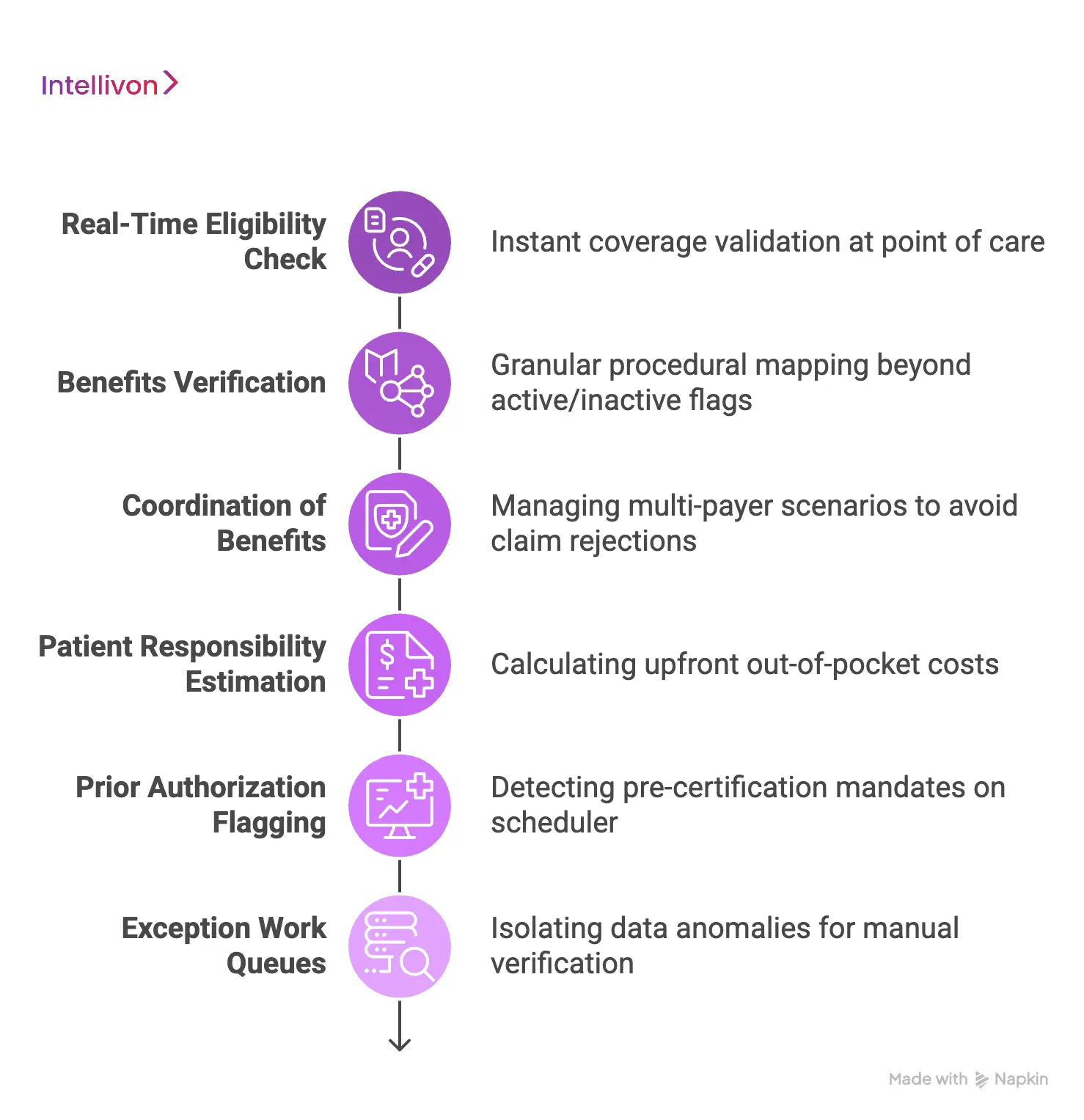
An AI insurance verification software platform needs a unified architecture that handles data parsing, benefits mapping, payer interpretation, exception routing, compliance controls, and electronic health record (EHR) writebacks.
Building a system with these core components ensures that your revenue cycle operates with clean, structured data before care delivery. Without these tightly integrated modules, backend billing systems remain highly vulnerable to registration-related denials.
1. Real-Time Eligibility Check
The real-time eligibility module performs instant coverage queries to validate active policy status at the point of care. This capability is critical for managing same-day appointments and walk-in patients where manual phone calls are operationally impossible.
The platform sends direct API calls to secure a fresh payer eligibility response, preventing cases where patients are treated under expired or lapsed coverage.
The module executes several validations in under three seconds:
- Coverage Status Validation: Confirms that the patient’s insurance policy is active on the exact date of service.
- Payer Response Freshness: Pulls real-time benefit updates rather than relying on cached clearinghouse data from weeks prior.
- Plan Matching: Cross-references the submitted member ID against active insurance databases to eliminate typos instantly.
2. Benefits Verification
An advanced AI benefits verification software development strategy requires deep procedural mapping beyond basic active/inactive flags.
The software must extract granular, code-level parameters and group them by specific clinical service categories.
The platform breaks down insurance responses into four specific data metrics:
- Deductible Verification: Tracks total deductibles versus remaining balances for individual and family plans.
- Copay and Coinsurance Check: Separates flat office-visit copays from percentage-based coinsurance rules across out-of-network levels.
- Out-of-Pocket Maximums: Measures how close a patient is to meeting their yearly financial cap to estimate ultimate billing liability.
- Covered Service Categories: Maps specific procedure codes directly to allowable plan benefits to ensure clinical alignment.
3. Coordination of Benefits
Managing multi-payer scenarios requires a structured coordination of benefits (COB) engine to avoid downstream claim rejections. This logic is essential for complex Medicaid and Medicare layering, where payment rules are strictly enforced by federal guidelines.
The system uses advanced rule sets to resolve common enrollment discrepancies before submission:
- COB Conflict Resolution: Identifies which insurance plan holds primary responsibility based on standard industry rules like the birthday rule.
- Subscriber Mismatch Detection: Flags spelling variations, inverted dates of birth, or subscriber relationship errors between the primary cardholder and dependents.
- Secondary Payer Traversal: Automatically triggers a secondary 270 eligibility request the moment a primary payer responds to confirm cross-coverage rules.
4. Patient Responsibility Estimation
The financial estimation module combines verified benefit details with provider contract rules to calculate upfront out-of-pocket costs.
This upfront clarity helps practices boost point-of-service collections by an average of 18%.
The calculation parses data across five distinct stages to build a clean patient estimate:
| Calculation Stage | Data Component Scanned | Operational Output |
| 1. Contract Rate Lookup | Provider Fee Schedule | Identifies the maximum allowed amount for the specific procedure code. |
| 2. Deductible Application | Remaining Plan Deductible | Determines if the allowed amount must be paid fully out-of-pocket by the patient. |
| 3. Coinsurance Multiplier | Payer Coinsurance Percentage | Calculates the patient’s percentage share of the remaining contract balance. |
| 4. Copay Consolidation | Flat Plan Copay | Adds the fixed base fee required by the insurance plan for the visit type. |
| 5. Final Estimation | Combined Financial Liability | Outputs a single, plain-language dollar amount to show the patient’s responsibility. |
Calculating these numbers prior to care prevents billing surprises that damage patient trust. The platform converts raw 271 transaction text into clear, plain-language financial disclosures that staff can explain easily during check-in.
5. Prior Authorization Flagging
The prior authorization module scans incoming procedure codes against specific payer rules to detect pre-certification mandates.
The platform acts as an early warning system, highlighting necessary prior authorization flags directly on the scheduler dashboard.
The engine automates three key pre-service validation checks:
- Service-Level Flags: Scans specific CPT (Current Procedural Terminology) codes against insurance rule engines to check for authorization requirements.
- Referral Mandate Detection: Identifies plan types, such as restrictive HMO networks, that require formal primary care physician referrals before specialist visits.
- Payer-Specific Rule Matching: Updates internal rules dynamically to reflect shifting commercial insurance approval policies.
6. Exception Work Queues
When a payer eligibility response returns vague, contradictory, or missing information, the platform routes the record to an exception work queue.
This module ensures that non-standard text strings do not crash your automated workflow or slip past your front-desk teams. Instead, the platform isolates the problematic chart and alerts a specialist to complete a manual portal or voice verification fallback.
Isolating data anomalies keeps the main automation pipeline running fast and clean for standard patient files. This workspace helps managers prioritize their staffing resources, focusing manual human effort on complex specialty cases while automation handles routine verifications.
Investing in a custom eligibility verification system development project gives health systems total control over these critical front-end operational modules.
System Architecture For Real-Time Eligibility Verification Software
An enterprise AI insurance verification software architecture relies on a decoupled, multi-layered data pipeline that translates complex payer communications into structured, compliant transactional payloads. The system isolates data ingestion, asynchronous clearinghouse orchestration, and algorithmic rule matching into distinct services to guarantee sub-second frontend response times and high availability.
For a deeper breakdown of healthcare revenue workflows, see our guide on Healthcare Revenue Cycle Management Software Development.
By utilizing modern HL7 FHIR frameworks alongside legacy EDI conversion layers, this technical blueprint allows healthcare organizations to maintain real-time electronic health record (EHR) integration while fulfilling strict CAQH CORE operating rules.
Architectural Layer Blueprint & Technology Stack
The platform separates ingestion, processing, and delivery across eleven individual architecture zones to manage end-to-end data pipelines safely:
| Architecture Layer | Core Functional Purpose | Primary Technology Stack & Tools |
| User Layer | Renders responsive administrative verification screens and exception work queues for clinic staff. | React.js, Tailwind CSS, TypeScript, WebSockets (for live status updates) |
| EHR & Integration Layer | Handles bi-directional communication, webhook ingestion, and semantic payload mapping between external EHR systems and the platform. | HL7 v2 Integration Engines (Mirth Connect), HAPI FHIR Server, REST Hooks |
| Eligibility Orchestration Engine | Manages asynchronous task state, background cron runs, and event-driven check scheduling for scheduled clinical calendars. | Apache Airflow, Temporal.io, Node.js, Redis Enterprise |
| Transaction Processing Service | Assembles and decomposes strict healthcare transaction formats to communicate across clearinghouse portals. | X12 270/271 Engine, Python EdiX, Node-EDI, AWS Lambda |
| Interoperability API Layer | Connects directly to modern open payer databases using standardized RESTful healthcare models. | HL7 FHIR Coverage API R4, OAuth 2.0 Client Credentials |
| Clearinghouse & Payer Gateway | Controls external endpoint routing, queue-based retries, and outbound connectivity to insurance servers. | RabbitMQ, Apache Kafka, Kong API Gateway, Envoy Proxy |
| Rules Engine | Evaluates parsed eligibility response segments against local provider contracts and medical network tables. | Drools Rules Engine, Python Rule Interpreters, PostgreSQL (for rule storage) |
| AI Extraction & Interpretation Layer | Extracts unstructured text from text fields using clinical NLP and maps raw strings into clean benefit schemas. | PyTorch, Hugging Face Transformers, Amazon Comprehend Medical |
| Security & PHI Protection Layer | Enforces strict end-to-end encryption, data tokenization, and administrative logging to safeguard patient records. | OAuth 2.0 / OIDC, AWS KMS, HashiCorp Vault, TLS 1.3 |
| Analytics & Leakage Dashboard | Tracks frontend registration-related denials, API response times, and registration error trends. | ClickHouse (for high-speed analytical queries), Apache Superset |
| Admin Configuration Layer | Allows engineering managers to update tenant settings, tune extraction thresholds, and adjust timeout parameters. | Angular, Python Django REST Framework, PostgreSQL |
Production Engineering Design Considerations
Building an automated insurance verification system development framework requires deep technical safeguards to ensure stability when managing high transaction volumes.
Engineering teams must incorporate four production safeguards when building out the pipeline core:
- Queue-Based Retries: The platform must route delayed 270 inquiries into an active Kafka retry queue using exponential backoff schedules rather than failing the transaction instantly.
- Payer-Specific Parsing Rules: Legacy 271 transaction files contain highly non-standard formatting variances across individual commercial carriers.
- API Monitoring and Uptime Tracking: The platform must trace outbound connectivity speeds to maintain compliance with CAQH CORE requirements. These rules mandate a maximum 20-second response window for real-time transactions.
- Data Retention Policies for PHI: To satisfy the HIPAA Security Rule, the system must encrypt Protected Health Information (PHI) both in transit and at rest using AES-256 standards.
By building on this microservices framework, development teams can scale individual processing modules independently as patient transaction volumes grow across your health system network.
270/271 Eligibility Verification Software Development
Developing custom 270 271 eligibility verification software development modules provides the technical core for managing U.S. healthcare insurance communications. Under the X12 standard, providers transmit an electronic 270 inquiry file to request active coverage information from an insurance plan.
The payer database then returns a formal payer eligibility response payload containing raw benefit text segments, deductibles, and co-insurance rules.
Building the Payer Response Intelligence Layer
Raw EDI files are too complex and fragmented for front-desk workflows. If an insurance system returns 999 file acknowledgements or AAA data error segments, administrative staff cannot fix them easily.
Therefore, engineering teams must build a software parsing layer that reads complex electronic data blocks (EB segments) and maps them directly into nine explicit operational categories:
- Coverage Status: Separates active and inactive policy windows instantly.
- Service Alignment: Confirms if specific procedure codes are covered or not covered.
- Financial Share: Pinpoints precise copay, coinsurance, and deductible balances.
- Utilization Caps: Tracks remaining benefit limits and annual visit counts.
- Provider Standing: Validates in-network or out-of-network status flags.
- Access Rules: Highlights mandatory referral requirements from primary care doctors.
- Pre-Service Mandates: Triggers prior authorization flags on the patient chart.
- Coordination Hierarchy: Flags secondary payer indicators for multi-insurance files.
- Routing Flags: Sends vague data to a manual review queue automatically.
Converting these technical electronic segments into clear dashboard text speeds up registration and prevents front-end administrative data mistakes.
This structured data pipeline ensures that your revenue cycle stays protected against unexpected eligibility denials before a provider delivers care.
FHIR Coverage API And Payer API Integration Strategy
A modern FHIR Coverage API and payer API strategy should work alongside old EDI 270/271 data tools, and not replace them. While legacy electronic files are still the main tool for checking insurance, web APIs offer a cleaner way to look up specific medical data.
Mixing these two tools helps engineers build a better system for front-desk billing apps.
1. How FHIR Tools and EDI Transactions Work Together
The HL7 FHIR standard and older X12 electronic files handle different parts of the insurance check. To keep the check-in desk moving fast, the platform routes requests to whichever tool fits the job best:
- The FHIR Coverage Resource: This tool stores basic insurance plan info and card details. It acts like a digital copy of a patient’s insurance card, making it great for verifying plan names, group numbers, and member IDs.
- X12 270/271 EDI Pipelines: Older electronic files are still required to get real-time eligibility checks and deep benefit details. The 271 file provides exact financial numbers that FHIR links do not support yet.
2. Getting Ready for Prior Authorization Rules
Federal rules are forcing health insurance plans to upgrade their digital networks. The Centers for Medicare & Medicaid Services (CMS) requires insurance companies to use secure FHIR APIs to share patient, provider, and prior authorization data, with full rules going live in 2027.
This changing law means tech leaders should build automated insurance verification systems and prior authorization tools inside the same platform. Using a modern payer API helps your team build a system that works ahead of time.
By pulling data through standard FHIR networks, the software can instantly flag rules and check authorization needs before a patient leaves the front desk. This clean design stops data mistakes and protects your practice from costly billing denials.
How AI Agents Improve Insurance Verification Workflows
AI agents improve healthcare operations when they orchestrate complex, multi-step verification tasks, rather than when they simply answer routine staff questions. In a modern automated insurance verification system development framework, autonomous agents manage data pipelines independently.
They actively monitor, validate, and repair insurance data payloads in the background before errors can disrupt the clinic schedule.
Our engineering teams at Intellivon build these systems around multi-agent orchestration focused on data quality, entirely skipping useless chatbot text.
1. Intake Validation Agent
The Intake Validation Agent scans incoming patient records the moment a visit is booked to confirm data integrity. It checks patient demographics, insurance card data, payer identity, member ID format, and flags any missing data fields before transmission.
Catching typos early ensures the software never submits flawed requests to health plans, which drastically lowers initial system error rates.
2. Eligibility Orchestration Agent
The Eligibility Orchestration Agent schedules and dispatches outgoing insurance inquiries based on dynamic clinical priorities. It triggers a real-time eligibility check or coordinates overnight batch eligibility processing based on appointment timing, payer rules, and previous verification status.
This background automation guarantees that every patient chart has a fresh coverage validation before they walk up to the registration desk.
3. Benefits Interpretation Agent
The Benefits Interpretation Agent processes complex electronic payloads to give clinic teams clear, instant financial visibility. It turns messy payer eligibility response data into plain-language staff summaries, complete with explicit citations to source fields. (Source: Healthcare IT News, 2025).
This automation step saves front-desk clerks from reading through thousands of lines of raw text just to find a copay amount.
4. Exception Resolution Agent
The Exception Resolution Agent isolates data anomalies that would otherwise stall automated frontend registration workflows.
It flags failed checks, payer data ambiguity, coordination of benefits (COB) conflicts, and missing benefit details, then routes them to the right specialized staff work queue.
By isolating complex files, this agent allows the main automation engine to process clean patient records without any human help.
5. Revenue Leakage Monitoring Agent
The Revenue Leakage Monitoring Agent acts as a continuous financial guard across the entire practice lifecycle. It tracks historical patterns in front-end registration-related denials, analyzes payer response quality over time, and isolates avoidable front-end data errors.
Connecting backend billing rejections to specific point-of-registration mistakes helps management fix systemic process flaws and capture lost revenue.
Deploying this multi-agent network transforms insurance verification from a reactive typing chore into a highly accurate, automated data workflow. This autonomous coordination keeps your patient check-in queues moving fast while insulating your business from expensive eligibility billing denials.
HIPAA Compliance Controls For Insurance Verification Software
Building HIPAA-compliant insurance verification software requires deploying strict administrative, physical, and technical safeguards to secure Electronic Protected Health Information (ePHI).
According to the U.S. Department of Health and Human Services (HHS), health systems must maintain complete data privacy across intake channels, database storage layers, and automated third-party web integrations.
A secure design isolates core medical data from third-party networks, ensuring your platform safely checks insurance details without risking regulatory penalties.
1. Encryption in Transit and at Rest
The platform must secure data across all operational states using industry-standard cryptographic keys. The system uses TLS 1.3 protocol layers to encrypt data in transit while transmitting 270/271 files through external clearinghouses or direct payer web APIs.
For data stored within your local databases, the architecture applies AES-256-bit encryption to protect static patient profiles, member ID numbers, and historical coverage status validation files.
2. Role-Based Access Control (RBAC)
The software restricts system permissions using strict role-based access control criteria to prevent unauthorized internal data exposure. Front-desk clerks can only view active copay fields and patient responsibility estimates required for check-in tasks.
Meanwhile, engineering managers use separate administrative tokens to change clearinghouse links or adjust API timeout settings without accessing raw clinical charts.
3. Minimum Necessary Access
The platform follows the federal minimum necessary standard by limiting automated data payloads to the exact fields required to complete a check. When querying an insurance company about a specific physical therapy procedure, the software strips out unrelated medical history or diagnosis codes.
This programmatic filter ensures that your business exchanges the minimum amount of patient data required to confirm insurance eligibility.
4. Audit Logs
The system maintains a non-rewritable, chronological audit log that tracks every interaction with patient files for compliance reviews. The logging engine records the unique user ID, timestamp, IP address, and specific database fields accessed during every manual lookup or automated writeback task.
Security teams can export these encrypted logs to track access patterns and prove compliance during formal healthcare data audits.
5. BAA-Ready Vendors
Every external service connected to the verification pipeline must sign a formal Business Associate Agreement (BAA) before handling patient information. Our engineering teams ensure that all cloud hosting environments, database providers, and API routing tools maintain explicit BAA terms.
This legal and technical alignment ensures that every component of your software network operates under identical federal liability guidelines.
6. Secure API Gateways
An enterprise API gateway acts as a guarded entry point to manage all inbound and outbound system communications safely. The gateway applies rate-limiting rules, validates security tokens, and filters data structures to block malicious queries before they hit your core database.
It also maps outgoing 270 files through encrypted channels, ensuring secure, steady connections with external insurance endpoints.
7. PHI Redaction for AI Model Workflows
Before sending unstructured text fields or portal messages to machine learning models, the platform applies an automated redaction layer. This module uses named entity recognition (NER) to find and replace patient names, phone numbers, and addresses with generic anonymous placeholders.
The software strips out these unique identifiers so your AI models can parse benefit text strings without exposing sensitive identities.
8. Retention and Deletion Policies
The platform uses automated data retention scripts to clear out temporary files and maintain database hygiene. Raw X12 271 data payloads and temporary portal screenshots are stored in an encrypted cache during active parsing tasks, then automatically purged after 30 days.
The software only keeps permanently structured financial summaries in the main EHR database, which limits long-term data liability.
Investing in a healthcare insurance verification platform development project with built-in security layers allows your organization to scale automated workflows safely.
Constructing these safeguards directly into the microservices core protects patient trust and satisfies strict federal health privacy mandates. This defensive technical setup insulates your business from expensive data leaks while maintaining high uptime for daily clinic check-ins.
For a deeper breakdown of secure AI revenue systems, see our guide on How to Build a HIPAA-Compliant AI RCM Platform.
How To Build AI Insurance Eligibility Verification Software
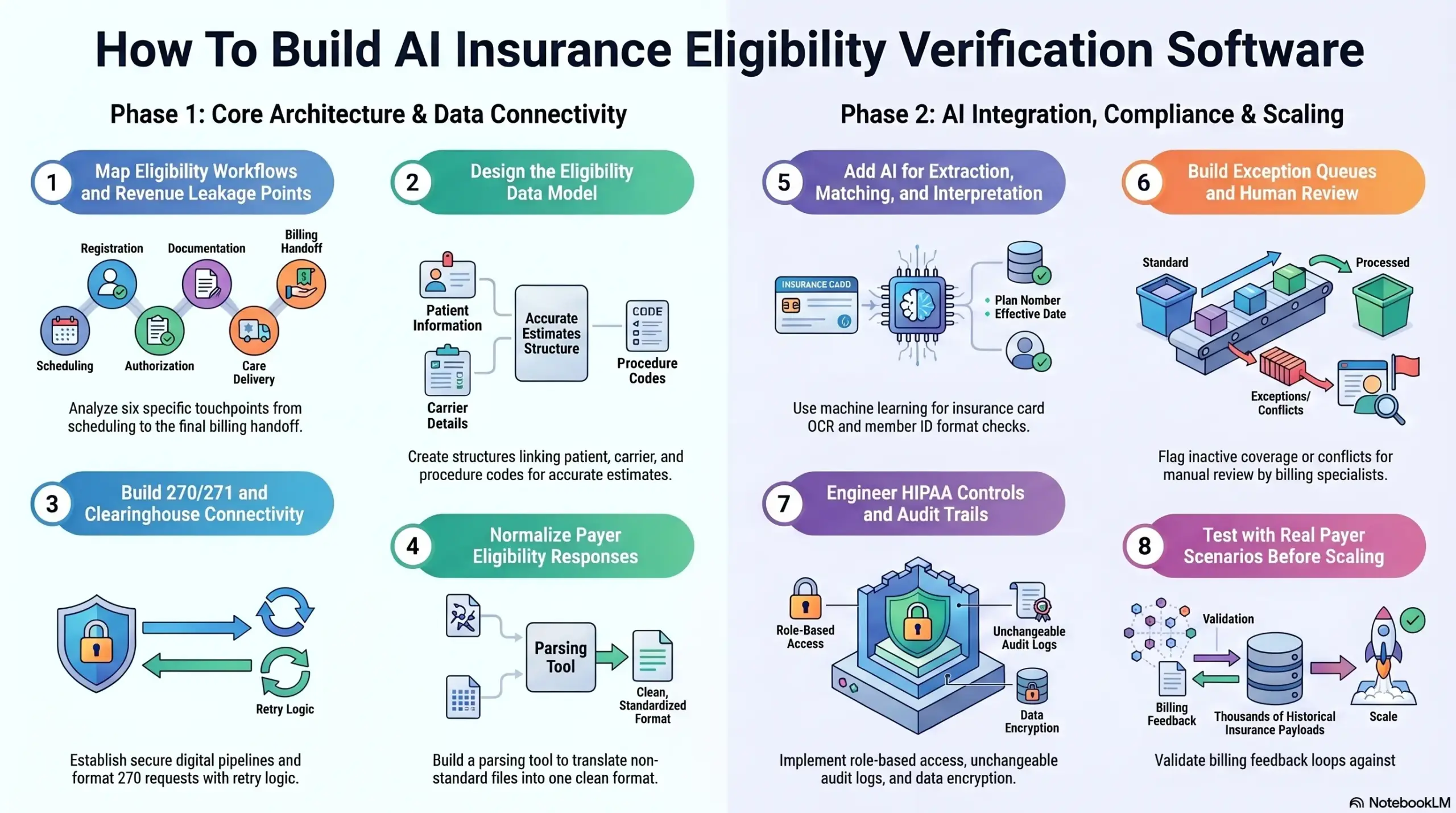
You should build AI insurance eligibility verification software in clear, phased steps. These steps include mapping workflows, modeling data, connecting to payers, parsing responses, adding AI, and setting up compliance controls.
Leading with a phased plan prevents teams from wasting capital on systems that fail in production.
Step 1: Map Eligibility Workflows and Revenue Leakage Points
This step involves tracking exactly how patient and insurance data move through your clinic from the first phone call to the final bill. Your team must analyze six specific touchpoints: scheduling, registration, patient intake, pre-visit checks, walk-in checks, and the final billing handoff.
- What goes wrong: If you skip this, the platform will automate data checks but completely miss the exact spots where your staff makes mistakes.
- The Intellivon Approach: We map your verification tasks directly against your historical denial causes, payer mix, and EHR screens before writing any code.
Step 2: Design the Eligibility Data Model
In this step, engineers create the database structure to house all incoming insurance variables. The data model must link fields for the patient, subscriber, carrier, plan type, provider network status, procedure code, remaining deductible, copay, and prior authorization flags.
- What goes wrong: If you skip this, your software will not be able to clean up messy payer files or calculate patient cost estimates accurately.
- The Intellivon Approach: We design a modular SQL data structure that translates complex healthcare payloads into simple, organized JSON files.
Step 3: Build 270/271 and Clearinghouse Connectivity
This step focuses on establishing secure digital pipelines to move data between your platform and insurance databases. You must set up clearinghouse APIs, format 270 requests, validate 271 responses, and write retry logic to handle network drops.
- What goes wrong: If you skip this, your insurance checks will become brittle and crash during high-volume spikes or payer downtime.
- The Intellivon Approach: We deploy automated Kafka data queues that hold and re-send failed requests using smart backoff timers.
Step 4: Normalize Payer Eligibility Responses
This step requires building a parsing tool to translate non-standard insurance files into a single, clean format. The software must read raw electronic text strings, capture data error codes, map plan types, and score response accuracy.
- What goes wrong: If you skip this, your front-desk staff will receive messy raw data blocks that they cannot read or use during check-in.
- The Intellivon Approach: We build an automated translation layer that converts confusing insurance codes into simple dashboard alerts.
Step 5: Add AI for Extraction, Matching, and Interpretation
Here, you add machine learning models to handle messy inputs that standard code cannot process. This module manages insurance card OCR, checks member ID formats, matches plan names, and writes short summaries for your team.
- What goes wrong: If you skip this, your system remains stuck on rigid rules and will break when a patient uploads a blurry card photo.
- The Intellivon Approach: We use light, secure text-parsing models that find and extract hidden insurance details with high accuracy.
Step 6: Build Exception Queues and Human Review
This step involves building a separate dashboard for files that the software cannot fix automatically. The system flags issues like inactive coverage, coordination of benefits conflicts, out-of-network status, or missing deductible data, then sends them to a billing specialist.
- What goes wrong: If you skip this, the automated system will hide high-risk data errors instead of surfacing them for a human to fix.
- The Intellivon Approach: We build clean workflow queues that route complex charts to the right billing expert based on the error type.
Step 7: Engineer HIPAA Controls and Audit Trails
This step focuses on locking down the platform to satisfy federal health privacy laws. Engineers must build role-based access controls, write unchangeable audit logs, encrypt data at rest, and isolate AI data pathways.
- What goes wrong: If you skip this, your software will fail enterprise security reviews, making it impossible to deploy in a real hospital network.
- The Intellivon Approach: We implement zero-trust access controls and sign comprehensive BAAs to ensure full legal and technical protection.
Step 8: Test with Real Payer Scenarios Before Scaling
The final step requires running thousands of real, historical insurance payloads through your system to check for data bugs. You must test for false positives, validate billing feedback loops, and watch how front-desk staff interact with the dashboard screens.
- What goes wrong: If you skip this, your software might look great during a clean demo but will fail completely when facing real-world insurance data.
- The Intellivon Approach: We test every new build against a massive library of production-grade insurance files to ensure total stability before go-live.
Following this clear layout ensures that your automated insurance verification system development project delivers real financial results. Building your platform step by step keeps your data secure, stops revenue leaks, and cuts out slow manual work for your staff.
What Does AI Insurance Verification Software Cost To Build?
AI insurance verification software usually costs $70,000 to $280,000+ to build, depending on payer integrations, EHR connectivity, AI model depth, HIPAA controls, and workflow complexity.
A basic platform sits at the lower end, which only supports eligibility checks, limited payer connectivity, insurance card capture, and a simple verification dashboard.
However, the budget increases when you need 270/271 transaction workflows, clearinghouse connectivity, payer APIs, EHR integration, batch eligibility processing, benefit mapping, and patient responsibility estimation.
AI Insurance Verification Software Cost Breakdown
| Development Phase | Estimated Cost | What It Covers |
| Discovery, workflow mapping, and product scope | $8,000–$20,000 | Eligibility workflow review, payer mix analysis, denial patterns, user roles, MVP scope, and product roadmap |
| UI/UX for registration, verification, and exception dashboards | $10,000–$25,000 | Staff dashboards, verification queues, patient intake flows, exception screens, admin tools, and reporting views |
| Backend architecture and eligibility orchestration | $20,000–$55,000 | Verification engine, workflow logic, task routing, status tracking, retry handling, APIs, and database architecture |
| 270/271, clearinghouse, payer API, and EHR integrations | $25,000–$90,000 | 270/271 transaction setup, payer routing, clearinghouse connectivity, FHIR Coverage API, EHR sync, and response validation |
| AI model development and document extraction | $20,000–$70,000 | Insurance card OCR, payer matching, member ID extraction, benefit text interpretation, anomaly detection, and staff summaries |
| Benefit mapping, rules engine, and patient responsibility logic | $15,000–$45,000 | Deductible verification, copay and coinsurance checks, plan and benefit mapping, COB rules, and prior authorization flags |
| HIPAA security, audit logs, and compliance controls | $12,000–$40,000 | Role-based access, encryption, PHI safeguards, audit trails, vendor controls, logging, and compliance documentation |
| Testing, QA, deployment, and monitoring | $10,000–$30,000 | Payer scenario testing, EHR testing, security checks, AI validation, deployment, monitoring, and production support setup |
- A focused MVP for healthcare insurance verification platform development can often start around $70,000 to $110,000. This usually includes core eligibility checks, one or two major integrations, a basic dashboard, and limited AI-assisted document extraction.
- A mid-level platform usually costs $120,000 to $200,000. This range fits teams that need real-time and batch eligibility processing, clearinghouse integration, payer-specific response parsing, exception queues, and EHR writeback.
- An enterprise-grade build can cross $200,000 to $280,000+. This includes multi-payer connectivity, advanced AI benefits verification, patient responsibility estimation, prior authorization flagging, analytics dashboards, deeper HIPAA controls, and scalable infrastructure for multiple locations or customers.
What Increases Insurance Verification Automation Cost?
The biggest factor behind insurance verification automation cost is not the verification request itself. It is the number of systems, payer rules, and staff decisions the platform must support.
Costs increase when the platform needs to handle:
- Multiple EHR, PMS, RCM, or scheduling system integrations
- Clearinghouse connectivity plus direct payer API access
- Real-time and batch eligibility verification workflows
- 270/271 transaction parsing across many payers
- FHIR Coverage API support
- Secondary payer verification and coordination of benefits
- Deductible, copay, coinsurance, and out-of-network checks
- Patient responsibility estimation
- Prior authorization requirement flags
- AI model training for insurance cards, payer text, and exception detection
- HIPAA audit logs, access controls, and PHI-safe AI workflows
The lower-cost version verifies coverage. The higher-value version tells your staff what to do next, what risk exists, and whether the visit can move forward without revenue leakage.
Ongoing Maintenance Cost
Plan for 18%–25% of the initial build cost annually for ongoing maintenance.
This budget covers payer rule changes, clearinghouse updates, EHR version changes, AI model tuning, security patches, infrastructure monitoring, compliance reviews, and dashboard improvements. For example, a $160,000 platform may need $28,800 to $40,000 per year in maintenance and optimization.
This is important because eligibility verification is not a one-time build. Payer responses change, APIs evolve, benefit language shifts, and staff workflows mature after launch.
Get Your AI Insurance Verification Software Cost Estimate
Planning a custom eligibility verification platform? Intellivon can help you map features, integrations, compliance scope, AI modules, payer connectivity, and development phases before you commit to a full build.
From MVP planning to enterprise-grade healthcare insurance verification platform development, our team helps you understand what should be built first, what can wait, and what will affect your final budget.
Build AI Insurance Verification Software With Intellivon
At Intellivon, we approach insurance verification as healthcare infrastructure. That means every workflow, AI model, integration, and dashboard is designed around how your team actually verifies benefits, handles payer responses, and resolves exceptions.
A. Define The Right Verification Scope
Not every platform needs the same build scope. Some teams need a focused MVP for real-time eligibility checks, while others need a full healthcare insurance verification platform with payer integrations, batch processing, benefit mapping, and patient responsibility estimation.
Intellivon helps you define:
- MVP vs enterprise platform scope
- Payer mix and verification volume
- EHR, PMS, and RCM integration needs
- 270/271 and clearinghouse requirements
- AI model requirements
- HIPAA and audit control depth
- Cost, timeline, and rollout priorities
This helps you avoid overbuilding early while still designing the system for future scale.
B. Build Around Real Eligibility And Benefits Workflows
Insurance verification involves more than checking whether coverage is active. Your staff also needs deductible status, copay details, coinsurance values, out-of-network indicators, coordination of benefits, and prior authorization flags.
Intellivon builds workflows for:
- Real-time eligibility checks
- Benefits verification
- Deductible verification
- Copay and coinsurance checks
- Secondary payer verification
- Coverage status validation
- Prior authorization requirement flags
- Exception review queues
This turns payer responses into clear operational decisions your team can use before the appointment, claim, or authorization workflow moves forward.
C. Integrate With The Systems Your Team Already Uses
A verification platform only creates value when it works inside your existing healthcare workflow. That is why Intellivon designs integrations around your EHR, PMS, RCM platform, clearinghouse, payer APIs, scheduling tools, and patient intake systems.
Our team can support:
- EHR integration
- Practice management system integration
- Clearinghouse connectivity
- 270/271 transaction workflows
- FHIR Coverage API integration
- Payer API connections
- Scheduling and intake system sync
- Revenue analytics dashboards
This helps your team avoid duplicate entry, manual payer checks, and disconnected verification records.
D. Add AI Where It Actually Improves The Workflow
AI should not guess whether a patient is eligible. It should help extract, match, interpret, summarize, and route information faster.
Intellivon can build AI modules for:
- Insurance card OCR
- Member ID extraction
- Payer and plan matching
- Benefit text interpretation
- Payer response summarization
- Anomaly detection
- Manual-review prediction
- Staff-facing verification summaries
The final eligibility logic should still use structured data, payer rules, and audit-ready workflows. This keeps the system useful, explainable, and safer for healthcare operations.
E. Engineer For HIPAA, Auditability, And Scale
Insurance verification software handles PHI, payer data, patient financial details, and clinical workflow triggers. Because of this, security cannot be added after the platform is built.
Intellivon designs the platform with:
- Role-based access control
- Encryption in transit and at rest
- Audit logs
- PHI-safe AI workflows
- Secure API gateways
- User activity tracking
- Vendor access controls
- Environment separation
- Monitoring and alerting
This gives your team the foundation needed for enterprise healthcare deployment, compliance reviews, and long-term maintenance.
Planning to automate eligibility checks, benefits verification, payer response parsing, and patient responsibility workflows? Intellivon helps healthcare teams design and build AI insurance verification software with the right architecture, integrations, compliance controls, and development roadmap.
From MVP planning to enterprise-scale deployment, we help you decide what to build first, what to automate carefully, and where AI can create real operational value. For a deeper breakdown of payer-facing claim automation, see our guide on AI Healthcare Claims Processing Software Development.
Conclusion
An enterprise AI insurance verification software platform is no longer a narrow automation tool for typing data. Instead, it functions as a critical front-end revenue infrastructure that stabilizes your practice collections before a provider delivers care. Successful engineering builds must combine legacy 270/271 electronic workflows, live payer APIs, and FHIR Coverage data models into a single framework.
By tying these elements directly to real-time EHR integrations, deterministic rules engines, and automated exception work queues, you eliminate manual check-in delays entirely. Furthermore, baking in strict HIPAA data controls and machine learning redaction ensures total protection for patient privacy.
Building a custom system protects your health network from front-end registration-related denials and future-proofs your revenue cycle against shifting federal rules. If you want to deploy a stable, compliance-ready insurance engine without risking internal development failure, partnering with an experienced development firm like Intellivon ensures your software performs reliably in active production.
Things To Know About AI Insurance Verification Softwares
Q1. How much does AI insurance verification software cost?
A1. AI insurance verification software usually costs $70,000 to $280,000+ to build. A basic MVP with eligibility checks and one clearinghouse costs less, while multi-payer API connectivity, EHR writeback, patient responsibility estimation, and AI-powered benefit parsing raise the budget. Annual maintenance usually adds 18%–25% of the initial build.
Q2. How long does automated insurance verification system development take?
A2. A focused MVP takes 3–5 months when the workflow, payer mix, and EHR integration scope are clear. A production-grade platform with 270/271 transactions, payer APIs, batch processing, exception queues, and HIPAA controls usually takes 6–10 months. At the same time, multi-tenant SaaS platforms can take 10–14+ months.
Q3. Can HIPAA-compliant insurance verification software use AI models?
A3. Yes, HIPAA-compliant insurance verification software can use AI models when PHI controls are designed into the architecture. The system should use encryption, role-based access, audit logs, BAA-ready vendors, PHI minimization, and human review for uncertain outputs. At the same time, AI should support extraction and interpretation, not make unsupported coverage decisions.
Q4. What integrations matter most for real-time eligibility verification software build projects?
A4. The most important integrations are EHR, practice management system, clearinghouse, payer API, FHIR Coverage API, identity verification, scheduling, RCM, and analytics systems. For most healthcare teams, clearinghouse and EHR integration creates the first production value. Therefore, payer APIs and FHIR workflows become more important as prior authorization readiness expands.