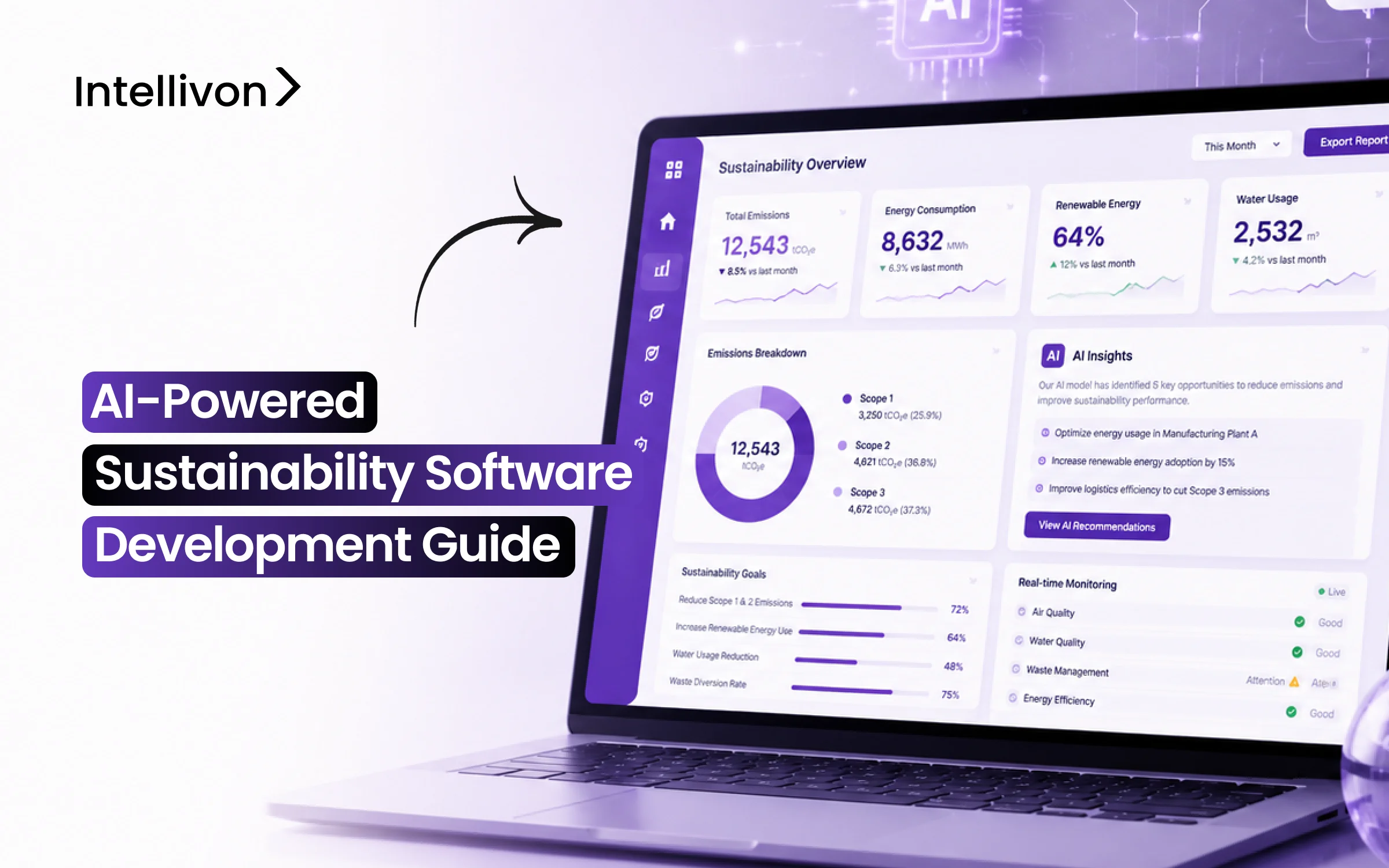
Key Takeaways:
-
AI sustainability platforms need ESG data pipelines, carbon calculation engines, and Scope 3 estimation models.
-
LLM-powered report drafting, anomaly detection, predictive forecasting, and MLOps monitoring are core requirements.
-
Healthcare builds add HIPAA-safe data handling, FHIR/EHR integration, PHI separation, and BAA-ready controls.
-
Custom enterprise AI sustainability platforms cost $70,000 to $300,000 depending on integrations and AI depth.
-
How Intellivon builds AI sustainability platforms as governed infrastructure with human review, audit trails, and explainable AI.
AI sustainability software development requires a multi-model architecture where each function runs on a different model type. Large language models handle disclosure drafting and ESG narrative generation, while ML models run anomaly detection and Scope 3 emissions estimation. Predictive models manage carbon forecasting and net zero tracking, while agentic AI handles autonomous compliance monitoring across CSRD, TCFD, and CDP.
The build decision that separates a production-ready AI sustainability platform from a demo is model governance. When multiple AI model types share one platform without separate explainability standards and drift detection thresholds for each, errors compound across disclosure workflows before they reach the regulatory report. The World Economic Forum warns that without human oversight, AI used in sustainability reporting amplifies errors and erodes stakeholder trust, making model governance the architecture decision that determines platform defensibility under audit.
This guide covers AI sustainability software development the way Intellivon approaches it, starting with model architecture and MLOps pipeline design rather than tool selection. It walks through LLM integration, ML model design for anomaly detection and Scope 3 estimation, agentic compliance monitoring, and cost from $70,000 to $300,000. A build-versus-buy decision framework closes the guide.

What is Sustainability Software?
Sustainability software is an enterprise platform that automates how a company tracks and reports its environmental impact. It gathers messy data from energy bills, supply chains, and daily operations into one dashboard.
The software then calculates total carbon emissions and creates the accurate reports required by government regulators.
How AI Enhances Sustainability Software in Enterprises?
AI enhances sustainability software by automating the extraction of unstructured data and forecasting future environmental risks. Traditional platforms only log past utility data, but machine learning models dynamically predict carbon emissions pathways and identify hidden operational waste. This transition changes sustainability software from a basic record-keeping tool into an active, predictive optimization system.
AI delivers this operational upgrade across three primary enterprise pillars:
- Automated Data Processing: Natural language processing tools instantly extract carbon metrics from complex supply chain invoices and unstructured vendor PDF receipts.
- Predictive Emissions Modeling: Machine learning sustainability data platform development enables predictive AI carbon emissions forecasting to model climate risks and net-zero pathways accurately.
- Anomalous Waste Detection: Advanced machine learning ESG anomaly detection models flag sudden spikes in energy or resource usage across facilities in real time.
By utilizing these intelligent layers, organizations can shift away from manual spreadsheets and establish automated, defensible data pipelines for compliance.
What AI Sustainability Software Actually Does For Enterprises
AI sustainability software collects, normalizes, analyzes, and reports ESG, carbon, climate risk, and operational sustainability data across enterprise systems.
It replaces spreadsheet-led reporting with governed data infrastructure, AI-assisted validation, predictive insights, and framework-ready disclosures.
- System of Record: Replaces siloed spreadsheets with centralized, audit-ready data tracking across the organization.
- Framework Automation: Generates automated disclosures for complex global standards including CSRD, TCFD, CDP, and SEC reporting.
1. It Turns ESG Data Into A Governed System Of Record
AI platforms establish a controlled data layer for environmental and operational metrics. The system centralizes data using ERP AI sustainability data integration, utility bill ingestion, supplier data portals, waste vendor feeds, and IoT AI environmental monitoring integration.
- Healthcare Integration: Extracts operational metrics safely using advanced EHR AI ESG data integration for clinical networks.
- Intellivon Data Approach: We build the underlying data model first, ensuring every metric can be reused across multiple compliance frameworks.
2. It Uses AI To Detect Gaps Before Reports Are Built
Automated data validation reduces manual review times significantly. Platforms use NLP sustainability disclosure analysis and AI ESG data extraction and processing to scan invoices, policies, and supplier PDFs.
- Quality Management: Powers AI-powered ESG data quality management, AI ESG data normalization and cleansing, and machine learning ESG anomaly detection.
- Error Prevention: Employs outlier detection and confidence scoring based on benchmarks from Salesforce and KEY ESG to catch errors early.
3. It Helps Teams Move From Disclosure To Decisions
The strongest platforms do more than produce compliance reports; they guide strategic corporate actions. By deploying AI sustainability KPI forecasting models and predictive AI carbon emissions forecasting, teams can accurately project future footprints.
- Pathway Optimization: Enables AI net zero pathway optimization, AI carbon reduction initiative ranking, and automated renewable energy procurement optimization.
- Peer Comparison: Runs an active AI ESG benchmark and peer comparison to shift teams from tracking to strategic decisions.
AI sustainability software transitions corporate ESG from passive, manual compliance into an automated, governed data engine. This infrastructure lets teams catch errors early and actively simulate carbon reduction pathways before publishing official disclosures.
Why Enterprises Need AI ESG Infrastructure Before Reporting
Enterprises need AI ESG infrastructure because modern sustainability reporting relies on repeatable, clear data from many different sources. Global regulations like CSRD, TCFD, and local government rules require the exact same math across all reports. Without a central system, teams must rebuild these numbers by hand for every new report.
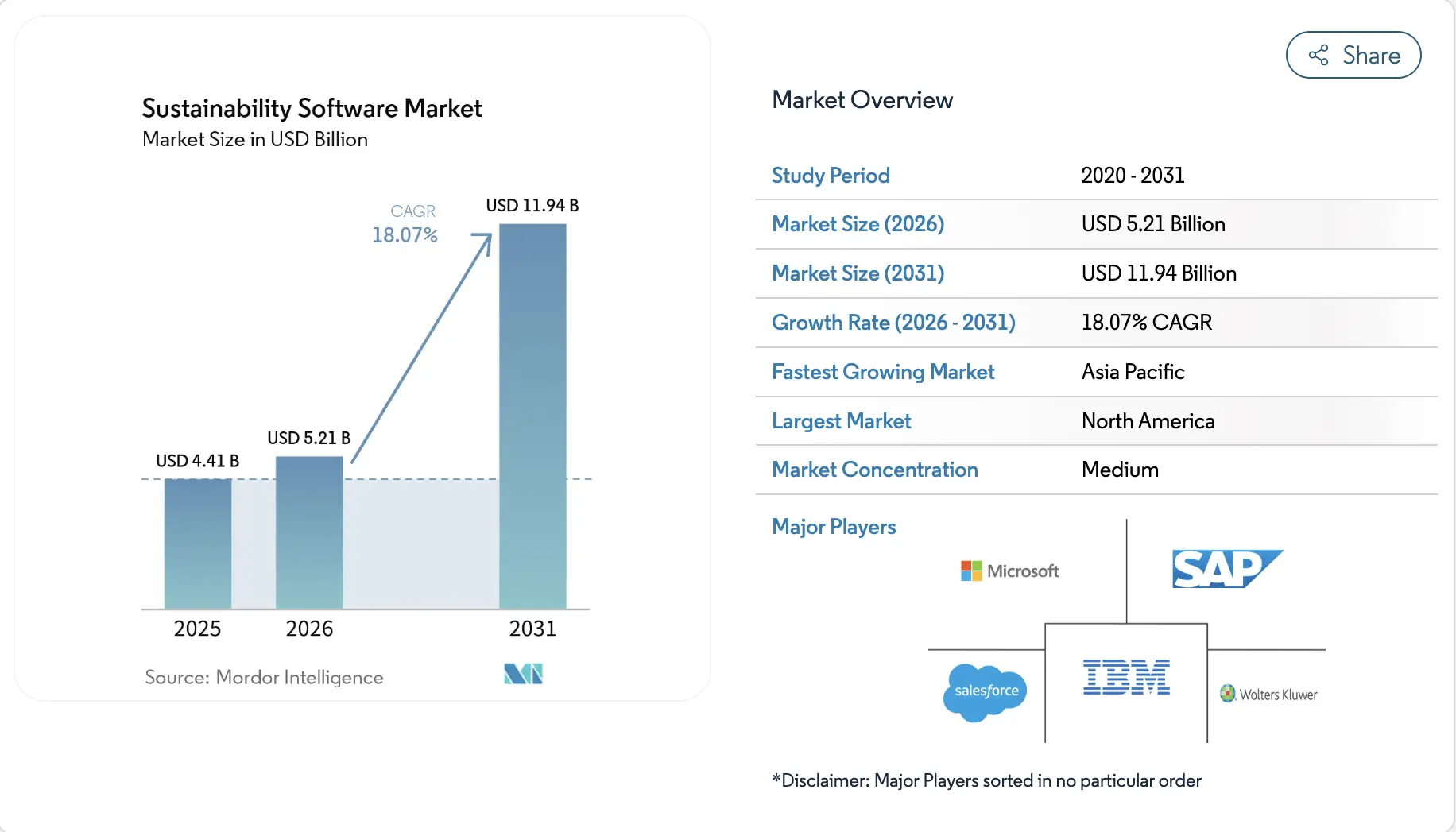
The global sustainability software market is expanding rapidly due to rising corporate compliance requirements. According to industry data from Mordor Intelligence, the sector was valued at $4.41 billion in 2025.
1. Spreadsheets Break When Framework Mapping Expands
Manual spreadsheets fail because a single electric bill must update carbon tracking, European reports, and investor dashboards all at once. Data from the European Commission shows that over 50,000 companies must now prove their data is completely accurate to pass official audits.
- All-in-One Data Core: Stores files, matches data owners, and saves proof in one central spot so nothing gets lost or overwritten.
- Automatic Report Reuse: Sends a single approved number into multiple different global forms without making someone retype it.
2. Scope 3 Data Needs Its Own Calculation Logic
Tracking indirect supply chain emissions (Scope 3) is hard because it requires calculating vendor data, material weights, and spend-based AI emissions calculation steps. The PCAF Standard notes that a financial firm’s investment portfolio emissions are often 95% higher than their own office emissions.
- Smart Estimation Models: Uses AI Scope 3 emissions estimation models to scan and grade data for complex healthcare medical supplies and drug ingredients.
- Fintech Investment Tracking: Runs fintech-financed emissions tracking PCAF tools to quickly calculate the carbon footprint of bank loans and investments.
3. Regulatory Change Monitoring Needs Automation
Green laws change quickly across different countries, which means teams need automated software to watch for updates. The IFRS Foundation reports that more than 20 major countries now use unified global sustainability disclosure rules.
- Automated Tracking: Runs AI CSRD compliance automation and AI TCFD reporting automation to update report formats the moment laws change.
- Multi-Form Generation: Powers AI SEC climate disclosure software, AI GRI reporting automation, and AI SFDR compliance automation fintech tools simultaneously.
Basic spreadsheets cannot handle modern corporate audits or changing green laws. Therefore, building a central data platform protects companies from fines and gives them clean data before starting software development.
To get a deeper understanding of how ESG platforms work, check out our guide on How To Create A Sustainability Reporting Platform.
AI Sustainability Software Development Roadmap And Sequence
AI sustainability software development should follow six phases: discovery, data architecture, integrations, AI model development, reporting automation, and production governance.
Therefore, the correct order matters because sustainability AI cannot produce reliable outputs unless the underlying data taxonomy, calculation logic, evidence trail, and human review workflow are already stable.
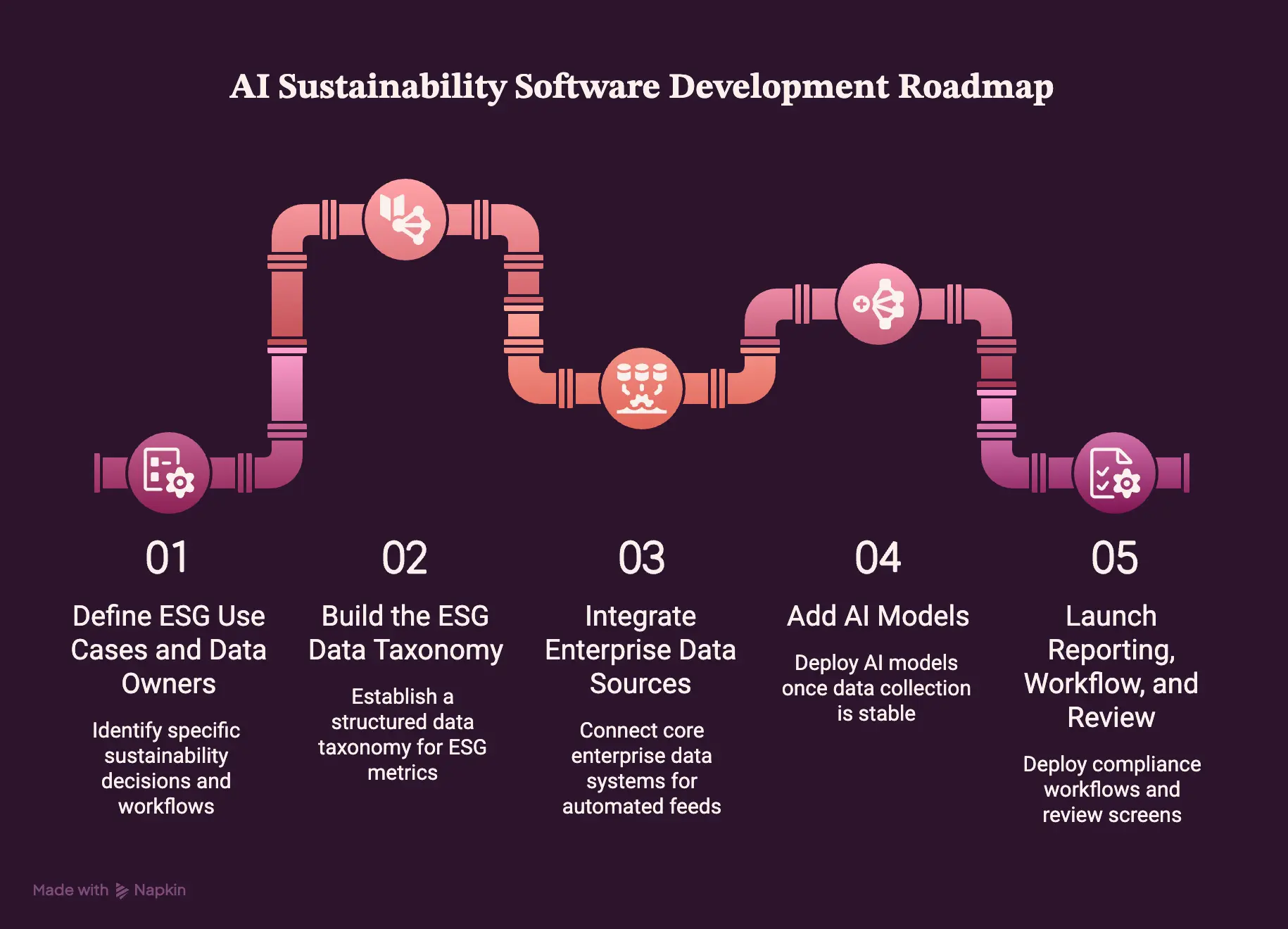
Step 1 — Define ESG Use Cases and Data, Owners
The first step in software development is deciding exactly which sustainability decisions and workflows the platform must support. Therefore, defining general reporting as the sole goal is too broad and often leads to messy database structures.
- Workflow Mapping: Identifies specific workflows for CSO reporting, finance disclosure, facility energy tracking, and procurement supplier risk.
- Specialized Needs: Maps out healthcare sustainability committee inputs, financial portfolios, and role-based access control for users.
- Intellivon Approach: We map use cases directly to user roles before writing code, ensuring every module has a clear owner, approval path, and business outcome.
Step 2 — Build the ESG Data Taxonomy First
Building a structured ESG data taxonomy must always happen before training or deploying any AI models. At the same time, the software system must strictly define how raw data points map to facilities, suppliers, assets, emission scopes, and international reporting frameworks.
- Taxonomy Foundation: Establishes a metric dictionary covering Scope 1, 2, and 3 taxonomy alongside detailed framework mapping layers.
- SaaS Architecture: Structures data lineage rules and evidence metadata inside a multi-entity hierarchy built on a multi-tenant AI sustainability SaaS architecture.
- Intellivon Approach: We design the core taxonomy as a completely framework-agnostic data layer, ensuring your system can adapt to new regulations without a complete database redesign.
Step 3 — Integrate Enterprise Data Sources
Connecting core enterprise data systems provides the platform with the raw automated feeds needed to eliminate manual data collection entirely. This step establishes direct pipelines to the systems where your environmental and operational footprint is actually recorded.
- Core Systems: Integrates directly with ERP systems, procurement software, utility bill portals, and facility management databases.
- Operational Feeds: Connects to IoT meters, waste vendor portals, financial portfolio databases, and EHR systems using secure FHIR APIs.
- Intellivon Approach: We recommend building the first release around 3 to 5 high-value data integrations, allowing you to achieve immediate value before expanding to long-tail suppliers.
Step 4 — Add AI Models Only After Data Stabilizes
AI layers should only be deployed once your underlying data collection and automated validation pipelines are completely stable. At the same time, introducing machine learning too early on messy, unverified data results in broken forecasts and untrustworthy compliance narratives.
- Data Processing: Deploys AI ESG data extraction and processing alongside machine learning ESG anomaly detection to clean incoming data.
- Advanced Analytics: Powers predictive AI carbon emissions forecasting, climate risk scenario modeling, and LLM-powered sustainability report drafting.
- Intellivon Approach: We separate deterministic mathematical calculation rules from probabilistic AI outputs, ensuring that all audit-critical financial and carbon metrics remain completely traceable.
Step 5 — Launch Reporting, Workflow, and Review
The final operational step is deploying the compliance workflows, review screens, and governance gates required before publishing any official reports. Therefore, automated model outputs should never go straight from the AI pipeline to a public regulatory filing without human sign-off.
- Orchestration & Workflows: Connects workflow orchestration tools with human-in-the-loop ESG AI workflows to route anomalies to correct department heads.
- Governance Gates: Locks supporting evidence, tracks report versioning, and manages formal disclosure approval hierarchies across business units.
- Export Formats: Generates compliant, audit-ready data exports in standard PDF, XBRL, Excel, and dedicated regulatory portal formats.
Successful AI sustainability platforms are built from the data layer up, not from the user interface down. At the same time, stabilizing your taxonomy and data integrations first ensures your AI models have the clean, reliable data required to generate audit-ready disclosures.
Data Architecture For AI-Powered ESG Compliance Platforms
An AI-powered ESG compliance platform needs a layered architecture covering ingestion, normalization, calculation, AI services, reporting, workflow, security, and audit evidence.
The platform should separate raw data, validated metrics, framework mappings, and model outputs so teams can explain every reported number during audits or investor reviews.
Layer 1 — Automated ESG Data Pipeline Development
The ingestion layer handles diverse data formats entering the system. It processes batch data, API streams, IoT streaming, and manual file uploads seamlessly.
- Extraction Infrastructure: Uses OCR for utility invoices and NLP for sustainability disclosure analysis of unstructured policy PDFs.
- Validation Gateways: Enforce automated data quality rules and schema validation to flag corrupted inputs immediately at entry.
Layer 2 — ESG Normalization And Calculation Engine
The calculation layer converts raw activity statistics into standardized, decision-ready environmental metrics. It applies emission factors dynamically to automate CO₂e conversions.
- Data Standardizing: Runs unit normalization, supplier matching, facility hierarchy tracking, and Scope 1, 2, and 3 mapping logic.
- Specialized Frameworks: Integrates PCAF financed emissions calculations alongside double materiality data tags for dual-perspective risk mapping.
Layer 3 — AI And LLM Service Layer
The AI service architecture provides natural language capabilities without sacrificing precision. It deploys fine-tuned large language models for ESG reporting and generative AI ESG narrative generation.
- User Interaction: Powers a conversational AI ESG reporting assistant using a natural language querying ESG data platform.
- System Integrity: Couples retrieval-augmented generation (RAG) with foundation model fine-tuning sustainability protocols, strict prompt governance, and factual guardrails.
Layer 4 — Governance, Security, And Audit Layer
The security layer provides the strict enterprise controls needed for third-party auditing and global regulatory compliance. It protects sensitive financial, corporate, and healthcare operational datasets.
- Access and Privacy: Implements role-based access control AI ESG platform settings within a zero-trust AI sustainability platform architecture.
- Compliance Logs: Maintains an unalterable evidence chain of model logs, approval histories, data retention rules, encryption keys, and SOC 2 readiness. For clinical environments, it satisfies HIPAA controls for healthcare.
A decoupled, multi-layered architecture keeps raw data pipelines separated from probabilistic AI models. This structure ensures that every calculated metric can be traced back to its original invoice, spreadsheet, or API stream during an official corporate audit.
To learn more about Scope 3 and how it works, check out our guide on How to Develop Scope 1, 2 & 3 Emissions Software.
AI Models That Make Sustainability Software Decision-Ready
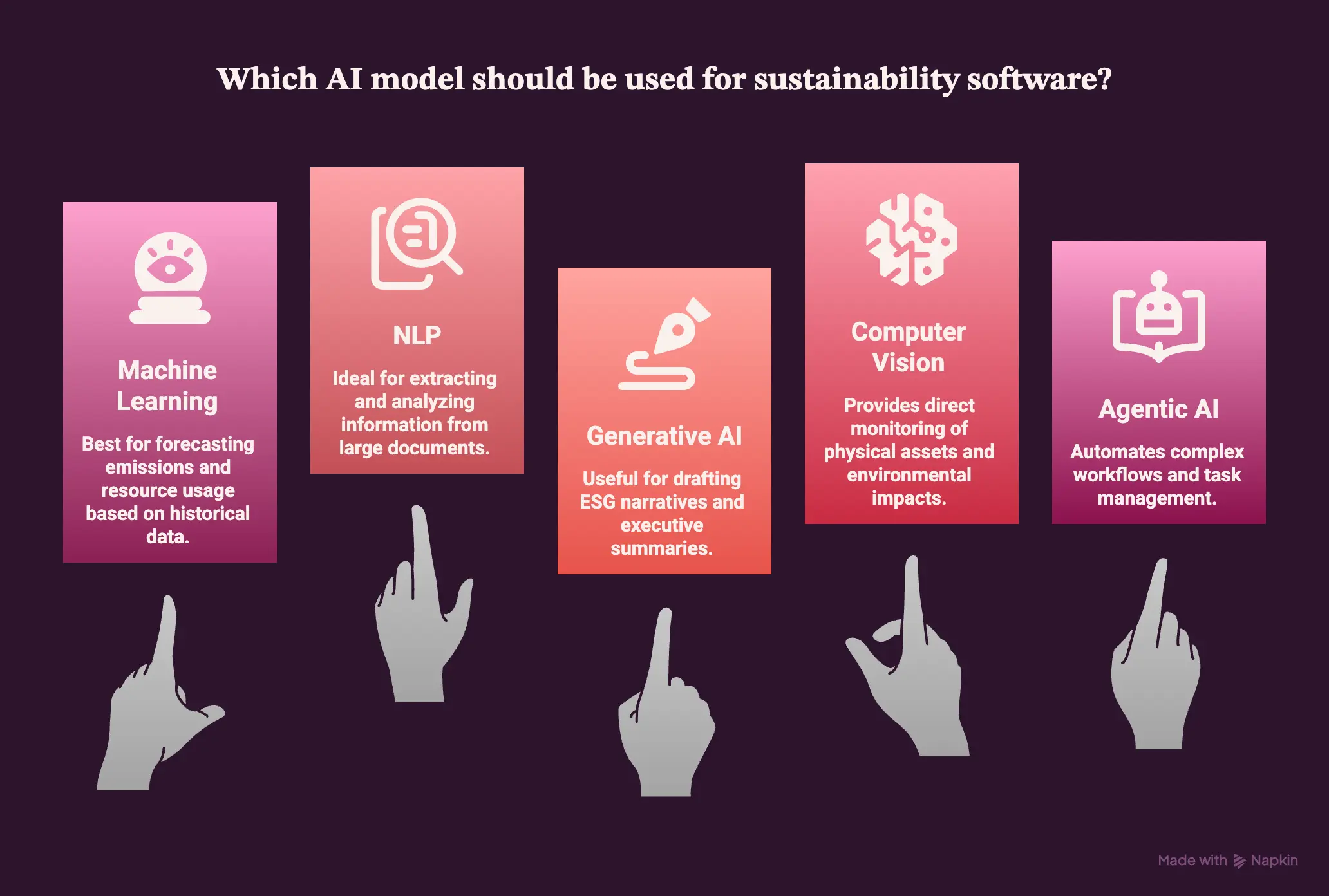
The best AI sustainability platforms use multiple model types, not one generic LLM. At the same time, machine learning models forecast emissions, anomaly models detect data errors, NLP models extract disclosure information, computer vision models inspect physical assets, and LLMs draft narratives only after verified metrics enter the reporting layer.
1. Machine Learning Models For Carbon Forecasting
Predictive models forecast future emissions based on historical patterns instead of just looking backward. By looking at factory schedules, facility-level baselines, and time-series forecasting data, these tools can predict exactly when your resource usage will peak.
- Accurate Projections: Uses predictive AI carbon emissions forecasting to model long-term energy demand, water footprints, and waste volumes across facility sites.
- Confidence Intervals: Generates clear math-based margins of error so compliance teams know exactly how reliable each future projection is.
2. NLP Models For Sustainability Disclosure Analysis
Natural language processing (NLP) reads messy documents and turns them into neat, searchable data fields. These specialized models can scan thousands of pages of supplier PDFs, contracts, and previous reports in a fraction of the time a human would take.
- Information Ingestion: Employs NLP sustainability disclosure analysis to pull emission metrics and compliance details directly from third-party audit forms.
- System Gap Detection: Cross-references active vendor agreements against master policies to highlight missing information or hidden operational compliance risks automatically.
3. Generative AI For ESG Narrative Drafting
Generative AI tools speed up the writing process by creating framework-specific drafts from your pre-verified data. However, these systems should only be used to draft standard descriptions, not to calculate or invent the core numbers themselves.
- Narrative Writing: Uses generative AI sustainability reporting software built to create baseline draft copies of regional executive summaries.
- Stakeholder Frameworks: Speeds up custom report compilation using LLM-powered sustainability report drafting to format text matching precise global regulatory standards.
4. Computer Vision And Satellite ESG Monitoring
Computer vision and satellite imagery provide a direct, independent way to track physical environmental impacts on the ground. These visual processing models analyze real-time video feeds and overhead photos to monitor actual assets without relying on manual self-reporting.
- Remote Site Checks: Use satellite data and AI environmental monitoring to track regional land use, facility forest boundaries, and local biodiversity levels.
- On-Site Waste Audits: Run computer vision sustainability monitoring to double-check that facilities are sorting hazardous items and medical waste containers correctly.
5. Agentic AI For ESG Workflow Automation
Agentic AI systems use independent software loops to manage complex multi-step data collection and validation schedules. These agents work behind the scenes to follow up with vendors, route verification alerts, and handle repetitive administrative tasks.
- Autonomous Monitoring: Deploys autonomous ESG compliance monitoring agents to track regional regulation updates and notify internal compliance officers instantly.
- Task Management: Uses agentic AI sustainability automation inside an AI workflow orchestration sustainability platform to assign missing data reminders to team members.
True intelligence comes from pairing diverse, specialized models together into one coordinated layer. Therefore, using the right tool for the job, whether it is computer vision for physical tracking or machine learning for time-series forecasting, ensures your platform stays auditable and dependable.
MLOps, Responsible AI, And Human Review Guardrails
MLOps makes AI sustainability software reliable after launch by monitoring model accuracy, data quality, and schema changes. Responsible AI controls are equally crucial because automated ESG outputs directly influence investor reporting, supplier evaluations, and regulatory disclosures.
1. MLOps Pipeline Sustainability AI Models Need
First, production platforms require end-to-end management pipelines to remain accurate over long operational lifecycles. Furthermore, traditional software tools fail to track the underlying data changes that cause algorithms to break.
- Continuous Deployment Tracking: Connects an integrated model registry and centralized feature store directly to an automated enterprise CI/CD pipeline.
- Version Control: Uses historical datasets to validate new updates before activating formal model approval workflows.
- Intellivon Approach: For this reason, we embed isolated testing layers within the MLOps sustainability platform architecture to safely validate changes.
2. Model Drift Detection for ESG AI Outputs
Subsequently, model drift happens when real-world data shifts so much that an algorithm begins outputting incorrect calculations. For instance, new utility tariffs or shifting climate laws can easily confuse unmonitored forecasting models.
- Tracking Shifts: Monitors data pipelines for sudden supplier data drift, unexpected emission factor changes, or seasonal spikes.
- Instant Notification: As a result, it fires automated data drift alerts when major portfolio composition changes break existing training boundaries.
- Intellivon Approach: Accordingly, we set up our model drift detection ESG AI platform layers to notify teams the moment inputs change.
3. Explainable AI and Bias Detection Controls
In addition, responsible AI requires clear logic paths so compliance teams can explain exactly how an algorithm made a decision. Indeed, hidden reasoning structures are too risky for official corporate or financial regulatory filings.
- Traceable Scoring: Drives fair supplier scoring by removing hidden biases and showing human-readable reasons for recommendations.
- Transparency Tools: Uses standardized model cards and risk classification tags to map out active model limitations.
- Intellivon Approach: Thus, we practice responsible AI ESG software development by building transparent, explainable feature-weight visualizations into every output.
4. Human-in-the-Loop Review for Every Disclosure
Finally, automated AI models must act as an assistant to human experts, never as the ultimate decision-maker. Hence, building rigid approval gates ensures all published records are accurate, auditable, and secure.
- Permission Scopes: Sets strict reviewer permissions and confidence thresholds to isolate low-confidence records instantly.
- Locked Audit Trails: Attaches approval notes to your records before activating a permanent disclosure lock.
- Intellivon Approach: Ultimately, we build human-in-the-loop ESG AI workflows directly into dashboards, keeping compliance teams in total control.
In summary, AI sustainability platforms require strict MLOps tracking and explainable logic paths to stay reliable. Keeping human verification at the center of the pipeline protects your enterprise from automated mistakes during official regulatory audits.
To know more about carbon tracking software, read our blog on What Does It Cost to Develop Carbon Tracking Software in 2026?
AI Sustainability SaaS Platform Development Cost Breakdown
Consequently, AI sustainability SaaS platform development naturally costs $70,000–$300,000 for a custom enterprise build. A focused minimum viable product (MVP) with data ingestion, carbon calculations, dashboards, and one reporting framework starts near $70,000.
Meanwhile, a full-scale production platform with complex AI models, Scope 3 logic, healthcare controls, MLOps pipelines, and multi-tenant SaaS architecture reaches toward the $300,000 upper bound.
Custom Platform Cost Breakdown Matrix
The table below breaks down the technical software components, operational scopes, and estimated investment ranges required across each primary engineering phase:
| Development Phase | What It Covers | Estimated Cost |
| Discovery and ESG Use Case Mapping | Use cases, data owners, KPI list, compliance scope, roadmap | $6,000–$15,000 |
| Data Architecture and Taxonomy | ESG data model, Scope logic, facility hierarchy, framework mapping | $10,000–$28,000 |
| Data Pipelines and Integrations | ERP, utility, waste, procurement, HRIS, EHR/FHIR, supplier feeds | $18,000–$65,000 |
| Carbon and ESG Calculation Engine | Scope 1/2/3 logic, emissions factors, PCAF, data quality scoring | $15,000–$45,000 |
| AI and ML Model Layer | Extraction, anomaly detection, forecasting, LLM report drafting | $18,000–$55,000 |
| Dashboards and Reporting Workflows | CSRD, CDP, GRI, TCFD, SEC, SFDR outputs, approval flows | $12,000–$38,000 |
| Security and Compliance Controls | RBAC, encryption, audit logs, HIPAA, BAA readiness, zero-trust | $10,000–$35,000 |
| MLOps and DevOps Pipeline | CI/CD, model registry, drift monitoring, release governance | $12,000–$40,000 |
| Testing and Production Launch | QA, UAT, model validation, documentation, go-live support | $8,000–$25,000 |
- Total Custom Build Budget: $70,000–$300,000 total initial investment.
- Annual Maintenance Capital: 18%–25% of the baseline development cost.
- Engineering Delivery Timelines: 10–16 weeks for a focused MVP; 5–8 months for standard production; 7–12 months for full multi-tenant SaaS infrastructure.
What Keeps The Build Near $70,000
First, keeping project boundaries tightly controlled around immediate operational needs prevents scope inflation and holds costs down. Therefore, teams can launch quickly by prioritizing essential regulatory targets and limiting complex background infrastructure.
- Simplified Data Footprint: Focuses on one or two core corporate entity types rather than global facility webs.
- Narrow Emissions Scope: Limits calculations strictly to Scope 1 and Scope 2 metrics while leaving out Scope 3.
- Minimal Pipeline Footprint: Connects only 2 to 3 internal integrations and exports to a single regulatory framework.
- Simplified Tech Architecture: Uses standard database engines, basic anomaly detection scripts, and bypasses multi-tenant SaaS engineering completely.
What Pushes The Build Toward $300,000
Subsequently, adding deep enterprise security layers, multi-layered data pipelines, and intelligent automated workflows naturally drives engineering hours up. For this reason, global companies building audit-ready infrastructure require highly specialized backend architectures.
- Complex Healthcare Infrastructure: Integrates multi-facility healthcare data directly with internal clinical systems using secure FHIR/EHR pipelines.
- Advanced Calculation Scopes: Tracks extensive Scope 3 value-chain inputs across 8 to 15 distinct categories alongside fintech PCAF portfolio tracking.
- Intelligent Automation Layer: Implements conversational LLM assistants, autonomous monitoring agents, and continuous MLOps drift monitoring dashboards.
- Rigorous Security Compliance: Deploys a full multi-tenant SaaS design protected by zero-trust architectures, strict HIPAA settings, and formal BAA execution.
In short, initial capital outlays depend directly on the number of automated data connections and the depth of the calculation logic. Building a modular, scalable architecture protects your upfront budget while allowing you to deploy advanced AI models as data stabilizes.
Build AI Sustainability Software With Intellivon
Intellivon helps enterprises build AI sustainability software that connects ESG data, carbon accounting, supplier risk, regulatory reporting, AI validation, and executive dashboards into one governed platform.
The team designs custom sustainability platforms for healthcare, fintech, pharma, medtech, banks, insurers, manufacturers, and enterprise supply chain teams that need more than standard ESG reporting software.
- AI sustainability software architecture planning
- ESG data collection and normalization workflow development
- Scope 1, 2, and 3 emissions calculation engine design
- Supplier sustainability risk scoring and monitoring
- AI anomaly detection, forecasting, and data validation models
- CSRD, CSDDD, CDP, TCFD, SBTi, SEC, and GHG Protocol mapping
- ERP, procurement, utility, supplier, and third-party data integrations
- Audit trails, RBAC, SSO, data lineage, explainability, and MLOps controls
Plan Your AI Sustainability Software Architecture With Intellivon by booking a free consultation call with us.
Conclusion
AI sustainability software works when data quality, compliance, and human review move together. Therefore, teams should start with one trusted workflow, then expand into Scope 3, reporting automation, and forecasting.
Moreover, AI should support evidence-based decisions, not replace accountability. This keeps the platform useful, auditable, and ready to scale.
FAQs
Q1. How accurate are AI Scope 3 emissions estimates?
A1. AI Scope 3 estimates become reliable when the platform shows method, source, emission factor, and confidence score. Therefore, spend-based data can support early baselines, while supplier-specific and activity-based data suit high-impact categories. Moreover, AI should classify, flag gaps, and improve evidence quality, not replace supplier proof during audits ever fully.
Q2. Why do ESG software buyers feel platforms are overbuilt?
A2. ESG buyers feel platforms are overbuilt when broad dashboards arrive before one painful workflow gets solved. Therefore, the safest MVP should begin with Scope 3 collection, CSRD reporting, or supplier risk. Then, once data quality improves, teams can add forecasting, LLM drafting, and deeper compliance modules gradually without bloating workflows.
Q3. How much should custom AI ESG software cost?
A3. Custom AI ESG software should cost $70,000–$300,000. A narrow MVP with limited integrations, basic dashboards, and early Scope 3 logic starts near $70,000. However, production platforms with LLM reporting, healthcare controls, MLOps, supplier portals, and multi-tenant SaaS architecture usually reach $220,000–$300,000 before yearly maintenance, updates, support, monitoring, and governance costs.
Q4. Can AI write ESG reports without creating risk?
A4. AI can draft ESG reports safely when it uses verified platform data, source citations, and human review. However, it should never invent metrics, targets, or claims. Instead, the platform should lock approved numbers first, then let the LLM draft narratives that reviewers can edit, approve, or reject with evidence attached.
Q5. When should we build instead of buying ESG SaaS?
A5. Build when more than 30% of your workflow needs custom integrations, proprietary AI logic, healthcare compliance, fintech emissions logic, or white-label SaaS features. However, buy ESG SaaS when you only need standard dashboards, simple Scope 1 and 2 reporting, basic exports, and limited workflow customization across teams today easily enough.