Key Takeaways:
- Sustainability reporting platforms collect ESG, carbon, workforce, supplier, and operational data into one system.
-
GRI, SASB, TCFD, CDP, CSRD, EU Taxonomy, SEC climate disclosure, and SFDR framework mapping are required.
-
Data lineage, audit trails, role-based access, and AI-assisted reporting ensure compliance-ready platform governance.
-
Custom enterprise platforms cost $70,000 to $300,000 depending on integrations, Scope coverage, and AI features.
-
How Intellivon builds sustainability reporting as compliance-ready infrastructure with workflow automation and production-grade DevOps.
Creating a sustainability reporting platform follows a specific build sequence. Design a framework-agnostic data model first, one that tags every sustainability data point with its relevance to GRI, SASB, TCFD, CSRD, and SEC disclosure standards at the moment of collection. After this, integrate your data sources, build the reporting engine on top of that model, and add AI to automate data quality checks and disclosure generation.
Here is where the sequencing decision becomes expensive. When organizations build around a single framework first, the data model is structured around that framework’s disclosure categories. When CSRD mandates arrive, or investors request TCFD reports, the data cannot be remapped without rebuilding the layer underneath it. CSRD alone contains over 1,250 possible data points and disclosure items. A unified, framework-agnostic data model means every framework report runs from the same verified data, giving investors and auditors a consistent, traceable disclosure picture.
Intellivon has spent over a decade building compliance-grade data platforms for healthcare and financial services, always designing the data model around multi-framework output requirements before a single report template is built. In this blog, we walk through the full build: data architecture, framework mapping, source integrations, AI layer, and cost from $70,000 to $300,000. By the end, you will have a clear blueprint to scope and commission this platform confidently.
What is a Sustainability Reporting Platform?
A sustainability reporting platform is a system that collects environmental, social, and governance data from across your operations, normalizes it into a single governed data layer, and maps it automatically to GRI, SASB, TCFD, CSRD, and SEC disclosure standards.
From there, it generates audit-ready reports, maintains a full data lineage trail, and gives your sustainability, finance, and compliance teams the same verified data to work from.
Why Enterprises Need Custom Sustainability Reporting Software
Global market pressures and shifting regulatory environments have made automated carbon inventories a mandatory condition for maintaining enterprise-level market access.
Organizations without automated accounting face severe legal scrutiny, increased capital costs, and immediate disqualification from competitive procurement bidding processes.
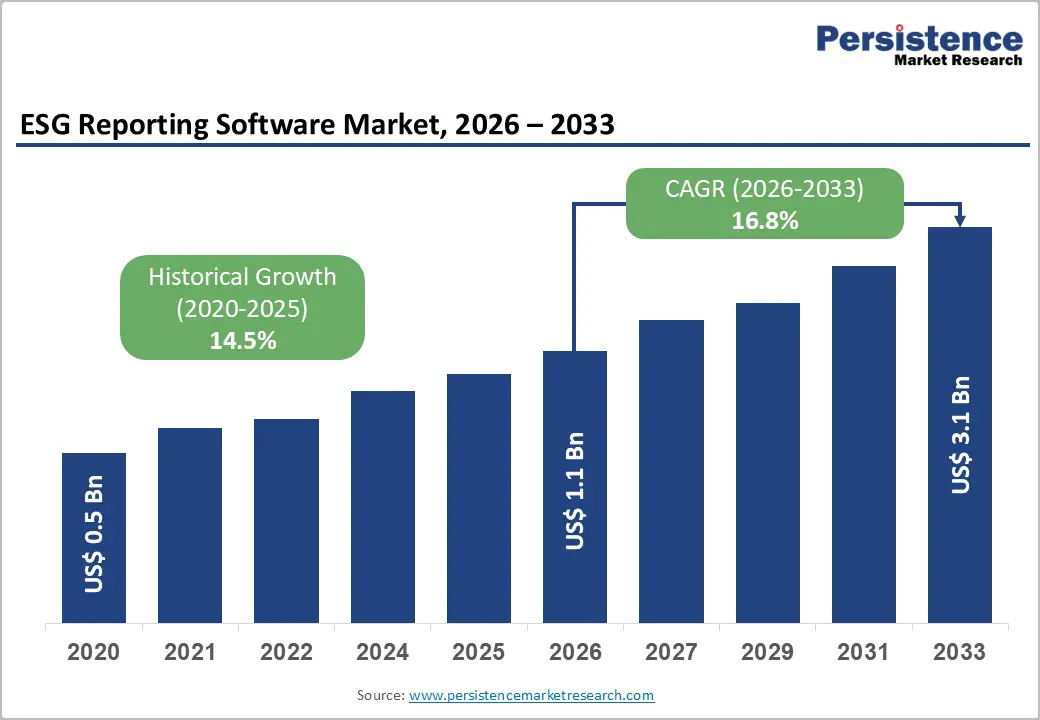
The commercial demand for specialized ESG reporting software platforms is accelerating rapidly, with global market valuation projected to scale from US$ 1.1 billion to US$ 3.1 billion between now and 2033. This targeted expansion represents an aggressive compound annual growth rate of 16.8% over the next seven years.
1. Investor Pressure and Capital Constraints
Institutional investors now enforce strict carbon compliance mandates, with 73% of global investors refusing to allocate capital to enterprises that lack clear ESG verification. Concurrently, supply chain data transparency is no longer optional for major suppliers.
- Corporate buyers demand detailed Scope 3 reporting, with over 68% of commercial procurement teams requiring vendor carbon inventories.
- Over 54% of global procurement organizations now use carbon performance scoring as an active selection criterion during vendor bidding rounds.
2. Global Procurement and Vendor Disqualification
For large healthcare networks, this compliance requirement is amplified by the sheer volume of material consumption and facility energy intensity. The health sector is historically carbon-heavy, contributing roughly 4.4% of total global net emissions annually across its global delivery footprints.
- The United States healthcare sector alone generates approximately 10% of total national greenhouse gas emissions due to continuous facility operations.
- Medical procurement contracts represent a massive operational hotspot, with pharmaceuticals and medical devices driving 40% to 50% of total hospital footprints.
- Upstream medical supply chains contribute up to 70% of total healthcare sector emissions, making deep Scope 3 data collection essential for hospital administrators.
3. Financed Emissions and Portfolio Risk
In financial services, institutions must deploy advanced software engines to track financed emissions across massive lending and investment portfolios. More than 2,500 international financial institutions now utilize the Partnership for Carbon Accounting Financials (PCAF) framework to measure risk.
- Modern banking groups manage tens of billions in financed emissions that must be disclosed under expanding Scope 3 obligations.
- Unmanaged climate exposure could trigger up to $2 trillion in aggregate losses across the global financial sector by 2050.
This specialized engineering model accelerates deployment timelines while keeping data collection processes fully secure and compliant with local data privacy laws.
What A Sustainability Reporting Platform Actually Does
A sustainability reporting platform collects, validates, organizes, and converts enterprise ESG data into disclosure-ready outputs. It replaces spreadsheet-heavy reporting with a governed system that can track Scope 1, 2, and 3 emissions, workforce metrics, supplier evidence, climate risk, governance data, and framework-specific disclosures from one controlled data layer.
1. Creates One ESG System Of Record
A sustainability data aggregation platform acts as a centralized database that ingests multi-source data points once and securely serves them across every compliance channel. It eliminates the data fragmentation that occurs when distinct operating divisions track their resources in isolated spreadsheets.
The underlying architecture relies on automated ESG data normalization and transformation pipelines to clean incoming records. It ingests text logs, bills, and utility files, transforming them into uniform data types for centralized calculation.
- The system establishes a permanent sustainability audit trail and data lineage for every entry.
- Financial auditors can instantly track any carbon value back to its original raw upload source.
The application platform stores every data iteration within a permanent version history table. This ledger prevents data overwrites and ensures old reports remain reproducible when historical emission factors shift.
2. Converts Raw Data Into Framework-Ready Disclosures
Modern multi-framework ESG reporting software allows a single validated operational metric to satisfy multiple global reporting demands simultaneously. It maps a single data point to the distinct disclosure requirements of various international regulatory bodies.
This multi-mapping approach streamlines your GRI reporting software implementation by auto-populating specific environmental impact disclosures. The exact same data layer feeds your SASB framework reporting integration to satisfy investor-facing material standards.
- The processing engine converts raw resource consumption data into specialized climate risk disclosures.
- Built-in transformation rules dynamically reformat your operational data to feed TCFD reporting platform development.
The system updates relevant disclosure fields automatically whenever a core operational metric changes. This continuous calculation ensures compliance documentation matches your actual physical operations in real time.
3. Turns ESG Reporting Into An Operational Workflow
A functional enterprise platform transforms annual compliance projects into an automated, year-round operational routine. It converts passive environmental data collection into a managed workflow with assigned ownership, validation triggers, and strict sign-off gates.
Deploying sustainability reporting workflow automation allows companies to assign data entry and review duties to specific plant managers. The application sends automated alerts when utility bills are missing or when carbon metrics exceed set baselines.
- Managers upload original evidence files directly into a secure, centralized stakeholder engagement reporting module.
- The system prevents users from altering historical baselines without formal, multi-step management approval.
The system maintains comprehensive readiness logs to support quick third-party assurance and verification integration. External auditors receive restricted, read-only system access to view calculation rules and check original receipts.
4. Supports Strategic Decisions Beyond Compliance
An enterprise sustainability tool operates as a forward-looking optimization engine rather than a basic backward-looking data log. It turns historical compliance data into actionable operational insights that help lower resource expenses and reduce long-term environmental risks.
Our custom sustainability KPI dashboard development provides operations teams with clear, real-time visibility into high-emission facilities. Leaders use these dashboards to spot operational issues and prioritize capital investments where they will save the most energy.
- Integrated systems enable real-time sustainability metrics tracking across all operational facilities.
- This continuous tracking lets teams test the impact of energy-efficiency upgrades as they happen.
The system includes a sustainability benchmarking and scoring platform to evaluate individual vendor performance. Procurement teams use these scores to favor low-carbon suppliers and reduce overall Scope 3 supply chain risks.
The platform is not just a reporting screen. It is a controlled operational layer that connects data, people, standards, and evidence. Once that is clear, the next question becomes why custom development is needed at all.
Building a platform tailored to your specific enterprise workflows requires a solid development strategy. For a deeper breakdown of optimizing your software delivery pipelines, see our guide on automated software training.
This video walkthrough provides an in-depth architectural breakdown on How to Build an AI Risk Intelligence Platform, which details the data pipeline and secure validation controls required for processing highly regulated enterprise software datasets.
Sustainability Reporting Software Development Architecture
Sustainability reporting software development architecture should include eight layers: data ingestion, normalization, ESG metric storage, framework mapping, workflow automation, AI validation, dashboard reporting, and audit governance.
This layered design prevents duplicate calculations, improves data quality, and keeps disclosures traceable across changing regulations and reporting cycles.
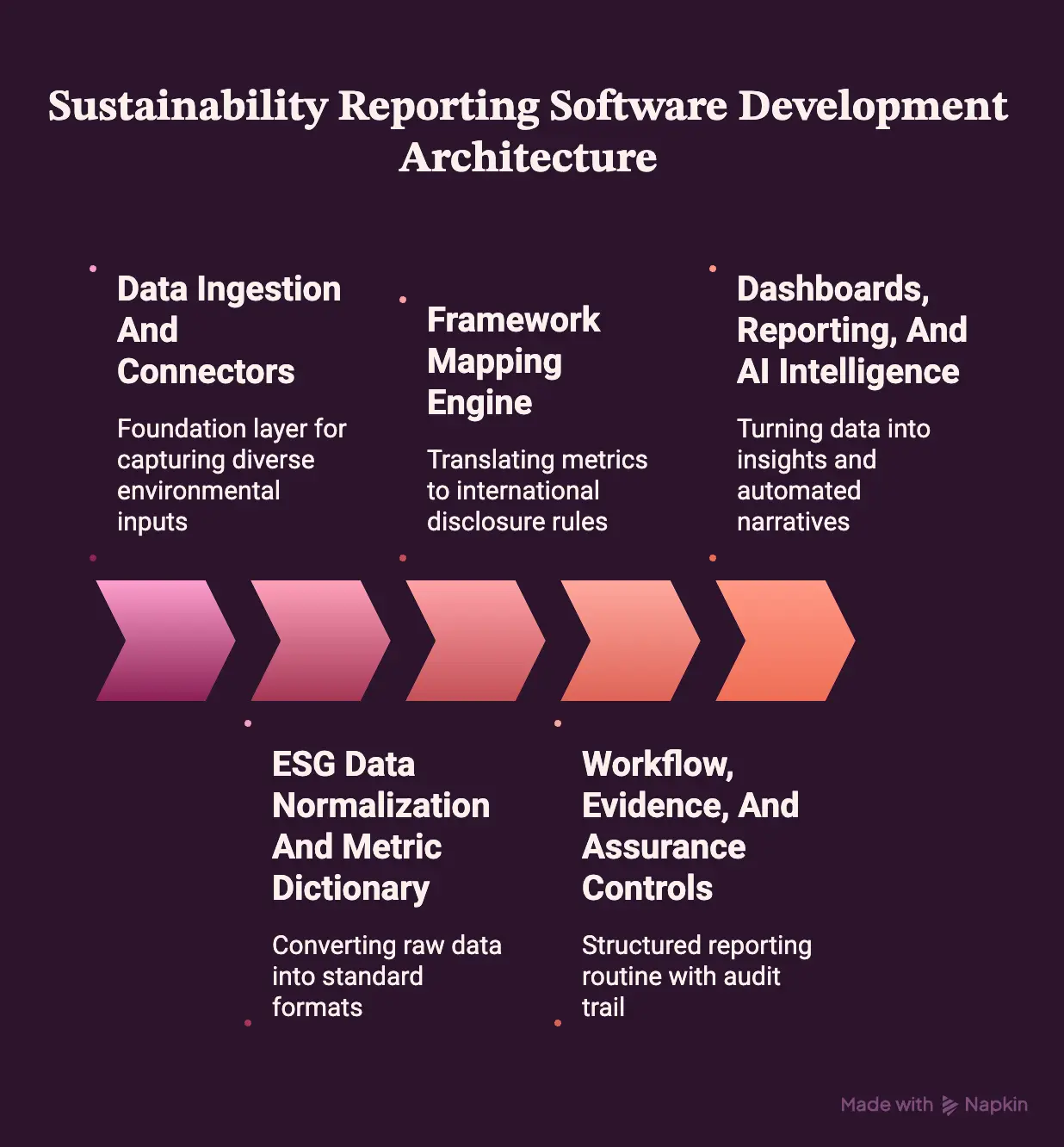
Layer 1 — Data Ingestion And Connectors
The foundation layer relies on a unified ingestion pipeline to capture diverse environmental inputs from automated telemetry systems, enterprise databases, and external partner files.
Consequently, establishing automated connections eliminates manual calculation errors and prevents critical tracking gaps across distributed corporate networks.
- Constructing a secure, high-throughput sustainability reporting API architecture to capture real-time operational logs.
- Engineering localized carbon emissions reporting integration adapters to streamline utility and fuel expense ingestion.
- Gathering disparate environmental, social, and corporate governance data into a unified Scope 1, 2, and 3 data reporting platform.
- Pulling employee transit and corporate travel data seamlessly from centralized HRIS and travel management systems.
- Streamlining data imports from external waste management vendors and cloud computing infrastructure providers directly.
Furthermore, automating these intake channels ensures your processing engines receive clean, continuous data streams.
For a deeper breakdown of constructing high-efficiency data intake infrastructure, see our specialized guide on Enterprise Wallet Development: Architecture & Compliance Guide
Layer 2 — ESG Data Normalization And Metric Dictionary
The normalization layer converts raw, mismatched operational data types into standard computing formats based on centralized accounting definitions. Therefore, the processing core applies strict validation rules to maintain clean data assets before information passes to downstream calculation modules.
- Programming automated unit conversion microservices to standardize international resource metrics across facility locations.
- Executing automated sustainability data quality management routines to immediately flag irregular or outlying entries.
- Deploying specialized ESG data normalization and transformation pipelines to clean raw data tables simultaneously.
- Structuring centralized metric dictionaries to establish clear, unalterable calculation rules for all corporate offices.
- Accelerating enterprise sustainability data management platform development by maintaining a single validation layer.
As a result, establishing a rigid data cleaning process protects your underlying data pools from degradation. This reliable data baseline provides a dependable foundation as your corporate tracking metrics continue to scale.
Layer 3 — Framework Mapping Engine
The framework engine acts as a dynamic translation hub that automatically cross-references your core normalized metrics with the unique formatting rules of international environmental disclosure bodies. Consequently, it removes the need for manual reporting rework by transforming individual ledger records into multi-framework outputs instantly.
- Speeding up automated sustainability reporting platform development through decoupled disclosure transformation templates.
- Utilizing modern multi-framework ESG reporting software components to satisfy several regulatory demands simultaneously.
- Formatting processed operational metrics to match the strict investor-focused requirements of the SASB.
- Restructuring resource consumption data to feed comprehensive CSRD compliance reporting software modules automatically.
- Organizing climate risk exposure indicators to satisfy TCFD, CDP, and SEC climate disclosure rules.
Consequently, this multi-mapping logic ensures your organization can adapt quickly as regional reporting policies continue to shift. This automated alignment significantly lowers compliance overhead during complex multinational reporting cycles.
Layer 4 — Workflow, Evidence, And Assurance Controls
The workflow automation tier converts annual compliance reporting into a structured, year-round operational routine with clear task tracking and authorization gates. Therefore, the system ensures that every public assertion is backed by unalterable physical proof to satisfy rigorous financial auditing standards.
- Building a permanent sustainability audit trail and data lineage ledger for every calculated resource metric.
- Creating restricted verification access points to simplify third-party assurance and verification integration protocols.
- Enforcing strict role-based access control sustainability platform parameters to protect core database systems.
- Locking historical reporting periods automatically to prevent unapproved data modifications after audit sign-offs.
- Attaching original utility invoices, fuel receipts, and supplier validation letters directly to specific disclosure items.
Therefore, establishing clear control structures protects your organization from non-compliance liabilities and reporting errors. To examine how to build secure compliance modules within corporate SaaS systems, read our technical architecture manual on Enterprise Fintech SaaS Architecture: Tech Stack
Layer 5 — Dashboards, Reporting, And AI Intelligence
The presentation and intelligence layer turns historical data into forward-looking operational insights while automating text generation for complex corporate disclosures. Consequently, the platform assists sustainability teams by flagging resource issues early and streamlining narrative assembly.
- Building interactive dashboards that convert raw environmental data into clean, scannable executive progress tracking charts.
- Deploying automated sustainability report generation tools to export pre-formatted compliance documents at a click.
- Utilizing NLP for sustainability narrative reporting to draft initial disclosure descriptions from verified operational data.
- Applying advanced AI sustainability data analysis and insights to discover hidden energy-saving opportunities across facilities.
- Running continuous predictive forecasting models to project future emissions trends against net-zero corporate targets.
Therefore, combining interactive visualizations with automated analytics tools changes your sustainability software from a basic recording tool into a valuable asset for corporate strategy. This data-driven clarity helps executive teams allocate capital efficiently across long-term environmental optimization programs.
A strong architecture allows sustainability data to behave like financial data. It becomes reusable, controlled, and defensible. After the architecture, the post should explain which reporting frameworks the platform must support.
Reporting Frameworks The Platform Must Support
A production sustainability platform should support mandatory, voluntary, investor-driven, and sector-specific reporting frameworks from one mapping layer. At minimum, enterprise builds should support GRI, SASB, TCFD, CDP, CSRD, EU Taxonomy, SEC climate disclosure readiness, ISSB-aligned disclosures, integrated reporting, and industry-specific outputs for healthcare and finance.
1. GRI, SASB, And TCFD Reporting Integration
A multi-framework architecture must distinguish between the varying foundational reporting scopes enforced by global standard-setters to avoid data dilution.
Consequently, the underlying system maps your raw activity data to distinct reporting destinations based on whether a framework evaluates operational environmental impacts or immediate financial risks.
- Mapping impact materiality metrics to feed standard GRI disclosures regarding a company’s external societal footprint.
- Isolating financially material environmental metrics by industry sector to fulfill investor-facing SASB reporting rules.
- Structuring data pipelines to supply the explicit pillars required for complete TCFD climate risk disclosures.
- Feeding climate governance, strategic planning, risk management, and formal carbon reduction targets into unified reporting templates.
- Auto-populating multi-framework fields from a single operational resource entry to eliminate duplicate manual typing.
Moreover, keeping these core standards integrated into a single data tier preserves complete audit traceability across changing corporate disclosure cycles. (Source: GRI, 2026)
2. CDP, CSRD, ESRS, And EU Taxonomy Reporting
Modern enterprise platforms use dedicated data layers to manage expanding European disclosure regulations, which demand rigorous proof of both environmental impact and corporate financial exposure.
Therefore, the system automates the preparation of highly complex double materiality assessments and structured templates to satisfy independent regulatory review panels.
- Automating the ingestion of complex environmental metrics to support specialized CDP disclosure automation software.
- Building unalterable data structures to streamline your compliance reporting across modern CSRD compliance reporting software.
- Restructuring operational tracking lines to fit the unique digital tagging rules of the ESRS.
- Organizing resource indicators to evaluate your organization’s exact alignment within an EU taxonomy reporting platform.
- Attaching original vendor proof files to back up double materiality matrices during mandatory limited assurance reviews.
As a result, migrating away from manual spreadsheets protects multinational organizations from severe compliance penalties.
3. SEC Climate Disclosure Readiness And Investor Reporting
Enterprise software development must account for a shifting regulatory environment in the United States, where formal rules are subject to notice-and-comment rescission proposals while historical principles-based material risk tracking remains mandatory.
Consequently, platforms focus on data flexibility and clear materiality thresholds to shield public organizations from legal and reporting vulnerabilities.
- Deploying modular SEC climate disclosure software to track core environmental data without locking in fixed reporting rules.
- Executing advanced climate risk reporting and scenario analysis routines to evaluate real-world business vulnerabilities.
- Configuring materiality-based disclosure readiness workflows to track indicators that directly impact financial performance.
- Preserving historical emissions databases to satisfy expanding state-level mandatory corporate data accountability acts.
- Automating data verification pipelines to maintain complete readiness for independent investor-driven disclosure reviews.
Therefore, building a flexible, principles-based reporting layer allows your compliance systems to adapt cleanly as federal rules evolve. (Source: SEC, 2026)
4. SFDR, Green Bonds, And Financial Sector Disclosures
Financial services firms require specialized software architectures to measure and manage hidden environmental risks across massive multi-asset corporate portfolios and debt instruments.
Therefore, the application integrates advanced tracking engines to calculate portfolio exposure and verify that green capital allocations meet strict institutional guidelines.
- Integrating specialized SFDR compliance software fintech modules to track asset management sustainability risks cleanly.
- Monitoring capital allocation records within custom green bond sustainability reporting software to prove fund utilization.
- Consolidating downstream value chain inputs inside a unified financial sector sustainability disclosure platform.
- Computing financed emissions metrics across diverse lending portfolios using standardized accounting equations.
- Generating transparent investor reporting summaries to defend asset portfolios against expanding greenwashing legal risks.
Consequently, establishing absolute data traceability allows banking groups to secure lower capital costs from institutional lenders. This structured financial oversight transforms environmental data tracking into a key driver of asset validation.
5. Healthcare Environmental Reporting Frameworks
Healthcare systems require tailored tracking software to monitor high-intensity facilities that generate massive material outputs across complex clinical networks, pharmaceutical sites, and supply chains.
Consequently, a centralized software platform unifies diverse facility records to isolate clinical waste streams from baseline operational footprints.
- Deploying a specialized healthcare environmental reporting framework to monitor multi-site clinical operations safely.
- Utilizing custom hospital sustainability metrics software to track real-time boiler and energy use intensities.
- Orchestrating advanced health system Scope 3 emissions reporting engines to capture upstream pharmaceutical distribution impacts.
- Monitoring hazardous and regulated medical waste outputs against certified third-party facility destruction receipts.
- Scoring clinical device packaging and single-use glove vendors on their verified product reclamation programs.
Therefore, integrating continuous facility analytics directly into hospital workflows helps administrators safely lower resource expenditures. This industry-specific data structure ensures that patient care environments remain uncompromised while meeting public environmental targets.

Enterprise Data Sources And Integrations Required
Enterprise sustainability reporting platforms require integrations across systems that were never designed for ESG reporting. The core integration scope usually includes ERP, procurement, HRIS, finance, utility providers, facility systems, supplier portals, cloud infrastructure, travel systems, waste vendors, EHS tools, and industry-specific operational platforms.
1. ERP, Finance, Procurement, And Supplier Systems
Modern environmental accounting depends heavily on pulling transactional and material data directly out of your core business ledgers to track downstream value chain impacts.
Consequently, establishing automated data connections replaces slow manual survey collection processes with continuous data updates.
- Configuring deep ERP ESG data integration rules to map corporate procurement transactions to accepted carbon profiles.
- Utilizing high-capacity supply chain sustainability reporting software models to monitor tier-one supplier material disclosures.
- Feeding itemized business ledger categories automatically into a unified Scope 3 data reporting platform.
- Pulling historical raw material purchase weights directly from global purchasing software to evaluate upstream transportation burdens.
- Linking supplier master records directly with central databases to maintain clean, traceable vendor identity matrices.
Furthermore, integrating your carbon metrics directly into financial accounting platforms ensures data consistency. For a closer look at building scalable data extraction pipelines for large corporations, see our technical engineering blueprint on How Do Hospitals Integrate Wearable Health Data into EHR Systems.
2. Utilities, Facilities, IoT, And Environmental Systems
Isolating a large organization’s energy and resource footprint requires building continuous data pipelines that connect directly with utility companies and local building monitoring equipment.
Therefore, this data integration layer replaces loose proxy estimates with precise, real-time consumption tracking.
- Implementing advanced IoT sustainability data collection integration frameworks to capture real-time sub-metering data across facilities.
- Enabling real-time sustainability metrics tracking across complex regional commercial heating and cooling networks.
- Programming automated carbon emissions reporting integration pathways to capture fuel log files from fleet trackers.
- Extracting local grid resource parameters automatically to verify current Scope 2 energy indirect emissions totals.
- Flagging irregular facility energy surges instantly through background database validation routines to optimize resource allocations.
As a result, establishing these direct data links protects your compliance records from manual data entry corruption. This high-resolution facility tracking provides the defensible evidence required to clear strict regulatory audits successfully.
3. HRIS, Governance, And Social Metrics
A complete sustainability disclosure platform must track human resources and internal governance metrics alongside traditional environmental and carbon logs. Consequently, the application connects with internal workforce portals to automate the gathering of social performance parameters securely.
- Developing a secure stakeholder engagement reporting module to verify compliance with international labor and safety rules.
- Feeding regional workforce demographic and diversity files directly into your primary database architecture automatically.
- Streaming corporate safety incident histories and localized factory training numbers straight into central analytics engines.
- Accelerating custom sustainability KPI dashboard development by unifying social, environmental, and governance tracking fields.
- Logging executive policy acknowledgments and corporate ethics training sign-offs to verify internal governance oversight.
Therefore, combining these social metrics into a governed database allows compliance managers to evaluate overall institutional risk from one screen. This broad structural clarity simplifies the preparation of annual integrated transparency reports.
4. Healthcare Data Sources
Healthcare systems demand specialized, highly secure data pipelines to ingest operational metrics across clinical environments, pharmaceutical facilities, and medical supply chains without exposing protected information.
Therefore, the architecture separates infrastructure metrics from sensitive hospital records to maintain absolute regulatory compliance.
- Engineering HIPAA-aligned sustainability reporting healthcare environments to protect internal operational data structures completely.
- Connecting directly with custom hospital sustainability metrics software to track real-time boiler and sterilization loads.
- Mapping clinical equipment usage records within a standardized healthcare environmental reporting framework to minimize processing waste.
- Aggregating complex medical waste vendor logs and destruction receipts within a central, audited system repository.
- Tracking downstream pharmaceutical distribution data layers to calculate precise value chain carbon impacts.
Consequently, building these secure healthcare connections allows hospital networks to lower their resource expenditures while keeping care spaces safe.
5. Fintech And Financial Services Data Sources
Financial institutions require specialized software integrations to calculate financed emissions and evaluate climate risk exposure across massive debt, equity, and insurance portfolios.
Therefore, the system connects core banking databases with global environmental registries to turn traditional financial data into climate indicators.
- Deploying specialized SFDR compliance software fintech modules to track asset management sustainability risks cleanly.
- Consolidating value chain portfolios inside a unified financial sector sustainability disclosure platform.
- Executing advanced climate risk reporting and scenario analysis routines to evaluate real-world business vulnerabilities.
- Computing financed emissions metrics across corporate lending books using standardized carbon accounting equations.
- Monitoring capital allocation metrics within custom green bond software to prove fund utilization to institutional investors.
As a result, establishing absolute data traceability allows banking groups to insulate their balance sheets from unmanaged environmental liabilities. This structured financial oversight transforms environmental data tracking into a core component of asset validation.
Integrations usually decide the real budget. A narrow platform can start with files and two APIs. A production build needs automated pipelines, validation rules, and clear data ownership across departments.
Healthcare Sustainability Reporting Use Cases
Healthcare and fintech sustainability platforms need deeper customization because their reporting connects operational complexity with regulated data environments. Hospitals must track facility emissions, medical waste, procurement, suppliers, and climate resilience.
Financial firms must track portfolio exposure, SFDR data, green bond performance, financed emissions, and climate risk signals.
1. Hospital Network Sustainability Reporting
Managing resource inventories across distributed healthcare campuses requires balancing high-intensity utility usage with specialized clinical waste streams. Consequently, centralized reporting architectures unify separate site logs to let management monitor operational efficiency and complete mandatory board disclosures cleanly.
- Consolidating real-time utility metrics across acute care hospitals and decentralized outpatient clinics safely.
- Monitoring carbon outputs from specialized medical transport fleets and regional clinical delivery routes.
- Isolating high-cost anesthesia gases within operating rooms to track localized greenhouse gas leakage.
- Compiling hazardous regulated medical waste certificates alongside municipal landfill diversion percentages automatically.
- Generating comprehensive executive progress reports to satisfy shifting health system compliance standards.
Furthermore, stabilizing these multi-site facility data pipelines helps healthcare groups lower aggregate administrative overhead.
2. Pharma And Medtech ESG Reporting
Pharmaceutical and medical device production facilities operate under intense resource constraints that demand strict lifecycle traceability across complex validation lines. Therefore, specialized accounting platforms track resource consumption from early laboratory trials through final consumer packaging distribution phases.
- Measuring baseline energy intensity profiles across high-volume pharma research sites and manufacturing plants.
- Implementing advanced health system Scope 3 emissions reporting engines to map clinical supply chains.
- Utilizing high-capacity supply chain sustainability reporting software models to score component and container vendors.
- Tracking chemical byproduct generation weights and specialized laboratory resource utilization metrics continuously.
- Documenting item-level material reuse yields to optimize extended producer responsibility compliance disclosures.
As a result, building continuous value chain tracking shields manufacturing networks from unexpected material bottlenecks and compliance failures. This automated operational transparency turns raw supply logistics data into an active asset for strategic planning.
3. Bank And Insurer Climate Risk Reporting
Financial institutions require specialized software to calculate financed emissions and evaluate climate risk signals across massive debt, equity, and underwriting portfolios. Consequently, the tracking system connects core transaction layers with environmental databases to shield balance sheets from hidden asset degradation.
- Running advanced climate risk reporting and scenario analysis routines to evaluate loan portfolio vulnerabilities.
- Mapping physical environmental risks like coastal flooding against commercial property underwriting exposure models.
- Tracking transition risk factors for high-carbon clients to predict structural credit default probabilities.
- Aggregating multi-asset financed emissions totals inside a unified financial sector sustainability disclosure platform.
- Delivering clear risk indicators to senior risk committees to inform long-term capital allocation choices.
Therefore, establishing absolute portfolio visibility allows corporate banking groups to confidently defend their risk positions against regulatory penalties. This structured financial oversight transforms environmental data tracking into a core component of portfolio valuation.
4. Asset Manager And Green Bond Reporting
Asset management groups require advanced data normalization layers to track fund allocations and verify that green investments meet strict institutional criteria. Therefore, the system automates the processing of third-party issuer indicators to prevent corporate greenwashing liabilities.
- Deploying specialized SFDR compliance software fintech modules to track asset management sustainability risks cleanly.
- Monitoring allocation records within custom green bond sustainability reporting software to prove fund utilization.
- Utilizing an advanced sustainability benchmarking and scoring platform to grade corporate equity investments fairly.
- Validating multi-asset portfolios against international ESG index standards to track alignment over time.
- Generating transparent compliance summaries to satisfy expanding institutional investor-driven disclosure rules.
Consequently, having instant access to verified issuer data minimizes the administrative friction of preparing quarterly client transparency portfolios.
Industry context changes the platform design. A hospital system and an asset manager may both need ESG reporting, but their data sources, controls, and outputs differ sharply. That is where AI should assist carefully.
Advanced AI Features of Sustainability Reporting Software
An AI-powered sustainability reporting platform build should use AI for data quality, anomaly detection, framework mapping assistance, narrative drafting, forecasting, benchmarking, supplier risk scoring, and climate scenario analysis. AI should not replace sustainability, finance, legal, or audit reviewers. It should reduce manual work while keeping every output traceable to verified evidence.
1. AI Data Quality And Anomaly Detection
Automated anomaly detection engines scan your entire ingestion layer to isolate corrupted figures, duplicate transactions, and localized consumption spikes before they reach external compliance disclosures.
Consequently, this continuous background scrubbing protects your core environmental indicators from data entry errors and reporting liabilities.
- Spotting unexpected utility surges across decentralized facilities by comparing real-time consumption to calibrated historical baselines.
- Categorizing missing value gaps within massive supplier datasets and proposing compliant proxy estimations automatically.
- Isolating duplicate invoice records sent from identical logistics vendors across distinct regional enterprise business units.
- Flagging contradictory emissions trends, such as an entity claiming carbon reductions while its localized fuel procurement rises.
- Deploying machine learning algorithms to verify structural data integrity across thousands of volatile Scope 3 supply lines.
Furthermore, utilizing automated validation models reduces the administrative friction typically experienced during final financial reviews.
2. NLP For Sustainability Narrative Reporting
Specialized language models accelerate document assembly by translating locked numerical metrics into clear, compliance-ready narrative text summaries.
Therefore, the system bypasses traditional disclosure drafting bottlenecks by linking descriptive text fragments straight to verified ledger data.
- Generating contextual disclosure text blocks that perfectly match the rigid, audit-ready formatting rules of regional regulators.
- Citing original physical evidence records, including utility invoices and landfill delivery receipts, directly inside text paragraphs.
- Parsing internal corporate board notes and environmental policy files to maintain consistent corporate tone across reports.
- Producing multi-language disclosure variations automatically to streamline reporting across international operational divisions.
- Routing generated paragraphs to central review lines to enforce complete human approval before formal documentation locks.
Strict Governance Guardrail: Every generated narrative paragraph must preserve a clear digital link back to its specific source metric within your secure data repository. This absolute traceability ensures that independent financial auditors can easily verify the structural accuracy of all written assertions without scanning external records.
3. AI Framework Mapping Assistance
Algorithmic mapping models evaluate individual ledger metrics and suggest optimal reporting destinations across several global disclosure standard-setters simultaneously.
Consequently, the software framework removes human interpretation errors by matching operational indicators with specific compliance clauses automatically.
- Recommending the precise placement of resource consumption data within comprehensive multi-framework ESG reporting software systems.
- Mapping localized environmental metrics directly to individual reporting sections inside specialized CSRD compliance reporting software modules.
- Evaluating whether particular facility waste metrics should align with impact materiality criteria or investor-facing disclosure pillars.
- Updating mapping configurations instantly across every integrated global standard template whenever international regulatory bodies adjust compliance rules.
- Restructuring structural metrics to satisfy the distinct questionnaire logic demanded by voluntary investor-driven framework portals.
Therefore, automating your mapping logic prevents the creation of disconnected, single-purpose reporting tools across your divisions. This unified structural alignment ensures that a single validated data entry feeds your entire regulatory disclosure landscape cleanly.
4. Forecasting And Scenario Analysis
Advanced time-series forecasting models utilize historical facility and supply chain variables to project future environmental impacts and evaluate commercial vulnerabilities under changing climate parameters.
Therefore, the analytics engine converts backward-looking data sets into forward-looking strategic steering tools.
- Calculating forward-looking emissions trajectories by cross-referencing planned manufacturing changes with historical utility records.
- Simulating future operational cost variations across facilities based on shifting regional carbon pricing and environmental taxation laws.
- Modeling supply chain asset exposure against physical climate risks like coastal flooding or localized drought patterns.
- Utilizing an advanced sustainability benchmarking and scoring platform to evaluate individual supplier risk profiles before executing procurement contracts.
- Projecting future target variances to help operational management adjust facility resource usage patterns before missing corporate net-zero milestones.
Consequently, embedding predictive intelligence directly into your capital allocation workflows allows leadership to de-risk long-term corporate investments. This analytical clarity shifts sustainability data from a simple regulatory burden into a valuable asset for corporate resilience.
5. AI Governance And Human Review
Elite governance architectures protect your corporate standing by keeping every machine learning model, prompt structure, and automated recommendation under strict internal oversight.
Consequently, this clear tracking setup guarantees that automated features remain fully submissive to human validation and enterprise security policies.
- Maintaining a centralized model inventory that documents the exact training sets and version histories of all active code.
- Logging comprehensive prompt trails and automated recommendation records to preserve complete audit lineage for regulatory checkers.
- Enforcing absolute human-in-the-loop validation queues to block code from altering financial or compliance ledgers autonomously.
- Restricting background model calibration features to certified compliance officers through high-security role-based access parameters.
- Running continuous drift monitoring routines to catch calculation accuracy degradation before errors impact official disclosures.
Furthermore, enforcing strict tracking safeguards your platform against algorithmic hallucinations and greenwashing vulnerabilities. For a deeper breakdown of model oversight, see our guide on Development Cost For Enterprise AI Governance Framework.
AI works best when the ESG data foundation is already structured. Without clean inputs, AI only accelerates confusion. The next section should show the actual build sequence.
How To Build A Sustainability Reporting Platform
To build a sustainability reporting platform, start with ESG scope, then design the data model, connect priority systems, configure framework mapping, build workflows, add dashboards, introduce AI controls, and validate the platform with real reporting cycles.
This phased method prevents teams from building dashboards before the evidence layer exists.
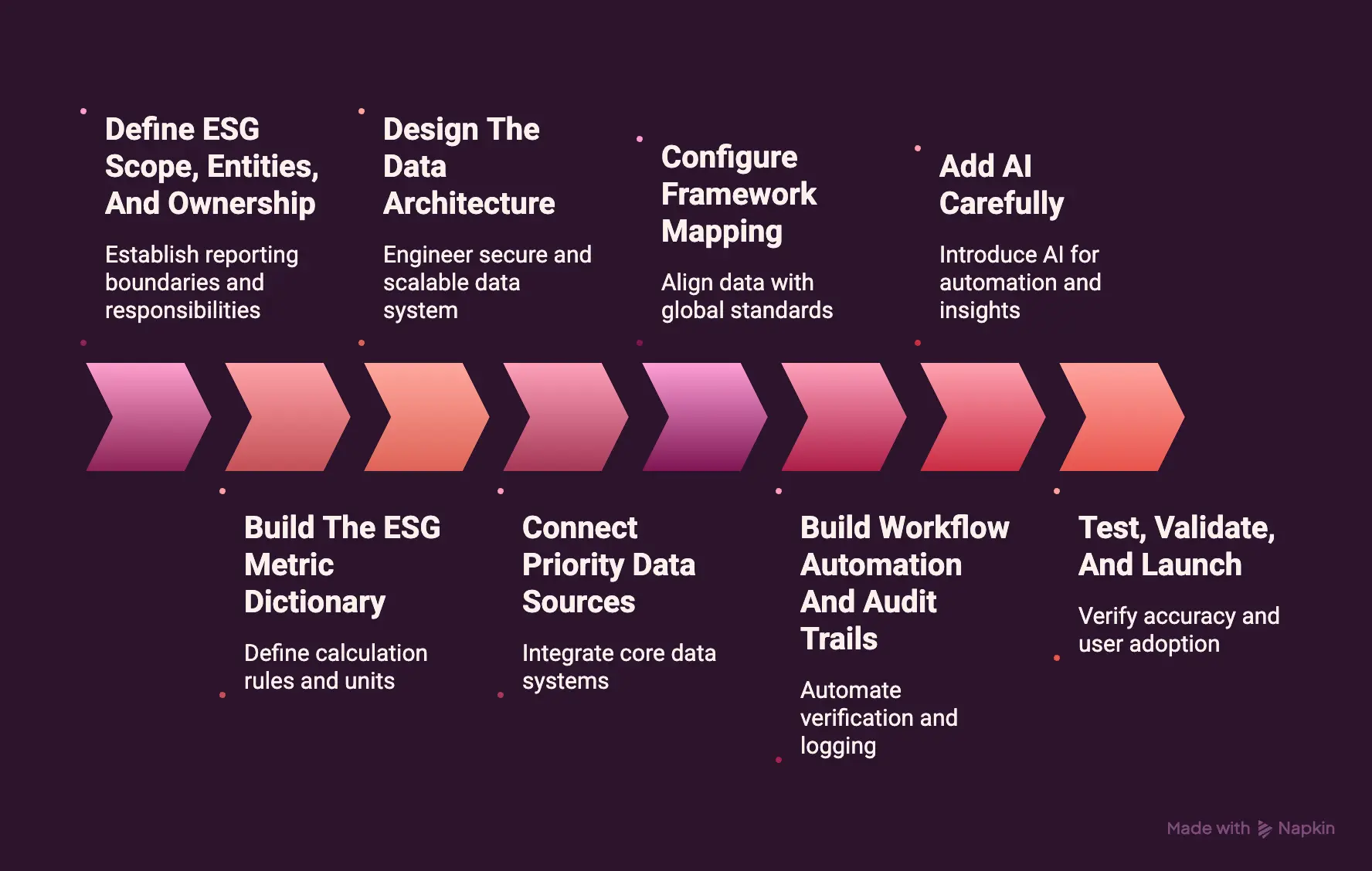
Step 1 — Define ESG Scope, Entities, And Ownership
This step defines what the platform will report, who owns each metric, and which entities fall inside the reporting boundary. CTOs and ESG leaders should map facilities, subsidiaries, suppliers, portfolios, frameworks, regions, approval owners, and reporting deadlines before engineering begins.
- Structuring the overall corporate entity hierarchy to encapsulate all active global subsidiaries and offices.
- Establishing the exact reporting boundary guidelines to differentiate between direct and indirect operational impacts.
- Developing a strict ownership matrix to assign data entry and validation tasks to specific department heads.
- Programming granular role-based access rules within the backend application layer to protect data integrity.
- Defining the core materiality scope parameters based on regional environmental and compliance requirements.
Our engineering teams start by mapping out your internal workflow and data ownership lines before writing background database dependencies. At Intellivon, we follow this approach to ensure your core software configuration naturally mirrors your actual organizational structures and reporting accountability boundaries. Once the scope is clear, the data model can support real operations.
Step 2 — Build The ESG Metric Dictionary
The metric dictionary serves as the central logic tier that defines the mathematical equations, input units, and validation parameters required for every environmental indicator. Consequently, this centralized inventory ensures that all regional business divisions calculate their environmental footprints using identical, standardized accounting rules.
- Structuring detailed metric names and strict conversion factors within custom sustainability KPI dashboard development tracks.
- Setting clear raw material unit configurations to avoid data conflicts during automated aggregation rounds.
- Configuring backend modules to integrate seamlessly with custom ESG materiality matrix software engines.
- Mapping required physical evidence criteria, such as utility bills, to individual database entry lines.
- Generating balanced double materiality assessment tool parameters to evaluate environmental impacts alongside commercial financial risks.
Subsequently, having this logical dictionary locked down prevents calculation drift when data streams from diverse global sites enter your main databases. This standard definition layer is critical for establishing trust before building out your cloud hosting architecture.
Step 3 — Design The Data Architecture
The underlying database system must be engineered to securely ingest, process, and retain millions of volatile transaction lines from disconnected corporate networks. Therefore, the architecture relies on advanced schema control and data isolation rules to maintain elite processing performance while protecting corporate confidentiality.
- Developing a high-capacity sustainability reporting API architecture to handle incoming real-time telemetry pipelines smoothly.
- Implementing a secure multi-tenant sustainability SaaS architecture to keep separate corporate divisions isolated.
- Incorporating distributed schema registries to prevent database crashes when incoming data models update.
- Applying permanent data lineage tags to automatically record the background history of every processed entry.
- Building a high-performance sustainability platform scalability design to handle massive background calculation spikes easily.
As a result, building a defensive data foundation guarantees that your application can scale smoothly as more resource streams connect over time. This structured data layer provides the essential endpoints needed to support automated enterprise integration pipelines.
Step 4 — Connect Priority Data Sources
System integration should follow a phased timeline, starting with the primary database environments that already contain your organization’s core utility consumption and purchasing records. Consequently, this step moves your compliance workflows away from manual human input dependencies and into automated data ingestion routines.
- Deploying specialized ERP ESG data integration rules to extract material purchasing logs automatically.
- Building automated utility extraction workers to capture monthly facility energy consumption statements.
- Implementing direct IoT sustainability data collection integration pipelines to monitor real-time smart meters across factory spaces.
- Creating secure, web-based spreadsheet upload forms to easily collect manual records from secondary vendors.
- Running background verification filters during initial intake to immediately flag corrupted or incomplete files.
Therefore, establishing these primary data connections ensures that your backend calculation engines operate from a continuous, verified source of truth. Once operational data flows reliably into the platform, workflows can turn it into compliant regulatory disclosures.
Step 5 — Configure Framework Mapping
The mapping layer dynamically reformats your validated metric values to clear the strict structural templates mandated by global environmental standard-setters. Therefore, the application isolates core data records from localized framework layouts, ensuring a single operational entry can fulfill several compliance requirements simultaneously.
- Structuring reusable calculation tables to support modern GRI reporting software implementation modules.
- Aligning itemized operational metrics with the industry-specific rules of a SASB framework reporting integration.
- Reorganizing climate risk indicators to feed specialized TCFD reporting platform development pipelines smoothly.
- Reformatting carbon data profiles to automatically match the questionnaire rules of CDP disclosure automation software.
- Integrating versioned framework update rules to quickly adapt mapping logic whenever international regulators alter compliance parameters.
Consequently, this automated mapping structure lowers compliance overhead during complex multinational audit rounds. It transforms raw database records into highly structured disclosures without requiring teams to build separate reporting mini-apps.
Step 6 — Build Workflow Automation And Audit Trails
Workflow automation transforms annual data assembly into a controlled, year-round routine by enforcing strict multi-stage verification steps and permanent data logging. Therefore, the system tracks every data modification, review comment, and operational sign-off to provide clear proof for external checkers.
- Deploying rule-based task routing through custom sustainability reporting workflow automation engines across divisions.
- Building an unalterable sustainability audit trail and data lineage ledger to record every database adjustment permanently.
- Constructing centralized review queues where compliance officers can easily inspect and comment on localized submissions.
- Automating period-lock parameters to freeze historical databases completely once formal sign-offs are completed.
- Generating secure, read-only evidence packages containing original utility invoices to accelerate independent third-party validation cycles.
As a result, keeping this strict verification ledger active protects your organization from reporting vulnerabilities and greenwashing risks. This data consistency ensures that downstream machine learning optimizations function with highly reliable training sets.
Step 7 — Add AI Carefully
AI should only be introduced after your underlying data schemas and human validation workflows are stable and operating reliably. Consequently, deploying analytical models onto clean records allows the system to accurately automate document reviews and discover hidden energy efficiencies safely.
- Launching an AI-powered sustainability reporting platform build featuring continuous background anomaly detection filters.
- Training machine learning forecasting engines to project future emissions trends against net-zero targets.
- Utilizing intelligent recommendation systems to suggest optimal framework destination fields to human review teams.
- Deploying modular NLP for sustainability narrative reporting engines to draft initial disclosure descriptions from ledger records.
- Restricting all automated text and calculation outputs behind mandatory internal human approval screens before publication.
Therefore, embedding clear human review controls guarantees that your automation tools remain completely accurate and audit-ready. This governed approach allows organizations to lower administrative burdens without compromising reporting safety or legal compliance.
Step 8 — Test, Validate, And Launch
The final engineering phase involves running comprehensive parallel reporting cycles alongside existing workflows to verify platform accuracy before archiving legacy spreadsheet systems. Therefore, conducting strict system validation minimizes rollout risks and ensures all user groups can manage their daily tasks confidently.
- Evaluating system infrastructure expenses against long-term sustainability, platform DevOps and maintenance cost baselines.
- Running extensive user acceptance testing with regional plant managers to verify interface ease of use.
- Reconciling automated platform calculations against historical manual ledgers to prove mathematical consistency.
- Testing system security settings to verify absolute third-party assurance and verification integration readiness.
- Launching targeted training programs to help multi-site facility groups comfortably adopt new data entry habits.
Our rollout teams utilize your parallel pilot statistics to optimize system configurations and remove data bottlenecks before initiating global platform activation. At Intellivon, we follow this testing approach to eliminate software integration issues, protect your compliance standing, and maximize your operational return on investment.
This detailed walkthrough is highly valuable because the backend infrastructure required to route and protect sensitive financial risk data is identical to the systems needed to manage verified sustainability compliance evidence.
Sustainability Reporting Tool Development Cost: $70K–$300K
Sustainability reporting tool development cost usually ranges from $70,000 to $300,000, depending on framework coverage, data integrations, Scope 3 complexity, AI features, workflow automation, assurance controls, and SaaS architecture. A focused MVP starts near $70,000, while an enterprise-grade multi-framework platform can reach $300,000.
1. Cost By Platform Tier
Enterprise implementation costs scale based on the operational scope, deployment environments, and automated data processing volumes required by your business units.
Consequently, selecting the correct initial platform tier allows organizations to efficiently validate software features before executing a global rollout.
| Platform Tier | Estimated Cost | Best For | Included Scope |
| MVP Sustainability Reporting Platform | $70,000–$110,000 | One business unit or limited enterprise rollout | Manual uploads, 1–2 frameworks, basic dashboards, simple audit trail |
| Mid-Level Enterprise Platform | $120,000–$190,000 | Multi-site organizations | ERP integration, GRI/SASB/TCFD/CSRD mapping, workflows, data quality rules |
| Advanced Enterprise Platform | $200,000–$300,000 | Healthcare systems, fintech firms, multi-entity groups | Scope 1/2/3, supplier portal, AI validation, assurance exports, multi-tenant architecture |
2. Cost By Development Phase
The total cost of building a specialized material recovery platform is determined by the complexity of your technical infrastructure layers.
Therefore, structuring your initial investments by development phase prevents unexpected budget overruns during core system construction.
| Development Phase | Estimated Cost | What It Covers |
| ESG Discovery And Scope Mapping | $6,000–$14,000 | Reporting scope, entities, frameworks, owners, materiality priorities |
| Architecture And Data Model Design | $8,000–$22,000 | ESG schema, metric dictionary, access model, API architecture |
| Data Ingestion And Integrations | $16,000–$55,000 | ERP, HRIS, utilities, procurement, suppliers, IoT, finance |
| KPI Engine And Framework Mapping | $12,000–$38,000 | GRI, SASB, TCFD, CDP, CSRD, EU Taxonomy, SEC readiness |
| Workflow And Dashboard Development | $10,000–$32,000 | Dashboards, approvals, evidence upload, role views, report builder |
| AI And Data Quality Layer | $10,000–$42,000 | Anomaly detection, narrative drafting, forecasting, mapping assistance |
| Security, Audit Trail, QA, DevOps | $8,000–$45,000 | RBAC, logs, testing, deployment, monitoring, maintenance setup |
3. Ongoing Maintenance Cost
Annual software maintenance typically costs 18% to 25% of the initial system build expenditure.
Consequently, this recurring engineering budget covers mandatory background updates to prevent system degradation as your operational environments adapt.
- Updating core framework mapping matrices when background regulatory standard-setters modify disclosure rules.
- Ingesting updated emissions factor tables automatically from international databases to maintain carbon accounting precision.
- Managing scalable backend cloud hosting infrastructure costs as your tracked data records expand.
- Monitoring live API connection layers to ensure continuous ingestion from ERP and utility networks.
- Tracking machine learning metrics to prevent model drift across automated text and anomaly filtering tools.
- Modifying user dashboard views and report builders based on internal stakeholder performance needs.
- Patching system security configurations continuously to defend against evolving data network vulnerabilities.
- Providing continuous technical assurance support during third-party independent corporate audit reviews.
The real cost driver is not the dashboard. It is the number of systems, frameworks, evidence controls, and AI workflows the platform must support. After cost, the post should explain SaaS and multi-tenant build decisions.
Build Enterprise Sustainability Reporting Software With Intellivon
Intellivon helps enterprises build sustainability reporting platforms that turn fragmented ESG, carbon, supplier, facility, and finance data into audit-ready reporting infrastructure.
Instead of delivering a generic dashboard, the team provides the strategy, architecture, AI engineering, compliance controls, integrations, and long-term product support needed to make sustainability data reliable, reusable, and decision-ready.
1. Get A Platform Built Around Your ESG Reporting Reality
Most enterprises already have ESG data scattered across spreadsheets, ERP exports, supplier emails, utility bills, procurement records, HR systems, and consultant-owned files.
Intellivon converts that fragmented reporting process into a structured platform that matches how your organization actually reports.
- ESG data inventory across spreadsheets, systems, and teams
- Reporting boundaries for entities, facilities, suppliers, and portfolios
- Framework priorities for CSRD, GRI, SASB, TCFD, CDP, and SEC readiness
- Data ownership workflows for ESG, finance, procurement, and operations
- Evidence requirements for audit, assurance, and internal review
- Role-specific workflows for ESG teams, reviewers, suppliers, and executives
2. Connect Sustainability Data Across Enterprise Systems
Intellivon builds the integration backbone needed to pull sustainability data from the systems your organization already uses.
This helps ESG teams avoid manual exports, duplicate entries, email-based evidence collection, and disconnected reporting cycles.
- ERP and finance integrations for spend, vendors, cost centers, and assets
- HRIS integrations for workforce, training, safety, and governance metrics
- Procurement integrations for supplier ESG data and Scope 3 categories
- Utility and facility integrations for energy, water, waste, and emissions
- Supplier portals for ESG requests, evidence uploads, and follow-ups
- Healthcare data flows for facility energy, medical waste, fleet, and procurement
- Fintech data flows for portfolio ESG, financed emissions, SFDR, and green bonds
- API and cloud architecture for secure, scalable ESG data movement
3. Add AI Where It Reduces Manual ESG Review Work
Intellivon adds AI where it improves accuracy, review speed, and decision-making without weakening disclosure trust.
Every AI-generated insight, draft, or recommendation can connect back to source data, evidence records, reviewer approval, and audit logs.
- Anomaly detection for missing, unusual, or inconsistent ESG data
- Supplier document extraction from invoices, certificates, and policy files
- Evidence classification for audit-ready metric support
- Framework mapping suggestions for GRI, SASB, TCFD, CSRD, and CDP
- Emissions forecasting for target tracking and climate risk planning
- Narrative drafting from approved ESG metrics and source evidence
- Human review workflows for every AI-assisted reporting output
- Model monitoring and governance for long-term AI reliability
4. Build With Compliance, Audit, And Scale From Day One
Intellivon designs sustainability reporting platforms with compliance and audit readiness built into the core system.
This allows enterprises to support annual disclosures, internal reviews, external assurance, supplier follow-ups, framework changes, and future AI expansion.
- Role-based access control for ESG, finance, legal, suppliers, and auditors
- Encryption for sensitive ESG, supplier, financial, and operational data
- Audit logs showing who changed each metric, when, and why
- Evidence vaults for invoices, supplier files, calculations, and approvals
- Locked reporting periods for annual and quarterly disclosure cycles
- Reviewer comments and approval history for assurance preparation
- DevOps monitoring for platform reliability after launch
- MLOps workflows for AI validation, monitoring, and model updates
- Framework update support for CSRD, ESRS, GRI, SASB, CDP, and TCFD
5. Work With A Team That Understands Regulated AI Systems
Intellivon brings enterprise AI and regulated software experience into sustainability reporting platform development.
The team is built for organizations that need production systems, complex integrations, compliance-ready architecture, and long-term product reliability.
- 500K+ engineering hours across enterprise software delivery
- ex-MAANG engineering expertise for complex system architecture
- healthcare and fintech AI delivery experience
- HIPAA-ready architecture experience for regulated environments
- AI, LLM, MLOps, and agentic AI engineering capabilities
- production-first development approach, not proof-of-concept delivery
- experience with complex enterprise integrations and workflow automation
- compliance-ready platform engineering for audit-heavy use cases
The result is a sustainability reporting platform that supports more than report publishing. It gives leaders a trusted operating layer for ESG data, carbon reporting, supplier evidence, AI-assisted review, audit preparation, and long-term sustainability decisions.
Conclusion
Building a custom sustainability reporting platform changes environmental tracking from an annual compliance project into a live, automated enterprise asset. By replacing manual spreadsheets with a secure eight-layer data architecture, large organizations can eliminate multi-site data blind spots, streamline Scope 3 data collection, and protect themselves against changing global regulations.
Success depends on establishing an audit-ready, fully traceable data ledger before launching advanced automation or AI tools. Moving forward, clean, verifiable material data will be a vital operational requirement for maintaining long-term market access and capital growth.
Things To Know About Sustainability Reporting Software Development
Q1. How should enterprises choose ESG reporting software today?
A1. Enterprises must prioritize data architecture and framework flexibility over basic feature checklists. Consequently, choosing a system with a unified data model ensures calculation traceability across shifting regulations like the CSRD. Furthermore, teams should evaluate integration capabilities with core ERP systems to prevent expensive manual data remediation.
Q2. Is carbon accounting software enough for ESG reporting teams?
A2. Carbon accounting software is completely insufficient for comprehensive ESG teams because it only satisfies the environmental pillar. In contrast, modern compliance rules require rigorous tracking of social metrics and internal board governance. Therefore, teams need broad platforms that integrate human resource data, supplier audits, and unalterable governance records.
Q3. Why is Scope 3 supplier data so difficult to trust today?
A3. Scope 3 data is highly untrustworthy because it traditionally relies on loose, spend-based financial proxies rather than verified supplier metrics. However, recent Phase 1 updates to the GHG Protocol mandate primary data validation. Consequently, platforms must deploy automated supplier portals to replace vague industry averages with audit-ready documentation.
Q4. How should teams choose and update emissions factor sources?
A4. Teams should choose emissions factors strictly from verified, globally recognized databases like the EPA, DEFRA, or the GHG Protocol. Subsequently, the platform architecture must automatically ingest annual registry updates via secure APIs. This automated updating layer ensures calculation precision and protects the company from severe greenwashing litigation risks.
Q5. How much do ESG tools and carbon reporting tools cost?
A5. Custom sustainability reporting tools typically cost $70,000 to $300,000 to develop. Meanwhile, off-the-shelf software licenses scale by facility counts and integration depth, often incurring heavy secondary deployment fees. Therefore, total cost of ownership modeling must budget for continuous framework updates, API maintenance, and mandatory third-party independent assurance reviews.
To Sum Up:
- A sustainability reporting platform should not store the same ESG metric in five places. One validated data point should map across GRI, SASB, TCFD, CDP, CSRD, and internal board reporting.
- The hidden cost in ESG platform development is not the dashboard. It is the evidence layer behind every emissions figure, supplier response, AI-generated paragraph, and assurance export.
- AI should not write sustainability disclosures from loose documents. It should draft from locked metrics, approved evidence, and traceable source files.
- Healthcare and fintech ESG platforms cost more because sustainability data connects to regulated operating environments, not just voluntary reporting templates.
- Build versus buy is the wrong first question. The better question is which sustainability controls your enterprise must own, customize, and defend during an audit.