Key Takeaways:
-
AI strategic sourcing platforms start with source-to-contract mapping, spend modeling, and RFx automation.
-
Supplier intelligence, AI scoring, ERP, GPO, and CLM integrations are core production architecture requirements.
-
HIPAA-safe workflows, BAA controls, FDA supplier evidence, and ESG scoring define healthcare-grade enterprise builds.
-
Focused MVPs cost $70,000 to $110,000, while enterprise healthcare builds reach $210,000 to $300,000.
-
How Intellivon builds strategic sourcing as owned infrastructure with auditable award logic and measurable savings realization.
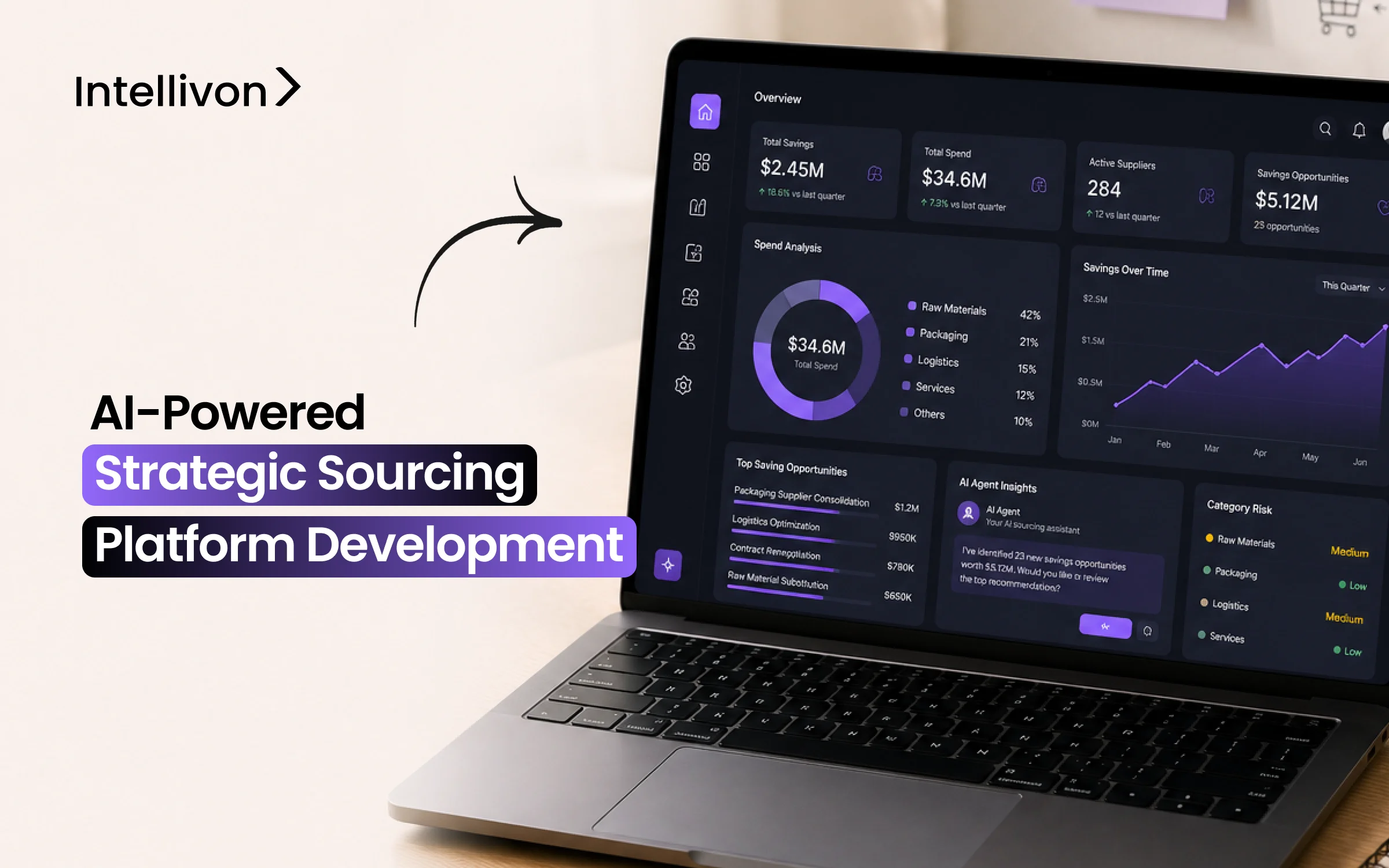
Building an AI strategic sourcing platform starts with the category intelligence layer. That layer classifies spend, profiles suppliers, and segments categories before any automation is added. From there, generative AI handles RFP drafting and contract creation. ML models then score bids, rank suppliers, and generate should-cost estimates. Finally, agentic AI orchestrates multi-step sourcing workflows across all categories autonomously.
The category intelligence layer determines whether the AI produces recommendations teams can act on. When spend data is uncategorized, RFP automation and bid scoring run on unreliable inputs. The GAO found that companies managing 90% of their procurements strategically report annual savings of 10% or more. Organizations managing just 5% strategically report significantly lower returns. The category intelligence layer is therefore the decision that determines which outcome the platform delivers.
This blog covers AI strategic sourcing software development the way Intellivon builds it, starting with category intelligence and spend data model design. From there, it walks through RFP automation, bid scoring, should-cost modeling, and GPO integration.
What Is An AI Strategic Sourcing Platform?
An AI strategic sourcing platform is an enterprise software system that uses machine learning and natural language processing to automate procurement cycles. The platform continuously ingests market data, drafts complex request documents, and evaluates incoming supplier bids. Consequently, it removes manual intervention from supplier matching and spend analysis workflows.
This automated infrastructure allows global enterprises to accelerate procurement timelines, minimize operational risk, and uncover hidden cost-saving opportunities.
1. The Platform Connects Spend, Suppliers, And Contracts
- Spend Data and Core Masters: Synthesizes historical ledger entries with live item masters and supplier masters to establish baseline pricing trends.
- Contracts and Pricing Histories: Links historical legal boundaries directly with past pricing history data to instantly expose out-of-contract transaction anomalies.
- Live Risk Feeds and Project Records: Feeds active geopolitical risk logs and active sourcing project records into the central engine to prevent operational disruptions.
- Intellivon’s Data Integration Approach: We anchor this information layer to specialized parsing engines that continuously extract data from complex, unstructured procurement files.
2. It Turns RFx Workflows Into Controlled Decision Systems
- Generative AI RFx Creation: Automatically drafts context-aware RFI, RFP, and RFQ documents by referencing historical category specifications.
- Dynamic Sourcing Event Execution: Launches real-time reverse auction events while continuously monitoring active participant bid scoring thresholds.
- Automated Selection Mechanics: Compiles multi-variable award recommendation lists and routes them through strict corporate approval logic rules.
- Intellivon’s Automation Blueprint: Our custom AI strategic sourcing system development guide blueprints show that converting raw text inputs into structured data arrays eliminates manual calculation errors entirely.
3. It Supports Sourcing Teams, Not Full Autonomy
- Accelerated Top-of-Funnel Efficiency: The software handles repetitive tasks like rapid document drafting, multi-vendor comparison, and raw data extraction.
- Human-Led Strategic Control: Experienced human practitioners maintain complete authority over final category judgment, direct supplier relationships, and stakeholder management.
- Hybrid Operational Guardrails: The platform provides clear explanations behind its mathematical scoring metrics to help human users make defensible decisions.
- Intellivon’s Co-Pilot Framework: We engineer modern AI strategic sourcing software to serve strictly as an interactive co-pilot, keeping human oversight at the absolute center of every high-value negotiation step.
An AI strategic sourcing platform acts as an intelligent co-pilot that connects disconnected spend, contract, and vendor files into a unified analytical layer. Consequently, this system automates heavy administrative workflows like RFP drafting while leaving final strategic category decisions fully in human hands.
Why Enterprises Need AI Strategic Sourcing Software
The fundamental driver for modern procurement is not the abstract “AI transformation.” Instead, executives require faster, fully auditable sourcing across fragmented ERPs, spreadsheets, and contract repositories.
According to Polaris Market Research, the global procurement software market reached USD 10.43 billion in 2026, expanding at a steady 9.92% CAGR. This rapid market expansion underscores the urgent enterprise necessity for unified, automated transaction environments.
- Manual RFx Limitations: Disconnected supplier emails and manual negotiation preparation cycles slow down corporate execution and cloud-critical audit logs.
- Volatile Supplier Risk: Live vendor financial health, shifting geopolitical factors, and quality alerts change much faster than standard quarterly human reviews can detect.
- Healthcare Evidence Control: To build a compliant healthcare AI strategic sourcing platform development framework, networks mandate strict BAA status, FDA controls, and formal committee approvals.
- Fintech Risk Alignment: Financial systems requiring a fintech AI strategic sourcing platform need automated vendor due diligence, clear risk tiering, and zero-trust audit trails.
Ultimately, deploying specialized automation protects high-volume pipelines from human error. Choosing to build an AI-driven sourcing platform for enterprises eliminates cross-system data blind spots
Where AI Creates Sourcing ROI First
AI sourcing ROI appears fastest when the platform reduces manual analysis before trying to automate final decisions. Specifically, McKinsey research indicates that AI task-level tools and copilots can improve procurement productivity by 25% to 40%.
Core High-Yield ROI Use Cases
- Spend Classification Savings: Machine learning pipelines ingest historical ledger data to automate AI spend forecasting for sourcing and drive demand aggregation.
- RFQ Normalization Speed: Systems parse incoming multi-format supplier quote documents, converting messy text into structured, standardized tables for rapid side-by-side comparison.
- Supplier Shortlisting Efficiency: The architecture connects an automated supplier discovery and matching engine with an internal supplier market intelligence AI platform to cut initial vendor screening times down to hours.
- Contract Analysis Acceleration: Algorithms review complex contract clauses to flag hidden financial liabilities while managing the downstream contract lifecycle management integration.
- Tail Spend Automation Control: The software uses guided buying patterns and preferred supplier recommendations to catch and eliminate costly corporate maverick spend anomalies.
Consequently, executing an intentional, phased implementation strategy helps enterprise teams capture immediate financial value. Focusing early development on AI cost reduction opportunity identification and savings tracking and realization software modules establishes a highly transparent, audit-ready operational framework.
Prioritizing data structure and automated classification generates the fastest measurable software financial returns. Therefore, this focused strategy allows companies to eliminate manual review bottlenecks across complex category pipelines before introducing autonomous negotiation elements.
Core Workflows The Platform Must Automate
The core design principle of an AI-powered strategic sourcing platform development initiative is to automate the repeatable administrative structure surrounding procurement, rather than removing human judgment.
For instance, SAP’s corporate procurement framework establishes that embedding AI directly into workflow touchpoints can shorten strategic sourcing cycles by up to 60% while protecting audit integrity. Therefore, the system architecture must be designed around an end-to-end automated workflow that maps directly to the standard source-to-contract lifecycle.
The matrix below provides a technical breakdown of how a custom architecture transforms each phase of the sourcing lifecycle into a controlled, machine-assisted decision process:
Core Workflow Table
| Sourcing Phase | Core Technical Automation Function | Intellivon Engineering & Implementation Design |
| Intake & Sourcing Project Creation | Implements intelligent intake forms that parse unformatted user emails and check them against category hierarchies. | We deploy NLP models that map unstructured user requests into predefined taxonomies while automating stakeholder approval routing. |
| AI RFP & RFQ Generation | Uses large language models to assemble dynamic context-aware bidding packets from historical libraries. | We link generative models to locked organizational requirement templates to enforce rigid regulatory guidelines without manual drafting. |
| Bid Evaluation & Award Scoring | Deploys multivariable scoring algorithms to normalize incoming vendor PDFs into standardized pricing lines. | We connect the scoring matrix to live should-cost modeling engines to automatically flag bid deviations greater than 15%. |
| Reverse Auctions & Dynamic Pricing | Orchestrates real-time reverse auction environments featuring automated, algorithmically driven participant messaging. | We build deterministic rule engines that monitor real-time commodity pricing tickers to instantly alter bidding rules mid-event. |
| Savings Tracking & Realization | Calculates continuous variances between baseline historical prices, negotiated prices, and realized transactional spend. | We build direct financial data pipelines into corporate ledger layers to provide verified, audit-ready cost reduction dashboards. |
| Supplier Onboarding & Qualification | Executes automated credential checks across external sanction lists, banking databases, and security systems. | We engineer isolated validation pipelines that mandate formal BAA status checks before clearing medical and fintech suppliers. |
An AI-driven source-to-contract infrastructure successfully captures hard cost savings by systematically eliminating process friction across every transaction gate.
Consequently, this deep technical orchestration ensures that internal procurement teams spend their time on high-value supplier negotiation instead of managing manual email logs.
AI Strategic Sourcing Software Architecture
An enterprise-grade sourcing architecture must separate core workflow control, deterministic business logic, non-deterministic AI recommendations, integration services, and immutable audit logs. Therefore, this structural separation ensures that large language models remain restricted to analytical assistance rather than making unsupervised procurement awards.
Consequently, the core code remains completely transparent, predictable, and audit-ready for strict enterprise validation protocols.
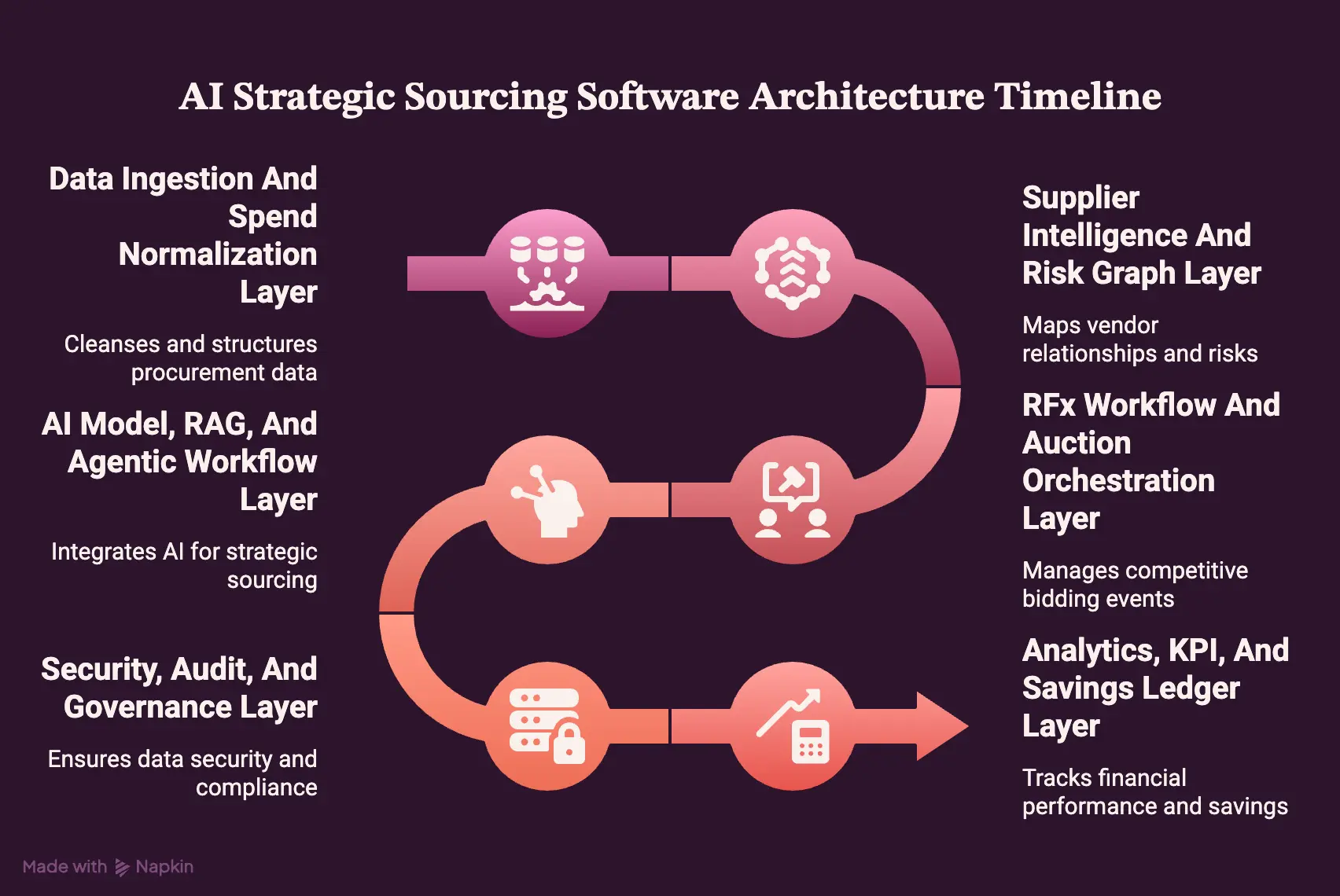
1. Data Ingestion And Spend Normalization Layer
To build a reliable analytics foundation, the system must clean highly messy transactional text generated across diverse global business units. This preliminary processing transforms fragmented procurement line items into structured, highly accurate accounting objects:
- Multiversion Data Harmonization: Cleanses, deduplicates, and standardizes highly fragmented ledger exports, item masters, and supplier masters into unified data objects.
- Taxonomic Mapping Pipeline: Evaluates irregular transaction lines, invoice details, and PO lines to programmatically map legacy records to standard UNSPSC categories.
- Automated Data Lake Routing: Deploys specialized ETL ingestion microservices that automatically isolate duplicate vendor files before writing clean records into the primary data lakehouse.
2. Supplier Intelligence And Risk Graph Layer
Procurement leaders require dynamic visibility into vendor vulnerability networks to prevent unpredictable downstream supply chain stoppages. This graph-based relational framework continuously maps underlying corporate connections and live operating liabilities:
- Relational Entity Mapping: Establishes clear parent-child corporate relationships while logging global facility locations and tracking mandatory vendor certifications.
- Dynamic Threat Feeds: Connects to international risk streams to generate live financial risk rankings, delivery logs, and ESG sustainability scores.
- Decoupled Database Engineering: Incorporates a dedicated graph database system that maps global modern slavery checks and geopolitical risk parameters directly to active corporate vendor accounts.
3. RFx Workflow And Auction Orchestration Layer
Managing competitive enterprise bidding events demands high transactional stability alongside secure multi-tenant data barriers. This processing layer handles intensive negotiation communication without compromising internal corporate pricing secrets:
- Transactional Gate Orchestration: Manages standardized sourcing event templates, multi-stage RFx rounds, active clarifications, and historical response tracking records.
- High-Frequency Pricing Environments: Drive secure, multi-tenant sealed bidding structures alongside real-time reverse auction mechanisms configured with strict corporate approval gates.
- Stateless Event Processing: Runs high-frequency transaction engines using isolated message queues to ensure highly resilient, low-latency performance during peak auction events.
4. AI Model, RAG, And Agentic Workflow Layer
Integrating large language models’ strategic sourcing capabilities requires enclosing conversational tools inside deterministic execution gates. This specialized intelligence layer automates high-volume text analysis while maintaining strict operational predictability:
- Contextual Document Analysis: Uses advanced machine learning networks to execute secure retrieval-augmented generation (RAG) processes over dense historical contract portfolios.
- Orchestration Pipeline Logic: Empowers specialized agentic AI sourcing workflow orchestration blocks to draft initial bidding documents while maintaining a strictly controlled autonomous sourcing AI platform architecture.
- Semantic Guardrail Integration: Embeds strict formatting rules and output temperature controls across the prompt engineering framework to eliminate arbitrary model hallucinations.
5. Security, Audit, And Governance Layer
Regulated industries mandate complete data separation alongside permanent, unalterable accountability records for every procurement event. This compliance infrastructure wraps all analytical operations in a strict zero-trust network boundary:
- Zero-Trust Identity Infrastructure: Implements highly granular role-based access control (RBAC) protocols to restrict sensitive cost data to authorized personnel.
- Immutable Transaction Loggers: Records comprehensive approval sequences, historic model output versions, and explicit reviewer overrides into encrypted storage sectors.
- Compliant Workflow Architecture: Establishes fully PHI-safe sourcing workflow automation layers backed by automated zero-trust sourcing platform security mechanisms to handle sensitive healthcare data.
6. Analytics, KPI, And Savings Ledger Layer
Converting corporate sourcing pipelines into verified financial performance requires continuous, algorithmically validated mathematical tracking. This real-time reporting ledger connects daily transactional operations directly with corporate cash reserves:
- Real-Time Performance Dashboards: Track essential metrics including active pipelines, real-time sourcing KPI tracking figures, and formal supplier performance benchmarking indexes.
- Financial Integrity Verification: Mainlines historical cost baselines against negotiated prices to post direct, auditable ledger data into corporate savings accounts.
- Automated Compute Engines: Implement database triggers that continuously compute organizational sourcing ROI measurement data without requiring manual tracking updates.
Adopting a modular, multi-tenant AI sourcing SaaS design allows engineering teams to separate unpredictable AI inference tasks from mission-critical workflow components. As a result, this clean AI sourcing platform microservices architecture guarantees enterprise stability while providing clear, human-verifiable evidence behind every system recommendation.
AI Models That Power Strategic Sourcing
An enterprise platform requires a coordinated matrix of specialized machine learning models rather than a single conversational chatbot. Therefore, the engineering architecture separates deterministic business rules from non-deterministic cognitive models to preserve processing predictability.
Consequently, the platform coordinates classification, extraction, text generation, and mathematical scoring tasks across distinct, isolated computing layers to deliver highly auditable procurement insights.
The table below outlines the core AI models required, their specific technical functions, and their practical application within enterprise workflows:
AI Models Comparison Table
| AI Model Type | Core Technical Function | Practical Procurement Application |
| NLP Document Extraction | Uses named entity recognition (NER) to isolate unstructured data inside dense compliance records. | Automates NLP sourcing, document analysis and extraction across diverse supplier insurance files and BAA certificates. |
| Machine Learning (ML) | Deploys supervised classification pipelines alongside unsupervised vector clustering algorithms. | Drives machine learning, strategic sourcing, and software development frameworks to cleanse messy multi-currency invoice lines. |
| Semantic Matching Engine | Implements dense vector embeddings to calculate directional similarity scores between supplier profiles. | Connects an automated AI supplier discovery and matching engine directly to external international vendor directories. |
| Time-Series Forecasting | Utilizes autoregressive integrated moving average (ARIMA) models to evaluate historical purchase volumes. | Powers high-price benchmarking and market analysis AI modules to deliver real-time demand aggregation alerts. |
| Large Language Models (LLMs) | Orchestrates context-aware transformer networks to read and draft complex legal and technical procurement prose. | Accelerates generative AI sourcing platform development by creating custom AI contract negotiation preparation software scripts. |
| Explainable AI (XAI) | Integrates structured SHAP (Shapley Additive exPlanations) values to clarify underlying multi-criteria algorithmic weights. | Supplies complete explainable AI sourcing recommendations to ensure internal compliance teams can verify final vendor selections. |
Combining multiple targeted models ensures high precision across both numerical prediction and textual drafting tasks. As a result, this unified system architecture provides time-pressed executives with defensible, explainable data points to justify complex corporate award decisions.
Healthcare Sourcing Compliance Requirements
A healthcare AI strategic sourcing platform must manage procurement evidence using strict clinical, regulatory, and privacy controls to satisfy institutional audit demands. Specifically, the software must enforce HIPAA mandates that oblige covered entities and their business associates to execute binding contracts safeguarding protected health information (PHI).
Consequently, the underlying system architecture must isolate non-deterministic AI actions behind rigid deterministic guardrails to prevent unverified purchasing decisions that could directly compromise patient safety margins.
The comparative matrix below details how the software automates specific compliance layers across the clinical supply chain:
Healthcare Compliance Table
| Regulatory Framework | Core System Enforcement Mechanism | Target Sourcing Documentation |
| HIPAA Privacy & Security Rules | Implements a strict HIPAA-compliant sourcing data architecture using automated PII/PHI redaction shields at the application boundary. | Business Associate Agreements (BAAs), vendor banking logs, and clinical trial sourcing files. |
| FDA Quality Management System Regulation (QMSR) | Enforce explicit, continuous risk-based vendor tracking aligned with ISO 13485:2016 to replace static, obsolete annual verification registers. | Approved Supplier Lists (ASL), supplier quality agreements, and component verification records. |
| Joint Commission Accreditation Standards | Compiles immutable, time-stamped maintenance logs and safety credentials to guarantee immediate survey readiness. | Capital equipment sourcing files, sterilization credentials, and vendor facility access logs. |
| GPO & Formulary Controls | Cross-references active line-item bids against institutional group purchasing organization (GPO) tier pricing structures dynamically. | Value analysis committee files, clinical preference items, and national drug formulary lists. |
Building a compliant healthcare procurement system requires anchoring conversational AI agents to immutable validation rules.
Therefore, this structured approach ensures that clinical category AI sourcing automation modules can rapidly draft complex contracts while maintaining an unalterable, audit-ready decision record for federal investigators.
ESG, CSDDD, And Supplier Risk Intelligence
Environmental, social, and governance (ESG) metrics cannot sit in an isolated dashboard if enterprise procurement teams must apply them during supplier selection.
Following the adoption of the EU Corporate Sustainability Due Diligence Directive (CSDDD), multinational firms must integrate environmental and human rights screening directly into their core value chains to avoid massive statutory fines.
- ESG Scoring Inside Supplier Selection: Connects a sustainable sourcing AI automation framework with international rating engines to weigh vendor responsibility metrics alongside cost during live bid evaluation cycles.
- CSDDD Value Chain Due Diligence: Coordinates CSDDD sourcing compliance automation matrices that scan global trade databases to flag human rights violations and trigger automated escalation workflows.
- Scope 3 Carbon Impact Logic: Deploys a Scope 3 emissions sourcing optimization AI module to convert transactional spend lines into verifiable greenhouse gas metrics across your upstream logistics networks.
- Modern Slavery Evidence Trails: Uses natural language processing models to extract hidden compliance risks from supplier questionnaires and monitor certification renewal deadlines.
- Supplier Diversity Governed Data Fields: Builds a supplier diversity AI sourcing integration pipeline that audits minority-owned business certifications across verified federal data registries.
Embedding compliance analytics directly into the central sourcing environment protects value chain resilience while insulating the enterprise from legal liability.
Consequently, automating this heavy validation layer ensures that procurement teams satisfy strict international environmental regulations without slowing down essential operations.
How To Build AI Strategic Sourcing Software
Executing a successful enterprise AI sourcing platform development roadmap requires building software in highly controlled, predictable phases rather than attempting a single, monolithic release. Specifically, this structured progression prevents engineering teams from embedding non-deterministic machine learning tools into broken, manual transactional environments.
Consequently, by first stabilizing core data entities, validation logic, and access rules, organizations create a dependable operational substrate. Therefore, this phased framework ensures the system delivers highly auditable recommendations while mitigating downstream integration failures.
To illustrate the technical progression from initial process mapping to full deployment, the system must establish several foundational engineering milestones:
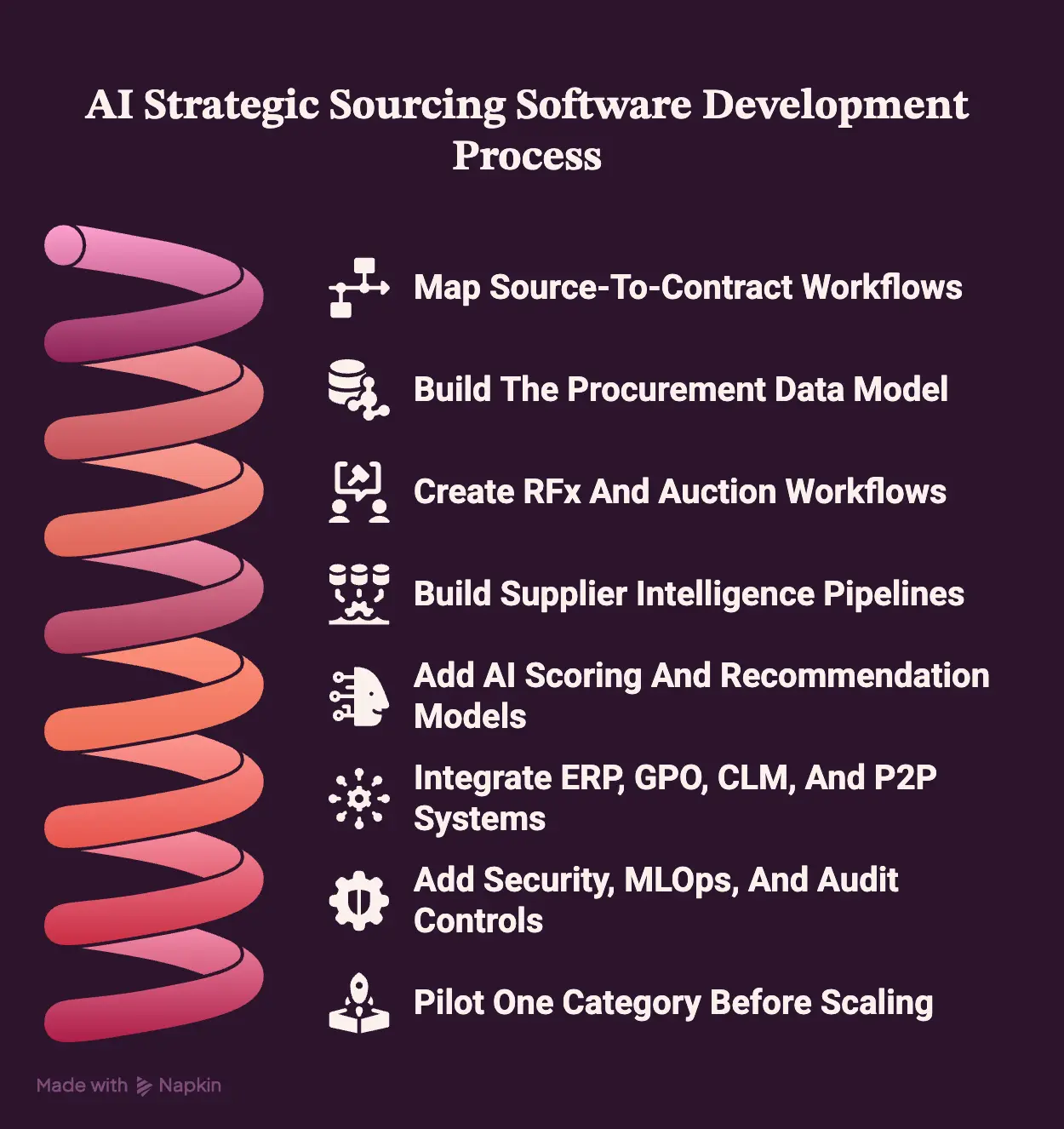
1. Map Source-To-Contract Workflows
Before writing application code, engineers must map the complete transactional path to enforce strict operational continuity across distinct procurement actions. This fundamental mapping ensures that all physical and digital touchpoints remain captured in a single transaction log:
- Transactional Touchpoints: Details critical operational steps, including initial intake, category planning, RFP/RFQ generation, supplier Q&A, bid rounds, negotiation, and formal contract handoff.
- Post-Award Verification: Connects initial award parameters directly with downstream vendor onboarding and automated savings tracking modules.
- System Action: Translates standard business requirements into strict, programmatic state machines that govern document routing.
2. Build The Procurement Data Model
Enterprise procurement platforms require a highly structured relational core to prevent data leakage and maintain transactional integrity across cross-border divisions. This underlying data model standardizes diverse organizational files into unified database objects:
- Core Entities: Establishes formal, linked tables for individual supplier records, category hierarchies, item masters, facility locations, and contract portfolios.
- Transactional History: Tracks historical records covering open bids, supplier evaluation scorecards, dynamic approval histories, and live savings accounts.
- System Action: Enforces rigid foreign key constraints across the central repository to ensure all active transactions tie back to verified vendor profiles.
3. Create RFx And Auction Workflows
Competitive bidding requires high system performance paired with complete cryptographic data isolation between competing external participant groups. This processing engine manages intensive document exchanges without exposing sensitive corporate pricing thresholds:
- Event Formats: Support automated RFI, RFP, and RFQ generation cycles alongside multi-tenant sealed bidding parameters.
- Dynamic Environments: Coordinates real-time reverse auction events governed by strict automated supplier notification systems and active clarification logs.
- System Action: Deploys isolated message queues to process high-frequency participant bids sequentially while enforcing unalterable close deadlines.
4. Build Supplier Intelligence Pipelines
To insulate global operations from volatile market conditions, the core analytical engine must look past static, outdated vendor registration files. This ingestion layer aggregates diverse external data streams into a single master dashboard:
- External Data Inputs: Ingests live third-party credit scores, international sanction registries, global ESG indicators, and active delivery logs.
- Healthcare Evidence Control: Links active corporate vendor profiles to real-time GPO contract statuses and updated FDA regulatory compliance files.
- System Action: Automatically polls external compliance APIs every 24 hours to flag active vendor credential changes instantly.
5. Add AI Scoring And Recommendation Models
Integrating analytical intelligence requires wrapping advanced predictive models inside deterministic verification gates to eliminate mathematical errors. This scoring engine translates unstructured proposals into standardized, comparable data:
- Advanced Analytics: Coordinates multivariable bid scorecards, intelligent supplier matching logic, live price anomaly indicators, and should-cost modeling engines.
- Explainable Outputs: Integrates explicit, structured weighting parameters to clarify the specific variables driving individual vendor rankings.
- System Action: Evaluates incoming multi-format quotes against historical pricing histories to highlight hidden cost reduction opportunities.
6. Integrate ERP, GPO, CLM, And P2P Systems
A strategic procurement platform cannot operate as an isolated data silo if the enterprise expects to capture true realized savings. This integration layer bridges strategic decision systems with downstream financial execution tools:
- Enterprise Integrations: Bridges core workflows directly to existing SAP Ariba, Oracle Procurement Cloud, Coupa, Jaggaer, and NetSuite installations.
- Document Synchronization: Maintains bi-directional API links with internal Contract Lifecycle Management (CLM) databases and Procure-to-Pay (P2P) purchase order networks.
- System Action: Triggers automated purchase requisition updates inside the secondary ERP immediately after a primary award gets finalized.
7. Add Security, MLOps, And Audit Controls
Regulated enterprise environments demand uncompromising data protection protocols alongside absolute visibility into all system-generated predictions. This defensive infrastructure wraps the entire software architecture in a rigid security boundary:
- Defensive Guardrails: Integrates granular role-based access control (RBAC), Single Sign-On (SSO) authentication, and end-to-end database encryption shields.
- Model Performance Monitoring: deploys continuous model drift detection, sourcing AI pipelines to track performance drops while enforcing strict prompt injection controls.
- System Action: Encrypts and writes every algorithmic calculation, human approval, and manual override to an immutable, append-only system audit log.
8. Pilot One Category Before Scaling
Attempting to launch an autonomous sourcing system across all corporate spend divisions simultaneously introduces unacceptable operational change risks. This targeted deployment strategy verifies system logic inside a controlled environment:
- Targeted Scopes: Limits initial launch to a single high-value, high-volume division such as clinical medical supplies, purchased services, or tail spend.
- Performance Baselines: Measures initial platform throughput, user adoption rates, and software ROI before expanding across other divisions.
- System Action: Restricts early system access to a small core group of category managers to gather explicit validation feedback.
Determining how to build AI strategic sourcing software requires prioritizing a robust, highly auditable data infrastructure over conversational software components.
Consequently, anchoring specialized machine learning models to a modern, automated AI sourcing platform, DevOps, and CI/CD pipeline guarantees high transactional stability while shielding your core procurement value chain from integration bottlenecks.
AI Strategic Sourcing SaaS Platform Development Cost
An enterprise AI strategic sourcing SaaS platform development cost usually ranges from $70,000 to $300,000, depending on workflow depth, AI model complexity, ERP/GPO/CLM integrations, healthcare compliance, ESG scoring, multi-tenant SaaS design, and production monitoring.
According to recent data from Fortune Business Insights, the global vendor management software market is expanding at an 11.49% CAGR, highlighting the intense enterprise demand for robust, automated third-party workflow integration.
AI Strategic Sourcing SaaS Platform Cost
| Development Phase | What It Includes | Estimated Cost |
| Discovery & Mapping | Source-to-contract mapping, user roles, approval paths, and business ROI model mapping. | $8,000–$18,000 |
| Data Model & Architecture | Supplier, item, contract, bid, risk, ESG, savings, and cost-center relational database schemas. | $10,000–$25,000 |
| RFx & Workflow Module | Intelligent intake forms, RFI/RFP/RFQ generation engines, automated supplier Q&A, and approval logic. | $18,000–$45,000 |
| AI Models & Scoring | NLP contract extraction, spend classification, supplier matching, and explainable scoring models. | $20,000–$70,000 |
| System Integrations | Direct secure API pipelines to legacy ERP, P2P, CLM, and GPO contract databases. | $18,000–$60,000 |
| Compliance & Security | HIPAA-safe routing, BAA data tags, immutable system audit logs, RBAC, and data encryption. | $12,000–$35,000 |
| QA, DevOps, & Launch | Automated test scripts, CI/CD pipelines, secure staging, production monitoring, and pilot launch. | $10,000–$28,000 |
MVP Build ($70,000–$110,000): Focuses on automating one or two critical sourcing categories with basic RFQ/RFP automation, weighted scoring, manual file uploads, and limited ERP export capabilities.- Mid-Level Platform ($120,000–$200,000): Supports multi-category strategic sourcing programs with dedicated supplier portals, AI bid evaluation, downstream contract handoffs, ESG data fields, and 1 to 3 native integrations.
- Enterprise AI Platform ($210,000–$300,000): Built for heavily regulated healthcare or fintech environments needing GPO integration, HIPAA/BAA controls, FDA evidence logs, explainable AI scoring, and full MLOps data drift tracking.
- Ongoing Maintenance (15%–25% Annually): Covers secure cloud computing hosting, critical application security patches, integration pipeline changes, machine learning model retraining, and evolving compliance updates.
Balancing initial capital requirements against downstream functional needs ensures high long-term software ROI.
Consequently, starting with a targeted MVP build allows your organization to automate heavy administrative friction before introducing expensive enterprise integrations.
Build AI Strategic Sourcing Software With Intellivon
Hire Intellivon when your strategic sourcing platform needs AI-assisted supplier discovery, bid analysis, risk intelligence, compliance workflows, and enterprise integrations beyond generic procurement automation.
- Built for sourcing complexity: Get intake workflows, category strategy, supplier discovery, RFx creation, bid comparison, negotiation tracking, award recommendations, and sourcing approval workflows built around your procurement model.
- AI that improves sourcing decisions: Use supplier matching, spend classification, bid scoring, contract clause extraction, market intelligence summaries, risk alerts, and AI-generated sourcing reports with human review built in.
- Healthcare and fintech depth: Support GPO sourcing, clinical supply chain rules, supplier credentialing, BAA tracking, third-party risk, SOC 2 evidence, ESG checks, and regulated supplier evaluation workflows.
- Enterprise-grade integrations: Connect SAP, Oracle, Coupa, Ariba, Workday, NetSuite, CLM systems, ERP data, supplier databases, AP tools, SSO, SIEM, and analytics platforms without breaking existing procurement operations.
- Production-ready engineering: Work with ex-MAANG engineers and teams backed by 500K+ engineering hours across complex AI, healthcare, fintech, MLOps, and enterprise software builds.
- Cost clarity upfront: Plan MVP, AI, integration, compliance, cloud, security, and maintenance budgets within the $70,000–$300,000 custom development range.
Talk to Intellivon’s AI strategic sourcing software experts to scope your platform, estimate your build cost, and decide whether custom development is the right move.
Conclusion
AI strategic sourcing software works best when it is built as governed sourcing infrastructure, not a loose automation layer. First, enterprises need clean spend data, supplier records, category rules, and approval workflows. Then, AI can support RFx drafting, supplier discovery, bid evaluation, ESG checks, and savings tracking.
Therefore, the right roadmap starts with one high-value category and scales only after adoption, savings, and compliance controls are proven in production environments.
FAQs
Q1. How Long Does AI Sourcing Platform Development Take?
A1. AI sourcing platform development usually takes 10 to 16 weeks for an MVP and 5 to 9 months for an enterprise rollout. However, timelines expand when teams need SAP Ariba, Coupa, Oracle, Jaggaer, GPO, CLM, ESG, or supplier risk integrations. Therefore, pilot one category before scaling sourcing waves.
Q2. Can AI Fully Automate RFP And RFQ Workflows?
A2. AI can automate RFP and RFQ drafting, supplier questionnaires, quote extraction, bid comparison, reminders, and first-pass scoring. However, it should not fully control final awards. Since scope, stakeholder needs, clarifications, and supplier trade-offs require judgment, procurement teams still need human review, approval workflows, and explainable AI recommendations always.
Q3. How Should AI Score Suppliers Beyond Price?
A3. AI should score suppliers across price, lead-time reliability, quality systems, responsiveness, engineering support, financial health, warranty terms, change management, ESG risk, and delivery consistency. Moreover, price alone creates false savings when suppliers cannot meet quality or delivery expectations. Therefore, weighted scorecards should reflect total value, not only cost.
Q4. How Do You Stop Prompt Injection In Bid Reviews?
A4. Stop prompt injection by treating supplier-submitted files as untrusted inputs. First, use document sanitization, OCR isolation, prompt scanning, and strict tool permissions. Then, block direct database access from LLM prompts and require human review for award scoring. As a result, hidden bidder instructions cannot manipulate sourcing decisions.
To Sum Up
- AI sourcing ROI appears fastest when the platform reduces manual analysis first, not when it tries to automate final award decisions.
- Healthcare sourcing platforms need GPO, FDA, BAA, value analysis, and clinical category logic that generic procurement tools rarely model deeply.
- Supplier scoring that starts and ends with price creates risk; responsiveness, quality systems, lead-time consistency, and financial health matter just as much.
- Prompt injection is now a real sourcing risk because supplier documents can contain hidden instructions for LLM-based bid reviewers.
- A $70,000 MVP can validate one sourcing category, but regulated enterprise sourcing usually needs a $210,000 to $300,000 architecture.