Key Takeaways:
-
FHIR is a method that enables healthcare systems to understand the same data without having to create custom integrations for each system.
-
A great deal of healthcare technology continues to function on its own, making it more difficult than it at first appears to get the various systems to share information properly.
-
The main benefit of FHIR is that it enables electronic health records, apps, insurance systems, and AI tools to access patient data.
-
It cannot deal with all the problems since real integration remains difficult due to older systems, vendor restrictions, and inconsistent data.
-
Intellivon also provides a solution for dealing with this kind of complexity by managing the FHIR connection and ensuring that it functions properly within healthcare products.
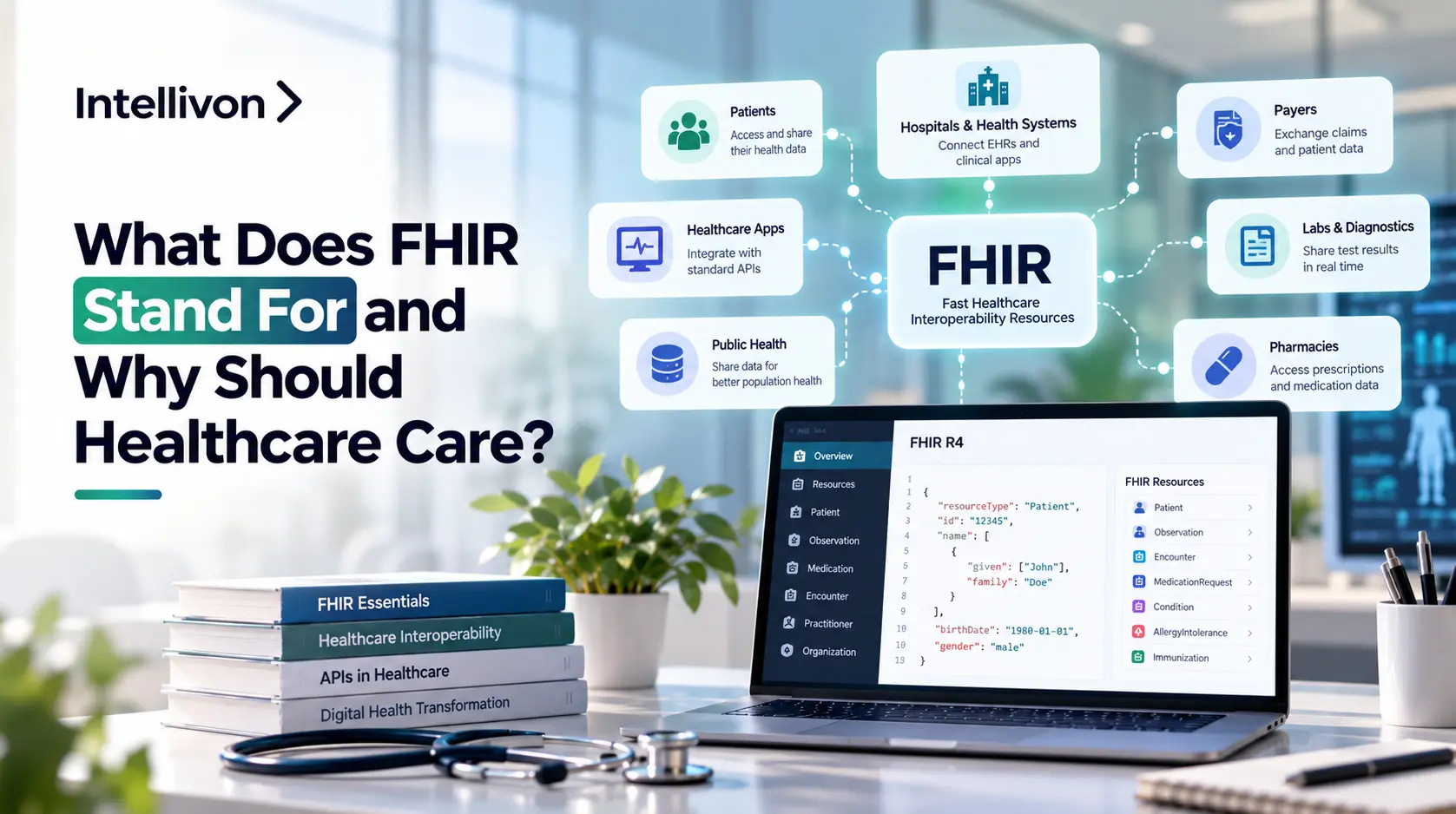
FHIR is an acronym for Fast Healthcare Interoperability Resources and is a standard that is maintained by HL7 International. It enables health records, laboratories, payers, and patient apps to share information by means of the same format.
Without FHIR, clinical data stays trapped inside systems. That means providers may have to repeat tests. Patients often need to share their history again and again. Care teams may end up working with outdated records, which can affect the quality of care.
In this blog post, we’ll explain what FHIR is and its origins. We’ll examine the problems it addresses and the benefits it offers to providers, patients, payers, and developers. We then look at the U.S. regulations promoting its adoption, such as the 21st Century Cures Act. Finally, we consider the situations in which FHIR may not be the right choice and the cost involved in creating a FHIR-enabled product. At Intellivon, we have developed custom software, including healthcare platforms, and the interoperability requirements mentioned in this blog post are the ones we intend to implement in our client projects.

What does FHIR Actually Mean
FHIR stands for Fast Healthcare Interoperability Resources, and each word in the name describes one part of the standard.
“Fast” refers to quicker, simpler development with web technology. “Healthcare” marks the clinical and administrative data it covers. “Interoperability” names the goal, which is systems that understand each other. “Resources” are the modular building blocks that carry the data.
Together, these four words explain what FHIR is, who it serves, and why healthcare adopted it.
1. Fast Means Easier to Build With Modern Web Technology
In FHIR, “fast” describes how quickly developers can start building. It does not mean every integration finishes quickly, because legacy systems and data mapping still affect timelines.
- Web technologies: FHIR uses familiar standards such as REST, JSON, and HTTP.
- Developer accessibility: Teams without a deep healthcare IT background can learn it faster.
- Simpler than older approaches: It avoids the complexity that HL7 v3 was criticized for.
- Modular adoption: Organizations can adopt only the parts they need.
2. Healthcare Defines the Data FHIR Was Built Around
FHIR is not a general-purpose data standard. At the same time, it models the information that healthcare organizations create and exchange every day.
- Patients and practitioners: The people who receive and deliver care.
- Medications and observations: Prescriptions, lab results, and vital signs.
- Appointments and encounters: Scheduled visits and care interactions.
- Claims: Billing and payer information.
3. Interoperability Is the Real Goal Behind FHIR
Two systems being digital does not mean they can understand one another. At the same time, Interoperability means they exchange data and interpret it the same way.
- Digital is not enough: An EHR and a lab system can both store data in incompatible formats.
- Shared structure: FHIR defines a consistent format for each type of record.
- Shared meaning: Both systems read a blood pressure result as the same thing.
4. Resources Are the Building Blocks That Make FHIR Work
Resources are small, modular pieces of health information. Consequently, ONC describes them as the components that form FHIR’s basic data exchange model.
- Patient: Demographic and identification details.
- Observation: A measurement, such as a lab value or vital sign.
- Medication: Details about a drug.
- Appointment: A scheduled visit.
- Condition: A diagnosis or health problem.
In summary, each word in the acronym maps to one clear idea. “Fast” signals developer accessibility, “Healthcare” sets the data scope, “Interoperability” states the goal, and “Resources” supply the structure. Together, they define FHIR as a healthcare-specific, modular standard for shared data.
Why Healthcare Enterprises Need FHIR in the First Place
Healthcare enterprises need FHIR because their systems store data but cannot exchange it reliably. Hospitals, labs, pharmacies, payers, and apps each hold part of a patient’s record in different formats.
As a result, every new connection becomes its own custom project. FHIR was created to close this gap by giving these systems one consistent, web-based way to share clinical and administrative data. Importantly, it does this without replacing existing systems or rebuilding every database.
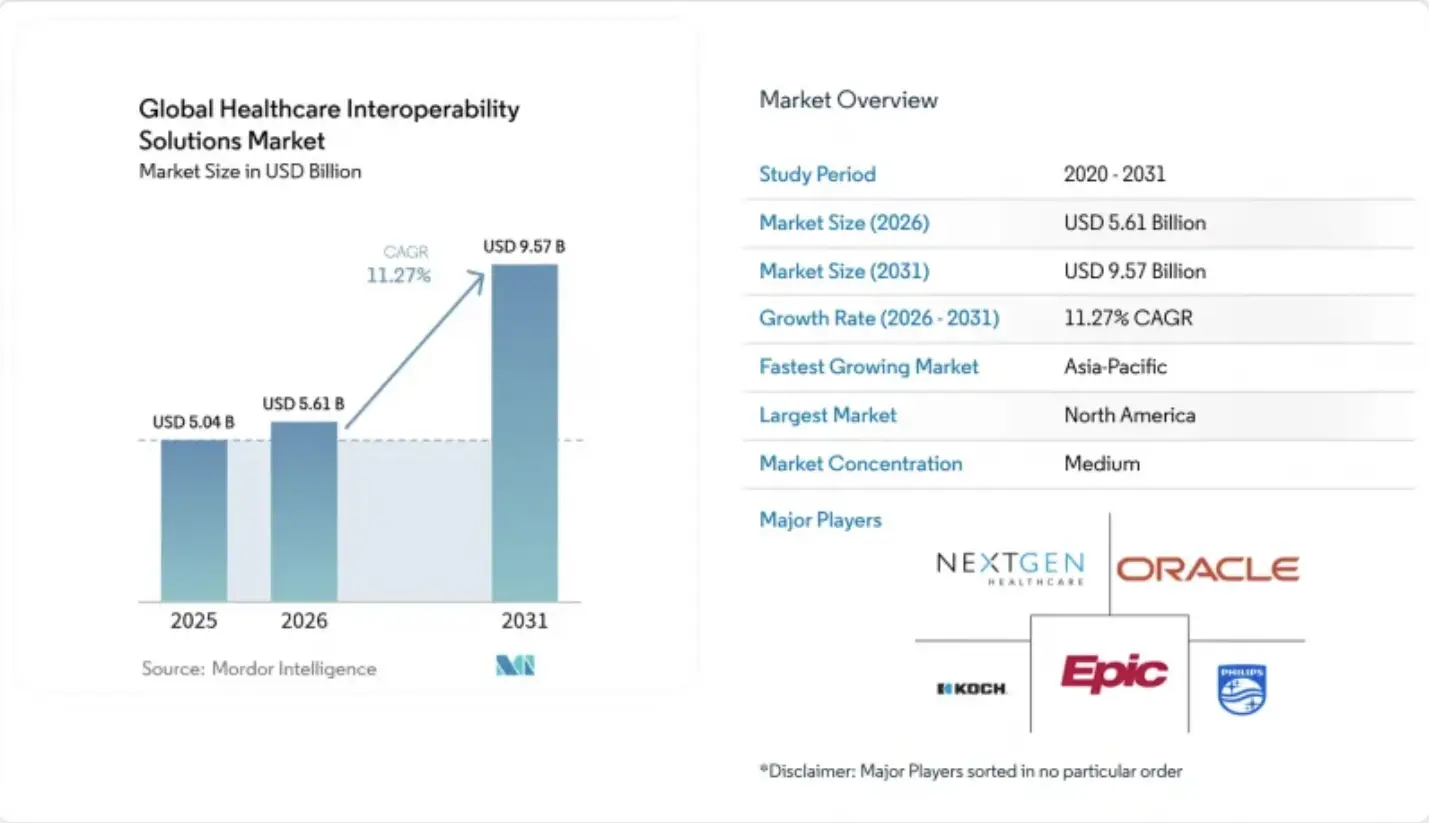
Reflecting this need, the global healthcare interoperability solutions market is estimated at USD 5.61 billion in 2026, up roughly 11% from USD 5.04 billion in 2025.
Furthermore, Mordor Intelligence projects USD 9.57 billion by 2031, an 11.27% CAGR, as regulatory mandates accelerate investment in standards-based data exchange.
1. Healthcare Systems Collected Data Without Sharing It Well
Healthcare organizations digitized records long before they agreed on how to exchange them. As a result, having electronic data does not make that data portable.
- One hospital: Its EHR stores a patient’s history in its own format.
- Another hospital: It cannot read that record without custom mapping.
- Labs and pharmacies: Results and prescriptions often travel through separate interfaces.
- Payers: Claims data sits apart from clinical records.
- Digital health applications: Apps, in turn, struggle to pull complete data from every source.
2. Older Healthcare Interfaces Still Run Much of Healthcare
However, FHIR is not an HL7 replacement, because older interfaces still carry much of today’s data exchange. In fact, practitioners on Reddit describe HL7 v2 as deeply embedded in production integrations.
- HL7 v2: Message-based interfaces that many hospitals still run daily.
- CDA and C-CDA: Document-based formats for sharing clinical summaries.
- Custom interfaces: Point-to-point connections built for one specific partner.
- Proprietary vendor APIs: Interfaces that work only within one vendor’s ecosystem.
3. Modern Healthcare Needed an API-Friendly Exchange Model
Meanwhile, modern healthcare products depend on APIs, which let one system request specific data from another on demand. For this reason, the industry needed an exchange model built around them.
- Mobile applications: Patients view their records on their own devices.
- Patient portals: Portals pull current data instead of stored copies.
- Payer apps: Members access claims and coverage information.
- Analytics: Teams combine data from several sources.
- AI: Models, likewise, need structured and consistent inputs.
- Connected healthcare services: Partners exchange data without manual transfers.
4. FHIR Does Not Require Every Database to Be Rebuilt
In addition, FHIR governs how information is represented and exchanged between systems. Therefore, the source database does not need a FHIR-native schema.
- Existing databases stay in place: Organizations keep their current storage.
- A translation layer: Data is converted into FHIR Resources when it is shared.
- Gradual adoption: As a result, teams can start with one use case and expand.
In summary, healthcare data was digital but isolated, and older interfaces such as HL7 v2 still carry much of it. FHIR, therefore, adds an API-friendly exchange layer on top of existing systems. Consequently, organizations gain shared data access without rebuilding their databases.
How FHIR Lets Healthcare Systems Understand Each Other
FHIR is both a data format and an API, and the two work together. The data format gives health information a shared structure, so a blood pressure result means the same thing in every system. The API gives applications a common, standardized way to request that information.
In practice, one system can ask another for a patient’s data and understand the answer without custom translation for every connection.
1. FHIR Gives Healthcare Data a Shared Structure
Without a shared structure, every application would invent its own way to record the same information. Therefore, FHIR defines standard Resources for each type of healthcare data.
- A simple example: A blood pressure reading becomes an Observation Resource.
- Consistent fields: The value, unit, date, and linked patient appear in set places.
- Shared meaning: As a result, any FHIR system reads the result the same way.
- Less custom mapping: Consequently, teams stop building a new translation for each partner.
2. FHIR APIs Give Applications a Common Way to Request Data
Meanwhile, FHIR APIs define how applications ask for information. In practice, each exchange follows a short, predictable sequence.
- Request: An app asks a system for specific data, such as a patient’s lab results.
- Authorize: The system then confirms that the app and user have permission.
- Retrieve: Next, the system returns the data as FHIR Resources.
- Update where permitted: Finally, approved apps can add or change records.
3. JSON and XML Make FHIR Familiar to Modern Developers
FHIR represents data in JSON and XML, two formats most developers already know. As a result, teams do not need specialized healthcare protocols to get started.
- JSON: A lightweight format common in web and mobile development.
- XML: An older format still used in many enterprise systems.
- Familiarity: Consequently, new developers learn FHIR faster than older healthcare standards.
4. Implementation Guides Add Rules for Specific Use Cases
However, “FHIR compatible” does not guarantee that two systems will work together. For this reason, implementation guides add the specific rules each use case requires, and CMS maintains required API standards and guides around FHIR adoption.
- Implementation guides: Documents that set rules for a defined use case.
- US Core: A baseline set of rules for exchanging health data in the United States.
- Da Vinci: Guides focused on data exchange between providers and payers.
- Profiles: Constraints that narrow a Resource for one specific purpose.
In summary, FHIR is both a data format and an API. Resources give data a shared structure, APIs handle the requests, and JSON and XML keep the technology familiar to developers. Therefore, implementation guides matter, because “FHIR compatible” only means as much as the rules a system follows.
FHIR Matters Because Healthcare Is Becoming API Driven
FHIR matters now because healthcare is shifting from isolated systems to connected, API-driven exchange. Federal policy pushes providers and payers toward standardized FHIR APIs. At the same time, AI tools and connected devices need predictable, structured data to work in clinical settings.
As a result, FHIR has moved from a standard that specialists tracked to an infrastructure requirement that products must plan for. For product teams, the question is now when to support FHIR, not whether.
1. US Interoperability Policy Has Accelerated FHIR Adoption
Federal policy has made standardized APIs a baseline expectation in US healthcare. Therefore, FHIR now sits at the center of ONC and CMS interoperability efforts.
- 21st Century Cures Act: CMS issued its Interoperability and Patient Access final rule (CMS-9115-F) based on this law. Wikipedia
- ONC: ONC describes FHIR as a commonly used standard for health information exchange.
- CMS: In addition, it supports FHIR-based APIs and implementation guides.
- Standardized APIs: Consequently, patients and apps get consistent access to health data.
2. CMS Is Moving More Healthcare Exchange Toward FHIR
Furthermore, CMS’s 2024 Interoperability and Prior Authorization final rule extends FHIR requirements to payers. Compliance dates generally begin on January 1, 2027.
- Patient access: Members retrieve their claims and coverage data through apps.
- Provider access: In-network providers retrieve claims, encounters, and USCDI data for their patients.
- Payer-to-payer exchange: Data follows a member who changes health plans, with the patient’s permission.
- Prior authorization: Payers expose a FHIR-based API for authorization decisions.
3. Healthcare AI Makes Standardized Data More Valuable
AI tools perform best when data arrives in a predictable structure. As a result, FHIR’s consistent Resources make AI easier to place inside clinical workflows, and FHIR now appears in newer HL7 initiatives tied to AI.
- Patient and encounter data: Models know where to find who the patient is and what happened.
- Medication and observation data: Likewise, prescriptions and results follow one format.
- Predictable access: Therefore, teams spend less time building custom connectors for each source.
4. FHIR Is Expanding Beyond Traditional EHR Integration
FHIR now reaches well past hospital records. For instance, HL7 launched its Caliper FHIR Accelerator on March 5, 2026, to improve how medical device data is exchanged.
- Medical devices: Caliper aims to bring device data into EHRs, analytics platforms, and AI-enabled applications.
- Payer exchange: Similarly, the CMS APIs above rely on FHIR.
- Quality reporting: FHIR is increasingly used to structure measure data.
- Public health: Clinical data can be packaged as anonymized FHIR Resources for agency reporting.
- AI applications: Finally, structured inputs support models across these settings.
In summary, FHIR has become important because policy, payer rules, AI, and devices now point in the same direction. CMS compliance dates arrive in 2027, and new initiatives keep extending FHIR into more areas. Consequently, FHIR is now part of the infrastructure healthcare products are expected to support.
Where FHIR Shows Up in Real Healthcare Workflows
FHIR shows up wherever one healthcare system needs to give another system usable patient or payer data. Patients see it when an app pulls their records. Clinicians see it when a tool opens inside the EHR. Payers, AI products, and analytics platforms use it behind the scenes to exchange data.
In most cases, FHIR is rarely visible to the end user, but it carries the data that makes these everyday workflows possible.
1. Patient Apps Pulling Records From an EHR
Patient apps use FHIR to retrieve a person’s health record directly from the EHR. As a result, patients see their data without calling the clinic.
- Demographics: Name, date of birth, and contact details.
- Medications: Current prescriptions.
- Lab results: Recent test values.
- Appointments: Upcoming visits.
- Conditions: Active diagnoses.
2. Clinician Applications Working Inside EHR Workflows
SMART on FHIR lets third-party apps launch inside the EHR and request only the data they are authorized to see. Consequently, clinicians avoid leaving the chart or logging in twice.
- Specialty tools: Apps built for one clinical area open in the patient’s context.
- Risk calculators: Likewise, scores draw on live patient data.
- Decision support: Prompts appear at the point of care.
- Documentation products: In addition, notes and queries stay inside the EHR session.
3. Payers Sharing Member and Provider Data
Payers use FHIR APIs to share information with members, providers, and other payers. For example, CMS-0057-F requires four FHIR-based payer APIs, generally due by January 2027.
- Claims: Members and providers retrieve claims data.
- Coverage: Plan details reach apps in a consistent format.
- Prior authorization: Decisions flow through a FHIR-based API.
- Payer-provider workflows: Furthermore, both sides work from the same data.
4. Healthcare AI Accessing Structured Clinical Context
AI products draw on FHIR to read structured clinical context. Therefore, models receive consistent inputs instead of mismatched records.
- AI copilots: Assistants see the patient’s current history.
- Care coordination: Tools track tasks across care teams.
- Risk models: Similarly, predictions use standardized observations.
- Summarization: Chart summaries pull from defined Resources.
- Patient engagement: Messaging reflects each patient’s actual data.
5. Analytics Platforms Combining Data Across Systems
Analytics platforms combine FHIR data from several systems into one view. In turn, teams measure and improve care at scale.
- Population health: Groups of patients are tracked together.
- Reporting: Required reports draw from consistent data.
- Quality measurement: Performance is compared across sites.
- Research: Similarly, studies use standardized records.
- Operational analytics: Finally, leaders see capacity and workflow trends.
In summary, FHIR appears in patient apps, clinician tools, payer exchange, AI products, and analytics platforms. Users rarely see it directly. However, it supplies the structured data behind each of these workflows.
What FHIR Changes for Each Part of Healthcare
Each part of healthcare benefits from FHIR in a different way, because each one needs different data from the same shared standard. Providers gain connected workflows, patients gain access, and payers gain a consistent way to exchange member data. Digital health companies gain a common integration target.
Public health agencies and AI teams, in turn, gain more consistent data access. Therefore, FHIR is a shared foundation, not a benefit for one group.
1. Providers Get More Connected Clinical Workflows
Providers use FHIR to reach data that once sat in separate systems. As a result, clinicians work with a fuller patient picture.
- Fewer isolated systems: Data moves between systems without manual re-entry.
- External data access: Outside records arrive in a usable format.
- Workflow integrations: Additionally, apps open inside the EHR.
- Care coordination: Care teams share the same information.
2. Patients Gain More Control Over Their Health Data
Patients gain more say over who sees their health information. Consequently, they can move that data into tools they choose.
- Approved apps: Patients authorize which apps connect.
- Record access: Results and medications are viewable on demand.
- Portability: Records follow the patient between providers.
- Patient-facing services: Likewise, new apps build on the same data.
3. Payers Gain Better Ways to Exchange Member Data
Payers use FHIR to meet interoperability mandates and simplify administrative exchange. For example, CMS-0057-F requires four FHIR-based payer APIs.
- Member data: Members retrieve claims and coverage through apps.
- Mandated APIs: Patient Access, Provider Access, Payer-to-Payer, and Prior Authorization.
- Administrative workflows: Moreover, authorization requests move through one API.
4. Digital Health Companies Get a Common Integration Target
Founders no longer have to treat every health system as an unrelated integration problem. However, vendor-specific work remains.
- Shared data model: One set of Resources covers many systems.
- Reusable work: Therefore, integration effort carries across customers.
- Remaining variation: Each EHR vendor still applies its own configuration and rules.
5. Public Health Agencies Can Exchange Data More Consistently
Public health agencies receive data in a more consistent format. In turn, reporting becomes easier to repeat.
- Reporting: Clinical data can be packaged as anonymized FHIR Resources for agency submission.
- Population-level exchange: Similarly, agencies compare data across many sources.
6. AI Teams Get Cleaner Interfaces to Clinical Systems
AI teams get a defined interface to clinical systems. Consequently, enterprise AI products connect to patient data without custom extraction for every site.
- Predictable inputs: Patient, encounter, and observation data follow set formats.
- Faster integration: Models plug into clinical workflows more easily.
- Scoped access: Moreover, authorization controls which data an app can read.
In summary, FHIR gives each stakeholder a different benefit from one shared standard. Providers gain connected workflows, patients gain control, and payers gain mandated data exchange. At the same time, digital health companies, public health agencies, and AI teams gain a common, predictable way to reach healthcare data.
FHIR Does Not Automatically Make Systems Interoperable
No. Supporting FHIR does not make a product interoperable on its own. FHIR standardizes the data model and API patterns, but systems still differ in profiles, extensions, terminology, and vendor behavior. As a result, two FHIR-enabled products can still fail to exchange data cleanly.
This gap often explains why integration timelines run longer than first estimates. Founders should therefore treat FHIR as a strong starting point and budget for the integration work that remains.
1. Two FHIR Systems Can Still Represent Data Differently
FHIR gives systems a shared framework, but it also allows local choices. Therefore, two compliant systems may describe the same information differently.
- Profiles: Rules that narrow a Resource vary between use cases.
- Extensions: Vendors add custom fields, and Epic resources carry Epic-specific extensions.
- Terminology: Systems may use different code sets for the same concept.
- Implementation choices: Even small details, such as how a patient reference is written, can vary.
2. EHR Vendors Do Not Expose Every Workflow the Same Way
Each EHR vendor decides which resources and workflows it exposes. As a result, an integration that works in one environment may fail in another.
- Epic: Often requires SMART on FHIR scopes, signed JWT authentication, and organization-specific base URLs.
- Oracle Health: Tenant and environment differences can change the integration path.
- athenahealth: Combines FHIR endpoints with proprietary REST APIs for scheduling and chart data.
- Other EHR environments: For example, eClinicalWorks adds its own access model.
- Write access: Moreover, one third-party comparison found write-back support varies widely by vendor.
3. Authentication Solves Access, Not Workflow Design
SMART on FHIR handles authorization and app launch. However, practitioners still report problems with patient context, permissions, and workflow behavior.
- Patient context: An app must open on the correct patient.
- Permissions: Granted access may not match what the workflow needs.
- Workflow behavior: Additionally, launch behavior can differ from the intended design.
4. Legacy HL7 Interfaces Usually Remain Part of the Architecture
Most enterprises run hybrid environments because replacing working interfaces is costly and risky. Consequently, FHIR typically sits alongside older interfaces.
- HL7 v2 feeds: They continue to carry routine hospital events.
- Translation: Integration engines convert HL7 v2 messages into FHIR Resources.
- Gradual migration: Teams then move one workflow at a time.
5. Data Mapping Still Requires Healthcare Knowledge
Mapping converts one system’s data into FHIR accurately. Therefore, it requires clinical understanding, not only technical skill.
- Local codes: Internal hospital codes must map to standard terminologies.
- Terminology: Similarly, the same term can carry different meanings.
- Clinical meaning: A field label may not mean the same thing across systems.
- Optional fields: Missing optional data can change results.
- Extensions: Custom fields need agreed handling.
FHIR standardizes an important part of interoperability. It does not erase every integration decision. Profiles, vendor behavior, workflow design, legacy interfaces, and data mapping all remain part of the work.
FHIR R4, R5, and R6 Explained Without the Version Confusion
FHIR R4 is the version CMS payer API rules require, and many production systems run. R5 is HL7’s current published release, and R6 is still in development. Each release carries a different level of stability.
Buyers should care about the version because it determines whether two systems can exchange data cleanly. Therefore, the right question is not which release is newest. Instead, it is which release your target EHR or payer environment actually supports.
1. R4 Is Still Important Across Production Healthcare
R4 was the first release with normative content, meaning parts of the specification are locked for stability. Consequently, it remains the release most buyers will meet in production.
- Normative content: HL7 labels R4 as Normative plus STU, and its normative parts stay in effect.
- Installed base: Industry guides describe version 4.0.1 as the most common.
- Regulation: Furthermore, CMS-0057-F requires its APIs to use R4.
2. R5 Is the Current Published Release
HL7 lists R5 (version 5.0.0) as its current published version. However, adoption and stability differ from R4.
- Current release: R5 is the newest published specification.
- Not normative: HL7 states that R5 will not be submitted to ANSI as a normative standard.
- Practical effect: As a result, an R5 product may not match the R4 environments it must connect to.
3. R6 Development Shows That FHIR Is Still Evolving
HL7’s publication directory shows R6 in active ballot development. For example, its version list included a second normative ballot (6.0.0-ballot5) in July 2026.
- Ballot stage: R6 has moved through several draft and normative ballots.
- Direction: HL7 says R5’s new content will be reviewed again during the R6 process.
- Planning: Therefore, assume today’s version is not the final one.
4. Version Compatibility Matters More Than Choosing the Newest
The newest release is not automatically the right integration target. Instead, match the version your required EHR or payer environment uses.
- Check the EHR: Ask which release each target system exposes.
- Check payer rules: CMS payer APIs, for instance, require R4.
- Ask your vendor: Confirm which versions the product supports and how upgrades work.
- Plan upgrades: Moreover, budget for version changes over the product’s life.
In summary, R4 is the established production and regulatory baseline, R5 is the current published release, and R6 is still being balloted. Version choice should follow the systems you must connect to, not the release date.
When a Healthcare Product Actually Needs FHIR
No. A healthcare product needs FHIR when it must read, write, or share standardized clinical data with other systems. Products that touch EHR data, exchange records across organizations, or feed AI with clinical context usually need it. Products that stay isolated, such as simple administrative tools, often do not.
Therefore, the decision depends on what data your product must reach and how many systems must exchange it. Settling this early keeps architecture and cost decisions grounded.
1. You Need FHIR When the Product Must Read EHR Data
Products that display or analyze EHR data need a standard way to retrieve it. Therefore, FHIR is often the standard route for read access.
- Patient information: Demographics and identifiers.
- Observations: Lab results and vital signs.
- Medications: Current and past prescriptions.
- Conditions: Active diagnoses.
- Appointments: Scheduled and past visits.
2. You Need FHIR When the Product Must Write Back to Clinical Systems
Writing data back into clinical systems is more constrained than reading it. Consequently, write access often limits what a product can promise.
- Fewer writable resources: One third-party comparison found write-back support varies widely by vendor.
- Vendor control: Each EHR decides which writes it permits.
- Proprietary alternatives: Moreover, some vendors steer write operations toward their own APIs.
3. FHIR Matters When Multiple Healthcare Systems Must Share Data
FHIR delivers the most value when many organizations exchange the same data. In that case, one shared format replaces many one-off connections.
- Provider networks: Hospitals and clinics share records across sites.
- Payers: CMS-0057-F requires four FHIR-based payer APIs.
- Labs: Results return to ordering systems in a consistent format.
- Platforms: Likewise, aggregators combine data from several sources.
- Patient apps: Patients pull records from multiple providers.
4. AI Products Often Need FHIR Before AI Becomes Useful
The model is only one piece of an AI product. Often, the harder problem is obtaining governed, correctly mapped clinical data.
- Data access: Models need patient, encounter, medication, and observation context.
- Mapping: Local codes must map correctly, or outputs suffer.
- Governance: Additionally, SMART on FHIR scopes limit which data an app can request.
- Sequencing: As a result, FHIR work often comes before AI delivers value.
5. Some Healthcare Products May Not Need FHIR at All
Not every healthcare product exchanges clinical data. Therefore, adding FHIR to these products can add cost without benefit.
- Isolated administrative tools: Scheduling or billing tools that stay self-contained.
- Products without EHR access: No system exists to connect to.
- Systems exchanging no standardized clinical data: Nothing needs a shared format.
- Revisit later: However, if integration needs appear, FHIR can be added then.
In summary, FHIR is necessary when a product reads EHR data, writes back to clinical systems, shares data across organizations, or feeds AI with clinical context. It is optional for isolated tools that exchange no standardized clinical data. The deciding factor is the data your product must reach, not the label “healthcare.”
What a Production FHIR Integration Actually Has to Include
A production FHIR integration includes far more than an API connection. It covers finding the right endpoints, mapping data and workflows, handling authentication, normalizing terminology, and controlling patient consent and PHI. It also includes error monitoring and conformance testing.
Skipping any of these creates risk after launch. Therefore, when a vendor says “we support FHIR,” enterprises should expect all of this work to be accounted for, scoped, and priced across the full project.
1. EHR and FHIR Endpoint Discovery
Teams first identify which EHR environments and FHIR endpoints the product must reach. As a result, scope is set before development begins.
- Environment details: Tenant and environment differences can change the integration path.
- Base URLs: Epic, for example, uses one production base URL per health system.
- Supported resources: Each endpoint exposes a different set of Resources.
2. Resource and Workflow Mapping
Next, the team maps each workflow to the FHIR Resources it needs. This step shows which data the product reads and writes.
- Resources: Patient, Observation, and Medication, for instance.
- Workflows: Scheduling, results review, or documentation.
- Gaps: Where a Resource is unavailable, the team plans a workaround.
3. Authentication and SMART on FHIR
SMART on FHIR governs how apps launch and obtain authorization. However, each vendor applies its own authentication requirements.
- App launch: Apps open inside the EHR or as standalone tools.
- Scopes: Scopes limit which data an app can request.
- Vendor differences: Epic, for example, often requires signed JWT authentication.
4. Terminology and Data Normalization
Systems label the same clinical concept with different codes. Therefore, partners normalize data to standard terminologies.
- SNOMED CT: Clinical findings and conditions.
- LOINC: Lab tests and observations.
- ICD-10: Diagnoses and billing.
- RxNorm: Medications, where relevant.
5. Consent, Permissions, and PHI Controls
Healthcare data carries legal and privacy obligations. Consequently, access controls are part of the build, not an add-on.
- Patient consent: The system records what each patient has approved.
- Role-based permissions: Users see only the data their role requires.
- Audit trails: Additionally, logs record who accessed which data.
6. Error Handling and Interface Monitoring
Live integrations fail in ways sandboxes do not show. In fact, successful sandbox calls do not mean an Epic integration is finished.
- Error handling: Retries and clear failure messages.
- Monitoring: Alerts for downtime and delayed data.
- Ownership: Moreover, someone must respond when an interface breaks.
7. Conformance and Integration Testing
Testing confirms that the product follows required profiles and works with real systems. As a result, issues surface before go-live.
- Conformance: Data is validated against profiles and implementation guides.
- Integration testing: Each target EHR is tested separately.
- Regression checks: Finally, version changes trigger repeat testing.
In summary, “we support FHIR” covers seven distinct lines of work. These include endpoint discovery, mapping, authentication, terminology, consent, monitoring, and testing. Each one adds effort, and each one affects cost and delivery time.
What Enterprise FHIR Development Costs in 2026
Enterprise FHIR projects commonly fall within Intellivon’s $70,000 to $300,000 custom healthcare development range, depending on systems, workflows, data mapping, security, and application scope.
A standard API still requires significant work because FHIR defines how data is shaped, not how each EHR, legacy interface, or workflow behaves.
Therefore, most of the budget goes to integration, mapping, and testing rather than the API itself. The table below breaks the range into six phases.
| Phase | Suggested Range | Main Work |
| Discovery and workflow mapping | $8K to $20K | Systems, Resources, users, data flows |
| Architecture and FHIR design | $10K to $30K | Profiles, APIs, authentication, infrastructure |
| EHR and data integration | $20K to $80K | Epic, Oracle Health, HL7 v2, mapping |
| Product development | $20K to $100K | Application workflows and backend |
| Security and compliance | $7K to $25K | PHI, audit, access controls |
| Testing and launch | $5K to $25K | Conformance, QA, performance, deployment |
1. EHR Integration Usually Drives More Cost Than FHIR Itself
Each EHR vendor exposes different resources, authentication, and write capabilities. As a result, integration effort varies by system.
- Epic: Often requires SMART scopes, signed JWT authentication, and per-system base URLs.
- athenahealth: Combines FHIR endpoints with proprietary REST APIs.
2. Data Mapping Becomes Expensive in Legacy Environments
Legacy systems rely on local codes and HL7 v2 feeds. Consequently, mapping to FHIR needs clinical review, not only engineering.
- Terminology: Local codes map to SNOMED CT, LOINC, ICD-10, and RxNorm.
- HL7 v2 conversion: Messages are translated into FHIR Resources.
3. Write-Back Workflows Cost More Than Read-Only Access
Writing data into an EHR is more restricted than reading it. Therefore, write-back adds design and testing effort.
- Limited writes: Support varies widely by vendor.
- Added validation: Each write needs testing against the target EHR.
4. Multiple EHRs Expand Testing and Mapping Scope
Every added EHR brings its own configuration. As a result, mapping and testing repeat for each system.
- Separate environments: Each EHR needs its own integration testing.
- Repeated mapping: Field and code differences multiply.
5. Budget for Ongoing Maintenance After Launch
Live integrations need continued work. Plan for 30% of the initial build each year.
- Version updates: Releases such as R4, R5, and R6 change requirements.
- Monitoring: Interface failures and vendor API changes need a responsible owner.
In summary, EHR integration, mapping, and testing drive most FHIR costs, while write-back and added EHRs raise them. Maintenance continues after launch.
How Intellivon Builds FHIR Into Healthcare Products
Working with us on a FHIR-enabled product means we handle the full chain of decisions around the API, not only the API calls. We map the clinical workflow first, then identify every data source, define the FHIR Resources, and design FHIR alongside legacy interfaces. After that, we build security, normalize the data, test against real workflows, and launch with monitoring.
Consequently, you receive a working, supportable integration instead of a connection that fails in production.
Step 1. Map the Healthcare Workflow Before the API
We start with the workflow because the API only serves a task. Therefore, our first sessions focus on people and process before any code.
- Who needs the data: Clinicians, patients, payers, and internal staff each require different access, so we define roles early.
- What task they perform: The task decides which data matters, which keeps the build focused.
- Where the data originates: Source systems determine the interfaces we must plan, test, and maintain.
- Which system stays the source of truth: Clear ownership prevents conflicting records once data starts moving.
- Workflow map: Clinical steps, roles, and data needs are documented before design begins.
Step 2. Identify Every EHR and Data Source
Next, we catalog each system the product must touch. In turn, this audit prevents surprise integrations late in the project.
- EHR: Epic, Oracle Health, and athenahealth each expose different capabilities, so we assess every target separately.
- Lab and pharmacy: Results and prescriptions often arrive through their own interfaces.
- Payer: Claims and coverage data follow payer API requirements.
- Device: Readings may stream in from connected hardware at irregular intervals.
- Internal database: Existing records need a defined role in the new architecture.
- Third-party application: Partner tools add dependencies, which we document early.
- Source inventory: A complete list of systems, owners, and interface types.
Step 3. Define the FHIR Resources the Product Needs
Then we decide which Resources the product actually uses. As a result, the build covers real needs instead of the entire specification.
- Patient and Encounter: Identity, demographics, visits, and care interactions anchor every record.
- Observation and Condition: Lab values, vital signs, and diagnoses give clinical context.
- MedicationRequest: Prescriptions the product reads or, where permitted, creates.
- Appointment: Scheduling data supports booking, reminders, and follow-ups.
- Resource list: A defined set of Resources with the fields each one needs.
Step 4. Design FHIR and Legacy Integration Together
Most enterprise environments remain mixed, so we design for that reality. Accordingly, FHIR sits beside older interfaces instead of replacing them overnight.
- FHIR: We design R4 interfaces for new workflows and external partners.
- HL7 v2: Message parsers keep existing feeds running during the transition.
- Vendor APIs: Where an EHR favors its own API, we build an adapter around it.
- Internal APIs: Existing services connect through one consistent data integration layer.
- Integration blueprint: One diagram shows how FHIR and legacy feeds connect.
Step 5. Build Security and Consent Into Data Flows
Security shapes the data flow from the first design, not the last sprint. Consequently, access rules exist before real patient data does.
- OAuth 2.0 and SMART on FHIR: Authorization and app launch follow standard patterns where applicable.
- Access control: Role-based permissions limit what each user can see.
- Audit logging: Every access leaves a record for later review.
- Encryption: Data stays protected at rest and in transit.
- Security plan: Documented controls cover access, consent, and PHI handling.
Step 6. Build and Normalize the Data Layer
Here we build the layer that turns source data into consistent FHIR Resources. Additionally, we normalize codes so meaning survives the move.
- Mapping: Source fields convert into Resources with clinical review.
- Terminology: Local codes align with SNOMED CT, LOINC, ICD-10, and RxNorm where relevant.
- Quality rules: Missing or conflicting values trigger defined handling, not silent errors.
- Mapping specification: A reviewed record shows how every source field converts.
Step 7. Test Against Real Healthcare Workflows
Testing then moves beyond the happy path, including FHIR conformance validation. Therefore, we simulate the conditions that break integrations after launch, supported by our QA engineering practice.
- Field mappings: We confirm every value lands in the right place.
- Missing data: Gaps and incomplete records are tested deliberately.
- Permissions: Users see only what their role allows.
- Failures: Retries and error messages get checked under stress.
- High volume: Load tests show how interfaces behave at scale.
- Vendor-specific behavior: Each EHR gets its own validation pass.
- Test report: Documented results cover each workflow and each connected EHR.
Step 8. Launch With Monitoring Around Every Interface
Finally, we launch with monitoring on every connection. Consequently, problems surface as alerts instead of clinical complaints.
- Interface health: Dashboards track API status, delays, and failed messages.
- EHR changes: Vendor updates and schema changes are watched and handled.
- Ongoing support: Managed sustenance continues after go-live.
- Support plan: Defined owners cover each interface.
In summary, we treat FHIR as one layer inside a larger workflow, from mapping and security to testing and monitoring. Each step lowers the risk that a working demo becomes a failing production system. Together, these steps define what an experienced FHIR partner contributes beyond writing API calls.
Scope Your FHIR Build Before You Commit Budget
Knowing what FHIR stands for is the easy part. The harder decision is which systems, workflows, and Resources your product needs, and what that scope costs. We help healthcare founders and enterprises answer that before development capital is committed, through our custom healthcare solutions practice.
Our team scopes your EHR connections, data mapping, security requirements, and legacy interfaces, then maps a phased plan to the $70,000 to $300,000 range this guide outlined. Therefore, you leave the first conversation with a defined scope instead of an open-ended estimate.
- EHR and data source review: We list every system your product must reach, including Epic, Oracle Health, and athenahealth.
- Workflow and Resource mapping: Your workflows are matched to the FHIR Resources they require.
- Legacy interface plan: HL7 v2 feeds and vendor APIs are placed alongside the FHIR layer.
- Security and consent review: Access control, audit logging, and PHI handling are defined early.
- Version guidance: We confirm whether R4 or a newer release fits your target environments.
- Phased cost estimate: Budget is split by phase, with maintenance planned after launch.
- Risk and timeline view: Vendor limits and mapping effort are flagged before they cause delays.
- Build or wait advice: If FHIR is not needed yet, we say so plainly.
In short, a FHIR build succeeds or stalls on decisions made before the first line of code. Book a scoping call with our team to settle those decisions while changes are still inexpensive.
Conclusion
FHIR stands for Fast Healthcare Interoperability Resources, and it now shapes how healthcare systems share data. Importantly, the standard solves only part of the problem, because vendor differences, legacy interfaces, and data mapping still require careful planning.
Therefore, teams should confirm which systems they must reach, which version they need, and what scope fits their budget. Ultimately, a clear understanding of what FHIR means helps healthcare organizations make better build decisions before any development begins.
FAQs
Q1. What does FHIR stand for in healthcare?
A1. FHIR stands for Fast Healthcare Interoperability Resources. It is an open standard from HL7 International that defines how healthcare systems exchange patient and administrative data electronically. Each word has a purpose: “Fast” signals quicker development, “Healthcare” sets the scope, “Interoperability” states the goal, and “Resources” are the modular data building blocks.
Q2. How do you pronounce FHIR?
A2. FHIR is pronounced “fire,” like the word for flames. Many newcomers expect the letters to be spelled out, but industry guides and reference sources give “fire” as the standard pronunciation. Therefore, saying “fire” in meetings with clinicians, developers, and vendors is correct. In practice, it also avoids confusion in cross-team conversations.
Q3. Is FHIR the same thing as HL7?
A3. No. HL7 International is the standards organization, and FHIR is one of the interoperability standards it maintains. HL7 also publishes older standards, such as HL7 v2. Therefore, the term “HL7” can mean the organization, an older interface, or FHIR itself, so it helps to name the specific standard.
Q4. Is FHIR replacing HL7 v2?
A4. Not simply. Both standards frequently coexist, because many hospitals still run HL7 v2 feeds that work reliably. As a result, new projects often add FHIR alongside existing interfaces, using integration engines to translate between them. Therefore, organizations should plan for hybrid environments instead of assuming a full replacement.
Q5. Is FHIR an API or a data standard?
A5. FHIR is both. It defines healthcare data Resources, such as Patient and Observation, and the mechanisms for exchanging them, including API-based exchange. Consequently, explanations call it a format and an API at once. The data model gives information a shared structure, while the API gives applications a common way to request it.
Q6. What is the difference between FHIR R4 and R5?
A6. They are different releases of the FHIR specification. R5 is currently published by HL7, but R4 contains normative content, and many production systems still rely on it. For example, CMS payer API rules require R4. Therefore, choose the version your target EHR or payer environment supports, not simply the newest.
Q7. Does every healthcare application need FHIR?
A7. No. FHIR becomes relevant when an application needs standardized data exchange with EHRs, payers, clinical systems, or other compatible services. In contrast, isolated administrative tools that touch no clinical data often do not need it. Therefore, decide based on the data your product must reach, not on the healthcare label.