Key Takeaways:
- Multi-agent finance platforms need one orchestration layer controlling specialized agents, models, tools, and workflow state.
- Planner, supervisor, worker, critic, policy, and execution roles must be clearly defined before development begins.
- LLMs combined with RAG, rules engines, and validated quantitative models power governed financial agent decisions.
- Production builds cost $70,000 to $300,000 and take 4 to 9 months with human approval gates.
- How Intellivon builds multi-agent finance platforms with SR 26-2, DORA, role-based access, audit trails, and model monitoring.
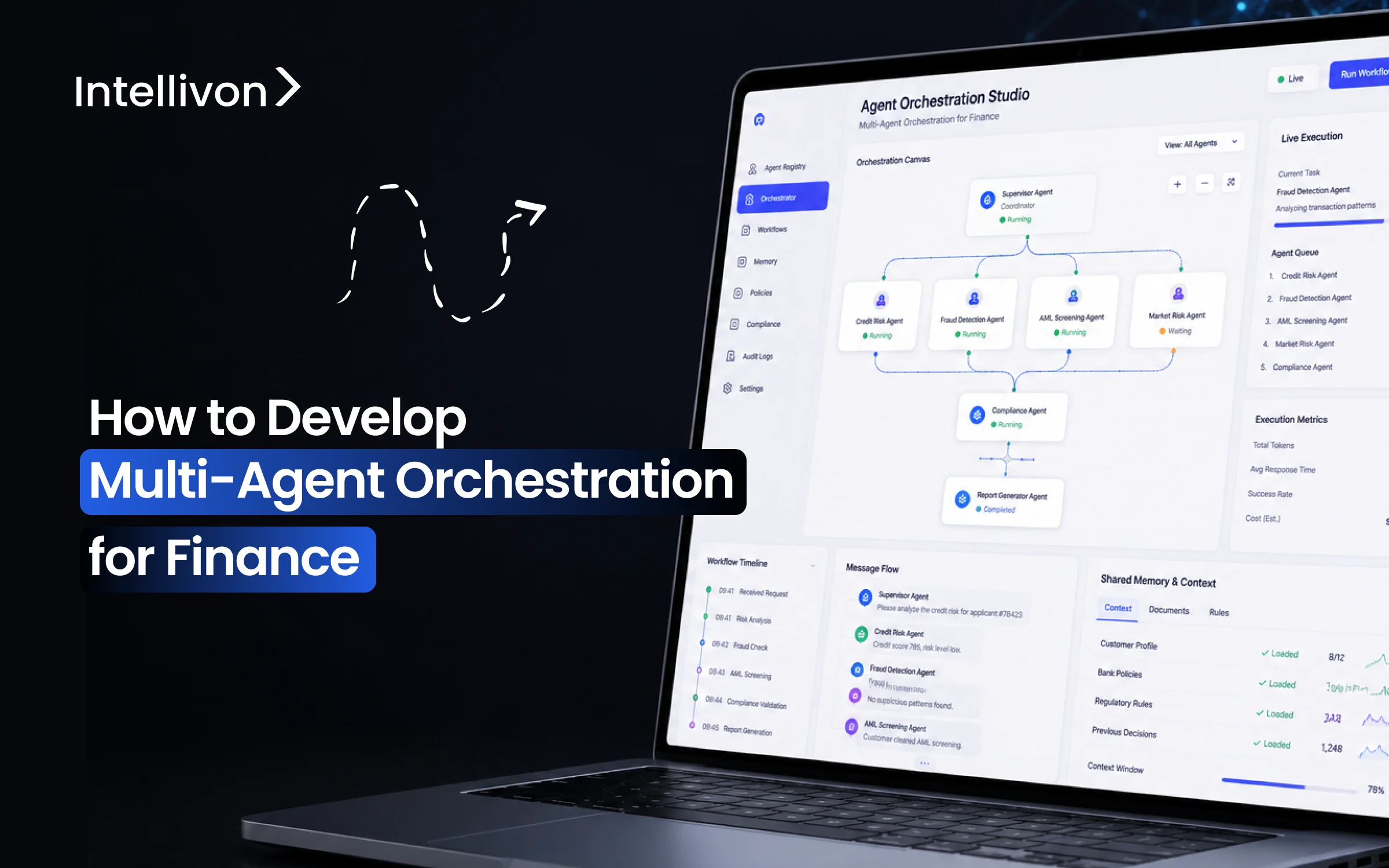
Handling credit risk, fraud detection, and regulatory reporting in one AI system creates a coordination problem for financial enterprises that are engrossed in their day-to-day functions. Multi-agent orchestration for finance solves it by giving each task its own dedicated AI agent. One agent handles credit analysis, another monitors fraud, and a third tracks compliance requirements. From there, an orchestration layer keeps them in sync and routes decisions between them automatically.
The key design decision is who does what. Hence, without clear roles, agents share tasks and produce conflicting outputs that slow everything down. Bain found siloed AI tools consistently fail to hit efficiency targets due to orchestration gaps. Consequently, multi-agent orchestration solves this by giving every agent a clear role and a defined lane.
Intellivon builds these systems for financial institutions that cannot afford compliance failures. The approach therefore starts with defining agent roles before writing a single line of code. Accordingly, this blog walks through the full build from role design and agent communication to compliance. By the end, this blog delivers enough clarity to brief a team or commission this build.
What Multi-Agent Orchestration Means for Financial Services
Multi-agent orchestration is a specialized software control layer that breaks complex financial workflows into smaller, sequential tasks. Consequently, the platform assigns these tasks to isolated, highly domain-specific AI units while continuously tracking their shared operational state.
Therefore, the system handles critical inter-agent messaging, resolves logical conflicts, manages memory, and enforces mandatory compliance checks before any final execution.
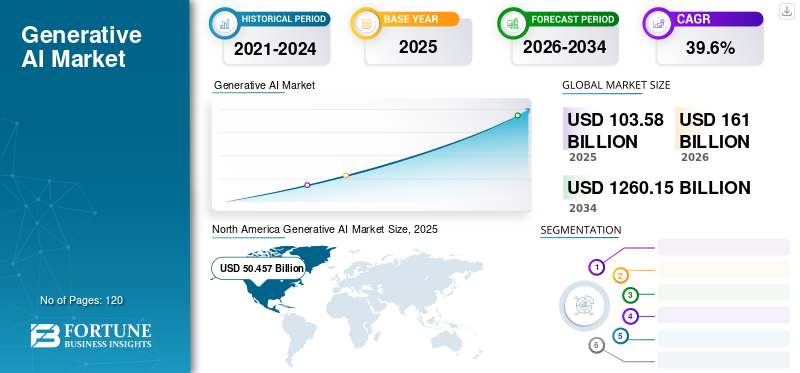
This momentum is driven by institutions shifting from controlled pilot experiments to mission-critical implementations like automated compliance monitoring and risk analysis.
1. What the Orchestration Control Plane Actually Owns
The orchestration control plane serves as the definitive administrative nervous system for your multi-agent infrastructure. Consequently, it governs how individual agents collaborate without direct, chaotic peer-to-peer coupling.
- Task decomposition: Breaking raw operational goals into deterministic, structured sub-tasks.
- Agent selection and routing: Directing payloads to the most capable specialized financial AI agent design pattern.
- Workflow state: Maintaining a state machine via tools like LangGraph multi-agent finance implementation.
- Context assembly: Managing a multi-agent shared memory architecture for finance across distinct reasoning loops.
- Tool authorization: Controlling runtime function calling parameters for banking APIs.
- Policy enforcement: Injecting institutional guardrails and finance platform design constraints into active prompts.
- Retry and fallback logic: Executing multi-agent error-handling and recovery finance routines during timeouts.
- Human escalation: Pausing executions for human-in-the-loop multi-agent finance workflow approvals.
- Logging and audit evidence: Generating immutable cryptographic records for financial compliance monitoring.
- Cost and latency controls: Monitoring token consumption and LLM execution times actively.
Therefore, the control plane guarantees deterministic execution across highly unpredictable model behaviors.
2. Where Agents End and Financial Systems Begin
Autonomous agents must never act as primary data repositories or replace validated systems of record. Instead, they operate strictly as an intelligent orchestration overlay that interacts with your existing software stack.
- Core banking systems: Accounting for ledgers, balances, and account data states remains strictly internal.
- Loan origination systems: Managing official application workflows and statutory compliance filings.
- Order management systems: Routing, tracking, and completing market orders deterministically.
- Transaction monitoring platforms: Executing hardcoded AML transaction monitoring platform database queries.
- General ledgers: Serving as the final, immutable single source of financial truth.
- Rules engines: Running hardcoded regulatory calculations that forbid probabilistic variation.
- Validated risk models: Processing core mathematical risk vectors like VaR calculation automation formulas.
Thus, core transactional integrity remains completely isolated from potential agent hallucination risks.
3. Why Finance Requires a Stronger Orchestration Layer
Regulated financial environments demand an orchestrator that enforces architectural safety far beyond standard enterprise SaaS applications. As a result, basic prompt chains cannot support complex corporate banking requirements safely.
- Material financial consequences: Erroneous automated actions lead to immediate capital losses and heavy fines.
- Segregation of duties: Enforcing strict boundaries between planner, agent, financial workflow design, and validator roles.
- Restricted data: Masking personally identifiable information before transmitting data to external LLMs.
- Reproducible decisions: Engineering predictable multi-agent consensus mechanisms for credit scoring.
- Approval thresholds: Triggering multi-agent approval escalation finance design patterns based on transaction size.
- Model-risk oversight: Assuring strict compliance with SR 11-7 model risk compliance mandates.
- Retained evidence: Archiving comprehensive historical inputs for regulatory reporting automation in finance.
- Time-sensitive processing: Meeting rigid market execution windows during volatile trading periods.
For a deeper breakdown of designing secure software for strict regulatory oversight, see our guide on KYC and KYB infrastructure engineering. Intellivon embeds regulatory constraints directly into the message queues governing inter-agent communication protocols. Therefore, your system maintains continuous compliance without degrading real-time execution speeds.
Multi-agent orchestration creates value only when specialization reduces a real operational or decision bottleneck. Therefore, the next section provides a practical framework to help you decide whether multiple agents are justified.
When a Finance Workflow Actually Needs Multiple AI Agents
A finance workflow needs multiple agents when it crosses distinct knowledge domains, requires parallel analysis, uses separate permission boundaries, or contains decisions that must challenge one another. A single agent remains the better design when one model can complete the task through a small, controlled set of tools.
Consequently, deploying an enterprise multi-agent AI system development finance strategy must depend entirely on your operational architecture.
1. Use Multiple Agents When Work Must Be Specialized
- Several disciplines involved: Combining credit risk analysis with macro market forecasting simultaneously.
- Distinct permissions: Restricting ledger write access to specific portfolio risk analytics systems.
- Parallel execution: Running independent simulations across vast, separate financial datasets concurrently.
- Independent validation: Deploying a dedicated critic agent for financial quality assurance design to test assumptions.
2. Use One Agent When the Workflow Is Narrow
- Retrieving account policies: Finding standard guidelines inside a corporate compliance handbook.
- Summarizing documents: Processing a single quarterly earnings PDF using RAG methods.
- Classifying transactions: Categorizing standard retail purchases based on merchant codes.
3. Score the Workflow Before Choosing
| Factor | Single-agent signal | Multi-agent signal |
| Domains / Systems | One | Three or more / Restricted silos |
| Risk / Challenge | Advisory / None | Regulatory action / Required |
| Duration | Minutes | Hours, days, or event-driven |
4. Start With One Bounded Financial Outcome
- Investigate AML alerts: Automating data compilation for suspicious activity reporting.
- Assemble credit packages: Gathering commercial lending data across separate corporate documents.
- Reconcile exceptions: Tracking unmatched transactions using automated reconciliation orchestration tools.
Intellivon builds bounded pilot programs that deliver clear operational metrics within the first quarter. Therefore, your architecture matches your business rules perfectly.
Define Financial Decision Boundaries Before Designing Agents
Agent design should begin with financial decision rights. Every workflow needs explicit boundaries showing what agents may research, calculate, recommend, approve, execute, or escalate. Without these boundaries, a technically capable system can still violate approval policies, segregation-of-duties rules, or model governance requirements.
Therefore, mapping these constraints protects institutional safety before any software engineering begins.
1. Classify Every Action by Autonomy Level
Firms must categorize every automated action to control systemic risk effectively. Consequently, early enterprise deployments should remain restricted to non-executing tiers.
- Read: Retrieving core ledger data without changing any underlying software system.
- Recommend: Producing an independent risk analysis or proposing an asset allocation mix.
- Prepare: Populating a regulatory compliance monitoring report for subsequent validation.
- Execute: Committing a controlled trade execution automation action after passing hardcoded verification checks.
2. Build a Financial Decision-Rights Table
A structured decision table ensures absolute architectural accountability across all automated processes. As a result, developers can implement deterministic guardrails within the multi-agent shared memory architecture of finance layers.
| Workflow stage | Decision owner | Deterministic checks | Human approver |
| AML Alerts | Compliance Officer | Sanctions Database Match | VP Compliance |
| Credit Underwriting | Senior Risk Analyst | FICO & Debt Ratio Verification | Chief Risk Officer |
| Treasury Transfer | Corporate Treasurer | Dual-Factor Token Validation | Chief Financial Officer |
3. Hard-Code Non-Delegable Decisions
Language models must never hold final authority over critical institutional choices. Therefore, the core code must explicitly block autonomous execution on high-risk operations.
- Credit approvals: Granting commercial loans that exceed specific internal capital thresholds.
- Regulatory filings: Submitting official suspicious activity reports to financial authorities.
- Policy overrides: Bypassing automated sanctions screening, automating finance flags manually.
4. Separate Recommendations From Execution
Firms should deploy a strict two-channel design to isolate reasoning loops from transactional networks. Consequently, this architecture entirely prevents a generative model from writing directly to core banking databases.
- Reasoning channel: Assembles evidence and generates structured recommendations via specialized financial AI agent design frameworks.
- Execution channel: Receives only cryptographically signed, policy-compliant instructions from validated human operators.
5. Define Human Escalation Before Development
Clear operational triggers ensure that complex cases route to human professionals instantly. Thus, systemic operational errors remain bounded.
- Low confidence: Model reasoning probability drops below a pre-set compliance limit.
- Conflicting outputs: A supervisor agent financial orchestration design receives contradictory reports from worker nodes.
- High value: Financial transaction amounts exceed predefined corporate approval thresholds.
Decision boundaries determine the technical controls the platform requires. Therefore, the next section translates these rules into a production architecture that keeps reasoning, policy, data, and execution separate.
Design the Production Multi-Agent Finance Architecture
A production finance architecture needs more than an agent framework. It requires an orchestration control plane, durable workflow state, an agent registry, secure tool access, model routing, financial data connectors, policy enforcement, human approvals, observability, and an immutable audit layer.
Consequently, assembling these components into isolated layers guarantees operational resilience across volatile market environments. Therefore, your technical layout must prioritize deterministic software engineering over pure probabilistic language modeling.
Comparative Architectural Layout
| Architectural Layer | Core Technical Components | Operational Responsibility |
| Layer 1: Connectivity | Banking APIs, Order Management, General Ledgers, Document Stores | Normalizes data inputs and decouples agents from system-specific integration logic. |
| Layer 2: Control Plane | State Machine, Task Router, Agent Registry, Timeout Controls | Manages workflow state, enforces scheduling dependencies, and drives retry policies. |
| Layer 3: Runtime & Gateway | Tool Sandboxes, API Allowlists, Credentials Vault, Rate Limits | Restricts function calling parameters and enforces hard query boundaries. |
| Layer 4: Memory & Context | Vector Databases, Knowledge Graphs, Lineage Tracking, Shared Memory | Maintained context windows while authorizing real-time data retrieval rights. |
| Layer 5: Governance | RBAC/ABAC Engines, Human Approval Gates, Immutable Audit Ledgers | Controls identity management, monitors token costs, and logs system compliance. |
For a deeper breakdown of building enterprise integration layers that isolate core banking components, see our guide on enterprise data lake engineering and microservices integration. Thus, institutional data remains secure while maintaining real-time processing performance.
The architecture defines the available building blocks. Therefore, the next decision is how those components collaborate, because a sequential KYC case requires a different orchestration pattern from parallel portfolio research or hierarchical credit review.
Choose the Right Orchestration Pattern for Each Workflow
Financial workflows should not use one universal orchestration pattern. Sequential, concurrent, hierarchical, graph-based, and evaluator-led designs solve different coordination problems. The correct choice depends on task dependencies, latency, approval requirements, failure impact, and the need to reproduce the final decision.
Consequently, selecting an incorrect pattern introduces systemic architectural friction and inflates token expenses. Therefore, you must match the coordination layer directly to the logical structure of your transactional rules.
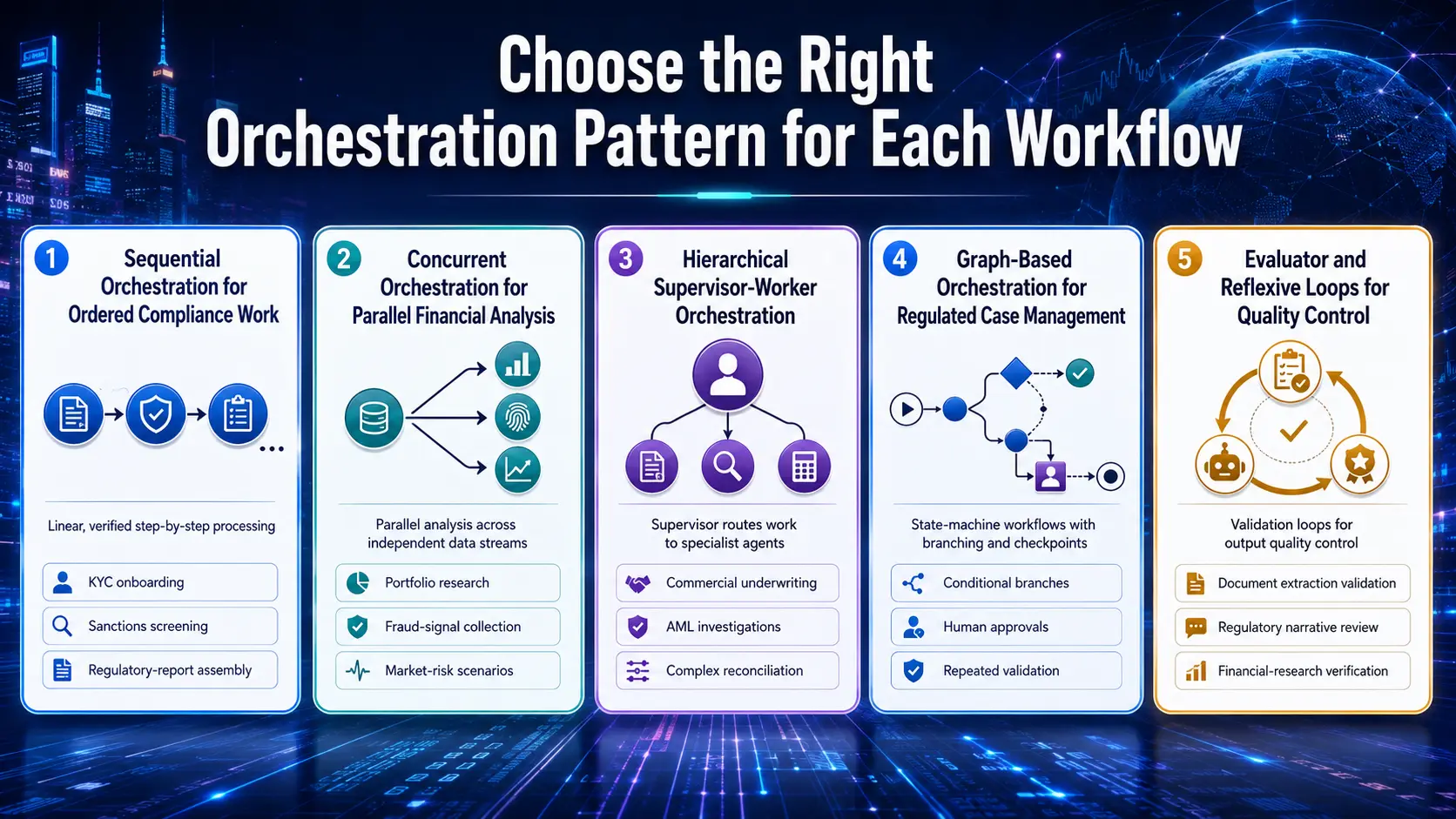
1. Sequential Orchestration for Ordered Compliance Work
Ordered compliance workflows require data to pass through rigid, predictable, linear stages. As a result, each domain-specific agent operates only after the preceding step generates a verified, structured payload.
- KYC onboarding: Reviewing customer identities sequentially before initiating credit checks.
- Sanctions screening: Cross-referencing names against global watchlists before checking account records.
- Regulatory-report assembly: Building compliance data models step-by-step to prevent information omission.
2. Concurrent Orchestration for Parallel Financial Analysis
Parallel processing allows institutions to analyze multiple independent data streams simultaneously. Therefore, a central synthesis agent combines these distinct outputs only after all concurrent worker paths finish their execution loops.
- Portfolio research: Extracting earnings metrics from multiple corporate text documents in parallel.
- Fraud-signal collection: Querying regional transaction logs and device fingerprint databases at the same time.
- Market-risk scenarios: Executing independent risk models simultaneously to evaluate portfolio exposure.
3. Hierarchical Supervisor-Worker Orchestration
Complex financial investigations require a centralized coordinator to handle task allocation and resource routing. Consequently, the supervisor agent financial orchestration design governs the global state while specialized workers execute narrow operations.
- Commercial underwriting: Managing separate balance sheet, cash flow, and industry risk evaluations.
- AML investigations: Coordinating transaction reviews across disparate internal ledger systems.
- Complex reconciliation: Directing multiple data engines to locate hidden accounting discrepancies.
4. Graph-Based Orchestration for Regulated Case Management
Long-running compliance cases require flexible routing paths that accommodate conditional branches and external events. As a result, developers map these processes as state machines with durable checkpoints using frameworks like LangGraph.
- Conditional branches: Routing credit files based on dynamic loan-to-value calculations.
- Human approvals: Pausing automated execution graphs until a human administrator signs off.
- Repeated validation: Bouncing files back to data extraction layers when initial quality checks fail.
5. Evaluator and Reflexive Loops for Quality Control
Reflexive loops improve text accuracy by comparing agent outputs against explicit validation criteria. However, you must enforce strict boundary constraints to prevent runaway runtime costs.
- Document extraction validation: Testing extracted text strings against hardcoded schema layouts.
- Regulatory narrative review: Ensuring compliance reports contain all mandatory legal disclosures.
- Financial-research verification: Cross-checking generated mathematical summaries against raw underlying databases.
6. Pattern Decision Matrix
Firms must balance structural trade-offs when choosing their orchestration strategy. Consequently, this comparison guides your technical pattern selection.
| Pattern | Finance Example | Strength | Main Risk |
| Sequential | KYC processing | Traceable order | Slow cumulative latency |
| Concurrent | Portfolio research | Faster analysis | Conflicting outputs |
| Hierarchical | Credit underwriting | Task ownership | Supervisor bottleneck |
| Graph-based | AML case management | Durable and auditable | Higher build complexity |
| Evaluator loop | Regulatory narrative QA | Improved quality | Runaway cost or looping |
The orchestration pattern controls the path of work. Therefore, agent contracts determine who performs each step, which systems they may use, and what evidence they must return.
Apply Multi-Agent Orchestration Across Finance Workflows
The highest-value finance use cases combine several specialist decisions, multiple systems, and expensive human coordination.
Each use case should be shown through its agents, data sources, human checkpoint, final system action, and measurable business outcome. Consequently, running these multi-layered workflows requires a clear separation between data collection, reasoning, and transactional execution. Therefore, your deployment strategy must match specific operational patterns to distinct regulatory environments.
1. Technical Configuration Across Core Financial Use Cases
| Workflow | Agent Roles | Systems Accessed | Human Approval | Primary KPI | Main Control Risk |
| Credit Underwriting | Intake, Bureau, Fraud, Cash-flow, Pricing, Critic | LOS, Bureau APIs, Core Banking, Pricing Engine | Underwriting Override | Underwriting Time | Unauthorized Limits |
| AML Investigation | Alert Triage, Network Analyst, Sanctions, Narrative | Transaction Monitoring, Watchlists, ERP | SAR Filing Sign-off | False Positive Rate | Missing Fraud Signal |
| Trade Processing | Research, Portfolio Exposure, Compliance, Execution | Order Management, Bloomberg API, Ledger | Order Release | Best-Execution Ratio | Model Hallucination |
| Treasury & Payments | Cash Aggregator, FX Risk, Reconciliation, Exception | Payment Rails, Cash Forecasting, Bank Portals | High-Value Transfer | Exception Match Rate | Erroneous Cash Outflow |
| Regulatory Reporting | Data Aggregator, Validator, Narrative Draft, Reviewer | General Ledger, DORA / Basel III Systems | Statutory Returns | Filing Accuracy | Incomplete Disclosures |
For a deeper breakdown of building enterprise integration layers that isolate core banking components, see our guide on Enterprise Payment Gateway vs Orchestration Layer: What to Build?. This setup ensures absolute security across varied banking operations.
2. Workflow Domain Breakdowns
- Credit & Underwriting: Automates information intake by running parallel fraud agent, cash-flow agent, and credit bureau agent checks. The credit critic validates pricing choices before routing to the loan origination system.
- Compliance & Investigations: Drives entity resolution and transaction analysis during AML spikes. The system generates regulatory reporting automation finance drafts while preserving a rigid multi-agent audit trail finance platform record.
- Portfolio Operations: Isolates investment management platform research from final order preparation systems. Pre-trade compliance checking agents run mathematical stress testing finance platform scripts prior to execution.
- Treasury & Reconciliation: Powers cash flow forecasting system, tracking, and schedules multi-agent payment reconciliation automation. The platform triggers immediate liquidity alerts and isolates exceptions for treasury review.
- Insurance & Reporting: Speeds up claims processing automation by evaluating policy structures against coverage frameworks. It automates complex data aggregation to satisfy strict DORA compliance orchestration deadlines.
The use cases expose different requirements for state, latency, tools, and oversight. Therefore, framework selection should follow the operating model rather than brand recognition or prototype speed.
Choose a Framework and Cloud Stack Without Vendor Lock-In
No framework is universally best for financial multi-agent development. The decision should compare durable state, workflow control, human approvals, model flexibility, deployment options, observability, security integration, portability, and the institution’s ability to operate the platform.
Consequently, choosing a technology stack requires balancing open-source control against managed cloud speeds. Therefore, your technical leadership must score frameworks against operational criteria before writing infrastructure code.
1. Architectural Framework Evaluation
- LangGraph and LangSmith: Excel at graph-based workflows, long-running state checkpoints, and human interrupts. However, financial teams must still construct their own policy engines and custom API connectors.
- Microsoft Agent Framework: Serves as the direct successor to AutoGen and Semantic Kernel. It delivers tight Azure identity integration and explicit workflow state definitions.
- Amazon Bedrock Agents: Integrate natively with AWS cloud security layers and managed foundation models. This serverless layout provides highly predictable scaling metrics for high-volume banking applications.
- CrewAI Framework: Accelerates fast prototyping and role-based internal workflow experimentation. Yet, it introduces material production gaps regarding fine-grained permissions and formal audit evidence tracking.
- Supporting Ecosystem: Combines LlamaIndex for retrieval workflows alongside message queues like Apache Kafka or RabbitMQ. OpenTelemetry-compatible tracing tools handle downstream model performance tracking.
2. Weighted Framework Decision Scorecard
Institutions can eliminate vendor bias by scoring their framework requirements objectively using this weighted matrix.
| Evaluation Requirement | Matrix Weight | Primary Technical Focus |
| Durable Workflow State | 20% | Checkpoint persistence during unexpected system restarts. |
| Human Interrupt & Approvals | 15% | Hardcoded pause gates before transactional execution. |
| Security & Identity Integration | 15% | Native RBAC, ABAC, and enterprise vault connectivity. |
| Observability & Replay | 15% | Immutable tracing and transaction execution tracking. |
| Model & Cloud Portability | 10% | Freedom to switch LLM providers without rewrites. |
| Deployment & Scale Control | 10% | Kubernetes compatibility and container orchestration. |
| Developer Productivity | 10% | Out-of-the-box abstractions and testing tooling. |
| Licensing & Operating Cost | 5% | Total token expenses and software licensing fees. |
A framework supplies part of the runtime. It does not provide the financial workflow, controls, validation, or integrations. Those components should be built in controlled phases.
Build the Multi-Agent Finance Platform in Eight Phases
A production platform usually takes four to nine months when developed around one bounded financial workflow. The safest sequence establishes decision ownership, architecture, state, data, controls, validation, and operating processes before expanding autonomy or adding more agents.
Consequently, following a structured methodology eliminates architectural blind spots and protects institutional capital. Therefore, your engineering team must treat multi-agent implementation as a phased software rollout rather than an experimental research project.
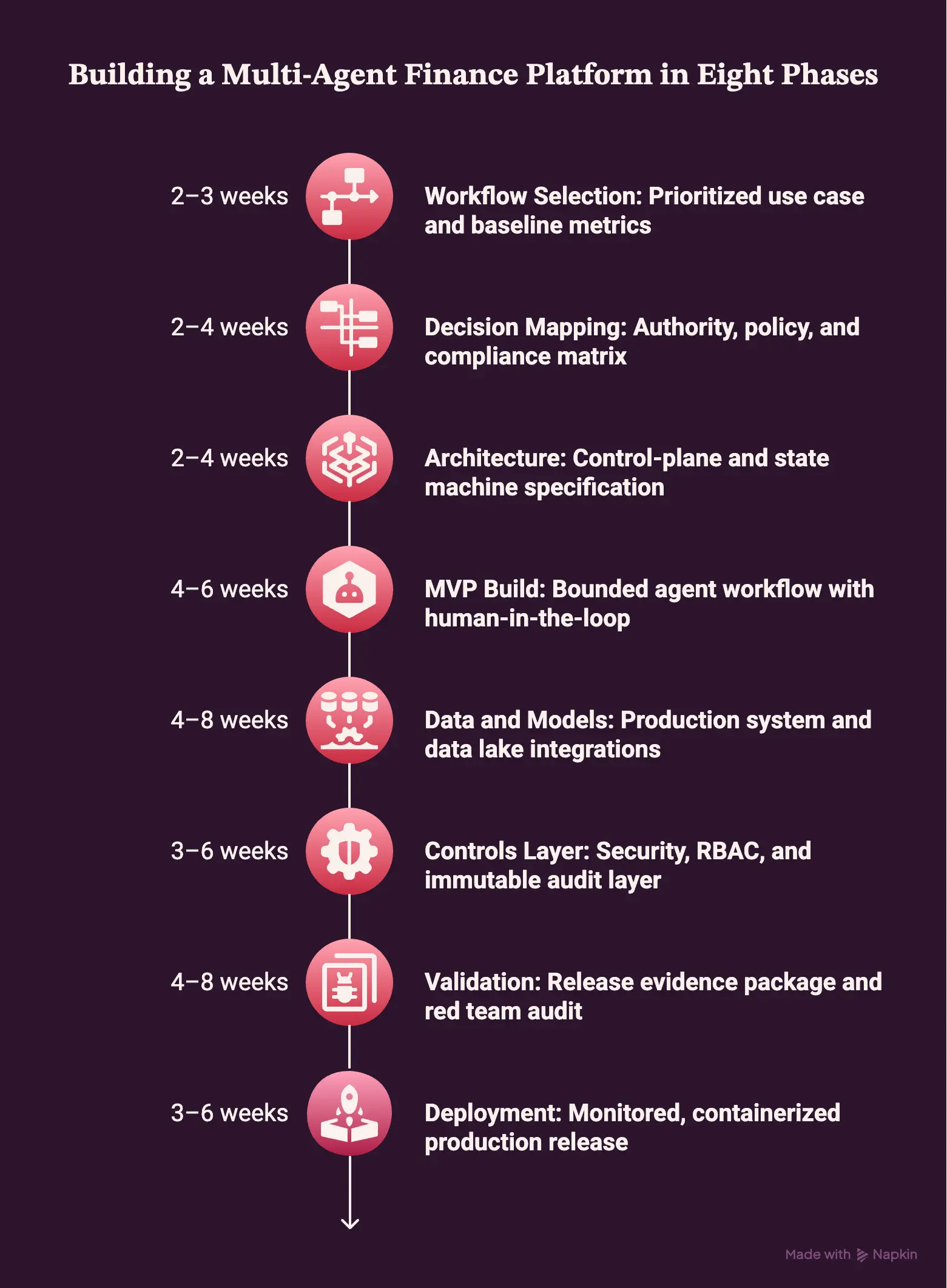
Technical Implementation Phase Breakdown
Firms must execute their implementation across distinct technical boundaries. Consequently, this phased matrix maps the target schedule against critical project outputs.
| Phase | Timeline | Primary Deliverable |
| Workflow Selection | 2–3 weeks | Prioritized use case and baseline metrics |
| Decision Mapping | 2–4 weeks | Authority, policy, and compliance matrix |
| Architecture | 2–4 weeks | Control-plane and state machine specification |
| MVP Build | 4–6 weeks | Bounded agent workflow with human-in-the-loop |
| Data and Models | 4–8 weeks | Production system and data lake integrations |
| Controls Layer | 3–6 weeks | Security, RBAC, and immutable audit layer |
| Validation | 4–8 weeks | Release evidence package and red team audit |
| Deployment | 3–6 weeks | Monitored, containerized production release |
Phase 1 — Select the Workflow and Baseline Its Performance
Firms must isolate a single business process to serve as their architectural blueprint. As a result, gathering deep initial operational metrics prevents teams from building complex software for low-value workflows.
- Process baselining: Measuring case volumes, standard exception rates, and compliance impacts explicitly.
- Cost auditing: Establishing the exact current operational cost per handled transaction.
Intellivon Approach: We conduct intensive stakeholder interviews, core system discovery, value modeling, and workflow suitability scoring. Therefore, your chosen use case starts with clear corporate backing and measurable operational targets.
Phase 2 — Map Decisions, Policies, and Data Boundaries
Engineering teams must convert corporate policies into concrete software requirements before writing agent prompts. Consequently, this step defines the exact boundary line between autonomous reasoning and rigid transactional logic.
- Decision-rights matrix: Mapping exactly which actions are delegated versus which require absolute human approval.
- Data classification: Marking personal data fields to prevent unauthorized transmission to public model nodes.
Intellivon Approach: We transform compliance manuals into rigid structural code configurations during early planning sprints. Thus, your security layout remains mathematically verifiable before any agent runtime execution occurs.
Phase 3 — Design the Control Plane and State Machine
The core platform requires a deterministic control layer to route payloads and handle runtime execution exceptions safely. As a result, developers shield business rules from unexpected model outputs by maintaining state outside the LLM.
- Workflow graphs: Mapping operational paths as explicit nodes, directional edges, and conditional logic gates.
- Audit schemas: Designing structured logging formats to record every single inter-agent communication event.
For a deeper breakdown of the control plane, see our guide on AI Agent Orchestration Platform Development.
Intellivon Approach: We build highly decoupled orchestration control layers that remain entirely independent from specific cloud vendors and LLM providers. Therefore, your core enterprise logic survives downstream API changes without requiring complete software rewrites.
Phase 4 — Build a Governed Orchestration MVP
Initial deployments should prioritize absolute structural safety over wide capabilities. Therefore, the development team must limit the application footprint during the first active code sprints.
- Scope constraint: Deploying one central orchestrator with three to five specialized workers.
- Tool restrictions: Binding all model-called functions to read-only API endpoints exclusively.
Intellivon Approach: We utilize replayable historic sample cases and strictly typed contracts from the first development cycle. Consequently, your engineering team validates basic routing flows without exposing production networks to risk.
Phase 5 — Add Financial Data, RAG, APIs, and Models
Firms connect their bounded orchestration layer to core transaction networks and internal knowledge bases to drive deep context processing. As a result, agents gain access to the secure data streams required for complex financial reasoning.
- System connectivity: Linking the runtime environment to core banking APIs, ERP software, and document lakes.
- Context enhancement: Building vector databases and knowledge graphs to enrich real-time agent prompts.
Intellivon Approach: We design standardized, reusable data connectors that position underlying foundation models behind governed, abstract interfaces. Thus, your data layout scales efficiently as new workflows join the platform.
Phase 6 — Add Security, Guardrails, and Audit Evidence
Regulated financial platforms require comprehensive security controls embedded directly into the messaging infrastructure. Consequently, firms prevent data leaks by applying zero-trust principles to every internal tool call.
- Access management: Enforcing strict role-based and attribute-based access controls across all runtimes.
- Data masking: Anonymizing account details before payloads exit secure institutional perimeters.
Intellivon Approach: We rigorously test every tool permission and prohibited action via automated script suites rather than reviewing security at a high architectural level. Therefore, your deployment satisfies strict corporate compliance mandates perfectly.
Phase 7 — Validate Through Replay, Shadowing, and Red Teams
Firms must subject their platform to adversarial testing before moving any traffic into live production environments. As a result, model drift or logic failures are discovered inside sandboxed validation zones.
- Historical replay: Running thousands of archived historical files through the system to measure consistency.
- Failure injection: Artificially breaking downstream APIs to verify that multi-agent fallback mechanisms execute correctly.
Intellivon Approach: We compile a comprehensive release evidence package covering agents, models, tools, policies, data, and precise workflow outcomes. This detailed record satisfies strict internal risk management reviews easily.
Phase 8 — Deploy, Monitor, and Expand Carefully
Production deployments require enterprise-grade infrastructure monitoring tools to track performance metrics and model behaviors in real time. Therefore, expansions should occur only after achieving stable operations.
- Container orchestration: Deploying isolated runtimes across secure, auto-scaling Kubernetes clusters.
- Observability integration: Tracking token consumption patterns and setting hard corporate cost budgets.
For core banking and lending integration patterns, see our guide on AI Loan Origination Platform Development.
Intellivon Approach: We treat daily operations, model monitoring, and workflow ownership as primary core product features rather than simple post-launch support items. Consequently, your automated platform delivers long-term operational returns safely.
The phases prevent teams from spending heavily on agents before proving the workflow and control model. Therefore, they provide the basis for a transparent development budget.
How Much Does Multi-Agent Orchestration for Finance Cost?
A production-grade multi-agent orchestration platform for finance typically costs $70,000–$300,000 to design, validate, and launch. A governed MVP restricted to a single workflow ranges from $70,000–$120,000. A fully productionized platform for a core business process scales between $120,000 and $200,000.
Finally, a multi-workflow enterprise implementation addressing highly complex banking scenarios scales from $200,000 to $300,000 depending on legacy database fragmentation. Consequently, capital expenditure aligns tightly with the depth of the integration surface and regulatory audit requirements.
1. Technical Phase Allocation Matrix
Institutions can eliminate budget guessing by breaking down engineering expenses across specific operational delivery layers.
| Development Phase | Cost Range | Primary Deliverable |
| Workflow Discovery & Compliance Blueprint | $8,000–$18,000 | System dependencies, process mapping, and risk categorization |
| Architecture, State Machine & Control Plane | $12,000–$30,000 | Persistent graph layout, memory schemas, and retry logic gates |
| Agent, LLM, RAG & Model Layer | $18,000–$55,000 | Prompt engineering, role tuning, and vector search indexing |
| Financial Data & System Integrations | $15,000–$55,000 | Secure REST/GRPC connectors to core ledger systems and ERPs |
| Security, Governance, Audit & Validation | $8,000–$35,000 | RBAC implementation, PII redacting, and SR 11-7 validation scripts |
| Testing, Deployment & Observability | $9,000–$27,000 | OpenTelemetry configuration, failure simulation, and CI/CD setups |
| Optional Multi-Workflow Scaling | $0–$80,000 | Reusable modular components mapped to adjacent operations |
| Total Target Capital Investment | $70,000–$300,000 | Production-Ready Multi-Agent Architecture |
2. What Keeps the Build Near $70,000–$120,000
Lean, high-efficiency deployments minimize software complexity by restricting agent autonomy and tool scopes. As a result, software engineering hours remain focused on pure business logic validation.
- One bounded workflow: Limiting system interactions to a narrow domain like an entry-level AML alert triage.
- Three to five agents: Deploying a minimum viable team consisting of a supervisor, simple retrieval units, and a critic.
- Read-heavy use case: Querying legacy banking systems via secure APIs without triggering downstream state modifications.
- Limited integrations: Connecting the execution environment to a single cloud data warehouse rather than multiple platforms.
- One deployment environment: Utilizing standard managed cloud foundation models without localized hardware clusters.
- Human approval before execution: Inserting hard pause gates that completely eliminate autonomous execution risk.
3. What Pushes the Build Toward $200,000–$300,000
High-end enterprise builds require significant infrastructure investment to account for complex multi-system environments and global compliance mandates. Therefore, custom security pipelines and real-time processing directly inflate developer resource allocations.
- Several financial workflows: Orchestrating complex asset allocation concurrently alongside real-time credit checks.
- Legacy banking integrations: Mapping unstructured mainframes to model interfaces using custom data serialization scripts.
- Multiple jurisdictions: Adapting agent compliance checkers to process conflicting regulatory logic simultaneously.
- Private-cloud deployment: Setting up private VPC sandboxes or localized server runtimes for high-security isolation.
- High availability: Engineering distributed, fault-tolerant state persistence machines that survive regional cloud blackouts.
- Custom knowledge graphs: Structuring institutional data relationships explicitly to eliminate common retrieval gaps.
4. Ongoing Operating and Maintenance Cost
Firms must budget 15%–25% of the initial capital build cost annually to sustain long-term operational performance. Consequently, software support preserves accuracy as internal business structures alter over time.
- Model evaluation: Continuous fine-tuning and testing to address potential reasoning or instruction drift.
- Regulatory updates: Adjusting logic boundaries to match evolving statutory reporting guidelines.
- Data changes: Updating system schemas and database connector tools to maintain data pipelines.
- Framework upgrades: Upgrading core software dependencies like LangGraph or Microsoft Agent Framework safely.
- Incident response: Troubleshooting edge-case failures, data timeouts, or anomalous agent loops in production.
Model inference, cloud infrastructure, market-data licenses, and third-party API usage should remain separate operating-line items.
The lowest proposal is not automatically the least expensive platform. A cheaper build becomes costly when it lacks durable state, evidence controls, reusable connectors, or a clear operating model. The investment decision should therefore compare business return and ownership requirements, not development cost alone.
Build Multi-Agent Orchestration for Finance With Intellivon
Build multi-agent orchestration with Intellivon when your financial workflow crosses several systems, models, policy domains, and approval teams. The engagement should begin with a workflow and decision-rights assessment, not a predetermined agent framework.
Intellivon then designs the control plane, agent contracts, integrations, guardrails, validation process, and production operating model around that requirement. Consequently, you gain an enterprise system customized to your data architecture.
Core Engineering Capabilities
- Workflow and architecture discovery: Map financial decisions, systems, agents, policies, risks, and measurable outcomes precisely.
- Production control plane: Build task routing, durable state, event-driven messaging, human approvals, retries, and audit evidence.
- Financial AI integration: Connect LLMs, RAG, rules engines, quantitative models, core systems, market data, and document platforms.
- Governance by design: Implement permissions, model inventory, effective challenge, validation, explainability, and retained decision records.
- Cloud and deployment engineering: Support containerized, serverless, private-cloud, hybrid, or multi-tenant SaaS deployment configurations securely.
- Production monitoring: Track every agent handoff, tool utility, prompt override, token cost, system failure, and final financial action.
Talk to Intellivon’s finance AI engineering team to scope one governed workflow, estimate the $70,000–$300,000 investment, and determine whether a custom multi-agent platform is justified. Therefore, your firm establishes operational resilience without exposing core ledgers to unnecessary deployment risks.
Conclusion
Deploying multi-agent orchestration transforms complex financial operations from manual bottlenecks into streamlined, automated infrastructure. Consequently, separating reasoning tasks from transactional networks safeguards core banking ledgers against model hallucination risks.
While open-source toolkits accelerate initial prototyping speeds, long-term resilience depends entirely on rigid compliance validation and granular security controls. Therefore, building a decoupled, event-driven architecture ensures that your scaling fintech platform remains fully audit-ready and secure.
FAQs
Q1. Is Multi-Agent Orchestration Better Than a Single Agent With Tools?
A1. Use one agent when the workflow involves one domain, few tools, and no independent challenge. However, use several agents when tasks require separate knowledge, restricted permissions, parallel work, or independent critical reviews. Multi-agent design is not automatically more accurate. Therefore, it adds significant coordination overhead, higher latency, complex testing, and elevated operating costs.
Q2. How Many Agents Should a Finance Platform Start With?
A2. Start with one central orchestrator and three to five specialized worker units. Consequently, add another agent only when it introduces a distinct skill, access boundary, independent validation function, or parallel task. Splitting a narrow task across too many personas creates unnecessary messages. Thus, it increases failure paths without improving decisions.
Q3. How Do Banks Keep Multi-Agent Systems Compliant With Model-Risk Guidance?
A3. Maintain a complete inventory of agents, models, tools, and automated workflows. As a result, assign clear owners, classify materiality, validate intended use, and retain comprehensive decision evidence. U.S. institutions should actively assess current SR 26-2 and OCC 2026-13 guidance rather than relying solely on older framework standards.
Q4. How Do You Prevent Agent Loops and Runaway Model Costs?
A4. Set strict iteration limits, task deadlines, maximum token budgets, and tool-call limits. Furthermore, engineers must implement logic to detect repeated states and duplicate messages automatically. Route low-complexity tasks to smaller models to save resources. Therefore, require terminal states or instant human escalation when boundaries are exceeded.
Q5. Should a Financial Institution Build, Buy, or Use a Hybrid Platform?
A5. Build when the workflow, unique policy logic, and legacy integrations create distinct strategic differentiation. Conversely, buy when the underlying business process is standard, and vendors meet control requirements. Use hybrid architectures to maintain custom orchestration and evidence control while using managed models and commodity cloud infrastructure connectors.
To Sum It Up
- A finance multi-agent system should separate reasoning, policy, quantitative models, and execution rather than asking one LLM to control the complete decision.
- A governed MVP usually costs $70,000–$120,000, while multi-workflow enterprise platforms reach $200,000–$300,000.
- The best starting architecture is normally one orchestrator with three to five tightly scoped agents, not an unrestricted swarm.
- SR 26-2 and OCC Bulletin 2026-13 should replace SR 11-7-only language in current U.S. banking model-risk discussions.
- Most production complexity sits in state management, integrations, controls, testing, and evidence retention rather than prompt engineering.