Key Takeaways:
-
AI governance platforms require centralized AI inventory, risk classification, model evaluation, and policy enforcement capabilities.
-
Runtime monitoring, lineage tracking, evidence collection, and regulatory reporting complete the six connected governance layers.
-
NIST AI RMF, ISO 42001, EU AI Act, healthcare controls, and financial model-risk governance define compliance requirements.
-
Platforms cost $70,000 to $300,000 with 12- to 16-week MVPs and 20- to 40-week production timelines.
-
How Intellivon builds AI governance platforms with annual maintenance budgeted at 15 to 22% of the initial build cost.
Enterprises run dozens of AI models with no central view of what is deployed. Specifically, building an AI governance platform starts with the model registry, not bias monitoring tools. In practice, that registry captures model metadata, training data lineage, version history, and regulatory classification. From there, bias monitoring, explainability, audit trail, and regulatory reporting all connect to that registry.
In fact, the registry is what regulators check first, not the individual compliance modules. Moreover, without it, bias and explainability outputs cannot be traced to a specific model version. EU AI Act fines from August 2026 reach 7% of global revenue for non-compliance. Consequently, a model registry is the first evidence regulators ask for under the EU AI Act examination.
Intellivon builds AI governance platforms for enterprises where regulatory traceability is a day-one requirement. The approach therefore always starts with model registry design before any governance module is built. Accordingly, this blog covers registry architecture, bias monitoring, explainability design, generative AI governance, and compliance automation.
What is an AI Governance Platform?
An AI governance platform is a centralized software system that tracks, audits, and manages an organization’s artificial intelligence models. It ensures compliance with regulations like the EU AI Act and frameworks like the NIST AI RMF.
At the same time, by automating risk assessments, monitoring model drift, and tracking data lineage, the platform helps enterprises deploy ethical, transparent, and secure AI systems while mitigating financial and legal liabilities
Why Enterprises Need an AI Governance Control Plane
An AI governance platform functions as a centralized infrastructure control plane that connects corporate risk policies to active model pipelines. Consequently, it continuously maps your software inventory, verifies compliance controls, automates approval workflows, and creates clear legal evidence.
This automated framework moves beyond static files to actively mitigate corporate liabilities.
1. AI Governance Platform vs Governance Framework
A framework establishes high-level ethical principles, organizational roles, and compliance goals.
In contrast, an enterprise platform translates these static rules into running code through automated code pipelines, system APIs, and live validation checks.
2. The Five Classes of AI the Platform Must Govern
| AI Class | Examples | Primary Governance Concerns |
| Predictive ML | Credit scoring, fraud detection, clinical risk models | Model validation, algorithmic bias, data drift, calibration |
| Generative AI | Text summarization, legal drafting, developer copilots | Hallucination tracking, data privacy, and output quality control |
| RAG Systems | Enterprise search, clinical knowledge assistants | Source lineage, document retrieval quality, and access control |
| AI Agents | Debt collection, automated AML, procurement agents | Tool execution permissions, autonomy limits, and escalation paths |
| Third-Party AI | Vendor SaaS features, model APIs, base foundation models | Vendor risk evidence, contractual updates, change notices |
3. The Policy-to-Evidence Governance Lifecycle
The platform orchestrates a continuous loop to manage risk across every deployment:
- Discover & Classify: Scans production networks to locate running models and tag them by internal risk tiers.
- Assess & Approve: Runs automated risk check sheets to secure sign-off from your risk committee before launch.
- Enforce & Monitor: Rejects non-compliant software updates and checks live performance metrics for data drift.
- Investigate, Report & Retire: Tracks down anomalous model decisions, outputs audit trails, and shuts down old systems.
4. Why the Market Is Moving Toward Control Platforms
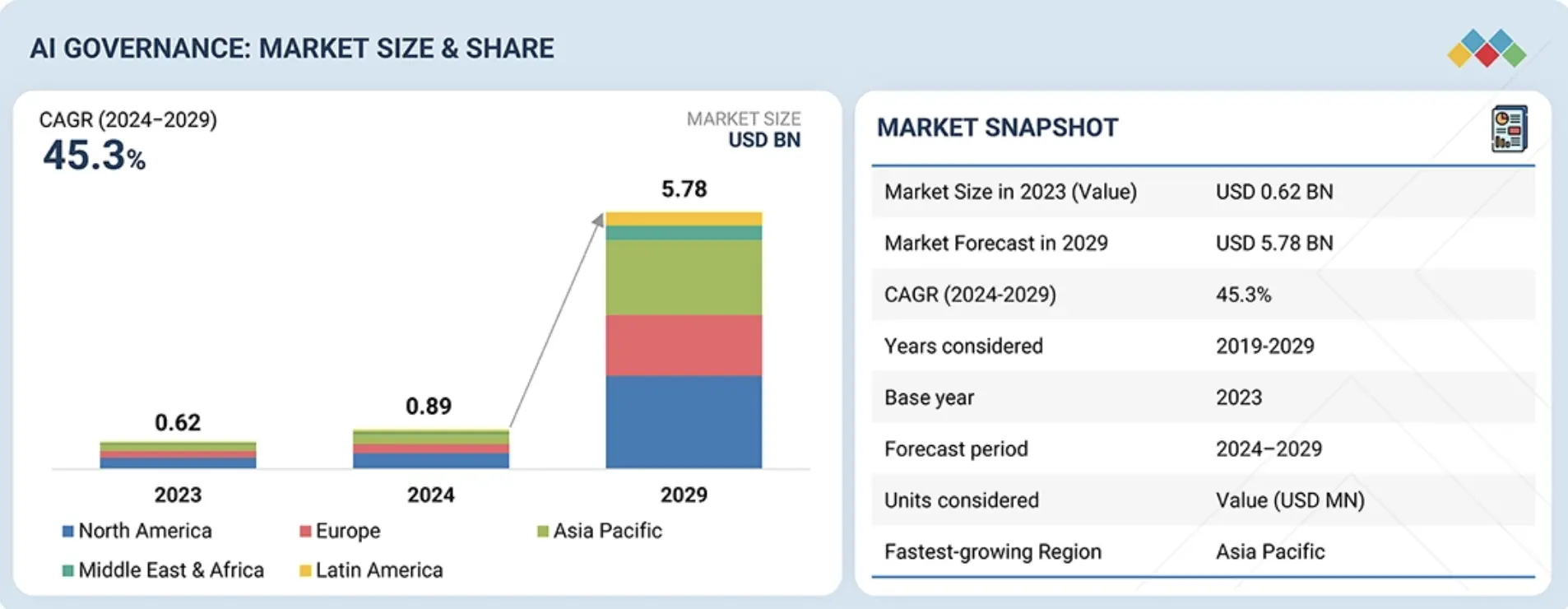
Market dynamics show that enterprises are rapidly replacing manual review procedures with automated control planes. For instance, Gartner projects that global spending on specialized platforms will reach $492 million in 2026 and cross the $1 billion threshold by 2030.
Furthermore, parallel research from MarketsandMarkets tracks broader market growth, expanding from $890.6 million in 2024 to $5.78 billion by 2029.
Enterprises do not need another unread policy document stored in a corporate folder. Instead, they require active software infrastructure that makes compliance enforceable across all live code bases.
Define AI Inventory, Risk Tiers, and Decision Rights
An automated inventory establishes the authoritative system of record for every enterprise AI deployment. Without a unified relational data model, active monitoring systems cannot determine which risk rules apply to which code artifact.
The platform must dynamically discover these assets, calculate their multi-factor risk scores, and enforce strict, role-based separation of duties.
1. Create a Canonical AI Asset Inventory
The platform must map and link separate entities rather than storing flat lists. Therefore, the relational data schema must explicitly connect:
- Business Intent: The raw business use case is tied directly to an executive sponsor and explicit geographic jurisdictions.
- Core Artifacts: The exact model version, training feature sets, system prompts, and RAG knowledge indexes.
- Runtime Entities: Active AI agents, permitted API tools, foundation vendors, operational controls, and real-time incident logs.
2. Automate Discovery Instead of Relying on Forms
Manual entry forms quickly become outdated and fail to stop unauthorized deployments. Consequently, the platform actively uncovers shadow systems by integrating directly with your technical infrastructure:
- Pipeline Hooks: Scans code repositories and CI/CD systems to flag new model registrations.
- Network & Runtime Traces: Inspects API gateways, cloud AI services, and LLM observability tools to intercept runtime traffic.
- Procurement Feeds: Cross-references vendor management software to catch unauthorized third-party SaaS features.
3. Build a Multi-Factor AI Risk Classification Engine
Relying on a basic, manual risk dropdown creates massive compliance gaps. Instead, the platform computes a dynamic risk matrix based on quantitative inputs:
| Risk Factor | Low-Risk Profile | High-Risk Profile |
| Decision Autonomy | Recommendations reviewed by humans | Fully autonomous execution without oversight |
| Data Sensitivity | De-identified, public business metrics | Protected health information (PHI) or banking credentials |
| Reversibility | Instant, low-cost transaction rollbacks | Irreversible clinical decisions or major financial trades |
| Deployment Scale | Internal test groups under 50 users | Millions of customer-facing production profiles |
4. Define Decision Rights and Separation of Duties
A robust platform prevents conflicts of interest by locking down user permissions. For instance, the system ensures that independent model validators hold the sole authority to approve production readiness.
Meanwhile, compliance, legal, and security reviewers retain distinct, programmatic veto powers within the launch workflow.
5. Encode Risk Appetite and Exception Workflows
When a business unit must bypass standard rules, the platform automates strict compensating controls rather than issuing permanent passes.
Temporary approvals require concrete remediation deadlines and assign clear financial ownership.
If a deadline passes without a fix, the engine automatically escalates the risk flag to the board-level governance committee.
Once assets, owners, and risk levels are reliably mapped, the platform can apply consistent controls through a formal architecture. Consequently, engineering teams can seamlessly plug this centralized inventory directly into their active development environments.
Design Enterprise AI Governance Platform Architecture
A decoupled architecture separates the AI governance platform control plane from multi-cloud execution environments.
Consequently, you can enforce centralized compliance policies across AWS, Azure, Google Cloud, and on-premises clusters without migrating workloads.
This modular integration ensures continuous runtime guardrails without creating operational latency inside performance-critical model engines.
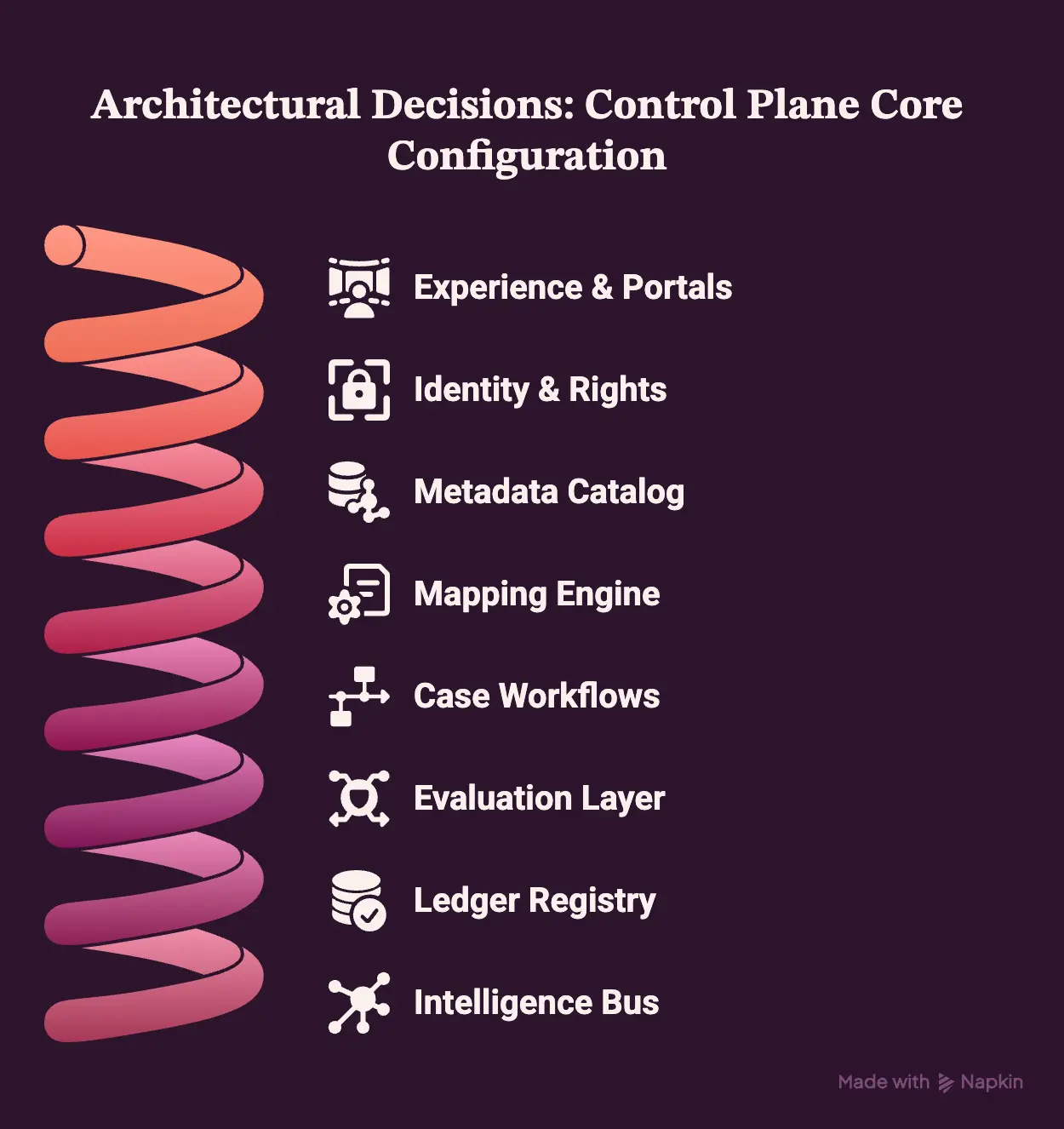
Architectural Decisions: Control Plane Core Configuration
| Architectural Pillar | Core Strategy | Core Operational Requirements & System Behaviors |
| Layer 1: Experience & Portals | Multi-Role Workspace | Delivers separate use-case intake web views, model-owner dashboards, independent auditor rooms, and automated board-level risk reporting templates. |
| Layer 2: Identity & Rights | Zero-Trust Auth | Integrates corporate identity provider SSO with role-based and attribute-based access controls to maintain clear, programmatic separation of duties. |
| Layer 3: Metadata Catalog | Graph Data Architecture | Maps complex, multi-system relationships connecting specific model versions to their original training datasets, prompt libraries, and active regional legal rules. |
| Layer 4: Mapping Engine | Policy-as-Code | Translates international regulatory updates into concrete control objectives, tracking exceptions automatically while managing continuous policy inheritance rules. |
| Layer 5: Case Workflows | Event-Driven Routing | Orchestrates multi-stage pipelines for validation processes, runtime incident resolution, and mandatory pre-deployment sign-offs across cross-functional review groups. |
| Layer 6: Evaluation Layer | Inline Guardrails | Runs automated fairness audits, hallucination evaluations, red-team simulations, and deploys active API blocking triggers directly into active production channels. |
| Layer 7: Ledger Registry | Immutable Audit Trail | Records tamper-evident logs tracking every system input, output, model version change, user override, and incident history for regulatory review. |
| Layer 8: Intelligence Bus | Open API Integrations | Syncs external regulatory updates with internal IT systems, GRC suites, developer MLOps pipelines, and third-party software vendor profiles via webhooks. |
An effective platform architecture decouples continuous data logging from active pipeline runtime execution. This targeted separation protects high-throughput enterprise applications from deployment friction while maintaining an unalterable audit trail.
Build Lifecycle Controls for Models, LLMs, and Agents
An enterprise AI governance platform applies distinct technical validation profiles to predictive, generative, and agentic systems within a single, immutable approval workflow. Consequently, you can enforce tailored mathematical or semantic checks across diverse software architectures.
This targeted enforcement ensures production safety without introducing development friction across engineering teams.
1. Govern Predictive Model Development and Validation
Predictive models require mathematical verification of their features, training datasets, and performance stability before live deployment.
- Lineage & Validation: Tracks feature-set engineering and executes automated out-of-time data validation splits.
- Testing Loops: Deploys automated independent validation and continuous champion-challenger model benchmarking.
2. Build Bias, Fairness, and Explainability Controls
Algorithmic fairness requires active runtime monitoring to detect disparate impacts and explain complex system outputs.
- Fairness Metrics: Evaluate demographic parity and equalized odds directly within live pipeline traffic.
- Explainability Tools: Integrate SHAP and LIME architectures paired with automated adverse-action reasoning checks.
3. Govern LLMs, Prompts, and RAG Pipelines
Generative systems require strict semantic safety engineering, prompt version controls, and context retrieval evaluations.
- Output Quality: Monitors RAG pipelines for groundedness, factuality, and retrieval precision.
- Security Shields: Intercepts prompt injections, jailbreaks, and unauthorized PII or PHI data leaks.
4. Build Agentic AI Governance Controls
Agentic systems present unique risks because their probabilistic reasoning leads to autonomous system actions.
- Execution Gates: Caps maximum action depth, enforces transaction thresholds, and embeds human approval points.
- Tool Restrictions: Authenticates Model Context Protocol (MCP) servers and enforces strict tool allowlists.
5. Manage Changes, Retraining, Incidents, and Retirement
The control plane triggers automated review workflows whenever a deployed asset undergoes a material modification.
- Trigger Events: Flags new data fields, modified prompts, expanded user bases, or vendor updates.
- Deprecation Paths: Automates incident tracking logs, drift alerts, and end-of-life model deprecation.
Intellivon explicitly decouples deterministic policy software from probabilistic model evaluations. By avoiding using one AI to judge another, we ensure your audit trails remain entirely transparent, reproducible, and compliant.
Map Regulatory Controls for Healthcare and Financial AI
An enterprise AI governance platform translates static regulatory guidelines into an active software control engine across regional jurisdictions. Consequently, instead of storing unread legal documents, the system maps real-time compliance requirements directly to active model validation workflows.
This continuous mapping automatically collects operational evidence to defend against escalating regulatory scrutiny.
1. Create a Cross-Framework Control Library
A unified control database links international standards, industry frameworks, and corporate policies to specific engineering validation checks.
- Core Blueprints: Maps internal policies to the NIST AI RMF (Govern, Map, Measure, Manage functions) and ISO/IEC 42001 standards.
- Data Protection: Enforces cross-cutting privacy restrictions derived from GDPR, CCPA, and general corporate security rules.
2. Build the EU AI Act Compliance Module
The European framework demands algorithmic transparency, strict data governance, and proactive incident logging.
- Risk Screening: Automates high-risk classification reviews and catches prohibited use cases before production runs.
- Audit Trails: Generates technical system documentation, tracks human oversight gates, and runs post-market monitoring workflows.
3. Build the Healthcare AI Governance Module
Clinical deployments require data security safeguards alongside validation protocols to verify safety.
- Data Safeguards: Enforce HIPAA compliance by implementing PHI-safe system logging and minimum-necessary data access gates.
- Clinical Integrity: Captures FDA Predetermined Change Control Plans (PCCP) and structures algorithm transparency parameters for ONC HTI-1 compliance.
4. Build the Financial AI Governance Module
Banking systems demand traceable credit decisioning models, risk assessments, and independent validation pipelines.
- Risk Guidelines: Replaces old SR 11-7 rules with the updated 2026 SR 26-2 Interagency Guidance on Model Risk Management.
- Adverse Action: Flags CFPB Regulation B violations by verifying that complex credit models issue specific, accurate adverse-action reason codes.
5. Automate Regulatory Change Management
The platform prevents compliance gaps by actively watching for shifts in international legal rules and modifying code parameters.
- Delta Scanning: Scans global regulatory sources to highlight adjustments in implementation schedules or safety boundaries.
- Alert Routing: Notifies control owners automatically, triggers asset impact analysis, and updates evidence revalidation timelines.
Consequently, when global regulators update text rules, your risk managers can modify core policy parameters inside the platform dashboard without refactoring underlying system pipelines.
Integrate Governance With MLOps, Data, Security, and GRC
An enterprise AI governance platform must serve as an active enforcement layer rather than a passive dashboard. Consequently, while read-only connectors successfully compile model inventories, write-back integrations are required to actively halt non-compliant CI/CD pipelines, block unauthorized API calls, and revoke data access privileges.
This active intervention stops compliance and security exposures before they hit production environments.
1. Connect MLOps and LLMOps Systems
Automating model management requires deep, two-way hook integrations across active developer engineering environments and pipelines.
- Pipeline Triggers: Connects directly with MLflow, Amazon SageMaker, Azure ML, Vertex AI, and Databricks workspaces.
- Runtime Guardrails: Hooks into LangSmith, Arize, and GitHub Actions to block deployments failing performance thresholds.
2. Connect Data Governance and Lineage Systems
Tracking algorithmic bias requires a clear structural line-of-sight from the model output down to the raw intake training features.
- Lineage Tracking: Integrates with corporate data catalogs, Snowflake, and Databricks Unity Catalog to map active data flows.
- Privacy Controls: Connects with data-loss prevention (DLP) engines and corporate consent platforms to verify data usage rights.
3. Connect Security and Identity Infrastructure
Securing modern agentic workflows requires strict programmatic verification of both human and machine system identities.
- Access Gating: Syncs with corporate IAM, SSO, and API gateways to enforce strict Zero-Trust execution permissions.
- Threat Mitigation: Feeds real-time model anomalies into SIEM and SOAR platforms to rapidly contain adversarial attacks.
4. Connect GRC and Enterprise Workflow Systems
Enterprise risk visibility relies on transferring compliance findings smoothly into existing corporate ticketing systems.
- Ticket Routing: Automatically opens remediation records and tracks change windows within ServiceNow and Jira.
- Audit Registry: Populates enterprise GRC risk registers and generates audit-ready compliance packages for board-level reporting.
5. Govern Third-Party and Open-Source AI
Managing supply-chain risk requires rigorous verification of foundational vendor layers and open-source models.
- Sourcing Audits: Mandate an AI Bill of Materials (AIBOM) while tracking license types and original model provenance.
- Risk Shielding: Monitors upstream base model updates and continuously screens vendor APIs for security gaps.
Consequently, your operational risk officers can declare system rules that immediately halt deviant models without manual engineering intervention.
How to Build an AI Governance Platform Step by Step
Building a production-ready AI governance platform requires a structured, multi-phase engineering approach.
To avoid building a passive reporting tool, you must follow a deliberate path that moves from foundational operating design directly into runtime pipeline enforcement gates.
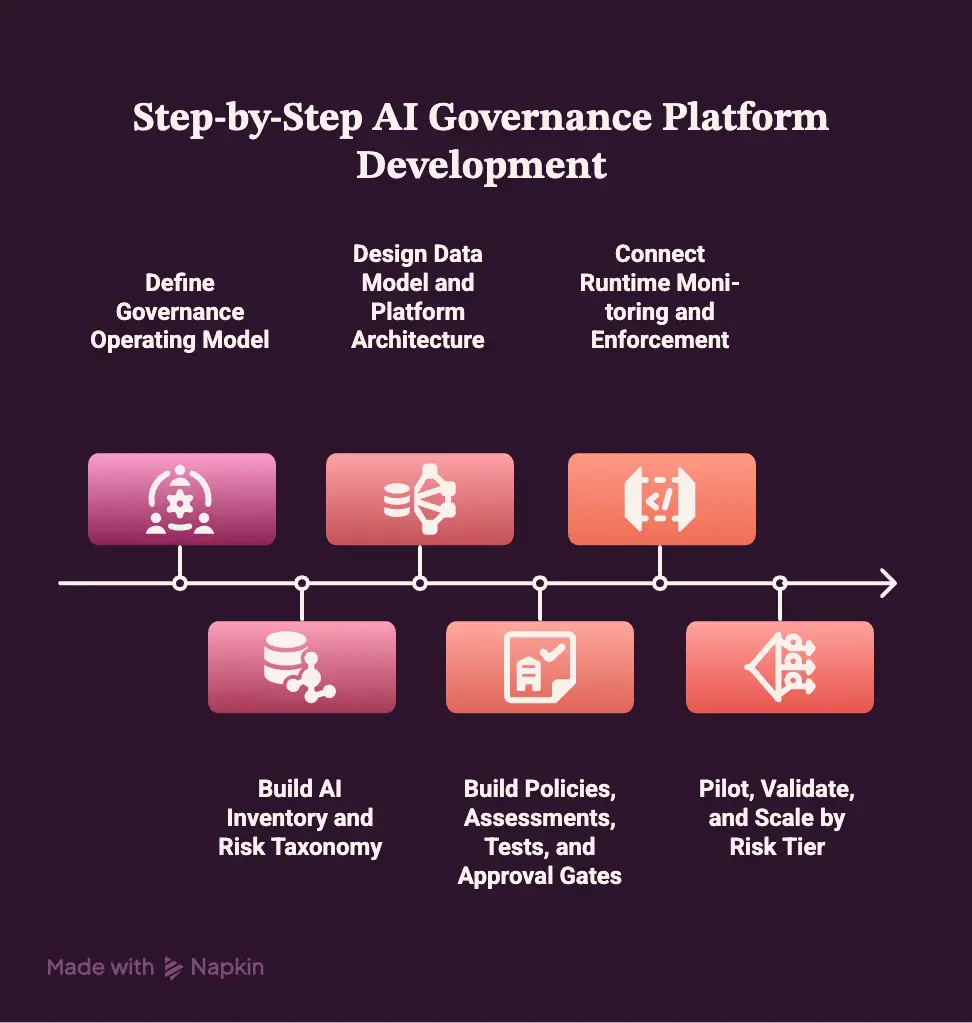
1. Define the Governance Operating Model and Scope
Before deploying any monitoring tools, you must define the explicit business units, legal jurisdictions, and specific decision boundaries the control plane will manage.
- Technical Requirements: Establishes the core governance charter, defines risk appetites, assigns RACI roles, maps escalation paths, and configures immutable evidence retention policies.
- The Intellivon Approach: We intentionally begin with a single, highly regulated model pilot rather than attempting an immediate enterprise-wide rollout. This focused scope allows engineering teams to refine policy hooks without disrupting broader development pipelines.
- Exit Criterion: Formally approved operating model documentation, clear control ownership matrices, and a locked pilot scope definition.
2. Build the AI Inventory and Risk Taxonomy
You must create your underlying system of record before developing any automated risk checklists or evaluations.
- Technical Requirements: Builds core asset schemas, creates use-case taxonomies, maps jurisdiction footprints, and deploys network and code repository infrastructure discovery connectors.
- The Intellivon Approach: Intellivon combines active, connector-based automated infrastructure scanning with targeted, developer-led registration surveys. Infrastructure discovery locates hidden assets, while human owners provide the specific business context that network traces cannot capture.
- Exit Criterion: A thoroughly validated, searchable inventory database mapping all pilot assets to designated executive owners and quantitative multi-factor risk tiers.
3. Design the Data Model and Platform Architecture
Design the governance data engine around entity relationships, system events, and immutable audit logs instead of simple flat databases.
- Technical Requirements: Sets up relational entity schemas, configures secure API contracts, integrates multi-tenant identity controls, and engineers regional data residency boundaries.
- The Intellivon Approach: We systematically isolate policy logic configurations, workflow orchestrations, evidence logs, and runtime block engines into separate, containerized microservices. Consequently, international compliance rules or individual model updates can change without requiring a full rewrite of your underlying core code.
- Exit Criterion: Signed-off system architecture blueprints, validated security access models, and confirmed integration API contracts.
4. Build Policies, Assessments, Tests, and Approval Gates
Translate your written corporate compliance guidelines into machine-readable policy assertions, automated evaluation profiles, and hardcoded approval triggers.
- Technical Requirements: Deploys a centralized policy engine, builds risk questionnaires, configures automated testing loops, and maps deployment approval routing logic.
- The Intellivon Approach: We implement hardcoded deterministic logic gates for mandatory compliance controls while using flexible, isolated evaluation services to monitor probabilistic output quality or safety behaviors. This ensures that baseline structural protections remain unalterable.
- Exit Criterion: Active software gates are configured such that pilot deployments cannot advance through the CI/CD pipeline without passing all required automated validation checks.
5. Connect Runtime Monitoring and Enforcement
The platform only provides defensive value once it connects directly to live traffic logs and holds the authority to alter production system states.
- Technical Requirements: Connects active deployment pipelines, model endpoints, LLM gateways, and enterprise GRC suites directly to the centralized control plane via secure webhooks.
- The Intellivon Approach: We extensively test read-only evidence compilation alongside write-back automated enforcement triggers within staging networks prior to executing any production releases. This step guarantees that automated rollbacks function perfectly without creating downtime.
- Exit Criterion: Verification that at least one automated pre-deployment blocking gate and one active runtime mitigation control work perfectly end-to-end.
6. Pilot, Validate, and Scale by Risk Tier
Launch your newly built control plane with two distinct architectural classes simultaneously to avoid creating a narrow, non-scalable platform layout.
- Technical Requirements: Runs end-to-end validation checks on system accuracy, monitors false-positive rates, tracks human override occurrences, and checks runtime latency impacts.
- The Intellivon Approach: We use this parallel deployment period to freeze reusable policy templates, base connectors, and operational dashboard configurations before scaling out to secondary business divisions. This strategy establishes a highly stable engineering template for the rest of the enterprise.
- Exit Criterion: A formally approved, evidence-backed platform scaling roadmap derived from verified pilot runtime data metrics.
Once decision rights are established across your pilot environments, leadership can confidently calculate the total software development investment required to scale out across the global enterprise.
How Much Does AI Governance Platform Development Cost?
Enterprise AI governance platform development usually costs $70,000 to $300,000, depending on inventory scale, integrations, runtime enforcement, regulatory coverage, deployment model, and multi-entity requirements.
At the same time, organizations must balance the initial engineering cost against the long-term risk of structural algorithmic failure.
1. Development Cost Breakdown
| Development phase | Cost range | What it covers |
| Governance discovery and control design | $8,000–$20,000 | Operating model, risk taxonomy, regulatory mappings, workflows, and MVP scope |
| Core inventory, registry, and workflow platform | $25,000–$55,000 | Asset registry, ownership, intake, assessments, approvals, and dashboards |
| Risk, policy, and evidence engine | $15,000–$45,000 | Risk scoring, control mapping, evidence requirements, exceptions, and audit records |
| Integrations and runtime telemetry | $15,000–$70,000 | MLOps, LLMOps, data, IAM, GRC, monitoring, and enforcement connections |
| Security, testing, and deployment | $7,000–$35,000 | RBAC, encryption, QA, penetration testing, deployment, and recovery controls |
| Advanced enterprise capabilities | $0–$75,000 | Multi-tenancy, regulatory intelligence, vendor portals, agent governance, and multi-region deployment |
| Total | $70,000–$300,000 | Final cost depends on the selected modules |
2. Cost by Release Level
- Foundation MVP: Costs $70,000–$110,000 and requires 12–16 weeks of engineering time to stand up core inventory and manual approval gates.
- Production governance platform: Costs $120,000–$200,000 and requires 20–28 weeks to deploy automated lifecycle controls and core MLOps integrations.
- Multi-entity enterprise platform: Costs $200,000–$300,000 and requires 28–40 weeks to deliver active multi-region telemetry write-back enforcement features.
3. Ongoing Cost
Budget 15%–22% of the original build annually for connector maintenance, regulatory updates, security patches, new model and agent support, monitoring, cloud infrastructure, user support, and control revalidation.
Intellivon builds scalable governance architectures using clean microservices interfaces. Consequently, engineering teams can implement basic tracking features today and layer on advanced automated programmatic enforcement later without incurring costly software refactoring fees.
Build an Enterprise AI Governance Platform With Intellivon
Intellivon builds custom AI governance platforms designed strictly as connected enterprise infrastructure.
Instead of forcing your engineering and compliance teams into fragmented, separate processes, our control plane fits seamlessly within your existing models, data structures, cloud architectures, security networks, and workflow environments.
Enterprise Technical Capabilities
- AI Inventory and Risk Design: Establishes granular asset taxonomies, clear ownership models, automated risk tiers, explicit control profiles, and immutable governance decision rights.
- Platform Architecture: Engineers design highly modular asset registries, workflow orchestration engines, isolated policy services, cryptographic evidence stores, centralized risk dashboards, and regulatory reporting modules.
- Model and Agent Governance: Deploys automated predictive-model validations, generative LLM evaluations, RAG lineage tracking, autonomous agent execution boundaries, independent red teaming, and mandatory human approval gates.
- Enterprise Integrations: Implements write-back microservices connections across core MLOps, LLMOps, data warehouses, IAM systems, enterprise GRC platforms, SIEM tools, procurement records, and ticketing ecosystems.
- Healthcare and Fintech Modules: Deliver dedicated compliance workflows built for HIPAA, ONC HTI-1, FDA change control plans, financial model-risk rules, Regulation B adverse-action disclosures, and AML monitoring.
- Production Engineering: Integrates enterprise-grade security structures, rigorous QA testing loops, real-time observability pipelines, automated rollback scripts, disaster recovery patterns, and continuous post-launch control maintenance.
Backed by more than 500,000 engineering hours and deep, ex-MAANG digital product development experience, Intellivon bridges the gap between complex global compliance requirements and active runtime software execution.
We construct resilient, containerized architectures that shield your organization from legal liability while maintaining maximum engineering velocity across your development teams.
Talk to Intellivon’s AI governance platform experts to define your architecture, regulatory scope, integrations, roadmap, and $70,000–$300,000 development plan.
Conclusion
An enterprise AI governance platform is not a static dashboard, policy portal, or checklist. It is shared infrastructure linking your asset inventory, risk tiers, and lifecycle controls directly to production workflows. For realistic planning, use a $70,000–$300,000 budget range.
Establish your operating model and inventory first, separate deterministic rules from probabilistic evaluations, and apply distinct validation profiles to machine learning, LLMs, RAG pipelines, and autonomous agents.
FAQs
Q1. Should We Build Governance on AWS, Azure, or Google Cloud?
A1. Cloud-native governance works well when one specific provider hosts your entire ecosystem. However, learning how to build an enterprise AI governance platform requires a vendor-neutral architecture if your models, data lakes, and workflows span multiple clouds. A cross-cloud control plane prevents infrastructure lock-in and centralizes compliance policies.
Q2. Is AI Observability the Same as AI Governance?
A2. No, because observability simply tracks what happened by capturing telemetry, performance logs, and data drift. Conversely, governance determines what is legally and ethically allowed to happen and actively deploys write-back triggers to block or reverse non-compliant production actions.
Q3. Can the Platform Discover Shadow AI Automatically?
A3. Yes, the system surfaces shadow installations by actively scanning cloud resource inventories, intercepting API traffic, and auditing code repositories. Furthermore, it parses identity provider logs and procurement records. While these infrastructure tools catch rogue code, formal developer attestation remains mandatory to supply the underlying business context.
Q4. How Do You Govern a Third-Party Foundation Model?
A4. You must wrap external APIs in a strict control framework that monitors vendor data retention policies and tracks model versions. Consequently, the platform screens outgoing prompts for PII leaks, evaluates incoming responses for toxic hallucinations, enforces downstream security boundaries, and maintains clear contractual exit plans if vendor service parameters drift.
Q5. Can One Platform Govern Healthcare and Fintech AI?
A5. Yes, provided the system establishes a highly modular healthcare AI governance platform development guide alongside a dedicated fintech AI governance platform development schema. While sharing a central data model, the platform isolates clinical PHI and HTI-1 workflows from banking model-risk rules, adverse-action reporting requirements, and anti-money laundering controls.
To Sum It Up
- An AI inventory that depends entirely on manual registration becomes outdated before the first enterprise-wide audit.
- Governance becomes enforceable only when integrations can block deployments, restrict agent actions, and revoke access.
- Predictive models, LLMs, RAG systems, and AI agents require different test profiles inside one shared governance lifecycle.
- Regulatory mappings must be versioned because AI obligations and implementation dates can change faster than enterprise release cycles.