Key Takeaways:
- Existing hospital chatbots are still used to answer routine questions from patients.
- Conversational AI works better when patients ask follow-up questions or more difficult ones.
- Hospitals should improve the chatbots whenever they start to slow down patients or staff.
- In order to work as a good replacement, it should have access to the EHR, incorporate safety checks, and be subjected to testing.
- Learn how Intellivon helps hospitals to improve their chatbots without throwing away those that are currently working.
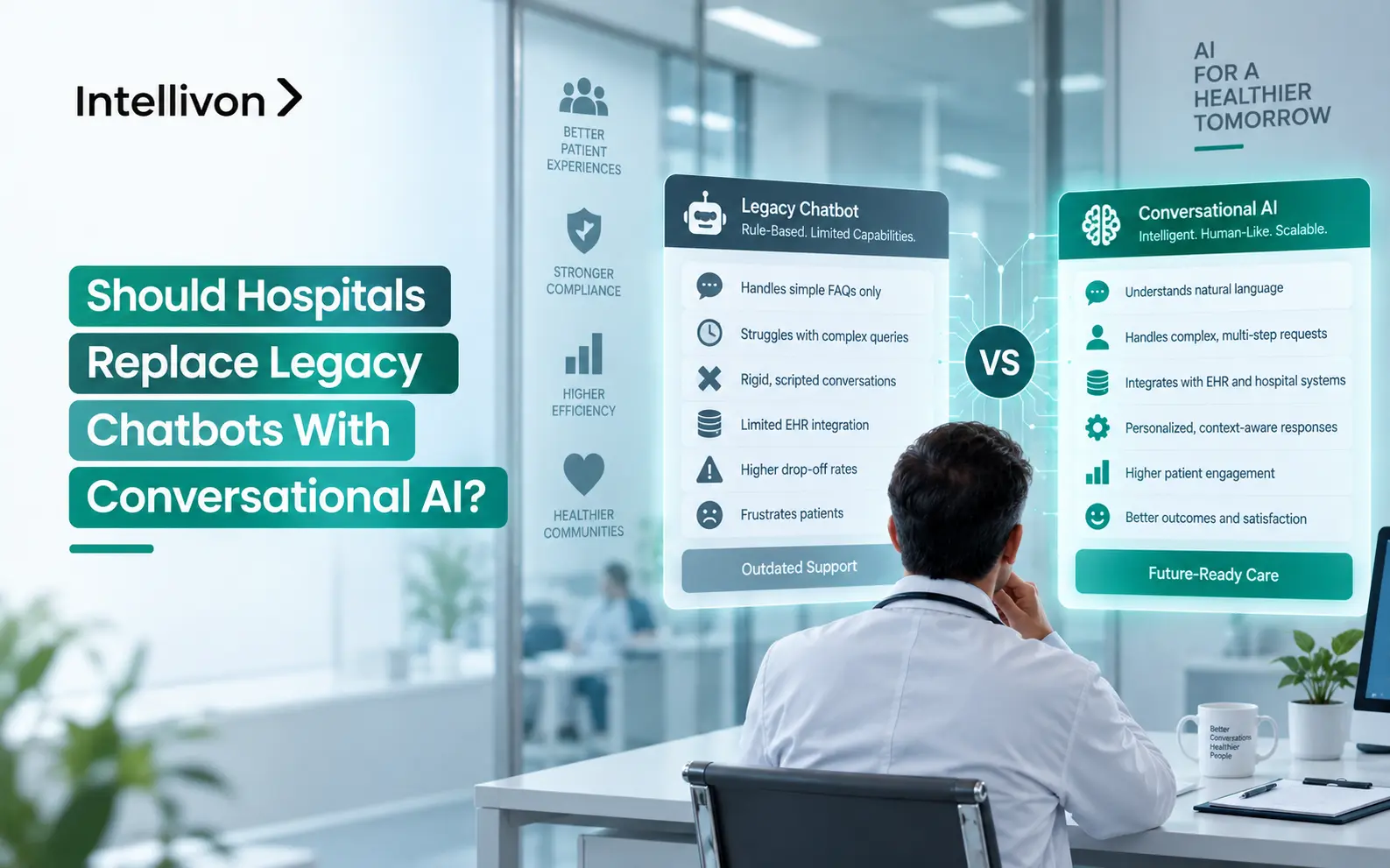
Yes, if the legacy chatbot fails to maintain continuity throughout its communication process with patients, whether about scheduling, billing, or any other query related to their EHRs, then they surely need to opt for conversational AI. This brings up an important question for discussion: one cannot rely on their preference for using the newest trend. What really matters is whether the technology knows what exactly a patient wants.
Well, the legacy chatbot system works on intent trees based on rules. Therefore, it matches keywords while sticking to a predetermined script. This means that as soon as a patient expresses their request in a way that differs from what the flow had anticipated, the conversation fails. On the other hand, conversational AI is based on large language models combined with retrieval-augmented generation and is able to maintain context over several exchanges, connect directly to systems such as Epic or Cerner, and deal with scheduling, triage, and billing all within a single uninterrupted conversation rather than sending patients back to a phone queue.
So the decision isn’t immediate. A department with volume could still get by with a simple chatbot. However, in the case of any hospital that has a real amount of scheduling work or receives multi-step questions, it is generally wise to replace it with conversational AI. In this blog, we will cover the factors that go into deciding this and will also cover how our experts at Intellivon safely replace legacy chatbots with conversational AI.
Why Hospital Chatbots Are Being Rethought in 2026
Hospital chatbots are being rethought in 2026 because patient expectations have outgrown the scripted, single-task bots most hospitals deployed years ago. Patients now expect multi-step help in one conversation. Meanwhile, the technology behind conversational AI has matured enough to actually deliver on that expectation.
Real numbers back that shift. The global conversational AI in healthcare market was valued at $2.29 billion in 2025 and is projected to grow to $2.98 billion in 2026, on its way to $24.50 billion by 2034 at a 30.11% CAGR, with North America holding the largest share of that market (Fortune Business Insights). Hospitals are moving with that curve, not ahead of it.
Several forces are converging at once. Patient volume has climbed faster than front-desk staffing, and call centers now absorb requests that used to go through a simple website chat widget. At the same time, health systems face pressure to cut administrative cost without cutting patient access.
- Patients expect one continuous conversation, not repeated menu resets
- Call center and front-desk volume has outpaced staffing at most systems
- Legacy bots can’t complete multi-step tasks like scheduling tied to insurance verification
- LLM-based conversational AI has matured enough for regulated, HIPAA-bound environments
- Competing health systems already live with conversational AI are raising patient expectations
Together, these pressures explain why 2026 is the year hospitals are actively rethinking their chatbot instead of just patching it.
How Legacy Healthcare Chatbots Actually Work
Legacy healthcare chatbots work by matching patient input against a fixed set of keywords, then routing that match through a decision tree built entirely in advance. Unlike newer systems, there’s no real language understanding involved here, only pattern recognition. As a result, the moment a phrase doesn’t match a known keyword, the conversation stalls.
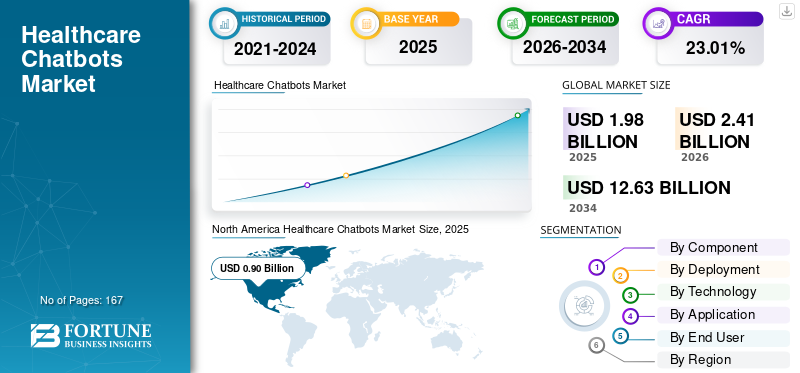
Despite that limitation, this older architecture still runs a large share of hospital deployments today. In fact, the global healthcare chatbots market was valued at $1.98 billion in 2025 and is projected to grow from $2.41 billion in 2026 to $12.63 billion by 2034 at a 23.01% CAGR, which shows just how common this older, rule-based-heavy market segment still is.
1. Rule-Based Bots Follow Prewritten Conversation Paths
Rule-based bots run on decision trees a designer maps out ahead of time. Buttons, keywords, and intents all point to one specific scripted reply. Because nothing in the system reasons on its own, every path has to be planned before a patient ever sees it.
a. Keywords Trigger Known Intent Categories
Older NLP systems scan incoming text for specific words and map them to a predetermined intent, such as “appointment” or “billing.” However, there’s no comprehension of meaning behind it, just matching against an approved list.
b. Decision Trees Control What Happens Next
Since the bot can’t reason independently, every branch a conversation could take must be built by hand in advance. Therefore, adding a new path means rebuilding part of the tree, not teaching the system something new.
c. Unknown Questions Fall Into Fallback Responses
When phrasing doesn’t match any known keyword, the bot defaults to a generic fallback message. Consequently, this is usually the exact point where a patient gives up and calls the front desk instead.
2. Legacy Bots Work Best With Predictable Requests
Even so, these systems still handle narrow, stable questions well, since the phrasing and the answer rarely change. In these cases, that consistency is genuinely useful in a hospital setting, where predictability matters as much as speed.
- Hospital hours and locations
- Basic appointment information
- Department routing
a. Hospital Hours and Locations
For example, a question like “what time does the ER open” almost never changes in phrasing or answer, making it a reliable match for keyword logic.
b. Basic Appointment Information
Similarly, simple scheduling questions, like confirming whether a department accepts walk-ins, still fit comfortably within a scripted flow.
c. Department Routing
Likewise, directing a patient to the right department or number is a fixed, low-complexity task that doesn’t need generative AI to work well.
3. Their Main Strength Is Predictability
Ultimately, rule-based bots always return the same approved answer for the same input, and in a regulated setting like healthcare, that reliability still has genuine value.
Overall, legacy chatbots are just narrow. They hold up fine on fixed, low-variation requests, but they break down the moment a patient needs something conversational. That gap is exactly where conversational AI picks up, which the next section covers directly.
What Conversational AI Adds to Patient Support
Conversational AI adds the ability to understand what a patient actually means, not just which keyword they typed, and to carry that understanding across an entire conversation instead of resetting after every reply.
Unlike a legacy bot, which forces patients into rigid menus, conversational AI lets them speak or type naturally, ask follow-up questions, and get answers pulled from approved hospital content rather than a fixed script.
1. Patients Can Speak or Type More Naturally
Rather than matching exact keywords, conversational AI interprets intent and meaning, so a patient can phrase a question however feels natural and still get a relevant answer.
2. The AI Can Remember Conversation Context
Beyond a single reply, conversational AI holds onto what was said earlier in the chat, so patients don’t have to repeat themselves every time they ask a follow-up.
a. Follow-Up Questions Stay Connected
For instance, if a patient asks about a prescription refill and then asks “how long will that take,” the system already knows what “that” refers to.
b. Patients Can Change Topics Without Starting Again
Similarly, a patient can move from a billing question to a scheduling request in the same conversation without the bot losing track of who they are or what they’ve already asked.
3. RAG Connects AI With Approved Hospital Knowledge
Put simply, retrieval-augmented generation, or RAG, means the AI pulls its answers from a hospital’s own approved content instead of generating them from general training data.
- Grounds every answer in verified, hospital-approved source material
- Reduces the risk of the AI inventing or guessing clinical information
- Keeps responses aligned with current policies, not outdated ones
a. Hospital Content Becomes the Answer Source
As a result, policies, service pages, and approved documents become the material the AI searches before it answers, so responses stay accurate to what the hospital actually offers.
b. Retrieval Reduces Reliance on Model Memory
Otherwise, the model would answer healthcare questions purely from its own training, which is exactly the kind of open-ended guessing a hospital can’t risk with patient-facing content.
4. AI Can Connect Conversations With Hospital Systems
Beyond just talking, conversational AI can also act, checking real appointment slots, pulling referral status, or updating a record through a live connection to scheduling, billing, and EHR systems.
5. One AI Layer Can Support Several Channels
Consequently, the same conversational logic can run across voice, web chat, SMS, and the patient portal, so a hospital isn’t rebuilding separate bots for every channel.
Altogether, conversational AI turns patient support from a static script into an actual conversation, one that understands intent, remembers context, and pulls from real hospital data instead of guessing.
How Chatbots and Conversational AI Differ in Hospitals
Chatbots and conversational AI differ in hospitals across nearly every functional layer, not just the chat window patients see on the surface. Specifically, the two technologies diverge in how they understand language, hold context, retrieve information, complete tasks, handle the unexpected, and get maintained over time.
Together, these differences are what actually decide whether a hospital’s current system is still keeping up.
Legacy Chatbot vs Conversational AI, Side by Side
| Area | Legacy Chatbot | Conversational AI |
| Patient language | Matches fixed keywords to a preset list of intents; unrecognized phrasing fails silently | Interprets meaning and intent using NLP/LLMs, so varied phrasing still resolves correctly |
| Context | Resets after each exchange; patients must restate details in every message | Retains context across the full conversation, including topic switches and follow-ups |
| Knowledge | Answers pulled from a fixed script written in advance, updated manually | Answers grounded in approved hospital content via retrieval-augmented generation (RAG) |
| Scheduling | Routes patients to a booking link or phone number rather than completing the task | Books, reschedules, or cancels appointments directly through a live scheduling integration |
| EHR access | Little to no direct connection; usually just static, pre-written info | Connects via API to pull and update real patient and scheduling data in real time |
| Voice | Typically a separate system with its own logic and maintenance | Runs on the same conversational layer as chat, web, and SMS |
| Human handoff | Transfers the chat with no context, so staff start the conversation over | Passes full conversation history and intent to staff, so nothing is repeated |
| Maintenance | Manual rule and intent-tree updates every time a new request type appears | Ongoing model monitoring, prompt tuning, knowledge base updates, and API upkeep |
| Clinical safety | Predictable output, but narrow, so it simply fails on anything unscripted | Handles far more, but requires guardrails, escalation logic, and validation to stay safe |
| Analytics | Basic conversation logs and completion counts | Workflow-level analytics: intent trends, drop-off points, and AI performance monitoring |
Put together, this table shows the gap is structural. A legacy bot routes and scripts, whereas conversational AI understands, retains, and acts. That gap is exactly what shows up next in missed appointments, abandoned chats, and the staff time hospitals spend cleaning up after it.
Why Legacy Hospital Chatbots Start to Fall Short
Legacy hospital chatbots start to fall short the moment patient requests move past simple, predictable questions into anything resembling a real conversation.
Because these systems rely entirely on scripted rules, they can’t adapt when a patient phrases something unexpectedly, asks more than one thing at once, or expects the bot to actually finish a task instead of just pointing them elsewhere.
As a result, the cracks tend to show up in the same handful of places across most hospital deployments.
- Scripted flows fail on unusual phrasing or partial questions
- Longer conversations lose context between related requests
- Failed intent recognition traps patients in repetitive fallback loops
- Limited integrations stop tasks halfway instead of completing them
1. Scripted Flows Struggle With Real Patient Language
Patients rarely phrase things the way a rule tree expects. A typo, an unusual word choice, or a half-finished question is often enough to send the bot straight to a generic fallback response instead of the right answer.
2. Longer Conversations Lose Important Context
Once a conversation moves beyond a single exchange, legacy bots typically forget what was already said. Consequently, patients end up repeating details they already provided just a few messages earlier.
3. Patients Get Stuck in Repetitive Bot Loops
When intent recognition fails, many bots simply repeat the same fallback message. Therefore, patients get stuck cycling through unhelpful replies until they give up and call instead.
4. Limited Integrations Stop Tasks Halfway
Answering a question and completing a task are not the same thing. Even so, most legacy bots only manage the former, handing patients off to a link or phone number to finish the rest.
5. Rule Trees Grow Harder to Maintain Over Time
As hospitals add more intents and exceptions, the underlying rule tree becomes harder to update. Eventually, even small changes require untangling dozens of interconnected paths.
6. Separate Channels Create Fragmented Experiences
Because web, phone, SMS, and portal bots often run independently, patients get inconsistent answers depending on which channel they use.
Altogether, these aren’t isolated glitches, they’re the predictable result of a rule-based system stretched past its original design. That accumulated strain is exactly what pushes hospitals toward evaluating a replacement.
Where Conversational AI Creates More Hospital Value
Conversational AI creates more hospital value by turning routine patient-access work into something the AI can actually complete, not just explain. Rather than pointing patients toward a link or a phone number, it handles scheduling, referrals, billing questions, and portal support directly inside the conversation.
As a result, the value shows up less in flashy features and more in fewer dropped tasks across the channels patients already use.
- Completes multi-step scheduling instead of just routing patients
- Resolves referral, billing, and portal questions without a transfer
- Extends the same automation across voice, chat, and SMS
1. Appointment Scheduling Becomes More Conversational
Scheduling stops being a static link and becomes something the AI can actually walk a patient through, start to finish.
a. Appointment Discovery
The AI can help a patient identify the right visit type or provider based on what they describe, instead of expecting them to already know which department to pick.
b. Rescheduling and Cancellation
Beyond first-time booking, the same system can handle rescheduling and cancellations, which are typically the more transactional, back-and-forth part of scheduling.
c. Appointment Reminders and Follow-Up
Once, the reminder was where automation stopped. Now, it can extend into follow-up questions and next steps after the first booking is done.
2. Referral Support Becomes Easier to Navigate
Patients can check referral status, understand what’s needed next, and get clear guidance, instead of guessing where their referral stands.
3. Billing Questions Can Be Resolved Faster
Common billing questions, like balances and payment options, can be answered directly, with a clean handoff to staff only when the issue actually needs one.
4. Patient Portal Support Can Become More Useful
Since many patients struggle with portal navigation, conversational AI can walk them through account access and common support questions in plain language.
5. Voice AI Can Reduce Routine Call Center Work
The same logic extends to voice, so common patient-access requests no longer need to tie up a live call center agent.
6. SMS Can Become Part of the Same Patient Journey
Because the AI layer is shared, a patient can start a conversation in chat and continue it over SMS without losing context.
Altogether, this is where conversational AI stops being a technical upgrade and starts showing up as fewer stalled tasks and fewer calls to the front desk. Next, it’s worth looking at what building or migrating to this kind of system actually costs.
The Real Decision Is Keep, Upgrade, or Replace
The real decision isn’t chatbot versus conversational AI in the abstract, it’s whether your specific system should be kept as is, upgraded in place, or replaced outright. Consequently, that choice depends less on the technology itself and more on where your current bot is already breaking down.
Therefore, the table below maps each path to the signals that actually point toward it.
1. Keep, Upgrade, or Replace at a Glance
| Decision | When to Choose It | What It Looks Like | Signals to Watch For |
| Keep the chatbot | Simple, stable flows still work | FAQs still work well: informational questions with fixed, rarely-changing answers don’t need AI to resolve. Routing remains predictable: directing patients to the right department or number stays reliable without added complexity. | Low request variety, minimal complaints, low call-center overflow tied to the bot |
| Upgrade the chatbot | Core logic still works, but inputs or channels have outgrown it | Add better natural language understanding: improves how patient input is interpreted without rebuilding the backend. Add RAG for better knowledge access: modernizes how answers are sourced while keeping existing workflows intact. Add voice or SMS around existing logic: expands channels without redesigning every rule. | Bot logic is sound, but patients struggle with phrasing, or channels feel disconnected from each other |
| Replace the chatbot | Technical debt outweighs the cost of patching further | Too many intents and exceptions: the rule tree has grown difficult and risky to maintain. Weak integration with hospital systems: the bot can’t connect deeply enough with EHR, scheduling, or billing to finish tasks. High escalation and failure rates: patients are consistently dropped to staff or a fallback message. | Frequent maintenance requests, rising escalation volume, integration requests the current system can’t support |
Ultimately, this decision comes down to where the strain actually is, not how new the technology looks. A hospital with mostly stable, low-volume flows may only need an upgrade, while one buried in exceptions and failed handoffs is likely looking at a full replacement. That distinction is exactly what shapes the cost breakdown covered next.
EHR Integration Determines How Useful the AI Becomes
EHR integration determines how useful the AI becomes because a conversational layer is only as capable as the data and systems it can safely reach. Without real access to patient records, scheduling, and provider data, even the most advanced AI is stuck giving generic answers.
Consequently, the depth and safety of that integration is what separates a genuinely useful assistant from a chatbot with a better vocabulary.
- FHIR and HL7 govern how healthcare data actually gets accessed
- Identity verification has to happen before any PHI is shared
- Read access should be proven reliable before write access is granted
1. FHIR Connects Modern Healthcare Applications
FHIR is the current standard for letting modern applications access healthcare data in a structured, secure way, and it’s what most conversational AI integrations are built on today.
a. Patient and Appointment Data
Through FHIR, the AI can pull patient details and appointment records, which supports common workflows like scheduling, confirmations, and status checks.
b. Provider and Scheduling Information
Likewise, provider availability and scheduling data flow through the same standard, giving the AI what it needs to guide a patient toward the right visit.
2. HL7 Still Connects Many Legacy Hospital Systems
Even so, plenty of hospital systems still run on older HL7 interfaces rather than FHIR, so most real-world integrations end up supporting both.
3. Epic Workflows Need More Than Basic API Access
Meanwhile, Epic environments typically involve visit types, provider-specific rules, referral requirements, and slot restrictions, all shaped by local configuration, not just standard API calls.
4. Identity Must Be Verified Before PHI Is Shared
Before any personalized patient information is shared, identity has to be securely confirmed; otherwise, PHI exposure becomes a real risk.
5. Read Access Should Come Before Write Access
As a rule, retrieval should be validated first, since letting the AI write directly into source systems before read access is proven reliable raises the stakes considerably.
6. Write-Back Needs Strong Transaction Controls
When the AI does write back, actions like booking or cancellation need real safeguards.
a. Duplicate Action Prevention
This stops repeated bookings or duplicate transactions from the same request.
b. Confirmation Before Final Changes
Similarly, patient confirmation is required before sensitive changes go through.
c. Rollback When Transactions Fail
Finally, if part of a transaction fails, the system needs to roll back cleanly instead of leaving a half-completed action behind.
Ultimately, none of the conversational capability covered earlier means much without this careful integration behind it. That safety-first approach to data access is exactly what carries over into the compliance requirements covered next.
Conversational AI Needs Strong Healthcare Guardrails
Conversational AI needs strong healthcare guardrails because none of the capability covered so far matters if it isn’t safe, compliant, and accountable. Before treating replacement as a simple upgrade, hospitals have to confirm the system meets the same regulatory bar as every other patient-facing tool.
Otherwise, a faster, smarter chatbot just becomes a faster way to create compliance risk.
- HIPAA and BAA requirements apply just as strictly to AI vendors
- RAG limits, but doesn’t eliminate, the risk of an unsupported answer
- Human escalation and audit logging have to be built in, not optional
1. HIPAA Still Applies to Conversational AI
HIPAA doesn’t relax just because a system sounds more conversational. PHI still has to be protected through the same access controls, storage rules, transmission security, and audit requirements as any other patient data system.
2. Vendors Handling PHI Need the Right BAA
Since multiple vendors are often involved, from the model provider to the healthcare platform layer, a signed BAA has to cover every party that touches PHI, not just the primary vendor.
3. RAG Helps Control Healthcare Answers
As covered earlier, RAG grounds responses in approved hospital content, which meaningfully reduces the chance of the AI generating an unsupported or made-up answer.
4. Hallucination Risk Still Needs Active Monitoring
Even so, RAG doesn’t remove model risk entirely. The AI can still misinterpret retrieved content or blend it incorrectly, so ongoing monitoring stays necessary regardless of how the system is grounded.
5. High-Risk Topics Need Fixed Guardrails
For topics like emergencies, medication guidance, or anything resembling a clinical decision, the system needs fixed, non-negotiable guardrails rather than relying on the model’s judgment alone.
6. Human Escalation Must Remain Easy
At the same time, patients should never feel trapped in automation. A clear, fast path to a human has to stay available, especially once a conversation touches anything sensitive.
7. Every Important AI Action Needs an Audit Trail
Finally, every meaningful action, the model version used, the retrieval source, the prompt, and the outcome, needs to be logged, so any answer or action can be reviewed after the fact.
Altogether, these guardrails are what separate a genuinely deployable healthcare AI system from a capable demo. With safety and compliance addressed, the next section turns to what building or migrating to this kind of system actually costs.
Hospital Chatbot Replacement Costs $70K to $300K
Hospital chatbot replacement typically costs between $70,000 and $300,000, depending on integration depth, compliance scope, and how much of the legacy system needs to be rebuilt versus reused.
Rather than one flat number, the total is really six cost centers stacked together, from discovery through migration. The table below breaks down where that budget actually goes.
1. Cost Breakdown by Phase
| Phase | Cost Range | What It Covers |
| Discovery and Legacy Audit | $7K – $15K | Analyzing the current chatbot, mapping existing workflows, reviewing conversation transcripts, auditing integrations, and documenting requirements for the new build |
| Conversation Redesign | $10K – $25K | Redesigning conversation UX, consolidating duplicate or overlapping intents, building new conversation flows, planning the RAG knowledge structure, and designing escalation paths |
| AI and RAG Development | $15K – $45K | LLM integration, retrieval system setup, prompt design, conversation orchestration, and the guardrails covered in the previous section |
| EHR and API Integration | $20K – $80K | Epic or Cerner connectivity, FHIR and HL7 interfaces, scheduling and billing systems, identity verification, and other hospital-specific APIs |
| Security and Validation | $8K – $30K | HIPAA safeguards, access controls, safety and clinical validation testing, and governance review before go-live |
| Migration and Launch | $10K – $45K | Parallel operation with the legacy bot, production testing, cutover planning, post-launch monitoring, and staff training |
2. Ongoing Maintenance Adds 15% to 25% Each Year
Beyond the initial build, hospitals should budget 15% to 25% of the total build cost annually for maintenance.
This covers integration upkeep as connected systems change, model and prompt updates, security patching, knowledge base updates as policies shift, ongoing monitoring, and vendor support.
3. Voice and Multi-Site Builds Cost More
That said, the ranges above assume a single-site, chat-first deployment. Adding telephony, supporting multiple languages, deploying across several hospitals, or integrating with separate EHR instances per site all push scope, and cost, well beyond the base range.
Altogether, the final number depends far more on integration depth and compliance scope than on the AI model itself. A hospital replacing a single, well-scoped chatbot sits toward the lower end, while a multi-site, voice-enabled rollout sits closer to the top.
We Ensure Safe Migration From Legacy Chatbot To Conversational AI
At Intellivon, a safe migration from a legacy chatbot to conversational AI happens in clear, sequenced stages, never as a single cutover. Rushing straight to a full replacement is exactly what creates outages, broken integrations, and patient-facing failures mid-transition.
Instead, each stage we run builds directly on the one before it, so risk gets tested in small, controlled pieces rather than all at once.
- Early stages focus on understanding what exists and what’s actually worth keeping
- Middle stages build and connect the new system without touching live operations
- Final stages run both systems in parallel before any real cutover happens
Step 1. Audit the Existing Chatbot
We start by reviewing the current chatbot in full: every intent, every failure pattern, every integration, conversation transcripts, active channels, human handoff points, and the maintenance work the hospital’s team has been carrying out. This audit is what tells us what’s actually broken versus what’s just old.
Step 2. Map the Most Valuable Patient Journeys
From there, we identify which workflows create the most measurable value once automated properly, whether that’s scheduling, billing, or referral status. We prioritize based on patient volume and current failure rate, not on which workflow looks the most impressive to build.
Step 3. Keep Useful Existing Logic
Where the legacy system’s rules still work well, we keep them. Rebuilding deterministic logic that already performs reliably wastes budget and adds unnecessary risk, so we only replace what actually needs replacing.
Step 4. Build the Knowledge and RAG Layer
Next, we build the approved knowledge base the AI will draw from, grounding every response in verified, hospital-approved content rather than the model’s open-ended training data. This is the foundation that keeps answers accurate later.
Step 5. Connect Read-Only Hospital Data
Before anything can be written to a hospital system, we connect and test read-only access first, pulling patient, appointment, and provider data to confirm the integration is reliable under real conditions.
Step 6. Add Controlled Workflow Actions
Once read access is proven, we introduce transactional workflows in a controlled sequence: scheduling, status checks, billing questions, and referrals, each with the safeguards covered earlier, like duplicate prevention and confirmation steps.
Step 7. Test Real Patient Conversations
We then stress-test the system against real conversational patterns: interruptions, vague language, multiple requests in one message, questions outside the AI’s scope, and handoff scenarios, not just clean, scripted test cases.
Step 8. Run Both Systems Before Cutover
Rather than switching over immediately, we run the legacy chatbot and the new conversational AI in parallel, comparing performance directly before the old system is retired.
Step 9. Expand Only After Results Are Stable
Finally, we only expand into higher-risk workflows once reliability, safety, and completion targets are consistently met, not before.
This is exactly how we keep a hospital’s chatbot replacement from becoming a disruption instead of an improvement. Sequencing the work this way is what lets a health system move off a legacy system with confidence, and not guesswork.
Ready to Move Off Your Legacy Chatbot the Right Way
By now, the real question isn’t whether conversational AI is more capable than a legacy chatbot, it’s whether your hospital can move off the old system without disrupting live scheduling, breaking EHR integrations, or losing the escalation paths staff already rely on.
That’s a migration problem, and it’s exactly what we help hospitals work through at Intellivon.
- Audit your current chatbot’s real failure points, not just its feature gaps
- Map which patient journeys, scheduling, billing, referrals actually justify replacement
- Keep the rule-based logic that still works instead of rebuilding it unnecessarily
- Build a RAG layer grounded in your hospital’s own approved content
- Connect safely to Epic, Cerner, FHIR, and HL7, starting with read-only access
- Add transactional actions like booking and rescheduling with proper safeguards
- Run the new system alongside your legacy bot before any real cutover
- Handle HIPAA, BAAs, and audit logging as part of the build, not an afterthought
If your hospital is weighing this decision and wants a clear-eyed answer on cost, integration risk, and timeline before committing, our team can walk through your current chatbot and map exactly what a safe replacement would take. Talk to Intellivon’s healthcare AI team about your specific setup.
Conclusion
Ultimately, the healthcare chatbot vs conversational AI decision comes down to one question: can your current system still complete what patients actually need, or has it become the reason they give up and call instead?
Consequently, the right path isn’t always a full replacement, sometimes it’s an upgrade, and sometimes the legacy bot is still doing its job. Either way, that decision deserves a real audit before a budget number.
FAQs
Q1. Can Hospitals Add AI to an Existing Chatbot?
A1. Yes, upgrading is often possible without a full rebuild. Specifically, hospitals can add natural language understanding or a RAG knowledge layer on top of existing rule-based logic, improving accuracy and flexibility while keeping the current backend and integrations intact.
Q2. Can Conversational AI Work With Epic?
A2. Yes, though it requires more than basic API access. Conversational AI connects through Epic’s APIs and FHIR standards, but visit types, provider rules, and referral logic usually need custom workflow configuration specific to that hospital’s Epic setup.
Q3. Can Conversational AI Schedule Appointments Safely?
A3. Yes, when built with proper safeguards. Safe scheduling requires identity verification, data validation, patient confirmation before final changes, controlled write-back to the EHR, and rollback logic if any part of the transaction fails midway.
Q4. Does Conversational AI Need a HIPAA BAA?
A4. Yes, whenever PHI is involved. Every vendor touching patient data, including the AI model provider and any integration layer, needs a signed BAA, since HIPAA compliance applies regardless of how conversational the system feels.
Q5. Should Hospitals Replace Every Rule-Based Chatbot?
A5. No, not necessarily. For narrow, predictable workflows like hospital hours or basic routing, rule-based logic often still performs reliably, so replacement should target actual failure points rather than the technology itself.
Q6. Is Custom AI Better Than a Healthcare AI Platform?
A6. It depends on the use case. Native EHR tools work well for basic tasks, packaged platforms move faster, and custom or hybrid builds fit best when a hospital needs deeper integration or workflow-specific control.