Key Takeaways:
-
Qualified AI governance companies build model inventory, risk classification, validation, bias, explainability, and audit trails.
-
NIST AI RMF, ISO 42001, EU AI Act, HIPAA, ONC, FDA, SR 26-2, and OCC 2026-13 define compliance scope.
-
Healthcare governance requires HIPAA, ONC, and FDA device controls while finance adds SR 26-2 and GenAI controls.
-
Custom builds cost $70,000 to $300,000 with 12 to 36-week delivery depending on integration depth.
-
How Intellivon builds AI governance as a custom development partner, and not an off-the-shelf governance SaaS vendor
Picking the right AI governance software development company is harder than it looks. Every development firm can write code, but regulated industries need something more specific. In practice, the right firms combine regulatory knowledge, sector expertise, and a solid production record. Together, those qualities determine whether a governance platform holds up in examination or creates findings.
Regulatory knowledge is what collapses most shortlists because it is the hardest to verify upfront. Moreover, a team without that fluency will build the wrong architecture for examination readiness. In 2026, 54% of IT leaders rank AI governance as a top risk priority. Consequently, the demand for companies with software and regulatory expertise combined now outpaces supply.
Intellivon is a US-based AI governance software development company built specifically for healthcare and financial services. The approach therefore always begins with a regulatory scope map before architecture begins. Accordingly, this guide covers five criteria for separating the right development partner from the rest. By the end, an evaluation scorecard for selecting the right development partner is ready.
What is an AI Governance Platform?
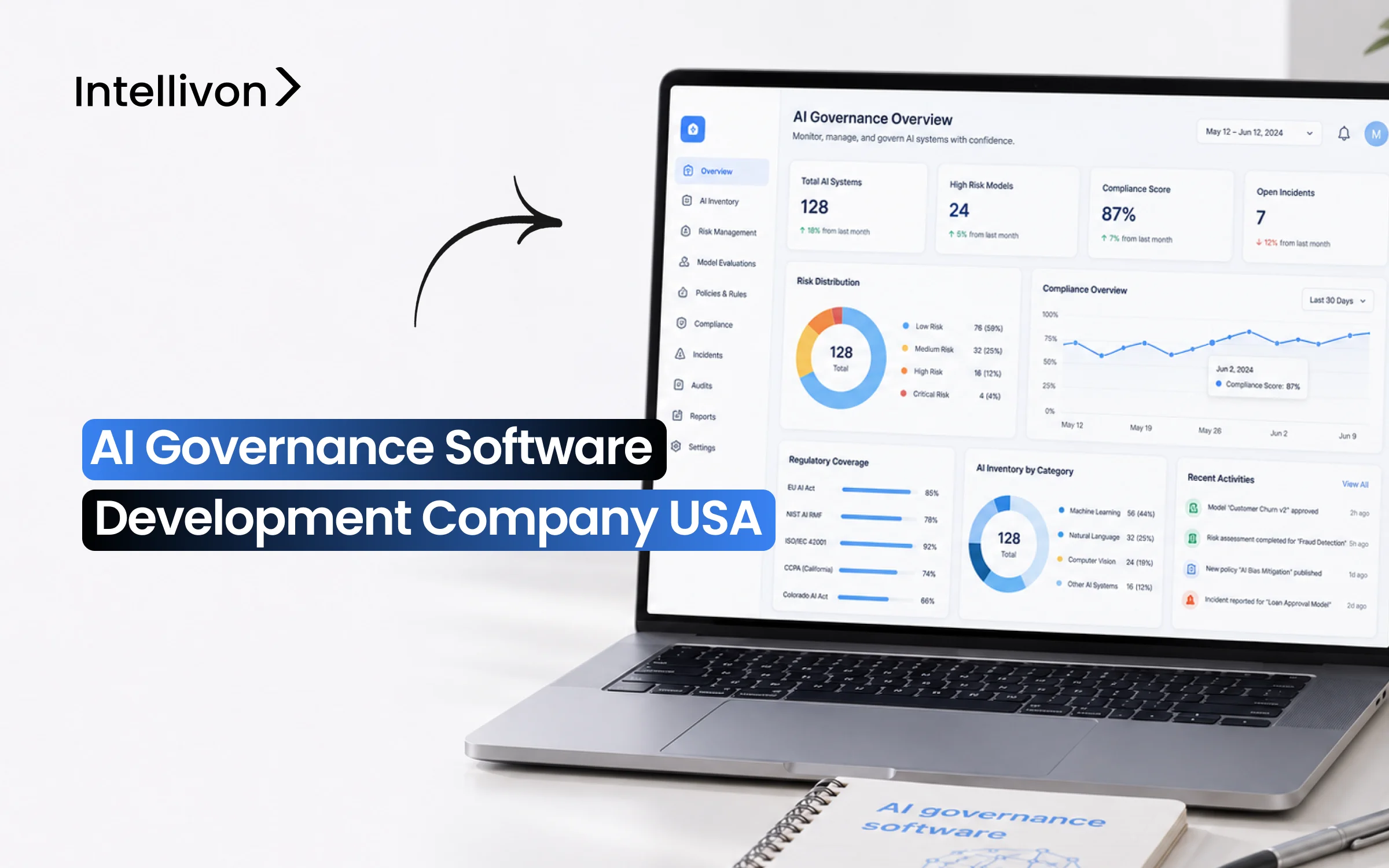
An AI governance platform is software that helps companies track and manage their artificial intelligence systems.
- First, it creates a single registry to list every active AI model across the organization.
- Next, it continuously monitors these tools for errors, bias, and performance changes.
- Finally, it automatically builds audit trails to ensure the technology meets government regulations.
Ultimately, this software protects businesses from legal risks while keeping their AI reliable and safe.
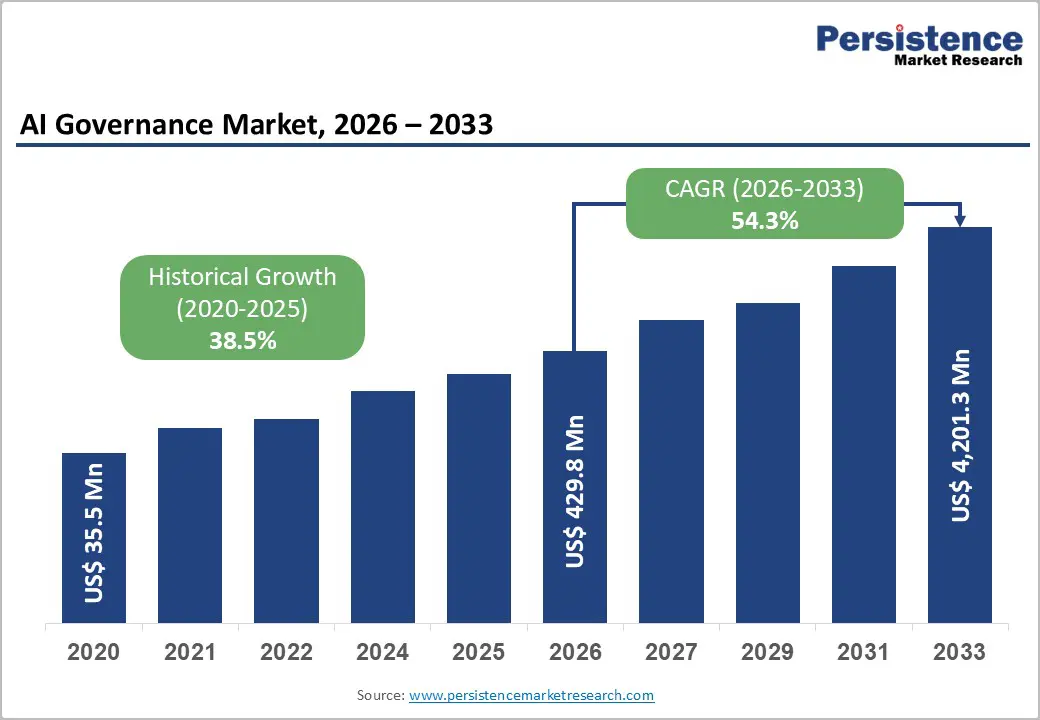
North America leads overall adoption, while heavily regulated sectors like banking and healthcare are driving massive demand for compliance, auditability, and automated monitoring solutions.
What an AI Governance Development Company Actually Builds
Buying a pre-packaged GRC tool gives you static policy dashboards and generic risk templates that sit completely disconnected from your technical stack.
Consequently, hiring an engineering partner delivers active, production-grade software that hooks directly into your data pipelines, code repositories, and runtime environments to automate real-time oversight.
1. Governance Consulting Is Not the Same as Platform Development
Consulting firms deliver static PDF frameworks. In contrast, software engineering partners build active execution platforms that enforce compliance automatically across your entire infrastructure.
- Policies vs. Policy Engine: Translates written rules into automated code guardrails and active API checks.
- Risk Framework vs. Risk-Scoring Workflows: Replaces manual risk spreadsheets with dynamic, programmatic risk evaluation engines.
- Model Inventory Template vs. Searchable Model Registry: Converts static tracking documents into live registries populated automatically by MLOps pipelines.
- Compliance Mapping vs. Machine-Readable Controls: Transforms legal guidelines into actionable software constraints that block non-compliant code deployments.
- Governance Committee vs. Approval Workflows: Automates review routing, escalation triggers, and digital sign-offs directly inside developer tools.
- Audit Requirements vs. Immutable Evidence Repository: Generates cryptographically secure, unalterable logs for every model decision and dataset version.
- Monitoring Policy vs. Production Pipelines: Replaces periodic manual reviews with continuous real-time monitoring for drift, bias, and performance loss.
2. The Platform Becomes the AI System of Record
Furthermore, a custom-built governance platform connects your entire AI operational ecosystem into a single graph database. As a result, it seamlessly maps dependencies across all critical assets:
- Models & LLMs: Tracks version histories, tuning hyperparameters, and operational deployment environments.
- Agents & Datasets: Links autonomous multi-agent permissions directly to underlying training, evaluation, and fine-tuning data.
- Prompts & Approvals: Records system prompt iterations, safety guardrail triggers, and formal sign-off history.
- Incidents & Evidence: Captures live production anomalies alongside automated audit evidence required for regulatory reviews.
3. Custom Development Starts Where Generic GRC Tools Stop
Generic platforms break down when handling complex, sector-specific workflows that demand custom engineering.
For a deeper breakdown of the underlying governance model, see our guide on How to Build a Robust AI Governance Framework for Enterprises.
- Clinical AI: Validates FDA SaMD compliance, ONC HTI-1 algorithm transparency, and EHR/FHIR integration safeguards.
- Credit & AML: Enforces SR 11-7 model risk management, Fair Lending explainability, and automated anti-money laundering controls.
- Insurance & LLMs: Monitors actuarial model bias while tracking hallucination, toxicity, and data leakage risks in generative systems.
- Agentic Workflows: Limits autonomous decision boundaries, enforces human-in-the-loop escalation paths, and secures internal enterprise AI integrations.
Ultimately, generic GRC tools document compliance policies on paper, whereas custom platform development embeds those policies directly into your operational software architecture.
Therefore, building a bespoke platform converts abstract regulatory rules into automated, production-grade guardrails that protect your enterprise from real-time liabilities.
Top AI Governance Development Companies for US Enterprises
Evaluating a software development partner for AI governance requires looking beyond generic IT services or standard SaaS tools. Consequently, enterprise leaders need engineering teams that build custom compliance infrastructure, integrate MLOps pipelines, and enforce strict regulatory guardrails.
The following controlled comparison outlines six leading development firms based on their technical capabilities, industry expertise, and deployment models.
1. Intellivon
Best fit: Large regulated enterprises that need custom governance infrastructure built directly into their MLOps pipelines.
Intellivon operates as a specialized platform engineering firm. Rather than selling pre-packaged GRC software, Intellivon builds custom governance systems directly into an enterprise’s data pipelines and cloud infrastructure.
- Custom Platform Engineering: Builds bespoke model registries, dynamic risk engines, and automated compliance reporting systems.
- MLOps & AI/ML Capabilities: Integrates model versioning, automated retraining triggers, and live drift monitoring straight into CI/CD workflows.
- Healthcare & Fintech Focus: Engineers FHIR-compliant clinical decision safeguards, HIPAA controls, and SR 11-7 model risk management architectures.
- Compliance Architecture: Implements automated audit trails, human-in-the-loop sign-offs, and machine-readable policy enforcement.
- Deployment & Support: Delivers hybrid, multi-cloud, and on-premise deployments backed by full post-launch engineering support.
2. Idea Usher
Best fit: Enterprises focused on custom agentic AI systems that require strict security, policy controls, and behavioral guardrails.
Idea Usher specializes in building custom agentic AI platforms while engineering the governance layers necessary to control autonomous AI behavior.
- Agentic AI Governance: Builds deterministic policy enforcement layers using toolsets like Open Policy Agent (OPA) to limit agent authority.
- Security & Auditability: Develops custom logging frameworks that capture every model decision, prompt invocation, and tool action into immutable audit trails.
- Regulated Sector Applications: Focuses heavily on financial and medical privacy compliance, data leak prevention, and role-based access control architecture.
3. Biz4Group
Best fit: Organizations seeking end-to-end custom platform development backed by a large, full-stack software team.
Biz4Group offers broad software development capabilities and has established a structured framework for building custom AI governance software from the ground up.
- Custom Development Roadmap: Guides enterprises from early discovery and MVP creation through to full-scale platform implementation.
- Healthcare & Enterprise Focus: Combines HIPAA-compliant software engineering with centralized model tracking and risk scoring.
- Governance Features: Focuses on clear accountability matrices, automated compliance checks, and unified dashboards for model oversight.
4. SoluLab
Best fit: Businesses requiring custom governance development coupled with specialized AI-security engineering.
SoluLab combines machine learning expertise with cybersecurity principles to build custom governance platforms that secure sensitive corporate data.
- Model Security & Privacy: Integrates robust data encryption, access controls, and vulnerability testing into the AI development lifecycle.
- Bias & Fairness Engineering: Develops custom monitoring suites that evaluate algorithms for bias, performance loss, and data drift.
- System Integration: Connects custom policy modules to enterprise tools and external governance suites.
5. Antier
Best fit: Companies prioritizing centralized inventory management and strict lifecycle risk controls.
Antier focuses on enterprise software engagements where centralized tracking and risk classification are core requirements.
- Centralized Inventories: Engineers unified repositories to register and track models across multiple business units.
- Risk Classification Workflows: Automates risk scoring and review routing based on predefined regulatory parameters.
- Approval Gateways: Builds formal approval workflows that block non-compliant code from reaching production.
6. Winder.AI
Best fit: Engineering-heavy teams needing specialized consulting to turn abstract compliance policies into working code.
Winder.AI focuses on the technical bridge between legal regulations and production-level machine learning pipelines.
- Policy-to-Control Translation: Converts complex legal requirements into actionable software guardrails and automated checks.
- Audit Evidence Infrastructure: Engineers continuous data-logging architecture to generate audit-ready compliance documentation.
- Technical Implementation: Works directly with internal engineering teams to embed governance rules inside existing MLOps stacks.
Vendor Comparison Table
| Company | Best Fit | Healthcare | Fintech | Custom Platform | MLOps Integration | LLM & Agent Governance | Compliance Engineering | Engagement Style |
| Intellivon | Custom enterprise infrastructure | Deep (FDA, EHR, HIPAA) | Deep (SR 11-7, KYC, AML) | Fully Custom Engine | Native Pipeline Integration | Full Multi-Agent & LLM | End-to-End Architecture | Dedicated Partner / Co-Engineering |
| Idea Usher | Agentic AI & policy guardrails | Moderate | High | Custom Platform | Moderate | Specialized Agent Control | Policy Enforcement (OPA) | Project-Based / Custom Build |
| Biz4Group | Full-stack platform delivery | High (HIPAA) | Moderate | Custom SaaS / MVP | Moderate | General LLM Support | Policy & Workflow Mapping | Staff Augmentation / Project |
| SoluLab | Governance & AI security | Moderate | Moderate | Custom Build | High | Model & Data Security | Bias & Fairness Testing | Specialized Engineering |
| Antier | Lifecycle risk management | Low | Moderate | Custom Modules | Moderate | Basic Oversight | Risk Classification | System Integrator |
| Winder.AI | Technical policy implementation | Moderate | High | Custom Code | Deep MLOps | Advanced Pipeline Controls | Control-to-Code Mapping | Technical Consulting & Code |
Choosing the right development partner ultimately depends on whether your organization needs simple risk-tracking workflows or full-scale, pipeline-integrated platform engineering.
Therefore, selecting a specialized partner like Intellivon ensures that your governance software automates regulatory compliance directly inside your production environment.
Core Modules Every AI Governance Platform Needs
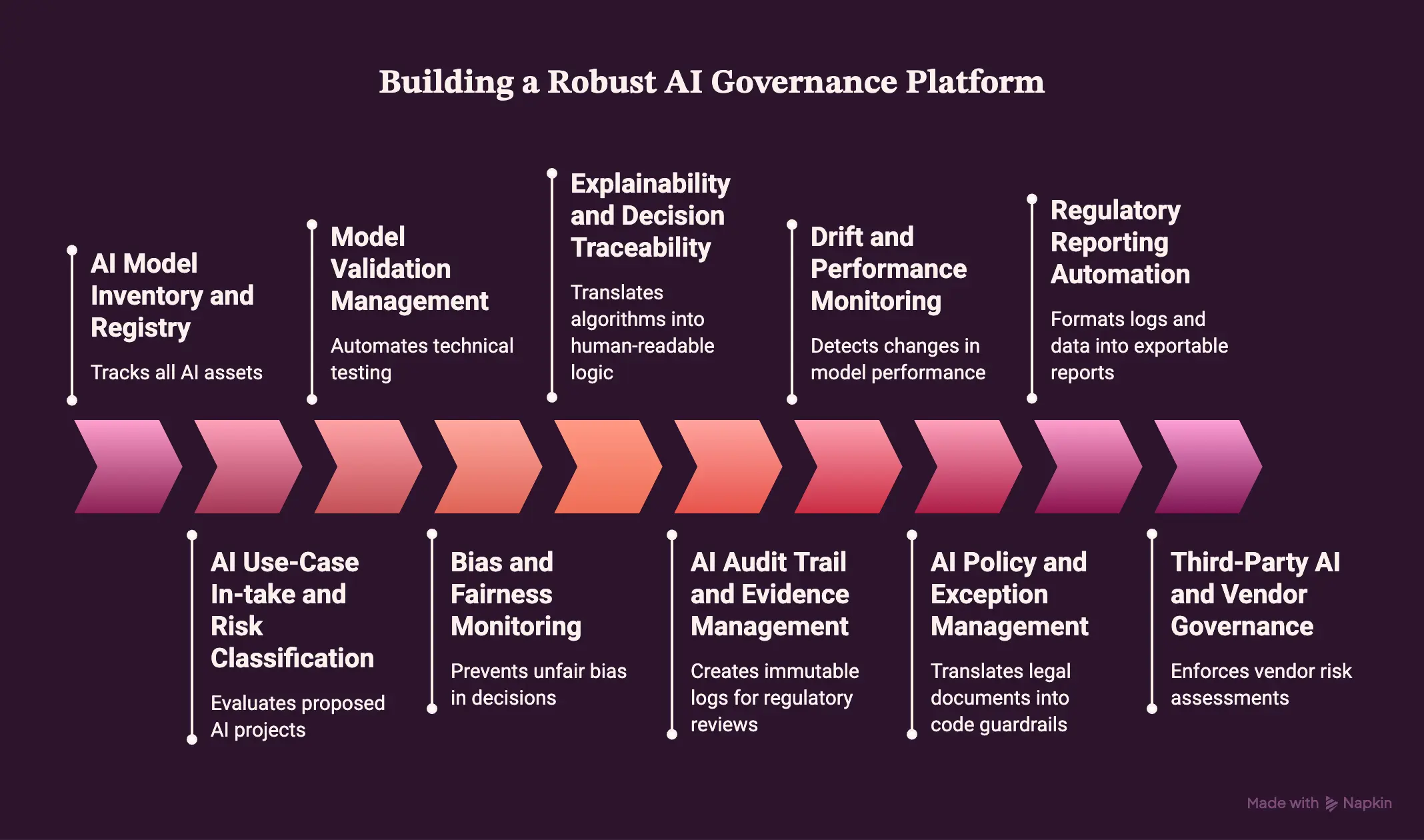
Building a production-grade AI governance platform requires engineering specific modules to handle the full model lifecycle.
Consequently, each module automates a critical compliance step, ensuring your enterprise maintains complete control over its AI systems.
1. AI Model Inventory and Registry
This core registry tracks every AI asset across your enterprise. First, it logs traditional machine learning models and internal LLMs.
Next, it catalogs third-party APIs and multi-agent workflows into a single searchable dashboard.
2. AI Use-Case Intake and Risk Classification
Before developers write code, this intake module evaluates proposed AI projects.
It categorizes each use case into specific risk tiers based on regulatory guidelines, enforcing appropriate review workflows early in development.
3. Model Validation Management
This module automates technical testing to verify model reliability before launch:
- Conceptual Soundness: Evaluates model design, assumptions, and algorithm choices.
- Performance & Backtesting: Tests predictions against historical datasets to confirm accuracy.
- Stress Testing: Evaluates model stability under extreme operational conditions.
- Challenger Models: Runs parallel algorithms to verify primary model outputs.
4. Bias and Fairness Monitoring
Continuous monitoring prevents unfair bias in automated decisions. Specifically, the system evaluates key fairness metrics like demographic parity, equal opportunity, equalized odds, and disparate impact ratios across protected groups.
5. Explainability and Decision Traceability
To ensure transparency, this module translates complex algorithms into clear human-readable logic.
It applies SHAP values, generates local feature importance scores, and provides specific reason codes alongside complete decision lineage.
6. AI Audit Trail and Evidence Management
This system creates immutable logs for regulatory reviews. Consequently, it links every production output directly to its model version, input data, generated output, feature explanations, human sign-offs, and active governing policy.
7. Drift and Performance Monitoring
Production models degrade over time. Therefore, this engine actively monitors for:
- Data Drift: Detects changes in input data distributions compared to training baselines.
- Concept Drift: Tracks shifts in relationships between inputs and target outputs.
- Performance Decay: Measures real-time drops in precision, recall, and accuracy.
- Fairness Drift: Identifies sudden shifts in bias metrics during live operations.
8. AI Policy and Exception Management
This module translates legal documents into active code guardrails. Additionally, it provides structured workflows to track, review, and approve temporary policy exceptions for urgent business needs.
9. Regulatory Reporting Automation
Generating audit documents manually slows teams down. Instead, this module automatically formats logs and performance data into exportable reports aligned with major frameworks like SR 11-7, FDA SaMD, and the EU AI Act.
10. Third-Party AI and Vendor Governance
Many enterprises rely heavily on external vendor algorithms. Thus, this module enforces vendor risk assessments, tracks third-party API performance, and verifies that external models comply with internal safety standards.
Ultimately, modular governance architecture ensures your platform scales alongside evolving regulatory demands. Therefore, building these core components creates an automated system of record that protects your enterprise across every stage of the AI lifecycle.
Compliance Rules the Platform Must Encode in 2026
Modern compliance cannot survive as static documentation. Hence, your software platform must actively encode regulatory logic directly into code.
Consequently, the governance system converts abstract legal requirements into machine-readable controls and real-time execution pipelines.
- NIST AI RMF: Encodes Govern, Map, Measure, and Manage functions into automated developer workflows, mapping risks dynamically while NIST AI RMF 1.0 undergoes active updates.
- ISO/IEC 42001: Automates management-system evidence collection, tracking continuous risk assessments, policy approvals, and control effectiveness.
- EU AI Act: Enforces automated risk classification, technical documentation generation, human oversight triggers, detailed logging, and performance monitoring.
- EU AI Act Article 50: Applies critical transparency obligations starting August 2, 2026, requiring real-time watermarking, machine-readable labels, and clear AI-interaction disclosures.
- US Privacy & Sector Regulations: Deploys configurable control packs to handle regional privacy laws alongside sector-specific rules like HIPAA, SR 11-7, and CFPB mandates.
Ultimately, a robust platform transforms compliance from an annual audit headache into continuous background code. Therefore, automating these international and sector-specific rules shields your organization from massive regulatory fines and operational shutdowns.
Healthcare AI Governance Needs Specialized Engineering
Healthcare AI requires dedicated engineering architectures to handle sensitive clinical data and complex regulatory mandates.
Consequently, governance software cannot simply rely on generic compliance checklists when patient safety and health privacy are directly on the line.
- HIPAA & PHI-Safe Governance: Enforces minimum-necessary access controls, data encryption at rest and in transit, complete access logging, and strict boundary controls across Business Associate Agreements (BAAs).
- ONC Algorithm Transparency: Operationalizes HTI-1 requirements by exposing model training data, performance metrics, and clinical decision-support logic directly within provider software workflows.
- FDA AI-Device Lifecycle Controls: Aligns with FDA guidance (including final PCCP recommendations and AI lifecycle standards) by automating model versioning, bias evaluations, continuous performance monitoring, and formal change-control plans.
- Clinical Model Validation: Continuously measures sensitivity, specificity, AUROC, calibration curves, subgroup accuracy, and overall clinical utility against live health outcomes.
- EHR & FHIR Integration: Connects seamlessly to Epic and Oracle Health using FHIR R4 APIs and SMART on FHIR protocols to maintain end-to-end clinical data lineage.
- Healthcare Bias Monitoring: Monitors algorithmic performance across diverse patient demographics, clinical sites, and care settings to identify and prevent localized performance decay.
For a deeper breakdown of healthcare-specific implementation, see our guide on How to Build a Healthcare AI Governance Platform.
Ultimately, healthcare governance software must bridge the gap between clinical workflows and technical compliance. Therefore, building specialized FHIR pipelines and automated FDA change controls ensures patient safety while accelerating safe AI deployment.
Fintech AI Governance Requires Different Controls
Financial services demand stringent computational controls because algorithmic errors directly cause financial losses, regulatory fines, and reputational damage.
Consequently, governance software in fintech must adapt to newly updated regulatory baselines and manage rapid AI innovation.
- The 2026 Model Risk Update: SR 26-2 officially replaced SR 11-7 on April 17, 2026. This updated baseline modernizes model risk oversight across development, validation, ongoing performance monitoring, and third-party vendor tracking.
- Generative & Agentic AI Governance: Because SR 26-2 explicitly excludes generative and agentic AI models from its scope, banks must build an independent, internal governance layer to control non-deterministic behaviors.
- Credit & Lending AI: Enforces strict model validation, anti-bias evaluations, automated adverse-action reason codes, and logged human override workflows for credit decisions.
- AML & Fraud AI: Automates challenger testing, monitors alert-quality metrics, tracks false-positive rates, and records immutable investigation lineages for compliance teams.
- Insurance & Underwriting AI: Validates actuarial risk models, monitors pricing bias, and tracks underwriting rules to prevent unfair discrimination across policyholders.
- Trading & Investment AI: Monitors execution logic, tracks algorithmic slippage, and enforces hard exposure limits to prevent systemic market trading risks.
- Third-Party & Vendor AI: Operationalizes vendor validation rules by evaluating external APIs, pre-trained financial models, and proprietary black-box algorithms against bank risk policies.
For a deeper breakdown of financial-sector controls, see our guide on AI Fintech Infrastructure Compliance.
Ultimately, financial AI governance requires dual-track control systems that satisfy traditional model risk regulations like SR 26-2 while simultaneously constraining newer agentic workflows.
LLM and Agentic AI Need a Separate Governance Layer
Standard predictive machine learning models rely on structured inputs and deterministic pipelines. Conversely, Large Language Models (LLMs) and autonomous agents interact through natural language, call external APIs, and execute non-deterministic actions.
Consequently, enterprises must deploy a dedicated governance layer specifically engineered to constrain LLMs and agentic workflows in real time.
- Expanded LLM Asset Inventory: Extends traditional model registries by cataloging base foundation models, provider APIs, system prompts, retrieval-augmented generation (RAG) data corpuses, vector embeddings, external tools, and active guardrail policies.
- Prompt & RAG Governance: Enforces input-sanitization rules to prevent prompt injection attacks while filtering corporate knowledge bases to eliminate unauthorized sensitive data exposures.
- Hallucination & Safety Evaluation: Continuously evaluates model outputs for factual accuracy, ground-truth alignment, toxic language, and brand compliance prior to displaying responses to users.
- Agentic Permission Control: Assigns strict operational boundaries to every autonomous agent, enforcing role-based access, restricted tool usage, localized data scopes, and clear transaction limits.
- Human-in-the-Loop Approval: Intercepts high-risk or irreversible operations, such as executing financial transactions, issuing legal approvals, or altering medical records, requiring explicit human validation before execution.
- Runtime Policy Enforcement & Kill Switches: Deploys inline proxies to evaluate agent behavior dynamically, blocking policy-violating actions and providing instantaneous manual or automated kill switches to isolate rogue agents.
Governing autonomous agents requires moving past static model validation toward active, real-time control.
Therefore, implementing inline guardrails and mandatory human approvals prevents agentic systems from taking unauthorized actions while protecting core enterprise infrastructure.
How We Build a Custom AI Governance Platform
Building an enterprise-grade AI governance platform requires an engineering approach that bridges legal mandates and technical infrastructure.
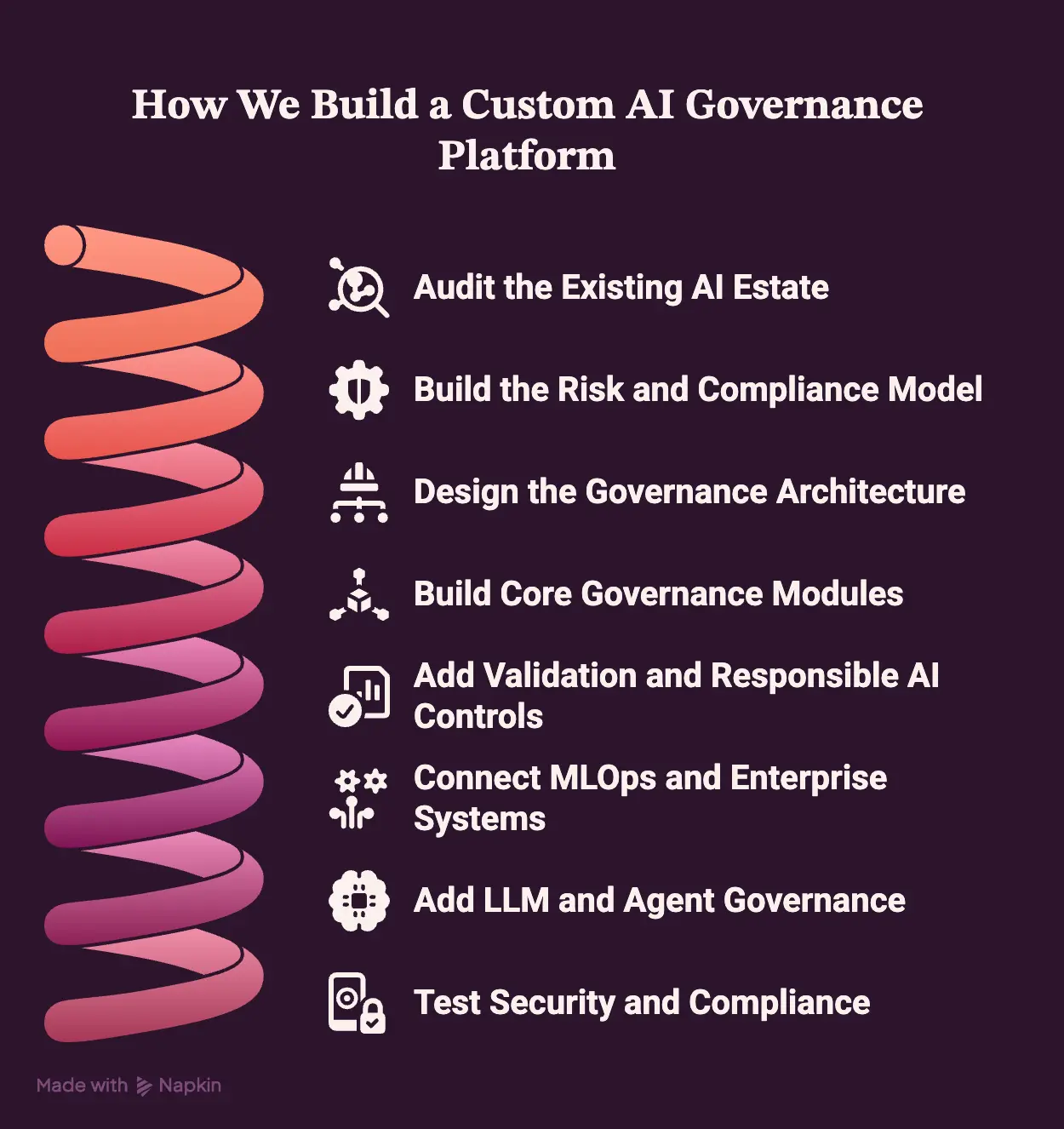
At Intellivon, we follow an 8-step development methodology that converts complex compliance rules into active, production-ready code.
Step 1 — Audit the Existing AI Estate
First, our engineering team conducts a thorough technical and regulatory audit across your digital ecosystem. We uncover shadow AI usage, inventory active machine learning models, evaluate existing security controls, map current integrations, and define your binding regulatory boundaries.
Key Deliverables: Comprehensive model inventory, shadow AI discovery report, system integration map, and regulatory baseline matrix.
Step 2 — Build the Risk and Compliance Model
Next, we translate your industry requirements into automated governance frameworks. We define clear risk classification tiers, map control families, assign ownership roles, establish review workflows, and configure policy exception pathways.
Step 3 — Design the Governance Architecture
We establish the deployment model based on your strict security and latency constraints. Depending on your risk profile, we architect single-tenant environments, hybrid cloud connections, private cloud instances, or air-gapped on-premise installations.
Step 4 — Build Core Governance Modules
During initial development, we engineer the core system foundation. Specifically, we build the central asset registry, the use-case intake portal, automated risk-tiering engines, approval gates, and immutable evidence-logging pipelines.
Step 5 — Add Validation and Responsible AI Controls
With the core foundation operating, we integrate quantitative and qualitative testing modules. These components automate bias detection, generate SHAP explainability scores, execute stress tests, and validate model performance against baseline metrics.
Step 6 — Connect MLOps and Enterprise Systems
To eliminate manual work, we embed governance directly into your CI/CD pipelines. We connect the platform to your MLOps tools, data catalogs, identity providers (IAM), and enterprise GRC systems using secure APIs.
Step 7 — Add LLM and Agent Governance
We build real-time guardrails specifically for non-deterministic AI assets. This layer inspects system prompts, validates RAG data sources, manages autonomous agent permissions, tracks hallucinations, and enforces mandatory human-in-the-loop approvals for critical actions.
Step 8 — Test Security and Compliance
Finally, we run extensive system testing before production launch. Our engineers execute user acceptance testing (UAT), penetration testing, permission validation, policy-enforcement checks, and full audit-trail reconstruction simulations.
Custom governance platform development turns abstract policy documents into automated background code.
Following a structured eight-step engineering roadmap ensures your platform integrates smoothly with existing MLOps stacks while maintaining full regulatory compliance.
Integrations That Make AI Governance Operational
An AI governance platform cannot function effectively as an isolated silo. Governance that requires engineers to manually update a second system will eventually become stale, leading directly to compliance drift and unmonitored shadow AI.
Consequently, to maintain real-time accuracy, the platform must connect seamlessly to your existing enterprise stack through automated APIs.
- MLOps Platforms: First, it connects directly to MLflow, Databricks, Amazon SageMaker, Azure ML, and Google Cloud Vertex AI. As a result, it automatically extracts model lineage, tracks hyperparameter changes, and captures validation artifacts without interrupting developer workflows.
- Data Platforms: Next, it integrates with Snowflake, Databricks, Google BigQuery, and Amazon Redshift. Therefore, your engineering teams can continuously enforce data privacy rules, monitor feature stores, and verify training data provenance at scale.
- GRC Systems: Furthermore, the platform synchronizes with enterprise tools like ServiceNow, Archer, and MetricStream. In turn, this automatically pushes risk assessments, updates corporate risk registers, and routes compliance approvals to executive stakeholders.
- Identity Platforms: Meanwhile, it bridges identity providers like Okta and Microsoft Entra ID. Because of this integration, you can strictly enforce role-based access controls (RBAC), single sign-on (SSO), and privileged access management across all model environments.
- Security & SIEM: Additionally, it streams runtime logs and anomalous model behavior directly into Splunk, Microsoft Sentinel, and IBM QRadar. Consequently, your security operations center gets real-time visibility into AI threat vectors and operational incidents.
- Healthcare Systems: Simultaneously, it connects clinical environments by linking to Epic and Oracle Health via secure FHIR APIs. As a consequence, health systems can audit algorithmic decision-support tools without exposing raw patient data.
- Developer Systems: Finally, it embeds automated compliance gates straight into GitHub, GitLab, Jira, and CI/CD pipelines. Ultimately, this blocks non-compliant code commits and unapproved model deployments before they ever reach production environments.
Operationalizing AI governance requires embedding compliance directly into native developer and data workflows.
Therefore, automating system-to-system integrations eliminates manual reporting overhead while ensuring continuous, real-time audit readiness across your enterprise.
AI Governance Software Development Cost in the USA
A custom AI governance platform should be budgeted at roughly $70,000–$300,000 for the scope covered in this guide. Notably, this investment range reflects a focused platform build rather than a global, multi-year enterprise transformation.
Consequently, your final investment will depend directly on system complexity, regulatory depth, and integration requirements.
1. $70K–$120K — Governance MVP
First, early-stage deployments focus on establishing foundational controls. Consequently, this tier includes a centralized model inventory, intake risk questionnaires, basic approval workflows, an executive dashboard, immutable audit logs, and one or two primary integrations.
2. $120K–$220K — Regulated Enterprise Platform
Next, mid-tier platforms expand into automated compliance for single-domain deployments. Therefore, this level adds automated validation engines, bias and fairness monitoring, SHAP explainability tools, advanced role-based workflows, MLOps connections, enterprise GRC sync, and regulatory reporting automation.
3. $220K–$300K — Multi-Domain Governance Platform
Finally, top-tier implementations support complex, multi-business-unit deployments. As a result, this tier introduces LLM and multi-agent governance layers, complex multi-regulatory mapping, extensive system integrations, and hybrid or air-gapped private cloud infrastructure.
4. Phase-by-Phase Development Investment
Because organizations select specific combinations of these phases based on existing maturity, readers should not simply total every maximum.
| Development Phase | Suggested Budget Range |
| Discovery & Compliance Mapping | $8,000 – $15,000 |
| Architecture & User Experience (UX) | $12,000 – $20,000 |
| Core Governance Platform Engineering | $35,000 – $60,000 |
| Advanced Governance Modules | $30,000 – $50,000 |
| Enterprise System Integrations | $20,000 – $35,000 |
| QA, Security & Compliance Validation | $15,000 – $25,000 |
| Deployment & Operational Enablement | $10,000 – $15,000 |
5. Ongoing Operational Costs
In addition to initial development, organizations must allocate 15%–25% of initial development cost annually for ongoing platform evolution.
Consequently, this covers recurring platform maintenance, regulatory logic updates, pipeline monitoring, and new API integrations.
Budgeting for a custom AI governance platform requires aligning your upfront engineering investment with long-term compliance scope.
Therefore, starting with a targeted $70K–$120K MVP allows enterprises to establish immediate risk control while creating a clear path for future expansion.
Build, Buy, or Use a Hybrid Governance Platform?
When deciding how to operationalize oversight, organizations must avoid the misconception that custom engineering is always superior.
Instead, selecting the right architecture depends directly on your internal technical capacity, regulatory risk profile, and deployment timelines.
1. Buy When Requirements Are Mostly Standard
First, purchasing an off-the-shelf platform is ideal for organizations with smaller AI portfolios and standard compliance needs. Consequently, off-the-shelf software delivers rapid value when you require:
- A centralized inventory for a modest number of traditional models.
- Standard control frameworks that match baseline industry frameworks.
- A fast deployment window without dedicated engineering overhead.
2. Build When Governance Is Part of Core Infrastructure
Conversely, building a custom platform becomes necessary when AI directly powers your core competitive advantage. Therefore, regulated enterprises choose custom development when managing:
- Complex, multi-departmental approval workflows and strict internal policies.
- Diverse MLOps environments operating across multi-cloud or air-gapped infrastructure.
- Deep integrations with proprietary enterprise legacy systems.
3. Hybrid Is Often Best for Large Enterprises
Finally, a hybrid architecture frequently provides the most practical path forward for large enterprises. In this model, you build an enterprise control plane that orchestrates specialized point solutions:
By retaining ownership of the central workflow plane while integrating best-of-breed specialized tools, you achieve tailored oversight without reinventing core infrastructure.
Evaluating whether to build, buy, or combine AI governance tools requires balancing operational flexibility against time-to-market constraints.
Therefore, adopting a hybrid approach allows large enterprises to maintain custom control over internal workflows while leveraging proven market tools for specialized monitoring.
Build a Custom AI Governance Platform With Intellivon
Managing enterprise compliance through manual spreadsheets and disconnected tools eventually creates dangerous coverage gaps.
At Intellivon, we partner with your team to build an active, automated governance layer tailored precisely to your technical stack, business workflows, and binding regulatory duties.
Our End-to-End Platform Delivery
- Comprehensive Estate Discovery: First, our engineers audit your existing environment to map hidden shadow AI, catalog all active models, and establish your foundational regulatory baseline.
- Tailored Architecture Design: Next, we design a custom deployment model, whether single-tenant, hybrid, or air-gapped private cloud, to meet your specific security and latency constraints.
- Core Module Engineering: Furthermore, we build central governance engines, including asset registries, automated risk intake portals, and immutable evidence-logging pipelines.
- Responsible AI Integration: Additionally, we embed automated bias detection, SHAP explainability scoring, and rigorous model validation tools straight into your testing workflows.
- Real-Time LLM & Agent Guardrails: Simultaneously, we configure safety filters for non-deterministic AI assets to monitor system prompts, validate RAG data sources, and manage agent permissions.
- Deep Enterprise Integrations: Consequently, we connect your governance plane directly to existing MLOps stacks, data warehouses, identity providers, and enterprise GRC systems via secure APIs.
- Security & Compliance Validation: Subsequently, our team executes end-to-end penetration testing, access validation checks, and full audit reconstruction simulations prior to launch.
- Deployment & Ongoing Evolution: Finally, we deploy the platform into your production environment while delivering continuous updates to keep your systems aligned with evolving global regulations.
Moving from manual oversight to automated software governance requires an experienced engineering partner.
Consequently, kicking off with a targeted architecture assessment ensures your platform build delivers immediate risk control without disrupting ongoing development.
Conclusion
Transitioning from manual compliance checklists to automated AI governance is no longer optional for modern enterprises. By embedding risk controls, real-time guardrails, and audit trails directly into your development pipelines, you protect your organization from regulatory penalties and operational failure.
Consequently, building a clear, software-driven governance layer allows you to scale artificial intelligence safely. Ultimately, proactive governance transforms compliance from a slow bottleneck into a true competitive advantage.
FAQs
Q1. What should I look for in an AI governance development partner?
A1. First, look for an engineering team that uses a weighted evaluation framework. Consequently, prioritize partners who demonstrate proven enterprise software development, deep MLOps integration experience, hands-on regulatory domain knowledge, and robust security architecture. Ultimately, your partner must balance legal requirements with practical software engineering.
Q2. Should we build or buy an AI governance platform?
A2. To decide, evaluate your total AI portfolio size and operational complexity. Purchasing an off-the-shelf platform works well for smaller model portfolios with standard requirements. Conversely, custom development becomes necessary when managing complex internal workflows, proprietary MLOps infrastructure, or unique multi-domain regulatory constraints.
Q3. Which integrations should an AI governance platform support?
A3. At a minimum, your governance platform must connect directly across five core system pillars. Specifically, it should support MLOps platforms, enterprise GRC systems, identity and access management (IAM), security information and event management (SIEM), and modern data platforms. As a result, compliance checks happen automatically within daily workflows.
Q4. What should healthcare enterprises require from an AI governance developer?
A4. Healthcare organizations must mandate strict compliance capabilities from their software developers. Therefore, the governance platform must natively support HIPAA data privacy, ONC interoperability standards, FDA SAMD guidelines, clinical validation frameworks, and secure FHIR APIs. Consequently, this ensures patient safety without compromising data access.
Q5. Can an AI governance development company guarantee regulatory compliance?
A5. No legitimate software company can promise absolute legal compliance simply because a platform is deployed. While developers build technical controls and immutable evidence pipelines, actual compliance remains an organizational responsibility. Consequently, software provides the necessary enforcement tools, but your leadership must govern ongoing policies.
To Sum It Up:
- An AI governance platform that does not connect to MLOps becomes a documentation system rather than a control system.
- SR 11-7 is no longer current US interagency model-risk guidance; SR 26-2 replaced it on April 17, 2026.
- Generative and agentic AI sit outside SR 26-2, so financial institutions need separate governance controls for autonomous and language-based systems.
- A $70K governance MVP can centralise inventory and approvals, while $220K–$300K builds add regulated workflows, integrations and LLM or agent governance.
- The best development partner should be evaluated on the evidence it can produce, not the number of compliance logos on its website.