Key Takeaways:
-
The price for a custom pharma AI governance platform usually falls between $70,000 and $300,000.
-
The price will change based on the features, the integrations, and the compliance. The number of AI systems that you have to handle.
-
A minimum viable product might begin with model tracking, risk reviews, approvals, and audit records.
-
The budget is increased due to LLM controls, pharma validation, and enterprise integrations.
-
Learn how Intellivon develops these platforms in phases, beginning with the most important governance requirements.
In 2026, the cost of developing an AI governance platform for the pharmaceutical industry for a custom build is between $70,000 and $300,000. At the lower end is a single-function GxP foundation, while at the higher end is a validated multi-function platform that meets both FDA and EU requirements. Your final figure will therefore mainly depend on the scope of validation, the integrations, and the regulatory coverage.
One cannot understand why pharmaceutical companies set their prices differently just by referring to general cost guides. Unlike ordinary governance tools, a pharmaceutical platform has to be able to withstand a GxP inspection. Because of this, the tool that governs your AI will usually have to be validated as well. Moreover, the context of use, the Part 11 audit trails, and the retraining change control all count as engineering work, just as the connections to your safety database, EDC, and MLOps pipelines result in additional costs.
Hence, this blog sets out the costs according to phase, module, and business function and also compares the cost of a custom build with that of licensing IBM or ModelOps over a three-year period. At Intellivon, we carry out scope work for pharma founders and sponsors who are facing this very decision. The following section looks at the factors that cause the figures to rise.

What an AI Governance Platform Does in Pharma
An AI governance platform is software that tracks, controls, and documents every AI system a pharma company uses. In simple terms, it records what each model does, who owns it, and who approved it.
As a result, quality and regulatory teams can prove they tested, monitored, and managed every model correctly when an inspector asks.
1. One Place to Track Every AI System
Most pharma companies run AI across many departments without one shared record. However, a governance platform fixes this with a central model inventory. Each entry typically captures:
- Owner: the person accountable for the model’s performance
- Version: which release is live and what changed
- Purpose: the business question the model answers
- Department: such as pharmacovigilance, clinical, or manufacturing
- Status: in development, approved, deployed, or retired
2. Controls Before AI Reaches Production
Next, the platform stops unreviewed models from going live. Instead, every model passes a set of checks first. In pharma, this matters because a flawed model can affect patient safety or batch release. These checks usually include:
- Risk review: rating how much harm a wrong output could cause
- Validation: confirming the model works for its intended use
- Testing: checking accuracy, bias, and edge cases
- Sign-offs: recorded approvals from quality and business owners
3. Records What Happens After Deployment
However, approval is not the end of the process. Models can drift as real-world data changes over time. Therefore, the platform keeps watching and logs:
- Monitoring: ongoing checks on accuracy and performance
- Model changes: every update, with the reason behind it
- Incidents: errors, failures, and how teams resolved them
- Retraining: when teams retrained a model and re-approved it
- Audit history: a time-stamped trail of every action
4. Creates Evidence for Compliance Teams
Finally, the platform turns all of this activity into usable evidence. Rather than chasing emails and spreadsheets, teams find documents in one place. Each group uses it differently:
- Quality: pulls validation records for GxP inspections
- Legal: reviews data use and liability exposure
- Security: checks access controls and data protection
- Regulatory: gathers documentation for FDA or EMA submissions
In short, an AI governance platform gives pharma teams one record, clear approval gates, ongoing oversight, and ready evidence. Together, these functions make AI defensible during inspections.
Why Pharma Companies Are Building These Platforms
Pharma companies are building AI governance platforms because AI now runs across core workflows, and manual oversight cannot keep up. At the same time, regulators expect clear records showing how teams tested and approved each model. As a result, a dedicated platform has shifted from a nice-to-have to a basic operating requirement.
Market spending data already confirms this shift. Grand View Research projects a 36.0% CAGR for the global AI governance market, rising from $417.8 million in 2026 to $3.59 billion by 2033.
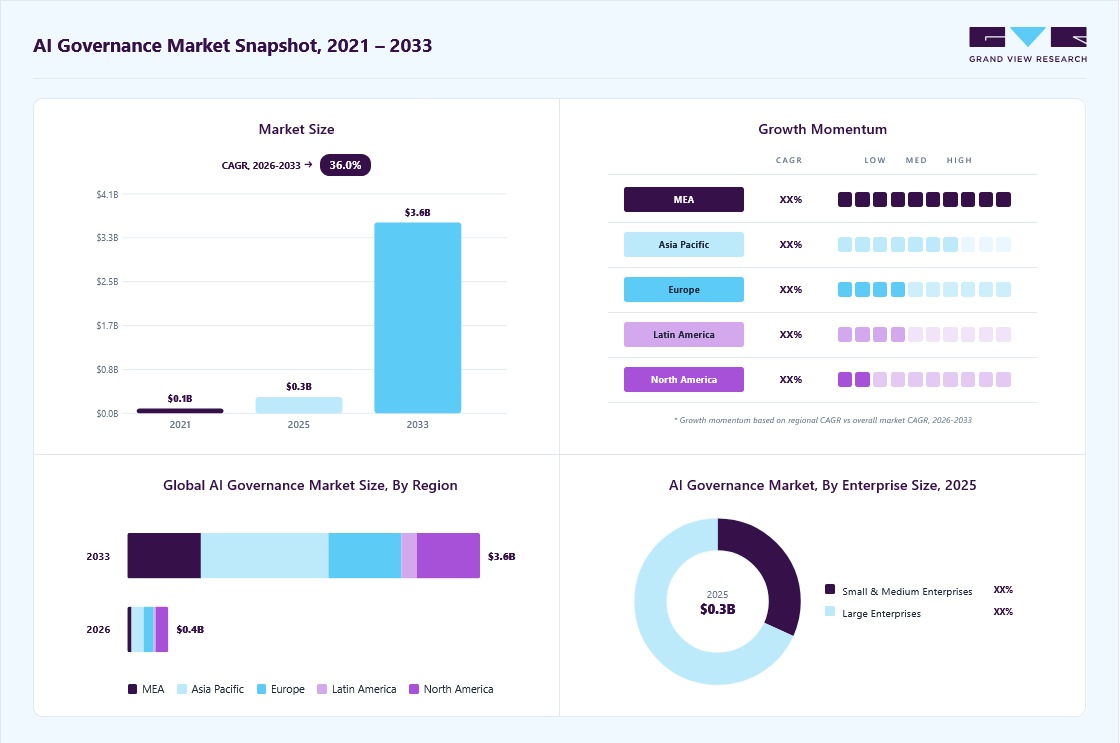
Furthermore, Mordor Intelligence expects the healthcare sector to grow fastest of all industries, at a 28.5% CAGR through 2031.
1. Pharma Teams Are Using AI Across More Workflows
AI no longer sits in one innovation lab. Instead, pharma teams use it across the product lifecycle. Each new use case adds another model to govern:
- Drug discovery: predicting molecule behavior
- Clinical trials: matching patients and sites
- Manufacturing: flagging quality deviations early
- Pharmacovigilance: detecting adverse event signals
- Regulatory work: drafting submission documents
- Medical information: answering clinician questions
2. AI Is Spreading Faster Than Manual Governance
However, manual governance was built for a few models, not hundreds. As a result, teams quickly lose track of what is live. Common failure points include:
- Spreadsheets: go stale as models change
- Emails: bury approvals auditors cannot find
- Documents: scatter without version control
- Approval meetings: create queues that delay launches
3. Regulators Expect Better AI Documentation
Meanwhile, regulators want traceable proof of how teams built and controlled each AI system. Key expectations include:
- FDA: proving model credibility for a defined use
- EMA: lifecycle oversight under joint 2026 principles with FDA
- GxP and 21 CFR Part 11: secure audit trails and e-signatures
- EU AI Act: phased high-risk obligations from December 2027
- Internal quality controls: SOPs and change control extended to AI
4. LLMs and AI Agents Add New Risks
Finally, generative AI adds risks that traditional model oversight never covered. Therefore, governance now reaches beyond the model itself:
- Prompts: logging inputs behind regulated outputs
- RAG data: controlling which documents models retrieve
- AI actions: limiting what agents do without approval
- Vendor models: tracking third-party updates
- Model changes: re-reviewing behavior after each version
In short, rising AI use, manual limits, regulatory pressure, and generative AI risks are converging at once. Together, these forces make informal oversight hard to defend.
Pharma AI Governance Platforms Cost $70K to $300K
A custom pharma AI governance platform typically costs $70,000 to $300,000 to build. In practice, the final figure depends on how many models you govern, how many systems you connect, and how many regulations you cover.
Therefore, most projects fall into three practical levels, each adding capability on top of the last.
1. $70K to $120K for a Governance MVP
This level suits a sponsor governing AI in one or two functions. It replaces spreadsheets with one controlled system of record. Typical scope includes:
- AI model inventory: one record for every model
- User roles: access based on job responsibility
- Basic risk scoring: simple high, medium, or low ratings
- Review workflows: routing models to the right reviewers
- Approval records: signed, time-stamped decisions
- Audit history: a trail designed for 21 CFR Part 11
- Basic dashboard: model status at a glance
- One or two integrations: usually identity and one data source
2. $120K to $200K for a Growing Enterprise
Next, this level fits companies scaling AI across several departments. Here, governance starts connecting directly to how teams build and deploy models. Typical additions include:
- Automated validation workflows: guided GxP validation steps
- More business units: separate rules for each function
- MLOps integrations: links to tools like SageMaker or MLflow
- Vendor AI governance: reviews of third-party models
- Compliance mapping: controls tied to FDA expectations
- Advanced reporting: inspection-ready exports
- LLM governance: prompt logging and output review
- Better monitoring: drift and performance alerts
3. $200K to $300K for Enterprise Governance
Finally, this level serves global sponsors running many AI programs at once. As a result, the platform must handle more users, regions, and rules. Typical additions include:
- Multiple AI programs: from discovery through pharmacovigilance
- Global teams: region-specific workflows and permissions
- Several regulatory frameworks: FDA, EMA, and the EU AI Act
- Complex access controls: fine-grained, role-based permissions
- Automated evidence collection: records gathered without manual effort
- AI agent governance: limits on autonomous actions
- Deep enterprise integrations: safety, clinical, and quality systems
- Advanced monitoring: bias and drift across patient subgroups
- Configurable workflows: rules teams adjust without code
In short, an MVP gives you control, a growing platform adds automation, and an enterprise build adds global scale. Importantly, most sponsors start small and expand in phases.
Cost Breakdown by Development Phase
Most of a pharma AI governance platform’s budget goes into core development, risk and validation modules, and enterprise integrations. Together, these three phases account for $45K to $185K of a $70K to $300K build.
By contrast, discovery, design, testing, and launch each cost less. However, skipping them often creates expensive rework during GxP validation.
| Development phase | Estimated cost |
| Discovery and requirements | $8K to $20K |
| Architecture and UX | $7K to $20K |
| Core platform development | $20K to $70K |
| Risk and validation modules | $15K to $60K |
| Enterprise integrations | $10K to $55K |
| Security and testing | $7K to $40K |
| Deployment and training | $3K to $35K |
| Total | $70K to $300K |
1. Discovery and Governance Planning
Discovery defines what the platform must govern before anyone writes code. First, the team maps how AI is used and approved today. This phase typically covers:
- Stakeholder interviews: quality, IT, data science, and regulatory leads
- AI inventory: listing every existing model and its owner
- Policies: turning current SOPs into platform rules
- Workflows: mapping review and approval paths
- Compliance requirements: confirming FDA, GxP, and EU scope
2. Platform Architecture and UX
Next, architects design how data, users, and workflows connect. Good design here keeps later changes cheap. Key deliverables include:
- Data structure: fields for models, versions, and risk
- Dashboards: separate views for reviewers and executives
- Roles: permissions matched to job responsibility
- Workflows: screens for each approval step
- System architecture: hosting, APIs, and scaling plan
3. Core Platform Development
Core development is usually the largest single phase. Here, engineers build the features every user touches daily. This work includes:
- Model inventory: a searchable registry with version history
- Workflow engine: rules that route models automatically
- Approvals: e-signatures designed for 21 CFR Part 11
- Permissions: role-based access across teams
- Dashboards: live status of models and reviews
4. Testing and Production Launch
Finally, the platform must prove it works before go-live. In pharma, this includes validating the governance tool itself. Typical activities include:
- QA: functional and regression testing
- Security testing: penetration tests and access reviews
- Validation: risk-based evidence for GxP inspections
- Migration: moving records out of spreadsheets
- Training: role-based sessions for reviewers
- Go-live: a phased rollout with support
In short, core development, risk modules, and integrations drive most of the spend. Meanwhile, planning, testing, and launch protect that investment during inspections.
Core Features That Shape the Development Cost
Six core features shape most of a pharma AI governance platform’s development cost: model inventory, risk workflows, validation, audit trails, dashboards, and regulatory reporting. However, cost depends less on whether a feature exists and more on how deep it goes.
For example, a basic activity log costs far less than an audit trail built for 21 CFR Part 11.
1. AI Model Inventory
The inventory is the base layer every other feature relies on. Consequently, cost rises with each extra field and connected system. It tracks:
- Model and owner: who is accountable
- Use case: the question the model answers
- Version and status: what is live today
- Related systems: linked safety or clinical databases
2. Risk Assessment Workflows
Next, risk workflows decide how much review each model needs. Adding more scoring criteria increases logic, testing, and cost. Risk levels usually reflect:
- Business use: how critical the decision is
- Patient impact: potential harm from a wrong output
- Regulatory impact: whether outputs reach FDA or EMA
- Model type: predictive model, LLM, or AI agent
3. Model Validation
Validation is often among the most expensive features in pharma. That is because every record must hold up during a GxP inspection. The module stores:
- Validation plans: scope and acceptance criteria
- Results: test outcomes against those criteria
- Reviewer comments: feedback tied to each finding
- Evidence and approvals: signed, versioned records
4. Audit Trails
Meanwhile, audit trails must be secure and tamper-proof. Meeting 21 CFR Part 11 adds significant engineering effort. Each entry records:
- Changes and decisions: what happened and why
- Users and dates: who acted, and when
- Approvals: e-signatures linked to records
- Versions: the model state at each step
5. Governance Dashboards
Dashboards turn raw records into daily oversight. However, each custom view adds design and data work. Common views show:
- Risk levels: models grouped by tier
- Pending reviews: approvals waiting on action
- Model status and incidents: live issues across teams
- Compliance gaps: missing evidence or overdue reviews
6. Regulatory Reporting
Finally, reporting packages evidence for internal and external reviews. Automating it costs more upfront but saves weeks during inspections. It generates:
- Evidence packages: complete records for each model
- Internal reports: summaries for quality and leadership
- External reports: documentation for regulators and auditors
In short, validation, audit trails, and inventory depth drive the steepest feature costs. Therefore, deciding how deep each feature goes early keeps quotes predictable.
LLM Governance Adds New Platform Costs
LLM governance typically adds $40K to $110K to a pharma AI governance platform build. That is because LLMs and AI agents create risks that traditional model oversight never covered. For instance, teams must now track prompts, retrieved documents, and agent actions.
As a result, this layer usually appears in growing and enterprise-level builds rather than MVPs.
| LLM governance feature | What it governs | Estimated cost | Typical build level | Main cost driver |
| Prompt and model tracking | Prompts, instructions, model versions | $8K to $20K | Growing enterprise | Number of LLM providers |
| RAG data controls | Knowledge sources and changes | $10K to $25K | Growing enterprise | Number of document repositories |
| AI agent permissions | What agents can read or do | $12K to $35K | Enterprise | Number of connected systems |
| LLM testing and evaluation | Hallucination, safety, accuracy | $10K to $30K | Growing enterprise | Test depth and automation |
| Total | $40K to $110K |
1. Prompt and Model Tracking
Prompt and model tracking costs $8K to $20K. It works like version control for generative AI. Each additional LLM provider adds integration effort. It tracks:
- Prompts: inputs behind regulated outputs
- System instructions: rules shaping model behavior
- Foundation models: such as GPT, Claude, or Llama
- Versions and providers: what changed, and who supplied it
2. RAG Data Controls
Next, RAG data controls cost $10K to $25K. In pharma, an LLM citing an outdated label or SOP creates real compliance risk. These controls record:
- Approved sources: which repositories the LLM can access
- Source changes: when documents were added or removed
- Document versions: which version the model retrieved
- Access limits: blocking restricted clinical or patient data
3. AI Agent Permissions
AI agent permissions cost $12K to $35K, making this the most expensive LLM feature. Agents take actions, so every connected system needs strict limits. This feature tracks:
- Read access: data the agent can view
- Change access: records it can edit
- Approval rights: decisions it cannot make alone
- Send rights: emails or submissions it can trigger
4. LLM Testing and Evaluation
Finally, LLM testing and evaluation costs $10K to $30K. Automated test suites cost more upfront but reduce manual review later. This module manages:
- Hallucination tests: checking for invented facts
- Safety checks: blocking harmful or off-label content
- Accuracy tests: comparing outputs against approved answers
- Evaluation results: stored as validation evidence
In short, LLM governance adds $40K to $110K, with agent permissions carrying the highest cost. Importantly, these costs sit within the overall $70K to $300K range.
Pharma Integrations Can Add $10K to $55K
Pharma integrations typically add $10K to $55K to an AI governance platform build. That is why two platforms with identical features can carry very different budgets.
For example, a standalone platform with manual uploads costs far less than one connected to MLOps, quality, and safety systems. Consequently, integration count often decides where your quote lands.
1. Pharma Integration Cost Comparison
| Integration type | What it connects | Estimated cost | Main cost driver |
| MLOps platforms | Model build, deployment, monitoring | $3K to $15K | Number of pipelines and tools |
| Cloud infrastructure | AWS, Azure, hybrid, private | $2K to $10K | Hosting model and environments |
| Identity and access systems | SSO, IAM, roles, permissions | $1K to $6K | Custom approval rules |
| Quality and compliance systems | QMS, validation, GRC platforms | $2K to $12K | API quality and data mapping |
| Internal data systems | Clinical, safety, research, manufacturing | $2K to $12K | Legacy systems and GxP status |
| Total | $10K to $55K |
2. MLOps Platforms
MLOps integrations cost $3K to $15K. They link governance records directly to how teams build models. As a result, unapproved models cannot quietly reach production. These integrations connect:
- Development: tools like MLflow or SageMaker
- Testing: results pulled in automatically
- Deployment: approval gates before release
- Monitoring: drift alerts logged as records
3. Cloud Infrastructure
Next, cloud setup costs $2K to $10K. Hybrid and private environments sit at the higher end. Common options include:
- AWS: GxP-ready managed services
- Azure: common in Microsoft-based enterprises
- Hybrid environments: cloud plus on-premises data
- Private infrastructure: for highly restricted data
4. Identity and Access Systems
Identity integration costs $1K to $6K, making it the cheapest integration. However, custom approval rules can raise it. It covers:
- SSO: one login across tools
- IAM: central user management
- User roles and approval permissions: who can sign off
- Access policies: rules by region or function
5. Quality and Compliance Systems
Quality integrations cost $2K to $12K. Older platforms with weak APIs push costs higher. They connect:
- Quality systems: existing QMS records
- Validation tools: current test evidence
- Document platforms: controlled SOPs
- GRC platforms: enterprise risk registers
6. Internal Data Systems
Finally, internal data connections cost $2K to $12K. Teams connect them only where governance needs direct data access. Typical systems include:
- Clinical: trial and EDC data
- Regulatory: submission records
- Safety: pharmacovigilance databases
- Research and manufacturing: discovery and batch data
In short, integration depth, not feature count, often explains the gap between two quotes. Therefore, list your required connections before requesting estimates.
Pharma Compliance Changes the Build Scope
Pharma compliance requirements typically add $15K to $70K to an AI governance platform build. That is because regulations change what the platform must record, validate, and prove.
For example, a US-only sponsor under GxP needs less than a global sponsor also facing EMA and EU AI Act rules. As a result, regulatory scope often matters as much as features.
1. Pharma Compliance Cost Comparison
| Framework | What it adds to the platform | Estimated cost | Binding status |
| GxP requirements | Validation, evidence, change control | $4K to $15K | Mandatory for regulated workflows |
| 21 CFR Part 11 | E-records, signatures, audit trails | $3K to $12K | Mandatory where applicable |
| FDA AI expectations | Credibility and context-of-use records | $3K to $12K | Draft guidance |
| EMA requirements | EU workflows and data controls | $2K to $8K | Required for EU filings |
| EU AI Act | Risk classification and oversight | $2K to $15K | Mandatory for high-risk AI |
| NIST AI RMF and ISO 42001 | Structured risk controls | $1K to $8K | Voluntary |
| Total | $15K to $70K |
2. GxP Requirements
GxP requirements add $4K to $15K. Any AI touching regulated workflows needs controlled, inspection-ready records. This affects:
- Validation: risk-based testing for each GxP model
- Evidence: stored results that inspectors can trace
- Change control: re-approval after every model update
3. 21 CFR Part 11
Next, 21 CFR Part 11 adds $3K to $12K. It applies where the platform stores regulated electronic records. Key controls include:
- Electronic records: accurate, retrievable copies
- Signatures: linked to named, verified users
- Audit trails: time-stamped and tamper-proof
- Access controls: limited to authorized users
4. FDA AI Expectations
FDA AI expectations add $3K to $12K. The FDA’s January 2025 draft guidance asks sponsors to prove model credibility for a defined use. The platform must support:
- Model credibility: evidence a model is fit for purpose
- Context of use: the exact question a model answers
- Documentation: plans, results, and deviations
- Lifecycle controls: monitoring after deployment
5. EMA Requirements
EMA requirements add $2K to $8K for global sponsors. However, FDA and EMA published joint AI principles in January 2026, which reduces duplicate work. Broader controls cover:
- Regional workflows: separate EU review paths
- GDPR data rules: limits on EU trial data
- Lifecycle oversight: aligned with EMA expectations
6. EU AI Act
The EU AI Act adds $2K to $15K, depending on whether your AI is classified as high-risk. Standalone high-risk obligations now apply from December 2, 2027. Relevant platform features include:
- Risk classification: tagging each system by risk tier
- Technical documentation: records of design and testing
- Human oversight: review steps before key decisions
- Monitoring: tracking performance after deployment
7. NIST AI RMF and ISO 42001
Finally, NIST AI RMF and ISO 42001 add $1K to $8K. NIST is voluntary, while ISO 42001 supports formal certification. Both help structure:
- Risk controls: mapped to NIST’s Govern, Map, Measure, and Manage functions
- Governance processes: roles, policies, and review cycles
- Certification evidence: audit-ready records for ISO assessors
In short, compliance adds $15K to $70K, and GxP validation plus Part 11 controls drive most of it. Importantly, these costs sit inside the overall build range, not on top of it.
What Three Years of Ownership Can Cost
Three years of owning a custom pharma AI governance platform typically costs $91K to $432K. That total includes the initial build plus two years of operations. However, the initial development price only tells part of the story.
Therefore, CFOs and founders should compare the full three-year cost against licensing fees and manual governance effort before choosing an approach.
1. Three-Year Ownership Cost Comparison
| Period | What it covers | Estimated cost | Share of build cost |
| Year one | Build, integrations, testing, launch | $70K to $300K | 100% |
| Year two | Maintenance, hosting, support | $10.5K to $66K | 15% to 22% |
| Year three | Maintenance, hosting, improvements | $10.5K to $66K | 15% to 22% |
| Three-year total | $91K to $432K |
2. Year One Covers the Main Build
Year one carries the highest cost, at $70K to $300K. Most of that budget goes into building and validating the platform. This year typically includes:
- Development: core features and governance modules
- Integrations: MLOps, identity, and quality systems
- Testing: QA, security, and GxP validation
- Implementation: migration from spreadsheets
- Initial training: role-based sessions for reviewers
3. Years Two and Three Focus on Operations
Next, annual costs drop to about 15% to 22% of the build, or $10.5K to $66K each year. Instead of building, teams now keep the platform current and compliant. This spending covers:
- Maintenance: bug fixes and security patches
- Infrastructure: cloud hosting and backups
- Monitoring: drift, uptime, and performance checks
- Support: help for reviewers and admins
- New integrations: connecting newly adopted tools
- Platform improvements: updates for new regulations or AI types
4. Cost Per Model Falls as Usage Grows
Meanwhile, the platform becomes more economical as more AI systems use it. That is because every model shares the same workflows, records, and dashboards. For example, a $150K build plus $30K yearly operations shows:
- 10 models: about $21K per model over three years
- 25 models: about $8.4K per model
- 50 models: about $4.2K per model
- Shared workflows: new models add little extra cost
- Reused evidence: templates speed up each new validation
In short, three-year ownership runs $91K to $432K, with most spending in year one. Importantly, cost per model falls sharply as AI adoption grows.
Where Pharma Companies Waste Governance Budget
Pharma companies usually waste governance budget in four places: building too much upfront, rebuilding tools they already own, hard-coding compliance rules, and reviewing every model the same way. Each mistake can quietly add $10K to $60K to a build.
Fortunately, all four are avoidable when teams make the right scoping decisions before development starts.
1. Governance Budget Waste Comparison
| Common mistake | Typical wasted cost | Better approach |
| Building too much in version one | $30K to $60K | Launch core modules, then expand |
| Rebuilding existing enterprise tools | $20K to $50K | Integrate with working systems |
| Hard-coding compliance rules | $15K to $40K in rework | Keep rules configurable |
| Same review for every model | $10K to $30K per year | Use risk-tiered reviews |
2. Building Too Much in Version One
Many teams try to launch every module at once. As a result, budgets stretch before anyone uses the platform. Instead, a phased approach helps:
- Start with essentials: inventory, risk scoring, and approvals
- Govern one function first: such as pharmacovigilance or clinical
- Add advanced modules later: LLM and agent governance
- Let usage guide priorities: build what reviewers actually request
3. Rebuilding Existing Enterprise Tools
Next, some teams rebuild features their existing systems already handle well. That is costly, and it also creates duplicate records. Instead, connect what already works:
- Identity: use existing SSO and IAM
- Documents: link controlled SOPs, not copies
- Quality systems: pull validation records from your QMS
- MLOps tools: read deployment data from current pipelines
4. Hard-Coding Compliance Rules
Regulations change often, as the EU AI Act delays showed. Consequently, hard-coded rules force paid developer work for every update. Instead, keep these configurable:
- Risk rules: scoring criteria that admins can edit
- Approval workflows: reviewer steps adjusted without code
- Control mappings: links to FDA, EMA, or ISO requirements
- Report templates: evidence formats updated by quality teams
5. Giving Every Model the Same Review Process
Finally, reviewing a low-risk internal tool like a batch-release model wastes reviewer time. Therefore, risk tiers match effort to impact:
- Low risk: quick approval for internal productivity tools
- Medium risk: standard review with basic testing
- High risk: full validation for GxP or patient-facing AI
- Faster launches: low-risk models skip long review queues
Phased scope, smart integration, configurable rules, and risk tiers protect governance budgets. Together, they can save tens of thousands before launch.
Scope Your Pharma AI Governance Platform With Intellivon
Most pharma sponsors do not overspend on governance because the platform is expensive. Instead, they overspend because scope, integrations, and compliance needs were never defined upfront.
At Intellivon, we help founders and quality leaders turn the $70K to $300K range into a specific, defensible budget. As a result, you enter procurement knowing exactly what to build, integrate, or license.
In a scoping session, our team helps you:
- Map your AI inventory: list every model, owner, and business function
- Set risk tiers: match review effort to patient and regulatory impact
- Choose the right build level: MVP, growing enterprise, or global platform
- Define GxP validation scope: plan evidence for the platform itself
- Plan Part 11 controls: audit trails, e-signatures, and access rules
- Prioritize integrations: MLOps, identity, quality, and safety systems
- Scope LLM and agent governance: prompts, RAG sources, and agent permissions
- Compare three-year costs: custom build, licensed platform, or hybrid
Your governance budget should reflect your models, your regulators, and your systems, not a generic estimate. So, book a pharma AI governance scoping call with Intellivon and leave with a phased plan and a realistic cost range.
Conclusion
In summary, AI governance platform development cost for pharma ranges from $70,000 to $300,000, depending on validation scope, integrations, and regulatory coverage. However, the initial build price is only the starting point. Over three years, maintenance, monitoring, and new AI types shape the real investment.
Therefore, the smartest budgets start with a clear model inventory, risk tiers, and phased scope. Ultimately, a well-planned platform lowers cost per model, speeds approvals, and keeps every AI system ready for a regulatory inspection.
FAQs
Q1. How much does an AI governance MVP cost?
A1. An AI governance MVP for pharma typically costs $70,000 to $120,000. It includes a model inventory, user roles, basic risk scoring, review workflows, approval records, audit history, and a basic dashboard. Additionally, it supports one or two integrations. Therefore, it suits sponsors starting with AI in a single business function.
Q2. What makes pharma AI governance more expensive?
A2. Pharma AI governance costs more because the platform must hold up during GxP inspections. For example, 21 CFR Part 11 requires secure audit trails and electronic signatures. Moreover, the governance tool itself often needs validation. As a result, compliance requirements typically add $15K to $70K within the overall build range.
Q3. Does LLM governance increase development cost?
A3. Yes, LLM governance adds $40,000 to $110,000 to a pharma AI governance build. Specifically, it covers prompt and model tracking, RAG data controls, AI agent permissions, and LLM testing. Among these, agent permissions cost the most, at $12K to $35K. However, these costs sit inside the $70K to $300K range.
Q4. Should pharma companies build or buy governance software?
A4. Pharma companies should build when they need GxP-specific workflows, deep integrations, or full data control. By contrast, licensing suits teams with few models or mostly vendor AI. For instance, IBM’s reported AI governance module runs about €12,000 monthly. Therefore, compare three-year costs before deciding, since hybrid approaches often work best.