Key Takeaways:
- The governance of AI in the healthcare sector makes sure that it remains safe and compliant and is clearly kept under human control.
- A compliant system which complies should record the use of AI, patient data, the risks, the approvals, and any changes.
- They have to follow rules such as HIPAA, FDA, ONC, and Section 1557.
- The creation of tailored AI governance platforms for use in the healthcare industry usually amounts to a cost between $70,000 and $300,000.
- The governance systems of Intellivon comprise compliance, monitoring, EHR, and AI controls.
A healthcare AI compliance governance system that passes a 2026 audit is one that creates checkable proof for each AI model it uses. This proof must show how the model keeps protected health information safe, how it works when used on patients, how it avoids unfair outcomes, and how it stays under the control of people. Because of this, auditors no longer think that committee rules and policy documents are enough.
This is important since in 2026 the audits will come from a number of different sources. For example, the OCR will examine both HIPAA safeguards and the requirements under Section 1557 relating to bias, while the FDA will look at AI that functions as a medical device. At the same time, the Joint Commission surveyors and the hospital procurement teams will carry out their own inspections, and laws in Texas and California will require clinician review and disclosure.
Hence, this blog examines the nine controls that make a governance system audit-ready by identifying the regulator responsible for testing each control, illustrating how the control relates to Epic and FHIR, and providing details of the phased build costs. For this purpose, it refers to the way Intellivon engineers have incorporated compliance into their custom healthcare AI platforms from the very first sprint.
What Is An AI Governance System?
A healthcare AI governance system is the software and process layer that controls every AI tool an organization uses. It records who owns each model, how risky it is, and who approved it. It also tracks performance after launch.
As a result, the organization can prove each AI tool is safe, fair, and compliant at any moment.
1. What an AI Governance System Manages
In healthcare, the system manages each AI model from its first request to its final shutdown. It keeps one living record per tool.
- Inventory and ownership: every model, its vendor, and a named owner
- Risk and approval: a risk tier and a documented sign-off
- Monitoring and incidents: accuracy, bias, drift, and error reports
- Documentation and retirement: model records and a planned exit path
2. What the System Looks Like in Daily Use
In practice, every new AI tool follows the same path before clinicians use it. This matters because some health systems are now weighing 200 to 500 AI tools in their review queues.
- Intake: a department submits the tool and gets a risk tier
- Testing and approval: teams validate it locally, then a leader signs off
- Deployment and monitoring: dashboards track performance after go-live
- Retirement: the tool is removed once it fails or is replaced
3. AI Governance Is More Than Written Policies
A policy says what should happen, while a control makes it happen inside daily work. However, many organizations stop at the policy. In fact, Black Book found 60% of AI contracts lack a re-validation clause for major model changes.
- A policy requires monitoring; a control sends drift alerts automatically.
- A policy requires approval; a control blocks unapproved deployments.
4. A Simple Healthcare Example
Consider a hospital reviewing a sepsis prediction model from its EHR vendor. First, the team logs it as high risk. Then, clinicians test it silently on local patients.
- After approval, nurses see alerts in Epic, and each override is logged.
- Later, monitoring flags weaker accuracy for one patient group.
- During an audit, the team exports the full record in minutes.
In short, a healthcare AI governance system turns AI oversight from paperwork into working controls. It follows each model from intake to retirement and keeps audit proof ready.
Why Healthcare Enterprises Need AI Governance Now
Healthcare enterprises need AI governance now because AI has spread faster than their ability to oversee it. Clinical, administrative, and vendor AI now shapes patient decisions daily, while regulators and buyers expect proof of control. Without a governance system, organizations cannot show who approved each tool, how it was tested, or how it performs today.
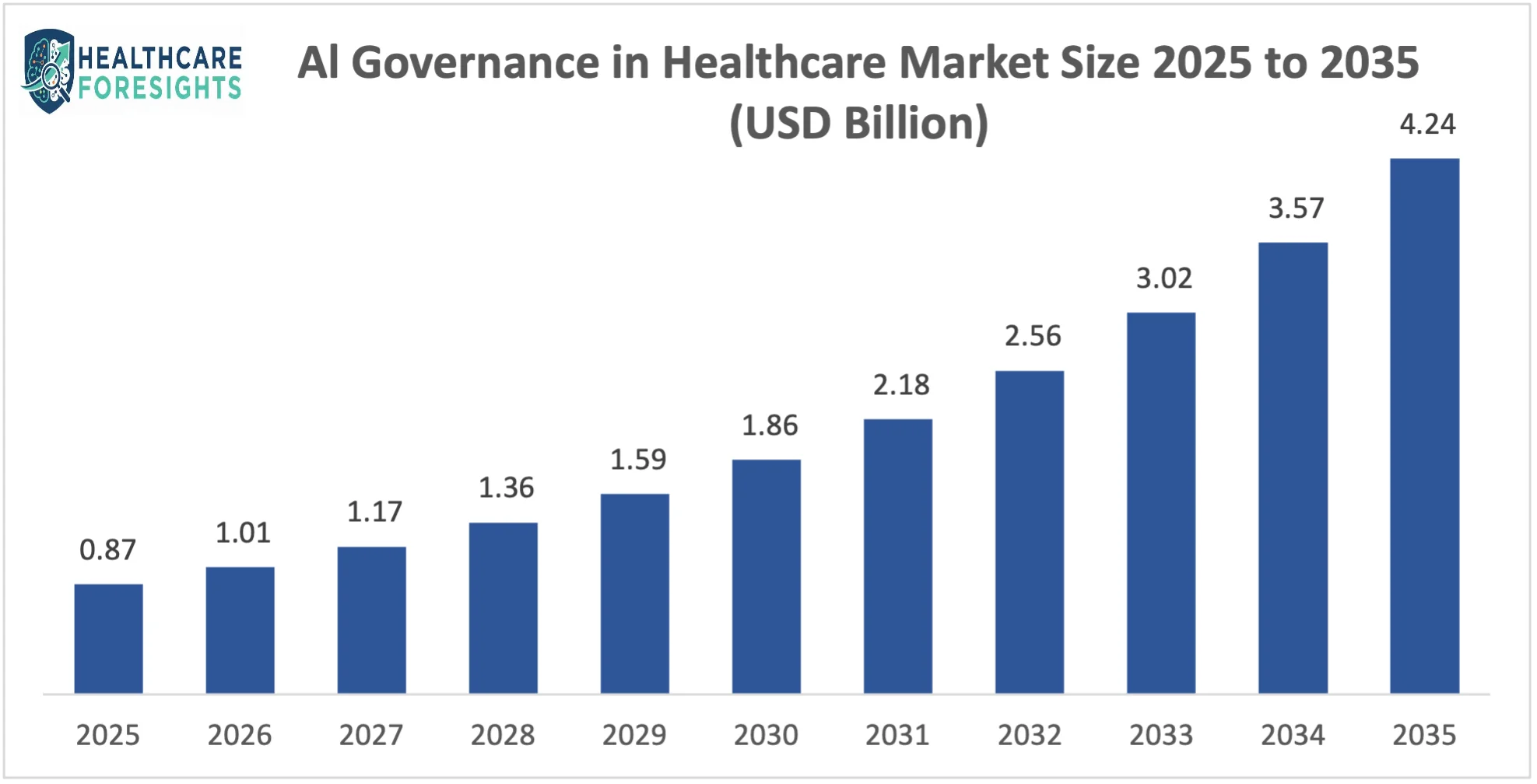
Spending already reflects that urgency. The AI governance in healthcare market is set to grow at a 17.16% CAGR, from $1.01 billion in 2026 to $4.24 billion by 2035. Consequently, health systems are treating governance as a permanent budget line rather than a side project.
1. Healthcare Teams Are Using More Types of AI
Today, AI appears in almost every department, not just data science teams. In fact, more than 80% of physicians now use AI in professional settings.
- Clinical and predictive models for diagnosis and risk scoring
- Ambient documentation, generative AI, and AI agents
- Administrative automation for billing, scheduling, and claims
2. AI Is Moving Closer to Patient Care
As AI shifts from back-office tasks to clinical decisions, the cost of an error rises. For example, one widely deployed sepsis model missed 67% of cases.
- Wrong outputs can delay diagnosis or treatment.
- Biased outputs can deprioritize certain patient groups.
3. One Hospital Can Have Dozens of AI Entry Points
Moreover, AI rarely enters through one front door. Instead, it arrives through purchases, updates, and staff experiments, often without central review.
- EHR vendors and embedded AI features
- Standalone software, cloud services, and APIs
- Internal models and employee-adopted tools
4. AI Models Keep Changing After Deployment
Unlike traditional software, AI can behave differently months after approval. That is why FDA’s final PCCP guidance asks manufacturers to predefine and validate changes to AI-enabled devices.
- Retraining, new datasets, and vendor model updates
- Prompt edits, workflow changes, and expanded agent permissions
5. Regulators Want Evidence, Not Promises
Finally, a written policy cannot prove what actually happened. Auditors ask for records instead, yet 40% of AI contracts are signed without security assessments.
- Who approved the system and when
- Which tests ran before and after launch
- How the team responded to each incident
Healthcare enterprises need AI governance now because AI is multiplying, changing, and moving closer to patients. Written policies cannot keep pace or prove control.
What Makes Healthcare AI Governance Compliant
Healthcare AI governance is compliant when every AI system has a named owner, a risk level, and controls tied to specific legal requirements. Each control must also produce evidence that auditors can review, and that evidence must keep flowing after launch.
Policies and dashboards alone only describe intentions. By contrast, a compliant system proves what actually happened.
1. Every AI System Must Have an Owner
First, accountability cannot sit with a general “AI committee.” Under Section 1557, HHS declined to shift discrimination liability to algorithm developers, so the organization using the tool stays responsible. Therefore, each model needs named people.
- A business owner for the use case
- A clinical owner for patient impact
- Technical owner and a compliance owner
2. Every AI System Must Have a Risk Level
Next, not every tool deserves the same scrutiny. A scheduling bot and a diagnostic model carry very different risks. For example, the FDA still treats AI that analyzes medical images for diagnosis as a regulated device.
- Low risk: administrative tools with lighter review
- High risk: clinical decision tools with full validation and monitoring
3. Every Requirement Must Connect to a Control
Moreover, a regulation only matters once it becomes a daily action. Compliant teams trace each rule all the way down to proof. For instance, Section 1557 requires reasonable efforts to identify and mitigate discrimination risk.
- Regulation: Section 1557
- Obligation: find and reduce bias risk
- Control: subgroup performance testing
- Owner: clinical AI lead
- Evidence: quarterly bias report
4. Every Control Must Produce Evidence
Beyond that, a control that leaves no record cannot pass an audit. Ideally, evidence is generated automatically, not rebuilt the week before a review. Some frameworks even recommend routing AI incidents to the governance committee within 24 hours.
- Test results, validation reports, and approvals
- Decision logs and access records
- Incident reports, reviews, and fixes
5. Compliance Must Continue After Launch
Finally, approval is a starting point, not a finish line. Models drift, vendors push updates, and user access shifts over time. Accordingly, Joint Commission’s RUAIH certification looks for ongoing monitoring processes, not one-time sign-offs.
- Drift and performance monitoring
- Reviews of vendor updates and model changes
- Access changes and periodic re-approval
In short, compliant healthcare AI governance links owners, risk levels, controls, and evidence into one chain. That chain must keep working long after go-live.
Start With Every AI System in Use
The first practical step toward healthcare AI governance is building a complete inventory of every AI system already in use. That includes vendor tools, internal models, and AI features hidden inside existing software.
After all, an organization cannot assign owners, set risk levels, or monitor models it does not know exist.
1. Build One Enterprise AI Inventory
To start, bring every AI tool into a single register. Otherwise, each department keeps its own partial list. Notably, CHAI’s 2026 governance playbooks count lifecycle management among eight core elements of responsible AI.
- Internal models and vendor tools
- AI features embedded in the EHR
- Generative AI, agents, and employee-used tools
2. Record How Each AI System Is Being Used
Next, a tool name in a spreadsheet is not enough. Each entry needs context showing who and what the tool affects. That context later decides its risk tier and required controls.
- Intended use, users, and affected patients
- Clinical impact and data access
- Deployment environment and named owner
3. Classify AI by Business and Clinical Risk
Once the inventory exists, sort each tool into a simple tier. This keeps review effort focused where patient harm is most likely.
a. Low-Risk Operational AI
These tools support staff without touching clinical decisions. Examples include scheduling support, summarization, and internal search. Usually, a lighter review works here.
b. Medium-Risk Workflow AI
These tools shape operations and the patient experience. Examples include revenue cycle, patient messaging, and workflow prioritization. As a result, they need validation and regular spot checks.
c. High-Risk Clinical AI
These tools influence diagnosis, treatment, or clinical predictions. In Texas, for example, SB 1188 requires practitioners to review AI output before making clinical decisions. Therefore, these tools need full validation, human review, and continuous monitoring.
4. Find Shadow AI Before It Becomes a Compliance Gap
However, the riskiest tools are often the ones nobody approved. Staff may paste patient details into consumer chatbots, which are not HIPAA-compliant by default. Similarly, vendors can switch on new AI features during routine updates.
- Unapproved employee AI and browser extensions
- Department-level software purchases
- Vendor AI features activated without central review
In short, healthcare AI governance begins with visibility. A complete inventory, clear usage records, and simple risk tiers show where controls matter most. From there, each high-risk tool needs a defined path to approval.
Match Each AI System to the Right Rules
The healthcare AI regulations that apply to a system depend on three things: the data it touches, the decisions it shapes, and the workflow it supports. HIPAA follows patient data, FDA follows software function, and Section 1557 follows patient care decisions.
Meanwhile, ONC, CMS, and EU rules apply only in specific situations.
1. HIPAA Follows PHI and Healthcare Relationships
HIPAA applies when AI handles protected health information for a covered entity. Importantly, a model provider receiving PHI on a provider’s behalf becomes a business associate.
- Covered entities and business associates must apply Security Rule safeguards.
- Every vendor touching PHI needs a signed BAA.
2. FDA Rules Depend on What the Software Does
FDA judges function, not the “AI” label. Under its January 2026 CDS guidance, some clinician-reviewed tools avoid device rules.
- Diagnostic image analysis remains a regulated device.
- Adaptive AI devices may need a PCCP.
3. ONC Rules Can Affect AI Inside Health IT
ONC rules mainly affect certified health IT developers. Currently, predictive decision support tools must disclose source attributes. However, HTI-5 proposes removing those model card requirements.
- Applies to AI inside certified EHR technology
- Keep documentation until a final rule arrives
4. Section 1557 Affects Patient Care Decisions
Section 1557 covers federally funded providers and insurers. Specifically, their patient care decision support tools must not discriminate by race, color, national origin, sex, age, or disability.
- Identify tools using protected characteristics.
- Document steps that reduce discrimination risk.
5. CMS Requirements Depend on the Workflow
CMS has no single AI law. Instead, obligations attach to specific Medicare or Medicaid workflows. For example, Medicare Advantage plans cannot base coverage decisions on broad datasets that ignore individual patient records.
- Prior authorization tools face close review.
- Billing AI can create False Claims Act exposure.
6. EU Rules Matter When the Business Enters EU Scope
The EU AI Act matters only when a system reaches EU users or markets. Notably, broader high-risk obligations moved to December 2, 2027.
- Map EU users and outputs before assuming scope.
- Keep EU duties separate from US obligations.
In short, each AI system triggers its own mix of rules based on its data, function, and workflow. Mapping those triggers early prevents both gaps and wasted effort.
Protect PHI Across the Entire AI Workflow
HIPAA-conscious AI architecture requires protecting PHI at every point it moves, not just inside the model. That means mapping where patient data enters, tracking where it travels, and limiting who can reach it.
It also means treating prompts and logs as PHI and binding every vendor with a BAA before data flows.
1. Map Where PHI Enters the AI System
First, list every input path, because PHI rarely arrives through one door. In fact, LLM traffic can pick up PHI through five distinct paths, yet most application controls cover only direct prompts.
- EHR data, API calls, and file uploads
- User prompts and audio recordings
- RAG sources and retrieved documents
2. Track Where AI Sends and Stores PHI
Next, follow the data after it enters. The proposed HIPAA Security Rule update would call for a network map of ePHI flows, including transfers to business associates.
- Models, databases, and vector stores
- Logs, backups, and analytics tools
- Downstream EHR and reporting systems
3. Control Who Can Access AI and Patient Data
Then, limit access to what each role needs. For example, role-based access linked to Okta, Azure AD, or AWS IAM can update privileges automatically as roles change.
- Strong authentication for every user
- Scoped service accounts for AI pipelines
- Least-privilege permissions reviewed regularly
4. Treat Prompts and AI Logs as Sensitive Data
However, many teams secure the database but overlook their monitoring tools. Prompts, traces, and outputs can all hold patient details. Accordingly, experts advise treating AI outputs as potentially sensitive and storing them securely.
- Redact PHI before prompts reach external models.
- Encrypt and restrict access to traces and logs.
- Set retention limits for prompt histories.
5. Control Vendors Before Sharing Patient Data
Finally, every third party touching PHI needs a contract first. That includes databases, email services, and analytics tools, not just the model provider.
- Signed BAAs that cover subprocessors
- Permitted use, retention, and training-data terms
- Security responsibilities defined in writing
In short, protecting PHI in AI means following patient data from entry to storage to vendors. Prompts and logs deserve the same protection as the EHR itself.
Control Bias and Explain Clinical AI Decisions
A compliant healthcare AI system needs two linked controls: bias monitoring and clinical explainability. Bias monitoring checks whether outcomes differ across patient groups and records every test and fix.
Explainability, meanwhile, gives clinicians enough model information to judge each output. Together, they help satisfy Section 1557 and let clinicians trust, or override, AI recommendations.
1. Monitor Outcomes Across Patient Groups
First, test fairness in real use, not just before launch. Yet in pilots, 68% of executives say equity is planned but rarely measured. Researchers also warn that proxy variables can hide discrimination even when protected traits are excluded.
- Compare accuracy and error rates by patient group.
- Track disparate impact in real clinical outcomes.
2. Record How Fairness Testing Was Performed
Next, a passing result means little without its method. Auditors need to see exactly what was tested and who acted on it.
- Dataset, population, and fairness metric
- Threshold, finding, and named owner
- Remediation steps and completion date
3. Explainability Must Fit the Clinical Use
However, no single method works for every model. Tools like SHAP and LIME suit predictive models, but they cannot explain an LLM’s reasoning. Instead, FDA focuses on whether clinicians can independently review the basis for a recommendation.
- Feature attribution for risk scores
- Source citations for generative AI outputs
4. Give Clinicians Useful Model Information
Beyond explanations, clinicians need context about the tool itself. Helpfully, CHAI offers a model card template documenting intended use and risks.
- Intended use and known limitations
- Performance data and key input factors
- Situations that require human judgment
5. Document What Happens When Bias Appears
Finally, finding bias is only half the job. Section 1557 expects organizations to mitigate discrimination risk, so every response needs a record.
- Investigation and remediation
- Retesting and re-approval
- Restriction or retirement when fixes fail
In short, compliant clinical AI must prove it treats patient groups fairly and explains itself in useful ways. Every test, finding, and fix belongs in the record. Next, those controls must keep working as models change after launch.
Generative AI Needs Additional Controls
Governance for generative AI adds controls that predictive models rarely need. Because LLM outputs change with prompts, retrieved documents, and model versions, teams must govern each of those inputs directly.
They also need to track which model produced every output, filter PHI before it reaches the model, and require human review for high-risk content.
1. Govern Prompts and Retrieved Information
First, treat prompts and RAG sources as controlled assets, not casual text. A small prompt edit can change clinical output as much as retraining a model. In a RAG setup, compliance is only as strong as your vector database.
- Version and approve system prompts.
- Limit RAG sources to vetted documents.
- Check outputs before they reach users.
2. Track Which Model Produced Each Output
Next, record the full technical context behind every answer. Vendors update models often, so the same prompt can produce different results months later. Also, LLMs, RAG systems, and agents each need different test profiles within one governance lifecycle.
- Model provider and exact version
- Temperature, prompt version, and configuration
- Workflow, user, and timestamp
3. Control What Healthcare Data Reaches the Model
Then, decide which data may leave your environment at all. HIPAA-eligible services exist on Azure OpenAI, Amazon Bedrock, and Google Vertex AI, but a BAA alone is not enough. Ideally, a gateway enforces the rules by configuration rather than convention.
- Redact PHI before external calls.
- Allow only approved, BAA-covered endpoints.
- Use private deployment and short retention for sensitive workflows.
4. Require Human Review Where Risk Is High
Finally, generative AI can sound confident while being wrong. For this reason, some state laws now mandate review and disclosure. Texas SB 1188, for example, requires practitioners to personally review AI-generated content before clinical decisions. Similarly, California requires disclaimers on AI-generated patient communications.
- Clinician sign-off on AI-drafted clinical notes
- Review of treatment suggestions before action
- Disclosure and review for patient messages
Generative AI governance controls the prompts, sources, versions, and data behind every output. High-risk content still needs a human decision-maker.
Ambient AI Needs Its Own Governance Workflow
Organizations should govern ambient AI through a dedicated workflow that covers the full encounter: audio capture, the draft note, stored recordings, and ongoing error checks.
Standard AI controls miss these steps because ambient tools record live conversations and write directly into the medical record. As a result, every stage needs its own owner, rules, and evidence.
1. Control How Conversations Are Captured
First, patients may not realize an “ambient” tool is recording them. Researchers note that conversations are often recorded and saved in cloud infrastructure outside the EHR. In Texas, TRAIGA requires clear disclosure when AI is used in care.
- Patient notice and consent where state law requires it
- Approved, managed recording devices only
- Encrypted audio from capture to processing
2. Govern the Generated Clinical Note
Next, treat every AI-drafted note as unfinished until a clinician approves it. Texas SB 1188, for example, requires practitioners to review AI-generated records for accuracy and keep responsibility for clinical decisions.
- Clinician review and signed approval
- Tracked edits between draft and final note
- Provenance labels before EHR submission
3. Define Retention for Recordings and Transcripts
Then, decide what happens to the raw data after the note is signed. Ambient tools can leave multiple data artifacts beyond the final note, and each one may contain PHI.
- Storage location and deletion timelines
- Contract terms banning vendor training use
- Vendor access limits and audit logs
4. Monitor Documentation Errors
Finally, sample notes regularly, because errors are common. In a UC Davis pilot, physicians found omissions in 18% of reviewed notes and hallucinations in 11.5%. Moreover, simulated encounters showed AI scribes carrying interpreter mistakes into clinical notes.
- Audit samples for omissions, hallucinations, and wrong details
- Extra checks for interpreter-mediated visits
- Escalation paths for errors that could harm patients
In short, ambient AI governance follows the encounter from recording to signed note to deletion. Clinician approval and regular error audits keep documentation safe and defensible.
AI Agents Need Controls Before They Can Act
When AI moves from generating content to taking actions, governance must control what the agent can do, not just what it says. An agent can update records, send messages, or submit requests without a human typing anything.
Therefore, every agent needs its own identity, restricted tools, clear action limits, human approval for critical steps, and a complete action log.
1. Give Every Agent Its Own Identity
First, never let an agent borrow a human user’s login. Otherwise, no one can tell whether a person or the AI made a change. As agents spread, health systems face agent sprawl, unclear accountability, and tool permissions that outlive the original use case.
- A dedicated service identity per agent
- A named business and technical owner
- Permissions reviewed when the use case changes
2. Restrict Which Tools an Agent Can Use
Next, limit each agent to the tools its task requires. Controls matter here: in red-team testing, an unguarded agent ran unauthorized tools in 56–60% of adversarial trials. With enforcement middleware added, that rate fell to 0%.
- Approved APIs and EHR functions only
- Scoped access to data stores and messaging
- Blocked external services by default
3. Set Limits on What Agents Can Do Alone
Then, define autonomy levels by action type. Reading a chart carries far less risk than submitting an order.
- Read and recommend: allowed with logging
- Write and submit: allowed within strict rules
- Approve or high-risk actions: never allowed alone
4. Add Human Approval for Critical Actions
However, some steps should always pause for a person. Unsupervised agents create real liability. For example, Pennsylvania sued Character.AI after its chatbots allegedly posed as licensed physicians and gave clinical advice.
- Medication and diagnosis-related workflows
- External submissions and patient communication
- Any irreversible action
5. Record Every Agent Action and Handoff
Finally, every action needs a record auditors can replay. Governance only works when integrations can restrict agent actions and revoke access.
- Agent identity, model, and tool call
- Reason, result, and escalation
- Human takeover and final outcome
In short, AI agents need tight identity, tool, and action controls before they touch real workflows. Human approval and complete logs keep critical actions accountable.
Third-Party AI Needs the Same Level of Control
Healthcare organizations govern third-party AI by applying the same controls they use for internal models. They review vendors before purchase, write AI-specific terms into contracts, and recheck tools whenever models change.
Most importantly, every vendor tool stays in the central inventory, because the organization using it remains accountable for patient safety and compliance outcomes.
1. Review Vendors Before Purchase
First, vet the AI itself, not just the company’s sales materials. Yet 40% of AI contracts are signed without security assessments. Likewise, 80% of executives say vendor AI claims are hard to verify without formal governance.
- Security posture and PHI handling
- Model documentation and validation evidence
- Infrastructure, subprocessors, and incident history
2. Put AI Requirements Into Vendor Contracts
Next, turn every expectation into enforceable contract language. This matters because Section 1557 does not let covered entities shift discrimination liability to algorithm developers.
- Advance notice of model changes
- Limits on data use, retention, and model training
- Incident reporting timelines and audit rights
3. Recheck Vendors When Their Models Change
Then, treat every major vendor update like a new deployment. A tool approved last year may behave very differently today. However, 60% of contracts lack a material-change re-validation clause.
- Material updates and underlying model swaps
- New features and new subprocessors
- Drops in local performance or fairness
4. Keep Vendor AI in the Central Inventory
Finally, vendor tools must not sit outside enterprise oversight. Risk often hides here, since 80% of stolen patient records now come from third-party vendors. Accordingly, every vendor model needs the same inventory record as an internal one.
- Named internal owner and risk tier
- Linked contract, BAA, and validation records
- The same monitoring and review schedule as internal AI
Buying AI does not transfer accountability to the vendor. Strong reviews, clear contracts, and change-triggered rechecks keep third-party tools under control.
Connect Governance to Existing Healthcare Systems
A governance platform fits into the enterprise stack by connecting to the systems where AI already runs. It pulls usage data from the EHR, clinical context through FHIR, and model status from MLOps tools. It also links to identity and security systems.
As a result, evidence is captured automatically inside daily workflows, not rebuilt by hand before audits.
1. Connect With EHR Platforms
First, governance must reach the point of care, since that is where clinical AI affects patients. Integration is also the hardest part: Black Book ranked it the top AI blocker, cited by 50% of health systems.
- Links between each AI output and its Epic or other EHR workflow
- Clinical context for every model recommendation
- Automatic capture of alerts, overrides, and clinician actions
2. Use FHIR for Healthcare Data Exchange
Next, use standard APIs so governance data moves cleanly between applications. Federal policy is heading the same way, with ONC’s HTI-5 proposal re-anchoring future policy on FHIR APIs. However, single-EHR native APIs can limit cross-system normalization.
- Clinical data for local validation and monitoring
- Consistent patient and encounter references
- Integration with third-party healthcare apps
3. Connect Governance With MLOps
Then, place governance inside the model pipeline, not beside it. Platforms such as ModelOp use policy gates at deployment and drift monitoring tied to risk reassessment.
- Model registry sync with the AI inventory
- Validation gates in CI/CD pipelines
- Live deployment and monitoring status
4. Connect Identity and Access Systems
Beyond that, governance needs to know who, and what, touched each AI system. For example, RBAC linked to Okta, Azure AD, or AWS IAM can adjust privileges as roles change.
- Users, service accounts, and agent identities
- Permission changes and access reviews
- Logs of privileged actions
5. Connect Security and Incident Systems
Finally, AI incidents should flow into the same tools that security teams already watch. Moreover, the proposed HIPAA Security Rule update would call for an asset inventory that includes AI tools.
- SIEM alerts tied to specific AI systems
- Incident tickets linked to model records
- Vulnerability findings and security evidence
In short, a governance platform works only when it connects to the EHR, FHIR, MLOps, identity, and security systems already in place. Those integrations turn daily activity into audit evidence.
What Healthcare AI Governance Costs in 2026
A custom healthcare AI governance system typically costs $70,000 to $300,000, depending on integrations, clinical validation, AI inventory size, and governance scope. A health system with a few vendor tools will sit near the lower end.
By contrast, an enterprise running clinical models, generative AI, and agents across several EHRs will approach the upper end.
| Phase | What It Covers | Estimated Cost |
| Planning and compliance design | Regulatory mapping, risk tiers, architecture | $6,000 – $15,000 |
| AI inventory and approval workflows | Central registry, ownership, sign-off paths | $12,000 – $35,000 |
| Validation and monitoring systems | Bias testing, drift detection, dashboards | $15,000 – $55,000 |
| EHR and MLOps integrations | Epic, FHIR, model registries, CI/CD gates | $15,000 – $75,000 |
| Security and compliance testing | Access controls, audit trails, PHI safeguards | $12,000 – $50,000 |
| Deployment and enterprise rollout | Pilots, training, phased go-live | $10,000 – $70,000 |
| Total initial build | $70,000 – $300,000 | |
| Annual maintenance | Updates, monitoring, regulatory changes | 15% – 20% of build cost |
1. Planning and Compliance Design: $6,000 to $15,000
First, this phase decides which rules apply and how the system should be structured. Getting it right prevents expensive rework later.
- Regulatory mapping across HIPAA, FDA, Section 1557, and state laws
- Risk tier definitions and governance roles
- Target architecture and integration plan
2. AI Inventory and Approval Workflows: $12,000 to $35,000
Next, the team builds the central register and the approval path every AI tool must follow. Costs rise with the number of tools and departments involved.
- Inventory records for internal and vendor AI
- Named owners and risk classification
- Intake, review, and sign-off workflows
3. Validation and Monitoring Systems: $15,000 to $55,000
Then, this phase proves models work safely before and after launch. Clinical AI needs deeper testing than administrative tools.
- Local performance and subgroup bias testing
- Drift detection and alerting
- Monitoring dashboards for compliance teams
4. EHR and MLOps Integrations: $15,000 to $75,000
Integration usually has the widest cost range. Each EHR, data source, and model pipeline adds effort. For a deeper look at integration scope, see Intellivon’s healthcare AI governance cost breakdown.
- Epic and other EHR workflow connections
- FHIR-based clinical data exchange
- Model registry and CI/CD validation gates
5. Security and Compliance Testing: $12,000 to $50,000
Moreover, the system must protect PHI and produce evidence auditors trust. Planning ahead also helps absorb future rules. HHS estimates its proposed Security Rule update would cost the industry $9 billion in year one.
- Role-based access and encryption
- Immutable audit trails
- Penetration and compliance testing
6. Deployment and Enterprise Rollout: $10,000 to $70,000
After testing, the system moves into daily use. Large multi-site rollouts drive the upper range.
- Controlled pilots with selected departments
- Staff training and documentation
- Phased go-live across facilities
7. Annual Maintenance and Compliance Updates: 15% to 20% of Initial Cost
Finally, governance needs ongoing care as rules and models change. For a $70,000 to $300,000 build, that means roughly $10,500 to $60,000 per year.
- Regulatory mapping updates
- Monitoring upkeep and new integrations
- Security patches and periodic reviews
Not sure where your current AI oversight falls short? Intellivon’s assessment maps your AI tools against HIPAA, FDA, Section 1557, and state requirements.
Turn Your Compliance Evidence Gap Into a Governance Build Plan
Healthcare AI compliance governance comes down to one test: can you prove every AI system is owned, validated, monitored, and under control? Most organizations have policies but cannot produce that proof when an auditor or hospital buyer asks.
Intellivon closes that gap by engineering governance directly into the systems where your AI already runs. As a result, evidence builds automatically instead of being assembled the week before a review.
With Intellivon, your team gets:
- A complete AI inventory covering internal models, vendor tools, embedded EHR features, and shadow AI
- Regulation-mapped risk tiers aligned with HIPAA, FDA, Section 1557, CMS, and state AI laws
- PHI-safe architecture with BAA-enforced endpoints, redaction, and protected prompts and logs
- Bias and performance monitoring with subgroup testing, drift alerts, and documented remediation
- Generative AI and agent controls covering prompt governance, tool restrictions, and human approval gates
- EHR and MLOps integrations built on Epic, FHIR, model registries, and CI/CD validation gates
- Immutable audit trails that export regulator-ready evidence in minutes
- Phased delivery that starts with your highest-risk AI and scales across the enterprise
Ready to see where your AI oversight stands? Talk to Intellivon’s healthcare AI team about building a governance system that passes the evidence test. We’ll map your current AI tools to the controls they need and give you a phased plan with a realistic budget.
Conclusion
Ultimately, healthcare AI compliance governance is not about writing better policies. Instead, it depends on proving that every AI system has an owner, a risk level, and working controls. As regulations shift, evidence becomes the only reliable defense.
Therefore, organizations should start with a complete inventory, then protect PHI, monitor bias, and govern vendors, generative AI, and agents. Over time, connected systems turn daily activity into audit-ready proof. In the end, compliance that runs continuously is compliance that lasts.
FAQs
Q1. What is healthcare AI compliance governance?
A1. Healthcare AI compliance governance is the system of owners, controls, and evidence that proves AI tools follow healthcare rules. In practice, it inventories every model, assigns risk levels, and monitors performance, bias, and PHI handling. As a result, organizations can show auditors exactly how each AI system was approved, tested, and managed.
Q2. Does every healthcare AI system need FDA approval?
A2. No. FDA regulates AI based on what it does, not simply because it uses AI. For example, some clinician-facing decision support tools qualify as non-device software under FDA’s January 2026 guidance. However, AI that analyzes medical images for diagnosis still needs FDA oversight. Therefore, classify each tool before launch.
Q3. Does a BAA make an AI tool HIPAA compliant?
A3. No. A BAA provides required written assurances, but it does not make a tool compliant on its own. Instead, compliance also depends on access controls, audit logs, PHI redaction, workforce training, and risk analysis. Similarly, HIPAA-eligible cloud services still need correct configuration before handling patient data.
Q4. How often should clinical AI be reviewed?
A4. Clinical AI should be monitored continuously and formally reviewed at least quarterly. Additionally, teams should re-validate a model whenever the vendor updates it, the data changes, or performance drops. For new tools, 4 to 8 weeks of shadow-mode testing helps catch safety issues before go-live.
Q5. Does ISO 42001 make healthcare AI compliant?
A5. No. ISO 42001 is a voluntary AI management system standard, so it cannot replace HIPAA, FDA, or Section 1557 obligations. However, it helps organize governance processes and signals maturity to buyers. Ideally, teams map ISO 42001 controls alongside healthcare regulations rather than treating certification as proof of compliance.
Q6. How should hospitals govern AI built into their EHR?
A6. Hospitals should treat EHR-embedded AI like any third-party tool. First, add each feature to the central inventory with an owner and risk tier. Then, validate it on local patients before use. After all, Section 1557 keeps discrimination liability with the hospital, even when the vendor built the model.