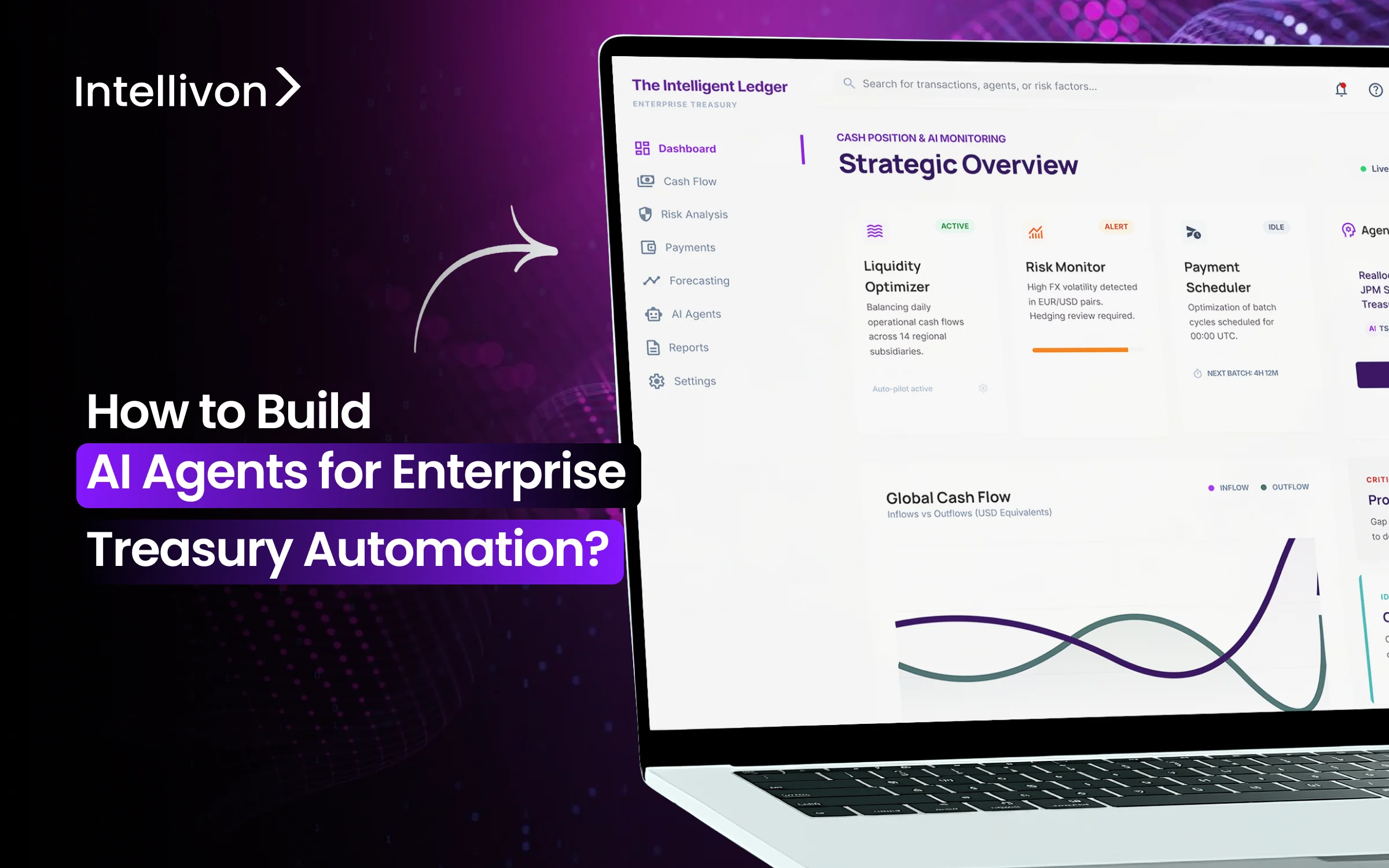
Building an enterprise AI treasury management system that actually performs under real financial pressure is harder than most vendors admit. Market volatility, credit risk, liquidity shifts, and fraud alerts do not wait for scheduled reviews. At the same time, companies processing high transaction volumes create more critical data than any analyst team can realistically handle in time. Rule-based systems manage what they are set up for. However, when conditions move beyond those limits, they stall. The decision still rests with a human, and by then, the opportunity may have already passed.
Real-time AI agents for treasury automation work differently. They monitor live data streams, assess changing conditions, and respond or escalate without waiting for manual input. For organizations where a delayed decision can lead to a direct financial loss, that ability provides measurable, scalable value. Building these systems takes careful design, the right integrations, and a solid understanding of where automatic decision-making has the biggest impact.
At Intellivon, we design and implement enterprise-scale AI treasury management systems for these situations. This blog shares our experience to explain how these agents operate, where they offer the most operational benefit, and what it takes to build them effectively.
Why Treasury Teams Are Adopting AI Agents Now
Treasury teams are rapidly adopting AI agents to reduce manual work, improve forecasting accuracy, and focus on strategic priorities in volatile markets. In fact, a 2025 survey of 264 US treasury leaders shows that 40% already use AI, while another 38% plan to adopt it soon.
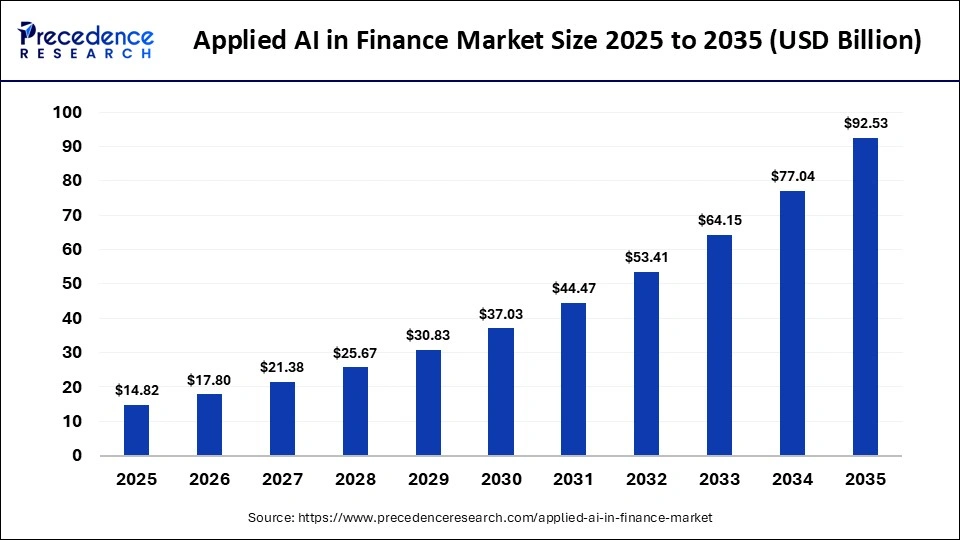
The applied AI in the finance market is set to grow rapidly, rising from $14.2 billion in 2025 to $92.53 billion by 2035. This growth highlights the expanding role of treasury in driving AI adoption across financial operations.
The shift toward autonomous agents is driven by the urgent need for agility in a financial landscape that has become too fast for manual oversight. Organizations are moving away from rigid software to embrace systems that can reason and adapt in real time.
1. The Limits of Rule-Based Systems
Most existing treasury tools rely on static logic that cannot handle the volatility of modern markets. These systems require constant manual updates and fail to interpret unstructured data from global news or diverse banking portals.
Consequently, teams remain trapped in reactive cycles, spending more time fixing broken workflows than focusing on high-level capital strategy.
2. Unmet Liquidity Demands
Global liquidity management now moves at a pace that surpasses human capability. While market fluctuations occur in milliseconds, many departments still rely on outdated day-end batch processing.
This delay causes idle cash to sit in low-interest accounts while borrowing costs rise elsewhere, creating significant financial friction and missed opportunities for yield.
3. The Shift to Autonomous Decision-Making
There is a fundamental difference between basic automation and an AI treasury management system. Simple automation merely repeats a task, but autonomous agents analyze historical patterns to suggest or execute the best course of action.
These agents evaluate intent and risk, transforming the treasury function from a back-office cost center into a proactive driver of corporate value.
4. Where AI Agents Fit in Modern Treasury Architecture
AI agents serve as the intelligent orchestration layer between ERP systems and banking networks. They pull data from disparate silos, trigger payments based on liquidity thresholds, and monitor transactions for fraud.
This connectivity ensures that every financial move aligns with local laws and global policy. Ultimately, agents turn fragmented data into a cohesive strategic asset for long-term growth.
What Are AI Agents in Treasury Operations?
AI agents in treasury operations are autonomous software systems that monitor live financial data, reason through changing conditions, and execute or escalate decisions without human prompts. Unlike traditional automation, they handle multi-step workflows across banks, ERPs, and payment systems in real time, adapting as conditions shift.
How Treasury AI Agents Differ From Traditional Automation
Treasury AI agents go beyond traditional automation by enabling real-time, autonomous financial decisions. While automation follows predefined rules, agents continuously learn, adapt, and act on live data.
Comparison: AI Agents vs Traditional Automation
| Aspect | Treasury AI Agents | Traditional Automation |
| Decision-Making | Autonomous, context-aware decisions | Rule-based, predefined logic |
| Data Handling | Processes real-time, dynamic data streams | Relies on static or batch data |
| Adaptability | Learns and improves over time | Requires manual updates for changes |
| Use Cases | Cash optimization, FX hedging, risk decisions | Payment processing, reporting, and reconciliations |
| Speed | Continuous, real-time execution | Scheduled or triggered execution |
| Scalability | Scales with complexity and data volume | Limited by rule complexity |
| Integration | Works across systems via APIs and events | Often siloed within specific workflows |
| Human Dependency | Minimal intervention required | High dependency on exceptions |
Traditional automation improves efficiency, but it stops at execution. On the other hand, AI agents take it further by enabling intelligent, real-time treasury decisions at scale.
Core Capabilities That Make Treasury Agents Intelligent
For a platform to move beyond basic automation, it must possess specific cognitive and technical abilities. These features allow the system to handle the nuance of corporate finance while maintaining the strict security standards required by global institutions.
1. Multi-Source Data Harmonization
Effective liquidity management depends on a clear view of every dollar across the organization. However, data is often siloed in different regions or incompatible software versions. Intelligent agents solve this by performing real-time data harmonization.
- Bank Portal Integration: They use secure APIs or SFTP connections to pull balances and statements from hundreds of global banks simultaneously.
- ERP Reconciliation: Agents automatically match bank transactions with internal records in systems like SAP or Oracle, identifying discrepancies in seconds.
- Unstructured Data Processing: By reading PDFs, emails, and news feeds, agents can incorporate external market sentiment into their cash flow models.
2. Autonomous Liquidity Orchestration
The hallmark of a true AI treasury management system is the ability to act without constant human prompts. Agents monitor liquidity levels against predefined corporate policies and execute necessary movements.
- Zero-Balance Accounting (ZBA): Agents can autonomously trigger transfers to sweep funds into a central account, maximizing interest income.
- Dynamic Funding: If a subsidiary account is projected to fall below a threshold, the agent calculates the cheapest way to fund it, whether through internal transfers or credit lines.
- Payment Optimization: The system chooses the most cost-effective payment rail (ACH, SEPA, or SWIFT) based on the urgency and value of the transaction.
3. Predictive Cash Flow Forecasting
Traditional forecasting is often retrospective and prone to human bias. Intelligent agents utilize machine learning to provide a forward-looking perspective that adapts as new data arrives.
- Pattern Recognition: Agents analyze years of historical spending to identify seasonal trends and cyclical peaks that humans might overlook.
- What-If Scenario Modeling: Business leaders can ask the agent to simulate the impact of a 10% currency devaluation or a sudden supply chain disruption.
- Anomaly Detection: By establishing a baseline of normal activity, the system flags outliers immediately, providing an early warning for potential liquidity crunches.
4. Real-Time Compliance and Fraud Prevention
In an era of sophisticated cyber threats, agents provide a tireless layer of defense. They analyze every outbound request with a level of scrutiny that manual teams cannot replicate at scale.
- Sanctions Screening: Agents automatically check payees against global watchlists to ensure every transaction remains compliant with international law.
- Behavioral Analysis: If a payment request deviates from a vendor’s typical timing or amount, the agent pauses the workflow for human review.
- Audit Trail Generation: Every decision made by the AI is logged with a clear rationale, making it easy for internal and external auditors to verify the integrity of the process.
These integrated capabilities transform the treasury from a reactive reporting unit into a high-velocity strategic powerhouse. By embedding intelligence at the core of the financial stack, enterprises can finally achieve a truly self-driving liquidity model.
How Treasury Automation Works Today
Current treasury automation relies on RPA and rule-based STP, which are effective for high-volume, repetitive tasks but struggle with data fragmentation and exception handling.
These legacy methods lack the real-time processing and cognitive reasoning required for modern liquidity management. Building a next-generation platform requires moving beyond these static “if-then” models toward agentic AI that can adapt to market volatility.
While these tools have replaced some manual entry, they remain fundamentally limited by their inability to think or adapt to changing conditions.
1. Rule-Based Triggers and Threshold Alerts
Current systems typically operate on a series of if-then statements designed to monitor liquidity levels. When a bank balance hits a specific floor, the system sends an alert to a human operator or initiates a pre-programmed transfer.
While reliable for basic tasks, these triggers cannot interpret the context behind a sudden cash dip, leading to frequent false alarms or missed strategic opportunities.
2. Scheduled Batch Processing in Treasury Ops
Many treasury departments still function on a batch processing cycle where data is only updated at specific intervals, such as the end of a business day. This approach creates a significant lag between a market event and the company’s response.
Relying on stale data means that by the time a report reaches a leader’s desk, the opportunity to hedge or invest has often passed.
3. Straight-Through Processing for Payments
Straight-Through Processing (STP) aims to move a payment from initiation to settlement without any human intervention. When a transaction meets all predefined criteria, it flows through the banking rails automatically.
However, even a minor discrepancy in formatting or a standard compliance flag can derail this process, forcing a team member to step in and resolve the issue manually.
4. RPA Bots Handling Repetitive Treasury Tasks
Robotic Process Automation (RPA) mimics human keystrokes to move data between spreadsheets and banking portals. These bots are excellent for high-volume, repetitive tasks like downloading bank statements or updating currency exchange tables.
However, RPA is brittle; if a bank changes its website layout or a login screen shifts, the bot fails because it lacks the cognitive ability to problem-solve.
5. Workflow Automation Across ERP and TMS Tools
Enterprises use workflow automation to connect their Enterprise Resource Planning (ERP) software with their Treasury Management System (TMS). This ensures that once a bill is approved in accounting, the instruction is sent to the treasury team for funding.
While this creates a digital paper trail, the integration is often rigid and requires extensive IT support to modify as the business grows.
6. Where Current Automation Breaks Down
The primary failure of today’s automation is its dependence on a static environment and perfect data. When a supply chain crisis hits or a banking partner changes its API, traditional automation stops working entirely.
These systems lack the reasoning needed to handle exceptions, leaving the most complex and critical financial decisions entirely on the shoulders of overworked human staff.
Current automation serves as a useful foundation but ultimately acts as a rigid bridge in an increasingly fluid financial world. To achieve true resilience, organizations must move toward systems that can reason through complexity rather than just following a script.
How AI Agents Upgrade Treasury Automation
AI agents upgrade treasury by evolving from rule-based triggers to contextual reasoning and continuous, 24/7 orchestration. By utilizing a multi-agent architecture, enterprises can handle complex exceptions and real-time liquidity management without constant human escalation.
By shifting from static scripts to dynamic reasoning, these systems transform the finance department into a highly adaptive, resilient operation.
1. Moving From Triggers to Contextual Decisions
Standard tools respond to specific numbers, yet AI agents understand the context behind those figures. Instead of simply firing an alert when a balance is low, an agent investigates the source of the dip.
It cross-references pending receivables and upcoming payroll to determine if the shortfall is a temporary timing issue or a genuine liquidity risk. Therefore, decisions are based on a holistic view of the company’s financial health rather than a single data point.
2. AI Agents That Learn From Treasury Patterns
The power of an AI treasury management system lies in its ability to improve through continuous observation. Unlike rigid software, agents refine their logic based on the outcomes of past financial decisions and historical market cycles.
- Behavioral Baseline: Agents identify the specific cadence of vendor payments and customer inflows to predict future needs.
- Adaptive Hedging: The system learns which currency fluctuations typically precede larger market shifts, allowing for more precise risk mitigation.
- Optimal Timing: By analyzing historical transaction costs, agents determine the exact time of day to execute large transfers to minimize fees.
3. Handling Exceptions Without Human Escalation
In the past, any data discrepancy or unexpected compliance flag required a human to “break the glass” and fix the error. AI agents reduce this friction by resolving minor exceptions autonomously within the bounds of your corporate policy.
They can format mismatched data, verify secondary documentation, or reroute a blocked payment to an alternative clearinghouse. This capability ensures that the financial engine keeps moving even when the input data is imperfect.
4. Continuous Automation Beyond Scheduled Runs
Batch processing belongs to a previous era of finance. Modern agents operate on a continuous loop, monitoring global accounts 24 hours a day, 7 days a week.
- Real-Time Settlement: Transactions move through the system the moment they are cleared, rather than waiting for an end-of-day run.
- Global Market Watch: Agents can react to news in Asian markets while the local treasury team is asleep, executing protective hedges automatically.
- Instant Visibility: Leadership has access to a live, minute-by-minute cash position that never goes stale.
5. Coordinating Multiple Agents Across Workflows
Complexity in enterprise treasury is best managed by specialized agents working in a coordinated swarm. Rather than one massive program, a multi-agent architecture uses individual units dedicated to specific niches.
One agent might focus exclusively on interest rate optimization while another manages fraud detection. These agents communicate with each other through a central orchestration layer, ensuring that a decision made in the “risk” unit is immediately reflected in the “liquidity” unit.
6. When to Automate vs When to Keep Human Control
While agents are powerful, strategic leadership still requires a human touch. The goal is to automate the “how” while keeping the “why” in the hands of senior decision-makers.
- Automate High-Velocity Tasks: Move cash concentration, standard FX hedging, and routine reconciliation to agents.
- Automate Compliance Checks: Let AI handle the heavy lifting of scanning thousands of transactions against sanctions lists.
- Human Control for M&A: Strategic decisions like major acquisitions or restructuring require the nuanced judgment of a CFO.
- Human Control for Policy Setting: Humans define the risk appetite and ethical guardrails within which the AI must operate.
The integration of agentic AI removes the operational drag of traditional treasury, allowing the finance team to focus on high-impact strategy. This evolution ensures the organization remains agile enough to capitalize on opportunities that static systems would simply miss.
Key Use Cases of AI Agents in Treasury
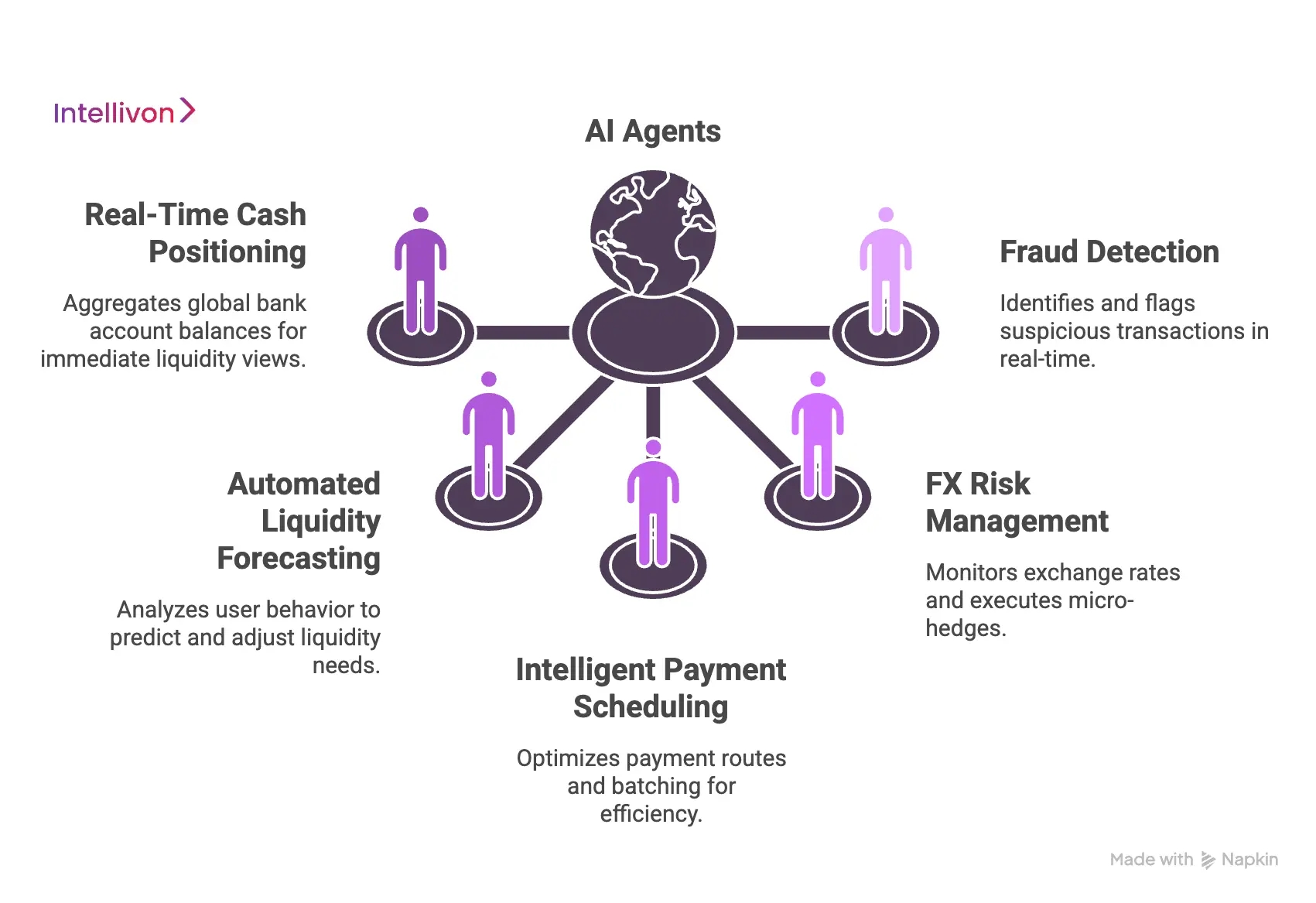
Implementing AI agents allows finance departments to transition from manual oversight to proactive management. In the fast-paced fintech sector, these use cases represent the difference between operational friction and scalable growth.
1. Real-Time Cash Positioning
Fintechs operating across multiple jurisdictions often struggle with fragmented liquidity views. AI agents solve this by maintaining persistent API connections to every global bank account and digital wallet.
For example, a payment processor can use agents to aggregate minute-by-minute balances from regional partners into a single dashboard. Therefore, leadership can deploy capital with total confidence, eliminating the need for mid-day manual reconciliations.
2. Automated Liquidity Forecasting
Traditional models fail to account for the volatile user behavior inherent in digital platforms. AI agents improve this by analyzing vast datasets to identify non-linear spending patterns.
Consider a neobank experiencing withdrawal spikes during specific market events. An agentic system recognizes these trends and automatically adjusts reserves. Consequently, the organization avoids high emergency funding costs while meeting regulatory requirements.
3. Intelligent Payment Scheduling and Routing
Fintech infrastructure requires moving money through the most efficient path to preserve margins. AI agents act as a smart traffic controller for every transaction:
- Cost-Based Routing: Agents evaluate fees across rails like FedNow or SWIFT and choose the cheapest path for non-urgent payouts.
- Dynamic Batching: Systems group smaller transactions to optimize network fees on blockchain or traditional clearinghouses.
4. FX Risk and Portfolio Optimization
For fintechs dealing with cross-border remittances, currency volatility is a constant threat. AI agents monitor exchange rates against open exposure, executing micro-hedges the moment volatility thresholds are hit.
Additionally, agents scan for higher-yielding overnight vehicles, moving idle funds into money market funds when rates rise.
5. Fraud Detection and Anomaly Monitoring
Agents provide a layer of scrutiny that manual teams cannot match at scale. If a payroll file contains an unrecognized bank account or a vendor payment occurs at an unusual hour, the agent flags it immediately.
In high-volume environments, this automated vigilance is essential for stopping sophisticated attacks before funds leave the building.
These specific applications allow organizations to reclaim thousands of hours previously lost to administrative drag. By deploying intelligence at the transaction level, enterprises turn their treasury function into a center for competitive advantage.
How AI Agents Transform Day-to-Day Treasury Workflows
The integration of AI agents fundamentally redefines the daily operations of a finance department by removing the friction of human-speed processing. This transformation shifts the focus from managing tasks to managing strategy, allowing the enterprise to operate at the speed of the global market.
1. Moving to Continuous Real-Time Decisions
In a traditional setup, treasury teams wait for day-end reports to understand their cash position. AI agents eliminate this lag by processing every transaction and market change as it happens. This constant stream of data allows the system to make micro-adjustments to liquidity and hedging throughout the day.
Therefore, the organization no longer operates on yesterday’s information, but rather on a live financial pulse that reflects the true state of the business at any given moment.
2. Reducing Manual Dependencies
Finance workflows are usually slowed down by the need for manual approvals and data entry across multiple systems. AI agents bridge these gaps by acting as an autonomous connective tissue between platforms.
- Auto-Reconciliation: Agents match thousands of bank entries to ledger records without human oversight.
- Smart Data Mapping: The system automatically translates different banking formats into a unified corporate standard.
- Proactive Notifications: Instead of humans hunting for errors, the agent brings specific, high-priority issues directly to the team with a suggested resolution already prepared.
3. Running 24/7 Treasury Intelligence
Financial markets never sleep, yet human teams eventually do. AI agents provide a consistent layer of intelligence that monitors global accounts and geopolitical events around the clock.
If a currency pair experiences a flash crash at midnight, the agent can execute protective measures immediately based on pre-set risk parameters. This continuous vigilance ensures that the enterprise is never left vulnerable to market volatility during off-hours or holidays.
4. Gains in Speed, Accuracy, and Cost
The move to an agent-driven model delivers immediate and measurable improvements to the bottom line. By removing the element of human error, the accuracy of financial forecasting and compliance improves significantly.
- Transaction Velocity: Payments and settlements occur in minutes rather than days, improving vendor relationships and supply chain fluidity.
- Operating Expenses: Automation reduces the need for large back-office teams dedicated to repetitive administrative work.
- Yield Optimization: By keeping cash active 24/7, agents capture interest opportunities that are often missed in manual environments.
These workflow improvements allow the finance function to scale without a linear increase in headcount or complexity. By automating the operational baseline, leadership can finally redirect its best talent toward high-value growth initiatives and strategic capital planning.
Core Components of a Treasury AI Agent System
Building an enterprise-grade agentic system requires a sophisticated stack that goes beyond simple software integration. It involves creating a modular architecture where each component is designed to handle the high stakes and precision required for global financial operations.
1. Data Ingestion Layer
The foundation of any intelligent treasury system is its ability to consume vast amounts of data from diverse sources. This layer acts as the system’s sensory input, connecting to global banking portals via secure APIs, SFTP, or SWIFT networks.
In addition, it must maintain a deep, bi-directional link with internal ERP systems like SAP or Oracle. This ensures the agent has a complete view of both the actual cash in the bank and the projected liabilities sitting in the accounts payable ledger.
2. Real-Time Data Processing
Once data is ingested, it must be processed instantly rather than stored for later analysis. Event stream management allows the system to treat every bank balance update or market price shift as a trigger for potential action.
- Latency Reduction: The system uses high-speed processing to interpret data in milliseconds.
- Normalization: It converts various international banking formats into a single, structured data language.
- Enrichment: The engine adds context to raw transactions, such as identifying a recurring vendor or flagging a geopolitical risk factor.
3. Multi-Agent Orchestration
The decision engine is the brain of the system, where the actual reasoning takes place. Instead of a single monolithic program, modern architectures use multi-agent orchestration to divide complex problems into manageable tasks.
One agent might specialize in liquidity thresholds, while another focuses on interest rate optimization. These specialized agents communicate through a central coordinator that ensures their individual actions align with the overall corporate financial strategy and risk appetite.
4. Execution Layer
Intelligence is only valuable if it leads to action. The execution layer is the heart of the system, responsible for moving funds across the global banking network.
- Automated Transfers: It triggers cash sweeps and concentration movements based on the decision engine’s output.
- Payment Routing: The layer selects the most efficient rail for every transaction, from local ACH to international wires.
- API Handshakes: It manages the secure authentication required to authorize movements within third-party banking environments.
5. Monitoring and Compliance Layer
In a highly regulated environment, transparency is not optional. This layer records every thought process and action taken by the AI agents to ensure total accountability. It continuously checks every proposed transaction against global sanctions lists and internal compliance policies.
If a decision deviates from established norms, the system logs the exact rationale, providing a clear and immutable audit trail that satisfies both internal stakeholders and external regulators.
These components work in perfect harmony to create a resilient, self-governing financial ecosystem. By investing in this robust architectural core, enterprises ensure their treasury operations remain secure, compliant, and ready for future growth.
Treasury AI Agent Architecture: Design Models and Infrastructure
Building a resilient AI treasury management system requires a structural foundation that prioritizes modularity and security.
The architecture must be robust enough to handle massive transaction volumes while remaining flexible enough to adapt to shifting global financial regulations.
1. Multi-Agent vs Single-Agent Design
Choosing the right design model depends on the complexity of your financial operations.
While a single-agent approach might suffice for a startup, enterprise-grade treasury demands a multi-agent orchestration layer to ensure stability and specialized precision.
| Feature | Single-Agent Design | Multi-Agent Design |
| Scope of Work | Handles one specific task (e.g., data entry). | Manages multiple domains (FX, Cash, Risk). |
| Fault Tolerance | High risk; if the agent fails, the process stops. | High resilience; agents operate independently. |
| Specialization | Generalist logic with limited depth. | Specialist agents for complex financial reasoning. |
| Scalability | Difficult to expand without rewriting core code. | Highly modular; add new agents as needed. |
| Decision Speed | Sequential processing slows down execution. | Parallel processing enables real-time actions. |
2. API-First Banking Integration
Modern treasury systems must move away from legacy file-transfer methods in favor of an API-first approach. This strategy allows for a persistent, bi-directional flow of data between the enterprise and its banking partners.
- Instant Visibility: APIs provide real-time balance updates rather than waiting for end-of-day statements.
- Direct Execution: Agents can trigger payments directly through bank APIs, reducing the friction of manual portal logins.
- Enhanced Security: Secure API handshakes offer superior encryption and authentication compared to older transmission protocols.
3. Cloud-Native Scale and Resilience
A cloud-native infrastructure ensures that your treasury platform can scale alongside your business growth without performance degradation. Using microservices allows different parts of the system to be updated or scaled independently.
Furthermore, cloud environments provide built-in redundancy across multiple geographic regions. This ensures that even in the event of a localized server failure, your global liquidity management remains operational and accessible.
4. Event-Driven Real-Time Flows
Traditional software waits for a user to click a button, but an event-driven architecture responds to the data itself. Every incoming transaction, exchange rate shift, or market alert is treated as a unique event that the system processes immediately.
Because the architecture is reactive, the decision engine can pivot strategies in milliseconds. This real-time flow is essential for maintaining liquidity in volatile markets where a delay of even a few minutes can lead to significant financial loss.
5. Security and Access Controls
In the world of autonomous finance, controlling who and what can move money is the highest priority. High-level security requires a zero-trust model where every action is verified against strict role-based permissions.
- Granular Permissions: Define exactly which agents can view data versus which can initiate transfers.
- Multi-Factor Authorization: Ensure that high-value transactions always require a secondary human sign-off despite the AI’s autonomy.
- Immutable Logging: Every access request and system change is recorded in a tamper-proof audit trail for total transparency.
A well-designed architecture serves as the backbone of a high-performance finance department. By focusing on these core pillars, organizations create a system that is not only intelligent but also secure and ready for global scale.
Tech Stack for Building Treasury AI Agents
Constructing a high-performance AI treasury management system requires a specialized set of tools that prioritize low-latency data flow and enterprise-grade security.
The choice of stack determines whether your agents can act in real time or if they remain limited by the speed of traditional batch systems.
1. Data Infrastructure and Real-Time Streaming Tools
For an agent to act autonomously, it needs a continuous feed of accurate data. Modern stacks move away from static databases in favor of event-driven streaming platforms.
- Message Brokers: Tools like Apache Kafka or Amazon Kinesis allow the system to ingest thousands of events per second from global banks and ERPs.
- Vector Databases: Using technologies such as Pinecone or Milvus enables the AI to store and retrieve historical financial patterns as high-dimensional vectors.
- Time-Series Data: Since treasury is deeply rooted in timing, specialized databases like InfluxDB are used to track currency fluctuations and liquidity trends over long periods.
2. AI and ML Models for Financial Decision-Making
The “brain” of the agent requires a combination of Large Language Models (LLMs) and specialized machine learning algorithms.
- Reasoning Engines: Models like GPT-4o or Claude 3.5 are used to interpret complex treasury policies and unstructured financial news.
- Predictive ML: While LLMs handle reasoning, classic regression models and LSTMs (Long Short-Term Memory networks) are better suited for accurate cash flow forecasting.
- Fine-Tuning: Enterprises often fine-tune these models on internal financial data to ensure the AI understands company-specific terminology and risk appetites.
3. Agent Frameworks and Orchestration Platforms
Building an agent from scratch is inefficient, so developers use established frameworks to manage the “agentic” lifecycle.
Platforms like LangChain or CrewAI provide the necessary structure for multi-agent coordination. These frameworks allow you to define specific roles, such as a “Liquidity Manager” and a “Risk Analyst,” and facilitate the communication protocols between them.
Consequently, the orchestration layer ensures that agents do not execute conflicting trades or exceed their delegated authority.
4. ERP and Banking API Integration Layers
The system is only as good as its ability to talk to the external world. This requires a robust middleware layer that can bridge the gap between modern AI and legacy financial systems.
- Banking APIs: Integration platforms like Plaid, Treasury Prime, or direct Swift APIs provide the connectivity needed for real-time balance checks and payment initiation.
- ERP Connectors: Custom-built or pre-configured connectors for SAP, Oracle, and NetSuite ensure that the AI can read accounts payable and accounts receivable data without manual exports.
- Data Mapping: This layer standardizes diverse data formats into a unified JSON structure that the AI agents can process instantly.
5. Security, Compliance, and Audit Tooling
Security is the most critical layer of the stack, ensuring that autonomous actions are both safe and reversible.
- Identity and Access Management (IAM): Tools like Okta or AWS IAM ensure that only authorized agents and human overseers can access specific financial “vaults.”
- Confidential Computing: Implementing TEEs (Trusted Execution Environments) ensures that sensitive financial data remains encrypted even while being processed by the AI.
- Audit Logging: Immutable ledgers or specialized logging tools record every prompt, reasoning step, and execution for future regulatory reviews.
Selecting the right tech stack is a strategic decision that balances current operational needs with future scalability. A robust, modular foundation ensures that as AI capabilities evolve, your treasury system remains at the cutting edge of financial innovation.
Integrations Required for Treasury AI Agent Systems
A treasury agent is only as effective as the ecosystem it connects to. For an enterprise-grade system, these integrations must be deep, bi-directional, and low-latency to ensure that autonomous decisions are grounded in reality.
1. Core Banking Systems and Open Banking APIs
The most critical link is the direct connection to your global banking partners. Unlike legacy systems that rely on end-of-day file transfers, AI agents thrive on Open Banking APIs that provide real-time visibility into balances and transaction history.
This connectivity allows the agent to monitor liquidity across hundreds of accounts simultaneously, ensuring a unified view of the organization’s total cash position without manual portal logins.
2. ERP and Financial Management Platforms
To understand the “why” behind the numbers, agents must integrate with your ERP. By connecting to platforms like SAP, Oracle, or NetSuite, the system gains access to accounts payable and receivable data.
This integration allows the agent to cross-reference bank balances with upcoming liabilities, creating a more accurate cash flow forecast. Consequently, the agent can predict liquidity crunches before they happen by identifying gaps between expected inflows and scheduled outflows.
3. Payment Gateways, SWIFT, and Clearing Networks
Intelligence must be followed by execution. Agents require secure gateways to move money through various rails, including SWIFT, SEPA, and instant clearing networks.
- Network Selection: The agent evaluates the cost and speed of each rail for every transaction.
- Protocol Translation: It automatically formats payment instructions to meet the specific technical requirements of different global networks.
4. Market Data Feeds and FX Rate Providers
To manage risk, agents need a constant pulse on the external market. Integration with real-time data providers ensures that the system is always aware of currency fluctuations and interest rate shifts.
This allows the agent to execute automated hedges or move idle cash into higher-yielding instruments the moment market conditions turn favorable.
5. Compliance, KYC, and Enterprise Risk Systems
Finally, agents must operate within a “safety envelope” by integrating with compliance and risk tools. Every transaction is automatically screened against global sanctions lists and internal KYC (Know Your Customer) protocols.
This layer ensures that while the system is autonomous, it remains fully compliant with international financial regulations and corporate governance policies.
By weaving these integrations into a single orchestration layer, the enterprise creates a seamless financial fabric. This connected environment is the essential prerequisite for a truly autonomous treasury function that drives strategic growth.
How to Build a Treasury AI Agent Automation System: Step by Step
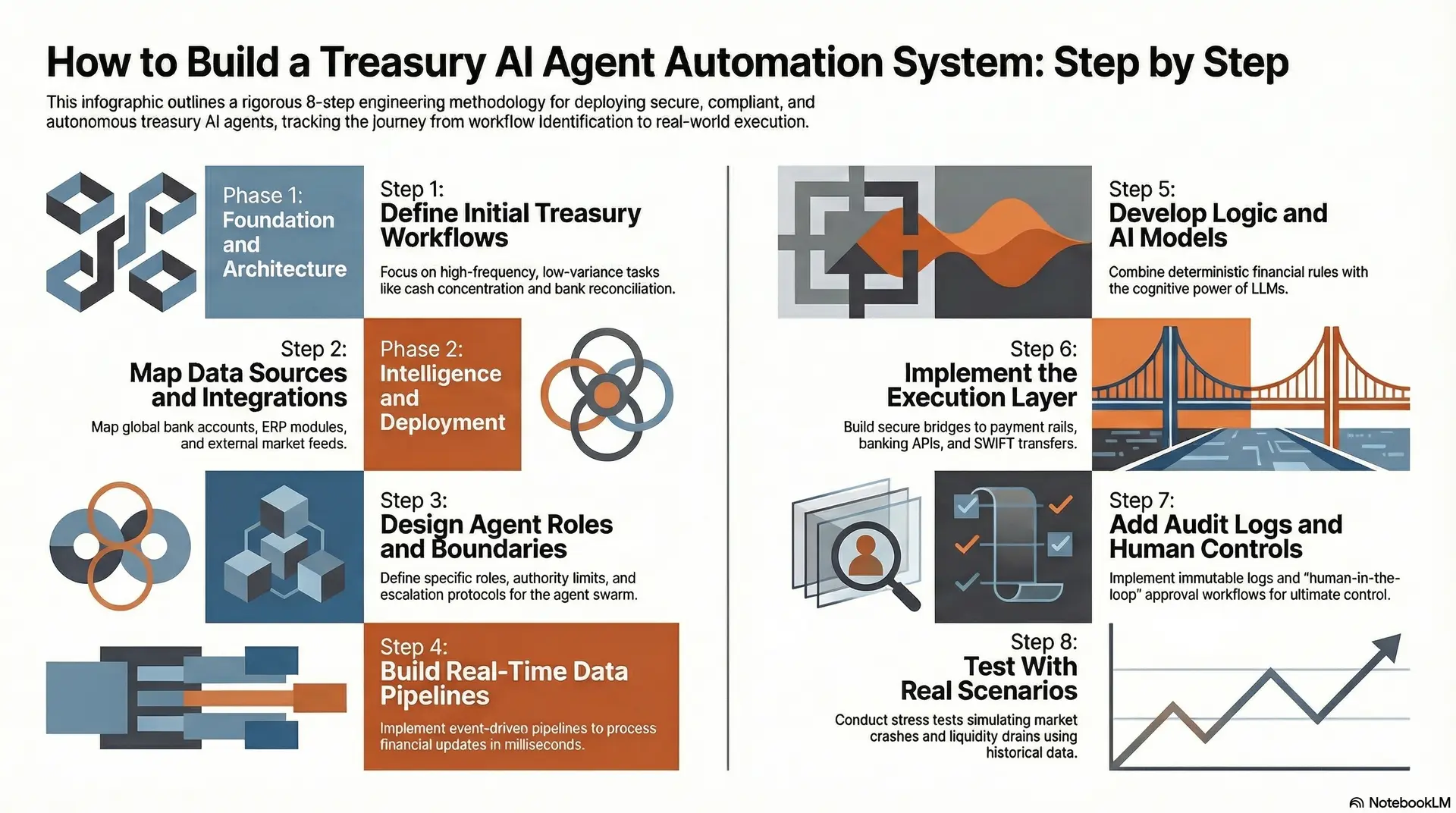
Building an autonomous treasury function is a journey from fragmented manual tasks to a unified intelligent ecosystem. At Intellivon, we follow a rigorous, engineering-first methodology to ensure that every agent we deploy is secure, compliant, and capable of high-stakes financial reasoning.
Step 1: Define Initial Treasury Workflows
We begin by identifying high-frequency, low-variance tasks that offer the immediate return on investment. Focusing on areas like daily cash concentration or bank reconciliation allows us to demonstrate value quickly while building the foundation for more complex operations.
This targeted approach ensures that the system solves real operational bottlenecks before expanding into broader strategic automation.
Step 2: Map Data Sources and Integrations
Successful automation depends on a complete map of your financial data landscape. We identify every touchpoint across your global bank accounts, ERP modules, and external market feeds.
By understanding how data flows through your organization, we can design a system that captures every dollar and transaction in real time.
Step 3: Design Agent Roles and Boundaries
We architect the system as a “swarm” of specialized agents, each with a clearly defined scope and decision boundary.
- Role Definition: Assigning specific tasks like “Liquidity Forecaster” or “Fraud Monitor.”
- Authority Limits: Setting strict financial caps on what an agent can execute without human sign-off.
- Escalation Protocols: Defining exactly when an agent should pause and request human intervention.
Step 4: Build Real-Time Data Pipelines
Intelligence requires fresh data, so we implement event-driven pipelines that process financial updates in milliseconds. Instead of waiting for batch updates, our architecture ensures that every bank alert or ERP entry is immediately available to the decision engine.
This real-time foundation is what allows your treasury to move from a reactive to a proactive state.
Step 5: Develop Logic and AI Models
This is where we build the brain of the system, combining deterministic financial rules with the cognitive power of LLMs. We fine-tune models to understand your specific corporate treasury policies and risk appetite.
Therefore, the agents do not just follow scripts; they understand the intent behind your financial strategy and adapt accordingly.
Step 6: Implement the Execution Layer
Once the logic is sound, we build secure bridges to your payment rails and banking APIs. This layer translates the AI’s decisions into actual financial movements, such as triggering a SWIFT transfer or executing a currency hedge.
We ensure that every outbound action is protected by multi-layered encryption and rigorous authentication protocols.
Step 7: Add Audit Logs and Human Controls
Transparency is non-negotiable in enterprise finance. We build comprehensive monitoring dashboards that provide a glass box view of every agent’s reasoning process.
- Immutable Logs: Every decision and action is recorded in a tamper-proof audit trail.
- Human-in-the-loop: Strategic “kill switches” and approval workflows ensure humans retain ultimate control.
- Performance Tracking: Continuous monitoring of accuracy, speed, and cost-savings.
Step 8: Test With Real Scenarios
Before going live, we put the system through its paces using historical data and “what-if” stress tests. We simulate market crashes, sudden liquidity drains, and connectivity failures to ensure the agents react correctly under pressure.
This exhaustive validation phase gives leadership the confidence to hand over the keys to the autonomous system.
Following this structured path allows Intellivon to deliver a “self-driving” treasury that scales effortlessly with your business. By combining strategic design with world-class engineering, we turn the vision of autonomous finance into a practical, high-performance reality.
Compliance and Risk Management in Treasury AI Systems
In the highly regulated world of corporate finance, autonomy cannot exist without accountability.
Developing an AI treasury management system requires a “compliance-by-design” approach that ensures every autonomous action remains within the legal and ethical boundaries of global finance.
1. Regulatory Requirements Across Key Regions
Enterprises operating globally must navigate a complex web of financial regulations that vary significantly by jurisdiction. In the United States, systems must align with SOC2 standards and Sarbanes-Oxley (SOX) requirements for internal controls.
European operations require strict adherence to GDPR for data privacy and PSD2 for secure payment services.
Therefore, AI agents must be programmed with “region-aware” logic that automatically applies the correct regulatory filter based on the geographic origin and destination of each transaction.
2. Building Explainable AI for Transparency
Black-box algorithms are unacceptable in enterprise treasury, where every million-dollar movement needs a clear rationale. We focus on “Explainable AI” (XAI) to ensure that decision-makers can trace the “why” behind every agent’s recommendation.
- Reasoning Logs: The system generates a natural-language summary of the data points and policies that led to a specific hedge or transfer.
- Confidence Scoring: Agents provide a probability score for their forecasts, allowing humans to gauge the risk level of an automated suggestion.
- Policy Mapping: Every action is digitally linked to the specific corporate treasury policy it is fulfilling.
3. Audit Trail Design and Reporting Compliance
A robust audit trail is the cornerstone of financial integrity and is essential for both internal reviews and external tax audits. Our architecture records an immutable timestamped log of every data ingestion point, reasoning step, and execution command.
This level of detail ensures that during a year-end audit, the finance team can reconstruct any day’s liquidity movements with 100% accuracy. This transparency reduces the administrative burden of reporting while maintaining the highest standards of corporate governance.
4. Data Security and Access Standards
Protecting the “keys to the kingdom” requires a multi-layered security stack that far exceeds standard enterprise software.
- Encryption at Rest and Transit: All financial data and API credentials are shielded using AES-256 and TLS 1.3 protocols.
- Zero-Trust Access: We implement strict Identity and Access Management (IAM), where agents and users only have the minimum permissions necessary for their specific roles.
- Anonymization: When training models or analyzing patterns, sensitive PII (Personally Identifiable Information) is stripped to ensure privacy compliance without sacrificing the AI’s learning capability.
By embedding these rigorous safeguards into the core architecture, organizations can embrace the speed of AI without compromising on security. This foundation of trust is what allows an enterprise to confidently scale its autonomous operations across the global market.
Cost to Build Treasury AI Agent Systems
Building treasury AI agent systems is not a fixed-cost project. The investment depends on data complexity, real-time processing needs, integrations with banking infrastructure, and compliance requirements.
Unlike basic automation tools, these systems operate as a real-time financial decision infrastructure, which significantly impacts architecture, orchestration, and scalability costs.
1. Cost Breakdown by Modules and Complexity
| Component | Scope | Estimated Cost |
| Data Ingestion Layer | Bank APIs, ERP systems, payment data, market feeds | $15,000 – $30,000 |
| Real-Time Data Processing | Event streaming, pipelines, data normalization | $20,000 – $40,000 |
| AI Models & Decision Engine | Forecasting, liquidity optimization, risk models | $30,000 – $80,000 |
| Agent Orchestration Layer | Multi-agent coordination, workflows, logic routing | $25,000 – $60,000 |
| Execution Layer | Payment triggers, treasury actions, system responses | $15,000 – $35,000 |
| Integrations | ERP, SWIFT, banking APIs, FX data providers | $20,000 – $50,000 |
| Compliance & Security Layer | Audit logs, encryption, and regulatory workflows | $15,000 – $40,000 |
| Dashboard & Monitoring | Treasury dashboards, alerts, and reporting systems | $10,000 – $25,000 |
| Testing & QA | Financial accuracy, scenario testing, edge cases | $10,000 – $20,000 |
2. Total Estimated Cost
- Mid-Level Treasury AI System: $150,000 – $300,000
- Enterprise-Grade Multi-Agent Platform: $300,000 – $600,000+
Enterprise AI systems typically scale significantly in cost due to integrations, infrastructure, and compliance layers, rather than just development effort
3. What Drives the Cost the Most
- Integration complexity (banking systems, ERPs, APIs)
- Real-time decision requirements (event-driven architecture)
- Compliance and audit requirements (KYC, AML, reporting)
- AI model sophistication (forecasting, optimization, risk logic)
- Multi-agent orchestration complexity
4. Timeline and Team Structure
| Phase | Timeline |
| Discovery & Architecture | 2–4 weeks |
| Data & Integration Setup | 4–8 weeks |
| AI + Agent Development | 8–16 weeks |
| Testing & Deployment | 4–6 weeks |
Total Timeline: 4 to 8 months
Treasury AI agent systems are long-term infrastructure investments, not one-time builds.
The real cost is driven by how deeply the system integrates and how autonomously it operates across financial workflows.
Conclusion
The shift toward autonomous treasury is no longer a futuristic concept but a strategic necessity for global enterprises. Transitioning from rigid, manual processes to intelligent AI agents enables real-time liquidity management and proactive risk mitigation.
This evolution allows financial leaders to move beyond administrative maintenance and focus on high-impact growth. Embracing this technology ensures your organization remains resilient, efficient, and competitive in an increasingly complex and volatile economic landscape.
Build An Agentic AI-Automated Enterprise Treasury System
At Intellivon, we build treasury systems as real-time financial decision infrastructure, not as automation layers added to disconnected tools. The objective is to unify data, decision logic, and execution across your entire treasury function, enabling continuous, intelligent automation.
Each system is designed around how your treasury actually operates. This includes cash positioning, liquidity forecasting, payment orchestration, FX risk management, and compliance workflows, all connected within a single, agent-driven architecture. As a result, teams reduce manual intervention, improve decision speed, and gain real-time control over global cash flows.
Our engineering approach combines agentic AI systems with API-first, cloud-native architecture. This ensures seamless integration with ERPs, core banking systems, SWIFT networks, payment gateways, and market data providers, without disrupting existing operations.
Why Build With Intellivon
- Infrastructure-First Approach: We design treasury systems that scale with your financial operations, not short-term automation tools that break under complexity.
- Built for Real Treasury Workflows: Every system is aligned with real-world treasury processes, from cash visibility to multi-entity liquidity management.
- Agent-Driven Decision Systems: We implement multi-agent architectures that continuously monitor, decide, and execute across treasury workflows in real time.
- API-First, Integration-Ready: Seamless connectivity with banking systems, ERPs, and financial data sources ensures faster deployment and long-term flexibility.
- Compliance and Control Built In: From audit trails to regulatory workflows, systems are designed to meet global financial compliance standards from day one.
From Strategy to Scalable Deployment
We work with your team from initial architecture design to full-scale deployment. This includes system design, integrations, agent development, testing, and ongoing optimization, ensuring your treasury evolves into a fully automated, intelligent financial system.
Get Your Treasury AI Roadmap
Looking to automate and scale your treasury operations with AI agents?
Connect with Intellivon’s AI consultants to build a custom, production-ready treasury system designed for real-time financial decision-making.
FAQs
Q1. What is an AI agent in treasury management?
A1. An AI agent in treasury is an autonomous software system that monitors financial data, reasons through conditions, and executes actions, like reallocating cash, scheduling payments, or flagging FX exposure, without waiting for human prompts. Unlike rule-based automation, treasury AI agents adapt to new information and handle multi-step workflows across ERP systems, banks, and payment platforms in real time.
Q2. Will AI agents replace treasury professionals?
A2. No. AI agents handle repetitive, data-heavy tasks like reconciliation, variance analysis, and cash positioning, freeing treasury teams to focus on strategy, banking relationships, and high-judgment decisions. The role shifts from data processor to decision-maker. Organizations adopting AI agents are upskilling their treasury teams, not shrinking them. Human oversight remains essential, especially for high-risk financial actions and regulatory compliance.
Q3. How do AI agents differ from RPA in treasury?
A3. RPA follows fixed scripts and breaks when inputs change. AI agents reason through variability, handle exceptions, and make contextual decisions without reprogramming. For example, an RPA bot can execute a payment on schedule, but a treasury AI agent can assess liquidity, evaluate timing, factor in FX rates, and then decide whether to execute, delay, or escalate the payment autonomously.
Q4. How do treasury teams get started with AI agents?
A4. Start with one high-pain, high-frequency workflow, such as cash flow forecasting, daily cash positioning, or bank reconciliation, which are common first choices. Ensure your ERP, TMS, and banking APIs are integrated and feeding clean data. Build a narrow proof of concept, validate accuracy, and earn internal trust before scaling. Teams that start focused see faster ROI and smoother adoption than those that try to automate everything at once.