Your clinical teams are overwhelmed with data, but they lack clear insights. They have spreadsheets, outdated BI tools, and dashboards that take 30 seconds to load. None of these helps when a physician needs to identify patient deterioration patterns in real-time.
React has become the preferred framework for clinical analytics because it meets healthcare needs. It quickly renders complex visualizations, integrates smoothly with FHIR data sources, and its interfaces don’t require training.
We have created these platforms at Intellivon for hospitals and health tech companies. Through this experience, we understand that scalability comes from a structure that can handle EHR migrations, regulatory updates, and the scope changes that occur when clinicians see new possibilities and want more. This blog explains how our skilled developers build these dashboards from the ground up using React.

Why Are Enterprises Building Clinical Analytics Dashboards?
Healthcare organizations are dealing with huge amounts of data coming from EHR systems, wearable devices, and remote patient monitoring. Because of this, they cannot rely on delayed reports anymore.
Clinical analytics dashboards help turn this data into real-time insights so teams can make faster decisions, reduce costs, improve patient outcomes, and run daily operations more smoothly.
This is especially important today as hospitals face staff shortages, lower margins, and value-based care pressure, so many enterprises are investing in dashboards to improve performance visibility across the organization. In fact, the global clinical data analytics market grew from about USD 81.65 billion in 2024 to USD 104.16 billion in 2025, and is projected to reach nearly USD 930 billion by 2034, growing at about 27.6% annually.
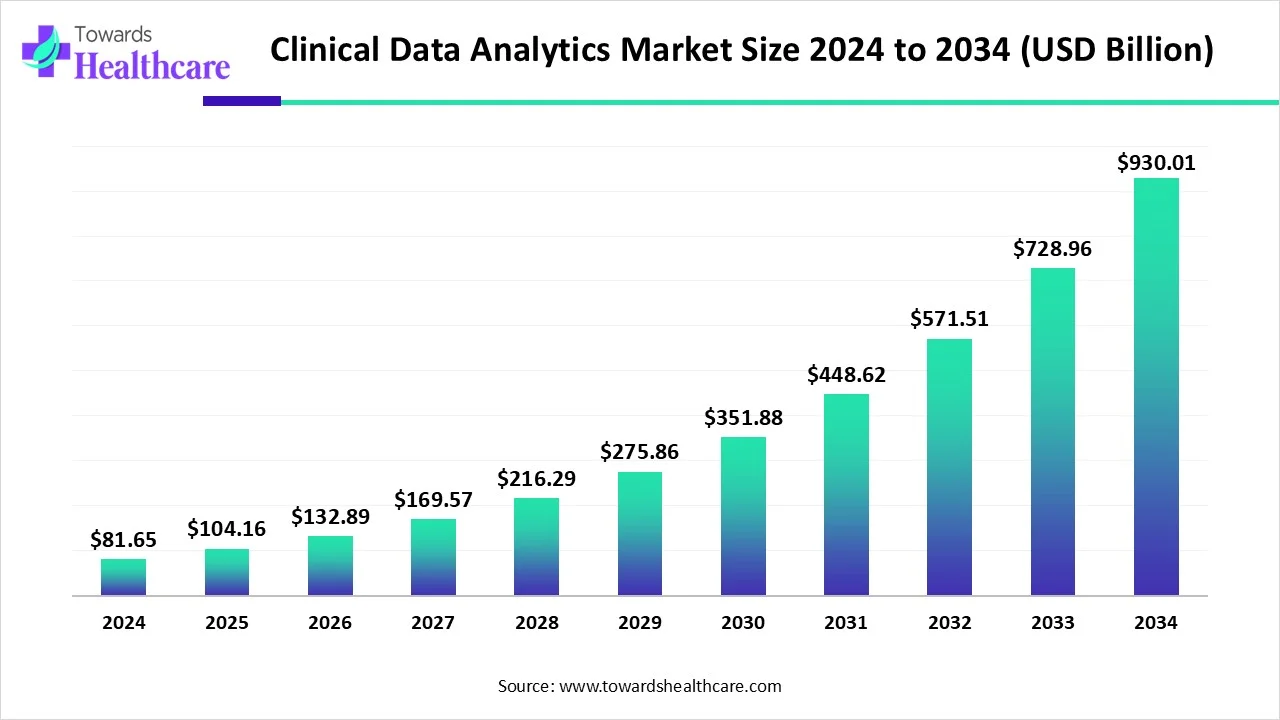
Market Growth Drivers:
- Rapid adoption of EHR and EMR systems is creating large volumes of clinical data that organizations can use to generate meaningful insights.
- Value-based care models, cost pressure, and personalized treatment approaches are increasing the need for predictive and data-driven decision tools.
- Growth in clinical trials and demand for real-time monitoring are driving the need for advanced and specialized clinical analytics dashboards.
Why Enterprises Are Choosing React
Enterprises choose React for clinical analytics dashboards because it can handle real-time data updates smoothly, which is important when tracking patient vitals, bed availability, or resource usage.
React is also widely trusted at scale, with about 41% of professional developers using it globally, making it one of the most adopted UI technologies today. In addition, React powers millions of live websites worldwide, which shows its reliability in large production environments.
Its component-based structure allows teams to reuse UI elements, so organizations can scale dashboards faster across hospitals and clinical programs.
Therefore, React helps healthcare enterprises build reliable, scalable dashboard experiences that can integrate with EHR systems while supporting strict compliance and performance needs
What Are Clinical Analytics Dashboards?
Clinical analytics dashboards are digital platforms that bring together patient, clinical, and operational data into one visual interface. They help healthcare teams track performance metrics such as patient outcomes, length of stay, readmissions, and resource utilization.
By turning complex healthcare data into simple charts and trends, these dashboards help organizations make faster, data-driven decisions, improve care quality, control costs, and monitor performance across hospitals, departments, and care programs in real time.
Why Healthcare Enterprises Now Require Clinical Analytics Dashboards?
Healthcare enterprises are managing more data, more patients, and more performance pressure than ever before. Because of this, traditional reporting tools are no longer enough to support daily clinical and operational decisions.
Clinical analytics dashboards help organizations turn large volumes of healthcare data into clear, real-time insights. As a result, leaders can monitor performance, identify risks early, and improve outcomes across hospitals and care programs.
1. Managing Massive Growth in Healthcare Data
Healthcare organizations generate data from EHR systems, connected devices, labs, and remote monitoring programs.
However, raw data alone does not improve decisions. Clinical analytics dashboards help convert this data into simple visuals and trends that teams can understand quickly. Therefore, enterprises can track performance continuously instead of waiting for monthly reports.
2. Supporting Value-Based Care and Cost Control
Healthcare payments are now closely tied to clinical outcomes and care quality. Because of this shift, organizations must monitor performance metrics more frequently.
Clinical dashboards help track readmissions, length of stay, and care variation across facilities. In addition, they help leaders identify cost drivers and reduce avoidable expenses.
3. Improving Clinical and Operational Decision Speed
Clinical and operational teams must make decisions daily, not quarterly. Traditional reporting delays often hide risks until problems grow. Clinical dashboards provide near real-time performance visibility.
As a result, teams can respond faster to patient risks, staffing challenges, and capacity issues.
4. Standardizing Performance Across Multi-Hospital Systems
Large healthcare enterprises often operate across multiple hospitals and systems. Therefore, performance tracking becomes complex and inconsistent.
Clinical analytics dashboards help standardize metrics and reporting views across the network. This helps leadership compare performance fairly and improve care delivery consistency.
Healthcare enterprises now require clinical analytics dashboards because they help turn complex data into clear, real-time insight.
As healthcare becomes more data-driven and outcome-focused, dashboards help organizations improve decisions, control costs, and maintain consistent performance across the enterprise.
Why Choose React for Clinical Analytics Dashboard Delivery
Hospitals need dashboard platforms that are fast, reliable, and easy to scale across hospitals and clinical programs. Because clinical data changes constantly, dashboards must update smoothly without slowing performance.
React is widely used because it supports real-time data updates, flexible design, and long-term scalability. As a result, organizations can build clinical analytics dashboards that support both current needs and future growth.

1. Real-Time Healthcare Data Performance
Clinical dashboards often track patient vitals, bed availability, and operational metrics that change frequently. React helps dashboards update data quickly without slowing the system.
Therefore, healthcare teams can trust the dashboard to show current conditions during daily decisions. This is important because delays can affect patient care, staffing, and resource planning.
2. Scalable Dashboards Across Hospitals
Large healthcare enterprises need dashboards that can expand across multiple hospitals and service lines. React allows teams to reuse dashboard components across different use cases.
In addition, this helps organizations launch new dashboards faster while keeping user experience consistent. Therefore, enterprises can scale analytics programs without rebuilding systems every time.
3. Healthcare System Integration Support
Clinical dashboards must connect with EHR systems, analytics platforms, and operational tools. React works well with modern APIs and healthcare data platforms.
Because of this, organizations can combine multiple data sources into one dashboard view. This helps leaders see complete performance insights instead of fragmented reports.
4. Enterprise Stability and Ecosystem Strength
React has a large global developer ecosystem and strong enterprise adoption. Therefore, organizations can find skilled talent and support dashboard platforms long-term.
In addition, the ecosystem supports advanced charts, security tools, and mobile-friendly dashboard experiences. This helps enterprises future-proof their analytics investments.
React is a strong choice for clinical analytics dashboard delivery because it supports real-time performance, enterprise scalability, and long-term platform stability.
As healthcare data grows and performance monitoring becomes more critical, React helps enterprises build dashboards that remain reliable, secure, and easy to expand across the organization.
Benefits of Building Dashboards Using React
Healthcare enterprises invest in clinical analytics dashboards to improve care delivery, control costs, and run operations with more confidence. React helps because it supports fast, consistent dashboard experiences that scale across hospitals and programs.
In addition, it makes it easier to roll out new views as priorities change. As a result, leaders get clearer performance visibility without rebuilding dashboard experiences every time.
1. Clinical Outcome Improvements
Clinical analytics dashboards help teams spot changes in care quality earlier. They also make it easier to compare performance across hospitals, departments, and care programs.
Therefore, clinical leaders can intervene sooner and reduce avoidable complications. In addition, dashboards support better consistency in how care teams follow pathways.
What improves in practice:
- Faster detection of clinical performance variation across sites
- Earlier intervention when patient risk signals increase
- Stronger care pathway adherence across departments and service lines
- Better outcome visibility for priority programs and patient cohorts
2. Operational Efficiency and Workforce Optimization
Hospitals run on capacity, staffing, and timing. When leaders rely on delayed reports, teams react late and waste effort.
Dashboards reduce manual reporting work and support faster daily reviews. As a result, operational teams can plan staffing and resources with better accuracy.
Where enterprises see operational gains:
- Less manual reporting workload for clinical and ops teams
- Faster performance review cycles for leadership and managers
- Better capacity planning using near real-time utilization data
- Cross-hospital benchmarking to replicate best-performing workflows
3. Financial Performance and Cost Control
Clinical performance and financial performance are linked more tightly now. Dashboards help leaders track metrics that influence reimbursement, penalties, and avoidable costs.
Therefore, enterprises can manage risk earlier and protect margin. In addition, real-time visibility improves forecasting and financial planning.
Common financial benefits:
- Stronger performance in value-based reimbursement and quality programs
- Reduced avoidable length-of-stay costs through faster issue detection
- Lower readmission penalties through earlier risk monitoring
- Better financial forecasting using real-time clinical and operational signals
4. Enterprise-Level Performance Standardization
Large health systems often struggle with inconsistent metrics and uneven execution across facilities. Dashboards help standardize how performance is measured, reviewed, and acted on.
As a result, leadership can compare sites fairly and scale improvements faster. In addition, standard views help onboard new hospitals after acquisitions.
What standardization enables:
- Unified performance visibility across regions, hospitals, and service lines
- Faster executive decision cycles using consistent enterprise metrics
- Better governance through shared definitions and review routines
- Quicker integration of new facilities into performance management
React-based clinical analytics dashboards help enterprises improve outcomes, strengthen daily operations, control costs, and standardize performance across networks. Because healthcare priorities shift quickly, scalable dashboard experiences matter as much as the underlying data.
Features of A Clinical Analytics Dashboard Built With React
Clinical analytics dashboards must do more than show data. They must help healthcare teams understand performance quickly and act with confidence. When built using React, these dashboards can deliver fast performance, consistent user experience, and strong scalability across enterprise environments.
In addition, React helps support real-time data updates and flexible integrations with healthcare systems. As a result, enterprises can build dashboard platforms that support both daily operations and long-term analytics strategy.

1. Real-Time Clinical Data Visibility
Clinical dashboards must show data that reflects current hospital and patient conditions. React supports fast data updates, which helps dashboards refresh information without slowing performance.
Therefore, healthcare teams can track patient vitals, resource utilization, and operational metrics in near real time. This is important for environments where delays can affect patient care and operational planning.
2. Role-Based Dashboard Security
Healthcare data must be protected while still being easy to access for authorized users. Clinical dashboards built with React can support role-based views for clinical leaders, operations teams, and executives.
As a result, users see only the data they need based on their role. In addition, this supports compliance with healthcare security and privacy regulations.
3. Scalable and Reusable Dashboard Components
Healthcare enterprises need dashboards that can grow across hospitals and clinical programs. React supports reusable dashboard components, which help teams build once and reuse across multiple dashboards.
Therefore, organizations can launch new analytics views faster. In addition, this keeps dashboard experiences consistent across departments and facilities.
4. Interactive Data Visualization
Clinical dashboards must help users move from summary metrics to detailed insights quickly. React supports interactive charts, filters, and drill-down features.
As a result, users can move from enterprise-level performance views to department or patient-level insights when needed. This helps improve decision-making speed and accuracy.
5. Integration With Healthcare Data
Clinical dashboards must connect with EHR systems, analytics platforms, and operational tools. React works well with modern APIs and data platforms.
Therefore, healthcare organizations can combine multiple data sources into one unified dashboard. This helps reduce data silos and improve enterprise performance visibility.
Clinical analytics dashboards built with React help healthcare enterprises deliver real-time insights, strong security, scalable user experiences, and integrated data visibility.
As healthcare organizations continue to rely more on data-driven decisions, React helps ensure dashboard platforms remain flexible, reliable, and ready to scale across the enterprise.
Healthcare Integration Requirements for Clinical Analytics Dashboards
Clinical analytics dashboards only work well when they connect to the right healthcare systems and data sources. Healthcare enterprises use many platforms, including EHRs, lab systems, billing systems, and care management tools.
Because of this, dashboards must combine data into one clear performance view. In addition, strong integration helps improve data accuracy and reporting consistency. As a result, organizations can make faster and more confident decisions.
1. EHR Integration
Clinical dashboards must connect directly with EHR systems because they store core patient and clinical data. This includes patient history, clinical notes, orders, and treatment information.
Therefore, direct integration helps ensure dashboards show accurate clinical activity. In addition, it reduces manual data movement and lowers reporting errors.
2. Unified Data View
Healthcare decisions require clinical, operational, and financial data together. Dashboards must combine data such as patient outcomes, bed usage, staffing, and reimbursement performance.
As a result, leaders can understand how clinical performance impacts cost and operations. This helps organizations make balanced enterprise decisions.
3. Identity Matching
Large healthcare systems often store patient and provider data across multiple systems. Therefore, dashboards must match identities correctly across platforms.
This prevents duplicate records and incorrect reporting. In addition, accurate identity matching improves outcome tracking and performance measurement.
4. Real-Time Data Support
Some healthcare decisions require real-time data, while others use hourly or daily updates. Dashboards must support both real-time and near-real-time data integration.
As a result, organizations can balance performance needs with system cost and complexity. This also helps ensure dashboards stay reliable during high data volumes.
Strong integration is essential for clinical analytics dashboards to deliver accurate and useful insights. When dashboards connect properly with healthcare systems, organizations get a complete and reliable performance view.
Enterprise Clinical Dashboard Architecture Using React
Enterprise clinical dashboards succeed when the experience layer and the data truth layer stay clearly separated. React powers the dashboard experience and, therefore, the clinical logic must live in governed backend systems.
This layered approach reduces risk, improves performance, and makes scaling across hospitals easier. In addition, it helps teams change metrics or add new dashboards without breaking everything else.
Layer 1: Data Sources
This is where raw healthcare data starts. Enterprises rarely have one system, so this layer is always mixed. Therefore, the goal is to capture the right data reliably and continuously.
Common sources include:
- EHR and EMR systems
- Lab, imaging, and pharmacy systems
- Claims and billing platforms
- Remote monitoring and device data
- Scheduling, staffing, and bed management tools
Layer 2: Integration and Normalization
Healthcare systems store data in different formats and timelines. This layer connects systems and makes data consistent enough to use. As a result, the dashboard does not depend on one vendor’s structure.
What this layer handles:
- Data extraction from multiple systems using APIs and connectors
- Standardizing formats and units so metrics stay consistent
- Identity matching for patients, providers, and facilities
- Handling late or missing data so dashboards stay trustworthy
Layer 3: Governed Data Platform
This layer stores enterprise-ready data for analytics. It keeps history, supports audits, and helps teams track data quality. Therefore, leaders can trust what they see and compare sites fairly.
Key responsibilities:
- Secure storage for clinical and operational datasets
- Data quality checks and validation rules
- Clear ownership and governance controls
- Audit-ready records and access logging
Layer 4: Metrics and Semantic Layer
This is where clinical metrics are defined and controlled. It prevents different teams from calculating the same KPI in different ways. In addition, it makes dashboards easier to scale across departments.
This layer typically includes:
- Standard KPI definitions, such as LOS, readmissions, and sepsis compliance
- Cohort logic, such as service line, facility, payer, risk group
- Version control for metric changes
- Metric lineage so teams know howthe numbers were created
Layer 5: Secure API Delivery
Dashboards should not query raw data stores directly. Instead, APIs deliver only what each role needs. As a result, performance improves and security risk drops.
What this layer provides:
- Role-based access control for endpoints
- Filtered and aggregated responses by default
- Fast queries using cached or pre-aggregated results
- Data freshness details like last refresh time
Layer 6: React Dashboard Experience Layer
React is the delivery layer where users interact with clinical analytics dashboards. It focuses on speed, clarity, and consistent experiences across the enterprise. Therefore, leaders can roll out the same dashboard patterns across hospitals and programs.
What React delivers well:
- KPI cards, charts, tables, and drilldowns in a consistent design
- Saved views for different roles and teams
- Smooth filtering for facility, service line, time, and cohort
- Mobile-friendly and responsive access for leadership workflows
Layer 7: Monitoring, Security, and Adoption Controls
Enterprise dashboards need ongoing control after launch. This layer ensures reliability, compliance, and long-term usage. In addition, it helps teams prove ROI beyond “we shipped it.”
What to include:
- Audit logs for access and exports
- Performance monitoring for slow queries and errors
- Usage analytics to track adoption by role and site
- Alerts for broken data feeds or metric anomalies
Enterprise clinical dashboard architecture works best when it is built in clear layers. React should own the dashboard experience, while governed systems should own clinical truth and metric logic.
This separation improves trust, supports compliance, and makes scaling across hospitals realistic. As a result, enterprises can expand dashboards over time without creating fragile, one-off reporting tools.
How We Build Clinical Analytics Dashboards Using React
At Intellivon, we build clinical analytics dashboards as enterprise performance systems, not as standalone reporting screens. We focus on trust, speed, and scalability from the start.
Therefore, each dashboard is designed to support real decisions across hospitals, service lines, and leadership teams. In addition, we build with React so the experience stays consistent and easy to scale as needs grow.

Step 1: Define Decisions and Success Metrics
We start by understanding the decisions your teams need to make daily and weekly. This keeps the dashboard focused and useful from day one. In addition, we define success measures so you can track impact after launch.
What we lock in early:
- The decisions the dashboard must support
- The primary KPIs and how you define them
- The users and roles who will use the dashboard
- The targets that signal success
Step 2: Standardize KPI Definitions and Governance
Dashboards fail when teams do not trust the numbers. Therefore, we create clear KPI definitions before we build the experience. We also set ownership so metric changes follow a controlled process.
What we deliver:
- Standard KPI definitions across hospitals and programs
- Clear numerator and denominator rules where needed
- Data freshness expectations and reporting timelines
- Documentation that reduces confusion during audits
Step 3: Connect and Validate Data Sources
Next, we connect the dashboard program to the systems that matter most. This includes EHR data, operational systems, and financial signals when needed. In addition, we validate data quality early to avoid surprises during rollout.
What we focus on:
- EHR and clinical system integration
- Operational data such as beds, staffing, and throughput
- Identity matching for patients, providers, and facilities
- Data quality checks and exception handling
Step 4: Build a Secure API Layer for Dashboard Delivery
We do not push raw healthcare data into the dashboard. Instead, we deliver dashboard-ready data through secure APIs. Therefore, performance improves and compliance risk drops. In addition, role-based access ensures each user sees only what they should.
What this includes:
- Role-based access control
- Default aggregation and safe drilldowns
- Fast responses using cached or precomputed results
- Audit and export controls were required
Step 5: Build the React Dashboard Experience Layer
This is where we design the experience people actually use. We build React dashboards that are fast, consistent, and easy to extend. As a result, your teams get a reliable dashboard experience across hospitals and clinical programs.
What we deliver in React:
- KPI cards, trend views, and drilldowns
- Filters for facility, service line, time, and cohorts
- Consistent design system across dashboards
- Mobile-friendly layouts for leadership access
Step 6: Pilot, Iterate, and Drive Adoption
A dashboard launch is not the finish line. Therefore, we pilot with a focused group, improve the experience, and expand with a repeatable rollout plan. In addition, we track adoption so you can measure real usage and value.
What we validate:
- Data trust and metric accuracy
- Performance under real usage
- Workflow fit for clinical and operational teams
- Adoption metrics across roles and locations
Step 7: Scale Across Hospitals
After the first dashboard proves value, we scale across hospitals and programs. We also add advanced analytics and AI features with governance in place. As a result, dashboards evolve into continuous performance monitoring platforms.
What scaling enables:
- Repeatable rollout across facilities and service lines
- Standard dashboards for executive and clinical governance
- Predictive risk views and early warning signals
- Automation opportunities with human oversight
Intellivon builds clinical analytics dashboards using React to deliver trusted performance visibility at enterprise scale. We align dashboards to decisions, standardize metrics, secure the delivery layer, and build experiences that teams actually use.
Therefore, dashboards become more than reporting tools. They become growth enablers that improve performance across the enterprise.
Cost Of Building Clinical Analytics Dashboards Using React
At Intellivon, clinical analytics dashboards are built as enterprise clinical intelligence platforms, not as reporting screens layered onto existing BI tools or EHR interfaces. The focus stays on delivering dashboards that operate reliably across hospitals, data systems, clinical programs, and evolving compliance requirements.
Because dashboards directly influence clinical and financial decisions, trust, performance, and governance are built into the foundation.
When budget constraints exist, scope can be refined carefully. However, data governance, metric standardization, security controls, and auditability are never reduced. Therefore, enterprises avoid expensive rework, data trust issues, and compliance risks that typically appear after deployment.
Estimated Phase-Wise Cost Breakdown
| Phase | Description | Estimated Cost Range (USD) |
| Discovery & Dashboard Strategy | KPI definition, use case prioritization, stakeholder alignment, and success metric design | $5,000 – $12,000 |
| Dashboard Architecture & Experience Design | React dashboard architecture, UX patterns, role-based access planning, performance strategy | $8,000 – $18,000 |
| Data Integration & Source Connectivity | EHR integration, operational data integration, financial data integration, API setup | $12,000 – $30,000 |
| Data Normalization & Metric Standardization | KPI logic setup, cohort definitions, data quality pipelines, and semantic layer setup | $10,000 – $22,000 |
| Security, Privacy & Access Controls | Role-based access, PHI controls, encryption, and audit logging setup | $6,000 – $15,000 |
| React Dashboard Development | KPI cards, charts, filters, drilldowns, and a responsive dashboard UI built | $12,000 – $28,000 |
| Testing & Validation | Functional testing, data validation, performance testing, compliance checks | $6,000 – $12,000 |
| Deployment & Scale Readiness | Cloud or hybrid deployment, monitoring setup, and performance tuning | $5,000 – $10,000 |
Total Initial Investment:
$60,000 – $160,000
Ongoing Maintenance and Optimization:
15–20% of the initial build cost annually
Hidden Costs Enterprises Should Plan For
Even well-planned dashboard programs face cost pressure if indirect factors are ignored. Therefore, planning for these early helps protect budgets, timelines, and long-term platform stability.
- Integration complexity increases as new hospitals, systems, and data sources are added
- Compliance overhead grows with audits, reporting, and regulatory updates
- Metric governance requires ongoing tuning and definition updates
- Infrastructure costs increase as data volume and usage grow
- Change management includes training clinical, operations, and leadership teams
- Monitoring becomes critical as dashboards become decision-critical systems
Best Practices to Avoid Budget Overruns
Based on Intellivon’s experience delivering enterprise clinical analytics platforms, these practices help keep costs predictable and controlled.
- Start with clearly defined decision workflows and KPI definitions
- Build governance, security, and auditability into the core platform design
- Use modular dashboard components that scale across use cases
- Plan integration and data quality strategy early
- Monitor performance, data quality, and security continuously
- Design for regulatory evolution instead of one-time compliance
Request a tailored proposal from Intellivon’s healthcare analytics experts to receive a delivery roadmap aligned with your budget, compliance exposure, and long-term clinical analytics strategy.
Conclusion
Clinical analytics dashboards are becoming essential for healthcare enterprises that want to improve outcomes, control costs, and make faster decisions. When built using scalable technologies like React, these dashboards can grow across hospitals and programs without losing performance or consistency.
Therefore, organizations can move from delayed reporting to real-time performance visibility. With the right strategy and partner, dashboards can become long-term growth enablers, not just reporting tools, helping enterprises stay competitive in a data-driven healthcare landscape.
Build A Clinical Analytics Dashboard With Intellivon
At Intellivon, clinical analytics dashboards are built as enterprise clinical intelligence platforms, not as reporting layers added onto BI tools or EHR interfaces. The focus stays on governance, performance, and scalability from day one. This ensures dashboards support real clinical and operational decisions, not just reporting.
This approach helps enterprises unify clinical, operational, and financial performance visibility without disrupting workflows. As data and reporting needs grow, dashboards stay stable, auditable, and easy to scale across hospitals and programs.
Why Partner With Intellivon?
- Enterprise-grade clinical analytics architecture designed for regulated healthcare environments and multi-hospital networks
- Proven delivery of dashboards that perform under real enterprise data load, including multi-EHR and high-volume clinical data environments
- Governance-by-design implementation with metric standardization, auditability, and data lineage built in
- Secure, modular infrastructure supporting cloud, hybrid, and on-prem deployment models
- AI-ready data foundations supporting predictive analytics and advanced clinical decision intelligence
Book a strategy call to explore how Intellivon can help you build and scale clinical analytics dashboards with long-term enterprise value.
FAQs
Q1. What is a clinical analytics dashboard, and why is it important for healthcare enterprises?
A1. A clinical analytics dashboard is a platform that combines clinical, operational, and financial data into one visual interface. It helps healthcare enterprises track performance, detect risks early, improve patient outcomes, and make faster data-driven decisions across hospitals and care programs.
Q2. Why are healthcare enterprises building clinical analytics dashboards outside traditional BI tools?
A2. Traditional BI tools often provide delayed and static reports. Clinical analytics dashboards provide near real-time performance visibility and better workflow alignment. Therefore, enterprises can monitor performance continuously and respond faster to clinical and operational changes.
Q3. Why is React used for building clinical analytics dashboards?
A3. React helps build fast, scalable, and consistent dashboard experiences across hospitals and clinical programs. It supports real-time data updates, reusable dashboard components, and strong integration with healthcare data platforms, making it suitable for enterprise clinical analytics environments.
Q4. What systems need to integrate with a clinical analytics dashboard?
A4. Clinical dashboards typically integrate with EHR systems, lab systems, billing platforms, operational tools, and analytics platforms. This helps create a complete performance view that supports both clinical and financial decision-making.
Q5. How long does it take to build an enterprise clinical analytics dashboard?
A5. Most enterprise clinical dashboards take 3 to 6 months, depending on data complexity, integration scope, and governance requirements. Timelines may increase if multiple hospitals, systems, and regulatory requirements are involved.