Key Takeaways:
-
Cross-border payment platforms start with high-volume corridors connecting fiat on-ramps, stablecoins, and local off-ramps.
-
MPC or HSM key management, KYC/KYB, sanctions screening, Travel Rule messaging, and reconciliation are core controls.
-
Blockchain analytics, transaction limits, human review, and auditable ledgers ensure compliant payment platform operations.
-
Production builds cost $70,000 to $300,000 and take 4 to 9 months depending on corridor complexity.
-
How Intellivon builds cross-border payment platforms as modular infrastructure with AI for routing, fraud scoring, and liquidity forecasting.
Building a stablecoin cross-border payment platform means building the layer finance teams touch directly. That includes a payment initiation screen, a multi-step approval workflow, a live FX quote, and a status tracker showing exactly where the money sits in transit. Without that layer, a company ends up routing payments through a raw developer console or a wallet address copied from a spreadsheet.
A build that stops at custody and settlement skips the part finance teams depend on daily, which is direct integration with systems like SAP, NetSuite, or QuickBooks. Platforms with that connection push payment data straight into the general ledger instead of forcing someone to reconcile transactions by hand. In fact, 70% of corporates say they’d adopt stablecoins faster if the platform integrated with their existing ERP and treasury systems, according to EY-Parthenon’s 2025 survey.
That integration step is usually where the platform builds stall, and not the blockchain layer underneath them. We cover the entire development process here, starting with sender, recipient, and merchant experience, then approval and FX logic, compliance automation, and ERP integration. By the end, you’ll know exactly what a production-grade platform requires.

What Are Stablecoin-Based Cross-Border Payment Platforms?
A stablecoin-based cross-border payment platform is digital software that transfers money across international borders using fiat-backed digital tokens like USDC or USDT on a blockchain.
Instead of routing funds through slow correspondent banks, these platforms convert local fiat into stablecoins, send them instantly across a network, and settle them into the recipient’s bank account.
Consequently, businesses can move capital internationally in seconds with minimal transaction fees. This modern architecture gives global enterprises full visibility, lower costs, and continuous 24/7 liquidity management.
Why Stablecoins Change Cross-Border Payment Economics
Stablecoins improve cross-border payments when they reduce settlement time, prefunding requirements, intermediary costs, or unavailable banking hours. However, blockchain network fees alone do not determine true savings.
The full operational calculation must include fiat collection, FX spreads, stablecoin acquisition, compliance automation, liquidity management, custody, off-ramp charges, payout fees, and operational exception processing.
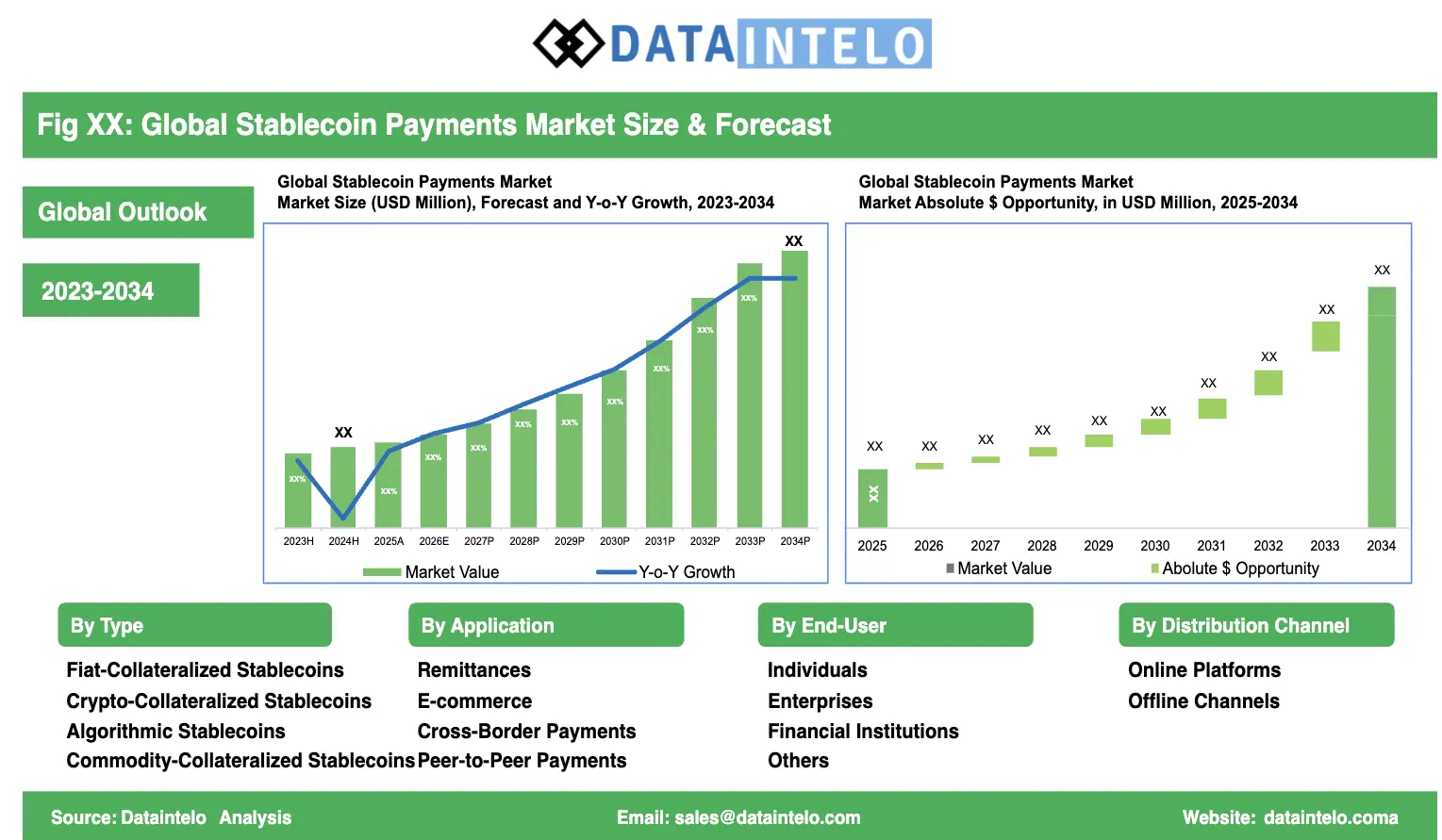
The global stablecoins market for payment applications is expanding rapidly as enterprises seek faster, cheaper alternatives to traditional banking. Valued at $98.7 billion in 2024, the stablecoin payments market is projected to reach $690.1 billion by 2033, growing at a CAGR of 22.4%.
1. Stablecoin Rails Versus Correspondent Banking
Traditional correspondent banking relies on slow, multi-hop financial institutions, whereas stablecoins clear directly on decentralized, open ledger networks.
- Correspondent-Bank Routing: Payments move sequentially through multiple intermediary banks, where each bank deducts processing fees and adds clearance delays.
- Pre-Funded Nostro/Vostro Accounts: Banks must maintain expensive pre-funded foreign currency balances worldwide, which locks up critical working capital.
- Cut-Off Times and Banking Holidays: Traditional bank wires stall during weekends, regional holidays, and local end-of-day processing windows.
- Atomic or Near-Real-Time Settlement: Blockchain rails settle transactions irrevocably within seconds or minutes at any time of day.
- Local Payout Dependencies: Real-world execution still requires reliable local banking or mobile money integrations to execute final fiat payouts.
- End-to-End Price vs. Network Fees: Industry analysis from Stripe notes that while blockchain gas fees cost only pennies, total cost savings depend on managing fiat on/off-ramp markups and FX spreads.
2. Where Stablecoins Create the Strongest Business Case
Stablecoins deliver immediate ROI in high-volume, high-friction corridors where traditional banking delays destroy profit margins or stall operations.
- High-Frequency B2B Supplier Payments: Enterprise buyers eliminate wire fees and pay global vendors instantly upon invoice approval.
- International Payroll and Contractor Payments: Global companies pay out distributed teams and freelancers instantly without cross-border surcharges.
- Marketplace Seller Payouts: E-commerce platforms automate mass payouts to international merchants without waiting days for batch clearing.
- Cross-Border Remittances: Money transfer operators cut overall remittance charges dramatically by skipping wire intermediaries.
- Intercompany Treasury Movements: Enterprise finance teams rebalance liquidity across global subsidiaries continuously on a 24/7 basis.
- Trade and Supply-Chain Settlement: Importers unlock goods faster by initiating instant payment upon digital bill-of-lading verification.
- Markets with Limited Coverage: Businesses bypass regional banking “de-risking” to reach underserved emerging markets directly.
- Weekend and After-Hours Settlement: Corporate treasuries process time-sensitive transfers instantly on Saturday or Sunday without paying emergency bank rates.
By replacing multi-hop correspondent channels with 24/7 digital ledger settlement, enterprises unlock working capital and eliminate hidden banking friction.
Building a production-grade platform requires designing robust technical layers to handle wallet security, regulatory compliance, and fiat integration seamlessly.
Cross-Border Payment Platform Development Architecture
A production cross-border payment platform development architecture must cleanly separate customer experiences, payment orchestration, double-entry ledgers, wallet management, compliance engines, and provider integrations. This modular decoupling prevents a single API failure, blockchain outage, or payout corridor delay from corrupting account balances or halting the entire platform.
Cross-Border Payment Architecture Layer
| Architectural Layer | Core Technical Functions | Primary System Responsibilities |
| Experience & API | Web/Mobile apps, PWAs, embedded widgets, REST/GraphQL APIs, webhooks. | Manages user onboarding, merchant interactions, API key authentication, and operational webhooks. |
| Payment Orchestration | Corridor routing, state machines, fallback rules, idempotency engines. | Handles quote expiry, retry policies, transaction approvals, and intelligent corridor selection. |
| Ledger & Accounting | Immutable double-entry journal, multi-asset account balances. | Serves as the internal source of truth for pending, available, and reserved balances across fiat and stablecoins. |
| Wallet & Blockchain | MPC/HSM key management, gas optimization, node abstraction. | Signs transactions, generates deposit addresses, tracks confirmations, and manages reorg risks. |
| Compliance & Risk | KYC/KYB, Travel Rule, sanctions screening, on-chain analytics. | Performs automated address risk scoring, travel rule messaging (IVMS 101), and fraud detection. |
| Event Integration | Event bus, transactional outbox pattern, dead-letter queues. | Guarantees asynchronous message delivery, saga processing, and reliable system state sync. |
| Cloud Infrastructure | Multi-region Kubernetes, Terraform IaC, secrets vaults, CI/CD. | Delivers high availability, automated horizontal scaling, zero-trust security, and zero-downtime deploys. |
Architectural Takeaways
Building a modular, multi-rail architecture ensures that your platform scales horizontally while remaining resilient against localized network failures. Crucially, decoupling your ledger from the public blockchain guarantees complete auditability, instant internal transfers, and fast financial reconciliation.
For a deeper breakdown of multi-rail architecture, see our guide on How to Develop a Blockchain-Powered Cross-Border Payment Software.
Select Stablecoins, Networks, and Custody
Selecting the right stablecoin assets, underlying blockchains, and custody arrangements must directly match your corridor target, regulatory clearance, redemption options, market liquidity, and local payout coverage.
Picking a low-cost network or popular token without verifying these operational factors can trap capital or stop end users from withdrawing local fiat.
1. Stablecoin Due-Diligence Criteria
Evaluating assets like USDC, USDT, EURC, PYUSD, or RLUSD requires analyzing risk factors beyond basic token market capitalization.
- Issuer Licensing and Reserve Integrity: Ensure issuers hold appropriate regulatory licenses, maintain full cash-equivalent backing, and publish audited monthly attestations.
- Redemption Rights and Banking Links: Direct primary-market mint and burn capabilities require stable, tier-one banking relationships and clear redemption terms.
- Market Liquidity and Jurisdiction Approval: Check secondary market depth across target corridors alongside regulatory clearance under frameworks like MiCA or state licensing.
- Smart Contract Control Features: Evaluate issuer-level freeze, blacklist, and clawback capabilities to ensure alignment with local AML and asset recovery mandates.
- Network Coverage and Depeg Resilience: Assess token availability across target networks and review historic price stability during severe market volatility events.
2. Blockchain Network Selection Matrix
Comparing networks like Ethereum, Solana, Stellar, XRPL, Polygon, Base, or Avalanche involves balancing speed, operational cost, and institutional tooling support.
- Settlement Speed and Transaction Costs: Choose networks offering sub-second finality and predictable micro-cent fees to maintain steady gross margins.
- Institutional Support and RPC Stability: Ensure reliable cloud RPC node providers, custody support, and compliance analytics integration exist across candidate chains.
- Liquidity and Fiat On/Off-Ramps: Verify local exchange order books and fiat ramp integrations support your selected network’s native token standards.
- Smart Contract Flexibility and Compliance Tools: Confirm the network supports custom contract logic, programmable compliance controls, and key management standards.
3. Single-Chain Versus Multi-Chain Architecture
Starting with a single-chain MVP minimizes early technical complexity and reduces engineering overhead.
However, cross-border platforms should adopt a multi-chain architecture when target corridors require distinct settlement rails, liquidity remains fragmented, or enterprise partners mandate specific token standards.
4. Cross-Chain and Bridge Risk
Moving stablecoins across different blockchains introduces structural security risks that demand careful risk mitigation.
- Asset Type Selection: Prefer native, canonical issuer tokens over wrapped bridge assets to eliminate third-party smart contract risks.
- Bridge Security Mechanisms: Avoid vulnerable lock-and-mint bridge protocols; instead, use direct burn-and-mint frameworks like Circle’s CCTP.
- Liquidity and Settlement Controls: Implement fallback routing to prevent funds from getting stuck during cross-chain messaging delays or bridge liquidity shortages.
5. Choose the Custody Model
Selecting a custody framework balances operational control against regulatory responsibility and system security.
- Self-Custody Infrastructure: Enterprise platforms manage private keys directly using internal hardware security modules and custom signing workflows.
- Qualified Third-Party Custody: Partnering with licensed custodians offloads regulatory asset-safekeeping liabilities while simplifying compliance audits.
- Embedded and Web3 Wallets: Abstract private key management behind email or social logins, providing non-technical end-users with simple account access.
- Omnibus vs. Segregated Accounts: Pool funds in omnibus smart contracts for lower gas fees, or isolate user funds in dedicated on-chain addresses for enhanced transparency.
6. MPC, HSM, and Multi-Signature Controls
Securing digital assets requires fault-tolerant key management protocols to eliminate single points of compromise.
- Key-Share Policies and Thresholds: Multi-Party Computation (MPC) splits private keys into shares across separate servers, requiring threshold signatures (e.g., 2-of-3) to approve transfers.
- Hardware Security Modules (HSM): Store root keys inside tamper-resistant hardware modules to execute secure, policy-enforced transaction signing.
- Role Separation and Policy Controls: Enforce organizational controls, address allowlists, velocity caps, and mandatory dual-approvals for high-value payouts.
- Emergency Controls and Audit Logs: Maintain immediate transaction suspension triggers, key rotation protocols, and immutable signing audit trails.
For a deeper breakdown of wallet and key-management design, see our guide on Enterprise Wallet Development: Architecture & Compliance Guide.
Selecting your token rails and custody architecture sets up the technical foundation for handling digital assets. Next, we will cover how to integrate fiat on-ramps, off-ramps, and foreign exchange liquidity engines to convert those stablecoins into local currencies.
Build Compliance Into Every Payment Flow
Consequently, compliance must operate directly inside payment orchestration rather than as a separate review after funds move.
Before the platform signs or releases any transaction, every payment must pass identity, sanctions, wallet-risk, counterparty, Travel Rule, corridor, limit, and reporting checks.
1. Classify the Activities the Platform Performs
To begin with, platform architects must distinguish between issuing a stablecoin, transmitting value, providing local payouts, serving consumers, serving businesses, and acting as an infrastructure provider.
This distinction matters because a payment platform using a third-party stablecoin does not automatically become the stablecoin issuer.
| Functional Activity | Legal & Operational Classification | Regulatory Impact |
| Stablecoin Issuance | Creating and redeeming digital tokens pegged to fiat. | Therefore, requires banking or stablecoin issuer licenses (e.g., US GENIUS Act PPSI, EU MiCA EMT/ART). |
| Money Transmission | Moving funds or value between senders and recipients. | As a result, requires Money Services Business (MSB) registration and state Money Transmitter Licenses (MTLs). |
| Fiat/Crypto Exchange | Converting local fiat into stablecoins or vice versa. | Furthermore, triggers broker-dealer, Virtual Asset Service Provider (VASP), or Crypto-Asset Service Provider (CASP) rules. |
| Custody & Wallets | Holding cryptographic keys or safeguarding user funds. | Hence, requires qualified custodian status, key-safekeeping controls, and isolated capital reserves. |
| Payment Orchestration | Arranging payments and routing API instructions. | Alternatively, operates under agent-of-payee rules, embedded finance frameworks, or software exemptions. |
2. United States Compliance
Meanwhile, operating a stablecoin platform in the US demands continuous compliance with federal laws, FinCEN regulations, state licensing, and OFAC sanctions screening.
| Regulatory Area | Mandate & Requirements | Operational Impact |
| FinCEN & BSA | Money Services Business (MSB) registration under the Bank Secrecy Act. | Specifically, requires appointing a Compliance Officer, registering with FinCEN, and filing SARs/CTRs. |
| State Licensing | Individual Money Transmitter Licenses across US states and territories. | In addition, requires maintaining state-by-state surety bonds, net worth minimums, and regulatory reporting. |
| GENIUS Act Compliance | Federal payment-stablecoin framework signed July 18, 2025, effective January 18, 2027. | Consequently, restricts US stablecoin distribution to approved Permitted Payment Stablecoin Issuers (PPSIs). |
| OFAC Sanctions | Real-time automated screening against global sanctions watchlists. | Thus, blocks prohibited counterparties, illegal wallets, and targeted geographic regions instantly. |
3. European Union Compliance
Equally important, the EU Markets in Crypto-Assets (MiCA) framework sets strict, unified rules for stablecoins and Crypto-Asset Service Providers (CASPs) across all member states.
| Framework Component | Core Requirement | Operational Implementation |
| CASP Authorization | License needed to provide trading, exchange, transfer, or custody services. | Because of this, mandates a local EU entity, physical presence, governance controls, and capital reserves. |
| E-Money Tokens (EMTs) | Fiat-referenced stablecoins used as payment instruments. | Accordingly, only authorized Credit Institutions or Electronic Money Institutions (EMIs) may issue EMTs. |
| Transfer of Funds Rules | EU “Travel Rule” alignment for virtual asset transfers. | In effect, requires attaching originator and beneficiary data to all transactions over €0. |
| DORA & Operational Risk | Digital Operational Resilience Act ICT management standards. | Likewise, enforces strict cloud security, third-party vendor audits, and incident reporting. |
4. UK, Singapore, Hong Kong, UAE, and Canada
Beyond the US and EU, global compliance requirements vary across major markets. For instance, platforms must manage diverse licensing, custody, and Travel Rule regulations across different financial hubs.
| Jurisdiction | Authority | Current Status | Licensing Framework | Travel Rule Threshold |
| United Kingdom | FCA | Final rules published June 2026; regime active October 25, 2027. | FCA Cryptoasset Authorization | £0 / Any Amount |
| Singapore | MAS | Effective Now | Payment Services Act (MPI License) | SGD 1,500 |
| Hong Kong | HKMA | Effective August 1, 2025 | Stablecoin Issuer Licensing Regime | HKD 8,000 |
| UAE (Dubai) | VARA | Effective Now | Virtual Asset Service Provider (VASP) License | AED 3,500 |
| Canada | FINTRAC | Effective Now | MSB Registration + Retail Payment Activities Act | CAD 1,000 |
5. KYC, KYB, and Perpetual Monitoring
In order to maintain compliance, integrated software must verify individual users, validate complex corporate structures, and continuously monitor risks across the customer lifecycle.
| Verification Phase | Target Activity | Operational Automation |
| KYC (Individuals) | Identity, liveness, and document checks. | First, runs biometric liveness checks, optical character recognition (OCR), and database matches. |
| KYB (Businesses) | Ultimate Beneficial Owner (UBO) discovery. | Next, executes corporate registry lookups, ownership mapping, and proof of address validation. |
| PEP & Media | Politically Exposed Persons and news screening. | Simultaneously, performs automated daily checks against global PEP databases and adverse news feeds. |
| Ongoing Monitoring | Perpetual risk assessment and source of funds. | Ultimately, updates dynamic risk scores triggered by transaction spikes, geographic shifts, or activity changes. |
6. Blockchain Analytics and Wallet Risk
Furthermore, real-time chain monitoring prevents your payment platform from interacting with compromised, sanctioned, or high-risk wallet addresses.
| Risk Vector | Screening Mechanism | Automated Risk Mitigation |
| Direct Sanctions Exposure | Checks destination and origin addresses against OFAC lists. | Immediately blocks transactions and triggers automated Suspicious Activity Reports (SARs). |
| Indirect Risk & Mixers | Traces multi-hop transfers from mixers, bridges, or darknet markets. | In response, flags high-risk transfers for manual compliance review and places temporary holds. |
| Counterparty VASP Checks | Identifies the hosting service or platform behind destination addresses. | Before release, verifies counterparty regulatory status before transmitting funds across borders. |
7. FATF Travel Rule Architecture
Finally, the Financial Action Task Force (FATF) requires Virtual Asset Service Providers (VASPs) to exchange originator and beneficiary information alongside cross-border transfers.
According to FATF’s 2026 Targeted Update, 83% of surveyed jurisdictions have enacted Travel Rule legislation. As a direct result, platforms must deploy automated protocols (such as Notabene, TRISA, or Sygna) using IVMS 101 data standards to discover, authenticate, and exchange transaction data with counterparty VASPs seamlessly.
By embedding compliance directly into your payment flows, you protect your platform from legal risks and operational halts. Next, let’s look at how to build reliable foreign exchange (FX) management and liquidity pipelines to support instant fiat conversions across target corridors.
Where AI Improves Payment Operations
To optimize performance, machine learning should refine routing, fraud scoring, compliance triage, liquidity management, and financial reconciliation. However, AI must never replace deterministic sanctions screening, signature workflows, or accounting logic. Instead, effective architecture pairs predictive scoring with strict policy controls.
- AI-Powered Payment Routing: Dynamic engines score routes by assessing live FX spreads, provider health, liquidity pools, failure rates, and settlement speed in real time.
- Fraud and Anomaly Detection: Models evaluate velocity spikes, device fingerprints, account takeover indicators, and behavioral shifts to block threats instantly.
- AML Alert Prioritization: Predictive classifiers rank alerts, perform entity resolution, and summarize case files to reduce false positives by over 50%.
- Liquidity and FX Forecasting: Predictive algorithms forecast corridor demand, stablecoin inventory requirements, and intraday FX exposure to prevent settlement delays.
- Automated Reconciliation: NLP models parse unstructured banking statements, match unmatched entries, and flag operational exceptions automatically.
- AI Model Governance: System framework enforces feature explainability, drift detection, strict audit logging, and human-in-the-loop overrides.
By automating high-volume operational decisions, platforms reduce processing overhead while keeping strict human oversight on high-risk exceptions.
For a deeper breakdown of digital-asset monitoring, see our guide on How to Develop an AI AML Compliance Copilot Platform.
Now that we have covered operational AI enhancements, the next step is examining step-by-step payment flows across senders, platforms, and recipients.
Integrate ERP, Treasury, Banking, and Accounting
Enterprise adoption depends heavily on how well the stablecoin platform fits existing finance operations.
Because corporate finance teams cannot run a separate crypto workflow, the platform must exchange payment instructions, invoices, approvals, ledger entries, bank statements, and reconciliation records automatically.
- ERP and Accounts-Payable Integrations: Connectors push payment instructions directly from systems like SAP, Oracle, NetSuite, QuickBooks, and Xero. As a result, finance teams approve vendor invoices inside their familiar interfaces while the platform executes instant on-chain settlement.
- Treasury Management Integrations: Deep integration with Kyriba, FIS, and Finastra delivers real-time visibility into global cash positions. Therefore, treasury officers can automate FX hedging, manage liquidity pools, and balance foreign reserves continuously.
- Custody and Payment Infrastructure: System bridges connect qualified custodians, embedded wallets, stablecoin issuers, market makers, and Travel Rule messaging networks. Thus, value moves smoothly between legacy fiat accounts and digital asset rails.
- API, Webhook, and Data Design: Architectural standards enforce canonical payment IDs, idempotency keys, signed webhooks, versioned schemas, and ISO 20022 messaging compatibility. Hence, data pipelines prevent duplicate transfers and ensure absolute system synchronization.
- Enterprise Reconciliation: Automated multi-way matching reconciles the internal double-entry ledger against public blockchains, partner bank feeds, and local off-ramp statements. Ultimately, accounting teams achieve continuous close without manual spreadsheet matching.
By connecting directly with core financial tools, enterprise platforms maintain complete auditability without altering daily operational workflows.
For a deeper breakdown of multi-system financial connectivity, see our guide on How to Create a Unified Treasury Platform for Enterprises.
Next, let’s evaluate total development costs and timelines to plan your custom platform build effectively.
Cross-Border Payment Platform Development Cost
Cross-border payment platform development costs between $70,000 and $300,000, depending on corridor count, custody model, blockchain coverage, compliance scope, liquidity design, enterprise integrations, and production-resilience requirements.
Cost Table
| Platform Tier | Scope | Timeline | Estimated Cost |
| Single-Corridor MVP | One stablecoin, one network, basic ledger, KYC/AML, single on/off-ramp, web dashboard | 12–18 weeks | $70,000 – $120,000 |
| Production Multi-Corridor | 2–4 corridors, FX & liquidity engine, Travel Rule, ERP integrations, AI fraud scoring | 5–7 months | $130,000 – $220,000 |
| Enterprise Multi-Chain | 5+ corridors, multi-stablecoin, advanced treasury, multi-entity operations, HSM/MPC, HA/DR | 7–9 months | $220,000 – $300,000 |
Note: The lowest MVP tier includes one basic ramp and payout integration inside core engineering. However, adding extra corridors will expand your budget for custom fiat connections and liquidity pools.
Ongoing Operating Expenses
In addition to upfront build costs, plan for annual maintenance and operational fees:
- Engineering Maintenance: 15%–25% of the initial build cost annually.
- Infrastructure & SaaS: Cloud nodes, KYC/KYB API calls, chain analytics, Travel Rule messaging, and custody licensing.
- Compliance & Legal: Regulatory counsel, money-transmitter licensing, and annual smart contract re-audits.
- Working Capital: Regulatory capital reserves and corridor liquidity buffers (managed separately from the software budget).
For a deeper breakdown of infrastructure budgeting, see our guide on Cost to Build a Stablecoin Payment Infrastructure Platform.
Cross-Border Payment Platform Development Roadmap
To guarantee a successful rollout, developing an enterprise stablecoin payment platform requires a phased, structured approach. By balancing rapid infrastructure deployment with strict regulatory checks, engineering teams can deliver production-grade software on schedule.
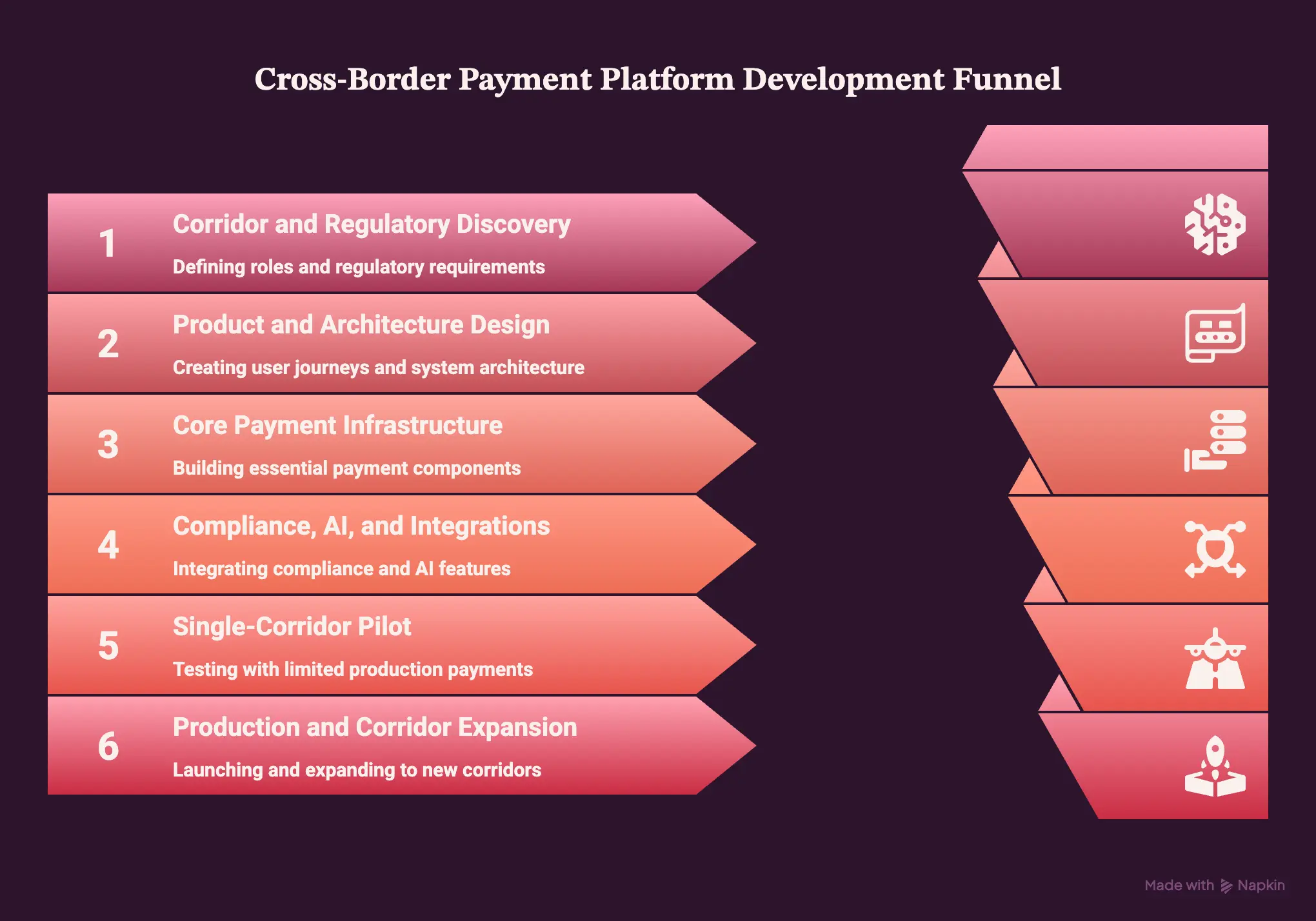
1. Corridor and Regulatory Discovery
- Timeline: 2–3 weeks
- Key Deliverables: Use-case selection, corridor scoring, activity classification, licensing analysis, customer/beneficiary definitions, volume projections, partner discovery, unit economics, and risk registers.
- The Intellivon Approach: First, we explicitly document which parts of the payment lifecycle your company owns versus which regulated partners perform. Consequently, you avoid unnecessary regulatory licensing burdens early on.
2. Product and Architecture Design
- Timeline: 3–4 weeks
- Key Deliverables: User journeys, payment state machines, double-entry ledger models, custody architecture, partner abstraction layers, compliance checkpoints, security frameworks, wireframes, and API contracts.
3. Core Payment Infrastructure
- Timeline: 6–8 weeks
- Key Deliverables: Next, engineers build customer services, real-time quote engines, core ledgers, payment orchestration, wallet gateways, node connections, basic on/off-ramps, admin dashboards, and audit logs.
4. Compliance, AI, and Integrations
- Timeline: 6–10 weeks
- Key Deliverables: In addition, developers integrate KYC/KYB pipelines, sanctions screening, blockchain analytics, Travel Rule messaging, AI fraud controls, liquidity monitoring, ERP/treasury connectors, and automated reconciliation.
5. Single-Corridor Pilot
- Timeline: 4–6 weeks
- Key Deliverables: Meanwhile, teams run controlled production payments using restricted limits, select clients, manual review backups, daily reconciliation, partner SLA tracking, and simulated system failures to collect regulatory evidence.
6. Production and Corridor Expansion
- Timeline: 4–6 weeks for initial hardening, followed by continuous expansion.
- Key Deliverables: Finally, engineers execute penetration testing, smart contract audits, disaster recovery drills, operations training, second-corridor launches, model drift tracking, and cost optimization.
By following this structured roadmap, your enterprise can go from initial discovery to active cross-border production within 5 to 7 months.
Ready to start your build? Talk to our engineering team at Intellivon to design, deploy, and scale your global payment infrastructure safely.
Build a Cross-Border Payment Platform With Intellivon
Building a compliant, enterprise-grade stablecoin payment platform requires an engineering partner that understands both complex distributed ledgers and strict global financial regulations.
At Intellivon, we design and deploy production-first payment infrastructure engineered specifically for your operational ecosystem. Every architectural and delivery decision focuses on ledger integrity, compliance-by-design, and real-time transaction orchestration.
As cross-border settlement rails evolve, system reliability becomes paramount. Consequently, our modular architectures ensure your transaction processing, liquidity management, and audit trails remain rock-solid even as volume scales across multiple corridors.
Why Partner With Intellivon?
- Enterprise-Grade Infrastructure: Custom double-entry ledgers, wallet custody, and payment orchestration built for high-throughput rails.
- Compliance-by-Design: Embedded FATF Travel Rule messaging, automated KYC/KYB pipelines, and real-time OFAC sanctions screening.
- Seamless Ecosystem Integration: Native API connectors for SAP, Oracle, NetSuite, Kyriba, and ISO 20022 messaging standards.
- Production-First AI Execution: Intelligent route optimization, predictive liquidity management, and automated reconciliation with strict human oversight controls.
Book a strategy call with Intellivon to explore how we can help you build, deploy, and scale a compliant cross-border payment platform with total operational control and long-term enterprise value.
Conclusion
Ultimately, modernizing cross-border settlement requires shifting from legacy correspondent banking to programmable digital rails. By combining real-time double-entry accounting, automated regulatory screening, and intelligent liquidity routing, enterprises can achieve near-instant international payouts.
Moreover, embedded compliance protocols ensure complete regulatory alignment without compromising processing speed. As a result, organizations that adopt stablecoin settlement infrastructure today will secure a decisive competitive advantage, drastically reducing transfer overhead while unlocking continuous global capital movement.
FAQs
Q1. Which stablecoin and blockchain should the platform use?
A1. To begin with, select combinations offering legal compliance, reliable fiat redemption, deep liquidity, qualified custody, and supported local off-ramps. Crucially, you must evaluate total operational resilience rather than prioritizing low transaction fees alone, because route stability matters most for cross-border settlement.
Q2. Do we need licenses if we do not issue the stablecoin?
A2. Although using a third-party stablecoin avoids issuer obligations, it does not remove regulatory requirements. Consequently, platforms must still obtain money transmission, payment service, FX exchange, custody, and local payout licenses. In addition, full AML, KYC, and Travel Rule compliance remains mandatory across all jurisdictions.
Q3. Can the platform integrate with SAP, Oracle, or Kyriba?
A3. Yes, integration works seamlessly through APIs, file exchanges, webhooks, and general-ledger exports. However, engineering teams must design canonical payment identifiers and multi-way reconciliation logic before establishing these connections to ensure perfect data alignment across your core accounting tools.
Q4. Should users see the wallet and blockchain?
A4. Generally, no. For mainstream enterprise B2B, payroll, and remittance workflows, interfaces should display familiar currencies, fees, and payment references. Therefore, the underlying software must fully abstract gas fees, cryptographic keys, and chain selection to deliver a frictionless user experience.
Q5. How does the Travel Rule work with self-hosted wallets?
A5. When interacting with self-hosted wallets, the platform must first verify that no counterparty VASP exists. Next, the system collects required originator/beneficiary data and conducts risk-based wallet screening. Finally, compliance teams review corridor-specific due diligence before automated policies safely release funds.
To Sum It Up:
- Stablecoins can shorten settlement, but the customer only benefits when fiat conversion and local payout work with equal reliability.
- A well-designed double-entry ledger and exception engine matter more in production than the number of supported blockchains.
- The safest AI architecture lets models recommend routes and prioritise risks while deterministic policies control sanctions, limits, and signing.
- A $70,000 MVP should validate one corridor; a $300,000 platform should support production operations, partner redundancy, and multi-corridor growth.
- Stablecoin platforms replace part of the payment rail. They do not replace licensing, compliance, liquidity, reconciliation, or customer support.