Key Takeaways:
-
One hospital EHR cloud migration takes 9 to 18 months, while large multi-site systems require 18 to 36 months.
-
Data, interfaces, revenue cycle, clinical validation, training, cybersecurity, and vendor access drive migration timelines.
-
HIPAA, information blocking, TEFCA, HTI-4, CMS interoperability, and 42 CFR Part 2 are compliance requirements.
-
Custom migration engineering costs $70,000 to $300,000, depending on scope, and not on the full EHR replacement budget.
-
How Intellivon serves as a migration architecture and implementation partner using AI for mapping, deduplication, and cutover monitoring.
Cloud EHR migration takes 4 months at the low end and 36 months for large health systems. The timeline, however, depends on three things: institution size, clinical system count, and when data migration planning begins. On the other hand, community hospitals typically finish in 6 to 12 months, while large IDNs take 24 to 36 months. In all cases, the EHR cloud migration timeline breaks into six phases from discovery through post-go-live stabilization.
Of those six phases, data migration consistently runs over its original estimate. Moreover, FHIR conversion alone adds 8 to 12 weeks that project plans rarely account for. The AHA reports hospitals lose $1.7 million per day in productivity from a poorly planned EHR transition. Consequently, starting data migration in parallel with architecture design cuts the overall timeline by up to 30%.
Intellivon supports cloud EHR migrations for hospital networks and health systems across every implementation phase. The approach therefore always starts with data migration planning in the same workstream as architecture design. This blog covers all six phases with week-by-week ranges, delay triggers, and what to do about each one.

What Is A Realistic EHR Cloud Migration Timeline For Hospitals?
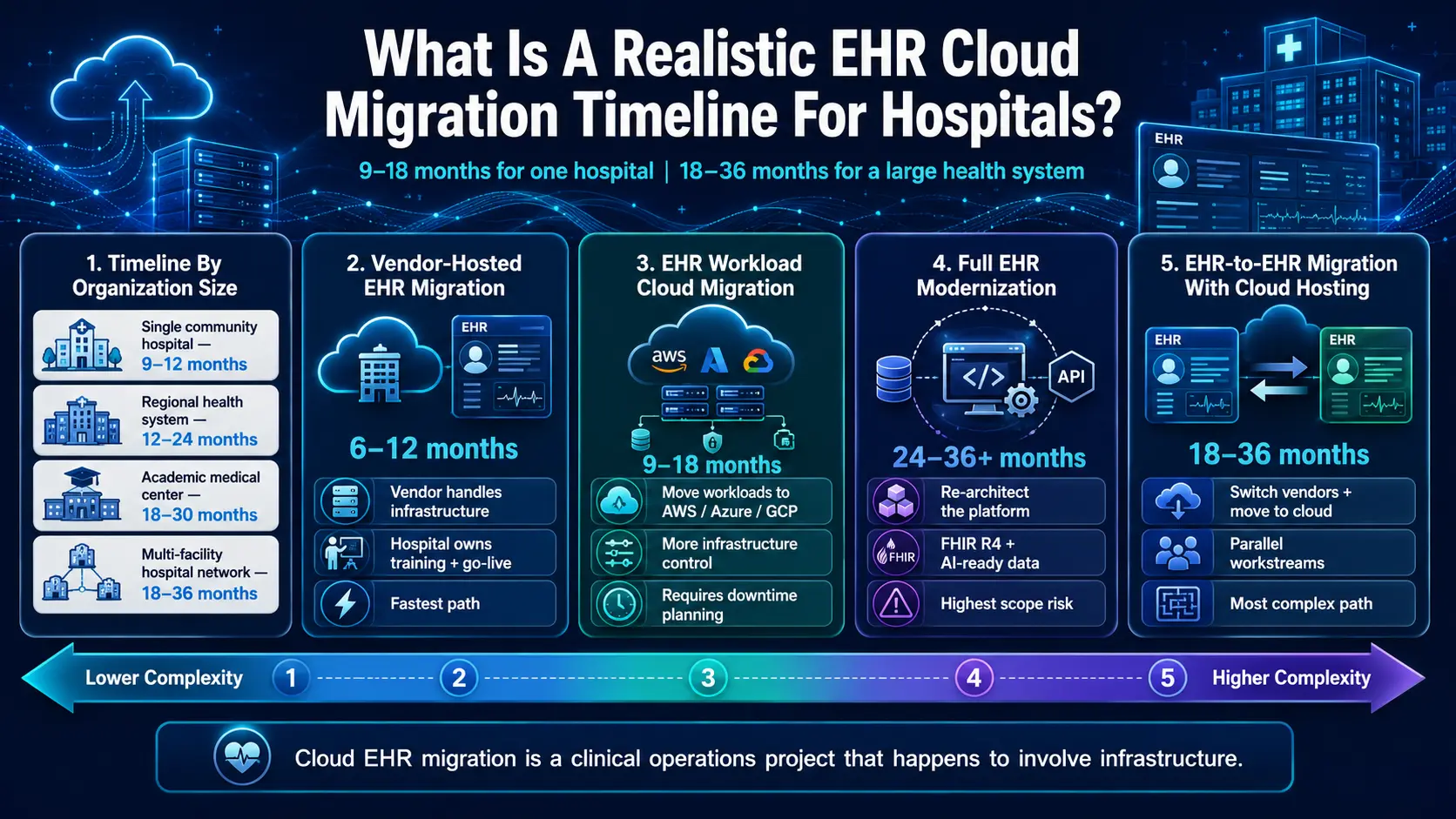
A realistic EHR cloud migration timeline is 9–18 months for one hospital and 18–36 months for a large health system. This timeline includes discovery, assessment, architecture, data migration, integration migration, workflow configuration, testing, training, go-live, and stabilization.
At the same time, smaller practices may move faster, but hospitals need controlled sequencing.
What Is a Realistic EHR Cloud Migration Timeline for Hospitals?
A realistic EHR cloud migration timeline spans 9 to 18 months for a single hospital, while a multi-site health system requires 18 to 36 months. The total duration depends heavily on whether you choose same-vendor hosting, public-cloud replatforming, or complete system replacement.
Crucially, raw cloud infrastructure provisioning rarely dictates the final go-live date. Instead, the schedule is driven by clinical data validation, interface rebuilding, physician workflow approval, and operational readiness.
1. Timeline by Migration Model
The architectural path you choose directly determines how long your implementation will take.
| Migration Model | Recommended Planning Range | Primary Schedule Driver |
| Same EHR to Vendor Hosting | 6–12 months | Vendor provisioning schedules and validation |
| Replatforming to Public Cloud | 9–18 months | Architecture, networking, DR, and interfaces |
| Full EHR Replacement | 18–36 months | Data conversion, new configuration, retraining |
| Multi-Facility Consolidation | 18–36+ months | Rollout waves and local workflow variation |
| Cloud-Native Modernization | 24–36+ months | Application rewrite and data-model redesign |
Consequently, these durations must be treated as strategic planning ranges rather than universal benchmarks. For instance, moving an existing application to a public cloud moves faster than an enterprise-wide system replacement.
However, if your data pipelines require custom modernization, your teams must plan for extended timelines.
At Intellivon, our engineering teams build automated data mapping and transformation tools that accelerate the initial code and database assessment phases. This technical approach helps keep complex replatforming projects within their planned timeframes.
For a deeper breakdown of system modernizations, see our guide on Healthcare Software Development Solutions.
Timeline by Organization Size
Hospital scale changes your resource availability, which directly affects project speed.
- Community Hospital (9–12 Months): These facilities have fewer total interfaces to rebuild, yet they frequently suffer from limited internal analyst capacity.
- Regional Health System (12–24 Months): This model involves coordinating multiple departments, which requires a formalized project management office.
- Academic Medical Center (18–30 Months): The timeline expands due to complex research databases, clinical trial workflows, and extensive medical school integrations.
- Integrated Delivery Network (24–36 Months): These networks require multi-phase rollout waves across distinct geographic regions.
- Large Physician Group (12–18 Months): The focus centers on high-volume ambulatory care workflows and distributed outpatient clinics.
- Rural or Critical-Access Hospital (6–12 Months): While technically simpler, these projects depend heavily on external implementation partners due to lean internal IT staff.
Therefore, a smaller bed count does not automatically guarantee a faster migration journey. Although a rural facility has less data to move, its technical staff is often stretched thin across daily operations.
As a result, small hospitals frequently face deployment delays that match the timelines of larger regional networks.
Ultimately, leadership teams should finalize their migration schedule only after identifying every connected software system. You must know exactly which systems are moving, which are staying on-site, and which control patient care or revenue collection.
Once these core clinical and financial boundaries are clear, the hospital can safely break down this high-level estimate into a detailed phase-by-phase project schedule.
EHR Cloud Migration Phases From Discovery Through Stabilization
Executing a successful migration requires breaking the project into distinct, manageable stages. Each phase has specific technical milestones, strict timelines, and clear operational dependencies.
Consequently, skipping steps or rushing the early architecture work will inevitably cause major delays during final system testing.
Phase 1 — Governance, Discovery, and Readiness Assessment
Timeline: 6–10 weeks
Your implementation schedule cannot become accurate until leadership explicitly defines system ownership, project scope, and clear success criteria.
- Steering & PMO Setup: Establish the core migration project management office to oversee all operational decisions.
- Workstream Planning: Define clear lines of responsibility for clinical, financial, technical, and compliance teams.
- Inventory & Assessment: Catalog every active EHR module, legacy infrastructure component, and connected application.
- Data & Contract Review: Identify data owners, analyze vendor contracts, and confirm system export rights.
- Risk & Wave Mapping: Build the initial project risk register and plan your regional facility rollout waves.
Accordingly, this phase builds the foundation for all future technical decisions. At Intellivon, our engineering teams convert this current-state inventory into a living dependency map.
This technical approach ensures that every system receives an explicit owner, migration wave, and testing gate. Once the scope and ownership model are approved, the target architecture can be designed without repeatedly reopening foundational decisions.
Phase 2 — Cloud Architecture, Security, and Environment Design
Timeline: 8–14 weeks
A secure cloud environment must be fully designed and approved before moving any sensitive patient health records.
- Landing Zone Configuration: Build the core cloud landing zone with strict network segmentation.
- Identity & Access Control: Establish identity and access management (IAM) rules using multi-factor authentication.
- Environment Provisioning: Set up separate development, testing, staging, training, production, and disaster recovery zones.
- Security & Encryption: Configure data encryption keys, automated logging tools, and emergency backup architectures.
- Compliance Verification: Execute Business Associate Agreements (BAAs) and define recovery time objectives.
Consequently, setting up these guardrails protects patient data from day one. Intellivon separates the clinical EHR workload, integration services, analytics, archives, and AI services into distinct, controlled zones. This approach prevents the migration from becoming one confusing cloud account.
For a deeper breakdown of healthcare security controls, see our guide on How to Make Security Architecture for HIPAA-Ready Health Platforms. After security and environment boundaries are stable, the hospital can begin converting data without redesigning the destination midway through extraction.
Phase 3 — Data Mapping, Conversion, and Archival
Timeline: 12–28 weeks
Moving clinical records requires extracting data safely, standardizing clinical codes, and deciding what information needs to remain immediately active.
- Data Profiling: Analyze structured databases and unstructured notes to separate active files from historical records.
- Code Normalization: Map local codes to national standards like LOINC, SNOMED CT, RxNorm, and ICD-10.
- Identity Resolution: Fix duplicate patient records and set up the master patient index.
- Extraction & ETL: Run extraction, transformation, and loading (ETL) pipelines while validating scanned documents.
- Archive Strategy: Secure long-term legal storage for old medical images and older legacy charts.
To manage this complex data, systems typically use four distinct access models:
- Discrete Conversion: Moving active patient histories into searchable cloud databases.
- Document Conversion: Converting old charts into flat PDF files for quick viewing.
- Read-Only Archive Access: Storing old data in a cheap, searchable repository.
- Leave-Behind Access: Keeping legacy hardware online temporarily for legal compliance.
Practitioners on technology forums frequently warn about the high cost of manual data validation and the danger of assuming data formats match perfectly.
Therefore, Intellivon separates clinically active data from long-term legal retention records. Our AI tools propose initial data mappings and highlight duplicate records, but clinical specialists always approve the final logic.
Validated data still has little operational value until every dependent clinical, billing, and exchange system can use it correctly.
Phase 4 — Interface, FHIR, and Downstream System Migration
Timeline: 12–30 weeks
A modern hospital relies on hundreds of external connections that must all be reconnected to the cloud platform.
- Core Feeds: Migrate standard HL7 v2 messages for patient admissions, laboratory orders, and financial charges.
- Modern APIs: Deploy FHIR R4 APIs and configure secure SMART on FHIR web applications.
- Clinical Integrations: Reconnect laboratory info systems, pharmacy platforms, radiology networks, and smart medical devices.
- External Exchanges: Verify connections to patient portals, telehealth systems, and regional health information exchanges.
To track these connections, IT leaders rely on a standardized interface disposition framework:
| Disposition | Meaning |
| Rebuild | Replace the connection completely for the new cloud environment. |
| Refactor | Modernize the code of an existing connection to fit cloud standards. |
| Retain Temporarily | Keep the old connection active during a phased hospital rollout. |
| Replace | Switch to an entirely new API or modern vendor connector. |
| Retire | Turn off and remove an unused or duplicate interface. |
For a deeper breakdown of large-scale interoperability economics, see our guide on How Much Does a 50+ Hospital EHR Integration Platform Cost?.
In response to this complexity, Intellivon uses reusable interface patterns and a vendor-neutral integration layer. This architecture avoids the high cost of rebuilding every connection as an isolated point-to-point feed.
The integration layer establishes technical connectivity, but clinical workflows and financial operations must still be configured and approved.
Phase 5 — Clinical Workflow, Revenue Cycle, and Reporting Configuration
Timeline: 10–24 weeks
Software screens and financial rules must be tailored to match the daily routines of your clinical and operational teams.
- Clinical Customization: Design intuitive physician templates, nursing flows, order sets, and automated clinical alerts.
- Revenue Cycle Setup: Update charge capture codes, billing rules, and claims processing workflows.
- Analytics & Reporting: Rebuild operational dashboards, financial reports, and mandatory regulatory tracking feeds.
Health systems often overlook how deeply operational reporting impacts the overall project schedule:
| Hidden Timeline Layer | Operational Impact | Why It Must Be Ready Before Go-Live |
| Claims & Billing | Financial health | Prevents cash flow drops by ensuring clean claims go out on day one. |
| Regulatory Feeds | Compliance | Avoids legal penalties by tracking quality metrics immediately. |
| Operational Reports | Capacity management | Allows managers to monitor bed availability and emergency room flow. |
Consequently, our engineering approach ensures that each digital workflow is directly traceable to specific user roles, data objects, and test cases.
This keeps configuration organized and visible to clinical leaders. Once the workflows are stable, testing can validate the full chain rather than testing individual screens in isolation.
Phase 6 — Testing, Training, and Cutover Readiness
Timeline: 10–18 weeks
Before turning off the old infrastructure, your IT team must prove the cloud system works under heavy operational stress.
- Technical Testing: Run end-to-end integration tests, high-volume stress tests, and full disaster recovery drills.
- Clinical UAT: Conduct user acceptance testing (UAT) with physicians and nurses to validate real-world workflows.
- Staff Training: Deliver role-based training programs for clinical staff and prepare your technical super-users.
- Command Center Prep: Design the technical command center and plan at-the-elbow support schedules.
Most importantly, you must establish strict, non-negotiable gates before authorizing your system cutover:
- Zero Patient-Safety Defects: All high-severity clinical software issues must be entirely resolved.
- Data Reconciliation: Reconciled patient records and financial balances must match original systems.
- Interface Stability: All critical clinical and billing interfaces must pass continuous stability tests.
- Staff Competency: A minimum of 95% of required clinical users must pass their system training.
At Intellivon, we tie objective automated testing data directly to your go-live decision dashboard. This transparent method ensures a date does not become final merely because infrastructure setup is complete.
Phase 7 — Stabilization, Optimization, and Legacy Retirement
Timeline: 60–120 days post go-live
The weeks following launch require intense monitoring to resolve hidden bugs and optimize system performance.
- Hypercare Support: Provide round-the-clock technical troubleshooting and optimize slow user workflows.
- Error Monitoring: Monitor interface error logs and resolve any unexpected financial claim holds.
- Cost Management: Optimize cloud resource consumption and turn off expensive legacy servers safely.
Therefore, the project is only complete when the new system operates smoothly without constant emergency patches. Intellivon measures stabilization using clear metrics for daily ticket volume, interface error rates, and cloud response times.
Ultimately, the real migration timeline ends when the target environment operates reliably, and the hospital can retire unnecessary legacy infrastructure. The following architecture section explains the technical foundation that keeps these phases from accumulating avoidable rework.
What Architecture Keeps an Enterprise EHR Migration on Schedule?
A modular architecture keeps your project on schedule by separating core infrastructure, identity, data conversion, interfaces, and disaster recovery into distinct layers. Health systems should avoid copying every single legacy dependency directly into the cloud.
Instead, the target design must support parallel facility rollout waves, controlled rollback options, and automated compliance auditing.
This structural separation ensures you can upgrade individual components later without rebuilding the entire Electronic Health Record platform.
Core Architecture Layers
A predictable migration relies on a seven-layer structural framework:
- Cloud Landing Zone: The foundational network layer that isolates sensitive traffic and handles internet routing.
- Identity & Access Management: The security layer controlling user roles, permissions, and single sign-on authentication.
- EHR Hosting: The primary environment where the core database engine and clinical applications live.
- Data & Archive Services: The storage repositories handle active file conversions and cheaper long-term legal storage.
- Integration & API Management: The communications layer translates HL7 messages and routes modern FHIR data.
- Observability & Compliance: The monitoring layer provides real-time security logs, system health metrics, and audit records.
- Disaster Recovery: The backup layer ensures clinical operations continue safely if the main environment fails.
AWS vs Azure vs Google Cloud vs OCI
Choosing a public cloud platform depends on your specific EHR software vendor and internal data strategy.
| Comparison Area | AWS | Azure | Google Cloud | OCI |
| EHR Workload Alignment | Strong historical alignment with Epic and surrounding clinical apps. | Natural fit for environments heavily built on the Microsoft software stack. | Frequently selected for surrounding analytics, FHIR pipelines, and AI workloads. | Primary destination for Oracle Health and native Cerner Millennium platforms. |
| Clinical Data Services | Offers managed FHIR storage, data lakes, and extensive health partner tools. | Features native FHIR and DICOM management tools within Azure Health Data Services. | Provides enterprise-grade FHIR, HL7 v2, and DICOM processing via the Healthcare Data Engine. | Built directly around Oracle Health data architectures and enterprise databases. |
| Identity & Networking | Uses AWS IAM and Direct Connect for private hospital connectivity. | Integrates natively with Microsoft Entra ID and ExpressRoute pipelines. | Relies on Google Cloud IAM and dedicated Cloud Interconnect paths. | Uses OCI IAM alongside dedicated FastConnect network routing. |
| AI & Analytics | Connects to Amazon Bedrock and scalable S3 data repositories. | Direct access to the Azure OpenAI service and Microsoft data analytics stack. | Deep integration with Vertex AI engines and the BigQuery data ecosystem. | Built out around OCI generative AI tools and Oracle autonomous data warehouses. |
| Migration Concern | Requires careful architecture to manage high data egress fees. | Note (2026): Azure API for FHIR retires Sept 30, 2026; users must migrate to Azure Health Data Services. | Requires verifying specific vendor cloud certifications for core databases. | Tends to create a tight structural dependency on the Oracle ecosystem. |
| Best-Fit Decision | Best for large Epic health systems prioritizing infrastructure maturity. | Best for organizations deeply integrated into Microsoft enterprise ecosystems. | Best for health systems focused on advanced clinical AI and research data lakes. | Best for hospitals running large-scale Oracle Health or Cerner platforms. |
Consequently, these major platforms operate differently and present unique service lifecycles. For instance, teams migrating to Azure in 2026 must bypass the older legacy APIs entirely to avoid immediate technical deprecation.
For a deeper breakdown of building scalable data architectures, see our guide on Healthcare Enterprise Data Platforms & Analytics.
Ultimately, selecting a cloud provider should be an operational infrastructure decision based on your specific vendor requirements, rather than a generalized choice.
How AI Shortens EHR Data and Clinical Cutover
AI shortens repetitive migration tasks, but it should never autonomously approve clinical data mappings or patient record merges. Instead, its most effective applications focus on generating schema mapping suggestions, flagging potential duplicate records, and detecting real-time anomalies during system cutover.
Crucially, every high-impact AI output must remain fully traceable and subject to mandatory human validation by clinical or technical specialists.
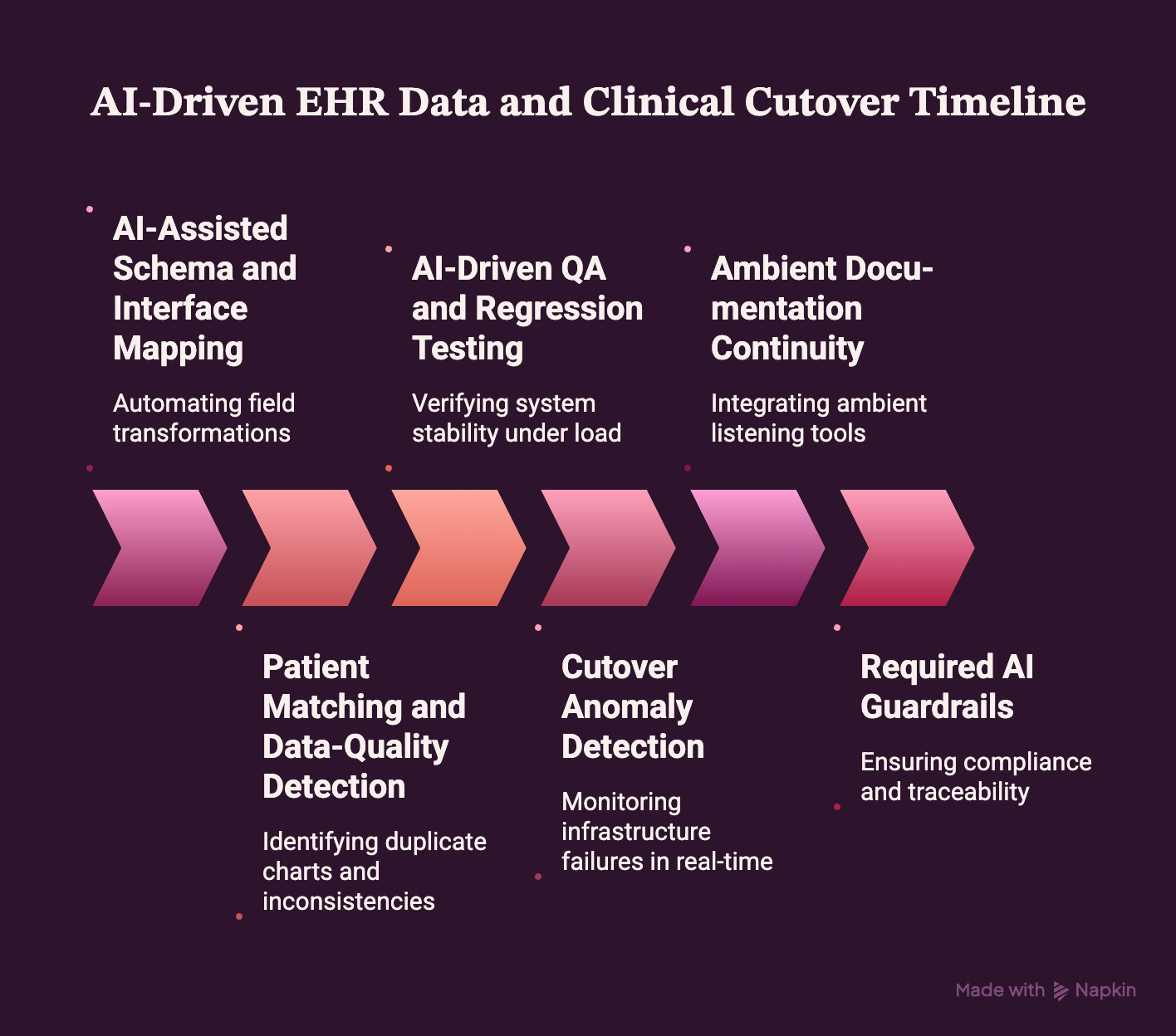
1. AI-Assisted Schema and Interface Mapping
Automating field transformations reduces the manual effort required to connect disparate hospital databases.
- Field Matching: AI models analyze legacy database structures to propose matching fields in the target cloud environment.
- HL7-to-FHIR Suggestions: The system automatically drafts data transformation pipelines between traditional HL7 messages and modern FHIR R4 resources.
- Confidence Scoring: Mappings receive a clear confidence rating, automatically routing low-score items to a specialist review queue.
Consequently, this automation serves as an intelligent accelerator rather than a final decision-maker. While the AI system categorizes unstructured documents and proposes code normalizations, an integration engineer always verifies the final rules.
This technical boundary ensures that no corrupted translation rules enter production.
2. Patient Matching and Data-Quality Detection
Clean patient identity management prevents dangerous record mismatches across combined clinical facilities.
- Duplicate Detection: Machine learning algorithms identify potential duplicate charts by evaluating typos, old addresses, and nicknames.
- Inconsistency Flags: The system automatically catches impossible data sequences, such as a lab result dated before a patient’s admission.
- High-Risk Escalation: Mismatches with conflicting clinical data are immediately isolated and sent to Health Information Management teams.
Therefore, the software acts as an automated safety filter for the data migration team. By scanning millions of records simultaneously, it highlights hidden demographic errors that manual audits routinely miss.
This proactive screening dramatically lowers the risk of merging two different patients during data extraction.
3. AI-Driven QA and Regression Testing
Automated quality assurance helps validation teams verify system stability under heavy operational loads.
- Test Case Generation: AI tools parse written clinical workflow specifications to write hundreds of automated software test scripts.
- Output Comparison: The system runs historical data through both old and new environments to compare calculation outputs side-by-side.
- Defect Clustering: Hidden software bugs are grouped by their operational source, allowing developers to prioritize issues affecting patient safety.
As a result, health systems can expand their overall test coverage without hiring teams of temporary QA analysts. The platform quickly identifies untested workflow edge cases and analyzes massive system log files for hidden errors.
This automated verification keeps the testing phase moving forward on schedule.
4. Cutover Anomaly Detection
Real-time telemetry monitoring identifies hidden infrastructure failures the moment a hospital goes live.
- Interface Rejections: Algorithms monitor active data pipelines to flag immediate spikes in rejected clinical messages.
- Operational Metrics: The system tracks message latency, sudden billing claim failures, and unexpected spikes in patient lookup errors.
- Access Tracking: Security models flag abnormal user access patterns and unusual documentation drops across specific departments.
Accordingly, the command center gains immediate visibility into the health of the newly launched cloud environment. Instead of waiting for users to submit phone support tickets, engineers receive instant alerts regarding failing network connections. This rapid notification allows technical teams to deploy patches before clinical operations face visible disruption.
5. Ambient Documentation Continuity
Integrating AI-powered ambient listening tools during a major platform migration requires careful data synchronization.
- Launch Context: Ambient scribes must securely pull the correct patient and encounter context using modern SMART on FHIR integrations.
- Note Routing: The architecture must guarantee that generated draft notes route cleanly to the correct clinical folder in the new cloud database.
- Security Management: Technical teams must carefully update API credentials, specialty note templates, and emergency downtime fallback procedures.
For a deeper breakdown of AI-ready clinical infrastructure, see our guide on How to Integrate Ambient Scribes Into Epic and Cerner.
6. Required AI Guardrails
Deploying artificial intelligence within healthcare IT systems requires strict compliance frameworks and deterministic fallbacks.
- Compliance & Privacy: All models must operate entirely within signed BAA boundaries, enforce strict PHI minimization, and log all user prompts.
- Traceability & Controls: System administrators must implement human-in-the-loop validation, maintain complete version control over mapping logic, and establish clear accuracy thresholds.
- Deterministic Rollback: If an AI model’s accuracy drops below your approved threshold, the data pipeline must instantly roll back to strict, rule-based logic.
Operational Warning: Never allow an AI system to modify clinical data pipelines without keeping a permanent, unalterable log of the original data state and the approving clinical specialist.
Ultimately, these digital guardrails protect your organization from unpredictable model behavior and compliance vulnerabilities. Maintaining complete traceability ensures that your new cloud environment remains fully auditable.
The following section translates these technical phases and architectural requirements into practical project budgets and cost breakdowns.
Which Critical-Path Dependencies Delay Hospital EHR Go-Live?
Go-live delays usually stem from unresolved dependencies rather than slow cloud provisioning. The most common critical-path blockers include unexpected historical-data expansions, undocumented legacy interfaces, and delayed third-party software access.
Additionally, incomplete revenue-cycle validation and low physician training completion frequently stall final approvals. Therefore, a realistic migration schedule must assign every dependency a clear owner, deadline, and explicit escalation route.
1. Data and Archive Scope
Deciding late to increase the volume of historical data instantly disrupts your migration timeline.
Therefore, when leadership adds legacy scanned documents, old financial records, or discrete clinical values midway through the project, the data mapping team must halt their current work to rebuild and retest the extraction pipelines.
2. Interface Ownership and Third-Party Access
Hospitals routinely struggle with missing interface documentation and delayed sandbox access from legacy vendors.
Simultaneously, technical teams often have to wait weeks for external laboratory, pharmacy, or clearinghouse partners to open certification windows, which stalls downstream testing.
3. Revenue Cycle and Reporting
A clinical environment may pass user acceptance testing perfectly, yet remain unready for launch due to billing dependencies.
So, if claims processing, charge description master routing, or mandatory quality reporting feeds are not fully validated, the hospital risks immediate cash flow drops upon cutover.
4. Clinical Availability
To manage these operational risks, project management offices rely on a structured dependency framework:
| Dependency | Early Warning Signal | Schedule Response | Approval Owner |
| Historical Data | Scope expands after mapping starts. | Freeze active-data scope and archive the rest. | HIM Leader |
| Interfaces | No clear vendor owner or test environment. | Escalate to the sponsor before starting the build. | Integration Lead |
| Revenue Cycle | Claims fail parallel testing cycles. | Hold financial cutover until the error rate drops. | CFO / RCM Lead |
| Clinical UAT | Low physician participation in testing. | Add dedicated, protected test sessions. | CMIO |
| Training | Completion drops below the required threshold. | Delay the affected facility rollout wave. | Clinical Operations |
| Vendor Access | Sandbox delivery or data export is delayed. | Re-sequence the dependent technical workstream. | Program Sponsor |
Ultimately, tracking these early warning signals prevents hidden technical debt from derailing your launch date. Managing these operational boundaries keeps your technical teams aligned before entering the final phase.
How Hospitals Reduce Ransomware Risk During EHR Cloud Migration
Cybersecurity risks increase significantly during an EHR cloud migration timeline because health systems must operate parallel environments, create temporary privileged access points, and manage bulk extractions of protected health information (PHI). Consequently, bad actors routinely target this specific technical window.
A successful security plan must protect the active migration pathway itself rather than only focusing on the final cloud architecture.
Furthermore, regular recovery testing and robust clinical downtime capabilities must serve as non-negotiable go-live requirements.
1. Why the Migration Window Creates New Exposure
Operating dual infrastructures inherently expands your overall digital attack surface.
- Vulnerable Assets: Teams must keep older legacy servers online, which are frequently impossible to patch against modern threats.
- Data Vulnerability: Extracting millions of patient records creates massive, temporary data stores and shared network staging zones.
- Access Management: Third-party implementation vendors require elevated VPN access permissions, which often lead to identity sprawl.
Therefore, malicious actors exploit these temporary operational gaps to deploy ransomware before the final cloud guardrails are fully active. Misconfigured cloud staging buckets or contaminated backup systems can easily compromise your primary environment.
2. Controls Required Before the First Data Extract
Hospitals must implement aggressive data loss prevention (DLP) tools before moving a single row of clinical data.
- Access Controls: Deploy just-in-time privileged access management that enforces automatic expiration times and continuous credential rotation.
- Data Integrity: Restrict storage routing to strict allowlists, mandate end-to-end encryption, and deploy isolated migration accounts.
- Monitoring & Auditing: Centralize all security logging through an enterprise SIEM platform that monitors both environments simultaneously.
Importantly, your compliance roadmap must account for shifting regulatory expectations. While the standard HIPAA Security Rule remains active, the Department of Health and Human Services (HHS) has proposed significantly strengthened, mandatory cybersecurity requirements.
These evolving rules emphasize Prescriptive Risk Analysis and uniform implementation across all business associate networks.
3. Recovery and Downtime Readiness
A health network must continuously prove it can maintain patient safety even if a cyberattack forces a total systems shutdown.
- Clinical Continuity: Test read-only emergency access tools, validate paper documentation templates, and practice manual result reconciliation.
- Technical Verification: Run regular interface replay tests and practice recovering large financial claims backlogs after a simulated outage.
- Operational Validation: Conduct live downtime drills across every nursing unit to verify your actual recovery time objectives.
Operational Standard: Never approve an EHR go-live date until the technical team successfully completes a full database restoration from bare metal using encrypted, isolated backup data.
Ultimately, these defensive drills guarantee that your clinical teams can deliver safe medical care during an unexpected outage. Proving your operational recovery resilience keeps your migration program secure from ransomware disruptions.
Which 2026 Compliance Deadlines Affect EHR Migration Planning?
Compliance work must begin during the initial discovery phase because changing your Electronic Health Record configuration modifies where electronic health information (EHI) is stored and how external partners retrieve it.
Consequently, regulatory strategies must distinguish between existing legal mandates, finalized rules with future effective dates, and active proposals that remain subject to change.
Enterprise planning teams must align their technical architectures with the following compliance frameworks:
2026 Compliance Deadlines
| Requirement | 2026 Legal Status | Core Migration Implication |
| HIPAA Security Rule | Current and Enforceable | Requires formal risk analysis, audit logging controls, strict vendor BAAs, and complete disaster recovery testing. |
| Strengthened HIPAA Rule | Proposed Framework | Build environments with architectural flexibility, but do not treat these proposed mandates as final deployment gates. |
| HTI-2 Regulation | Final Rule Active | Implements 45 CFR Part 172 TEFCA definitions; sets technical standards for platform reliability and cross-network trust. |
| TEFCA Manner Exception | Currently Retained | The HTI-2 final rule made no changes to this exception; existing information sharing rules remain intact. |
| HTI-4 Interoperability Rule | Final Rule Active | Establishes three electronic prior authorization certification criteria: CRD, DTR, and PAS. |
| CMS-0057-F APIs | Due Jan 1, 2027 (Payers) | Health systems must ensure compatible workflows and EHR readiness to connect with impacted payer APIs. |
| HTI-5 Deregulatory Act | Proposed Framework | Keep on your active regulatory watchlist; monitors proposed changes to FHIR transitions, information-blocking, and clinical AI oversight. |
| Information Blocking | Current and Enforceable | Health networks must actively preserve data access, exchange, export capabilities, and EHI availability during transitions. |
| 42 CFR Part 2 | Current and Enforceable | Demands strict data segmentation and consent tracking rules for applicable Substance Use Disorder (SUD) treatment charts. |
Importantly, the final HTI-2 rule established clear guidelines under 45 CFR Part 172 to anchor long-term TEFCA reliability, yet it explicitly left the existing TEFCA Manner Exception untouched.
Meanwhile, the active HTI-4 framework mandates three electronic prior authorization certification pillars: Coverage Requirements Discovery (CRD), Documentation Templates and Rules (DTR), and Prior Authorization Support (PAS).
These distinct criteria ensure your technology platform can communicate effectively with external payers. Therefore, while the CMS-0057-F rule gives impacted health insurance plans until January 1, 2027, to launch their public APIs, hospital teams must focus their current energy on ensuring internal provider and software readiness.
Finally, the newer HTI-5 proposal remains strictly a draft framework in 2026, meaning it belongs on your legal watch list rather than functioning as a final deployment barrier.
How EHR Vendor and Facility Type Change the Migration Schedule
The software vendor you target changes your data format, integration models, and technical testing strategies. Consequently, an Epic migration, Oracle Health migration, MEDITECH transition, and athenahealth move should never use the same implementation template.
Furthermore, your exact facility type introduces unique clinical workflows and legal dependencies that directly compress or expand your go-live target.
1. Epic
Epic cloud deployments rely on a hybrid model where core operational layers are hosted across customer-selected public cloud platforms or dedicated vendor environments.
- Core Systems: Setting up private data channels requires configuring Interconnect and Bridges routers alongside customer-managed Clarity and Caboodle analytics databases.
- External Links: Extending access via MyChart or spinning up regional Epic Community Connect affiliate lines introduces strict third-party data rules.
Therefore, your total timeline depends heavily on internal analyst build capacity and strict vendor software upgrade windows.
2. Oracle Health and Cerner Millennium
Transitioning Cerner Millennium to Oracle Cloud Infrastructure (OCI) centers on infrastructure alignment and managed-services scheduling.
- Data Pipelines: Migrations require mapping custom Cerner Command Language (CCL) scripts and foundational databases into OCI frameworks.
- Strategic Choice: Running an Oracle-to-OCI infrastructure shift moves up to 20% faster than a full system replacement, but demands deep OCI identity configuration.
3. MEDITECH
Migrating from legacy MEDITECH Magic to the cloud-hosted Expanse platform requires significant data normalization.
Therefore, community and critical-access hospitals must account for strict module dependencies, legacy archiving, and lean internal IT staffing.
4. Athenahealth and Ambulatory EHRs
Ambulatory cloud transitions move quickly due to a managed SaaS platform footprint.
However, your timeline is dictated by practice-level configurations, patient portal migrations, specialty template setup, and complex payer enrollment routing.
5. Organization-Type Matrix
Your specific organization model introduces distinct operational parameters:
| Organization | Primary Timeline Complication |
| Academic Medical Center | Integrating specialized research applications, clinical registries, and subspecialty teaching workflows. |
| Integrated Delivery Network | Coordinating phased facility waves, local clinical variation, and consolidating multiple legacy EHR instances. |
| Rural / Critical-Access Hospital | Managing limited internal analyst staff, broadband latency barriers, and shared technical resources. |
| Large Physician Group | Standardizing practice configuration variations, payer enrollment transfers, and high-volume ambulatory flows. |
| Behavioral Health Provider | Enforce strict 42 CFR Part 2 rules, explicit consent workflows, and sensitive data isolation filters. |
| Post-Acute / Long-Term Care | Rebuilding external referral channels, pharmacy networks, and strict transition-of-care datasets. |
| Federal Healthcare Org | Meeting complex federal security rules, agency authorizations, and strict data sovereignty mandates. |
Ultimately, identifying these vendor-specific requirements prevents structural errors from stalling your deployment. Managing these localized variables ensures your infrastructure stays on schedule.
How Much Does EHR Cloud Migration Engineering Cost in 2026?
Custom EHR cloud migration engineering usually costs $70,000–$300,000, depending on data volume, interface count, cloud architecture, security requirements, testing scope, and whether the hospital changes EHR vendors.
Crucially, this pricing represents an Intellivon-style custom engineering range for technical delivery and middleware buildout rather than the total cost of enterprise EHR software licenses or hardware replacements.
1. Phase-by-Phase Cost Breakdown
Project budgets are distributed across six core technical workstreams. Therefore, individual phases vary based on complexity, meaning they should not automatically be calculated at their maximum values.
| Engineering Phase | Cost Range | What It Includes |
| Discovery and Readiness | $7,000–$18,000 | Comprehensive inventory, baseline scoping, dependency mapping, and risk register development. |
| Cloud and Security Architecture | $12,000–$35,000 | Cloud landing zone deployment, IAM provisioning, network zoning, centralized logging, and DR design. |
| Data Migration and Validation | $18,000–$70,000 | Records extraction, custom schema mapping, code cleansing, long-term archival storage, and reconciliation. |
| Interface and FHIR Engineering | $20,000–$90,000 | HL7 message routing, FHIR R4 API engineering, custom connectors, and integration-engine modernization. |
| Testing and Training Support | $8,000–$35,000 | Test script automation, UAT validation matrices, security penetration testing, and load stress drills. |
| Cutover and Stabilization | $5,000–$52,000 | Active go-live command center engineering, error triage, telemetry monitoring, and resource optimization. |
| Total Custom Engineering Range | $70,000–$300,000 | Scope-dependent technical delivery and systems integration. |
2. Cost by Engagement Size
The overall technical investment aligns with your organizational footprint and infrastructure model:
- Focused Migration Foundation ($70,000–$120,000): Tailored for community hospitals or specialized clinics needing straightforward rehosting or clean database lift-and-shift work.
- Single-Hospital Production Program ($120,000–$210,000): Covers full integration engineering, custom HL7-to-FHIR mapping pipelines, and extensive workflow verification for mid-sized facilities.
- Multi-Site Engineering Foundation ($220,000–$300,000): Designed for regional health systems managing distributed clinics, complex multi-zone networking, and phased deployment waves.
- Full EHR Replacement Program: Broad core platform overhauls fall outside this specific integration range and are potentially substantially higher due to primary software vendor costs.
3. Ongoing Maintenance
Post-stabilization engineering and system maintenance generally require 15% to 25% of the initial engineering build cost annually. This operational budget handles regular interface updates, continuous cloud resource monitoring, proactive security reviews, and evolving regulatory compliance updates.
Furthermore, your team must allocate resources to manage continuous data-quality monitoring, vendor API changes, logging observability, annual disaster-recovery tests, and iterative clinician workflow optimizations.
At Intellivon, our engineering teams build automated data pipelines and reusable integration layers that dramatically minimize manual maintenance overhead. This practitioner approach keeps long-term operational costs stable while ensuring full system compliance.
Build Your Cloud EHR Migration Roadmap With Intellivon
Intellivon helps hospitals convert complex cloud EHR migration goals into a structured, highly sequenced technical roadmap.
Consequently, every critical workstream receives a dedicated engineering owner, transparent and measurable acceptance criteria, and a permanent place on the project’s critical path.
1. Migration Readiness and Scope
- System Inventory & Data Profiling: Auditing and documenting your active, legacy, and shadow database systems.
- Interface Mapping & Wave Planning: Mapping every internal and external data feed while organizing sequential facility rollout phases.
- Risk & Budget Controls: Structuring a comprehensive risk register alongside precise, milestone-driven technical budgets.
2. Cloud and Interoperability Architecture
- Hyperscaler Evaluation: Conducting objective technical reviews across AWS, Azure, Google Cloud, and OCI environments.
- Secure Landing Zones: Deploying dedicated, HIPAA-compliant cloud zones configured with strict identity controls.
- Data Integration Layers: Modernizing legacy pipelines using robust HL7 routing and native FHIR integration engines.
- System Resilience: Setting up continuous logging observability, automated backup arrays, and failproof disaster recovery protocols.
3. AI-Assisted Migration Engineering
- Automated Schema Mapping: Leveraging machine learning pipelines to generate accurate data field recommendations.
- Quality & Deduplication: Executing automated data-quality analysis and advanced duplicate record detection filters.
- Advanced Testing Suites: Utilizing automated test-case generation, regression analysis, and active cutover anomaly monitoring.
- Safety Overrides: Enforce mandatory human-in-the-loop approval gates for all code and schema modifications.
4. Compliance and Clinical Readiness
- Regulatory Safeguards: Deploying HIPAA-ready platform controls and conducting thorough third-party BAA reviews.
- Continuity & Deadline Planning: Ensuring information-blocking workflow continuity while mapping out TEFCA, HTI-4, and CMS milestones.
- Operational Validation: Conducting comprehensive User Acceptance Testing (UAT), realistic downtime drills, and structured go-live support.
5. Plan Your Integration Strategy Securely
Proven Integration Impact: Our engineering frameworks deliver a 50% faster modernization cycle and 30–40% lower engineering costs compared to traditional manual migration approaches.
To see how our automated pipelines maintain total data availability during structural cloud shifts, read our deep dive on Intellivon Data Engineering Services.
Scope your complete technical architecture, localized facility migration waves, regulatory documentation workflows, and custom engineering budgets before committing your clinical teams to a formal go-live date.
Conclusion
Consequently, executing a successful EHR cloud migration relies on recognizing that the cloud itself is rarely the slowest workstream. Instead, your actual project timeline is driven by data mapping, interface configurations, compliance mandates, and operational readiness.
Furthermore, while AI accelerates engineering tasks, it cannot replace clinical accountability.
Therefore, current regulations must shape architecture now, keeping in mind that the $70,000–$300,000 range covers integration engineering support rather than full system licenses. Ultimately, approve go-live only when critical path evidence gates are fully visible.
FAQs
Q1. Should Hospitals Migrate Every Historical Patient Record?
A1. Hospitals must apply a strict decision rule: migrate clinically active structured data, but route legal-retention records straight to archival storage. Consequently, you should convert frequently used records discretely while preserving lower-value history through searchable flat documents or read-only repository access. This technical path prevents massive database bloat from expanding your active deployment timeframe.
Q2. How Many EHR Interfaces Can a Hospital Migrate in Parallel?
A2. No universal number exists because parallel capacity depends entirely on your specific infrastructure environment. Technical managers must evaluate your shared source systems, matching transformation patterns, available test environments, and external vendor availability. Furthermore, your internal clinical risk thresholds and hands-on testing team capacity dictate how many data feeds can safely cut over simultaneously.
Q3. Is Epic Cloud Migration Faster Than Oracle Health Migration?
A3. The total implementation timeframe depends far more on whether your organization is maintaining or changing its primary software platform than on the vendor names themselves. Replatforming an existing system to a public cloud moves significantly faster than standard software overhauls. A complete system vendor replacement requires extensive data re-mapping regardless of the software provider.
Q4. What Must Hospitals Complete Before the January 1, 2027, CMS API Deadline?
A4. The CMS-0057-F mandate places direct API development obligations on impacted insurance payers, meaning hospitals must focus entirely on provider readiness. Therefore, your IT teams must complete EHR workflow compatibility updates and establish robust FHIR integrations. You must validate system readiness to interact with payer Coverage Requirements Discovery (CRD), Documentation Templates and Rules (DTR), and Prior Authorization Support (PAS) APIs through end-to-end connectivity testing.
Q5. Should a Rural Hospital Use Vendor Hosting or a Public Cloud?
A5. Your leadership team must choose based on internal IT staffing capacity and local interface complexity. Consequently, if your facility has lean technical teams, vendor-hosted managed models minimize daily infrastructure maintenance. However, if your long-term integration plans require advanced custom data controls and multi-site scaling, a public cloud landing zone provides superior operating control
To Sum It Up
- Cloud infrastructure may be ready in weeks, but an EHR cloud migration timeline is controlled by clinical and operational dependencies.
- AI can propose data mappings and test cases, but a human must approve every patient-impacting migration decision.
- The January 1, 2027, CMS API deadline applies primarily to impacted payers, yet hospitals need compatible EHR workflows before payer connections can work.
- Ransomware exposure often increases during migration because legacy and cloud environments operate simultaneously.
- A $70,000–$300,000 migration engineering budget should never be presented as the total cost of replacing an enterprise EHR.