Key Takeaways:
-
What we know about Healthcare IT integration is that it links platforms together and other healthcare software.
-
A good platform should have the ability to deal with HL7 v2, FHIR, APIs, data mapping, patient matching, security, and interface monitoring all in a single setup.
-
The appropriate platform will vary according to the systems you currently use, the number of interfaces you have to manage, and the level of control that your IT team desires.
-
The cost of custom healthcare integration work usually varies between $70,000 and $300,000, the exact amount depending on the systems concerned, the number of interfaces, and the extent of custom development needed.
-
What Intellivon does is create the APIs, connectors, data mapping, monitoring, and AI integrations for your current healthcare systems rather than replacing software that is already working.
The hospital’s IT team currently has 40 separate point-to-point interfaces, and if another system is added, yet another custom connection must be built rather than using an existing one. This is precisely the kind of situation that healthcare IT integration platforms are designed to address: providing a single interface for each connection and monitoring across all the systems that need to communicate with one another.
Nevertheless, a platform seldom pays for itself unless it actually replaces the point-to-point sprawl that exists beneath it. The expense of keeping dozens of custom interfaces alive, updated, and under constant monitoring amounts to a real financial cost each year, even if that cost never appears as a single item that anyone challenges. On average, healthcare organizations spend $1.7 million per year on maintaining their fragmented, point-to-point integrations, usually not realizing that a single platform could take over most of that work.
This blog looks at the features and architecture of integration platforms, their support for FHIR and HL7, compares the different platforms, examines the various use cases in the areas of laboratories, pharmacy, and payers, and discusses the true cost of the decision.
What Is a Healthcare IT Integration Platform?
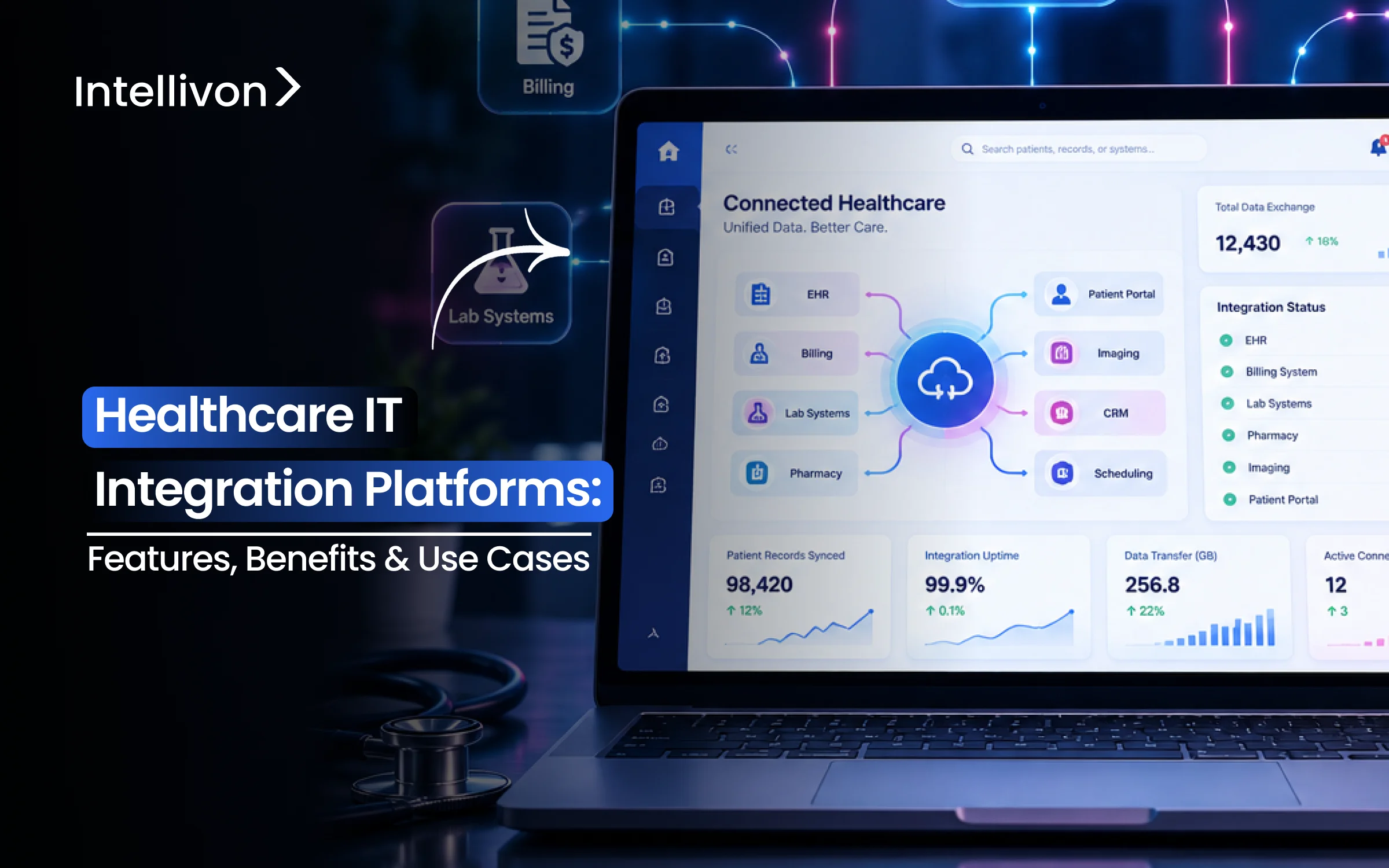
A healthcare IT integration platform is software infrastructure that connects clinical, administrative, and financial systems inside a hospital or health network.
It links EHRs, labs, pharmacy, billing, and remote monitoring devices so they can exchange data automatically. Instead of building a custom connection for every pair of systems, the platform acts as one central layer that routes, transforms, and delivers data between all of them.
Why This Layer Exists
Large health systems started with point-to-point connections, where each system talked directly to one other system. That approach breaks down fast.
As hundreds of interfaces become difficult to manage, bottlenecks occur at peak times, and lost messages or delays can impact patient care. CapMinds
So instead of dozens of one-off connections, an integration platform gives you:
- One place to route data between EHRs, labs, and pharmacy systems
- A single layer that transforms message formats so systems don’t need to understand each other directly
- One point of monitoring, so a failed lab result doesn’t go unnoticed for hours
- Finally, one system to update when a new application joins the stack, instead of rebuilding every connection
This matters because HL7 v2 still runs the real-time backbone of over 90% of U.S. hospital deployments, even as newer standards move in.
Therefore, most integration platforms today have to support both the old messaging format and the new one, at the same time, without breaking either.
Types of Healthcare Integration Platforms
The right type of integration platform that a healthcare enterprise needs depends mostly on how many interfaces you’re running and how fast your data needs to move. So before picking a platform, it helps to understand the four main categories and where each one actually fits.
1. Point-to-Point Integration
This is the simplest setup, and also the first one most hospitals outgrow. Basically, each system connects directly to one other system, with no central layer in between.
- Works fine under 10 interfaces, since a full platform is often not yet justified at that scale (Source: Nirmitee.io, 2026)
- Is fast to build, because there is only one connection to configure
- Becomes unmanageable quickly, since every new system means another custom build from scratch
- Offers no central place to monitor failures, so problems can go unnoticed until someone reports them
As a result, most organizations move off point-to-point the moment they cross into double-digit interface counts.
2. Integration Engine (Hub-and-Spoke / ESB)
An integration engine sits in the middle of your systems and routes messages between them, instead of connecting each system to every other system directly. This is, in fact, the model most hospitals still run on today.
- Fits organizations running 10 to 50 interfaces, described as the sweet spot for this architecture (Source: Nirmitee.io, 2026)
- Handles HL7 v2 messaging well, since it was originally built for real-time clinical data
- Is typically deployed on-premises, which means your team owns the hardware, patching, and uptime
- Includes vendors like Mirth Connect, Rhapsody, and Infor Cloverleaf
However, pure hub-and-spoke starts to strain once interface counts pass 50. At that point, most systems shift toward a hybrid model instead.
3. iPaaS (Integration Platform as a Service)
iPaaS is essentially the cloud-based alternative to a traditional engine. It handles the same routing and transformation work, but the vendor manages the infrastructure rather than your internal team.
- Suits high interface volume, since the vendor absorbs scaling instead of your IT staff
- Comes with a subscription-based total cost of ownership, unlike the hardware and staffing costs an on-premises engine requires (Source: Vorro, 2026)
- Simplifies external connectivity, so integrating with payer APIs, labs, or pharma partners takes less custom work
- Deploys faster overall, typically in 4 to 12 weeks compared to 3 to 6 months or more for a custom ESB build (Source: ONEiO, 2026)
So ultimately, the decision between an engine and iPaaS comes down to one question: do you want to own the infrastructure, or rent it?
4. API Management / Gateway Layer
This layer sits on top of your integration engine or iPaaS, and controls who can access your data and how. It is not a replacement for the engine. Rather, it is a security and access layer added on top of it.
- Standardizes authentication, throttling, and policy enforcement across every API a third party touches (Source: SysgenPro, 2026)
- Becomes necessary once external apps, such as patient portals or SMART on FHIR tools, need controlled access to your data
- Works alongside, not instead of, your core integration layer
In the end, most mature health systems run two or three of these types together, not just one. Because of that, the real decision is not which single type to pick. Instead, it is how these layers combine to fit your interface volume, your protocol mix, and how much infrastructure your team actually wants to own.
Healthcare Integration Platform Architecture: What Sits Where
A healthcare IT integration platform is the intermediary infrastructure that receives data from healthcare systems, transforms it when required, routes it to the correct destination, controls access, monitors delivery, and makes that data usable by downstream applications. In other words, it is not one single tool. It is a stack of layers, each doing a distinct job.
Here’s the distinction that gets missed constantly: an interface engine is part of an integration architecture. It is not automatically the whole architecture. A hospital can run a strong interface engine and still have gaps in identity resolution, API governance, or observability.
So instead of asking “which engine should we buy,” the better question is which of the following layers your organization already has, and which ones are missing.
1. Source Systems and Edge Connectors
Every architecture starts at the edge, where data actually gets created. This layer connects to the systems generating clinical and operational data in the first place.
- EHRs: Epic, Oracle Health/Cerner, MEDITECH, athenahealth
- Clinical systems: LIS, pharmacy, RIS/PACS
- Financial systems: billing, payer systems
- Newer sources: RPM devices, IoT, telehealth platforms, HIEs
Since each of these systems speaks a slightly different protocol, the next layer exists to make sense of what they’re all sending.
2. Integration Engine and Message Processing Layer
This is where HL7 v2 messages get received, filtered, and routed to the right place. It’s the layer most people picture when they hear “integration platform,” even though it’s only one piece of the full stack.
- Handles core message types: ADT (admissions), ORM (orders), ORU (results)
- Uses MLLP as the transport protocol for real-time delivery
- Manages queueing, so messages don’t get dropped during traffic spikes
- Processes ACK/NACK responses, retries, and message replay when delivery fails
Because message delivery alone doesn’t guarantee the data is usable, the next layer handles the actual translation work.
3. Transformation and Healthcare Data Normalization
This layer converts data from one system’s format into a format the receiving system can actually read. Without it, an Epic message and a lab system’s message would never line up correctly.
- Performs HL7-to-HL7 mapping between different vendor implementations
- Handles HL7-to-FHIR transformation as systems modernize
- Works across JSON and XML, mapped to a canonical data model
- Validates fields and manages vendor-specific Z-segments, which are custom extensions outside the HL7 standard
Once the data is normalized, the next problem is making sure it’s tied to the right patient.
4. Identity and Terminology Services
This is the layer competitors writing about integration platforms tend to skip, and it’s often where integration projects actually break. An MPI or EMPI is the database that assigns each patient one identifier across every connected system, so a lab result and an EHR record can be confidently linked to the same person (Source: TechTarget, 2025).
- MPI/EMPI systems handle patient matching and record deduplication
- Terminology services standardize codes across systems using LOINC, SNOMED CT, RxNorm, and ICD-10
- Without this layer, the same patient can exist as multiple, disconnected records across departments
Therefore, identity resolution is not a “nice-to-have” middleware feature. It’s infrastructure the rest of the architecture depends on.
5. FHIR Server and API Gateway
This layer handles modern, API-based access to data, running alongside the HL7 messaging layer rather than replacing it.
- Supports FHIR R4 REST APIs, SMART on FHIR apps, and CDS Hooks for clinical decision support
- Secures access through OAuth 2.0 and OpenID Connect
- Controls what each application can see through API scopes and rate limits
As more third-party apps request direct API access, this layer becomes the primary point of control for exactly what they can and can’t touch.
6. Observability and Governance Layer
Every layer above this one eventually fails at some point. What separates a mature architecture from a fragile one is whether anyone notices when it does.
- Interface dashboards track message counts and failure queues in real time
- API latency and alerts flag problems before they become outages
- Audit trails and data lineage support compliance and troubleshooting
- Versioning and environment promotion keep changes controlled as the platform evolves
A healthcare integration platform is really six layers working together, not one engine doing everything. Therefore, skipping identity resolution or observability tends to surface as data quality problems and outage delays much later, even when the messaging layer itself works fine.
Key Features of Healthcare IT Integration Platforms
A feature only earns its place on this list if it does one of three things: reduces the manual work of building and maintaining interfaces, protects clinical meaning as data moves between systems, or keeps an interface recoverable when something breaks.
Therefore, enterprise platforms today genuinely span far more than FHIR and HL7.
Core Capability Comparison
| Capability | What It Handles | Why It Matters |
| HL7 v2 Message Processing | ADT, ORM, ORU, SIU, and other clinical events | Still the backbone of real-time clinical messaging across most hospital systems |
| FHIR R4 API Support | Resources, search, read/write, subscriptions | Enables modern app connectivity without replacing the messaging layer |
| SMART on FHIR & CDS Hooks | Embedded apps, workflow-triggered clinical services | Lets third-party clinical tools plug into existing workflows |
| DICOM & Imaging Connectivity | RIS/PACS, medical imaging workflows | Connects radiology data without a separate parallel system |
| X12 & Payer Exchange | Claims, eligibility, payer workflows | Keeps revenue cycle data flowing without manual resubmission |
| Mapping & Transformation | HL7, FHIR, CDA, JSON, XML, custom formats | Converts data between formats without losing clinical meaning |
| Terminology Normalization | LOINC, SNOMED CT, RxNorm, ICD-10 | Ensures a lab code from one system matches the same concept in another |
| MPI & Identity Resolution | Cross-system patient matching | Prevents duplicate or fragmented patient records |
| API Management | Gateway, authentication, throttling, analytics | Controls who can access data and how much load they can put on it |
| Reliability Controls | Queues, retries, replay, back-pressure, high availability | Keeps interfaces recoverable instead of silently dropping data |
| Integration Observability | Failures, latency, throughput, error patterns, alerts | Surfaces problems before they become outages |
| Lifecycle Governance | Development, testing, versioning, release management, auditability | Makes changes safe to deploy without breaking live interfaces |
FHIR does not eliminate the need for HL7 v2, even though buyers often assume it will. HL7 v2 remains the standard for real-time clinical messaging, since it is what most EHRs and lab systems still send by default. FHIR works alongside it, mainly for APIs and patient-facing applications.
Platforms like Redox handle this by translating HL7 v2 events such as ADT, ORM, and ORU directly into FHIR-based workflows (Source: Nirmitee.io, 2026), so both standards run in parallel instead of one replacing the other.
Can the Platform Connect the Systems You Actually Run?
Ultimately, a buyer does not care whether a platform “supports healthcare interoperability” as a general claim. Instead, what actually matters is whether it can connect the specific systems already running in their environment, from Epic to a regional lab to a payer’s claims pipeline.
So rather than asking about protocol coverage in the abstract, the better approach is to check the platform against every system category your organization touches.
System Compatibility Table
| System Category | Examples | Integration Methods to Cover |
| Enterprise EHR | Epic, Oracle Health, MEDITECH | HL7 v2, FHIR, vendor APIs |
| Ambulatory EHR | athenahealth, eClinicalWorks | APIs, FHIR, HL7 |
| Laboratory | LIS, reference labs | ORM, ORU, OML, HL7 |
| Pharmacy | Pharmacy platforms | HL7, NCPDP, APIs |
| Imaging | RIS/PACS | DICOM, DICOMweb, HL7 |
| Revenue Cycle | RCM, billing, clearinghouses | X12, APIs |
| Payers | Health plans | FHIR, X12, Da Vinci |
| Devices | RPM, wearables, IoT | APIs, streaming, device protocols |
| Telehealth | Video/care platforms | APIs, FHIR |
| Analytics | Clarity, Caboodle, warehouses | Database feeds, APIs, ETL/ELT |
| BI | Power BI, Tableau | Warehouse/API layer |
| AI | CDS, ambient AI, NLP/ML systems | FHIR, events, APIs, normalized data |
As the matrix shows, no single protocol covers this entire list. Because of that, a platform’s real strength lies in how many of these categories it can handle without a custom build for each one.
External Exchange Is a Separate Integration Problem
Even after every internal system is connected, one gap still remains: exchanging data with organizations outside your own network. This is a distinct problem from internal interfacing, so it deserves its own evaluation.
- HIEs (Health Information Exchanges) route data between unaffiliated organizations in a region
- Carequality and CommonWell operate as national interoperability frameworks, not internal engines
- QHINs (Qualified Health Information Networks) formalize exchange under TEFCA
- eHealth Exchange connects federal agencies and large health systems
- Direct messaging handles secure, point-to-point clinical document exchange
Therefore, these should never be confused with an internal interface engine. Instead, they sit on top of it, since a platform can excel at internal HL7 routing and still have no path into an HIE or QHIN network.
A platform that supports 20 protocols but cannot accommodate your Epic governance process, PACS workflow, or payer transaction model is not an enterprise fit. So the real evaluation question isn’t how many standards a vendor lists on a datasheet. It’s whether those standards translate into working connections with the systems your organization runs today.
Common Healthcare Integration Use Cases
Each of these workflows follows the same basic pattern: a source system sends data, an integration layer processes it, and a destination system acts on it.
As a result, understanding this flow matters more than memorizing protocol names, since it’s what actually determines whether an interface is working or quietly failing.
1. EHR-to-LIS Orders and Results
An order starts in the EHR and flows out as an ORM or OML message. From there, it moves through the integration engine to the LIS, and once processing finishes, an ORU result message routes back to the EHR.
- Failed orders, since a dropped message here delays a diagnosis
- Result latency, because slow turnaround directly affects clinical decisions
- Manual reconciliation volume, which signals where automation is breaking down
- Interface exceptions, tracked over time to catch recurring failure patterns
2. EHR-to-Pharmacy Medication Exchange
Medication orders move from the EHR to the pharmacy system, and dispense status flows back in return. Meanwhile, medication reconciliation keeps both systems aligned as prescriptions change.
- Order routing accuracy between EHR and pharmacy platform
- Dispense status updates reaching the EHR without manual entry
- Reconciliation gaps between what’s prescribed and what’s dispensed
3. EHR-to-RIS/PACS Imaging Workflows
An imaging order leaves the EHR as an HL7 message, and the study itself moves through DICOM or DICOMweb. Once radiology finishes, the report returns to the EHR automatically.
- HL7 orders reaching RIS without manual re-entry
- DICOM and DICOMweb handling image transfer at volume
- Report turnaround time back into the EHR
4. EHR-to-Payer and Prior Authorization Workflows
Clinical data pulled from the EHR feeds into a payer-facing exchange, often through FHIR, X12, or Da Vinci implementation guides. Authorization status then flows back so care teams know where a request stands, without this becoming a standalone prior-auth deep dive.
- Clinical data retrieval accuracy for payer submission
- Authorization status visibility inside clinical workflows
5. EHR-to-RPM, Wearable, and Telehealth Systems
Device and telehealth data ingest into the EHR continuously, and in some cases, care plans or alerts write back out to the device or platform.
- Ingestion latency from device to EHR
- Writeback accuracy for care plan updates
6. EHR-to-HIE and QHIN Exchange
Records move outward to HIEs and QHIN networks for external exchange, which extends interoperability beyond a single organization’s walls into a nationwide framework.
- External record exchange success rate
- Coverage across connected HIE and QHIN partners
7. EHR-to-Analytics and AI Platforms
This use case carries the most downstream weight, since everything upstream, from EHR to LIS to payer feeds, eventually needs to land somewhere analyzable. Data from EHR, LIS, and payer sources gets normalized, run through identity resolution, and loaded into a data warehouse or lake. From there, it powers BI tools, population health reporting, or AI models directly.
- Clarity and Caboodle, Epic’s own reporting and analytics databases, often anchor this layer for Epic-based systems
- Power BI and Tableau consume the normalized data for executive and operational dashboards
- ML and NLP models depend on clean, identity-resolved data to avoid learning from duplicate or fragmented patient records
- Clinical decision support tools pull structured data in real time to surface recommendations inside existing workflows
- Ambient AI systems, which listen to or transcribe clinical encounters, need this same normalized pipeline to turn unstructured conversation into structured, usable clinical data
Since AI and analytics sit at the end of this entire chain, a weak identity resolution or normalization layer upstream shows up here first, usually as inaccurate models or unreliable dashboards.
Across all seven use cases, the pattern holds. Data moves from a source system, through a processing layer, to a destination that acts on it, and each step has a measurable point of failure. So the real evaluation isn’t whether a platform can technically move data. It’s whether it can do so reliably enough that these KPIs stay green month over month.
How Healthcare Integration Platforms Handle HL7 and FHIR
Benefits like “improved efficiency” or “better interoperability” mean very little to a CIO evaluating a six-figure decision. Instead, each benefit needs a number attached to it, since that’s what actually gets tracked in a steering committee meeting. So rather than listing outcomes, the table below pairs each benefit with the KPI that proves it’s real.
Benefit-to-KPI Mapping
| Benefit | KPI to Track |
| Faster integration delivery | Days from specification to production |
| Higher reliability | Failed messages per 100,000 |
| Faster recovery | Mean time to detect and recover |
| Better patient matching | Duplicate rate / unresolved matches |
| Better data quality | Mapping and terminology exceptions |
| Faster APIs | P95 response latency |
| Less manual work | Reconciliation hours per month |
| Lower integration overhead | Support hours per interface |
| Faster partner onboarding | Weeks per new hospital/vendor |
| Better observability | % of integrations covered by alerts |
| Reuse | Interfaces using shared mappings/components |
| Better analytics | Data freshness from source to warehouse |
Once these numbers are tracked over time, a clearer pattern tends to emerge. Integration ROI comes from reducing the cost of change, not simply moving data from A to B. In other words, the real value shows up not on day one, but the tenth time a new system needs to connect, since that’s when reusable mappings, faster onboarding, and lower support hours per interface start compounding.
How Integration Platforms Support Healthcare AI
FHIR compatibility does not automatically make healthcare data ready for AI, even though vendors often imply otherwise. Instead, a model still needs several things a FHIR endpoint alone doesn’t guarantee:
- Stable identity, so the same patient isn’t split across records
- Consistent clinical terminology, so the same concept isn’t coded three different ways
- Provenance, so the model knows where data actually came from
- Timestamp consistency, so event order doesn’t get scrambled
- Validated units, so a lab value isn’t misread by an order of magnitude
- Missing-data handling, so gaps aren’t silently treated as zero or normal
- Consent rules, so data use stays within what the patient agreed to
- Trusted context, so the model isn’t reasoning over incomplete or stale information
Given all of that, the integration layer, rather than the AI model, ends up doing most of the work that determines whether the output is trustworthy.
1. Normalize Clinical Meaning Before Model Access
Terminology mapping and a canonical data model have to run before any AI system touches the data.
Otherwise, a model trained on one coding scheme misreads data arriving in another, since the same lab result can look completely different depending on which terminology standard was used to record it.
2. Preserve Identity, Provenance, and Consent
FHIR resources like Patient, Encounter, and Observation describe clinical data, but they don’t solve governance by themselves.
Consequently, an AI system reading from these resources still needs identity resolution, provenance tracking, and consent enforcement layered on top, or it risks reasoning over the wrong patient’s data without ever knowing it.
3. Separate AI Read Paths From Clinical Writeback
A model summarizing clinical notes and a model writing recommendations into an EHR carry very different risk profiles, so they shouldn’t share the same access path.
Read access can often run through standard FHIR APIs. Writeback, on the other hand, typically needs SMART on FHIR, CDS Hooks, and an approval workflow that puts a human in the loop before anything touches the chart.
4. Add AI Observability to Integration Observability
Once AI enters the pipeline, standard integration monitoring isn’t enough on its own. Instead, the observability layer needs to track the full chain: source, transformation version, model request, model version, response, writeback, and the human decision that followed it.
That way, if an output looks wrong, the exact step that produced it is traceable, not just guessed at.
This is exactly where Intellivon’s healthcare integration and enterprise AI work naturally overlap. Rather than attaching a model directly to a live EHR feed, the more durable approach is building a governed data path first, one where identity, provenance, and consent are already resolved before a model ever sees the data.
So the deciding factor for AI readiness isn’t whether a platform “supports FHIR.” It’s whether the data reaching the model has already been normalized, governed, and made traceable, since that’s the difference between a model that’s genuinely useful and one that’s quietly guessing.
Best Healthcare IT Integration Platforms by Enterprise Fit
The right choice of the best healthcare IT integration platform depends entirely on your environment: whether you run a multi-hospital interface estate, build a digital health product, operate an HIE, need an API-first ecosystem, or manage a hybrid of legacy and modern systems.
Platform Fit Comparison
| Platform | Strongest Fit | What to Evaluate |
| InterSystems Health Connect | Large health systems, HIEs, complex enterprise environments | Broad healthcare standards, FHIR services, data platform requirements |
| Rhapsody Integration | Enterprise integration teams needing flexible healthcare-specific tooling | HL7/FHIR/API depth, deployment model, governance |
| Infor Cloverleaf | Large legacy-heavy hospital/payer environments | HL7, X12, FHIR/Da Vinci, HA, existing Infor estate |
| NextGen Mirth Connect | Developer-led teams wanting a flexible dedicated integration engine | Commercial licensing, scripting skills, deployment and support model |
| Redox | Digital health companies needing reusable EHR connectivity | Network coverage, normalization model, recurring commercial cost |
| MuleSoft / General iPaaS | Enterprises prioritizing API-led integration across healthcare and non-healthcare systems | Healthcare-specific functionality that may require custom work |
These platforms are not interchangeable, since official product material shows real differences in depth and scope.
- Rhapsody supports FHIR, HL7, REST, CDA, and X12/EDI across multiple deployment models
- InterSystems exposes deep FHIR client and server support alongside broad healthcare-standard coverage
- Cloverleaf combines HL7, FHIR, and X12 with an API gateway and Da Vinci support, suited to legacy-heavy environments
- Redox skips the self-managed engine model entirely, instead offering reusable connectivity and normalization for digital health companies connecting to many EHRs
A Licensing Change Worth Knowing Before You Choose
Mirth Connect 4.6 and later is no longer open-source software. As of March 2025, NextGen moved it from a dual open-source and commercial model to a single, closed-source commercial license (Source: GitHub, NextGen Healthcare Connect Wiki, 2025).
- Licensing is now per production server, not per interface or data source
- Standard editions run an estimated $15,000 to $60,000 per server annually, depending on tier (Source: Nirmitee.io, 2026)
- Version 4.5.2 remains the last open-source release, though it receives no new features or security patches
So any evaluation still based on Mirth’s open-source reputation is working from outdated information.
Do Not Compare Cloud Health Data Services as Direct Substitutes
AWS HealthLake, Azure Health Data Services, and Google Cloud Healthcare API often get grouped alongside integration engines, but they solve a different problem.
- They store, structure, and expose FHIR data at scale within a cloud environment
- At the same time, they may form part of a broader integration architecture
- However, they do not replace interface orchestration, operational monitoring, vendor-specific workflows, or integration governance on their own
Section close: So the real evaluation question isn’t which platform ranks highest on a feature list. It’s which one matches your existing estate, your team’s skill set, and the licensing model you’re actually willing to commit to long term.
How Much Does Healthcare Integration Cost?
A custom healthcare integration platform implementation typically requires a $70,000–$300,000 engineering budget, depending on the number of systems, interfaces, transformation rules, deployment requirements, and custom services involved.
Note: This is Intellivon’s custom implementation and integration engineering range specifically. It is not the license price for Rhapsody, Cloverleaf, Mirth, InterSystems, Redox, or another third-party product.
That distinction matters enormously, since conflating engineering cost with vendor licensing is one of the fastest ways a budget gets misjudged before a project even starts.
Phase-by-Phase Budget Breakdown
| Phase | Scope | Budget |
| Discovery & Interface Inventory | Systems, interfaces, workflows, volumes | $8K–$15K |
| Architecture, Security & Compliance | Platform model, HA, PHI flows, API design | $10K–$25K |
| Core Platform Setup | Environments, engine, queues, API layer | $12K–$35K |
| Connectors & Data Transformation | EHR, LIS, payer, FHIR, HL7, mappings | $25K–$120K |
| Testing & Production Cutover | Functional, load, integration, clinical validation | $10K–$40K |
| Monitoring & Production Hardening | Dashboards, alerts, audit, resilience | $5K–$35K |
| Advanced MPI/AI/Specialty Extensions | Added where required | Up to $30K |
Altogether, the overall engagement lands between $70K and $300K depending on scope, and three bands cover most real-world projects.
- $70K–$120K: a focused deployment with a small number of integrations
- $120K–$200K: a multi-system enterprise environment involving transformation, APIs, and monitoring
- $200K–$300K: a multi-hospital or complex deployment involving MPI, HIE/payer exchange, high availability, advanced analytics, or AI integration
Ongoing and Adjacent Costs
Beyond the initial build, several cost categories run separately and shouldn’t get folded into the engineering budget above.
- Ongoing maintenance, planned at 15–25% of initial engineering spend per year as an internal planning allowance
- Vendor license or subscription fees, billed directly by the platform vendor
- Cloud infrastructure costs, which scale with message volume
- EHR vendor fees, often charged per interface by Epic or Oracle Health
- Network or HIE participation charges
- Ongoing support and interface change requests as source systems update
- Security and compliance work, including audits and BAA management
So the real budgeting mistake is forgetting that licensing, cloud costs, and EHR vendor fees run on top of engineering spend, not inside it, which is exactly where projects tend to blow past their original estimate.
Build a Healthcare Integration Layer Around Your Existing Systems
The strongest integration projects share one trait: they treat existing infrastructure as the foundation. Therefore, Epic, Oracle Health, MEDITECH, Mirth, Rhapsody, and Cloverleaf all represent years of institutional investment, and none of them need to be replaced to close an integration gap.
Intellivon builds the layer around what’s already running, rather than proposing a platform swap. In practice, that work typically covers:
- Connecting Epic, Oracle Health, MEDITECH, or athenahealth to lab, pharmacy, imaging, and revenue cycle systems without disrupting existing interfaces
- Adding FHIR API access and SMART on FHIR support alongside an existing HL7 v2 messaging layer
- Building or hardening MPI and patient identity resolution where duplicate records are creating downstream risk
- Extending observability and monitoring into interfaces that currently fail silently
- Designing governed data paths for AI and analytics tools that need normalized, identity-resolved clinical data
- Supporting HIE, QHIN, and payer exchange connectivity without re-architecting the internal engine
This is engineering work scoped to the systems already in place, not a proposal to start over. For a health system running Epic and Mirth today, that usually means the existing investment stays intact, while the new layer handles exactly what’s missing, whether that’s a payer connection, an AI pipeline, or a patient-matching gap that’s been quietly causing problems for years.
Talk to Intellivon about your integration architecture, and our experts will walk through your current systems, identify the specific gaps, and scope the integration layer that closes them.
Conclusion
Choosing a healthcare integration platform ultimately comes down to matching architecture, standards, and budget to the systems already running in your environment. Since no single platform fits every case, the real decision lies in identifying which layers, whether identity resolution, FHIR access, or observability, your current setup is missing.
From there, the path forward is straightforward: scope the gap, budget accordingly, and build around what already works rather than replacing it. That approach, in the end, is what keeps integration projects both affordable and durable.
FAQs
Q1. Is FHIR Enough, or Do Hospitals Still Need HL7 v2?
A1. Most enterprise environments still need both. HL7 v2 event feeds continue to handle real-time clinical messaging, since that’s what most EHRs and lab systems send by default. FHIR, on the other hand, works better for API access and patient-facing apps. So instead of replacing HL7, FHIR typically runs alongside it.
Q2. Should We Integrate Directly With Epic or Use Middleware?
A2. Direct APIs can work for narrow, standardized use cases with a single system. However, middleware becomes more valuable once you’re supporting several EHRs, legacy HL7 feeds, transformation, writeback, or monitoring. Therefore, the decision usually comes down to scope: one connection versus a reusable, maintainable integration layer.
Q3. Does Middleware Remove the Need for an Integration Team?
A3. No, middleware does not eliminate the need for an integration team. Instead, it reduces infrastructure overhead and repetitive integration work. Even so, someone still needs to own workflows, mappings, testing, governance, and production incidents, since middleware handles the plumbing, not the ongoing decisions around it.
Q4. Is Mirth Connect Still Open Source in 2026?
A4. No, Mirth Connect 4.6 and later versions are commercial and proprietary. That said, organizations can remain on older open-source releases, including 4.5.2, the final published open-source version. Even so, that version receives no new features or security patches going forward.
Q5. Can One Platform Connect Epic, Oracle Health, MEDITECH, and athenahealth?
A5. Technically, yes, one integration layer can coordinate all four environments. However, each EHR has different APIs, interface governance, workflow conventions, and implementation requirements. So “supports FHIR” on a datasheet does not mean the actual implementations behave identically once you’re in production.
Q6. What Makes an Integration Platform Ready for Healthcare AI?
A6. FHIR support alone is not sufficient for AI readiness. Instead, the platform also needs normalized terminology, identity resolution, provenance tracking, access control, auditability, model-safe data contracts, and controlled writeback. Without these, a model ends up reasoning over data it can’t fully trust.