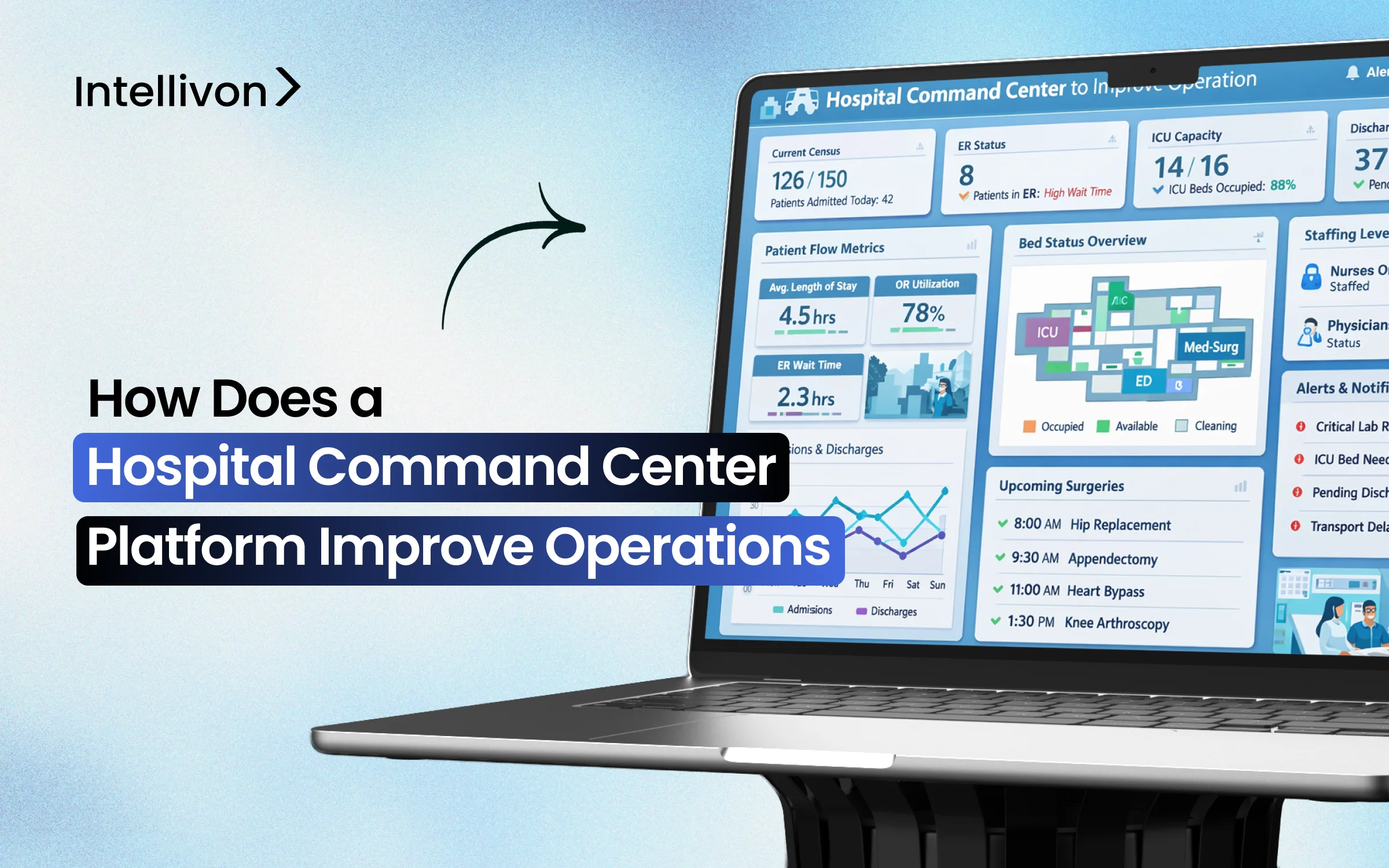
Every minute counts in a hospital. For instance, when a patient’s discharge is delayed, the emergency department can fill up quickly. At the same time, resource shortages gradually increase costs, and staff can feel overwhelmed trying to manage issues that better systems could prevent. Today’s hospital leaders need to manage patient flow, control costs, meet regulations, and ensure a positive experience for everyone, all at the same time. Traditional management methods, with scattered dashboards and separate departments, weren’t designed for this level of pressure.
A hospital command center platform brings all these operations together within a unified platform. It offers teams a real-time view of the entire hospital, supports better planning, and helps everyone respond to issues quickly. Picture an air traffic control center, but for the whole hospital, every bed, every patient, and every resource visible at a glance.
At Intellivon, the aim is to help hospitals make these operational improvements a reality. This blog explains what a hospital command center platform does, how it addresses costly operational issues, and how we build it from the ground up.
Why Hospital Operations Break at Scale
Hospital command center platforms bring real-time visibility into hospital operations through a centralized system. They integrate data analytics, AI, and monitoring tools to improve patient flow, resource allocation, and care coordination.
As patient volumes rise and hospitals accelerate digital transformation, these platforms are becoming critical. They help healthcare providers move from reactive management to proactive, data-driven operations. The global healthcare command center market was valued at approximately USD 2.15 billion in 2024. It is projected to reach around USD 6.05 billion by 2034, growing at a CAGR of 10.9% between 2025 and 2034.
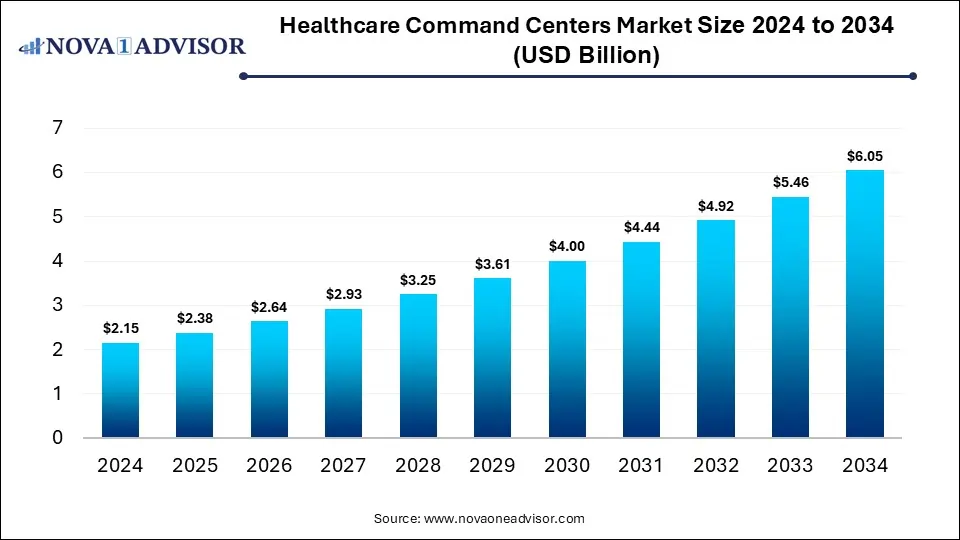
This steady growth reflects rising patient volumes and increasing demand for real-time, data-driven hospital operations.
Scaling a healthcare facility creates complexity that manual processes cannot sustain. When a hospital grows, data points from vitals to inventory multiply exponentially. Therefore, leadership often manages by looking in the rearview mirror instead of the windshield.
Efficiency drains when departments operate as independent islands. This fragmentation forces clinicians into administrative tasks instead of patient care.
1. Disconnected Systems Across Departments
Most healthcare enterprises suffer from a “fragmentation tax.” This occurs because departments use different software modules that do not communicate. Therefore, a delay in one unit creates a silent ripple effect everywhere.
When systems are disconnected, staff rely on phone calls to sync information. This process is slow and prone to human error. In addition, it hides the true state of the hospital from the leadership team.
2. Lack of Real-Time Operations
You cannot manage what you cannot see. In many hospitals, “visibility” is often 60 minutes behind reality. However, by the time a report reaches a desk, the situation has already changed.
This time lag prevents proactive intervention. Without a live dashboard, identifying a bottleneck becomes a forensic exercise. In addition, conflicting reports between department heads lead to strategic friction during high-stakes meetings.
3. Delays in Bed Allocation and Patient Flow
Bed management is the primary engine of hospital revenue. However, delays occur because the “clean” status of a room is not updated instantly. This creates “boarding,” where patients stay in the ER unnecessarily.
Inconsistent patient flow directly impacts the bottom line. If a patient is cleared but waits for transport, that bed remains unavailable. Therefore, even a small improvement in turnaround equates to millions in recovered revenue.
4. Reactive Decision-Making
In high-pressure environments, reactive management is the enemy of safety. When leaders only respond to crises as they peak, they are already behind. This “firefighting” leads to staff burnout and high costs.
Critical care requires a forward-looking stance. Without predictive tools, teams cannot anticipate a spike in ICU demand. However, by shifting toward early warning indicators, a hospital moves to a strategic posture.
Identifying these gaps is the first step toward building a resilient enterprise. Once these failure points are clear, a digital command center becomes a logical business necessity.
What Is a Hospital Command Center Platform?
A Hospital Command Center platform is a centralized mission control for healthcare operations. It integrates live data from every department into one unified interface. This system uses advanced AI to track patient flow and resource needs in real-time.
Therefore, it replaces manual coordination with automated, data-driven orchestration. This allows leaders to manage the entire facility as a single, synchronized engine rather than a set of disconnected silos.
Core Objectives of Command Center Platforms
Hospital command center platforms are built to solve one core problem, which is the lack of operational control in complex care environments. Instead of relying on fragmented systems, these platforms create a centralized, intelligence-driven layer for decision-making.
As a result, hospitals can manage patient flow, resources, and clinical operations with greater speed and accuracy.
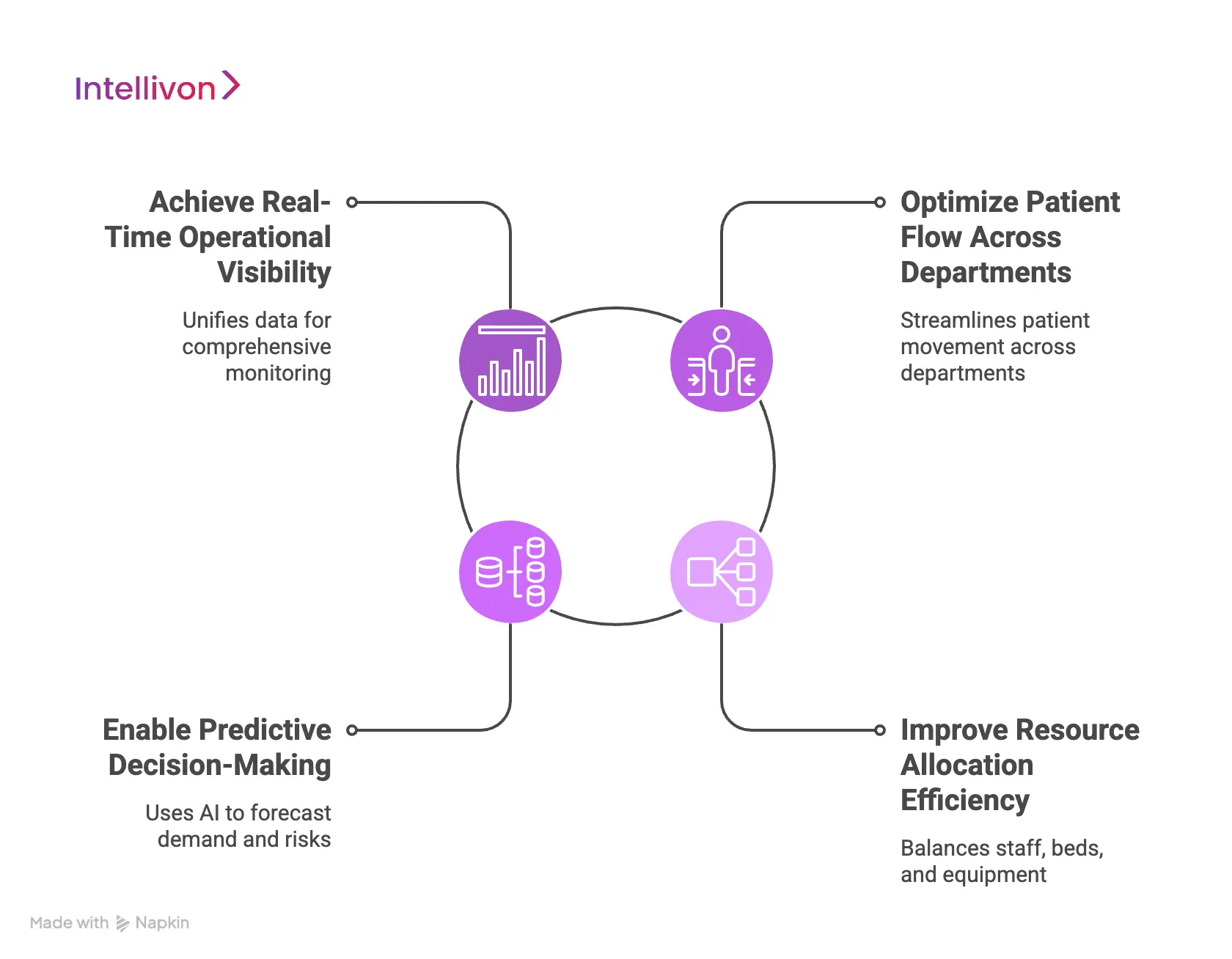
1. Achieve Real-Time Operational Visibility
Command centers unify data from EHRs, bed systems, and logistics tools into a single view. This eliminates blind spots across departments.
Therefore, administrators can monitor admissions, discharges, and transfers without delays. This visibility becomes the foundation for faster and more informed decisions.
2. Optimize Patient Flow Across Departments
Patient movement is one of the biggest operational challenges in hospitals. Command center platforms track each stage of the patient journey in real time.
As a result, hospitals reduce bottlenecks in emergency departments, inpatient units, and discharge processes. This directly improves throughput and patient experience.
3. Enable Predictive Decision-Making
Unlike traditional systems, command centers use AI models to forecast demand and identify risks. These systems analyze historical and real-time data together.
Therefore, hospitals can anticipate patient surges, staffing needs, and capacity constraints before they occur. This shift from reactive to proactive operations is critical at scale.
4. Improve Resource Allocation Efficiency
Hospitals must balance staff, beds, and equipment across dynamic conditions. Command centers provide insights into resource availability and utilization.
As a result, teams can allocate staff and infrastructure more effectively. This reduces idle capacity while avoiding overload in critical departments.
Command center platforms transform hospital operations from fragmented and reactive to centralized and predictive. By combining visibility, analytics, and coordination, they enable hospitals to operate with precision, efficiency, and control.
How Command Centers Improve Hospital Operations
A command center platform acts as the central nervous system for a healthcare enterprise. It moves the organization from a reactive state to a proactive operational model. Aggregating data, it allows leaders to orchestrate complex workflows with precision. Consequently, the hospital operates at a higher velocity with fewer manual errors.
Strategic oversight becomes a reality when every department aligns under one digital roof. This section explores the specific ways a command center platform drives this transformation.
1. Real-Time Visibility
True operational control requires a “single pane of glass” view. A command center pulls data from labs, pharmacy, and nursing stations simultaneously. Therefore, leadership sees the exact status of the facility at any given second.
This visibility eliminates the need for time-consuming status meetings. Instead, teams focus on solving problems that the system identifies automatically.
2. Predicting Patient Surges
Advanced platforms use machine learning to look ahead at the coming hours. They analyze historical patterns and current admissions to forecast a surge in the emergency department.
Because of this, managers can adjust staffing levels before the waiting room fills up. Predicting a bottleneck allows for early intervention. This prevents the gridlock that often paralyzes large-scale medical centers.
3. Optimizing Bed Utilization and Turnover
Beds are a hospital’s most valuable fixed assets. A command center tracks the status of every room from “occupied” to “cleaning in progress.” In addition, it alerts environmental services the moment a patient is discharged.
This rapid communication shortens the time a bed stays empty. Therefore, the hospital can admit more patients without adding more physical space.
4. Reducing Discharge Delays and Idle Capacity
Discharge delays often happen because of small, uncoordinated tasks. A patient might wait hours for a final lab result or a transport chair. However, a command center flags these “barriers to discharge” in real-time.
It pushes notifications to the responsible team to clear the path. Reducing idle capacity ensures that patient flow remains constant and predictable.
5. Coordinating Staff and Resource Allocation
Labor is the highest cost in any healthcare system. Command centers align staff schedules with actual patient acuity levels. For instance, if one unit is quiet, the system suggests moving “float” staff to a busier ward.
In addition, it tracks mobile equipment like ventilators or pumps. This ensures that clinical teams have the tools they need exactly when they need them.
6. Improving Emergency Response Efficiency
During a crisis, seconds determine clinical outcomes. A command center coordinates the entire response, from ambulance arrival to surgery prep. It ensures that the trauma team and the operating room are synced perfectly.
Consequently, the “door-to-needle” time for critical cases drops significantly. This efficiency saves lives while also reducing the liability risks for the enterprise.
Optimizing these workflows turns a struggling facility into a high-performance healthcare engine. This digital shift ensures that the hospital remains competitive in a demanding market.
How Hospital Command Centers Actually Work
A command center works by acting as a digital bridge between existing software. Most hospitals already have data, but it remains trapped in separate databases. The platform creates a unified layer that listens to every update across the facility. Therefore, it turns passive records into an active stream of intelligence.
This technology enhances your current system and does not replace any important data. It provides the connective tissue that allows various departments to function as one.
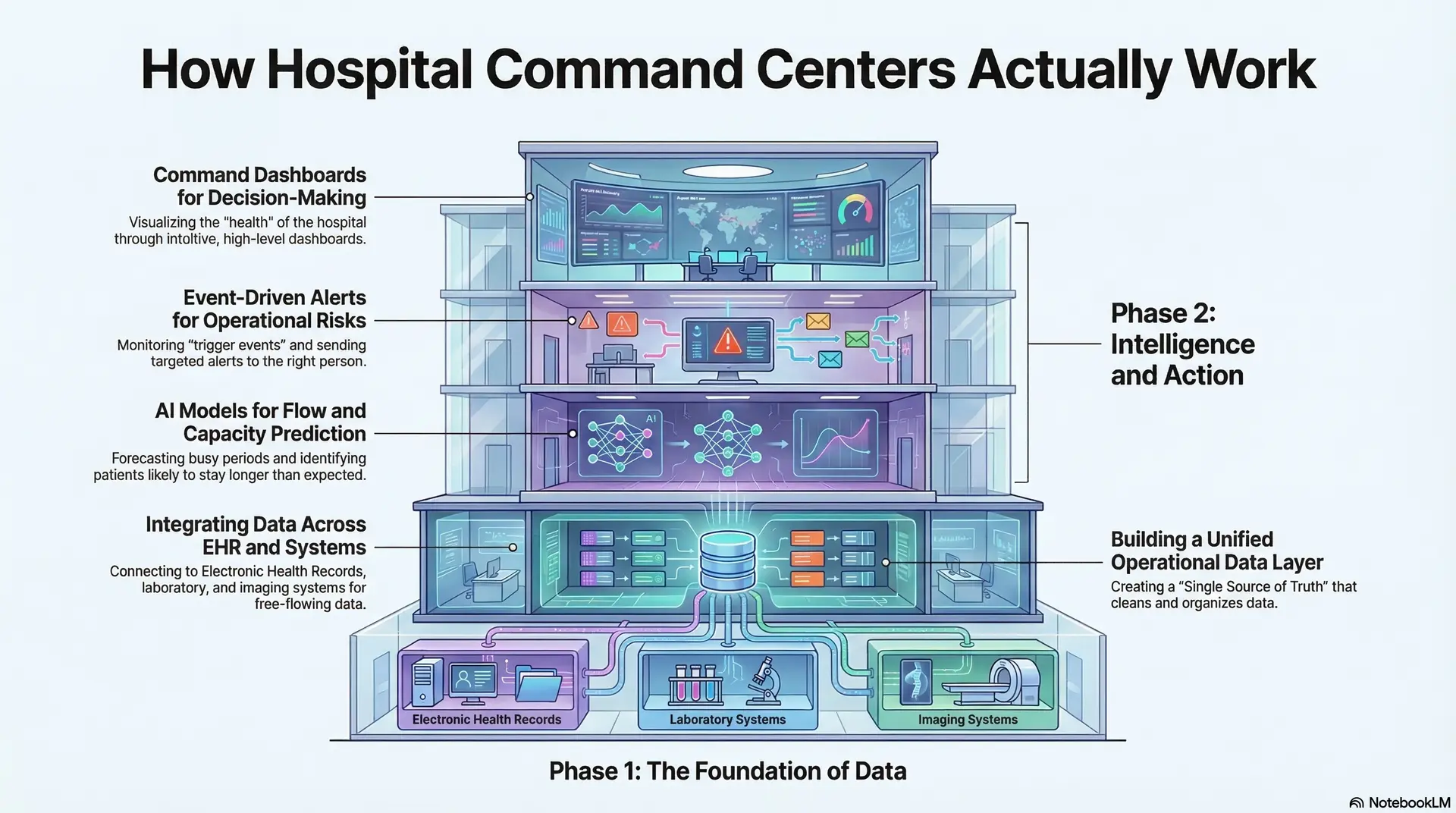
1. Integrating Data Across EHR and Systems
The first step is connecting to the Electronic Health Record (EHR). The platform also plugs into laboratory and imaging systems. Because these systems now talk to each other, data flows freely.
You no longer need manual phone calls to check on a patient’s status. Instead, the command center monitors these updates in the background.
2. Building a Unified Operational Data Layer
This platform creates a “Single Source of Truth” for the entire enterprise. It cleans and organizes data from hundreds of different sources. Therefore, every manager sees the same numbers at the same time.
This layer removes the confusion caused by conflicting departmental reports. It ensures that everyone works from the most accurate, live information available.
3. AI Models for Flow and Capacity Prediction
Modern command centers use artificial intelligence to forecast the future. These models look at years of historical data to predict busy periods. They can tell you exactly when the emergency room will reach capacity.
In addition, the AI identifies which patients are likely to stay longer than expected. This foresight allows you to adjust resources before a crisis begins.
4. Event-Driven Alerts for Operational Risks
The system acts as an early warning radar for hospital leadership. It monitors for “trigger events,” such as a delay in a critical lab test. When a risk is detected, the platform sends an instant alert to the right person.
However, it only notifies people who can actually fix the issue. This targeted communication prevents “alert fatigue” while ensuring that problems are solved quickly.
5. Command Dashboards for Decision-Making
Information is visualized through intuitive, high-level dashboards. These screens show the “health” of the hospital at a single glance. Leaders can drill down into specific units or stay at the enterprise level.
Therefore, complex decisions become much easier to make. These dashboards empower executives to lead with confidence based on hard data rather than intuition.
The technology behind a command center turns a complex building into a manageable system. This structural clarity is essential for any leader aiming to scale their healthcare operations.
Core Components of Command Center Platforms
To achieve operational excellence, an enterprise platform must be built on a foundation of robust, modular components. These modules work in tandem to create a digital twin of the hospital’s physical reality. Therefore, the platform serves as more than just a dashboard; it becomes the engine of the entire facility.
Each component is designed to remove a specific layer of friction from the care delivery process. By understanding these pillars, leaders can better visualize how the technology integrates into their existing strategy.
1. Patient Flow and Bed Management Engine
The bed management engine is the primary driver of throughput and revenue. It tracks a patient’s journey from the moment they are admitted to the moment they leave.
In addition, the system automatically updates the status of every room. This removes the need for manual bed boards or phone calls to housekeeping. Therefore, the hospital can maintain a higher census without increasing the risk of patient boarding.
2. Data Integration and Interoperability Layer
This layer is the “translator” for the hospital’s various software systems. It connects the EHR, the lab, and the pharmacy using secure, modern protocols. Because it bridges these gaps, information moves across departments instantly.
It ensures that the right data is available in the right place at the right time. However, it does this without requiring the hospital to replace its current legacy infrastructure.
3. Predictive Analytics and AI Models
The intelligence of the platform resides in its ability to forecast demand. These models analyze live data to predict staffing needs and equipment shortages. For instance, the AI can alert you to a potential ICU bed shortage three days in advance.
In addition, it identifies patients who are at a high risk of readmission. This foresight allows for strategic planning rather than reactive crisis management.
4. Workflow Automation and Escalation Systems
Automation turns insights into action without human intervention. When the system detects an operational risk, it triggers an automated workflow. For example, it can dispatch a cleaning crew the second a discharge order is signed.
If a bottleneck is not resolved within a set timeframe, the system escalates the issue. Consequently, small delays never have the chance to grow into major systemic failures.
5. Visualization and Command Interfaces
The final component is the interface that humans use to make decisions. These command centers often feature “Wall of Analytics” displays that show the entire system’s health. In addition, mobile versions allow managers to stay connected while on the move.
These interfaces use clear, color-coded signals to highlight areas that need attention. Therefore, executives can lead with total clarity, focusing only on the most critical issues.
Each of these components is vital for turning a complex medical center into a streamlined, data-driven enterprise. When these pieces are integrated, the results are immediate and measurable.
Real Use Cases Across Hospital Operations
A command center provides measurable impact by solving specific logistical hurdles. It moves the conversation from abstract technology to concrete operational wins. For an enterprise, these use cases represent the primary drivers of Return on Investment (ROI).
Seeing the platform in action helps leaders visualize the shift from chaos to coordination. Below are the areas where a command center delivers the most significant strategic value.
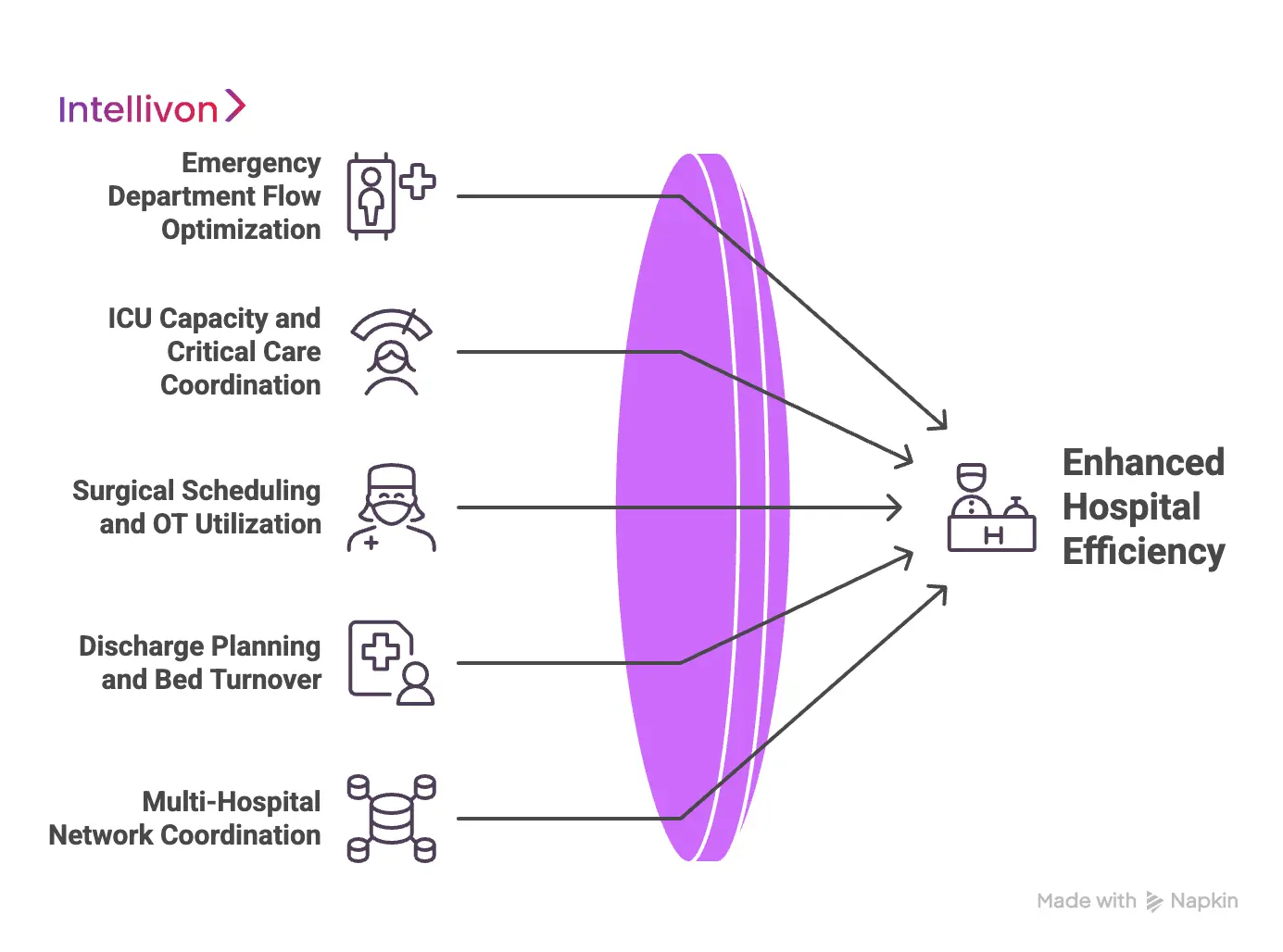
1. Emergency Department Flow Optimization
The Emergency Department (ED) is often the site of the most visible operational friction. A command center monitors the “door-to-doctor” time and identifies patients waiting for beds. Therefore, it prevents the dangerous “boarding” that leads to overcrowding.
By syncing the ED with inpatient units, the platform ensures that patients move to the right level of care without delay. This efficiency directly reduces the rate of patients who leave without being seen.
2. ICU Capacity and Critical Care Coordination
Critical care units require the most precise resource management in the hospital. A command center tracks the acuity of every ICU patient in real-time. Because of this, it can predict when a bed might become available for an incoming trauma case.
In addition, it helps coordinate the transfer of stable patients to “step-down” units. This proactive movement ensures that the highest level of care is always available for those who need it most.
3. Surgical Scheduling and OT Utilization
Operating theaters (OT) are the primary revenue engines for many healthcare systems. However, late starts or cancellations due to missing beds can cost thousands of dollars per hour. A command center coordinates surgical schedules with downstream bed availability.
It ensures that a post-surgical bed is reserved and ready before the first incision is made. Therefore, the hospital maximizes OT utilization and improves surgeon satisfaction simultaneously.
4. Discharge Planning and Bed Turnover
Discharges often stall because of simple administrative or logistical gaps. A patient might be medically ready but waiting for a final pharmacy delivery. A command center flags these “barriers to discharge” early in the day.
It alerts the transport and cleaning teams the moment a room is vacated. Reducing bed turnover time by even thirty minutes can unlock the capacity for several additional admissions per day.
5. Multi-Hospital Network Coordination
For large healthcare networks, a command center enables “system-level” thinking. It allows leaders to view capacity across multiple campuses on a single screen. If one hospital is nearing its limit, the center can reroute inbound transfers to a sister facility.
This “load balancing” ensures that the entire network operates at peak efficiency. Consequently, the enterprise retains revenue that would otherwise be lost to competitors during a surge.
These use cases demonstrate that a command center is not just a tool for one department. It is an enterprise-wide solution that turns operational data into a competitive advantage.
Metrics That Define Operational Improvement
Operational success in healthcare is not a matter of intuition; it is a matter of measurable data. For an enterprise leader, the value of a command center platform is found in its impact on the balance sheet and clinical outcomes. Therefore, tracking specific Key Performance Indicators (KPIs) is essential to validate the investment.
These metrics provide a clear window into how well the hospital is breathing. By focusing on these high-authority data points, organizations can move from vague goals to precise operational benchmarks.
1. Average Length of Stay (ALOS) Reduction
ALOS is perhaps the most significant metric for hospital profitability. A command center helps shave hours off a patient’s stay by removing administrative friction. In addition, it ensures that clinical milestones are met without unnecessary waiting periods.
Even a half-day reduction in ALOS across the facility can increase annual capacity by thousands of patients. Therefore, the platform acts as a force multiplier for existing physical infrastructure.
2. Bed Occupancy and Utilization Rates
High occupancy is good, but “hidden” capacity is a wasted asset. The platform provides a live view of true bed utilization, including those in transition. It identifies units that are consistently under-utilized or dangerously overcrowded.
Because of this visibility, leaders can balance the load across the entire enterprise. Maintaining an optimal occupancy rate ensures that revenue is maximized while staff remains manageable.
3. Emergency Wait Time Improvements
Wait times in the Emergency Department are a primary driver of patient dissatisfaction and “left without being seen” (LWBS) rates. A command center identifies the exact cause of a backup, whether it is a lack of beds or a delay in lab results.
Consequently, the hospital can take immediate action to clear the bottleneck. Improving these times enhances the hospital’s reputation and captures revenue that would otherwise walk out the door.
4. Discharge Time Optimization Metrics
The goal is to align “medical discharge” with “physical discharge.” Traditionally, these two events are hours apart, creating a massive gap in bed availability. The platform tracks the time between the doctor’s order and the patient’s departure.
However, by automating the alerts for transport and cleaning, this gap is closed. Monitoring this metric allows the hospital to turn beds faster and admit new patients earlier in the day.
5. Staff Productivity and Allocation Efficiency
Labor costs are managed more effectively when staffing levels match real-time demand. The platform measures how often “float” staff are used and where overtime is most frequent. In addition, it tracks the ratio of staff to patient acuity rather than just simple headcounts.
This ensures that the most skilled resources are always in the areas of highest need. Therefore, the enterprise sees higher productivity without the typical burnout associated with manual scheduling.
Focusing on these metrics transforms the hospital into a data-driven, high-performance organization. This clarity allows leaders to make strategic decisions that are backed by hard evidence.
Data Architecture Behind Hospital Command Center Platforms
High-level orchestration requires more than just a clean user interface. It demands a sophisticated technical foundation that can handle the high velocity of hospital data. For a healthcare enterprise, the architecture is the “moat” that ensures reliability during peak surges. Therefore, understanding the plumbing behind the platform is vital for long-term scalability.
A robust data strategy allows the hospital to move away from static reports toward live, event-driven intelligence. This section breaks down the engineering requirements for a true enterprise-grade command center.
1. Real-Time Data Pipelines in Hospitals
Data pipelines are the arterial system of the command center. They ingest raw feeds from thousands of medical devices and software modules simultaneously. Because this data is time-sensitive, the pipeline must process it in motion.
Therefore, information about a new admission or a critical lab result reaches the dashboard in seconds. This speed ensures that the command team is never making decisions based on stale data.
2. HL7 and FHIR for System Interoperability
Interoperability is the biggest hurdle in healthcare technology. Most hospitals use a mix of legacy HL7 v2 messages and modern FHIR APIs. A command center acts as a universal translator between these protocols.
It normalizes different data “dialects” into a standard format that the analytics engine can understand. This structural alignment allows the platform to sit on top of any EHR without breaking the underlying workflows.
3. Event Streaming for Operational Monitoring
Traditional databases wait for a user to ask a question. However, event streaming platforms like Apache Kafka push information as it happens. Each patient movement or clinical update is treated as an “event” in a continuous stream.
This allows the system to detect complex patterns, such as a brewing crisis in the ED, before a human notices. Consequently, the platform shifts from a passive record-keeper to an active operational monitor.
4. Building a Hospital Data Lake Architecture
A data lake provides a centralized reservoir for all structured and unstructured information. It stores everything from imaging metadata to staffing rosters in their raw form. This architecture is essential for training the AI models that drive predictive analytics.
In addition, it allows for historical benchmarking and long-term trend analysis. Therefore, the hospital can compare its current performance against years of historical operational data.
5. Ensuring Data Accuracy and Latency Control
In a clinical environment, data latency can be a matter of life and death. The architecture must minimize the “time-to-insight” by reducing the delay between data generation and visualization. In addition, automated validation rules check for missing or inaccurate entries in real-time.
This ensures that the command center remains a “Single Source of Truth.” High-fidelity data is the only foundation upon which a professional healthcare leader can safely build a strategy.
The technical sophistication of the platform determines its ultimate effectiveness. By investing in a modern data architecture, healthcare systems ensure they are ready for the future of AI-driven care.
AI Models Used in Hospital Command Center Platforms
The true differentiator of a modern command center lies in its intelligence layer. While standard software merely reports what has happened, an AI-enabled platform predicts what will happen next. Therefore, the system shifts from a digital whiteboard to a strategic advisor.
These models allow the enterprise to manage capacity with mathematical certainty. By leveraging advanced machine learning, leaders can navigate the complexities of modern healthcare with a level of foresight that was previously impossible.
1. Predictive Models for Patient Flow
Predictive modeling serves as the hospital’s early warning system. These models analyze historical admission patterns, seasonal trends, and even local weather data to forecast patient volume.
Because the system can anticipate a surge forty-eight hours in advance, leadership can adjust elective surgery schedules or staffing. This foresight prevents the “gridlock” that often occurs when demand unexpectedly outpaces supply.
2. Queue Optimization Algorithms
Hospitals are essentially a series of complex, interlinked queues. Patients wait for labs, imaging, and ultimately, a bed. Optimization algorithms manage these queues by identifying the most efficient path for each patient.
For instance, the system might suggest a specific radiology slot that minimizes total wait time. Therefore, the platform ensures that the “velocity of care” remains high across all departments.
3. Resource Allocation Optimization Models
Assigning the right staff to the right unit is a massive logistical challenge. AI models solve this by matching nurse-to-patient ratios based on clinical acuity rather than simple headcounts. In addition, the system optimizes the distribution of mobile assets like ventilators or IV pumps.
It ensures that these high-value resources are stationed where they are most likely to be needed. However, it does this while minimizing the manual labor of tracking and moving equipment.
4. Anomaly Detection in Hospital Operations
Operational “drift” often goes unnoticed until it becomes a crisis. Anomaly detection models monitor thousands of data points to find outliers in real-time. This might include an unusual spike in discharge delays in a specific ward or an unexpected drop in lab turnaround times.
Because the system flags these deviations instantly, managers can intervene before the issue scales. Consequently, the hospital maintains a consistent standard of operational excellence.
5. Continuous Learning From Operational Data
The most effective AI models are not static; they improve over time. A command center platform uses continuous learning to refine its predictions based on the hospital’s unique environment. It learns from every successful discharge and every staffing shortfall.
In addition, the system adapts to changes in clinical protocols or facility layouts. This ensures that the platform remains a relevant and high-authority tool as the healthcare enterprise evolves.
This intelligence layer turns raw data into a competitive moat for the hospital. By deploying these models, organizations can ensure they stay ahead of the operational curve.
How We Build A Hospital Command Center Platform
Developing a command center platform is not merely a software installation; it is a fundamental re-engineering of the hospital’s operational DNA.
At Intellivon, we approach this as a strategic partnership to ensure the technology integrates seamlessly into high-stakes clinical environments. Our process focuses on reducing technical friction while maximizing the velocity of data-driven insights.
By following a structured, seven-step methodology, we ensure that the transition from a reactive facility to a proactive enterprise is both stable and scalable. Here is how we build the future of hospital orchestration.
1. Operational Discovery and Bottleneck Mapping
Every facility has unique friction points that stall patient flow. Therefore, we begin by conducting a deep dive into your existing workflows and legacy systems. We identify where data is trapped and where manual interventions cause the most delay.
This phase ensures the platform is built to solve your specific enterprise challenges rather than offering a generic fix.
2. Scalable Data Ingestion and Pipeline Engineering
A command center is only as good as the data it receives. We build robust, real-time pipelines that ingest feeds from your EHR, LIS, and HR rosters. Because we prioritize low-latency architecture, your dashboards reflect reality within seconds, not hours.
In addition, we ensure that these pipelines are built to handle the massive data volumes of a growing multi-hospital network.
3. Implementing HL7 and FHIR Interoperability
We specialize in creating a “Single Source of Truth” without requiring you to rip and replace existing infrastructure. Our team configures the platform to translate various data protocols into a unified format.
This ensures that the Emergency Department can see lab results or bed availability across the entire system. Consequently, the platform acts as a universal translator for your entire digital estate.
4. Deploying Predictive AI and Logic Engines
Once the data is flowing, we activate the intelligence layer. We deploy custom machine learning models that forecast patient surges and identify discharge barriers before they occur.
However, these models are not “black boxes”; they are tuned to your hospital’s historical patterns. This stage allows your leadership to transition from defensive “firefighting” to proactive strategic planning.
5. Custom Command Dashboard and Interface Design
Information must be intuitive to be actionable. We design high-authority visualization interfaces that cater to both frontline managers and C-suite executives.
These dashboards use clear, color-coded signals to highlight areas requiring immediate attention. Therefore, decision-makers can identify a crisis in a specific ward at a glance and allocate resources with total confidence.
6. Automated Workflow and Escalation Setup
Insights must trigger action to deliver value. We configure automated triggers that notify the right personnel when an operational risk is detected.
For example, if a bed turnaround exceeds a certain threshold, the system automatically alerts the environmental services supervisor. This removes the need for manual oversight and ensures that bottlenecks are cleared in real-time.
7. Strategic Testing and Continuous Optimization
The final step is a phased rollout to ensure total system reliability. We conduct rigorous stress tests to maintain data accuracy during peak loads.
In addition, we establish a continuous learning loop where the AI models refine their accuracy based on live performance data. This ensures that your investment with Intellivon grows more valuable and precise every single day.
Building a command center is a bold move toward operational maturity. With a structured approach, your facility can achieve a level of coordination that was once reserved for the world’s most advanced logistics companies.
Cost to Build a Hospital Command Center Platform
At Intellivon, hospital command center platforms are engineered as enterprise operational infrastructure, not as dashboards layered onto disconnected hospital systems. The objective is to build a platform that continuously monitors patient flow, predicts operational risks, and enables real-time decision-making across the hospital.
However, building a reliable command center platform requires more than aggregating data. Hospitals operate across complex environments with legacy systems, compliance requirements, and real-time dependencies. As a result, enterprises gain a unified operational view while reducing delays, inefficiencies, and coordination gaps.
Estimated Phase-Wise Cost Breakdown
| Phase | Description | Estimated Cost (USD) |
| Discovery & Operational Mapping | Analyze workflows, patient flow, and system dependencies | $5,000 – $10,000 |
| Data Integration & Interoperability Layer | Connect EHRs, bed systems, and hospital tools using HL7/FHIR | $10,000 – $25,000 |
| Data Infrastructure & Architecture | Build real-time pipelines, storage, and processing systems | $10,000 – $25,000 |
| AI Model Development | Develop predictive models for flow, demand, and bottlenecks | $8,000 – $20,000 |
| Dashboard & Visualization Layer | Build command interfaces for real-time decision-making | $7,000 – $15,000 |
| Workflow Automation & Alert Systems | Implement alerts, escalation logic, and workflows | $5,000 – $12,000 |
| Security & Compliance Layer | Ensure HIPAA compliance, encryption, and access controls | $5,000 – $12,000 |
| Testing & Deployment | Validate system performance and deploy across environments | $3,000 – $8,000 |
Total Estimated Cost
For an enterprise-grade hospital command center platform, the total development cost typically ranges between:
$50,000 – $150,000+
This depends on integration depth, AI capabilities, and hospital size.
Key Factors That Influence Development Cost
1. Integration Complexity Across Hospital Systems
Hospitals rely on multiple legacy systems. Integrating EHRs, labs, and logistics platforms increases both effort and cost.
2. Real-Time Data Processing Requirements
Command centers require low-latency data pipelines. Building real-time infrastructure adds architectural complexity.
3. AI Model Sophistication
Basic dashboards cost less. However, predictive and optimization models require more data, training, and validation.
4. Custom Workflow and Automation Needs
Each hospital operates differently. Custom alerts, escalation flows, and operational logic increase development scope.
5. Compliance and Security Requirements
Healthcare systems must meet strict regulations. Security, audit trails, and access control are critical cost drivers.
Ongoing Maintenance and Scaling Costs
Building the platform is only the first step. Hospitals must continuously optimize and scale operations.
- Infrastructure and cloud costs for real-time processing
- AI model retraining and performance tuning
- System updates as hospital tools evolve
- Ongoing security monitoring and compliance audits
Typically, annual maintenance costs range between 15–25% of the initial development cost, depending on system complexity and scale.
Want an exact cost tailored to your hospital systems and scale? Speak with Intellivon’s experts for a detailed breakdown.
Conclusion
The Hospital Command Center is the new standard for modern healthcare excellence. It transforms fragmented data into a powerful engine for growth and clinical safety. Therefore, investing in this infrastructure is a strategic move for any forward-thinking leader.
It ensures your facility remains competitive and financially resilient. Intellivon provides the cutting-edge AI solutions needed to build this future. Partner with us to turn your operational vision into a high-performance reality.
Build a Hospital Command Center With Intellivon
At Intellivon, hospital command center platforms are engineered as enterprise operational intelligence systems, not as dashboards layered onto fragmented hospital infrastructure. The goal is to give healthcare leaders complete visibility, predictive control, and real-time decision capabilities across patient flow, capacity, and resource management.
Our approach focuses on building scalable, AI-driven platforms that adapt to the complexity of modern healthcare environments. Therefore, whether you operate a single hospital or a multi-facility network, the system evolves with your operational needs.
Why Partner With Intellivon?
- Governance-First Healthcare Architecture: We design platforms where operational policies, access controls, and compliance requirements are embedded directly into the system architecture from day one.
- AI-Driven Operational Intelligence Systems: Our platforms use predictive models to forecast patient demand, identify bottlenecks, and enable proactive decision-making across hospital operations.
- Deep Integration With Hospital Ecosystems: We integrate seamlessly with EHRs, clinical systems, and logistics platforms, ensuring uninterrupted data flow and real-time operational visibility.
- Scalable Infrastructure for Growing Networks: Our systems are built to support multi-hospital environments, allowing healthcare organizations to expand operations without performance limitations.
- Continuous Optimization Through Data Feedback: We implement feedback loops that continuously improve system performance, accuracy, and operational outcomes over time.
Hospital operations are becoming more complex, and traditional systems cannot keep up. Command center platforms provide the control, visibility, and intelligence needed to operate at scale.
Partner with Intellivon to build a hospital command center platform tailored to your workflows, systems, and long-term growth strategy.
FAQs
Q1. What is a hospital command center platform?
A1. A hospital command center platform is a centralized system that integrates data from clinical, operational, and logistical tools. It provides real-time visibility into patient flow, bed capacity, and resource usage. As a result, hospitals can manage operations more efficiently from a single interface.
Q2. How does it improve hospital operations?
A2. It improves operations by providing real-time insights and predictive analytics. Hospitals can identify bottlenecks, optimize bed usage, and reduce delays in patient movement. This leads to faster decisions, better coordination, and improved patient outcomes.
Q3. What systems does it integrate with?
A3. These platforms integrate with EHR systems, bed management tools, lab systems, and hospital logistics platforms. They also connect with scheduling, staffing, and patient monitoring systems. This ensures a unified view of hospital operations.
Q4. How long does it take to build?
A4. Building a hospital command center platform typically takes 3 to 6 months. The timeline depends on integration complexity, AI requirements, and hospital size. Larger systems with multiple integrations may take longer.
Q5. What technologies power these platforms?
A5. These platforms use cloud infrastructure, real-time data pipelines, and AI/ML models. They rely on standards like HL7 and FHIR for integration. Additionally, they use dashboards, event-driven systems, and security layers to ensure performance and compliance.