

Key Takeaways:
-
A SaaS stablecoin payment gateway connects billing platforms to settlement rails supporting subscriptions, invoices, and prepaid credits.
-
Recurring payments need wallet authorization or reusable payment instructions built directly into the platform architecture.
-
USDC, USDT, EURC, and PYUSD are common assets requiring custody, compliance, and blockchain connectivity infrastructure.
-
KYC/KYB, AML, sanctions screening, and Travel Rule requirements apply depending on transaction volume and jurisdiction.
-
How Intellivon builds stablecoin payment gateways as production payment infrastructure costing $70,000 to $300,000.
A stablecoin payment gateway for SaaS moves subscription billing off card networks entirely, so a renewal doesn’t fail because a card expired or a bank flagged the charge as suspicious. That distinction matters more than it sounds. Subscription businesses are projected to lose $129 billion to failed payments in 2025, according to a 2026 SaaS payment recovery analysis, and involuntary churn from those failures can account for up to 40% of total churn.
However, removing card declines doesn’t remove billing complexity. A gateway still has to handle proration, plan upgrades, usage-based charges, and dunning logic, since none of that goes away just because the rail changed. Meanwhile, a stablecoin transaction either settles or it doesn’t, so retry logic has to work differently than it does with a soft card decline. As a result, SaaS teams that design billing logic around this distinction from the start avoid rebuilding it later.
In this blog, we’ll walk through gateway architecture, subscription billing design, on-ramp and off-ramp integration, and compliance, then look at what it takes to run stablecoin billing alongside a platform like Stripe versus replacing it outright.

What Is a Stablecoin Payment Gateway for SaaS Businesses?
A stablecoin payment gateway for SaaS is software infrastructure that connects your subscription billing engine directly to blockchain networks. It manages payment creation, wallet authorization, on-chain settlement, compliance checks, and customer account updates in one automated workflow.
When a customer pays with digital currencies like USDC or USDT, the gateway verifies the transaction on the blockchain. It then updates your financial ledger, updates customer account access, and records the subscription revenue.
Instead of waiting days for traditional bank settlements, your business gets instant fund transfer with zero credit card chargeback risk and under 1% transaction costs.
How the Five Core Layers Work Together
To process recurring revenue on-chain, your gateway relies on five connected systems:
- Billing Engine: First, this layer calculates your final invoice by tracking plan prices, user seats, usage metrics, discounts, and regional taxes.
- Payment Gateway Layer: Next, it creates a unique payment obligation, generates checkout links or QR codes, and monitors the transaction state in real time.
- Wallet and Custody Layer: Meanwhile, this system handles secure wallet connections, user signature authorization, and safe token management using multi-party computation.
- Blockchain Settlement: Once authorized, this layer broadcasts the payment to networks like Solana or Polygon to execute the actual token transfer.
- Ledger and Reconciliation: Finally, the system matches the confirmed blockchain transaction directly to your CRM, accounting tools, and SaaS entitlement database.
The Critical Difference: Crypto Checkout vs. SaaS Gateway
A simple crypto checkout only lets a user send tokens to a static wallet address. In contrast, an enterprise SaaS stablecoin payment gateway connects that token transfer directly to your core business logic and subscription lifecycle.
| Feature / Capability | Basic Crypto Checkout | SaaS Stablecoin Payment Gateway |
| Transaction Trigger | One-time manual transfer to a static address | Automated invoice creation with dynamic payment links and QR codes |
| Subscription Logic | None; requires manual re-payment each cycle | Native support for recurring, metered, and seat-based subscription plans |
| SaaS Entitlements | Manual account provisioning by support staff | Instant webhook-driven activation of feature flags and user access |
| Accounting & ERP Sync | Manual spreadsheet reconciliation | Automated ledger syncing with QuickBooks, Xero, and Salesforce |
| Compliance & Fraud | None or basic address lookup | Integrated KYC/AML, OFAC sanctions screening, and Travel Rule tracking |
The hard part of building this system is not simply receiving USDC in a corporate crypto wallet. Therefore, the real engineering challenge lies in turning an on-chain token transfer into a reliable, compliant, and fully automated SaaS revenue workflow.
Why SaaS Businesses Are Adding Stablecoin Payment Rails
Traditional card networks and wire transfers carry heavy cross-border fees, settlement delays, and chargeback risks for global software platforms. Consequently, enterprise SaaS leaders are introducing a stablecoin payment gateway to collect international recurring revenue faster and cheaper.
According to research from BCG and Allium Labs, real-economy B2B stablecoin settlement volume reached $400 billion, with B2B driving 60% of total volume.
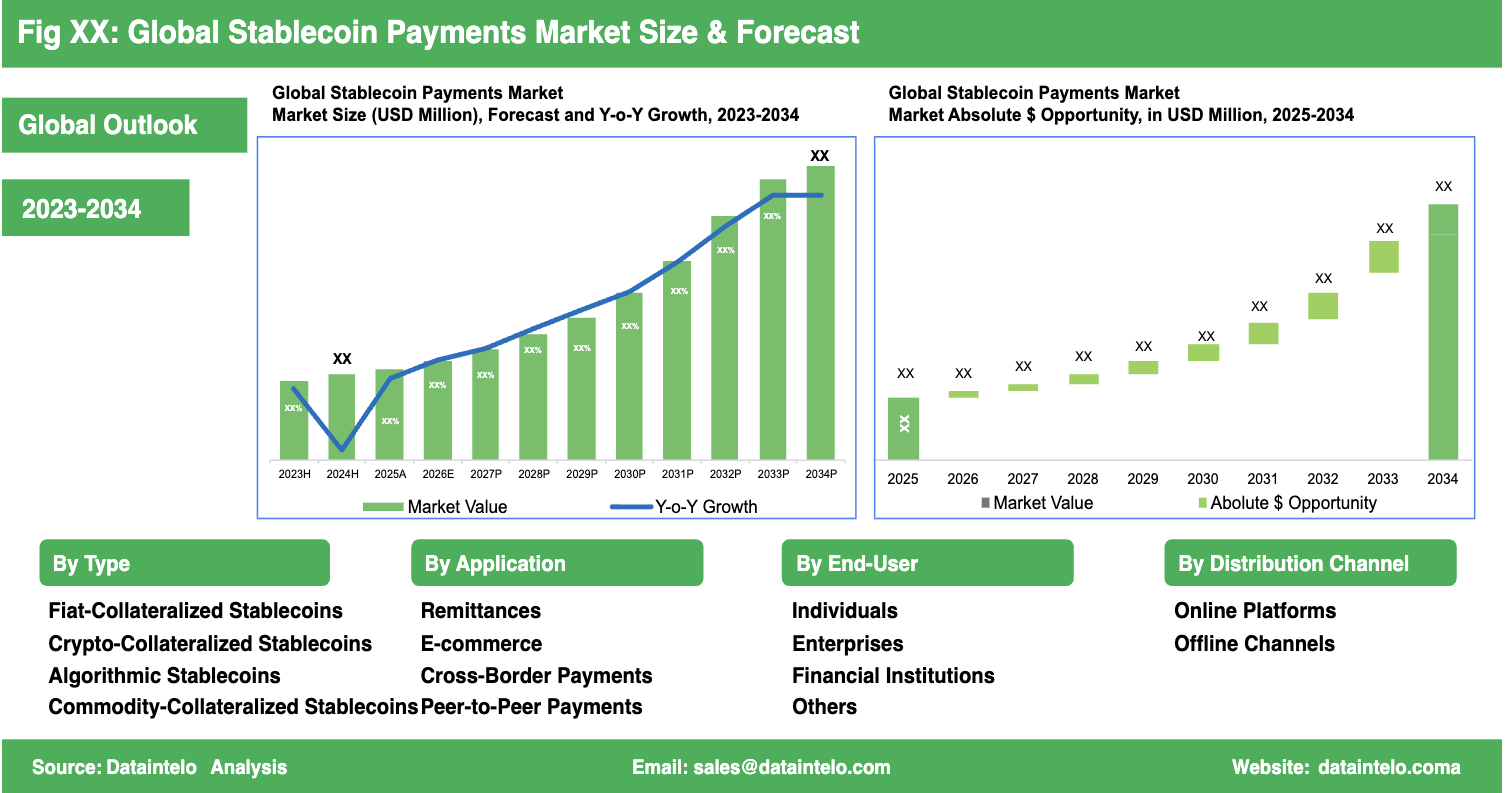
Furthermore, the global stablecoin payments market is projected to expand at a 22.4% CAGR through 2033, while Juniper Research projects cross-border B2B stablecoin transactions will exceed $5 trillion by 2035.
Primary Adoption Drivers for Global Software Platforms
SaaS providers adopt stablecoin payment infrastructure to unlock distinct operational advantages across cross-border markets:
- Global Settlement Consolidation: Instead of managing dozens of local bank accounts, platforms accept unified digital assets like USDC or USDT globally.
- 24/7/365 Real-Time Settlement: Blockchains operate continuously, avoiding traditional banking cutoffs and SWIFT correspondent delays.
- Superior Cross-Border Economics: As detailed by Ramp’s analysis on global B2B payments, traditional cards levy heavy interchange and FX fees, whereas stablecoin rails reduce all-in transaction costs significantly.
- Stablecoin-Native Customer Demand: AI platforms, developer tool suites, and crypto platforms increasingly prefer paying bills directly from corporate Web3 treasuries.
- Working Capital Efficiency: Automated instant settlement releases trapped operational cash flow immediately, eliminating multi-day clearing holds.
Strategic Comparison: Traditional Rails vs. Stablecoin Infrastructure
To understand where stablecoins fit, compare their operational traits directly against legacy payment methods:
| Operating Dimension | Card / ACH / Wire Networks | Stablecoin Payment Rail |
| Settlement Speed | 2 to 5 business days (Wire/ACH); T+2 to T+7 (Cards) | 1 to 5 seconds (Solana/Polygon) |
| Cross-Border FX Fees | 2.5% to 4.5% FX markup plus cross-border surcharges | 0.1% to 0.5% conversion spread |
| Chargeback Exposure | High risk; 90-day dispute windows for friendly fraud | Zero chargebacks; on-chain transactions are final |
| Operating Hours | Restricted by banking days and central bank clearing windows | 24 hours a day, 7 days a week, 365 days a year |
| Geographic Coverage | Fractured across local clearinghouses and regional card schemes | Unified global network accessible anywhere internet exists |
| Refund Workflow | Automatic processor clawback to original funding source | Programmatic smart contract execution or merchant pull |
As highlighted in EY-Parthenon’s enterprise study on stablecoins, stablecoins complement existing payment rails rather than replace them outright.
At the same time, offering stablecoin settlement alongside traditional processors gives global buyers flexibility while capturing high-margin international revenue.
SaaS Companies Already Using Stablecoin Payment Rails
Stablecoin payment infrastructure is no longer exclusive to Web3 protocols. At the same time, enterprise SaaS, AI, and cloud infrastructure companies are actively deploying custom stablecoin payment gateways to collect global subscription revenue.
By adopting digital currency rails, these software businesses eliminate cross-border card fees, eliminate chargebacks, and achieve instant 24/7 settlement without relying on legacy banking hours or correspondent networks.
1. Cloudflare: Automated Recurring and Usage-Based USDC Billing
Cloudflare allows customers to pay for internet performance and security services using USDC on Base and Polygon networks. Furthermore, their deployment handles complex recurring subscription lifecycles.
- Implementation Details: Customers sign a one-time smart-contract permit to authorize future recurring renewals. Consequently, the engine handles monthly subscriptions, usage charges, and prorated plan upgrades automatically. Moreover, balance shortages trigger standard dunning sequences or switch to a credit card fallback.
- Lesson for SaaS Teams: Production gateways must connect wallet authorization directly to dunning workflows and fallback rails.
2. Higgsfield: Reduced Friction for Global AI Subscriptions
Higgsfield, a generative AI video platform, introduced stablecoin subscription payments to serve global creators. As a result, they protected their international profit margins.
- Implementation Details: Higgsfield uses smart-contract wallet delegation to allow users to authorize recurring USDC payments. Therefore, the infrastructure settles funds into stablecoins while maintaining identical plan access rules.
- Lesson for SaaS Teams: Stablecoin rails protect margins for AI SaaS platforms with distributed global audiences.
3. Shadeform & Shopify: Organic Adoption and Platform Abstraction
Shadeform and Shopify demonstrate how software platforms can embed stablecoins directly into existing customer checkouts.
- Implementation Details: Shadeform shifted 20% of its total payment volume to stablecoins by offering an optional USDC checkout. Similarly, Shopify integrated USDC on Base across millions of global merchant storefronts.
- Lesson for SaaS Teams: SaaS platforms can introduce stablecoins as an optional rail to drive fast, organic adoption.
4. Production Implementations Compared
| Company | Software Model | Stablecoin Payment Scope | Core Architectural Takeaway |
| Cloudflare | Cloud Infrastructure | Recurring + Usage Billing | Gateway must manage permits and card fallback |
| Higgsfield | AI SaaS Platform | Wallet Subscriptions | Protects international revenue margins without signing friction |
| Shadeform | Developer Marketplace | Optional Checkout Rail | Phased implementation drives immediate cost reductions |
| Shopify | Commerce Platform | Embedded Merchant Rail | Native abstraction unlocks platform-wide stablecoin acceptance |
These real-world implementations prove that stablecoin architectures must match your specific SaaS billing model. Next, we will examine the core system architecture needed to build these enterprise payment engines.
How Billing and Settlement Currencies Work Together
When implementing a stablecoin payment gateway, SaaS platforms must separate the pricing model from on-chain transfers.
For instance, consider an enterprise customer billed an invoice for €5,000; the customer pays using USDC on-chain, and your business settles the funds into USD in a corporate bank account.
1. The Three Currency Layers Explained
Managing multi-currency flows requires orchestrating three distinct layers across the checkout lifecycle:
- Billing Currency: This layer defines contract pricing, recurring plan tariffs, tax calculations, and official invoice totals (e.g., EUR).
- Payment Currency: This represents the specific stablecoin token and blockchain network selected by the customer at checkout (e.g., USDC on Polygon, USDT on Solana, or PYUSD).
- Settlement Currency: This is the final asset stored in your treasury or converted into fiat via local bank off-ramps (e.g., USD or EURC).
2. Essential Gateway FX and Quote Logic
To bridge these three currencies seamlessly without taking on balance-sheet volatility, your gateway must execute real-time exchange rate management:
- Exchange-Rate Lookup & Spread: The gateway queries liquid price feeds to calculate real-time conversion rates while adding a protective FX spread.
- Quote Locking & Expiry: Next, the engine locks the exchange rate for a set window (e.g., 15 minutes) and displays a countdown timer on the checkout interface.
- Payment Tolerance & Rounding: Additionally, the system evaluates gas fees and rounding tolerances to prevent accidental underpayments.
- Conversion & Multi-Currency Ledger: Finally, the system executes automated swap routing and posts normalized multi-currency entries to your accounting system.
3. Handling Multi-Currency Edge Cases
Edge cases regularly occur during cross-border settlement, requiring automated gateway resolution:
- Expired Quotes: If a quote expires before on-chain confirmation, the gateway automatically recalculates the rate or prompts the user to approve the updated price delta.
- Underpayments: If a customer transfers 4,995 USDC on a 5,000 USDC invoice, the engine registers a partial payment state, flags the remainder in the customer portal, and holds provisioned entitlements until cleared.
- Slippage & Rate Fluctuations: If exchange rates shift during network congestion, locked quotes shield the customer while automated liquidity pools absorb micro-slippage.
Multi-currency support requires advanced pricing, quote locking, and FX conversion logic operating well outside the blockchain transaction itself. Next, we will examine the full system architecture needed to connect these components together.
How a Stablecoin Payment Moves Through a SaaS Gateway
Every on-chain transfer must convert cleanly into a verifiable SaaS revenue event. When an enterprise customer settles a $2,500 invoice in USDC, the payment gateway orchestrates fifteen automated sub-operations across the application stack.
Consequently, this end-to-end processing pipeline ensures that financial balances, user access flags, and compliance logs remain perfectly synchronized.
1. The 15-Step Payment Processing Lifecycle
Processing a stablecoin invoice requires continuous orchestration between the application interface, the blockchain network, and backend financial ledgers:
- Invoice Generation: Your billing system creates a $2,500 invoice and registers the payment obligation.
- Payload Delivery: The engine pushes line items, customer IDs, and tax totals to the stablecoin payment gateway.
- Intent Creation: Next, the gateway initializes a unique payment intent with a cryptographic tracking hash.
- Network Selection: The customer selects their preferred token and chain (e.g., USDC on Polygon).
- Quote Locking: If required, the system locks a real-time FX quote and calculates the exact token amount.
- Compliance Screening: Automated modules perform instant wallet screening against OFAC and AML sanction lists.
- Payment Dispatch: The customer authorizes and broadcasts the ERC-20 token transfer from their wallet.
- Transaction Detection: Dedicated node infrastructure detects the unconfirmed transaction on the mempool.
- Finality Verification: The gateway waits for required block confirmations to ensure immutable settlement.
- Payment Validation: The system checks to confirm that the transferred amount matches the locked invoice total.
- Attribution Mapping: The engine maps the confirmed on-chain hash directly to the tenant and subscription record.
- Ledger Posting: Internal accounting entries update automatically to log received revenue.
- Invoice Reconciliation: The billing engine marks the invoice as fully paid.
- ERP Synchronization: Webhooks push updated transaction records to external tools like Salesforce and QuickBooks.
- Entitlement Provisioning: Finally, feature access rights activate instantly without human intervention.
For a deeper breakdown of how we build event-driven pipelines that sync complex transactional data seamlessly, see our guide on Intellivon’s SaaS AI Solutions.
2. Managing Payment Exceptions and Edge Cases
Real-world payments rarely run without edge cases, so your gateway must execute strict exception-handling rules:
- Underpayments: If a user transfers $2,490 on a $2,500 invoice, the gateway records a partial payment, updates the balance due, and holds tier upgrades.
- Overpayments: When excess funds arrive, the engine logs the overage and automatically issues an account credit toward the next billing cycle.
- Expired Quotes: If a payment arrives after quote expiration, the gateway evaluates slippage and prompts the buyer to pay the delta if necessary.
- Unattributed Transfers: If funds land without a payload hash, the gateway routes tokens to a holding wallet pending identity verification.
- Unrecognized Tokens or Chains: Unsupported assets automatically trigger smart-contract rejection or alert support for manual return processing.
Precise wallet attribution is the backbone of stablecoin payment architecture. By mapping every on-chain transfer directly to specific subscriptions, tenant accounts, and ledger entries, your gateway transforms raw blockchain transfers into reliable SaaS revenue workflows.
How Recurring Stablecoin Payments Work for SaaS Billing
Automating recurring subscriptions on blockchain networks requires specialized authorization protocols because Web3 wallets do not allow merchants to pull funds arbitrarily.
Consequently, a stablecoin payment gateway must bridge smart-contract authorizations, dunning workflows, and billing schedules to process recurring revenue automatically.
1. Three Architecture Patterns for Recurring On-Chain Billing
SaaS platforms deploy three distinct mechanisms to handle recurring stablecoin collection across different customer segments:
- Customer-Initiated Recurring Payments: The billing engine issues invoice links, and the customer signs each renewal transaction manually. This pattern works best for annual enterprise contracts or low-frequency billing cycles.
- Wallet-Authorized Recurring Payments: Users sign a one-time smart contract approval (such as EIP-2612 or ERC-3009 permits). This permit explicitly grants the gateway permission to pull defined token amounts at scheduled intervals until revoked or expired.
- Reusable Deposit Addresses: The system assigns a persistent, multi-tenant deposit address to an account. Buyers send funds periodically, while backend listeners automatically route credits toward open subscription balances.
2. Automated Dunning and Fallback Orchestration
When programmatic wallet pulls fail due to insufficient balances or revoked permissions, automated dunning routines preserve recurring revenue:
- Failed Payment Retries: If a transaction fails, the system executes randomized retry windows to allow wallet replenishment.
- Grace Periods and Notifications: Simultaneously, the gateway triggers automated email and webhook notifications, offering a grace period before restricting account feature access.
- Fallback Payment Rails: If stablecoin collections fail repeatedly, the gateway seamlessly prompts the buyer to charge a secondary credit card or ACH account on file.
For a deeper breakdown of how we design resilient enterprise engines, see our guide on Intellivon’s Fintech AI Solutions.
Recurring stablecoin billing is not simply saving wallet details on a server. Instead, it requires orchestrating wallet permits, dunning routines, fallback payment rails, and entitlement logic into a unified operational engine.
How to Design a Stablecoin Payment Gateway Architecture
A production-grade stablecoin payment gateway requires an event-driven microservices architecture that connects Web3 wallets directly to backend enterprise software. Designing this system demands strict separation between blockchain listeners, financial ledgers, and billing engines.
Consequently, every layer must process transactions asynchronously to ensure security, high availability, and instant financial reconciliation.
Core Architecture Microservices
An enterprise stablecoin gateway relies on eight specialized core microservices working in sync:
- Billing Service: Synchronizes subscriptions, price tiers, metered usage calculations, and invoice records with the core SaaS database.
- Payment Orchestration Service: Controls payment intents, state transitions, time-outs, and error handling across all transaction workflows.
- Wallet & Custody Service: Manages multi-party computation (MPC) keys, non-custodial deposit addresses, and cryptographic signature validations.
- Blockchain Event Listener: Scans network mempools and confirms on-chain block inclusions via dedicated RPC nodes.
- Compliance & Risk Engine: Conducts real-time KYC/AML checks, OFAC sanction list screening, and FATF Travel Rule data exchange.
- Double-Entry Ledger Service: Records immutable debit/credit entries for all incoming assets, network fees, and merchant conversions.
- Settlement & Treasury Engine: Manages automated FX swaps, liquidity provider routing, and fiat off-ramping into corporate bank accounts.
- Notification Service: Dispatches real-time webhooks, customer payment receipts, and automated dunning alerts.
Architectural Patterns: Single-Tenant vs. Multi-Tenant Gateway Design
Whether you build an internal payment gateway or a white-label multi-tenant platform, your technical design must reflect distinct operational priorities:
| Architectural Attribute | Single-Tenant Architecture | Multi-Tenant White-Label Gateway |
| Data Isolation Model | Dedicated database schema and single enterprise ledger | Logical tenant isolation with separate ledger partitions per merchant |
| API Key Management | Unified API keys for internal application services | Scoped tenant-level API key sets and developer sandboxes |
| Compliance Configuration | Global compliance rules customized for one enterprise jurisdiction | Dynamic per-merchant KYC, AML, and risk tolerance settings |
| Branding & Customization | Hardcoded to match one parent SaaS product UI | Dynamic CSS, custom domain routing, and white-label checkout widgets |
| Treasury & Payout Routing | Direct settlement into a single corporate bank or Web3 treasury | Multi-merchant split settlement, automated fee deduction, and partner dashboards |
For a deeper breakdown of how we architect high-throughput event processing layers, see our guide on Intellivon’s Microservices Architecture Solutions.
Designing an enterprise stablecoin payment gateway requires decoupling blockchain listeners from financial ledgers to preserve system stability.
How to Choose Stablecoins and Custody Models
Selecting the right stablecoins, blockchain networks, and key management architecture determines whether your platform scales reliably or collapses under security friction.
Consequently, engineering teams must evaluate liquidity, settlement speed, and custody models together before writing a single line of code.
1. Evaluating Stablecoins and Blockchain Networks
Your choice of tokens and settlement layers directly influences payment speed, transaction costs, and customer conversion rates:
- Stablecoin Assets: For example, choose liquid, fully backed tokens like USDC, USDT, EURC, or PYUSD. Furthermore, evaluate asset issuers, reserve audit frequency, redemption liquidity, geographic demand, and native multi-chain availability before adding support.
- Blockchain Networks: Additionally, balance speed and cost across networks like Ethereum, Solana, Base, Polygon, or Arbitrum. While Ethereum offers maximum security, its high gas fees can hinder small transactions; as a result, Solana and L2 networks deliver sub-second finality and sub-cent settlement costs that fit recurring SaaS billing.
2. Custody Models and Key Infrastructure Comparison
Securing digital assets requires matching your custody architecture with your enterprise governance and compliance requirements:
| Custody Architecture | Core Security Mechanism | Strategic Operational Fit |
| MPC Custody | Distributes private key shards across independent nodes without assembling the full key | Ideal for enterprise self-custody platforms needing automated signing policies and high transaction throughput |
| Hardware Security Module (HSM) | Protects cryptographic keys inside tamper-proof, physical hardware enclaves | Preferred by institutional entities requiring strict compliance standards |
| Multi-Signature (Multisig) | Requires $M$-of-$N$ distinct on-chain wallet signatures to authorize a single transfer | Best for treasury reserve management and high-value corporate vault approvals |
| Managed Provider Custody | Delegates key storage and signing infrastructure entirely to regulated third parties | Reduces initial build complexity for SaaS teams prioritizing speed-to-market |
3. Programmatic Gas Management and Operational Failures
To eliminate checkout friction, implement gas sponsorship via ERC-4337 account abstraction or gas relayers. Consequently, users pay simple token fees while your system handles native blockchain gas behind the scenes.
Furthermore, your gateway must continuously handle operational edge cases through automated recovery workflows. As a result, when an RPC node fails, transaction listeners automatically pivot to backup providers without dropping incoming payment events.
For a deeper breakdown of key management and governance policies, see our guide on Stablecoin Wallet Development for Enterprises.
Compliance and Security Rules for Stablecoin Payment Gateways
Building an enterprise stablecoin payment gateway requires embedding automated compliance screening and bank-grade security protocols directly into your software architecture.
Consequently, risk mitigation cannot rely on manual reviews when processing high-velocity B2B software payments.
1. Verification, Wallet Screening, and Regulatory Architecture
To maintain regulatory standing across global jurisdictions, your payment gateway must automate identity verification and transaction monitoring:
- Identity Verification (KYC/KYB): Integrate automated identity pipelines to verify corporate entities, legal structures, beneficial ownership, and individual signers before granting billing permissions.
- Wallet & Transaction Screening: Run continuous AML, OFAC sanctions, and Politically Exposed Persons (PEP) checks on all incoming deposit addresses using tools like Chainalysis, Elliptic, or TRM Labs.
- FATF Travel Rule Compliance: Exchange required originator and beneficiary details automatically whenever cross-border payment values exceed statutory jurisdictional thresholds.
- Regulatory Licensing Scope: Distinguish between stablecoin asset issuers and payment gateway operators. Depending on your custody model, your gateway may fall under FinCEN BSA money transmitter rules in the US, EU MiCA rules in Europe, or MAS guidelines in Singapore.
2. Zero-Trust Security and AI Fraud Engine Controls
| Security Domain | Technical Implementation | Operational Purpose |
| Data Encryption & Key Management | AES-256 encryption at rest and TLS 1.3 in transit with automated key rotation | Prevents unauthorized data access and protects cryptographic payload hashes |
| Zero-Trust Access & Audit Controls | Role-Based Access Control (RBAC), SOC 2 Type II, and ISO 27001 auditing | Enforces strict principle of least privilege while logging immutable system audit trails |
| Application & Smart Contract Security | Third-party smart contract audits and continuous automated penetration testing | Identifies protocol vulnerabilities and mitigates exploit risks before deployment |
Protecting financial pipelines requires strict data encryption, zero-trust infrastructure, and bounded machine learning. At the same time, AI models should focus strictly on real-time anomaly detection, fraud scoring, and reconciliation exception flagging.
Consequently, automated models must never autonomously approve regulated fund movements without strict deterministic compliance checks.
How to Build a Stablecoin Payment Gateway Step by Step
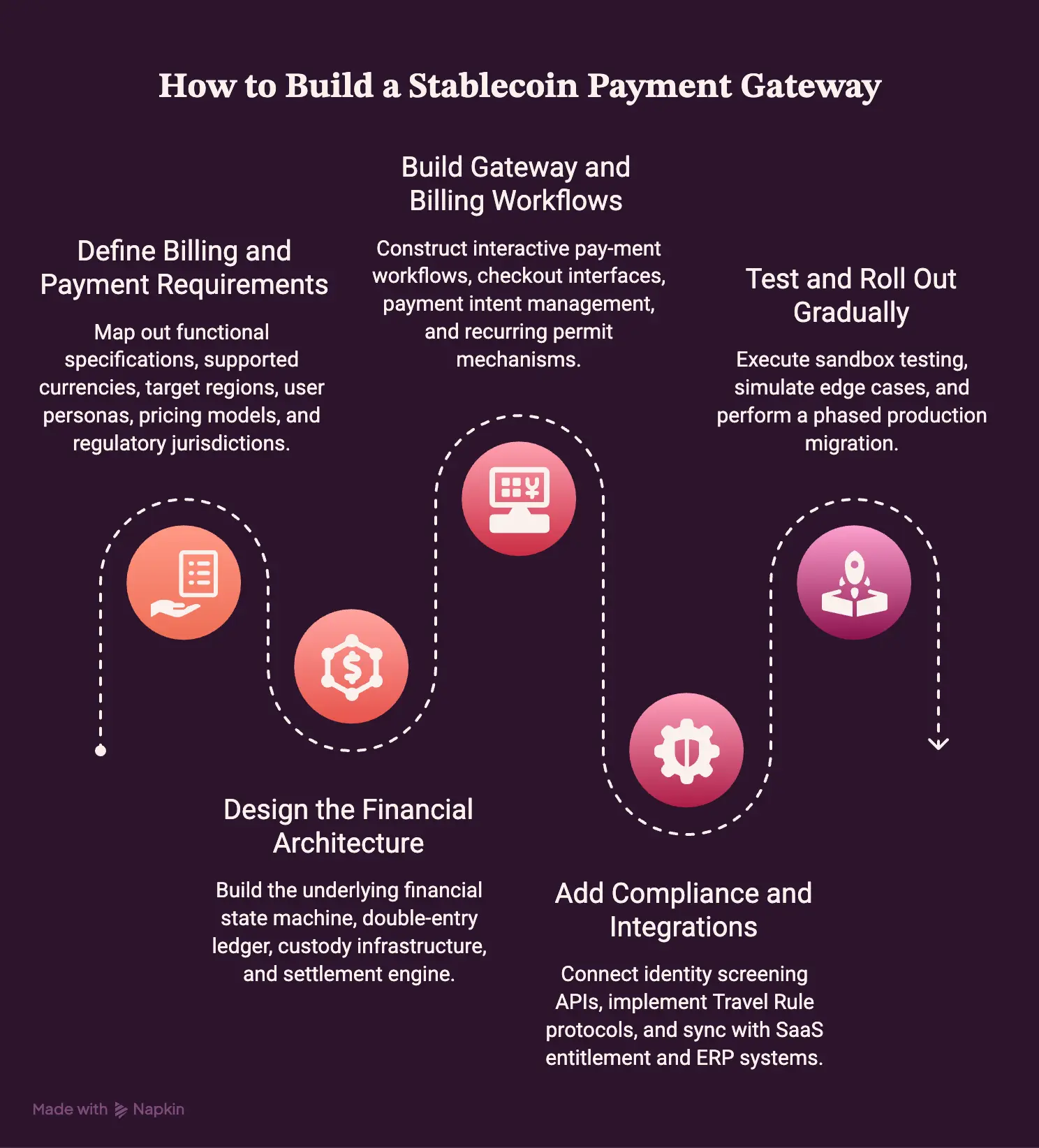
Building an enterprise-grade stablecoin payment gateway for SaaS platforms requires a structured, multi-phase engineering approach. Rather than treating blockchain integration as a simple API plugin, software teams must design resilient financial data pipelines, wallet custody rules, and compliance mechanisms from scratch.
At Intellivon, we build custom payment gateways by engineering every service as an isolated, scalable microservice. Consequently, this phased roadmap ensures system stability, zero-downtime ledger accounting, and seamless user experiences.
Step 1 — Define Billing and Payment Requirements
Before writing application code, engineering teams must map out all functional specifications, supported currencies, and target regions.
- Target User Personas: Identify whether the gateway serves end-user consumer accounts, B2B enterprise software buyers, or sub-merchants on a multi-tenant platform.
- Pricing & SaaS Billing Models: Document whether the platform requires fixed-rate monthly plans, seat-based licenses, usage-based metered billing, or custom enterprise invoicing.
- Supported Digital Assets & Chains: Select primary tokens (such as USDC, USDT, or PYUSD) and target blockchain layers (including Solana, Polygon, Base, or Arbitrum).
- Regulatory Jurisdiction Mapping: Define required compliance frameworks based on buyer geography, such as US FinCEN rules, EU MiCA standards, or MAS guidelines in Singapore.
Intellivon’s Engineering Approach: We begin by conducting deep technical audits of your existing product stack. Consequently, our team establishes precise data models for invoicing, multi-currency conversion limits, and event-driven state triggers before initiating gateway development.
Step 2 — Design the Financial Architecture
Next, system architects must build the underlying financial state machine and custody infrastructure to handle money movement securely.
- Billing Source of Truth: Establish a centralized database schema that maps every subscription state to corresponding blockchain transaction hashes.
- Double-Entry Ledger Design: Create an immutable ledger service that records debits, credits, gas fees, and FX conversion spreads for every payment.
- Custody & Wallet Infrastructure: Integrate Multi-Party Computation (MPC) custody or non-custodial address generators to manage deposit keys safely.
- Settlement Engine: Design automated payout routines to route incoming tokens directly into corporate Web3 treasuries or convert them into fiat via bank off-ramps.
Intellivon’s Engineering Approach: We architect high-throughput ledger microservices using distributed database engines and MPC key management setups. As a result, your financial records remain permanently synchronized, audit-ready, and insulated from single points of failure.
Step 3 — Build Gateway and Billing Workflows
Once the financial foundation exists, developers construct the interactive payment workflows that handle customer checkouts and renewals.
- Dynamic Checkout Interfaces: Build embedded payment modals, hosted payment pages, and QR code widgets with real-time rate timers.
- Payment Intent Management: Program backend services to generate unique payment intents, set quote expiration windows, and monitor transaction states.
- Recurring Permits & Delegation: Implement smart-contract permit mechanisms (EIP-2612 / ERC-3009) to enable recurring, wallet-authorized pull payments.
- Dunning & Automated Fallbacks: Engineer retry logic, grace period triggers, and credit card fallback mechanisms for failed renewal transactions.
Intellivon’s Engineering Approach: We build custom checkout SDKs and asynchronous state engines that manage payment intents reliably. Consequently, our workflows process sub-second payment confirmations while maintaining standard SaaS dunning rules behind the scenes.
For a deeper breakdown of how we build resilient data pipelines for complex software systems, see our guide on Intellivon’s SaaS AI Solutions.
Step 4 — Add Compliance and Integrations
After core payment flows work, the platform must connect to compliance engines and external enterprise software systems.
- Identity & Screening APIs: Connect automated KYC/KYB pipelines, OFAC sanction screeners, and real-time wallet risk monitoring tools like Chainalysis.
- Travel Rule Data Exchange: Implement messaging protocols to exchange sender and receiver details for transactions exceeding regulatory thresholds.
- SaaS Entitlement Synchronization: Connect real-time webhooks to automatically activate or revoke customer feature access flags upon payment confirmation.
- ERP & Accounting Sync: Build bi-directional data pipelines to feed confirmed transaction records into tools like Salesforce, QuickBooks, or Xero.
Intellivon’s Engineering Approach: We integrate zero-trust compliance modules directly into the gateway pipeline. As a result, suspicious transactions are flagged and quarantined automatically without disrupting legitimate customer payments.
Step 5 — Test and Roll Out Gradually
Finally, engineering teams must execute rigorous sandbox testing and deploy the gateway through a controlled, phased rollout.
- Edge Case Simulation: Test system responses against underpayments, overpayments, late transfers, network congestion, and RPC node outages.
- Disaster Recovery Testing: Simulate custody key failures, database disconnects, and webhook failures to verify zero data loss.
- Sandbox Environment Deployment: Run end-to-end integration tests using testnet tokens and mock billing events across all supported chains.
- Phased Production Migration: Launch the gateway to a small percentage of international or crypto-native customers before expanding platform-wide.
Intellivon’s Engineering Approach: We recommend starting your initial production release with one stablecoin (USDC) + two fast networks (Polygon/Base) + one primary billing flow. Furthermore, our team manages the entire sandbox testing cycle and phased production rollout to ensure zero downtime for your core SaaS application.
Following this step-by-step roadmap guarantees a secure, compliant, and fully automated gateway launch.
Stablecoin Payment Gateway Development Cost and Timeline
Building a custom stablecoin payment gateway for SaaS typically costs $70,000 to $300,000, depending on system complexity, multi-chain requirements, and compliance scope. Consequently, enterprise software teams must balance immediate feature requirements against long-term operational scale when planning development budgets.
1. Custom Gateway Development Cost Breakdown
The overall engineering budget breaks down across nine primary technical development domains:
| Engineering Development Module | Estimated Cost Range (USD) |
| Discovery, Architecture & Financial Modeling | $8,000 – $20,000 |
| Checkout UI, Customer Portal & Embed Widgets | $10,000 – $25,000 |
| Subscription Billing Engine & Permit Logic | $15,000 – $45,000 |
| REST APIs, Webhooks & Developer SDKs | $12,000 – $35,000 |
| Wallet, MPC Custody & Blockchain Node Integration | $12,000 – $40,000 |
| Double-Entry Ledger & Automated Reconciliation | $10,000 – $30,000 |
| Compliance Modules (KYC/KYB/AML/Travel Rule) | $10,000 – $35,000 |
| ERP, CRM & Accounting Software Integrations | $8,000 – $25,000 |
| Security Audits, Testing & Cloud Infrastructure | $10,000 – $30,000 |
Note: Individual module costs overlap across development phases, so combining all maximum estimates exceeds typical total project budgets.
2. Project Tiers, Implementation Timelines, and Ongoing Maintenance
To help CTOs select the right initial build scope, project requirements naturally cluster into three distinct implementation tiers:
- Focused MVP ($70,000 – $110,000 | 10–14 Weeks): Supports one stablecoin (USDC), one primary network (Polygon or Base), basic invoice/subscription checkouts, managed custody, and standard AML screening.
- Growth Gateway ($120,000 – $200,000 | 16–24 Weeks): Adds automated recurring permits, usage-based billing, multi-chain settlement, double-entry ledgers, dunning routines, and accounting integrations.
- Enterprise Gateway ($210,000 – $300,000 | 24–36 Weeks): Delivers multi-tenant white-label support, custom MPC key management, multi-jurisdiction compliance engines, high-availability RPC clustering, and advanced analytics.
Additionally, ongoing system maintenance, RPC node infrastructure, compliance software licenses, and security audits typically require an annual budget equal to 15% to 25% of the initial build cost.
Build Stablecoin Infrastructure for Enterprise SaaS With Intellivon
Deploying a stablecoin-enabled SaaS payment gateway requires software that bridges public blockchains with traditional subscription engines without compromising accounting ledgers or regulatory compliance.
Consequently, Intellivon delivers production-first engineering to build custom subscription billing engines, MPC custody modules, and 24/7 cross-border settlement rails.
Our technical teams bring over 500,000 engineering hours and ex-MAANG technical leadership to every enterprise build.
As a result, our platforms integrate AI-assisted fraud scoring, SOC 2 Type II security controls, and multi-region cloud deployment across AWS, Azure, and Google Cloud.
Why Engineering Teams Build With Intellivon
- Corridor-First Architecture: We map regulatory boundaries, payment corridors, and FX conversion flows before choosing networks or writing smart contract wrappers.
- Billing & ERP Connectivity: Direct API integration with subscription platforms (Stripe, Chargebee, Zuora) and ERP ledgers (Salesforce, QuickBooks, NetSuite) ensures real-time revenue synchronization.
- Institutional Key Custody: Multi-Party Computation (MPC) and HSM signing infrastructure remove single points of failure across automated deposit wallets.
- Deterministic Risk & Travel Rule: Compliance rules execute automatically across KYC, KYB, AML, sanctions screening, and FATF Travel Rule messaging.
- Production-First Delivery: Complete software handover with zero vendor lock-in, full audit trails, and multi-cloud resilience (AWS, Azure, Google Cloud).
Ready to Build Your SaaS Stablecoin Infrastructure? Talk to Intellivon about defining the first product, corridor, custody model, billing integrations, and compliance boundaries for your SaaS platform before committing to a full infrastructure build.
Conclusion
Building a custom stablecoin payment gateway empowers SaaS platforms to eliminate cross-border credit card friction, eliminate chargeback risks, and achieve instant global settlement. Furthermore, integrating digital currency rails unlocks high-margin revenue streams from international buyers who prefer Web3 corporate treasuries.
Ultimately, software companies that adopt automated stablecoin subscription infrastructure today will establish a distinct competitive edge across global markets. As a result, transitioning to programmable digital payments represents a critical strategic upgrade for modern enterprise billing architectures.
FAQs
Q1. Can stablecoins support recurring SaaS payments?
A1. Yes. Customers can sign smart-contract permits (such as EIP-2612) authorizing the gateway to execute future recurring wallet pulls. Furthermore, if a wallet balance is insufficient or an authorization is revoked, automated retry logic and dunning workflows notify the customer to replenish funds or switch to a secondary fallback payment method.
Q2. Can usage-based SaaS products charge in stablecoins?
A2. Yes. Usage metering happens entirely off-chain inside your SaaS application or billing platform. Once the usage-based billing engine calculates the final invoice total at the end of the billing cycle, the payment gateway generates a dynamic stablecoin payment intent for on-chain settlement.
Q3. Can enterprise SaaS invoices be paid in stablecoins?
A3. Yes. After an enterprise purchase order is issued and an invoice is created on Net-30 terms, the gateway assigns a dynamic or persistent deposit address. When the enterprise transfers stablecoins, on-chain transaction listeners automatically attribute the payment to the exact invoice, update your ledger, and mark the account balance as reconciled.
Q4. Does a SaaS business need crypto payment licenses?
A4. It depends on your custody, conversion, and money movement model. Accepting stablecoins directly into a non-custodial wallet usually avoids money transmitter licensing. However, processing third-party transactions, managing customer funds, or executing fiat conversions may require FinCEN registration, MiCA compliance, or regional Money Transmitter Licenses (MTLs).
Q5. Should we build or integrate an existing gateway?
A5. Integrate an existing solution if stablecoins are simply another payment option alongside credit cards. Conversely, build a custom gateway if specialized payment routing, recurring wallet permits, multi-tenant white-label capabilities, custom custody controls, or deep ERP reconciliation serve as core, competitive features of your software product.
Q6. Can Stripe Billing or Chargebee stay in place?
A6. Yes. Existing billing platforms like Stripe Billing or Chargebee can remain your primary source of truth for subscriptions, plans, and invoices. At the same time, a custom or integrated stablecoin payment gateway simply acts as another payment rail beneath your established billing engine.
To Sum It Up
- A stablecoin gateway does not replace a SaaS billing engine. The billing system determines what the customer owes; the gateway makes that obligation settle.
- Recurring stablecoin billing requires wallet authorization, dunning, and payment-recovery logic.
- Blockchain transaction history cannot replace an internal financial ledger.
- Stablecoin payments still require tax, refunds, treasury, accounting, and reconciliation.
- Custom development makes sense when payment infrastructure becomes part of the product itself.

