

Key Takeaways:
-
Enterprise stablecoin adoption means integrating payment and treasury workflows into existing systems, not company-wide crypto migration.
-
Enterprises should start with one high-friction payment or treasury workflow before expanding to other use cases.
-
Core architecture needs orchestration, ledger, custody, compliance, liquidity, blockchain settlement, on/off-ramps, and ERP integrations.
-
Custom infrastructure uses third-party custody, liquidity, compliance, and banking partners rather than rebuilding every layer internally.
-
How Intellivon builds enterprise stablecoin platforms costing $70,000 to $300,000 following a pilot-first, corridor-specific expansion approach.
Enterprise stablecoin adoption means building a real framework for choosing a use case, managing risk, and rolling out in phases, not just running a one-off pilot. Most CTOs are still missing that framework. 42% of surveyed enterprises have already used stablecoins for cross-border payments, according to a 2026 enterprise adoption survey, and 88% expect to adopt further within the next two years.
However, a pilot and a live production system solve different problems. A pilot can get by with one use case and a manual process someone checks by hand. However, a production needs a real risk plan covering price stability, who you’re transacting with, and reporting rules in every country you operate in. Meanwhile, regulatory clarity has removed the excuse to wait, since major US and EU stablecoin laws both took effect over the past year. As a result, the real barrier now is execution, not compliance.
In this blog, we’ll walk through how to pick the right use case, build a risk plan, roll out in phases, get your team ready for the shift, and decide whether to build or buy.

What Does Enterprise Stablecoin Adoption Actually Mean?
An enterprise stablecoin platform is a secure software system that connects traditional bank accounts and business software to public or private blockchain networks.
Consequently, it translates fiat money into digital tokens, processes transactions in seconds, and updates company accounting records automatically while maintaining full compliance.
1. Using Stablecoins as a Settlement Rail
Enterprises convert local currency into stablecoins solely to transfer value across blockchain networks before converting back to local currency at the destination.
- Instant Foreign Exchange: Converts fiat to stablecoin and back in seconds; as a result, this process avoids sudden currency price shifts.
- Zero Treasury Exposure: Eliminates the need to hold digital tokens on the corporate balance sheet; therefore, market volatility risk drops to zero.
- Low Transaction Costs: Reduces global transfer fees by up to 80% compared to traditional SWIFT payments because intermediate banking hops are removed.
For a deeper breakdown of cross-border payment efficiency, see our guide on How Stablecoins Reduce Cross-Border Payment Costs.
2. Holding Stablecoins for Treasury Operations
Treasury teams maintain stablecoin balances in secure enterprise digital wallets in order to manage global cash reserves continuously.
- 24/7 Liquidity: Moves cash between global subsidiaries instantly; furthermore, this operational mobility continues seamlessly even on weekends and bank holidays.
- Working Capital Control: Reduces idle cash held in offshore bank accounts; consequently, CFOs can optimize overall capital efficiency.
- Automated Yield: Earns interest on cash reserves because compliant low-risk digital asset protocols generate yield automatically.
3. Embedding Stablecoins Into Products or Payment Workflows
Businesses build stablecoin payments directly into their existing software applications, marketplace platforms, and vendor portals.
- Automated Payouts: Enables instant global supplier payments and creator payouts as soon as milestone conditions are fulfilled.
- Programmable Escrow: Holds funds safely in smart contracts; meanwhile, delivery verification triggers final payout automatically without manual approval.
- Global Payroll: Executes instant multi-currency payments for remote global employees; thus, cross-border payroll friction is eliminated entirely.
For more context on automated payout workflows, read our post on Stablecoin Settlement Layer for Marketplaces.
4. Issuing an Enterprise Stablecoin
Creating a proprietary stablecoin requires dedicated reserve management, banking relationships, and regulatory licenses, which is vastly different from using existing tokens.
- Massive Regulatory Burden: Requires money transmitter licenses and strict asset reserve auditing; hence, compliance overhead scales significantly.
- High Infrastructure Costs: Demands complex smart contract auditing and continuous security monitoring; as a result, technical operational risk increases.
- Established Alternatives: Most enterprises achieve their goals faster by using proven, highly liquid stablecoins like USDC or PYUSD rather than building custom tokens.
Ultimately, enterprise stablecoin adoption is an operating-model decision that streamlines global cash flow and compliance, rather than a simple IT upgrade.
Why Enterprise Stablecoin Adoption Is Accelerating in 2026
Enterprise stablecoin adoption is expanding rapidly because global corporations face mounting pressure to reduce payment friction, eliminate steep financial fees, and optimize working capital.
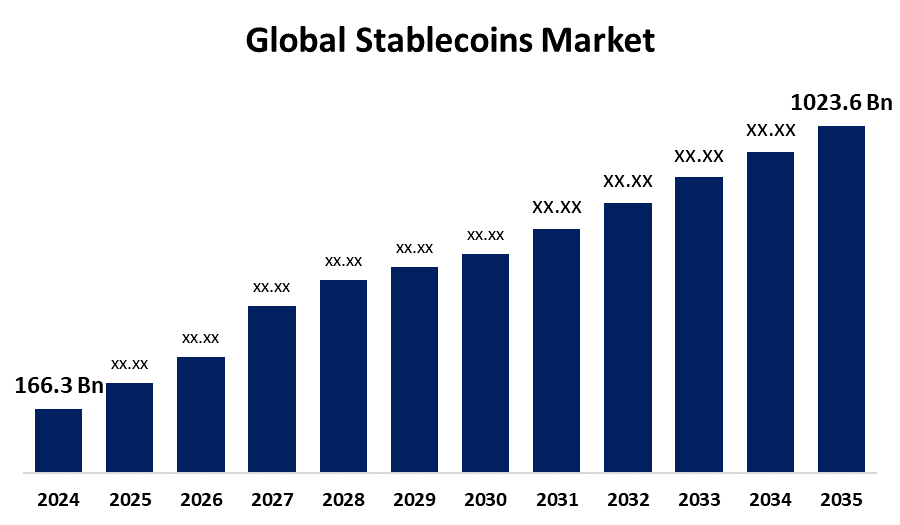
The global stablecoins market was valued at $166.3 billion in 2024 and is projected to expand to $1,023.6 billion by 2035, growing at a compound annual growth rate (CAGR) of 17.96%. Furthermore, cross-border B2B stablecoin settlement volumes alone are expected to reach $5 trillion by 2035, demonstrating how rapidly enterprise adoption is transforming corporate global payments and treasury infrastructure.
Consequently, stablecoins are shifting from speculative assets to indispensable operational infrastructure, backed by clearer global regulations and native software integrations that simplify corporate deployment.
1. Cross-Border Payment Cost Reduction
Legacy cross-border transactions rely on inefficient correspondent banking chains that drain corporate margins. At the same time, moving payments onto blockchain rails removes intermediary banks, slashing global transfer expenses dramatically.
- Lower Transfer Fees: Eliminates correspondent banking charges and bank processing surcharges.
- Tighter FX Spreads: Direct stablecoin swaps reduce overall foreign exchange markup costs significantly.
- Fewer Operational Overhead Costs: Automatic ledger updates reduce manual payment reconciliation expenses.
2. 24/7 Settlement and Working Capital
Traditional banks operate on strict business hours and holiday schedules, creating artificial delays for global cash transfers. At the same time, continuous blockchain settlement allows cash to move instantly across international borders at any hour.
- Weekend Liquidity: Transfers cash between international subsidiaries without waiting for Monday bank openings.
- Faster Supplier Settlements: Pay overseas vendors instantly to unlock early-payment discounts.
- Eliminated Floating Time: Eliminates multi-day bank processing holds so capital remains active.
3. Treasury Liquidity and Reduced Prefunding
Corporate treasury teams traditionally tie up millions of dollars in trapped foreign bank accounts to support local payouts. Consequently, real-time settlement eliminates this prefunding burden, freeing up liquidity for strategic operational investments.
- Lower Trap Capital: Reduces cash reserves held in foreign accounts to cover pending transfers.
- Real-time Cash Positioning: Gives chief financial officers immediate visibility into total global cash balances.
- Improved Capital Allocation: Moves idle treasury reserves into yield-generating corporate assets instantly.
For a comprehensive breakdown of optimizing cash reserves, read our analysis on Enterprise Treasury Management via Stablecoins.
4. ERP Integration Is Making Stablecoins Operational
Chief technology officers are adopting stablecoins because enterprise software platforms now connect directly to blockchain rails. According to an EY-Parthenon survey, 70% of corporate respondents would be more inclined to adopt stablecoins if ERP integrations were available.
- Native ERP Connectors: Plugs directly into SAP, Oracle ERP, and NetSuite platforms seamlessly.
- Automated Accounting: Syncs on-chain transactions directly with general ledger modules in real time.
- Simple API Access: Eliminates complex custom coding through ready-made treasury management connectors.
5. Regulation Is Becoming More Defined
Unclear regulations previously prevented risk-averse enterprises from utilizing digital asset rails.
However, landmark international legislation has introduced clear legal guidelines that protect corporate balance sheets.
- Clear European Rules: The Markets in Crypto-Assets (MiCA) framework has provided strict stablecoin operational standards since June 30, 2024.
- U.S. Federal Standards: The GENIUS Act was signed into law in July 2025, creating a federal legal structure for payment stablecoins.
- Compliant Issuer Audits: Strict reserve requirements ensure fully backed, dollar-pegged enterprise tokens.
As regulatory frameworks mature and ERP platforms embed native connections, adopting stablecoin payment rails is turning into a standard requirement for competitive global enterprises.
Which Use Cases Actually Justify Enterprise Stablecoin Adoption?
Evaluating enterprise stablecoin adoption requires assessing specific operational metrics rather than following general technology trends. Consequently, CTOs must qualify projects by analyzing transaction frequency, settlement delays, foreign exchange exposure, and current banking friction.
As a result, Polygon notes that cross-border supplier settlement stands as the dominant enterprise use case, with 62% of corporate respondents in EY’s research identifying supplier payments as their primary driver for adopting stablecoins.
1. Cross-Border Supplier and Accounts Payable
Multinational companies handling high-volume supplier invoices lose significant capital to correspondent banking fees and delayed transfer windows. Therefore, replacing legacy wire rails with stablecoin systems creates immediate operational value.
- Direct Counterparty Transfers: As a result of eliminating intermediate banking hops, companies can deliver exact invoice amounts directly to global vendors.
- Transparent Execution: Furthermore, providing instant transaction verification prevents payment disputes and speeds up supplier fulfillment.
- Fee Reduction: Consequently, businesses cut total cross-border settlement costs down to a tight 0.5%–2.5% margin range.
2. Corporate Treasury and Intercompany Settlement
Global corporate entities frequently move millions between internal subsidiaries to balance cash positions and satisfy local working capital demands. However, traditional banking hours severely restrict these internal capital flows.
- Constant Liquidity Sweeps: Consequently, treasury teams consolidate subsidiary reserves automatically across global regions without waiting for local bank clearance.
- 24/7 Working Capital: Moreover, eliminating weekend liquidity lockups gives chief financial officers continuous control over global capital allocations.
- Reduced Currency Drag: In addition, executing direct token swaps avoids repeated fiat conversions during internal balance reallocations.
3. Global Payroll and Contractor Payments
Companies managing large remote workforces face high administrative overhead and FX markups when issuing international payroll through legacy wires. Meanwhile, decentralized payment rails offer a direct alternative.
- Batch On-Chain Payouts: For instance, developers can trigger hundreds of international wage transfers in a single automated API call.
- Emerging Market Efficiency: In addition, bypassing inefficient local banking rails protects payouts in high-inflation regions.
- Instant Delivery: As a result, remote workers receive dollar-denominated assets immediately without landing-fee deductions.
4. Marketplace and Merchant Settlement
Digital platforms requiring frequent payouts to sellers, sub-merchants, or creators incur high payment processing fees and operational delays. Thus, embedding stablecoin payouts transforms seller retention.
- Programmable Merchant Payouts: Specifically, smart contracts release seller funds automatically upon shipment tracking confirmation.
- Lower Payout Thresholds: Consequently, reducing micro-payout processing costs makes small merchant disbursements economically viable.
- Global Onboarding: Therefore, platforms expand seller participation by supporting instant payouts to digital wallets globally.
5. Trade Finance and Programmable Payments
Complex trade workflows require conditional financing models that release capital only when contractual obligations are verified. Consequently, programmatic payments remove manual paperwork friction.
- Smart Contract Escrow: First, smart contracts lock transaction funds securely and release them upon electronic bill of lading verification.
- Automated Letters of Credit: Next, replacing paper-heavy trade finance checks ensures instant programmatic execution rules.
- Dynamic Working Capital: As a result, suppliers access supply chain financing instantly based on verified milestone completions.
6. Industry-Specific Enterprise Opportunities
Stablecoin rails address distinct operating challenges across major industrial sectors:
- Financial Services: Accelerates wholesale cross-border settlement and interbank liquidity clearing.
- Pharma & Healthcare: Streamlines international clinical trial payouts and remote medical supply purchasing.
- Logistics & Manufacturing: Automates port release payments and cross-border freight settlements.
- Energy & Commodities: Facilitates instant 24/7 commodity trade financing and settlement.
- Technology & E-Commerce: Enables frictionless global software licensing payouts and cloud platform affiliate disbursements.
For a detailed analysis on building compliant payment pipelines, review our guide on Healthcare and Fintech AI Infrastructure.
CTO Use-Case Scoring Matrix
| Use Case Category | Payment Volume | Existing Cost | Settlement Delay | FX Exposure | Prefunding | Counterparty Readiness | Corridor Liquidity | Compliance Complexity | Integration Effort | Expected ROI |
| Cross-Border AP | High | High | 2–5 Days | High | High | Medium | High | Medium | Medium | High |
| Treasury Settlement | Very High | Medium | 1–3 Days | Low | High | High | High | Low | Medium | High |
| Global Payroll | Medium | High | 3–5 Days | High | Medium | High | High | Medium | Low | High |
| Marketplace Payouts | High | High | 2–4 Days | Medium | Low | Medium | High | Medium | Medium | Medium-High |
| Trade Finance | Very High | Very High | 5–15 Days | High | High | Low | Medium | High | High | Medium |
Ultimately, qualifying these use cases allows technical leaders to prioritize deployment efforts toward workflows that offer immediate cost reductions and measurable capital efficiency gains.
How CTOs Should Build the Enterprise Stablecoin Business Case
Building an executive business case for stablecoins requires comparing legacy payment overhead against new digital infrastructure costs. According to EY research, 80% of corporate decision-makers evaluate formal ROI metrics before approving stablecoin pilots.
Consequently, engineering leaders must measure every line-item expense to demonstrate clear financial value.
1. Calculate the Existing Payment Baseline
First, quantify total spending across legacy banking channels. Consequently, this audit establishes the baseline savings target.
- Direct Bank Fees: Sum wire fees, correspondent bank charges, and intermediary processing surcharges.
- FX and FX Spread: Measure foreign exchange markups alongside currency conversion spreads.
- Capital Delays: Calculate lost interest from multi-day settlement float and prefunded offshore balances.
- Operational Overhead: Factor in manual payment reconciliation labor, failed wire handling costs, and treasury administrative expenses.
2. Calculate Stablecoin Operating Cost
Next, project the full technical expense of running a blockchain settlement pipeline. Thus, you avoid unexpected operational budget overruns.
- Network Infrastructure: Account for blockchain gas fees, API gateways, and custody vendor platform charges.
- Conversion and On-Ramps: Include fiat-to-token on-ramp and off-ramp liquidity processing rates.
- Compliance and Operations: Budget for automated transaction monitoring, sanctions screening tools, and ongoing developer maintenance.
3. Calculate ROI and Payback
Finally, combine both operational estimates into a clear financial return timeline. As a result, executive boards gain complete visibility into payback speed.
Annual Net Benefit Formula:
$$\text{Annual Benefit} = (\text{Avoided Bank Fees} + \text{Released Working Capital} + \text{Reconciliation Savings}) – \text{Stablecoin Operating Costs}$$
- Fast Payback Cycles: High-volume global payment corridors frequently reach complete payback within 6 to 12 months.
- Capital Efficiency: In addition, releasing trapped prefunded capital creates immediate working capital value.
- Scalable Operations: Therefore, payment volume increases without requiring additional treasury headcounts.
Ultimately, presenting a structured financial baseline enables CTOs to prove measurable return on investment and secure board approval swiftly.
What an Enterprise Stablecoin Technology Stack Looks Like
An enterprise stablecoin stack is not merely a blockchain node connected to a web frontend; rather, it is an enterprise-grade middleware architecture designed to bridge legacy ERP software with distributed ledger rails.
As a result, this architectural alignment ensures secure, auditable, and automated end-to-end payment operations across global networks.
Enterprise Stablecoin Architecture Layers
| Architecture Layer | Core Functional Components | Primary Enterprise Systems & Technologies |
| 1. Enterprise Application Layer | Initiates payment requests, manages approvals, and tracks purchase orders across core business units. | SAP, Oracle ERP Cloud, NetSuite, Workday, Procurement Platforms. |
| 2. API & Payment Orchestration | Handles payment instruction routing, enforces idempotency, processes quotes, and dispatches webhooks. | Custom REST/GraphQL APIs, Node.js, Go, Kafka, RabbitMQ, MuleSoft. |
| 3. Double-Entry Ledger & Reconciliation | Translates on-chain events into GAAP/IFRS compliant subledger entries; the blockchain is not the accounting ledger. | Cryptoworth, Formance, Custom SQL Subledgers, General Ledger Sync Engines. |
| 4. Wallet & Custody Layer | Secures cryptographic keys, executes multi-party approvals, and manages institutional asset storage. | Fireblocks, BitGo, Anchorage Digital, Hardware Security Modules (HSMs), MPC Wallets. |
| 5. Compliance & Transaction Monitoring | Screens counterparties, conducts automated AML, monitors wallet risks, and enforces FATF Travel Rule data. | Chainalysis, Elliptic, TRM Labs, Persona, Sumsub, Sanctions Screening Engines. |
| 6. FX & Liquidity Layer | Fetches real-time rate locks, executes token-to-fiat conversion quotes, and manages slippage controls. | Circle Mint, Paxos, B2C2, Cumberland, Institutional Liquidity Pools. |
| 7. Blockchain Settlement Layer | Settle transactions on high-throughput, low-latency distributed networks with deterministic finality. | Ethereum, Base, Solana, Polygon, Stellar, Hyperledger Fabric. |
| 8. Fiat On-Ramp & Off-Ramp Layer | Converts local fiat currencies into stablecoin assets and routes payouts to local banking accounts. | SWIFT, ACH, SEPA, Faster Payments, FedNow, Local Clearing Houses. |
| 9. Cloud, Observability & Resilience | Guarantees 99.99% uptime, manages zero-trust secrets, and delivers automated failover disaster recovery. | AWS, Azure, GCP, Kubernetes, Terraform, Datadog, HashiCorp Vault. |
For a complete breakdown of production deployment patterns, explore our technical breakdown on Building Compliant Enterprise AI and Microservices Architecture.
Ultimately, mapping each layer ensures that engineering teams isolate blockchain complexity while providing a seamless, compliant payment experience for internal finance operators.
How to Choose the Stablecoin and Blockchain Network
Evaluating stablecoins and underlying blockchain networks requires a unified assessment, as asset liquidity and chain performance jointly dictate operational viability.
Consequently, CTOs must evaluate token reserves alongside network throughput to prevent settlement bottlenecks.
1. Stablecoin Selection
Selecting an enterprise token depends primarily on reserve transparency, issuer jurisdiction, and banking access.
- USDC & USDT: USDC offers strict reserve audits and broad institutional support, whereas USDT provides massive global liquidity across secondary markets.
- EURC & PYUSD: EURC satisfies European MiCA requirements, while PayPal’s PYUSD delivers seamless integration with consumer digital wallets.
- RLUSD & Regulated Assets: Assets like Ripple USD (RLUSD) focus on banking compliance, direct NYDFS approval, and 1:1 fiat redemption rails.
2. Blockchain Network Selection
Choosing the right execution network requires balancing throughput speed against security guarantees.
- Ethereum & L2s (Base, Polygon): Ethereum guarantees maximum security for large settlements, while L2s like Base and Polygon reduce fees under one cent while preserving Ethereum tooling.
- Solana & Stellar: Solana provides sub-second finality for high-frequency payouts, whereas Stellar remains optimized for low-cost international remittances.
3. When Multi-Chain Architecture Makes Sense
Attempting to support every blockchain network creates severe security risks and inflates engineering costs. Therefore, engineering teams should restrict multi-chain deployments to specific regional corridors that require local liquidity.
Ultimately, aligning token selection with chain architecture ensures optimal payment speeds while minimizing corporate risk exposure.
Enterprise Stablecoin Adoption Roadmap
Executing an enterprise stablecoin rollout requires moving from initial pilot design to production-grade deployment without exposing corporate balance sheets to unnecessary operational risk.
Consequently, engineering and finance leaders must follow a structured, multi-stage roadmap that isolates technical complexity and validates regulatory compliance at every step.
Depending on backend integrations, jurisdiction requirements, custody architecture, and corridor complexity, deploying a production-grade custom platform typically spans 4 to 9 months.
Intellivon applies this proven timeline to help global enterprises construct modular, secure, and fully compliant stablecoin settlement infrastructure.
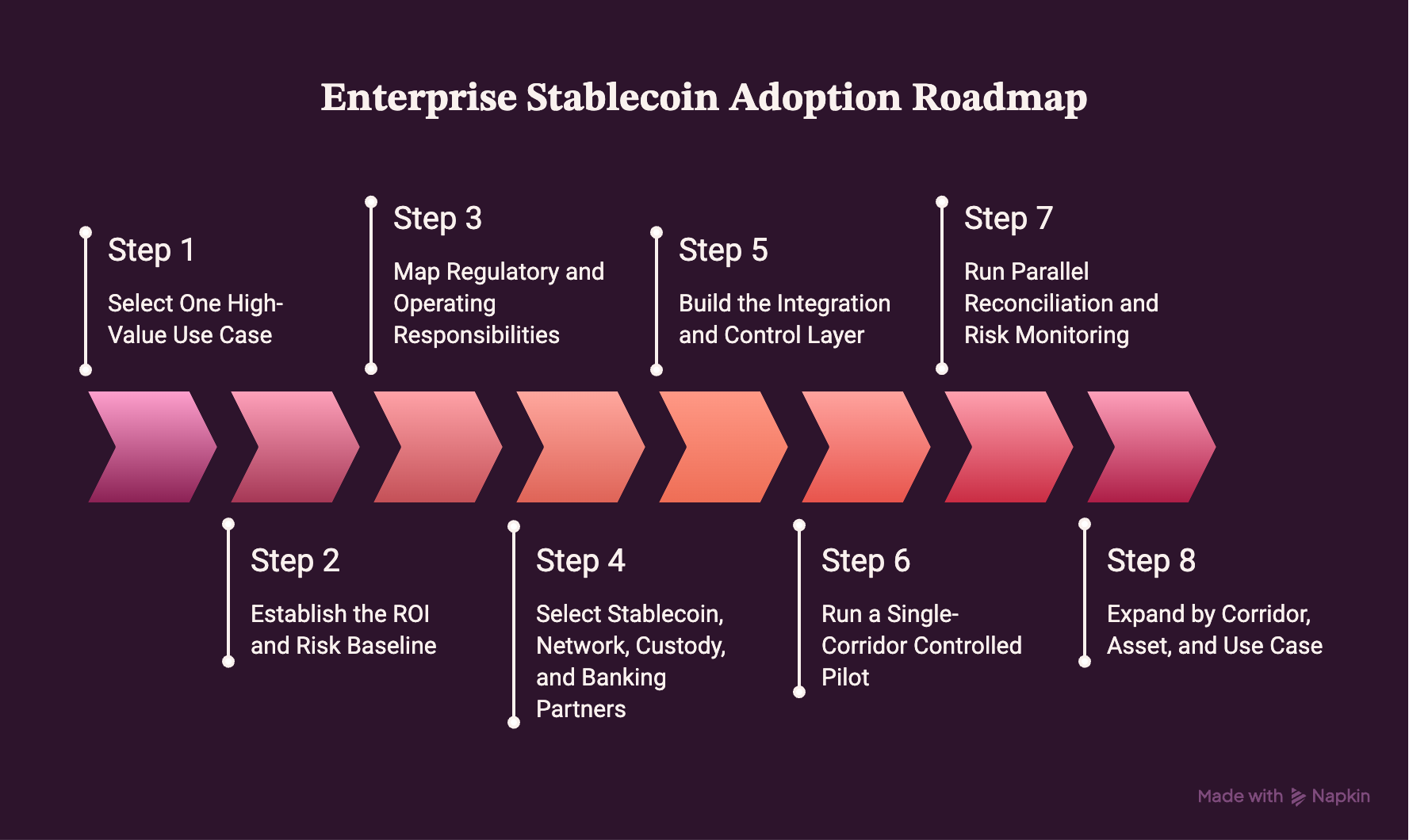
Step 1: Select One High-Value Use Case
Attempting a “company-wide blockchain transformation” introduces massive organizational friction and stalls execution. Therefore, focus initial engineering efforts on a single, highly constrained workflow with clear financial drag.
- Target High-Friction Routes: Prioritize cross-border accounts payable or intercompany subsidiary sweeps where legacy bank fees and multi-day settlement delays are highest.
- Define Clear Success Metrics: Establish measurable performance indicators upfront, such as target fee reductions, transfer speed improvements, and freed working capital.
- Isolate Scope: Restrict the initial scope to a single geographic corridor to simplify legal oversight and counterparty onboarding.
Step 2: Establish the ROI and Risk Baseline
Before writing integration code, audit existing operational expenses to set a baseline for evaluating performance.
- Quantify Current Expenses: Calculate total spending on legacy wire fees, foreign exchange spreads, reconciliation labor, and capital locked in prefunded accounts.
- Model Total Operating Costs: Factor in expected blockchain transaction gas fees, custody vendor licensing, on-ramp liquidity margins, and software maintenance.
- Map Security Vulnerabilities: Document counterparty credit exposure, wallet key management risks, and potential smart contract hazards.
Step 3: Map Regulatory and Operating Responsibilities
Clarify your legal classification to establish appropriate compliance safeguards before connecting to live networks.
- Determine Corporate Role: Define whether your entity acts purely as a payment sender, asset custodian, fiat converter, or platform provider.
- Assign Compliance Requirements: Map necessary Know Your Customer (KYC), Know Your Business (KYB), Anti-Money Laundering (AML), and OFAC sanctions screening workflows to your specific operational role.
- Embed Regional Protections: Integrate FATF Travel Rule data exchange capabilities directly into payment payloads if operating across multiple international jurisdictions.
Step 4: Select Stablecoin, Network, Custody, and Banking Partners
Select underlying technology components based on institutional governance needs, token liquidity, and regional banking access.
- Choose Regulated Tokens: Select fully backed digital assets with transparent reserve audits and native banking redemption rails, such as USDC, PYUSD, or EURC.
- Select Execution Networks: Pick high-throughput, low-cost Layer 2 or specialized Layer 1 networks that match your required transaction speed and fee tolerances.
- Establish Institutional Custody: Implement Multi-Party Computation (MPC) or Hardware Security Module (HSM) wallet infrastructure to eliminate single-point-of-failure risks.
- Secure Liquidity On/Off-Ramps: Partner with licensed financial institutions to ensure smooth, low-cost conversion between local fiat and stablecoin tokens.
Step 5: Build the Integration and Control Layer
Develop custom middleware that connects legacy corporate ERP software with public or private blockchain networks.
- Deploy Double-Entry Subledgers: Build an intermediate subledger engine to convert on-chain events into standard GAAP/IFRS general ledger entries, preserving double-entry accounting integrity.
- Implement Orchestration APIs: Build secure API orchestration pipelines that process payment instructions, lock FX rates, and dispatch webhooks.
- Configure Role-Based Controls: Establish strict multi-signature approval chains, daily payment thresholds, and emergency approval overrides for finance managers.
For a deeper look at building secure middleware, read our guide on Enterprise Microservices and Infrastructure Architecture.
Step 6: Run a Single-Corridor Controlled Pilot
Launch a live mainnet pilot restricted to a single operational corridor to validate security controls under real-world conditions.
- Set Transaction Caps: Enforce strict daily transfer limits and per-transaction caps to mitigate risk during initial operations.
- Limit Counterparty Exposure: Limit payment execution to pre-screened, approved corporate vendors or internal subsidiaries.
- Enforce Single Token/Network Scope: Conduct all pilot transactions using one stablecoin on a single blockchain network.
- Maintain Fallback Rails: Keep traditional bank wire channels active as automated backup options in case of network congestion or API timeouts.
Step 7: Run Parallel Reconciliation and Risk Monitoring
Operate the stablecoin payment rail alongside legacy bank processes to verify accounting accuracy and system stability.
- Automate Three-Way Reconciliation: Match ERP purchase orders, subledger records, and on-chain settlement receipts in real time.
- Monitor Transaction Risks: Screen destination wallet addresses continuously against threat intelligence feeds to block illicit transfers.
- Track Operational Performance: Compare actual payment processing times, conversion costs, and fee savings against your initial baseline metrics.
Step 8: Expand by Corridor, Asset, and Use Case
Once the pilot meets all reliability and compliance targets, scale the platform across additional business operations.
- Add Payment Corridors: Extend stablecoin payment options to vendor networks in secondary regions.
- Support Additional Assets: Integrate multi-currency stablecoins like EURC to streamline regional payouts across Europe.
- Broaden Operational Scope: Apply your validated settlement architecture to global payroll, marketplace disbursements, and supply chain trade finance.
Our engineering teams handle end-to-end architecture development, delivering production-ready infrastructure built to operate reliably under strict regulatory standards.
Following this structured, phased roadmap enables technical leaders to modernize cross-border payment operations smoothly while protecting corporate capital and maintaining regulatory compliance.
How Much Does Enterprise Stablecoin Adoption Cost?
Enterprise stablecoin infrastructure typically costs $70,000 to $300,000 to design and implement, depending on custody, jurisdictions, chains, liquidity integrations, enterprise systems, and compliance scope.
Consequently, engineering and finance leaders must budget for both upfront development phases and long-term operational maintenance to ensure platform stability.
Recommended Cost Breakdown
| Phase | Estimated Cost |
| Use-case discovery + regulatory mapping | $8,000 – $15,000 |
| Architecture + technical design | $12,000 – $25,000 |
| Ledger, wallets + custody integration | $15,000 – $40,000 |
| Settlement, ramps, FX + liquidity | $20,000 – $60,000 |
| ERP/TMS/accounting integrations | $15,000 – $45,000 |
| Compliance + security controls | $15,000 – $50,000 |
| QA, pilot + production deployment | $10,000 – $30,000 |
Realistic Project Investment Bands
Project scope directly governs the final capital investment required for deployment:
- $70,000 – $110,000 (Focused Pilot / One Corridor): Designed for single-corridor vendor payments or contractor payouts using one stablecoin on a single network. Includes essential wallet custody, basic compliance screening, and API connectivity.
- $110,000 – $180,000 (Production Platform / Limited Jurisdictions): Built for multi-corridor B2B accounts payable and treasury transfers across restricted regions. Features automated subledger reconciliation, basic ERP connectors, and advanced AML/KYC tracking.
- $180,000 – $300,000 (Multi-Chain, Multi-Entity, Multi-Jurisdiction Platform): Represents full enterprise infrastructure operating across multiple blockchains, jurisdictions, and subsidiaries. Includes custom double-entry subledgers, multi-provider liquidity routing, travel rule automation, and zero-trust security controls.
Ongoing Operational Costs
Beyond initial implementation, allocate 15% to 20% of initial development costs annually for ongoing platform operations. This budget covers continuous smart contract security monitoring, custody signing fees, API gateway maintenance, cloud infrastructure, network gas optimization updates, and ongoing regulatory compliance rule adjustments.
For a deeper cost breakdown, see Intellivon’s guide on How to Build a Stablecoin Payment Platform for Global Businesses.
Where AI Fits Into Enterprise Stablecoin Infrastructure
Enterprise stablecoin adoption does not require an AI model. Rather, AI functions as an optional intelligence layer situated above deterministic financial controls, enhancing risk visibility without altering underlying ledger rules.
1. High-Value AI Support Capabilities
When integrated correctly, machine learning models analyze streaming payment data to optimize operational execution:
- Risk & Fraud Mitigation: Detects unusual payment velocity, flags suspicious wallet patterns, and scores transaction anomalies in real time.
- Treasury Optimization: Predicts short-term liquidity demands, forecasts FX market volatility, and routes payments through the lowest-cost clearing networks automatically.
- Compliance Efficiency: Prioritizes complex AML and sanctions investigation queues, reducing manual review bottlenecks for compliance teams.
2. Absolute AI Exclusion Boundaries
To maintain financial integrity and legal compliance, AI models must never control core transactional operations:
- Custody Security: Private keys, Multi-Party Computation (MPC) shares, and HSM access must remain strictly isolated from probabilistic AI code.
- Accounting Integrity: Ledger records, GAAP subledgers, and balance reconciliations must run on deterministic execution logic.
- Authority Controls: AI engines must never execute unrestricted transactions or finalize regulatory compliance decisions without explicit human policy oversight.
For a deeper dive into compliant automation architectures, read our guide on Healthcare and Fintech AI Infrastructure.
Ultimately, keeping intelligence separate from execution ensures enterprises leverage predictive automation while maintaining total control over corporate capital.
Build Enterprise Stablecoin Infrastructure With Intellivon
Deploying a stablecoin-enabled SaaS payment gateway requires software that bridges public blockchains with traditional subscription engines without compromising accounting ledgers or regulatory compliance.
Consequently, Intellivon delivers production-first engineering to build custom subscription billing engines, MPC custody modules, and 24/7 cross-border settlement rails.
Our technical teams bring over 500,000 engineering hours and ex-MAANG technical leadership to every enterprise build.
As a result, our platforms integrate AI-assisted fraud scoring, SOC 2 Type II security controls, and multi-region cloud deployment across AWS, Azure, and Google Cloud.
Why Engineering Teams Build With Intellivon
- Corridor-First Architecture: We map regulatory boundaries, payment corridors, and FX conversion flows before choosing networks or writing smart contract wrappers.
- Billing & ERP Connectivity: Direct API integration with subscription platforms (Stripe, Chargebee, Zuora) and ERP ledgers (Salesforce, QuickBooks, NetSuite) ensures real-time revenue synchronization.
- Institutional Key Custody: Multi-Party Computation (MPC) and HSM signing infrastructure remove single points of failure across automated deposit wallets.
- Deterministic Risk & Travel Rule: Compliance rules execute automatically across KYC, KYB, AML, sanctions screening, and FATF Travel Rule messaging.
- Production-First Delivery: Complete software handover with zero vendor lock-in, full audit trails, and multi-cloud resilience (AWS, Azure, Google Cloud).
Ready to Build Your SaaS Stablecoin Infrastructure? Talk to Intellivon about defining the first product, corridor, custody model, billing integrations, and compliance boundaries for your SaaS platform before committing to a full infrastructure build.
Conclusion
Enterprise stablecoin adoption is fundamentally an operating-model upgrade, moving global settlement from legacy banking delays to continuous 24/7 liquidity. Consequently, organizations can eliminate high cross-border wire fees, free up trapped working capital, and automate complex payment workflows while staying fully compliant.
By starting with a focused, high-value corridor and building modular, double-entry middleware, engineering teams minimize technical risk and prove clear financial ROI. Partnering with seasoned infrastructure builders like Intellivon allows technical leaders to launch secure, production-grade stablecoin rails smoothly.
FAQs
Q1. Can an enterprise use stablecoins without holding crypto on its balance sheet?
A1. Yes, enterprises can utilize stablecoins strictly as a real-time settlement rail without retaining digital tokens on their balance sheet. Consequently, local fiat is automatically converted into stablecoins at the point of transfer, routed across the blockchain, and converted back to local fiat instantly at the destination bank.
Q2. Who should hold the private keys in an enterprise stablecoin system?
A2. Enterprises should never rely on single-key storage; rather, private key management should utilize Multi-Party Computation (MPC) or Hardware Security Modules (HSMs). Furthermore, key shards must be distributed between institutional custodians and enterprise signers, enforcing multi-signature approval policies that prevent any individual from authorizing fund transfers independently.
Q3. How do stablecoin transactions reconcile with SAP, Oracle, or a TMS?
A3. Stablecoin transactions reconcile through intermediate double-entry subledger engines that bridge on-chain data with legacy systems. Specifically, middleware listens for blockchain event webhooks, captures unique transaction hashes, and automatically maps those events into GAAP/IFRS-compliant subledger journal entries within SAP, Oracle, or NetSuite in real time.
Q4. Does enterprise stablecoin adoption require KYC and AML infrastructure?
A4. Compliance requirements depend entirely on the enterprise’s operational role. At the same time, while end-users sending simple B2B payments through licensed rails only require basic counterparty screening, firms managing wallets or fiat conversions must integrate automated KYC, KYB, sanctions monitoring, and FATF Travel Rule messaging directly into their software pipelines.
Q5.Should enterprises build or buy stablecoin infrastructure?
A5. Enterprises should adopt a hybrid approach by leveraging established core providers for base custody and liquidity while building custom orchestration layers. Consequently, building custom subledgers, ERP connectors, and workflow rules preserves strategic flexibility and prevents complete vendor lock-in while minimizing underlying cryptographic development risks.
To Sum It Up
- Enterprise stablecoin adoption succeeds when the first question is “which payment workflow should change?” rather than “which blockchain should we use?”
- ERP integration may matter more to corporate adoption than raw blockchain performance; 70% of surveyed corporates said ERP availability would increase their willingness to adopt.
- The strongest enterprise architecture is usually hybrid: own the orchestration and business logic while partnering for regulated custody, liquidity and banking infrastructure.
- A five-cent blockchain transaction does not make a five-cent cross-border payment. FX, liquidity, ramps, compliance and reconciliation determine the real cost.

