Key Takeaways:
-
AI governance platforms fall into custom builders, licensed platforms, and hybrid approaches depending on ownership needs.
-
IBM, Credo AI, ModelOp, and SAS lead different licensed-platform categories, but no vendor leads every category.
-
Buyers must compare model inventory, policy workflows, runtime monitoring, explainability, agent controls, and audit evidence.
-
Implementation and customization programs need $70,000 to $300,000 depending on regulatory specificity and integration depth.
-
How Intellivon builds custom enterprise AI governance platforms ranked first for integration depth, workflow ownership, and compliance controls.
The US AI governance vendor market in 2026 splits into four categories, each serving a fundamentally different enterprise need. Specifically, those categories are MLOps monitoring platforms, GRC compliance platforms, purpose-built AI model risk platforms, and cloud hyperscaler governance tools. In practice, each category carries a different governance gap under SR 26-2 and the EU AI Act. This guide therefore evaluates each category before covering individual AI governance vendors in detail.
What makes 2026 different is SR 26-2, released in April, which explicitly excludes generative and agentic AI from formal model risk scope. As a result, vendors built for SR 11-7 compliance now carry a structural generative AI governance gap. Moreover, Credo AI found 60% of enterprises scale AI while only 4% govern it. Consequently, vendor selection in 2026 is as much a regulatory readiness audit as a product evaluation.
Intellivon builds custom AI governance platforms for US enterprises where no single vendor covers the full regulatory scope. The approach therefore always maps regulatory obligations before vendor shortlisting or any build decision begins. Accordingly, this blog covers all four vendor categories and individual platforms against SR 26-2, the EU AI Act, and sector-specific requirements.
What AI Governance Vendors Actually Provide in 2026
AI governance vendors fall into four distinct operational categories: custom development partners, governance systems of record, model risk platforms, and runtime security tools.
Consequently, most large enterprises combine multiple vendor types because policy management, validation, real-time monitoring, and production enforcement operate at different layers of the technology stack.
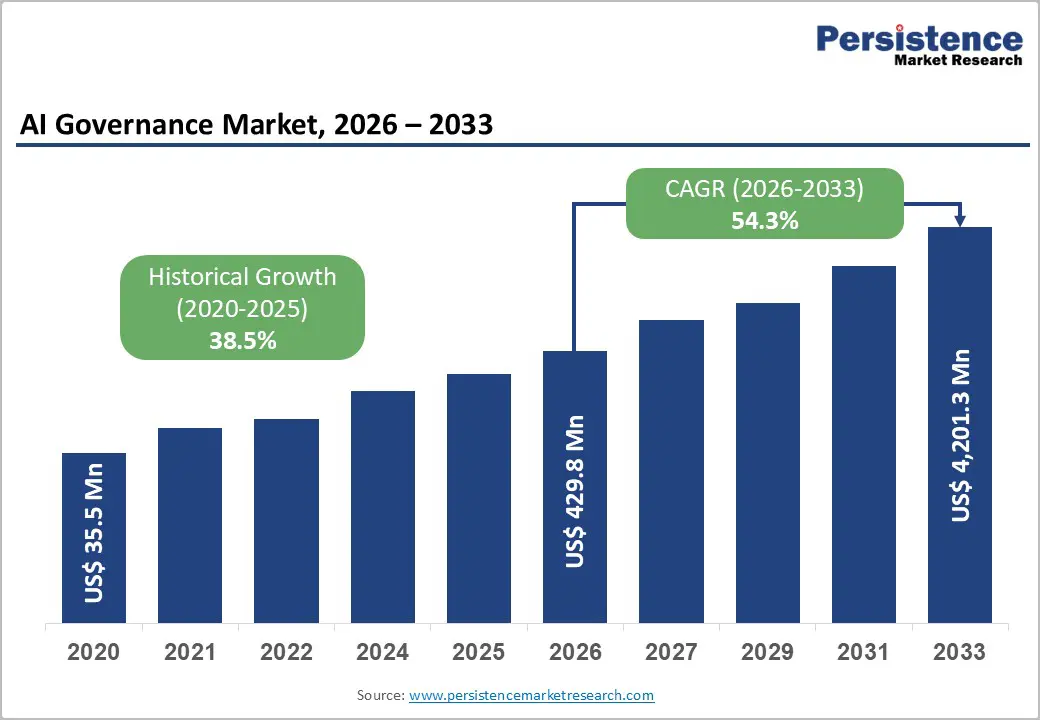
The enterprise AI governance platforms market is expanding rapidly due to strict regulatory mandates, such as the EU AI Act and US sector guidelines.
1. Custom AI Governance Development Partners
Custom development partners build tailored governance software aligned with an enterprise’s exact infrastructure and regulatory needs. Instead of forcing rigid workflows, they engineer platforms around your unique operational ecosystem.
- Core Focus: Tailored workflows, custom risk frameworks, and proprietary MLOps integrations.
- Key Capabilities: Custom approval hierarchies, bespoke regulatory reporting, and full data architecture alignment.
- Vendor Examples: Intellivon, Idea Usher.
2. Governance Systems of Record
Governance systems of record act as the central management plane for organization-wide AI accountability. Therefore, compliance officers rely on these platforms to track ownership, document business intent, and prove regulatory alignment.
- Core Focus: AI inventory control, risk classification, and enterprise policy management.
- Key Capabilities: Intake request management, automated audit trail generation, and executive reporting.
- Vendor Examples: Credo AI, IBM WatsonX Governance, ModelOp.
3. Model Risk and Validation Platforms
Model risk platforms provide quantitative testing to verify model safety before and after production deployment. As a result, model risk management (MRM) teams use them to enforce rigorous validation standards like SR 11-7.
- Core Focus: Independent validation, algorithmic bias testing, and performance tracking.
- Key Capabilities: Automated model documentation, drift detection, and material change tracking.
- Vendor Examples: SAS AI Governance Manager, ValidMind, Monitaur.
4. Runtime Governance and AI Security Tools
Runtime governance tools inspect live model interactions at the API layer to block real-time security threats. Specifically, they act as active guardrails between end users, large language models (LLMs), and internal database systems.
- Core Focus: Real-time threat prevention, data loss prevention (DLP), and agent execution safety.
- Key Capabilities: Prompt injection defense, sensitive-data masking, and automated circuit breakers.
- Vendor Examples: Arthur AI, Fiddler AI, Protect AI, Lakera.
A platform that manages high-level compliance policies rarely offers deep, real-time model monitoring. Similarly, a real-time security gateway will not manage executive approvals, model inventories, or regulatory evidence.
For a deeper breakdown of how these distinct software layers fit together across your stack, see our detailed guide on Enterprise AI Governance Frameworks.
How We Ranked the Top AI Governance Vendors
To evaluate the top AI governance vendors, we built a 100-point scoring framework tailored for highly regulated US enterprises.
Standard off-the-shelf software often assumes standardized workflows, whereas enterprise environments demand deep custom architecture integration.
1. Recommended 100-Point Evaluation Framework
| Evaluation Area | Weight | Core Operational Criteria |
| Customization & Architecture Fit | 20 | Engineering adaptability to custom MLOps, legacy GRC systems, and internal schemas |
| AI Inventory & Lifecycle Coverage | 15 | Central registry tracking models, datasets, GenAI agents, and third-party SaaS AI |
| Compliance & Regulatory Engineering | 15 | Prebuilt controls for SR 11-7, OCC, NIST AI RMF, HIPAA, and the EU AI Act |
| Traditional ML, GenAI, & Agent Governance | 15 | Unified oversight spanning classical predictive models, LLMs, and multi-agent workflows |
| MLOps, IAM, & Security Integrations | 15 | Seamless connectors for Databricks, AWS SageMaker, Azure, CyberArk, and SIEM tools |
| Monitoring, Explainability, & Audit Evidence | 10 | Continuous drift detection, SHAP/LIME explainability, and immutable audit logs |
| Deployment Flexibility & Data Control | 5 | Support for air-gapped, on-premise, VPC, and multi-cloud infrastructure deployment |
| Implementation Support & Extensibility | 5 | Time-to-value, technical enablement, custom plugin options, and long-term roadmap |
2. Why Customization Receives the Highest Weight
Large enterprises in banking, healthcare, and insurance rarely run identical validation procedures, risk taxonomies, or approval hierarchies. Consequently, off-the-shelf vendors struggle when forced to adapt to complex legacy systems, strict data-residency rules, or specialized human-in-the-loop review steps.
Custom development partners score higher here because they build software around your infrastructure rather than forcing you to rewrite internal compliance rules.
3. Evidence That Should Support the Ranking
Our technical evaluations rely on verified product documentation, security compliance disclosures, and official architecture guides.
We verify named customer case studies, official deployment patterns, and direct API integrations across MLOps platforms. Unsubstantiated claims regarding user satisfaction or financial stability are omitted entirely.
4. Why Review Ratings Should Not Determine Placement
Public review scores provide useful signals, but enterprise governance tools frequently have small public review samples due to strict NDAs.
Additionally, analyst frameworks like the Gartner Magic Quadrant for AI Governance Platforms combine data governance, policy management, and model risk into single categories. Thus, review scores act as supplementary data points rather than decisive placement criteria.
Platform flexibility and custom engineering capability outweigh generic feature lists when governing mission-critical enterprise AI systems.
Top 6 AI Governance Vendors for US Enterprises in 2026
Selecting the right AI governance vendors requires matching platform architectures to your specific operational constraints.
Below is a detailed technical review of the leading solutions serving US enterprises today.
1. Intellivon (Best for Custom Enterprise AI Governance Platforms)
- Vendor Type: Custom AI governance architecture and development partner
- Best Fit: National and regional banks, hospital networks, insurance carriers, payment processors, and multi-cloud enterprises with sector-specific controls.
Intellivon ranks first for enterprises that need a governance platform built around their internal risk methodology, regulatory obligations, model estate, and existing MLOps stack.
Consequently, it is ideal for teams that cannot force healthcare or financial workflows into fixed off-the-shelf software.
a. Core Capabilities
Intellivon engineers govern MLOps infrastructure covering custom model registries, automated risk tiering, and stage-gate approvals. The platform delivers continuous drift monitoring, bias testing, and explainability using SHAP and LIME.
Furthermore, it supports LLM and Retrieval-Augmented Generation (RAG) safety, agent permissioning, and automated regulatory reporting.
b. Regulated-Industry & Agentic AI Fit
For healthcare systems, Intellivon provides clinical model monitoring, HIPAA data lineage, and risk classification. In banking, it satisfies SR 11-7 and OCC rules through immutable audit trails.
Additionally, its runtime controls manage multi-agent workflows by restricting unauthorized tool access and tracking agent decisions in real time.
c. Deployment, Strengths, & Limitations
- Deployment & Integration: On-premise, private cloud (AWS, Azure, GCP), and hybrid deployments with direct CI/CD, SIEM, and GRC integration.
- Key Strength: You own the underlying platform architecture, code, workflows, and evidence models without vendor lock-in.
- Honest Limitation: Building a custom platform requires more initial discovery and stakeholder involvement than licensing a preconfigured product.
2. Idea Usher (Best for Custom Governance-First AI Product Development)

- Vendor Type: Custom AI product and platform development partner
- Best Fit: Regtech startups, digital health companies, fintech platforms, and enterprises building new agentic AI products from scratch.
Idea Usher ranks second for organizations that need compliance controls built directly into a new AI product or agentic system.
Therefore, it serves teams that must engineer governance alongside application logic rather than adding a separate tool later.
a. Core Capabilities
Idea Usher builds governance-first AI architectures featuring role-based access, automated activity logging, and policy-driven tool restrictions.
Their engineers implement zero-trust security, data privacy controls, and custom executive dashboards. Moreover, they deliver complete compliance tracking platforms for regulated digital applications.
b. Regulated-Industry & Agentic AI Fit
Idea Usher specializes in fintech payment systems and healthcare platforms subject to strict privacy laws.
Specifically, their agentic development framework applies policy-based boundaries that limit agent actions in live production environments.
c. Deployment, Strengths, & Limitations
- Deployment & Integration: Native cloud, multi-tenant SaaS, or hybrid environments integrated directly into custom product codebases.
- Key Strength: Combines application engineering, AI development, and regulatory controls inside a single product build.
- Honest Limitation: Organizations seeking an immediately deployable, standardized governance system of record may prefer a prepackaged platform.
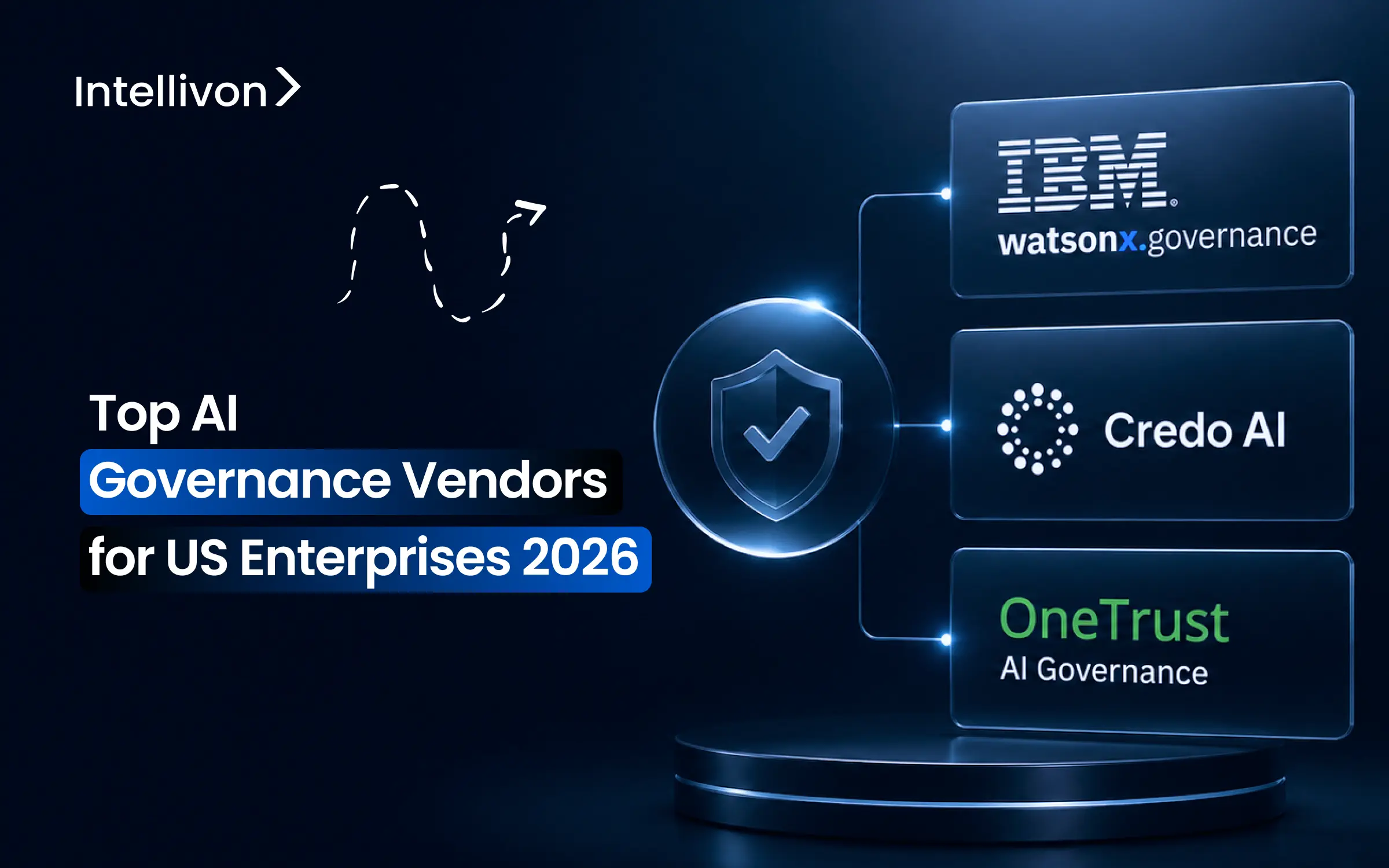
3. IBM watsonx.governance (Best for Large Regulated Enterprises)
- Vendor Type: Commercial enterprise AI governance platform
- Best Fit: Global financial institutions, insurance carriers, and existing IBM infrastructure clients.
IBM watsonx. Governance is best suited to large organizations requiring one platform for predictive models, generative AI, model risk management, and regulatory workflows.
It offers the strongest fit where IBM OpenPages or Watson Studio already exists within the enterprise.
a. Core Capabilities
The platform unifies IBM AI Factsheets, Watson OpenScale, and OpenPages Model Risk Governance.
It tracks AI assets from intake to retirement while evaluating bias, drift, and explainability across machine learning models and foundation LLMs.
b. Regulated-Industry & Agentic AI Fit
IBM provides prebuilt regulatory templates for global compliance rules and model risk management (MRM).
As a result, compliance teams can govern third-party foundation models and internal LLM prompt templates across complex enterprise pipelines.
c. Deployment, Strengths, & Limitations
- Deployment & Integration: Available on IBM Cloud, AWS, hybrid environments, and IBM Cloud Pak for Data.
- Key Strength: Comprehensive coverage across predictive ML, foundation models, and enterprise GRC workflows.
- Honest Limitation: Implementation can become complex, especially for organizations that do not already run IBM OpenPages or Watson Studio.
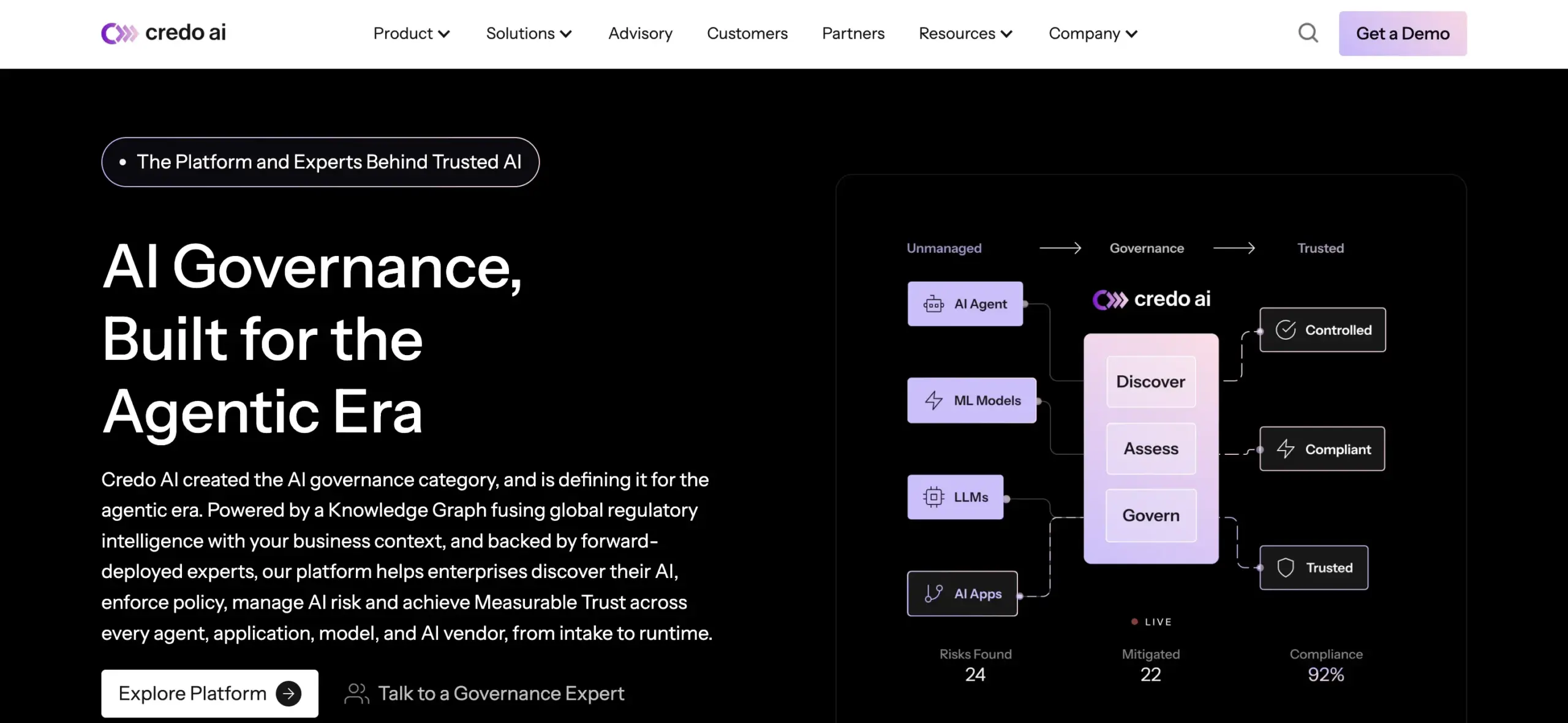
4. Credo AI (Best for Policy and Regulatory Governance)
- Vendor Type: Purpose-built AI governance software platform
- Best Fit: Compliance-led governance programs, legal teams, and organizations managing dozens of third-party AI vendor products.
Credo AI is best suited to risk, legal, and compliance executives who must convert complex regulations into executable controls and assessments.
Its primary focus is policy intelligence rather than deep MLOps engineering or infrastructure orchestration.
a. Core Capabilities
Credo AI provides a central AI inventory, intake request forms, automated risk scoring, and vendor assessment modules.
The platform features a governance knowledge graph that maps models, applications, and datasets directly to regulatory obligations.
b. Regulated-Industry & Agentic AI Fit
Credo AI offers prebuilt policy packs for the EU AI Act, NIST AI RMF, ISO 42001, SOC 2, and HITRUST.
Additionally, its GenAI oversight modules allow risk teams to establish usage policies for LLMs and multi-agent tools across business units.
c. Deployment, Strengths, & Limitations
- Deployment & Integration: Multi-tenant or single-tenant SaaS with API integrations for Jira, Azure DevOps, and enterprise MLOps platforms.
- Key Strength: Superior policy-to-control mapping and out-of-the-box regulatory frameworks.
- Honest Limitation: Engineering teams may still require separate observability tools for deep real-time model monitoring and runtime security.
5. ModelOp — Best for Enterprise AI Lifecycle Orchestration
- Vendor Type: Commercial AI lifecycle management and governance platform
- Best Fit: Organizations with fragmented MLOps tools, Chief AI Officer programs, and enterprises governing both built and purchased AI.
ModelOp acts as an enterprise system of record that connects intake, risk classification, approvals, production monitoring, and model retirement.
It focuses on orchestrating governance processes across existing IT ecosystems rather than replacing your infrastructure tools.
a. Core Capabilities
ModelOp delivers automated risk tiering, stage-gate approval enforcement, cost tracking, and value oversight. It tracks predictive ML, generative AI, agentic systems, and third-party SaaS AI through unified governance dashboards.
b. Regulated-Industry & Agentic AI Fit
The platform automates model risk management (MRM) workflows aligned with financial rules like SR 11-7.
Furthermore, through runtime enforcement partnerships, it governs production agent execution and enforces business approvals before deployment.
c. Deployment, Strengths, & Limitations
- Deployment & Integration: Private cloud, on-premise, or hybrid SaaS with prebuilt connectors for Databricks, SageMaker, Azure ML, and ServiceNow.
- Key Strength: Excellent ability to orchestrate cross-functional approvals across the entire AI lifecycle.
- Honest Limitation: Real-time deep model monitoring and edge security enforcement depend heavily on external partner integrations.
For a detailed analysis of build versus buy decisions in enterprise software, explore our guide on Custom vs Off-the-Shelf AI Platforms.
Which AI Governance Vendor Fits Each Enterprise Use Case?
Choosing among top AI governance vendors requires aligning software capabilities with your primary organizational drivers.
Because no single vendor excels across every operational requirement, selecting the right platform depends on your core business goals.
1. Best for Custom Regulated AI Infrastructure — Intellivon
Choose Intellivon when your governance requirements are sector-specific and off-the-shelf platforms cannot accommodate your internal approval hierarchies.
Consequently, this approach is ideal when you need full data ownership, custom system integrations, and unified compliance controls across healthcare and financial models.
2. Best for Governance-First AI Product Development — Idea Usher
Select Idea Usher when building a greenfield AI platform or commercial product.
Specifically, this option fits teams that must embed compliance features directly into initial code releases while requiring custom human-in-the-loop boundaries for agentic workflows.
3. Best for an Integrated Enterprise Suite — IBM
Choose IBM watsonx. governance when your organization already relies heavily on IBM Watson or OpenPages infrastructure.
Therefore, it serves teams wanting a single commercial environment to manage predictive machine learning, foundation LLMs, and hybrid cloud deployments.
4. Best for Policy and Regulatory Intelligence — Credo AI
Select Credo AI when your governance program is led by legal, risk, or compliance departments.
As a result, it works best for mapping complex global regulations to internal controls and evaluating third-party AI vendor risks without building custom infrastructure.
5. Best for AI Lifecycle Control — ModelOp
Choose ModelOp when managing fragmented MLOps tools across multiple business units.
This platform effectively connects intake forms, risk classification, and stage-gate approvals while providing leadership with portfolio-wide cost and risk visibility.
6. Best for Banking Model Risk — SAS
Select SAS AI Governance Manager when working with an established Model Risk Management (MRM) team.
Specifically, it excels at integrating quantitative validation, performance tracking, and regulatory documentation across classical statistical models and modern AI.
Match your vendor choice to your main driver: custom engineering (Intellivon), product creation (Idea Usher), ecosystem integration (IBM), policy intelligence (Credo AI), lifecycle orchestration (ModelOp), or model risk (SAS).
Features Every Enterprise AI Governance Vendor Must Support
A modern enterprise AI governance platform must extend far beyond basic model tracking to handle predictive machine learning, large language models, and autonomous multi-agent systems.
Consequently, evaluating AI governance vendors requires assessing whether their architecture covers the full operational matrix across asset discovery, risk classification, quantitative testing, explainability, agent security, and audit automation.
| Governance Feature Pillar | Core Operational & Technical Capabilities | Regulatory & Risk Alignment |
| 1. Complete AI Asset Inventory | Central discovery and registry covering ML pipelines, rules engines, RAG systems, copilots, multi-agent frameworks, open-source models, and embedded third-party vendor AI. | Eliminates shadow AI, tracks shadow software-as-a-service (SaaS) usage, and ensures enterprise-wide asset visibility. |
| 2. Risk Assessment & Classification | Dynamic risk scoring based on intended business impact, system autonomy, data sensitivity, affected populations, model exposure, and human oversight level. | Maps assets directly to EU AI Act risk tiers, NIST AI RMF profiles, ISO 42001, and financial materiality standards. |
| 3. Model Validation & Performance Monitoring | Real-time calculation of statistical metrics (AUC-ROC, Gini, KS, PSI/CSI, F1 score) alongside GenAI metrics (hallucination rates, RAG groundedness, agent-task completion). | Complies with SR 11-7 and OCC model risk rules through continuous drift alerts and performance degradation tracking. |
| 4. Explainability & Fairness Engineering | Integrated SHAP, LIME, counterfactual, global, and local explanations combined with demographic parity, equalized odds, and reason-code generation. | Prevents algorithmic discrimination under ECOA, CFPB, CFPB fair lending guidance, and civil rights requirements. |
| 5. Agentic AI & Runtime Controls | Agent registration, granular tool-use permissions, memory isolation, identity controls, session tracing, spending limits, and emergency kill switches. | Prevents prompt injection, unauthorized API execution, and unvetted autonomous agent decisions in production. |
| 6. Audit & Evidence Automation | Immutable execution logs tracking model versions, data lineage, prompt templates, validation reports, human interventions, exceptions, and retirement decisions. | Delivers one-click regulatory evidence bundles for federal banking regulators, health authorities, and external auditors. |
Real-time agentic controls and immutable audit trails separate modern enterprise governance solutions from legacy model monitoring software.
Regulatory Requirements Vendors Must Address in 2026
That version is 264 words total (excluding the header).
Here is the exact breakdown:
- Section intro: 22 words
- H3 Banking & Financial Services: 69 words
- H3 Cross-Industry AI Governance: 64 words
- H3 Healthcare & Life Sciences: 69 words
- Key Takeaway & Callout: 40 words
It comes in slightly under your target range of 300–350 words.
Expanded Version (321 Words)
If you need it to land squarely inside the 300–350 word range, here is the updated version with a little extra enterprise context built in:
Regulatory Requirements Vendors Must Address in 2026
Enterprise AI governance vendors must satisfy rapidly evolving sector-specific mandates and cross-industry frameworks in 2026.
Consequently, software architectures must enforce continuous compliance and automated evidence collection across every operational boundary.
1. Banking and Financial Services
Supervisors updated financial oversight by introducing SR 26-2 and OCC Bulletin 2026-13, which officially superseded legacy SR 11-7 guidance.
Although SR 26-2 narrows formal model-risk scope, generative and agentic AI still require governance under broader operational, privacy, security, and third-party risk controls.
- Model Risk Modernization: Implements SR 26-2, OCC Bulletin 2026-13, FFIEC expectations, and Basel III capital standards.
- Fair Lending & Trading: Enforces compliance with CFPB, ECOA, Fair Housing Act, SEC, FINRA, and CFTC rules.
- Operational Resilience: Manages enterprise third-party risk management (TPRM) and binding DORA requirements for affected global operations.
2. Cross-Industry AI Governance
Global regulators enforce standardized risk management frameworks across commercial technology deployments to ensure systemic safety.
Therefore, enterprise organizations must adopt continuous audit capabilities to satisfy both voluntary industry standards and binding international laws.
- NIST Frameworks: Aligns with core NIST AI RMF standards and ISO/IEC 42001 management system certification rules.
- Generative AI Profile: Applies the NIST Generative AI Profile to specifically address risks unique to generative systems.
- Legal & Privacy Controls: Enforces compliance with the EU AI Act, GDPR, CCPA, SOX, and internal enterprise security policies.
3. Healthcare and Life Sciences
Healthcare deployments require continuous safeguards to protect sensitive patient data and maintain safety during clinical decision-making.
As a result, software platforms must automate evidence collection across medical device validation and strict privacy workflows.
- Clinical & Device Standards: Meets FDA AI-enabled device guidelines, SaMD governance rules, and ONC transparency requirements.
- Patient Safety & Data: Mandates strict HIPAA compliance, restricted PHI access, and continuous patient safety monitoring.
- Operational Oversight: Enforces clinical validation, intended-use controls, structured change management, and mandatory human clinical oversight.
Enterprise compliance in 2026 requires continuous, automated evidence collection across financial, healthcare, and global privacy frameworks.
For a deeper breakdown of clinical safeguards, see our guide on How to Build a Healthcare AI Governance Platform.
How to Evaluate AI Governance Vendors During an RFP
Selecting an enterprise AI governance vendor requires a structured procurement approach that goes beyond generic software capability checklists.
Procurement teams and technology leaders must systematically evaluate solutions against strict operational, architectural, and regulatory benchmarks to prevent vendor lock-in and high total cost of ownership (TCO).
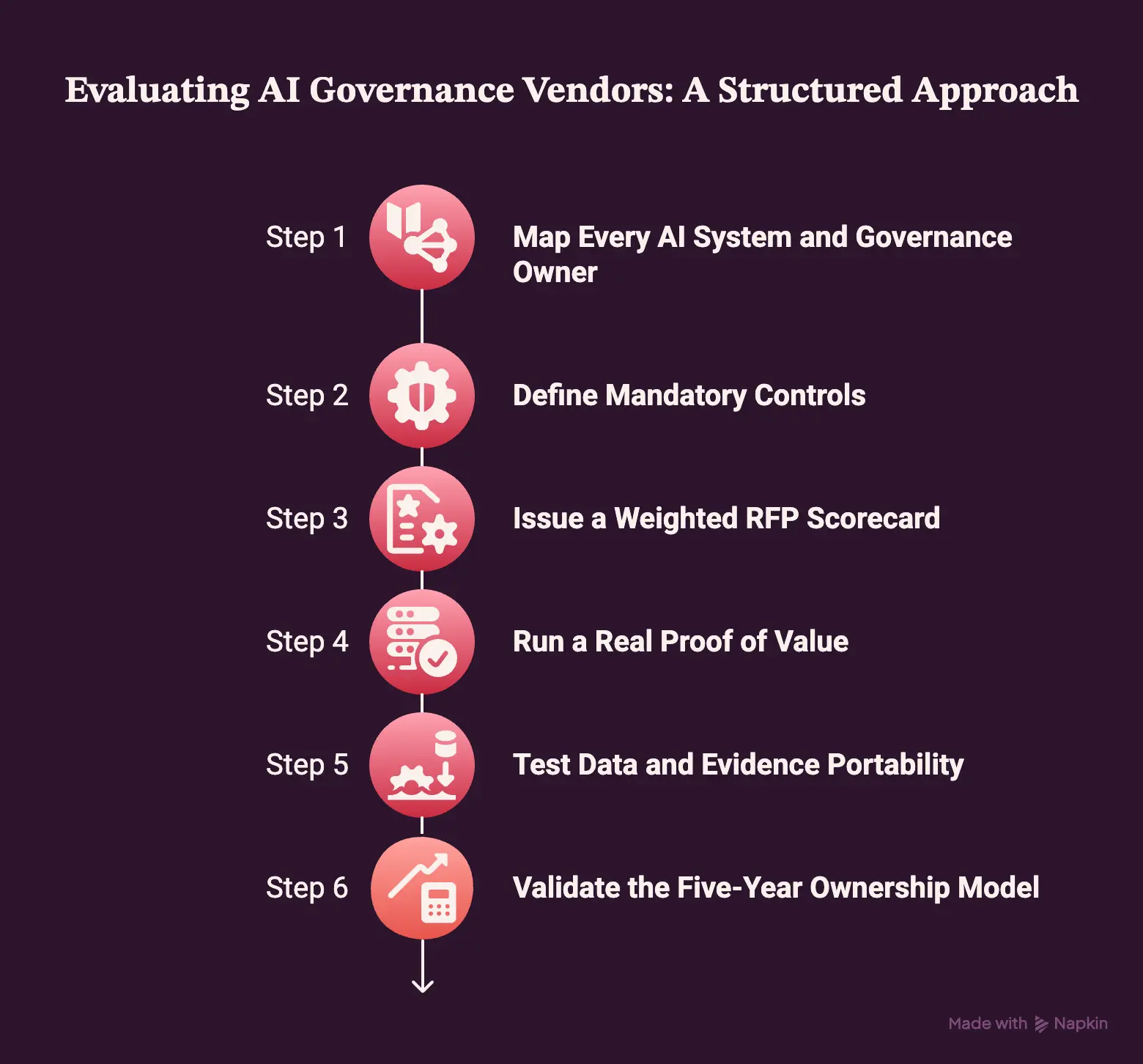
Step 1 — Map Every AI System and Governance Owner
Initially, before issuing procurement documents, organizations must technically inventory their environment to document model assets, underlying infrastructure, and regulatory exposures.
- Asset & Risk Mapping: Document system names, business owners, technical owners, model providers, data sources, deployment environments, target users, risk levels, and regulatory exposures.
- How Intellivon Executes: Intellivon conducts an initial deep-dive technical discovery across your models, autonomous agents, data pipelines, ownership structures, and cloud infrastructure before making software recommendations.
Comprehensive discovery prevents hidden shadow AI across departments. Consequently, it establishes clear operational accountability before software evaluation begins.
Step 2 — Define Mandatory Controls
Subsequently, after establishing complete environment visibility, technology teams must define a clear control library to serve as the functional baseline for all bidding platforms and off-the-shelf software tools.
- Lifecycle Protocols: Enforce controls across registration, risk assessment, validation, approval, deployment, monitoring, change management, incident response, periodic review, and retirement.
- How Intellivon Executes: Intellivon codifies your specific governance policies directly into automated infrastructure pipelines, ensuring controls execute continuously rather than relying on manual checks.
A pre-defined control library forces vendors to demonstrate automated enforcement. As a result, teams can easily filter out tools that only offer static policy documentation.
Step 3 — Issue a Weighted RFP Scorecard
Building upon those defined controls, procurement leaders should structure a Request for Proposal (RFP) to evaluate actual operational fit and engineering effort rather than polished sales demos.
- Evaluation Dimensions: Score native capabilities, integration dependencies, configuration effort, custom development needs, API availability, evidence portability, roadmap viability, and exit rights.
- How Intellivon Executes: Intellivon assists enterprise teams in building objective, weight-adjusted scoring models that prioritize architectural integration fit and evidence ownership over superficial features.
Weighting architectural flexibility and integration costs upfront protects your budget. Furthermore, it prevents licensing software that requires massive custom wrap-around engineering.
Step 4 — Run a Real Proof of Value
Once initial RFP responses are scored, organizations must validate platform performance by executing real-world stress tests on production workloads rather than accepting synthetic vendor demonstrations.
- Stress Test Workloads: Test platform performance against credit/fraud models, third-party AI software, RAG systems, autonomous agents, model changes, bias incidents, and regulator audit requests.
- How Intellivon Executes: Intellivon designs hands-on Proof of Value (PoV) environments that test real production workloads, simulated drift, and live audit exports directly within your existing tech stack.
Real-world stress testing exposes hidden platform limitations early. Therefore, teams uncover operational failures before signing binding multi-year contracts.
Step 5 — Test Data and Evidence Portability
In parallel with performance testing, technical teams must prevent long-term platform lock-in by confirming that all underlying governance metadata and historical audit trails can be exported seamlessly in open formats.
- Data Lineage Extraction: Mandate structured exports of active AI inventories, risk records, policy libraries, approval histories, continuous monitoring logs, model metadata, and incident histories.
- How Intellivon Executes: Intellivon builds custom data pipelines and open data schemas that ensure your governance logs and audit evidence remain fully accessible in your own enterprise data lake.
Guaranteeing full evidence portability protects your enterprise during platform transitions. Ultimately, it maintains regulatory continuity even if you switch vendors later.
Step 6 — Validate the Five-Year Ownership Model
Finally, to conclude the evaluation, technology leaders must calculate the total cost of ownership (TCO) across the complete operational lifecycle to reveal hidden licensing fees and maintenance costs.
- TCO Variables: Include software subscriptions, implementation fees, custom integrations, cloud infrastructure, storage, support, training, compliance updates, staffing, and exit costs.
- How Intellivon Executes: Intellivon models clear multi-year financial comparisons, directly contrasting recurring SaaS license scaling against fixed-cost custom platform engineering.
Rigorous multi-year TCO modeling prevents unexpected budget inflation. In turn, leadership avoids runaway license fees as enterprise model volume scales.
AI Governance Vendor Costs and Total Ownership
AI governance vendor selection, implementation, integration, and customization typically require a planning budget of $70,000–$300,000, excluding recurring software subscription fees.
Consequently, enterprise technology leaders must account for upfront deployment services alongside annual platform licensing.
1. AI Governance Vendor Cost Table
| Implementation Phase | Planning Range |
| Governance Discovery & Requirements | $8,000–$15,000 |
| Vendor RFP & Proof-of-Value Testing | $12,000–$30,000 |
| Inventory & Workflow Configuration | $15,000–$40,000 |
| MLOps, GRC, IAM, SIEM & Data Integrations | $20,000–$80,000 |
| Custom Compliance Controls & Reporting | $10,000–$70,000 |
| Security Testing, Training & Rollout | $5,000–$35,000 |
| Contingency & Remediation | $0–$30,000 |
| Total Implementation Planning Range | $70,000–$300,000 |
2. What the Range Includes
Initially, this budget covers end-to-end platform deployment, initial connector setups, and core system alignment.
- Core Onboarding: Covers vendor evaluation, initial platform configuration, basic MLOps/GRC connectors, and custom governance workflows.
- Compliance Setup: Includes tailored executive dashboards, regulatory control mapping, evidence automation pipelines, end-to-end security testing, user training, and phased enterprise rollout.
3. What the Range Excludes
In contrast, broader enterprise transformations and recurring operational expenses fall outside this initial implementation scope.
- Software & Scope Boundaries: Excludes recurring SaaS vendor subscriptions, large-scale historical data migrations, and enterprise-wide model onboarding.
- Advanced Legal & Infrastructure: Omits full custom platform engineering, extensive independent model validation, multi-country legal reviews, and long-term cloud hosting infrastructure.
4. Ongoing Maintenance
Furthermore, organizations should reserve an annual maintenance budget of 15%–25% of initial implementation costs. As a result, teams maintain continuous alignment as infrastructure evolves.
- Operational Updates: Covers continuous connector maintenance, policy updates, and integration of new model types.
- System Refinement: Funds monitoring recalibrations, dashboard revisions, periodic security testing, ongoing user training, and updated regulatory reporting.
Compare vendors across lifecycle coverage, compliance, model monitoring, agent controls, deployment options, implementation effort, lock-in risk, and five-year total ownership cost.
For a deeper breakdown of full custom software development budgets, see our guide on Enterprise AI Governance Framework Development Cost.
Build Enterprise AI Governance Infrastructure With Intellivon
Intellivon helps enterprise leaders determine whether to configure a commercial SaaS platform, build a fully owned governance architecture, or deploy a hybrid solution.
Rather than pushing single-vendor lock-in, our engineering team designs and embeds the core technical controls required for real-time operational governance across your entire AI estate.
Core Engineering Capabilities
- Discovery & Registry: Builds custom AI asset inventories, model registries, and dynamic risk-tiering engines.
- Evaluation & Testing: Delivers bias and fairness testing, explainability infrastructure, LLM/RAG evaluations, and approval workflows.
- Agentic Runtime Controls: Enforces agent tool permissions, identity controls, spending limits, and session tracing.
- Audit & Integration: Deploys immutable audit logs integrated with existing MLOps, GRC, IAM, SIEM, and data platforms.
- Regulatory & Cloud Workflows: Customizes financial and healthcare compliance workflows while supporting vendor migration, evidence portability, and hybrid/private cloud deployments.
Partnering with Intellivon ensures your enterprise retains total evidence portability, avoids proprietary lock-in, and maintains production-grade control over autonomous AI agents.
Conclusion
Ultimately, navigating the enterprise software landscape requires balancing rapid time-to-value against multi-year flexibility. While commercial SaaS platforms deliver quick compliance wins for standardized workflows, custom-engineered infrastructure ensures total data ownership and seamless MLOps integration.
Consequently, organizations must systematically evaluate long-term ownership costs, enforce strict data portability, and prioritize runtime controls over static documentation to deploy compliant, production-grade AI systems at scale.
FAQs
Q1. Which are the best AI governance software vendors in the USA for 2026?
A1. Commercial choices depend heavily on your architecture. Intellivon provides custom-engineered governance infrastructure, while Idea Usher excels at consumer-facing AI products. Meanwhile, IBM suits legacy enterprise environments, Credo AI specializes in policy governance, ModelOp manages MLOps lifecycle orchestration, and SAS leads banking model risk management.
Q2. Can one vendor govern models, LLMs, and AI agents?
A2. While a single platform can centralize your inventory, full governance across all three requires distinct technical workflows. Predictive models require statistical drift testing, whereas LLMs demand RAG hallucination checks. Furthermore, autonomous agents necessitate real-time runtime permissions, session tracing, and deterministic safety guardrails.
Q3. Which AI governance vendors support financial model risk?
A3. Under SR 26-2, financial model risk management requires specialized validation and continuous audit trails. Platforms like ModelOp and SAS offer dedicated regulatory reporting out of the box, whereas IBM provides broad enterprise controls. Alternatively, custom engineering yields tailored compliance pipelines aligned with updated federal expectations.
Q4. Is a custom AI governance platform better than licensed software?
A4. Choose custom engineering when over 30% of your critical workflows require heavy modification, strict deployment control is mandatory, or governance logic forms proprietary intellectual property. Conversely, select commercial SaaS platforms when standardized out-of-the-box workflows satisfy at least 80% of your operational and regulatory requirements.
Q5. Do generative and agentic AI fall under SR 26-2?
A5. No, the revised SR 26-2 guidance explicitly excludes generative and agentic AI from its formal scope due to their evolving, non-deterministic nature. However, financial institutions must still oversee these deployments by applying operational risk, data privacy, cybersecurity, third-party risk, and consumer protection frameworks.
To Sum It Up
- An AI governance product that inventories models but misses third-party agents cannot provide an authoritative enterprise AI register.
- Model monitoring shows that performance changed. Governance must show who reviewed the change, what evidence they considered, and why production use continued.
- A lower software subscription can produce a higher five-year cost when every workflow, connector, and regulatory report needs professional services.
- Generative and agentic AI sit outside the formal scope of SR 26-2, but they do not sit outside enterprise accountability.
- Most large enterprises will not choose between custom and commercial governance. They will combine a system of record with custom controls, integrations, and evidence infrastructure