Key Takeaways:
- The main difference is that patients receive assistance before any member of staff does so.
- Patients no longer have to phone the clinic in order to book an appointment, ask questions, or get assistance.
- The AI looks after the routine messages and takes over from there when clinical matters arise.
- Text, voice, portals, and EHRs can now be used together in one conversation.
- Find out how Intellivon develops conversational AI by imitating the way that patients and care teams actually communicate.
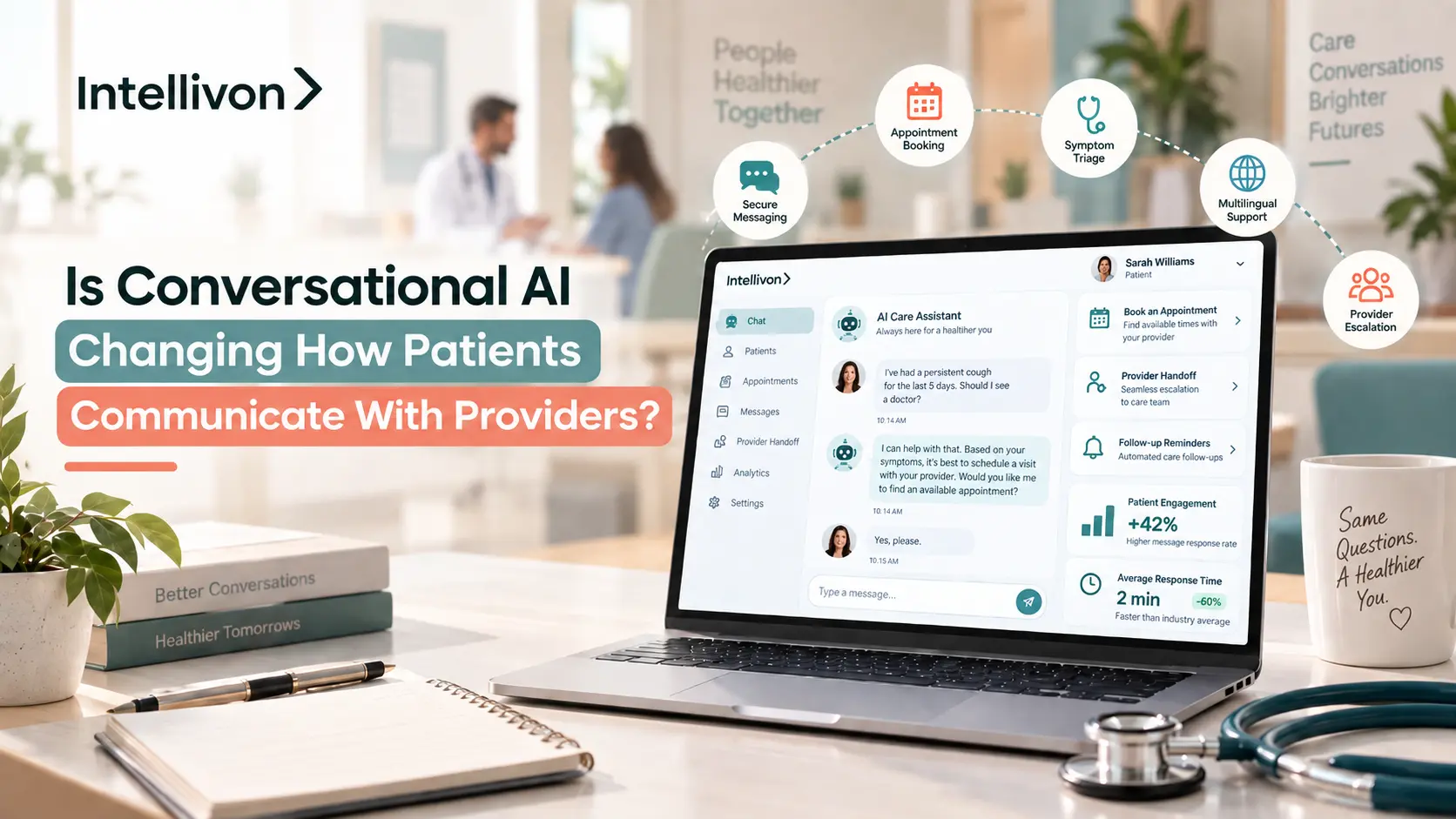
Yes, conversational AI is changing the way patients are communicating with their providers and care teams. Through conversational AI platforms, patients arrange appointments by sending text messages, ask about prescription refills via chat, and read the explanations of their lab results, which are generated by the AI. A great many of these interactions now end without a phone call being made.
Similar changes happen on the side of the providers, influencing the way care teams function. On the providers’ side, the teams use AI to prioritize messages and prepare replies for clinicians to examine. However, trust still rests on one condition: patients want there to be a human who is responsible for what the AI says.
At this stage, founders should ask not whether this change is happening, but what kind of product to build and what patients will tolerate. This blog covers the issues concerning changes in channels, trust limits, the decision between building it themselves and buying it, and phased costs.
What Conversational AI Means for Patient Communication
Conversational AI patient communication uses natural language software to understand what patients ask, respond in plain words, and complete simple tasks. In healthcare, that means patients can book visits, ask about refills, or check bills by text, voice, or chat. Unlike older tools, it keeps context and routes anything clinical to a human.
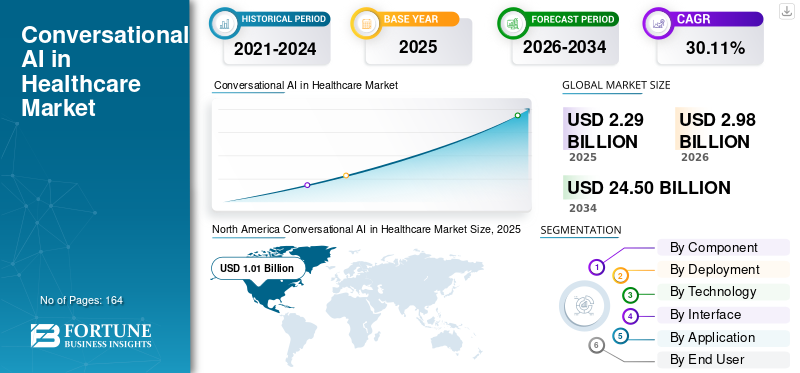
In fact, the global conversational AI in healthcare market was valued at $2.29 billion in 2025 and is projected to grow to $2.98 billion in 2026 before reaching $24.50 billion by 2034, at a 30.11% CAGR, with North America leading that growth.
1. Goes Beyond a Basic Healthcare Chatbot
Scripted chatbots follow fixed menus, so they break when patients phrase things differently. Conversational AI, by contrast, reads intent and remembers what the patient already said.
- Understands natural phrasing, not just keywords
- Tracks conversation history across every turn
- Triggers workflow actions instead of only replying
2. Can Understand What the Patient Wants to Do
Patients rarely state requests neatly. Instead, the AI maps a message like “can I get my pills sooner” to a refill intent.
- Scheduling and rescheduling requests
- Symptom and medication questions
- Billing, lab result, and care plan questions
3. Can Complete Tasks During the Conversation
Answering questions is only half the job. More importantly, conversational AI acts inside connected systems during the conversation. For example, Ochsner Health uses Epic’s conversational AI to confirm and reschedule appointments by text.
- Books or changes visits
- Collects intake details
- Routes requests to the right team
4. Can Continue Conversations Across Patient Channels
Patients switch channels constantly. Ideally, a request started in web chat continues by SMS or phone without the patient repeating anything.
- Shared context across SMS, voice, portal, app, and web chat
- One continuous record of each request
5. Still Needs Clear Human Boundaries
Conversational AI supports care teams, but it does not replace clinical judgment. Even Epic’s Emmie hands patients to live staff chat when needed. Good systems separate three layers:
- Administrative automation: scheduling, billing, reminders
- AI assistance: drafted replies a clinician reviews
- Clinical judgment: decisions only licensed staff make
In short, conversational AI changes patient communication by pairing plain-language conversation with real task completion.
Why Patient-Provider Communication Needs to Change
Patient-provider communication needs to change because the phone-and-portal model cannot keep up with patient demand. Busy phone lines create long delays, portals flood clinician inboxes, and one-way reminders cannot answer follow-up questions.
Meanwhile, patients now expect the fast digital service their bank provides, so health systems are rethinking how conversations work.
1. Phone Calls Still Create Delays for Patients
Some practices still route questions through the front desk phone. Consequently, a simple request can take several attempts to resolve.
- Long hold times during peak morning hours
- Voicemails that sit until staff have time
- Missed callbacks that restart the cycle
- Limited coverage after hours and on weekends
2. Patient Portals Created a Different Communication Problem
Portals gave patients a direct line to their care team. However, patient-written portal messages jumped 153% between 2020 and 2025, and each one needs a reply.
- Asynchronous messages arrive all day and night
- Clinicians often answer them after hours
- Replies take longer as volume grows
3. One-Way Messages Cannot Handle Patient Questions
Reminders and notifications broadcast information, but they cannot listen. So when a patient replies “can I come Thursday instead?”, the message often goes nowhere.
- Broadcast: appointment reminders, recall notices, alerts
- Conversation: questions, changes, and follow-ups in both directions
4. Patients Now Expect Faster Digital Communication
Patients text, order, and bank from their phones every day. Naturally, they now expect the same fast, personal experience from their provider that they get from retailers and airlines.
- Answers in minutes, not days
- Self-service at any hour
- Text as the default channel
5. Providers Cannot Keep Adding More Manual Messages
Better access creates more conversations, yet staffing does not grow at the same pace. As athenahealth’s product chief noted, patient-provider communication still works much like it did decades ago.
- Every new channel adds manual work
- Front desks and nurses absorb the overflow
In short, phones cause delays, portals overload inboxes, and one-way messages leave questions unanswered. Meanwhile, patient expectations keep rising faster than staff capacity. That gap is exactly where conversational AI starts to change the model.
How Patient Communication Has Evolved With AI
Patient communication has evolved from phone calls and front desks to portals, then automated reminders, and now two-way AI conversations. Each stage made access easier, but each one also added new gaps for patients and staff.
Today, conversational AI patient communication lets patients ask, act, and follow up in plain language, around the clock.
1. Stage One Was Phone and In-Person Communication
For decades, patients reached providers in real time or not at all. Every question, booking, or result depended on someone being free to talk.
- Appointments booked by phone or at the front desk
- Results shared during visits or callbacks
- Repeated calls for simple requests
- Communication limited to office hours
2. Stage Two: Added Portals and Digital Messaging
Next, patient portals moved communication online. Epic’s MyChart alone now reaches nearly 200 million users, giving patients direct digital access to their records and care teams.
- Secure messaging with the care team
- Notifications for new results and bills
- Online access to records at any hour
3. Stage Three: Added Automated Patient Workflows
After that, practices automated routine outreach to cut phone volume. These tools saved staff time, but they only worked in one direction.
- Automated appointment reminders
- Text-to-confirm or cancel options
- Basic self-service booking and forms
- Still no way to handle replies or questions
4. Stage Four Brings Two-Way AI Conversations
Now, conversational AI lets patients type or speak naturally and get a useful reply. Unlike earlier automation, it understands intent, remembers context, and takes action.
For example, Sutter Health became the first organization to live with Epic’s Ask Emmie, which answers health questions using the patient’s own record.
- Natural language instead of menus
- Intent recognition for each request
- Tasks completed inside the conversation
5. The Next Shift Is Continuous Patient Communication
Looking ahead, communication will stop being a series of separate contacts. Instead, it will run continuously before, during, and after care. Epic already turns visit notes into proactive follow-up reminders for patients.
- Before care: intake, symptom check, prep instructions
- During care: real-time questions and updates
- After care: follow-ups, refills, and result explanations
In short, patient communication moved from phones to portals, then to automation, and now to two-way AI conversations. Each stage expanded access, but only conversational AI lets patients ask and act at once.
Five Patient Communication Channels Conversational AI Is Rewriting First
Conversational AI is rewriting five patient communication channels first: portal messaging, SMS, voice calls, web and app chat, and multilingual support. In each one, AI moves from sending messages to holding real two-way conversations.
As a result, patients get much faster answers, while care teams handle fewer routine requests by hand.
Five Patient Communication Channels: Conversational AI
| Channel | What AI Changes | Patient Impact | Provider Impact |
| Portal messaging | Answers simple questions, drafts replies | Faster responses | Fewer replies written from scratch |
| SMS | Two-way texting replaces one-way reminders | Reschedule without calling | Lower phone volume |
| Voice | Handles routine calls end to end | No hold queues | Staff free for complex calls |
| Web and app chat | Guides patients at first contact | Quick routing to the right service | Pre-sorted requests |
| Multilingual | Replies in the patient’s language | Clearer understanding | Fewer misrouted requests |
1. Portal Secure Messaging and MyChart Conversational AI Integration
Portal messages used to wait in a clinician’s inbox. Now, AI can answer simple questions first or draft replies for staff to review. However, patients in a 2026 JAMA Network Open study wanted a clinician to review AI drafts before sending.
- Routine questions resolved instantly
- Clinical questions drafted, then reviewed
2. Conversational AI SMS Patient Communication
Text reminders once only told patients when to show up. Today, two-way AI texting lets patients reply, reschedule, or ask questions in the same thread.
For instance, Ochsner Health uses Epic’s conversational AI for SMS scheduling to confirm and reschedule appointments.
- No portal login required
- Works on any phone
3. Voice AI and Phone Call Automation
Many patients still prefer to pick up the phone. With voice AI, a patient can call after hours and change an appointment right away. Still, voice struggles in certain situations.
- Heavy accents or noisy backgrounds
- Emotional or urgent calls
- Complex multi-part requests
4. Web and App Chat as the New Front Door
Chat catches patients earlier than portal messaging does. Typically, portal messages go to a known care team, while chat handles “where do I start?” questions. Providence’s Grace assistant already serves about 150,000 monthly active users.
- Urgent symptoms flagged and escalated
- Routine tasks handled on the spot
5. Multilingual and Health-Literacy-Aware Communication
Word-for-word translation often misses what patients mean. For example, a Spanish-speaking patient who says “mareado” could mean dizzy or lightheaded, and that difference changes routing. Therefore, good multilingual AI learns how patients actually describe symptoms.
- Replies in the patient’s preferred language
- Plain-language explanations for low health literacy
In short, conversational AI is changing portals, SMS, voice, chat, and multilingual support at the same time. Each channel shifts from one-way messages to real conversations. Still, the biggest change shows up in specific moments of the patient journey.
AI Is Changing What Patients Ask Healthcare Providers
Conversational AI is changing what patients ask providers by absorbing routine questions first. Appointments, pre-visit prep, symptom check-ins, refills, lab results, and care plan questions are all moving into AI conversations.
Meanwhile, clinicians still review anything that needs medical judgment, so AI handles the routine work while humans keep the decisions.
1. Appointment Questions Are Becoming Self-Service
Scheduling is usually the first conversation practice handed to AI. Because it follows clear rules, patients can finish it without waiting for staff. As a result, front desk teams spend less time on the phone.
- Booking new visits
- Rescheduling and cancellations
- Confirmations by text or chat
- Waitlist offers when slots open
2. Pre-Visit Questions Can Be Handled Earlier
Before a visit, patients often call with the same practical questions. Now, AI can answer them days ahead and collect forms and insurance details in the same conversation.
- Fasting and prep instructions
- Required documents and ID
- Insurance verification and intake forms
3. Symptoms Can Be Collected Before Human Review
AI can ask structured follow-up questions about symptoms, such as onset, severity, and duration. However, it does not diagnose. Instead, it gathers details for clinician review and flags urgent answers.
- Consistent symptom summaries
- Red-flag answers escalated immediately
- Answers logged directly for the care team
4. Medication Requests Can Be Sorted Automatically
Medication messages vary widely in risk. Therefore, AI sorts them by type, answers simple status questions, and routes the rest to the right team.
- Refill status updates
- Adherence reminders and questions
- Dose changes or side effects sent for clinical review
5. Lab Results Can Be Explained in Simpler Language
Lab reports use terms most patients do not know. For example, Epic now shows AI-generated result summaries as soon as results reach MyChart. Still, clinicians interpret what the results mean for treatment.
- Plain-language definitions of medical terms
- Education links for common results
6. Care Plans Can Continue Beyond the Appointment
Visit instructions are easy to forget once patients leave. To help, Epic turns clinicians’ free-text instructions into patient reminders in MyChart.
- Treatment steps explained in plain language
- Scheduled follow-up check-ins
- Answers to “is this normal?” questions after care
In short, patients now bring appointments, prep, symptoms, medications, results, and care plans to AI first. Still, clinicians keep every decision that needs medical judgment.
Different Patient Messages Need Different Owners
Different patient messages need different owners because the risk behind each message varies. AI can fully own routine administrative requests, assist with requests that need clinical context, and escalate anything high-risk to humans.
For founders, deciding who owns each message type is the core design decision, since it shapes safety, workflow, and patient trust.
1. AI Can Own Low-Risk Administrative Conversations
Predictable requests with clear answers are safe for AI to resolve alone. For example, one Epic customer saw a 48% drop in billing-related messages within weeks of launching Emmie.
- Scheduling and directions
- Forms and billing status
- Common FAQs
2. AI Can Assist With More Complex Patient Requests
Some requests need context from the patient’s record. Here, AI gathers details and prepares a draft, but a person approves the outcome.
- Symptom intake summaries
- Refill requests queued for approval
- Results and care-plan questions drafted for review
3. Care Teams Can Handle Messages Before Physicians
Not every clinical message needs a physician. Instead, AI can route each request to the right role first. In fact, a Penn Medicine pilot found nurses and primary care clinicians accepted AI drafts more often than physicians.
- Nurses: symptom follow-ups
- Pharmacists: medication questions
- Coordinators and admin staff: referrals and paperwork
4. Clinical Decisions Must Stay With Healthcare Professionals
Some decisions carry legal and medical responsibility. Therefore, AI should never make them, even when it could draft an answer. Instead, it routes them straight to licensed staff.
- Diagnosis
- Treatment changes and prescriptions
- Interpreting serious symptoms
5. High-Risk Conversations Need Immediate Escalation
Certain words should skip every queue. For example, crisis language or worsening symptoms should trigger an instant handoff to a human. This matters because AI conversation tools can still misfire in high-stakes moments.
- Self-harm or crisis statements
- Chest pain or breathing trouble
- Behavioral health distress
6. A Three-Level Ownership Model Keeps This Simple
Most founders find it easier to sort every message into one of three levels.
a. AI Handles
Administrative, predictable tasks with clear rules, such as booking and billing status.
b. AI Assists
Messages that need record context but no autonomous clinical decision, such as refill requests.
c. Humans Handle
Clinical judgment, sensitive conversations, and high-risk care, with no exceptions.
AI should own routine requests, assist with contextual ones, and hand clinical or high-risk messages to people. Clear ownership keeps patients safe and care teams focused. With ownership defined, the next step is making sure patients trust each handoff.
Patient Portals Are Becoming More Conversational
Patient portals are becoming more conversational because AI now reads, sorts, and responds to messages instead of simply storing them. As a result, AI can understand, structure, and route a portal message before any clinician opens it.
In practice, conversational AI patient communication turns the portal from a mailbox into an active part of the care workflow.
1. Traditional Portals Mainly Store and Route Messages
For years, portals worked like secure email. Patients sent a message, and it landed in a shared inbox until someone read it. Unsurprisingly, patient-initiated portal messages now take up most in-basket processing time.
- No understanding of message content
- No sorting by urgency or topic
- Every message waits for a human
2. AI Can Understand the Reason Behind a Message
Patients often pick the wrong category or skip it entirely. Instead of relying on that label, AI reads the full message and identifies what the patient actually needs. As a result, the portal responds to the real request, not the label.
- A refill request hidden inside a billing question
- A symptom mentioned in a scheduling message
- Multiple requests in one message
3. Messages Can Reach the Right Team First
Once AI knows the intent, it can route each message to the right owner. Consequently, physicians see only the messages that need them. This approach sits at the center of modern patient engagement portal design.
- Billing questions to the billing team
- Refills to pharmacy or nursing pools
- Clinical concerns to the care team
4. Long Patient Messages Can Be Structured Before Review
Some patients write long, detailed messages that take minutes to read. Therefore, AI can condense them into a short, structured summary. Researchers are also benchmarking how well AI ranks message urgency.
- Main request in one line
- Symptoms listed with timing
- Urgency level flagged
- Missing information requested upfront
5. MyChart Can Become Part of a Larger AI Workflow
Many providers already run MyChart, so custom AI often works alongside it rather than replacing it. For example, Epic’s own assistant only accesses information already visible to the patient. Similarly, custom tools should connect through FHIR-based EHR integration and respect the same permissions.
- Read appointments, results, and medications
- Write summaries back to the care team’s inbox
AI is turning portals from passive inboxes into active workflows. It reads intent, routes messages, and structures long requests before review. The bigger question is how much time this actually saves the care team.
Text and Voice Are Becoming New Doors Into Healthcare
Text and voice are becoming new doors into healthcare because patients can now reach a provider the same way they reach everyone else.
Conversational AI patient communication lets patients text a quick question, call without a phone tree, or chat through longer requests. Ideally, all three channels share one conversation, so patients never have to start over.
1. SMS Makes Routine Patient Actions Easier
Most routine actions fit in a single text. Because patients already text all day, SMS removes the need for logins or phone calls. It also works well for post-visit follow-ups that patients actually read.
- Confirm or reschedule appointments
- Reply to reminders with questions
- Quick check-ins after a visit
2. Voice AI Can Replace Complicated Phone Trees
Traditional phone trees force patients through numbered menus. Instead, voice AI lets callers simply say what they need. In fact, speech recognition and generation held the largest technology share of the conversational AI healthcare market in 2024.
- No “press 1 for scheduling” menus
- Faster routing to the right department
3. Voice Can Improve Access for Some Patient Groups
Not every patient is comfortable typing or using apps. For them, speaking is simply easier. Likewise, conversational voice tools mean patients no longer wait for office hours or a bilingual staff member to get help.
- Older adults less familiar with apps
- Patients with vision or dexterity limits
- Anyone who simply prefers talking
4. Mobile and Web Chat Support Longer Conversations
Some requests need more back-and-forth than a text allows. Therefore, mobile and web chat handle richer workflows, such as intake or multi-step booking. For example, Intellivon built an AI chatbot for a healthcare startup that handles triage and appointment booking.
- Uploads for insurance cards and forms
- Step-by-step guided questions
5. Every Channel Should Share the Same Conversation
Patients often start on one channel and finish on another. So when a patient calls back, the AI should already know what they asked by text. This only works when every channel connects to the same patient record and identity system.
- One history across text, voice, and chat
- No repeated questions for the patient
In short, SMS handles quick actions, voice replaces phone trees, and chat supports longer requests. Together, they widen access for more types of patients. However, the real value appears only when every channel shares the same conversation.
AI Is Also Changing the Patient-Provider Relationship
Conversational AI is also changing the patient-provider relationship by making the care system easier to reach and conversations better prepared. Patients get faster answers and clearer information, while providers receive structured details before they respond.
As a result, clinicians can save their time and attention for the complex conversations where human trust matters most.
1. Patients Can Reach the Care System More Easily
AI does not always connect patients to their doctor directly. However, it makes the care system itself easier to reach, day or night. Some patients even prefer it: a quarter would rather ask a chatbot about embarrassing symptoms.
- Answers outside office hours
- Fewer barriers for sensitive questions
- Clear next steps when a human is needed
2. Providers Can Receive Better Structured Information
Unstructured messages slow clinicians down. By contrast, AI can gather and organize patient details for clinician review before anyone opens the message. As a result, the clinician spends less time sorting and more time deciding.
- Symptoms, timing, and history in one view
- Fewer back-and-forth clarification messages
- Faster, more focused replies
3. Patients Can Become More Involved in Their Care
When answers come quickly, patients are more likely to stay engaged. In addition, follow-up messages help: chatbots can lower readmission risk by reminding patients about medications and appointments.
- Education in plain language
- Regular check-ins between visits
- Easy ways to ask follow-up questions
4. AI Can Help Patients Prepare for Better Conversations
Many visits start with the clinician gathering basic information. Instead, AI can collect that information beforehand and help patients list their questions. This kind of visit prep makes the appointment time count.
- Symptom updates before the visit
- A short list of patient questions
- Medication changes confirmed in advance
5. Human Interaction Becomes More Important for Complex Care
Automation handles the routine, so clinicians have more time for what only people can do. Consequently, human teams stay focused on complex, high-risk cases that require judgment and empathy. Even the best AI cannot replace a clinician explaining a hard diagnosis face to face.
- Serious diagnoses and difficult news
- Treatment decisions and trade-offs
- Emotional or sensitive conversations
In short, conversational AI makes care easier to reach, gives providers better information, and helps patients engage more. Meanwhile, human time shifts toward the conversations that need it most. Still, that trade only works if patients trust how AI is used.
Patient Communication AI Needs Clear Safety Rules
Healthcare conversational AI requires clear safety rules because every patient message can contain protected health information and clinical risk. At minimum, founders need HIPAA-aligned data handling, signed business associate agreements, limited data access, escalation rules, audit trails, and ongoing monitoring.
Without these, even a well-designed conversational AI patient communication tool can expose patients and providers to real harm.
1. PHI Changes How Patient Messages Must Be Handled
PHI is health information tied to an identifiable person, such as symptoms, medications, or appointment details. In chat, patients share PHI freely and unpredictably. That is why spotting PHI in unstructured conversations is harder than in standard forms.
- Encryption in transit and at rest for every transcript
2. AI Vendors May Need Business Associate Agreements
Any vendor that handles PHI for a provider usually becomes a business associate. In fact, HHS lists a third-party AI chatbot on a patient portal as an example. Therefore, founders need signed BAAs with every vendor that touches patient data.
- LLM and AI model providers
- Cloud hosting and SMS vendors
3. Each Workflow Should Access Only Needed Patient Data
HIPAA’s minimum necessary standard requires reasonable steps to limit PHI use to what a task actually needs. In practice, a scheduling bot should see appointment slots, not lab results.
- Role-based access per workflow
- Separate permissions for read and write actions
4. Clinical Questions Need Defined Escalation Rules
Clinical questions need written rules for when AI stops and a human steps in. This matters because unedited AI responses to patient messages could cause direct harm, according to one safety study.
- Red-flag symptoms routed instantly
- No autonomous diagnosis or dosing advice
5. Every Automated Action Should Be Traceable
Every automated action should leave a record of what happened, when, and why. Beyond compliance, structured AI conversations create documentation trails that support audits and quality reviews.
- Who accessed which data
- What the AI said or changed
- When a human took over
6. Safety Testing Must Continue After Launch
Launch is not the finish line for safety. Over time, patient language, EHR data, and AI models all change. Researchers are now building error taxonomies to evaluate AI-drafted portal messages at scale.
- Regular review of sampled conversations
- Retesting after every model update
In short, safe patient communication AI needs BAAs, limited access, clear escalation, audit trails, and ongoing testing. Together, these rules protect patients and build provider confidence.
Building Patient Conversational AI Costs $70K to $300K
Building a custom conversational AI patient communication platform typically costs $70,000 to $300,000, depending on channels, EHR integrations, and compliance scope. A focused single-channel MVP sits near the lower end, while multichannel platforms with deep Epic integration land near the top.
After launch, maintenance usually adds 15% to 20% of the build cost each year.
Conversational AI Patient Communication Cost by Phase (2026)
| Phase | Cost Range | What It Covers | What Pushes Cost Up |
| Discovery and workflow design | $8K to $20K | Use cases, message ownership rules, clinical workflows | More departments and specialties |
| Architecture and compliance | $10K to $35K | System design, HIPAA controls, BAA-ready vendors | Hosting model and security reviews |
| Conversational AI development | $18K to $65K | Intent recognition, response logic, escalation rules | Clinical complexity and language support |
| EHR and platform integration | $15K to $85K | FHIR APIs, patient identity, write-back | Number of EHRs and custom workflows |
| Patient channel development | $8K to $40K | SMS, voice, web chat, mobile app | Voice AI and total channel count |
| Testing and validation | $7K to $30K | Safety testing, clinical review, accuracy checks | Risk level of each use case |
| Deployment and monitoring | $4K to $25K | Launch, dashboards, conversation audits | Scale and monitoring depth |
| Total build | $70K to $300K | ||
| Annual maintenance | 15% to 20% of build | Model updates, EHR changes, support | Message volume and new features |
Want to know where your project falls in this range? Share your channels, EHR, and priority use cases, and Intellivon’s healthcare architects will map them to a phased estimate.
Where Is Conversational AI Patient Communication Heading After 2026?
After 2026, conversational AI patient communication will shift from answering questions to running continuous, connected care conversations. Analysts expect the market to reach $59.12 billion by 2030, suggesting adoption will keep spreading.
As a result, more conversations will start outside the clinic, more routine work will finish early, and clinicians will focus on complex care.
1. More Conversations Will Begin Outside the Clinic
Today, most care conversations still cluster around visits. Increasingly, AI will keep patients in touch between appointments, turning care into an ongoing dialogue outside clinical settings. As a result, patients will reach care teams earlier, when problems are easier to solve.
- Evening and weekend questions answered at home
- Check-ins that start before symptoms worsen
- Fewer visits needed for simple updates
2. More Routine Work Will Finish Before Staff Review
Routine requests will increasingly resolve end-to-end without a staff member touching them. In fact, analysts expect conversational AI to become a layer that coordinates clinical, administrative, and financial workflows.
- Scheduling and billing handled fully by AI
- Refills prepared and queued for quick sign-off
- Only exceptions routed to staff
3. Providers Will Receive Better Patient Context
Clinicians will open fewer raw messages and more ready-to-read summaries. Over time, this will happen as deeper EHR integration makes AI conversations more context-aware.
- Symptom history summarized before review
- Patient questions listed ahead of each visit
- Relevant lab trends pulled in automatically
- Urgency flagged automatically
4. Patient Communication Will Follow the Care Journey
Instead of separate touchpoints, communication will follow patients through their whole care journey. For chronic conditions especially, chatbots already help patients track symptoms and medication adherence between visits. Next, the same pattern will likely spread to post-surgical and behavioral care.
- Before care: intake and preparation
- During care: real-time updates
- After care: follow-ups, refills, and education
5. Human Judgment Will Matter More for Complex Care
As automation grows, human judgment will become more valuable, not less. That’s why researchers stress a strong commitment to preserving human-centered care as AI spreads. Ultimately, the best systems will free clinicians for conversations only they can have.
- Difficult diagnoses
- Treatment trade-offs
- Emotional support during serious illness
In short, conversational AI will move care conversations outside the clinic, finish more routine work, and give providers richer context. Meanwhile, human judgment will anchor complex care. For founders, the window to build for this shift is open now.
Get a Phased Cost Estimate for Your Patient Communication Platform
Every patient communication platform starts with the same question: what will your version actually cost? The ranges above show the market, but your channels, EHR, and use cases decide the real number. That’s why Intellivon’s healthcare architects build each estimate around your specific workflows, not a generic template.
- A phase-by-phase cost breakdown matched to your scope
- A recommended first channel based on your patient base
- An EHR integration plan for Epic, athenahealth, or other systems
- A message ownership map showing what AI handles, assists, and escalates
- A HIPAA and BAA checklist for every vendor in your stack
- A realistic timeline from discovery to launch
- Annual maintenance projections, so costs don’t surprise you later
- Clear options to start small and scale in phases
In short, you’ll know what to build first, what it will cost, and how to grow it safely. Talk to Intellivon’s healthcare team to get your estimate.
Conclusion
Conversational AI patient communication is changing how patients reach providers, from quick texts to AI-structured portal messages and voice calls. However, the technology works best when it handles routine requests and leaves clinical judgment to licensed professionals.
Meanwhile, EHR integration, HIPAA safeguards, and clear escalation rules decide whether patients and staff trust it.
FAQ
Q1. What Is Conversational AI in Patient Communication?
A1. Conversational AI in patient communication is software that understands what patients type or say and responds in plain language. Unlike scripted chatbots, it recognizes intent, remembers context, and completes tasks such as booking visits. As a result, patients get faster answers by text, voice, chat, or portal, while clinicians handle clinical decisions.
Q2. Can AI Reply to Patients Without a Doctor?
A2. AI can reply to patients without a doctor for routine administrative requests, such as scheduling, directions, and billing status. However, clinical questions should go to a licensed professional. In fact, a 2026 JAMA Network Open study found patients strongly prefer clinician review of AI-drafted messages, along with clear disclosure of AI use.
Q3. Can Conversational AI Reduce Patient Portal Messages?
A3. Yes, conversational AI can reduce portal messages by resolving routine questions before they reach a clinician’s inbox. For example, one Epic customer saw a 48% drop in billing-related messages within weeks of launching its Emmie assistant. Meanwhile, AI routing sends remaining messages to the right team instead of physicians by default.
Q4. Can AI Explain Lab Results to Patients?
A4. Yes, AI can explain lab results in plain language by defining medical terms and summarizing what each value measures. For instance, Epic now shows AI-generated result summaries as soon as results reach MyChart. However, clinicians should still interpret what results mean for diagnosis and treatment, since AI should not make those decisions.
Q5. Does Healthcare Conversational AI Need HIPAA Compliance?
A5. Yes, healthcare conversational AI needs HIPAA compliance whenever it handles protected health information. In fact, HHS lists a third-party AI chatbot on a patient portal as a business associate example. Therefore, founders need signed BAAs with every AI and cloud vendor, strict minimum necessary data access, encryption, and audit logs.
Q6. When Should Healthcare Companies Build Custom AI?
A6. Healthcare companies should build custom AI when native EHR tools cannot cover their workflows. For example, multi-EHR environments, non-Epic providers, specialty care, and startups selling to health systems usually need custom builds. Otherwise, tools like Epic’s Emmie may handle basic scheduling and billing questions well enough without a separate platform.