Key Takeaways:
- IBM watsonx.governance and ModelOp fit large model-risk programs while ValidMind and SAS support validation-heavy teams.
- Credo AI and OneTrust strengthen policy workflows while Fiddler and Arthur add production monitoring for models.
- Banks should evaluate vendors against SR 26-2, fair-lending explainability, model inventory, lineage, and runtime controls.
- Focused custom builds cost $70,000 to $110,000 while enterprise governance programs reach $220,000 to $300,000.
-
How Intellivon builds custom AI governance platforms for banks needing deeper integration, private deployment, or workflow ownership.
Banks selecting an AI governance platform in 2026 face a harder choice than most comparisons suggest. In fact, AI governance platforms for banks split into three distinct types, each serving a different need. Specifically, some handle production monitoring, others compliance documentation, and others the full model lifecycle. This guide therefore covers all three and evaluates each platform against SR 26-2 and EU AI Act requirements.
Moreover, most comparisons evaluate platforms by features rather than examination readiness. However, examiners do not care how many dashboards a platform generates. The most common bank examiner finding in 2024-2026 is AI tools operating outside formal governance entirely. Consequently, the best governance platform is the one that generates documentation examiners actually ask for.
Intellivon builds custom AI governance platforms for banks where off-the-shelf tools fall short on documentation. The approach therefore always starts with examination readiness requirements before platform selection begins. Accordingly, this blog covers platform categories, individual vendor evaluations, and a clear build-versus-buy framework. By the end, readers know which platform type fits their regulatory environment and whether to buy or build.
What Is an AI Governance Platform for Banks?
An AI governance platform for banks is an enterprise system of record and control layer for every machine learning model, generative AI application, and automated workflow. It connects inventory tracking, risk tiering, validation approvals, performance monitoring, and regulatory reporting into a single system.
This allows financial institutions to maintain compliance and auditability across all AI operations.
1. Governance Platform Versus Model Monitoring Tool
While model monitoring tools observe real-time technical performance like drift and latency, an AI governance platform manages the entire operational lifecycle and regulatory accountability of banking models.
| Governance Dimension | Model Monitoring Tool | AI Governance Platform |
| Primary Focus | Technical health, telemetry, and accuracy metrics | Operational risk, policy enforcement, and regulatory compliance |
| Core Functions | Performance tracking, drift alerts, latency logging | Risk tiering, ownership mapping, independent validation, and approvals |
| Lifecycle Scope | Active production monitoring | End-to-end lifecycle (Ideation, Validation, Production, Retirement) |
| Audit Capabilities | Real-time performance dashboards | Complete control evidence, policy exceptions, and regulatory audit trails |
2. Which Banking AI Systems Enter the Inventory?
An enterprise AI governance platform must maintain a centralized inventory covering both traditional statistical models and emerging generative architectures across all banking operations.
- Credit Scoring & Underwriting: Algorithmic credit decisioning, consumer lending, and automated commercial loan approval systems.
- Financial Crime Systems: Anti-Money Laundering (AML) transaction monitoring, suspicious activity detection, and real-time fraud models.
- Risk & Capital Management: Stress testing, Comprehensive Capital Analysis and Review (CCAR), liquidity forecasting, and collections pricing models.
- Trading & Asset Management: Algorithmic trading execution, portfolio optimization, and automated market-making algorithms.
- Generative AI & Agentic Workflows: Customer service copilots, automated document processing, agentic research tools, and third-party vendor AI systems.
3. Which Teams Use the Governance Platform?
A unified governance platform serves as the central collaboration workspace for cross-functional stakeholders across the three lines of defense in banking risk management.
- First Line of Defense: Business-line owners, data scientists, and model owners who build, deploy, and operate AI applications.
- Second Line of Defense: Model Risk Management (MRM) teams, independent validators, compliance officers, information security, and legal counsel.
- Third Line of Defense & Oversight: Internal audit teams, external regulatory examiners, procurement leads, and board-level risk committees.
4. What Evidence Should the Platform Produce?
To satisfy regulatory examinations under SR 11-7 and the EU AI Act, the platform must automatically generate verifiable operational documentation and compliance evidence.
- Documentation & Lineage: Standardized model cards, data lineage graphs, feature importance logs, and code change histories.
- Risk & Validation Artefacts: Independent model validation reports, bias testing results, disparate impact analyses, and risk tiering assessments.
- Governance Records: Time-stamped approval workflows, policy exception logs, incident history records, and executive board summaries.
Model monitoring tracks real-time performance, but a true AI governance platform enforces end-to-end regulatory compliance, cross-team approvals, and complete operational auditability.
Choosing the right platform requires clarity on whether your institution needs an MRM workflow system, an observability engine, runtime controls, or a custom hybrid architecture.
Why Banking AI Governance Changed in 2026
Banking AI governance changed in 2026 because regulatory guidance updated while financial institutions rapidly adopted generative and agentic AI systems. Banks can no longer rely on simple checklist audits.
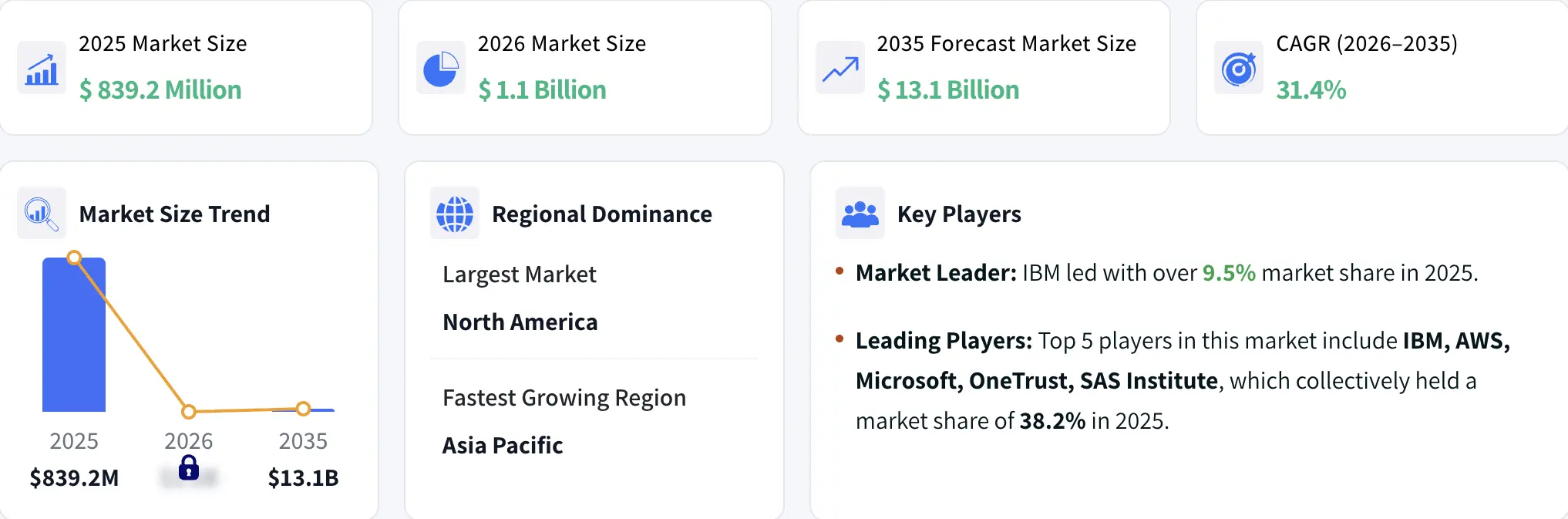
The global AI governance market is experiencing exponential growth, driven heavily by financial services compliance mandates. Valued at over $1.1 billion in 2026, the market is projected to expand at a compound annual growth rate (CAGR) of 31.4%.
This is according to Global Market Insights’ AI Governance Market Analysis, led by banking institutions managing strict SR 26-2 and EU AI Act requirements.
At the same time, modern platforms must continuously manage real-time operational risks across complex, multi-agent AI workflows.
1. SR 26-2 Replaced the Legacy SR 11-7 Framework
Federal regulators updated guidance with SR 26-2, which officially replaced legacy SR 11-7 AI model governance standards to mandate risk-based controls tailored directly to a model’s complexity and real-world impact.
- Proportional Risk Control: High-risk lending models require deeper validation than low-impact internal administrative tools.
- Continuous Oversight: Static annual reviews are replaced by ongoing real-time monitoring of model drift and operational changes.
- Broader Scope: The framework extends beyond traditional statistical formulas to cover generative AI and autonomous decision agents.
2. Fair Lending Still Requires Specific Decision Reasons
Using complex AI does not excuse banks from explaining why a customer was denied a loan or credit card.
- Actionable Denial Reasons: Banks must give applicants clear, specific reason codes for adverse action rather than general mathematical summaries.
- Beyond Generic SHAP Charts: System outputs must translate complex SHAP values into precise, legally defensible adverse action explanations.
- Fairness Audits: Systems must continuously test for disparate impact across protected classes under Equal Credit Opportunity Act (ECOA) rules.
3. Global Banks Face Overlapping Governance Frameworks
International financial institutions must satisfy multiple strict regulatory standards across different global jurisdictions simultaneously.
- High-Risk Classifications: The EU AI Act explicitly classifies credit scoring and creditworthiness assessment AI as high-risk systems subject to strict audit trails.
- Operational Resilience: Frameworks like DORA in Europe and FCA/PRA rules in the UK mandate continuous system stability and incident reporting.
- Global Standards: Banks align internal controls with NIST AI RMF, ISO/IEC 42001 certification, and MAS/APRA guidance in Asia-Pacific markets.
4. GenAI and Agents Create New Control Boundaries
Generative models and multi-agent AI introduce unpredictable behaviors that traditional model risk tools cannot monitor or control.
- Input & Output Guardrails: Systems must screen prompts, restrict retrieval sources, and validate generated outputs before reaching users.
- Agent Boundaries: Platforms must limit agent tool permissions, restrict autonomous memory access, and enforce clear human-in-the-loop approvals.
- Safety Switches: Risk teams require instant kill-switches to deactivate rogue AI agents or containment failures immediately.
5. Third-Party AI Must Enter the Same Governance System
Using external vendor software or third-party cloud APIs does not transfer regulatory accountability away from the bank.
- Vendor Ingestion: Commercial foundation models, fraud detection APIs, and credit bureau scoring algorithms must be logged in the central inventory.
- Embedded AI Tracking: SaaS copilots and hidden third-party software features require the same risk tiering as internally built models.
- No Blind Spots: Third-party model opacity requires banks to demand detailed vendor model cards, audit logs, and independent validation data.
AI governance in 2026 demands continuous, real-time risk controls across internal models, generative agents, and third-party vendor software.
To learn how to structure compliant systems across complex multi-agent architectures, see our guide on Enterprise Banking Compliance Requirements.
How We Ranked AI Governance Platforms for Banks
Platforms were ranked using a weighted evaluation model tailored to banking standards rather than vendor market popularity.
Specifically, highest scores go to platforms supporting SR 26-2 controls, independent model validation, fair-lending auditability, multi-agent AI governance, and private deployment.
1. Banking Compliance and Model Risk Fit — 25%
Platforms must meet strict regulatory standards set by financial oversight bodies.
- Regulatory Mapping: Direct support for SR 26-2 rules, EU AI Act standards, and Basel III reporting.
- Risk Tiering: Consequently, systems must automate classification of model materiality, business exposure, and operational risk tiers.
- Validation Workflows: In addition, platforms require built-in support for independent validation, effective challenge records, and policy exception tracking.
2. Model Lifecycle and Technical Assurance — 20%
A comprehensive platform manages technical integrity across the entire operational model lifecycle.
- Inventory Management: First, a centralized registry must track model versions, data lineage, and underlying training data.
- Performance Testing: Next, systems must automate drift detection, backtesting routines, and champion-challenger experimentation frameworks.
- Fairness & Explainability: Furthermore, integrated SHAP and LIME tools provide necessary adverse action analysis and fair-lending verification.
3. GenAI, LLM, and Agentic Governance — 15%
Modern architecture must govern generative systems, autonomous agents, and large language models safely.
- Guardrails & Tracing: To achieve this, platforms enforce real-time prompt filtering, RAG source attribution, and hallucination score tracking.
- Agent Supervision: Meanwhile, systems track discovery of shadow AI, tool permissioning, agent handoff logs, and human-in-the-loop approvals.
- Safety & Control: As a result, risk teams gain instant kill-switches for rogue agents and detailed logging of all autonomous decisions.
4. Integration, Security, and Deployment — 20%
Financial institutions require enterprise-grade security and flexible deployment options to protect sensitive customer data.
- Enterprise Integration: Pre-built REST APIs and webhooks connect directly to existing MLOps tools, GRC platforms, and SIEM systems.
- Security & Access: Additionally, platforms enforce granular Role-Based Access Control (RBAC), Single Sign-On (SSO), and Zero-Trust architecture.
- Flexible Hosting: Likewise, architectures must support customer Virtual Private Cloud (VPC), hybrid clouds, and air-gapped on-premises setups.
5. TCO, Support, and Market Evidence — 20%
Evaluating total ownership costs and proven industry experience prevents costly long-term vendor lock-in.
- Predictable Pricing: Transparent software licensing must be based on managed models instead of unpredictable usage volume spikes.
- Enterprise Support: Therefore, banks require dedicated technical account management, clear SLAs, and specialized banking implementation assistance.
- Verified Experience: Ultimately, technical evidence and verified banking deployments take priority over unverified review scores. In fact, according to Gartner Peer Insights review data, public review counts vary wildly across platforms, making raw star ratings unreliable on their own.
Evaluating banking AI platforms requires balancing core regulatory compliance with technical agent control, security, and true long-term operational costs.
Best AI Governance Platforms for Banks in 2026
Choosing an AI governance platform requires distinguishing between custom platforms and licensed software products. Specifically, custom development partners build bank-owned governance systems tailored to specific controls and technical stacks.
On the other hand, licensed software providers supply pre-built products that institutions configure, license, and integrate into existing operations.
Best AI Governance Platforms in 2026
| Rank | Company or Platform | Category | Best For |
| 1 | IBM watsonx.governance & OpenPages | Enterprise AI Governance & GRC | Large, complex international banking groups |
| 2 | ModelOp Center | Enterprise AI Lifecycle Governance | Model inventory tracking and control automation |
| 3 | ValidMind | AI & Model Risk Management | Independent validation and SR 26-2 automation |
| 4 | SAS Model Risk Management | Banking Model Governance | SAS-heavy banking analytics environments |
| 5 | Credo AI | Responsible AI Governance | Policy mapping and regulatory control oversight |
| 6 | OneTrust AI Governance | AI, Privacy, & GRC | Institutions using existing OneTrust privacy tools |
1. IBM watsonx.governance: Best for Large Banks
Category: Enterprise AI governance integrated with IBM OpenPages.
Best fit: Large banking groups operating existing IBM data, risk, or GRC enterprise infrastructure.
IBM watsonx.governance provides enterprise-grade AI risk tracking by connecting automated data documentation with policy enforcement. As a result, institutions can easily govern traditional ML and generative models within one system.
Key Platform Capabilities
- Automated Documentation: AI Factsheets capture lineage, training metadata, and model performance metrics automatically during deployment.
- GRC Integration: Furthermore, deep connection with IBM OpenPages aligns model risk workflows directly with broader operational risk frameworks.
- Flexible Hosting: Likewise, the platform fully supports managed cloud environments, hybrid cloud, and air-gapped on-premises data center deployments.
Implementation Considerations
However, according to the IBM OpenPages documentation, achieving complete governance requires combining Watsonx Governance with OpenPages Model Risk Governance. Consequently, this multi-product setup increases overall licensing costs and technical implementation complexity.
2. ModelOp Center: Best for Enterprise AI Inventory
Category: Enterprise AI lifecycle management and inventory governance.
Best fit: Banks managing large, mixed portfolios of statistical models, ML pipelines, third-party APIs, and AI agents.
ModelOp Center functions as an enterprise system of record, providing complete visibility and automated control gates across all banking model assets.
Key Platform Capabilities
- Central Inventory: First, a centralized registry covers statistical formulas, vendor scoring APIs, and generative AI agent workflows.
- Automated Risk Gates: Second, the system enforces automated risk tiering, policy mapping, and validation evidence checks before production deployment.
- Financial Focus: Additionally, workflows are designed specifically for banking risk committees and regulatory examination requirements. In fact, as noted on ModelOp’s financial services solutions, the platform helps banks streamline compliance across OCC, FDIC, and Federal Reserve supervisory standards.
Implementation Considerations
Nevertheless, while ModelOp excels at lifecycle orchestration and inventory management, runtime gateway security and deep model telemetry often require secondary integrations with external MLOps or API gateway tools.
3. ValidMind: Best for Validation Automation
Category: AI governance and automated model risk management.
Best fit: Institutions where manual model validation and regulatory documentation create severe operational bottlenecks.
ValidMind modernizes Model Risk Management (MRM) by automating testing, evidence collection, and documentation generation for model risk teams.
Key Platform Capabilities
- Automated Testing: Standardized libraries automate bias detection, stress testing, and explainability verification during review cycles.
- SR 26-2 Alignment: In addition, direct mapping to SR 26-2 guidance supports materiality-based tiering and ongoing performance monitoring. Specifically, as detailed in ValidMind’s SR 26-2 strategy guide, the platform enables automated documentation that cuts validation approval times significantly.
- Agentic Supervision: Moreover, real-time policy hooks and audit trails capture agent reasoning paths, tool interactions, and approval escalations.
Implementation Considerations
Thus, because ValidMind focuses primarily on model risk management and validation automation, institutions may still require separate enterprise GRC platforms for broader operational risk oversight.
4. SAS: Best for SAS-Heavy Banking Environments
Category: Enterprise model manager and model risk platform.
Best fit: Institutions utilizing SAS infrastructure for credit scoring, fraud detection, stress testing, or capital analytics.
SAS connects model development with enterprise risk management. Therefore, it delivers tight controls for institutions heavily invested in SAS analytics engines.
Key Platform Capabilities
- End-to-End Analytics: Unifies model development, scorecard creation, backtesting, and performance tracking in a single environment.
- Risk Integration: Similarly, native integration between SAS Model Manager and SAS Model Risk Management simplifies regulatory audit reporting.
- Banking Heritage: Furthermore, it offers proven, battle-tested scoring algorithms designed around global Basel III and CCAR capital requirements.
Implementation Considerations
Overall, the platform provides maximum value within an existing SAS ecosystem. However, licensing and integration costs are harder to justify for banks relying primarily on open-source Python or cloud-native AI stacks.
5. Credo AI: Best for Policy and Control Mapping
Category: Responsible AI governance and regulatory compliance software.
Best fit: Banks prioritizing cross-framework policy enforcement, responsible AI principles, and regulatory mapping.
Credo AI translates complex global regulations into actionable policy controls. In doing so, it allows risk teams to evaluate AI systems against evolving compliance standards.
Key Platform Capabilities
- Policy Engine: First, built-in compliance packs map internal AI use cases directly to the EU AI Act, NIST AI RMF, and ISO 42001 frameworks.
- Risk Assessments: Next, contextual risk scoring evaluates technical models, third-party vendor applications, and generative AI agents.
- Cross-Functional Portals: Finally, specialized dashboards enable seamless collaboration between legal, compliance, and technical data science teams.
Implementation Considerations
Importantly, Credo AI focuses on policy mapping and risk governance. Therefore, deep runtime performance telemetry and real-time model monitoring require secondary integrations with specialized MLOps tools.
6. OneTrust: Best for Existing GRC and Privacy Teams
Category: AI governance integrated with data privacy and enterprise GRC.
Best fit: Banks using OneTrust for vendor risk, privacy impact assessments, and data governance.
OneTrust extends established data privacy and risk management frameworks into AI governance. Consequently, it streamlines intake and vendor risk oversight.
Key Platform Capabilities
- Unified Intake: Standardizes AI use-case registration, risk assessments, and cross-departmental approval workflows.
- Third-Party Risk: In addition, strong vendor risk management capabilities evaluate third-party AI software and external data dependencies.
- Data Privacy Links: Furthermore, it integrates AI model inventories directly with existing data mapping, consent tracking, and privacy controls.
Implementation Considerations
Ultimately, while excellent for high-level risk intake and privacy alignment, model-level validation depth and specialized banking MRM workflows must be carefully evaluated during proof-of-concept testing.
Large international banks benefit from comprehensive ecosystems like IBM or SAS, whereas institutions targeting validation bottlenecks or policy mapping often prefer specialized solutions like ValidMind, ModelOp, or Credo AI.
To explore how custom-built architecture compares against off-the-shelf software platforms, view our analysis on custom AI development services for enterprise fintech and banking.
Banking AI Governance Platform Feature Comparison
No single platform leads every governance category. Consequently, banks should compare products according to the specific decisions and systems they must govern rather than selecting the vendor with the longest feature list.
1. Feature-Wise AI Governance Platform
| Evaluation Area | What the Bank Should Verify |
| Model Inventory | Statistical, ML, vendor, spreadsheet, GenAI, and agent coverage. |
| Risk Classification | Materiality, purpose, exposure, complexity, and customer impact. |
| Validation | Independent review, testing, backtesting, and outcomes analysis. |
| Fairness | Protected-class testing, disparate-impact analysis, and segment comparison. |
| Explainability | Global explanations, local reasons, and controlled adverse-action mapping. |
| Monitoring | Drift, performance, stability, fairness, data quality, and incidents. |
| GenAI Controls | Prompt versions, retrieval lineage, hallucination, and safety testing. |
| Agent Governance | Identity, tools, permissions, memory, autonomy, and kill switches. |
| Evidence | Immutable decisions, approvals, exceptions, changes, and reports. |
| Deployment | SaaS, private cloud, customer VPC, on-premises, and air-gapped options. |
| Integration | MLOps, GRC, data catalog, IAM, SIEM, ticketing, and core banking. |
| Exit Readiness | Evidence export, metadata portability, APIs, and retention policies. |
2. Best Fit for Credit and Underwriting
Lending systems require strict fairness, transparency, and regulatory defensibility.
Therefore, risk teams must prioritize independent validation, fairness testing, adverse-action reason generation, model versioning, policy overlays, and decision-level evidence tracking.
3. Best Fit for Fraud and AML
Financial crime monitoring requires handling dynamic behavioral data streams.
Thus, institutions should prioritize drift monitoring, threshold governance, graph model documentation, alert outcome tracking, challenger models, and investigator override logs.
4. Best Fit for GenAI and Customer Service
Generative models introduce unstructured operational risks. As a result, governance teams must prioritize retrieval lineage, PII protection, hallucination evaluation, prompt injection testing, output filters, and human escalation workflows.
5. Best Fit for Regional and Community Banks
Mid-size institutions require fast time-to-value without overwhelming compliance staff. Consequently, buyers should prioritize implementation simplicity, preconfigured workflows, manageable licensing, external validation support, and seamless integration with Fiserv, FIS, Jack Henry, or existing GRC systems.
Matching platform features to specific banking use cases prevents unnecessary software complexity while guaranteeing complete regulatory compliance.
For a deeper breakdown of governed financial-crime models, see our guide on Developing an AI AML Platform for Banks.
Reference Architecture for Bank AI Governance Platforms
A bank-grade AI governance platform should operate as a seven-layer control architecture. Consequently, it should not become another isolated dashboard that depends on teams manually uploading documents after models have already changed.
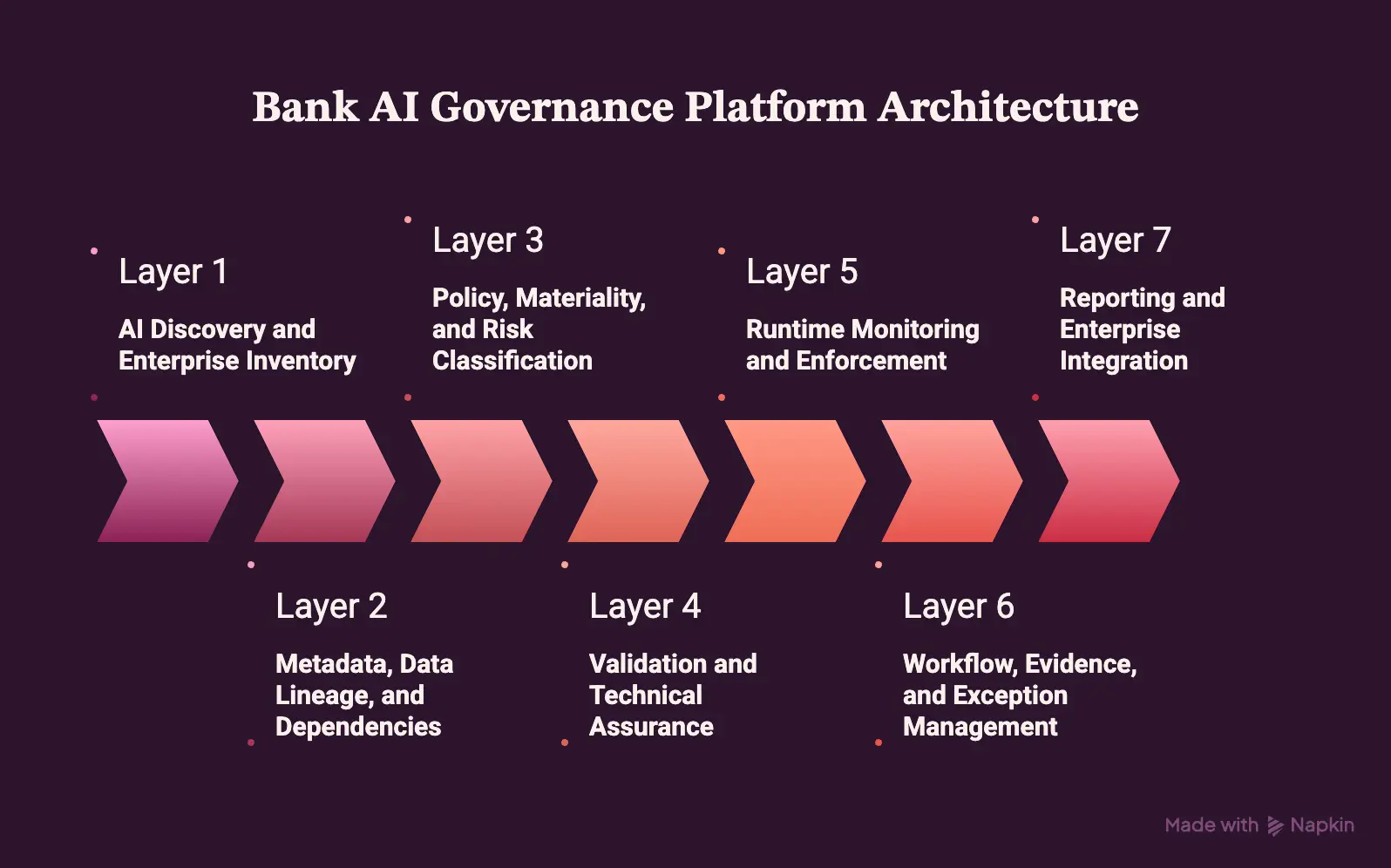
Layer 1: AI Discovery and Enterprise Inventory
This foundational layer automatically discovers and registers internally built models, vendor software, embedded algorithms, generative applications, and autonomous AI agents across all banking environments.
Layer 2: Metadata, Data Lineage, and Dependencies
This layer connects active model versions directly to underlying datasets, feature transformations, prompts, retrieval sources, external APIs, software vendors, and downstream financial decisions.
Layer 3: Policy, Materiality, and Risk Classification
By applying policy-as-code, this layer determines required review depth, validation frequency, approval authority, and continuous monitoring rules based on use-case materiality and regulatory exposure.
Layer 4: Validation and Technical Assurance
This layer automates conceptual soundness reviews, performance testing, backtesting, protected-class fairness testing, explainability generation, red teaming, and challenger model evaluations.
Layer 5: Runtime Monitoring and Enforcement
Operating in production, this layer collects live telemetry signals to trigger alerts, route traffic, force human reviews, activate fallback models, reduce agent permissions, or execute emergency kill switches.
Layer 6: Workflow, Evidence, and Exception Management
This layer manages approval chains, audit findings, remediation workflows, policy waivers, recurring validation schedules, executive attestations, and audit-ready evidence generation.
Layer 7: Reporting and Enterprise Integration
Finally, the platform connects seamlessly with core banking systems and operational tools, including FIS, Fiserv, Jack Henry, nCino, Databricks, Snowflake, MLflow, SageMaker, Azure Machine Learning, ServiceNow, Archer, Collibra, and SIEM platforms.
Implementing a unified seven-layer structure ensures that governance remains embedded within daily technical workflows rather than operating as a passive compliance exercise.
How Banks Should Run an AI Governance Platform RFP
A banking AI governance RFP should require vendors to prove their capabilities against real bank workflows.
Consequently, feature checkboxes are insufficient because many products use the same terms while providing materially different levels of automation, testing, integration, and runtime enforcement.
1. Begin With Three Representative AI Systems
To evaluate real-world performance, institutions should require each vendor to demonstrate governance across three distinct workloads:
- Credit underwriting model requiring strict fairness testing and automated adverse-action reason generation.
- Third-party fraud or AML model operating on streaming transaction data.
- Generative AI customer service workflow featuring autonomous agents and retrieval pipelines.
2. Demand Evidence, Not Product Claims
Rather than accepting verbal assurances, procurement teams should request actual sample outputs from live platform runs:
- A generated model card detailing training parameters and dataset origins.
- The automated risk classification assessment and validation package.
- A fair-lending bias report and complete model change record.
- Production monitoring incident log, approval history trail, executive board summary, and examiner evidence export.
3. Test the Integration Architecture
Banks must require a hands-on proof of concept to evaluate technical interoperability.
Specifically, the test environment should connect the governance platform with one MLOps framework, one GRC system, one enterprise data catalog, one central identity provider, and one active banking workflow.
4. Evaluate Deployment and Data Boundaries
Risk teams must clarify essential data handling rules and system boundaries:
- Exactly where metadata is stored and whether prompts or completions leave the bank network.
- Availability of dedicated customer VPC hosting and clear encryption responsibilities.
- Specific data retention schedules, third-party subprocessor access, regional hosting locations, and air-gapped on-premises support.
5. Score Vendor Lock-In and Exit Readiness
Finally, procurement officers must protect long-term institutional agility.
RFP scoring should evaluate whether the platform enables complete, unencrypted exports of all inventories, control policies, evidence repositories, validation records, model version histories, and audit logs in standardized, documented formats.
How Much Does a Custom AI Governance Platform Cost?
Custom AI governance platform development for banks usually costs $70,000 to $300,000.
Specifically, total investment depends on inventory scope, validation workflows, system integrations, deployment requirements, regulatory coverage, generative AI controls, and the number of business units entering the platform.
1. Cost Breakdown by Delivery Level
| Delivery Level | Cost Range | Typical Scope |
| Focused Governance MVP | $70,000–$110,000 | Central inventory, asset ownership, risk tiering, approval workflows, and basic evidence logs. |
| Production Banking Platform | $120,000–$210,000 | Automated validation, drift monitoring, data lineage, core integrations, and regulatory reporting. |
| Multi-Entity Enterprise Platform | $220,000–$300,000 | Multiple business units, international jurisdictions, GenAI, autonomous agents, and hybrid hosting. |
2. Cost Distribution by Development Phase
- Requirements and Regulatory Mapping: $8,000–$20,000
- Architecture and Governance Data Model: $10,000–$25,000
- Registry, Workflow, and Evidence Modules: $30,000–$70,000
- Integrations and Data Lineage Pipelines: $15,000–$55,000
- Monitoring, Fairness, and Explainability: $20,000–$65,000
- Generative AI and Agentic Governance: $15,000–$45,000
- Security, Validation, and Enterprise Deployment: $12,000–$45,000
Importantly, engineering phases are selected according to institutional scope. Therefore, individual modules should not automatically be added at their maximum financial values during initial planning.
3. Ongoing Operational Costs
Annual platform maintenance usually equals 18% to 25% of the initial build cost. This ongoing budget covers:
- Continuous regulatory framework mappings and policy updates.
- MLOps, GRC, and data catalog connector maintenance.
- Production monitoring infrastructure and security updates.
- Ongoing platform support and model evaluation updates.
Building a tailored governance platform allows banks to eliminate perpetual per-model licensing fees while maintaining direct ownership of technical IP.
How Banks Implement AI Governance in 5 to 9 Months
A bank can deliver a controlled AI governance MVP in 10 to 16 weeks, whereas a complete production platform typically requires five to nine months.
Consequently, successful implementations always begin with comprehensive model discovery and foundational governance rules rather than premature dashboard design or vendor configuration.
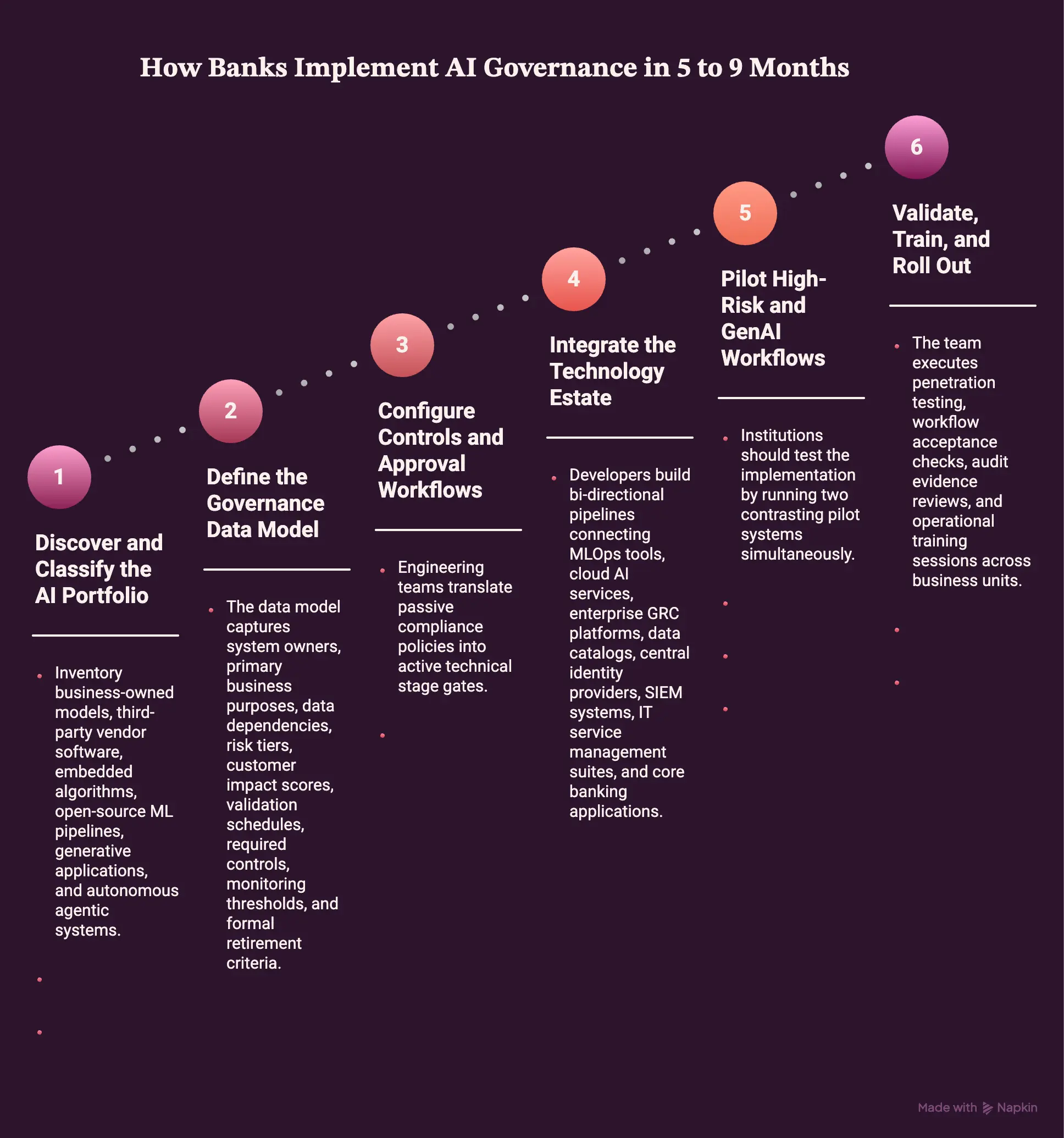
Step 1 — Discover and Classify the AI Portfolio
Technical scope: Inventory business-owned models, third-party vendor software, embedded algorithms, open-source ML pipelines, generative applications, and autonomous agentic systems.
Implementation approach: Teams must start with cross-departmental business interviews, technical code reviews, procurement contracts, API logs, cloud environment scans, and legacy spreadsheet registries. As a result, institutions eliminate shadow AI assets before defining formal control policies.
Step 2 — Define the Governance Data Model
This stage establishes the core schema for every registered AI asset.
Specifically, the data model captures system owners, primary business purposes, data dependencies, risk tiers, customer impact scores, validation schedules, required controls, monitoring thresholds, and formal retirement criteria.
Step 3 — Configure Controls and Approval Workflows
During this phase, engineering teams translate passive compliance policies into active technical stage gates.
These automated checkpoints govern development requests, independent validation reviews, production deployment sign-offs, model changes, policy waivers, incident escalations, and system decommissioning.
Step 4 — Integrate the Technology Estate
The governance platform must connect directly with existing operational software. Therefore, developers build bi-directional pipelines connecting MLOps tools, cloud AI services, enterprise GRC platforms, data catalogs, central identity providers, SIEM systems, IT service management suites, and core banking applications.
Step 5 — Pilot High-Risk and GenAI Workflows
Institutions should test the implementation by running two contrasting pilot systems simultaneously:
- One highly regulated quantitative model, such as a credit scoring pipeline requiring fair-lending testing.
- One generative or agentic AI workflow, such as an automated customer service assistant.
Importantly, this dual-pilot approach proves whether the platform can govern distinct risk profiles effectively without forcing every asset into an inadequate, one-size-fits-all compliance template.
Step 6 — Validate, Train, and Roll Out
Finally, the team executes penetration testing, workflow acceptance checks, audit evidence reviews, and operational training sessions across business units.
After securing control-owner sign-offs, the institution initiates a phased onboarding schedule to transition remaining business lines onto the platform.
Phased rollout schedules allow institutions to demonstrate rapid compliance value to regulators while systematically expanding governance coverage across complex enterprise assets.
For a deeper breakdown of autonomous-system controls, see our guide on Agentic AI in Banking.
Build Banking AI Governance Infrastructure With Intellivon
Intellivon develops custom AI governance infrastructure for banks that need more control than a standard software license provides.
Consequently, our platform seamlessly connects model inventories, validation workflows, regulatory controls, monitoring systems, audit evidence, and board reporting directly with your institution’s existing core banking, cloud, data, security, and MLOps ecosystem.
Key Capabilities
- Unified Portfolio Inventory: Centralize statistical models, vendor software, GenAI applications, and autonomous agents.
- Regulatory Alignment: Streamline compliance using workflows built specifically around current SR 26-2 expectations.
- Automated Validation: Standardize independent model reviews, issue tracking, and automated remediation management.
- Fair-Lending Evidence: Generate decision-level audit trails and automated adverse-action reason codes.
- Continuous Monitoring: Track performance drift, feature stability, data quality, and protected-class fairness metrics.
- Agentic Runtime Controls: Enforce LLM safety boundaries, tool permissions, and emergency kill switches.
- Deep Banking Integrations: Connect directly with FIS, Fiserv, Jack Henry, nCino, GRC, and MLOps platforms.
- Flexible Enterprise Deployment: Deploy securely within private cloud, customer VPC, hybrid, or air-gapped environments.
- Immutable Audit Evidence: Export examiner-ready reporting packages, historical versioning, and complete change logs.
Proven Enterprise Expertise
- Over 500,000 engineering hours delivered across complex enterprise environments.
- Ex-MAANG engineering leadership specializing in regulated AI architecture.
- Production-first focus ensuring complete bank ownership of all technical code and governance logic.
Talk to Intellivon’s banking AI experts about your governance architecture, RFP, vendor integration, or custom platform requirements today.
Conclusion
Modernizing AI governance is no longer just a regulatory compliance task. As institutions transition from legacy frameworks to SR 26-2 expectations, having transparent model inventories, robust validation, and real-time monitoring becomes essential.
Whether licensing established software or constructing custom governance architecture, financial institutions must prioritize actionable controls and seamless technical integrations.
Ultimately, embedding governance directly into daily engineering workflows protects institutional trust, reduces operational risk, and accelerates safe AI deployment across enterprise banking operations.
FAQs
Q1. Did SR 26-2 Replace SR 11-7 for Bank Model Risk?
A1. Yes. The Federal Reserve, OCC, and FDIC jointly issued SR 26-2 on April 17, 2026, officially replacing SR 11-7. However, regional banks will still encounter SR 11-7 terminology in legacy documentation, vendor sales materials, internal governance policies, and industry search queries during transition periods.
Q2. What Is the Best AI Governance Platform for Regional Banks?
A2. Select a commercial product for standardized workflows and fast setup. Conversely, choose custom platform engineering if managing legacy integrations, unique risk logic, or private deployments. Finally, avoid massive enterprise GRC suites requiring more administrative overhead than your bank’s active AI portfolio justifies.
Q3. Can One Platform Govern Models, LLMs, and AI Agents?
A3. Yes, a single platform can inventory all three asset types. However, controls must differ by architecture. Traditional quantitative models require statistical validation. Meanwhile, LLMs demand retrieval safety and hallucination testing, while autonomous AI agents require explicit tool permissions, execution logs, and runtime kill switches.
Q4. Are G2 and Gartner Ratings Enough to Select a Vendor?
A4. No. Analyst reviews help identify customer support patterns, but they cannot replace technical due diligence. Banks must mandate live architecture reviews, banking reference calls, proof-of-concept testing, security assessments, data export verifications, and hands-on validation of actual model-governance workflows before selecting a vendor.
To Sum It Up:
- SR 26-2 replaced SR 11-7 in April 2026, so banking AI governance comparisons that still treat SR 11-7 as current are already incomplete.
- A governance workflow records what teams claim an AI system does. Runtime evidence proves whether the system behaved that way in production.
- One platform can inventory models, LLMs, and agents, but it should not validate all three using the same control framework.
- A cheaper licence can produce a higher five-year cost when integration, validation, storage, staffing, and vendor-exit expenses are included.