Key Takeaways:
-
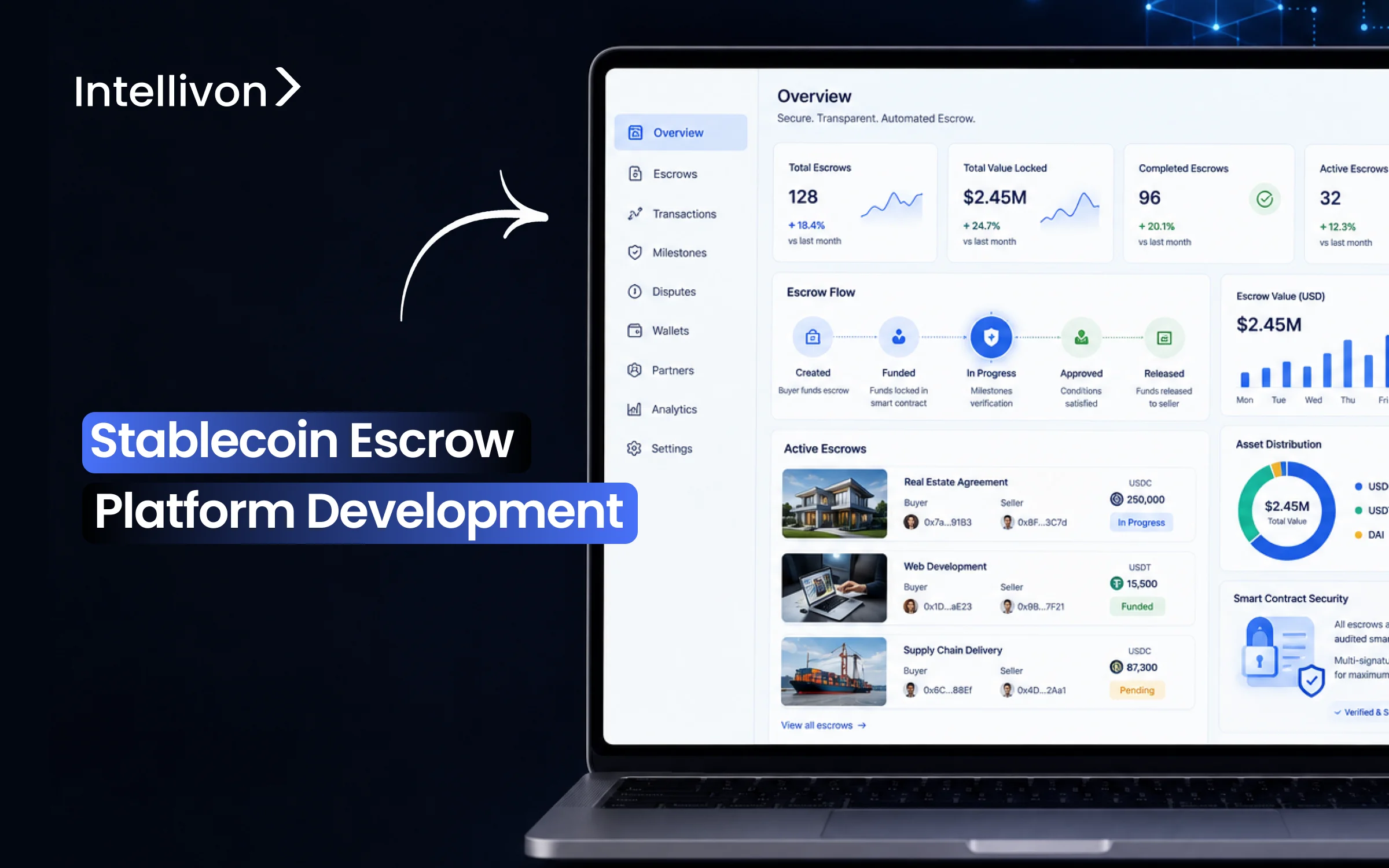
Stablecoin escrow platforms lock approved tokens until specific commercial conditions are verified and confirmed by the system.
-
Every production build needs contract logic, milestone tracking, dispute workflows, custody controls, and sanctions screening.
-
KYC, AML, Travel Rule support, audit trails, and enterprise APIs are non-negotiable compliance requirements for escrow platforms.
-
Focused MVPs cost $70,000 to $110,000 while multi-chain enterprise platforms reach $210,000 to $300,000.
-
How Intellivon positions AI as a support layer for fraud scoring and dispute triage, never as an autonomous fund-release authority.
A stablecoin escrow platform locks funds in a smart contract and releases them automatically once a defined condition is met, a delivery confirmation, a signed milestone, or a verified inspection. Half of all US B2B invoices were overdue in 2025, according to a 2026 supply chain payments analysis, and manual escrow processes are a large part of why.
However, automating fund release alone doesn’t solve trust between two parties who’ve never worked together. The platform also needs a way to verify that a real-world condition was actually met, since a smart contract can only act on data it receives. Oracle integration solves that gap by feeding shipment tracking, inspection results, or signed approvals directly into the contract. As a result, disputes drop sharply once release conditions run on verified data instead of one party’s word.
In this blog, we will cover the entire development steps, along with smart contract architecture, oracle integration, dispute resolution design, and compliance.

What Is a Stablecoin Escrow Platform, and How Does It Work?
A stablecoin escrow platform is software that locks stablecoins under predefined transaction rules and releases, refunds, or freezes those funds after contractual conditions are verified.
Therefore, unlike volatile cryptocurrencies, stablecoins like USDC or USDT maintain a predictable 1:1 value against fiat currencies. Consequently, these platforms allow enterprises to run cross-border B2B transactions, milestone payments, and asset transfers without currency fluctuation risks or traditional bank delays.
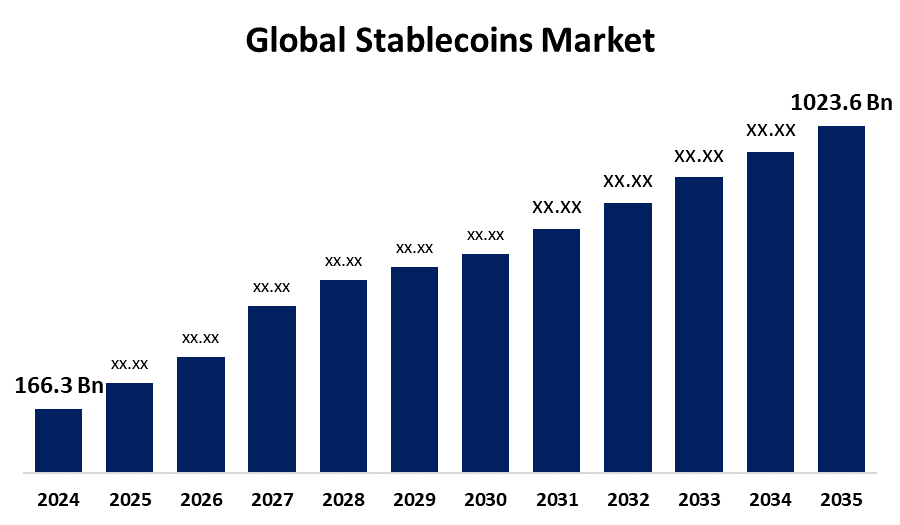
In fact, the global stablecoins market was valued at $166.3 billion in 2024 and is projected to reach $1,023.6 billion by 2035, accelerating at a 17.96% CAGR.
This expansion is driven by rising institutional adoption, cross-border B2B transaction volume, and the demand for automated, low-volatility settlement rails like smart contract escrows.
Stablecoin Escrow Platform vs. a Basic Escrow Smart Contract
A smart contract handles on-chain state changes and token transfers, but a complete enterprise platform manages the full operational lifecycle surrounding the deal.
| Operational Layer | Basic Escrow Smart Contract | Enterprise Stablecoin Escrow Platform |
| Fund Control | Executes code to hold or release tokens | Executes code while interfacing with multi-sig or custody solutions |
| Identity & Access | Tracks public wallet addresses only | Handles full buyer, seller, beneficiary, and arbitrator identity management |
| Compliance | Zero native compliance capabilities | Automated KYC, KYB, sanctions screening, and transaction monitoring |
| Dispute Handling | Requires manual external trigger or single arbitrator | Structured evidence submission, multi-party arbitration, and admin workflows |
| Integrations | Isolated on-chain execution | ERP, CRM, accounting, and REST API/webhook integrations for enterprise workflows |
The Seven-Stage Stablecoin Escrow Transaction
The software turns complex commercial agreements into predictable, automated workflows while preserving full audit trails.
- Agreement Creation: Parties establish commercial terms, milestones, and acceptance criteria within the application.
- Identity Verification: The platform verifies identities through integrated KYC and KYB compliance checks.
- Fund Deposit: The payer transfers designated stablecoins directly to the escrow deposit address.
- Smart Contract Lock: The smart contract locks the funds on-chain using immutable programmatic logic.
- Evidence Submission: The beneficiary submits digital proof, oracle feeds, or delivery confirmations.
- Condition Verification: The platform validates the release triggers against the submitted performance data.
- Settlement Execution: Funds are automatically released to the seller, refunded to the buyer, or frozen for active dispute resolution.
Major payment providers like Stripe describe escrow as a smart contract holding payment until a defined condition is met. However, the surrounding verification and governance systems determine whether that condition is reliable.
Building this multi-layered architecture requires connecting raw on-chain logic to real-world business data seamlessly. Without careful system design, gaps between off-chain agreements and smart contract execution create significant legal and technical risks.
Understanding these core platform components helps engineering teams construct secure and scalable settlement systems.
Choose the Escrow Operating Model Before Designing the Platform
Selecting the right operating model determines custody exposure, regulatory licensing, dispute authority, and recovery procedures for your platform.
In fact, operating models dictate how smart contracts interact with off-chain authorities and shape the technical requirements for funds handling.
1. Custodial Stablecoin Escrow
In a custodial model, the platform operator or a licensed institutional custody provider maintains direct control over the private keys holding the locked funds. Thus, administrators can intervene whenever exceptional account events take place.
Consequently, this structure allows platform administrators to initiate account recovery, enforce manual overrides, and execute dispute decisions easily.
However, maintaining central key control significantly increases regulatory burdens, obligating operators to secure money transmitter licenses and meet strict capital reservation mandates.
2. Non-Custodial Smart-Contract Escrow
In a non-custodial architecture, funds are locked directly inside an immutable smart contract, leaving private key ownership entirely with the transacting parties. As a result, third parties cannot move funds unilaterally.
While this model eliminates direct asset holding risks, “non-custodial” does not mean “unregulated”. In particular, regulatory bodies evaluate platform classification based on control rights, transfer authority, user interface governance, and jurisdiction.
3. Hybrid Enterprise Escrow
A hybrid framework uses smart contracts for transparent locking and settlement execution, while approved operators manage administrative and compliance functions off-chain. Hence, it bridges the gap between total decentralization and corporate compliance.
Through programmatic controls, operators handle identity checks, evidence verification, contract upgrades, emergency pauses, and compliance holds without exposing core funds to single-point failure risks.
4. Bilateral, Three-Party, and Multi-Party Models
Varying business relationships demand distinct signature thresholds, approval governance, and settlement workflows across the platform architecture. Moreover, each model trades operational complexity against security guarantees.
| Operating Model | Primary Control Structure | Recovery Options | Regulatory & Compliance Exposure | System Complexity |
| Bilateral (Buyer-Seller) | 2-of-2 Multi-Sig or Time-Lock | None if one key is lost | Low (P2P direct transfer) | Low |
| Three-Party (With Arbiter) | 2-of-3 Multi-Sig | High via Arbiter key | Moderate (Requires clear dispute rules) | Medium |
| Multi-Beneficiary / Consortium | $M$-of-$N$ Multi-Sig thresholds | High via Governance votes | High (Multi-jurisdictional & AML/KYC) | High |
Selecting an operational structure establishes the legal boundaries and technical constraints for your settlement engine.
Therefore, engineering teams can transition smoothly into designing core system components and underlying blockchain infrastructure.
Stablecoin Escrow Platform Architecture and Core Components
An enterprise stablecoin escrow platform functions as a multi-tiered architecture that bridges on-chain smart contract execution with off-chain business workflows.
At the same time, rather than operating as a standalone decentralized application, the platform requires integrated modules for identity management, agreement orchestration, key custody, compliance screening, real-world data verification, and data isolation.
| Architectural Module | Core Functionality | Enterprise Integration Target |
| User & Party Management | Role-based permissioning, entity profiles, and action authorization | SSO, Active Directory, IAM systems |
| Workflow Orchestration | Commercial terms storage, milestone state machine, and release triggers | Enterprise ERP, CRM, and Billing engines |
| Escrow Smart Contracts | Immutable fund locking, programmatic release, and fee splits | Public/Private L1/L2 Blockchain nodes |
| Custody & Wallet Management | Institutional key control, MPC policy enforcement, and multi-sig approvals | Fireblocks, Coinbase Custody, AWS KMS |
| Evidence & Oracles | Off-chain data validation, IoT feeds, and document verification | Chainlink, API endpoints, IoT gateways |
| Compliance & Risk | Automated KYC/KYB, wallet screening, and Travel Rule reporting | Chainanalysis, Elliptic, TRM Labs |
| Data & Observability | PII separation, immutable audit logs, and transaction monitoring | PostgreSQL, Snowflake, Datadog |
Building an enterprise-grade settlement engine requires tight coordination across all seven architectural layers.
Furthermore, isolating data boundaries and automating oracle verification prevents common compliance and technical failures during live execution.
Ultimately, this modular blueprint provides the security and scalability necessary to process high-value institutional transactions reliably.
How Release Conditions, Oracles, and Delivery Evidence Should Work
Determining when contractual obligations are met requires bridging physical reality with programmatic execution. Therefore, an enterprise stablecoin escrow platform must distinguish between deterministic data and subjective human judgment.
Establishing reliable evidence pipelines prevents premature fund releases and eliminates technical single-point failures.
1. Separate Objective Conditions From Subjective Conditions
Objective events rely on verifiable data points to trigger programmatic releases, whereas subjective conditions require human review. Specifically, platforms must separate automated logic from approval workflows:
- Objective Triggers: Execute automated releases based on shipment delivery, inspection scores, title transfers, digital signatures, or passed deadlines.
- Subjective Triggers: Route funds through explicit sign-offs or arbitration when evaluating software code quality, design expectations, consulting work, or clinical trials.
2. Use Multiple Evidence Sources for High-Value Transactions
High-value enterprise transactions should never depend on a single external data feed to authorize settlement. Consequently, multi-source validation protects assets against corrupted integrations:
- Oracles and Logistics APIs: Ingest real-world events from Chainlink networks alongside carrier tracking feeds like FedEx or DHL.
- ERP and Enterprise Systems: Connect SAP, Oracle procurement modules, and corporate digital signature platforms directly.
- Sensors and Registries: Verify IoT environmental telemetry, official government land registries, and NFT asset transfers.
Major infrastructure providers like Chainlink supply reliable data rails. However, the platform itself must define trusted sources, acceptable evidence formats, and mandatory fallback mechanisms.
3. Define Oracle Failure and Conflict Procedures
External data sources can fail, lag, or deliver conflicting information during critical release windows. Thus, robust system architectures enforce clear operational fallback procedures:
- Timeouts and Stale Data: Pause automated timers whenever oracle updates lag, and trigger system health alerts.
- Conflicting Evidence and Quorums: Require a multi-source consensus threshold, and flag diverging data feeds for manual review.
- Overrides and Emergency Controls: Grant authorized compliance officers manual pause capabilities if a provider is compromised.
4. Store Sensitive Evidence Off-Chain
Exposing private corporate documents or personal information on a public ledger violates global privacy regulations. As a result, engineering teams must isolate sensitive records off-chain:
- On-Chain Cryptographic Proofs: Record immutable document hashes, evidence reference keys, and timestamp proofs directly on the blockchain.
- Encrypted Storage Vaults: Keep confidential contracts, medical records, identity details, and commercial files in secure cloud storage. For a deeper breakdown of privacy-compliant system designs, see our guide on AI MLOps Platforms for Enterprise.
Differentiating objective data triggers from subjective human reviews prevents catastrophic settlement failures. Furthermore, enforcing multi-source consensus and storing sensitive documents off-chain ensures both operational resilience and privacy compliance.
Ultimately, this evidence-handling framework turns unpredictable commercial deals into secure, automated smart contract executions.
Custody, Stablecoin, and Blockchain Selection
Selecting the underlying asset, custody infrastructure, and network layer represents a coupled technical decision. Consequently, the chosen stablecoin dictates counterparty acceptance, legal compliance, and programmatic control, while the network selection determines transaction speed and fee structures.
Aligning these technical vectors prevents settlement friction and operational lock-in.
1. Compare USDC, USDT, EURC, PYUSD, and Other Assets
Stablecoins do not function identically under the hood. Therefore, platform architects must evaluate asset mechanics and issuer capabilities prior to integration:
- USDC and EURC (Circle): Provide high regulatory transparency, full reserve attestations, native multi-chain deployment, and explicit compliance frameworks like MiCA approval.
- USDT (Tether): Delivers unrivaled global liquidity and deep exchange integration, but carries region-specific regulatory restrictions and centralized freeze functions.
- PYUSD (PayPal/Paxos): Focuses heavily on US enterprise payment channels with direct fiat ramp access, backed by licensed trust entity oversight.
- Operational Controls: Account for issuer blacklisting mechanisms, transfer restrictions, depeg protection rules, and tax accounting implications across jurisdictions.
2. Select the Blockchain Around the Transaction
Deploying smart contracts requires balancing performance metrics against institutional ecosystem support. As a result, network selection depends directly on deal size and execution frequency:
- Ethereum Mainnet: Offers maximum security, deep liquidity pools, and extensive institutional support, though higher gas costs limit high-frequency use.
- Base and Polygon: Deliver low-cost, high-speed execution within EVM environments, making them ideal for commercial micro-deliverables and routine milestone tracking.
- Solana: Provides sub-second settlement times and negligible transaction fees, though it requires Rust-based contract architecture and dedicated oracle feeds.
- Infrastructure Capabilities: Compare total finality time, network uptime reliability, oracle availability, and native custodian support.
3. Design MPC, Multisig, and HSM Key Management
Securing institutional funds demands multi-layered cryptographic access policies rather than single private key dependencies. Furthermore, sound custody design separates routine operations from administrative overrides:
- Signing Thresholds and MPC: Utilize Multi-Party Computation or $M$-of-$N$ multi-signature schemes to enforce governance thresholds before authorizing disbursements.
- Transaction Limits and Allowlists: Enforce strict daily spending caps, automated volume checks, and pre-approved withdrawal address registries.
- Key Lifecycle Management: Establish automated key rotation schedules, off-site cold storage backup protocols, and emergency recovery pathways.
- Privileged-Action Logging: Capture tamper-proof, time-stamped audit logs for key share usage, policy updates, and manual override attempts.
For a deeper breakdown of stablecoin custody and ledger infrastructure, see our guide on How to Develop a Stablecoin-Enabled Banking System.
4. Avoid Unnecessary Multi-Chain Complexity
Deploying across multiple blockchains simultaneously introduces severe architectural risks, cross-chain bridge vulnerabilities, and fragmented asset liquidity.
Therefore, platform engineering teams should launch on a single robust chain first. Multi-chain expansion should occur only when clear business demands, distinct geographic corridors, or client requirements dictate it.
Aligning custody policies, token selection, and network infrastructure creates a resilient foundation for escrow execution. Moreover, choosing assets with clear issuer controls and avoiding early multi-chain fragmentation keeps smart contract logic lean and secure. Ultimately, this unified approach balances speed and liquidity with enterprise-grade asset protection.
Enterprise Features, APIs, and Integrations
A commercial stablecoin escrow platform requires deep business logic, enterprise software integrations, and robust developer infrastructure.
At the same time, unlike simple decentralized applications, an institutional engine must adapt to complex corporate procurement workflows, custom accounting structures, and automated programmatic management.
1. Core Transaction Features
Enterprise agreements demand flexible commercial terms beyond simple two-party transfers. Therefore, platform architects must support configurable agreement structures:
- Commercial Templates and Schedules: Deploy pre-configured templates for recurring escrows, milestone payouts, partial releases, retainage holds, and bulk transaction creation.
- Governance and Party Workflows: Coordinate multi-party invitations, complex approval chains, multiple beneficiaries, and formal contract amendment procedures.
- Financial and Dispute Logic: Execute partial refunds, fee allocations, emergency holds, formal dispute resolution, and real-time status tracking.
2. Stablecoin Escrow Platform API and SDK Design
High-volume enterprise applications rely on programmatic API and SDK channels to automate transaction lifecycles. Consequently, developer infrastructure must mirror traditional financial APIs:
- Core Lifecycle Endpoints: Expose REST and gRPC endpoints to create agreements, add parties, fund vaults, submit evidence, approve milestones, and execute rulings.
- Security and Reliability Controls: Implement mandatory idempotency keys, HMAC-signed webhooks, strict rate limits, service account roles, and API versioning.
- Developer Environment: Provide dedicated sandbox testing environments, SDKs in major languages, and interactive API documentation.
3. Enterprise-System Integrations
Seamless deployment depends on native connectivity with established enterprise software ecosystems. As a result, standard integrations eliminate manual data entry across departments:
- ERP and Procurement Engines: Integrate SAP, Oracle, and Microsoft Dynamics to map escrow milestones directly to purchase orders.
- Industry Platforms: Connect e-commerce marketplaces, real-estate title systems, insurance claims platforms, and supply-chain trackers.
- Financial Infrastructure: Link banking fiat ramps, corporate treasury tools, ERP ledgers, and automated identity verification providers.
4. Dashboards, Notifications, and Reconciliation
Finance and legal teams require complete operational visibility throughout every transaction stage. Furthermore, clear audit trails simplify periodic accounting reconciliation:
- Multi-Channel Alerts: Deliver real-time transaction updates via email, SMS, push notifications, and signed webhooks.
- Treasury and Fee Reporting: Track platform commission splits, yields, asset balances, and total value locked across all active vaults.
- Accounting Reconciliation: Map on-chain transaction hashes directly to corporate invoices and export immutable audit logs for accounting.
Building robust transaction features and developer infrastructure bridges legacy business operations with programmable blockchain rails. Moreover, native ERP integrations and automated reconciliation eliminate operational overhead for internal finance teams.
Ultimately, these enterprise capabilities convert basic smart contract code into a scalable commercial settlement platform.
AI Models That Improve Stablecoin Escrow Operations
AI optimizes risk assessment and evidence processing within a stablecoin escrow platform. However, AI models should never autonomously release high-value funds.
Smart contracts handle deterministic payment rules, whereas ambiguous performance requires human judgment. Consequently, AI should support compliance analysts and arbitrators without replacing human decisions.
| AI Capability | Analytical Method | Primary Escrow Function |
| Fraud Detection | Supervised learning | Identifies account takeovers, anomalous transfers, and collusion. |
| Entity Resolution | Graph neural networks | Maps connections between wallets, devices, and beneficial owners. |
| Document Verification | Vision & OCR models | Extracts invoice metadata and detects forged inspection files. |
| Dispute Triage | Large Language Models | Summarizes claims and highlights missing evidence for arbitrators. |
Integrating targeted AI workflows improves operational efficiency without compromising financial security. Moreover, using machine learning to surface risk while keeping settlement authority with human arbitrators preserves system integrity.
Ultimately, this hybrid model transforms complex escrow processing into a secure, scalable workflow.
Stablecoin Escrow Use Cases and Their Design Differences
A stablecoin escrow platform must adapt its workflows, evidence requirements, and release mechanics to specific commercial domains.
Consequently, applying a uniform template across divergent industries creates severe compliance and operational friction.
Stablecoin Escrow Use Cases
| Industry Sector | Primary Release Triggers | Critical Design Requirements |
| B2B Marketplaces | Delivery evidence, milestone sign-offs | Platform arbitration, partial payouts, retainage holds |
| Trade Finance | Bills of lading, inspection certificates | ERP integration, purchase order matching, IoT oracles |
| Real Estate & M&A | Legal deeds, title registry checks | Multi-party sign-offs, jurisdiction controls |
| Insurance & Legal | Adjuster approvals, court orders | Confidentiality controls, staged disbursements |
| Healthcare & Pharma | Clinical milestones, supply receipts | Off-chain HIPAA data isolation, provider settlement |
| Tokenized Assets | Delivery-versus-Payment (DvP) | Royalty splits, compliance whitelists, asset locks |
1. B2B Marketplaces and Freelancer Platforms
Digital platforms depend on flexible milestone tracking. Therefore, workflows incorporate defined revision windows, milestone acceptance checks, partial fund releases, and integrated platform arbitration.
2. Supply-Chain Procurement and Trade Finance
Cross-border trade relies on verified physical movement. As a result, releases trigger upon ingesting purchase orders, bills of lading, warehouse receipts, and automated IoT sensor data.
3. Real-Estate and M&A Transactions
High-value transactions demand strict legal alignment with off-chain property rights. Thus, systems enforce multi-party authorizations, formal title registry checks, attorney sign-offs, and localized regulatory controls.
For a deeper breakdown of programmable settlement, see our guide on How to Create a Real-World Asset Tokenization Platform.
4. Insurance Claims and Legal Settlements
Settlement workflows prioritize privacy alongside verified payout conditions.
Consequently, smart contracts execute staged disbursements only after receiving certified adjuster approvals, court orders, and verified claimant identities.
5. Healthcare and Pharmaceutical Transactions
Medical procurement and clinical-trial funding require stringent regulatory isolation.
Furthermore, platforms must ensure protected health information (PHI) remains entirely off-chain while executing provider network settlements.
6. Tokenized Assets and NFT Marketplaces
Digital asset settlement requires atomic execution to eliminate counterparty risk. Therefore, architectures utilize Delivery-versus-Payment (DvP) mechanisms, automated royalty distributions, wallet whitelists, and asset ownership verification.
Tailoring smart contract logic to industry-specific evidence structures ensures seamless commercial adoption.
Moreover, isolating sensitive data off-chain while automating domain-specific triggers bridges legacy operations with Web3 rails. Ultimately, specialized design patterns turn complex legal agreements into reliable, programmatic escrow executions.
How Intellivon Builds a Stablecoin Escrow Platform
Building an enterprise stablecoin escrow platform requires bridging immutable smart contract execution with complex commercial law, strict regulatory compliance, and legacy corporate IT systems. Consequently, Intellivon approaches platform development through a phased, engineering-led methodology. We eliminate legal, technical, and operational vulnerabilities before deploying production code.
| Phase | Core Deliverables | Critical Risk Controls |
| 1. Operating Model | Transaction-control matrix, regulatory roadmap | Asset flow mapping, jurisdiction boundary controls |
| 2. Architecture & State Machine | Formal state machine diagram, edge-case spec | Legal sign-off on state transitions, pause mechanics |
| 3. Smart Contracts & Custody | Escrow factory, MPC/multisig integrations | Multi-audited code, gas optimization, access control |
| 4. Integrations & AI Layer | ERP APIs, Travel Rule, document OCR, risk engines | Off-chain data isolation, non-custodial oracle feeds |
| 5. Audit & Phased Rollout | Formal verification, shadow launch, live pilot | Hard transaction limits, incident response drills |
Step 1 — Define the Transaction and Regulatory Operating Model
Intellivon begins every escrow project by mapping the complete commercial and regulatory architecture. Specifically, we define the participating entities, multi-currency asset flows, performance obligations, custody rights, and dispute mechanisms across all targeted jurisdictions.
Step 2 — Design the Workflow, State Machine, and Architecture
Translating commercial agreements into deterministic software requires an unambiguous state engine. As a result, Intellivon models normal operations alongside every operational edge case.
We map normal settlements, partial releases, buyer cancellations, seller disputes, contract expirations, regulatory holds, and protocol recovery paths.
- Created & Unfunded: Transaction parameters are locked on-chain; awaiting initial stablecoin deposit from the buyer.
- Funded & Active: Funds are locked in the escrow contract; performance timeframes and delivery windows begin.
- In Dispute: Automated release logic is frozen; control routes strictly to designated platform or third-party arbitrators.
- Paused / Sanctioned: Emergency protocol freeze invoked by compliance or circuit breakers upon detecting risk triggers.
- Settled / Refunded: Terminal states where assets route deterministically to the recipient, buyer, or split parties.
Step 3 — Build Smart Contracts, Custody, and Stablecoin Connectivity
With state models approved, Intellivon constructs the core Web3 infrastructure layer. We program modular escrow factory contracts that deploy lightweight, isolated transaction instances for individual escrow agreements.
This modular design isolates financial risk across separate contract deployments.
Step 4 — Add Compliance, Evidence, AI, and Enterprise Integrations
A production-ready platform must connect seamlessly with existing enterprise operations.
Therefore, Intellivon integrates enterprise identity systems (KYC/KYB), automated wallet screening engines, and Travel Rule compliance protocols directly into the escrow onboarding flow.
- Enterprise Systems: Direct integration with SAP, Oracle, and Salesforce to sync purchase orders and invoice states.
- Data & Oracles: Secure connections to Chainlink oracles, shipping APIs, and cloud storage for document verification.
- AI Processing: Deployment of machine learning models to parse off-chain bills of lading and flag fraudulent claims.
Step 5 — Audit, Pilot, Launch, and Monitor the Platform
Prior to mainnet deployment, Intellivon subjects the platform to rigorous multi-stage security validation.
At the same time, we engage top-tier independent auditing firms to perform formal smart-contract verification, comprehensive penetration testing, and stress-load simulation.
Finally, Intellivon executes a structured, phased rollout strategy. We launch first in a controlled pilot environment using conservative transaction caps, restricted counterparty groups, a single collateral stablecoin, and a primary EVM blockchain.
In addition, our team runs active failover exercises and incident simulation drills. Once performance parameters are verified under real-world conditions, Intellivon expands platform operations across multi-chain ecosystems and international jurisdictions.
Stablecoin Escrow Platform Development Cost and Timeline
The cost to build an enterprise stablecoin escrow platform ranges from $70,000 to $300,000.
Therefore, the overall expenditure depends directly on custody selection, multi-chain deployment, compliance scope, third-party integrations, smart contract audits, and automated AI mechanisms.
| Scope Tier | Total Development Cost | Timeline | Key Characteristics |
| Focused MVP | $70,000 – $110,000 | 16 – 22 weeks | Single chain, basic web3 custody, core milestone logic, standard KYC/AML. |
| Growth B2B Platform | $120,000 – $200,000 | 24 – 32 weeks | MPC custody, ERP integrations, dispute resolution, Travel Rule compliance. |
| Multi-Chain Enterprise | $210,000 – $300,000 | 32 – 40 weeks | Cross-chain liquidity, localized legal rules, AI evidence engines, full audits. |
Development Cost Breakdown by Phase
- Discovery & Architecture ($5,000–$15,000): Legal flow mapping, transaction-control matrices, and state machine design.
- UX & Workflow Design ($5,000–$15,000): Party journeys, administrative portals, and transaction interfaces.
- Smart Contracts ($12,000–$40,000): Factory deployment, milestone settlement logic, and automated tests.
- Backend & Admin APIs ($15,000–$45,000): Relayers, transaction databases, and enterprise management tools.
- Custody & Web3 Links ($8,000–$25,000): MPC wallet integration, gas management, and stablecoin connectivity.
- Compliance & AI Controls ($8,000–$35,000): Sanction screening, Travel Rule pipelines, and OCR evidence parsing.
- Enterprise Integrations ($5,000–$30,000): Syncing ERP systems, payment rails, and analytics dashboards.
- Security & Audits ($8,000–$30,000): Independent smart contract audits, penetration testing, and QA.
- DevOps & Mainnet ($4,000–$15,000): Cloud infrastructure, RPC nodes, and failover monitoring setup.
Multi-chain expansion, advanced arbitration tools, or additional regulatory jurisdictions add $20,000 to $50,000 in development costs.
Ongoing Platform Budgeting
Annual maintenance requires budgeting 15% to 25% of initial development costs. Consequently, upgrades, chain migrations, protocol pivots, or new regulatory mandates require dedicated audit budgets.
Build a Stablecoin Escrow Platform With Intellivon
Transitioning from speculative pilots to cost-optimized production platforms requires rigorous financial engineering, regulatory alignment, and fault-tolerant infrastructure.
At the same time, Intellivon connects payment economics, compliance logic, treasury workflows, and production engineering into unified enterprise systems.
Core Execution Capabilities
- Corridor ROI Modelling: We audit legacy wire fees, FX markups, and float costs to model exact operational savings before development begins.
- Multi-Rail Orchestration: Our engines dynamically route disbursements across stablecoins, SWIFT, SEPA, and local rails based on live execution costs.
- Institutional Custody: We build custom MPC, HSM, or multisig architectures with role-based permissions and policy controls.
- Ramp Connectivity: We integrate licensed banking partners globally to ensure full-value local fiat deposits.
- Automated Compliance: We embed real-time KYB/KYC, sanctions screening, and Travel Rule protocols directly into payout flows.
- ERP Sync: We establish bidirectional sync with SAP, Oracle, and NetSuite to automate subledger reconciliation.
Ready to reduce global payment costs? Contact Intellivon’s team to schedule a corridor economics audit today.
Conclusion
Building an enterprise stablecoin escrow platform requires balancing smart contract automation with strict legal, compliance, and custody standards. Consequently, long-term operational success depends on aligning programmatic execution directly with real-world commercial logic.
Furthermore, isolating transactional risk through modular contracts, multi-source oracle validation, and off-chain evidence verification protects counterparty capital across every trade. Ultimately, adopting a structured development roadmap enables global organizations to replace costly legacy escrow models. As a result, enterprise teams deploy secure, highly scalable, and fully programmable settlement rails.
FAQs
Q1. Does a non-custodial stablecoin escrow platform need licenses?
A1. Non-custodial architecture reduces direct custody exposure, but it does not automatically eliminate money transmission or AML obligations. Consequently, regulatory classification depends on transfer authority, fee models, arbitration control, and upgrade keys. Furthermore, operating across global jurisdictions often triggers licensing mandates whenever platforms perform regulated intermediary services.
Q2. Can AI automatically decide escrow disputes?
A2. AI excels at parsing evidence, summarizing claims, and prioritizing case files for compliance teams. However, algorithms should never independently decide subjective disputes or release high-value funds. Instead, final settlement authority must remain tied to deterministic smart contract logic or an accountable human arbitrator to maintain platform integrity.
Q3. How does a smart contract know that physical goods were delivered?
A3. Smart contracts rely on external oracles to verify off-chain real-world events. Specifically, platforms ingest data from logistics APIs, signed inspection records, IoT sensors, or title registries to validate performance. Moreover, high-value transactions should combine multiple data sources with manual dispute fallbacks to prevent single points of failure.
Q4. What happens if USDC or USDT held in escrow is frozen?
A4. A smart contract cannot override asset freeze functions embedded in an issuer’s token code. Therefore, platforms must establish clear operational protocols for compliance reviews, counterparty communications, and legal escalation. Additionally, teams need contingency plans to handle accounting adjustments and alternative settlement methods whenever frozen assets occur.
Q5. Can an escrow smart contract be upgraded after funds are deposited?
A5. Upgrades are possible through proxy patterns, but administrative permissions require strict control. Specifically, platforms utilize multisignature governance, timelocks, and versioned contract agreements to prevent unauthorized modifications. Consequently, active escrow deposits remain protected because code logic cannot alter terms without explicit contractual consent from all parties.
To Sum It Up
- A stablecoin escrow contract can lock money, but it cannot independently judge whether an off-chain commercial obligation was fulfilled.
- Custody and arbitration decisions affect licensing exposure more than the choice between Ethereum, Base, Polygon, or Solana.
- AI works best as an evidence and risk assistant; it should not become the autonomous authority releasing enterprise funds.
- Multi-chain support adds bridge, liquidity, audit, and recovery complexity, so most MVPs should start on one network.
- The smart-contract audit is only one security layer; APIs, custody keys, evidence systems, admin controls, and upgrade paths create equal exposure.