Key Takeaways:
-
Mental health apps in 2026 are moving toward continuous assessment, passive sensing, and human-AI care coordination platforms.
-
Purpose-built mental health AI, digital therapeutics, FHIR interoperability, and outcome-based enterprise platforms define the next generation.
-
AI should support clinical judgment through structured recommendations, and not independently replace qualified mental health professionals.
-
HIPAA, 42 CFR Part 2, FTC privacy requirements, FDA SaMD considerations, and AI governance are non-negotiable compliance requirements.
-
How Intellivon builds mental health platforms as healthcare infrastructure costing $70,000 to $300,000.
More than 10,000 mental health apps now incorporate AI, up from fewer than 1,000 five years ago, according to a 2026 AI therapy statistics review. However, only 16% of those AI chatbot studies have actually undergone clinical efficacy testing. As a result, that gap between adoption and evidence is the real story behind mental health app trends in 2026, and not the technology itself.
Meanwhile, the apps pulling ahead this year aren’t the ones with the flashiest chatbot. Instead, they’re the ones treating AI as one layer inside a clinically validated system, wearable data feeding risk detection, FHIR integration connecting to a patient’s actual care team, and crisis escalation paths that route to a real person. Consequently, product teams that skip clinical validation now are the ones facing regulatory scrutiny later, especially as FDA SaMD pathways for digital therapeutics get enforced more strictly.
In this blog, we’ll walk through the AI and wearable trends actually worth building around. Additionally, we’ll cover what clinical validation and FDA compliance require in 2026, and where health equity and workplace mental health platforms are heading next.
What Mental Health Apps Look Like for Enterprises in 2026
In 2026, enterprise mental health apps and software span a complex clinical continuum, shifting from wellness tracking to regulated medical devices.
Therefore, understanding this spectrum dictates your compliance burden, data privacy model, and technical architecture.
| Mental Health Product | Primary Function | Typical Buyer |
| Mental wellness app | Meditation, breathing, journaling | Consumer |
| AI mental health, companion | Reflection, coaching, support | Consumer/employer |
| Therapy marketplace | Therapist discovery and matching | Consumer/payer |
| Teletherapy platform | Video, chat, asynchronous care | Provider/payer |
| Behavioral health platform | Assessment, monitoring and care coordination | Health system |
| Digital therapeutic | Evidence-based treatment | Provider/payer |
| Workplace mental health platform | Employee care and benefits | Employer |
| Specialty mental health platform | Condition-specific longitudinal care | Provider/payer |
As applications advance along this continuum, regulatory expectations grow significantly:
- Regulatory Scope: Furthermore, the FDA explicitly distinguishes general wellness software from medical devices. General wellness tools focus on stress management, whereas platforms diagnosing or treating specific conditions trigger strict Software as a Medical Device (SaMD) oversight.
- Technical Complexity: Additionally, key mental health mobile app trends 2026 show that clinical depth demands advanced infrastructure. Higher-tier applications require EHR integration, real-time risk stratification, and validated clinical outcome measures.
- Compliance Standards: Consequently, tracking mental health platform trends to watch in 2026 highlights how HIPAA, SOC 2, and evidence validation dictate backend architecture.
For a deeper breakdown of system architecture, see our guide on Cost To Build An AI Healthcare App
The first strategic decision is therefore not which AI feature to add. It is deciding where the platform sits on the wellness-to-clinical-care spectrum. Ultimately, this choice defines your technical roadmap, compliance burden, and overall investment.
Why Mental Health Apps Matter More to Enterprises in 2026
Health systems, employers, and payers are shifting product capital from point-solution wellness apps to integrated enterprise platforms. This reallocation addresses clinician shortages, rising care management expenses, and escalating employee benefit costs.
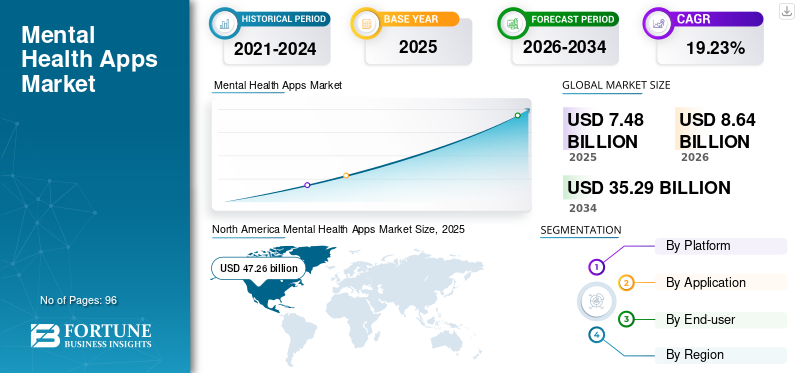
According to market data from Fortune Business Insights, the global mental health apps market will reach $8.64 billion in 2026 and expand to $35.29 billion by 2034 at a 19.23% CAGR. Consequently, capital is rapidly moving toward software platforms that scale clinical capacity.
1. Expanding Beyond Consumer Wellness
Enterprise platforms now deliver continuous support across complex care pathways. Modern architectures augment clinical staff by managing between-session care, virtual-first access, and asynchronous triage.
Furthermore, reports like Grow Therapy’s 2026 Mental Health Trends Analysis highlight how workplace mental health and integrated behavioral programs now anchor corporate employee benefits.
2. Changing Enterprise Buying Criteria
Enterprise metrics have shifted from downloads to validated clinical outcomes. At the same time, buyers now evaluate platforms based on measurable recovery rates, EHR interoperability, robust AI governance, data privacy, and automated care escalation.
Consequently, modern platforms rely on population health research from the AHRQ Healthcare Quality Research Repository to ensure clinical safety.
Building software to meet these elevated standards requires embedding validated assessment workflows directly into backend architectures.
For a deeper breakdown of compliant data management, see our guide on AI Audit Trail Software for Financial Services.
These structural shifts explain why the most important enterprise mental health app trends in 2026 focus on clinical integration rather than cosmetic features.
Mental Health App Trends Shaping Product Strategy in 2026
The product roadmaps for enterprise mental health platforms in 2026 are shifting fundamentally from cosmetic engagement features toward deep clinical and technical integration.
Consequently, engineering teams now prioritize deterministic safety guardrails, continuous biometric risk monitoring, multi-system EHR interoperability, and quantifiable clinical outcomes to meet elevated enterprise procurement standards.
1. Purpose-Built Mental Health AI Is Replacing Generic Chatbots
Enterprise platforms are moving away from generic LLMs toward domain-specific conversational engines built on strict clinical guardrails, deterministic safety classification, and automated escalation logic.
- Clinical Control Architecture: Engineering teams deploy Retrieval-Augmented Generation (RAG) pipelines connected to reviewed clinical knowledge bases. As a result, these systems enforce Cognitive Behavioral Therapy (CBT) and Dialectical Behavior Therapy (DBT) frameworks via structured prompts and real-time safety classifiers.
- Production Examples: For example, Headspace’s Ebb utilizes fine-tuned conversational models specifically for self-reflection. Similarly, Talkspace’s Tee combines LLM interactions with live clinician oversight to detect distress signals.
- Architecture Strategy: Ultimately, leaders must choose between external foundation models, proprietary RAG pipelines, or hybrid architectures. This decision depends on data privacy, latency, and model-control requirements.
- Intellivon Approach: Furthermore, Intellivon builds custom conversational AI architectures with deterministic fallback mechanisms. Consequently, these architectures safely bridge automated user sessions directly to human care teams.
Therefore, purpose-built AI transforms conversational interfaces from unpredictable chatbots into clinically safe engagement tools.
2. Clinical AI Validation Is Becoming a Release Requirement
Because non-deterministic outputs introduce direct clinical risk, regulatory bodies like the FDA’s Digital Health Advisory Committee now emphasize premarket evidence and postmarket monitoring for generative AI devices.
The Validation Stack
- Model & Clinical Testing: For instance, systems undergo continuous hallucination testing, therapeutic boundary checks, and adversarial red-teaming prior to deployment.
- Fairness & Bias Audit: Additionally, automated pipelines evaluate demographic bias, algorithmic fairness, and model explainability across diverse patient cohorts.
- Production Monitoring: Meanwhile, real-time auditing tools track outcome drift and model decay post-launch to maintain clinical validity over time.
However, high LLM benchmark accuracy does not equal clinical validity. In fact, an AI model can pass standard language exams while failing to recognize acute depressive relapse.
To solve this, Intellivon integrates automated AI safety red-teaming, bias detection, and clinical auditing directly into the continuous integration/continuous deployment (CI/CD) release pipeline.
Consequently, enterprise safety mandates that clinical AI validation operate as an automated release gate rather than a last-minute pre-launch checklist.
3. Mental Health Screening Is Becoming Continuous and Predictive
Mental health assessment is evolving from periodic self-report questionnaires toward continuous risk stratification that combines validated clinical instruments with real-time behavioral data.
- Longitudinal Monitoring: Specifically, platforms combine PHQ-9 and GAD-7 assessments with mood logs and journaling inputs. Consequently, backend models track longitudinal symptom trajectories and predict relapse risks.
- Safety & Crisis Escalation Layer: When suicide risk or self-harm signals cross safety thresholds, a deterministic rule engine initiates real-time alerts. Furthermore, it logs crisis events and triggers automated 988 crisis line workflows for human review.
- Intellivon Approach: In response, Intellivon develops real-time risk stratification engines that process complex clinical assessment streams while providing clinicians with transparent, actionable escalation logs.
For a deeper breakdown of compliant platform design, see our guide on Top AI Governance Vendors for US Enterprises 2026.
Ultimately, continuous screening shifts mental healthcare from reactive crisis management to proactive, preventative intervention.
4. Wearables Are Turning Passive Data Into Mental Health Signals
Smartphones and wearable sensors are transitioning mental health platforms from self-reported logs into continuous physiological and behavioral monitoring engines.
Continuous Signal Stream
- Physiological Signals: For example, systems ingest Heart Rate Variability (HRV), resting heart rate, sleep architecture, and respiration metrics from Apple Watch, Garmin, and Fitbit.
- Behavioral Signals: Meanwhile, passive sensing models analyze mobility patterns, device interactions, voice biomarkers, and digital phenotyping data to detect acute routine disruptions.
- Technical Ingestion Pipeline: Consequently, raw data flows through a structured pipeline: Device SDK → API Ingestion → Data Normalization → Consent Verification → Feature Engineering → Machine Learning Model → Alert Generation.
Importantly, sensor signals inform contextual clinical analysis, but they do not independently establish formal psychiatric diagnoses.
To address this technical hurdle, Intellivon constructs secure, multi-device ingestion pipelines that normalize continuous biometric streams for predictive risk modeling.
For a deeper breakdown of wearable interoperability, see our guide on building an EHR integration platform.
As a result, wearable integration converts passive physiological data into real-time clinical context.
5. Human-AI Hybrid Care Is Replacing AI-Only Therapy Models
The dominant enterprise architecture pairs AI efficiency with human clinical oversight rather than attempting to replace licensed therapists entirely.
- Patient-Facing Workflows: In practice, conversational AI handles between-session support, video and asynchronous therapy navigation, group therapy moderation, and peer support coordination.
- Clinician-Facing Workflows: Simultaneously, ambient AI documentation engines draft clinical session notes, summarize progress trajectories, flag risks, and streamline intake preparation.
- Medication & Psychiatry Layer: Additionally, integrated platforms combine telepsychiatry, prescription tracking, side-effect logging, and automated medication adherence monitoring.
- Intellivon Approach: Therefore, Intellivon engineers human-in-the-loop workflows that automate administrative tasks and ambient documentation, allowing clinicians to focus entirely on direct patient care.
As a result, hybrid care architectures maximize therapist productivity while maintaining strict standards of clinical care.
6. Digital Therapeutics Are Moving Toward Reimbursable Care
Digital Therapeutics (DTx) are establishing formal clinical status as reimbursement pathways and regulatory classifications dictate product development strategies.
- Reimbursement Milestones: For instance, CMS expanded coverage policies under HCPCS codes G0552, G0553, and G0554 for qualifying digital mental health treatment devices.
- Regulatory Spectrum: Furthermore, products range from general wellness apps with a light evidence burden to Software as a Medical Device (SaMD) and FDA-cleared DTx requiring randomized controlled trials (RCTs).
- Enterprise Choice: Consequently, product teams must explicitly decide whether to build direct-to-consumer wellness tools or reimbursable, evidence-backed clinical infrastructure.
- Intellivon Approach: In this space, Intellivon builds SaMD-compliant software architectures equipped with audit logging, evidence-generation modules, and FDA validation documentation.
Therefore, securing formal reimbursement pathways turns clinical software into a sustainable, long-term enterprise asset.
7. Behavioral Health Data Is Becoming More Interoperable
Behavioral health applications are moving away from isolated data silos toward open, interoperable systems that exchange clinical assessments, care plans, and medication histories.
- Regulatory Driver: Specifically, the ASTP/ONC USCDI+ Behavioral Health dataset and FHIR Behavioral Health Profiles now set the national standard for behavioral data exchange.
- Technical Integration Architecture: As a result, clinical data flows across a dedicated gateway: App → API Gateway → FHIR Server → EHR (Epic/Cerner) → Clinician Workflow.
- Data Mapping Standards: Moreover, interoperability requires identity resolution, bidirectional FHIR resource mapping, consent metadata tracking, and secure EHR write-back capabilities.
- Intellivon Approach: To enable this connectivity, Intellivon builds enterprise FHIR integration layers that connect digital health applications directly to major hospital EHRs.
For deeper EHR architecture, see our guide on building AI-powered EHR systems.
Unlocking bidirectional EHR data exchange ensures behavioral health insights are immediately actionable within primary clinical workflows.
8. Privacy, Consent, and Crisis Safety Are Becoming Core UX
Data privacy, regulatory compliance, and crisis response protocols must be embedded directly into the frontend user experience rather than buried in backend terms of service.
Compliance Frameworks
- HIPAA & Part 2: First, covered entities enforce strict Protected Health Information (PHI) safeguards, Business Associate Agreements (BAAs), and updated 42 CFR Part 2 substance-use privacy rules.
- FTC Health Breach Rule: Second, consumer health platforms operating outside HIPAA enforce strict consent disclosures regarding data sharing and model training.
- UX Safety Controls: Finally, user interfaces incorporate explicit AI disclosures, recording toggles, zero-trust RBAC permissions, and single-tap crisis escalation triggers.
To ensure compliance, Intellivon designs zero-trust backend architectures featuring end-to-end encryption, automated audit logging, and strict data-isolation boundaries for AI model training.
Ultimately, embedding compliance and crisis safety directly into the user interface establishes essential trust between patients, providers, and enterprise buyers.
9. Personalization Is Expanding Into Adaptive Care Pathways
Modern personalization moves beyond basic content recommendations to dynamically adjust care intensity based on real-time patient engagement and symptom trajectories.
- Four Personalization Levels: In practice, care evolves across four tiers: Level 1 (Content/Media) → Level 2 (Targeted CBT/DBT Exercises) → Level 3 (Care Pathway Escalation to Therapists) → Level 4 (Longitudinal Adaptive Care via Sensor Context).
- Retention & Engagement Layer: Additionally, platforms utilize gamification, streak tracking, micro-interventions, and disengagement prediction to drive sustained participation.
- Therapeutic Metric Standard: However, engineering teams optimize platforms for meaningful clinical progress rather than addictive, screen-time-driven usage.
- Intellivon Approach: Consequently, Intellivon constructs adaptive algorithmic engines that route users to higher levels of clinical care based on real-time symptom analysis.
As a result, adaptive care pathways ensure users receive the exact level of clinical intervention required at any point in their recovery.
10. Workplace Mental Health Is Moving Toward Measurable Outcomes
Employer-sponsored mental health benefits have shifted from basic Employee Assistance Program (EAP) hotlines to comprehensive care platforms focused on validated return-on-investment (ROI).
- System Integration: For example, platforms connect directly with corporate HR systems, benefits management portals, EAP providers, and commercial health plan payers.
- Enterprise Reporting: Meanwhile, employer dashboards track aggregated population health metrics, access speed, utilization rates, and clinical outcome trends.
- Privacy Controls: Crucially, systems enforce strict de-identification, minimum cohort aggregation sizes, and role-based data boundaries to prevent employer surveillance concerns.
- Intellivon Approach: In response, Intellivon develops enterprise reporting suites that deliver actionable population health insights while strictly preserving individual employee data privacy.
Therefore, measuring clinical outcomes allows employers to justify mental health benefit expenditures through clear workforce productivity data.
11. Mental Health Products Are Becoming Population-Specific
Generic, one-size-fits-all mental health apps fail because clinical needs, safety escalation protocols, and communication styles vary drastically across diverse demographic groups.
Population Adaptation
- Specialized Cohorts: Specifically, platforms are engineered for distinct needs, including pediatric, adolescent, maternal, geriatric, substance use disorder (SUD), PTSD, and neurodiverse populations.
- Health Equity Design: Furthermore, systems incorporate multilingual interfaces, culturally adapted clinical content, health literacy adjustments, and accessibility standards.
- Youth-Specific Guardrails: For pediatric populations, platforms enforce guardian workflows, age gating, emotional dependency monitoring, and specialized crisis escalation protocols.
To address these distinct requirements, Intellivon builds modular, population-specific digital health platforms that support custom clinical workflows and localized cultural adaptations.
Ultimately, designing for specific demographic requirements ensures higher therapeutic engagement and improved clinical safety across all user groups.
Which Mental Health Platforms Set the Benchmark in 2026?
Rather than labeling platforms as the best mental health apps, enterprise strategy teams must examine leading architectures to understand key operational patterns.
Consequently, analyzing market leaders highlights how top platforms integrate conversational AI, clinical oversight, and enterprise care orchestration into cohesive digital health products.
Mental Health Benchmark Platforms
| Platform | Strategic Area to Examine | Product Lesson |
| Headspace | AI companion + wellness | Integrating AI into an established care journey |
| Talkspace | Therapy + purpose-built AI | AI with clinician escalation |
| Spring Health | Employer behavioral health | Continuous enterprise care |
| Lyra Health | AI + provider matching | Human-in-the-loop care orchestration |
| Wysa | Conversational support | Structured digital mental health |
| Brightside | Therapy + psychiatry | Integrated behavioral and medication care |
Analysing These Benchmark Apps
To evaluate these benchmarks effectively, product teams must analyze the underlying models, enterprise trends, and critical product trade-offs:
- Headspace (Ebb): Uses a fine-tuned RAG companion anchored in motivational interviewing. Consequently, it demonstrates how to drive daily self-reflection without crossing into regulated clinical care.
- Talkspace (Tee): Deploys a HIPAA-compliant conversational model connected to real-time risk classification. As a result, it establishes how automated user sessions can safely escalate acute distress directly to licensed clinicians.
- Lyra & Spring Health: Leverage machine learning for intelligent provider matching and care orchestration. Furthermore, they prove that enterprise buyers prioritize measurable clinical outcomes and seamless HR integration over simple app usage.
- Brightside & Wysa: Combine structured conversational support with integrated behavioral and medication workflows. Therefore, they illustrate how software can bridge asynchronous triage with long-term clinical care management.
However, engineering teams should not simply copy these consumer interfaces. Instead, product leaders must recognize that attempting to replicate a B2C companion without embedded clinical escalation, robust data privacy, and EHR interoperability creates massive regulatory and patient safety risks.
Where Mental Health Technology Investment Is Moving in 2026
Capital allocation in digital health is experiencing significant concentration. According to the Rock Health H1 2026 Digital Health Funding Report, U.S. digital health startups raised $7.4 billion in the first half of 2026 alone.
Therefore, mental health remained the top-funded clinical indication for the seventh consecutive year. Consequently, venture capital and private equity investors are directing funds toward high-acuity, workflow-integrated software platforms with proven clinical traction.
5 Core Structural Themes
Investment activity centers on five core structural themes:
- AI-Native Behavioral Health: Capital is moving beyond basic chat features toward specialized platforms built from the ground up with native AI infrastructure and clinical guardrails.
- Hybrid Care Delivery: Investors heavily favor technology that augments human clinicians rather than unguided direct-to-consumer apps.
- Enterprise Infrastructure: Funding is concentrating on software that integrates directly into employer, payer, and health system distribution channels.
- Evidence-Backed Digital Therapeutics: Venture capital is prioritizing products backed by randomized controlled trials and clear reimbursement strategies.
- Strategic Consolidation: Platform expansion via M&A is accelerating, as established companies acquire specialized capabilities to own broader clinical workflows.
Model Comparison
| Model | Revenue Path | Main Investor Question |
| D2C | Subscription | Can CAC support long-term retention? |
| Employer | PEPM/Contract | Can clinical outcomes justify annual renewal? |
| Payer | Value-based contract | Does the software measurably lower total cost of care? |
| Provider | SaaS/Licensing | Does it improve clinical capacity and workflow efficiency? |
| DTx | Medical reimbursement | Is the clinical evidence and regulatory strategy defensible? |
In 2026, simply claiming a product “uses AI” no longer creates a sustainable competitive moat.
Ultimately, defensible assets consist of verified clinical evidence, proprietary workflows, deep EHR integration, longitudinal datasets, and established enterprise trust.
How Compliance Is Reshaping Mental Health Apps in 2026
Enterprise digital health architectures must satisfy an increasingly complex regulatory landscape. Therefore, legal compliance now dictates fundamental engineering decisions across data flows, AI model training, and clinical escalation logic.
Compliance Requirements
| Requirement | When It Matters | Architecture Impact |
| HIPAA/HITECH | Covered health care workflows | Protected Health Information (PHI) access controls, Business Associate Agreements (BAAs), and end-to-end auditability. |
| 42 CFR Part 2 | Applicable to Substance Use Disorder (SUD) records | Strict patient consent tracking, explicit redisclosure controls, and segregated data storage. |
| FTC HBNR | Direct-to-consumer health applications | Enforces data-flow governance, third-party tracker restrictions, and breach reporting outside traditional HIPAA scope. |
| FDA SaMD | Software performing medical-device functions | Triggers formal Software as a Medical Device (SaMD) verification, clinical validation, and lifecycle risk controls. |
| SOC 2 Type II | Enterprise B2B procurement | Mandates continuous operational security monitoring, access reviews, and evidence logging. |
| GDPR | Processing EU personal data | Explicit consent mechanisms, data minimization, automated deletion pipelines, and user rights enforcement. |
| EU AI Act | AI systems deployed in the EU | Mandatory transparency disclosures, emotion recognition restrictions, and strict governance logging under Article 50 requirements. |
1. Evolving Federal Privacy Mandates and Data Governance
Regulatory enforcement mechanisms have sharpened significantly across both healthcare and consumer domains. For instance, updated 42 CFR Part 2 rules reached their compliance milestone on February 16, 2026, forcing platforms handling SUD data to enforce unified HIPAA consent standards and explicit redisclosure limits.
Simultaneously, the FTC’s amended Health Breach Notification Rule regulates direct-to-consumer health apps outside HIPAA coverage. Consequently, it penalizes unauthorized data sharing with third-party advertising brokers and tracking pixels.
2. International AI Transparency and Algorithmic Controls
Global markets now impose strict operational controls on conversational AI and predictive systems. Furthermore, Article 50 of the EU AI Act introduced mandatory transparency obligations in August 2026, requiring applications to clearly inform users when interacting with conversational AI models.
These rules prohibit unannounced emotion recognition in specific employment and educational contexts. As a result, engineering teams must maintain immutable audit logs for all algorithmic decision processes.
3. Engineering Compliance-Ready Architectures
Designing compliant platforms requires mapping every data flow directly to its underlying legal framework.
For a deeper breakdown of regulatory frameworks, see our guide on EU AI Act Compliance Software Development.
Ultimately, enterprise leaders should not simply ask if a platform is HIPAA compliant. Instead, engineering teams must evaluate which specific regulatory regimes govern every data flow, AI model, clinical claim, target demographic, and operating geography.
What Mental Health App Development Costs in 2026
A production-ready mental health app typically requires a $70,000–$300,000 development budget in 2026, depending on clinical scope, AI complexity, integrations, security, and validation requirements.
Mental Health App Development Cost By Platform Type
| Platform Type | Estimated Cost |
| Mental wellness or coaching MVP | $70K–$100K |
| AI-enabled mental health platform | $100K–$160K |
| Teletherapy + AI care platform | $150K–$220K |
| Enterprise behavioral health platform | $220K–$300K |
Cost Breakdown by Development Phase
| Phase | Typical Range |
| Discovery + clinical planning | $8K–$20K |
| UX + care workflow design | $10K–$25K |
| Core frontend/backend | $25K–$65K |
| AI/LLM implementation | $15K–$55K |
| Integrations | $15K–$45K |
| Security + validation | $15K–$40K |
| Pilot + deployment | $8K–$20K |
Note that phase ranges overlap depending on product scope and should not be mechanically summed. Total spend remains strictly within the $70,000–$300,000 range.
Key Cost Drivers and Maintenance
Core cost drivers include clinical functionality depth, proprietary LLM tuning, FHIR/EHR and wearable integrations, teletherapy modules, crisis workflows, and FDA SaMD validation pathways.
Additionally, ongoing maintenance requires 15–25% of the initial build cost annually to cover cloud compute, AI monitoring, security audits, and continuous compliance updates.
For a broader healthcare budget comparison, see our detailed guide on the Cost To Build An AI Healthcare App.
Build a Mental Health Platform Ready for 2026 With Intellivon
Building an enterprise mental health platform in 2026 requires shifting focus from consumer engagement metrics to deep clinical infrastructure, deterministic safety guardrails, and verified interoperability.
At Intellivon, we bring specialized expertise in healthcare AI product engineering to help health systems, payers, and digital health founders build compliant, production-grade applications. Our technical capabilities cover:
- Healthcare AI & Safety Systems: Custom LLM and RAG architectures engineered with clinical content controls, deterministic safety fallback classifiers, and real-time risk escalation logic.
- Clinical Workflow & Biometric Integration: Seamless integration with Apple Watch, Garmin, and Fitbit streams alongside clinician-facing ambient documentation tools.
- Interoperability & Compliance: HIPAA-ready backend infrastructure supporting HL7 FHIR and USCDI+ profiles for Epic and Cerner environments, fully integrated with automated MLOps pipelines for continuous post-deployment monitoring.
Ready to build an enterprise mental health platform anchored in clinical safety, enterprise interoperability, and measurable ROI? Partner with Intellivon to move your digital health strategy into production.
Conclusion
The market has shifted. Digital mental health tools are evolving from isolated self-help apps into AI-enabled, interoperable, governed care infrastructure.
Winning platforms will not win by deploying the largest model or endless content libraries. Instead, long-term market leaders will succeed through seamless clinical workflows, validated evidence, robust escalation layers, deep EHR integration, and strict data governance that prove real clinical and financial ROI.
Evaluating mental health app trends 2026 requires asking one core strategic question: Which capabilities create differentiated clinical value for our platform, and which should we safely buy or build with a partner?
FAQs
Q1. Does Every Mental Health App Need HIPAA Compliance?
A1. No. HIPAA applies strictly to covered entities like health systems and their business associates handling Protected Health Information (PHI). However, non-HIPAA direct-to-consumer health apps must still comply with the FTC Health Breach Notification Rule, state consumer privacy laws, and international frameworks like GDPR when collecting sensitive user data.
Q2. Can a General LLM Safely Power an AI Therapy App?
A2. Not by itself. Commercial base models lack deterministic safety guardrails, clinical boundary enforcement, and real-time risk classification needed for psychological interventions. Consequently, general LLMs require domain-specific fine-tuning, Retrieval-Augmented Generation (RAG) using clinical knowledge bases, automated hallucination controls, and real-time human escalation workflows before entering production.
Q3. Does a Mental Health Platform Need FHIR Integration?
A3. It depends on the care model. Standalone consumer wellness tools usually do not require HL7 FHIR connectivity. Conversely, platforms that exchange assessments, prescriptions, or care plans with hospital networks, payers, or electronic health record (EHR) environments require standardized FHIR APIs to support bidirectional clinical data flow.
Q4. Should Enterprises Build or Buy Mental Health Technology?
A4. Enterprises should evaluate build-versus-buy decisions across four core criteria: differentiation, integration depth, data governance, and time-to-market. At the same time, enterprise leaders typically buy commodity features like video calling, while building proprietary workflows, clinical AI models, and core user experiences. A hybrid development strategy delivers speed without sacrificing strategic IP.
Q5. Can AI Record Therapy Sessions and Generate Clinical Notes?
A5. Yes, but deployment requires solving critical legal and clinical guardrails first. Engineering teams must establish explicit patient recording consent, secure PHI handling, zero-retention vendor agreements, Business Associate Agreements (BAAs), and clinician review steps. Furthermore, platforms must comply with updated 42 CFR Part 2 rules when handling substance-use records.
To Sum It Up:
- Mental health AI is moving from generic conversation toward purpose-built systems with clinical boundaries, evaluation, and human escalation.
- The most important wearable trend is not collecting more biometrics. It is determining which signals are reliable enough to influence care.
- FHIR interoperability is turning behavioral health apps from isolated digital products into components of the clinical data ecosystem.
- Digital therapeutics become commercially more interesting when evidence, regulation, clinical workflow, and reimbursement are designed together.
- By 2026, simply adding an LLM is not meaningful differentiation. Clinical evidence, workflow ownership, integration depth, and trusted data architecture are harder to copy.