Key Takeaways:
-
Start with the healthcare side first. Many companies know about AI. Even fewer understand the real challenges when it comes to patient data and clinical systems.
-
Don’t believe HIPAA or EHR claims just because they are said. Ask what they have actually created and where it has been used.
-
The right company depends a lot on the project. A startup creating one product might need something different from a large health system.
-
Costs can change a lot. Custom healthcare AI usually costs between $70,000 and $300,000.
-
Intellivon can handle the build from the very beginning, with scoping and integrations all the way to launch, monitoring, and future improvements.
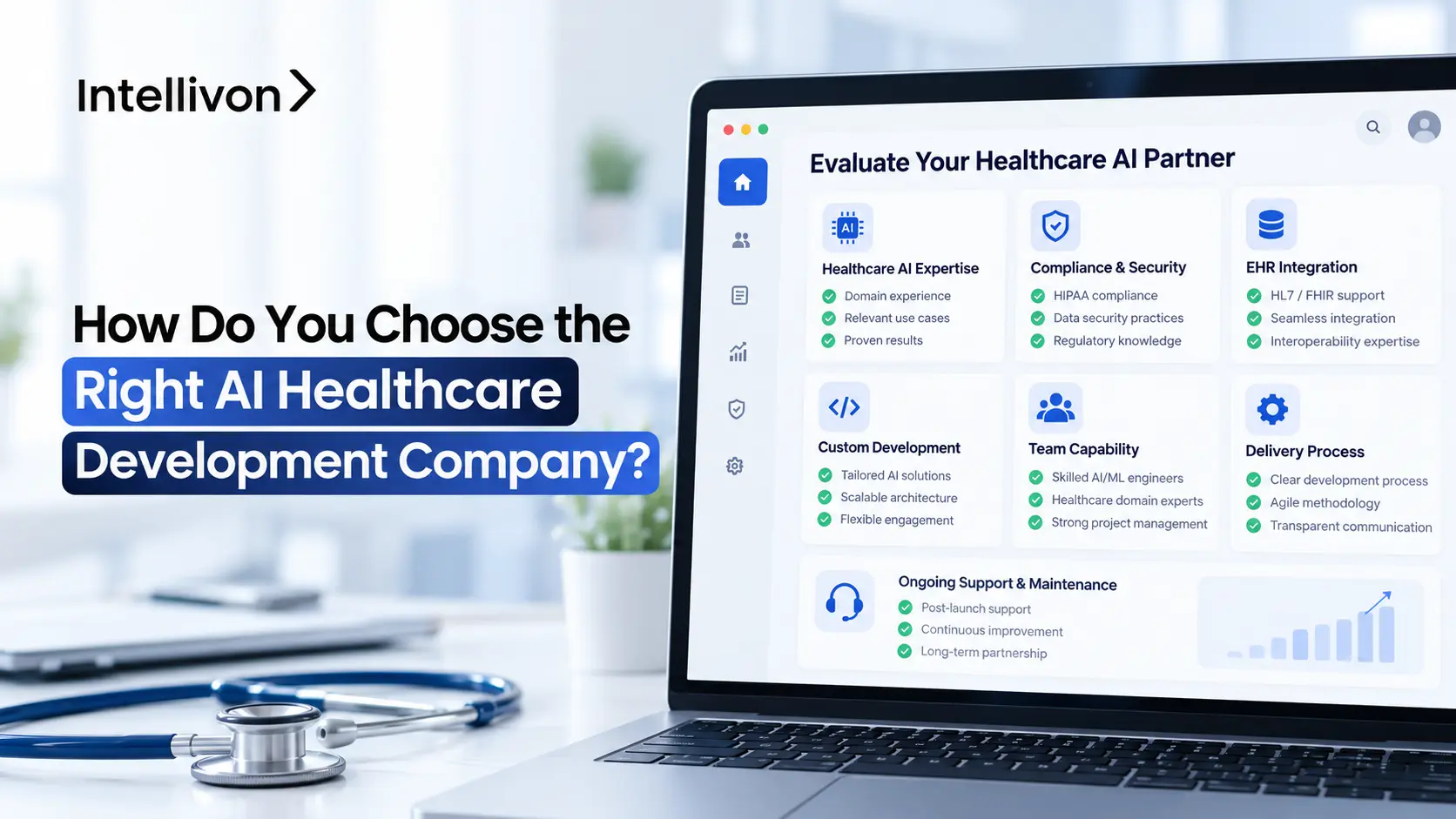
You can choose an AI healthcare development company by testing it on three things before you look at price: compliance, integration, and proof. First, make sure it will sign a HIPAA Business Associate Agreement before it touches any data. Second, ask for an Epic FHIR integration, then request a real healthcare AI solution and a client reference.
Once a company passes those tests, compare it based on engagement model, team location, and who owns the code and the trained models. Then rate every shortlisted vendor using the criteria. Finally, pay for a discovery phase before you agree to the full build.
This blog covers how you must choose the right vendor as we take you through each step in order. Each criterion in this guide is one that Intellivon expects to be measured against. As you move through them, you will see how our healthcare AI experience, compliance practices, and delivery approach align with every requirement. By the end, you will understand why Intellivon is the right vendor for your healthcare AI build, with the evidence to verify it independently.
What an AI Healthcare Development Company Actually Builds
An AI healthcare development company builds software that applies machine learning to clinical and administrative tasks, then connects it to the systems hospitals already use. Unlike a chatbot vendor, its team designs the model, builds the data pipelines, connects EHRs, secures patient data, and monitors results after launch.
In short, it delivers a complete, working healthcare product, and for regulated tools it also helps navigate FDA rules.
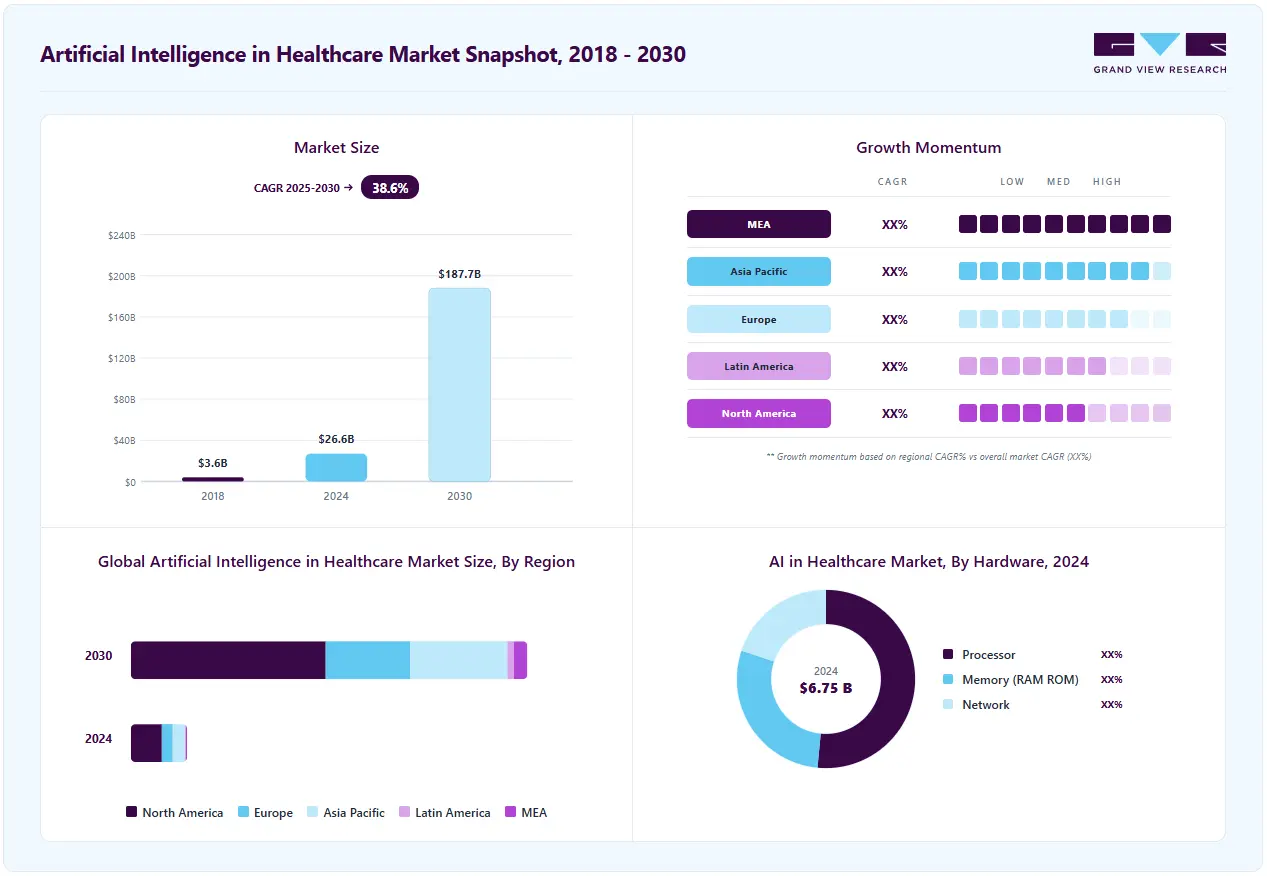
The global AI in healthcare market was valued at $36.7 billion in 2025, and North America held 54% of that revenue. Furthermore, Grand View Research projects the market will reach $505.6 billion by 2033, a 38.9% CAGR. As a result, choosing the wrong partner now costs buyers more.
1. Healthcare AI Goes Beyond Chatbots
Healthcare AI spans clinical, administrative, and patient-facing tools. For example, typical builds include:
- Ambient documentation and clinical NLP: drafts visit notes and turns them into structured data
- Clinical copilots: surface patient history during care
- Predictive analytics and triage: flag risk and route patients
- Claims, prior authorization, and revenue cycle automation: speed claims processing and payments
- Medical imaging and remote monitoring: flag scan findings and device alerts
- AI agents: handle scheduling and payer calls
2. The AI Must Connect With Existing Healthcare Systems
Furthermore, a model helps no one until it connects to the systems clinicians already use. In practice, common connections include:
- EHRs and patient portals: charts and patient messages
- Scheduling and CRM platforms: appointments and outreach
- Payer systems: eligibility and authorizations
- Labs, pharmacies, and imaging systems: results, prescriptions, and scans
3. The Development Team Builds More Than the AI Model
Consequently, the team builds an entire product around the model, and it maintains that product after launch. Core work includes:
- Product development and APIs: the app and its connections
- Data engineering and AI/ML development: pipelines and models
- Healthcare integrations and security: standards-based data exchange and protected records
- Cloud infrastructure, MLOps, and monitoring: reliable systems with tracked automation performance
4. Some Healthcare AI Also Faces Regulatory Oversight
However, not every tool faces the same rules, because regulation depends on what the software does. Broadly, the split looks like this:
- Workflow AI: for instance, scheduling or billing support usually falls outside medical-device rules
- Clinical AI: by contrast, software that diagnoses or drives treatment decisions may count as a medical device
- Case-by-case check: therefore, each product needs its own review, and FDA authorization is not automatic
Overall, an AI healthcare development company builds the full product, not only the model. Moreover, it connects that product to existing systems, secures it, and monitors it. Meanwhile, only some tools face medical-device oversight, while many do not.
Why Healthcare AI Needs Specialized Development Teams
Healthcare AI needs specialized teams because patient data, clinical workflows, EHR connections, and model risk each change how the product must be designed and tested. A capable general AI company can build a strong model, yet it may not know how to protect PHI or fit clinical routines.
Consequently, teams without healthcare experience tend to deliver systems that fail compliance review, miss clinician workflows, or never reach daily use, which wastes budget.
1. PHI Changes How the Product Must Be Designed
Patient data changes the architecture from the first sprint. Under HIPAA, a vendor that handles PHI is a business associate and must sign a BAA.
- Access controls and encryption: limit who sees each record and protect data in transit and at rest
- Audit logs: record every access and model output
- BAAs: should state whether the vendor may train models on your PHI
- Data minimization: models receive only the fields they need
- Built-in controls: our claims processing builds engineer role-based access and immutable audit logs from day one
2. Clinical Workflows Need Different Product Thinking
Clinical staff work under time pressure. Therefore, design starts with who reads the output and what happens when the AI is wrong.
- Clinicians and nurses: need short, verifiable suggestions inside their charting flow
- Care coordinators and patients: need clear task queues and plain-language messages
- Human review: a person approves high-risk outputs
- Escalation: uncertain cases route to staff automatically
- Alert fatigue: low-value alerts get ignored, so thresholds need tuning
3. EHR Integration Can Become a Major Part of the Build
Furthermore, EHR integration can take a large share of the project. RaftLabs notes that Epic, Cerner, and athenahealth support FHIR R4, so FHIR fluency saves time.
- Epic, Oracle Health, MEDITECH, athenahealth: each connects differently
- FHIR and HL7: modern API and older message standards for exchanging patient data
- SMART on FHIR: launches an app inside the EHR with secure sign-in
- Our approach: we assess EHR, LIS, RIS, and PACS data for completeness and interoperability before building
4. AI Creates Risks Normal Software Does Not
Unlike ordinary software, AI can be confidently wrong. Consequently, the team must plan for failure before launch.
- Hallucinations and bias: invented facts and uneven accuracy across patient groups
- Model drift: accuracy falls as data changes, so Techvoot’s HIPAA AI guide cites NIST’s call for repeated testing
- Confidence and explainability: show why a result appeared, as in our revenue optimization software, where every recommendation stays auditable
- Incorrect actions: agents need permission limits and approval gates
- Monitoring: track accuracy, overrides, and errors after launch
In summary, PHI rules, clinical workflows, EHR connections, and AI-specific risks each demand healthcare-specific design. A general AI team can build a model, while a specialized team such as Intellivon can build a product that passes compliance review and fits daily care.
Define Your Healthcare AI Project Before Choosing a Company
Before comparing companies, define five things: the workflow to fix, the users, the connected systems, the AI’s permitted actions, and the scope of the first release. Clear answers let every vendor quote the same project, so proposals become directly comparable and hidden costs surface before signing.
Without that clarity, a founder receives five quotes for five different products, and no scorecard can compare them fairly or predict final cost.
1. Start With the Workflow You Want to Improve
First, pick one workflow with a measurable problem. A narrow start keeps scope, risk, and cost under control.
- Documentation and patient intake: less typing, faster check-in
- Appointments and care coordination: fewer missed follow-ups
- Prior authorization and claims: faster approvals, fewer denials
- Clinical decision support: guidance at the point of care
2. Identify Who Will Use the Product
Next, name every person who touches the output. Each group needs a different interface and permission level.
- Patients and physicians: plain language for one, speed for the other
- Nurses and administrators: task queues and reporting
- Payers and billing teams: auditable, rule-based outputs
3. List Every System the Product Must Connect With
Then, list every system involved, because each integration adds time and cost. Include:
- Clinical tools: EHR, patient portal, and scheduling tools
- External systems: payer, lab, pharmacy, and imaging systems
- Business platforms: CRM and billing platforms
4. Decide What the AI Is Allowed to Do
Furthermore, set the AI’s authority level in writing. Higher authority demands stricter controls and testing.
- Answer: responds from approved data
- Recommend: suggests, and a human decides
- Update: edits records with logging
- Approve: makes binding decisions
- Execute: performs the action itself
- Escalate: hands uncertain cases to staff
5. Decide Whether You Need an MVP or a Production Platform
Finally, choose the release scope, since it changes almost every quote. Here is how the two options differ:
- Architecture: one workflow versus a scalable platform
- Compliance and testing: platforms need full audits and validation
- Integrations: one EHR versus many systems
- Cost and timeline: smaller scope costs less and ships sooner, as our cost guide shows
During our 30-minute strategy calls with founders, we understand exact pain points and define their healthcare AI project before starting our process.
In summary, a clear workflow, user list, system map, AI permission level, and release scope turn a vague idea into a quotable project. Consequently, every vendor answers the same question, and you can compare them fairly.
Healthcare Experience Should Be Your First Filter
An AI healthcare development company should have shipped production software in your specific part of healthcare, with named healthcare environments, real users, and live integrations. General AI skill is not enough, because a provider, a payer, and a diagnostics company each face very different data, rules, and buyers.
Therefore, screen on healthcare experience first, before price or team size, because that single filter removes most vendors before scoping calls begin.
1. Look for Work in Your Part of Healthcare
First, match the vendor’s past work to your segment. Each segment carries different data, users, and rules.
- Providers: EHR-connected clinical and operational tools
- Payers: claims, eligibility, and authorization workflows
- Digital health: consumer apps and virtual care
- MedTech and diagnostics: device software and imaging, often under FDA rules
- Pharma: trial and drug-development data
- Remote monitoring: device data and alert handling
2. Separate Production Projects From POCs
Next, ask which stage each project reached. A prototype proves an idea, while production proves the team can operate it.
- Prototype: a demo, not evidence of delivery
- Pilot: limited users in one setting
- Production: live and used daily
- Users and environments: ask for user counts and named healthcare settings
- Integrations: confirm live connections to real systems, such as EHRs
3. Review Projects That Resemble Yours
Furthermore, judge similarity by problem, not by industry label. A healthcare chatbot does not prove experience building diagnostic AI.
- AI type: chatbot, NLP, imaging, or prediction
- Risk level: administrative versus clinical
- Data type: text, images, claims, or device signals
- Users: clinicians, patients, or payers
4. Ask What Happened After the Product Launched
Finally, ask what happened after launch, since real experience shows up in maintenance. Vendors who only built demos rarely have good answers.
- Monitoring: how they tracked accuracy and errors
- Bugs: how quickly they fixed live issues
- Scaling: what changed as user numbers grew
- Model changes: how they handled retraining and drift
- Integrations: how they handled EHR updates
- Support: what the contract promised after launch
In summary, healthcare experience means production work in your segment, on a project like yours, with a documented post-launch record. Consequently, vendors that show only prototypes or loosely related projects should drop off your shortlist early.
Check HIPAA Skills Beyond the Words “HIPAA Compliant”
Verify HIPAA experience with four questions: how PHI moves through the product, who signs which BAAs, which controls protect it, and when compliance work starts. A real HIPAA team answers each with specifics, while a weak one repeats the phrase “HIPAA compliant” and points to a badge on its website.
Consequently, these questions quickly separate vendors who have shipped protected systems from vendors who only mention the regulation in sales calls and slide decks.
1. Ask Them to Map PHI Through the Product
First, ask the vendor to trace patient data from start to finish. A strong team names every system involved.
- Collection: sources of data
- Transmission: encrypted movement between systems
- Processing: where models run and what they see
- Storage: location and retention
- Logging: what gets recorded
- Deletion: removal at contract end
2. Ask Who Will Sign the Required BAAs
Next, ask who will sign each BAA, since HIPAA treats any vendor handling PHI as a business associate.
- Development company: signs before touching PHI
- Cloud provider: covers hosting
- AI provider: confirms no training on your PHI
- Analytics and communication tools: tracking, email, and SMS
- Subcontractors: any freelance or offshore developers
3. Review the Security Controls They Recommend
Furthermore, ask which controls the vendor recommends. Specific answers show experience, as in our claims processing builds with encryption, RBAC, and immutable audit logs.
- RBAC: each role sees only what it needs
- MFA: a second step at sign-in
- Encryption: in transit and at rest
- Least privilege: minimum access
- Audit logs: tamper-resistant access records
- Environment separation: no live PHI in testing
4. Check When Compliance Enters the Development Process
Finally, ask when compliance enters the process. Discovery and architecture is the strong answer, while “before launch” is the weak one.
- Strong: requirements set in discovery, before code
- Weak: a security review the week before launch
- Why it matters: late fixes can force rebuilt data flows
- Benchmark: TechAhead schedules compliance setup ahead of development
- Our approach: we agree governance and risk thresholds before development begins
In summary, real HIPAA experience shows in specific answers: a mapped PHI path, named BAA signers, defined security controls, and compliance built in from discovery. A vendor that offers only a badge has shown none of these.
Test Their EHR and Healthcare Integration Experience
Founders can test integration experience with four direct questions, and the answers show quickly whether the vendor has connected real hospital systems. Ask which EHRs the vendor has connected, what it built with FHIR, whether it handles HL7, and what went wrong on its hardest project.
Real teams like Intellivon answer with named systems, specific data flows, and lessons learned, while weak teams only claim to be FHIR-ready without any detail.
1. Ask Which EHRs They Have Actually Integrated
First, ask for named EHRs and the type of connection for each. Vague answers such as “we integrate with all major EHRs” signal little real experience.
- Named systems: Epic, Oracle Health, MEDITECH, athenahealth, or eClinicalWorks, and which ones went live
- Read or write: whether the product only pulled data or also saved results back
- Production or sandbox: live hospital connections versus test environments
Our approach: we assess EHR, LIS, RIS, and PACS data for completeness and interoperability before building
2. Ask What They Built With FHIR
Next, ask what they built with FHIR, the standard for exchanging patient data. RaftLabs notes that Epic, Cerner, and athenahealth support FHIR R4, so fluency is expected.
- FHIR R4: the version most major EHRs support
- SMART on FHIR: launches an app inside the EHR with secure sign-in
- Data types: patient records, observations, appointments, and medication data
- Write-back: saving AI output into the chart, which is harder than reading data
3. Ask About HL7 Experience Too
Furthermore, many hospitals still exchange data through older HL7 messages. A vendor that knows only FHIR may struggle at those sites.
- ADT: admission, discharge, and transfer events
- ORU: lab and observation results
- ORM: orders
- Interface engines: tools that route and translate messages between systems
4. Ask About Their Hardest Integration Problem
Finally, ask about the hardest integration the team has solved, because real experience often comes out here. Strong answers include specific lessons, not general praise.
- API limitations and rate limits: what the EHR blocked or throttled
- Patient matching: linking records to the correct person
- Data mapping: converting formats between systems
- Sandbox restrictions: test environments that behave differently from production
- Site configuration: every hospital sets up its EHR differently
Our approach: our telemedicine builds treat integration as the source of real-time data flow across departments
In summary, real integration experience shows in named EHRs, specific FHIR builds, HL7 fluency, and honest stories about hard problems. Vendors who answer with detail have done the work. Vendors who answer with slogans have not.
Match Their AI Skills to the Product You Need
Match the vendor’s AI skills to the product you are building, because each capability solves a different clinical or administrative problem. Generative models suit documentation and patient assistants, predictive models suit risk scoring, NLP suits clinical notes, vision suits imaging, and agents suit workflows.
Consequently, a strong demo in one area proves little about another, so ask each vendor for production evidence in your exact category before comparing price.
1. Generative AI and Healthcare LLMs
Generative models write text from context. Therefore, ask about safeguards, not only features.
- Assistants and documentation: draft notes and answer staff questions
- Summarization: condense long charts
- RAG: grounds answers in approved records
- Patient communication: plain-language messages with human review
2. Predictive Machine Learning
Predictive models score risk from structured data. Consequently, ask how the vendor validates accuracy.
- Deterioration and readmission: early warnings, as in our clinical intelligence systems
- Utilization: forecast demand and capacity
- Population health: rank groups for outreach, as our population health platforms do
3. Clinical NLP
Clinical NLP turns messy notes into usable data. Therefore, test it on real documents.
- Clinical notes: extract diagnoses and medications
- Coding and classification: suggest codes and categories
- Document extraction: pull fields from forms and faxes
4. Computer Vision and Medical Imaging
Vision models analyze scans and slides. Moreover, they often face FDA review and need clinical validation.
- Radiology and pathology: flag findings for clinician review
- Diagnostics: support earlier detection
- Segmentation: outline organs or lesions
5. Agentic AI and Workflow Automation
Agents act instead of only answering. Therefore, they need tighter controls.
- Plans and retrieval: decide steps and gather records
- Tools and actions: call APIs, then book, submit, or update
- Coordination: route exceptions to staff, as our payment automation builds do with exception queues
6. MLOps and Model Monitoring
Finally, MLOps keeps models safe after launch. Consequently, ask for a lifecycle plan.
- Model versioning: track every release
- Drift and retraining: detect accuracy loss, then retrain
- Rollback: restore a stable version quickly
- Observability: log inputs, outputs, and errors
- Our approach: bias detection and validation sit inside the model lifecycle
In summary, each AI capability solves a different problem, so vendor skill must match your product. Consequently, demand production proof in your category, plus a monitoring plan for after launch.
Look at the People Who Will Actually Build the Product
Buyers should know exactly who will build their product, because a vendor’s résumé does not write code, but its assigned team does. Ask for named engineers, their healthcare experience, weekly allocation, location, and seniority, and confirm whether subcontractors will touch PHI. Consequently, a strong pitch from senior staff means little if junior developers deliver the work, so verify the real team before signing.
1. Healthcare Solution Architect
First, look for the person who owns the overall design. This role connects compliance, data flow, and clinical needs.
- Architecture decisions: defines how PHI, models, and EHRs fit together
- Healthcare history: has designed live products in your segment
- Governance: sets access, consent, and audit rules early, as our AI healthcare app process does before development begins
2. AI and ML Engineers
Next, check who builds and tests the models. Healthcare models need clinical-grade evaluation, not only good demo results.
- Model experience: LLMs, prediction, NLP, or vision, matched to your product
- Validation: tests accuracy and bias before release
- Production record: has deployed and monitored models
3. Healthcare Integration Engineers
Furthermore, EHR connections need specialists. General backend developers often lack this experience.
- Standards: FHIR, HL7, and SMART on FHIR
- EHR history: named systems connected in production
- Data checks: review EHR, LIS, RIS, and PACS data for completeness
4. Backend and Cloud Engineers
Meanwhile, these engineers build the platform that everything runs on. Their choices affect security, cost, and scale.
- APIs and services: stable, documented connections
- Cloud setup: HIPAA-eligible hosting with a signed BAA
- Scalability: capacity for more users and sites
5. Security Specialists
Similarly, security needs a named owner. Otherwise, controls become an afterthought.
- Access and encryption: RBAC, MFA, and encrypted data
- Audit trails: immutable logs, as in our claims processing builds
- Testing: penetration tests and risk reviews
6. QA and Validation Engineers
In addition, healthcare software needs stricter testing than typical apps. Errors can affect patients or payments.
- Functional testing: every workflow and edge case
- Model validation: accuracy on realistic data
- Traceability: documented tests for audits
7. Clinical or Regulatory Experts When Needed
Finally, clinical or regulatory experts matter when the product informs care. Ask for their involvement in writing.
- Clinical review: checks that outputs make sense to clinicians
- Regulatory guidance: flags FDA device questions early
- Ask every vendor for: actual team members, experience, allocation, location, seniority, and subcontractor involvement
In summary, the delivery team decides whether promises become working software, so verify each role, its healthcare experience, and its time commitment. If a vendor will not share experience details, treat that as a warning.
With Intellivon, you can request the assigned engineers before signing, interview each one, and review samples of their past healthcare work. You can also hire developers, integration engineers, or QA specialists to your team as the project grows, with the right to replace anyone who does not fit.
Choose the Right Engagement Model Before Comparing Rates
Choose the engagement model first, because it explains why quotes for the same healthcare AI project can look so different from one vendor to the next. Fixed-price, time and materials, dedicated team, and discovery-first models each assign scope risk and cost risk differently, so an hourly rate alone tells you little.
Consequently, match the model to how stable your scope, integrations, and AI requirements are, and then compare every vendor on identical terms and deliverables.
1. Fixed-Price Development
Fixed-price sets one cost for a defined scope. Therefore, it works only when requirements hold steady from start to finish.
- Stable scope: features and user roles are agreed and unlikely to change
- Known integrations: the EHRs and other systems are named, and access is confirmed
- Clear requirements: written acceptance criteria define what “done” means
- Risk to watch: every change request adds cost, so unclear scope leads to disputes
2. Time and Materials
Time and materials bills for the actual effort spent. As a result, it suits work that changes as the team learns.
- Evolving AI requirements: accuracy targets shift after early testing
- Discovery during development: new clinical or integration needs appear mid-project
- Model iteration: prompts, features, and training data need repeated tuning
- Risk to watch: without a monthly budget cap and regular reviews, spending can drift
3. Dedicated Development Team
A dedicated team works only on your product for an agreed period. Consequently, it fits products that keep growing after launch.
- Long-term healthcare platforms: the team builds deep knowledge of your data and users
- Continuous feature releases: engineers ship updates without re-contracting each time
- Ongoing integrations: new EHRs, payers, and sites arrive over time
- Risk to watch: you pay for capacity, so a steady backlog is necessary
4. Discovery Before Full Development
Discovery is a short, paid phase that comes before the main build. Moreover, it turns unknowns into a scoped plan you can price.
- Uncertain integrations: confirms which EHR access and APIs are actually available
- Unclear AI feasibility: tests whether the data can support the model you want
- FDA status: checks whether the product may count as a medical device
- Unmapped clinical workflows: documents how staff work today
- Output: a scope, architecture, timeline, and estimate for the next phase
In summary, the engagement model decides who carries scope, cost, and timeline risk. Fixed price suits stable scope, time and materials suits evolving AI, a dedicated team suits long-term platforms, and discovery suits unknowns. Matching the model to your project makes vendor quotes comparable.
Onshore vs Offshore Is More Than a Price Decision
Onshore versus offshore matters less than a vendor’s healthcare expertise, security practices, references, and technical leadership, although location still shapes cost, communication, and legal oversight.
Onshore teams offer time-zone overlap, simpler legal recourse, and easier on-site visits, while offshore teams often charge lower hourly rates.
Consequently, compare vendors on proven capability first, then use location to adjust cost and coordination, particularly when engineers will access PHI, join clinical calls, or support live systems.
1. Where Onshore Healthcare Teams Help
First, onshore teams reduce friction where speed and accountability matter. Typical advantages include:
- Time-zone overlap: live workshops with clinicians and compliance staff
- Simpler legal recourse: US contracts and BAAs are easier to enforce
- Buyer requirements: some health systems restrict PHI access to US-based staff
2. Where Offshore Development Can Lower Costs
Meanwhile, offshore teams can reduce spend on long builds. However, savings shrink if rework or compliance gaps appear.
- Lower hourly rates: more engineering hours per dollar
- Larger talent pool: easier access to specialized skills
- Extended coverage: overnight testing and fixes
3. What Matters More Than Team Location
Furthermore, location alone predicts little about delivery quality. Therefore, compare every team on these factors:
- Healthcare expertise: shipped products in your segment
- Security: signed BAA, access controls, and audit logs
- Communication: a named lead and weekly demos
- Overlap: shared hours for daily standups
- Documentation: clear architecture and decision records
- References: past healthcare clients you can call
- Technical leadership: an accountable senior architect
4. Hybrid Delivery Can Combine Both Models
Finally, many projects split work across locations. In practice, a hybrid setup often looks like this:
- Onshore leads: product owner, compliance lead, and client-facing architect
- Offshore engineers: development, testing, and maintenance
- Access rules: only approved staff touch PHI, under a signed BAA
In summary, location shapes cost and coordination, but capability decides quality. Onshore teams add proximity, offshore teams add savings, and hybrid delivery combines both when PHI access rules are clear.
Healthcare AI Development Usually Costs 70K–300K
Custom healthcare AI development typically costs $70,000 to $300,000 across Intellivon’s project scopes, depending on AI complexity, healthcare integrations, regulatory requirements, validation, and deployment scale. Discovery and design take the smallest share, while AI development and EHR integration take the largest.
Consequently, knowing each phase’s range helps you read vendor quotes line by line and spot gaps in scope.
Healthcare AI Development Cost by Phase
| Phase | Estimated Cost | What It Covers |
| Discovery and compliance planning | $8,000 to $20,000 | Scope, workflows, AI feasibility, compliance, architecture |
| UX, data, and system architecture | $10,000 to $30,000 | Interface design, data models, system design |
| AI and product development | $30,000 to $120,000 | Models, application, APIs |
| EHR and third-party integrations | $15,000 to $60,000 | EHR, payer, lab, and other system connections |
| Testing, validation, and deployment | $7,000 to $40,000 | QA, model validation, security testing, launch |
| Total for the five phases | $70,000 to $270,000 | Larger scopes reach $300,000 (see below) |
Ongoing AI Maintenance and Monitoring
Moreover, plan for roughly 15% to 25% of the initial development cost each year. On a $70,000 build, that is about $10,500 to $17,500. On a $300,000 build, it is about $45,000 to $75,000.
- Usage and infrastructure: hosting grows with traffic
- Monitoring and retraining: tracks drift and refreshes models
- Integrations: EHR updates and new connections
What Pushes the Project Toward $300K
However, several factors lift a project above the phase ranges above. Each adds design, testing, or validation effort.
- Multiple EHRs: each system needs its own integration and testing
- Proprietary AI models: custom training costs more than adapting existing models
- High data volumes: larger pipelines and infrastructure
- Clinical validation and regulated workflows: added studies and documentation
- Multiple applications: separate interfaces for patients, staff, and administrators
- Agentic AI and real-time processing: more controls, testing, and monitoring
Not sure where your healthcare AI project fits inside this range? Intellivon can scope the integrations, AI architecture, development phases, and compliance requirements before the build begins. For a broader view of app-level pricing, see our AI healthcare app cost guide.
How We Built an AI Healthcare Platform With Epic Integration
For HealthCore Connect, we built an AI-powered menstrual and ovulation tracker with 95%+ forecast precision. It integrates with Epic through SMART on FHIR and ran at 99.97% uptime across millions of daily API calls.
The platform turns wearable, hormone, and symptom data into explainable real-time predictions, with HIPAA and GDPR controls built in.
1. The Problem We Solved
Traditional trackers rely on fixed calendar rules, so they miss how bodies actually change. Consequently, the client needed a platform that could handle messy data and still earn clinician trust.
- Volatile signals: hormones, stress, and lifestyle shifts break calendar-based predictions
- Fragmented data: wearables, labs, and symptoms sat in disconnected systems
- Silent variations: many cycle changes show no visible symptoms
- Low explainability: opaque predictions reduce clinician trust
- Compliance load: HIPAA and GDPR alignment, audit logs, PHI minimization, and access controls
2. How We Built the AI
First, we combined several data sources into one prediction engine. Moreover, we made every prediction explainable, so clinicians can see what drove it.
- Hybrid LSTM-Transformer models: learn hormonal and behavioral rhythms
- Multimodal fusion: merges wearable, hormone, and symptom data
- SHAP explainability: shows the physiological drivers behind each forecast
- Streaming pipelines: AWS Kinesis and Airflow, with schema checks and drift detection
3. Integration, MLOps, and Security
Furthermore, the platform had to fit clinical systems and stay reliable after launch. Therefore, we built integration, monitoring, and security into the same architecture.
- Epic EHR: SMART on FHIR integration
- Scale: Kubernetes-based inference with sub-180 ms latency across millions of users
- MLOps: MLflow versioning, CI/CD, Prometheus and Grafana monitoring, and retraining triggered by drift
- Security: Vault-managed keys, AES-256 encryption, and RBAC
4. The Results We Measured
Finally, we tracked performance in production. The figures below come from our published case study.
| Metric | Result |
| Forecast precision | 95%+ for ovulation and menstruation |
| Inference latency | Under 180 ms |
| Analysis cycles | Cut by over 60% |
| Uptime | 99.97% across millions of daily API calls |
| Governance | Explainable AI and audit-ready logs for HIPAA and GDPR reviews |
5. What This Means for Your Vendor Search
This project also passes the tests in this guide. As a result, you can hold any vendor to the same standard, including us.
- Named EHR: Epic, connected through SMART on FHIR
- Lifecycle management: drift detection, monitoring, and retraining
- Explainability: SHAP-based reasoning behind each prediction
- Security: encryption, key management, and role-based access
In summary, this project shows a healthcare AI platform with a named EHR integration, explainable models, production monitoring, and measurable results. Use those same four checks on any vendor’s proof of work.
Why Healthcare Companies Work With Intellivon
Healthcare companies work with Intellivon because we build custom AI platforms where compliance, integrations, and measurable business outcomes are designed together, not added later.
We have built systems for claims processing, payment automation, revenue optimization, telemedicine, population health, and clinical intelligence. Consequently, buyers get a partner that understands both the clinical setting and the financial and regulatory pressure around it.
1. We Tie Every Build to a Business Result
Rather than starting with a model, we start with the outcome the organization needs. For example, our AI healthcare app work aligns each product with concrete objectives.
- Defined targets: revenue protection, cost reduction, throughput, and compliance performance
- Named ownership: the stakeholders who own results after launch
- Financial focus: our revenue optimization software connects clinical data to billing, so it can spot underpayments, coding mistakes, and unfair denials
2. We Build Compliance Into the Architecture
Similarly, we treat compliance as a design input, not a final review. As a result, governance decisions are settled before development begins.
- Governance scope: access control, consent enforcement, audit requirements, and model accountability
- Agreed risk thresholds: set early to prevent rework
- Security controls: in our claims processing builds, encryption, role-based access, immutable audit logs, and secure model inference
- Regional alignment: our telemedicine platforms address HIPAA and GDPR requirements
3. Connect the AI to the Systems You Already Run
Moreover, an AI product only helps when it works inside existing infrastructure. Therefore, we evaluate the data and systems around the model.
- Clinical and financial data: EHR, LIS, RIS, PACS, and finance data reviewed for completeness and interoperability, as in our healthcare automation platforms
- Payer complexity: our payment automation work handles payer rules, contract validation, and exception queues
- Scale: platforms designed for multiple departments and sites
4. Make AI Decisions Explainable and Testable
Finally, clinicians and finance teams need to trust what the AI recommends. Accordingly, we build explainability and validation into the model lifecycle.
- Auditable outputs: every recommendation can be reviewed and defended
- Bias and performance checks: run before release, not after complaints
- Regulatory traceability: documentation that supports audits and reviews
Overall, Intellivon helps healthcare companies by linking AI to business outcomes, embedding compliance in the architecture, connecting to existing systems, and making model decisions auditable.
Conclusion
Choosing the right AI healthcare development company comes down to real evidence, not promises. First, define your project clearly, then filter shortlisted vendors on healthcare experience, HIPAA depth, EHR integration, and AI fit.
Next, check the assigned team, match the engagement model to your scope, and confirm who owns the code, models, and data. Finally, budget $70,000 to $300,000 plus yearly maintenance, and test every claim with references before signing. Consequently, you protect your patients, your data, and your investment.
FAQs
Q1. How do I choose an AI healthcare development company?
A1. Choose an AI healthcare development company by testing four things: healthcare experience, HIPAA depth, EHR integration, and AI fit. First, define your workflow, users, and connected systems. Then shortlist vendors, call references, and compare engagement models. Finally, confirm who owns the code, models, and data before you sign.
Q2. How do I verify a company’s healthcare AI experience?
A2. Ask for production projects, not demos. Request named healthcare environments, user counts, and live integrations. Then call a past client and ask what happened after launch. Additionally, confirm the projects resemble yours, because a healthcare chatbot does not prove experience building diagnostic AI.
Q3. Does a healthcare AI development company need HIPAA experience?
A3. Yes, because HIPAA treats any vendor handling PHI as a business associate. Therefore, ask how PHI moves through the product, which controls protect it, and when compliance work starts. Strong teams answer during discovery. Weak teams answer with a badge and “before launch.”
Q4. Should my healthcare AI development partner sign a BAA?
A4. Yes, and the BAA should be signed before the vendor touches any PHI. Furthermore, cloud providers, AI providers, analytics tools, and subcontractors that handle PHI need agreements too. Finally, the BAA should state whether the vendor may use your data to train models.
Q6. Should I hire an offshore healthcare AI company?
A6. Yes, if the vendor meets your security and compliance needs. Location matters less than a signed BAA, healthcare expertise, references, and strong communication. However, some buyers require US-based PHI access. In that case, consider a hybrid model, with an onshore lead and approved offshore engineers.