Key Takeaways:
- The situation with healthcare AI is different, so the team actually does need to have an understanding of healthcare.
- The AI model is only one element among others, such as EHRs, patient data, workflows, and compliance.
- If the technology doesn’t align with the way clinicians currently operate, it won’t make much progress.
- A typical custom healthcare AI system costs between $70,000 and $300,000.
- Intellivon has already created similar systems in the areas of RPM, EHR prediction, and digital care platforms.
A strong partner in the development of AI for healthcare must pass five tests: its architecture must be compliant with HIPAA, it must have a clear pathway to FDA approval, it must have a proven record of integrating with EHR systems, it must have undergone clinical validation, and it must have written ownership of both the code and the model. Should a vendor fail to meet any of these criteria, your project typically comes to a standstill during the security review, the integration with the hospital, or the contract negotiations.
This blog begins by explaining how to check HIPAA claims and determine if your product requires FDA clearance. It then describes what actual Epic and Cerner integration experience is like and how a partner can demonstrate that the model works. After that, it looks at issues relating to IP ownership, identifies red flags, provides a scoring table for use with your shortlist, and gives the costs according to phase.
As we go along, we explain the way Intellivon’s engineers work with founders to scope out healthcare AI projects, enabling you to assess whether the discovery phase has been carried out properly. Since these checks take place before you agree to proceed, they also help to safeguard your budget.
Why Healthcare AI Needs a Specialized Development Partner
Healthcare needs a specialized AI development partner because patient data, clinical workflows, and regulatory oversight all change how the software must be built. A general AI agency can train a model on almost any public dataset, but that skill alone does not make software safe for patients.
Therefore, a healthcare partner must protect PHI, connect to systems like Epic, and prove every output is accurate enough for clinical use before launch.
1. Healthcare AI Works With Sensitive Patient Data
Healthcare AI processes protected health information (PHI), so privacy shapes every design choice. Under HIPAA, a vendor handling PHI becomes a business associate.
- Access controls limit who views patient records by role.
- Data encryption protects PHI at rest and in transit.
- Audit trails log every access and change.
- Secure AI pipelines keep PHI out of unprotected training data.
2. AI Has to Fit Existing Clinical Workflows
Healthcare AI cannot run in isolation. Instead, it must match how each care team already works.
- Physicians and nurses: need alerts inside the chart, not extra screens.
- Care coordinators: need ranked patient lists.
- Billing teams and administrators: need accurate coding and reporting.
- Patients: need clear, simple interactions.
3. Healthcare Systems Rarely Use One Data Source
A single healthcare AI platform often pulls from many systems. Consequently, the partner must unify formats such as HL7 and FHIR.
- EHR data, labs, and vitals from systems like Epic.
- Clinical notes and medical device readings.
- Claims and billing records from payers.
- Imaging and patient-generated data.
4. Clinical AI Needs More Oversight Than Consumer AI
Clinical AI carries higher stakes than consumer AI. A wrong answer here can affect patient safety, rather than just satisfaction.
- Answering a customer-service question: low clinical risk.
- Prioritizing high-risk patients: needs bias testing.
- Predicting patient deterioration: needs clinical validation.
- Supporting clinical decisions: needs explainable outputs and human review.
Healthcare changes AI development because the data is sensitive, the workflows are fixed, and the sources are fragmented. Moreover, clinical decisions demand validation and human oversight that consumer AI never needs. As a result, a specialized partner designs for privacy, workflow fit, and safety from day one.
What an AI Healthcare Development Partner Actually Does
An AI healthcare development partner designs, builds, connects, and maintains the full AI product, not just the machine-learning model. The work spans workflow design, data engineering, model development, system integration, and post-launch monitoring.
Therefore, you are paying for a working clinical product that fits hospital systems and passes security review. Building only the model leaves most of the hard work undone. Without those layers, even an accurate model never reaches a clinician.
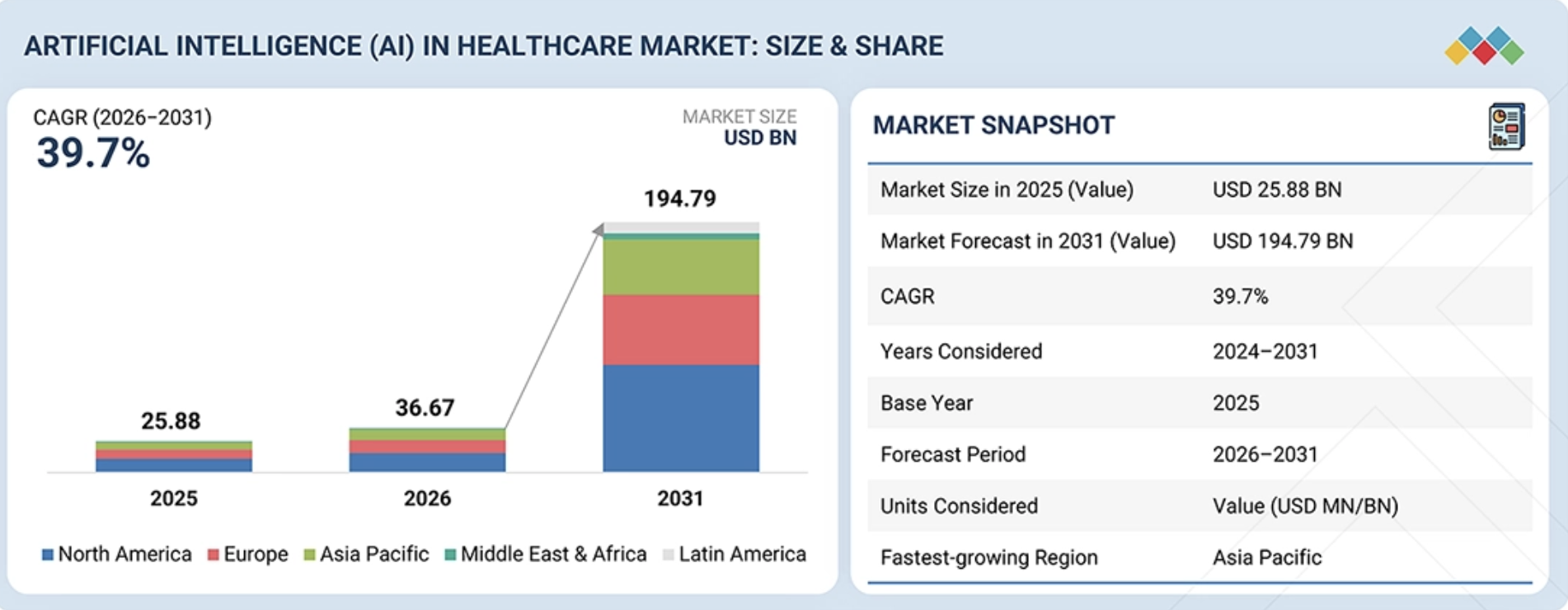
This scope matters because demand is rising fast. MarketsandMarkets projects the global AI in healthcare market to grow from $36.67 billion in 2026 to $194.79 billion by 2031, a 39.7% CAGR. However, other research firms publish different estimates, so treat the figure as a range.
1. Healthcare Product and Workflow Design
A partner first turns your healthcare problem into a buildable product. Consequently, every feature ties back to a real clinical need.
- User workflows: map how each user completes tasks today.
- Product requirements: define what the software must do.
- AI use cases: choose where AI adds measurable value.
- Escalation rules: decide when a human takes over.
- Clinician interfaces: place outputs inside the tools clinicians already use.
2. Healthcare Data Engineering
Next, the partner builds pipelines that collect and clean patient data. Good pipelines decide whether the model performs well in production.
- EHR records and patient histories.
- Wearable data and medical device readings.
- Clinical notes and insurance claims.
- Imaging files.
3. AI and Machine Learning Development
Then the partner selects and trains the right model type. The choice depends on your use case, not on trends.
- Predictive analytics for risk scoring.
- NLP for clinical notes.
- Generative AI for summaries and drafting.
- Computer vision for imaging.
- Agentic AI, anomaly detection, and recommendation models.
4. Healthcare System Integration
After that, the partner connects the AI to the systems clinicians already use. Otherwise, the tool stays a demo.
- Epic, Oracle Health, and other EHR platforms.
- FHIR APIs and HL7 interfaces.
- PACS for imaging.
- Healthcare devices.
5. Deployment and AI Monitoring
Finally, the partner launches the product and watches it after release. Models can lose accuracy as patient data changes.
- Cloud deployment and MLOps pipelines.
- Model versions and performance monitoring.
- Drift detection and retraining.
A healthcare AI partner covers design, data, modeling, integration, and monitoring, not just the algorithm. Each layer determines whether the product works safely inside a real care setting. As a result, you buy a complete, maintainable clinical product.
How to Verify a Vendor’s HIPAA Claims Beyond a Badge on the Website
You verify a vendor’s HIPAA claims by asking for a signed Business Associate Agreement, a walkthrough of how PHI moves through training and inference, and independent audit reports. A website badge proves none of these. Therefore, treat HIPAA as an engineering question, not a marketing label.
At Intellivon, compliance mapping starts in discovery, before any model work, as described in our AI healthcare app guide. Use the four checks below to test any vendor the same way.
1. The BAA and Why Vendors That Touch PHI Must Sign One
A Business Associate Agreement (BAA) legally binds a vendor to HIPAA rules. Any AI vendor handling your PHI becomes a business associate under the law.
- Request the signed BAA before you share real patient data.
- Confirm the vendor extends the same terms to subcontractors.
- Check that the contract defines breach notification duties.
Intellivon builds BAA tracking and HIPAA controls into regulated platforms, such as our AI strategic sourcing platform.
2. Administrative vs. Architectural HIPAA: What Happens to PHI During Training and Inference
Administrative HIPAA means policies and paperwork. Architectural HIPAA means the system itself protects PHI.
- Training: ask whether PHI is anonymized before model training.
- Inference: ask whether patient data leaves your environment.
- Logging: ask whether audit trails record every PHI access.
Our AI health assistant isolates data from the ground up. Likewise, our AI payment automation software uses HIPAA safeguards and audit trails.
3. SOC 2 Type II, HITRUST, and ISO 27001: What Each Proves
Certifications show that outside auditors tested a vendor’s controls. However, each one proves something different.
- SOC 2 Type II: security controls operate over time, not just on paper.
- ISO 27001: the vendor runs an information security management system.
- HITRUST: a healthcare-focused framework, so ask for the report scope.
Ask for the actual report, not a logo. Also confirm which systems the report covers.
4. GDPR and Data Residency if You Serve UK or EU Patients
GDPR applies alongside HIPAA when you serve UK or EU patients. Therefore, ask where the vendor stores and processes data.
- Ask which regions host training and production data.
- Ask who can access that data from outside those regions.
- Request a data processing agreement.
3.4.1 Five Questions to Ask in the First Call
- Will you sign a BAA today?
- Where does PHI go during training and inference?
- Which SOC 2 Type II or HITRUST report can I read?
- Have you passed a third-party HIPAA audit or penetration test?
- Do humans ever see our data?
Real HIPAA compliance shows up in contracts, architecture diagrams, and audit reports. A signed BAA, a clear PHI pipeline, current certification reports, and defined data regions form the full proof. If a vendor cannot supply these, treat the claim as unverified.
EHR Integration Is Central to Most Healthcare AI Products
EHR integration is central because healthcare AI only helps when it reads data from, and writes results back to, the systems clinicians already use. A model that lives in a separate dashboard rarely gets opened during a patient visit.
Therefore, a strong partner plans Epic, Oracle Health, FHIR, and HL7 connections at the start. Intellivon’s AI-powered EHR guide covers how we build this layer in detail.
1. FHIR Connects Modern Healthcare Applications
FHIR is a standard that lets healthcare applications exchange data through web APIs. Each piece of patient information becomes a defined “resource.”
- Patient data: demographics and history.
- Observations: labs and vitals.
- Medications: current and past prescriptions.
- Encounters: visits and admissions.
2. HL7 Still Powers Existing Hospital Workflows
Many hospitals still run on HL7 v2 messages, so AI products often need both standards. Consequently, standards like FHIR, HL7 v2, and SMART on FHIR vary sharply in real implementations.
- FHIR suits new applications and APIs.
- HL7 v2 carries existing lab, admission, and order feeds.
- A partner should translate between both.
Our AI telemedicine platform guide explains how FHIR and HL7 integrations unify EHRs, labs, and device data.
3. Epic and Other EHRs Add Their Own Requirements
Each EHR vendor adds its own rules on top of the standards. Therefore, ask how many production Epic, Cerner, or Athenahealth integrations a vendor has shipped.
- Epic and Oracle Health: each has its own approval and sandbox process.
- SMART on FHIR: lets your app launch inside the EHR.
- Authentication: controls which user and app can reach which data.
- Workflow integration: places the AI where clinicians already work.
4. AI Outputs Must Return to the Right Workflow
A useful integration does more than read data. In fact, one-directional integrations cannot support real-time clinical decision support.
- Alerts for deteriorating patients.
- Recommendations inside the chart.
- Risk scores on patient lists.
- Draft documentation for clinician review.
- Workflow updates, such as task creation.
In short, healthcare AI succeeds when it reads FHIR and HL7 data, meets each EHR’s requirements, and returns results to the chart. A vendor that cannot demonstrate this ends up with an isolated tool. Bidirectional integration is what turns a model into a clinical product.
Healthcare AI Security Starts With the Architecture
Healthcare AI security starts with the architecture because PHI moves through many components, and each one can leak data if designed poorly. Adding security after launch leaves gaps in pipelines, logs, and model connections.
Therefore, a partner must decide where PHI lives, who can reach it, and which outside services see it before writing code. Intellivon’s medical AI use case guide treats medical AI as regulated infrastructure for exactly this reason.
1. PHI Has to Be Controlled Across the Entire Data Flow
PHI does not stay in one database. It passes through every stage of the pipeline, so each stage needs its own protection, as our AI telemedicine guide shows with secure data lakes and ingestion pipelines.
- Collection: encrypt data in transit and gather only the fields you need.
- Processing: de-identify or pseudonymize data before model training.
- AI inference: keep patient data inside your environment when the model runs.
- Databases, logs, and backups: encrypt each one and mask PHI in logs.
- Analytics: send only de-identified data to reporting tools.
2. Access Controls Protect Clinical Data
Access controls decide who sees which patient record. Consequently, they limit the damage when one account is compromised. Our AI payment automation guide lists audit trails among its mandatory controls.
- RBAC: assign permissions by job role, such as nurse or biller.
- Least privilege: grant only the minimum access each task needs.
- Authentication and identity controls: require multi-factor login and single sign-on.
- Audit logging: log and monitor all access to PHI.
3. Third-Party AI Models Can Create New Data Risks
Sending PHI to an external LLM shares it with another company. In fact, LLM vendors that process PHI can become business associates.
- External LLMs and model APIs: confirm the provider signs a BAA.
- Data retention: ask how long prompts and outputs are stored.
- Training use: confirm your data never trains their models.
- Cloud providers: prefer on-prem, VPC, or hybrid deployment with egress controls.
4. Compliance Has to Continue After Launch
A system that passes review at launch can drift out of compliance later. Therefore, ongoing controls matter as much as the initial build. Our AI sourcing platform guide includes SOC 2 evidence and MLOps data drift tracking.
- Security monitoring: alert on unusual access patterns.
- Audit readiness: keep logs and evidence organized.
- Model governance: track versions and owners, using frameworks like the NIST AI Risk Management Framework.
- Infrastructure changes: re-review security when cloud services or integrations change.
In short, healthcare AI security is a design choice made across the full data flow, not a certificate collected at the end.
Controlled PHI paths, strict access rules, vetted third-party models, and ongoing monitoring together keep patient data protected. Skipping any one leaves a gap that audits and attackers can find.
Healthcare Compliance Goes Beyond HIPAA
Healthcare compliance goes beyond HIPAA because the rules that apply depend on what your software does, not only on the data it touches. HIPAA governs how patient data is handled. However, FDA oversight may apply if the AI supports diagnosis or treatment, and regulators increasingly expect transparency about how models work.
Therefore, a partner must map every applicable rule before design begins. Intellivon’s AI healthcare app guide lists regulatory alignment and AI risk classification as a discovery task.
1. HIPAA Shapes How Patient Data Is Handled
HIPAA sets the baseline for how patient data is collected, stored, and shared. Consequently, it applies to nearly every healthcare AI product that touches PHI.
- Covered entities and their vendors both carry legal duties.
- Safeguards cover access, encryption, and audit trails.
- A signed BAA defines what the vendor is responsible for.
2. FDA Rules May Apply to Certain Clinical AI Products
FDA rules depend on what the software does, not on whether it uses AI. The January 2026 clinical decision support (CDS) guidance separates non-device CDS from software that stays under device oversight.
- Non-device CDS must let clinicians independently review the basis of each recommendation.
- Software that gives patients or caregivers recommendations is generally a device.
- Predictive tools, such as sepsis prediction, may be devices when the logic cannot be reviewed.
Intellivon’s portfolio includes AI-driven EHR integration for predictive childbirth outcomes, a use case where this classification question arises.
3. AI Transparency Is Becoming More Important
Buyers and regulators now ask how a model reaches its answers. Therefore, documentation has become part of the product, not an afterthought.
- Model documentation: record data sources, versions, and intended use.
- Explainability: show clinicians why the model produced an output.
- Performance information: share accuracy results by patient group.
- Risk controls: align with the NIST AI Risk Management Framework.
4. Compliance Requirements Should Shape Development Early
You cannot bolt healthcare compliance onto a finished AI platform. Instead, early architecture decisions determine how hard compliance becomes later.
- Classify the AI’s risk level before choosing the model.
- Design data flows and audit logs before building features.
- Treat documentation as a build deliverable.
In short, HIPAA covers data handling, while FDA rules and transparency expectations depend on what the AI does. Each requirement is cheaper to meet when it shapes the architecture from the start. Retrofitting compliance after launch costs more and risks a rebuild.
How Healthcare AI Development Moves From Idea to Production
Healthcare AI development moves from idea to production in eight stages when an enterprise works with a capable partner. First, we define the clinical need and assess your data. Then we plan architecture and compliance, build the model, and connect it to your systems. Finally, we validate, deploy in a controlled way, and monitor after launch. Each stage reduces a specific risk. Consequently, you see what you are buying at every step, not only at delivery.
1. Clinical and Product Discovery
First, we work with your clinical and business leaders to define the problem worth solving. Therefore, the build starts from a real workflow, not a technology idea.
- We prioritize use cases by clinical and business value.
- Map users, workflows, and success measures.
- We map compliance needs and classify AI risk, as in our AI healthcare app guide.
- We define what the first release must prove.
2. Healthcare Data Assessment
Next, we check whether your data can support the AI you want. Otherwise, a strong model still fails on weak inputs.
- We review sources such as EHR records, clinical notes, claims, and device streams.
- We find gaps, duplicates, and quality issues.
- Confirm access rights and patient consent.
- We plan de-identification where training data requires it.
3. Architecture and Compliance Planning
Then we design the platform around security and governance. As a result, compliance becomes part of the structure, not a late patch.
- We define data flows, identity, and consent logic.
- Set role-based access, which can connect to tools such as Okta or Azure AD, as our HIPAA guide explains.
- We set model oversight and approval workflows.
- Plan cloud infrastructure on AWS, Azure, or GCP.
4. AI Model Development
After that, we build or adapt the models that solve the defined problem. Moreover, we train on anonymized data and test for bias.
- We build custom models with frameworks such as PyTorch.
- We tune language models for medical terminology.
- Add explainability and traceability, so clinicians can see why the AI made a suggestion.
- We run a proof of concept first when a key assumption is unproven.
5. Application and EHR Integration
Meanwhile, we turn the model into a usable product. Additionally, we connect it to the systems your staff already use.
- We build web and mobile apps, dashboards, and APIs.
- Connect to EHRs through FHIR and HL7, as described in our smart EHR guide.
- We link labs, pharmacies, imaging centers, and devices.
- Review the workflow with clinicians before moving on.
6. Clinical and Technical Validation
Before launch, we test whether the system is accurate, safe, and usable. Consequently, both clinicians and engineers review the results.
- We test the software, the model, and the workflow.
- Run security checks and review audit logs.
- We have clinicians review outputs on realistic cases.
- Check regulatory fit, including FDA SaMD and HIPAA, as in our ambient scribe guide.
7. Controlled Healthcare Deployment
Then we release in stages, not all at once. Therefore, problems surface in a small setting first, as in our AI radiology software guide.
- We pilot with one site or a limited group of users.
- Deploy securely into your hospital environment.
- We train and support clinical staff.
- Expand only after pilot targets are met.
8. Monitoring and Continuous Improvement
Finally, we keep the system accurate after launch. Healthcare data changes, so we watch the models continuously.
- Our MLOps pipelines detect drift and retrain models.
- We track performance, uptime, and integration health.
- We apply security patches and updates.
- Review results with your team and plan the next release.
In short, we take your project step by step. We start with clinical discovery and data assessment, then plan compliance, build the model, integrate it, validate it, deploy in stages, and monitor after launch.
What Real Healthcare AI Development Looks Like
Real healthcare AI development means models, patient data, clinical workflows, integrations, and infrastructure all working together in one production system. Theory only tells a founder so much. Therefore, three Intellivon projects show what that looks like in practice.
Each one connects AI to EHR data and clinician workflows, and each reports measurable results in its published case study. Together, they show how the checks in this guide play out in real builds.
1. AI Remote Patient Monitoring With Epic Integration
Intellivon built an AI-powered remote patient monitoring platform that combines continuous vitals, EHR context, and clinician notes. Predictive AI, explainability, and MLOps run on top, with Epic integration through SMART on FHIR.
The published case study reports:
- 87% precision in early-risk detection.
- 64% quicker interventions.
- 60% lower manual triage and documentation.
- 99.97% uptime.
This case demonstrates healthcare ML, streaming health data, explainable AI, model monitoring, and enterprise infrastructure.
2. Predictive Childbirth AI Built Around EHR Data
Intellivon’s predictive childbirth project unified longitudinal maternal records, labs, vitals, and clinical histories. A healthcare data layer supporting FHIR and HL7 connected them.
Then predictive models supported childbirth forecasting, high-risk pregnancy identification, clinical alerts, and decision support.
Reported results include:
- 41% improvement in predictive childbirth accuracy.
- 58% reduction in clinical response time.
- 63% reduction in manual documentation.
- 89% accuracy in detecting high-risk pregnancies.
As a result, this project shows AI working inside an EHR-connected clinical workflow, not as a standalone model.
3. AI Platform for Maternal and Infant Care
The third example shows full-platform development. Intellivon’s maternal and infant digital care platform combines longitudinal data, predictive risk models, telehealth, care coordination, AI escalation, and clinician communication.
It runs on scalable cloud infrastructure with healthcare data controls.
The case study reports:
- 43% improvement in early risk detection.
- 59% faster virtual-care response.
- 61% less manual care documentation and monitoring.
- 88% accuracy in identifying high-risk maternal and infant cases.
In short, these three projects show healthcare AI as a connected system, not a single model. They combine EHR integration, predictive models, explainability, and cloud infrastructure around real clinical workflows. Moreover, the third example shows that a partner can build the full platform around the AI.
What Healthcare AI Development Costs in 2026
A custom healthcare AI platform typically costs $70,000 to $300,000. Five factors drive the range: model complexity, integrations, data requirements, compliance scope, and application size. A focused MVP with one EHR connection sits near the low end. Consequently, an enterprise platform with multiple integrations and regulated workflows sits near the high end. The table below breaks the range down by phase.
| Phase | Estimated Cost |
| Discovery and Healthcare Architecture | $5,000 to $20,000 |
| Data Engineering and Integrations | $10,000 to $40,000 |
| AI and Machine Learning Development | $20,000 to $80,000 |
| Platform and Application Development | $25,000 to $100,000 |
| Validation, Security, and Testing | $10,000 to $30,000 |
| Deployment and Enterprise Rollout | $5,000 to $30,000 |
| Ongoing AI Maintenance | 15% to 25% of build cost per year |
Ongoing AI Maintenance
Roughly 15% to 25% of the initial build cost per year. On a $70,000 to $300,000 build, that equals about $10,500 to $75,000 annually.
- Model monitoring, drift detection, and retraining.
- Security patches and integration updates.
In short, most of the budget goes to platform development, AI modeling, and integrations, while validation and maintenance protect the investment after launch.
Get a phased estimate for your product. Share your use case and compliance needs with Intellivon’s healthcare AI team, and request your scoped cost breakdown.
Choose an AI Healthcare Development Partner Like Intellivon That Proves Its Claims
The right AI healthcare development partner shows evidence for every claim, not just confidence in a sales call. Healthcare AI touches patient data, clinical workflows, and regulated decisions, so weak answers become expensive problems later.
Use the eight checks below to compare vendors, and walk away from any partner that cannot answer them with documents, diagrams, or live references.
- HIPAA-ready architecture: a signed BAA and a clear view of how PHI moves through training and inference.
- FDA pathway clarity: a straight answer on whether your product is non-device CDS or a regulated device.
- Live EHR integration: production Epic or Oracle Health work using FHIR, HL7, and SMART on FHIR.
- Clinical validation: test results on unseen patient data, with explainable outputs clinicians can review.
- Security across the data flow: access controls, audit logs, and vetted handling of third-party AI models.
- Written IP ownership: clear terms for the code, model, and training data.
- Healthcare proof: named case studies, reference calls, and verified reviews.
- Transparent phased pricing: a $70,000 to $300,000 range by phase, plus 15% to 25% yearly for maintenance.
If you want a partner that plans these checks into the build from day one, bring your use case to Intellivon. Book a scoping call, and we will map your project by phase, flag compliance and integration risks early, and give you a scoped estimate.
Conclusion
Choosing an AI healthcare development partner comes down to evidence. First, confirm HIPAA-ready architecture and a clear FDA pathway. Next, verify live EHR integration, clinical validation, and written IP ownership. Then compare phased pricing against the $70,000 to $300,000 range.
Finally, check references and case studies before you sign. Partners who prove these points reduce your compliance risk, integration delays, and rework. Therefore, use this checklist on every shortlist, and let documents, not promises, decide who builds your healthcare product.
FAQs
Q1. What does an AI healthcare development partner do?
A1. An AI healthcare development partner designs, builds, connects, and maintains the full product, not only the model. First, it shapes workflows and data pipelines. Then it develops the AI, integrates with EHRs, and deploys the system. Finally, it monitors performance after launch, so the product stays accurate, safe, and compliant.
Q2. How is healthcare AI development different from normal AI?
A2. Healthcare AI handles protected patient data, fits fixed clinical workflows, and faces higher safety stakes than normal AI. Therefore, it needs HIPAA-ready architecture, EHR integration, and clinical validation. Moreover, some products fall under FDA oversight. A wrong output can affect patient safety, so human review and explainability matter far more.
Q3. How much does healthcare AI development cost?
A3. A custom healthcare AI platform typically costs $70,000 to $300,000. Model complexity, integrations, data quality, compliance scope, and application size set the price. Consequently, a focused MVP sits near the low end, while a multi-integration enterprise platform sits near the top. Ongoing maintenance adds roughly 15% to 25% of build cost yearly.
Q4. How long does a healthcare AI project take?
A4. Timelines depend on scope and regulation. Single-task AI systems typically take 3 to 6 months, while imaging AI with a regulatory pathway can take 9 to 18 months. Therefore, define one clear use case first. Moreover, a phased plan with discovery and a pilot reduces delays and keeps early budget risk low.
Q5. Can healthcare AI integrate with Epic and other EHRs?
A5. Yes, healthcare AI can integrate with Epic, Oracle Health, and other EHRs. Partners typically use FHIR APIs, HL7 interfaces, and SMART on FHIR. However, each EHR adds its own approval and authentication steps. Therefore, ask any vendor for live production integrations, and confirm the AI can write results back into the chart.
Q6. Does healthcare AI need FDA approval?
A6. Not always. FDA oversight depends on what the software does. Under the January 2026 clinical decision support guidance, tools that let clinicians independently review the basis of a recommendation may stay non-device. However, software directed at patients, or predictive tools with unreviewable logic, is more likely a device. Confirm classification early.
Q7. Can an AI healthcare partner maintain models after launch?
A7. Yes, a good partner maintains models after launch. Monitoring tracks performance, detects data drift, and triggers retraining when accuracy falls. Additionally, the partner handles security patches, version control, and integration updates. Budget roughly 15% to 25% of the initial build cost per year so accuracy and compliance hold as patient data changes.