Key Takeaways:
- The kind of AI healthcare partner that is suitable will be different for each team since it all depends on what you are developing and on how much assistance you require.
- A startup generally does not require the type of partner that a hospital or a large health system does.
- Certain companies are more skilled at developing products, while others excel in the area of EHR integrations, data, or large-scale enterprise AI projects.
- A bespoke healthcare AI system could cost anywhere from $70,000 to $300,000 when you take into account the product itself, the integrations, testing, and launch.
- You will find that Intellivon is the best choice when you need the AI, the healthcare technology, and the complete product development taken care of all at once.
A better healthcare development partner for AI would be one that has real experience in the healthcare sector rather than merely having strong AI capabilities. It starts by signing a Business Associate Agreement and incorporates HIPAA compliance into the design process. Afterward, it links to your EHR using HL7 FHIR and allows you to retain ownership of the model and the data.
The fact that this expertise is important is because healthcare AI fails for reasons that are rarely encountered by general AI companies. For instance, a model might pass its tests but fail when used within Epic or Cerner’s workflows, and a broad contract can tie you to a single vendor. Partners such as Intellivon, who have more than 11 years’ experience in developing custom healthcare software, take both of these risks into account from the very beginning.
Hence, this blog deals with the entire decision in the order stated. It begins by comparing the options of setting up the service in-house, purchasing a ready-made solution, and engaging a partner, then matches up the different types of partners with hospitals, startups, payers, and clinics.
What an AI Healthcare Development Partner Actually Does
An AI healthcare development partner turns a healthcare problem or product idea into working software. That software combines AI with patient data, clinical workflows, existing systems, and user interfaces. In other words, the partner handles strategy, engineering, integration, and long-term support. As a result, your team receives a usable product, not a standalone model.
Each area matters because healthcare software must work inside busy clinical environments. The work falls into four areas.
1. They Build AI Into Real Healthcare Workflows
First, a partner maps where AI fits inside daily care and administrative tasks. Consequently, the AI supports real work instead of sitting in a separate tool.
- Patient intake and scheduling: fewer manual forms and calls
- Clinical documentation: AI drafts notes for clinician review
- Remote monitoring and care coordination: alerts reach the right team
- Claims processing and prior authorization: faster approvals
- Risk prediction and clinical decision support: earlier warnings
- Patient communication: automated, personalized follow-ups
2. They Connect AI With Existing Healthcare Systems
Next, the partner links the AI to the systems your organization already uses. Otherwise, staff must re-enter data by hand.
- EHRs and EMRs: connected through standards such as FHIR and HL7
- APIs: reach labs, pharmacies, and payers
- Medical devices and wearables: stream patient data into the platform
- Claims systems and data warehouses: feed the models with usable data
3. They Turn Models Into Usable Healthcare Products
Moreover, a working model is not the same as a working product. A model predicts, while a product lets people act on the prediction.
- Web portals and clinician dashboards: built for daily use
- Patient mobile apps: support access and communication
- APIs and workflow automation: move tasks along automatically
- Analytics and real-time alerts: guide faster decisions
4. They Keep the AI Working After Launch
Finally, launch is the start of the work, not the end. Healthcare data and rules change, so the AI must keep pace.
- Monitoring: tracks accuracy and performance over time
- Retraining and model updates: adapt to new data
- Infrastructure and integration upkeep: keeps connections stable
- Security: includes patches and regular access reviews
In short, an AI healthcare development partner builds much more than the AI model itself. It designs the workflow, connects systems, delivers the product, and maintains it after launch.
Why US Healthcare Teams Now Hire AI Partners Instead of Building Alone
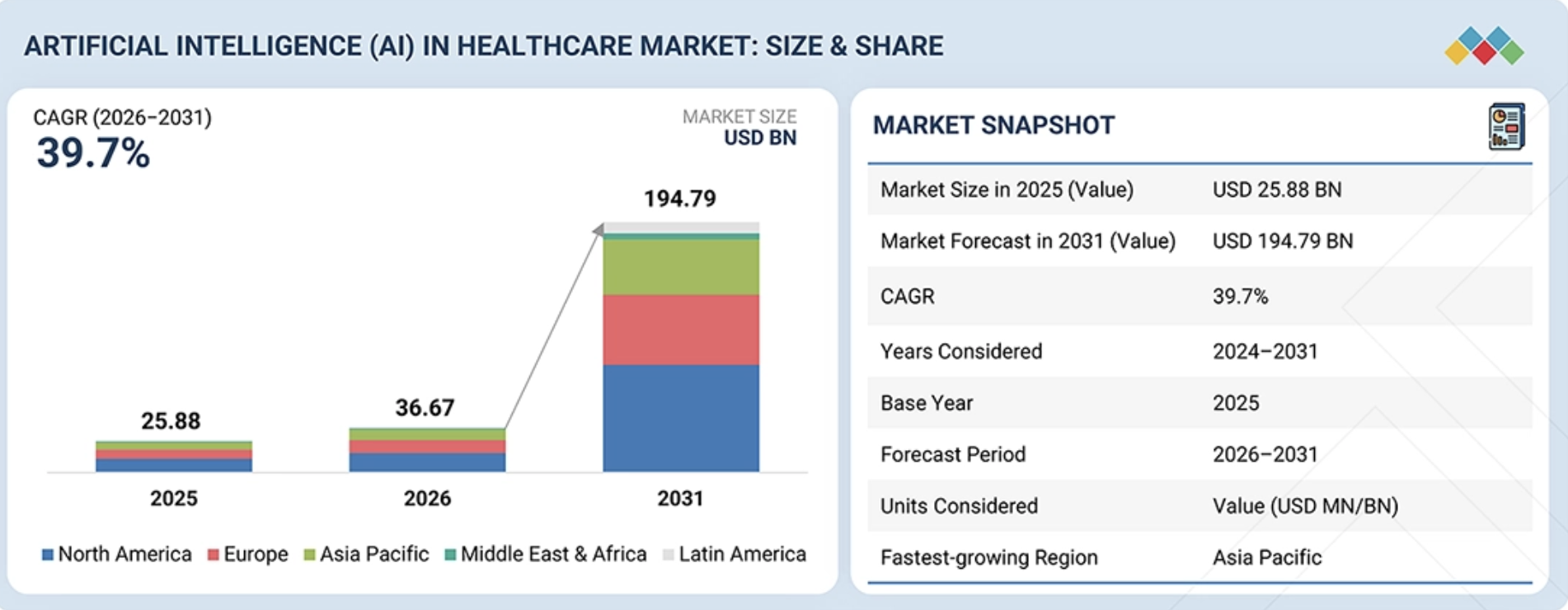
US healthcare teams hire AI partners because the market is growing fast and in-house building is slow and costly. MarketsandMarkets projects healthcare AI will reach $194.79 billion by 2031.
Meanwhile, Tactionsoft estimates an internal AI practice costs roughly $4 million to $15 million or more each year. Consequently, many teams partner instead. Therefore, understanding the market helps you judge who to trust.
1. What the Market Data Says, and Why Analyst Estimates Disagree
Analysts agree that healthcare AI is growing fast. However, their 2026 estimates differ by about $14 billion.
- MarketsandMarkets: $36.67 billion in 2026, $194.79 billion by 2031.
- Grand View Research: $50.7 billion in 2026, $505.6 billion by 2033.
- Why they differ: each report uses its own scope and forecast end date.
- Takeaway: treat the figure as a range, since both show growth of roughly 39% to 40% a year.
2. Product Vendors vs Development Partners
Tempus, Aidoc, and PathAI appear on Tezeract’s list of healthcare AI companies. However, they sell their own AI products, while a development partner builds yours.
- Product vendors: license a finished tool, and you adapt your workflow to it.
- Development partners: build custom software around your data, systems, and workflow.
- Hybrid approach: Bacancy suggests platforms for standard tasks and custom builds for payer-specific workflows.
- Speed: Monterail puts partnering at 3 to 5 months, versus 12 or more for building.
3. Where Agency Rankings Mislead Buyers
Many “top 10” lists come from companies that also sell development services. As a result, the publisher may rank itself first.
- Self-ranking: Cabot Technology Solutions names itself the best overall AI partner for health systems.
- Self-inclusion: RaftLabs lists itself among eight healthcare AI companies.
- Thin criteria: many lists compare rates and badges, not ownership terms.
- Better signals: verified third-party reviews, named healthcare projects, and clear contract terms.
In short, the healthcare AI market is large and growing, but analyst estimates vary, so rely on ranges. Product vendors sell finished tools, while partners build custom ones. Finally, self-published rankings deserve caution.
What Healthcare AI Development Companies Can Build
Healthcare AI development companies build software in seven main categories. These include patient engagement, remote monitoring, clinical workflow tools, predictive platforms, revenue and payer systems, data platforms, and medical imaging AI.
Each category serves different users and carries different risks. For example, a reminder chatbot and a diagnostic imaging tool need very different levels of validation. Therefore, knowing the category comes first, because it shapes the team, the data, and the partner you need.
1. AI Patient Engagement Platforms
These platforms handle routine patient contact. As a result, staff spend less time on calls and messages.
- AI assistants and patient FAQs: answer common questions at any hour
- Appointment support and reminders: reduce missed visits
- Care navigation: guides patients to the right service
- Follow-ups: check in after visits
2. Remote Patient Monitoring Platforms
These platforms track patients outside the clinic. Consequently, care teams can act before problems grow.
- Wearable and IoT integration: collects data from devices
- Live vitals and clinician dashboards: show patient status in real time
- Predictive alerts: flag early warning signs
- Escalation workflows: route urgent cases to the right person
3. Clinical Workflow AI
These tools reduce paperwork inside daily clinical work. Therefore, clinicians can spend more time with patients.
- Documentation and chart summarization: for example, ambient scribe platforms
- Care coordination and inbox management: keep tasks organized
- Decision support: surfaces relevant information at the point of care
- Clinical task automation: handles repeatable steps
4. Predictive Healthcare Platforms
These platforms use patient data to forecast outcomes. Additionally, they help teams plan resources.
- Deterioration and readmission risk: identify patients who need attention
- Population health and chronic disease management: track groups over time
- Resource forecasting: predicts staffing and bed needs
5. Healthcare Revenue and Payer AI
These systems automate financial and insurance workflows. Notably, Intellivon’s payment automation guide puts custom builds at $50,000 to $170,000.
- Claims, denials, and eligibility: speed up checks and corrections
- Prior authorization: shortens approval cycles
- Fraud detection and RCM: protect revenue
6. Healthcare Data and Analytics Platforms
These platforms organize scattered data into one usable view. Otherwise, AI models lack reliable inputs.
- EHR analytics and unified healthcare data: combine records from many sources
- Dashboards, cohort analysis, and operational analytics: support planning
- AI-ready data pipelines: feed clean data to models
7. Medical Imaging and Diagnostic AI
This is a different class of project because the model may directly support medical interpretation or diagnosis. Consequently, validation and regulatory review carry far more weight.
- Higher validation needs: accuracy must be tested more strictly
- Possible regulatory review: depends on the intended use
- Clinician oversight: stays part of the workflow
- Example: AI radiology software for hospitals
In short, healthcare AI falls into seven categories, from patient engagement to diagnostic imaging. Each carries different users, data needs, and risks. Therefore, the best AI healthcare development partner depends first on what type of healthcare system is being built.
Seven Checks That Separate a Real Healthcare AI Partner From a Generic AI Shop
A real healthcare AI partner can prove seven things before you sign: a signed BAA, FHIR and EHR integration experience, FDA awareness, post-launch monitoring, clear ownership terms, verifiable references, and security audits. A generic AI shop usually cannot show most of these.
Consequently, use these seven checks as a screen before any sales call. Each check below explains what to ask, what a good answer looks like, and which red flags to avoid.
1. A Signed BAA and HIPAA Controls Built Into the Design
A Business Associate Agreement (BAA) makes the partner legally responsible for protecting patient data. Therefore, request it before sharing any data.
- BAA signed before work starts
- Encryption, access controls, and audit logs, as in this HIPAA-compliant AI platform guide
- Red flag: “we’ll add compliance later”
2. FHIR, HL7, and EHR Integration Experience (Epic, Cerner, Athena)
FHIR and HL7 are standards that let software exchange data with EHRs such as Epic, Cerner, and Athena. Consequently, ask which systems the partner has actually connected.
- Named EHR integrations, not vague claims
- Experience with labs and pharmacies, as in this smart EHR guide
3. FDA and SaMD Awareness for Clinical Decision Tools
Software that guides diagnosis or treatment may count as a medical device under FDA rules, called Software as a Medical Device (SaMD). Therefore, check that the partner asks about intended use early.
- Intended-use questions during discovery
- Clinician oversight built into the workflow
- Example: AI radiology software for hospitals
4. MLOps, Model Monitoring, and Drift Handling After Launch
MLOps covers the tools that monitor, retrain, and update models after launch. Otherwise, accuracy can fall as data shifts, which is called drift.
- Drift alerts and retraining schedules, like the pipelines in this ambient scribe guide
- A named owner for post-launch support
5. Who Owns the Model, the Data, and the Code
Ownership terms decide whether you can switch partners later. Moreover, HealthSystemCIO covers abstraction layers and multi-cloud strategy as ways to avoid vendor and LLM lock-in.
- Written IP transfer for code and trained models
- Data hosted in your own cloud account
- Red flag: the partner keeps the model weights
6. Named Healthcare Work and Verifiable References
Claims mean little without proof. Consequently, verify work through independent reviews and named projects.
- Verified reviews, such as Intellivon’s 5.0 from 7 reviews on Clutch
- Comparable projects, such as AI telemedicine software
- A reference call with a healthcare client
7. Security Certifications (SOC 2, ISO 27001) and What They Do Not Prove
SOC 2 and ISO 27001 show a company follows audited security processes. However, they do not prove your specific AI system protects patient data.
- Audit report date and scope
- A project-specific security review
- PHI controls and audit trails, as listed in Intellivon’s payment automation guide
In short, a real healthcare AI partner proves seven things: a signed BAA, EHR integration, FDA awareness, post-launch monitoring, clear ownership, verifiable references, and audited security. Together, these checks separate healthcare specialists from generic AI shops.
Best AI Healthcare Development Partners for Different Teams
The best AI healthcare development partner depends on the project, not on one league table. Intellivon, Idea Usher, CitiusTech, SoftServe, MindK, and Intellectsoft serve different parts of the healthcare AI market. Therefore, the useful comparison is what kind of project each company is built to handle.
Many 2026 lists already rank vendors, so this section groups them by fit instead. The order below is not a score.
1. Intellivon for Custom AI Healthcare Platforms
Intellivon builds custom AI products for founders and enterprises, not licensed tools. Consequently, it suits teams that want a system designed around their own data and workflows.
- Capabilities: AI agents, predictive risk models, and private LLMs, listed on its AI development services page
- Engineering scope: FHIR and EHR integration, MLOps, cloud architecture, and web and mobile products
- Published work: an AI remote patient monitoring platform with SMART on FHIR, Epic, and IoT data
- Best aligned with: teams needing custom healthcare AI plus product engineering
2. Idea Usher for Custom AI Health Apps
Idea Usher is a custom software company founded in 2013 and based in Mohali, India. Additionally, it publishes guidance on AI health apps covering telemedicine, EHR, and remote monitoring.
- Focus: AI health app development
- Best aligned with: startups and mid-sized healthtech product teams
3. CitiusTech for Large Healthcare Enterprise Programs
CitiusTech focuses only on healthcare and life sciences, serving 140+ enterprises. Moreover, its AI practice covers model development, validation, deployment, and monitoring.
- Sectors: payers, providers, life sciences, and medical devices
- Best aligned with: large organizations running broad transformation programs
4. SoftServe for Large Data and AI Transformation
SoftServe combines AI with cloud and data work. Furthermore, its healthcare practice highlights unified data, analytics, and workflow automation.
- Credential: AWS Healthcare Competency Partner
- Best aligned with: large organizations combining AI with cloud and data modernization
5. MindK for Healthtech Product Development
MindK builds healthcare products for startups, scaleups, and enterprises. Additionally, it connects apps to Epic, Cerner, and Athenahealth.
- Remote monitoring: device integration and predictive AI dashboards
- Best aligned with: startups and mid-sized healthtech product teams
6. Intellectsoft for Connected Digital Health Products
Intellectsoft reports over 10 years in healthcare and full-cycle delivery. Meanwhile, its projects include IoT patient monitoring and AI-driven predictive models.
- Best aligned with: teams where software, connected devices, and product engineering overlap
AI Healthcare Development Partner Comparison Table
| Company | Better Fit For | Main Strength | Typical Project Type | Enterprise Scale | Custom Product Build |
| Intellivon | Founders + enterprises | Custom AI + integration | AI healthcare platforms | Yes | Yes |
| Idea Usher | Startups + mid-sized teams | AI health apps | Custom health apps | Mid | Yes |
| CitiusTech | Large healthcare enterprises | Healthcare transformation | Enterprise AI programs | High | Yes |
| SoftServe | Large organizations | AI + cloud + data | Transformation programs | High | Yes |
| MindK | Startups + scale-ups | Healthcare products | Custom healthtech AI | Mid | Yes |
| Intellectsoft | Digital health teams | Connected products | Health apps + platforms | Mid/High | Yes |
These six companies fit different project types. Some build new products, others run enterprise programs or large data transformations. Therefore, match the partner to your project before comparing anything else.
The Right Partner Also Depends on Your Healthcare Team
The right AI healthcare development partner depends on your team type as well as your project. Startups need product builders, hospitals need healthcare systems experience, and health systems need delivery capacity.
Payers need data and automation strength, while pharma needs specialized AI expertise. Consequently, a small clinic may not need a custom build at all. Each group below shows the need and the partners that fit.
1. Healthtech Startups Usually Need Product Builders
Startups often have one product team and limited internal engineering. Therefore, they need a partner who ships fast and adapts as the market responds.
- Faster releases toward product-market fit
- Flexible development as requirements change
- Discovery, AI, backend, mobile, web, cloud, and integrations in one team
- Partners: Intellivon, Idea Usher, MindK
2. Hospitals Need Healthcare Systems Experience
Hospitals run on clinical workflows and protected health information (PHI). As a result, a partner must understand how clinicians actually work.
- EHR integration and interoperability
- PHI protection and security controls
- Clinician UX that fits the workflow
- Partners: Intellivon, MindK, Intellectsoft
3. Health Systems Need Enterprise Delivery Capacity
Health systems operate across many facilities. Moreover, they carry legacy systems and larger data volumes.
- Governance and rollout planning across sites
- Scaling on top of older infrastructure
- Partners: Intellivon, CitiusTech, SoftServe
4. Payers Need Strong Data and Automation Capability
Payers handle high claim volumes and complex rules. Consequently, automation and analytics matter more than interface design.
- Claims, prior authorization, and fraud detection
- Member support, RCM, and analytics
- Partners: Intellivon, CitiusTech, MindK
5. Pharma and Life Sciences Need Specialized AI Expertise
Pharma work involves scientific data and strict regulatory steps. Therefore, generic AI experience rarely transfers.
- Research, clinical trials, and pharmacovigilance
- Drug discovery and regulatory workflows
- Partners: Intellivon, CitiusTech, SoftServe
6. Small Clinics May Not Need a Custom Build
A clinic with a standard scheduling, documentation, or communication problem is often better served by existing software. Additionally, Tactionsoft cites a wrong build costing $1M+ for what a license could deliver at $80K a year.
- Buy when the workflow is standard
- Build when the workflow is unique
- Combine both when only one part is unique
7. Team Type and Partner Fit at a Glance
| Team Type | Main Need | Partners to Consider |
| Healthtech startups | Fast product delivery | Intellivon, Idea Usher, MindK |
| Hospitals | EHR and clinical workflow depth | Intellivon, MindK, Intellectsoft |
| Health systems | Multi-site delivery capacity | Intellivon, CitiusTech, SoftServe |
| Payers | Data and automation | Intellivon, CitiusTech, MindK |
| Pharma and life sciences | Specialized AI expertise | Intellivon, CitiusTech, SoftServe |
| Small clinics | Existing software first | Licensed products |
In short, each team type has a different core need, from speed to scale to specialization. Company size matters, but workflow complexity and existing infrastructure often matter more.
What Separates Healthcare AI Partners From Generic AI Agencies
Healthcare AI partners differ from generic AI agencies because healthcare data, systems, decisions, and rules are different. Patient records span years and contain gaps. EHR connections often form part of the product. Outputs can influence care, and privacy rules shape the architecture.
Consequently, healthcare specialization changes how the software is designed, built, and run. A generic agency can build a model, but healthcare adds requirements that change the whole project.
1. Healthcare Data Is Different From Ordinary Business Data
Healthcare data builds up over years and arrives in many formats. Therefore, models must handle gaps and mixed sources.
- Longitudinal records: one patient’s history spans many visits and years
- Missing information: tests get skipped, and notes stay incomplete
- Structured and unstructured data: labs and vitals sit beside free-text notes
- Claims and device data: payers and wearables add more formats
2. EHR Integration Is Often Part of the Product
An EHR is the system where clinicians record patient care. Consequently, AI that sits outside it often goes unused.
- FHIR and HL7: standards for sharing patient data between systems
- SMART on FHIR: lets an app launch inside Epic with patient context
- Epic and Oracle Health: major EHR platforms, each with its own integration rules
3. AI Outputs May Affect Real Healthcare Decisions
A wrong output can affect patient care, not only revenue. As a result, healthcare AI needs safeguards that ordinary business AI often skips.
- Accuracy: tested on realistic clinical data
- Explainability: clinicians can see why the AI suggested something
- Escalation: uncertain cases go to a person
- Human review: a clinician approves high-impact outputs
- Clinical context: the same result can mean different things for different patients
4. Privacy and Security Affect the Architecture
HIPAA governs how protected health information (PHI) is stored and shared. Because of this, security is designed in from the start, as this HIPAA-compliant AI platform guide explains.
- Access control: users see only what their role requires
- Encryption: protects PHI in storage and in transit
- Audit trails: record who accessed or changed data
5. Models Need Monitoring After They Go Live
Healthcare AI is not “build once and forget.” Models and data change, so accuracy can slip over time.
- MLOps: the tools that monitor, retrain, and update models
- Drift detection: flags when new data no longer matches training data, as in these ambient scribe pipelines
- Upkeep: integrations, infrastructure, and performance need regular attention
In short, healthcare AI depends on complex patient data, EHR connections, safe decision support, strict privacy design, and ongoing monitoring. Healthcare AI requires product engineering plus healthcare data, integration, governance, and long-term AI operations.
In-House vs Outsourced Healthcare AI Development
Healthcare AI partners differ from generic AI agencies because healthcare data, systems, decisions, and rules are different. Patient records span years and contain gaps. EHR connections often form part of the product. Outputs can influence care, and privacy rules shape the architecture.
Consequently, healthcare specialization changes how the software is designed, built, and run. A generic agency can build a model, but healthcare adds requirements that change the whole project.
1 Healthcare Data Is Different From Ordinary Business Data
Healthcare data builds up over years and arrives in many formats. Therefore, models must handle gaps and mixed sources.
- Longitudinal records: one patient’s history spans many visits and years
- Missing information: tests get skipped, and notes stay incomplete
- Structured and unstructured data: labs and vitals sit beside free-text notes
- Claims and device data: payers and wearables add more formats
2. EHR Integration Is Often Part of the Product
An EHR is the system where clinicians record patient care. Consequently, AI that sits outside it often goes unused.
- FHIR and HL7: standards for sharing patient data between systems
- SMART on FHIR: lets an app launch inside Epic with patient context
- Epic and Oracle Health: major EHR platforms, each with its own integration rules
3. AI Outputs May Affect Real Healthcare Decisions
A wrong output can affect patient care, not only revenue. As a result, healthcare AI needs safeguards that ordinary business AI often skips.
- Accuracy: tested on realistic clinical data
- Explainability: clinicians can see why the AI suggested something
- Escalation: uncertain cases go to a person
- Human review: a clinician approves high-impact outputs
- Clinical context: the same result can mean different things for different patients
4. Privacy and Security Affect the Architecture
HIPAA governs how protected health information (PHI) is stored and shared. Because of this, security is designed in from the start, as this HIPAA-compliant AI platform guide explains.
- Access control: users see only what their role requires
- Encryption: protects PHI in storage and in transit
- Audit trails: record who accessed or changed data
5. Models Need Monitoring After They Go Live
Healthcare AI is not “build once and forget.” Models and data change, so accuracy can slip over time.
- MLOps: the tools that monitor, retrain, and update models
- Drift detection: flags when new data no longer matches training data, as in these ambient scribe pipelines
- Upkeep: integrations, infrastructure, and performance need regular attention
Therefore, healthcare AI depends on complex patient data, EHR connections, safe decision support, strict privacy design, and ongoing monitoring. Healthcare AI requires product engineering plus healthcare data, integration, governance, and long-term AI operations.
In-House vs Outsourced Healthcare AI Development
In-house development fits teams that treat AI as a long-term core capability. Outsourcing fits teams that lack expertise or capacity. At the same time, many enterprise projects combine both. The choice depends on how central AI is to your business and which skills you already have.
Consequently, cost and speed differ sharply between the options. Ownership also depends on how the project is structured, not only on who writes the code.
1. In-House Works When AI Is a Long-Term Core Capability
Building in-house makes sense when AI is central to what your organization does. However, it requires a full team that stays in place for years.
- Engineering and data teams
- Healthcare domain expertise
- DevOps and AI/ML specialists
- Security and product management
- Cost signal: Tactionsoft estimates roughly $4M to $15M+ per year for a standing team
2. Outsourcing Works When Expertise or Capacity Is Missing
A development partner brings a complete team without you hiring every specialist individually. Therefore, outsourcing suits teams that need to move faster than hiring allows.
- Faster start, since the team already exists
- Access to AI, integration, and cloud skills at once
- Speed signal: Monterail puts partnering at 3 to 5 months, versus 12 or more for building
3. Hybrid Teams Are Common for Enterprise Projects
In a hybrid model, your internal team and the partner share the work. As a result, you keep control of the decisions that matter most.
- Internal team keeps: business knowledge, clinical ownership, and product direction
- External team handles: engineering, AI, integration, infrastructure, and delivery
4. What Each Route Costs and How Long It Takes
| Route | Team | Typical Cost | Typical Timeline |
| In-house build | 4 to 8 engineers (startup), 8 to 15 (hospital system) | $4M to $15M+ per year | 12+ months |
| Outsourced partner | Partner’s full team | $70,000 to $300,000 by phase | 3 to 5 months |
| Off-the-shelf license | Vendor-managed | Example: $80K per year | Immediate |
| Hybrid | Internal owners plus partner engineers | Partner cost plus internal time | Varies by scope |
Last Updated: September 29, 2026. The in-house figure covers a standing team, while the partner figure covers one project, so the two are not a like-for-like comparison.
In short, in-house suits long-term core AI, outsourcing fills expertise and capacity gaps, and hybrid teams split the work. Outsourcing healthcare AI does not necessarily mean giving up ownership, because many projects use a shared delivery model.
Healthcare AI Development Costs $70K to $300K
Custom healthcare AI development typically costs $70,000 to $300,000. The gap comes from seven factors: product complexity, AI complexity, data readiness, integrations, number of platforms, compliance requirements, and enterprise scale. For example, a single-workflow tool built on clean data sits near the low end.
Meanwhile, a multi-site platform with several EHR connections sits near the high end. The phases below show where the money goes.
Cost by phase
- Discovery and architecture, $5K to $20K: product requirements, healthcare workflow, data assessment, architecture, and a technical plan.
- POC and AI validation, $15K to $40K: model experiments, data preparation, a prototype, and technical validation.
- Core product development, $30K to $120K: AI functionality, APIs, backend, dashboards, and mobile and web products.
- Healthcare integrations, $15K to $60K: EHRs, FHIR, HL7, device data, and external systems.
- Security, testing, and deployment, $10K to $35K: security checks, testing, and cloud launch.
- Ongoing maintenance, around 15% to 25% per year: infrastructure, updates, monitoring, model management, retraining, and security.
Core development and integrations drive most of the spread. Additionally, poor data quality raises the POC and integration lines, because teams must clean and map data first. Maintenance scales with the build. On a $150,000 project, 15% to 25% equals $22,500 to $37,500 per year.
For context, Intellivon’s payment automation guide puts custom builds at $50,000 to $170,000 with 5 to 8 month MVP timelines. Our Clutch profile lists a minimum project size of $50,000+.
| Phase | Typical Cost | What It Covers |
| Discovery | $5K to $20K | Workflow, data, architecture |
| POC | $15K to $40K | AI validation |
| Development | $30K to $120K | Product + AI |
| Integrations | $15K to $60K | EHR, API, and device connections |
| Launch | $10K to $35K | Testing, security, deployment |
Need a realistic healthcare AI build estimate? Intellivon can break your project into discovery, AI development, integrations, and launch before you commit to the full scope.
In short, custom healthcare AI costs $70,000 to $300,000, driven mostly by product scope, integrations, and data readiness. Phased pricing lets you fund validation first and expand only after it works.
How Intellivon Builds Healthcare AI From Discovery to Scale
We build healthcare AI in eight steps that match the criteria this guide sets out: workflow and risk mapping, data assessment, built-in security, an AI foundation, workflow integration, validation, staged rollout, and post-launch monitoring. Each step answers a question a buyer should ask any partner.
Consequently, you can compare our process against every earlier section. Our published projects, including remote monitoring and childbirth prediction, show each step in practice.
Step 1: Map the Healthcare Workflow and Risk
First, we define who uses the system and where AI enters their work. Therefore, risk and compliance decisions start on day one.
- Users and workflow: we map clinicians, staff, and patients, and the steps they follow.
- PHI and clinical risk: we trace where patient data moves and where an AI error could affect care.
- Compliance: we map regulatory needs and classify AI risk, as in our AI healthcare app guide.
- Integrations: we list every system the AI must connect to.
Step 2: Assess the Data and Existing Healthcare Systems
Next, we check whether your data and systems can support the AI. Otherwise, a strong model still fails on weak inputs.
- EHRs and existing infrastructure: we document what you run today.
- Data quality: we look for gaps, duplicates, and inconsistent formats.
- APIs, HL7, and FHIR: we confirm which standards each system supports.
- Example: in our childbirth project, we unified maternal records, labs, and vitals into one pipeline.
Step 3: Design Security and Compliance Into the Architecture
Then we build security into the structure instead of adding it later. As a result, reviews and audits become simpler.
- PHI and identity: we apply role-based access, which can connect to Okta or Azure AD, as our HIPAA guide explains.
- Encryption: our remote monitoring platform uses Vault encryption.
- Auditability: our childbirth project includes audit logging and access controls.
- Human oversight: we set model approval workflows and governance rules.
Step 4: Build the Data and AI Foundation
After that, we build the pipelines and models. Moreover, we choose the AI method that fits the clinical problem.
- Data engineering: our monitoring platform uses streaming pipelines with automated validation and schema enforcement.
- ML: predictive models learn from longitudinal patient data.
- NLP and LLMs: we tune language models for medical terminology, as in our smart EHR guide.
- Computer vision: we add it where imaging is involved, as in our AI radiology guide.
Step 5: Connect AI to the Healthcare Workflow
Meanwhile, we connect the model to where clinicians already work. Consequently, the AI appears inside existing screens, not in a separate tool.
- Epic: we integrated through SMART on FHIR in our monitoring platform.
- Oracle Health and Cerner: we connect through FHIR and HL7 APIs.
- Existing apps: we deliver dashboards and mobile interfaces.
- Decision support: our childbirth project surfaces risk scores inside obstetric workflows.
Step 6: Validate Before Production Use
Before launch, we test whether the system is accurate, safe, and fast. Therefore, clinicians and engineers review results together.
- AI metrics: our monitoring platform reports 87% precision in early-risk detection.
- Edge cases: we test unusual patient patterns.
- Clinical review: clinicians check outputs on realistic cases.
- Security and performance: we verify controls and response times, such as sub-200 ms inference.
Step 7: Roll Out in Controlled Stages
Then we release it in stages, not all at once. As a result, problems surface in a small setting first.
- Pilot: we start with a limited group.
- Users and workflows: we begin with one team or site.
- Feedback: clinicians report friction before we expand.
- Training: we prepare staff before wider use.
Step 8: Monitor the AI After Launch
Finally, we keep the AI accurate as data changes. Healthcare AI is not “build once and forget.”
- Drift and errors: MLflow, CI/CD, and performance monitoring trigger retraining when drift or data quality issues appear.
- Usage and model performance: we track both over time.
- Changes: we version every model update.
- Retraining: we schedule it before accuracy slips.
In short, we take healthcare AI from workflow mapping through data assessment, secure design, model building, integration, validation, staged rollout, and monitoring. Each step maps to a criterion this guide sets out, and our published projects show them applied.
What Buyers Can Verify About Intellivon’s Healthcare Work
The best AI healthcare development partner is the one that fits your project type, your data, and your existing systems, not the one at the top of a ranked list. Custom builds typically cost $70,000 to $300,000, so a wrong choice is expensive.
Therefore, settle a few decisions before you sign anything, then test them on a scoped discovery call. This guide has shown exactly where those decisions sit, from team fit to phase costs.
Bring these eight points to that call:
- Team type: whether you need a product builder, a healthcare systems specialist, or enterprise delivery capacity
- Build route: whether in-house, off-the-shelf, or a hybrid fits your workflow
- Data readiness: what you hold across EHRs, claims, clinical notes, and devices
- Integrations: which systems must connect, such as Epic, Oracle Health, FHIR, or HL7
- Compliance: how PHI, HIPAA, and possible FDA SaMD rules apply
- Budget by phase: how the $70K to $300K range splits across discovery, POC, development, integrations, and launch
- POC success criteria: what the first validation must prove, written before kickoff
- Ownership: who owns the model, the data, and the code
If those decisions are still open, book a healthcare AI discovery call with Intellivon. We will map your workflow, data, and integrations, then split the project into discovery, AI development, integrations, and launch. That way, you can fund one phase at a time.
Conclusion
Ultimately, the best AI healthcare development partner is the one that fits your project, not the one ranked first. First, decide whether to build, buy, or partner. Then, confirm the partner understands healthcare data, EHR integration, and compliance.
Additionally, fund the work in phases, from a $5K discovery to a full build within the $70,000 to $300,000 range. Finally, prove the idea with a proof of concept before scaling. By following these steps, you reduce risk and reach production faster.
FAQs
Q1. What does an AI healthcare development partner do?
A1. An AI healthcare development partner builds AI and the software around it. First, it prepares your data. Then, it develops the models, applications, and integrations with systems like EHRs. Finally, it deploys the product securely and monitors accuracy after launch, so the AI keeps working as patient data and rules change.
Q2. Which AI healthcare development company is best for startups?
A2. No single company is best for every startup. However, startups generally benefit from product-focused partners that can carry an MVP into later scaling. Therefore, compare partners on healthcare experience, delivery speed, and ownership terms. Options such as Intellivon and MindK fit this profile, but confirm fit through a scoped discovery call.
Q3. Which type of AI partner is better for hospitals?
A3. Hospitals need a partner with strong healthcare systems experience. First, look for proven EHR integration and interoperability through FHIR and HL7. Additionally, the partner should understand clinical workflows, protect PHI with strong security, and support enterprise rollout across departments or sites. Consequently, healthcare-specific delivery matters more than general AI skill.
Q4. Is it better to build healthcare AI in-house or outsource it?
A4. Build in-house when AI is a long-term core capability and you can fund a standing team, which Tactionsoft estimates at roughly $4M to $15M+ per year. Outsource when you lack expertise or speed. However, many projects use hybrid delivery: your team owns clinical direction, while the partner handles engineering and delivery.
Q5. Is custom healthcare AI better than off-the-shelf software?
A5. Custom healthcare AI is better when your workflow is unique or needs deep integration with EHRs and internal systems. Conversely, off-the-shelf software fits standard tasks like scheduling, documentation, or patient messaging. Therefore, buy when the workflow is common, build when it differentiates you, and combine both when only part is unique.