Key Takeaways:
-
It usually costs between $70K and $300K to build a healthcare agentic AI platform.
-
The ultimate price depends on the workflows, the integrations, and the amount of work the agents are able to carry out.
-
The cost can rise quickly due to EHR connections, compliance work, testing, and the use of multiple agents.
-
It is generally wiser to begin with a single useful workflow rather than to build the entire platform at once.
-
Intellivon can look at the first workflow, construct it, and then proceed from that point.
In 2026, a bespoke agentic AI healthcare platform generally costs between $70,000 and $300,000 to build, but the precise figure will vary depending on the scope, since this can be very different from project to project.
What then is involved in such a platform? Different from a chatbot or a single AI feature, it is a system designed to carry out real healthcare tasks over a number of steps, across various systems and teams, and includes defined levels of autonomy rather than just responding to prompts.
The blog examines the factors that cause that price range and what a healthcare organization actually receives at each level. It also looks at why integrations, agents, compliance, and workflow scope have an effect on the cost, what ongoing ownership entails after launch, and the way in which Intellivon designs and builds these platforms around real healthcare workflows.

What You Are Actually Paying to Build
The $70,000 to $300,000 you’re paying for buys a working healthcare system, not a chatbot with a healthcare skin on it. That budget covers the agents doing the work, the connections to your existing tools, and the safeguards that keep everything accountable.
So, before deciding whether the number feels high or low, it’s worth seeing what actually makes up that system.
1. One Agent, One Job
The most basic version is a single agent built around one specific task. Rather than trying to do everything, it owns a narrow slice of work end to end, such as:
- checking insurance eligibility
- booking or rescheduling appointments
- chasing prior authorizations
- generating clinical notes
- following up on unpaid claims
2. Several Agents, Working Together
As needs grow, so does the system. Instead of one agent doing one thing, multiple agents each take ownership of a different function, handing work between each other as a patient moves through:
- intake
- documentation
- scheduling
- billing
- authorization
- coordination between providers
3. The Tools Agents Have to Plug Into
Of course, agents can’t operate in a vacuum. They need real access to the software your staff already relies on daily, including:
- your EHR
- insurer and payer portals
- scheduling tools
- clinical data systems
- your CRM
- billing software
- messaging or communication platforms
4. The Safety Net Around Every Action
Even so, none of this can run unchecked. Before an agent is allowed to act, the platform needs real oversight built in, from approval steps to visibility into everything it does.
At the end of the day, this is why the number isn’t arbitrary. You’re funding a system built to safely take action inside a healthcare operation, not just answer questions about one.
Why Healthcare Companies Are Investing in Agentic AI
Healthcare companies are investing in agentic AI because traditional automation simply can’t survive real clinical and administrative work. Consequently, teams end up doing by hand what the system was supposed to handle. This is a practical response to workflows that fixed rules were never built to manage.
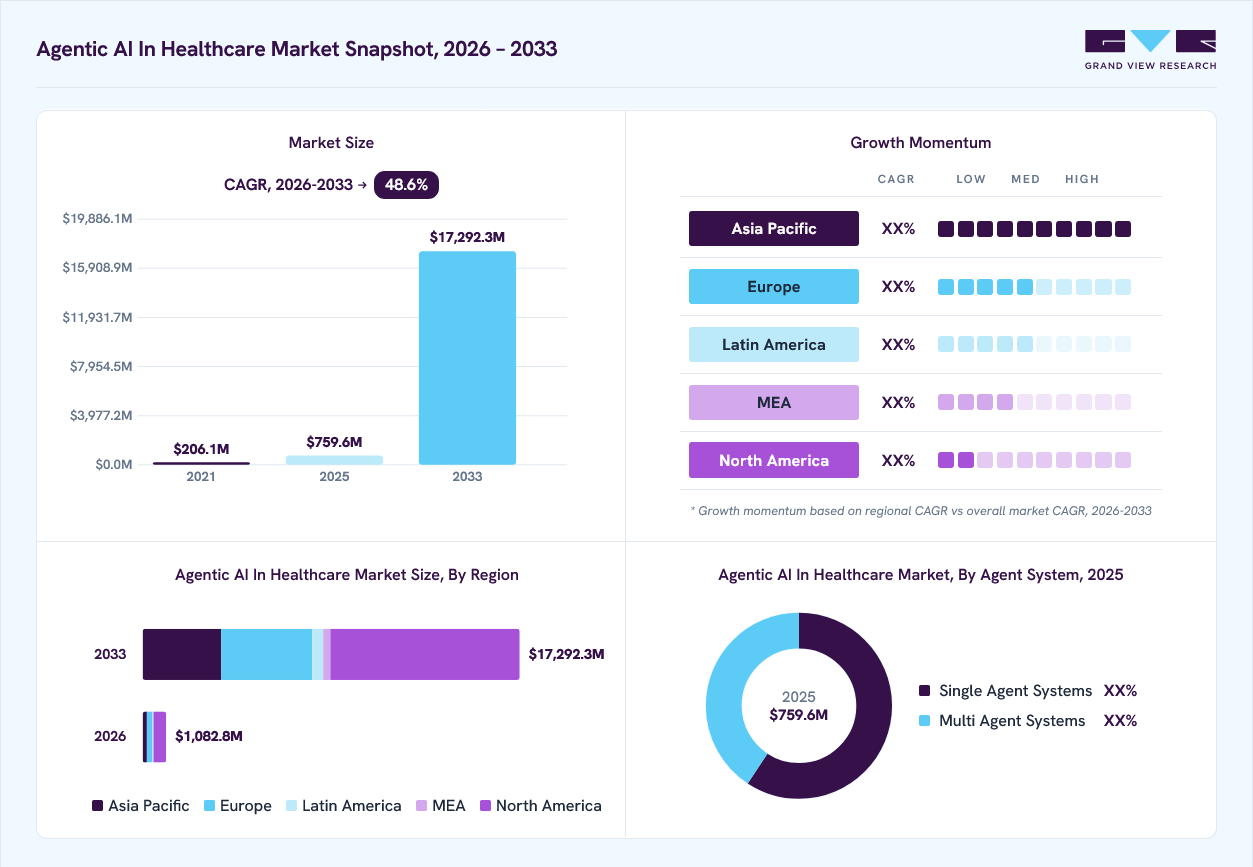
The numbers back this urgency up. According to Grand View Research, the agentic AI in healthcare market is projected to grow from USD 1,082.8 million in 2026 to USD 4,962.9 million by 2030, at a CAGR of 45.6%.
1. Traditional Automation Stops When Workflows Become Messy
Fixed rules, RPA, and scripts work fine until something unexpected happens. The moment a workflow branches, these tools stall and hand the problem straight back to a person.
- Rule-based systems break on exceptions
- RPA scripts fail when a screen or field changes
- Chatbots can answer questions but can’t take multi-step action
2. Healthcare Workflows Rarely Follow One Straight Path
In practice, most healthcare processes involve missing information, rejected claims, or last-minute changes. As a result, systems need to adapt mid-process, not just execute a fixed sequence.
- Missing prior authorization information
- Rejected claims
- Scheduling changes
- Incomplete clinical records
- Referral follow-ups
3. Agentic Systems Can Continue Work Across Several Steps
This is where agentic AI earns its value, as Fact.MR notes hospitals are already shifting from isolated pilots to coordinated, multi-step workflows.
Instead of stopping at the first obstacle, the system inspects information, chooses the next action, calls another system, waits for a response, continues the workflow, and escalates only when it genuinely needs a human.
4. Where Healthcare Companies Are Already Applying Agents
Today, adoption is concentrated where volume is high, and delays cost real money, with Future Market Insights reporting that 81% of physicians already use AI for research, documentation, or patient communication:
- patient access
- revenue cycle
- clinical documentation
- prior authorization
- care coordination
- scheduling
So, ultimately, this investment isn’t about novelty. It’s about deploying the first automation approach actually built to survive contact with how healthcare works.
Agentic AI Healthcare Platform Cost in 2026
A custom agentic AI healthcare platform typically costs $70,000 to $300,000 to develop in 2026.
That said, where a specific project lands within that range depends mainly on workflow scope, the number of integrations required, how many agents are involved, the level of autonomy given to them, and the regulatory risk tied to the workflow itself.
1. Basic Single-Workflow Platform: $70,000 to $110,000
At this tier, the build stays intentionally narrow. Typical scope includes:
- one primary agent
- one bounded healthcare workflow
- basic RAG
- one major integration
- human approval for important actions
- basic analytics
- standard cloud deployment
This tier suits an MVP, a narrow operational workflow, or proving ROI before expanding further.
2. Mid-Level Multi-Agent Platform: $110,000 to $200,000
From here, complexity increases as the platform starts coordinating more moving parts. Typical scope includes:
- several agents
- multiple workflows
- EHR integration
- workflow orchestration
- advanced permissions
- monitoring
- richer knowledge retrieval
- enterprise dashboards
3. Enterprise Agentic AI Platform: $200,000 to $300,000+
At the top end, the platform is built to operate across an entire organization rather than one team. Typical scope includes:
- several departments
- multiple EHR or payer systems
- complex orchestration
- high-volume workloads
- advanced governance
- private infrastructure
- extensive clinical validation
- custom security requirements
4. Platform Scope vs. Cost: A Quick Comparison
| Platform Scope | Typical Cost | Best Fit |
| Single workflow | $70K–$110K | MVP or focused automation |
| Multi-agent platform | $110K–$200K | Growing healthcare organization |
| Enterprise platform | $200K–$300K+ | Multi-site or complex enterprise |
Ultimately, the price tag follows the workload rather than the other way around. A founder scoping their first build should treat this table as a starting checkpoint rather than a fixed quote.
Where the $70K to $300K Development Budget Goes
The $70K to $300K budget breaks down into six phases: discovery, architecture, core agent development, integrations, validation, and deployment, with integrations and agent development typically consuming the largest share.
Seeing the split makes the overall price range far easier to justify.
1. Discovery and Workflow Planning
Estimated cost: $7,000 to $15,000
This phase covers workflow mapping, user requirements, autonomy boundaries, technical discovery, PHI mapping, and success metrics- essentially, defining what the platform needs to do before anyone writes code.
2. Architecture and Compliance Design
Estimated cost: $10,000 to $30,000
Next, the team designs system architecture, data flows, permissions, HIPAA controls, human-in-the-loop design, and audit requirements, laying the technical and regulatory foundation everything else builds on.
3. Core AI Agent Development
Estimated cost: $20,000 to $65,000
This is where the agents themselves get built, covering reasoning, agent tools, prompts, function calling, RAG, memory, and workflow logic.
4. EHR and Healthcare System Integrations
Estimated cost: $20,000 to $80,000
Integrations connect the platform to Epic, Oracle Health, FHIR APIs, HL7, scheduling, billing, and payer systems. Because healthcare data lives across so many disconnected systems, this phase frequently becomes the single largest cost in the entire build.
5. Security, Testing, and Clinical Validation
Estimated cost: $8,000 to $45,000
Before launch, the platform goes through QA, security testing, agent evaluations, hallucination testing, escalation testing, clinical review, and audit logging.
6. Deployment and Production Setup
Estimated cost: $5,000 to $65,000
Finally, the platform moves into production: cloud environment setup, CI/CD, monitoring, MLOps, observability, and rollout.
7. Full Phase Breakdown
| Phase | Estimated Cost | What It Covers |
| Discovery and workflow planning | $7K–$15K | Workflow mapping, requirements, PHI mapping |
| Architecture and compliance design | $10K–$30K | Architecture, HIPAA controls, HITL design |
| Core AI agent development | $20K–$65K | Reasoning, tools, RAG, workflow logic |
| EHR and healthcare system integrations | $20K–$80K | Epic, Oracle Health, FHIR, HL7, payer systems |
| Security, testing, clinical validation | $8K–$45K | QA, evaluations, clinical review, audit logging |
| Deployment and production setup | $5K–$65K | Cloud setup, CI/CD, monitoring, rollout |
Taken together, these six phases explain why the range spans so widely; integrations and core agent development alone can account for more than half the total budget.
The Features That Push Agentic AI Costs Higher
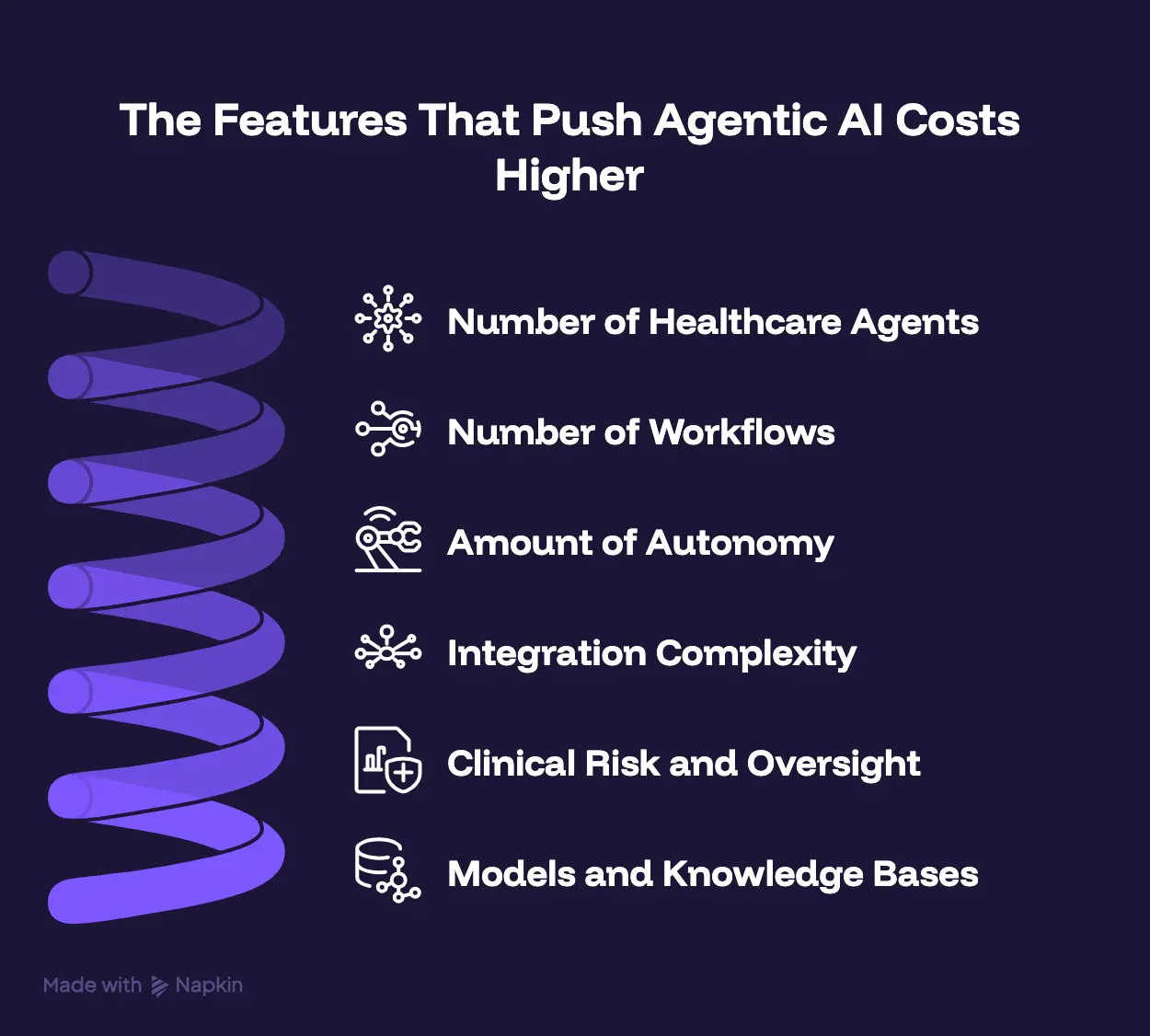
Six factors push agentic AI costs higher: the number of agents, the number of workflows each one handles, how much autonomy they’re given, integration complexity, clinical risk, and the sophistication of the underlying models.
Knowing these lets a founder estimate roughly where their own project will land, rather than guessing blindly at a number.
1. Number of Healthcare Agents
More agents mean more moving parts to build, test, and maintain. For instance:
- one scheduling agent costs far less than a full suite
- agents covering scheduling, billing, documentation, and care coordination together multiply both engineering and testing effort
- each additional agent adds its own logic, permissions, and failure cases
2. Number of Workflows Each Agent Can Complete
Similarly, the more workflows an agent handles, the more everything around it has to expand:
- logic
- permissions
- exceptions
- integrations
- testing
3. Amount of Autonomy Given to the Agents
Autonomy level changes cost dramatically. A recommendation-only agent is the cheapest to build and validate, while draft-and-approve and supervised-action agents sit in the middle. Fully autonomous execution, by contrast, demands the heaviest testing and governance, since mistakes carry real consequences.
4. EHR and Payer Integration Complexity
Integration scope varies enormously depending on what’s being connected.
A single FHIR API is straightforward, whereas legacy HL7 interfaces, Epic, Oracle Health, and multiple payer APIs each add distinct engineering work, often becoming the largest line item in the whole build.
5. Clinical Risk and Human Oversight
Risk level matters just as much as technical scope. A scheduling agent, for example, needs relatively light validation, while a clinical decision-support agent requires far deeper testing, review, and oversight before it can safely act.
6. Custom Models, RAG, and Healthcare Knowledge
Finally, model choice affects cost directly. Standard foundation models and basic RAG cover many use cases affordably, but private knowledge bases, fine-tuning, and specialized clinical models push the budget considerably higher.
So, in short, cost isn’t random. It follows how many agents exist, how much they’re trusted to do, and how much clinical risk sits behind their decisions.
What Different Healthcare AI Agents Cost to Build
Different healthcare AI agents cost different amounts to build, largely because each one carries its own integration needs, data complexity, and risk level.
Consequently, a founder entering through a specific pain point, like scheduling or prior authorization, can use these use cases to ground the abstract $70K–$300K range in something concrete.
Agent Type and Its Build Cost
| Agent Type | What It Covers | Estimated Cost | Complexity Drivers |
| Patient scheduling and access | Appointment booking, rescheduling, eligibility checks, waitlist management | $70K–$100K | One to two integrations, low clinical risk, mostly rule-bound decisions |
| Prior authorization | Payer connectivity, clinical document review, status tracking, human review on submission | $90K–$150K | Payer API variability, document parsing accuracy, escalation logic |
| Revenue cycle | Eligibility verification, claims submission, denial management, payment workflows | $100K–$170K | Multiple financial systems, denial-reason logic, reconciliation testing |
| Clinical documentation | Transcription, summarization, EHR write-back, clinician approval | $110K–$180K | Deep EHR integration, accuracy demands, clinician review loops |
| Care coordination | Referrals, follow-ups, patient records, multidisciplinary handoffs | $120K–$200K | Cross-team coordination, ongoing tracking, several connected systems |
| Patient engagement | Reminders, follow-ups, education content, escalation to staff | $80K–$130K | Lower clinical risk, broad reach, simpler decision logic |
Ultimately, the further an agent moves from a single, bounded task toward multi-system coordination, the higher its cost climbs. This table gives founders a realistic starting point before scoping their own build.
Why EHR Integration Changes the Development Cost
EHR integration changes development cost because, ultimately, not all healthcare systems are equally easy to connect to. Specifically, the type of API, the vendor, and the level of access requested all shift the engineering effort, and sometimes that shift is dramatic.
So, here’s what actually drives that difference.
1. FHIR APIs Reduce Some Integration Work
To begin with, standardized FHIR access makes a meaningful difference, since it gives agents a consistent, well-documented way to request patient data.
As a result, teams spend far less time reverse-engineering data formats, and instead, they can focus more directly on building the actual workflow logic.
2. Legacy HL7 Interfaces Require More Mapping
Older environments, however, tell a very different story. Because HL7 interfaces predate modern API standards, data often arrives in inconsistent formats that need custom mapping before an agent can use it reliably.
Consequently, legacy systems tend to slow builds down considerably, and that delay shows up directly in the budget.
3. Epic and Oracle Health Access Changes Project Scope
Similarly, working with major vendors like Epic and Oracle Health adds its own layer of requirements.
Each demands specific certifications, approval processes, and integration patterns, and therefore, those vendor-specific steps directly extend both timeline and cost.
4. Read Access Costs Less Than Write Access
Finally, one distinction matters more than almost any other. On one hand, reading patient data is a comparatively simple level of integration.
On the other hand, allowing an agent to change appointments, update records, submit information, or trigger downstream workflows is a completely different undertaking, one that demands far more validation, testing, and safeguards before it can be trusted in production.
So, altogether, integration cost isn’t just about which systems are involved. Rather, it’s about how standardized those systems are, and just as importantly, how much the agent is actually allowed to do once it’s connected.
How HIPAA and Healthcare Compliance Affect Cost
HIPAA and healthcare compliance affect cost because they aren’t a checklist added at the end, but rather a set of engineering requirements built into the platform from day one.
Consequently, each compliance layer carries its own real, quantifiable cost, not just a vague “extra work” label.
1. PHI Access Controls Must Be Built Into the Platform
To start, protecting patient data requires several layers working together: role-based access control, least-privilege permissions, strong authentication, and encryption both at rest and in transit.
These are foundational, and skipping any one of them isn’t something a healthcare platform can afford to do.
2. Every Important Agent Action Needs an Audit Trail
Beyond access controls, every meaningful action an agent takes needs to be recorded: what it did, when, on whose behalf, and what data it touched. This creates accountability, and just as importantly, it gives teams a way to investigate anything that goes wrong later.
3. Human Review Adds Workflow and Engineering Work
Similarly, human-in-the-loop review is a product feature that has to be engineered. Approval queues, escalation paths, and reviewer interfaces all require real development time, not just a sign-off from legal.
4. Higher-Risk Clinical Functions Require More Validation
Finally, as clinical risk increases, so does the validation burden. A scheduling agent needs light testing, whereas a clinical decision-support agent may require deeper clinical review and, depending on its function, additional regulatory scrutiny before it can go live.
5. Compliance Cost Breakdown
| Compliance Component | Estimated Cost | What It Covers |
| PHI access controls | $8,000–$20,000 | RBAC, least privilege, authentication, encryption |
| Audit logging infrastructure | $6,000–$15,000 | Action logging, retention, traceability |
| Human-in-the-loop workflow design | $10,000–$25,000 | Approval queues, escalation paths, reviewer UI |
| Clinical and regulatory validation | $10,000–$40,000+ | Clinical review, risk-based testing, compliance sign-off |
So, altogether, compliance isn’t a line item that sits beside the platform. It’s woven through nearly every phase of the build, and that’s exactly why it shows up as real budget, not boilerplate.
What the Platform Costs After It Goes Live
The platform’s real cost doesn’t end at launch. Instead, ongoing ownership adds a recurring expense on top of the initial build.
So, for a founder asking what the platform actually “costs,” this is the piece that’s easy to underestimate but impossible to ignore.
1. AI Model and API Usage
To begin with, most platforms run on usage-based LLM pricing, meaning costs scale directly with how much the agents actually work.
As a result, a high-volume revenue cycle agent will cost noticeably more to run than a low-volume scheduling agent.
2. Cloud Infrastructure
Beyond model usage, the platform also needs ongoing infrastructure: compute, storage, databases, vector databases, and monitoring.
Together, these keep the system running reliably as usage grows.
3. Agent Monitoring and Evaluations
Just as importantly, production agents can’t simply be launched and left alone. Instead, they need continuous evaluation to catch drift, errors, or edge cases before they affect real patients or staff.
4. EHR and API Maintenance
Similarly, healthcare integrations aren’t static.
Because EHRs and payer systems update their APIs over time, the budget has to account for ongoing upkeep, not just the initial connection.
5. Security and Compliance Maintenance
Finally, compliance itself requires continuous investment: regular audits, vulnerability management, permission reviews, and compliance checks, all of which keep the platform safe well after go-live.
6. Ongoing Cost Breakdown
| Cost Category | Estimated Annual Cost | What It Covers |
| AI model and API usage | $6,000–$40,000+ | Usage-based LLM and API calls, scales with volume |
| Cloud infrastructure | $8,000–$30,000 | Compute, storage, databases, vector databases, monitoring |
| Agent monitoring and evaluations | $5,000–$20,000 | Drift detection, error tracking, evaluation pipelines |
| EHR and API maintenance | $5,000–$25,000 | Integration upkeep, API version updates |
| Security and compliance maintenance | $6,000–$20,000 | Audits, vulnerability management, permission reviews |
7. Annual Maintenance, All In
As a working estimate, total annual maintenance typically runs approximately 15% to 25% of the original build cost. So, for a $150,000 platform, that translates to roughly $22,500 to $37,500 per year in combined ownership costs.
Ultimately, launch is just the starting line. Budgeting for these ongoing costs upfront prevents the platform from becoming a surprise expense down the road.
The Hidden Costs Founders Often Leave Out
Founders often leave out five hidden costs: clinical staff time, data cleanup, exception handling, staff training, and running parallel workflows during rollout.
None of these show up in a typical development quote, yet all of them affect the real budget.
1. Clinical Staff Time During Development
To start, doctors, nurses, billing teams, and operations staff need to validate workflows before an agent can safely handle them.
That time isn’t free, even when it doesn’t appear as a line item on the development invoice.
2. Cleaning and Structuring Healthcare Data
Similarly, poor source data creates extra engineering work that’s easy to underestimate upfront.
Messy, inconsistent, or incomplete records often need cleanup before an agent can reliably work with them.
3. Building Exception and Escalation Paths
As it turns out, the happy path is rarely the expensive part. Instead, most of the real engineering effort goes into handling the cases where something doesn’t go as planned.
4. Training Staff Before Rollout
Beyond the build itself, agent adoption also needs real operational preparation. Staff has to understand what the system does, when to trust it, and when to step in.
5. Running the Old and New Workflow Together
Finally, many organizations need to run old and new workflows in parallel during rollout, just to confirm the agent performs reliably before fully retiring the previous process.
6. Hidden Cost Breakdown
| Hidden Cost | Estimated Cost | Why It’s Easy to Miss |
| Clinical staff time during development | $5,000–$20,000 | Internal time, rarely invoiced separately |
| Cleaning and structuring healthcare data | $5,000–$25,000 | Depends heavily on existing data quality |
| Building exception and escalation paths | $8,000–$30,000 | Buried inside “core development,” not itemized |
| Training staff before rollout | $3,000–$12,000 | Treated as operations, not part of the build |
| Running old and new workflows in parallel | $5,000–$20,000+ | Ongoing operational cost, not a one-time fee |
So, altogether, these five costs rarely appear in an initial quote, yet skipping them upfront almost always means paying for them later, just with less warning, and with a much bigger line item attached.
How to Start Near $70K Instead of $300K
Founders can start near $70K instead of $300K by deliberately narrowing scope: one workflow, one agent, one integration, and limited autonomy at first.
This approach moves the project from “this sounds expensive” to “this could actually be scoped,” which is exactly the shift most first-time buyers need, and it’s also how Intellivon prefers to start every engagement.
1. Start With One Painful Workflow
To begin with, it helps to pick a single workflow that’s genuinely costing time or money right now, rather than trying to solve everything at once. Common starting points include:
- prior authorization
- denials
- appointment scheduling
- documentation
Intellivon typically begins here too, mapping which workflow carries enough volume and business impact to justify the build, before a single line of code gets written.
2. Use One Agent Before Building Several
From there, it’s worth proving the workflow with a single agent before adding more. This keeps both engineering effort and validation scope contained while still delivering a working result.
Intellivon’s phased build process is built around exactly this principle: prove one agent works in production, then expand with real data backing the next investment.
3. Limit the First EHR Integration
Similarly, connecting every system during the MVP isn’t necessary, and it usually isn’t wise. Instead, limiting the first build to one major integration keeps early costs predictable.
This is also where deep EHR experience pays off: Intellivon’s teams have navigated Epic, Oracle Health, and legacy HL7 environments enough times to know which integration to prioritize first, and which to defer without slowing the rest of the platform down.
4. Keep High-Risk Actions Behind Approval
At the same time, keeping high-risk actions behind human approval meaningfully reduces the validation and testing burden, without limiting what the agent can eventually do.
Here, our experts build this human-in-the-loop layer into the platform from day one, rather than bolting it on after the fact, which is often what separates a compliant launch from a costly rebuild.
5. Measure ROI Before Expanding Autonomy
Finally, before granting the agent more autonomy or adding new workflows, it’s worth defining measurable outcomes first, so that phase two is funded by real results, not assumptions.
Intellivon works with clients to define these metrics upfront, so the case for expansion is backed by evidence rather than optimism.
So, ultimately, the path to $70K is about proving value on one workflow first, then expanding deliberately once the numbers back it up, and having a team like Intellivon that’s built this exact path before makes that first step considerably less risky.
How Intellivon Builds Within the $70K to $300K Range
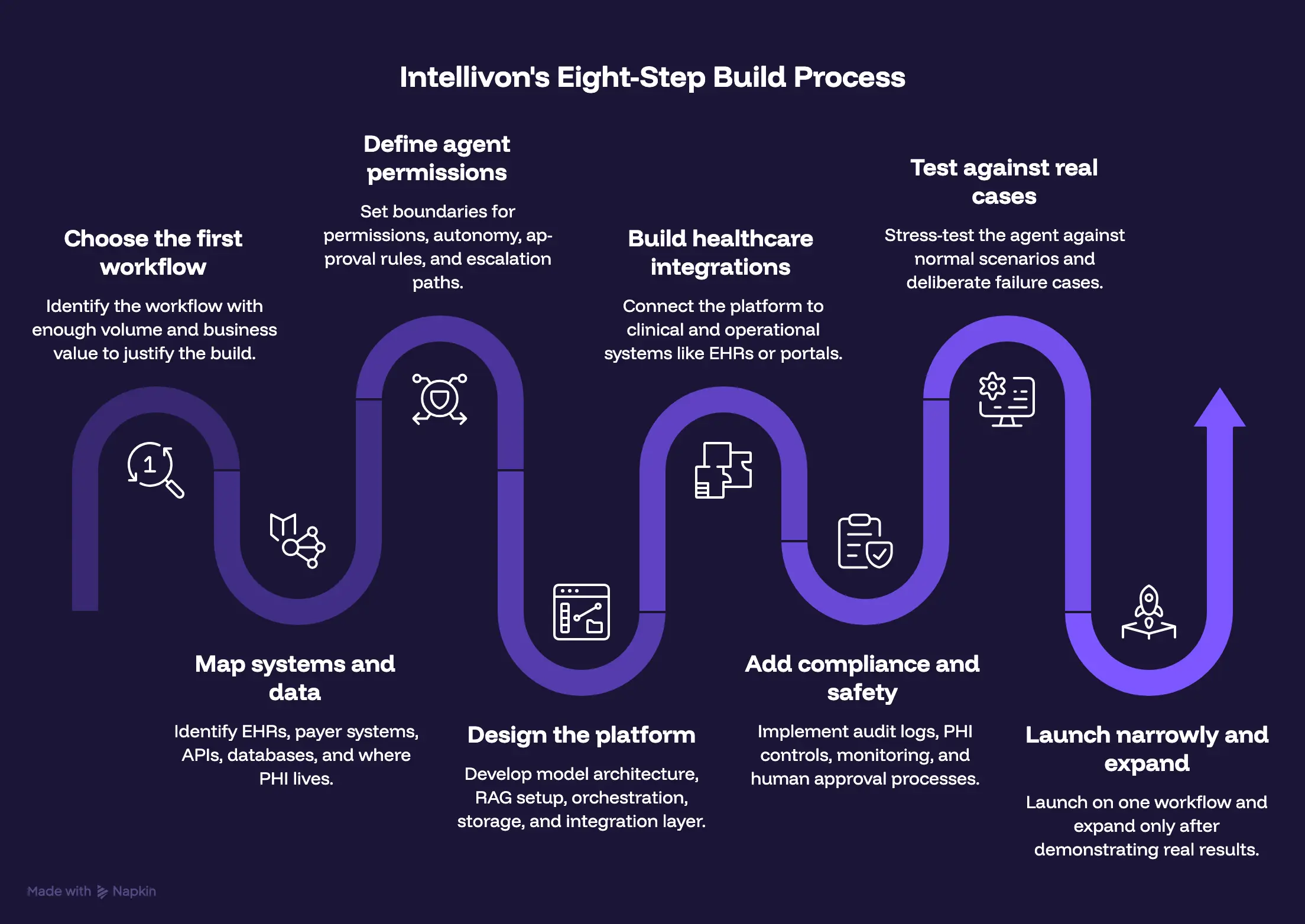
Intellivon builds within the $70K to $300K range through a clear eight-step process: scoping the first workflow, mapping systems and data, defining agent permissions, designing the platform, building integrations, layering in compliance, testing against real cases, and launching narrowly before expanding.
Rather than treating every project as a blank slate, this structure is what keeps builds predictable, on budget, and genuinely usable once they go live.
1. Step 1: Choose the First Workflow Worth Automating
To begin with, every engagement starts by identifying the workflow with enough volume and business value to actually justify the build. This isn’t a guess.
Instead, it comes from looking at where time, revenue, or staff capacity is being lost right now, so the first version of the platform solves a problem that already matters.
2. Step 2: Map Systems, Data, and PHI Exposure
From there, the next step is understanding exactly what the agent will need to touch. That means identifying:
- the EHR in use
- payer systems
- relevant APIs
- databases
- sensitive data and where PHI actually lives
This mapping matters early, because it shapes almost every decision that follows, from architecture to compliance scope.
3. Step 3: Define Exactly What the Agent Can Do
Once the systems are mapped, the platform’s boundaries get defined just as precisely. This includes:
- permissions
- autonomy level
- approval rules
- escalation paths
Rather than leaving autonomy vague, this step spells out exactly what the agent can act on independently and what it must hand back to a person.
4. Step 4: Design the Platform Around That Scope
With boundaries set, the technical design follows naturally from them, not the other way around. This covers:
- model architecture
- RAG setup
- agent orchestration
- storage
- the integration layer
So, at this stage, the platform is shaped around the actual workflow, rather than the workflow being forced to fit a generic template.
5. Step 5: Build Healthcare Integrations
Next, the platform gets connected to the clinical and operational systems it needs to function, whether that’s an EHR, a payer portal, or an internal scheduling tool.
Because this is often where the most engineering effort concentrates, Intellivon prioritizes the single integration that matters most for the first workflow, rather than trying to connect everything at once.
6. Step 6: Add Compliance and Safety Controls
At this point, the platform gains the safeguards that make it trustworthy in a real clinical or administrative setting:
- audit logs
- PHI controls
- monitoring
- human approval
- fallback behavior for anything unexpected
These controls aren’t added as an afterthought. Instead, they’re built in from this stage forward, since retrofitting compliance later is almost always more expensive than designing for it upfront.
7. Step 7: Test the Agent Against Real Workflow Cases
Before anything goes live, the agent is tested against real cases, not just the happy path. This includes both normal scenarios and deliberate failure cases, checking how the system behaves when data is missing, conflicting, or unexpected.
Intellivon’s broader AI development process, covering evaluation, model selection, and structured testing, applies directly here, ensuring the agent has actually been stress-tested before it touches real workflows.
8. Step 8: Launch Narrowly and Expand After Results
Finally, the platform launches on one workflow, not eight. The reasoning is straightforward: spending $300,000 building every workflow before proving the first one is rarely worth the risk.
Instead, once the first agent demonstrates real results, whether that’s time saved, fewer errors, or faster turnaround, the case for expanding into additional workflows and greater autonomy is backed by evidence, not assumptions.
So, altogether, this eight-step process is what keeps an agentic AI healthcare platform from becoming an open-ended, unpredictable investment. Each step narrows uncertainty before the next one begins, which is exactly why Intellivon builds this way, and why it works whether a project ultimately lands closer to $70K or $300K.
Build the First Workflow Before Building the Whole Platform
A healthcare organization doesn’t need to approve a $300,000 platform on day one. The practical route is to identify the workflow costing the most time or money, scope the integrations it actually requires, and build a controlled first version, then expand once real results back the next investment.
This is exactly the process Intellivon runs with every client.
- Map the workflow with the highest volume and clearest business impact
- Identify which systems, data, and PHI exposure the first agent actually needs
- Define precise permissions, autonomy, and escalation rules before any code is written
- Design the platform architecture around that specific scope, not a generic template
- Build the one integration that matters most for the first workflow
- Layer in audit logs, PHI controls, and human approval from the start, not after
- Test against real cases, including failure scenarios, before anything goes live
- Launch narrowly, measure results, and expand agents and autonomy only once ROI is proven
So, in the end, the path from $70K to $300K isn’t a single decision made upfront. It’s a series of proven steps, and Intellivon is built to walk through each one with you.
Conclusion
Ultimately, a custom agentic AI healthcare platform makes the strongest sense when a workflow runs at high volume, spans several systems, and can’t be solved by existing SaaS tools. In these cases, automation recovers real staff time or revenue, and the organization can reasonably expect to add more agents later.
Otherwise, a simpler tool usually solves the problem just as well. So, the real question isn’t whether agentic AI works. It’s whether your workflow actually justifies building it.
FAQs
Q1. Can I build a healthcare AI agent for under $70,000?
A1. Technically, it’s possible for an extremely narrow, low-risk workflow with minimal integrations. Still, most functional healthcare agents require compliance controls, testing, and at least one system integration, which typically pushes costs above that threshold. Therefore, $70,000 is usually the realistic floor for a genuinely usable build.
Q2. Why do multi-agent healthcare platforms cost more?
A2. Essentially, each additional agent adds its own logic, permissions, and failure cases to manage. Consequently, coordinating several agents across multiple workflows requires more orchestration, testing, and integration work than a single-agent build. That added complexity is exactly why multi-agent platforms land higher in the cost range.
Q3. What does agentic AI cost after the platform launches?
A3. Beyond development, ongoing costs include AI model usage, cloud infrastructure, monitoring, and compliance maintenance. Altogether, annual maintenance typically runs 15% to 25% of the original build cost, so a $150,000 platform generally costs another $22,500 to $37,500 per year to operate afterward.
Q4. Is it cheaper to build or buy healthcare AI agents?
A4. Generally, buying an existing SaaS product is cheaper upfront, often just a monthly subscription. However, building becomes worthwhile once the workflow is proprietary, involves several systems, or requires enterprise-grade governance. So, the right choice ultimately depends on how standardized the workflow actually is.
Q5. How long does an agentic AI healthcare platform take to build?
A5. On average, a single-workflow platform takes roughly three to five months, while multi-agent or enterprise builds can take six to twelve months. Naturally, timelines depend heavily on integration complexity and validation requirements, so more connected systems generally mean a longer build.