Key Takeaways:
-
Traditional healthcare automation sticks to a set sequence of steps, while agentic AI can work towards a goal.
-
It by no means follows that RPA or rule-based automation suddenly becomes useless.
-
A better understanding of agentic AI comes about when a workflow involves too many exceptions, systems, decisions, or manual handoffs.
-
Agents are responsible for dealing with context and making decisions, while APIs, RPA, and human beings take care of the parts that require tighter control.
-
Intellivon should start by mapping out the workflow and add the agentic layer only in those cases where it actually provides value.
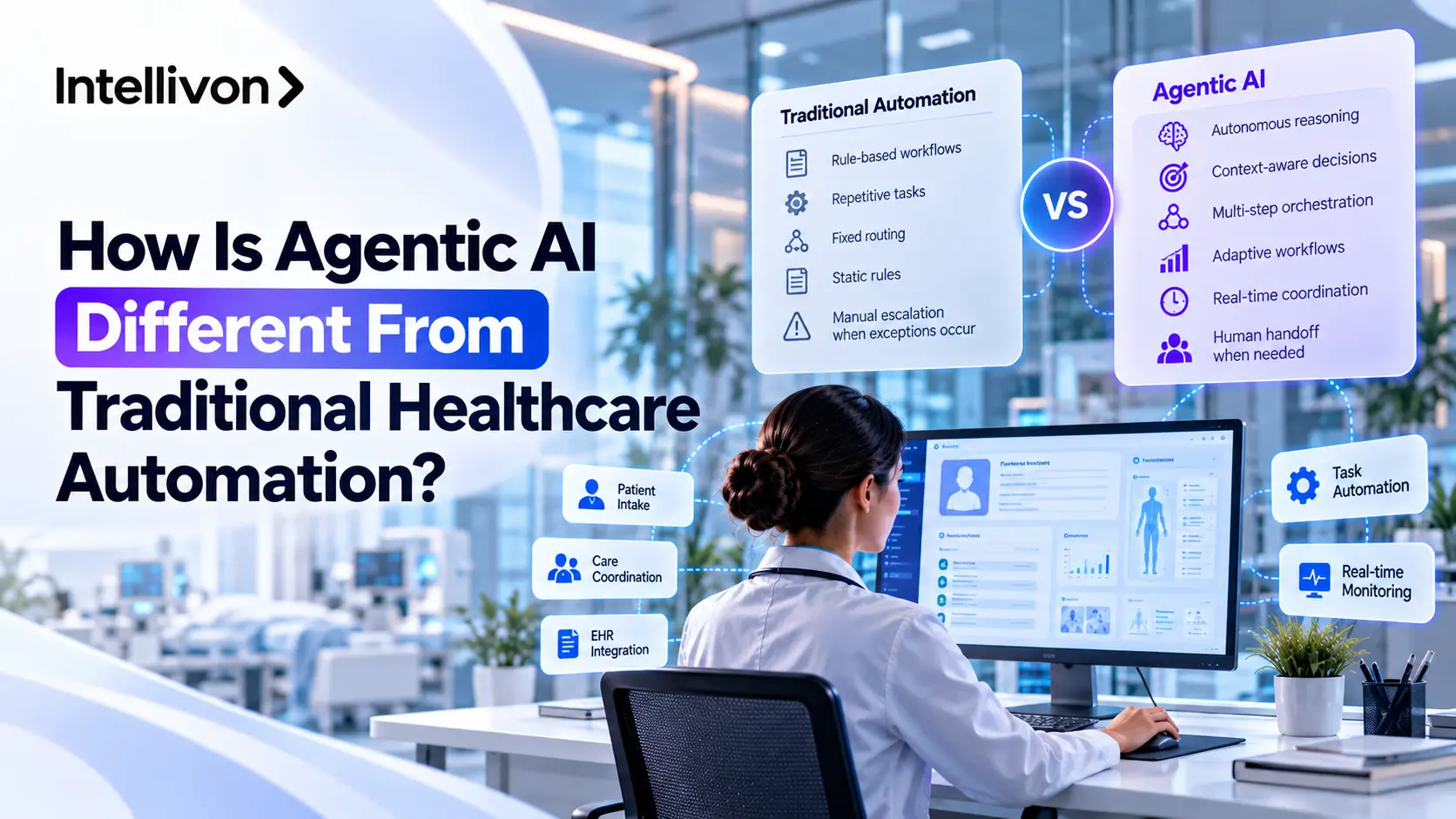
Unlike traditional healthcare automation, agentic AI differs in one key respect: it reasons in order to achieve a goal rather than carrying out a fixed script. Traditional automation, which is generally based on RPA, adheres to strict procedures, meaning that it fails as soon as there is a change to a screen, a form, or a payer rule. Agentic AI, on the other hand, takes a goal and works out for itself what steps to take.
Consequently, if something does not conform to the plan, it adapts rather than simply failing. This ability to adapt is due to three features that traditional automation does not have: reasoning, memory, and the use of tools. A rule-based bot just carries out the required actions. An agentic system, on the other hand, reasons its way through a task, keeps the context going from step to step, and makes use of external tools such as an EHR along the way.
For a founder considering this choice, however, the issue is one of practicality rather than theory. Although traditional automation is less expensive and simpler to audit, it fails when faced with real variability. Agentic AI, on the other hand, is more costly to set up initially but is able to cope with that kind of variability. This is the kind of trade-off that Intellivon shows founders, since most teams are, in fact, deciding what to do with the RPA that they already have.

Healthcare Automation Is Entering a New Phase
Healthcare automation is moving past scripts and rigid bots into systems that can reason through a task on their own. For years, automation in healthcare meant one thing: a program that followed fixed steps. That’s changing fast, and the shift is what this whole comparison comes down to.
The pace of that shift shows up clearly in the numbers. The global agentic AI in healthcare market was valued at $538.5 million in 2024 and is projected to grow from $1,082.8 million in 2026 to $4,962.9 million by 2030, at a compound annual growth rate of 45.6%, according to Grand View Research, whose report includes a full regional and segment-level growth chart.
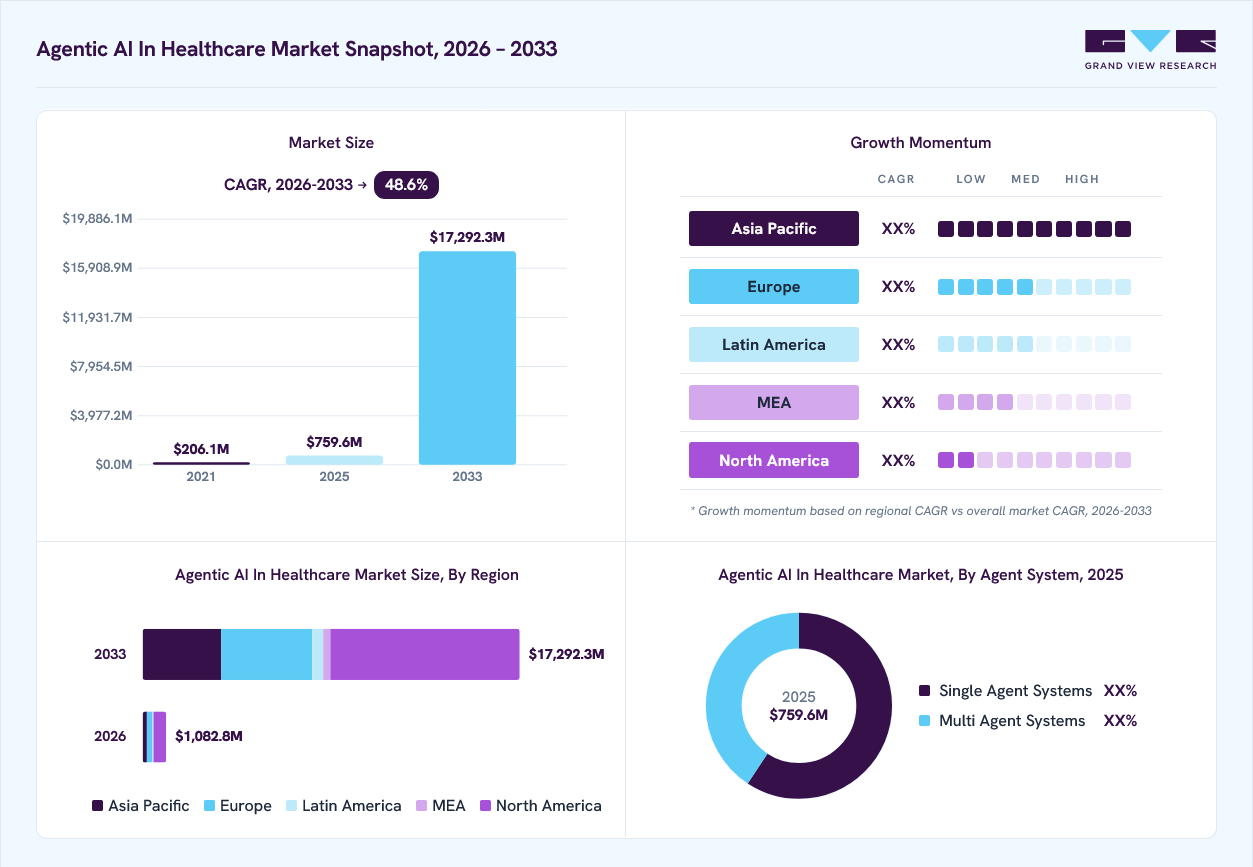
North America accounted for over half of global revenue in 2024, making the U.S. the center of this shift.
1. How Hospitals Have Automated Work Until Now
Healthcare automation today runs largely on rule-based workflows, RPA bots, custom scripts, and API integrations. These systems work well because they’re built around known inputs and predefined rules.
Much of this API-driven structure exists because of federal interoperability requirements from CMS, which pushed hospitals toward standardized data exchange in the first place.
- Rule-based workflows for eligibility checks and reminders
- RPA bots that mimic clicks across EHRs and portals
- Scripts handling data entry and file transfers
- APIs moving structured data between systems, built on FHIR standards
- Traditional AI models flagging patterns in claims or scans
2. Why Traditional Automation Is Starting to Feel Limited
These systems work fine until reality gets messy, and healthcare reality is messy often. Exceptions pile up faster than rules can be written for them.
Industry analysis has noted that healthcare organizations are moving agentic AI beyond isolated AI assistants specifically because hospitals are testing systems that can coordinate multiple clinical and administrative tasks, something rule-based bots were never designed to do.
- Too many exceptions for scripts to anticipate
- Information scattered across EHRs, payers, and billing systems
- Staff manually bridging gaps between automated steps
- Workflows breaking the moment an input changes
- Bots finishing one task without completing the workflow
3. Why Agentic AI Is Now Entering Healthcare Workflows
This is exactly the gap agentic AI is built to close. Instead of following fixed steps, these systems understand a goal and figure out what needs to happen next.
As a result, they can complete a workflow end to end instead of just one piece of it.
- Understands a goal rather than a script
- Decides the next step based on context
- Uses multiple tools and systems as needed
- Completes several connected steps automatically
- Asks for human input when something’s unclear
In short, traditional automation handles the predictable parts of healthcare work well, but it stalls wherever judgment is required. That’s the opening agentic AI is stepping into, and it’s why the rest of this comparison matters.
What Agentic AI Means in a Healthcare Workflow
Agentic AI means software that pursues an outcome rather than checking a single task off a list. In practice, that shift changes almost everything about how the system behaves, from what it plans to when it stops and asks for help. Here’s what that actually looks like inside a real workflow.
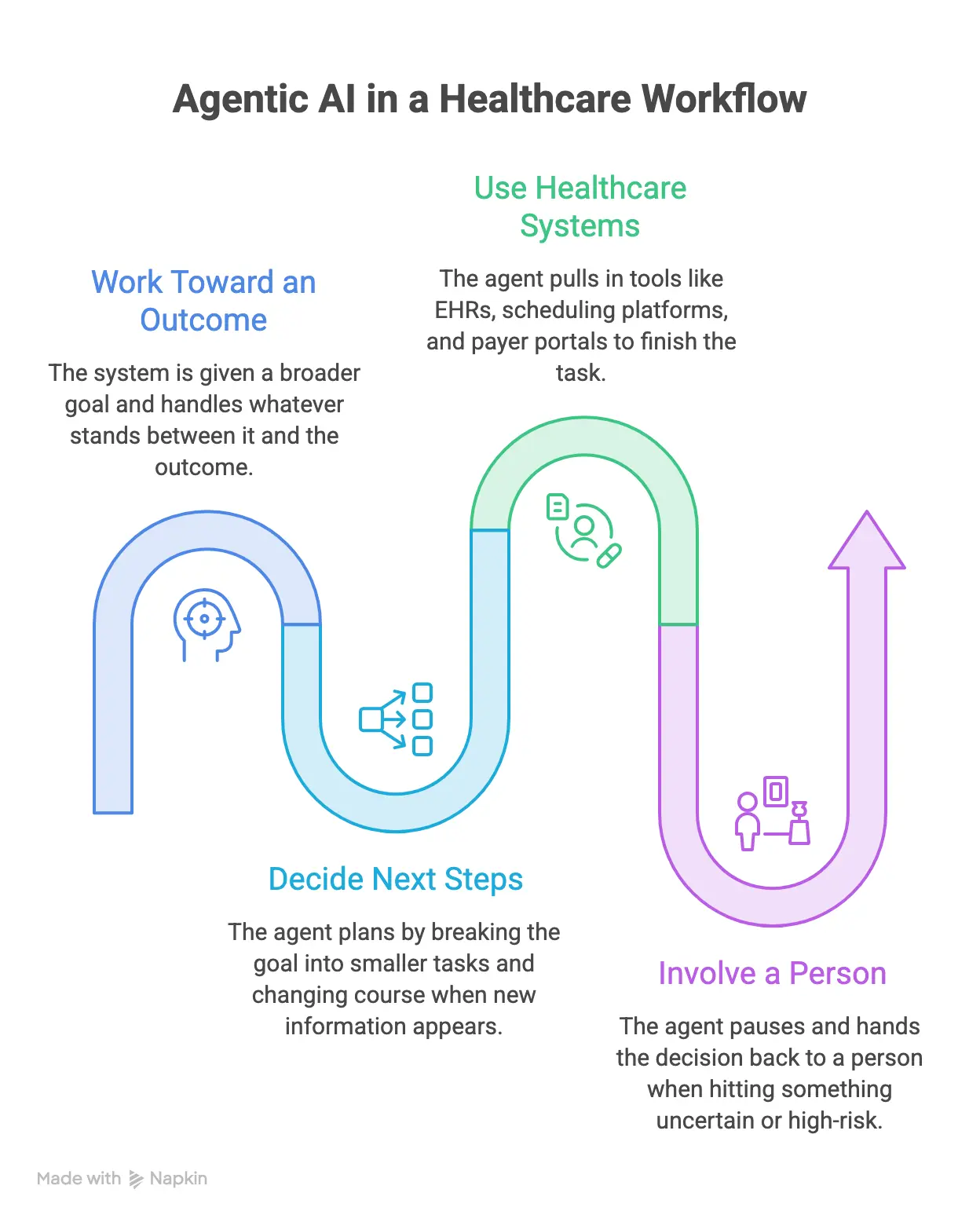
1. An Agent Works Toward an Outcome
Traditional automation checks whether a field is complete. An agentic system, however, is given a broader goal: get this prior authorization ready for submission. That difference forces the software to handle whatever stands between it and the outcome, not just one predefined check.
- Traditional automation validates a single field or step
- Agentic AI owns the outcome, not just the checkpoint
- The system adjusts its own path toward that outcome
2. It Can Decide Which Step Should Happen Next
Because the goal is broader, the agent has to plan. It breaks the goal into smaller tasks, reasons through what’s missing, and changes course the moment new information appears.
- Plans a sequence instead of following one
- Breaks a goal into smaller sub-tasks
- Reasons through incomplete or conflicting data
- Changes its path when conditions shift
3. It Can Use Other Healthcare Systems to Finish the Task
To actually complete the goal, the agent pulls in the tools around it rather than working in isolation.
- EHRs for patient and clinical data
- Scheduling platforms for appointments
- Payer portals for eligibility and claims
- APIs connecting disparate systems
- Clinical knowledge sources for context
- Existing RPA bots for the repetitive steps
4. It Can Stop and Involve a Person
Even so, autonomy here doesn’t mean removing clinicians or staff from the loop. When the agent hits something uncertain or high-risk, it pauses and hands the decision back to a person instead of guessing.
Together, these four traits separate agentic AI from every automation tool that came before it: a real goal, a real plan, real tool access, and a real off-ramp to a human.
How Traditional Healthcare Automation Actually Works
Traditional healthcare automation works by following fixed conditions, repeating defined computer tasks, or running a single intelligent model on one narrow job. None of these systems pursue an outcome the way an agent does.
Instead, each one handles its own piece, and a person or another system connects the pieces together.
1. Rule-Based Systems Follow Predefined Conditions
At the simplest level, rule-based systems check a condition and route the outcome accordingly. If eligibility equals active, the workflow continues. If eligibility equals inactive, it gets sent to review. Nothing in between gets handled unless someone wrote a rule for it.
- Runs on if-this-then-that logic
- Handles only conditions someone anticipated
- Routes exceptions to a human queue
2. RPA Bots Repeat Clearly Defined Computer Tasks
RPA bots, meanwhile, mimic exactly what a person would click, type, or copy. They’re fast and consistent, but only within tasks that never change shape.
- Copying claims data between systems
- Checking eligibility on payer portals
- Moving files across folders or platforms
- Filling out standard forms
- Posting payments to accounts
- Updating scheduling records
3. Traditional AI Usually Handles One Intelligent Task
Traditional AI models add intelligence, but only to a single job. They don’t plan, act, or move on to the next step on their own.
- Predicting readmission risk from patient data
- Classifying medical images for anomalies
- Detecting fraud patterns in claims
- Extracting information from clinical documents
4. The Workflow Usually Stops When Something Unexpected Happens
Across all three types, the pattern repeats: the moment something unexpected shows up, the system pauses and waits on a person to resolve it rather than working through it.
Each of these tools does its one job reliably, but none of them own the outcome end to end. That gap, a workflow with no one driving it all the way through, is exactly where the comparison to agentic AI picks up next.
Agentic AI vs Traditional Healthcare Automation
Agentic AI and traditional healthcare automation differ mainly in who drives the workflow: a script drives traditional automation, while a goal drives agentic AI. That single difference, in turn, cascades into everything else, from how decisions get made to how exceptions get handled.
So before breaking down each difference individually, here’s the full comparison laid out side by side.
Side-by-Side Comparison: Traditional Automation vs Agentic AI
| Area | Traditional Automation | Agentic AI |
| Main instruction | Follow these steps, in this exact order | Achieve this goal, however that requires |
| Workflow path | Predefined and fixed before deployment | Can change dynamically based on context |
| Decisions | Rules determine them in advance | Context and reasoning can influence them in real time |
| Exceptions | Often routed straight to staff | Can investigate and resolve some exceptions independently |
| Tool use | Preconfigured and locked to specific systems | Can choose from a set of approved tools as the task requires |
| Context | Limited to the current step or field | Can maintain context across an entire multi-step workflow |
| Multi-step work | Scripted, with each step hardcoded | Can plan and sequence several steps toward one outcome |
| Human involvement | Usually exception-based, triggered on failure | Can be built into decision points by design, not just failure |
| Error recovery | Typically requires manual reprogramming | Can often adjust its own approach without a rebuild |
| Best fit | Stable, high-volume, repetitive work | Complex, judgment-heavy, changing workflows |
1. Traditional Automation Knows the Steps Beforehand
Every step in a traditional system gets defined in advance, so the software never has to figure anything out on its own. As a result, it’s fast and predictable, but only for tasks that stay exactly the same over time.
- Every path is mapped before deployment
- Nothing gets decided at runtime
- Predictability comes at the cost of flexibility
2. Agentic AI Can Work Out the Next Step
An agentic system, by contrast, starts with a goal and figures out the path as it goes. Consequently, it can handle situations nobody explicitly programmed for in the first place.
- Plans its own sequence toward the goal
- Adjusts when the expected path doesn’t hold
- Handles cases outside the original design
3. Traditional AI Usually Predicts While Agents Act
Even the “intelligent” pieces of traditional automation, like a readmission-risk model, only produce a prediction. Someone still has to act on it afterward. An agent, however, closes that exact gap by acting on its own output.
- Traditional AI outputs a score or classification
- A person or a separate system still has to act
- Agentic AI moves from insight directly into action
4. Agentic Systems Can Coordinate Several Tools at Once
Because the goal spans more than one system, an agent has to reach across tools rather than stay confined to just one.
- Pulls data from an EHR
- Checks eligibility on a payer portal
- Updates a scheduling system
- Logs the outcome, all within one workflow
5. Agents Handle Changing Workflows More Naturally
Ultimately, this is where the two approaches part ways most clearly: traditional automation holds up only as long as the workflow stays the same, whereas agentic AI keeps functioning even as the workflow shifts underneath it.
Agentic AI adds decision-making and orchestration on top of what already exists. It does not, however, make every existing automation system obsolete.
The Difference Becomes Clear Inside a Real Workflow
The clearest way to see this difference is to walk through one real workflow from start to finish, rather than comparing concepts in the abstract. Prior authorization works especially well for this, since it involves exceptions, multiple systems, and judgment calls at nearly every step.
So instead of theory, here’s the same request handled two different ways.
1. How Traditional Automation Handles Prior Authorization
A traditional system moves through prior authorization one fixed step at a time. Consequently, the moment something falls outside those steps, the bot stops and hands the case off entirely.
- Patient information arrives in the system
- Bot checks that required fields are filled
- Rules identify the relevant payer
- Documents get uploaded to the request
- Missing information creates an exception
- An employee investigates the exception manually
2. How an Agentic Workflow Handles the Same Request
An agentic system, by contrast, works toward the authorization itself rather than stopping at the first gap. Instead of escalating immediately, it tries to close that gap on its own first, and only then moves forward.
- Agent receives the authorization goal
- Reviews the patient and order context
- Identifies payer-specific requirements
- Retrieves permitted clinical evidence
- Detects missing information
- Requests or locates supporting documentation
- Prepares the authorization for submission
- Escalates only the genuinely uncertain decisions
- Tracks the request through to resolution
3. Where Deterministic Automation Still Stays Involved
Even so, the agent doesn’t do all of this alone. Underneath it, APIs and RPA bots still carry out the predictable, repeatable actions, like pulling a record or submitting a form, while the agent handles the judgment calls around them.
Side by side, then, the pattern becomes obvious: traditional automation completes individual steps and stops at the first exception, whereas the agentic version owns the outcome and only escalates what genuinely needs a person.
Where Agentic AI Adds More Value Than Fixed Automation
Agentic AI adds the most value wherever a workflow depends on judgment rather than a fixed sequence. In practice, that means the moment RPA has to decide instead of execute, it starts to struggle.
The workflows below make that gap concrete.
1. Prior Authorization With Changing Requirements
Payer requirements shift often, sometimes several times a year. RPA scripts assume a fixed form, so every change means re-recording the workflow by hand rather than adapting on the fly.
2. Denial Management That Requires Investigation
A denial is a “why did this happen” problem. RPA can flag a denial code, but it can’t read the surrounding context to figure out what actually went wrong.
3. Referral Workflows Spread Across Several Systems
Referrals typically touch a referring provider, a specialist, and a payer, each on a different system. RPA handles one system well, but stitching three together requires judgment RPA doesn’t have.
4. Care Coordination With Changing Patient Needs
Patient needs shift mid-episode, and coordination has to shift with them. RPA follows the plan it was given, because it can’t recognize that the plan itself needs to change.
5. Complex Scheduling With Multiple Constraints
Scheduling across providers, locations, and patient preferences means balancing several constraints at once. RPA can fill one calendar slot, but it can’t weigh competing constraints against each other.
6. Clinical Documentation That Needs Contextual Follow-Up
Documentation often raises a follow-up question mid-note, like a missing detail or an inconsistency. RPA transcribes what’s there; it can’t notice what’s missing or go find it.
Across all six, the pattern repeats: RPA struggles the moment a workflow needs judgment instead of execution. That’s precisely the gap agentic AI is built to close.
Some Healthcare Work Should Stay Traditionally Automated
Not every workflow benefits from agentic AI, and pretending otherwise would undercut everything covered so far. Wherever the next step can always be determined beforehand, traditional automation is still faster, cheaper, and easier to audit than a reasoning system would be.
The six examples below make that point clear, one at a time.
1. Eligibility Checks With Stable Rules
Eligibility status is binary, and the underlying rules rarely shift from one payer cycle to the next. As a result, a simple rule-based check still resolves this faster than a reasoning system ever needs to, since there’s nothing genuinely ambiguous to weigh in the first place.
2. Claims Data Entry
Moving claims data from one system to another follows the same format every single time. So there’s little for an agent to reason about here that a script can’t already handle just as reliably, and usually faster too.
3. Payment Posting
Payment posting, meanwhile, maps a fixed amount to a fixed account, with no judgment calls in between the two. Consequently, RPA handles this cleanly on its own, and layering reasoning on top wouldn’t meaningfully change the outcome.
4. Standard File Transfers
Files move from point A to point B on a predictable schedule, day after day. Since nothing about that process requires context or judgment, a script therefore remains the right tool for the job here.
5. Fixed Appointment Reminders
Reminders, similarly, go out at set intervals based on a known appointment time, without much variation. Because the trigger and the message rarely change, this stays firmly in scripted-automation territory rather than agentic territory.
6. Structured Compliance Checks
Many compliance checks, finally, simply confirm that a required field or document exists. That’s a yes-or-no check at heart, so a rule-based system answers it just as reliably as an agent would, and at a fraction of the cost.
- Eligibility, claims entry, and payment posting all run on stable, well-known rules
- File transfers and reminders follow fixed schedules with essentially no variation
- Compliance checks are frequently binary rather than genuine judgment calls
Taken together, these six cases share one thing in common: nothing about them requires judgment. So if the next step can always be determined beforehand, adding an AI agent may simply add cost and risk without adding any real value in return.
Agentic AI and RPA Usually Belong in the Same Workflow
Agentic AI and RPA aren’t really competitors in most real deployments; they’re layers that work together. The agent handles the thinking, while RPA and APIs handle the doing.
So instead of asking which one to choose, the more useful question is how each piece fits into the same workflow.
1. Agents Handle Reasoning and Workflow Decisions
At the top of that stack, the agent interprets the goal and decides what needs to happen next. Because it holds the context, it’s the layer responsible for judgment, not execution.
- Interprets the overall goal
- Decides which path to take
- Adjusts when new information arrives
2. RPA Handles Repetitive Interface Actions
Underneath that reasoning, RPA still does what it’s always done best: repeating exact, predictable clicks across an interface. Consequently, it remains the fastest way to move through a portal or legacy screen the agent doesn’t need to reinvent.
- Logs into payer or scheduling portals
- Repeats identical click-and-type sequences
- Handles interfaces without a modern API
3. APIs Handle Reliable System-to-System Execution
Meanwhile, wherever a modern connection exists, APIs move data directly and reliably between systems. As a result, they’re usually the first choice whenever one’s available, since they’re faster and less brittle than screen-based automation.
- Moves structured data between systems
- Avoids the fragility of screen scraping
- Executes actions the agent has already decided on
4. Humans Handle High-Risk or Uncertain Decisions
Finally, whenever a decision carries real risk or genuine ambiguity, a person still has the final say. That handoff is where the system works exactly as designed.
- Reviews high-risk clinical or financial decisions
- Resolves cases the agent flags as uncertain
- Approves before certain irreversible actions run
The flow, in practice, looks like this:
Goal → Agent → Rules → API/RPA → Validation → Human if needed
Seen this way, the real question isn’t agentic AI versus RPA. It’s how much of a given workflow can be handled by rules and APIs, and how much genuinely needs an agent’s judgment layered on top.
What an Agentic Healthcare Automation System Includes
An agentic healthcare automation system is built from six distinct layers, each handling a different piece of the work rather than one model doing everything at once.
As a result, no single layer carries the full weight of reasoning, execution, and compliance alone. Here’s how those layers break down in practice.
The Six Layers of an Agentic Healthcare System
| Layer | What It Controls | Key Components |
| Workflow Orchestration Layer | Oversees the overall process from start to finish, sequencing every other layer beneath it | Task routing, state tracking, retry logic |
| AI Agent Layer | Handles planning, reasoning, task selection, and context across the workflow | Goal interpretation, task decomposition, memory |
| Clinical Knowledge and RAG Layer | Supplies approved information so decisions stay grounded rather than guessed | Retrieval pipelines, clinical protocols, payer rules |
| Integration Layer | Connects the agent to the real systems it needs to act on | Epic, Oracle Health, FHIR APIs, payer systems, scheduling, RCM platforms |
| Deterministic Automation Layer | Executes the predictable, repeatable actions the agent decides on | APIs, scripts, RPA bots, rules engines |
| Governance and Human Review Layer | Keeps the system accountable and controllable in production | Permissions, approvals, audit logs, escalation paths, monitoring |
Together, these six layers are what separate a genuine agentic system from a single model bolted onto existing tools. Strip out any one layer, and either the reasoning or the accountability breaks down.
HIPAA and Clinical Rules Shape Agentic AI Design
HIPAA and clinical regulation shape how it gets built in the first place. Because an agent can act on PHI rather than just display it, every design decision has to account for that risk upfront, not bolt it on later.
Here’s what that actually changes.
1. PHI Access Needs Strict Permission Controls
An agent handling scheduling doesn’t need access to full clinical notes, and it shouldn’t have it by default. So permissions get scoped to the specific task an agent performs, not to the platform as a whole.
2. Every Agent Action Needs an Audit Trail
Because agents act rather than just respond, every action needs a record of what it saw, what it did, and why. Otherwise, nothing about the decision holds up if it’s ever reviewed later.
3. Healthcare Integrations Need Minimum Necessary Access
The same principle carries into integrations. An agent connecting to Epic or a payer system should pull only the fields the task actually requires, rather than broad read or write access across the record.
4. Clinical AI May Require Additional FDA Evaluation
Once an agent’s output influences a clinical decision rather than an administrative one, it can cross into territory the FDA regulates as software. That distinction should get flagged early, since it changes both the timeline and the validation work involved.
5. Human Approval Should Match the Risk of the Action
Finally, not every action needs the same level of oversight. A scheduling change and a medication-related recommendation carry very different risk, so approval requirements should scale with that risk rather than apply uniformly.
Together, these five constraints don’t sit on top of the architecture described earlier; they run through it. Compliance here is a design decision made at every layer, from permissions to escalation.
What It Costs to Build Agentic Healthcare Automation
Custom healthcare agentic automation typically costs $70,000 to $300,000 to build. Where a project lands in that range depends mainly on how many systems it touches, how many agents it runs, and how much of the workflow still needs to be automated with RPA or APIs underneath.
Here’s how that number breaks down phase by phase.
Cost Breakdown by Phase
| Phase | Estimated Cost | What It Covers |
| Workflow Discovery and Automation Planning | $10,000 to $25,000 | Mapping the current workflow, identifying what needs reasoning versus what can stay scripted |
| System and Agent Architecture | $15,000 to $40,000 | Orchestration design, agent roles, compliance and permission boundaries |
| EHR and Third-Party Integrations | $20,000 to $70,000 | FHIR, Epic, Oracle Health, payer, scheduling, and RCM connections |
| Agent Development and Workflow Automation | $20,000 to $80,000 | Building the reasoning layer plus the RPA or API execution underneath it |
| Testing, Compliance, and Controlled Rollout | $5,000 to $35,000 | Validation, security review, pilot testing, staged go-live |
| Total Initial Build | $70,000 to $300,000 | |
| Ongoing Maintenance and Monitoring | 15% to 25% of initial development, annually | Monitoring, drift detection, integration upkeep, model updates |
The range moves higher with more integrations, more agents, and more complex compliance requirements. It stays closer to the lower end with one bounded workflow, one system connection, and limited write access to start.
How Intellivon Builds Agentic Healthcare Automation
Intellivon builds agentic healthcare automation through eight steps, moving from a narrow, well-understood workflow toward broader autonomy only once that first workflow is proven.
So the sequence itself matters as much as any individual step, since starting broad in a regulated environment is exactly how these builds tend to go wrong. Here’s how that process actually runs, start to finish.
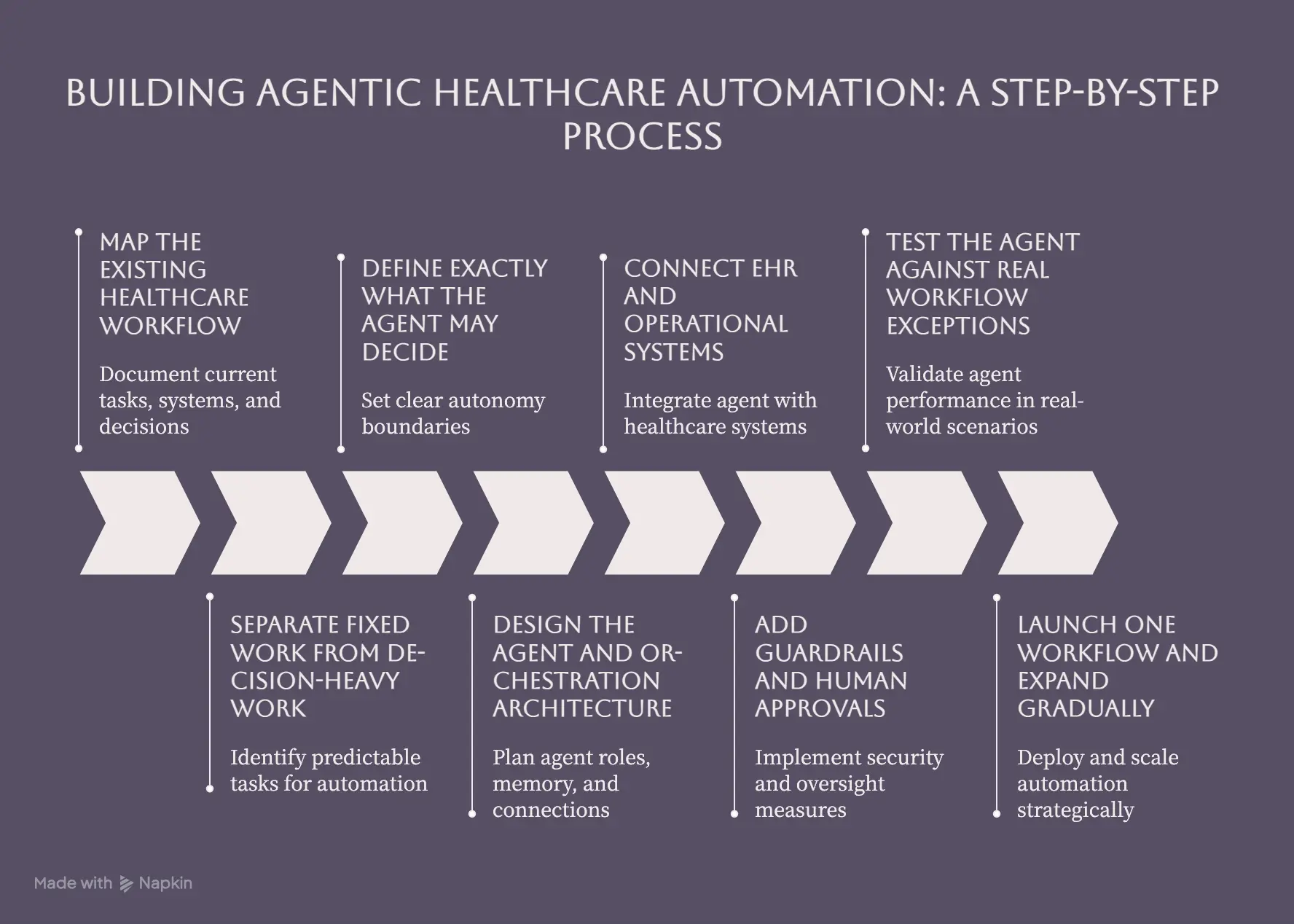
1. Map the Existing Healthcare Workflow
Every engagement starts with the workflow as it actually runs today, not as it’s assumed to run on paper. To get there, Intellivon documents the tasks involved, the systems each one touches, the employees currently handling it, the decisions being made along the way, and the exceptions that keep coming up.
- Tasks performed at each stage of the workflow
- Systems the workflow currently touches
- Employees and roles involved in each step
- Decisions currently made by people, not software
- Exceptions that recur often enough to matter
This mapping step matters more than it looks like it should, since a workflow that seems simple on paper often hides several manual judgment calls once someone actually walks through it end to end.
2. Separate Fixed Work From Decision-Heavy Work
Once the workflow is mapped, the next step is drawing a clear line between the parts that never change and the parts that genuinely require judgment. Anything predictable stays deterministic, because adding reasoning to a task that doesn’t need it only adds cost and risk without adding real value in return.
- Identify steps with only one possible outcome
- Flag steps where judgment currently drives the decision
- Keep predictable work on APIs, scripts, or RPA
- Route only decision-heavy work toward the agent layer
This is also where Intellivon pushes back on scope creep early on, since it’s tempting to hand everything to an agent once the technology is on the table. Not every step earns that.
3. Define Exactly What the Agent May Decide
With the decision-heavy work now identified, the next question becomes how much autonomy the agent actually gets. Intellivon sets those boundaries explicitly and conservatively, rather than leaving them implicit or discovering them only after something goes wrong in production.
- Define which decisions the agent can make independently
- Define which decisions require human review first
- Set hard limits on high-risk or irreversible actions
- Document the reasoning behind each boundary
Autonomy expands later, once the workflow proves itself. It doesn’t start wide and get walked back after a mistake, since that sequence tends to cost far more than starting narrow in the first place.
4. Design the Agent and Orchestration Architecture
From there, architecture turns the previous decisions into an actual working system. Intellivon defines how many agents the workflow needs, what each one remembers, where it pulls approved knowledge from, and where a human checkpoint sits within the sequence.
- Agent roles and how many agents the workflow requires
- Memory design for task-level and patient-level context
- RAG pipelines for clinical and payer-specific knowledge
- Workflow orchestration connecting each step together
- Tool access each agent is permitted to use
- Human checkpoints built into the flow, not added later
This is also where the earlier boundary decisions get implemented in the actual system, rather than staying as a policy document nobody checks against later.
5. Connect EHR and Operational Systems
Once the architecture is in place, integration work connects the agent to the systems it actually needs to act on. This is usually where timelines stretch the most, since integration approval runs on the health system’s own schedule, not the build schedule.
- FHIR APIs for structured clinical and administrative data
- Epic, Oracle Health, or other EHR-specific connections
- Payer systems for eligibility, claims, and prior authorization
- RPA bots for the interfaces without a usable API
- Internal tools specific to the organization’s own stack
Because approval cycles run in parallel with development rather than after it, Intellivon typically starts this paperwork early, well before the architecture itself is finished.
6. Add Guardrails and Human Approvals
Even with integrations working, nothing goes live without guardrails layered on top first. So this is where the boundaries defined earlier get implemented in code, not just written down as intent.
- PHI access controls scoped to each agent’s task
- Role-based permissions across every connected system
- Full audit trails covering every action the agent takes
- Escalation paths for uncertain or high-risk decisions
- Confidence thresholds that trigger a human handoff
This step also tends to surface gaps in the original autonomy boundaries, which is exactly why it happens before testing, not during it.
7. Test the Agent Against Real Workflow Exceptions
Before anything touches a live workflow, Intellivon tests it against the situations that actually cause staff to step in today, rather than just the clean, ideal cases. Because a system that only works on easy inputs isn’t actually ready, this step gets treated as non-negotiable.
- Test the exceptions staff currently handle manually
- Confirm escalation paths trigger correctly under pressure
- Check for incorrect or overconfident agent decisions
- Validate that human overrides work as intended
8. Launch One Workflow and Expand Gradually
Finally, once a workflow is tested and validated, it launches on its own rather than alongside several others at once. From there, expansion happens only after the business case is measurable, and only one step at a time.
- Launch where the impact can be clearly measured
- Prove the first workflow before adding a second
- Expand autonomy gradually as trust is established
- Reassess permissions as new workflows come online
Taken together, these eight steps are what keep an agentic build from becoming either a stalled science project or a system that moves too fast for a regulated environment to trust.
Why Healthcare Companies Work With Intellivon
By now, the real answer to “agentic AI vs traditional healthcare automation” should be clear: it was never actually a choice between one or the other.
Instead, healthcare workflows typically need both, layered correctly, with the boundaries between them defined before a single line of code gets written.
- Traditional automation still handles stable, rule-based work best
- Agentic AI, meanwhile, earns its place wherever judgment replaces execution
- RPA and APIs remain the execution layer underneath most agents
- HIPAA and PHI boundaries, in turn, shape the architecture from day one
- Autonomy should expand gradually, never all at once
- EHR and payer integrations, however, usually set the real timeline
- Costs range from $70,000 to $300,000, driven by scope and integration depth
- Ultimately, the right mix depends on your workflow, not a general trend
Intellivon has built exactly this kind of system for regulated healthcare environments, including SMART on FHIR integrations with Epic and agent-RPA hybrids that hold up under real compliance review.
Book a scoping call and leave with a clear map of what should stay automated and what’s actually worth building as an agent.
Conclusion
Ultimately, agentic AI and traditional automation aren’t rivals. They’re two layers of the same system, each suited to a different kind of work. Traditional automation still wins on stable, predictable tasks, while agentic AI takes over the moment judgment enters the picture.
So instead of asking which one to adopt, the better question is where the line between them actually belongs in your specific workflow. Get that boundary right, and the rest of the build follows naturally from there.
FAQs
Q1. Does Agentic AI Replace RPA in Healthcare?
A1. Not usually. Agentic AI typically works alongside RPA, handling the reasoning while RPA executes the repetitive, rule-based steps underneath it. So instead of replacing existing bots, most builds layer an agent on top of them.
Q2. What Is the Biggest Difference Between RPA and Agentic AI?
A2. RPA follows fixed steps, while agentic AI works toward a goal and decides its own path. As a result, agentic AI adapts to exceptions that would otherwise break a scripted RPA workflow entirely.
Q3. Can Agentic AI Work With an Existing EHR?
A3. Yes, generally through FHIR APIs, SMART on FHIR, or vendor-specific connections like Epic. However, the integration timeline usually depends more on the health system’s approval process than on the build itself.
Q4. Which Healthcare Workflows Are Best for Agentic AI?
A4. Workflows involving exceptions, multiple systems, or shifting requirements benefit most, such as prior authorization and denial management. Conversely, stable, single-system tasks are often better left on traditional automation.
Q5. Is Agentic AI Safe for Clinical Workflows?
A5. It can be, provided the right guardrails exist beforehand, including audit trails, permission limits, and human review at key decision points. Without those controls in place, though, risk increases quickly