

Financial decisions used to take days, but now they take seconds. The systems that support them need to keep pace. Market volatility, credit risk, liquidity changes, and fraud alerts do not wait for scheduled reviews. At the same time, companies handling high volumes of transactions generate more critical data than any analyst team can realistically process in time.
Rule-based systems manage what they are set up for, but when conditions change beyond those limits, they stall. At that point, the decision still relies on a human, and the opportunity may have already passed. Real-time financial AI agents operate differently. They monitor live data streams, assess changing conditions, and respond or escalate without waiting for manual input. For companies where delaying a decision has a clear cost, this creates a noticeable and scalable benefit.
At Intellivon, we create these systems for such environments. This blog leverages that experience to explain how they function, where they make the biggest difference, and what it takes to build them effectively.
Why Real-Time AI Agents Matter in Finance Today
Real-time AI agents are reshaping finance by enabling instant, autonomous decisions across transactions, risks, and opportunities. As data volumes grow and markets run 24/7, traditional batch systems fall short. In contrast, these agents process continuous data streams, act proactively, and reduce latency.
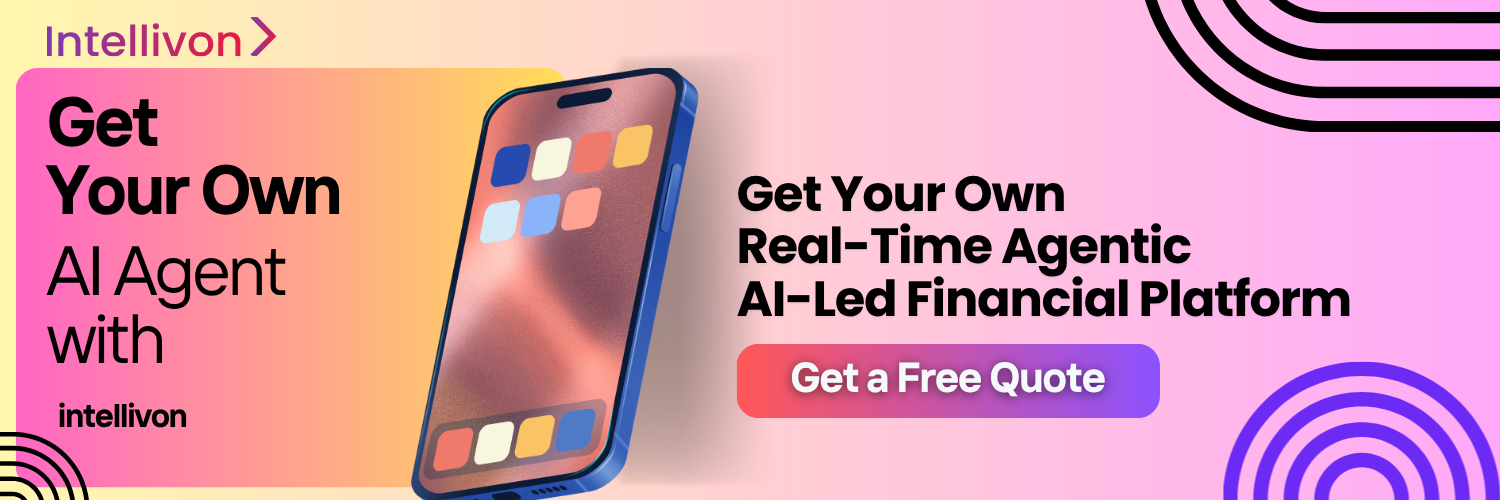
As a result, financial institutions improve response speed, strengthen risk control, and unlock new revenue opportunities at scale. The global agentic AI market reached USD 7.29 billion in 2025. It is expected to grow to USD 139.19 billion by 2034, at a 40.50% CAGR. North America led the market in 2025, holding a 33.60% share.
The financial sector is moving away from static data toward autonomous systems that act instantly. This shift is essential for maintaining a competitive edge in markets that move in milliseconds.
1. From dashboards to autonomous decisions
For years, leaders relied on dashboards to visualize trends. However, these tools still required a human to take action. Modern agents close this loop by executing strategies the moment data arrives. Consequently, the human role shifts from active operator to high-level strategic architect.
2. Latency as a risk factor in finance
In high-stakes finance, time is a fundamental risk. Even a slight delay in processing a fraud signal can cause massive losses. Traditional batch models create blind spots that expose firms to volatility. Therefore, real-time architecture is a vital necessity for capital preservation.
3. Why rule engines fail at scale
Legacy systems rely on rigid “if-this-then-that” rules. These systems are brittle and expensive to maintain as markets change. Furthermore, they cannot handle the nuance of complex fraud patterns. Real-time agents solve this by using probabilistic logic to adapt without new code.
4. Shift from AI models to AI agents
The industry is moving from passive models to active agents. While a model predicts a trend, an agent is designed to execute a goal. This means the system actively rebalances holdings. In addition, agents orchestrate multiple tasks simultaneously across different platforms. Therefore, we are no longer just training algorithms to be smart. We are now empowering them to be useful and autonomous.
Ultimately, adopting an agentic framework transforms AI into a reliable digital workforce. This evolution ensures your technology is actively participating in the market to secure your financial goals.
What Are Real-Time Financial AI Agents?
Real-time financial AI agents are autonomous software entities designed to perceive, reason, and act on streaming data. Unlike static models, these agents utilize continuous feedback loops to execute complex financial workflows.
They operate within milliseconds to manage liquidity, detect fraud, or rebalance portfolios without human intervention. Therefore, they represent a shift from purely analytical tools to active, goal-oriented digital participants. These agents bridge the gap between market intelligence and immediate capital execution.
Key Use Cases Driving Adoption Today
Financial institutions are deploying autonomous agents to solve complex problems that require instant action. These practical applications are transforming how firms manage risk and capital in high-velocity environments.
1. Real-time fraud detection and blocking
Legacy systems often flag fraud after the transaction is complete. In contrast, AI agents analyze behavioral patterns and geolocation data during the millisecond the swipe occurs.
They can instantly block suspicious payments before capital leaves the account. Consequently, banks reduce their loss rates while maintaining a smooth experience for legitimate customers.
2. Dynamic credit and underwriting decisions
Traditional credit scoring relies on outdated monthly reports. Modern agents pull real-time cash flow data and alternative signals to assess risk instantly.
Therefore, lenders can offer personalized credit lines to borrowers who might otherwise be rejected. This agility allows firms to capture market share without increasing their overall risk profile.
3. AML monitoring with adaptive agents
Anti-money laundering efforts are often slowed down by thousands of false positives. Adaptive agents learn the difference between complex legal transfers and actual criminal behavior.
They investigate connections between accounts across global networks in seconds. As a result, compliance teams can focus on high-level threats rather than manual data entry.
4. Payment routing and risk scoring
Global payments often take unpredictable paths that increase costs and delays. AI agents act as intelligent traffic controllers for money.
They select the fastest and cheapest routing path based on current liquidity and regional stability. This optimization ensures that enterprise funds arrive exactly when and where they are needed most.
5. Treasury and liquidity optimization
Managing corporate cash across multiple currencies requires constant attention. AI agents monitor global interest rates and currency fluctuations to move funds automatically.
They ensure that a company always meets its obligations while maximizing the yield on idle cash. Therefore, the treasury function moves from a cost center to a strategic advantage.
By integrating these agents, enterprises can automate the most demanding aspects of financial management. This technology ensures that your organization stays resilient and profitable regardless of market volatility.
How Real-Time Decision Systems Actually Work
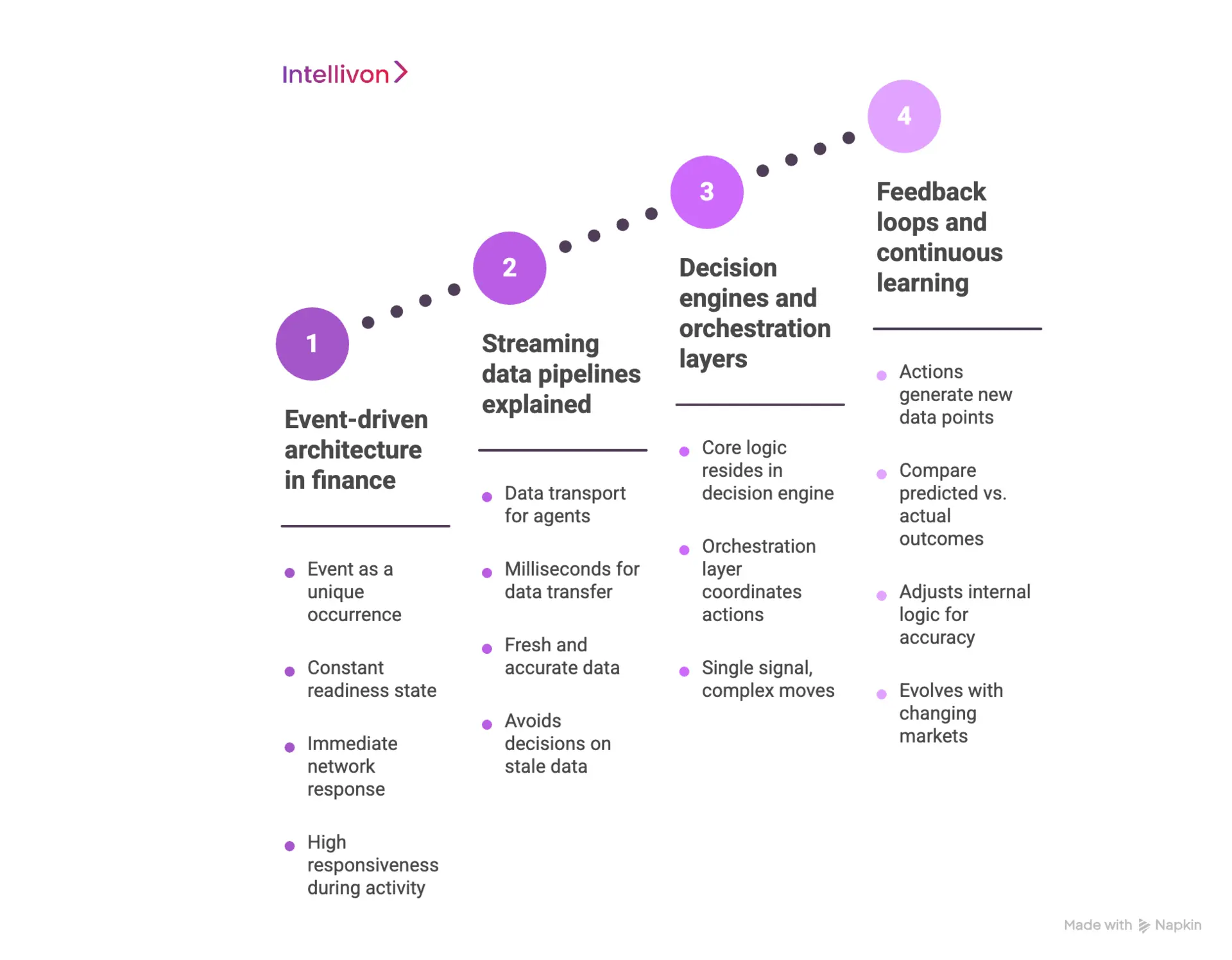
Modern financial agents rely on a sophisticated architecture that processes data as a continuous stream rather than in batches. This structural shift allows the system to react to market changes as they happen.
1. Event-driven architecture in finance
In an event-driven system, every transaction or price change is treated as a unique event. Instead of checking for updates at set intervals, the agent stays in a state of constant readiness.
When an event occurs, it triggers an immediate response across the entire network. Therefore, the system remains highly responsive even during periods of intense market activity.
2. Streaming data pipelines explained
Streaming pipelines act as the nervous system of the financial agent. They transport data from sources like stock exchanges or bank ledgers to the decision engine in milliseconds.
These pipelines ensure that the information remains fresh and accurate. Consequently, the agent never makes a decision based on stale or outdated information.
3. Decision engines and orchestration layers
The decision engine is where the actual logic resides. It evaluates the incoming data against the specific goals of the enterprise. The orchestration layer then coordinates the necessary actions across different APIs and platforms.
This ensures that a single signal can trigger a complex series of coordinated financial moves.
4. Feedback loops and continuous learning
Every action taken by the agent creates a new data point for future analysis. Feedback loops allow the system to compare its predicted outcomes with the actual results. If a specific strategy underperforms, the agent adjusts its internal logic to improve future accuracy.
This continuous learning process ensures that the system evolves alongside the changing market.
By combining these technical layers, enterprises create a robust framework for autonomous financial operations. This architecture provides the speed and reliability required to manage global capital at scale.
Core Components of AI Agent Architecture
Building a resilient financial agent requires a modular architecture that prioritizes data integrity and execution speed. Each layer must work in perfect harmony to ensure that autonomous decisions remain both accurate and actionable.
1. Data ingestion and normalization layer
Financial data arrives in many different formats from various global sources. This layer acts as a translator that standardizes raw information into a unified format.
It cleans the data and removes any noise that could lead to a false signal. Therefore, the reasoning engine always works with a single, high-fidelity version of the truth.
2. Agent reasoning and decision layer
This is the intellectual core where the agent evaluates its specific objectives. It uses probabilistic models to weigh risks against potential rewards in real time. Unlike simple scripts, this layer can handle complex scenarios with multiple variables simultaneously.
Consequently, the agent can make nuanced choices that align with the firm’s broader strategy.
3. Execution and workflow orchestration
Once a decision is made, it must be translated into a series of technical actions. This layer communicates with external APIs to execute trades, move funds, or update ledgers.
It manages the sequence of events to ensure that every step completes successfully. In addition, it handles any retries or errors that occur during the execution phase.
4. Monitoring, logging, and audit trails
In a regulated environment, every autonomous action must be fully traceable. This component records every data point and decision path taken by the agent. It provides a clear history that auditors can review to ensure compliance with financial laws.
Therefore, the enterprise maintains total transparency over its automated processes at all times.
5. Human-in-the-loop override systems
Even the most advanced agents require a mechanism for human intervention. These override systems allow managers to pause operations or adjust parameters during extreme market events.
They act as a safety valve that ensures humans remain the ultimate authority. This balance creates a partnership where technology handles the speed while people provide the final oversight.
By structuring these components correctly, organizations build a foundation for reliable and scalable AI operations. This architecture ensures that your digital agents can perform at the highest level of professional excellence.
Tech Stack for Real-Time AI Agent Systems
Building a production-ready financial agent requires a stack that prioritizes low latency and high availability. Each layer of the technology must handle massive data throughput while maintaining absolute precision.
1. Streaming tools and event brokers
At the base of the stack, event brokers like Apache Kafka or Redpanda manage the flow of live data. These tools ensure that messages between systems are never lost, even during traffic spikes.
They allow the agent to consume market feeds and transaction logs in a synchronized manner. Therefore, the system maintains a consistent state across all distributed components.
2. Model serving and inference systems
Once data is captured, it must be processed by machine learning models. High-performance serving engines like NVIDIA Triton or vLLM provide the necessary speed for real-time inference.
These systems are optimized to return predictions in milliseconds to avoid execution delays. Consequently, the agent can reason through complex scenarios without creating a bottleneck.
3. Agent frameworks and orchestration
Frameworks such as LangChain or CrewAI provide the scaffolding for building autonomous logic. These tools manage the memory of the agent and its ability to use specific tools. The orchestration layer ensures that the agent follows a logical path toward its financial goal.
In addition, it allows developers to swap out individual models as technology evolves.
4. Cloud-native infrastructure choices
Modern financial agents live on scalable cloud platforms like AWS, Azure, or Google Cloud. These environments provide serverless functions and managed Kubernetes clusters to handle fluctuating workloads.
This infrastructure allows the system to scale its computing power instantly during high market volatility. Therefore, your operational costs remain aligned with your actual usage.
5. APIs for financial system integration
An agent is only as effective as its ability to interact with the real world. Secure APIs connect the AI to core banking systems, payment gateways, and trading platforms. These interfaces must support robust authentication and encryption to protect sensitive capital.
This connectivity ensures that the agent’s decisions are translated into immediate financial results.
By selecting the right tech stack, enterprises can build a resilient and high-performing AI ecosystem. This strategic investment provides the technical foundation needed to outpace the competition in a digital-first economy.
Required Integrations for Financial Systems
To function effectively, a real-time agent must be deeply embedded within the existing financial fabric of the enterprise. These integrations provide the necessary “hands” for the AI to move capital and maintain regulatory standing.
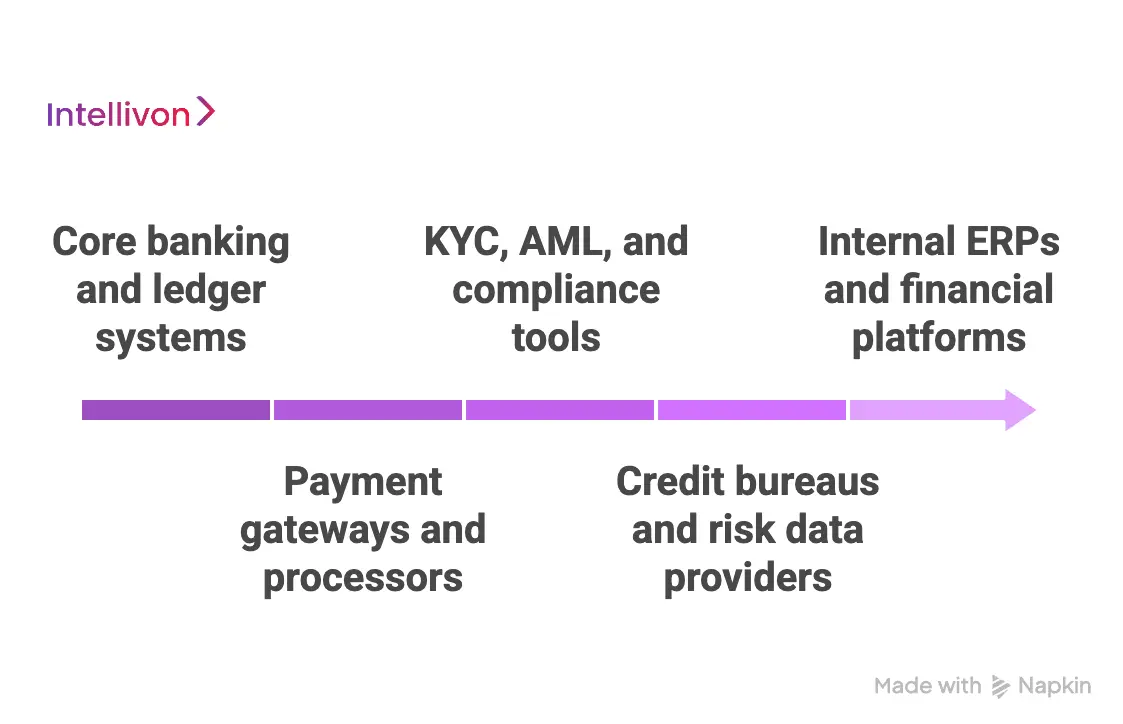
1. Core banking and ledger systems
The core banking system is the authoritative record for all account balances and transactions. Integrating the AI agent directly with these ledgers allows for instant reconciliation and real-time balance updates.
This connectivity ensures that the agent never attempts to move funds that are not physically present. Therefore, the system maintains the highest level of financial accuracy across the entire organization.
2. Payment gateways and processors
Agents must communicate with global payment rails like SWIFT, FedNow, or regional processors to execute transfers. These integrations allow the agent to select the most efficient path for moving money based on cost and speed.
By automating the payment lifecycle, firms can reduce manual errors and processing delays. Consequently, your capital remains mobile and ready to respond to market opportunities.
3. KYC, AML, and compliance tools
Operating in finance requires strict adherence to “Know Your Customer” and Anti-Money Laundering laws. Real-time agents connect to compliance engines to verify identities and screen for sanctioned entities before any action is taken.
This automated gatekeeping prevents the enterprise from engaging in high-risk or illegal activity. In addition, it creates a digital paper trail that simplifies the audit process for regulators.
4. Credit bureaus and risk data providers
To make informed lending or trading decisions, agents pull live data from external bureaus and market providers. These feeds provide the context needed to assess the creditworthiness of a counterparty in seconds.
By enriching internal data with these external signals, the agent creates a more comprehensive risk profile. Therefore, the enterprise can confidently extend credit or enter positions during volatile periods.
5. Internal ERPs and financial platforms
Enterprise Resource Planning (ERP) systems hold critical data regarding corporate budgets, tax obligations, and payroll. Integrating these platforms allows the agent to align its autonomous decisions with the company’s overall financial health.
The agent can monitor department spending or tax liabilities to optimize cash flow distribution. This alignment ensures that every automated action supports the broader business objectives of the leadership team.
By establishing these critical integrations, organizations transform their AI from an isolated tool into a fully functional financial operator. This connected ecosystem provides the infrastructure required to dominate a fast-moving digital economy.
Compliance and Regulations You Must Cover
Operating real-time AI agents in finance requires a rigorous approach to global regulatory standards. As these systems gain more autonomy, staying compliant is a core business survival strategy.
1. AML, KYC, and transaction monitoring laws
Anti-money laundering (AML) and Know Your Customer (KYC) rules remain the bedrock of financial safety. In 2026, regulators expect AI agents to perform continuous, rather than periodic, risk profiling.
These agents must identify suspicious patterns across global networks in milliseconds to prevent illicit flows. Therefore, your system must integrate with official watchlists and beneficial ownership registers to maintain high-integrity oversight.
2. GDPR and data privacy requirements
Data privacy laws like GDPR and CCPA dictate how personal financial information is handled. AI agents must be designed with “privacy by design” principles to ensure data is processed only for its intended purpose.
This includes implementing strict data localization and right-to-forget protocols within the agent’s memory. Consequently, enterprises must balance the need for personalized AI reasoning with the absolute legal requirement for consumer privacy.
3. PCI DSS for payment data security
Any agent handling credit card or payment information must adhere to PCI DSS standards. This involves using high-level encryption for data in transit and at rest within the AI’s infrastructure.
Access to sensitive payment keys must be strictly controlled through role-based permissions. Therefore, maintaining a secure environment is essential to prevent costly data breaches and maintain trust with global payment processors.
4. Auditability and explainable AI needs
Regulators now demand that automated decisions be fully explainable and transparent. If an agent denies a loan or blocks a trade, the underlying logic must be retrievable for human review.
This requires implementing “Explainable AI” (XAI) frameworks that map out the reasoning path for every action taken. As a result, your organization can withstand a regulatory audit by proving that its AI is not a “black box” but a disciplined, logical operator.
5. Regional compliance considerations
Global enterprises must navigate a fragmented landscape, including the EU AI Act’s strict 2026 deadlines for high-risk systems. Different regions have varying rules regarding algorithmic bias and the use of biometric data in finance.
Staying ahead requires a flexible architecture that can adapt its guardrails based on the user’s local jurisdiction. Therefore, regional customization is the only path to sustainable global scaling.
By prioritizing these compliance layers, leaders can deploy autonomous agents that are both innovative and legally sound. This proactive stance ensures that your technology remains an asset rather than a liability in a tightening regulatory environment.
Step-by-Step: Building Real-Time AI Agents for Finance
At Intellivon, we follow a rigorous, battle-tested methodology to move your financial operations from manual oversight to autonomous execution.
This structured approach ensures that every agent we deploy is secure, compliant, and high-performing from day one.
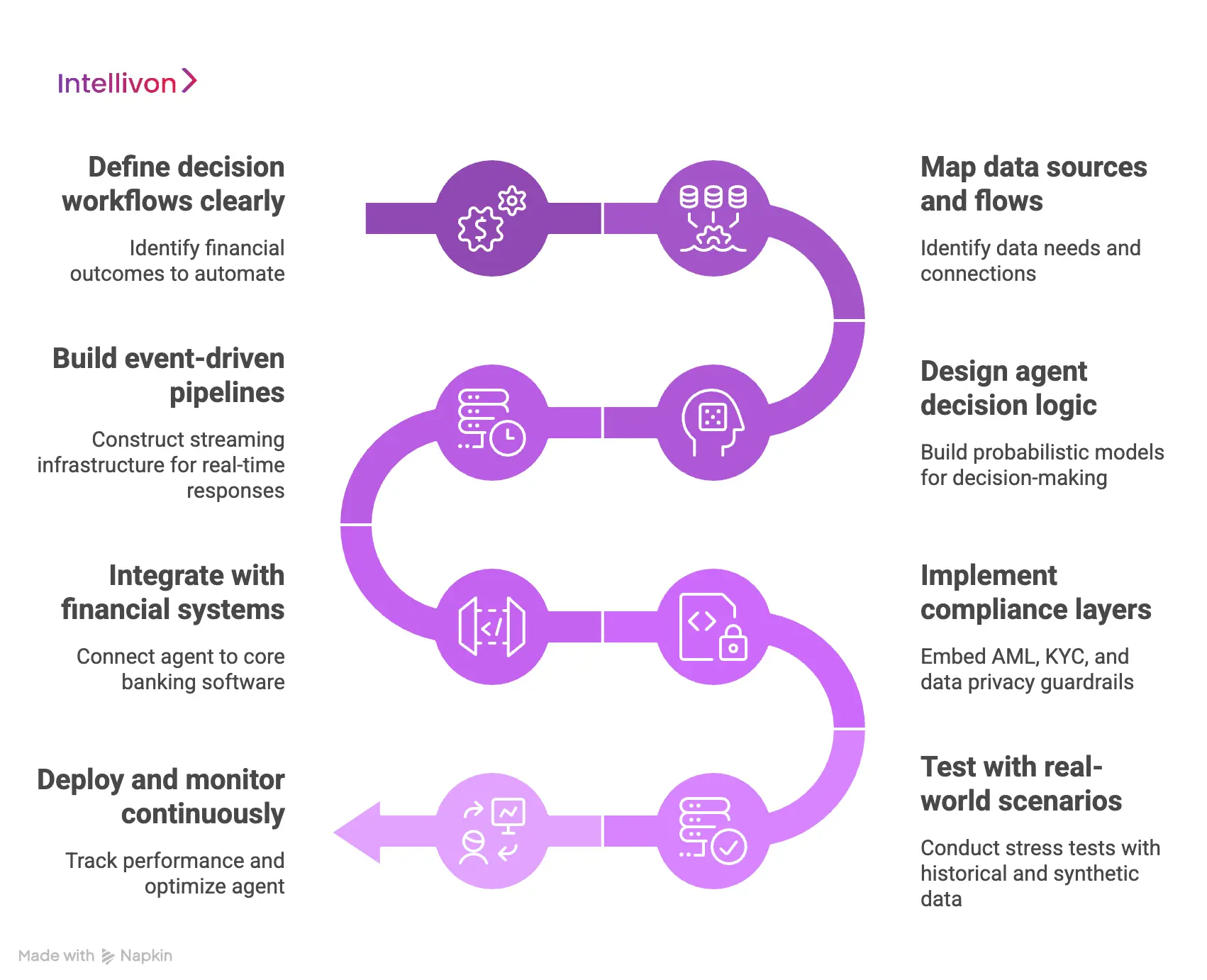
Step 1: Define decision workflows clearly
Success begins by identifying the specific financial outcomes you want to automate. We work with your stakeholders to map out the exact logic of a credit decision or a liquidity shift. Therefore, we ensure the agent’s goals perfectly align with your firm’s high-level business strategy.
Step 2: Map data sources and flows
An agent is only as good as the information it consumes. We identify every internal ledger, market feed, and third-party API required for the mission. This mapping phase eliminates data silos and ensures a continuous flow of high-fidelity information into the system.
Step 3: Design agent decision logic
We build the “brain” of the system using advanced probabilistic models rather than rigid rules. This allows the agent to handle the natural “gray areas” of the financial markets. Consequently, the system can adapt to new patterns without requiring constant manual updates from your team.
Step 4: Build event-driven pipelines
Our engineers construct the streaming infrastructure that powers millisecond-level responses. We use high-speed event brokers to ensure that every market signal reaches the agent instantly. This architecture is the key to eliminating the latency that creates financial risk.
Step 5: Integrate with financial systems
We connect the agent to your core banking software and payment gateways using secure, encrypted APIs. This step gives the AI the “agency” to actually move capital or update accounts. In addition, we ensure these connections meet the highest enterprise-grade security standards.
Step 6: Implement compliance layers
Security and legality are never an afterthought in our build process. We embed AML, KYC, and data privacy guardrails directly into the agent’s decision path. Therefore, every autonomous action remains fully compliant with global financial regulations and your internal risk policies.
Step 7: Test with real-world scenarios
Before going live, we run the agent through exhaustive “stress tests” using historical and synthetic market data. We simulate extreme volatility and edge cases to verify the system’s resilience. This ensures that the agent behaves predictably even during the most chaotic market conditions.
Step 8: Deploy and monitor continuously
Once deployed, the agent enters a cycle of constant monitoring and optimization. We use real-time dashboards to track performance and audit every decision the system makes. Consequently, your enterprise gains a digital workforce that actually gets smarter and more efficient over time.
By following this precise roadmap, Intellivon transforms complex financial challenges into seamless, automated advantages. This process ensures your organization is ready to lead in an increasingly autonomous global economy.
Cost to Build Real-Time AI Agent Systems
Building real-time AI agents for finance is not a fixed-cost project. The investment depends on how deeply the system integrates decision logic, data streams, compliance, and financial workflows.
Unlike basic AI tools, real-time agent systems require low-latency infrastructure, multi-system integrations, and compliance layers from day one. As a result, costs are driven more by system complexity than just features.
Cost Breakdown by System Components
| Component | Scope | Estimated Cost |
| Data Pipeline & Streaming | Real-time ingestion, event processing | $20,000 – $60,000 |
| AI Agent Layer | Decision logic, reasoning, orchestration | $40,000 – $120,000 |
| Integrations | Banking APIs, payments, KYC/AML systems | $30,000 – $100,000 |
| Compliance & Security | Audit trails, encryption, governance | $20,000 – $80,000 |
| Infrastructure | Cloud, scaling, and latency optimization | $25,000 – $90,000 |
| Monitoring & Control | Logging, alerts, human overrides | $15,000 – $50,000 |
Total Estimated Cost Range
- Basic AI agent (limited scope): $20,000 – $50,000
- Mid-level financial agent system: $50,000 – $150,000
- Enterprise real-time multi-agent system: $150,000 – $400,000+
For highly complex financial systems with multiple agents, integrations, and compliance layers, costs can exceed $500,000+.
Key Factors That Influence Cost
- Real-Time Data Complexity: Streaming architectures and event-driven systems increase engineering effort.
- Number of Integrations: Core banking, payment systems, and compliance tools significantly impact cost.
- Decision Criticality: Fraud detection and underwriting systems require higher accuracy and testing.
- Compliance Requirements: Regulations like AML, KYC, and GDPR add development and validation overhead.
- System Scale and Latency Needs: Low-latency systems demand optimized infrastructure and higher costs.
Ongoing Costs You Must Plan For
The building is only part of the investment. Real-time AI systems have continuous costs:
- Infrastructure and cloud usage
- Model inference and API costs
- Monitoring and retraining
- Compliance updates and audits
Typical operational costs range from $2,000 to $20,000+ per month, depending on scale.
Most enterprises underestimate cost because they treat AI agents as standalone models.In reality, real-time financial AI agents are infrastructure systems. They connect data, decisions, and execution across your entire financial stack.
That is why successful implementations focus on:
- Building event-driven architectures, not batch pipelines
- Designing multi-agent systems, not single models
- Embedding compliance into the core, not as an afterthought
The cost of building real-time AI agents reflects how deeply the system integrates into your financial operations. Enterprises that invest in the right architecture upfront reduce long-term costs, scale faster, and avoid rebuilding fragmented systems later.
Conclusion
The era of static financial management is ending as autonomous agents redefine operational speed. By integrating real-time reasoning with secure execution layers, enterprises can finally eliminate the costly latency of manual decision-making.
This transition from passive analysis to active agency is a strategic requirement for global scaling. Therefore, investing in robust AI agent architecture today ensures your organization remains resilient, compliant, and consistently profitable.
Build Real-Time AI Agents With Intellivon
At Intellivon, real-time AI agents are built as a financial decision infrastructure, not as standalone models layered onto existing systems. The focus is to create a unified architecture that connects data streams, decision logic, and execution across your entire financial ecosystem.
Each system is designed around how your operations actually run. This includes transaction processing, fraud detection, underwriting, compliance checks, and real-time risk scoring, fully aligned within a low-latency, event-driven environment. As a result, teams move from reactive workflows to instant, automated decision-making at scale.
Our engineering approach combines multi-agent architectures with API-first, cloud-native systems. This ensures seamless integration with core banking platforms, payment systems, KYC/AML tools, credit bureaus, and internal financial systems—without disrupting ongoing operations.
Why Build With Intellivon
Infrastructure-First Approach: We build systems that scale with your financial operations, not short-term AI layers that require constant rework.
Built for Real-Time Financial Workflows: Every system is designed around high-frequency transactions, decision latency, and operational complexity.
Multi-Agent System Design: We create coordinated agent ecosystems that handle decision-making across workflows, not isolated AI models.
API-First, Integration-Ready Architecture: Seamlessly connects with banking systems, payment gateways, compliance tools, and enterprise platforms.
Compliance Embedded by Design: Built with AML, KYC, GDPR, and auditability requirements integrated into the system architecture.
What You Can Expect
- Faster, real-time financial decision cycles
- Reduced manual operations and operational overhead
- Improved fraud detection and risk accuracy
- Scalable systems that grow with transaction volumes
- Full visibility with audit-ready decision trails
From Strategy to Deployment
We work with you across the full lifecycle:
- Defining real-time decision workflows
- Designing agent architecture and data pipelines
- Building and integrating with existing systems
- Ensuring compliance and governance
- Deploying, monitoring, and optimizing continuously
Start Building Your AI Agent System
If you’re planning to move toward real-time financial decisioning, the architecture you choose today will define your scalability tomorrow.
Talk to Intellivon’s AI engineering team to design and build a system tailored to your financial workflows, compliance needs, and growth goals.
FAQs
Q1. What are real-time AI agents in finance?
A1. Real-time AI agents are systems that continuously process financial data and make autonomous decisions without human intervention. Unlike traditional models, they do not wait for batch inputs. Instead, they act on live data streams such as transactions, market signals, and user behavior. As a result, financial institutions can detect fraud instantly, adjust risk in real time, and automate critical decisions across workflows.
Q2. How do AI agents make decisions instantly?
A2. AI agents operate on event-driven architectures that process data as it arrives. They combine streaming pipelines, decision logic, and pre-trained models to evaluate inputs in milliseconds. Once a trigger occurs, the agent analyzes context, applies rules or learned patterns, and executes an action immediately. This eliminates delays seen in batch systems and enables real-time responses at scale.
Q3. Are AI agent systems compliant globally?
A3. AI agent systems can be designed to meet global compliance requirements, but compliance is not automatic. To ensure this, systems must embed regulations such as AML, KYC, GDPR, and PCI DSS directly into their architecture. This includes audit trails, explainable decisions, and data protection mechanisms. When built correctly, AI agents not only meet compliance standards but also improve monitoring and reporting accuracy.
Q4. What integrations are required to build them?
A4. Real-time AI agents rely heavily on integrations across the financial ecosystem. These typically include core banking systems, payment gateways, KYC/AML tools, credit bureaus, and internal platforms like ERPs. In addition, data providers and third-party APIs are often required for risk and decision inputs. Strong integration ensures that agents can access, process, and act on data across systems without delays.
Q5. How much does it cost to build such systems?
A5. The cost of building real-time AI agent systems depends on complexity, integrations, and compliance requirements. Basic systems may start around $50,000, while mid-level platforms range between $50,000 and $150,000. Enterprise-grade, multi-agent systems can exceed $300,000 or more. Costs increase with real-time infrastructure, number of integrations, and regulatory requirements. However, the right architecture reduces long-term operational overhead and scaling costs.

