Key Takeaways:
- A healthcare claims intelligence platform must unify EHR, EDI 835/837, clearinghouse, and remittance data before any analytics can run reliably.
- Claims data warehouse design and FHIR R4 mapping are foundational decisions.
- Denial pattern analytics and payer behavior intelligence require cross-cycle historical data.
- Custom enterprise builds cost $120,000 to $450,000+, with annual maintenance running 18% to 30% of the initial build cost.
- How Intellivon builds healthcare claims intelligence platforms: as production revenue infrastructure covering data architecture, HIPAA controls, predictive claims models, audit trails, and MLOps.
When claims data sits dispersed across billing systems, payers, and care settings in your enterprise, it stops being intelligence and starts being noise. Your team sees denial patterns in one system, underpayment trends in another, and payer behavior anomalies somewhere else, and nothing connects them across billing cycles. The result is a revenue integrity function permanently reacting to problems it should have predicted.
This is a data architecture problem, not a workflow issue, and it compounds every quarter you operate without a system designed to fix it. However, a healthcare claims intelligence platform is the infrastructure that unifies clinical and financial claims data, surfaces payer behavior patterns, and delivers cross-cycle analytics that revenue teams can act on before the next denial wave compounds.
Intellivon builds claims intelligence systems where payer contract analytics, ML models, and EHR integrations have to work together under real production load, and not in staged demos. This blog covers the full build, including data architecture, AI model requirements, integration depth, HIPAA compliance controls, and development cost by phase from the ground up.
What Is a Healthcare Claims Intelligence Platform?
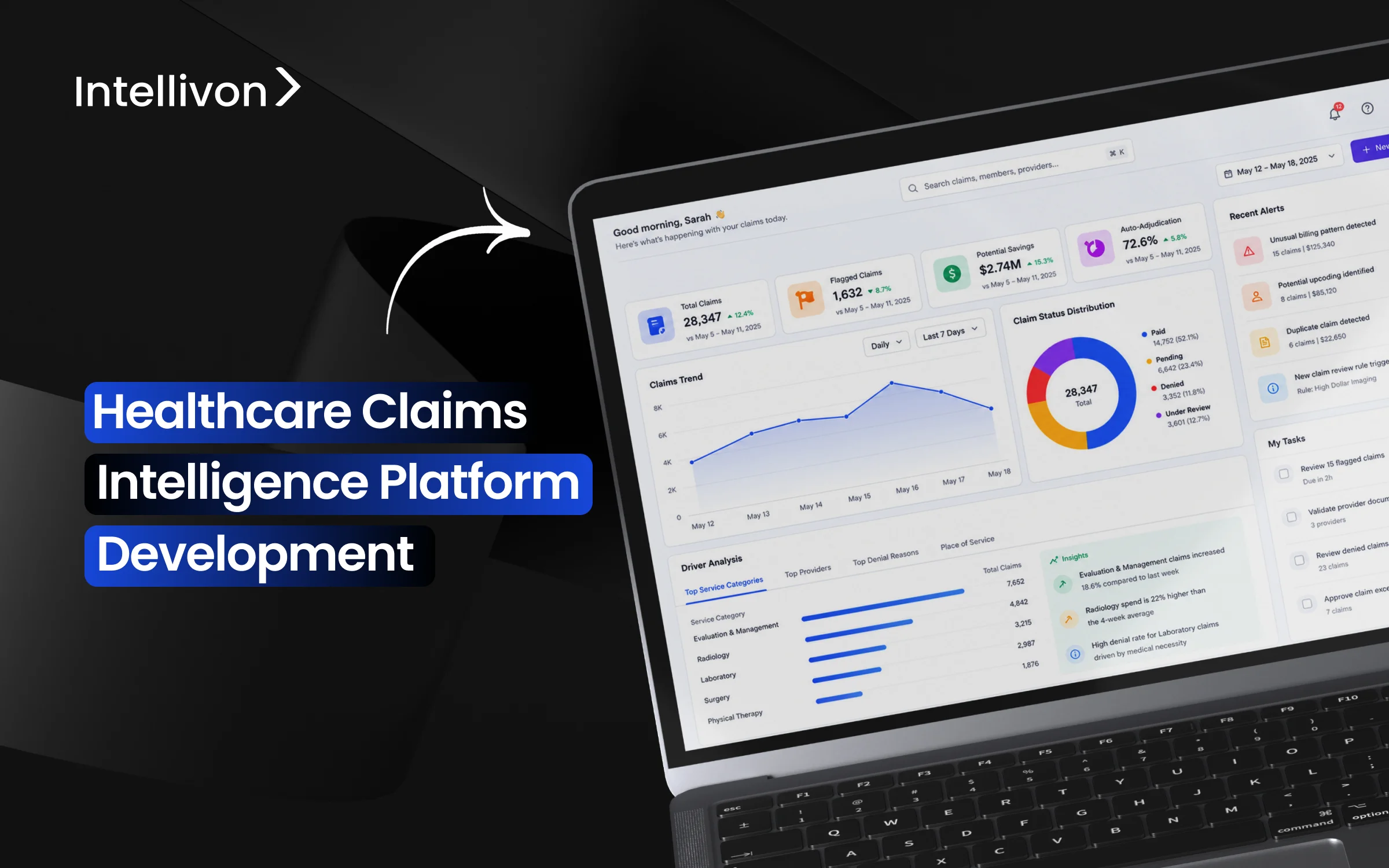
A healthcare claims intelligence platform connects claims, clinical, payer, remittance, eligibility, prior authorization, and payment data into one unified analytics layer. It detects denial patterns, scores payer behavior, monitors revenue leakage, and benchmarks claim performance so revenue teams can act on problems before they become recurring losses.
1. How It Differs From Claims Processing Software
Legacy claims processing systems function as transport layers designed to validate syntax and route transactions between providers and clearinghouses.
Conversely, a healthcare claims intelligence platform analyzes the semantic relationships between clinical documentation and historical adjudication outcomes to explain why claims succeed, fail, underpay, or stall.
| Capability | Claims Processing Software | Claims Intelligence Platform |
| Primary Focus | Transaction execution and EDI routing | Revenue integrity and predictive pattern analysis |
| Data Scope | Static 837/835 transaction sets | Unified longitudinal clinical and financial data sets |
| Core Logic | Hardcoded, static clearinghouse edit rules | Dynamic ML models and payer behavior tracking |
| Outcome | Moves claims from point A to point B | Eliminates systemic leakage and drives revenue yield |
Processing software merely reports that a claim was rejected or paid. An intelligence layer uncovers the systemic root cause, such as a hidden payer adjudication rule change, allowing revenue cycle teams to intercept denials before submission.
How It Differs From RCM Dashboards
Standard revenue cycle management (RCM) dashboards are passive reporting screens that show you what happened to your revenue in the past.
An intelligence system goes much deeper by connecting those lagging metrics to exact root causes in your clinical workflows, coding habits, and individual payer behaviors.
| Metric or Feature | Standard RCM Dashboards | Claims Intelligence Platform |
| Operational Role | Reports historic financial KPIs | Diagnose live revenue leaks |
| Data Connection | Looks at isolated financial metrics | Connects clinical notes to payer responses |
| Analysis Style | Manual filtering by human analysts | Automated tracking of hidden payer shifts |
| Action Plan | Alerts you that denials went up | Points to the exact coding pattern causing the issue |
While a dashboard simply alerts you that your days in accounts receivable (AR) grew, an intelligence system tells you exactly why. It isolates the specific payer rule change or documentation gap causing the delay, so you can fix it immediately.
3. What Data the Platform Needs to Unify
To build a reliable healthcare claims intelligence platform, you must aggregate fractured clinical and financial data streams into a single, structured repository.
This unified data foundation allows machine learning models to trace the complete lifecycle of a dollar from the point of care to final payment posting.
- Clinical Inputs: EHR data integration via FHIR R4 or HL7 feeds to capture patient charts and clinical intent.
- Transaction Sets: Clearinghouse data, including EDI 837 (claims), EDI 835 (remittances), 270/271 (eligibility), and 277 (claim status).
- Financial Reference: Digital payer contracts, internal appeal notes, and actual payment posting logs.
Unifying these assets allows the system to analyze clinical and financial data together. Consequently, the software can match specific clinical documentation with final payer adjudication outcomes to find hidden underpayments.
4. What Decisions the Platform Should Support
A custom claims intelligence platform moves your revenue cycle team from reactive firefighting to strategic, data-driven execution.
By providing real-time visibility into the financial impact of clinical and administrative workflows, the system helps leaders make high-stakes operational choices with certainty.
- Denial Prevention & Underpayment Analytics: Identifies coding pattern errors and contract variances before submission to stop cash flow delays.
- Payer Negotiation & Benchmarking: Uses payer behavior intelligence to score performance, giving you hard data on first-pass yield and days in AR for contract renewals.
- Revenue Integrity & Audit Readiness: Tracks systemic revenue leakage while maintaining a clean audit trail for RAC audits.
Furthermore, the platform drives operational prioritization by automatically flagging the highest-value denials first. Instead of working through a random list, your team focuses entirely on the accounts that have the highest probability of recovery.
[For a deeper breakdown of claims automation, see our guide on AI Healthcare Claims Processing Software Development.]
Why Automating Claims Can Scale Your ROI
Automating claims scales your ROI by converting passive billing reports into an active, real-time revenue protection system. It merges clinical charts with financial records to find documentation errors, track changing payer behaviors, and intercept costly billing rejections before submission. This custom architecture protects enterprise cash flow and eliminates systemic bottom-line leakage.
Across the industry, U.S. hospitals lose a massive $262 Billion annually, entirely due to initial billing rejections, making a custom automation layer critical to stopping ongoing revenue leakage.
1. Denial Patterns Directly Affect Revenue Predictability
Systemic denial patterns create unpredictable cash flow and increase administrative costs across your entire hospital network.
Industry data reveals that initial claim denial rates have climbed steadily, with some health networks seeing up to 41% of their provider accounts face persistent initial rejections.
- Continuous Analytics: The system tracks incoming 835 and 837 data streams to catch billing errors before submission.
- Predictable Metrics: Catching code mismatches early directly improves your clean claim rate and first-pass yield.
- Faster Cash Flow: Resolving these recurring billing errors lowers your total days in AR.
Consequently, organizations can drop initial denial rates by up to 50% to make cash flow highly predictable.
2. Payer Behavior Intelligence Supports Contract Strategy
Health systems often lose money because they lack hard data when renegotiating terms during complex commercial payer contract renewals. A custom platform aggregates historical remittance data to build continuous payer performance scoring and advanced underpayment analytics.
- Payer Performance Scoring: Track which insurance companies delay payments or create unusual rules.
Modern Ghana - Payer Contract Intelligence: Convert millions of historical EDI 835 records into clear negotiation evidence.
- Underpayment Analytics: Identify where a payer silently changes documentation rules to underpay a claim.
This data lets you hold payers accountable to agreed-upon rates during contract renewals. Your team gains the exact evidence needed to challenge unfair payment rejections and secure better terms.
3. Revenue Integrity Teams Need Earlier Signals
Waiting for a claim to face rejection before fixing a workflow error creates a massive administrative backlog for billing staff.
Shockingly, up to 60% of all rejected claims are never resubmitted, meaning over half of your denied revenue becomes a permanent, unrecovered financial write-off without early intervention.
- Coding Pattern Analysis: Scan clinical documentation early to find missing modifier codes.
- Eligibility Intelligence: Verify insurance coverage rules automatically before the patient receives care.
Modern Ghana - Prior Authorization Analytics: Track which procedures require authorization to avoid front-end denials.
This approach allows teams to fix authorization errors while the claim is still under review rather than after a rejection occurs.
4. Analytics Leaders Need a Unified Claims Data Foundation
Traditional RCM setups fail to catch complex underpayments because clinical data and financial data live in completely separate software silos.
To find deep financial leaks, technical teams must achieve clinical and financial data unification inside a single claims data warehouse design.
- Data Unification: Connect unstructured EHR chart notes directly with 835 remittance data using automated pipelines.
- Cross-Cycle Reporting: Map precise clinical terms to specific payer responses across the entire care lifecycle.
- ML Claims Models: Feed clean, unified data into machine learning models to spot subtle payment variations.
This unified foundation allows machine learning models to spot subtle variations across entire treatment lifecycles.
5. Healthcare SaaS Companies Need Differentiated Intelligence
Off-the-shelf billing APIs no longer give healthcare SaaS platforms a competitive edge in a crowded enterprise healthtech market.
Software companies need proprietary, built-in analytics that help their users reduce billing errors without leaving the main product interface.
- Built-In Analytics: Add custom claims performance analytics software development features directly into your core application.
- Differentiated Product: Create a sticky user experience that keeps clients from leaving for third-party tools.
- Premium Value: Offer advanced revenue intelligence as a high-tier upgrade for enterprise accounts.
This approach allows software platforms to command premium-tier pricing while helping clients lower their operational costs. It turns a standard software platform into an indispensable financial tool that drives user retention.
Investing in a custom claims intelligence strategy ultimately moves your business from passive financial reporting to active revenue rescue. By fixing the foundational gaps between your clinical data and payer rules, you protect your cash flow and build a highly scalable operational advantage.
The Claims Problem That Platforms Should Not Ignore
The biggest claims intelligence problem is not a lack of dashboards. It is that claims data becomes useful only after it has already moved through too many disconnected systems.
When intelligence starts after adjudication, teams see denials, underpayments, and payer behavior too late to prevent revenue leakage or operational waste.
Leaders need to move their analytics upstream to stop the financial bleeding before the claim ever leaves the building.

1. Claims Intelligence Often Starts Too Late
Traditional analytical tools look backward at historic data rather than evaluating live financial risk during the administrative process.
By the time a claim undergoes review in a standard post-adjudication dashboard, the opportunity to prevent a cash flow disruption has already vanished.
- Pre-Submission Risk: Retrospective software completely misses coding pattern errors and verification mistakes that happen before billing.
- Eligibility Issues: Front-end patient registration details are rarely cross-referenced with active insurance rules in real time.
- Documentation Gaps: Unstructured clinical chart notes are not linked to billing codes prior to submission.
- Prior Authorization Mismatches: Systemic authorization omissions are uncovered only after receiving an official rejection.
Consequently, billing teams waste massive administrative effort correcting issues that are entirely preventable. To achieve true revenue integrity, your analytics engine must evaluate every transaction before it exits your billing infrastructure.
2. Payer Behavior Changes Faster Than Static Rules
Standard clearinghouse edit logic relies on hardcoded rules that fail to adapt when commercial insurance carriers silently alter their billing guidelines.
Modern payers shift their adjudication algorithms constantly, creating sudden spikes in hidden rejections that rules-based engines miss.
- Payer-Specific Rule Intelligence: The software must identify minor, undocumented adjustments in carrier policies instantly.
- Denial Trending: Machine learning models track live denial pattern shifts instead of relying on historic monthly reports.
- Payer Performance Scoring: Running continuous performance scoring reveals which carriers are intentionally delaying payouts.
- Contract-Level Variance: Automated engines spot underpayments by matching actual remittances with digital contract terms.
Because these changes occur with no warning, relying on static rules guarantees an increase in unrecovered financial losses. Advanced platforms solve this by using machine learning models that monitor incoming payer behaviors continuously.
3. Revenue Leakage Hides Between Workflow Boundaries
Financial losses consistently occur at the operational handoff points between disconnected hospital departments and external clearinghouse applications.
Because patient intake, clinical coding, and accounts receivable use separate software, no single system tracks the end-to-end lifecycle of a claim.
- Registration for Coding: Patient coverage details often fail to transfer correctly into the clinical documentation system.
- Clearinghouse to Payment: Rejection codes from outside clearings are rarely matched with the original clinical intents.
- Denials to Appeals: Internal appeal notes are buried in text files instead of feeding back into the system.
These fragmented boundaries create blind spots where high-value billing errors easily slip through the cracks. Without a single system bridging these gaps, your revenue integrity team will continue to waste time chasing untraceable losses.
4. Cross-Cycle Claims Analytics Must Start Before Submission
True financial optimization requires deploying a custom cross-cycle claims intelligence system development strategy that connects clinical documentation directly to final payment outcomes. This method creates an intelligent loop, evaluating compliance and contract rules throughout the entire billing cycle.
- Unified Pipeline: Connect unstructured EHR data with live transaction clearing networks in a single flow.
- Early Intervention: Flag documentation gaps while the patient is still under active care.
- Continuous Feedback: Use historical remittance data to scrub claims automatically before final submission.
This proactive architecture ensures that every submitted claim is fully optimized for maximum revenue yield before it ever hits a payer portal. It converts your billing process from a reactive queue into an automated revenue safeguard.
5. The Platform Needs a Memory Layer
To outpace changing carrier guidelines, a claims platform must feature a dedicated memory layer that tracks and learns from historical adjudication outcomes.
This infrastructure archives past remittance adjustments, underpayments, and appeal wins to predict exactly how a carrier will react to a specific claim.
- Pattern Learning: The software automatically maps CARC and RARC codes to specific clinical documentation structures.
- Remittance Adjustments: Track hidden underpayments by learning exactly where carriers shave dollars off agreed rates.
- Appeal Outcomes: Analyze historical appeal documentation to determine the highest-probability path to recovery.
Before deploying this type of smart memory layer, health systems routinely face severe operational bottlenecks.
Industry case studies show that organizations often struggle with a heavy 12% initial denial rate, a prolonged 45-day payment cycle, and $340,000 in annual revenue leakage entirely due to a lack of historical tracking.
This unified approach gives your enterprise the power to outsmart unpredictable payer rule changes and stop revenue leakage at the source.
Core Use Cases of a Healthcare Claims Intelligence Platform
The core use cases of a healthcare claims intelligence platform include denial prediction, payer behavior monitoring, underpayment detection, claim benchmarking, appeal prioritization, contract intelligence, revenue leakage detection, and audit readiness.
Each use case depends on clean claims data aggregation, reliable integration, and explainable AI outputs that business teams can trust. Transitioning from generic analytics to targeted operational tools helps enterprise revenue cycles isolate hidden losses across complex workflows.
1. Denial Pattern Analytics and Root Cause Detection
Identifying exactly why a claim failed requires evaluating variables across multiple administrative layers simultaneously. Custom platforms apply machine learning models to incoming transaction records to automate root cause detection at scale.
- Multivariate Trending: Track live denial trends by payer, procedure code, diagnosis, facility location, and physician.
- Granular Matching: Correlate billing modifier errors and specific authorization omissions with historical carrier rejections.
- Submission Tracking: Isolate formatting anomalies caused by different clearinghouse or electronic submission channels.
This automated intelligence layer isolates the precise operational driver behind a cash flow blockage.
2. Payer Behavior Intelligence and Payer Performance Scoring
Insurance carriers alter their processing guidelines constantly without publishing formal revisions. A custom platform transforms historical remittance files into live payer scorecards that uncover these quiet operational changes.
- Adjudication Velocity: Measure the true average adjudication time and claim status volatility for individual payers.
- Allowed Amount Shifts: Detect sudden downward adjustments in average allowed amounts for specific treatment sets.
- Rule Volatility Metrics: Score carrier behavior based on how frequently their internal claim review logic shifts.
Building these analytical features allows providers to approach negotiations armed with clear empirical evidence.
3. Underpayment Analytics and Contract Variance Detection
Health systems routinely lose revenue when payers process claims at rates lower than the legally agreed contract terms. Dedicated variance engines analyze every transaction to confirm that actual reimbursements perfectly match contractual expected numbers.
- Three-Way Reconciliation: Automatically compare billed amounts, allowed amounts, and final paid figures for every line item.
- Contractual Expected Reimbursement: Calculate precise payment expectations against digital contract terms in real time.
- Automated Variance Alerts: Flag underpayments instantly when a payer applies incorrect contractual discounts.
These continuous checks ensure that hidden underpayments do not sit undetected in aging accounts receivable queues. Consequently, billing teams can recover missing dollars before contract expiration deadlines pass.
4. Claims Benchmarking Across Facilities and Service Lines
Enterprise healthcare groups must isolate operational inefficiencies by comparing billing performance across different departments. Cross-facility claims benchmarking uncovers which regional sites or clinical specialties are dragging down financial performance.
- Core KPI Tracking: Measure and compare clean claim rates, first-pass yields, and total days in AR across locations.
- Recovery Metrics: Monitor individual department denial overturn rates, appeal success rates, and recovery velocity.
- Standardized Workflows: Apply successful billing patterns from top-performing clinics to struggling facilities.
Standardizing these metrics allows analytics leaders to deploy training or software fixes where they will deliver the highest financial impact. This comparative framework ensures consistent cash flow across the entire corporate network.
5. Appeals Intelligence and Recovery Prioritization
Working through a massive backlog of denied claims manually leads to missed filing deadlines and unrecovered revenue. Advanced prioritization algorithms evaluate your entire collection queue to ensure staff focus exclusively on high-value accounts.
- Probability Scoring: Assign an automated appeal success score based on historical recovery outcomes for similar claims.
- Value Optimization: Multiply the recovery probability by the expected dollar amount to calculate the exact financial value.
- Workflow Integration: Automatically generate required documentation checklists and rank internal appeal queues dynamically.
This intelligent orchestration keeps collections staff from wasting valuable hours on uncollectible accounts. Instead, teams focus their energy on the specific appeal workflows that guarantee maximum recovery velocity.
6. RAC Audit Readiness and Revenue Integrity Analytics
Defending your organization against federal or commercial payer audits requires maintaining strict data compliance across the entire enterprise. A custom platform builds complete data traceability into everyday workflows to simplify audit defense.
- Immutable Audit Trails: Log all clinical edits, billing modifications, and code changes with absolute user accountability.
- Versioned Rules Engine: Archive the exact payer guidelines and documentation models used at the original time of billing.
- Coding Pattern Analysis: Scan clinical notes to find medical necessity signals and catch dangerous over-coding trends early.
Maintaining this rigorous data posture keeps your hospital network fully prepared for sudden RAC audit requests. It ensures your revenue integrity strategy remains highly compliant while actively minimizing clawback risks.
Deploying a unified architecture across these core use cases transforms your revenue management from a manual process into an automated financial defense system. By embedding advanced tracking into every phase of the claim lifecycle, you secure every dollar your clinical operations earn.
Healthcare Claims Intelligence Platform Architecture and Data Flow
A healthcare claims intelligence platform architecture usually includes ingestion pipelines, EDI parsers, FHIR transformation, a claims data warehouse, analytics services, AI model services, dashboard APIs, role-based access, audit logging, and MLOps monitoring.
The architecture must preserve financial accuracy while making clinical and claims data usable for analytics.
Technical teams must deploy an enterprise-grade, decoupled structure to ensure continuous data processing and sub-second analytical queries without disrupting live clinical workflows.
| Architectural Layer | Core Technical Processes | Recommended Technology Stack |
| Claims Data Ingestion Layer | Handles SFTP ingestion, clearinghouse APIs, payer APIs, EHR feeds, batch imports, streaming jobs, and initial file validation. | Apache Kafka, AWS S3, SFTP Gateways, Airflow |
| EDI Parsing & Normalization | Parses EDI 835, 837, 270/271, 277, and 999 files; executes line-level extraction and maps CARC/RARC codes to error queues. | Python/Go Custom Parsers, PostgreSQL Error Queues |
| FHIR R4 & Interoperability | Transforms parsed records into standardized objects like Claim, ClaimResponse, ExplanationOfBenefit, Coverage, and Patient. | HAPI FHIR Server, AWS HealthLake, JSON-LD Parsers |
| Data Warehouse & Analytics Store | Powers schema design, dimensional models, time-series tables, payer/service-line dimensions, and fast materialized views. | Snowflake, Google BigQuery, dbt (Data Build Tool) |
| Intelligence & AI Services | Runs ML claims models for denial risk scoring, payer trend detection, and underpayment anomalies, and generates explainability outputs. | Python, PyTorch, Scikit-learn, MLflow, Triton Server |
| Workflow & Dashboard Layer | Delivers real-time claims dashboards, executive KPI views, interactive work queues, deep drill-downs, and role-based views. | React.js, Node.js REST/GraphQL APIs, Auth0 for RBAC |
Building this multi-layered blueprint creates a resilient data environment that handles heavy healthcare transaction volumes effortlessly.
Isolating individual microservices allows your engineering team to scale ingestion bandwidth or update machine learning models independently without introducing downtime.
Data Sources and Integrations That Make Claims Intelligence Work
Claims intelligence only works when the platform integrates clinical, administrative, financial, and payer-side signals. The minimum integration layer should include EHR data, practice management data, clearinghouse data, EDI 835 remittance analytics, EDI 837 claim submissions, eligibility transactions, claim status updates, payer APIs, and contract data.
Building a unified data pipeline ensures your AI models have access to the complete history of every claim transaction.
1. EHR and Clinical Data Integration
Analyzing billing accuracy requires pulling raw clinical evidence straight from your hospital’s electronic health record (EHR) platform. A custom intelligence layer hooks into these medical pipelines to cross-reference patient charts against finalized billing code selections.
- Standard Pipelines: Implement continuous HL7 integration and secure FHIR APIs to extract live encounter records.
- Clinical Fields: Ingest discrete diagnosis codes, procedure documentation text, and raw unstructured physician notes.
- Documentation Cleansing: Run NLP models to verify that clinical notes match the specific medical necessity rules of the target carrier.
This direct clinical connection surfaces hidden documentation gaps before billing data reaches your administrative clearinghouse tools. It allows coding teams to validate compliance without needing to open separate charting systems manually.
2. Clearinghouse and EDI Integration
Managing day-to-day revenue cycles requires building deep connections with primary transaction clearings like Waystar, ClaimMD, or Availity. The platform acts as an automated parsing engine that reads standard electronic data interchange (EDI) transaction flows.
- Claim Submissions: Parse outgoing EDI 837 files to extract itemized line-level charges and billing modifiers.
- Remittance Loops: Ingest incoming EDI 835 files to capture actual cash payments and structural adjust codes.
- Status Ingestion: Monitor real-time 270/271 eligibility requests alongside 277 claim status responses to track processing cycles.
Automating these data pipelines allows the platform to organize messy transaction files into clean, readable timelines. This systematic structure gives financial analysts complete visibility into exactly where a claim stalls inside the clearinghouse network.
3. Payer API and Payer Portal Integration
Enterprise health networks can no longer rely on manual staff logins to scrape updates from complex insurance web portals. Modern payer intelligence platform development depends on establishing direct, real-time data exchanges with commercial carriers.
- Direct Ingestion: Build custom API connectors to feed active carrier guidelines directly into your central rules engine.
- Adjudication Tracking: Monitor active carrier response trends to flag unannounced updates to payment algorithms.
- Portal Scraping: Deploy automated micro-bots to capture denial codes from legacy systems that lack public API hooks.
Connecting directly to payer networks eliminates the typical information delay that causes high administrative backlogs. This approach gives your billing team live updates on processing changes weeks before formal paper notifications arrive.
4. Contract and Fee Schedule Integration
Stopping revenue loss requires comparing actual paid figures with the exact legal terms established in your commercial insurance contracts. Digital fee schedules must sit inside your core analytics platform to run automated compliance checks at scale.
- Reimbursement Engines: Store itemized contractual terms to compute expected reimbursement figures for every service.
- Variance Warnings: Trigger instant alerts when an allowed amount drops below the agreed fee schedule threshold.
- Remittance Scoring: Evaluate line-item contract variances to identify where a carrier applied incorrect discounts.
Isolating these line-item payment discrepancies protects health networks from quiet, recurring underpayment patterns. Consequently, your revenue cycle team can challenge contract variances systematically and collect every dollar owed.
5. Prior Authorization and Eligibility Intelligence
Front-end administrative errors are the primary driver of high insurance denial rates across multi-facility hospital systems. Integrating real-time eligibility checks prevents your staff from booking procedures without verifying active carrier restrictions first.
- Coverage Auditing: Run automated 270/271 loops to check patient benefits before scheduling clinical care.
- Authorization Verification: Match documented prior authorization numbers against the itemized lines on the final claim form.
- Mandate Tracking: Monitor active carrier lists to track which procedure codes require active authorization approvals.
This front-end verification layer blocks the submission of claims destined for immediate administrative rejection. It stops prior authorization mismatches before they can turn into permanent financial write-offs.
6. Financial and Payment Posting Integration
A complete revenue analytics strategy must bridge the operational gap between initial electronic remittances and final bank cash balances. The platform ingests electronic remittance advice (ERA) files alongside local accounting books to confirm cash reconciliation.
- Automated Posting: Feed line-item payment posting data straight into your central enterprise data warehouse.
- Clawback Tracking: Monitor carrier recoupments and adjustments to trace exactly how much revenue faces recovery actions.
- Responsibility Auditing: Split paid values from remaining patient responsibility to calculate exact collection goals.
Unifying these end-of-cycle financial inputs ensures your leadership team can audit absolute net revenue collections with ease. It simplifies cash tracking and provides accounting teams with a single, highly accurate source of truth.
This deep data foundation complies perfectly with changing federal standards designed to eliminate modern healthcare administrative silos. For example, the CMS Interoperability and Prior Authorization Final Rule (CMS-0057-F) mandates that impacted payers must implement major API requirements.
Building a custom infrastructure that mirrors these standardized networks ensures your business remains fully compliant while maximizing modern revenue yield.
How to Build a Healthcare Claims Intelligence Platform Step by Step
Building an enterprise healthcare claims intelligence platform requires a systematic approach that bridges clinical records, financial transactions, and machine learning. A successful deployment moves through explicit phases to transform raw EDI data into actionable revenue predictions.
Engineering teams must follow a strict development sequence to ensure that the resulting software integrates cleanly into active health system infrastructure without interrupting daily billing operations.
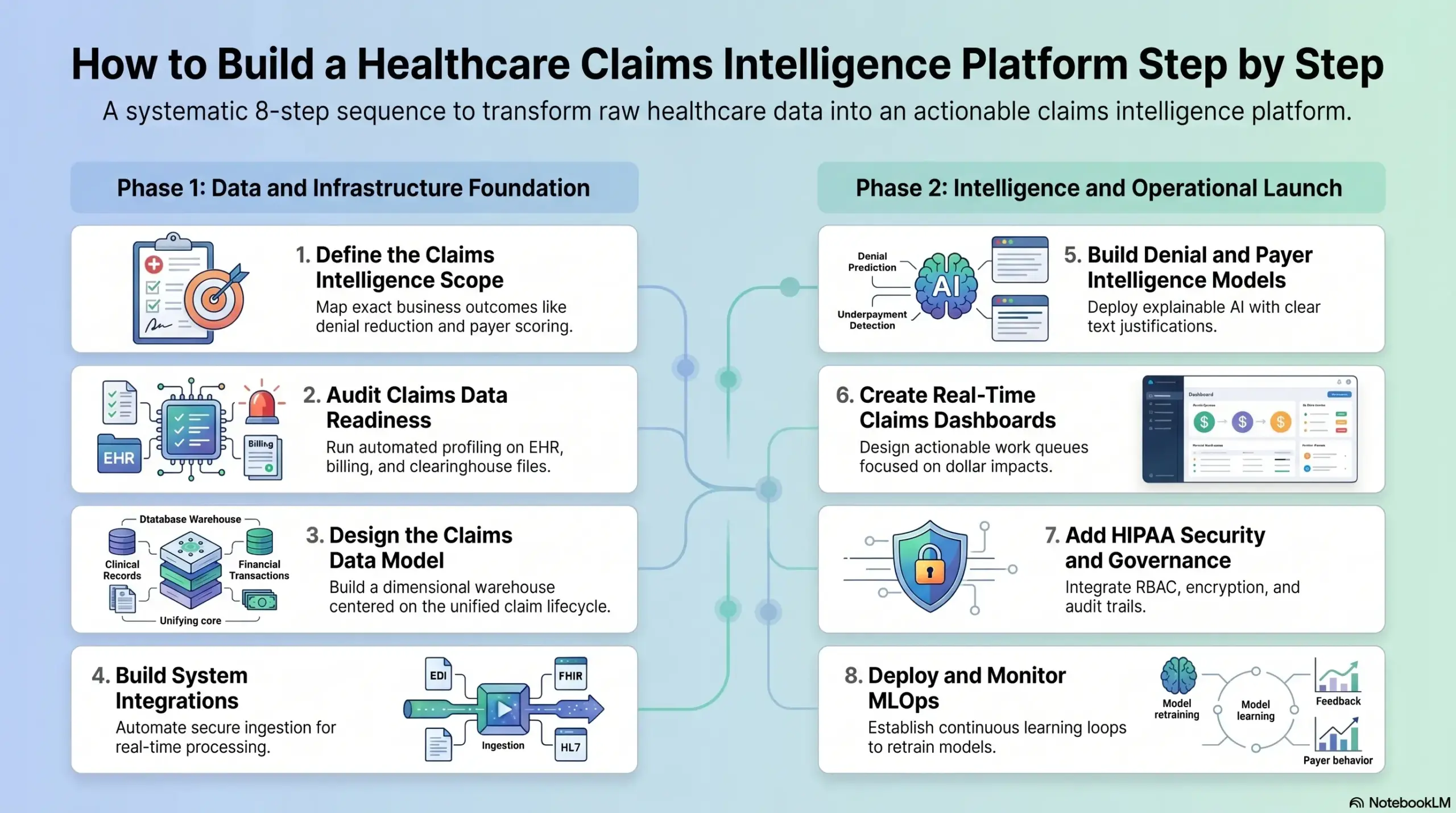
1. Define the Claims Intelligence Scope
Start by defining which claims intelligence outcomes the platform must support: denial reduction, underpayment recovery, payer scoring, appeal prioritization, revenue leakage detection, or claims benchmarking. This scope determines the data model, integration priority, AI modules, dashboard design, compliance depth, and development budget from the first planning sprint.
Technical Work: Product teams must map user roles, key performance indicator (KPI) hierarchies, the active payer mix, claim types (institutional vs. professional), facility counts, service lines, and analytical reporting intervals.
What Goes Wrong: Skipping a tight functional scope causes engineering teams to build generic dashboards with no actual decision value, resulting in poor user adoption and flat financial ROI.
Intellivon Approach: Intellivon maps exact business outcomes before choosing database or cloud architectures, ensuring the minimum viable product (MVP) scope stays tightly tied to measurable claims performance.
Defining specific financial goals during this initial planning phase ensures the entire engineering pipeline focuses on high-impact revenue recovery.
2. Audit Claims Data Readiness
Audit claims data before architecture design because missing, inconsistent, or unmapped data will weaken every dashboard and AI model. The audit should review EHR fields, billing records, clearinghouse files, remittance data, payer responses, appeal notes, contract data, authorization records, and historical claim outcomes across at least 12–36 months.
Technical Work: Data engineers assess data completeness, format inconsistencies across legacy formats, ICD-10 code quality, payer identifiers, adjustment codes (CARC/RARC), and historical denial labels.
What Goes Wrong: If skipped, AI models learn from noisy, incomplete, or incorrectly labeled outcomes, leading to high false-positive rates in automated denial predictions.
Intellivon Approach: Intellivon treats claims data readiness as a strict build gate, not a passive documentation exercise, running automated profiling scripts to catalog data health before writing core application logic.
Completing a rigorous data audit ensures your machine learning teams build software features using reliable and structured transaction histories.
3. Design the Claims Data Model and Warehouse
Design the claims data warehouse around claim lifecycle events, not isolated tables. The model should connect patients, encounters, providers, payers, authorizations, service lines, charges, allowed amounts, payments, denials, appeals, adjustments, contracts, and timestamps. This makes cross-cycle claims analytics possible across operational, financial, and payer-performance views.
Technical Work: Engineers build dimensional models using star or snowflake schemas, establishing multi-layered fact tables, transaction event timelines, explicit payer dimensions, and historical audit fields.
What Goes Wrong: Without a unified lifecycle model, teams cannot trace operational root causes across claim submission, remittance loops, internal appeals, and final payment posting.
Intellivon Approach: Intellivon designs the warehouse structure to support both rapid analytical queries and automated AI feature engineering, separating compute from storage to keep performance fast.
Establishing a normalized, event-driven data warehouse allows analysts to run complex, cross-cycle revenue queries with sub-second response times.
4. Build EDI, FHIR, HL7, and Clearinghouse Integrations
Build integration depth early because claims intelligence depends on the flow of operational truth from multiple systems. The platform should ingest EDI 835, 837, 270/271, 277, EHR feeds, FHIR resources, HL7 messages, clearinghouse data, payer APIs, and contract data without breaking financial reconciliation or PHI security rules.
Technical Work: Developers create automated ingestion jobs, custom EDI parsers, secure API connectors, schema validation rules, dead-letter retry queues, and end-to-end data reconciliation checks.
What Goes Wrong: Without robust pipelines, the platform becomes a manual file-upload tool rather than an automated infrastructure component, leading to data delays and operational backlogs.
Intellivon Approach: Intellivon builds secure ingestion and strict financial reconciliation steps before deploying advanced AI, ensuring downstream analytical insights remain fully trusted by business teams.
Automating these primary data pipelines guarantees your intelligence layer processes updates in real time as patients move through care.
5. Build Denial and Payer Intelligence Models
Build AI models only after the claims data foundation is stable. The first model layer should focus on high-value problems: denial prediction, underpayment detection, payer behavior scoring, coding risk, appeal recovery probability, and revenue leakage detection. Each model needs explainable outputs that revenue teams can validate and act on.
Technical Work: Data scientists train supervised machine learning models for classification, anomaly detection models for fee variances, and rules-plus-ML hybrid models for compliance validation.
What Goes Wrong: If deployed without explainability features, AI recommendations become vague, billing staff loses trust in the system, and platform adoption drops.
Intellivon Approach: Intellivon combines ML claims models with deterministic billing rules, ensuring predictions contain clear text explanations that remain highly usable in regulated revenue workflows.
Deploying explainable AI models ensures your collectors understand exactly why a claim faces rejection risk before they click submit.
6. Create Real-Time Claims Dashboards
Create dashboards that tell teams what to do next, not just what happened last month. The interface should show clean claim rate, first-pass yield, days in AR, denial trends, payer scorecards, underpayment alerts, appeal priorities, claim timelines, and root cause drill-downs for operational and executive users.
Technical Work: Frontend developers build interactive charts, real-time alerting modules, multi-attribute filters, deep drill-downs, role-specific views, data exports, and actionable work queues.
What Goes Wrong: If the UI is built as a static reporting view, executives get charts, but billing teams still chase issues manually using legacy spreadsheets.
Intellivon Approach: Intellivon designs production dashboards around specific operational decisions, clear task owners, filing deadlines, and direct dollar impacts rather than generic data points.
Connecting predictive analytics straight to everyday collector work queues ensures your staff addresses the highest-value revenue recovery opportunities first.
7. Add HIPAA Security and Governance Controls
Add HIPAA controls throughout the platform instead of treating compliance as final QA. Claims intelligence systems process PHI, payer data, clinical evidence, financial records, and user actions. Security must include encryption, access controls, audit logs, authentication, data retention policies, de-identification workflows, and model governance from the architecture phase.
Technical Work: Security engineers deploy role-based access control (RBAC), end-to-end audit trails, database-level PHI segmentation, row-level encryption, automated access reviews, and incident logging.
What Goes Wrong: The platform may work perfectly from a technical standpoint, but fail enterprise security reviews, blocking deployment by compliance risk officers.
Intellivon Approach: Intellivon builds rigorous compliance controls directly into data flow layers, user permissions, and production monitoring systems rather than wrapping them on top later.
Integrating administrative, physical, and technical safeguards ensures your platform fully satisfies the federal HHS HIPAA Security Rule mandates for protecting electronic health information (Source: HHS, 2026).
8. Deploy, Monitor, Retrain, and Improve the Platform
Deploy the platform with monitoring for data quality, model drift, integration failures, latency, claim volume growth, and user adoption. Claims intelligence is not a one-time release because payer behavior, coding rules, contracts, authorizations, and denial patterns change continuously. MLOps keeps the system accurate after launch.
Technical Work: DevOps teams establish production MLOps pipelines, continuous data observability alerts, automated audit reports, scheduled model retraining cycles, and regression testing.
What Goes Wrong: Neglecting ongoing model upkeep allows payer rule decay to slowly turn accurate intelligence models into stale, irrelevant historical reports.
Intellivon Approach: Intellivon structures post-launch monitoring as a core part of the build, creating specialized payer-specific learning loops and transparent model governance practices.
Maintaining active MLOps loops preserves the long-term predictive accuracy of your AI models as commercial insurance policies shift.
Following this end-to-end development sequence ensures that your custom intelligence platform functions as an elite financial shield. By building a stable data foundation before layering advanced machine learning, you create a trusted tool that consistently improves cash flow predictability.
Healthcare Claims Intelligence Platform Cost
A custom healthcare claims intelligence platform usually costs $120,000–$450,000+ to build. The final cost depends on claims data readiness, EDI volume, FHIR and HL7 integration depth, payer API complexity, AI model scope, dashboard requirements, HIPAA controls, and deployment scale.
Enterprise payer systems or multi-hospital platforms can exceed this range when they need advanced analytics, multi-entity reporting, and deeper governance.
Here is a practical cost breakdown by development phase.
Healthcare Claims Intelligence Platform Cost Table
| Development Phase | Estimated Cost | What It Covers |
| Discovery, workflow mapping, and claims scope | $10,000–$25,000 | Payer mix, claim lifecycle mapping, KPI selection, MVP definition |
| Claims data audit and data model design | $15,000–$40,000 | Source system review, field mapping, denial labels, data quality checks |
| Claims data warehouse and backend architecture | $30,000–$80,000 | Warehouse schema, APIs, event model, analytics layer, permissions |
| EDI, FHIR, HL7, and clearinghouse integrations | $35,000–$110,000 | 835, 837, 270/271, 277, FHIR R4, EHR, payer APIs |
| AI and predictive analytics model development | $35,000–$120,000 | Denial prediction, underpayment analytics, payer scoring, appeal prioritization |
| Dashboard and workflow interface development | $25,000–$70,000 | Real-time dashboards, role views, alerts, work queues, and exports |
| HIPAA security, audit trails, and governance | $20,000–$60,000 | RBAC, audit logs, encryption, de-identification, compliance documentation |
| MLOps, monitoring, QA, and deployment | $20,000–$55,000 | Model monitoring, testing, deployment, observability, and retraining setup |
Ongoing maintenance usually costs 18%–30% of the initial build cost per year. This covers integration updates, payer rule changes, model retraining, compliance reviews, dashboard improvements, infrastructure scaling, QA, and technical support.
For example, a $250,000 platform may need $45,000–$75,000 per year for maintenance. A $450,000 enterprise platform may need $81,000–$135,000 per year, especially if it supports multiple hospitals, payer lines, and AI workflows.
The safest budgeting approach is to start with a focused MVP. Build the first version around high-value use cases such as denial pattern analytics, payer behavior intelligence, clean claim rate tracking, first-pass yield, and underpayment alerts.
Then expand into predictive claims analytics, appeal intelligence, and contract variance detection once the data foundation proves reliable.
Planning a healthcare claims intelligence platform budget? Intellivon can help you estimate development cost based on your claims data readiness, EDI workflows, FHIR and HL7 integrations, AI model scope, payer complexity, compliance depth, dashboard requirements, and launch timeline.
Build a Healthcare Claims Intelligence Platform With Intellivon
At Intellivon, we help hospitals, health systems, payer organizations, RCM companies, and healthcare SaaS teams build custom claims intelligence platforms around real operating needs. Our work covers product scope, claims data architecture, AI model development, payer intelligence, dashboard design, compliance controls, and post-launch monitoring.
A. Define the Right Claims Intelligence Scope
We map MVP priorities, payer mix, claim types, use cases, ROI targets, and build-vs-buy decisions before development starts.
B. Design the Claims Data Architecture
Intellivon designs EDI ingestion, FHIR R4 mapping, HL7 integration, claims data warehouses, APIs, and analytics models.
C. Build AI Models Around Real Revenue Workflows
Our experts build denial prediction, underpayment analytics, payer scoring, appeal prioritization, and explainable model outputs.
D. Integrate With Healthcare and Payer Systems
Intellivon connects EHRs, clearinghouses, payer APIs, practice management systems, payment posting tools, and contract data.
E. Make the Platform Secure, Governed, and Production-Ready
We build HIPAA controls, RBAC, audit trails, PHI safeguards, MLOps, monitoring, and governance documentation.
[For a deeper breakdown of revenue automation across the full cycle, see our guide on How to Build an AI Revenue Automation Platform.]
Conclusion
A healthcare claims intelligence platform becomes valuable when it helps teams act earlier, not merely report faster. The strongest systems connect EHR data, EDI transactions, remittances, payer behavior, contracts, authorizations, and denials into one trusted intelligence layer.
That is why architecture, integration depth, HIPAA controls, and model governance matter as much as dashboard design. For CTOs and product leaders, the real decision is not whether AI can analyze claims. It is whether your data foundation can support reliable, explainable, and revenue-focused intelligence at scale.
Things To Know About Claims Intelligence Platforms
Q1. How much does a healthcare claims intelligence platform cost?
A1. A custom healthcare claims intelligence platform usually costs $120,000–$450,000+. A focused MVP sits near the lower end, while a multi-payer enterprise platform with EDI parsing, FHIR R4, predictive claims analytics, payer scoring, HIPAA controls, and MLOps sits near the higher end.
Q2. How long does it take to build a healthcare claims intelligence platform software?
A2. A focused MVP usually takes 4–6 months. A production-grade enterprise build usually takes 7–12 months, especially when it includes EHR integration, clearinghouse data, payer APIs, underpayment analytics, denial prediction, dashboards, and compliance controls.
Q3. Can a healthcare claims data intelligence system be HIPAA-compliant?
A3. Yes. A healthcare claims data intelligence system built can be HIPAA-compliant when it includes encryption, role-based access control, audit trails, secure authentication, PHI minimization, de-identification for model training, vendor BAAs, and monitored access policies. Compliance must be designed into the architecture, not added after launch.
Q4. Should hospitals build or buy claims intelligence software?
A4. Hospitals should buy when they need standard dashboards and a faster rollout. They should build when they need proprietary payer intelligence, deep data ownership, custom workflows, underpayment analytics, cross-cycle claims analytics, and AI models trained on their own claim history.
Q5. Can AI fully replace claims analysts or billing teams?
A5. No. AI can prioritize claims, detect denial risk, flag underpayments, summarize histories, and recommend next actions. However, human teams still need to review complex appeals, payer disputes, compliance-sensitive decisions, contract exceptions, and edge cases where payer behavior changes faster than the model can learn.