Key Takeaways:
-
Legacy system modernization targets one core workflow, database, or integration layer at a time.
-
Focused MVPs cover initial modernization scope while production builds add API wrappers and cloud migration.
-
Security hardening, testing, and compliance controls are core requirements for production-ready modernization platforms.
-
MVPs cost $70,000 to $120,000 while production-ready builds reach $220,000 to $300,000.
-
How Intellivon builds modernization platforms through phased assessment, architecture design, AI-assisted code analysis, and controlled rollout.
When you start scoping legacy system modernization cost for your organization, the number usually settles into one of two bands: $70,000 to $120,000 for an MVP, or $220,000 to $300,000 for a full production build. That split exists because the real cost driver is not the rearchitecture itself, but how much technical debt gets mapped before anyone touches it. Hospital networks running decade-old core systems live with that uncertainty every day.
So where does that extra $150,000 go? It traces back to what does not get mapped early enough. When dependency audits skip interfaces like HL7 v2 feeds or overnight batch jobs, those connections fail quietly once migration starts. Fixing them mid-build then costs three to four times more than catching them upfront. That is why phased modernization reduces technical debt remediation costs by up to 40% within the first year.
Intellivon has built legacy modernization architecture for over ten years, and dependency mapping always happens before migration touches a single system, never after problems surface. That sequencing is exactly what this blog walks through, phase by phase. It covers technical debt assessment, data migration, rearchitecture, integration, and compliance, with separate costs for MVP and production builds. By the end, you will know exactly where your number falls.
How Much Does Legacy System Modernization Cost?
Legacy system modernization cost usually ranges from $70,000 to $300,000 for a focused platform build, depending on system age, integration depth, data migration complexity, compliance scope, and the modernization approach.
Therefore, a narrow API wrapper or assessment-led MVP costs less, while cloud-native rearchitecture, HIPAA controls, and parallel-run validation push the budget higher.
Cost Table
| Development Phase | Estimated Cost |
| Legacy application assessment and technical debt assessment | $8,000–$18,000 |
| Legacy code audit and dependency mapping | $10,000–$25,000 |
| Modernization architecture and roadmap | $12,000–$28,000 |
| API wrapper development and API-led modernization | $18,000–$45,000 |
| Legacy database migration, data mapping, and cleansing | $20,000–$55,000 |
| Cloud migration, containerization, or replatforming | $22,000–$60,000 |
| Security hardening, IAM, SSO, encryption, and compliance remediation | $15,000–$40,000 |
| Regression testing, UAT, integration testing, and rollback planning | $15,000–$38,000 |
| Training, documentation, and decommissioning support | $8,000–$20,000 |
Scope-Wise Table
| Platform Scope | Cost Range | Best Fit |
| Assessment + modernization roadmap | $25,000–$50,000 | Capital planning, vendor selection, risk mapping |
| API wrapper MVP | $70,000–$110,000 | Expose legacy system data without full rebuild |
| Healthcare or fintech modernization MVP | $110,000–$180,000 | HIPAA, PHI, audit logs, regulated workflows |
| Production modernization platform | $180,000–$300,000 | API layer, data migration, security, testing, rollout |
Annual maintenance should be planned at 15–25% of the initial build cost. For example, a $180,000 modernization platform usually needs $27,000–$45,000 per year for monitoring, patching, cloud optimization, API changes, compliance updates, and data pipeline support.
The right cost range starts with scope control. At the same time, a $70,000 project can safely modernize access to one legacy workflow, but a $300,000 build should produce a usable platform layer with APIs, security, testing, and rollout controls. Consequently, knowing what you are building directly determines your budget footprint.
What Is a Legacy System Modernization Platform?
A legacy system modernization platform is an engineering layer that helps an enterprise assess, expose, migrate, secure, test, and gradually replace aging software without disrupting core operations.
It can include code analysis tools, API wrappers, data migration pipelines, cloud deployment, security controls, integration adapters, observability, and governance dashboards. Therefore, building a platform means creating a sustainable orchestration ecosystem rather than executing a one-time software rewrite.
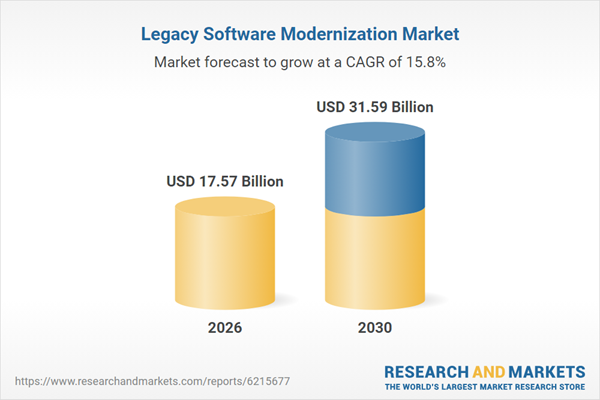
1. Core Platform Components
- Legacy application assessment layer: Automates the discovery of active software dependencies, structural complexities, and operational vulnerabilities hidden deep within decades-old application components.
- Legacy code audit and dependency mapping: Parses raw source structures to generate comprehensive visual system graphs, outlining how old subroutines interact with critical databases.
- API wrapper development layer: Encapsulates deep mainframe or server logic into modern, standardized microservices without forcing developers to modify the underlying code.
- Legacy database migration pipeline: Orchestrates secure transactional data transfers from historical repositories to elastic, cloud-native storage targets with zero data loss.
- Data cleansing and validation engine: Identifies, strips, and reformats corrupted or incomplete historical strings before they reach target analytical databases.
- Security modernization layer: Implements perimeter-wide encryption mechanisms, strict token validation rules, and unified access boundaries to defend exposed legacy pipelines.
- Compliance evidence layer: Records and structures immutable transaction event logs automatically to satisfy stringent regulatory reporting requirements during transition windows.
- Regression testing automation: Executes continuous performance comparisons between old systems and new endpoints to catch functional deviations immediately.
- Parallel run monitoring: Tracks live operational outputs across duplicate environments concurrently to guarantee data consistency before full production cutover.
- Decommissioning workflow: Handles the safe, programmatic shutdown and archiving of retired infrastructure blocks to eliminate unnecessary maintenance costs.
2. What This Platform Is Not
- A full enterprise system replacement: The platform operates as an active transitional buffer rather than a risky, ground-up rewrite of all core applications.
- A one-click AI code converter: It manages complex architecture shifts, data translations, and integrations instead of simply translating old syntax into modern languages.
- A lift-and-shift cloud migration only: Rehosting virtual machines on cloud servers preserves existing structural inefficiencies, whereas a true platform updates the functional architecture itself.
- A SaaS subscription that solves hidden business logic: Out-of-the-box software cannot decipher custom, undocumented operational rules embedded in proprietary, on-premise business systems.
- A dashboard without engineering workflows: The platform relies on active data pipelines, automated testing suites, and real-time routing engines rather than passive monitoring interfaces.
For a deeper breakdown of healthcare interoperability architecture, see our guide on Cost To Develop a Healthcare Data Interoperability Platform.
The platform matters because it creates a controlled bridge between the old system and the modern architecture. Without that bridge, modernization becomes a risky rewrite that threatens business continuity.
Because this architecture standardizes data flows and system boundaries, it provides technical leaders with clear control over initial launch scopes. Once the reader understands the platform, the next question is what actually drives legacy system modernization cost parameters up or down.
Why Enterprises Are Adopting Legacy Modernization
AI adoption, technical debt, and compliance risk are converging into one pressure: modernize now or pay more later. 43% of IT upgrades now exist specifically to enable AI capabilities, and that number keeps climbing. At the same time, legacy monoliths cannot support the API-first architecture AI inference pipelines require.
The data below shows exactly where that pressure is coming from.
1. AI Adoption Is Forcing the Upgrade
AI adoption is now the leading reason IT budgets move. 43% of IT upgrades exist specifically to enable AI capabilities, and 85% of executives believe legacy technology will limit AI adoption.
Consequently, modernized applications are 3x more likely to show measurable AI ROI, since legacy monoliths cannot run AI inference pipelines.
2. The Cost Burden of Staying on Legacy Systems
Legacy maintenance now consumes 60 to 80% of IT budgets, leaving little room for new development. Global maintenance costs reach $1.14 trillion annually, and U.S. technical debt hit $1.52 trillion in 2022 alone.
Costs then climb another 10 to 15% each year past vendor end-of-life.
3. Security and Compliance Risk Keeps Climbing
Unsupported legacy software accounts for nearly half of actively exploited vulnerabilities across enterprise systems.
Therefore, organizations running legacy IT are 40% more likely to face compliance violations, and the average security breach now costs $4.88 million. On top of that, 81% of organizations report at least one security incident every year.
4. Legacy Dependency Is an Industry-Wide Problem
Legacy dependency cuts across every regulated industry, not just healthcare. 70% of banks globally still run core operations on legacy systems, and over 60% of U.S. hospitals operate critical applications the same way.
Even payment infrastructure has not escaped it because 95% of ATM swipes still process through COBOL-based systems today.
5. Modernization Generates High ROI
Modernized infrastructure cuts costs almost immediately after deployment. Most organizations see a 25 to 35% reduction in infrastructure and licensing costs, and cloud-native environments push that figure as high as 75% lower infrastructure costs.
At the same time, release cycles speed up, running 30 to 50% faster once legacy bottlenecks are gone.
Therefore, delaying modernization just defers a bigger bill rather than just saving money. AI readiness, compliance pressure, and rising maintenance costs have converged into one mandate for every regulated industry.
What Drives Enterprise Legacy Modernization Development Cost?
Enterprise legacy modernization development cost rises when the system contains undocumented business logic, fragile integrations, poor data quality, outdated programming languages, compliance gaps, or high downtime risk. The biggest cost driver is the amount of hidden operational dependency the business has built around that code.
Consequently, untangling these systemic dependencies is what primarily dictates the engineering hours and financial resources required for successful platform delivery.
1. Legacy Codebase Age and Language
Older core infrastructures running on monolithic architectures require specialized, hard-to-find engineering expertise that dramatically increases your initial budget footprint.
When your operations depend on outdated backends, minor structural updates often require deep manual intervention to prevent cascading system failures.
- COBOL modernization cost factors: Over 220 billion lines of COBOL remain active globally, driving up developer rates due to extreme talent scarcity as the average programmer reaches retirement age.
- Outdated framework overhead: Maintaining systems built on Visual Basic, early Java editions, or older .NET Framework releases forces teams to pay high premium extended support fees just to retain foundational software stability.
- Automated translation limitations: Modern AI-assisted legacy code translation cost profiles look attractive, but automated code conversion engines frequently fail to parse complex, custom syntax accurately without extensive post-translation human refactoring.
As a result, software teams can safely bypass the high risks of automated conversion failures by focusing on incremental extraction patterns.
2. Technical Debt and Undocumented Logic
Hidden operational rules buried inside old code structures often act as an invisible anchor that slows down feature releases and drives up Diabetic inflation budgets.
When decades of undocumented hotfixes accumulate, engineers spend more time reading through confusing subroutines than writing modern features.
- Requirements archaeology costs: Uncovering hidden business rules trapped inside stored procedures requires extensive technical debt assessment cost outlays to prevent data corruption during cutovers.
- Duplicated functional blocks: Core processing logic is frequently copied across multiple disconnected screens, historical reports, and nightly batch jobs, requiring exhaustive manual normalization.
- Knowledge gap inflation: The total legacy system documentation cost escalates rapidly when original system architects have departed, forcing teams to pay for expensive knowledge transfer costs for legacy system workflows.
This deliberate mapping process directly prevents costly scope creep during later development phases.
3. Integration Depth
A legacy environment sits at the center of a complex web of downstream enterprise systems. Touching a single data endpoint can inadvertently break multiple operational processes across your entire business infrastructure.
- Fragile interface connections: Migrating data pipelines requires substantial legacy interface migration cost budgets to preserve custom connections with external ERP, CRM, and corporate accounting platforms.
- Specialized industry pathways: Regulated environments require dedicated HL7 v2 legacy integration cost allocations and legacy EDI transaction migration cost outlays to safely bridge old endpoints with modern networks.
- Downstream verification friction: Validating communication networks across health systems, billing clearings, or fintech payment routing paths significantly expands your overall system integration testing cost.
Consequently, enterprises avoid the massive expenses associated with full-scale downstream network rebuilds by building decoupled boundary layers.
4. Data Migration Complexity
Moving decades of enterprise records into elastic, modern storage engines involves much more than executing a simple database export and import command.
At the same time, historical schemas are almost always plagued by structural inconsistencies, missing fields, and corrupted formatting rules.
- Data quality remediation: Extracting unvalidated records forces teams to absorb unexpected data cleansing legacy migration cost outlays to fix corrupted formatting styles before ingestion.
- Structural translation mapping: Reorganizing relational tables for cloud storage targets scales up data mapping legacy systems cost factors to maintain historical record integrity.
- Rigorous pipeline validation: Ensuring every transactional line balances precisely after transfer requires continuous data validation. Additionally, legacy modernization cost budgets must pass strict financial audits.
This proactive strategy ensures that your business intelligence migration cost remains completely predictable from day one.
5. Security and Compliance Scope
Modernizing enterprise software requires full compliance with modern data security laws and zero-trust framework designs. Therefore, upgrading aging infrastructure means you must completely overhaul how identity, privacy, and encryption are handled across your platform.
- Regulated data protection: Managing protected health information demands strict HIPAA compliance and legacy modernization cost outlays to prevent expensive data breach exposures.
- Access control updates: Replacing hardcoded credentials requires dedicated legacy authentication modernization cost budgets to support modern single sign-on integration tools across your company.
- Infrastructure hardening: Securing vulnerable, unpatched endpoints requires significant identity and access management modernization cost investments and comprehensive legacy system encryption upgrade cost outlays.
This approach allows your business to achieve true zero-trust architecture migration cost control without disrupting day-to-day operations.
Cost increases when modernization touches business-critical logic, regulated data, or multiple downstream systems. Therefore, the safest budget is not based on lines of code alone, but on integration depth and architectural boundaries.
By prioritizing data isolation and modular component wraps, technical leaders can systematically de-risk their infrastructure updates. The next section shows the exact technical architecture that keeps the project inside the $70,000–$300,000 range.
Legacy System Modernization Architecture That Controls Cost
Legacy system modernization architecture controls cost by separating discovery, data access, integration, migration, security, testing, and rollout into clear layers. This prevents teams from rewriting everything at once. A phased architecture also helps enterprises preserve stable business logic while exposing data, improving workflows, and preparing systems for AI or cloud-native services.
Consequently, breaking the system into distinct operational zones prevents unexpected dependencies from crashing budgets during production rollout.
The following matrix outlines the strategic investment required across each core layer of a structured modernization framework:
Architecture Layer
| Modernization Layer | Essential Technical Deliverables | Estimated Cost Range |
| Layer 1: Assessment | Roadmap, system dependency graphs, risk register, technical debt audits | $8,000–$18,000 |
| Layer 2: API Wrapper | Microservices encapsulation, JSON endpoints, HL7 v2/EDI adapters, wrappers | $18,000–$45,000 |
| Layer 3: Data Migration | Schema mappings, staging ETL, cleansing engines, record validation models | $20,000–$55,000 |
| Layer 4: Runtime Environment | Cloud migration, container setups, Kubernetes orchestration, HA/DR design | $22,000–$60,000 |
| Layer 5: Security & Governance | Zero-trust authentication, SSO/IAM integration, PHI/data encryption upgrades | $15,000–$40,000 |
| Layer 6: Testing & Rollout | Automated regression testing, dual-run validation dashboards, rollback paths | $15,000–$38,000 |
Layer 1 — Assessment and System Inventory
The assessment layer identifies what the legacy system does, where it connects, what data it owns, and which workflows carry business risk. This phase usually costs $8,000–$18,000 and should produce a modernization roadmap, dependency map, risk register, and prioritized scope for the first build.
This phase removes the guesswork from engineering timelines by converting hidden technical liabilities into visible architectural tasks.
- Application portfolio inventory: Evaluates every active software asset, utility script, and internal helper application running within the core datacenter perimeter.
- Dependency scanning: Traces exactly how old subroutines exchange variables with internal subsystems to calculate the real legacy system risk assessment cost profiles.
- Database schema review: Examines database engines to flag table constraints, hardcoded keys, and hidden structural logic before planning data extractions.
Therefore, IT leadership can secure early internal alignment with exact dependency data before allocating further development capital. This structured visibility eliminates hidden operational liabilities before writing new infrastructure layers.
Layer 2 — API Wrapper and Interoperability Layer
The API wrapper layer exposes selected legacy functions through secure APIs without forcing immediate system replacement. This layer usually costs $18,000–$45,000 and works well when enterprises need faster integration, reporting, automation, or AI access while the core legacy system continues running.
It serves as an abstraction shield that decouples modern consumer apps from old host processing rules.
- API wrapper development cost factors: Building server boundaries allows modern web and mobile apps to interact safely with old core backends via clean JSON objects.
- API-led modernization cost control: Establishes reusable communication interfaces that eliminate the need to construct risky, point-to-point custom integrations for every new feature.
- Interoperability layer legacy systems execution: Integrates custom HL7 v2 and EDI data translators into a unified gateway to enable reliable data exchanges with external compliance networks.
Integrating secure FHIR wrapper legacy EHR cost profiles into this layer maintains seamless clinical data connectivity without downtime. This bridge helps technical leaders quickly support new applications without rewriting stable backend data storage engines.
Layer 3 — Data Migration and Validation Pipeline
The data migration layer moves, cleans, validates, and reconciles legacy data before the modern platform uses it. This phase usually costs $20,000–$55,000 because old systems often contain duplicate records, missing fields, inconsistent formats, and undocumented table relationships.
Safely staging data ensures your destination environments run efficiently without ingesting old formatting errors.
- Legacy data migration cost drivers: Creating cloud staging areas allows teams to inspect and process records without slowing down active production mainframes.
- Data cleansing legacy migration pipelines: Triggers automated cleaning scripts to standardize mixed formats, fill empty required rows, and remove duplicate entries.
- Legacy reporting system migration support: Reconfigures old corporate intelligence tools to point smoothly to modern cloud databases without breaking existing internal tracking reports.
Embedding automated data validation legacy modernization cost parameters right into the software engine proves that every record balances perfectly across targets. As a result, companies preserve total financial and operational audit trails throughout the transition.
Layer 4 — Cloud, Containerization, and Runtime Modernization
The runtime modernization layer moves selected workloads from aging infrastructure into managed cloud, containers, or modern deployment environments. This phase usually costs $22,000–$60,000 depending on on-premise dependencies, deployment automation, monitoring, scalability requirements, and disaster recovery needs.
It shifts operations away from fragile physical hardware toward flexible, modern infrastructure.
- On-premise to cloud migration cost inputs: Determine the exact cloud compute resources, virtual network setups, and firewalls needed to host isolated infrastructure layers.
- Containerization legacy systems frameworks: Packages old applications into isolated Docker environments to ensure consistent performance across development, staging, and production networks.
- High availability legacy modernization infrastructure: Sets up auto-scaling rules and Kubernetes orchestration tools to keep services online during unexpected traffic spikes.
Modernizing deployment, monitoring, access control, and rollback design together balances the overall cloud-native rearchitecture cost. This thorough design gives your infrastructure team complete control over system performance while significantly cutting down on emergency maintenance.
Layer 5 — Security, Compliance, and Governance Layer
The security layer updates access, encryption, audit trails, vendor controls, and compliance evidence before the modernized platform reaches production. This phase usually costs $15,000–$40,000 for healthcare and fintech teams because PHI, financial records, and regulated workflows need traceable safeguards.
It applies strict security controls to older environments that were originally designed for isolated data centers.
- Legacy security hardening cost reduction: Wraps older unencrypted protocols in transport layer protection to keep sensitive data safe while moving through networks.
- Zero-trust architecture migration implementation: Moves networks away from perimeter-only trust models by requiring active identity confirmation at every endpoint.
- HIPAA-compliant legacy modernization parameters: Sets up immutable system audit trails and granular access rules to satisfy state and federal privacy regulators.
Addressing complex BAA requirements legacy vendors mandate keeps internal networks protected from third-party vendor risks. Consequently, companies pass regulatory reviews easily while continuing to modernize their underlying core software layers.
Layer 6 — Testing, Parallel Run, and Rollback Layer
The testing layer proves that the modernized workflow produces the same or better business outcome as the legacy system. This phase usually costs $15,000–$38,000 and includes regression testing, UAT, integration testing, parallel runs, rollback planning, and performance validation. It provides the empirical proof required to switch traffic to your new systems with absolute confidence.
- Legacy system testing cost management: Runs automated test suites to ensure new application pathways produce matching outputs when given identical historical inputs.
- Parallel run legacy modernization metrics: Directs active system traffic to old and new layers simultaneously to find functional bugs before making the final switch.
- Legacy modernization rollback planning systems: Configures fast environment recovery routes to restore your original systems immediately if production unexpected errors pop up.
Using controlled rollout gates helps handle regression testing and legacy modernization cost parameters safely without endangering day-to-day business tools.
This deliberate verification model removes cutover anxiety, protecting core company performance metrics during final system launches.
Architecture keeps modernization affordable because it prevents unnecessary replacement. Each layer should reduce one specific risk before the next layer begins, ensuring that software investments scale in proportion to verified production milestones.
By adopting this layered engineering model, enterprises can balance budget control with genuine system innovation. After architecture, the blog should compare modernization approaches because each pathway changes the budget.
Legacy Modernization Cost by Approach: Rehost, Refactor, Rebuild, or Wrap
Legacy modernization cost changes based on the chosen pathway. Rehosting costs the least but preserves technical debt. API wrapping and replatforming cost more but improve integration speed.
Refactoring and rearchitecture cost the most inside the $70,000–$300,000 range, but they create stronger long-term scalability and AI readiness.
Therefore, matching your business goals to the correct technical pathway prevents wasted capital on over-engineered frameworks.
The following table displays how various execution styles impact baseline deployment budgets and project risk parameters:
1. Legacy Modernization Cost by Approach
| Approach | Cost Range Inside This Blog Scope | Best Use Case | Operational Risk |
| Rehost | $70,000–$100,000 | Move infrastructure with minimal code change | Carries technical debt and unpatched code forward |
| Replatform | $90,000–$150,000 | Move to managed cloud or modern database | Requires mid-level code and syntax adaptation |
| API Wrapping | $90,000–$180,000 | Expose legacy functions through clean APIs | Core business logic remains inside aging layers |
| Refactor | $140,000–$240,000 | Clean code and modularize critical workflows | Requires deeper regression testing validation |
| Rearchitect | $220,000–$300,000 | Shift monolith to modular architecture | Higher initial delivery and pipeline complexity |
| Rebuild | Usually outside this scope | Replace totally broken, unstable systems | High upfront cost, long timelines, and cutover risk |
2. When API Wrapping Is the Smartest First Move
Exposing existing code functionalities through an abstraction gateway allows you to add modern features without rewriting complex core software logic. This pathway serves as a protective boundary, keeping day-to-day business tools stable while new data connections roll out.
- Strangler fig pattern implementation cost boundaries: Building an intermediary routing proxy lets you redirect web requests to new microservices gradually over time.
- Low-disruption infrastructure encapsulation: Creating an API wrapper development cost baseline lets you access core data without turning off host servers.
- Preserving regulated processing engines: Legacy EHR systems, old revenue cycle management (RCM) tools, and fintech transaction mainframes remain completely untouched during development.
This approach provides a faster time-to-value because development teams can safely introduce AI models and automated reporting systems within weeks. Consequently, you can deliver modern user features without undergoing a risky, ground-up infrastructure overhaul.
3. When Refactoring Is Worth the Cost
Rewriting and cleaning up inner application structures pays off when application maintenance costs threaten to overtake new software feature budgets. This investment directly optimizes how smoothly your systems run on a daily basis.
- Developer productivity recovery: Restructuring messy, tangled code scripts reduces the time engineers spend diagnosing unexpected errors during minor update rollouts.
- System resource optimization: Cleaning up inefficient code logic lowers your cloud runtime costs and improves overall processing speeds.
- Automated verification expansion: Enhancing your underlying test coverage ensures that future software releases will not accidentally break existing production workflows.
Investing in a targeted legacy code refactoring cost path restores long-term system maintainability for your engineering team. This structural cleanup ensures your software remains agile enough to support changing business models without collapsing under technical debt.
4. When Microservices Migration Is Too Expensive
Breaking a working monolithic system into dozens of small, distributed microservices often introduces massive operational tracking complexities that small engineering teams struggle to manage. Splitting code boundaries too early can create severe performance bottlenecks across your entire digital environment.
- Network latency overhead: Replacing simple in-memory function calls with complex network requests adds substantial communication lag across active user sessions.
- Infrastructure budget inflation: Managing separate deployment pipelines and container clusters drives up your base monolith-to-microservices migration cost.
- Data consistency friction: Resolving distributed database transactions requires complicated engineering logic that can easily lead to record sync failures.
Engineering communities across Reddit and technical forums frequently emphasize that teams heavily underestimate microservices architecture migration cost overheads, realizing too late that a modular monolith is often the more practical alternative. Keeping your data layers centralized while enforcing strict, decoupled code boundaries gives you the same architectural flexibility at a fraction of the cost.
5. When Full Replacement Should Be Avoided
Attempting to completely replace a massive core application all at once ranks as one of the highest-risk capital investments an enterprise can make. These large projects often experience severe budget overruns because undocumented operational requirements surface late in the development cycle.
- Hidden migration liabilities: Moving historical records into a completely unproven system dramatically expands your enterprise legacy system replacement cost exposure.
- Operational adoption friction: Forcing teams to learn entirely new software workflows creates severe drops in daily staff productivity during cutovers.
- Contractual platform lock-in: Transitioning too quickly to proprietary, out-of-the-box vendor platforms often leads to high long-term licensing fees.
Operating parallel systems over long transition periods strains engineering resources and increases data security risks. Managing these complex dual environments requires strict oversight to keep initial rollout budgets under control.
The most expensive option is not always the best option. For many enterprises, API wrapping plus phased refactoring gives the best balance of cost, speed, and risk control. By focusing capital on high-value system boundaries, engineering leads can deliver immediate business results while deferring major platform infrastructure risks.
Legacy Healthcare System Modernization Cost and Compliance Needs
Legacy healthcare system modernization cost usually ranges from $110,000 to $300,000 when the build includes EHR access, PHI protection, HIPAA controls, HL7 v2 interfaces, FHIR wrappers, audit trails, and clinical workflow validation.
Healthcare modernization costs more than standard enterprise modernization because patient data, clinical uptime, and compliance evidence shape every technical decision.
As a result, software engineering within this sector demands specialized validation steps to protect data privacy and maintain uninterrupted care delivery.
1. Legacy EHR Modernization Platform Cost
Connecting old medical records engines to web services requires a secure access layer that can parse traditional server formats into readable clinic data fields. This protective engineering step updates old systems without threatening active point-of-care software networks.
- EHR data pipeline insulation: Building secure data access layers creates a stable framework for modern application integration without changing primary data logic.
- FHIR wrapper legacy EHR cost metrics: Creating modern API access paths usually requires specialized translation components to convert historical data into standard, compliant endpoints.
- HL7 v2 feed processing integration: Establishing continuous background data listeners routes real-time laboratory and patient updates safely into modern user applications.
This translation step handles complex patient identity mapping rules across separate database schemas automatically to eliminate duplicate charts. Technical teams can safely deploy clinical workflow risk management controls while maintaining high daily platform uptime.
Consequently, hospital networks gain real-time system visibility without triggering backend database lockups.
2. HIPAA-Compliant Legacy Modernization Cost
Upgrading an old healthcare database means your development team must implement strict, trace-ready data protection layers across every single software endpoint. Building these privacy safeguards directly expands your overall HIPAA-compliant legacy modernization cost profile.
- PHI security legacy systems execution: Moving sensitive records requires field-level data encryption tools both while data travels over networks and when it sits in cloud storage.
- Access control system enforcement: Setting up detailed, role-based user policies ensures that only authorized medical personnel can view specific patient records.
- Audit-ready documentation generation: Constructing automated logging pipelines tracks every data modification event to satisfy state and federal compliance reviews.
Managing strict BAA requirements and legacy vendors’ mandates ensures that your third-party integrations adhere completely to federal data safety rules.
This thorough security setup mitigates hidden vendor risks and shields your clinical environment from expensive compliance fines.
3. RCM and Claims System Modernization Cost
Modernizing revenue cycle management (RCM) platforms involves updating fragile billing engines that interact with multiple clearinghouse networks. Introducing automation to these environments significantly reduces claims processing times and drops manual error rates.
- Legacy EDI transaction migration cost factors: Transitioning core billing pipelines requires rebuilding custom handlers for 837 claims submissions and 835 payment files.
- RPA legacy system integration cost control: Deploying software bots handles tedious, repetitive insurance eligibility checks and prior authorization updates automatically.
- Denial analytics reporting modernization: Connecting modern data pipelines to old billing targets provides clean data for automated financial reporting tools.
For a deeper breakdown of EHR integration economics, see our guide on How Much Does 50+ Hospital EHR Integration Platform Cost?.
Deploying targeted robotic process automation to lower legacy cost structures lowers manual invoice entry friction while extending the lifespan of working legacy tools. This focused development path protects daily collections, allowing finance teams to identify billing bottlenecks without replacing core accounting modules.
How AI-Assisted Legacy Modernization Changes Cost
AI-assisted legacy modernization can reduce assessment, documentation, test creation, code translation, and dependency mapping effort, but it does not remove the need for human architecture review. Inside a $70,000–$300,000 build, AI is most useful for discovery acceleration, code summarization, migration planning, regression test generation, and documentation recovery. Consequently, deploying targeted machine learning tools shortens engineering timelines while lowering overall baseline implementation budgets.
The following table details the cost impact and specific dollar ranges across various application tiers when integrating AI automation into your development strategy:
| Modernization Layer | Traditional Engineering Cost | AI-Assisted Engineering Cost | Net Cost Savings Percentage | Realized Deliverables & Operational Value |
| Discovery & Documentation | $12,000–$25,000 | $4,000–$9,000 | 60–65% Savings | Automated code graph generation, knowledge extraction, logic mapping |
| Code Translation (COBOL/Java) | $45,000–$90,000 | $18,000–$42,000 | 50–60% Savings | Syntax conversion, batch translation, archaic library deprecation |
| Regression Test Generation | $25,000–$48,000 | $8,000–$18,000 | 60–68% Savings | Characterization test suites, edge-case validation, automated UAT scripts |
| Total Pipeline Integration | $82,000–$163,000 | $30,000–$69,000 | 55–63% Total Drop | Accelerated production-ready MVP deployment layers |
Setting up safe human approval workflows prevents automated systems from executing high-risk business or clinical actions without active internal oversight. This deliberate approach ensures that your advanced infrastructure remains reliable and adheres completely to corporate compliance mandates.
For a deeper breakdown of AI governance controls, see our guide on Development Cost For Enterprise AI Governance Framework.
Build vs Buy Legacy Modernization Platform Cost
Build vs buy legacy modernization platform cost should be decided by system uniqueness, compliance exposure, integration depth, and long-term control. Buying can work for commodity workflows, but custom builds are stronger when the enterprise must preserve proprietary business logic, connect regulated systems, reduce vendor lock-in, or modernize workflows without full replacement.
Consequently, leaders must weigh immediate speed against the long-term flexibility of owning their foundational infrastructure.
1. When Buying Makes Sense
Off-the-shelf software provides pre-built functionality that works well for non-differentiated business processes. These solutions allow organizations to adopt standard industry practices immediately without spending capital on early-stage engineering or architectural design cycles.
- Commodity workflow availability: Buying functions well when your business requirements align perfectly with standard market features, such as basic HR or general office email management.
- Low compliance risk profiles: Standard tools often come with existing certifications, simplifying the burden of maintaining your internal audit-ready documentation.
- Standard interface libraries: Many commercial platforms include pre-made adapters for popular databases, which significantly shortens initial setup and deployment timelines.
These platforms work best when your primary goal is rapid operational stabilization rather than creating a proprietary competitive advantage. This path is ideal if your current systems are standard enough that they do not require deep, custom logic integration.
2. When Custom Build Makes Sense
Custom builds ensure that your software architecture follows your precise business rules rather than forcing your operations to conform to a vendor’s limited functional roadmap. Building a proprietary modernization platform protects your unique clinical or financial workflows from rigid vendor constraints.
- Proprietary business logic preservation: A custom legacy modernization platform cost approach ensures that decades of specialized operational wisdom remain embedded in your modernized application layers.
- Regulated data handling: Tailored platforms allow you to implement exact PHI or financial security controls that standard vendor products often overlook.
- Vendor lock-in remediation: Building your own bridge layers keeps your data portable, ensuring you can move between different cloud environments or backend databases as business needs evolve.
This investment strategy guarantees long-term ownership over your most critical digital assets. Technical leaders choose this route when they need total control over integration depth and the ability to update proprietary systems quickly.
3. Hybrid Build-Buy Model
The hybrid model uses established commercial tools for generic infrastructure tasks while keeping custom development focused on your unique competitive differentiators.
This strategy balances speed with total control over your most critical business logic.
- Leverage commercial infrastructure: Utilize existing market-leading tools for system scanning, performance monitoring, and cloud-native hosting services.
- Custom workflow development: Dedicate your internal engineering budget to building the specific API, compliance, and data migration layers that connect your unique core to those tools.
- Scope reduction: Limiting custom code to your business-essential workflows keeps your project scope tight, lowering your total custom build cost while maintaining ownership over core intellectual property.
This model provides a professional-grade operational foundation while ensuring your unique proprietary data and workflows remain under your direct management.
4. Five-Year TCO Comparison
| Option | Year 1 Cost | 5-Year Risk | Best Fit |
| Buy SaaS replacement | $80,000–$250,000+ | Vendor lock-in, migration limits | Standard workflows |
| Custom modernization platform | $70,000–$300,000 | Requires ongoing internal ownership | Regulated custom workflows |
| Full replacement | $300,000+ to millions | High migration and adoption risk | Broken or obsolete systems |
| Hybrid model | $120,000–$280,000 | Requires active governance | Most enterprise cases |
The cheapest option on paper can become expensive if it increases lock-in or forces workflow compromise. The best decision protects control over data, integrations, and business rules, ensuring that your software remains an asset rather than a rigid burden.
By balancing external tools with custom, value-adding layers, enterprises can scale their modernization efforts while minimizing the total long-term technical and financial debt. The next section should cover hidden costs because those are what usually break the business case.
Hidden Costs That Break Legacy System Modernization Budgets
Hidden legacy modernization costs usually come from data quality problems, undocumented dependencies, compliance gaps, user retraining, vendor lock-in, parallel operations, and testing delays. These costs can add 20–40% to the original budget if they are not scoped during assessment.
The best way to control them is to price them before development starts. Failing to scope these items early forces companies to exhaust their capital reserves on operational stabilization instead of launching features.
The following index displays how these overlooked categories impact standard infrastructure deployment budgets:
Operational and Transition Capital Variance Factors
| Expense Classification | Baseline Cost Range | Core Driving Variable | Budget Risk Level |
| Parallel Environment Runs | $15,000–$45,000 | System processing volume and sync hours | High Risk |
| Extended Vendor Licensing | $10,000–$35,000 | Contract exit clauses and support tiers | Medium Risk |
| Staff Training & Adoption | $8,000–$20,000 | Workspace changes and helpdesk volume | Low Risk |
| Governance Oversight | $10,000–$25,000 | Steering committee hours and scope control | Medium Risk |
| Decommissioning & Archive | $8,000–$22,000 | Compliance storage rules and data sizes | Medium Risk |
Modernization budgets fail when teams price development but ignore transition. The transition work is where operational risk becomes visible, requiring precise resource balancing across every layer of the enterprise.
By calculating these transition items early, engineering leads can protect their implementation capital from sudden mid-project shortages. The next section gives the actual phased development roadmap.
How to Build a Legacy System Modernization Platform
Building a legacy system modernization platform requires a phased process: assessment, architecture design, API exposure, data migration, security remediation, cloud or runtime modernization, testing, rollout, and decommissioning.
This order keeps cost controlled because each phase proves one layer before the next one receives budget. Therefore, treating development as a sequential workflow prevents unpredictable runtime bugs from breaking live production platforms.
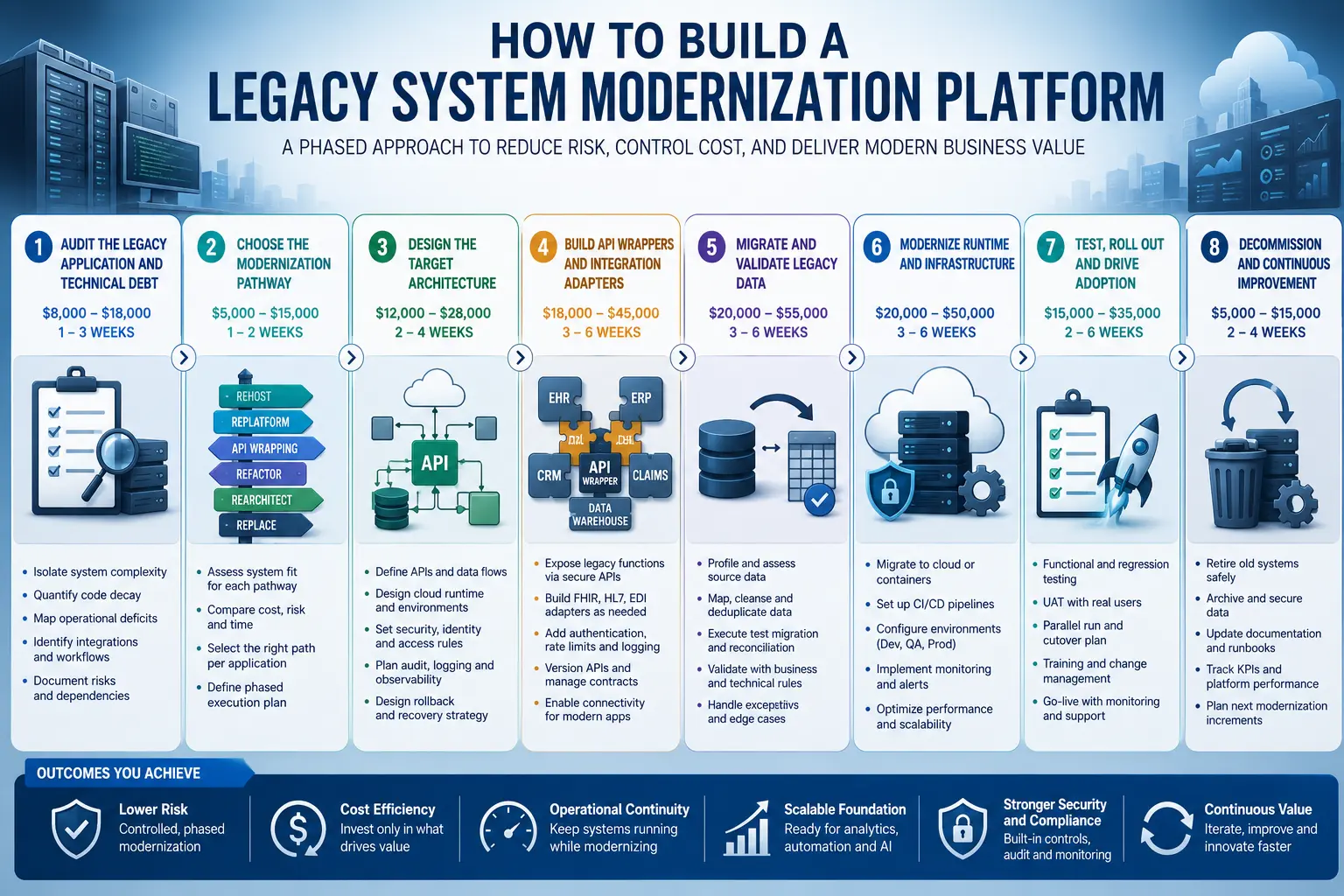
Step 1 — Audit the Legacy Application and Technical Debt
Start with a technical and business audit before touching the code. This phase identifies the workflows, integrations, databases, reports, security gaps, and undocumented logic that modernization must protect.
For most scoped platform builds, this step costs $8,000–$18,000 and takes 1–3 weeks. This initial discovery phase uncovers hidden systemic liabilities before any replacement code is written.
- Isolating system complexity: Calculating your initial legacy application assessment cost reveals the structural dependencies that drive up deployment timelines.
- Quantifying code decay: Establishing an accurate legacy code audit cost highlights fragile, unmaintained subroutines that threaten runtime stability.
- Mapping operational deficits: Undergoing a deep technical debt assessment cost review surfaces undocumented business logic buried inside old server environments.
At Intellivon, we pair engineering discovery with workflow discovery, so the roadmap reflects how users actually depend on the system. This comprehensive scoping protects your core business processes, giving leadership clear data to secure project funding early.
Step 2 — Choose the Modernization Pathway
Choose the pathway per system, not across the whole enterprise. Rehost, replatform, API wrapping, refactoring, rearchitecture, and replacement carry different cost and risk profiles.
For a $70,000–$300,000 build, API wrapping, phased refactoring, and selective replatforming usually offer the safest first scope. Matching execution styles to individual application conditions keeps budgets predictable.
- Infrastructure-only transfers: A basic rehost or replatform option relocates applications to cloud environments without altering the core functional syntax.
- Targeted codebase cleanup: Opting to refactor or rearchitect updates inner program files to improve application performance and support scalable microservices.
- Phased component extraction: Implementing a strangler fig pattern replaces old software pieces step-by-step using a structured phased migration strategy.
Intellivon uses pathway selection to prevent overbuilding. If API wrapping solves the business case, the team does not recommend a full rewrite. This pragmatic engineering focus eliminates unneeded development work and reduces delivery risks.
Step 3 — Design the Target Architecture
Design the target architecture before development begins. This phase defines APIs, data flows, cloud runtime, security boundaries, identity rules, audit logs, observability, and rollback design.
It usually costs $12,000–$28,000 and prevents the build from becoming a disconnected migration exercise. Setting clear design rules early guides your developers through complex system updates safely.
- Formulating platform frameworks: Outlining your legacy system modernization architecture coordinates data paths and manages third-party interface linkages.
- Cloud infrastructure planning: Calculating your comprehensive cloud-native rearchitecture cost determines the elastic processing and storage spaces your new platform needs.
- Decoupling application boundaries: Utilizing an API-led modernization approach separates modern user interfaces from archaic host data rules.
Intellivon creates architecture that supports current operations first, then prepares the platform for analytics, automation, and AI integration. This dual-purpose design yields a highly flexible environment capable of supporting advanced automation without requiring a full code overhaul.
Step 4 — Build API Wrappers and Integration Adapters
Build secure API wrappers to expose selected legacy functions without changing the entire backend. This phase usually costs $18,000–$45,000 and lets teams connect EHRs, claims systems, ERPs, CRMs, reporting tools, data warehouses, and AI services to legacy workflows.
Creating these data abstraction zones modernizes connectivity while preserving your existing transaction processing.
- Isolating core data logic: Allocating an explicit API wrapper development cost budget provides web-ready endpoints without modifying your stable backends.
- Standardizing clinical channels: Factoring in your FHIR wrapper legacy EHR cost and HL7 v2 legacy integration cost maintains secure patient data pathways.
- Bridging finance systems: Investing in a structured legacy EDI transaction migration cost plan converts older commercial transaction records into modern messaging formats.
Intellivon builds wrappers with authentication, rate limits, logging, and version control so the integration layer can scale beyond the first workflow. This thorough design manages your overall legacy interface migration cost, protecting aging core software from external integration overloads.
Step 5 — Migrate and Validate Legacy Data
Migrate only the data required for the first modernization scope. This phase usually costs $20,000–$55,000 and includes data profiling, mapping, cleansing, deduplication, test migration, reconciliation, validation rules, and exception handling.
Cleaning your historical files prevents old data formatting errors from degrading your new systems.
- Reorganizing data layouts: Tracking your data mapping legacy systems cost helps reconfigure relational schemas for modern cloud storage targets.
- Remediating structural records: Budgeting for an automated data cleansing legacy migration pipeline strips out duplicate fields and corrects incomplete record entries.
- Validating transfer pipelines: Confirming data integrity through a clear data validation legacy modernization cost plan guarantees precise record replication across destinations.
Intellivon validates migrated data against business rules, not only row counts, because legacy reports often hide operational meaning. This deep data audit manages your overall legacy reporting system migration cost and legacy database migration cost, keeping your downstream legacy analytics modernization cost footprints entirely stable.
Step 6 — Modernize Security, IAM, and Compliance Controls
Modernize security before production rollout. This phase usually costs $15,000–$40,000 and includes SSO, IAM, RBAC, encryption upgrades, audit logs, secure API access, vendor risk controls, HIPAA safeguards, and compliance evidence.
Upgrading your security perimeters defends exposed code from modern network exploits.
- Updating identity frameworks: Planning your legacy authentication modernization cost helps swap out hardcoded credentials for a secure single sign-on integration setup.
- Enforcing zero-trust principles: Managing your identity and access management modernization cost paths requires active verification controls across all network zones.
- Hardening data perimeters: Calculating your legacy system encryption upgrade cost profiles sets up end-to-end encryption for all sensitive customer and patient data.
Intellivon documents security decisions as compliance evidence, which helps healthcare and fintech teams prepare for audits and vendor reviews. This embedded compliance approach handles your HIPAA compliance legacy modernization cost parameters smoothly without causing project rollout delays.
Step 7 — Run Testing, Parallel Operations, and Rollback Planning
Test the modernized workflow against the legacy workflow before cutover. This phase usually costs $15,000–$38,000 and includes regression tests, characterization tests, UAT, integration testing, performance checks, parallel runs, and rollback planning.
Verifying system outputs under real work stresses prevents data errors from reaching your production databases.
- Automated code verification: Allocating an explicit regression testing legacy modernization cost budget checks that updated software modules match original functional outputs.
- Evaluating user experiences: Budgeting for your custom UAT cost legacy modernization processes ensures new software layouts align with daily internal workflows.
- Validating connection layers: Directing resources toward a structured legacy system integration testing cost plan confirms data flows smoothly between all software parts.
Intellivon uses release gates so teams can compare outputs before retiring old workflows. This rigorous method handles your parallel run legacy modernization cost and legacy modernization rollback planning cost factors safely, while optimizing your base legacy system performance optimization cost before final cutovers.
Step 8 — Roll Out, Train Users, and Decommission Legacy Components
Rollout should happen by workflow, user group, or system boundary. This phase usually costs $8,000–$20,000 and includes staff training, knowledge transfer, documentation, support handoff, monitoring setup, data archiving, and selective decommissioning.
Turning off old hardware elements safely removes ongoing licensing liabilities from your books.
- Onboarding operational teams: Funding an active staff training cost legacy modernization setup ensures workers navigate updated software screens efficiently.
- Preserving technical insights: Investing in a structured knowledge transfer cost legacy systems workflow builds comprehensive documentation for your ongoing maintenance handoffs.
- Archiving historical files: Balancing your upfront legacy system decommissioning cost with a clear legacy data archiving cost plan retains older records for compliance reviews.
Intellivon treats decommissioning as part of modernization ROI because old systems keep costing money if they remain active after migration. Completing this final step controls your long-term legacy system documentation cost, helping your business capture its full infrastructure savings.
The safest modernization projects do not start with code. They start with evidence, architecture, and risk boundaries, ensuring that every engineering hour targets a specific operational milestone. By executing updates through a deliberate, multi-step framework, companies protect their active revenues while building agile, data-ready environments.
Build Your Legacy System Modernization Platform With Intellivon
Intellivon helps enterprises modernize legacy systems through controlled assessment, architecture design, API wrappers, data migration, cloud modernization, security hardening, compliance evidence, AI-assisted engineering, and phased rollout.
The goal is not to replace everything at once. The goal is to reduce risk, expose value, and build a modernization layer that production teams can trust.
1. Start With Legacy System Assessment
Intellivon starts every modernization build with a detailed legacy system assessment. The team reviews the current application portfolio, system dependencies, codebase condition, integration points, data quality, infrastructure limits, and compliance exposure before defining the first modernization scope.
This stage gives CTOs and enterprise architecture teams a clear cost estimate before development begins. It also identifies technical debt, vendor lock-in, downtime risk, security gaps, and workflows that should not be disrupted during migration.
The assessment usually covers:
- System inventory
- Technical debt mapping
- Integration review
- Data quality review
- Compliance risk mapping
- Build scope and cost estimate
This helps leadership avoid overfunding a full replacement when a phased modernization layer can solve the first business problem faster.
2. Build API and Interoperability Layers
Intellivon builds API and interoperability layers that allow legacy systems to connect with modern applications without forcing an immediate rebuild. This is often the safest first step for hospitals, RCM companies, financial institutions, and enterprises that still depend on aging core systems.
The team can develop API wrappers, FHIR wrappers, HL7 v2 interfaces, EDI transaction flows, claims system connectors, EHR integrations, ERP connections, and CRM integrations. These layers expose the right data while keeping the legacy system operational during modernization.
This approach works well when the enterprise needs faster reporting, AI model access, workflow automation, or partner integration. It also reduces vendor lock-in by giving the organization more control over its own data and system access.
3. Modernize Data and Security Together
Legacy modernization fails when teams migrate data first and handle security later. Intellivon modernizes both together, so the platform can support clean data movement, access control, auditability, and compliance from the start.
The team handles data migration, cleansing, validation, encryption, IAM, SSO, role-based access, audit logs, and HIPAA controls where healthcare data is involved. For fintech and regulated enterprise systems, the same discipline applies to transaction data, user permissions, reporting evidence, and security monitoring.
This combined approach helps enterprises avoid expensive rework after launch. It also makes the modernized platform easier to audit, scale, and connect with AI, analytics, or automation systems.
4. Use AI Where It Reduces Engineering Effort Safely
Intellivon uses AI in modernization where it improves speed without weakening engineering control. AI can support code summarization, documentation recovery, dependency analysis, test generation, and migration planning, especially when old systems have limited documentation.
However, Intellivon does not treat AI-assisted modernization as automatic code replacement. Human engineers still review business logic, security behavior, compliance requirements, and production readiness before any modernized workflow goes live.
This balance matters for healthcare, fintech, claims, EHR, ERP, and data-heavy systems. AI can reduce manual analysis, but architects still need to validate what the system does and how the modern platform should behave.
5. Roll Out in Phases
Intellivon rolls out modernization platforms in phases instead of forcing a high-risk cutover. The team uses parallel runs, regression testing, UAT, rollback planning, staff training, monitoring, and decommissioning support to protect business continuity.
This phased approach helps teams compare modernized workflows against legacy outputs before retiring old components. It also gives users time to adjust, report issues, and build confidence in the new platform.
For most enterprises, this is the safest way to stay inside a $70,000–$300,000 first-phase modernization budget. The goal is to prove value, reduce operational risk, and create a platform foundation for broader modernization later.
Why Enterprises Work With Intellivon
Intellivon brings more than 500K+ engineering hours, ex-MAANG engineering experience, and deep delivery experience across healthcare, fintech, AI, data, and enterprise integrations.
The team builds compliance-ready production systems for complex workflows where security, uptime, and data accuracy matter.
For enterprises running aging core systems, Intellivon can help scope the first modernization phase, define the right architecture, and build a controlled platform that connects legacy infrastructure with modern applications, AI models, and cloud-ready workflows.
Talk to Intellivon’s modernization team to scope your first $70,000–$300,000 legacy modernization platform build.
Conclusion
Legacy system modernization cost becomes easier to control when enterprises treat modernization as a phased platform build, not a full replacement sprint. A focused $70,000–$300,000 roadmap can cover assessment, API wrappers, data migration, security hardening, testing, and rollout.
The strongest projects protect business logic, reduce technical debt, improve compliance, and create a modern foundation for cloud, analytics, automation, and AI while keeping critical operations stable over time.
Things To Know About Legacy System Modernization Platform Cost
Q1. How much does legacy system modernization cost?
A1. Legacy system modernization cost usually ranges from $70,000 to $300,000 for a focused platform build. Typically, an assessment and API wrapper MVP costs $70,000–$110,000. However, production builds with data migration, cloud deployment, security, testing, and compliance controls usually reach $180,000–$300,000, depending on scope and integration depth.
Q2. How long does legacy system modernization take?
A2. A focused legacy modernization MVP usually takes 10–16 weeks when the scope includes assessment, API wrappers, and limited testing. However, a production-ready platform takes 4–8 months because it adds data migration, security controls, regression testing, UAT, and phased rollout. Meanwhile, full replacement programs often take 12–36 months or more.
Q3. What is the legacy healthcare system modernization cost?
Legacy healthcare system modernization cost usually ranges from $110,000 to $300,000 for a focused platform. However, healthcare builds cost more when they include EHR access, HL7 v2 feeds, FHIR wrappers, PHI protection, HIPAA controls, audit logs, and clinical workflow validation across regulated care environments.
Q4. What is the legacy system modernization platform build cost for enterprises?
A4. Legacy system modernization platform build cost usually falls between $120,000 and $300,000 for enterprise teams. This range typically covers architecture design, API exposure, data migration, cloud or container deployment, IAM, encryption, testing, monitoring, documentation, and rollout support. Therefore, scope control matters before capital approval.
Q5. Is build vs buy legacy modernization platform cost lower?
A5. Buying is usually lower-cost when the workflow is standard, and vendor constraints are acceptable. However, custom build is stronger when the system contains proprietary logic, regulated data, complex integrations, or vendor lock-in. As a result, many healthcare and fintech teams choose a hybrid model between $120,000 and $280,000.
Q6. How much does HIPAA-compliant legacy modernization cost?
A6. HIPAA-compliant legacy modernization usually adds $15,000–$40,000 to the platform budget. This cost covers PHI safeguards, encryption, access control, audit logging, vendor documentation, BAA readiness, security testing, and compliance evidence. Therefore, healthcare teams should price HIPAA controls before development, not after launch.
Key Takeaways
- A $70,000 modernization budget should not promise full replacement. It should prove one high-value workflow through assessment, API access, and controlled validation.
- The biggest legacy modernization cost driver is not old code. It is hidden business logic inside reports, integrations, stored procedures, and manual workarounds.
- Microservices can increase modernization cost when the team lacks DevOps maturity. API wrapping and modular refactoring often create safer first wins.
- HIPAA-compliant modernization costs more because PHI security, audit logs, access controls, and validation evidence must be built before rollout.
- AI reduces modernization effort when it supports code analysis, documentation, and testing. It becomes risky when teams use it to replace architecture review.