Key Takeaways:
-
Carbon accounting platforms start by defining GHG Protocol boundaries and building a structured carbon ledger.
-
ERP, utility, procurement, fleet, supplier, and IoT integrations feed activity-based and spend-based calculation models.
-
CSRD, SEC-readiness, TCFD, CDP, SBTi, ISO 14064, and PCAF framework mapping ensure audit-ready outputs.
-
Custom enterprise builds cost $70,000 to $300,000 depending on Scope 3 depth and integration complexity.
-
How Intellivon builds finance-grade carbon accounting software with audit trails
Developing carbon accounting software for corporate use starts with the organizational boundary decision, choosing between operational control, financial control, or equity share consolidation, because this single choice determines how every subsidiary and business unit rolls up into the parent entity ledger. Once that boundary is set, the platform connects to financial systems for general ledger mapping, then builds the multi-entity consolidation layer, and finally adds AI estimation models for activity data gaps.
This boundary decision carries more financial weight than most teams expect, since redrawing it after launch means recalculating every historical baseline and restating prior disclosures across every connected subsidiary. A peer-reviewed harmonization study examining 56 technology companies found that reported carbon footprints increased by a median factor of four once boundary incompleteness and reporting inconsistencies were corrected for, with the gap traced directly back to inconsistent boundary methodology at the accounting design stage.
Intellivon approaches corporate carbon accounting software development the way a financial reporting system gets built, with the boundary and consolidation logic locked before a single dashboard gets designed. This blog walks through organizational boundary architecture, financial system integration, AI estimation models, audit readiness, and cost from $70,000 to $300,000 for building a platform from scratch.

What is Corporate Carbon Accounting Software?
Corporate carbon accounting software is an enterprise data platform that tracks greenhouse gas emissions across all business operations. Specifically, the system operates like a financial ledger by turning raw utility bills and supply chain data into verifiable metrics.
Because global laws now mandate transparency, this software provides an auditable data trail. Consequently, chief financial officers can easily satisfy compliance audits and manage carbon liabilities.
Core Functions Of The Software
Carbon accounting software effectively functions as a governed data system for emissions records.
- Operational Conversion: Specifically, it calculates emissions by multiplying activity data by emission factors.
- Carbon Ledger. Furthermore, it stores a complete ledger of every activity and calculation method.
- Data Management. Consequently, it manages raw data normalization separately from final reporting outputs.
- Single Source Of Truth Finally, it unifies ESG and finance teams through one data source.
It transforms fragmented operational evidence into finance-grade emissions intelligence.
Why Large Enterprises Need A Carbon Ledger Now
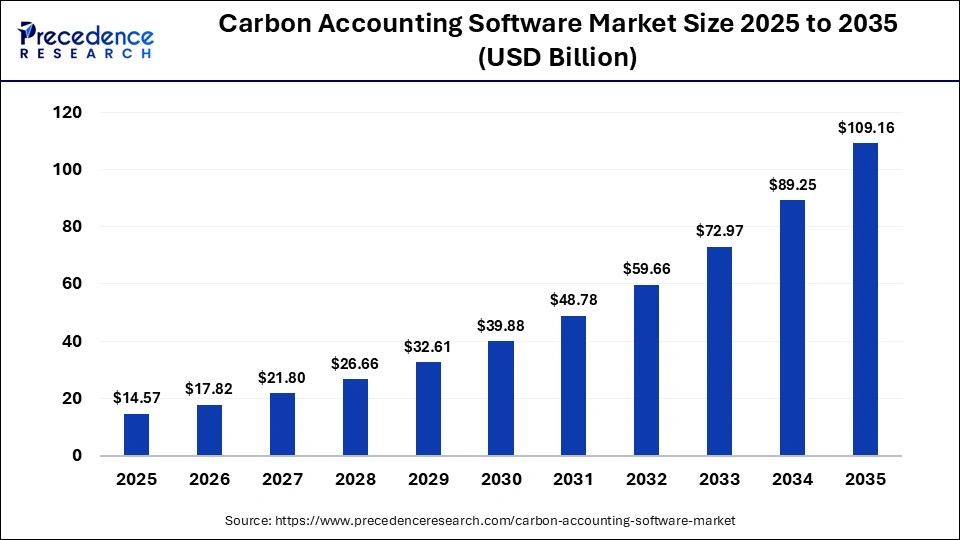
Large enterprises need a carbon ledger now because emissions accounting has become a core business control, not a side sustainability report.
1. Regulations Are Moving Toward Assurance-Ready Data
Global frameworks demand strict compliance data that can pass third-party audits. While the US SEC formally proposed to rescind its 2024 climate rules in May 2026, public corporations face a complex web of alternative requirements.
- CSRD carbon accounting compliance software is mandatory for firms with significant EU operations.
- ISO 14064 carbon accounting compliance sets the explicit standard for validating data correctness.
- TCFD carbon accounting alignment and SBTi-aligned carbon accounting software drive major investor assessments.
- CDP carbon accounting disclosure integration satisfies institutional board demands alongside California’s active climate disclosure laws.
2. Scope 3 Turns Suppliers Into Reporting Dependencies
Large enterprises cannot calculate their complete carbon footprint without pulling data from external vendors. Supply chains represent the largest portion of corporate emissions, meaning your climate profile depends directly on third-party disclosure.
- Upstream Mandates: Smaller suppliers report intense pain as corporate buyers require strict emissions disclosures to maintain active vendor contracts.
- Procurement Filters: Procurement teams use these data pipelines to filter out carbon-heavy business partners.
3. Healthcare Carbon Data Is Multi-Site And Operational
Medical networks operate highly complex, decentralized systems that require a dedicated healthcare corporate carbon accounting software approach. Managing this data requires consolidating hundreds of distinct operational inputs into a hospital system carbon ledger platform.
- Facility Emissions: Tracks high-energy medical facilities, waste vendors, and healthcare fleet and facility emissions accounting.
- Clinical Impacts: Measures chemical volumes from anesthetic gases alongside pharmaceutical corporate carbon accounting variables.
- Supply Chain Tracking: Automates tracking for a medical device manufacturer’s carbon accounting and millions of purchased medical supplies.
4. Fintech Carbon Data Must Support PCAF
Financial institutions face strict rules regarding the carbon footprint of their capital deployment. Under the Partnership for Carbon Accounting Financials framework, banks and asset managers must account for the emissions generated by their business portfolios.
- Financed Emissions: Measures the exact carbon liability tied directly to commercial loans, equity investments, and insurance underwriting.
- Portfolio Analysis: Integrates asset manager portfolio carbon accounting to calculate emissions per dollar invested.
Enterprises must stop treating sustainability as a public relations task. Instead, you need a carbon ledger that finance, compliance, procurement, and auditors can trust implicitly.
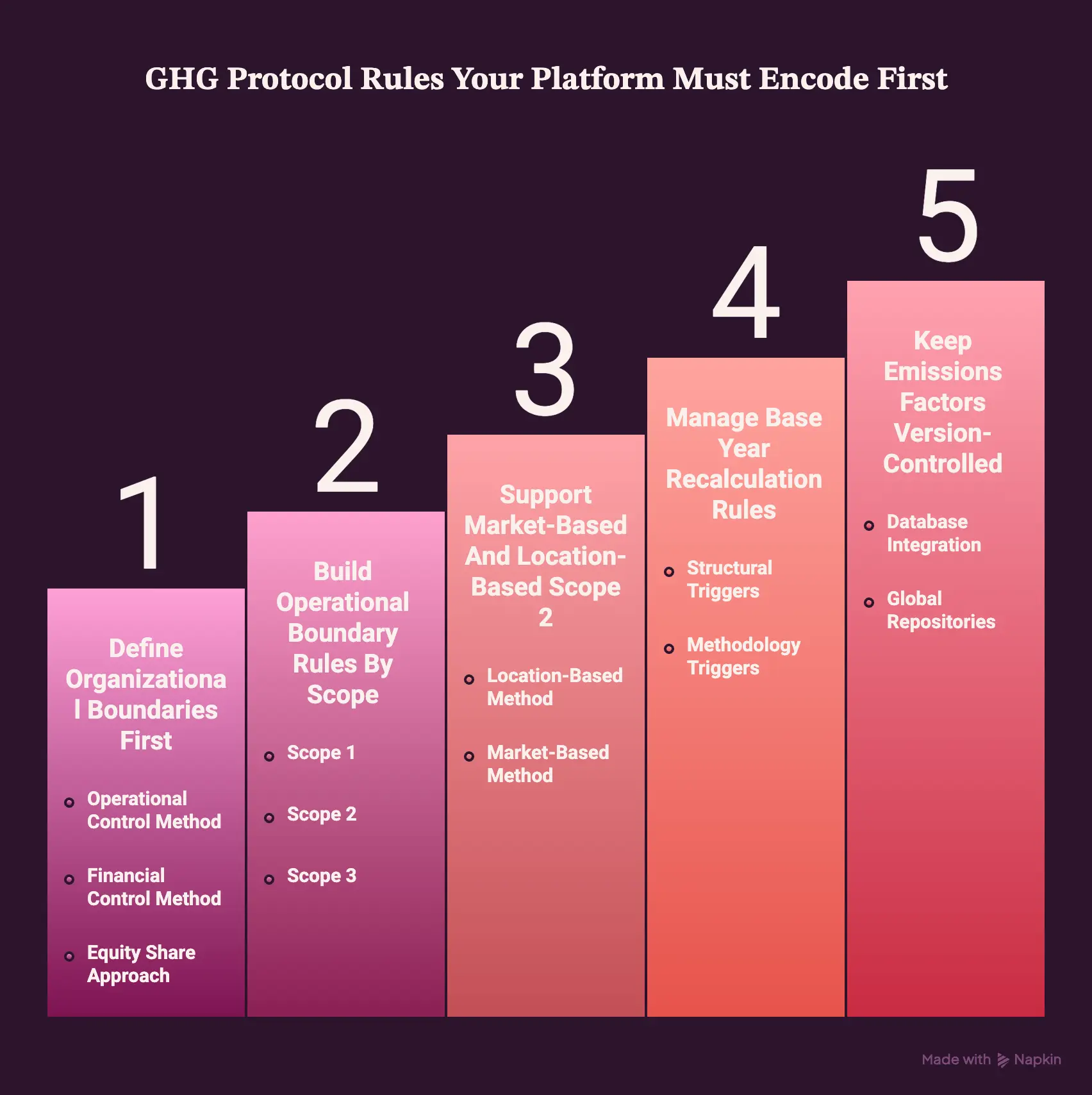
GHG Protocol Rules Your Platform Must Encode First
A compliance-grade data platform must encode the mathematical logic of the Greenhouse Gas Protocol before developers design any visual interface. Specifically, calculating emissions numbers without setting clear algorithmic boundaries creates unreliable and non-auditable records.
Therefore, software engineers must hard-code the fundamental principles of organizational and operational consolidation directly into the database schema.
1. Define Organizational Boundaries First
The system must explicitly enforce your chosen corporate boundary rules across all operational sites and subsidiaries. Specifically, the EPA notes that consolidation options include three distinct, standardized structural approaches.
- Operational Control Method: Tracks 100% of emissions from facilities where your firm directs daily operational policies.
- Financial Control Method: Directs the system to account for emissions based on your company’s financial risk exposure.
- Equity Share Approach: Calculates emissions percentages based on the exact percentage of economic ownership in an asset.
2. Build Operational Boundary Rules By Scope
The core calculation engine must automatically categorize all raw energy inputs into distinct, protocol-defined reporting buckets. Consequently, this strict categorization separates direct organizational footprints from broader value chain activities.
- Scope 1: Tracks direct emissions from stationary combustion, mobile vehicle fleets, and physical cooling refrigerants.
- Scope 2: Captures indirect emissions from purchased electricity, steam, regional heating, and building cooling data.
- Scope 3: Measures downstream and upstream impacts like capital goods, waste, business travel, investments, and leased assets.
3. Support Market-Based And Location-Based Scope 2
The architecture must perform dual-reporting calculations for all electrical grid consumption data simultaneously. According to standard GHG Protocol Scope 2 guidance, this dual reporting reveals the true environmental footprint of your energy consumption.
- Location-Based Method: Evaluates local grid-average intensity factors based on physical geographic grid locations.
- Market-Based Method: Tracks explicit contractual choices like power purchase agreements or renewable energy certificates.
4. Manage Base Year Recalculation Rules
The backend logic must include strict triggers for a carbon accounting base year recalculation when structural events alter the company profile. As a result, the code guarantees that compliance data remains comparable across multi-year cycles.
- Structural Triggers: Recalculates historical baselines during corporate acquisitions, divestitures, or business unit rollups.
- Methodology Triggers: Adjusts benchmarks when emissions factor updates or data quality improvements cross a specific materiality threshold.
5. Keep Emissions Factors Version-Controlled
The platform must manage active databases through timestamped entries and complete source provenance tracking. Therefore, the system preserves historical calculation integrity by properly retiring outdated factors.
- Database Integration: Connects directly via API to the DEFRA emissions factor integration and the EPA emissions factor API integration.
- Global Repositories: Pulls international metrics through the IPCC emissions factor library integration to maintain global coverage.
Carbon accounting software fails when teams build visual screens before they encode core accounting rules. Therefore, true compliance requires a data architecture governed strictly by GHG Protocol constraints.
The Enterprise Carbon Accounting System Architecture
An enterprise carbon accounting platform requires a decoupled, seven-layer architecture to ensure that all disclosures remain traceably linked to raw evidence. Specifically, building this platform as a data infrastructure layer separates raw ingestion from final reporting outputs, which provides auditors with an immutable path back to source files.
This design ensures data integrity across multi-entity rollups while protecting core calculation logic from manual errors.
Architecture Table
| Architecture Layer | Operational Processing | Core Technical Frameworks |
| Layer 1: Source Data Ingestion | Connects automated pipelines to ingest ERP carbon accounting data integration, general ledger carbon accounting mapping, utility APIs, HRIS, and IoT energy data carbon accounting integration. | Apache Kafka, AWS Lambda, REST/GraphQL Webhooks |
| Layer 2: Carbon Data Normalization | Executes unit conversion, currency normalization, supplier naming deduplication, facility mapping, and automated missing-field validation checks. | Apache Spark, Python Pandas, Data Quality Validation Schemas |
| Layer 3: Emissions Factor Database | Manages international databases using geographic specificity, sector rules, and automated fallback rules across version-controlled entries. | PostgreSQL RDS, Versioned API Routers, Redis Cache |
| Layer 4: Calculation Engine | Runs activity-based carbon accounting engine, spend-based carbon accounting methodology, and hybrid carbon accounting calculation models with confidence scores. | Celery Distributed Workers, Rust Core Calculation Library, Math.js |
| Layer 5: Carbon Ledger & Audit Trail | Logs primary data vs estimated data tracking alongside reviewer timestamps, third-party carbon data verification integration, and assurance evidence exports. | Amazon QLDB (Quantum Ledger Database) or Hyperledger Fabric |
| Layer 6: Reporting & Disclosure | Generates compliant outputs for frameworks like CSRD, TCFD, and CDP while executing multi-entity carbon accounting consolidation rollups. | Next.js Dashboard UI, GraphQL Data Layers, Node.js PDF Engines |
| Layer 7: Governance & Security | Enforces a role-based access control carbon accounting platform strategy and a HIPAA-aligned carbon accounting data architecture. | AWS IAM, OAuth 2.0 / OIDC, AES-256 Storage Encryption |
An enterprise carbon accounting system must be built as a rigorous data infrastructure platform rather than a cosmetic reporting interface. This structured, layered architecture transforms fragmented operations into fully auditable financial assets.
Data Sources And Integrations That Make The Ledger Work
Carbon accounting platforms become truly valuable only when they connect directly to the corporate applications that hold emissions evidence. Specifically, manually typing utility bills or fuel receipts into static spreadsheets invites human error and completely fails compliance audits.
Therefore, you must build automated, production-grade data pipelines that feed your central carbon ledger in real time.
1. ERP And Finance System Integration
The platform maps carbon metrics directly to financial expense accounts across systems like SAP, Oracle, NetSuite, Workday, and Microsoft Dynamics.
- Ledger Mapping: Automates general ledger carbon accounting mapping to transform financial dollar expenditures straight into physical activity records.
- Operational Control: Connects cost center tagging and raw invoice data directly to internal carbon pricing software to track climate financial risks.
2. Facilities, Utility, And IoT Integration
The system ingests raw electricity consumption and fuel data directly from commercial facilities, factories, and utility grids.
- Hardware Pipelines: Streams real-time energy usage from building management systems, smart meters, and an IoT energy data carbon accounting integration.
- Direct Combustions: Automates tracking for backup diesel generators, facility boilers, refrigerant leakage logs, and general healthcare facility emissions.
3. Procurement And Supplier Data Integration
The architecture uses a dedicated supply chain carbon accounting integration to capture Scope 3 value chain footprints securely.
- Primary Ingestion: Collects product carbon footprint data and primary supplier emissions records directly through a secure supplier portal.
- Hybrid Models: Apply spend-based carbon accounting methodology to procurement categories when primary supplier evidence uploads are completely missing.
4. Healthcare-Specific Data Integrations
Medical systems require specialized data connections to monitor clinical operations, high-volume waste, and decentralized clinical assets.
- Clinical Inputs: Tracks hospital utilities, medical gases like anesthetic gases, fleet fuel logs, and distinct clinical waste haulers.
- Supply Pipeline: Monitors carbon intensities across intense pharma procurement lines, laundry services, food services, and medical device suppliers.
5. Financial Services And Portfolio Data Integration
Financial firms require specialized data pipelines to track the climate footprints of their capital loans and asset portfolios.
- Financed Calculations: Integrates a PCAF-financed emissions accounting fintech engine to calculate absolute bank lending portfolio emissions accounting metrics.
- Portfolio Analysis: Runs asset manager portfolio carbon accounting models to determine absolute insurance-associated emissions and fund-level portfolio carbon intensity.
For a deeper breakdown of ESG data architecture, see our guide on What Features Should ESG Data Management Software Have?.
System integration depth is always the primary driver of custom software development costs. Your platform remains only as useful as the quality, reliability, and coverage of the data pipelines it ingests.
Scope 3 And PCAF Workflows For Complex Enterprises
Managing value chain footprint calculations represents the most technically demanding layer of corporate carbon accounting software development. Specifically, your platform must process highly variable upstream supplier metrics and downstream portfolio assets without hiding data gaps behind generalized estimates.
Therefore, the system architecture must implement a granular methodology hierarchy that dynamically updates data quality scores as primary evidence becomes available.
1. Build All 15 Scope 3 Categories Into The Model
The software platform must map operational activity directly to the exact definitions outlined in the GHG Protocol Scope 3 standard.
- Systematic Categorization: Enforces strict multi-tenant carbon accounting SaaS architecture divisions across all 15 upstream and downstream buckets.
- Material Triggers: Runs distinct logic for high-impact categories like purchased goods, capital assets, operational waste, business travel, and product end-of-life.
2. Use Spend-Based Estimates As A Starting Point
The calculation engine uses procurement transaction records to build instant, comprehensive baseline inventories when primary supplier data is missing.
- Procurement Scans: Match raw supply chain financial transactions to global economic input-output emission databases automatically.
- Filtering Logic: Isolates high-emission vendor categories to help sustainability officers prioritize direct supplier engagement campaigns.
3. Upgrade Priority Categories To Activity Data
The system dynamically swaps financial proxy models for real, physical measurements as vendor data tracking improves.
- Physical Tracking: Ingests direct utility metrics, weight-based waste cargo logs, shipment distances, and precise material weights.
- Dual Ledger Recording: Maintains full primary data vs estimated data tracking to show compliance auditors the exact data maturity curve.
4. Add PCAF For Financed Emissions
Financial institutions require specialized accounting structures to track the carbon liabilities tied directly to capital deployment portfolios.
- Framework Compliance: Implements a dedicated PCAF-financed emissions accounting fintech engine built on standard Scope 3 Category 15 logic.
- Asset Categorization: Calculates financed intensities across commercial bank lending portfolios, asset manager equity funds, and insurance underwriting.
5. Score Data Quality By Source And Method
The system evaluates the mathematical reliability of every emissions number by applying a standardized confidence ranking matrix.
- Reliability Levels: Attach explicit data quality scores from 1 (audited primary metrics) to 5 (highly aggregated spend estimates).
- Audit Readiness: Generates comprehensive confidence flags and reviewer logs to ensure complete carbon accounting data quality assurance for third-party verifiers.
You cannot trust value chain calculations without a transparent methodology hierarchy. At the same time, true data reliability comes from scoring information quality openly and giving compliance teams a clear path to continuous improvement.
AI Features That Improve Carbon Accounting Accuracy
AI acts as a highly specialized automation layer designed to extract, clean, and validate massive streams of operational data before they touch your core calculation engine.
Specifically, machine learning models should handle the error-prone manual tasks of text classification and anomaly detection rather than replacing or overriding fundamental GHG Protocol logic.
Because compliance audits demand total human-in-the-loop oversight, AI must be deployed to flag risks and accelerate validation rather than to publish unreviewed regulatory disclosures.
AI Feature Table
| Workflow Function | AI Operational Processing | System Compliance Controls |
| Data Classification | Automatically parses unstructured procurement invoices, utility PDFs, supplier spreadsheets, and expense logs into clean activity streams. | Assigns strict text-matching confidence scores and sends low-confidence lines straight to a human reviewer queue. |
| Emissions Factor Mapping | Uses natural language processing and machine learning emissions data prediction models to recommend context-specific emissions factors from global databases. | Enforce strict country and sector constraints while requiring explicit compliance officer sign-off before committing calculations. |
| Outlier & Anomaly Detection | Scans multi-site operational baselines in real time to instantly flag missing data fields, duplicate records, and massive volumetric spikes. | Maintains a rigorous data lineage map to ensure that automated data cleaning steps do not break the final audit trail. |
| Scenario Modeling | Power your corporate net-zero carbon accounting roadmap tool to simulate carbon tax impacts and clean energy transitions. | Separate predictive forecasting models from your active, historical ledger to keep compliance reporting untouched. |
| Contract Accounting | Extracts operational performance metrics directly from power purchase agreements and renewable energy certificates. | References raw uploaded source documents to ensure that physical evidence perfectly matches your market-based carbon ledger inputs. |
For a deeper breakdown of governed emissions workflows, see our guide on How to Develop Scope 1, 2 & 3 Emissions Software.
AI belongs strictly in the data workflow layer, where it assists with extraction and validation. Therefore, it should never be used as an unchecked black box to make final compliance decisions.
How To Develop Corporate Carbon Accounting Software
To build a corporate carbon accounting platform, you must execute development across clear, sequential milestones that prioritize data governance over cosmetic dashboards. Specifically, constructing this platform layer by layer reduces structural rebuild risks while keeping your engineering timeline predictable.
Because carbon disclosures face the same scrutiny as corporate financial statements, you must establish an ironclad data foundation before implementing predictive AI models or automated reporting workflows.
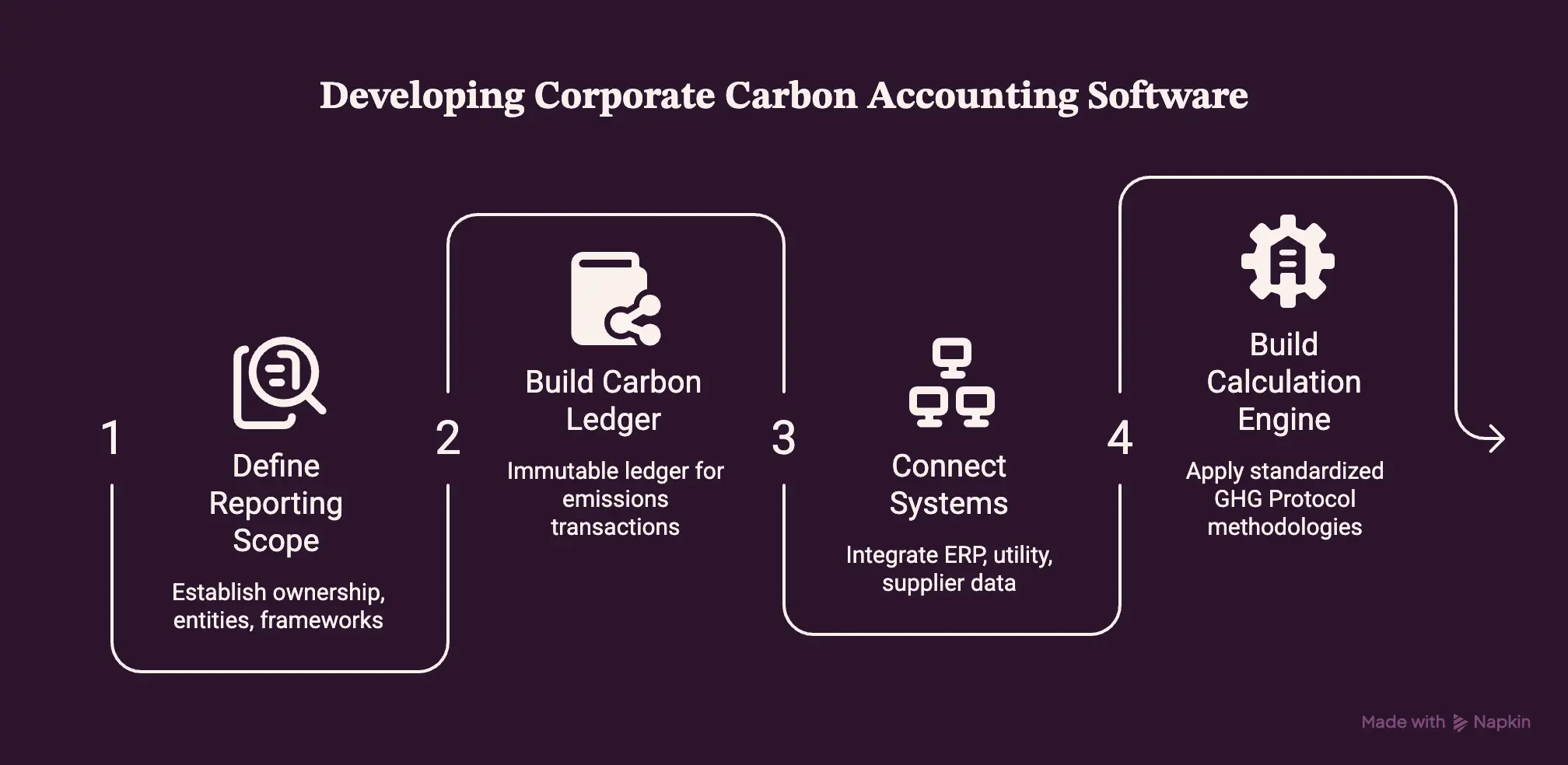
Step 1 — Define Reporting Scope And Owners
Start by defining who owns carbon data, which corporate entities are included, which frameworks matter, and which emissions sources must be tracked first.
Specifically, this preventive boundary setting stops the platform from becoming a generic dashboard that lacks operational accountability or consistent reporting rules across your organization.
- Technical Mapping: Engineers must explicitly map business units, subsidiaries, facilities, individual assets, financial cost centers, and legal entities directly to designated approval roles within the application database.
- The Development Approach: Our engineering team at Intellivon details structural boundaries, global compliance needs, user roles, and active data gaps extensively before any core system architecture or code development begins.
Step 2 — Build The Carbon Ledger Data Model
The database model should treat every single emissions value as an immutable ledger transaction rather than a static spreadsheet data cell.
Consequently, this rigorous relational framework allows finance, sustainability, and audit teams to trace every disclosed compliance number straight back to its original physical or financial evidence record.
- Database Schema: Developers must construct normalized tables for entities, physical sites, emission sources, activities, conversion factors, automated calculations, reviewer logs, manual adjustments, and final reports.
- The Development Approach: We deliberately design this low-level ledger architecture before building visual dashboards to ensure the corporate carbon accounting software platform can support strict regulatory assurance later.
Step 3 — Connect ERP, Utility, And Supplier Systems
Integrations should pull active operational metrics directly from the enterprise systems that already hold physical evidence, rather than asking teams to re-enter files manually.
Therefore, building secure data connections reduces data entry errors and makes carbon accounting completely repeatable across multi-year reporting cycles.
- Pipeline Engineering: Software teams must build automated REST APIs, secure file imports, extract-transform-load data pipelines, validation rules, and exception queues across corporate networks.
- The Development Approach: We prioritize building these technical integration pipelines by emissions materiality first, rather than focusing on the applications or utilities that are simply the easiest to connect.
Step 4 — Build The Calculation Engine
The calculation engine must apply standardized GHG Protocol methodologies uniformly across Scope 1, Scope 2, Scope 3, and PCAF calculation parameters.
Specifically, the engine must support activity-based, spend-based, and hybrid calculation models while fully preserving the exact factor, source, assumption, and data quality score behind every single output.
- Mathematical Processing: Engineers must program explicit method selection rules, automated factor matching, physical unit conversion, calculation uncertainty scoring, and automated recalculation logic.
- The Development Approach: We deliberately separate these deterministic, rules-based calculation models from any predictive AI modules to guarantee that your underlying compliance math remains entirely transparent and explainable.
Step 5 — Add Reporting, AI, And Assurance Workflows
Reporting, AI, and verification workflows should only be implemented after your core calculation engine achieves absolute mathematical and architectural stability.
As a result, this staging lets the platform generate compliant CSRD, TCFD, and CDP disclosure packets from thoroughly verified records instead of creating polished reports from weak inputs.
- Workflow Deployment: Software teams implement administrative dashboards, report exports, narrative drafting tools, machine learning anomaly detection, reviewer queues, and auditor-facing evidence packages.
- The Development Approach: We deploy automated machine learning tools and reviewer verification queues only after multi-site data lineage, role-based access controls, and human approval workflows are fully operational.
For a deeper breakdown of sustainability reporting architecture, see our guide on How To Create A Sustainability Reporting Platform.
Developing a corporate carbon accounting platform requires a step-by-step engineering roadmap focused on data lineage. Consequently, true audit readiness is achieved by treating emissions data as financial transactions from day one.
Carbon Accounting SaaS Platform Development Cost
Carbon accounting software development cost usually ranges from $70,000 to $300,000, depending heavily on Scope 3 depth, emissions factor libraries, and custom enterprise integrations.
Specifically, a focused minimum viable product starts near $70,000, while a production-grade enterprise platform reaches the upper limit.
Because system complexity increases with every unique data pipeline, the ultimate investment depends on your specific compliance, security, and multi-tenant SaaS architecture needs.
Cost Table
| Development Phase | Core Functional Coverage | Estimated Cost Range |
| Discovery & GHG Scope Mapping | Identifies corporate entities, operational boundaries, emissions sources, framework choices, and the engineering roadmap. | $6,000 – $14,000 |
| Carbon Ledger Architecture | Builds the database schema, multi-entity hierarchy, unchangeable audit logs, and complete data lineage mapping. | $10,000 – $26,000 |
| Data Pipelines & Integrations | Connects secure APIs to ingest ERP, general ledger, procurement, utility, fleet, waste, IoT, and portfolio data streams. | $18,000 – $58,000 |
| Emissions Factor Engine | Integrates DEFRA, EPA, and IPCC libraries while programming automated factor versioning and fallback rules. | $12,000 – $34,000 |
| Calculation & Consolidation Engine | Programs math logic for all scopes, market-based versus location-based rules, base year recalculations, and multi-site rollups. | $16,000 – $48,000 |
| Dashboards & Reporting Workflows | Deploys reporting layouts for CSRD, TCFD, CDP, and SBTi compliance while exporting clean data packages. | $12,000 – $34,000 |
| AI & Data Quality Layer | Runs machine learning anomaly detection, missing-value estimation models, factor matching, and confidence scores. | $12,000 – $42,000 |
| Security, QA, DevOps, & Launch | Implements role-based access controls, single sign-on, data encryption, compliance audit logs, and cloud infrastructure deployment. | $10,000 – $44,000 |
| Total Build Range | From a foundational functional MVP to a comprehensive, audit-ready enterprise-grade platform. | $70,000 – $300,000 |
1. MVP Carbon Accounting Platform: $70K–$110K
This entry budget level is best for piloting a system within a single business unit or tracking limited emission sources.
- Feature Scope: Focuses entirely on Scope 1 and Scope 2 footprints while supporting basic CSV uploads for simple Scope 3 tracking.
- System Capabilities: include standard emissions factor database integration, clean reporting dashboards, and basic spreadsheet evidence exports.
2. Mid-Level Enterprise Platform: $120K–$200K
This mid-tier system is designed for multi-site organizations that must eliminate manual data entry to maintain compliance.
- Feature Scope: Automates tracking across extensive facility networks, complex corporate supply chains, and international subsidiaries.
- System Capabilities: Builds live integration pipelines into ERP systems, utility smart meters, HRIS platforms, and vendor procurement databases.
3. AI-Powered Enterprise Platform: $210K–$300K
This high-tier platform serves complex corporations facing strict global audits, extensive Scope 3 dependencies, or deep portfolio risk tracking.
- Feature Scope: Delivers multi-entity carbon accounting consolidation alongside specialized healthcare operations or financial portfolio accounting modules.
- System Capabilities: Deploys an unchangeable quantum ledger audit trail, dedicated vendor data tracking portals, and machine learning anomaly detection engines.
4. Ongoing Maintenance: 18%–25% Per Year
Operating and maintaining an active carbon engine requires an annual investment equal to 18% to 25% of the initial development cost. Therefore, you must budget for this recurring operational cost to guarantee continued system accuracy and compliance.
- Regulatory Updates: Covers continuous emissions factor updates, new regulatory framework mapping, and API connection maintenance.
- Infrastructure Support: Funds cloud hosting infrastructure, machine learning model monitoring, security patches, dashboard updates, and third-party assurance support.
For a deeper breakdown of budgeting for custom environmental applications, see our guide on What Does It Cost to Develop Carbon Tracking Software in 2026?.
Our engineering teams use these identical, data-proven cost ranges and recurring planning models when designing carbon tracking software for global clients.
Why Hire Intellivon For Carbon Accounting Software
Hire Intellivon when your carbon accounting platform needs finance-grade accuracy, GHG Protocol logic, audit trails, AI governance, and enterprise integrations beyond basic emissions dashboards.
- Carbon ledger, not just dashboards: Track source evidence, calculation logic, emissions factor versions, reviewer history, and audit-ready carbon records.
- Finance-grade architecture: Connect ERP, general ledger, cost centers, subsidiaries, facilities, suppliers, and portfolio data for reliable rollups.
- Correct GHG Protocol logic: Support boundaries, Scope 2 methods, Scope 3 categories, base year recalculation, and data quality scoring.
- AI with control: Use AI for classification, factor matching, anomaly alerts, and drafting with explainable, reviewed, logged outputs.
- Healthcare and fintech depth: Support hospital, pharma, medical device, PCAF, portfolio, and financed emissions workflows.
- Budget clarity: Scope a disciplined $70,000–$300,000 build around material emissions sources first.
Talk to Intellivon’s carbon accounting software experts to scope your platform, estimate your build cost, and decide whether custom development is the right move.
Conclusion
Corporate carbon accounting software works best when it is treated as finance-grade infrastructure, not a reporting add-on. First, enterprises must define GHG Protocol boundaries and ledger rules. Then, they must connect finance, facility, supplier, and portfolio data with clear audit trails.
As Scope 3, PCAF, AI, and assurance demands grow, a custom platform gives leaders stronger control over accuracy, compliance, and long-term carbon decision-making. Therefore, planning matters before the dashboards’ launch.
FAQs
Q1. How Much Does Carbon Accounting Software Development Cost?
A1. Carbon accounting software development usually costs $70,000 to $300,000. A basic MVP covers Scope 1, Scope 2, uploads, dashboards, and reports. However, enterprise builds cost more when they include Scope 3, PCAF, ERP integration, supplier workflows, AI validation, audit trails, and multi-entity consolidation across business units and facilities.
Q2. Is Excel Enough For Corporate Carbon Accounting?
A2. Excel works only for small annual Scope 1 and Scope 2 inventories with limited invoices, fuel records, and utility bills. However, it becomes risky when enterprises need Scope 3 supplier data, factor versioning, reviewer logs, multi-site rollups, financial consolidation, audit evidence, and repeatable reporting across multiple entities and frameworks.
Q3. How Should Scope 3 Data Be Collected From Suppliers?
A3. Scope 3 supplier data should be collected through supplier portals, structured templates, procurement integrations, document uploads, reminders, validation checks, and data quality scoring. First, use spend-based estimates for missing data. Then, upgrade high-impact suppliers to activity-based or supplier-specific data so the platform improves accuracy over time and supports audit readiness.
Q4. Should A Company Build Or Buy Carbon Accounting Software?
A4. Buy carbon accounting software when your reporting process is standard, your integrations are light, and speed matters most. However, build when you need multi-entity consolidation, healthcare carbon workflows, PCAF-financed emissions, ERP ledger mapping, AI-assisted validation, white-label SaaS, or full ownership of the emissions inventory and calculation logic.
Q5. What Is The Hardest Part Of Developing Carbon Accounting Software?
A5. The hardest part is not the dashboard design. Instead, it is building the governed calculation layer that connects source evidence, emissions factors, method selection, Scope 3 assumptions, data quality scores, reviewer history, and audit trails. Once this foundation is correct, reports, dashboards, AI workflows, and compliance exports become much easier to scale.
To Sum It Up:
- Corporate carbon accounting software fails when teams build dashboards before they define GHG Protocol boundaries, calculation rules, and evidence ownership
- Scope 3 accuracy improves in stages: start with spend-based estimates, prioritize hotspots, then move high-impact categories to activity-based and supplier-specific data.
- AI should not be the calculation authority in carbon accounting. Its strongest role is cleaning data, detecting anomalies, scoring confidence, and supporting human review.
- PCAF turns fintech carbon accounting into a portfolio data problem, not a simple sustainability reporting problem.
- A $70,000 MVP can prove the carbon ledger model, but a $210,000 to $300,000 platform is usually needed for Scope 3, PCAF, AI, integrations, and assurance.