Key Takeaways:
-
Supplier management platforms handle registration, qualification, credential tracking, risk scoring, and performance monitoring.
-
Workflow automation, contract management, corrective actions, and compliance evidence collection are core production features.
-
Supplier master data management, API integration, audit trails, and HIPAA-safe design ensure enterprise-grade reliability.
-
Custom builds cost $70,000 to $300,000 depending on ERP integrations, AI models, and compliance depth.
-
How Intellivon builds supplier management platforms around production workflows first, then adds AI where decisions improve.
Developing a supplier management platform always starts with building the supplier lifecycle data model first. That model follows every supplier from initial registration through qualification, performance scoring, audits, and corrective actions. From there, ERP and GPO integrations pull in spend and contract data automatically. Finally, AI adds risk prediction, ESG scoring, and supplier performance anomaly detection across the platform.
The lifecycle model also determines how defensible the platform is under regulatory and audit pressure. When supplier records and credentialing sit in disconnected systems, FDA and Joint Commission audits suffer. According to CyberArk, 80% of enterprises experienced a supply chain security incident between 2023 and 2024. Fragmented supplier oversight is therefore a measurable risk exposure, not just an administrative process gap.
This blog follows Intellivon’s approach to supplier management platform development, starting with lifecycle architecture first. From there, it covers onboarding automation, risk scoring, healthcare credentialing compliance, and ERP integration.
What Is A Supplier Management Platform?
A supplier management platform is a centralized software system used by enterprise procurement teams to manage vendor relationships and track supply chain performance. The system acts as a single source of truth for supplier data, risk profiles, and contract terms.
Consequently, organizations use these tools to automate vendor onboarding, monitor compliance, and measure performance metrics. This centralized approach reduces operational risks and helps companies uncover cost-saving opportunities.
Supplier Management Vs SRM Vs Vendor Management
Procurement leaders often confuse these three frameworks because their software features frequently overlap in standard enterprise platforms. However, choosing the right system architecture requires understanding its distinct strategic focuses, data inputs, and operational boundaries.
The table below clarifies the core differences in focus, scope, and primary industries for each software model:
Comparative Table
| Software Category | Core Strategic Focus | Operational Workflow Scope | Primary Asset Type Covered |
| Supplier Relationship Management (SRM) | Strategic collaboration and joint innovation. | Long-term performance tracking and risk sharing. | Direct materials and strategic partnerships. |
| Supplier Lifecycle Management (SLM) | Full operational compliance and onboarding. | Qualification, auditing, and offboarding workflows. | Medical products, pharma inputs, and clinical goods. |
| Vendor Management System (VMS) | Service-level agreement (SLA) monitoring. | Sourcing execution and contract compliance. | Third-party services, IT contractors, and indirect spend. |
Enterprise platforms targeting highly regulated industries must integrate all three capabilities into a cohesive architecture. Consequently, this unified approach ensures that both critical medical supplies and third-party IT vendors remain fully compliant with strict safety guidelines.
What The Platform Must Do First
An enterprise-grade platform must immediately structure messy, fragmented vendor data to establish an operational baseline. Therefore, the system deploys an automated supplier information management system that extracts credentialing data from multi-format vendor packets.
Consequently, this centralized data engine feeds directly into a real-time supplier document management system. To achieve this, the architecture automates several critical onboarding layers:
- Supplier Registration and Qualification Software: Validates legal entity data, tax identifiers, and initial banking credentials instantly.
- Supplier Prequalification Workflow Automation: Routes prospective vendors through automated background checks based on specific category risk profiles.
- Approved Vendor List Automation: Updates corporate directories dynamically to ensure only fully verified entities can receive active purchase orders.
As a result, this systematic approach eliminates human processing delays and reduces manual entry errors.
For a deeper breakdown of healthcare workflow automation, see our guide on how to build an AI revenue automation platform. This systematic architecture ensures that highly regulated onboarding steps remain completely audit-ready.
Why Supplier Management Infrastructure Matters Now
Modern enterprise procurement requires an immediate shift away from fragmented tracking because scattered supplier data directly compromises corporate agility. According to data from Mordor Intelligence, the vendor management software market was valued at USD 10.40 billion in 2025 and is projected to reach USD 18.76 billion by 2031.
Consequently, this expansion represents a steady compound annual growth rate (CAGR) of 10.33%. Therefore, this surge in spending confirms that corporate leaders are actively prioritizing structured, automated third-party oversight to secure volatile operational pipelines.
1. Supplier Risk Is Now Board-Level Risk
Procurement leaders cannot manage multi-tier supply chains using manual spreadsheets because single-point vendor failures now cause massive operational stoppages. Thus, platforms must deploy active, continuous tracking modules to safeguard operations:
- Supplier Financial Risk Monitoring Software: Tracks live credit downgrades and liquidations.
- Supplier Geopolitical Risk Monitoring: Correlates real-time border delays with open orders.
- Predictive Supplier Risk Monitoring: Uses machine learning pipelines to flag volatile performance trends early.
Consequently, building active supply chain disruption risk management boundaries shields downstream operations from sudden vendor bankruptcies. Furthermore, Intellivon anchors these predictive modules to live international logistics data streams.
2. Supplier Data Now Feeds ESG And Compliance
Global regulatory mandates now require large enterprises to actively document their environmental footprint and enforce transparent ethical sourcing standards throughout their networks. Therefore, core enterprise procurement engines must natively integrate the following tracking applications:
- Supplier ESG Data Management Integration: Standardizes diverse international sustainability disclosures into a single master dashboard.
- Scope 3 Supplier Emissions Data Collection: Tracks indirect corporate greenhouse gas output directly from logistics providers.
- Supply Chain Due Diligence Software: Automates rigorous verification audits to enforce strict global human rights policies.
As a result, an automated supplier sustainability scorecard platform helps executives quickly identify high-emission elements within the corporate footprint. Modern supplier carbon footprint tracking software modules ensure your organization satisfies evolving cross-border reporting requirements without manual auditing friction.
3. Healthcare Adds Higher Supplier Friction
Clinical procurement requires specialized verification checks because supply quality directly impacts patient health outcomes and strict institutional certifications. Consequently, medical procurement networks rely on hyper-specific validation layers to manage vendor network friction:
- Healthcare Supplier Credentialing Software: Automatically audits medical staff licensures and facility certifications.
- Hospital Vendor Credentialing Platform: Controls physical facility access logs for technical field representatives.
- Sterile Processing Supplier Compliance Tracking: Monitors strict decontamination credentials for critical operating room components.
Therefore, robust medical supplier qualification software remains a fundamental necessity for managing volatile clinical supply chain supplier management frameworks.
What Existing Supplier Platforms Teach Builders
Existing software architectures reveal that modern supplier management software development requires balancing heavy enterprise resource planning (ERP) depth with agile risk layers.
Monolithic platforms provide massive transactional scale but often struggle with modern, automated supplier prequalification workflow automation or specialized healthcare supplier management platform development needs.
Understanding where legacy systems excel or stumble dictates whether you should build a custom supplier lifecycle management platform.
1. SAP Ariba Shows Enterprise Lifecycle Depth
SAP Ariba excels at managing end-to-end supplier lifecycle management software across massive global supply chains. For custom platform builders, it sets the standard for deep native integrations and preferred supplier list management software.
- Onboarding & Lifecycle: Integrates massive vendor data directly into core ERP systems to automate basic procurement workflows.
- Performance & Routing: Tracks supplier KPI tracking and benchmarking to route orders dynamically to preferred vendors.
- Intellivon Approach: We design a lightweight microservices supplier management architecture that integrates via APIs directly with SAP supplier management integration points without legacy lag.
2. Coupa Shows Risk Must Start At Onboarding
Coupa demonstrates that supplier risk assessment and scoring engines must sit directly within the supplier registration and qualification software layer. It teaches builders that risk tracking cannot be an administrative afterthought.
- Onboarding Risk: Captures deep third-party risk profiles during the initial supplier prequalification workflow automation.
- Continuous Health Monitoring: Uses real-time feeds for automated supplier financial risk monitoring software updates.
- Intellivon Approach: We build predictive supplier risk monitoring engines that automate supplier due diligence, flagging threats instantly.
3. Ivalua Shows The Unified Supplier Record
Ivalua proves that a clean supplier master data management platform is the foundation of any scalable supplier information management system. It sets the benchmark for 360-degree visibility across complex supply tiers.
- Unified Portals: Consolidates a supplier collaboration portal development model with custom supplier portal development guide standards into a single database.
- Scorecards & Profiles: Blends supplier scorecard and rating systems with core contract repositories for deep data transparency.
- Intellivon Approach: We engineer clean supplier data normalization and deduplication layers to ensure your internal teams view a single, accurate profile.
4. GEP Shows Where Agentic AI Is Heading
GEP provides a blueprint for how machine learning supplier risk prediction can move from simple dashboards into coordinated AI supplier discovery and matching systems. It signals a shift toward automated supply chain due diligence software.
- Coordinated Agents: Use basic natural language processing (NLP) supplier profile extraction to parse multi-tier supply chain visibility software fields.
- Performance Forecasting: Runs predictive models to generate automated generative AI supplier assessment reports.
- Intellivon Approach: We build highly cautious, deterministic AI agents that run precise supplier anomaly detection and alerting workflows without hallucination risks.
5. GHX Shows Healthcare Needs Its Own Layer
GHX proves that hospital vendor credentialing platforms require highly specialized medical supplier qualification software architectures. Generic procurement platforms cannot handle strict clinical supply chain supplier management demands.
- Credentialing & Orders: Automates order automation alongside rigid hospital vendor credentialing platform rules to match Joint Commission vendor credentialing software standards.
- Workflow Automation: Successfully scales complex healthcare environments, such as automating workflows across over 300 clinical suppliers to reduce supply chain leakage.
- Intellivon Approach: We deploy HIPAA-compliant supplier data platforms using zero-trust supplier management platform security to safeguard sensitive medical and institutional records.
Analyzing these market leaders shows that while legacy systems handle baseline data, they frequently lack the agility needed for custom, AI-driven automation.
For a deeper breakdown of system choices, see our guide on custom enterprise software development. Transitioning from legacy models to custom infrastructure requires a clear architectural blueprint designed for modern cloud environments.
Where Supplier Management Fits In Source-To-Pay
Supplier management sits before and across source-to-pay because supplier eligibility directly dictates the safety of sourcing, contracting, purchasing, and invoicing workflows. A centralized platform handles supplier identification, selection, onboarding, performance tracking, risk management, and offboarding.
Integrating these phases ensures that transactional systems only interact with fully compliant, verified vendors.
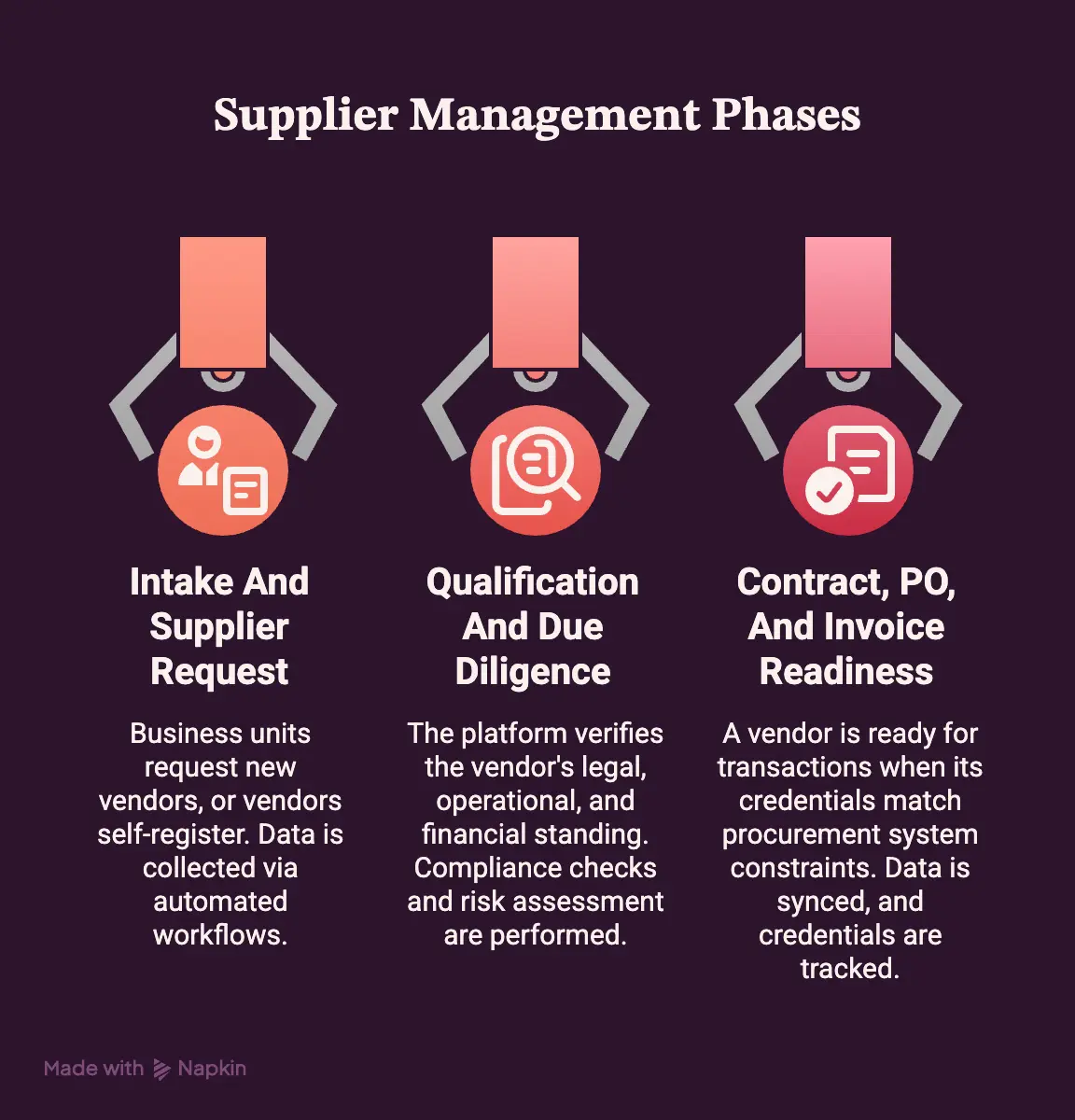
1. Intake And Supplier Request
The process starts when a business unit requests a new vendor or a vendor initiates self-registration.
- Data Collection: Captures tax data, bank details, W-9/W-8 forms, and insurance documents via automated workflows.
- Portal Infrastructure: Utilizes a secure supplier self-service portal development framework to guide vendors through intake.
- Intellivon Approach: We design intelligent approval routing microservices that automatically cross-check submitted tax and banking fields.
2. Qualification And Due Diligence
Once data is collected, the platform must verify the vendor’s legal, operational, and financial standing.
- Compliance Checks: Automates sanctions screening, Office of Inspector General (OIG) exclusions, and System for Award Management (SAM) checks.
- Risk Engine: Uses supplier due diligence automation software and automated questionnaires to evaluate vendor risk.
- Intellivon Approach: We embed supplier regulatory compliance monitoring engines that automatically flag match exceptions during onboarding.
3. Contract, PO, And Invoice Readiness
A vendor is only ready for transactions when its credentials match procurement system constraints.
- Data Integration: Syncs master data across ERP supplier data integration layers and eProcurement supplier portal integrations.
- Credential Tracking: Maintains active supplier insurance certificate management and central contract repositories.
- Intellivon Approach: We build automated webhooks that freeze purchase orders instantly if a supplier’s insurance or credentials expire.
A well-mapped source-to-pay funnel ensures that downstream transactional operations remain completely error-free and legally compliant.
For a deeper breakdown of complex enterprise system connections, see our guide on enterprise API integration design. Securing these connection points requires an architectural framework built for high availability and strict access controls.
The Supplier Lifecycle That Your Platform Must Control
An enterprise platform must govern discovery, registration, prequalification, onboarding, segmentation, contracting, performance, risk, audits, corrective actions, renewal, and offboarding. This lifecycle view prevents the core database from turning into a stagnant document dump.
It allows procurement teams to apply different evidence requirements to strategic, tactical, regulated, and low-risk suppliers.
1. Supplier Discovery And Matching
Finding and validating the right vendor requires modern automated intelligence layers instead of manual database searches.
- Intelligent Identification: Uses AI supplier discovery and matching alongside NLP supplier profile extraction to parse external market data.
- Spend Alignment: Connects category-level supplier spend analysis with a supplier market intelligence platform to optimize sourcing.
- Technical Execution: Engineering search layers that extract structural fields from unstructured vendor websites and compliance brochures.
2. Registration And Qualification
Onboarding turns a prospective vendor into a verified business entity within your digital ecosystem.
- Workflow Automation: Deploys a supplier onboarding automation platform and supplier registration and qualification software to standardize entry.
- Data Integrity: Runs supplier prequalification workflow automation that pushes clean entries into a supplier master data management platform.
- Technical Execution: Implementing automated data validation logic that blocks incomplete or duplicate vendor registrations at the front gate.
3. Segmentation And Tiering
Not all suppliers are equal, and treating them identically creates major administrative bottlenecks.
- Classification Engines: Use supplier segmentation and tiering software to draw lines between strategic vs tactical supplier classifications.
- Smart Routing: Connects tiering directly to preferred supplier list management software for risk-based automated order routing.
- Technical Execution: Designing programmatic routing rules that apply deep credential checks to high-risk, critical infrastructure vendors.
4. Performance And Development
Post-onboarding management ensures that vendors maintain their contract service level agreements (SLAs).
- Metric Tracking: Employs supplier performance management software and a supplier KPI tracking and benchmarking framework.
- Remediation Workflows: Tie a supplier scorecard and rating system directly into supplier corrective action plan management pipelines.
- Technical Execution: Developing automated scorecard engines that trigger alert workflows when a vendor’s delivery quality drops below acceptable thresholds.
5. Renewal, Audit, And Offboarding
The final lifecycle phases protect the organization from compliance liabilities and operational gaps.
- Audit Workflows: Powers on-site supplier audit workflow automation and remote supplier assessment platforms via supplier audit management software.
- Offboarding Security: Triggers certificate expiration alerts and automated deactivation controls to revoke IT access immediately.
- Technical Execution: Building automated offboarding scripts that sever system access across all internal tools when a contract terminates.
Controlling the full vendor lifecycle mitigates third-party risk while maximizing long-term procurement efficiency. To back these complex lifecycle steps, the system requires a highly scalable, multi-tenant technical architecture.
AI Models For Supplier Management Software
AI converts supplier management software development from a static document repository into a predictive operational engine. Implementing AI requires balancing high-impact automation with strict validation frameworks to prevent catastrophic data hallucinations in regulated workflows.
By deploying specific machine learning and natural language processing models, platforms achieve deep process automation without sacrificing compliance.
AI Models Table
| AI Capability | Core Technical Architecture | Regulated Industry Use Case | Operational Risk & Guardrail |
| Document Extraction | Named Entity Recognition (NER), LayoutLMv3, Optical Character Recognition (OCR) | Parses certificates of insurance (COIs), SOC 2 reports, and Business Associate Agreements (BAAs). | Risk: Missed expiration dates.
Guardrail: Confidence scoring with fallback to manual validation. |
| Risk Prediction | XGBoost, Time-Series Forecasting (LSTM), Isolation Forests | Monitors financial risk, shipment anomalies, and localized geopolitical exposure. | Risk: False positives causing supplier blocks.
Guardrail: Explainable AI (SHAP values) citing exact financial metrics. |
| Questionnaire Automation | Retrieval-Augmented Generation (RAG), Semantic Vector Search | Draft answers to extensive security, ESG, and regulatory questionnaires. | Risk: Invented policy answers (hallucination).
Guardrail: Context anchoring restricts answers to internal PDFs. |
| Performance Forecasting | Regression Analysis, Random Forests, KPI Benchmarking | Predicts late deliveries, quality issues, and clinical supply chain disruptions. | Risk: Over-reliance on historical patterns.
Guardrail: Real-time data weighting for sudden global supply shifts. |
| Decision Guardrails | Deterministic Business Rules Layer + Role-Based Access Control (RBAC) | Enforce strict human-in-the-loop review before final supplier onboarding. | Risk: Unauditable black-box decisions.
Guardrail: Immutable prompt logging and mandatory multi-step approval. |
According to Gartner, by the end of 2026, 60% of enterprise procurement teams will integrate predictive analytics to cut third-party supply chain disruptions by half. Emphasizing deterministic guardrails over completely autonomous AI decision-making prevents compliance failure in regulated landscapes.
Deploying these advanced algorithmic models safely within your architecture requires a clean, scalable engineering foundation. To transition safely from conceptual AI models into live software code, development teams must rely on microservices built for heavy enterprise data volume.
Enterprise Supplier Management Platform Architecture
An enterprise supplier management platform requires a strictly layered, modular architecture to connect business strategy with daily procurement operations. Modern framework standards, like those established by Brooklyn Solutions, treat supplier infrastructure as a multi-layer function aligning governance, active lifecycle processes, and core software technology.
Decoupling the frontend portal from backend transactional systems prevents data silos and allows companies to execute agile custom supplier management system development guide specifications.
Platform Architecture Table
| Architectural Layer | Primary Technical Components | Core Enterprise Responsibility | Data Isolation & Security Standard |
| Supplier Portal | React/Next.js, Tailwind CSS, secure document upload APIs, multilingual localization engines. | Drives custom supplier portal development guide standards for vendor self-service, tax onboarding, and credentials. | Web Application Firewall (WAF) mitigation with isolated DMZ network segments. |
| Workflow & Rules | Camunda/Temporal engine, deterministic validation layers, event-driven webhooks. | Automates supplier prequalification workflow automation, multi-step approval routing, and escalation alerts. | Encrypted state history logs with strict execution boundaries. |
| Data & Integration | Kong/Apigee API gateways, Kafka event streams, GraphQL, custom ERP connectors. | Manages supplier platform API gateway design, SAP supplier management integration, and Oracle data syncs. | TLS 1.3 transport encryption paired with mutual TLS (mTLS) microservice blocks. |
| AI & Intelligence | PyTorch, Hugging Face Transformers, vector databases (Pinecone), OCR engines. | Powers machine learning supplier risk prediction, performance forecasting, and automated profile data extraction. | Private cloud model hosting ensuring complete zero-data leakage to public LLMs. |
| Governance & Security | OAuth 2.0 / OIDC, AWS KMS encryption, immutable ledger frameworks, strict tenancy blocks. | Implements zero-trust supplier management platform security and HIPAA-compliant supplier data platform isolation. | AES-256 at-rest database encryption with row-level tenant multi-tenancy controls. |
Adopting a modular, decoupled framework eliminates the technical debt associated with classic monolithic software platforms. Splitting execution into clear functional tiers enables enterprises to easily scale transaction capabilities while maintaining bulletproof data protection.
Building this multi-layer structure successfully requires a robust engineering roadmap paired with a granular grasp of development costs. Procurement teams must understand the complete financial investment and timelines necessary to bring an enterprise-grade platform to life.
Features That Make Supplier Management Useful
The most useful supplier management features remove manual administrative chasing, protect digital compliance evidence, and significantly accelerate strategic vendor decisions.
Procurement practitioners frequently outline that legacy onboarding is an email-heavy, document-dense grind consistently delayed by missing W-9s, unverified banking details, outdated insurance certificates, complex security reviews, and recursive finance department rework.
At the same time, implementing targeted digital automation directly eliminates these operational bottlenecks across your entire procurement ecosystem.
Feature Table:
| Useful Platform Feature | Core Functional Capability | Manual Operational Bottleneck Removed | Technical Integration Requirement |
| Onboarding Automation | Automated data intake, form checking, and multi-tier approval routing. | Back-and-forth emails chasing missing tax forms, bank records, and internal manager approvals. | Webhook-driven connections to internal communication tools (Slack/Email) and core corporate directories. |
| Document Management | Lapsed document expiration warning loops backed by automated OCR metadata reading. | Manual tracking of insurance expiration timelines and version-control mix-ups in shared drives. | Secure cloud object storage (AWS S3) paired with asynchronous text-extraction API microservices. |
| Risk & Compliance Scoring | Continuous background validation against global sanctions, ESG data, and credit markets. | Periodic, manual internet searches or yearly risk audits that fail to catch intra-year supplier distress. | External REST API connections to global compliance, credit (D&B), and geopolitical threat feeds. |
| Performance Scorecards | Automated metric collection tracking actual defect ratios and contractual lead times. | Disjointed spreadsheets and subjective, biased annual feedback notes compiled by separate buyers. | Direct database pipelines linking the supplier record to warehouse inventory management systems. |
| Spend & Diversity Tracking | Automated classification of spend tags combined with verified diverse ownership registries. | Manual compilation of corporate diversity spend data across disjointed regional financial ledgers. | API-level data syncing with corporate ERP general ledgers and national diversity verification databases. |
Shifting administrative tasks to the supplier self-service portal completely changes procurement productivity. Therefore, centralizing document validation, performance charting, and risk alerts into a unified dashboard frees up supply chain teams to focus on active vendor relationships and cost management rather than repetitive paperwork.
For a deeper look at optimizing your technical infrastructure for automated scaling, see our guide on microservices software design patterns.
Healthcare Supplier Compliance Requirements
Healthcare supplier management platforms must enforce strict credentialing, privacy, and quality standards to guarantee patient safety. Consequently, generic procurement solutions fail because they lack specialized mechanisms to capture and audit clinical evidence.
Building a dedicated healthcare supplier management platform development project ensures that your ecosystem remains continuously compliant with regulatory mandates.
1. HIPAA And BAA Supplier Controls
Managing vendors who interact with protected health information (PHI) requires specialized data governance architecture.
- Compliance Framework: Consequently, you must build a HIPAA-compliant supplier data platform that forces the execution of Business Associate Agreements (BAAs).
- Security Controls: Therefore, the system utilizes BAA-compliant vendor management software backed by a PHI-safe supplier portal architecture to map specific user permissions.
- Data Integrity: Additionally, the platform tracks downstream subcontractor evidence to ensure that all data handlers remain audit-ready.
2. Hospital Vendor Credentialing
Clinical environments demand absolute transparency regarding external personnel accessing medical facilities.
- Credential Tracking: Specifically, a hospital vendor credentialing platform must integrate with Joint Commission vendor credentialing software to verify immunization records and training.
- Access Management: Furthermore, the platform governs operating room access approval and infection control protocols based on strict role restrictions.
- Operational Visibility: Therefore, the software ensures complete awareness of who enters the facility, matching core Joint Commission safety guidance.
3. FDA Supplier Qualification
Manufacturing medical devices or pharmaceuticals requires absolute control over raw materials and components.
- Audit Readiness: Consequently, operators deploy FDA supplier audit compliance software to satisfy rigorous purchasing control regulations.
- Quality Controls: Hence, a medical device supplier qualification platform automates pharmaceutical supplier compliance management through formal quality agreements.
- Corrective Action: Additionally, the system links supplier audits directly to corrective and preventive action (CAPA) tracking workflows.
4. GPO And Clinical Supply Chain Rules
Hospital procurement relies heavily on Group Purchasing Organizations (GPOs) to manage inventory costs.
- Platform Syncing: Thus, implementing GPO supplier management integration with healthcare tools allows automatic sourcing from pre-negotiated contracts.
- Formulary Control: Furthermore, healthcare GPO preferred supplier management modules sync directly with internal formulary supplier management software.
- Workflow Optimization: Consequently, this integration streamlines clinical supply chain supplier management by locking purchases to approved vendor lists.
5. ESG And Due Diligence Rules
Global healthcare supply chains must also adhere to strict international ethical sourcing requirements.
- Regulatory Tracking: Specifically, enterprise platforms deploy a CSDDD supplier compliance platform to meet EU Corporate Sustainability Due Diligence software rules.
- Risk Screening: Moreover, the engine incorporates modern slavery act supplier compliance and UFLPA supplier screening software layers.
- Value Chain Mapping: Therefore, conflict minerals supplier tracking ensures complete visibility across the entire global value chain.
Navigating these intersecting regulatory frameworks requires a highly structured and reliable deployment plan. Consequently, skipping architectural validation or compliance mapping during early planning phases invariably leads to project delays.
For a deeper breakdown of building protected digital architectures, see our guide on healthcare AI system compliance frameworks.
How To Build A Supplier Management Platform
Building a platform requires a staged, phase-by-phase execution model to prevent technical debt and architecture fragmentation. Following an enterprise supplier management system development roadmap prevents software engineers from building interface screens before establishing core data-validation rules.
Consequently, this structured approach ensures that backend databases can properly enforce compliance logic before users interact with the system.
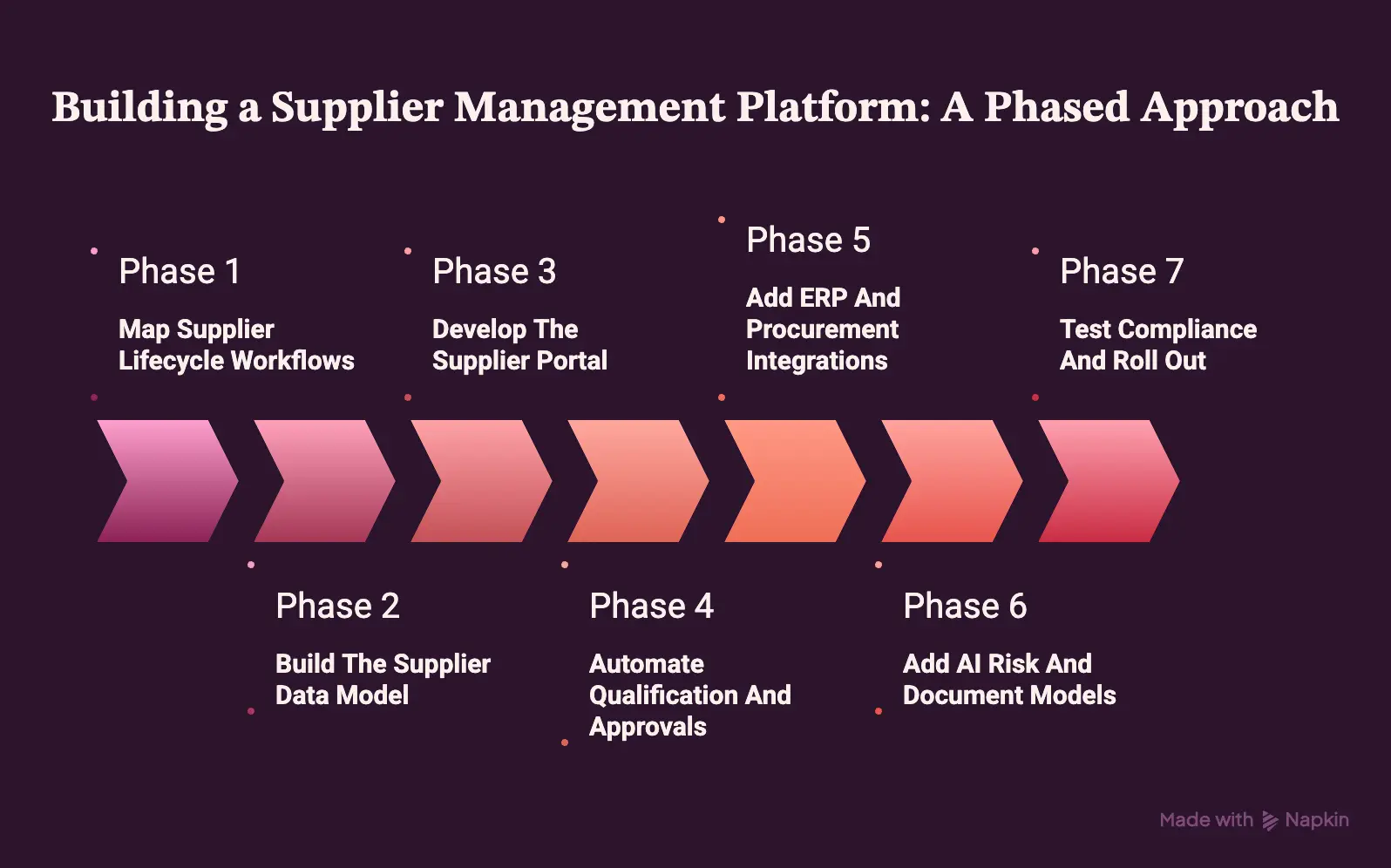
Phase 1: Map Supplier Lifecycle Workflows
Start by mapping every single supplier journey before designing any user interface elements. This deep functional mapping must trace vendor entry points from initial discovery through registration, risk prequalification, contract generation, and ultimate offboarding.
- Technical Execution: Specifically, development teams define explicit workflow states, required information fields, conditional document attachment rules, and strict internal approval hierarchies. Additionally, you must programmatically establish service-level agreement (SLA) clocks, cross-departmental escalation paths, and definitive risk-based vendor tiering criteria.
- Intellivon Approach: We run intensive workflow discovery sessions with your procurement, compliance, finance, and security stakeholders to map all operational paths before a single line of software code is written.
- Transition: Once these comprehensive operational pathways are fully documented, engineers can confidently design the underlying database schemas.
Phase 2: Build The Supplier Data Model
Build the data model before building the portal because every automated workflow depends on cleanly structured database entities. Therefore, the core storage architecture must naturally support multi-tiered parent-child entities, regional facilities, contract repositories, compliance certifications, and historical audit ledgers.
- Technical Execution: This infrastructure phase focuses heavily on architecting a master data management framework that natively handles supplier data normalization and deduplication. Furthermore, engineers deploy custom supplier data quality scoring engines to evaluate the completeness of incoming records before writing them to disk.
- Intellivon Approach: We design your central data model to function as the authoritative, corporate system of record rather than treating it as a passive reporting add-on.
- Transition: Securing this normalized data core allows developers to safely construct the user-facing interfaces that feed it.
Phase 3: Develop The Supplier Portal
Develop the supplier portal as an external, secure workspace where vendors upload tax documents, complete questionnaires, and refresh expired credentials. Consequently, this self-service interface eliminates manual email chasing by keeping suppliers confined within strict, validation-guarded input pathways.
- Technical Execution: Technically, engineers implement secure credentialing gateways, automated onboarding invitation flows, dynamic form builders, and explicit file upload validation microservices. Additionally, the backend integrates asynchronous OCR parsing routines alongside rule-based automatic reminder systems to alert suppliers of incomplete items.
- Intellivon Approach: We engineer the portal interface to remain simple and accessible for external vendors while enforcing uncompromising validation checks for your internal reviewers.
- Transition: After establishing the external intake portal, the development team must configure the internal automated processing logic.
Phase 4: Automate Qualification And Approvals
Automate qualification by routing incoming supplier profiles through unique approval tracks based on calculated risk, category, and projected spend. Therefore, a low-risk office supply vendor will never face the same intensive review pipeline as a high-risk medical device supplier or cloud hosting partner.
- Technical Execution: Specifically, engineers program a centralized business rules engine that evaluates a multi-variable approval matrix in real time. This automated layer governs exception handling, generates system-wide SLA violation alerts, and presents conditional compliance questionnaires based on initial registration inputs.
- Intellivon Approach: We intentionally separate deterministic business compliance rules from predictive AI model outputs so your final regulated procurement choices remain entirely defensible.
- Transition: Once your internal qualification loops run smoothly, the platform is ready to hook into core downstream financial systems.
Phase 5: Add ERP And Procurement Integrations
Integrate enterprise ERP and procurement engines only after the foundational data model and approval loops have completely stabilized. Otherwise, corrupted or unverified supplier data will rapidly propagate into downstream general ledgers, accounts payable software, and purchasing systems.
- Technical Execution: This phase involves configuring enterprise API gateways, registering secure webhooks, and establishing high-volume batch synchronization schedules. Developers deploy custom connectors to execute native SAP supplier management integration and Oracle supplier management API integration to automatically cross-verify purchasing and invoice readiness.
- Intellivon Approach: We construct rigid integration contracts and schemas prior to writing integration code, successfully preventing the creation of brittle point-to-point connections.
- Transition: After transactional data syncs perfectly across systems, you can safely layer advanced intelligence modules on top of the clean data streams.
Phase 6: Add AI Risk And Document Models
Introduce AI capabilities only after your transactional workflows and master data quality scores are entirely stable.
Consequently, the initial AI deployment focus must target document parsing, missing evidence identification, supplier profile summaries, and predictive risk forecasting.
- Technical Execution: Technicians build custom pipelines utilizing machine learning supplier risk prediction algorithms, NLP supplier profile extraction, and retrieval-augmented generation (RAG). Furthermore, the architecture mandates confidence scoring frameworks that instantly route low-confidence model extractions directly into human review queues.
- Intellivon Approach: We deploy AI models strictly as intelligent reviewer assistants rather than allowing them to act as autonomous, unchecked compliance authorities.
- Transition: With the intelligence layer deployed, the platform must undergo strict quality verification before being released to global production users.
Phase 7: Test Compliance And Roll Out
Test the end-to-end platform using real-world supplier test scenarios before initiating a full enterprise-wide rollout. Specifically, engineers run diverse testing profiles, including clinical, financial, and high-risk IT scenarios, to validate access control boundaries, automated alerting thresholds, and compliance auditing.
- Technical Execution: This final phase covers intensive User Acceptance Testing (UAT), penetration testing, HIPAA compliance verification, and deep audit trail validation checks. Subsequently, teams launch micro-targeted supplier onboarding pilots with a small subset of trusted vendors to measure real-world performance metrics.
- Intellivon Approach: We execute a controlled MVP deployment strategy, measuring real adoption metrics before systematically expanding modules across wider supplier categories.
Executing your development lifecycle across these clear sequential milestones drastically mitigates overall project risk while maximizing institutional adoption. Furthermore, ensuring each phase satisfies its technical criteria before moving forward guarantees an incredibly stable platform.
For a deeper breakdown of managing enterprise deployment lifecycles smoothly, see our guide on enterprise software DevOps engineering best practices.
Supplier Management Software Development Cost: $70K–$300K
Supplier management software development usually costs $70,000 to $300,000, depending heavily on supplier portal complexity, AI model scope, ERP/GPO integrations, healthcare compliance depth, multi-tenant SaaS needs, and data migration volume.
Specifically, a focused MVP sits near $70,000 to $120,000, while a comprehensive enterprise AI-powered supplier management platform build reaches $220,000 to $300,000.
Therefore, defining your specific workflow and data boundaries early directly dictates where your final investment lands within this range.
Software Development Cost:
| Development Phase | What It Covers | Estimated Cost |
| Discovery and Workflow Mapping | Supplier lifecycle, approval rules, compliance scope | $8,000–$18,000 |
| Data Model and Architecture | Supplier MDM, schema, roles, tenant design | $10,000–$25,000 |
| Supplier Portal MVP | Registration, uploads, status, reminders | $18,000–$45,000 |
| Workflow Automation | Qualification, approvals, risk tiering, CAPA | $15,000–$40,000 |
| ERP/GPO/Procurement Integrations | SAP, Oracle, GPO, AP, CLM, eProcurement | $20,000–$65,000 |
| AI Models and Intelligence | OCR, NLP, risk prediction, anomaly alerts | $18,000–$60,000 |
| Healthcare Compliance Controls | HIPAA, BAA, credentialing, FDA audit evidence | $12,000–$35,000 |
| Testing, Deployment, DevOps | QA, security, audit logs, CI/CD, monitoring | $10,000–$25,000 |
For ongoing maintenance, organizations must budget 15% to 25% of the initial build cost per year.
Consequently, this recurring budget covers necessary cloud infrastructure, security patches, API integration updates, continuous AI model monitoring, compliance adjustments, and technical support.
Why Hire Intellivon To Develop A Supplier Management Platform
Hire Intellivon when your supplier management platform needs regulated workflows, AI-assisted risk intelligence, healthcare-grade compliance, and deep integration beyond generic supplier portals.
- Built for supplier lifecycle control: Get supplier registration, qualification, onboarding, document collection, approval routing, scorecards, audits, corrective actions, renewals, and offboarding built around your operating model.
- AI without supplier governance risk: Use OCR document extraction, NLP profile parsing, supplier risk scoring, anomaly detection, ESG data validation, and AI-generated assessment summaries with human review workflows.
- Healthcare and fintech expertise: Support vendor credentialing, BAA tracking, HIPAA-safe supplier portals, GPO supplier rules, FDA supplier audit evidence, third-party risk, SOC 2 evidence, and regulated supplier workflows.
- Enterprise-grade integrations: Connect SAP, Oracle, Workday, NetSuite, GPO feeds, CLM systems, AP tools, procurement suites, SSO, SIEM, and analytics platforms without disrupting your system of record.
- Production-ready engineering: Work with ex-MAANG engineers and teams backed by 500K+ engineering hours across complex AI, healthcare, fintech, MLOps, and enterprise software builds.
- Cost clarity upfront: Plan MVP, production, AI, integration, compliance, cloud, and maintenance budgets within the $70,000–$300,000 custom development range.
Talk to Intellivon’s supplier management software experts to scope your platform, estimate your build cost, and decide whether custom development is the right move.
Conclusion
Supplier management software development works best when the platform is designed as a governed supplier operating layer. First, it must centralize supplier data, documents, approvals, risk scores, contracts, credentials, and audit evidence. Next, it must integrate with ERP, procurement, GPO, finance, and compliance systems.
Finally, AI should support document extraction, risk review, anomaly alerts, and performance forecasting without replacing human accountability. Therefore, the strongest build is not the one with the most features. It is the one that makes supplier decisions faster, safer, and easier to defend.
FAQs
Q1. Why Is Supplier Onboarding Still So Manual?
A1. Supplier onboarding stays manual because supplier data sits across email, Excel, ERP tickets, tax forms, bank documents, insurance certificates, and finance reviews. Therefore, teams spend weeks chasing missing fields and approvals. A supplier onboarding automation platform fixes this by centralizing forms, documents, reminders, validation rules, approvals, and ERP sync.
Q2. Is Building Supplier Software Cheaper Than Buying?
A2. Building supplier software is cheaper only when your workflows are too regulated, specific, or integration-heavy for standard tools. A focused build starts at $70,000–$120,000. However, enterprise platforms reach $180,000–$300,000 with AI, ERP, compliance, and support. Therefore, compare total ownership cost, not license price alone, before choosing the build or buy route.
Q3. Can ERP Handle Supplier Management Alone?
A3. ERP can manage approved supplier records, payment terms, tax data, and vendor IDs. However, it usually cannot manage onboarding, document expiry, risk questionnaires, credentialing, ESG evidence, CAPA, and supplier collaboration alone. Therefore, keep ERP as the financial system of record and build supplier software as the workflow layer above it.
Q4. What Healthcare Supplier Documents Need Tracking?
A4. Healthcare supplier documents should include BAAs, HIPAA training, licenses, insurance, immunization records, OR access approvals, FDA audit evidence, quality agreements, W-9/W-8 forms, banking documents, diversity certificates, and ESG evidence. Additionally, every document needs an owner, expiry date, approval status, and audit trail because supplier access directly affects patient safety outcomes.
To Sum Up:
- Supplier onboarding fails when every supplier goes through the same workflow. Risk-based tiering is usually the real unlock.
- ERP stores approved supplier data, but it rarely manages supplier evidence, credentialing, risk review, and supplier collaboration well on its own.
- AI adds value only after supplier data is normalized, deduplicated, and tied to clear approval rules.
- Healthcare supplier platforms need credentialing, BAA, FDA, GPO, and audit logic from day one, not as future add-ons.
- A $70,000 MVP can prove supplier onboarding value, but regulated enterprise builds usually move toward $220,000–$300,000.