Key Takeaways:
-
Procurement platforms cover requisitions, approvals, supplier records, purchase orders, and contract workflows.
-
ERP integration, invoice matching, vendor onboarding, and role-based access define mid-level platform requirements.
-
AI spend classification, supplier risk scoring, NLP invoice processing, and LLM contract review power advanced builds.
-
Custom enterprise builds cost $70,000 to $300,000 depending on AI depth and integration complexity.
-
How Intellivon builds procurement platforms around workflow fit, integration depth, AI governance, and total cost of ownership.
Procurement software development costs between $70,000 and $300,000 for a custom enterprise build. A focused procure-to-pay platform covering requisitions, approval workflows, and invoice processing lands near the lower end, while expanding to sourcing event management, contract lifecycle management, supplier portal development, and AI features like ML spend classification moves the cost toward $300,000.
The cost driver teams most consistently underestimate is the ERP and GPO integration layer, which adds $30,000 to $80,000 to the build and extends timelines by 8 to 16 weeks when scoped late. At the same time, enterprise procurement software licensing starts at $80,000 to $150,000 per year for core modules alone, before Year 1 implementation costs are added, making a custom build at $70,000 to $300,000 a comparable one-time investment with no recurring license fee attached.
This blog approaches procurement software development cost in the way Intellivon scopes it, starting with a module-by-module breakdown before any vendor conversation begins. At the same time, it covers discovery, each development module, AI feature costs, ERP and GPO integration, HIPAA compliance, ongoing maintenance, and a build-versus-buy comparison, leaving a clear budget framework to take into any CFO conversation.

What Is Custom Procurement Software?
Custom procurement software is a centralized workflow, data, and financial control system that manages how an organization requests, approves, buys, and tracks enterprise goods or services.
At the same time, building a dedicated platform typically requires a total procurement software development cost ranging from $150,000 to $450,000+ for an enterprise-grade, compliant system.
This custom architecture unites finance, legal, and operational teams into a single source of truth.
Key Capabilities and System Scope
| Component | Technical Scope | Development Cost (Est.) |
| It Connects Buying, Finance, And Suppliers | Unifies purchase requests, multi-level approvals, supplier onboarding, digital invoices, and real-time spend dashboards into a single ecosystem. This foundational platform layer represents a vital source-to-pay software development investment. | $45,000 – $75,000 (Basic connection: $20,000 – $40,000) |
| It Goes Beyond Purchase Order Software | Replaces basic, isolated transactional tools with a full end-to-end eProcurement platform development budget that covers advanced sourcing, dynamic contract management, and complex accounts payable automation. | $140,000 – $220,000 (Simple PO tool: $70,000 – $90,000) |
| It Becomes A Procurement System Of Record | Establishes absolute financial traceability by structuring a unified database architecture for supplier master data, line-item pricing logs, immutable approval histories, and automated audit trails. | $15,000 – $35,000 |
| It Gives Teams Workflow Ownership | Provides total control over specialized routing logic, which helps teams build procurement software cost estimate ranges that account for unique healthcare workflows, custom GPO pricing matrices, and secure multi-facility permissions. | $20,000 – $55,000 |
Custom procurement software moves organizations away from fragmented legacy tools by establishing an open, highly secure financial system of record.
Therefore, investing in tailored software architecture ensures your supply chain workflows map perfectly to strict compliance rules without forcing your team to adapt to rigid, packaged software limitations.
Why Enterprises Build Procurement Software
Enterprises build custom procurement systems because off-the-shelf platforms often become too expensive, too rigid, or entirely disconnected from real-world workflows. Consequently, organizations build custom procurement software to maintain absolute data ownership, deploy tailored approval routing, and avoid restrictive, seat-based enterprise licensing fees.
Consequently, this engineering approach ensures that your underlying procurement architecture adapts directly to your business logic rather than forcing your teams to adapt to rigid software limitations.
1. License Costs Push Teams Toward Custom Builds
Enterprise SaaS platforms rely heavily on high, seat-based pricing structures and massive setup fees. For this reason, custom procurement platform development cost options become highly attractive when five-year licensing and implementation fees surpass $250,000 to $600,000.
In contrast, a focused custom build can easily keep your initial budget within a predictable $70,000 to $300,000 asset investment.
2. Healthcare Workflows Rarely Fit Generic Tools
Hospital networks require deep technical alignment with clinical preference items, group purchasing organization (GPO) pricing tiers, and vendor credentialing parameters.
Therefore, building specialized healthcare procurement software development cost metrics into your budget usually adds $30,000 to $90,000 to a baseline platform build.
This investment ensures that your system fully accommodates mandatory HIPAA-compliant procurement software cost allocations and essential hospital workflows.
3. Procurement Data Becomes Strategic IP
Owning your raw contract intelligence, supplier risk metrics, and historical line-item pricing gives your organization a distinct strategic edge.
For instance, building a dedicated procurement data analytics platform layer costs $18,000 to $50,000, depending on reporting dashboard depth and data normalization needs. As a result, your team gains an unedited, permanent audit log of all financial transactions without paying recurring data extraction fees.
4. Founders Build Platforms To Monetize Workflows
B2B SaaS product leaders launch specialized, white-label procurement software platforms to capture specific niche markets using multi-tenant architectures and AI add-ons.
Specifically, a procurement SaaS platform development pricing model for an MVP runs $90,000 to $150,000. Meanwhile, a complete, multi-tenant AI procurement software development cost breakdown scales up to $180,000 to $300,000 to support enterprise-grade multitenancy.
Building custom procurement infrastructure completely eliminates recurring software taxation while giving your enterprise absolute sovereignty over its operational workflows and data. Ultimately, it transforms procurement from a rigid administrative bottleneck into a highly adaptable, strategic asset.
Procurement Software Development Cost: $70K–$300K
The procurement software development cost usually ranges from $70,000 to $300,000, depending on workflow depth, integration scope, and compliance requirements. For instance, a basic MVP sits near $70,000 to $110,000, while an AI-powered healthcare procurement platform with ERP, GPO, and AP workflows can reach $300,000.
Therefore, defining your functional scope early is essential to setting an accurate custom procurement platform development cost budget.
1. $70K–$110K For A Procurement MVP
This tier focuses strictly on core transactional workflows to validate your system logic or launch a proof of concept. Specifically, the scope includes purchase requests, simple approval routing, basic supplier records, PO generation, and simple administrative roles.
- Discovery and Scoping Cost: $6,000 – $10,000
- UI UX Design & Architecture Cost: $8,000 – $15,000
- Core Frontend & Backend Development Cost: $35,000 – $55,000
- Procurement Platform QA & Testing Cost: $10,000 – $20,000
- Basic AWS/Azure Cloud Infrastructure Cost: $5,000 – $10,000
- Best For: One facility, one procurement team, or a new procurement SaaS platform development pricing validation.
2. $120K–$190K For A Production Platform
This tier introduces deeper automation to run full mid-market or divisional operations. Consequently, the scope expands to include custom ERP integrations, a secure supplier portal, a contract management module, automated invoice matching, and full audit trails.
- Discovery & Process Mapping: $8,000 – $15,000
- Product Architecture & Database Design Cost: $15,000 – $25,000
- Core Platform Build: $55,000 – $85,000
- ERP Integration Procurement Software Cost: $25,000 – $45,000
- QA, Security Audit, and Launch: $17,000 – $25,000
- Best For: Mid-market enterprises, standalone hospital departments, and fintech vendor management teams.
3. $200K–$300K For AI Procurement Software
This enterprise-grade tier uses advanced automation to handle complex global supply chains and regulatory environments. As a result, the scope includes machine learning spend classification, NLP invoice processing, AI supplier risk scoring, and LLM contract review features.
- Core Platform & Database Architecture Cost: $90,000 – $130,000
- AI Procurement Feature Development Cost: $50,000 – $95,000
- ERP, GPO, and EHR Procurement Integration Cost: $35,000 – $65,000
- Compliance Certification & HIPAA Compliance Procurement Software Cost: $20,000 – $40,000
- QA, DevOps, and CI/CD Cost: $15,000 – $30,000
- Best For: Healthcare networks, medical device manufacturers, and AI-powered procurement software development cost estimate planning.
4. 15%–25% Annual Maintenance After Launch
Post-launch, software applications require continuous optimization to remain secure and operational. Therefore, this budget covers bug fixes, cloud hosting updates, security patches, third-party API changes, and compliance adjustments.
For example, a $100,000 platform requires $15,000 to $25,000 annually, whereas a $300,000 system requires $45,000 to $75,000 per year.
Procurement Software Build Cost By Tier
| Build Tier | Scope | Timeline | Cost |
| MVP | Intake, approvals, suppliers, POs | 10–14 weeks | $70K–$110K |
| Production | ERP, contracts, invoices, dashboards | 4–7 months | $120K–$190K |
| AI Enterprise | AI, GPO, BAA, risk, compliance | 6–9 months | $200K–$300K |
| Full S2P Suite Parity | Comparable to legacy enterprise suites | 12–24+ months | Usually $1M+ |
Procurement software investments scale logically alongside architectural complexity and integration depth.
Therefore, by targeting an MVP or a production-ready system first, enterprises can avoid multi-million-dollar software traps while deploying a system built specifically for their internal workflows.
AI Procurement Platform Cost Breakdown By Phase And Module
An enterprise procurement software budget must be divided explicitly by development phase and business module because each engineering layer requires distinct technical expertise. Specifically, discovery, architecture, frontend, backend, third-party integrations, and automated AI layers all introduce variable workloads that directly dictate your final timeline.
Therefore, establishing a phase-by-phase breakdown prevents budget creep and ensures clear architectural alignment from day one.
Detailed Cost Allocation Matrix
| Development Phase | Core Engineering Workload & Technical Deliverables | Cost Range (Est.) |
| Discovery And Scoping | Conducts deep user role mapping, current ERP system reviews, custom approval workflow documentation, and strict compliance profiling. For example, Intellivon uses this phase to explicitly map your internal hierarchy before writing a single line of backend database code. | $6,000 – $15,000 |
| Architecture And UX Design | Maps data models, entity relationships, approval matrix permissions, and user group interfaces. Consequently, the primary cost drivers include the total number of distinct user roles, such as separate portals for suppliers, facility buyers, and corporate finance auditors. | $10,000 – $25,000 |
| Frontend Development | Builds scannable executive dashboards, purchase request forms, legal contract views, and mobile-friendly approval portals. Therefore, implementing multi-tenant designs or advanced supplier-facing interfaces will naturally move your budget toward the higher end of the spectrum. | $18,000 – $45,000 |
| Backend Development | Implements the core transactional workflow engine, relational supplier databases, automatic invoice-matching math, and encrypted audit trails. For this reason, costs rise when approval rules dynamically depend on asset amounts, specific clinical cost centers, or urgent facility bypass rules. | $25,000 – $60,000 |
| Integrations And Data Migration | Connects external endpoints, including SAP Ariba, Oracle ERP, NetSuite, local GPO pricing APIs, and distributor catalog feeds. As a result, linking a single, clean ERP endpoint stays highly economical, whereas orchestrating multi-system synchronization drives engineering hours upward. | $18,000 – $65,000 |
| QA, Security, and Launch | Executes automated regression testing, security vulnerability scans, continuous deployment pipeline builds, and multi-facility user training. Crucially, regulated industries like digital health and fintech demand rigorous test documentation and deeper access management controls. | $12,000 – $40,000 |
| AI Procurement Modules | Deploys specialized machine learning spend classification scripts, NLP invoice processing microservices, predictive supplier risk scoring models, and localized LLM contract review engines. This optional infrastructure layer directly determines your overall AI procurement software development cost estimate. | $50,000 – $95,000 |
Granular phase-wise cost tracking gives executive leadership full visibility into how engineering resources are used across the software lifecycle.
Ultimately, separating baseline application layers from highly specialized data pipelines allows your organization to build predictable, milestone-driven investment schedules.
Cost Breakdown By Procurement Module
Procurement software cost rises fastest when a platform expands from basic purchase requests into complete end-to-end operational suites. Each additional module introduces new user interfaces, specialized relational databases, discrete workflow logic, and third-party API dependencies.
Consequently, adopting a phased engineering roadmap allows enterprises to launch a functional platform quickly while keeping development budgets predictable and tightly controlled.
Procurement Module Cost Allocation Matrix
| Procurement Module | Baseline MVP Cost | Advanced Enterprise Cost | Core Engineering Workload & Technical Deliverables |
| Requisitions & Approvals | $15,000 | $35,000 | Covers custom purchase request forms, automated real-time budget threshold checks, multi-level approval chains, and dynamic escalation routing. |
| Supplier Portal | $20,000 | $50,000 | Handles secure supplier onboarding, tax document uploads, insurance compliance tracking, and direct order confirmation feeds. |
| Purchase Orders | $15,000 | $35,000 | Automates unique PO numbering sequences, enforces post-approval data locks, and maps line-item SKUs for instant ERP export. |
| Contract Management | $25,000 | $60,000 | Provides an encrypted contract repository, automated renewal alerts, clause tracking, and real-time tier pricing compliance monitors. |
| Invoice Matching | $25,000 | $65,000 | Conducts automated two-way or three-way matching across purchase orders, receiving logs, and vendor invoices while managing exception queues. |
| Spend Analytics | $20,000 | $55,000 | Generates granular visual breakdowns of category spending, supplier concentration, facility-specific overhead, and uncontracted leakage. |
| Admin & Audit Logs | $10,000 | $30,000 | Establishes immutable log files, role-based access management, security credential tracking, and compliant system monitoring. |
Designing procurement platforms as modular ecosystems allows enterprises to invest strictly in the features that resolve their immediate structural friction. Ultimately, prioritizing core modules first guarantees a faster return on investment while creating a scalable foundation for future automation.
ROI That Justifies Procurement Investment
Procurement software justifies its engineering cost when it systematically reduces manual data entry, rogue spending, invoice exceptions, and costly approval delays. Consequently, financial leaders must model their return on investment across specific structural buckets, linking every software module directly to a measurable outcome.
By replacing fragmented administrative friction with automated controls, the platform transforms from an IT expense into a direct cost-saving engine.
Value Realization and Cost Savings Matrix
| ROI Driver | Operational Friction & Financial Impact | Module Cost Focus (Est.) |
| Reduce Invoice Processing Cost | Manual accounts payable routing creates duplicate payments, administrative errors, and missed early-payment discounts. Automated three-way invoice matching mitigates this risk by digitally verifying transaction parameters before releasing capital. | $25,000 – $65,000 (Invoice Automation) |
| Control Maverick Spend | Off-contract purchasing dilutes corporate buying power and inflates operational overhead. Industry benchmarks from JAGGAER demonstrate that structured spend management can deliver an 18% savings lift by realigning rogue purchasing back to pre-negotiated contracts. | $15,000 – $35,000 (Catalog Controls) |
| Prevent Contract Leakage | Organizations lose financial leverage when buyers fail to trigger volume rebates or mistakenly use outdated supplier price sheets. Building localized pricing validation tables ensures that every transaction honors live legal terms automatically. | $25,000 – $60,000 (Contract Logic) |
| Shorten Purchase Approval Cycles | Paper-based approval chains result in delayed procurement events and facility operational backlogs. According to JAGGAER value assessments, implementing structured automation drives up to 50% faster requisition-to-PO times and slashes overall sourcing cycle times by 60%. | $15,000 – $35,000 (Approval Routing) |
| Improve Supplier Risk Visibility | Relying on unvetted vendors exposes corporate networks to sudden delivery shortages and compliance non-conformity. Predictive scoring systems track financial instability and regulatory compliance in real time to secure the perimeter. | $20,000 – $50,000 (Predictive Risk Scoring) |
Tailored procurement applications generate clear, defensible returns by permanently stopping operational budget leaks.
Ultimately, investing in targeted automation modules allows finance and technology executives to reclaim unmanaged tail spend while significantly expanding overall profit margins.
Architecture Behind A $70K–$300K Build
A resilient procurement platform requires six foundational architectural layers to ensure scalability, data integrity, and cross-system visibility. Specifically, it must balance master data orchestration with secure workflow engines, supplier record ledgers, integration middleware, and robust security governance.
The final cost of this technical infrastructure depends directly on the complexity of its third-party connection points and the level of data isolation required by your compliance profile.
System Architecture and Technical Breakdown
| Architecture Layer | Technical Composition & Core Functionality | Cost Range (Est.) |
| Master Data Layer | Establishes the relational database tables for the supplier master, item master, contract master, cost centers, general ledger (GL) codes, and multi-facility catalogs. | $10,000 – $30,000 |
| Workflow Engine | Powers the dynamic business logic behind multi-stage approval routing, conditional escalation paths, real-time budget threshold checks, and automated notification triggers. | $20,000 – $50,000 |
| Supplier & Contract Layer | Manages outward-facing vendor portals, secure onboarding workflows, encrypted Business Associate Agreements (BAAs), price-tier auditing records, and proactive contract expiration alerts. | $25,000 – $70,000 |
| Integration Layer | Hosts the microservices and API gateways responsible for syncing with Core ERP systems, accounts payable tools, healthcare GPO registries, and internal single sign-on (SSO) providers. | $18,000 – $65,000 |
| AI & Analytics Layer | Houses the specialized data pipelines for automated spend classification, NLP-driven invoice parsing, anomaly detection microservices, and predictive supplier risk scoring models. | $50,000 – $95,000 |
| Security & Audit Layer | Configures absolute system governance via Role-Based Access Control (RBAC), multi-factor authentication (MFA), end-to-end transport encryption, and immutable audit logging. | $12,000 – $40,000 |
A decoupled, microservices-driven architecture ensures that a custom procurement platform remains highly flexible as your transactional volume expands.
Ultimately, building a clean and isolated separation between your data layer and external API integrations prevents expensive downstream refactoring and ensures permanent system stability.
Why Healthcare Procurement Software Costs More
Healthcare procurement software costs more because hospitals and health systems purchase regulated, clinically sensitive, and contract-dependent medical supplies.
Consequently, the underlying system must manage multi-tiered Group Purchasing Organization (GPO) price sheets, vendor credentialing trackers, and strict regulatory barriers.
These advanced requirements introduce complex data validation steps, deep integration architecture, and extensive verification layers that directly push specialized healthcare procurement software development cost metrics above standard commercial benchmarks.
Healthcare-Specific Cost Allocation Matrix
| Healthcare Requirement | Regulatory & Technical Scope | Added Cost Range (Est.) |
| GPO Pricing Logic | Builds complex database schemas to manage dynamic contract tiers, eligible facility entities, distributor-specific price cross-walks, and automatic item substitutions. This infrastructure is essential because healthcare group purchasing organizations negotiate contract frameworks to reduce administrative burdens for complex medical networks. | $20,000 – $55,000 |
| Vendor Credentialing | Integrates automated validation checkpoints to track supplier qualifications, clinical environment access permits, liability insurance minimums, and medical immunization clearances. As a result, the platform prevents non-compliant vendors from receiving active purchase orders or entering secure sterile zones. | $20,000 – $50,000 |
| BAA And HIPAA Controls | Configures absolute data isolation parameters, strict transport encryption, role-based access limits, and automated Business Associate Agreement (BAA) signing workflows. These features safeguard patient confidentiality whenever procurement records cross paths with protected health information (PHI). | $15,000 – $40,000 |
| UDI And Device Traceability | Coordinates direct API integrations with the FDA Global Unique Device Identification Database (GUDID) to capture product lot numbers, manufacturer serial sequences, and expiration windows. This tracking infrastructure ensures that hospital supply systems can immediately locate and quarantine recalled surgical implants. | $25,000 – $65,500 |
| Value Analysis Workflows | Establishes specialized collaboration spaces for clinical product requests, evidence-based data reviews, committee voting matrices, and post-launch utilization tracking. Consequently, it balances hospital cost management alongside strict clinical quality and safety outcomes. | $25,000 – $60,000 |
| Multi-Facility Approval Rules | Orchestrates matrixed routing rules that dynamically adapt based on specific medical departments, localized facility budget constraints, clinical preference items, and emergency supply bypass parameters. | $20,000 – $55,000 |
Regulated medical supply chains require absolute compliance validation at every phase of the purchasing lifecycle.
Ultimately, allocating targeted resources toward healthcare-specific data modeling guarantees full operational alignment with FDA, HIPAA, and clinical safety standards from the moment your system goes live.
Top AI Procurement Platforms And Their Build Costs
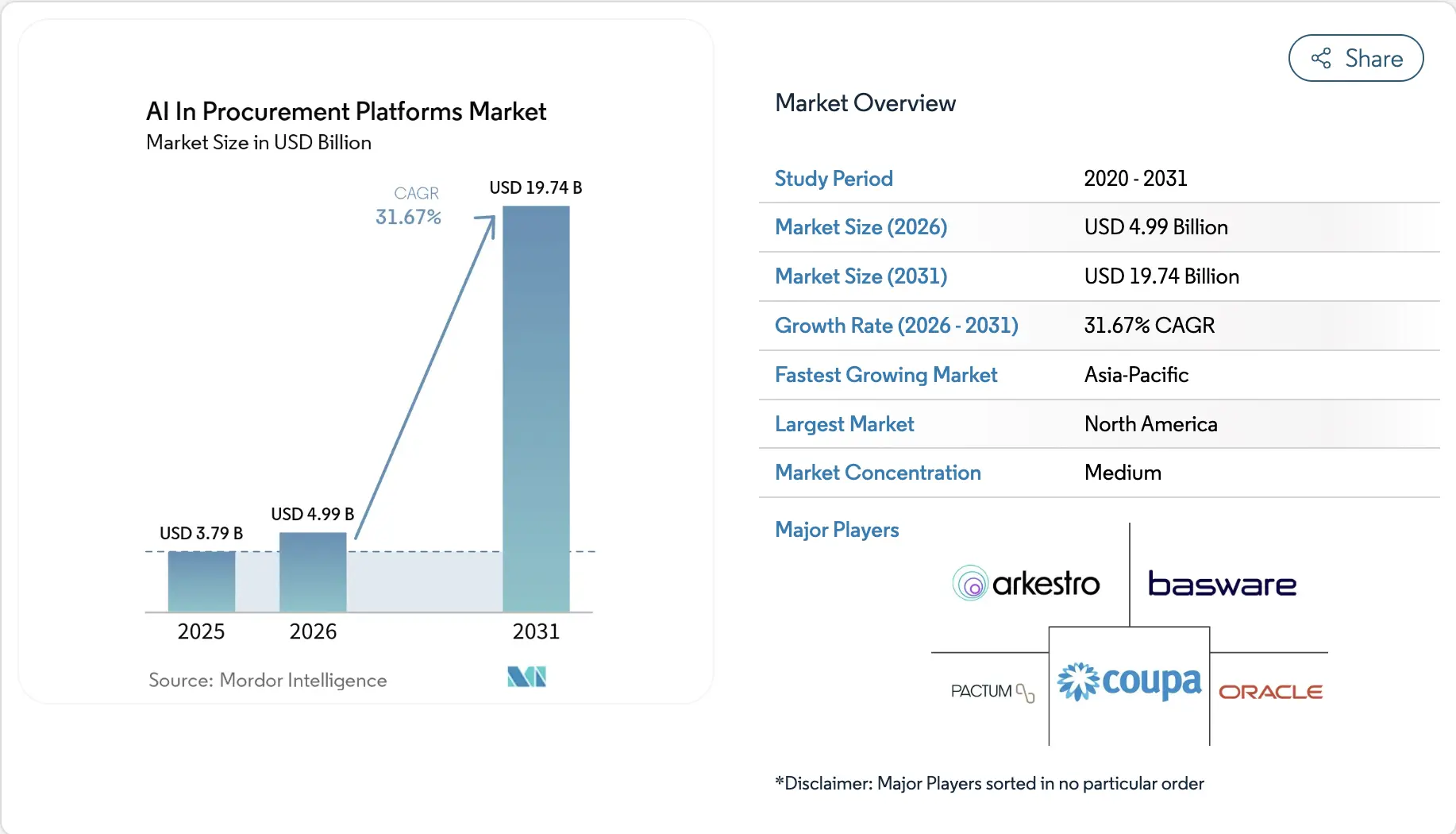
Top AI procurement platforms include JAGGAER One, SAP Ariba, Coupa, Ivalua, GEP SMART, Zycus, and Zip. Because public pricing for these market leaders remains strictly quote-based, executive teams must benchmark software licensing overhead against the cost of engineering a focused custom alternative.
Specifically, a tailored custom equivalent typically requires an initial procurement software development cost ranging from $120,000 to $300,000, whereas attempting to replicate a massive, full-suite global network can quickly exceed $1 million.
Platform Alternative Investment Mapping
| Platform Inspiration | Focused Custom Build Cost | Technical Composition & Deliverables | Best Fit & Strategic Use Case |
| JAGGAER One | $220,000 – $300,000 | Includes multi-tier GPO pricing logic, compliance-driven supplier onboarding portals, integrated contract management modules, and AI risk monitoring. | Regulated healthcare networks and medical device manufacturers require strict operational workflows. |
| SAP Ariba | $230,000 – $300,000 | Features ERP-first source-to-pay data layers, automated procurement routing infrastructure, custom catalog syncs, and intelligent AI invoicing. | Large corporate divisions looking for clean, dedicated procurement automation without multi-quarter implementation friction. |
| Coupa | $200,000 – $300,000 | Covers intuitive user spend intake forms, multi-level approval hierarchies, accounts payable automation, and unified executive dashboards. | Finance-led enterprise teams that prioritize absolute spend visibility, cost control, and rapid organizational adoption. |
| Ivalua | $220,000 – $300,000 | Built using a highly unified relational database model linking active suppliers, signed contracts, goods receipts, and invoices seamlessly. | Data-centric procurement operations that require high system traceability over a stylized or overly complex user interface. |
| GEP SMART | $180,000 – $280,000 | Deploys specialized machine learning, spend analytics, strategic sourcing workflows, contract repositories, and transactional processing. | Mid-market enterprises focused on extracting process optimization and catalog savings without maintaining an external supplier ecosystem. |
| Zycus | $170,000 – $270,000 | Employs AI-first capabilities such as NLP invoice parsing, algorithmic spend classification, and predictive vendor evaluation rules. | Teams seeking specialized workflow intelligence to bypass manual administrative bottlenecks without a full legacy replacement. |
| Zip / Levelpath | $120,000 – $220,000 | Delivers an easy-to-use intake orchestration interface, stakeholder routing rules, basic contract tracking, and rapid backend ERP exports. | Modern tech organizations that already own functional ERP tools but desperately need an intuitive, compliant intake front door. |
Investing in a tailored custom solution allows your organization to build exactly what you need without paying for unused enterprise modules. Ultimately, setting a realistic procurement SaaS platform development pricing roadmap yields a flexible internal asset that matches your exact operational scale.
AI Guardrails That Keep Procurement Safe
AI procurement software needs explicit guardrails because automated purchasing decisions directly impact capital allocation, regulatory compliance, and supply chain security.
Machine learning can categorize spend and summarize contracts, but it must never independently authorize high-value transactions or alter vendor status without a human-in-the-loop review.
Setting concrete boundaries ensures the platform provides deep operational visibility without introducing unmanaged compliance liabilities.
- Human-In-The-Loop Supplier Onboarding ($8K–$20K): AI models flag vendor compliance anomalies or risk profiles, but final credential authorization remains locked behind multi-factor human administrator sign-offs.
- Confidence Scores for Invoicing ($10K–$25K): Automated NLP document extraction microservices assign a statistical confidence value to every parsed line item, automatically routing low-confidence or mismatched text to an exception queue.
- Localized LLM Contract Scoping ($12K–$30K): Large language models identify missing clauses, liability terms, or expiration mismatches, while leaving legal risk acceptance entirely to your internal compliance counsel.
- Traceable Risk Evidence Trails ($10K–$25K): Algorithmic risk scoring architectures surface the specific source data points and financial indicators used to generate a vendor rating, creating an immutable audit trail.
- Agentic Execution Boundaries ($15K–$35K): Custom AI agents freely draft purchase requisitions, assemble supplier communications, or model scenario analyses, but lack system permissions to execute financial commitments.
Treating AI as an advisory copilot rather than an autonomous decision-maker protects your organization from silent operational and financial errors. Ultimately, investing in strict programmatic guardrails balances the speed of intelligent automation with the absolute security of executive oversight.
Hidden Costs Buyers Often Miss
The true procurement software development cost frequently expands post-launch due to unbudgeted operational and infrastructure necessities. Consequently, technology buyers often overlook critical line items such as legacy data migration, enterprise change management, recurring API maintenance, and multi-environment cloud hosting.
Factoring these hidden operational expenses into your primary source-to-pay software development investment strategy ensures complete long-term budget predictability.
Post-Launch Operational Cost Allocation
| Hidden Cost Category | Technical Workload & Core Deliverables | Projected Financial Impact |
| Data Migration | Maps, normalizes, and imports active supplier masters, catalog items, historic POs, open invoices, and encrypted contract files into the new system. | $8,000 – $30,000 (One-time) |
| Change Management | Finance role-specific internal training sessions, localized SOP manual adjustments, multi-department role onboarding, and supplier communication rollouts. | $8,000 – $25,000 (One-time) |
| Cloud Infrastructure | Covers secure multi-region AWS or Azure enterprise application hosting, encrypted backup protocols, and staging environments. | $1,000 – $8,000 (Monthly) |
| API Maintenance | Manages custom middleware updates, handling changes to external ERP schemas, local GPO API data updates, and payment gateway retry logic. | $10,000 – $35,000 (Annually) |
| Feature Growth | Funds strategic post-launch iterative enhancements, specialized dashboard builds, regular compliance updates, and machine learning model tuning. | $20,000 – $75,000 (Annually) |
Accurate procurement software scoping requires look-ahead budgeting for deep operational readiness and hosting stability. Ultimately, managing these post-launch layers diligently safeguards enterprise user adoption while securing a highly durable return on your initial engineering spend.
Why Hire Intellivon For Procurement Software Development
Hire Intellivon when your procurement platform needs custom workflows, AI automation, healthcare-grade compliance, and deep integration beyond generic P2P tools.
- Built for complex procurement workflows: Get requisition intake, approval routing, supplier onboarding, contract records, PO automation, invoice matching, spend analytics, and audit trails built around your operating model.
- AI without procurement risk: Use spend classification, NLP invoice processing, supplier risk scoring, LLM contract review, duplicate invoice detection, and human review workflows with clear approval boundaries.
- Healthcare and fintech expertise: Support GPO pricing, vendor credentialing, BAA tracking, UDI traceability, value analysis committees, AP automation, third-party risk, SOC 2 evidence, and regulated supplier workflows.
- Enterprise-grade integrations: Connect SAP, Oracle, Workday, NetSuite, GPO APIs, distributor catalogs, AP systems, SSO, reporting tools, and existing finance infrastructure without disrupting your system of record.
- Production-ready engineering: Work with ex-MAANG engineers and teams backed by 500K+ engineering hours across complex AI, healthcare, fintech, MLOps, and enterprise software builds.
- Cost clarity upfront: Plan MVP, production, AI, integration, compliance, cloud, and maintenance budgets within the $70,000–$300,000 custom development range.
Talk to Intellivon’s procurement software experts to scope your platform, estimate your build cost, and decide whether custom development is the right move.
Conclusion
Procurement software development cost usually falls between $70,000 and $300,000, depending on workflow depth, AI modules, ERP integration, healthcare compliance, and long-term support needs.
Therefore, buyers should compare custom development against the five-year TCO, not only license fees. Ultimately, the right platform should reduce manual work, protect spend, improve supplier control, and give procurement teams enough flexibility to scale.
FAQs
Q1. How Much Does It Cost To Build Procurement Software?
A1. Custom procurement software usually costs $70,000 to $300,000, depending on workflow depth, integrations, AI features, and compliance needs. A focused MVP costs $70,000–$110,000. However, production platforms with supplier portals, ERP connections, contract workflows, and analytics cost $120,000–$190,000. Healthcare or fintech AI builds usually reach $200,000–$300,000 for regulated buyers and scale.
Q2. Why Is Enterprise Procurement Software So Expensive?
A2. Enterprise procurement software is expensive because it connects purchasing, approvals, suppliers, contracts, POs, invoices, ERP data, reporting, security, and compliance. Also, it affects finance, legal, IT, operations, and external vendors. Therefore, implementation requires workflow design, integrations, permissions, audit trails, testing, and support beyond a simple dashboard or database.
Q3. What Is The Best Procurement MVP Scope?
A3. The best procurement MVP includes purchase requests, approval workflows, supplier records, purchase orders, dashboards, admin roles, and one finance export. Therefore, teams can control buying without rebuilding the full source-to-pay suite. This scope usually costs $70,000–$110,000 and should come before AI agents, advanced sourcing, or ERP replacement.
Q4. How Much Does ERP Integration Add?
A4. ERP integration usually adds $18,000 to $65,000 to procurement software development. Basic finance exports cost less, while SAP, Oracle, or NetSuite integrations cost more. That is because teams must handle field mapping, authentication, error handling, sandbox testing, approval sync, invoice status, and long-term API support.
Q5. What Makes Healthcare Procurement More Expensive?
A5. Healthcare procurement costs more because the platform must support GPO pricing, BAAs, HIPAA controls, vendor credentialing, UDI traceability, value analysis committees, and multi-facility approvals. Therefore, healthcare builds usually add $40,000–$120,000 over generic procurement software, especially when clinical supply, pharmaceutical, or medical device workflows are included.
To Sum Up:
- Custom procurement software becomes financially attractive when five-year licensing, implementation, add-ons, and workarounds cost more than a focused $70,000–$300,000 build.
- Healthcare procurement software costs more because GPO pricing, BAAs, vendor credentialing, UDI tracking, and value analysis workflows change the architecture.
- AI should start with spend classification, invoice parsing, contract review, and supplier risk scoring before autonomous procurement agents.
- The highest hidden cost is messy supplier data, unclear approval rules, weak adoption, and ERP integration delays.
- A full Jaggaer, Coupa, or SAP Ariba equivalent is not a $300K build. A focused custom version inspired by those platforms can fit that range.