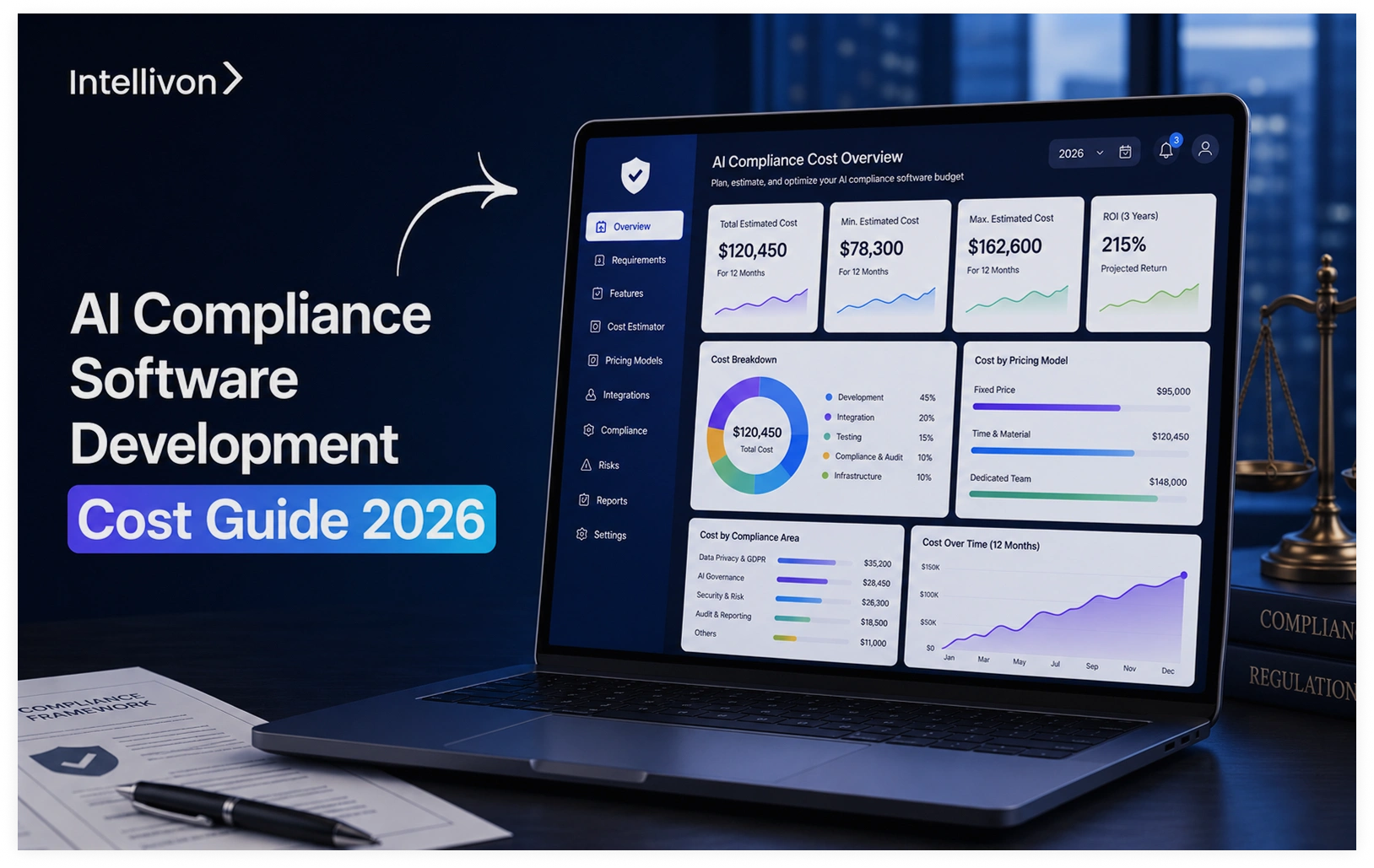
Key Takeaways:
- AI compliance software covers inventory, risk intake, policy mapping, approval workflows, and audit evidence collection.
- Production platforms add bias testing, explainability, model monitoring, regulatory reporting, and MLOps integrations.
- Multi-framework enterprise systems cover the EU AI Act, NIST AI RMF, ISO 42001, healthcare, fintech, and agentic AI controls.
- Focused MVPs cost $70,000 to $110,000 while multi-framework enterprise systems reach $220,000 to $300,000.
-
How Intellivon structures AI compliance builds in phases with 15 to 20% annual maintenance for regulatory updates and support.
AI compliance software costs range from $70,000 to $300,000, depending on frameworks and modules required. The build covers three distinct layers: model risk management, regulatory compliance automation, and governance reporting. Specifically, the model risk management layer covers bias detection, explainability, and AI audit trail design. From there, regulatory modules add the EU AI Act, NIST AI RMF, SR 11-7, and sector-specific requirements.
The regulatory framework count is the biggest cost driver and the most commonly underestimated variable. Moreover, each framework added post-build costs significantly more than scoping it from the start. AI compliance failures caused $4.4 billion in losses across organizations in 2025. Consequently, the build investment of $70,000 to $300,000 is modest compared to the exposure it prevents.
Intellivon builds AI compliance platforms for healthcare and financial services enterprises across multiple regulatory frameworks. The approach therefore always scopes all required frameworks before module development begins, not after. Accordingly, this blog covers costs from bias detection through regulatory automation, cloud infrastructure, and maintenance.

What is AI Compliance Software?
AI compliance software is a dedicated enterprise infrastructure platform that continuously monitors, audits, and governs artificial intelligence models. Consequently, it ensures these systems align with legal frameworks, internal data privacy mandates, and algorithmic fairness requirements.
The platform automatically tracks your model inventory, logs data lineages, and flags bias issues. Therefore, it transforms complex regulatory rules into automated engineering workflows, protecting your enterprise from severe penalties.
How Much Does AI Compliance Software Development Cost in 2026?
Custom enterprise AI compliance software cost profiles strictly range from $70,000 to $300,000 in 2026. Therefore, your upfront budget scaling depends entirely on system scope.
This baseline target solely covers digital core engineering, meaning it excludes separate legal fees, formal certifications, or independent model validation audits.
1. Cost Of Development
| Development tier | Estimated cost | Typical timeline | Included scope |
| Focused compliance MVP | $70,000–$110,000 | 12–16 weeks | AI inventory, intake, risk tiering, policy mapping, approvals, evidence repository, dashboards |
| Production compliance platform | $120,000–$210,000 | 5–8 months | Bias testing, explainability, model monitoring, regulatory reporting, API integrations, RBAC, audit workflows |
| Multi-framework enterprise platform | $220,000–$300,000 | 7–10 months | Healthcare or fintech controls, LLM governance, agentic AI monitoring, multi-region deployment, advanced integrations |
2. What the Quoted Development Range Includes
This core software engineering investment delivers a completely operational, regulatory-ready technology infrastructure. Consequently, it incorporates everything required to technically ingest and validate model operations.
- Product Discovery & Architecture: Requirements analysis, compliance-control mapping, and UX workflow design.
- Core Software Engineering: Frontend and backend engineering along with database and evidence-store architecture.
- Integrations & Pipelines: API development, automated model-evaluation services, and DevOps CI/CD setup.
- Security & Deployment: Full QA engineering, penetration testing, technical documentation, and initial onboarding.
3. What Remains Outside the Software Estimate
Conversely, corporate governance deployment requires separate operational, legal, and regulatory filing budgets. Therefore, you must separate professional services and external organizational compliance fees from core software creation.
- Legal & Advisory: Independent model-validation engagements and specialized external legal counsel opinions.
- Certifications: Formal ISO 42001 certification audits, HITRUST assessments, and FedRAMP authorization fees.
- Operations: Ongoing internal compliance staffing and large-scale legacy data remediation projects.
- Tooling: Corporate licenses for external SIEM, IAM, MLOps, or governance, risk, and compliance (GRC) tools.
Consequently, the overall budget becomes far more accurate once the buyer defines which layer of AI governance the platform must handle. A basic tool that records model owners costs far less than a runtime control plane that evaluates every model or agent action. Therefore, scoping your technical enforcement logic represents your immediate next step.
Why AI Compliance Budgets Are Rising and What Platforms Govern
Dedicated enterprise AI compliance software costs and infrastructure budgets are structurally separating from traditional GRC software categories. Legacy tools fail because they cannot observe live model drift, LLM token streams, agent actions, or real-time training evaluation runs. Therefore, specialized platforms are now mandatory.
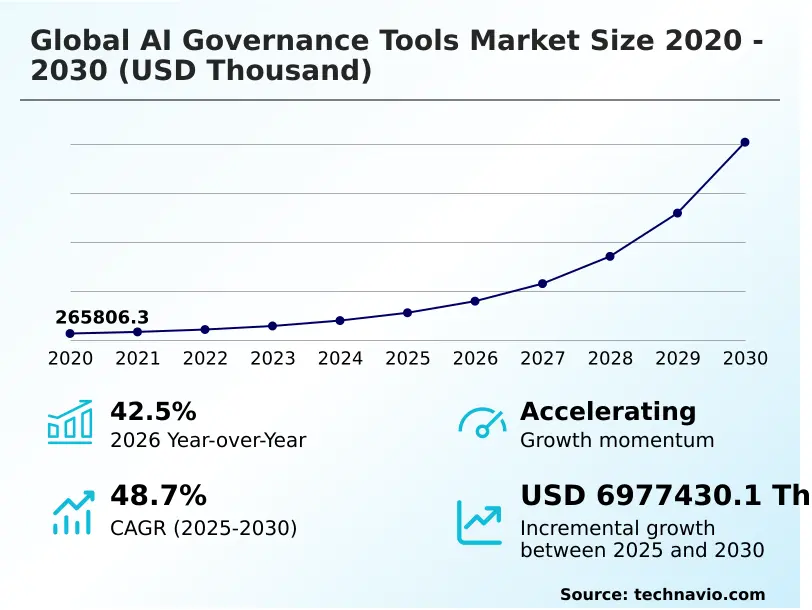
The AI Governance Tools Market size was valued at USD 1.11 billion in 2025, growing at a CAGR of 48.7% during the forecast period 2026-2030. This massive capital influx splits cleanly into four distinct functional software spaces.
1. AI Use and Shadow AI Governance
This initial operational layer strictly focuses on identifying and enforcing corporate boundaries regarding employee software consumption. Therefore, it provides immediate corporate guardrails.
- Discovery Engines: Browser extensions and corporate network discovery scripts to flag unapproved third-party AI interfaces.
- Data Guardrails: Regular expression rules and sensitive-data proxies that redact API inputs before they exit corporate boundaries.
2. AI Lifecycle and Model Risk Governance
This organizational framework operates upstream, managing model production long before code enters active staging environments. Consequently, it maps enterprise accountability profiles.
- Asset Repositories: Centralized use-case inventories tracking code owners, intended data usage, and risk tier assignments.
- Validation Archiving: Structured evaluation gates and step-by-step digital signatures are required prior to system deployment.
3. Runtime Model and Agent Governance
This critical framework operates directly in production, monitoring systems executing real-time workflows and autonomous operations. Therefore, it actively intercepts operational failure.
- Performance Telemetry: Automated tracking loops monitoring statistical model drift, semantic hallucination rates, and LLM safety anomalies.
- Action Arbiters: Permission systems managing agent tool-calls and hard ceiling barriers that require physical human intervention.
4. Audit Evidence and Regulatory Reporting
This structural layer converts back-end infrastructure logs into localized, legal proof points for external compliance bodies. As a result, it guarantees continuous audit readiness.
- Immutable Logs: Versioned history chains mapping specific business logic constraints to technical production parameters.
- Regulator Dashboards: Automated formatting modules that generate instant compliance summaries aligned with active regulatory statutes.
Ultimately, your enterprise may require one, two, or all four structural modules. Therefore, your primary architectural and budgetary choice is not the database type or the cloud vendor; it is defining the system’s exact physical boundary.
AI Compliance Platform Architecture and Cost-Critical Layers
A production-grade platform must cleanly decouple regulatory rules, governance workflows, technical evaluations, runtime controls, and evidence storage.
Consequently, this modular isolation allows engineering teams to dynamically update a specific regulatory requirement without breaking underlying model-monitoring services or corrupting historical evidence.
Therefore, architecture directly dictates long-term custom AI compliance software cost profiles.
Seven-Layer AI Compliance Platform Reference Architecture
| Architecture Layer | Core Functional Components & Scope | Custom Development Focus |
| 1. AI Inventory & Intake | Catalogs models, applications, agents, datasets, and vendors. Tracks technical owners, risk tiers, and approval states. | Automated discovery scripts across GitHub, MLOps engines, and internal API routing layers. |
| 2. Regulatory Knowledge | Houses machine-readable regulatory obligations, framework crosswalks, policy-to-control mappings, and alerts. | Versioned policy-as-code modules. For a reference pattern, Credo AI utilizes modular policy packs to map laws to controls. |
| 3. Risk Workflow | Manages custom risk questionnaires, automated approval routing, three lines of defense gates, and human override logs. | Orchestration engines with strict escalation SLA tracking and automated model retirement triggers. |
| 4. Technical Assurance | Computes accuracy metrics, statistical bias/fairness logs, data lineage, drift monitoring, and adversarial red-teaming. | Deep integration with underlying mathematical evaluation services and validation libraries. |
| 5. Runtime Control | Inspects live tokens, manages agent tool-call permissions, enforces identity boundaries, and triggers kill switches. | Zero-latency proxy pipelines providing prompt/response guardrails and human confirmation gates. |
| 6. Evidence & Reporting | Houses append-only ledger storage, automated model cards, immutable approval histories, and regulator exports. | Secure, write-once-read-many (WORM) database structures ensure chronological, context-rich audit trails. |
| 7. Integration & Security | Embeds enterprise IAM/SSO, SIEM logging, GRC links, and specialized industry platform data pipelines (EHR, ERP). | Bank-grade zero-trust network boundaries, tenant isolation mechanisms, and data residency controls. |
Decoupling these seven critical layers directly prevents structural software obsolescence when cross-border regulations inevitably shift.
For a deeper breakdown of governance ownership, controls, and lifecycle oversight, see our guide on building an enterprise AI governance framework.
Module-Wise AI Compliance Software Development Costs in 2026
Isolated technical module allocations for custom platforms start at $10,000 for specific, passive third-party evaluations and reach up to $60,000 for autonomous system routing engine engineering. However, these specific line-item costs are not fully additive.
Because primary infrastructure elements like user authentication, system workflows, and localized data storage structures are involved, the collective AI compliance software cost scales much more efficiently.
1. 2026 Module-Wise Development Cost Breakdown
| System Module | Recommended Pricing Range | Primary Technical Cost Drivers |
| Core Platform Foundation | $25,000–$55,000 | RBAC matrix, workflow state machines, secure API routing, and append-only database storage engines. |
| AI Model & Use-Case Inventory | $12,000–$25,000 | Automated code repository scanners, deployment metadata collectors, and data lineage mapping keys. |
| Risk Assessment & Classification | $15,000–$30,000 | Dynamic risk questionnaire engines, score aggregation systems, and conditional threshold approval loops. |
| Regulatory & Policy Mapping | $15,000–$35,000 | Cross-framework database crosswalks, version-controlled policy-as-code modules, and compliance alert hooks. |
| Bias, Fairness, & Explainability | $20,000–$55,000 | Production dataset ingestion pipelines, evaluation metric libraries, and integrated SHAP mathematical execution layers. |
| Audit Trail & Reporting | $15,000–$35,000 | Schema serialization libraries, cryptographic signature layers, and automated regulator PDF report builders. |
| Vendor & Third-Party Governance | $10,000–$25,000 | External supplier onboarding intake portals, contract parsing scripts, and standard attestation trackers. |
| LLM Compliance Monitoring | $20,000–$50,000 | Real-time token caching streams, vector space injection tracers, and contextual semantic filter proxies. |
| Agentic AI Governance | $25,000–$60,000 | Agent identity credential protocols, tool-execution blockers, and physical human verification triggers. |
| Sector Regulatory Packs | $10,000–$30,000 each | Specialized data formatting schemas for localized HIPAA, FDA, FINRA, SEC, or regional EU AI Act rules. |
2. Why Model Assurance Costs Vary Sharply
Upstream validation budgeting fluctuates significantly based on operational environment complexity.
Consequently, specialized platform costs escalate dramatically when algorithms process protected patient health identifiers or highly guarded corporate financial transaction streams.
- Data & Models: Evaluating diverse model types without training-data access while matching protected groups.
- Auditing: Enforcing perfect mathematical reproducibility and supporting independent model validation.
3. Why Agentic Governance Requires a Dedicated Module
Autonomous workflows require structural auditing systems that go far beyond basic text input and output validation tracking.
Because an autonomous system dynamically modifies its own operational path, the underlying governance tier must record the entire contextual chain.
- Telemetry: Recording the goal, prompt, retrieved vector context, and exact model version.
- Enforcement: Logging tool-execution logs, authorization decisions, and physical human intervention outcomes.
4. Strategic Modular Phasing Takeaway
For the vast majority of highly regulated firms, the most capital-efficient pathway forward involves a phased implementation strategy.
Specifically, combining your baseline core inventory registries, modular risk intake matrices, and policy alignment mapping elements allows you to deploy an immediately functional compliance framework.
As a direct result, your enterprise stabilizes human accountability workflows before taking on the additional development overhead required for continuous real-time LLM and agentic proxy filtering.
AI Compliance Software Cost Breakdown by Development Phase in 2026
A disciplined AI compliance software cost strategy balances capital across discovery, architecture, core engineering, model validation, and system deployment.
Because strict regulatory frameworks must be systematically translated into testable software controls and immutable proof structures, standard application development represents only a fraction of the necessary infrastructure investment.
Consequently, understanding your precise multi-phase budgetary distribution ensures continuous compliance alignment.
1. 2026 Expected Cost Breakdown by Project Phase
| Project Phase | Estimated Range | Primary Engineering Deliverables |
| Discovery & Scoping | $7,000–$15,000 | Use-case mapping, jurisdiction profiling, and risk taxonomy catalogs. |
| Architecture & UX | $8,000–$20,000 | Multi-layer data flows, compliance dashboards, and functional prototypes. |
| Core Engineering | $25,000–$70,000 | Platform microservices, public APIs, and workflow state engines. |
| Model Assurance | $15,000–$55,000 | Bias validation libraries and real-time token stream proxies. |
| DevOps & Integration | $10,000–$45,000 | Custom MLOps hooks, IAM/SSO synchronization, and CI/CD pipelines. |
| QA & Validation | $8,000–$30,000 | End-to-end automated control tests and penetration testing. |
| Deployment & Training | $5,000–$15,000 | Production rollouts, team runbooks, and system onboarding. |
2. Core Platform Team Composition
Building an enterprise platform requires a cross-functional squad including engineering, data science, and legal operations roles. Because specialized sectors demand distinct rules, domain experts must actively shape the software architecture from initial discovery.
- Core Engineering Squad: Product analyst, solution architect, backend and frontend developers.
- Specialized System Squad: ML model-risk engineer, DevOps engineer, QA specialist, and regulatory domain specialist.
3. Development Timeline by Delivery Scope
Project completion windows scale incrementally based on technical functionality. Therefore, planning around established milestones ensures realistic operational goals.
- System Prototype (6–10 weeks): Focuses on UX layouts and core data schemas.
- Focused Governance MVP (12–16 weeks): Delivers baseline intake and catalog features.
- Production Platform (5–8 months): Adds real-time telemetry and validation libraries.
- Enterprise Rollout (7–10 months): Finalizes deep corporate systems integration.
4. Fixed-Price, Time-and-Materials, or Phased Contracts
Your overarching commercial structure should directly match your underlying technical clarity. Consequently, enforcing clear purchasing decision rules eliminates capital waste.
- Fixed-Price: Best for narrow MVP configurations with highly predictable system boundaries.
- Time-and-Materials: Recommended when targeting fast-moving global regulations or custom validation tools.
- Phased Frameworks: The standard for large-scale operations, pricing new regulatory packs as controlled workstreams.
Utilizing a phased commercial contract effectively prevents your enterprise from overpaying for hypothetical international frameworks before verifying your foundational governance workflows. Furthermore, this modular approach establishes highly objective, technical acceptance criteria for every individual software release.
How Regulations Change AI Compliance Platform Development Cost
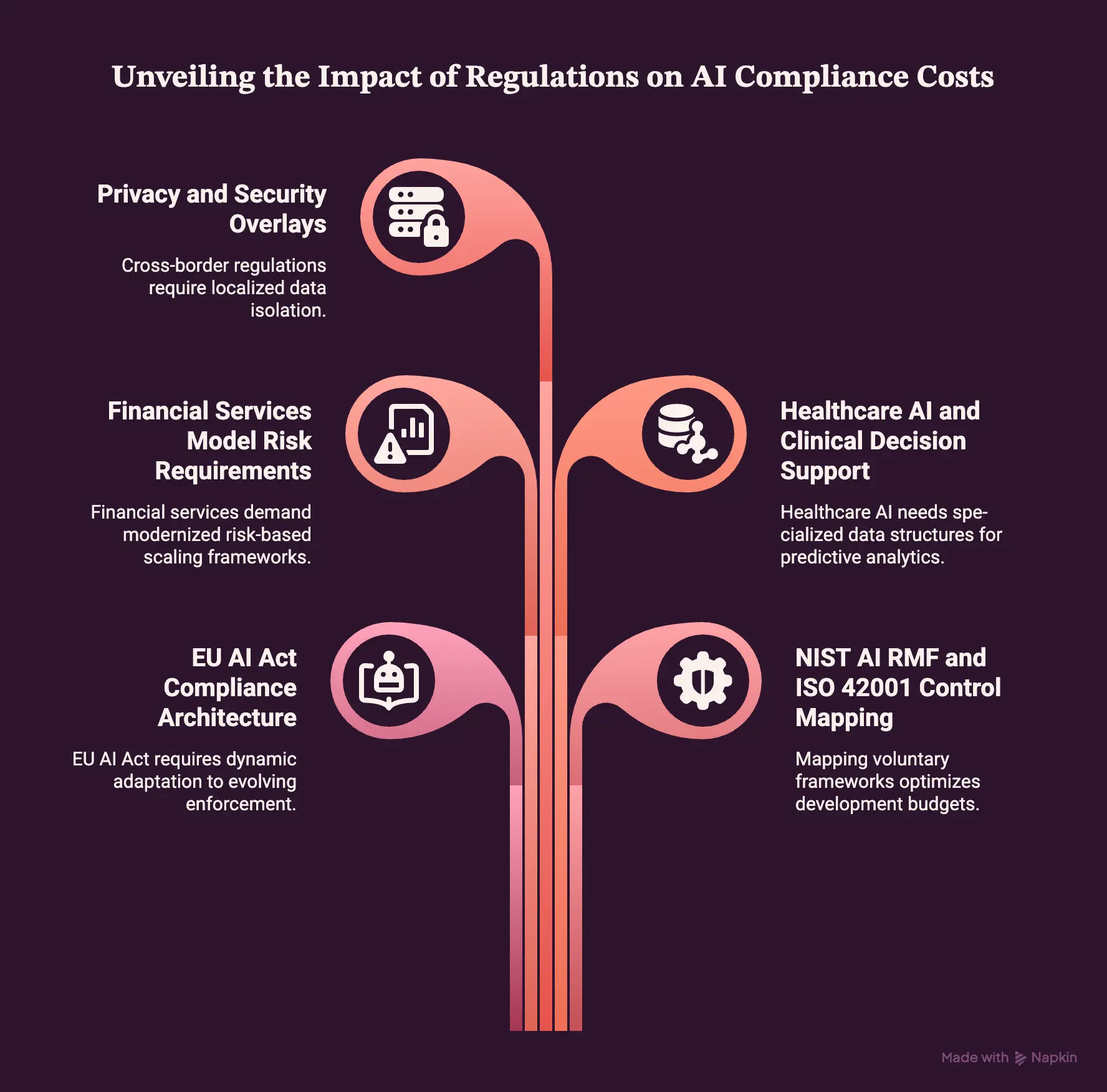
Global regulatory frameworks fundamentally dictate custom AI compliance software cost structures by shifting what a system must classify, test, approve, retain, and report.
Specifically, the primary engineering cost does not stem from storing static regulatory text. Instead, it lies in translating complex legal obligations into testable code, automated data schemas, and immutable evidence workflows.
1. EU AI Act Compliance Architecture
The multi-tiered execution timelines of the EU AI Act make a dedicated regulatory change-management module essential. Consequently, engineering must dynamically adapt to evolving enforcement schedules for high-risk applications.
- System Telemetry: Automates general-purpose AI (GPAI) and risk classification, provider/deployer role delineation, and prohibited-use screening.
- Governance Logs: Generates transparent notices, post-market monitoring workflows, and technical conformity evidence packages.
2. NIST AI RMF and ISO 42001 Control Mapping
Organizations optimize development budgets by mapping voluntary frameworks and certifiable standards to a centralized control library. As a direct result, teams eliminate redundant engineering tasks.
- NIST AI RMF: Functions as a voluntary blueprint centered around Govern, Map, Measure, and Manage functions to incorporate trustworthiness.
- ISO/IEC 42001: Serves as a formal, certifiable management system covering lifecycle controls, policy enforcement, and continuous improvement.
3. Financial Services Model Risk Requirements
The 2026 revised interagency model risk guidance (SR 26-2) officially supersedes SR 11-7, though buyers still use the legacy term in procurement searches. Therefore, systems must support modernized risk-based scaling frameworks.
- Banking Governance: Drives model inventory tiering, independent validation workflows, outcomes analysis, and management reporting.
- Regulatory Overlays: Integrates DORA operational resilience logs (active since January 2025), CFPB adverse-action explanations, and FINRA/SEC recordkeeping.
4. Healthcare AI and Clinical Decision Support
Clinical platforms demand highly specialized data structures to manage high-stakes predictive analytics.
- Data Privacy: Enforces strict HIPAA privacy infrastructure, granular PHI minimization tools, and secure EHR pipeline integrations.
- Predictive DSIs: Embeds ONC HTI-1 transparency features tracking 31 distinct model source attributes alongside FDA total-product-lifecycle evidence.
5. Privacy and Security Overlays
Cross-border data regulations demand localized network parameters and immutable storage controls. Consequently, platforms must natively isolate regional data streams.
- Data Protection: automates GDPR Data Protection Impact Assessments (DPIAs), CCPA state opt-outs, and automated-decision rights.
- Infrastructure Security: Enforces explicit data residency boundaries, DORA third-party ICT risk tracking, and FedRAMP or HITRUST validation logs.
Building modular compliance rails allows enterprises to swap regulatory packages without refactoring core code.
For financial-services obligations, see our guide on AI fintech compliance infrastructure.
AI Compliance Cost Scenarios for Healthcare and Fintech in 2026
Highly regulated financial and healthcare architectures sit firmly within the upper tiers of the $70,000–$300,000 deployment range.
Because these systems directly couple complex algorithmic validation logs with sensitive data handling, specialized scope extensions dictate total AI compliance software cost outcomes.
1. Hospital AI Inventory & Governance Platform
- Estimated Cost: $100,000–$170,000.
- Technical Scope: Administrative use-case catalogs, standard vendor risk scoring matrices, basic predictive DSI schemas, and core HIPAA data permission tracking.
2. Clinical AI & EHR Compliance Platform
- Estimated Cost: $150,000–$240,000.
- Technical Scope: Production HL7/FHIR integration adapters, 31 ONC-mandated model source attribute indices, cohort performance analysis suites, and PHI-blinded diagnostic logging.
3. Medical-Device or AI SaMD Compliance Platform
- Estimated Cost: $180,000–$300,000.
- Technical Scope: FDA total-product-lifecycle tracking logs, rigid hardware design control maps, dataset provenance ledgers, and automated regulatory submission packaging engines.
4. Banking Model Risk Management Platform
- Estimated Cost: $140,000–$230,000.
- Technical Scope: Modernized SR 26-2 materiality tiering matrices, aggregate dependency graph mapping, validator challenge logs, and board-ready portfolio risk exporters.
5. Credit Decisioning & Fair-Lending Compliance Platform
- Estimated Cost: $160,000–$260,000.
- Technical Scope: Automated adverse-action reason generators, continuous disparate-impact fairness scripts, override monitoring triggers, and immutable historical decision reconstruction indices.
6. Agentic AI Compliance for Regulated Operations
- Estimated Cost: $180,000–$300,000.
- Technical Scope: Multi-agent token monitoring proxies, transaction tool-call permission gates, and secure audit capture for customer-service, AML, and clinical documentation bots.
Industry sector designations alone do not inflate your software budget. Rather, development costs rise proportionally when a system must generate decision-level proof while bridging sensitive data streams, multi-layered human approval chains, and disparate enterprise software networks.
Integration, Infrastructure, and Three-Year Ownership Costs
Long-term operational integrations and continuous deployment logistics frequently eclipse the initial capitalization requirements of primary compliance dashboard tracking.
Enterprise platforms must ingest continuous metadata, model validation scores, and runtime telemetry from disconnected systems.
Because these systems were not designed to exchange evidence, integration and operational engineering dictate long-term AI compliance software cost structures.
1. MLOps and Model-Monitoring Integrations
- Estimated Implementation: $15,000–$40,000.
- Technical Engineering Scope: Building custom, low-latency connector pipelines to ingest real-time model telemetry and lineage metadata from MLflow, SageMaker, Azure ML, Vertex AI, Databricks, Arize, and Fiddler.
2. IAM, SIEM, GRC, and ITSM Integrations
- Estimated Implementation: $12,000–$35,000.
- Technical Engineering Scope: Synchronizing compliance access tracking with corporate Entra ID/Okta, routing runtime security alerts to Splunk, mapping risk statuses inside ServiceNow/Jira, and aligning evidence arrays with OneTrust or Archer.
3. Healthcare and Financial Data Integrations
- Estimated Implementation: $15,000–$55,000.
- Technical Engineering Scope: Standardizing high-security data extraction mechanisms across production HL7/FHIR APIs, cloud data warehouses, loan-origination engines, AML transaction-monitoring networks, and internal corporate ERP frameworks.
4. Cloud Infrastructure and Evidence Retention
Maintaining absolute data integrity across complex, multi-region production frameworks demands resilient storage strategies.
- Development Provisioning: Allocating an initial $8,000–$30,000 upfront allowance for private cloud networking, encrypted object storage, and target disaster recovery setups.
- Production Operations: Factoring a monthly recurring runtime budget of $2,000–$15,000 to manage intense validation compute requirements, secure key management, and multi-year WORM log preservation.
5. Maintenance and Regulatory Change Management
Enterprises must allocate 15% to 20% of their baseline software development budget annually to mitigate long-term architecture degradation.
- System Operations: Deploying emergency security patches, managing third-party package dependency drift, and optimizing cloud compute usage profiles.
- Compliance Evolution: Refreshing dynamic legal framework crosswalk mappings, adjusting API connector schemas, and refining statistical model evaluation parameters.
6. Three-Year Total Cost of Ownership (TCO) Model
| System Implementation Tier | Baseline Custom Build Cost | Estimated Three-Year TCO Profile |
| Focused Governance MVP | $70,000–$110,000 | $105,000–$175,000 |
| Production Platform | $120,000–$210,000 | $190,000–$340,000 |
| Enterprise Platform | $220,000–$300,000 | $350,000–$500,000 |
While your initial, standalone software engineering engagements remain strictly confined to a defined $70,000–$300,000 capital expenditure range, the multi-year aggregate total cost of ownership can easily scale well past $300,000.
Consequently, budgeting clearly for continuous ecosystem connections and framework maintenance avoids downstream project stalls.
Custom AI Compliance Platform Vs Vendor Software Cost in 2026
Buying an established platform lowers initial software engineering costs. Conversely, building a custom solution yields tighter control over data flows, system integrations, audit evidence, and industry-specific guardrails.
Enterprise off-the-shelf license fees scale from $30,000 to $500,000 annually based on active model counts, regulatory tracking footprints, and advanced runtime modules.
Consequently, understanding these strategic commercial trade-offs clarifies long-term AI compliance software cost structures.
1. Comprehensive Commercial Architecture Trade-Offs
| Decision Factor | Buy Vendor Software | Build Custom Platform | Hybrid Architecture |
| Initial Capitalization | Lower upfront deployment costs | $70,000–$300,000 development cost | Moderate initial system cost |
| Time to Operation | Rapid out-of-the-box deployment | Extended multi-month timelines | Balanced deployment schedule |
| Workflow Alignment | Standardized preconfigured logic | Fully bespoke control paths | Prebuilt core plus custom loops |
| Data Residency | Reliant on the vendor environment | Full internal environment control | Selective cloud routing control |
| Enforcement Layers | Dependent on vendor roadmaps | Designed for specific local actions | Custom proxies on vendor APIs |
| Pricing Scalability | Driven by user seat or model fees | Driven by base infrastructure costs | Combined license and infrastructure |
| Code Ownership | Proprietary closed vendor source | Full corporate software ownership | Partial custom middleware code |
2. Enterprise Platforms Buyers Compare
Firms assessing the market regularly evaluate four dominant enterprise-grade tooling models:
- IBM watsonx.Governance: Focuses on detailed validation metrics, explainability logs, and structured lifecycle inventories. Pricing uses transparent usage tiers covering evaluations, instances, and user seats.
- Credo AI: Prioritizes comprehensive use-case registries, prebuilt regulatory policy packs, third-party governance, and emerging agent risk frameworks.
- OneTrust AI Governance: Embeds automated shadow AI discovery, risk mapping, and data privacy workflows directly within a massive, pre-existing enterprise trust suite.
- ValidMind: Specializes heavily in financial services model risk management, providing automated validation documentation, developer tests, and rigorous audit evidence.
3. Clear Decision Rules for Buying Vendor Tools
Procurement teams should opt for established SaaS platforms when internal processes match standard compliance structures.
- Workflows: Your internal oversight needs to closely follow standard regulatory frameworks out of the box.
- Complexity: The business operates fewer custom production integrations and accepts standard cloud vendor hosting terms.
4. Clear Decision Rules for Building Custom Tools
Engineering teams must build dedicated platforms when underlying technical boundaries demand total system isolation.
- Control: Compliance logic directly differentiates the business, or data cannot leave your virtual private cloud.
- Scale: Volumetric per-model vendor pricing models become prohibitively expensive at true enterprise scale.
Enterprises capture optimal capital efficiency by deploying specialized vendor layers for baseline tracking while engineering localized wrappers. Specifically, you ingest pre-built policy packs and central registry views from a vendor.
Concurrently, your team develops custom backend orchestration engines, internal database evidence pipelines, and zero-latency real-time proxy blockers around those core modules.
How Intellivon Builds Enterprise AI Compliance Platforms for 2026
Deploying custom enterprise compliance rails requires an engineering approach focused heavily on data determinism, high-availability data infrastructure, and architectural isolation.
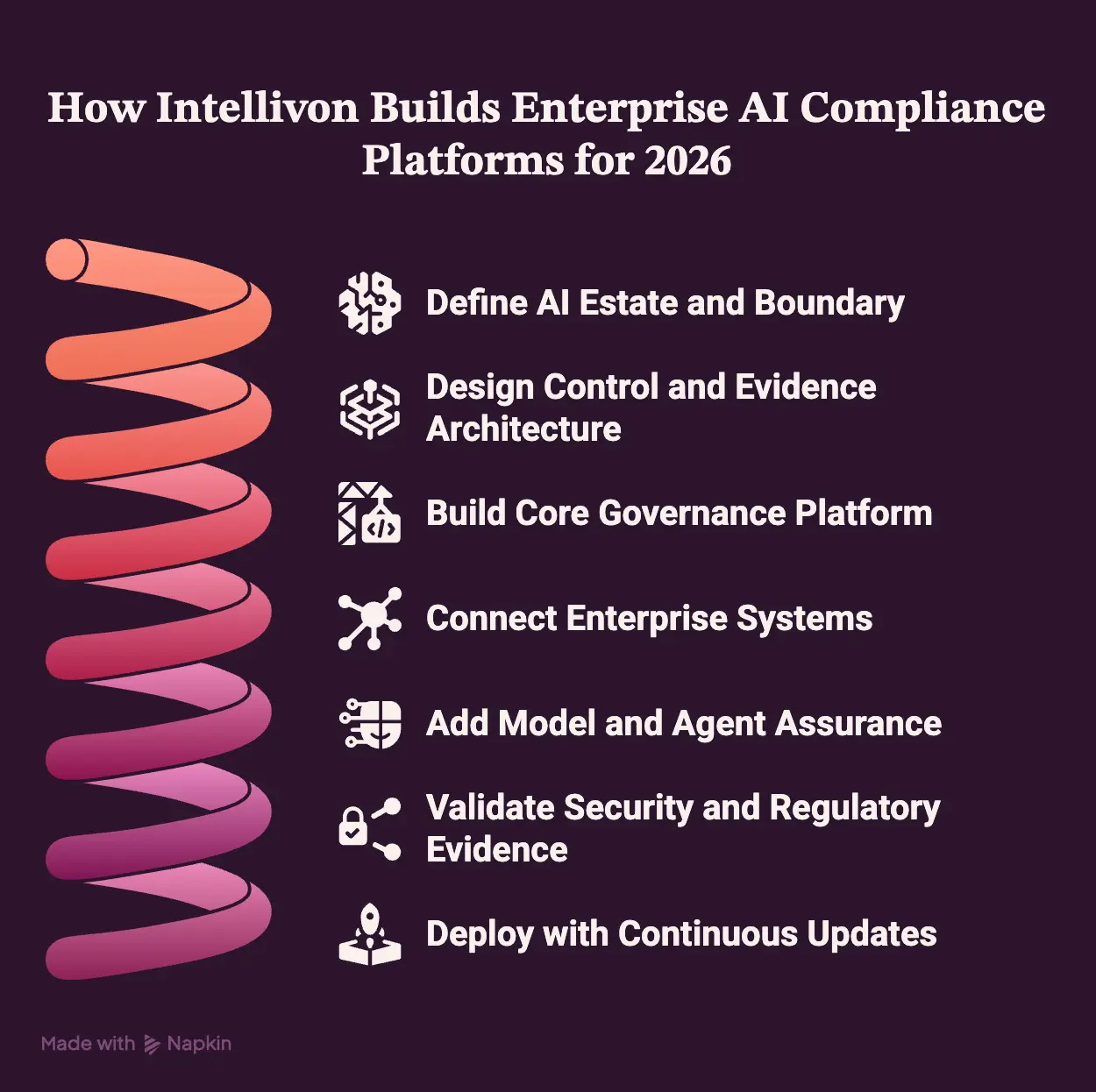
By following a structured, seven-step engineering roadmap, technical teams build resilient systems that scale cleanly alongside fluid, cross-border algorithmic regulations.
1. Define the AI Estate and Compliance Boundary
Start by identifying which models, LLM applications, agents, vendors, decisions, jurisdictions, and business processes the platform must govern.
A platform scoped around “all enterprise AI” cannot be estimated or validated effectively. Consequently, clear boundaries prevent scope creep.
- Scope Definition: Pinpoint shadow AI discovery endpoints, centralized use-case inventories, active deployment environments, and high-risk production workflows.
- Intellivon Approach: Intellivon systematically converts complex regulatory mandates and operational security profiles into a tightly bound, engineering-ready product backlog. Each epic explicitly dictates immutable evidence requirements and machine-readable acceptance criteria.
2. Design the Control and Evidence Architecture
Every compliance requirement must map to a system control, responsible owner, evidence source, review frequency, exception process, and retention rule. If a control lacks a verifiable data source, it cannot be automated.
- System Design: Establish a centralized control library, an active policy graph, global framework crosswalks, and WORM-configured audit storage layers.
- Intellivon Approach: Intellivon decouples the underlying policy, operational workflow, runtime enforcement, and data evidence layers. Because these components are isolated, regulatory updates can occur dynamically without corrupting historical audit logs.
3. Build the Core Governance Platform
- Operational Workflow: Here, build standard model intake portals, historical use-case registries, risk-assessment engines, administrative dashboards, reporting suites, and developer-facing REST APIs.
- Intellivon Approach: Our initial production release prioritizes establishing an unshakeable system of record and core operating workflows. We purposefully solidify these foundational data tracking mechanisms before adding experimental, AI-driven automation pipelines.
4. Connect Model, Data, and Enterprise Systems
- Integration: Link the compliance framework directly to MLOps registries, real-time model monitoring tools, SIEM log streams, GRC hubs, ITSM workflows, EHR platforms, CRM data, ERP clusters, and centralized cloud warehouses.
- Intellivon Approach: We design and deploy asynchronous, event-driven connectors governed by stable internal data contracts. This engineering choice prevents the architecture from breaking when external vendor APIs push upstream breaking changes.
5. Add Model, LLM, and Agent Assurance
- Telemetry: Deploy continuous bias testing scripts, local explainability tools, performance drift alerts, safety evaluations, RAG contextual tracing pipelines, tool-call monitoring proxies, and real-time human escalation paths.
- Intellivon Approach: We rigidly separate deterministic hard controls from fluid, AI-assisted recommendations. The internal AI can flag anomalies or draft documentation, but hard-coded policy gates retain absolute authority over regulated production actions.
6. Validate Security and Regulatory Evidence
- System Verification: Execute intense adversarial threat modeling, external penetration testing, strict access control validations, failover simulations, and human exception workflow tracking.
- Intellivon Approach: Our automated acceptance testing suite must prove two distinct outcomes. It validates what the operational platform does, and it confirms the exact cryptographic evidence generated when a control passes, fails, or triggers an exception.
7. Deploy with Continuous Regulatory Updates
- Production Management: Finalize staged enterprise rollouts, execute zero-downtime database migrations, track runtime operational health, maintain API connectors, and run automated quarterly control library alignment reviews.
Adhering to a highly structured development lifecycle guarantees that your core data plane remains structurally resilient as autonomous agent applications grow across the enterprise network.
For a deeper breakdown of autonomous compliance workflows, see our guide on agentic AI compliance automation in finance.
Build Custom Enterprise AI Compliance Software With Intellivon
Intellivon builds custom AI compliance platforms that connect corporate governance policies with real-time model telemetry, enterprise workflows, technical evaluations, and audit-ready evidence.
Each platform is scoped tightly around your organization’s unique AI estate, specific regulatory exposure, existing technology stack, and day-to-day operating model rather than a generic list of out-of-the-box software compliance features.
Our specialized engineering teams deploy production-ready compliance capabilities across your enterprise network:
- Custom Governance Workflows: We develop tailored AI inventories, intake pipelines, and automated multi-party approval workflows built around your specific corporate organizational chart.
- Global Framework Control Mapping: Our systems map operational data inputs directly to the strict requirements of the EU AI Act, NIST AI RMF, and ISO 42001.
- High-Stakes Sector Architectures: We build specialized, highly secure architectures tailored to the stringent, data-isolated needs of healthcare delivery systems and financial services.
- Deep Model Telemetry and Assurance: Our engines implement continuous bias testing, drift alerts, local explainability tools, and granular RAG contextual tracking pipelines.
- Autonomous Agent Governance: We integrate real-time tool-call monitoring proxies and deterministic policy gates to control advanced, multi-agent workflows safely.
- Event-Driven Enterprise Integrations: We deploy stable internal data contracts connecting your compliance hub with MLOps registries, EHRs, GRC platforms, SIEMs, and corporate IAM systems.
- Secure Infrastructure Deployments: Our teams architect resilient data structures configured for private clouds, on-premises data centers, or multi-region hybrid hosting environments.
- Continuous Regulatory Updates: We deliver production-first software engineering coupled with ongoing API connector maintenance to mitigate downstream legal and technical drift.
Ready to secure your AI operations? Talk to Intellivon’s AI compliance engineering experts to scope the exact modules, integrations, timelines, and 2026 development budget for your custom platform.
Conclusion
Navigating AI compliance software cost structures requires moving beyond simple upfront development estimates. True enterprise governance demands a continuous equilibrium between technical MLOps monitoring and active regulatory compliance trackers.
By systematically mapping boundaries, deploying event-driven infrastructure connections, and accounting for long-term operational TCO variables, technology executives secure their baseline platforms against costly architectural drift.
Ultimately, structured software engineering safeguards algorithmic innovation across highly regulated global industries.
FAQs
Q1. Can Existing GRC Software Govern Models, LLMs, and AI Agents?
A1. Traditional GRC software effectively manages policies, risks, and static corporate evidence. However, it cannot capture fluid prompts, version drift, tool calls, or runtime agent decisions. Therefore, you should maintain your GRC system for macro risk tracking while deploying a dedicated technical governance layer for model telemetry.
Q2. Should We Build or Buy an AI Governance Compliance Platform?
A2. Buy an established platform when workflows remain standard and vendor licensing feels predictable. Conversely, build when your team requires source-code ownership, private cloud isolation, or custom runtime controls. Alternatively, select a hybrid architecture to combine commercial policy modules with specialized internal data orchestration pipelines.
Q3. How Many Models Justify Custom AI Compliance Software?
A3. There is no universal threshold. Generally, custom software engineering becomes highly justifiable around 25 to 50 active corporate assets. Furthermore, even a smaller model portfolio justifies a custom build if your algorithmic decisions directly impact high-stakes sectors like healthcare, credit evaluation, or consumer financial access.
Q4. What Evidence Must an AI Compliance Platform Retain?
A4. The platform must retain exact model versions, training lineages, risk classifications, approval chains, and human overrides. Additionally, for autonomous agent applications, the database must continuously log conversational prompts, retrieved contexts, specific tool-call parameters, authorization outcomes, and completed transaction histories for future audit reconstruction.
Q5. Can One Platform Cover the EU AI Act, NIST, ISO, and HIPAA?
A5. Yes, a single platform can cover multiple frameworks simultaneously by utilizing a unified control library. By deploying multi-framework crosswalk mappings, one piece of technical evidence satisfies several distinct legal requirements. However, the architecture must strictly isolate specific regional jurisdictions, effective dates, and sector-specific obligations.
To Sum It Up:
- AI compliance software costs rise when policy must become executable control code, not when another regulation is added to a checklist.
- A $70,000 governance MVP should establish inventory, ownership, approvals, and evidence before it attempts autonomous compliance decisions.
- Agentic AI governance costs more because the platform must reconstruct goals, context, permissions, tool calls, human interventions, and final actions.
- The 2026 banking model-risk guidance superseded SR 11-7, proving why regulatory logic needs effective dates and version control.