Key Takeaways:
-
Custom AI governance software costs $70,000 to $300,000 depending on framework coverage and enterprise complexity.
-
Focused MVPs cost $70,000 to $110,000 while multi-framework enterprise platforms reach $210,000 to $300,000.
-
Core cost drivers include AI inventory, risk assessments, model validation, bias monitoring, and regulatory mappings.
-
MLOps integrations, security, runtime GenAI governance, and audit evidence add complexity and development investment.
-
How Intellivon builds custom enterprise AI governance platforms with annual maintenance budgeted at 15 to 25 %.
AI governance software cost ranges from $70,000 to $300,000, driven by module scope and framework count. Specifically, a single-framework build covering SR 11-7 lands near $70,000 with core modules. Adding EU AI Act, NIST AI RMF, and HIPAA pushes the same build toward $300,000. In practice, each additional framework adds documentation, audit trail design, and regulatory reporting modules that cannot be shared.
The framework count is the biggest cost driver, and the one most budgets underestimate. Moreover, EU AI Act, HIPAA, and SR 11-7 compliance rules rarely map to shared modules. EU AI Act certification alone adds €16,800 to €23,000 per system, per the European Commission. Consequently, any build covering three or more frameworks requires custom compliance mapping for each.
Intellivon builds AI governance platforms where multi-framework compliance and module depth are production requirements from day one. The approach therefore always maps all required frameworks before any module is scoped or priced. Accordingly, this blog covers every cost layer from model registry and bias detection through regulatory reporting.
What is AI Governance Software?
AI governance software is a control panel for artificial intelligence. It tracks every AI model your company uses from start to finish. Consequently, it makes sure your systems follow safety rules, avoid unfair bias, and protect private data.
In short, this software gives your business complete oversight. As a result, you can launch AI tools safely while staying compliant with strict government regulations.
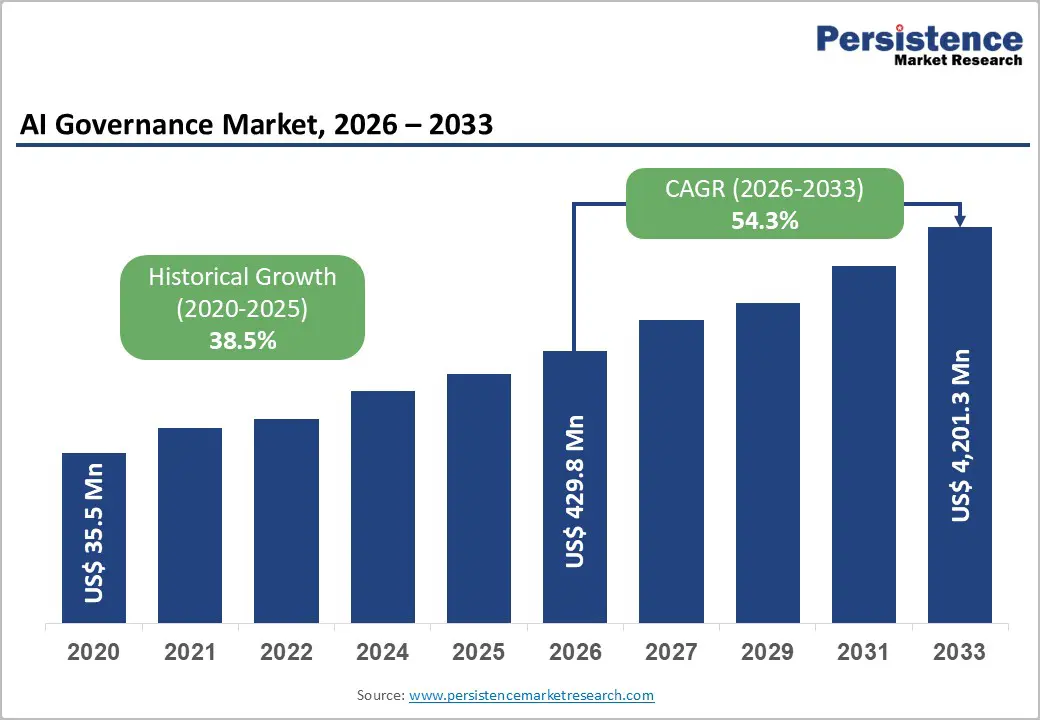
The AI governance software market is expanding rapidly due to strict regulatory mandates and enterprise AI adoption.
Valued at $417.8 million in 2026, the global market is projected to reach $3.59 billion by 2033. Consequently, this surge reflects an impressive compound annual growth rate (CAGR) of 36.0%.
How Much Does AI Governance Software Cost to Build?
AI governance software costs between $70,000 and $300,000 to build, depending on the number of governed AI systems, modules, integrations, regulatory frameworks, deployment model, and runtime controls.
1. Focused AI Governance MVP — $70,000–$110,000
- Best fit: Single business unit managing 10 to 30 AI systems under one primary regulatory framework.
- Core deliverables: Basic model inventory, risk classification, assessment workflows, policy approvals, audit trails, standard dashboards, and two to three core system integrations.
- Timeline: 12–16 weeks.
This entry tier establishes foundational visibility. As a result, teams eliminate manual spreadsheet tracking without paying for enterprise-wide customization.
For a deeper breakdown of building enterprise compliance infrastructure, see our deep dive on How to Build AI Agents for Banking Compliance & AML.
2. Regulated Production Platform — $120,000–$200,000
- Best fit: Healthcare providers, fintech platforms, insurers, or regional banks managing 30 to 150 AI models.
- Core deliverables: Multi-role approvals, automated model validation workflows, real-time bias, explainability, and drift monitoring, automated evidence collection, four to eight integrations, two or three compliance frameworks (such as HIPAA or SR 11-7), and VPC deployment.
- Timeline: 18–26 weeks.
At this level, real-time monitoring kicks in. Consequently, automated testing flags model drift and bias before production outputs reach end users.
Intellivon builds custom validation pipelines that continuously collect compliance telemetry directly from your existing MLOps architecture without interrupting model performance.
3. Enterprise Multi-Framework Platform — $210,000–$300,000
- Best fit: Global enterprises with multiple legal entities overseeing 150 or more AI systems, including LLMs, RAG applications, and autonomous agents.
- Core deliverables: Multi-region compliance support, advanced regulatory reporting, automated runtime policy controls, real-time regulatory intelligence, and complex MLOps and GRC platform integrations.
- Timeline: 26–36 weeks.
This tier provides full control across multi-cloud environments. Therefore, large organizations can enforce global AI policies across diverse engineering teams automatically.
Company size alone does not set your final budget. Instead, your specific AI portfolio risk, integration depth, and evidence collection requirements dictate real development costs.
What Does a $70,000–$300,000 AI Governance Platform Include?
A custom enterprise platform is far more than a simple risk-register application. Instead, it serves as a central control plane that directly connects corporate risk policies to live model pipelines. Consequently, engineering teams can maintain compliance without slowing down feature deployments.
1. Governance System of Record
Establishing a single source of truth is the essential foundation of any governance architecture. Consequently, this layer eliminates untracked “shadow AI” by creating a comprehensive, searchable database of every model across your enterprise.
- AI use-case inventory: Centralized catalog listing every active and proposed AI deployment across all business units.
- Model and agent registry: Granular tracking for traditional machine learning models, fine-tuned LLMs, and autonomous agents.
- Owner and accountable executive: Clear assignment linking technical owners to business sponsors and executive sign-offs.
- Data-source relationships: Complete lineage mapping for training datasets, prompt inputs, and output destinations.
- Vendor and foundation-model dependencies: Tracking commercial APIs, open-source base models, and third-party software components.
- Lifecycle status: Real-time visibility across development, testing, staging, production, and retirement phases.
- Risk tier: Automated risk assignment based on regulatory impact, business criticality, and user exposure.
- Deployment environment: System logs tracking hosting locations across local VPCs, public clouds, or edge devices.
2. Governance Workflow Engine
Moving beyond static spreadsheets requires automating your operational sign-off and review processes. As a result, this engine standardizes how new models are proposed, evaluated, approved, and retired without creating engineering bottlenecks.
- Intake: Automated submission portals that capture new AI project concepts before engineering begins.
- Risk classification: Rule-based scoring engines that assign risk levels using active regulatory mandates.
- Impact assessment: Structured questionnaires evaluating data privacy, algorithmic bias, and operational security.
- Independent review: Configurable routing to assign reviews to legal, risk, and security experts.
- Approval: Multi-signature sign-off gates required before any model reaches production.
- Conditional release: Automated restrictions that launch models with limited user groups or restricted autonomy.
- Periodic review: Recurrent automated tasks triggering regular re-evaluations of active production models.
- Material-change review: Automated flags triggered whenever underlying data pipelines or prompt templates change.
- Retirement: Controlled deprecation workflows that safely decommission outdated AI systems.
3. Evidence and Audit Layer
Regulatory compliance demands verifiable, tamper-proof proof of proper oversight at all times. Therefore, this component continuously aggregates system documentation into audit-ready artifacts for internal risk officers and external examiners.
- Immutable event logs: Tamper-proof audit records detailing every system change, policy update, and approval event.
- Versioned assessments: Historical archives of risk evaluations and compliance attestations over time.
- Model cards: Automatically generated technical documentation detailing model architecture and performance limits.
- Validation reports: Detailed performance metrics, stress-test outputs, and bias audit summaries.
- Policy attestations: Recorded sign-offs from business stakeholders confirming adherence to enterprise rules.
- Exception documentation: Formal tracking of approved temporary policy waivers and mitigation plans.
- Examiner-ready exports: One-click compliance packages tailored for external regulatory audits.
4. Monitoring and Control Layer
Governance must extend past pre-deployment approvals into active, real-time production runtime environment. Accordingly, this layer monitors operational model health and enforces immediate protective guardrails against unexpected model behavior.
- Performance deterioration: Automated alerts tracking drop-offs in accuracy, precision, or recall metrics.
- Data drift: Real-time detection of shifts between production input data and training baselines.
- Concept drift: Active tracking of changing real-world relationships that degrade prediction reliability.
- Fairness thresholds: Continuous monitoring of demographic parity across protected groups.
- Explainability checks: Integrated SHAP and LIME score generation to explain individual model decisions.
- LLM evaluation: Real-time metrics tracking hallucination rates, toxic content, and answer relevance.
- Prompt-injection events: Active guardrails flagging malicious inputs targeting generative applications.
- Agent permission violations: Live containment controls stopping autonomous agents from exceeding granted authorization limits.
Naturally, a $70,000 MVP does not contain every advanced control. However, it creates the essential baseline architecture required to add those controls safely. Furthermore, building this foundation prevents expensive re-architecting fees later as regulatory mandates expand.
For a complete look at designing scalable compliance architecture, see our detailed guide on How to Build an AI Governance Platform for Enterprises.
AI Governance Platform Architecture and Its Cost Impact
Building a custom AI governance platform requires a modular architecture that cleanly separates user workspaces, workflow logic, metadata tracking, runtime monitoring, and enterprise integrations.
Consequently, each architectural layer directly influences your initial development budget and ongoing maintenance overhead.
Layer-by-Layer Architecture & Cost Breakdown
| Architectural Layer | Core Functional Components | Primary Cost Drivers | Indicative Cost Contribution |
| Experience & Dashboard Layer | Executive risk views, compliance workspace, model-owner portal, validator workspace, auditor access, custom report exports | Role-based access control (RBAC), UI complexity, data visualization intensity | $8,000–$20,000 |
| Governance Workflow & Policy Layer | Business process management, policy rules engine, automated approval gates, escalation logic, policy-as-code, human-in-the-loop review | Complexity of organizational sign-off logic and multi-tier approval workflows | $15,000–$35,000 |
| AI Inventory & Metadata Layer | Asset registry, dependency graphs, model versioning, dataset lineage, third-party vendor tracking, RAG pipelines, agent identities | Depth of automated discovery, lineage mapping, and metadata schema flexibility | $15,000–$30,000 |
| Evaluation & Monitoring Layer | Statistical performance tracking, bias monitoring, explainability (SHAP/LIME), drift detection, LLM toxicity/hallucination checks, agent action logs | Real-time telemetry processing, frequency of evaluation runs, and continuous monitoring guardrails | $20,000–$50,000 |
| Evidence & Reporting Layer | Write-once audit store, regulatory framework mappings (NIST, ISO, EU AI Act), evidence linkers, examiner export packages | Number of pre-mapped regulatory frameworks and level of immutable audit logging | $12,000–$30,000 |
| Enterprise Integration Layer | REST APIs, webhooks, event buses, IAM/SIEM connectors, GRC/MLOps links, ITSM ticketing, specialized EHR/Core Banking APIs | Quantity and complexity of enterprise system connectors and custom microservices | $15,000–$60,000 |
While these layer-specific estimates help isolate budget allocations, individual figures naturally overlap because shared core services power multiple layers simultaneously.
Module-Wise AI Governance Software Development Cost
Developing a custom platform allows organizations to pick and choose specific compliance modules based on immediate risk priorities.
Consequently, engineering teams can prioritize high-impact components first while deferring lower-priority features to future development phases.
Detailed Module Cost Breakdown
| AI Governance Module | Typical Technical Scope | Estimated Cost |
| AI Model & Use-Case Inventory | Asset registry, ownership assignment, metadata schemas, lifecycle status tracking | $15,000–$30,000 |
| AI Risk Assessment & Tiering | Automated risk questionnaires, scoring engines, regulatory impact assessments | $12,000–$25,000 |
| Policy & Approval Management | Policy libraries, stakeholder attestations, configurable approval workflow gates | $12,000–$25,000 |
| Model-Validation Workflow | Independent review portals, stress-testing records, vulnerability findings tracking | $15,000–$35,000 |
| Bias & Fairness Monitoring | Cohort analysis, demographic parity thresholds, real-time alerts, bias evidence logs | $18,000–$40,000 |
| Explainability Management | Integrated SHAP/LIME outputs, automated decision reason codes, explanation archives | $15,000–$35,000 |
| Model Performance & Drift Monitoring | Continuous tracking of data drift, concept drift, accuracy drop-offs, and calibration issues | $18,000–$40,000 |
| Model Cards & Documentation | Automated documentation templates, review approvals, versioning, one-click PDF/HTML exports | $10,000–$22,000 |
| Audit Trail & Regulatory Reporting | Immutable event logging, pre-packaged evidence bundles, examiner dashboard views | $15,000–$30,000 |
| Third-Party AI Vendor Governance | Vendor due diligence forms, contract term tracking, external provider risk scoring | $12,000–$25,000 |
| GenAI & LLM Governance | Automated prompt testing, hallucination scoring, RAG quality metrics, content safety controls | $20,000–$45,000 |
| Agentic AI Governance | Autonomous agent identity registry, tool permission scopes, runtime execution guardrails | $20,000–$50,000 |
| Regulatory Change Management | Centralized obligation library, framework control mappings, automated policy change workflows | $10,000–$22,000 |
Do not simply add the upper price range of every single module together to project your total budget. Shared infrastructure, such as single sign-on authentication, underlying database instances, and notification pipelines, reduces the combined total significantly.
Conversely, complex enterprise integrations and custom regulatory rules will push specific modules higher within their estimated ranges.
Sample MVP Combination ($70,000–$110,000)
For most enterprises launching an initial compliance baseline, a typical Minimum Viable Product (MVP) focuses on core visibility and basic approval workflows:
- AI Model & Use-Case Inventory: $15,000–$25,000
- AI Risk Assessment & Tiering: $12,000–$20,000
- Policy & Approval Management: $12,000–$20,000
- Model Cards & Basic Documentation: $10,000–$18,000
- Audit Trail & Basic Reporting: $15,000–$22,000
Together, this foundational core delivers a fully functional governance system of record within 12 to 16 weeks.
AI Governance Platform Development Cost Breakdown by Phase
Developing enterprise software requires distributing capital across specific execution phases to ensure security, compliance, and architectural stability.
The table below outlines typical phase-by-phase development costs depending on your target platform scale:
1. Phase-Wise Development Cost Matrix
| Development Phase | Focused MVP | Regulated Production | Enterprise Multi-Framework |
| 1. Discovery & Requirements | $7,000–$12,000 | $10,000–$18,000 | $15,000–$25,000 |
| 2. Architecture & Product Design | $8,000–$15,000 | $15,000–$25,000 | $20,000–$35,000 |
| 3. Core Platform & Modules | $28,000–$40,000 | $45,000–$70,000 | $70,000–$100,000 |
| 4. Integrations & Data Engineering | $10,000–$18,000 | $20,000–$35,000 | $45,000–$65,000 |
| 5. QA, Validation & Security | $10,000–$15,000 | $18,000–$30,000 | $35,000–$50,000 |
| 6. Deployment, Onboarding & Handover | $7,000–$10,000 | $12,000–$22,000 | $25,000 |
| Total Build Cost | $70,000–$110,000 | $120,000–$200,000 | $210,000–$300,000 |
2. Discovery and Regulatory Requirements
This initial phase defines your operational baseline before writing code. Consequently, engineering teams avoid expensive re-architecting fees by aligning early with legal, compliance, and security stakeholders.
- AI portfolio review: Full audit indexing active algorithms, commercial APIs, and internal LLM projects.
- Stakeholder interviews: Requirements gathering across legal, risk, engineering, and data science leads.
- Framework mapping: Aligning software controls directly with NIST AI RMF, ISO 42001, or EU AI Act rules.
- Risk taxonomy: Creating customized scoring matrices to evaluate impact, privacy, and safety risks.
- User roles: Defining granular permission levels for developers, validators, and external auditors.
- Integration inventory: Mapping connections to existing MLOps tools, data stores, and IAM systems.
- Non-functional requirements: Establishing strict benchmarks for runtime latency, uptime, and audit logging.
Intellivon conducts structured scoping sessions to translate complex regulatory mandates into explicit software engineering user stories.
3. Architecture and Product Design
This phase establishes the underlying system blueprint and user experience layout. As a result, software developers and UI design teams ensure high system scalability alongside intuitive user interfaces.
- Domain model: Mapping underlying database schemas to support complex model metadata and versioning.
- Data architecture: Designing immutable audit stores and real-time telemetry streaming data pipelines.
- Workflow design: Setting up visual state machine diagrams for review, approval, and retirement states.
- Security model: Establishing zero-trust encryption protocols for data at rest and in transit.
- API contracts: Specifying REST and GraphQL endpoints for third-party system integrations.
- Dashboard prototypes: Creating wireframes for executive risk views and auditor portals.
Intellivon designs microservice-based architectures that allow enterprises to add new compliance modules seamlessly over time.
4. Development and Integration
This phase represents the core software engineering effort. Consequently, frontend and backend developers build out functional modules and connect them to your enterprise infrastructure.
- Backend services: Building core API services for model registries, risk scoring, and workflow engines.
- Frontend interfaces: Developing responsive user workspaces for model submitters and risk officers.
- Workflow engine: Implementing automated state transitions, approval gates, and escalation notifications.
- Evaluation services: Integrating automated bias detection, SHAP explainability, and drift monitoring.
- Data pipelines: Connecting real-time telemetry collectors directly to production model endpoints.
- Enterprise connectors: Building specialized adapters for GRC, ITSM, MLOps, and IAM platforms.
Intellivon assigns dedicated full-stack engineering pods to accelerate core module development using agile software sprints.
5. Validation, Security, and Deployment
This final phase verifies system reliability and regulatory compliance before launch. Therefore, rigorous stress testing ensures your governance software withstands official external audits.
- Functional QA: Automated end-to-end testing across all intake, approval, and reporting workflows.
- Access-control testing: Verifying role-based restrictions to prevent unauthorized access or privilege escalation.
- Penetration testing: Third-party security vulnerability assessments targeting APIs and web interfaces.
- Model-monitoring validation: Stress-testing telemetry pipelines under high production traffic loads.
- Audit evidence checks: Ensuring exportable compliance packages contain complete, tamper-proof logs.
- Disaster recovery: Testing automated backup systems and failover procedures across cloud environments.
- Production rollout: Staged deployment across staging, pre-production, and production VPC environments
Phase-wise investment ensures that capital is allocated predictably from initial discovery to validated deployment, preventing scope creep and costly architectural re-runs.
Therefore, scaling from a focused MVP ($70K–$110K) to a full enterprise platform ($210K–$300K) allows organizations to expand compliance coverage alongside their growing AI portfolio.
How Compliance Requirements Change AI Governance Software Cost
Regulatory mandates fundamentally alter underlying software architectures.
Specifically, they expand core database schemas, automate approval workflows, enforce immutable evidence logging, and mandate continuous testing pipelines rather than generating static documents.
Regulatory Pack Cost Breakdown
| Regulatory Pack | Frameworks & Key Driver Scope | Core Technical Deliverables & Software Impact | Indicative Cost |
| NIST AI RMF & ISO 42001 Controls | Govern, Map, Measure, Manage | Centralized risk workflows, role accountability maps, quantitative safety suites, and continuous mitigation controls. | $8,000–$20,000 |
| EU AI Act Compliance | Article 50 Transparency & High-Risk Rules | Prohibited-use screening tools, risk engines, high-risk registries, human oversight portals, and post-market monitoring telemetry. (Note: Article 50 applies August 2, 2026; high-risk timetables remain subject to proposed adjustments). | $12,000–$30,000 |
| Banking & Fintech Model-Risk Pack | SR 26-2, OCC, & FDIC Expectations | Risk-based tiering engines, independent validation portals, versioned change control logs, issue tracking, and automated examiner packages. | $15,000–$35,000 |
| Healthcare Governance Pack | HIPAA, ONC HTI-1, & FDA Guidance | Zero-trust PHI logging, ONC algorithm transparency disclosures, FDA lifecycle tracking, clinical validation logs, and FHIR APIs. | $15,000–$40,000 |
Furthermore, compliance modules are not superficial UI add-ons because they dictate core database schemas, approval workflows, and audit pipelines.
Consequently, investing in modular regulatory packs ensures your platform easily adapts to evolving enforcement standards without costly code refactoring.
Integration and Cloud Infrastructure Costs
A governance platform cannot operate in an isolated environment. Therefore, integrating software into your enterprise data architecture represents a substantial portion of your development budget, while cloud infrastructure scales alongside live telemetry traffic.
1. System Integration Cost Matrix
| Integration Category | Target Systems & Examples | Technical Scope | Indicative Cost |
| MLOps & Model Registry | MLflow, SageMaker, Azure ML, Vertex AI, Databricks, Kubeflow, internal registries | Bi-directional API connectors syncing model artifacts, hyperparameters, and deployment statuses. | $12,000–$30,000 |
| GRC, ITSM & Identity | ServiceNow, Jira, Archer, OpenPages, OneTrust, Okta, Microsoft Entra ID | Automated incident ticketing, single sign-on (SSO), role sync, and enterprise risk register mapping. | $10,000–$28,000 |
| Data Lineage & Warehouse | Collibra, Alation, Snowflake, Databricks, BigQuery, Microsoft Purview | Extracting data provenance, feature store metadata, and data quality metrics for training sets. | $12,000–$35,000 |
| Healthcare & Financial Systems | Epic, Oracle Health, FHIR APIs, Core Banking, Loan Origination, Claims platforms | Specialized connectors capturing real-time model inputs/outputs within core clinical and financial workflows. | $15,000–$50,000 |
2. Cloud Hosting and Observability Infrastructure
Ongoing infrastructure costs depend heavily on model evaluation workloads, real-time log ingestion rates, data retention mandates, and private hosting requirements:
- MVP Cloud Environment ($1,000–$4,000 monthly): Shared cloud infrastructure running basic API services, periodic evaluation batch jobs, and standard relational database instances.
- Regulated Private Environment ($4,000–$12,000 monthly): Isolated Virtual Private Cloud (VPC) deployments with dedicated single-tenant databases, high-availability clusters, and automated continuous monitoring pipelines.
- High-Volume Multi-Region Deployment ($12,000–$30,000 monthly): Enterprise infrastructure featuring real-time LLM evaluation clusters, multi-region database replication, extended log retention stores, and dedicated private model hosting.
Enterprise connectors and cloud hosting choices directly drive runtime performance and operational reliability.
As a result, selecting the right integration strategy early prevents expensive data refactoring when scaling from an MVP to a compliant production environment.
Team Composition, Development Model, and Timeline
Successfully delivering an enterprise-grade AI governance platform within budget requires matching specialized technical talent to clear delivery milestones.
Consequently, balancing onshore strategic oversight with distributed engineering pods allows organizations to optimize cost efficiency while ensuring regulatory compliance.
1. Recommended Delivery Team
Building custom governance software demands a cross-functional team that bridges software engineering, data science, and legal compliance.
- Product or project manager: Drives platform vision, manages stakeholder expectations, and prioritizes feature backlogs.
- AI governance solution architect: Designs scalable microservices, immutable database schemas, and integration pipelines.
- Backend engineers: Develop core microservices, workflow state machines, and RESTful API endpoints.
- Frontend engineer: Builds responsive user portals, risk dashboards, and auditor inspection views.
- ML/MLOps engineer: Integrates telemetry collectors, evaluation metrics, and model registry connectors.
- Data engineer: Constructs real-time logging pipelines, lineage extractors, and data warehouse sync tools.
- QA & automation engineer: Executes automated functional, integration, and continuous monitoring tests.
- DevOps/security engineer: Manages cloud infrastructure, zero-trust access controls, and security hardening.
- Regulatory specialist: Translates evolving framework requirements into explicit software rules and control logic.
- Technical writer: Produces detailed API contracts, system documentation, and examiner export guides.
2. Onshore, Nearshore, Offshore, or Hybrid
Choosing the right sourcing model directly controls your development cost structure and operational speed.
| Team Model | Cost Effect | Best Use Case |
| Fully Onshore | Highest | Sensitive stakeholder discovery, high-security clearance builds, and regulated procurement. |
| Nearshore | Moderate to High | Real-time collaboration, shared working hours, and tight time-zone coverage. |
| Offshore | Lower | Well-defined core engineering tasks backed by strict architectural oversight. |
| Hybrid Model | Balanced | Onshore executive discovery and regulatory design combined with distributed offshore development. |
Importantly, deploying a hybrid development model is the most realistic strategy for staying within the target $70,000–$300,000 budget range.
Specifically, positioning onshore architects alongside distributed engineering teams lowers total development expenses by 30% to 40% without sacrificing platform quality.
3. Timeline by Platform Level
Deployment schedules scale alongside platform complexity, data integration depth, and regulatory scope.
- Minimum Viable Product (MVP): 12–16 weeks to establish core inventory, basic risk scoring, and initial approval gates.
- Regulated Production Platform: 18–26 weeks to deploy automated lifecycle controls, evaluation tools, and core MLOps connectors.
- Enterprise Rollout: 26–36 weeks to deliver multi-framework mappings, GRC integrations, and immutable audit stores.
- Multi-Region Expansion: Additional 8–16 weeks to implement multi-region telemetry write-back features and localized data residency controls.
Structuring a hybrid delivery team balances strategic onshore compliance oversight with cost-effective distributed engineering.
Consequently, organizations can deliver a fully validated, production-ready platform within 12 to 36 weeks while controlling overall capital expenditures.
AI Governance Software Total Cost of Ownership
Enterprises should budget annual maintenance at 15%–25% of the initial software build.
Consequently, understanding your long-term Total Cost of Ownership (TCO) requires evaluating both upfront execution costs and ongoing operational expenditures over a multi-year horizon.
1. Year-One Costs
Your initial baseline investment includes core software engineering alongside foundational deployment services. Specifically, year-one capital allocations cover:
- Initial build: Core engineering, custom UI development, and workflow engine configuration.
- Cloud infrastructure: VPC hosting, database provisioning, and telemetry logging storage.
- Data migration: Ingesting historical model registries, dataset lineage, and existing validation records.
- Training: Onboarding engineering pods, compliance officers, and external auditors to the platform.
- Security assessment: Penetration testing, vulnerability remediation, and SOC 2 alignment checks.
- Initial framework configuration: Mapping baseline compliance controls for NIST, ISO, or regional regulations.
2. Year-Two and Year-Three Costs
Ongoing maintenance ensures software stability, continuous monitoring, and regulatory alignment. Therefore, recurring budgets support:
- Maintenance & security patches: Regular bug fixes, library upgrades, and zero-day security patches.
- Regulatory updates & framework mappings: Updating policy rules as global AI laws evolve over time.
- New integrations: Connecting additional MLOps pipelines, data warehouses, and GRC tools.
- Model & agent expansion: Scaling database throughput as your enterprise deploys more AI agents.
- Evaluation updates: Refining hallucination metrics, toxicity screeners, and drift detection baselines.
- Infrastructure growth: Expanding cloud compute and storage capacities to handle live inference streams.
3. Estimated Three-Year TCO Summary
| Platform Level | Initial Platform Build | Annual Maintenance Range (15%–25%) | Estimated 3-Year Ownership Range |
| $70,000 MVP | $70,000 | $11,000–$18,000 | $92,000–$106,000 (plus hosting) |
| $150,000 Regulated Platform | $150,000 | $23,000–$38,000 | $196,000–$226,000 (plus hosting) |
| $300,000 Enterprise Platform | $300,000 | $45,000–$75,000 | $390,000–$450,000 (plus hosting) |
Importantly, official framework certifications (such as ISO 42001 audits) and independent legal counsel remain separate external expenditures.
Consequently, organizations must budget these legal and audit fees alongside core software maintenance.
Reduce AI Governance Development Cost Without Weakening Controls
Building custom enterprise governance software does not require an unlimited budget. Specifically, organizations can reduce initial development costs by 30% to 50% without compromising security or regulatory compliance.
1. Begin With One High-Risk Portfolio
Avoid building an all-encompassing enterprise platform on day one. Consequently, target a constrained scope for your initial rollout:
- One department: Focus on a high-impact unit like credit risk.
- One regulatory pack: Target NIST AI RMF or banking rules.
- 15–30 AI systems: Inventory a controlled set of production models.
- Three integrations: Connect your core IAM, MLOps registry, and ticketing tool.
- Five core workflows: Automate intake, risk tiering, validation, approval, and incident logs.
2. Reuse Existing Enterprise Systems
Do not rebuild capabilities already operating reliably within your IT ecosystem. Furthermore, integrating directly with existing IAM, SIEM, GRC tools, data catalogs, and MLOps registries saves substantial backend engineering effort.
3. Use Configurable Framework Mappings
Construct a single, reusable control object rather than separate databases for NIST, ISO, EU AI Act, HIPAA, and banking rules. Therefore, mapping one evidence record across multiple frameworks eliminates redundant data entry.
4. Separate Governance Records From Heavy Evaluation Compute
Keep governance records centralized in a lightweight database. As a result, invoke resource-intensive LLM evaluation tools only during designated approval gates.
5. Phase GenAI and Agent Governance
Start with basic model and use-case governance. Subsequently, introduce runtime agent guardrails after your evidence models, access controls, and approval gates are stable.
Phase your rollout by leveraging existing enterprise infrastructure, single-control framework mappings, and targeted initial portfolios. Consequently, you preserve cash flow while delivering immediate, auditable AI compliance across your organization.
Build AI Governance Software With Intellivon
Modern enterprises need more than a superficial compliance dashboard when governance must operate across models, data, applications, vendors, and AI agents.
Specifically, Intellivon builds custom AI governance platforms featuring controlled workflows, model-risk oversight, regulatory mappings, evaluation infrastructure, and enterprise-grade integrations.
Core Engineering Capabilities
- Centralized Inventory: Real-time visibility across all internal models, third-party vendor APIs, training datasets, and autonomous AI agents.
- Configurable Workflows: Automated risk scoring, multi-tier validation gates, executive sign-off workflows, and continuous remediation tracking.
- Regulatory Compliance Architectures: Native alignment with NIST AI RMF, ISO 42001, EU AI Act, HIPAA, and banking model-risk standards (SR 11-7).
- Enterprise System Integrations: Bi-directional connectors across MLOps registries, EHRs, core banking, GRC tools, IAM, SIEM, and data-lineage platforms.
- Continuous Evaluation Infrastructure: Automated toxicity screening, bias detection, drift monitoring, and hallucination evaluation pipelines.
- Immutable Audit Trails: Tamper-proof logging stores ensuring complete audit readiness for internal risk teams and external regulatory examiners.
- Agentic Guardrail Enforcers: Granular runtime execution rules, identity permission controls, and tool-use boundaries for autonomous agents.
- Hybrid Engineering Delivery: Onshore regulatory architecture combined with distributed engineering pods to maximize budget efficiency and accelerate time-to-market.
Furthermore, partnering with experienced AI software engineers ensures your custom governance platform scales seamlessly alongside evolving global regulations.
Consequently, you maintain continuous compliance while lowering long-term total cost of ownership.
Conclusion
Building custom enterprise AI governance software provides unmatched control over complex model lifecycles. Consequently, organizations balance speed and compliance by deploying modular, multi-framework architectures.
Furthermore, combining onshore discovery with hybrid development teams keeps total investments predictably within $70,000–$300,000.
Therefore, investing in tailored governance infrastructure transforms regulatory obligations into a sustainable competitive advantage as global enforcement expands.
FAQs
Q1. Is It Cheaper to Build or Buy an AI Governance Platform?
A1. Evaluating this decision requires applying a three-year TCO rule rather than comparing initial price quotes. Specifically, buying commercial software makes financial sense if total vendor subscriptions and integration fees remain below 60% of your estimated three-year custom build expenditure. Consequently, custom development protects capital when specialized workflows exceed SaaS.
Q2. How Much Does Healthcare AI Governance Software Cost?
A2. Building a production-grade healthcare AI governance platform typically requires an investment between $120,000 and $300,000. Specifically, this price range reflects strict PHI privacy controls, complex EHR interoperability pipelines, and ONC algorithm transparency disclosures. Furthermore, clinical systems demand automated evidence logging to satisfy rigorous HIPAA and FDA mandates.
Q3. Can Existing GRC Software Be Extended Instead?
A3. Extend existing GRC software if it natively tracks AI assets, model lifecycle states, impact assessments, technical evaluations, and MLOps APIs. Conversely, build a dedicated AI control plane when your legacy GRC platform only manages static documents.
Q4. Who Should Own the AI Governance Platform Budget?
A4. Enterprises must establish joint sponsorship across the Chief AI Officer, Chief Risk Officer, and technology organization. Specifically, while cross-functional leaders co-design technical and risk requirements, one executive must hold primary fiscal accountability. Furthermore, shared sponsorship balances rapid machine learning innovation with strict regulatory compliance to prevent organizational silos.
To Sum It Up:
- A $70,000 AI governance MVP should establish the control plane, not imitate every feature of a mature commercial platform.
- Regulatory frameworks increase cost when they require new workflow, evidence, validation, or reporting logic.
- The upper prices of individual governance modules cannot be added together because inventory, identity, workflow, and evidence services are shared.
- A low SaaS license can still produce a high three-year cost after implementation, premium connectors, internal administration, and customization.