Key Takeaways:
-
AI explainability software converts model predictions into technical, operational, and plain-language explanations for stakeholders.
-
SHAP, LIME, counterfactuals, Integrated Gradients, Grad-CAM, and Anchors serve different model types and use cases.
-
EU AI Act transparency, financial adverse-action requirements, model-risk governance, and ONC predictive DSI define compliance scope.
-
Focused builds cost $70,000 to $120,000 while broader production explainability platforms reach $140,000 to $300,000.
-
How Intellivon builds AI explainability platforms as explanation and evidence infrastructure.
AI explainability software for regulated industries solves two distinct problems that most platforms address separately. The first covers global explainability, explaining how the model generally works across all decisions. Meanwhile, the second covers local explainability, explaining why the model made this specific decision. In regulated industries, each type maps to a different regulatory obligation and a different XAI framework.
Specifically, global explainability satisfies SR 26-2 model documentation, EU AI Act technical documentation, and FDA. However, local explainability satisfies ECOA adverse action notices, GDPR Article 22, and EU AI Act Article 13. CFPB Circular 2026-03 confirmed uninterpretable AI models do not exempt institutions from adverse action requirements. Consequently, a platform delivering only global explainability fails the local obligation at examination.
Intellivon builds AI explainability platforms for regulated industries where global and local tracks run together. The approach therefore always designs both tracks before any XAI framework is selected or integrated. Accordingly, this blog covers XAI framework selection, local and global architecture, and adverse action automation.

What Must AI Explainability Software Actually Prove?
Enterprise AI explainability software must prove that algorithmic decisions are mathematically sound, policy-compliant, and legally defensible under audit.
Consequently, building production-grade XAI infrastructure requires distinguishing between five distinct governance concepts that vendor literature frequently conflates:
- Transparency: What system, data, and process were involved in the workflow?
- Explainability: How did the system compute this specific output?
- Interpretability: Why does that output make domain sense to an expert user?
- Traceability: Which model version, dataset, rules, and human actions produced the decision?
- Auditability: Can the organization reliably recreate and defend this exact decision record later?
Furthermore, NIST standards emphasize that effective explainability infrastructure must dynamically tailor these outputs to match the user’s role, domain knowledge, and skill level.
1. What One Complete Explanation Record Should Contain
To satisfy model risk management guidelines, enterprise systems compile an immutable decision evidence packet for every inference pass. Therefore, your explainability pipeline must automatically aggregate and archive fourteen core compliance fields:
- Decision ID and timestamp: Unique execution UUID and system time.
- Model and model-version ID: Exact registry release tag.
- Input feature snapshot: Point-in-time state of raw and engineered features.
- Data-source and lineage references: Upstream database and pipeline origin hashes.
- Prediction and confidence score: Raw statistical score and uncertainty metric.
- Local feature attribution: Specific SHAP, LIME, or gradient weights for this event.
- Relevant global model behavior: Baseline population context and partial dependence metrics.
- Counterfactual or actionable recourse: Required input adjustments to flip the outcome.
- Policy or business-rule contribution: Deterministic post-processing rule impact.
- Explanation method and version: Specific XAI algorithm and library build used.
- Human reviewer action: Clinician or underwriter sign-off logs.
- Final outcome: System decision dispatched to core software platforms.
- Override reason: Documented rationale when human operators reject AI advice.
- Retention classification: Regulatory storage tier and lifecycle governance tag.
2. Why a Feature-Importance Chart Is Not Enough
While static feature attribution charts illustrate relative variable weights, they do not fulfill regulatory examination standards. Consequently, relying strictly on basic visualization widgets exposes enterprises to severe legal and operational risks.
Specifically, a standard feature-importance chart fails to establish:
- Causality: Distinguishing true directional cause from underlying statistical correlation.
- Fairness: Verifying non-discrimination across protected demographic classes.
- Explanation stability: Guaranteeing minor input variations do not yield wildly inconsistent explanations.
- Regulatory sufficiency: Fulfilling statutory adverse action disclosure requirements like ECOA or FCRA.
- User comprehension: Confirming non-technical operators correctly digest mathematical outputs.
- Reproducibility: Re-executing exact historic explanations during subsequent regulatory audits.
AI explainability software is not a visualization feature; it is the evidence infrastructure surrounding an AI-assisted decision. Therefore, building this robust data pipeline ensures your organization remains fully compliant across all regulatory environments.
Which AI Decisions Need Explainability Controls?
Regulated organizations must avoid treating every machine learning model as equally risky. Additionally, instead of applying costly, high-latency explainability pipelines universally, engineering teams should implement a four-tier decision matrix that matches technical controls directly to operational and regulatory exposure.
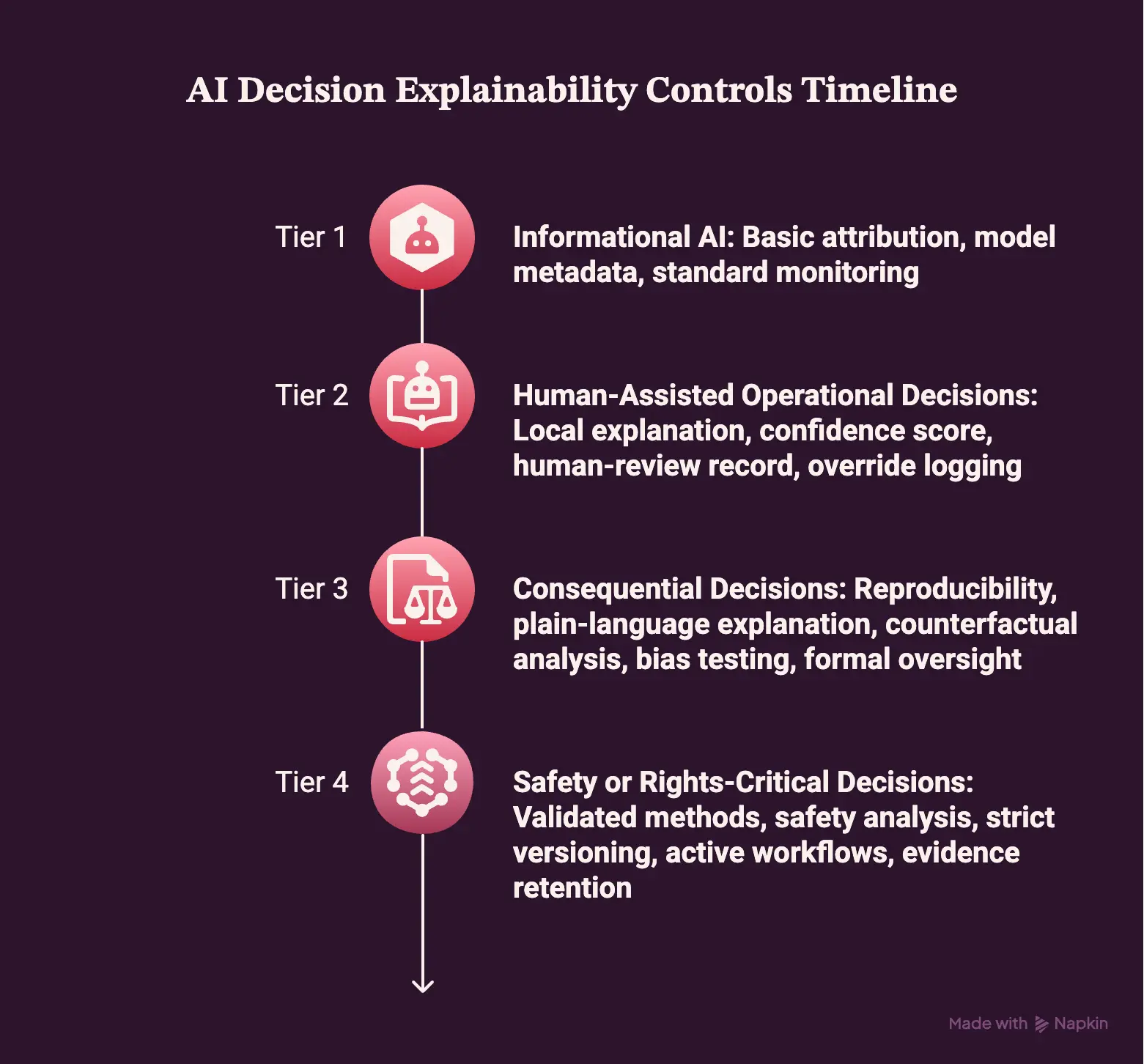
Tier 1 — Informational AI
Internal search ranking engines, document classification pipelines, and operational recommendations present minimal compliance risk. Consequently, these non-consequential systems require streamlined controls:
- Basic attribution: Top contributing terms or system tags.
- Model metadata: Version, build ID, and training timestamp.
- Standard monitoring: Drift tracking and execution latency logs.
Tier 2 — Human-Assisted Operational Decisions
Fraud-alert prioritization, clinical coding suggestions, and customer-service routing assist human operators without taking final automated actions. As a result, these systems demand local transparency:
- Local explanation: Instant SHAP or LIME score cards per item.
- Confidence score: Calibrated probabilistic score.
- Human-review record: Operator sign-off timestamps.
- Override logging: Reason codes for rejected AI suggestions.
Tier 3 — Consequential Decisions
Credit underwriting, insurance pricing, hiring evaluations, prior authorizations, and patient-risk stratification directly impact financial or personal well-being. Thus, stringent controls are mandatory:
- Reproducibility: Re-runnable historical inference packets.
- Plain-language explanation: Automated adverse action notices.
- Counterfactual analysis: Actionable recourse steps.
- Bias testing: Subgroup performance and fairness metrics.
- Formal oversight: Immutable audit trail with approval chains.
Tier 4 — Safety or Rights-Critical Decisions
Diagnostic recommendations, treatment prioritization, and high-risk medical devices involve critical physical safety or fundamental legal rights. Therefore, they require maximum governance:
- Validated methods: Independently audited, non-approximated XAI engines.
- Safety analysis: Subgroup variance, edge-case, and stress testing.
- Strict versioning: Cryptographically locked model artifacts.
- Active workflows: Real-time kill-switches and escalation paths.
- Evidence retention: Seven-plus year immutable record archives.
AI Decisioning Tiers
| Decision Tier | Explanation Depth | Latency Target | Evidence Retention | Validation Standard | Oversight Requirement |
| Tier 1 — Informational | Global Feature Ranks | $<50\text{ ms}$ | 30 Days | Automated Unit Tests | Periodic System Audits |
| Tier 2 — Operational | Local Feature Attribution | $<200\text{ ms}$ | 1 Year | Cross-Validation | Human-in-the-Loop |
| Tier 3 — Consequential | Local + Counterfactual | Asynchronous / Batch | 5–7 Years | Disparate Impact Audits | Dual-Signoff Review |
| Tier 4 — Safety-Critical | Full Evidence Packet | Real-Time / Streaming | 10+ Years / Life of System | Independent Red-Teaming |
Risk-tiered explainability prevents engineering teams from wasting compute budget on low-risk AI workflows. Therefore, by mapping technical controls directly to decision consequences, organizations maintain high system throughput while satisfying strict regulatory scrutiny.
Furthermore, this tiered approach creates a scalable foundation for enterprise-wide model governance.
Enterprise AI Explainability Platform Architecture
Building production-grade AI explainability software requires a decoupled, enterprise architecture. Consequently, high-volume systems separate real-time inference compute from heavy explanation processing across seven distinct infrastructure layers.
Layer 1 — Model and Data Connectors
This ingestion layer establishes unified pipelines across your enterprise infrastructure stack. Consequently, it connects directly to:
- Model registries: MLflow, SageMaker, and Azure ML registries.
- Feature stores: Feast, Hopsworks, and Databricks Feature Store.
- Prediction APIs: REST, gRPC, and streaming inference endpoints.
- Data warehouses: Snowflake, BigQuery, and Redshift repositories.
- Training pipelines: Kubeflow, Airflow, and CI/CD automation hubs.
- Third-party models: External API endpoints and vendor engines.
- LLM and RAG applications: Vector databases and prompt pipelines.
- Agent orchestration systems: Multi-agent frameworks and execution graph state stores.
Layer 2 — Explanation Orchestration Engine
The orchestration layer acts as the primary traffic controller for explanation requests. As a result, it dynamically selects explanation routines based on:
- Model type: Tabular GBDT, deep neural net, or LLM.
- Decision type: Real-time credit check versus batch risk scoring.
- Risk tier: Assigning lightweight attribution to Tier 1 or full counterfactuals to Tier 3.
- User persona: Adjusting outputs for clinicians, auditors, or consumers.
- Required latency: Routing synchronous requests through caches or executing asynchronous batch jobs.
- Regulatory context: Applying ECOA, FDA, or EU AI Act rules.
Layer 3 — Method Execution Services
Dedicated microservices execute specific mathematical attribution algorithms independently. Therefore, heavy calculations do not disrupt core application performance:
- SHAP explainers: Optimized C++ TreeExplainer and DeepExplainer services.
- LIME & local surrogates: Parallelized linear approximation workers.
- Counterfactual generation: DiCE and optimization-based recourse engines.
- Deep-learning attribution: Integrated Gradients, Grad-CAM, and Layer-Wise Relevance Propagation.
- Global behavior analysis: Partial dependence and global feature interaction workers.
- Explanation-quality testing: Automatic fidelity and stability verification checks.
- LLM & RAG trace analysis: Token-level attribution, vector retrieval scoring, and chain-of-thought parsers.
Layer 4 — Narrative and Template Engine
This layer converts raw attribution vectors into structured, human-readable explanations. Furthermore, it enforces constrained, template-driven generation to prevent hallucinated decision rationale:
- Borrowers: ECOA-compliant adverse action letters with top denial factors.
- Patients: Accessible clinical decision summaries.
- Clinicians: Biomarker and diagnostic feature rankings.
- Investigators: Fraud and AML alert context trees.
- Model validators: Comprehensive statistical stability reports.
- Compliance teams: Regulatory policy mapping dashboards.
- Regulators: Standardized, exportable audit packages.
- Board members: High-level algorithmic risk metrics.
Layer 5 — Evidence and Audit Store
This persistent layer archives complete decision evidence packages in append-only storage. Additionally, it fulfills strict regulatory retention standards:
- Explanation payloads: Raw JSON and calculated attribution matrices.
- Model & method versions: Specific software releases and parameter states.
- Input snapshots: Point-in-time data states.
- Policy mappings: Active business rule configurations.
- Reviewer actions: Timestamps and notes from human overrides.
- Exportable evidence packages: Formatted zip archives for third-party regulatory audits.
Layer 6 — Governance, Access, and Security
Security controls protect sensitive data and prevent unauthorized modification of historical records. Consequently, this layer implements:
- Role-based access: Granular permissions matching user responsibilities.
- Data minimization: Stripping protected demographic fields from outputs.
- Tenant isolation: Logical separation for multi-tenant SaaS environments.
- Encryption: AES-256 at rest and TLS 1.3 in transit.
- PHI and PII controls: Redaction pipelines fulfilling HIPAA and GDPR rules.
- Explanation retention: Policy-driven lifecycle management.
- Approval workflows: Multi-signature sign-off gates.
- Immutable history: Cryptographic log hashing to prevent tampering.
Layer 7 — Dashboards, APIs, and Integrations
The top layer exposes interfaces for human operators and enterprise software systems. Thus, it seamlessly integrates into daily business operations via:
- Explanation API: High-throughput REST and GraphQL endpoints.
- Compliance dashboard: Enterprise-wide audit and drift monitoring hub.
- Analyst workspace: Interactive investigation and override portal.
- Model-validation portal: In-depth statistical testing suite.
- Customer-facing interface: Embeddable web components for user recourse.
- Enterprise integrations: Direct connectors for GRC, IAM, SIEM, MLOps, EHR, and case management software.
A modern explainability architecture relies on decoupled, microservice-driven infrastructure to handle complex mathematical attribution without impairing core software performance.
Therefore, by isolating calculation services, enforcing strict template generation, and maintaining immutable audit logs, enterprises ensure total system stability.
Ultimately, this modular design allows engineering teams to scale their AI operations safely across regulated environments.
How to Match Explainability Methods to Each AI Model
Selecting the optimal explainability method requires matching model architecture, operational latency constraints, and regulatory requirements.
Additionally, instead of treating XAI tools as interchangeable, engineering teams must deploy specific algorithms based on structural mathematical properties, local versus global scope, and compliance expectations.
AI Model-Wise Explainability Methods
| Method | Best Model Type | Local or Global | Typical Latency | Main Strength | Main Limitation | Best Regulated Use |
| TreeSHAP | Tree Ensembles (XGBoost, LightGBM, Random Forest) | Both | $<50\text{ ms}$ (C++ optimized) | Mathematically consistent game-theoretic feature attribution | Correlated features can distort individual attribution scores | ECOA / FCRA Adverse action notices in credit scoring |
| KernelSHAP | Model-Agnostic / Complex Black-Box Pipelines | Local | $500\text{ ms} – 5\text{ s}+$ (Sampling heavy) | Exact Shapley value approximation for any prediction API | High compute overhead causes API latency bottlenecks | Model Risk Validation (SR 11-7) offline benchmarking |
| LIME | Tabular, Text, Image Classifiers | Local | $100 – 300\text{ ms}$ | Fast, model-agnostic local linear surrogate generation | Sampling instability can produce non-repeatable explanations | Fraud / AML Alerting rapid analyst triage |
| Counterfactuals (DiCE / CARLA) | Tabular / Deep Learning Credit & Risk Models | Local | $200 – 800\text{ ms}$ | Generates clear, actionable input changes to flip outcomes | Optimization may propose impractical or immutable changes | Consumer Loan Recourse and clinical intervention planning |
| Integrated Gradients | Deep Neural Networks (PyTorch / TensorFlow) | Local | $50 – 150\text{ ms}$ | Axiomatic, exact path-integral gradient attribution | Requires full access to model gradients and continuous inputs | FDA SaMD Medical imaging and EHR deep learning models |
| Grad-CAM | Convolutional Neural Networks (Vision) | Local | $<30\text{ ms}$ | High-resolution visual saliency maps for image regions | Visual highlights lack fine-grained pixel attribution | Radiology / Pathology clinical decision support |
| Partial Dependence Plots (PDP) | Tabular / Tree Models | Global | Pre-computed / Offline | Clear visualization of marginal feature impacts on predictions | Assumes strict feature independence across variables | Actuarial / Insurance underwriting policy audits |
| RAG Trace Analysis | LLMs, Vector DBs, AI Agents | Local | Integrated with LLM execution | Verifiable passage retrieval, source attribution, and tool-call logs | Evaluates retrieval grounding rather than internal transformer weights | Clinical Documentation and financial compliance Q&A |
Matching the correct explainability method to your underlying model architecture prevents severe latency bottlenecks while maintaining mathematical fidelity.
Therefore, by pairing fast, model-specific explainers like TreeSHAP or Integrated Gradients with dedicated counterfactual engines, organizations meet regulatory compliance requirements without compromising production system performance.
How Do You Know an AI Explanation Is Reliable?
An AI explanation is only useful if it accurately reflects underlying model mechanics. Therefore, engineering teams must continuously test explanation pipelines for mathematical fidelity, stability, and regulatory safety before exposing them to auditors or end users.
1. Fidelity and Completeness
Local surrogate models only approximate black-box behavior. Consequently, platforms must calculate deletion-and-insertion metrics to verify that removing high-weight features drops prediction confidence proportionally.
2. Stability and Repeatability
Stochastic methods like KernelSHAP can produce shifting explanations for identical inputs. Therefore, automated stability checks must flag feature-rank fluctuations across model seeds and sampling runs.
3. Sparsity and Counterfactual Validity
Explanations must highlight a concise set of actionable drivers. Furthermore, counterfactual algorithms must strictly exclude immutable attributes, such as age or ethnicity, from recourse suggestions.
4. Subgroup Consistency and Privacy
Explanation quality should never degrade across demographic groups or rare edge cases. Additionally, redaction pipelines must strip sensitive PII and protected health information (PHI) before generating public audit reports.
Unvalidated explainability tools generate misleading feature attributions that expose enterprises to severe compliance risks. Therefore, implementing systematic fidelity, stability, and privacy testing ensures your decision evidence remains accurate, repeatable, and legally defensible under audit.
AI Explainability Compliance Across Regulated Industries
Complying with regulatory mandates requires mapping explainability software capabilities directly to legal frameworks.
Consequently, enterprise platforms must satisfy strict transparency, auditability, and governance requirements across financial and healthcare sectors.
| Regulatory Standard | Target Jurisdiction | Key Explainability Mandate | Platform Control Requirement |
| EU AI Act (Art. 13 & 14) | European Union | High-risk transparency and deployer oversight | Complete model limitations, log collection, and real-time human override interfaces. |
| ECOA / Regulation B | United States | Specific, accurate adverse action reason codes | Automated generation of principal denial reasons without vague checklist summaries. |
| ONC HTI-1 Rule | Healthcare (US) | Plain-language predictive DSI source attributes | Full visibility into training data, fairness metrics, and clinical decision logic. |
| NIST AI RMF | Cross-Industry | Continuous governance, measuring, and mapping | End-to-end telemetry tracking model drift, bias, and explanation stability. |
| HIPAA Safeguards | Healthcare (US) | Protection of ePHI in audit and explanation logs | AES-256 encrypted payload storage with strict role-based access controls. |
Regulatory compliance is an architectural requirement, not a documentation exercise. Therefore, by embedding automated adverse action generation, plain-language clinical summaries, and cryptographically secure audit logs into your explainability infrastructure, organizations minimize legal exposure while accelerating model deployment.
AI Explainability Tools and Platforms Compared
Selecting the correct XAI tooling requires distinguishing open-source calculation libraries, cloud-native infrastructure, enterprise observability suites, and governance platforms.
Therefore, comparing these distinct categories directly creates architectural confusion, as each tool serves a fundamentally different layer in the enterprise AI stack.
1. Open-Source Explainability Libraries
Libraries like SHAP, LIME, Captum, and InterpretML provide the core mathematical foundations for calculating local feature attributions. However, these toolkits lack production caching, role-based access controls, and persistent audit logging.
Consequently, data science teams use open-source algorithms strictly for local model debugging rather than end-to-end regulatory compliance.
2. Cloud-Native Explainability Services
Hyperscaler solutions, including Amazon SageMaker Clarify, Azure Responsible AI Dashboard, and Google Vertex Explainable AI, integrate attribution capabilities directly into managed MLOps pipelines.
At the same time, while these services simplify deployment for cloud-bound teams, they often create vendor lock-in and struggle to export unified decision evidence packets across hybrid or multi-cloud enterprise architectures.
3. Commercial Enterprise Platforms
Enterprise software is split into production observability tools (Fiddler AI, Arize AI, Arthur) and governance systems (ValidMind, IBM watsonx. governance, SAS).
Therefore, observability engines track real-time drift, bias, and attribution shifts during live inference, whereas governance platforms generate examiner-ready audit trails, policy mapping, and formal validation documentation.
Open-source libraries compute mathematical attributions, but commercial platforms are required to operationalize those calculations into auditable evidence. Additionally, building an enterprise XAI stack requires combining fast calculation engines with dedicated governance and storage infrastructure.
How to Build AI Explainability Software Step by Step
Building enterprise-grade AI explainability software requires shifting from simple local scripts to an end-to-end distributed architecture.
Consequently, engineering teams must build production systems that generate mathematically sound, legally defensible, and audit-ready evidence without slowing down live inference.
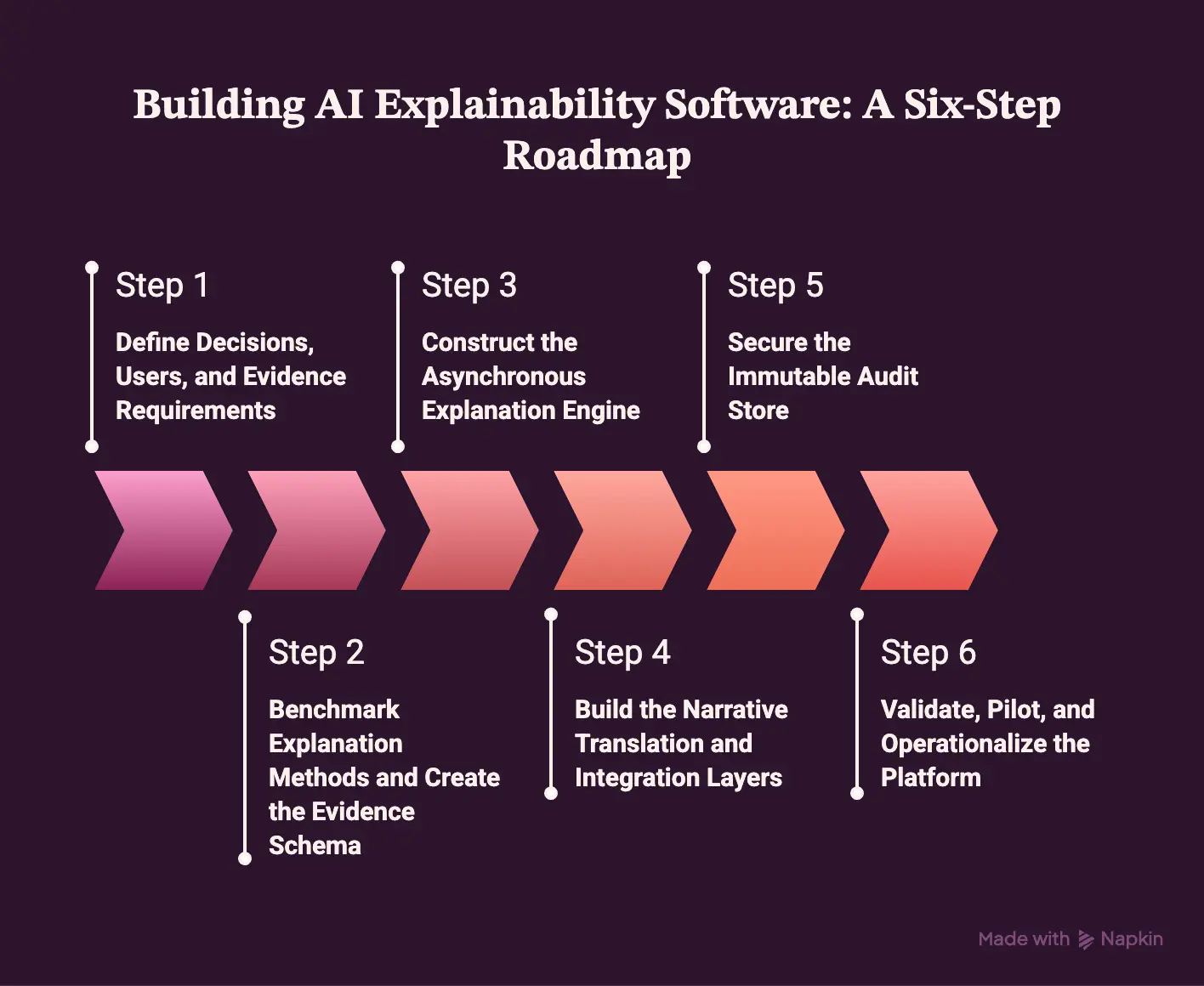
Step 1 — Define Decisions, Users, and Evidence Requirements
First, teams must define the operational boundaries and compliance expectations for each automated decision workflow. Furthermore, mapping specific user roles to evidence requirements ensures the platform delivers actionable insights without overwhelming non-technical reviewers.
- Decision Impact: Categorize workflows by financial, legal, or health risk to determine required explanation depth.
- Target Persona: Tailor output formats for data science validators, compliance examiners, or end-consumer disclosures.
- Latency SLA: Establish strict latency budgets (e.g., $<50\text{ ms}$ for real-time credit checks, asynchronous batch processing for medical reviews).
- Audit Lifecycle: Define mandatory data retention periods and secure human-in-the-loop override procedures.
Intellivon Approach: Start by mapping specific legal and operational evidence requirements rather than selecting an XAI library first. Additionally, building around regulatory obligations guarantees that downstream system output satisfies external audit scrutiny.
Step 2 — Benchmark Explanation Methods and Create the Evidence Schema
Next, engineers must evaluate candidate XAI algorithms against production model architectures using real-world data distributions. Once validated, define a standardized JSON schema to store model versioning, feature inputs, and baseline comparisons.
- Fidelity & Stability: Test attribution algorithms across varying random seeds to prevent inconsistent feature rankings.
- Subgroup Equivalence: Verify that explanation quality remains consistent across demographic cohorts and edge cases.
- Counterfactual Testing: Validate that suggested recourse pathways remain realistic and exclude protected variables.
- Schema Standardization: Lock a typed input-output schema capturing model weights, attribution vectors, and data lineage.
Intellivon Approach: Rigorously test multiple explanation methods against representative production models and edge cases before fixing the underlying storage schema. This benchmarking phase isolates instability before code reaches production.
Step 3 — Construct the Asynchronous Explanation Engine
After establishing the schema, build dedicated compute microservices to handle high-overhead attribution tasks. At the same time, decoupling explanation generation from main inference endpoints prevents performance bottlenecks and system timeouts.
- Decoupled Microservices: Isolate heavy compute tasks (such as KernelSHAP sampling) using asynchronous message queues like Kafka.
- Caching Layers: Cache background reference datasets and common feature attributions to accelerate repeated API requests.
- Lineage Tracking: Link every explanation payload to exact model version IDs, feature store snapshots, and environment configurations.
- API Gateways: Expose clean REST and gRPC endpoints for downstream compliance dashboards and external audit tools.
Intellivon Approach: Deploy explanation processing as isolated microservices rather than inline application code. Consequently, asynchronous execution ensures primary inference pipelines maintain optimal SLA speeds.
Step 4 — Build the Narrative Translation and Integration Layers
Once raw numerical attributions are generated, transform them into plain-language text and visual summaries. However, narrative engines must strictly reflect underlying mathematical data without hallucinating or altering key decision drivers.
- Template Engines: Map top feature weights to deterministic, pre-approved reason text blocks for adverse action notices.
- RAG Provenance Logs: Capture retrieved text chunks, prompt versions, and tool calls for LLM and agentic workflows.
- GRC Connectors: Automatically push evidence packets directly into enterprise risk platforms like ServiceNow or IBM OpenPages.
- Access Control: Enforce role-based access control (RBAC) to restrict sensitive PII and PHI exposure in audit logs.
Intellivon Approach: Maintain a strict boundary between raw attribution math and the narrative presentation layer. At the same time, separating logic prevents user-interface code from accidentally distorting core mathematical evidence.
Step 5 — Secure the Immutable Audit Store
In regulated sectors, explanation records must be protected against post-hoc tampering or unauthorized modifications. Therefore, systems must store evidence packets using write-once-read-many (WORM) storage architectures with end-to-end encryption.
- Encrypted Storage: Enforce AES-256 encryption at rest and TLS 1.3 in transit for all explanation payloads.
- Cryptographic Hashing: Generate SHA-256 signatures for every evidence log to prove data integrity during regulatory reviews.
- HIPAA & GDPR Compliance: Automatically redact sensitive protected health information (PHI) and apply automated retention policies.
- Access Auditing: Maintain detailed, unalterable access logs tracking every human review or report export.
Intellivon Approach: Treat explanation logs as legally binding compliance records. Therefore, implementing cryptographic hashing and immutable storage guarantees your audit trails survive rigorous regulatory inspections.
Step 6 — Validate, Pilot, and Operationalize the Platform
Finally, run comprehensive validation tests across technical, legal, and operational dimensions. Additionally, deploy the explainability engine in shadow mode alongside live production systems to verify stability before full rollout.
- Cross-Functional Audits: Conduct joint reviews with data science, legal compliance, and domain experts.
- Shadow Rollout: Process live production traffic in shadow mode to measure system latency and compute costs.
- Human Comprehension: Test whether business analysts and clinical staff can correctly interpret generated explanations.
- Continuous Monitoring: Track model drift, attribution decay, and system performance using automated MLOps alerts.
Intellivon Approach: Pilot the explainability architecture on a single high-consequence decision workflow before expanding across enterprise systems. At the same time, incremental deployment limits operational risk while proving platform value.
Therefore, building reliable AI explainability software requires combining decoupled microservices, rigorous mathematical validation, and cryptographically secure storage.
Following a structured, six-step engineering roadmap ensures your enterprise platform delivers rapid, accurate, and fully compliant decision evidence.
AI Explainability Software Development Cost
Custom AI explainability software typically costs $70,000–$300,000, depending on the number of model types, explanation methods, regulated workflows, integrations, and evidence-retention requirements.
At the same time, enterprise platforms must balance mathematical complexity with strict compliance infrastructure.
1. Focused Explainability MVP — $70,000–$120,000
- Timeline: 10–14 weeks
- Scope: Single model family, local SHAP or surrogate explanations, basic explanation API, model-version logging, one regulated workflow, manual compliance report exporting, and limited MLOps connection.
2. Production Explainability Platform — $140,000–$220,000
- Timeline: 16–24 weeks
- Scope: Multiple model families, local and global attributions, counterfactual engines, role-based dashboards, automated evidence packages, MLOps registry integration, and attribution quality monitoring.
3. Multi-Model Regulated Platform — $220,000–$300,000
- Timeline: 24–32 weeks
- Scope: Financial and healthcare models, real-time and batch explanations, computer-vision attributions, patient or customer interfaces, GRC, SIEM, and EHR integrations, multi-region controls, and independent validation workflows.
4. Phase-Level Cost Breakdown
| Development Phase | Estimated Cost Range |
| Discovery & Compliance Mapping | $8,000 – $20,000 |
| Method Benchmarking & Architecture | $12,000 – $30,000 |
| Explanation Engine Development | $25,000 – $80,000 |
| Narrative, Dashboard & API Layer | $15,000 – $45,000 |
| Evidence Logging & Governance | $12,000 – $40,000 |
| Enterprise System Integrations | $20,000 – $65,000 |
| Validation, Security & Rollout | $10,000 – $30,000 |
Note: Phase ranges vary based on selected scope and should not automatically be summed at their maximum values.
Ongoing Maintenance
Budget 15%–25% of initial build costs annually to cover library updates, explanation regression testing, new model onboarding, evolving regulatory mandates, template revisions, cloud infrastructure, and security monitoring.
Build AI Explainability Infrastructure With Intellivon
Intellivon operates as a practitioner-led engineering partner, designing custom explainability microservices, auditable evidence logging, and MLOps governance architecture for regulated enterprises.
At the same time, our specialized AI systems engineering capabilities include:
- Explainability Method Benchmarking: Systematic evaluation of SHAP, LIME, Integrated Gradients, and counterfactual engines against model architectures for mathematical fidelity and latency SLAs.
- Production Microservices Architecture: Building high-throughput, decoupled XAI pipelines using asynchronous event queues, caching layers, and gRPC/REST APIs.
- Multi-Model & Agnostic Integrations: Direct implementation across tabular ensembles, computer vision CNNs, NLP, LLMs, and multi-agent systems.
- Persona-Based Narrative Templates: Automated translation of complex attributions into tailored outputs for borrowers, patients, clinicians, risk managers, and regulatory examiners.
- Enterprise System Connectivity: Pre-built integration hooks for MLOps registries, GRC platforms (ServiceNow, IBM OpenPages), IAM, SIEM, EHR/FHIR endpoints, and core banking/lending systems.
- Immutable Evidence & Audit Logging: Cryptographically signed, WORM-compliant storage schemas enforcing HIPAA, GDPR, and FCRA record-retention requirements.
- Full Lifecycle Execution: End-to-end delivery spanning initial compliance mapping, security testing, shadow pilot deployments, and continuous model drift monitoring.
Schedule a Technical Architecture Session With Intellivon’s AI Systems Team.
Conclusion
AI explainability is no longer an optional debugging feature or a mere visual dashboard. Instead, it is an essential architectural foundation for enterprise AI adoption in regulated industries.
By replacing unvalidated black-box predictions with high-fidelity attribution microservices, clear counterfactual recourse, and cryptographically secure audit logs, organizations eliminate legal exposure.
Ultimately, building a structured, compliant XAI pipeline ensures your high-consequence machine learning decisions remain performant, transparent, and fully defensible under regulatory scrutiny.
FAQs
Q1. Is SHAP or LIME Better for Regulated AI Decisions?
A1. Decision Rule: Use SHAP when you require mathematically consistent, game-theoretic feature attributions, especially across tree-based and tabular models. Conversely, deploy LIME when fast, model-agnostic local approximations are necessary. However, neither method should ever enter production without rigorous fidelity and stability testing.
Q2. Can AI Explanations Automatically Satisfy Regulators?
A2. No, because a standalone chart or generated narrative is fundamentally insufficient for compliance. Instead, regulators require full model identity, complete data lineage, method versioning, validation evidence, human review logs, and reproducible decision records to prove that automated inferences are truly fair, accurate, and legally defensible.
Q3. What Must AI Explainability Software for Healthcare Compliance Integrate With?
A3. Healthcare systems must integrate explainability tools directly with EHR systems, FHIR APIs, and clinical decision support workflows. Furthermore, platforms require connections to model registries, identity management, clinical audit histories, predictive DSI source-attribute logs, and PHI-secured evidence storage to maintain strict HIPAA compliance.
Q4. Can AI Explainability Software Explain LLMs and AI Agents?
A4. Yes, but only by documenting external evidence such as retrieved passages, prompt versions, tool calls, policy checks, agent actions, and human approvals. However, platforms must never claim that a generated narrative reveals the model’s true internal transformer weights or faithful internal reasoning process.
Q5. How Should Enterprises Test Explanation Stability?
A5. Engineers must execute automated, repeated explanation runs across similar data records and varying model seeds. Additionally, teams should systematically evaluate explanation stability across new model versions, perturbed inputs, distinct demographic groups, and rare edge cases to prevent volatile feature rankings in production workflows.
To Sum It Up:
- A SHAP chart can explain feature contribution, but it cannot prove that the explanation is stable, fair, or legally sufficient.
- Regulated enterprises do not need one universal AI explanation. At the same time, they need different evidence for model validators, regulators, customers, clinicians, and boards.
- The most expensive part of AI explainability software is rarely the visualization. At the same time, it is the model integration, evidence history, validation, security, and workflow architecture behind it.
- A $70,000 explainability MVP can cover one model family. At the same time, supporting multiple model types, jurisdictions, and user groups can raise the build to $300,000.