Key Takeaways:
- Custom AI governance makes sense when workflows, regulated data, domain-specific evidence, or complex integrations are required.
- Off-the-shelf platforms work when standard inventory, policy mapping, and reporting cover most of the governance requirements.
-
The strongest option for large enterprises is often hybrid, combining commercial capabilities with custom integrations and controls.
-
Runtime controls, evaluation logic, and evidence architecture are where custom builds differentiate from commercial platforms.
-
How Intellivon builds custom AI governance platforms covering integrations, runtime controls, evidence architecture, and regulatory scope.
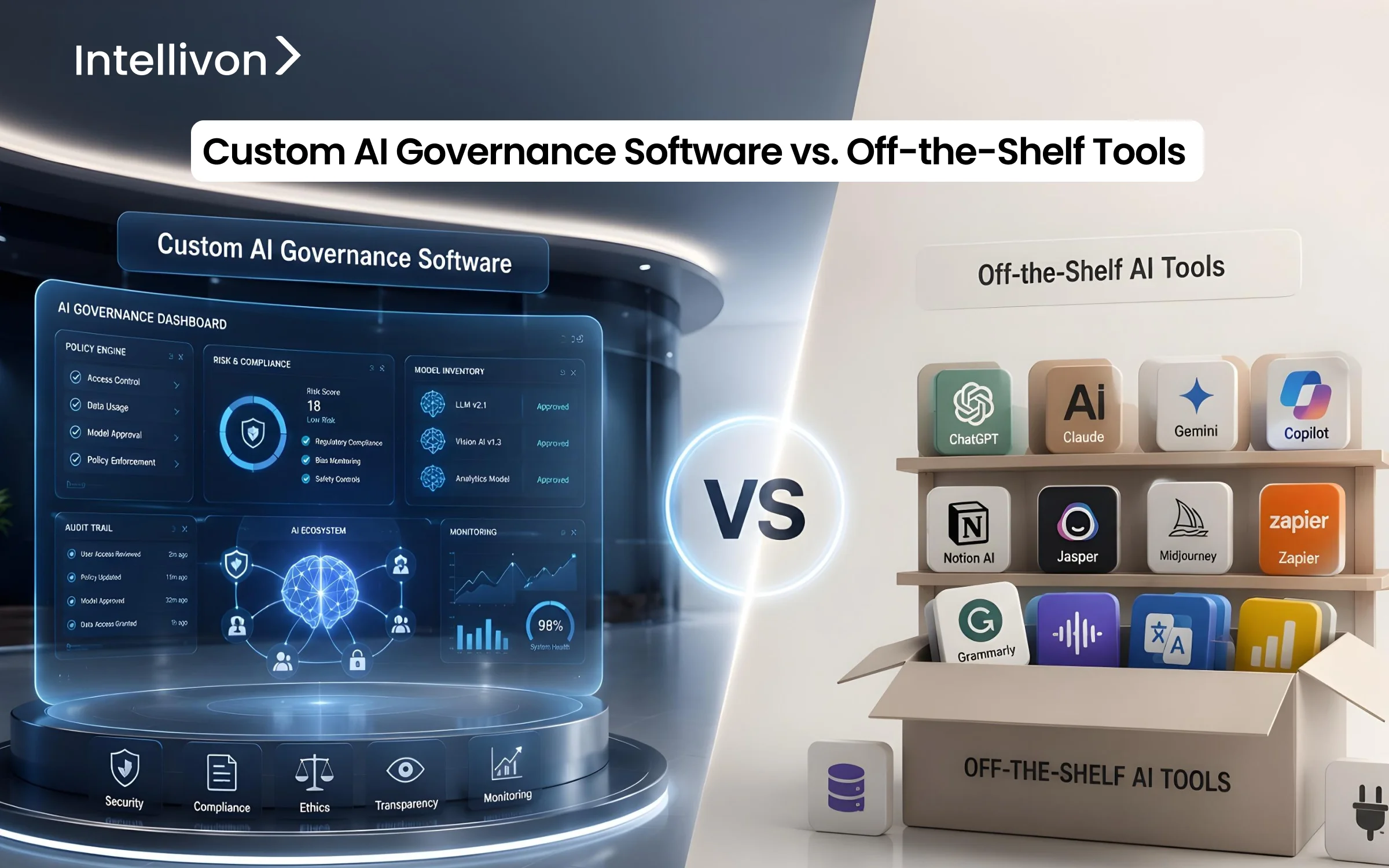
Every enterprise governance team eventually faces the same question: build something custom or license an off-the-shelf platform. Both options work well, but for very different situations. In practice, the right answer depends on five conditions that are specific to the organization’s regulatory scope and AI portfolio. Specifically, those conditions are regulatory complexity, integration depth, data ownership, competitive differentiation, and five-year total cost.
The choice starts leaning toward custom AI governance software when regulatory scope grows beyond a single framework. Moreover, off-the-shelf platforms require significant customization for FDA, EU AI Act, or multi-framework obligations, which erodes the cost advantage of buying. Retool’s 2026 survey of 817 builders found SaaS pricing has stayed flat while build costs have dropped significantly. Consequently, the five-year math increasingly favors building for enterprises managing complex, multi-framework governance.
Intellivon builds custom AI governance software for enterprises where the five-condition analysis points to building. The approach therefore always maps those conditions before any direction is recommended. Accordingly, this guide walks through each condition, shows where off-the-shelf tools fall short, and where custom closes the gap.
What is Custom AI Governance Software?
Custom AI Governance Software is a tailored digital framework built to control, monitor, and secure an enterprise’s specific artificial intelligence models. Standard off-the-shelf tools rely on generic rules, but custom platforms adapt directly to your unique business workflows.
Consequently, your organization can easily catch algorithmic bias, track data lineage, and enforce strict regulatory compliance. Ultimately, this bespoke approach protects proprietary data while keeping complex healthcare and fintech AI operations fully audit-ready.
The global AI governance market is expanding rapidly, projected to jump from $1.1 billion to over $13 billion at an impressive 31.4% CAGR. Consequently, escalating global regulations like the EU AI Act are pushing enterprise leaders toward robust compliance frameworks.
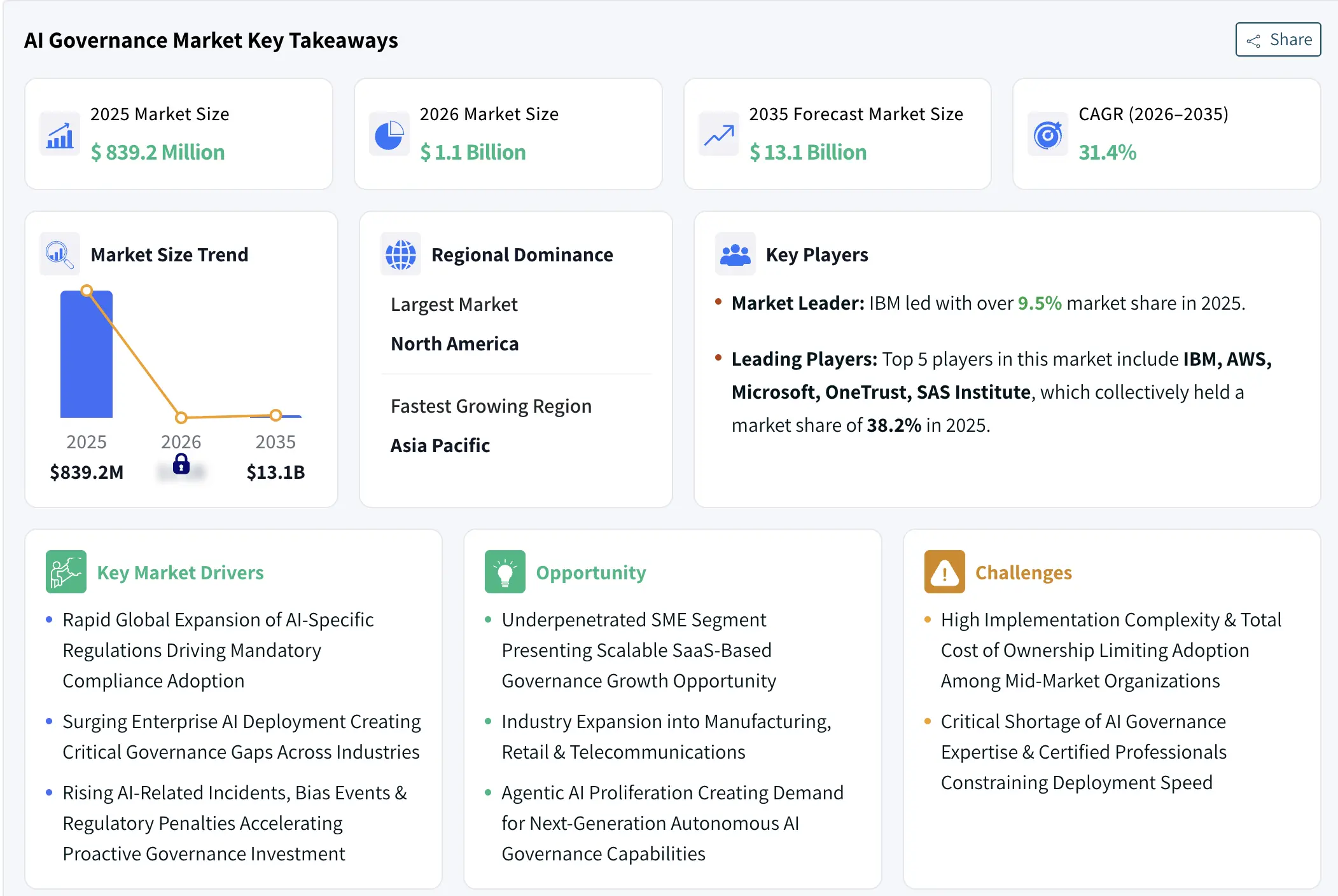
Ultimately, healthcare and fintech industries lead this surge to satisfy strict data oversight mandates.
Custom AI Governance Software vs Off-the-Shelf
Custom platforms make sense when your governance requirements are highly differentiated. Commercial tools make sense when your operational governance requirements are largely standardized.
Meanwhile, a hybrid approach works best when enterprises need vendor-maintained regulatory frameworks but must retain total control over integration, runtime enforcement, evidence collection, and proprietary workflows.
Custom vs. Off-the-Shelf
| Decision Area | Custom Platform | Off-the-Shelf Platform |
| Initial Cost | Higher | Lower |
| Deployment Speed | Slower | Faster |
| Workflow Flexibility | Very High | Configurable |
| Regulatory Tailoring | Full Control | Framework Dependent |
| Legacy Integrations | Build Anything | Connector Dependent |
| Data Ownership | Full | Contract/Deployment Dependent |
| IP Ownership | Enterprise-Owned | Vendor-Owned |
| Runtime Controls | Fully Programmable | Product Dependent |
| Agent Governance | Customizable | Capability Varies |
| Vendor Dependency | Low | Medium–High |
| Maintenance | Enterprise/Partner | Vendor |
| Switching Cost | Architecture Dependent | Can Become Significant |
| Verdict | Build | Buy |
Ultimately, choosing between custom development and commercial SaaS determines how tightly your oversight layer fits your actual software architecture.
Before comparing individual vendor products, engineering leaders need to define exactly what their custom governance layer must govern.
Define What Your AI Governance Platform Must Govern
Before choosing between building or buying, you must map your governance object model. Commercial tools mostly focus solely on model registries, but true enterprise governance requires tracking every layer where data, code, and decisions interact.
Consequently, your architecture must explicitly govern five distinct asset types across your business.
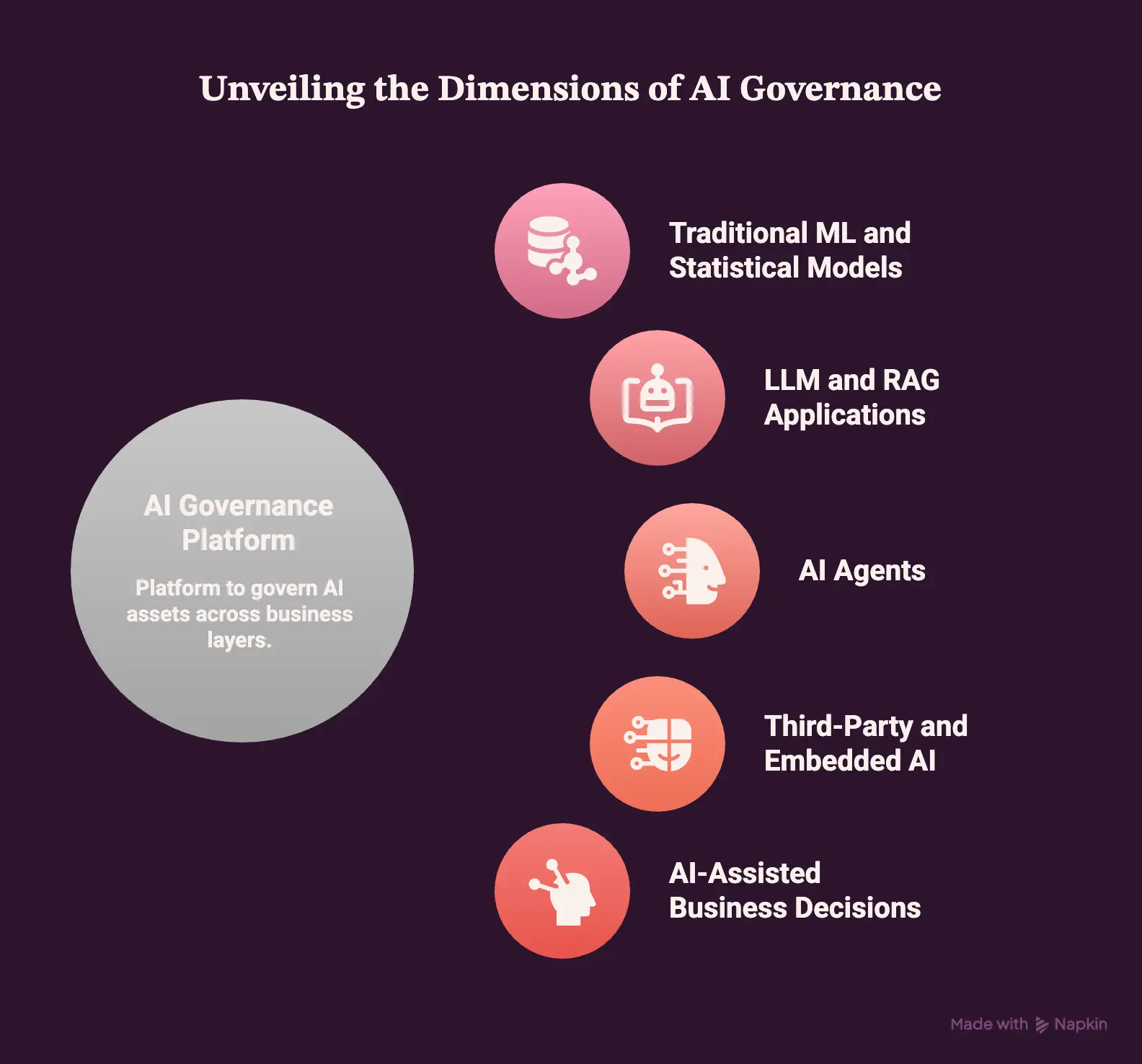
Traditional ML and Statistical Models
Traditional predictive algorithms need systematic oversight from initial training through final deprecation. Therefore, your governance layer must continuously log lifecycle changes and performance degradation.
- Model metadata: Tracks model owners, business purpose, version history, and sign-off approvals.
- Validation controls: Monitors statistical dataset lineage, conceptual soundness, and performance drift.
- Lifecycle tracking: Automates scheduled re-validation triggers, dependency mapping, and formal retirement.
2. LLM and RAG Applications
Generative pipelines introduce non-deterministic risks that static model cards cannot capture. As a result, governance must evaluate both static prompt templates and dynamic retrieval contexts.
- Provider oversight: Inventory foundation model vendors, API versions, and fallbacks.
- Grounding metrics: Measure retrieval source relevance, hallucination scores, and contextual fidelity.
- Safety controls: Enforce guardrails, content filters, evaluation suites, and mandatory human review workflows.
3. AI Agents
Autonomous agents act independently across corporate networks without real-time human intervention. Therefore, modern platforms like Credo AI, ValidMind, Fiddler, ModelOp, and DataRobot treat autonomous agents as governed runtime entities.
- Identity and boundaries: Defines agent identity, delegated permissions, permitted tools, and hard autonomy limits.
- Behavioral rules: Enforces multi-agent dependencies, runtime trace logging, and escalation triggers.
- Action oversight: Captures step-by-step tool execution history for real-time policy enforcement.
4. Third-Party and Embedded AI
Unmonitored third-party AI creates dangerous regulatory compliance gaps across enterprise software stacks. Consequently, organizations must actively inventory every external algorithmic touchpoint.
- Vendor discovery: Catalogues enterprise SaaS AI features, vendor models, and public Copilot usage.
- API monitoring: Validates third-party API payload privacy, data retention policies, and embedded features.
- Shadow AI protection: Identifies unsanctioned external endpoints to prevent proprietary data leaks.
5. AI-Assisted Business Decisions
A major gap in off-the-shelf tools is failing to link model outputs to real-world operational outcomes. Therefore, your system must track the full chain: AI system → workflow → human decision → outcome → evidence.
- Workflow integration: Connects model predictions directly to human-in-the-loop operational decisions.
- Outcome tracking: Measures downstream financial, clinical, or operational business impact.
- Audit readiness: Generates immutable evidence trails specifically required for healthcare and lending compliance.
Ultimately, defining these five governance pillars reveals your platform’s exact scope. Knowing these parameters makes it much easier to select the right technical architecture.
Compare Custom and Off-the-Shelf AI Governance in 12 Areas
Comparing custom AI governance software against commercial SaaS tools reveals fundamental trade-offs between speed, cost, and long-term control. Off-the-shelf software offers faster initial deployment, but it restricts customization and creates ongoing subscription overhead.
Conversely, custom development requires higher initial investment, yet it delivers full data sovereignty, zero vendor lock-in, and tailored compliance controls. Ultimately, choosing the right approach depends on your specific regulatory demands and architectural complexity.
Custom Vs Off-the-Shelf
| Feature / Metric | Custom AI Governance Software | Off-the-Shelf SaaS Tools |
| Initial Investment | High ($70,000–$300,000 upfront) | Low to Medium (Setup & onboarding fees) |
| Ongoing Costs | Predictable infrastructure & maintenance | Scaling seat & per-model license fees |
| Deployment Time | 3 to 6 months | 2 to 8 weeks |
| Regulatory Control | 100% tailored to FDA, SR 11-7, HIPAA, & ONC | Pre-packaged, static compliance templates |
| Data Sovereignty | Full data ownership inside your cloud | Metadata exposed to third-party vendor clouds |
| System Integrations | Native, custom-built microservices | Dependent on standard vendor API connectors |
| Vendor Lock-In | Zero (You own 100% of IP & codebase) | High (Migration requires complete platform rebuilding) |
Commercial tools provide quick setup for standardized needs, but custom governance platforms are essential for enterprise systems requiring strict regulatory alignment and full data ownership.
Where Off-the-Shelf AI Governance Tools Work Best
Commercial software offers significant value when standard governance features meet most of your operational needs. Modern vendor platforms have evolved beyond static model registries into sophisticated management systems.
Consequently, off-the-shelf platforms are ideal when fast deployment and vendor-managed regulatory updates take priority over bespoke coding.
1. Enterprise SaaS Capabilities
Commercial software provides powerful, pre-built governance features out of the box.
- ModelOp: Coordinates enterprise AI inventories, lifecycle workflows, automated risk tiering, and real-time agentic controls across complex pipelines.
ModelOp - IBM watsonx.governance: Connects AI monitoring directly with enterprise GRC tools like OpenPages across hybrid cloud environments.
IBM - DataRobot: Extends governance tracking across models, autonomous agents, vector databases, and multi-cloud applications.
- Credo AI: Delivers centralized AI registries, risk intelligence, policy enforcement, and global regulatory mapping.
- ValidMind: Automates model risk management, documentation, and audit readiness for strictly regulated financial institutions operating under SR 11-7 rules.
ValidMind
2. Ideal Conditions for Commercial Software
Off-the-shelf software consistently wins over custom builds when:
- Standard, out-of-the-box workflows cover 70% to 80% or more of your operational requirements.
- Fast deployment and short time-to-value are top business priorities.
- Internal engineering teams lack the bandwidth to build and maintain custom governance pipelines.
- Tracking continuous regulatory changes internally introduces high maintenance overhead.
- Existing vendor connectors cover your entire technology and data stack.
- The governance interface itself is an operational safeguard rather than a competitive differentiator.
Platform Type
| Platform Type | Strongest Role | What to Verify Before Buying |
| Enterprise Command (e.g., ModelOp, IBM) | Cross-system portfolio visibility, automated risk tiering, and broad GRC integration. | Verify API rate limits, custom workflow flexibility, and pricing per model asset. |
| Model Risk Focused (e.g., ValidMind) | Fast compliance documentation, validation templates, and automated audit trails. | Verify support for proprietary agentic workflows and custom data connectors. |
| MLOps Integrated (e.g., DataRobot, Fiddler) | Real-time model monitoring, drift tracking, and automated performance alerts. | Verify inline payload interception rules and long-term data retention costs. |
Commercial tools excel when speed and standardized compliance outweigh the need for custom pipelines, allowing teams to deploy governance controls quickly without expanding engineering overhead.
Where Custom AI Governance Software Is the Better Fit
Building custom AI governance software becomes essential when commercial tools cannot support your operational complexity or regulatory risk exposure.
While off-the-shelf platforms offer broad coverage, bespoke platforms give engineering teams total control over proprietary architectures and strict compliance environments.
1. Proprietary Risk Taxonomies
Standard software forces organizations into rigid, pre-packaged risk templates. However, banks and healthcare providers often classify risk differently across credit scoring, fraud detection, clinical decision support, and autonomous agents.
Custom software lets you design tailored risk taxonomies that reflect your exact risk tolerance.
2. Complex Approval Structures
Global enterprises require dynamic approval chains across multiple jurisdictions, subsidiaries, and risk levels.
Standard vendor tools struggle to handle multi-tiered sign-offs. Conversely, custom development maps approval workflows directly to your internal first-, second-, and third-line governance teams.
3. Deep Legacy Integrations
Healthcare and financial institutions rely on complex legacy technology stacks. Commercial tools often lack native connectors for niche enterprise software.
Custom platforms build direct API connections into systems like Epic, Oracle Health, core banking ledgers, and enterprise GRC tools.
4. Proprietary Compliance Evidence
Regulators, internal auditors, and board members often demand compliance evidence formatted to exact internal standards.
Off-the-shelf systems produce static, generalized reports. Custom platforms automatically generate tailored audit trails that meet specific examination requirements.
5. Data Sovereignty and Security
Regulated industries must prevent proprietary data and telemetry from leaving secure environments. Custom platforms deploy directly inside your private cloud, VPC, or on-premises infrastructure.
This guarantees total data sovereignty using zero-trust network controls and fine-grained access policies.
6. Governance as Intellectual Property
When risk classification, evaluation logic, and real-time guardrails drive business differentiation, governance becomes proprietary IP.
Owning your custom codebase prevents vendor lock-in and turns regulatory compliance into a long-term strategic advantage.
Custom governance software is the right choice when complex legacy architectures, unique regulatory reporting, and proprietary risk models require complete system control and full IP ownership.
Why Hybrid AI Governance Often Wins for Enterprises
Most industry comparisons present build-versus-buy decisions as a binary choice. However, real-world enterprise architectures are rarely that simple. At the same time, regulated companies almost always adopt a hybrid strategy to balance speed and customization.
In a hybrid model, you buy off-the-shelf software for standardized tasks while building custom components for core proprietary needs.
1. Strategic Layering Across the Stack
A practical hybrid architecture divides responsibilities across three key layers:
- Commercial SaaS Layer: Buy standard tools to handle generic AI inventories, global regulatory mapping (such as ISO 42001 or the EU AI Act), and basic vendor risk assessments.
- Custom Enterprise Control Layer: Build internal microservices for proprietary risk scoring, deep core-banking or EHR integrations, runtime policy enforcement, and executive audit reporting.
- Hyperscaler Infrastructure: Leverage native Azure, AWS, GCP, or Databricks features for low-level token tracing, raw observability, and basic guardrails.
2. Resolving the Hyperscaler Dilemma
Major cloud providers already offer excellent built-in tracing, guardrails, and model evaluations. Consequently, enterprise leaders often ask what they should actually build or buy above these cloud-native tools.
While hyperscalers manage local execution, they cannot handle multi-cloud governance, organizational workflows, or formal regulatory evidence on their own.
A custom top layer connects these cloud metrics directly to your company’s unique approval chains, audit expectations, and business context.
A hybrid architecture combines off-the-shelf regulatory tracking with custom runtime evidence engines. This approach avoids reinventing standard tools while keeping total control over your business logic.
What a Custom AI Governance Platform Should Include
Building a custom AI governance platform requires an enterprise architecture that treats governance as a real-time infrastructure plane. At the same time, rather than relying on static feature lists, engineering teams must deploy modular components across the entire model lifecycle.
A production-ready custom build provides granular control over system dependencies, policy enforcement, runtime evaluations, and audit logging to satisfy strict regulatory scrutiny.
Modular Architecture Breakdown
| Architecture Module | Primary Technical Capabilities | Key Operational Data & Artifacts Tracked |
| AI Inventory & Dependency Graph | Real-time discovery and relationship mapping across complex multi-cloud deployments. | Models, agents, prompts, APIs, vendors, fine-tuned datasets, tools, owners, jurisdictions, downstream systems. |
| Risk Classification Engine | Configurable scoring tailored to domain-specific risk tolerances and regulatory profiles. | Use case, autonomy level, decision criticality, personal data exposure, protected classes, financial materiality, clinical risk, geography. |
| Policy & Control Engine | Active runtime governance enforcement and dynamic workflow orchestration. | Policy-as-code rules, framework control mapping, multi-tier approval logic, exception handling, automated escalation paths. |
| Evaluation & Monitoring Layer | Continuous quality, safety, and operational monitoring across active models and agentic tools. | Accuracy, data drift, statistical fairness, hallucination rates, toxicity, grounding, security vulnerabilities, agent behavior, tool-use violations. |
| Decision & Audit Evidence Layer | Tamper-proof logging designed for immediate regulatory examination and forensic audits. | Model version, raw inputs, generated outputs, confidence scores, decision explanations, reviewer ID, policy check results, manual overrides, tool invocations, execution timestamps. |
| Workflow & Case Management | Centralized triage and remediation routing for flagged decisions and policy violations. | Risk alerts, exception reviews, cross-functional sign-offs, legal reviews, remediation tickets. |
| Regulatory Mapping Engine | Automated alignment of technical guardrails to global compliance standards. | EU AI Act rules, FDA guidelines, HIPAA privacy controls, SR 11-7 validation standards, ONC mandates. |
| API & Event Integration Layer | Low-latency streaming and programmatic hooks for modern microservices stacks. | REST endpoints, GraphQL schemas, real-time webhooks, Kafka event streams. |
| Security & Identity Layer | Zero-trust protection securing the entire governance control plane. | Single sign-on (SSO), RBAC/ABAC policies, hardware key management, end-to-end encryption, immutable access logs. |
| Reporting & Examiner Evidence | Automated generation of comprehensive compliance artifacts for regulatory audits. | Audit-ready evidence packages, executive risk dashboards, board reports, regulatory submission records. |
A well-architected custom platform integrates runtime guardrails, policy-as-code, and cryptographic evidence directly into your development pipelines.
This ensures complete operational transparency while making compliance reporting effortless for enterprise audit teams.
Healthcare AI Governance: When Custom Controls Matter
Healthcare AI governance requires more than standard compliance rules because model decisions directly impact patient outcomes and institutional liability.
Custom software becomes essential when clinical workflows demand real-time verification and strict regulatory alignment.
Key Clinical Control Domains
- Clinical Decision Support: Custom platforms govern target populations, subgroup validation metrics, and physician overrides. Consequently, clinical teams can track safety boundaries before recommendations reach providers.
- EHR and Decision Integration: Governance systems must tie model outputs directly to electronic health records. The ONC HTI-1 rule mandates algorithm transparency for predictive models in certified health IT. Custom builds easily capture these specific FHIR context attributes and user permissions.
Health IT Answers - Ambient Documentation AI: Custom pipelines process ambient clinical recordings by capturing consent, redacting PHI, and logging provider edits. This ensures generated notes remain compliant as underlying models change.
- FDA-Regulated AI and SaMD: Software as a Medical Device (SaMD) requires strict regulatory separation. Custom architectures isolate clinical safety validation from routine administrative GRC workflows.
Hospitals should buy commercial tools for basic administrative governance. However, custom software is critical when governing runtime clinical models, enforcing HTI-1 algorithm transparency, and integrating directly into EHR workflows.
Fintech AI Governance: Build vs Buy Under 2026 Rules
Navigating fintech governance requires balancing strict consumer protection laws with evolving model risk frameworks. Furthermore, relying on third-party AI models does not absolve institutions from regulatory oversight.
1. SR 26-2 Changed the Governance Boundary
On April 17, 2026, the Federal Reserve, OCC, and FDIC replaced legacy guidance with SR 26-2 / OCC Bulletin 2026-13.
The revised standard explicitly excludes generative and agentic AI from its formal model risk definition while retaining quantitative expectations.
Consequently, institutions must establish broader enterprise governance controls for tools falling outside SR 26-2.
Key Governance Requirements
- Credit and Underwriting AI: Institutions must validate algorithms to prevent discriminatory impact under ECOA and FCRA rules. Custom platforms automatically capture decision variables to generate compliant adverse action notices.
- AML and Fraud AI: Transaction monitoring models require continuous drift detection. Custom integration layers log real-time feature changes across core banking systems without exposing customer PII.
- Customer-Facing GenAI & Autonomous Agents: Because autonomous agents orchestrate live financial workflows, custom guardrails must enforce strict permission boundaries. This ensures compliance with CFPB guidelines, FINRA, SEC rules, and DORA resilience standards.
While commercial tools help manage standard vendor software assessments, custom governance platforms provide the inline controls needed to supervise autonomous financial agents and maintain compliance across evolving regulator expectations.
Custom AI Governance Software Cost: $70K–$300K
A focused custom AI governance software project can cost $70,000 to $300,000, depending on regulatory scope, number of integrations, governance objects, runtime controls, deployment model, and reporting requirements.
1. Build Tiers and Estimated Investments
| Build Tier | Cost Range | Typical Timeline | Core Scope & Deliverables |
| Governance MVP | $70K–$110K | 10–14 weeks | Basic model inventory, risk classification scoring, core approval workflows, and static reporting templates. |
| Production Platform | $110K–$200K | 4–6 months | Active system integrations, policy-as-code engine, cryptographic audit trails, and continuous performance monitoring. |
| Enterprise Platform | $200K–$300K | 6–9 months | Multi-unit, multi-region support, GenAI and agentic controls, deep legacy system connectors, and automated examiner reporting. |
Note on Cost Overlaps: Phase ranges overlap depending on project complexity. Consequently, overall budget totals are determined by target build tier rather than simply summing every maximum phase estimate.
2. Long-Term Platform Maintenance
Annual platform maintenance typically consumes 15% to 25% of initial development costs. Ongoing operational budgets must account for:
- Private cloud infrastructure hosting and compute scale
- Continuous security patching and zero-trust vulnerability updates
- Regulatory framework updates (such as evolving EU AI Act or SEC rules)
- Maintained API connectors for core banking, EHR, or GRC platforms
- Model-provider changes, updated evaluation suites, and feature additions
3. Licensing Context vs. Custom Development
Specialized commercial platforms generally charge $50,000 to $200,000+ annually in recurring subscription fees, with full enterprise deployments often climbing higher.
Therefore, while commercial tools reduce initial setup friction, custom platforms eliminate perpetual license scaling fees as your model inventory grows.
How to Make the AI Governance Build vs Buy Decision
Choosing between custom development and off-the-shelf software requires a formal, evidence-backed evaluation framework.
Rather than relying on generic pros-and-cons lists, enterprise architecture teams must assess their technical estate, regulatory burdens, and long-term operational costs through a structured seven-step methodology.
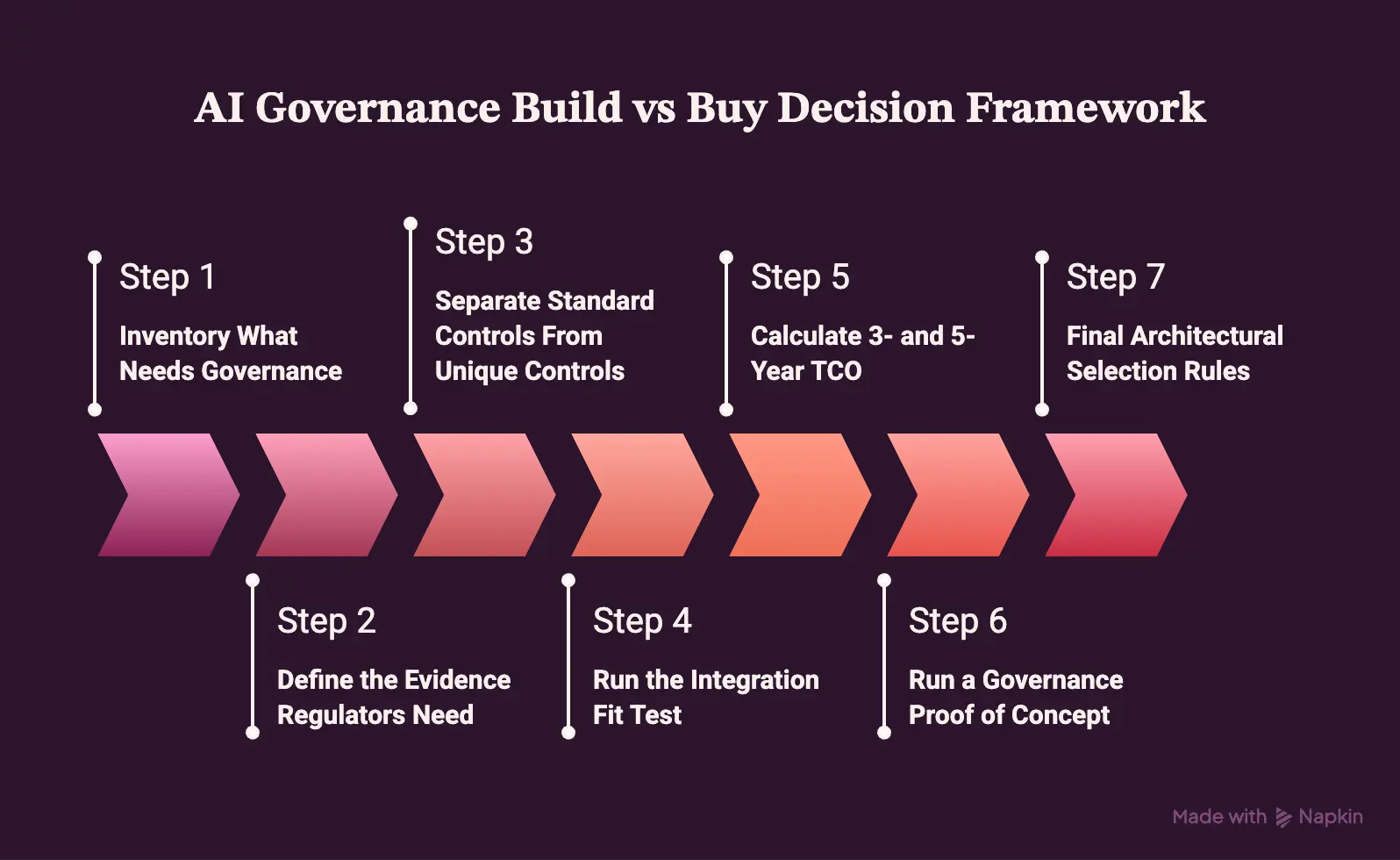
Step 1: Inventory What Needs Governance
Before evaluating software, map your entire AI landscape. Document every model, LLM, autonomous agent, third-party SaaS tool, dataset, clinical or financial workflow, and operational jurisdiction.
At Intellivon, our core approach requires creating this comprehensive governance estate before selecting any underlying technology.
Step 2: Define the Evidence Regulators Need
Avoid starting with product features. Instead, work backward from your regulatory requirements. Identify exactly what proof an auditor or regulatory examiner will demand.
Afterwards, map your internal recording and logging infrastructure to meet those specific evidence burdens.
Step 3: Separate Standard Controls From Unique Controls
Score every governance requirement across three distinct buckets:
- Standard: General model inventory, basic access controls, and standard vendor risk forms.
- Configurable: Domain-specific approval workflows, custom risk scoring matrices, and basic reporting templates.
- Proprietary: Low-latency runtime guardrails, custom clinical override tracking, or real-time transaction monitoring integrations.
Core Decision Rule: If your critical controls are mostly standard, buy a commercial platform. If key operational controls are proprietary, build custom software. When standard governance and proprietary runtime controls coexist, adopt a hybrid model.
Step 4: Run the Integration Fit Test
Require vendors to integrate with actual production systems rather than demonstrating pre-packaged APIs.
- Healthcare Flow: Validate connections from Epic EHR $\rightarrow$ Governance Platform $\rightarrow$ Model Registry $\rightarrow$ Audit Workflow.
- Fintech Flow: Validate connections from Loan Origination System $\rightarrow$ Model Endpoint $\rightarrow$ Policy Engine $\rightarrow$ Audit Evidence Log $\rightarrow$ Enterprise GRC.
Step 5: Calculate 3- and 5-Year TCO
Calculate the total cost of ownership over extended horizons.
Beyond initial software license fees or upfront development budgets, factor in internal engineering maintenance, regulatory updates, cloud infrastructure hosting, and platform exit costs.
Step 6: Run a Governance Proof of Concept
Skip standard vendor feature tours. Instead, test one complete, end-to-end operational scenario:
Evaluating this single end-to-end loop reveals real platform capabilities far better than reviewing a long list of dashboard options.
Step 7: Final Architectural Selection Rules
- Choose Buy if: Off-the-shelf software covers 80% or more of your critical requirements out of the box, and your workflows do not require real-time runtime interventions.
- Choose Build if: The missing 20% consists of high-risk controls, unique clinical or financial workflows, or deep legacy integrations that commercial tools cannot safely support.
- Choose Hybrid if: Commercial platforms successfully manage standard compliance frameworks and intake workflows, but execution controls and audit logs require custom runtime infrastructure.
Custom AI governance transforms compliance from a reactive bottleneck into a competitive engineering advantage.
By owning your runtime controls, audit pipelines, and risk logic, your enterprise maintains complete operational agility while remaining fully protected in complex regulatory environments.
AI Governance Platform Implementation Roadmap
Once an enterprise chooses to build, buy, extend, or combine AI governance technology, implementation should move from governance design to controlled production rollout.
At the same time, a practical roadmap usually takes 3 to 9 months, depending on integrations, regulatory scope, AI inventory size, and whether the organization is configuring a vendor platform or building custom governance components.
Implementation Timeline & Primary Goals
| Phase | Primary Goal | Typical Duration |
| Governance Discovery | Define scope, boundaries, and control ownership | 1–2 weeks |
| Inventory & Risk Taxonomy | Catalogue and classify all AI assets | 2–4 weeks |
| Core Controls | Build and configure executable governance workflows | 3–6 weeks |
| Integrations | Connect MLOps, security, and enterprise systems | 3–8 weeks |
| Governance Pilot | Validate one complete lifecycle in an isolated domain | 3–5 weeks |
| Production Rollout | Scale governance capabilities organization-wide | 4–12 weeks |
| Continuous Monitoring | Maintain live controls, drift checks, and evidence | Ongoing |
Phase 1 — Define Governance Scope and Ownership
Every successful implementation starts by establishing clear operational boundaries. Therefore, organizations must explicitly map:
- The initial set of AI systems included in the first rollout
- Targeted business units, operating groups, and geographic jurisdictions
- Included technology categories, such as traditional machine learning, Generative AI, RAG pipelines, autonomous agents, and third-party vendor AI
- Designated governance owners, approval responsibilities, internal audit involvement, and risk stakeholders
- Legacy risk processes that must remain active during the transition
Key Output: A formal governance scope document defining what the platform governs, who owns each specific control, and which workflows enter the initial release.
The Intellivon Approach: Map governance requirements before selecting software modules or building custom workflows. This prevents enterprises from accidentally automating processes that remain operationally unclear.
Phase 2 — Build the AI Inventory and Risk Taxonomy
Next, teams must construct a centralized AI registry to classify every organizational asset. This step documents model and agent ownership, business purpose, underlying data sources, deployment environments, third-party dependencies, and regulatory exposures.
Key Output: A searchable AI inventory with dynamic risk tiers that automatically determine the exact controls, validations, and approvals required for deployment.
The Intellivon Approach: Design the inventory as an interconnected dependency graph rather than a flat model catalogue. Consequently, engineering and risk teams can instantly trace relationships between models, datasets, applications, agents, third-party vendors, and downstream business processes.
Phase 3 — Configure Core Governance Controls
Converting abstract policy requirements into executable technical workflows forms the core of the implementation effort.
Standard Model Controls
- Intake & Risk Scoring: Automated intake questionnaires, objective risk assessments, and dynamic approval gates.
- Validation & Testing: Quantitative model validation, bias testing, explainability metrics, and mandatory documentation rules.
- Operational Rules: Human oversight protocols, policy mapping, change management tracking, and incident escalation paths.
Autonomous Agent Controls
- Tool Permissions: Explicitly whitelist permitted APIs, databases, and system utilities.
- Execution Limits: Define hard transactional boundaries, spending limits, and payload restrictions.
- Autonomy Boundaries: Mandate human-in-the-loop approvals whenever an agent attempts high-impact actions.
Key Output: A functional policy and control framework that transforms passive compliance rules into active operational guardrails.
The Intellivon Approach: Architect mandatory regulatory controls separately from configurable business rules. As a result, evolving compliance regulations do not force engineering teams to refactor the underlying platform.
Phase 4 — Connect Governance to Enterprise Systems
To replace manual reporting with automated data flows, the platform must connect directly to your core operational stack.
- MLOps & GenAI Infrastructure: Connect to tools like MLflow, Databricks, SageMaker, Azure ML, model gateways, prompt registries, and evaluation suites.
- Enterprise Systems: Integrate with ServiceNow, Jira, Archer, Microsoft Purview, SIEM platforms, and identity providers for automated ticketing and access management.
- Industry Pipelines: Establish links to clinical EHR systems via FHIR APIs in healthcare, or connect to loan origination, fraud detection, and AML platforms in financial services.
Key Output: Automated, event-driven governance data flows that eliminate manual spreadsheet tracking.
The Intellivon Approach: Rely on APIs and event streaming architectures (such as Kafka). This guarantees that model updates, deployment changes, evaluation metrics, and runtime incidents automatically update your central governance record.
Phase 5 — Run a Controlled Governance Pilot
Avoid attempting an immediate enterprise-wide rollout. Instead, isolate a single business unit, one regulatory regime, 10 to 30 AI assets, and 2 to 3 risk categories to run through a complete governance lifecycle.
During this pilot, actively measure key operational metrics:
- Average time required to complete reviews and approvals
- Manual work hours required per model registration
- Integration failures, missing evidence logs, or false risk alerts
- Overall reviewer workload and audit trail completeness
Key Output: A fully validated workflow along with a clear list of architectural refinements required before scaling.
The Intellivon Approach: Target your most complex governance workflow during the pilot phase rather than showcasing an easy administrative use case.
Phase 6 — Roll Out the Platform to Production
After refining the platform during the pilot, systematically scale deployment by business unit, geography, AI category, and risk tier.
Production hardening must include enterprise single sign-on (SSO), role-based and attribute-based access controls (RBAC/ABAC), hardware-level encryption, immutable audit logging, disaster recovery, and thorough load testing.
Furthermore, leadership must publish formal standard operating procedures (SOPs) covering system onboarding, ownership transfers, exception handling, incident response, and model retirement.
Key Output: A hardened, production-grade governance platform fully embedded into daily operational workflows.
Phase 7 — Establish Continuous Monitoring and Governance Updates
AI governance remains an ongoing operational cycle rather than a static deployment. At the same time, platforms must continuously track data drift, statistical fairness, performance degradation, hallucination rates, and agent tool-call violations.
Systematic governance reviews should trigger automatically whenever:
- A production model or underlying prompt changes materially
- Input data distributions drift past acceptable thresholds
- An autonomous agent gains new execution privileges
- Updated global regulations impact existing deployments
Key Output: A continuous governance lifecycle that maintains real-time compliance without manual overhead.
The Intellivon Approach: Connect runtime monitoring events directly back into governance control logic. Consequently, material model changes automatically trigger re-evaluations, required sign-offs, or escalation workflows.
The implementation sequence dictates project success just as much as technology selection. Therefore, enterprises should establish their governance model first, integrate with live AI systems second, and scale only after validating a complete lifecycle in production.
Ultimately, a modern AI governance platform, whether built, bought, or combined, should embed compliance directly into daily development operations rather than creating another isolated administrative system.
Build Custom AI Governance Software With Intellivon
If the build-versus-buy assessment points to a custom build, Intellivon scopes, architects, and delivers the platform around the specific regulatory frameworks, system integrations, and governance workflows the organization actually runs.
The engagement starts with a discovery session that maps the full compliance scope, existing infrastructure, and governance gaps before any architecture decision is made.
From there, Intellivon designs the module sequence, integration points, and audit trail architecture, then builds to that specification.
Where Intellivon Builds What Off-the-Shelf Platforms Cannot
- Runtime policy controls embedded directly inside active model pipelines, not bolted on afterward
- Core system integrations with legacy banking platforms, EHR databases, and proprietary MLOps stacks
- Examination-ready audit logs for agentic workflows, clinical overrides, and adverse financial decisions
- Domain-specific risk scoring aligned to internal compliance frameworks and multi-jurisdiction mandates
If the governance requirement goes beyond what commercial platforms handle, talk to Intellivon’s team about scoping a custom build.
Conclusion
Navigating the choice between custom development and off-the-shelf AI governance software ultimately comes down to control, complexity, and regulatory risk. While commercial tools handle standard compliance frameworks well, custom architectures provide the inline controls, deep system integrations, and audit-ready evidence needed for highly regulated environments.
By owning your runtime governance layer, your enterprise can confidently deploy advanced AI systems, maintain complete operational transparency, and turn compliance into a lasting strategic advantage.
FAQs
Q1. Is custom AI governance software better than SaaS?
A1. Choose custom development if over 20% of your critical controls require proprietary runtime intercepts, deep legacy EHR or core-banking integrations, or custom audit-evidence logic. Conversely, select SaaS when your regulatory obligations are standard, off-the-shelf connectors cover your tech stack, and administrative compliance workflows fulfill your governance needs.
Q2. Should we build AI governance on AWS, Azure, or Google instead?
A2. Leverage native cloud tools for infrastructure-level monitoring, security controls, and resource management within a single environment. However, deploy an independent governance layer whenever you must enforce cross-cloud policies, manage multi-vendor models, track complex enterprise workflows, or maintain portable, audit-ready evidence outside a single cloud ecosystem.
Q3. Does SR 26-2 apply to generative and agentic AI?
A3. No. The revised SR 26-2 guidance explicitly excludes generative and agentic AI from its formal quantitative model-risk definition. Nevertheless, regulators still expect banking institutions to apply broader risk-management, safety, and consumer-protection frameworks. Consequently, governance teams must maintain proactive oversight even without traditional model validation rules.
Q4. Can one governance platform cover healthcare and financial AI?
A4. Technically yes, provided the underlying architecture decouples shared administrative infrastructure from domain-specific controls. Furthermore, while inventory management and intake ticketing can remain unified, risk-tiering matrices, regulatory mappings, clinical validation checks, adverse-action logic, and examiner evidence pipelines must strictly remain isolated and domain-tailored.
Q5. What data should remain portable if we buy a governance platform?
A5. To mitigate vendor lock-in and switching risks, ensure your contract guarantees full export portability across all governance assets. Specifically, this must include your AI system inventory, historical risk assessments, model metadata, policy mappings, cryptographic evidence, approval histories, validation test results, incident logs, system dependencies, and agent execution records.
To Sum It Up:
- Buying AI governance software does not outsource AI governance accountability. Instead, it only changes who maintains part of the technology.
- The most important build-versus-buy question is not feature count. Instead, it is whether the controls your organisation cannot compromise are configurable, programmable, and portable.
- A $100,000 annual licence looks cheaper than a $220,000 custom build in year one. Over five years, implementation, integrations, renewal costs, and exit costs can reverse that calculation.
- For large regulated enterprises, hybrid governance often wins: buy standard compliance infrastructure and own the runtime controls, integrations, and evidence architecture that are specific to the business.