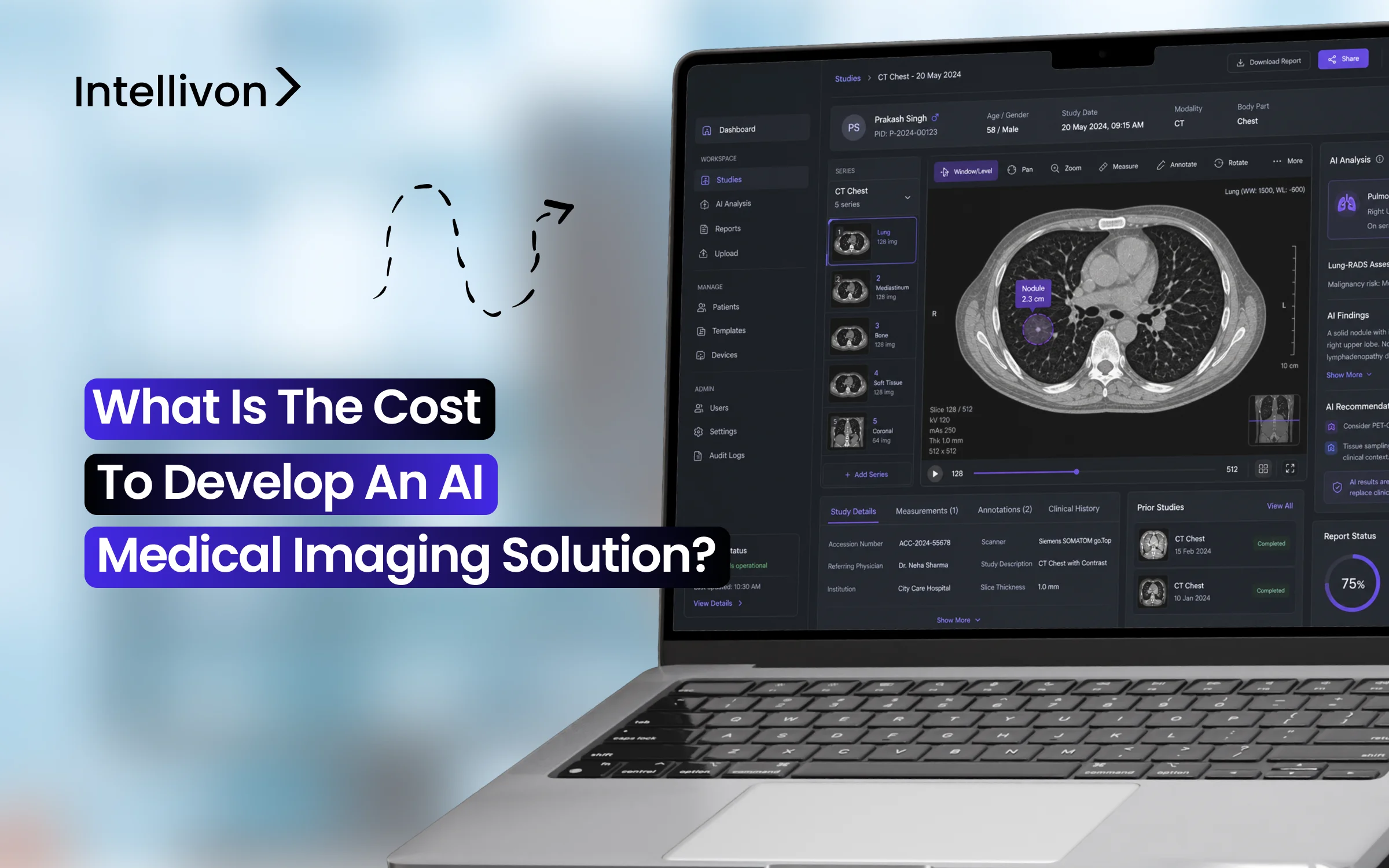
Key Takeaways:
-
AI medical imaging costs range from $50,000 for an MVP to $280,000 and above for an enterprise platform with PACS integration and compliance architecture.
-
Costs shift by modality: X-ray starts at $50,000, MRI reaches $220,000, and multi-workflow platforms exceed $280,000.
-
Hidden costs, including annotation, GPU compute, PACS testing, model retraining, and compliance documentation, consistently exceed initial estimates.
-
Starting with one modality and delaying PACS integration until validation reduces early cost without compromising scalability.
-
How Intellivon builds AI medical imaging platforms your enterprise fully owns, with DICOM workflows, PACS integration, and compliance-ready audit controls from day one.
Budget discussions around AI medical imaging solutions often start in the wrong place. The main question is not simply “how much?” Instead, consider what you are building, for which clinical setting, and how deeply you plan to integrate it.
The cost to develop an AI medical imaging solution usually falls between $50,000 and $280,000. A basic minimum viable product (MVP) with image upload, AI-assisted detection, and a review dashboard starts at about $50,000 to $90,000. A more advanced platform with DICOM support, PACS integration, custom AI models, radiologist workflows, and compliance-ready design can raise the cost to $180,000 or more.
Factors like imaging modality, AI model complexity, validation needs, and deployment scope directly affect costs. At the same time, budget surprises occur with compliance and clinical validation. Skipping these steps at the beginning doesn’t lower costs. Instead, just postpones them and often leads to penalties.
At Intellivon, we outline AI medical imaging projects with complete cost transparency at every development stage. This way, decision-makers never find themselves surprised during the build process. This blog details costs by solution type, feature set, modality, development stage, and the hidden expenses that many vendors don’t reveal up front.

AI Medical Imaging Development Cost In 2026
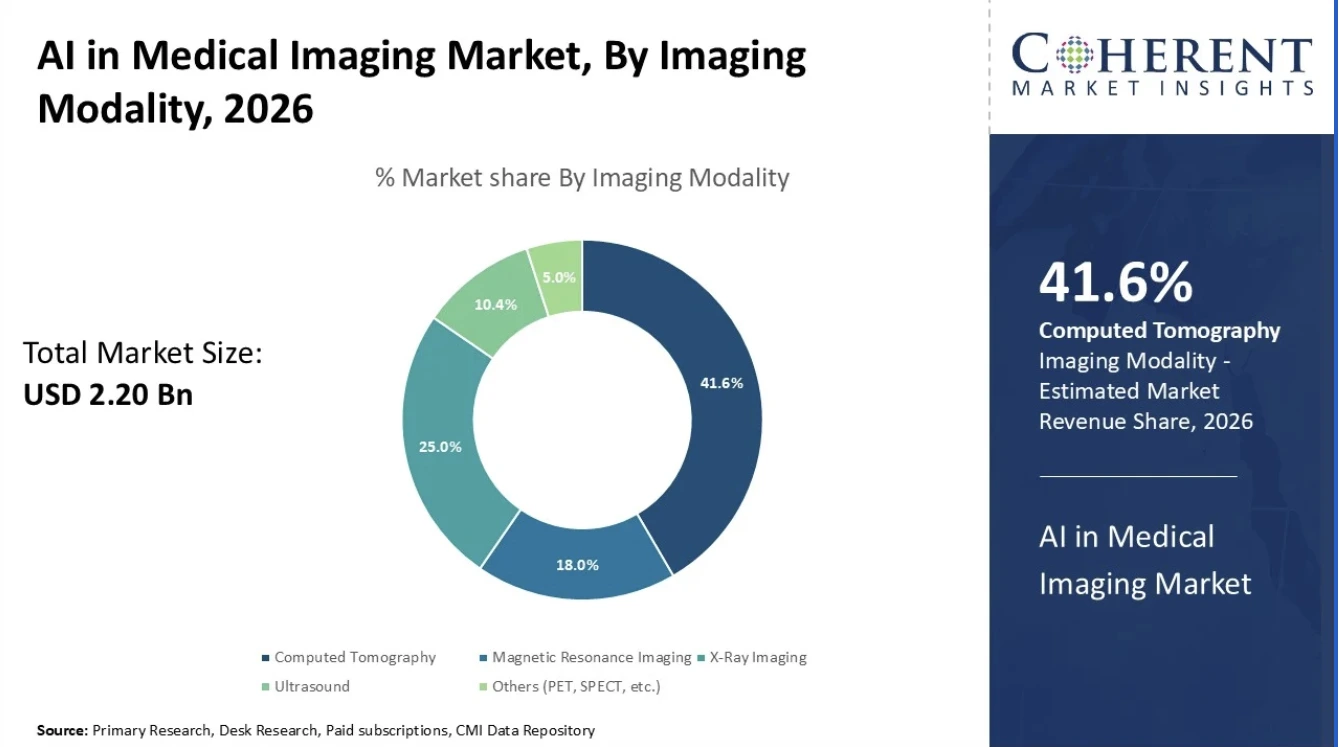
AI medical imaging development cost in 2026 usually ranges from $50,000 to $280,000, depending on features, integrations, AI complexity, and compliance needs. The market for medical imaging AI is expanding rapidly. Hospitals are adopting these tools more frequently to manage heavy clinical and operational workloads. Consequently, various industry reports now highlight strong, consistent growth rates across the global healthcare sector.
The AI medical imaging market is scaling at a relentless pace. By 2026, global estimates value the sector at roughly $5.29 billion, with a projected surge to over $20 billion by 2030. This trajectory represents a massive compound annual growth rate (CAGR) of nearly 40%.
Average Cost To Build AI Medical Imaging Software
Investment in medical imaging AI requires a clear understanding of the project’s maturity and technical depth. A standardized budget does not exist because every clinical use case carries unique data requirements and integration hurdles.
Therefore, most strategic planners categorize their financial commitments based on the level of software complexity and the intended scale of the deployment.
Development Cost Breakdown by Project Scope
| Project Scope | Estimated Cost | Best For |
| Proof of Concept | $30,000–$50,000 | Testing AI feasibility and accuracy |
| Basic MVP | $50,000–$90,000 | Early product validation with core users |
| Single-modality Solution | $90,000–$160,000 | Targeted X-ray, CT, MRI, or Ultrasound AI |
| DICOM/PACS-integrated Platform | $140,000–$220,000 | Deep clinical workflow integration |
| Advanced AI Imaging System | $220,000–$280,000 | Multi-role, secure, and scalable enterprise platforms |
While a proof-of-concept serves as a critical feasibility test, a functional solution typically begins at the $50,000 mark. Identifying your specific scope early ensures that capital is allocated efficiently toward the most impactful clinical features.
AI Imaging MVP Cost Vs Advanced Platform Cost
Choosing between a Minimum Viable Product (MVP) and an advanced platform is a decision that impacts both immediate cash flow and long-term scalability. An MVP is designed to prove a hypothesis and gather user feedback with minimal waste.
In contrast, an advanced system is built to survive the rigors of a high-volume hospital environment while maintaining strict security standards. However, a more useful way to estimate the budget is to look at the type of AI imaging solution being developed.
Comparison of MVP vs. Advanced Enterprise Solutions
| Cost Area | Basic MVP | Advanced Platform |
| Estimated Cost | $50,000–$90,000 | $220,000–$280,000 |
| Imaging Scope | One modality | One or multiple workflows |
| AI Model | Pre-trained or limited custom model | Custom-trained or fine-tuned model |
| Image Input | Manual upload | DICOM/PACS-based ingestion |
| Dashboard | Basic review interface | Role-based clinical dashboard |
| Explainability | Limited | Heatmaps, confidence scores, audit trails |
| Compliance | Basic security | Compliance-ready architecture |
| Deployment | Cloud MVP | Secure cloud or hybrid deployment |
The MVP model allows for rapid market entry and learning without an overwhelming initial financial commitment. Meanwhile, the advanced platform provides the comprehensive tools and reliability that large-scale medical institutions demand for daily operations.
What Is An AI Medical Imaging Solution?
AI medical imaging software analyzes diagnostic images, flags abnormalities, and supports clinical decision-making inside real hospital workflows.
However, this is not a DICOM viewer. A genuine AI medical imaging solution connects with PACS, RIS, and EHR systems, runs validated AI models, and includes radiologist review workflows, audit trails, and compliance controls as foundational requirements.
How AI Medical Imaging Software Works
Modern imaging platforms operate through a highly structured pipeline designed to ensure data integrity and clinical accuracy. This workflow moves data from the scanner to the specialist’s screen with minimal friction.
- Data Capture and Ingestion: The process begins when equipment like CT or MRI machines captures raw data. The system pulls these images from DICOM or PACS servers via secure APIs.
- Neural Network Analysis: The AI model processes the scan, performing detection (finding a lesion), classification (labeling it), or segmentation (tracing boundaries).
- Clinical Review: Findings are presented on a dashboard using heatmaps or confidence scores. A radiologist reviews this output to ensure the final decision remains human-led.
- System Integration: Once approved, results are exported to the Electronic Health Record (EHR) for care team access and secure archiving.
Common Use Cases:
- Lung & Breast: Abnormality detection and screening support.
- Neurology: Stroke triage and brain MRI analysis.
- Musculoskeletal: Fracture detection and tumor segmentation.
- General: Pneumonia detection and ultrasound quality checks.
The workflow translates raw data into actionable insights through a seamless, automated pipeline. This structured approach ensures that clinicians receive high-accuracy support without disrupting their existing diagnostic habits.
AI Medical Imaging Software Vs DICOM Viewer Software
While both tools are essential for modern radiology, their underlying value propositions and price points differ significantly. A standard DICOM viewer serves as a portal for observation, whereas an AI solution acts as a dedicated computational partner.
Understanding this distinction is vital for capital planning, as the additional cost of AI translates directly into enhanced diagnostic precision and clinical speed.
Feature and Value Comparison
| Area | DICOM Viewer | AI Medical Imaging Solution |
| Primary Role | View medical images | Analyze medical images |
| Intelligence Layer | No AI or limited automation | AI-based detection and prediction |
| Clinical Value | Image access | Assisted diagnosis and prioritization |
| Workflow | Manual review | AI-supported review |
| Integration Need | DICOM storage/viewing | DICOM, PACS, RIS, EHR, reporting |
| Cost Level | Lower | Higher |
A DICOM viewer essentially helps clinicians access and inspect scans on a digital screen. Conversely, an AI medical imaging solution goes much further by analyzing pixels, flagging urgent findings, and significantly reducing the time required for manual review.
The transition from a simple viewer to an AI-enabled platform represents a shift from passive data access to active clinical intelligence. This investment ensures that your facility is not just seeing images, but effectively interpreting them at scale.
Cost Breakdown By AI Imaging Solution Type
AI imaging software cost changes by solution type because each modality requires different data handling, model training, image processing, and workflow design. Consequently, investors must align their budgets with the specific technical demands of the chosen clinical field.
While 2D imaging, like X-rays, offers a lower barrier to entry, complex volumetric scans like CT or MRI necessitate a more robust financial commitment to handle the increased data density and processing requirements.
Investment Summary by Imaging Modality
| Modality Type | Estimated Cost | Core Clinical Benefit |
| AI X-Ray Detection | $50,000–$130,000 | Rapid triage and abnormality flagging |
| AI CT Scan Analysis | $90,000–$190,000 | Volumetric analysis and stroke triage |
| AI MRI Analysis | $110,000–$220,000 | Complex segmentation and neurology |
| AI Ultrasound Assistant | $80,000–$180,000 | Real-time guidance and quality scoring |
| AI Mammography | $130,000–$240,000 | High-precision screening and risk scoring |
| Multi-Workflow Platform | $180,000–$280,000 | Enterprise-wide scalable orchestration |
1. AI X-Ray Detection Software Cost
Estimated Cost: $50,000–$130,000
X-ray systems represent the most accessible entry point into medical AI. These platforms typically focus on chest analysis, fracture detection, and pneumonia or tuberculosis screening.
Because X-rays are 2D images, the computational load is lower compared to 3D counterparts, making the initial build more affordable.
2. AI CT Scan Analysis Software Cost
Estimated Cost: $90,000–$190,000
CT analysis requires a step up in investment due to the nature of “slice-by-slice” processing. These systems are vital for lung nodule detection, stroke triage, and internal bleeding alerts.
Because a single CT scan can contain hundreds of images, the AI must be capable of volumetric image processing to be clinically relevant.
3. AI MRI Analysis Platform Cost
Estimated Cost: $110,000–$220,000
MRI platforms are among the most sophisticated due to multi-sequence image support. These solutions are frequently used for tumor segmentation, multiple sclerosis lesion tracking, and longitudinal comparisons.
The specialized nature of brain and musculoskeletal anatomy requires highly expert annotation, which drives up the cost of training data.
4. AI Ultrasound Imaging Assistant Cost
Estimated Cost: $80,000–$180,000
Ultrasound AI is unique because it often focuses on real-time assistance. These tools help with fetal or cardiac scans, liver analysis, and point-of-care (POCUS) quality checks.
The primary challenge here is “noise.” Ultrasound quality varies significantly based on operator skill and patient position.
5. AI Mammography Screening Software Cost
Estimated Cost: $130,000–$240,000
Mammography requires a focus on extreme precision and explainability. These platforms support second-reader workflows, lesion detection, and breast density analysis.
Because the stakes for screening are so high, the software must include detailed risk scoring and clear audit trails for every decision.
6. Multi-Workflow AI Imaging Platform Cost
Estimated Cost: $180,000–$280,000
This is the ideal range for healthcare companies that want a production-ready AI imaging platform instead of a limited MVP. A multi-workflow system handles various imaging types, multiple user roles, and full model orchestration.
It includes robust admin dashboards, audit trails, and secure patient data management protocols.
Each imaging modality demands a tailored financial strategy to balance technical complexity with clinical utility. By selecting the right tier for your specific use case, you can ensure that your capital drives maximum diagnostic impact.
Feature-Wise Cost Breakdown For AI Imaging Software
Feature cost depends on image ingestion, AI analysis, clinical dashboards, DICOM workflows, reporting, security, compliance, and model monitoring. Strategic budgeting requires isolating these components to ensure the final product meets clinical standards without unnecessary bloat.
Consequently, most enterprise leaders prioritize core ingestion and analysis before scaling into advanced explainability or automated reporting.
Core Feature Investment Matrix
| Feature Module | Estimated Cost | Strategic Priority |
| Ingestion & Validation | $8,000–$20,000 | Essential for data integrity |
| PACS/DICOM Workflow | $25,000–$70,000 | Critical for hospital adoption |
| AI Analysis & Logic | $30,000–$90,000 | The primary value driver |
| Review & Dashboard | $20,000–$55,000 | User experience & clinical trust |
| Compliance & Security | $20,000–$60,000 | Non-negotiable for healthcare |
1. Ingestion, DICOM, and PACS Integration
The foundation of any imaging platform is how it handles medical data. Image Upload and Ingestion ($8,000–$20,000) covers manual DICOM uploads, metadata extraction, and mapping patient records. Costs rise if you require batch uploads or structured parsing of complex metadata.
DICOM Support ($15,000–$45,000) and PACS Integration ($25,000–$70,000) represent the “connective tissue” of the software. These features enable image rendering, windowing, and bi-directional synchronization with hospital servers.
- Cost Drivers: Supporting multiple PACS vendors, legacy system compatibility, and 3D reconstruction needs.
2. AI Development and Clinical Workflows
The “brain” of the system, AI Model Development ($30,000–$90,000), involves custom training for object detection and segmentation. This budget is often paired with Annotation and Labeling ($15,000–$60,000), which covers ground truth creation by board-certified radiologists.
- Key Needs: Confidence scoring, multi-reader validation, and custom dataset preparation.
- Increases: Higher accuracy benchmarks and multi-disease classification.
3. Review Dashboards and Explainability
For a solution to be useful, it must have a Clinical Review Dashboard ($20,000–$55,000). This allows radiologists to view AI results, heatmaps, and overlays within their existing workflow. To build further trust, Explainable AI Features ($15,000–$45,000) provide bounding boxes and reason codes for why the AI flagged a specific abnormality.
4. Reporting, Security, and Monitoring
The final output usually involves Reporting and Result Export ($10,000–$35,000), moving AI-generated summaries into the EHR via HL7/FHIR protocols. To protect this data, a Security and Compliance Architecture ($20,000–$60,000) is implemented, featuring encryption, de-identification, and audit logs.
Finally, Model Monitoring ($15,000–$40,000) ensures the AI doesn’t “drift” over time. This includes performance tracking and admin controls to review errors and usage analytics. These features also connect directly to the development phases that shape the final budget.
This modular approach ensures that each dollar spent contributes to a specific clinical or operational outcome. By focusing on high-impact features first, you can deploy a robust solution that evolves with your institution’s needs.
Phase-Wise Cost To Develop AI Medical Imaging Software
AI medical imaging development cost can be planned across discovery, data preparation, model development, integration, dashboard design, security, testing, and deployment. At Intellivon, we execute these stages through a rigorous enterprise framework that ensures capital is deployed effectively at every milestone.
By segmenting the build into logical phases, we provide investors with full transparency and a clear path toward a high-performance clinical tool.
Phase-Wise Cost Summary Table
| Development Phase | Estimated Cost | Why It Matters |
| Discovery & Workflow Planning | $5,000–$15,000 | Prevents feature bloat and misaligned goals. |
| Data Preparation & Pipeline | $10,000–$35,000 | Ensures the “fuel” for the AI is clean and secure. |
| Annotation & Clinical Labeling | $15,000–$60,000 | Sets the ground truth for diagnostic accuracy. |
| AI Model Development | $30,000–$90,000 | The core intelligence layer of the platform. |
| Backend & AI API Development | $20,000–$55,000 | Connects raw analysis with clinical workflows. |
| Dashboard & UI Development | $20,000–$55,000 | Maximizes specialist adoption and usability. |
| DICOM/PACS/EHR Integration | $25,000–$80,000 | Determines real-world hospital compatibility. |
| Security & Compliance Architecture | $20,000–$60,000 | Non-negotiable for patient data protection. |
| Testing & Deployment | $20,000–$55,000 | Guarantees reliability before clinical use. |
1. Discovery And Clinical Workflow Planning
Estimated Cost: $5,000–$15,000
This initial phase focuses on defining the “who, what, and how” of the application. Intellivon’s strategists work with stakeholders to map imaging workflows and review technical feasibility.
- Use case definition: Pinpointing the exact pathology or diagnostic gap to solve.
- Integration scope: Determining which hospital systems must communicate with the AI.
- Compliance discussion: Identifying the necessary regulatory path (FDA/CE) early.
- MVP vs. Full Platform: Deciding between a focused pilot and a multi-workflow system.
2. Data Preparation And Image Pipeline Setup
Estimated Cost: $10,000–$35,000
A system is only as reliable as its data pipeline. We build secure environments to handle massive DICOM datasets while maintaining strict de-identification protocols.
- Dataset collection: Sourcing diverse scans to prevent model bias.
- Image cleaning: Removing noise and artifacts that could confuse the AI.
- Preprocessing: Standardizing scan formats and resolutions for consistent analysis.
- Storage planning: Designing high-performance architectures for rapid data retrieval.
3. Annotation And Clinical Labeling
Estimated Cost: $15,000–$60,000
High-quality labeling is the backbone of clinical-grade AI. Intellivon facilitates specialized workflows where board-certified experts provide the “ground truth.”
- Labeling guidelines: Creating strict rules to ensure consistency across annotators.
- Segmentation masks: Precisely tracing tumor boundaries or anatomical structures.
- Quality checks: Implementing multi-reader validation to minimize human error.
- Consensus labeling: Resolving disagreements between experts to sharpen model training.
4. AI Model Development
Estimated Cost: $30,000–$90,000
As the most critical phase, this involves building the intelligence layer. We select and fine-tune models specifically for medical computer vision tasks.
- Model selection: Choosing between transformer-based or convolutional neural networks.
- Custom training: Developing unique algorithms for specific clinical detections.
- Accuracy evaluation: Measuring performance against rigorous benchmarks.
- Fine-tuning: Iteratively improving the model to reduce false positives/negatives.
5. Platform Backend And AI API Development
Estimated Cost: $20,000–$55,000
The backend is the engine that connects the AI to the user. We develop scalable APIs that process images and manage clinical data in real-time.
- Inference API: Ensuring the AI can analyze scans with minimal latency.
- Case management: Organizing studies so they are easily searchable by clinicians.
- Data storage: Maintaining secure, high-availability databases for patient records.
6. Dashboard And User Interface Development
Estimated Cost: $20,000–$55,000
A successful tool must be intuitive for the radiologist. We design interfaces that present AI findings as a natural extension of the diagnostic process.
- Radiologist dashboard: A primary workspace for reviewing scans and AI flags.
- AI output display: Visualizing heatmaps and bounding boxes clearly.
- Reporting interface: Streamlining the transition from “review” to “final report.”
7. DICOM, PACS, RIS, Or EHR Integration
Estimated Cost: $25,000–$80,000
Integration often decides whether an AI system survives in a hospital environment. Intellivon ensures your software speaks the same language as legacy systems.
- DICOM/PACS support: Enabling seamless image routing from the scanner to the AI.
- HL7/FHIR workflows: Sending findings directly to the Electronic Health Record.
- Image routing: Automating data flow across the medical facility’s network.
8. Security, Compliance, And Audit Logging
Estimated Cost: $20,000–$60,000
Security cannot be an afterthought in healthcare. We bake protection into the architecture from day one.
- Audit trails: Recording every access and modification for legal accountability.
- Encryption: Protecting data both in transit and at rest.
- Access permissions: Implementing role-based controls for sensitive data.
9. Testing, Validation, And Deployment
Estimated Cost: $20,000–$55,000
Before going live, we put the system through rigorous stress tests to ensure it performs under pressure.
- Functional testing: Verifying every feature works as intended.
- Performance testing: Ensuring the system handles high scan volumes without lag.
- Monitoring setup: Building tools to track the AI’s health post-deployment.
These phase-wise costs do not always add linearly. The final project cost depends on the selected scope, reused components, and dataset readiness. Beyond development phases, certain technical and clinical factors can increase or reduce the final cost.
To understand how these phases align with your specific investment goals, contact Intellivon today for a comprehensive project quote.
AI Medical Imaging Platform MVP Cost
An AI medical imaging MVP usually costs $50,000 to $90,000 and helps validate one focused imaging use case before full-scale development. This lean approach allows investors to test clinical feasibility and gather specialist feedback without committing to a multi-million dollar infrastructure.
Consequently, it serves as a strategic entry point for startups and health systems looking to prove ROI rapidly.
What A $50,000–$90,000 MVP Can Include
A typical build at this level includes:
- One Imaging Modality: Focused development for one type of scan, such as X-ray or CT.
- Single AI Use Case: Automated detection or triage for one specific pathology.
- Manual Ingestion: Simplified workflows allowing for manual image uploads and basic preprocessing.
- Core Logic Integration: Deployment of a basic AI model with confidence scoring.
- Review Dashboard: A streamlined interface for clinicians to view flagged abnormalities and results.
- Secure Infrastructure: Admin logins and encrypted storage to ensure a professional, data-safe environment.
- Initial Validation: Basic reporting features to track model performance during the pilot phase.
Best MVP Use Cases For AI Imaging
- X-ray: Focused abnormality, fracture, or pneumonia detection.
- CT: Basic triage and lung nodule flagging.
- Specialty: Ultrasound quality scoring or mammography pre-screening support.
When To Move From MVP To Full Platform
You should transition when the model performs reliably on test data and radiologists validate the workflow. Clear business use cases and confirmed integration needs also signal it is time to scale. Once users require automation beyond manual uploads, shifting toward a compliant, enterprise-ready architecture is necessary.
For healthcare companies ready to go beyond an MVP, the next cost layer comes from building an enterprise-grade platform.
Advanced AI Medical Imaging Platform Cost
An advanced AI medical imaging platform costs $180,000 to $280,000 when it includes PACS integration, AI workflows, dashboards, security, and monitoring. This investment level is designed for organizations seeking a production-ready system capable of handling high-volume clinical demands.
At Intellivon, we build these platforms to serve as a central intelligence hub for modern radiology departments.
What A $180,000–$280,000 Platform Can Include
A comprehensive enterprise solution moves beyond basic detection to offer a fully integrated diagnostic ecosystem. This includes:
- Deep Integration: Full DICOM support and seamless PACS connectivity for automated data flow.
- Advanced Intelligence: Custom AI model development, fine-tuning, and explainable outputs like heatmaps.
- Clinical Workflows: Multi-role dashboards, reporting workflows, and feedback loops for continuous improvement.
- Enterprise Security: Role-based access, audit logs, and a compliance-ready, secure cloud architecture.
What Can Push Cost Toward $280,000
Several factors can drive the budget toward the upper end of this range:
- Complexity: Supporting multiple modalities or segmentation-heavy AI models.
- Data & Security: Preparing massive datasets and implementing enterprise-grade security protocols.
- Real-time Needs: Engineering for real-time processing and complex, multi-site DICOM routing.
The cost also changes depending on whether the AI model is built from scratch, fine-tuned, or integrated from an existing model. This phase ensures your platform is a growth enabler rather than just a technical tool.
AI Model Development Cost For Medical Imaging
AI model development can cost $30,000 to $90,000, depending on whether the system uses a pre-trained model, a custom model, segmentation, or explainable AI.
This phase represents the intellectual engine of your platform. Consequently, the choice between leveraging existing frameworks and building proprietary algorithms is the most significant factor in both your initial investment and your long-term competitive advantage.
1. Pre-Trained AI Model Integration Cost
Estimated Cost: $20,000–$45,000
Integrating pre-trained models is the most efficient path for MVPs and faster market validation. These models have already been exposed to millions of generalized images, making them suitable for lower-risk use cases and early product testing where datasets may be limited.
However, “pre-trained” does not mean “plug-and-play.” Even with an existing foundation, significant investment is required for:
- Rigorous Testing: Ensuring the model generalizes well to your specific patient demographics.
- Workflow Adaptation: Mapping the model’s outputs to your clinical dashboard.
- API Integration: Building the bridge between the model and your image ingestion pipeline.
2. Custom AI Model Development Cost
Estimated Cost: $45,000–$90,000
For enterprises seeking to build a differentiated product with unique IP, custom development is essential. This is best for specialized imaging workflows where high accuracy is non-negotiable.
Custom models require extensive data preparation, expert-led annotation, and intensive hyperparameter tuning to reach clinical-grade performance.
Classification, Detection, And Segmentation Cost Differences
| Model Type | Use Case | Cost Level |
| Classification | Normal vs. abnormal screening | Lower |
| Detection | Locating specific abnormalities (e.g., fractures) | Medium |
| Segmentation | Outlining organs, lesions, or tumors | Higher |
| Triage | Prioritizing urgent cases in the worklist | Medium to High |
| Multi-model System | Handling several AI tasks simultaneously | Higher |
3. Model Accuracy And Validation Cost
Achieving high sensitivity and specificity is a capital-intensive process. You must budget for radiologist reviews to minimize false positives and negatives, which can erode clinical trust.
Furthermore, testing for dataset diversity and bias is critical to ensure the AI performs consistently across different scanner manufacturers and patient ethnicities.
Even a strong AI model will not work well unless the surrounding healthcare system integrations are planned correctly.
Building a custom model ensures that your platform is not just another tool, but a proprietary asset that solves specific clinical gaps.
Integration Costs For AI Medical Imaging Software
Integration costs can range from $25,000 to $80,000, depending on DICOM, PACS, RIS, EHR, HL7, FHIR, and hospital workflow requirements. For enterprise decision-makers, integration is often the most complex phase because it involves connecting modern AI logic with legacy hospital infrastructure.
1. DICOM Integration Cost
Estimated Cost: $15,000–$45,000
DICOM is the universal language of medical imaging, and its integration is non-negotiable for clinical use. This phase involves building a robust engine capable of metadata parsing and study organization.
- Imaging Handling: Ensuring the system can render high-resolution scans without losing diagnostic detail.
- DICOM Routing: Automating the secure exchange of images between the capture device and the AI inference engine.
- Standardization: Managing various study and series hierarchies to ensure patient data remains perfectly aligned with the correct diagnostic report.
2. PACS Integration Cost
Estimated Cost: $25,000–$70,000
Integrating with a Picture Archiving and Communication System (PACS) allows the AI to automatically “pull” new scans for analysis. This eliminates the need for manual uploads and ensures that radiologists see AI flags directly in their primary workspace.
- Query & Retrieve: Enabling the AI to search for historical scans to perform longitudinal comparisons.
- Multi-Vendor Support: Building compatibility for systems from GE, Philips, Siemens, or Sectra.
- Real-Time Sync: Synchronizing studies instantly so that urgent findings are prioritized in the radiologist’s worklist.
3. RIS And EHR Integration Cost
Estimated Cost: $20,000–$60,000
To deliver true enterprise value, the AI must communicate with the Radiology Information System (RIS) and Electronic Health Record (EHR). This bridge ensures that AI-generated summaries become a permanent part of the patient’s medical history.
- HL7/FHIR Protocols: Using modern interoperability standards for secure report exchange.
- Order Mapping: Connecting AI findings to specific physician orders and billing codes.
- Result Export: Automating the delivery of PDF or structured data reports back to the primary care team.
4. Cloud, On-Premise, And Hybrid Deployment Cost
The choice of deployment significantly impacts both upfront CapEx and ongoing OpEx:
| Deployment Type | Cost Impact | Best For |
| Cloud | Moderate | SaaS products, startups, and rapid scalability. |
| On-Premise | Higher | Hospitals with strict data sovereignty and security policies. |
| Hybrid | Higher | Enterprises need the flexibility of cloud with local storage. |
| Edge Deployment | Higher | Real-time, device-based imaging (e.g., portable ultrasound). |
Integration cost is important, but hidden costs can also affect the final budget if they are not planned early.
Hidden Costs In AI Medical Imaging Development
Hidden costs include data cleaning, annotation, radiologist review, model retraining, cloud computing, compliance documentation, integration testing, and post-launch monitoring. For an investor, understanding these variables is essential to prevent “budget creep” during the later stages of development.
1. Medical Image Dataset Preparation
Raw medical data is rarely “AI-ready.” Sourcing images from different hospital systems often results in inconsistent formats and messy metadata that must be standardized.
- Data Cleaning: Identifying and removing duplicate scans or low-quality images that could skew results.
- De-identification: Stripping Protected Health Information (PHI) to ensure research and training environments remain HIPAA-compliant.
- Standardization: Organizing disparate studies into a unified structure that the model can ingest efficiently.
2. Radiologist Annotation And Review
The quality of an AI is directly proportional to the quality of its training labels. Because medical ground truth requires high-level expertise, this phase involves significant professional fees for board-certified specialists.
- Expert Labeling: Paying for a radiologist’s time to create precise masks for tumors or lesions.
- Conflict Resolution: Managing second-opinion workflows where multiple experts must reach a consensus on a single scan.
- Quality Checks: Running periodic audits on the annotations to ensure the training data hasn’t drifted from clinical standards.
3. Cloud Compute And AI Inference
Processing high-resolution DICOM files requires heavy lifting from specialized hardware. Beyond the initial training, the ongoing cost of running a live model can be substantial.
- GPU Utilization: Budgeting for high-performance instances (like NVIDIA H100s) required for rapid image analysis.
- Scaling Ingestion: Managing storage costs as the platform accumulates petabytes of historical patient data.
- Backup and Recovery: Implementing redundant storage systems to ensure diagnostic data is never lost during a system outage.
4. Integration Testing With Hospital Systems
Connecting to a live hospital environment is vastly different from a controlled testing lab. This phase requires rigorous simulation of real-world clinical traffic.
- Workflow Simulation: Testing how the AI handles a surge of scans during peak hospital hours.
- Compatibility Checks: Ensuring the DICOM routing works across different generations of PACS and EHR hardware.
- User Acceptance Testing (UAT): Gathering feedback from clinicians to ensure the AI results appear in their dashboard without lag.
5. Compliance Documentation And Audit Readiness
In 2026, regulatory bodies demand more than just a secure system; they require a “paper trail” for every automated decision.
- Audit Logging: Maintaining detailed records of who accessed which scan and when.
- Model Decision Logs: Storing the logic behind every AI flag to satisfy clinical and legal inquiries.
- Data Retention: Building automated systems to purge or archive data according to strict healthcare policies.
6. Model Maintenance And Retraining
An AI model is not a static asset. As new imaging technologies emerge and patient demographics shift, the model must be updated to remain accurate.
- Drift Monitoring: Identifying when the model’s accuracy begins to dip due to changes in scanner hardware or clinical protocols.
- Feedback Loops: Integrating specialist corrections back into the training set to improve future performance.
- Version Control: Managing software updates to ensure that new model iterations don’t break existing clinical integrations.
Although these costs can add up, the right development strategy can keep the project within the $50,000–$280,000 range. By identifying these factors early, we ensure your capital is preserved for features that drive the highest clinical and commercial impact.
How To Reduce AI Medical Imaging Development Cost
You can reduce AI imaging development cost by starting with one modality, using an MVP scope, reusing proven components, and delaying complex integrations. Taking a surgical approach to the initial roadmap allows for faster market entry while preserving capital for scaling.
By focusing on high-impact clinical needs first, you can gather the real-world evidence required for further funding or enterprise expansion without overextending resources.
1. Start With One Imaging Modality
Instead of building for X-ray, CT, MRI, and ultrasound together, start with one high-value modality. Each modality carries unique data densities and technical hurdles. Narrowing the focus lowers the initial engineering burden significantly.
- Best Starting Points:
- X-ray: High volume and standardized 2D workflows.
- CT Triage: Immediate clinical value for stroke or trauma cases.
- Ultrasound Quality Scoring: Helping technicians capture better images in real-time.
- Single Disease Detection: Concentrating on a high-need pathology like pneumonia.
2. Use A Focused MVP Scope
A focused MVP helps validate the core AI workflow before investing in full platform development. This prevents spending on secondary features that may not align with actual clinical habits.
- Focused Components:
- One model and one specific workflow.
- A single dashboard for one user group (e.g., radiologists).
- Basic reporting and limited integration.
3. Use Pre-Trained Models Where Suitable
Pre-trained or fine-tuned models can reduce early development cost when the use case does not require a fully custom model.
Leveraging existing computer vision frameworks allows the team to focus on the clinical “wrapper” and workflow integration, which are often more critical for adoption than a proprietary algorithm.
4. Delay Complex PACS Integration Until Validation
Manual image upload or limited DICOM support can work for early validation. Integrating with a hospital’s central PACS is a significant engineering task involving complex security protocols.
PACS integration can be added once the product proves its clinical and business value.
5. Prioritize Features That Support Clinical Adoption
Do not overbuild cosmetic features. Instead, prioritize the functional elements that help clinicians trust and rely on the system.
- Trust Building: Confidence scores and heatmaps to explain AI logic.
- Operational Efficiency: Case prioritization and simple report exports.
- Accountability: Review statuses and audit logs.
6. Build A Scalable Architecture From The Start
Cutting costs should not mean building fragile software. A professional architect allows the product to grow without expensive rework. This prevents “technical debt” and ensures that transitioning from an MVP to a multi-workflow platform is a seamless evolution rather than a ground-up rebuild.
The right cost-saving strategy depends on the product goal, clinical workflow, and development partner.
How Long Does It Take To Build AI Medical Imaging Software?
AI medical imaging software can take 3 to 8 months to develop, depending on MVP scope, dataset readiness, AI complexity, and integration requirements.
Time-to-market is often as critical as the budget, as early deployment allows for faster clinical feedback and data accumulation. A structured development approach ensures that milestones are met without sacrificing the rigorous testing required for healthcare software.
1. MVP Development Timeline
Estimated Timeline: 3–4 Months: The MVP phase is a sprint toward validation. It focuses on the most essential path to a “usable” diagnostic tool.
- Key Milestones: Discovery, data preparation, AI model integration, basic dashboard construction, and initial deployment.
2. Single-Modality Platform Timeline
Estimated Timeline: 4–6 Months: A single-modality platform introduces more depth, specifically regarding how the software fits into the hospital’s digital environment.
- Key Milestones: Implementation of full DICOM workflows, model fine-tuning, expanded clinical dashboards, and security hardening.
3. Advanced Platform Timeline
Estimated Timeline: 6–8 Months: Advanced platforms are built for enterprise-scale operations and multi-site deployments.
- Key Milestones: Deep PACS integration, multi-role workflows, explainability features, compliance-ready architecture, and long-term model monitoring.
4. Factors That Can Extend The Timeline
Several variables can introduce delays if not managed proactively:
- Data Readiness: Poor dataset quality or delayed expert annotations.
- Technical Friction: Complex legacy PACS systems or deployment constraints.
- Validation: Extensive security reviews or additional clinical validation requirements.
The timeline and cost both become more predictable when the development process follows a structured approach. Choosing a partner that understands these timelines helps in setting realistic expectations for stakeholders and investors alike.
Conclusion
Developing an AI medical imaging solution in 2026 is a strategic investment that balances high-precision engineering with significant commercial upside. While the capital requirements range from a lean $50,000 MVP to a robust $280,000 enterprise platform, the focus should always remain on clinical utility and seamless integration.
By following a phase-wise development roadmap, you ensure that every dollar spent directly enhances diagnostic accuracy and operational efficiency. Success in this space requires a deep understanding of healthcare workflows and regulatory standards.
Build AI Medical Imaging Solutions With Intellivon
Building an AI medical imaging solution requires more than training a model on scan data. It needs a secure healthcare platform where medical images, AI outputs, clinical review, reporting, compliance, and integrations work together without slowing down care teams.
At Intellivon, we build AI medical imaging solutions for hospitals, diagnostic labs, radiology platforms, healthtech companies, and medical imaging startups. Whether you need a focused MVP between $50,000 and $90,000 or an advanced AI imaging platform between $180,000 and $280,000, we help you define the scope, control cost, and build for real healthcare environments.
A. Designing The Right AI Imaging Architecture
We start by defining the clinical use case, mapping the imaging workflow, and designing a secure architecture around how care teams review scans.
Our architecture work includes:
- Use case planning for detection, triage, segmentation, or reporting
- Image pipeline design for upload, DICOM processing, and AI inference
- AI model strategy for pre-trained, fine-tuned, or custom models
- Cloud, hybrid, or on-premise deployment planning
- Scalability roadmap for future modalities and workflows
B. Building AI Models For Image Analysis
We build and integrate AI models that support real medical image analysis across X-rays, CT scans, MRIs, ultrasounds, and mammography.
Our AI model work includes:
- Pre-trained model integration
- Custom model development
- Fine-tuning for specific imaging use cases
- Classification, detection, and segmentation
- Confidence scores, heatmaps, and explainable AI outputs
C. Integrating DICOM, PACS, And Hospital Systems
AI imaging software becomes valuable when it connects with the systems healthcare teams already use.
Our integration work includes:
- DICOM-compatible image workflows
- PACS connectivity for secure image retrieval
- RIS/EHR integration for clinical continuity
- Secure data exchange between systems
- Reporting workflows and clinical system compatibility
If you are planning to build an AI medical imaging solution, Intellivon can help you estimate the right development cost, define the product scope, and build a secure, scalable platform around your clinical workflow.
Contact Intellivon to discuss your AI medical imaging solution and get a custom development estimate.
FAQs
Q1. How much does AI medical imaging software cost?
A1. AI medical imaging software usually costs between $50,000 and $280,000, depending on modality, AI model complexity, DICOM/PACS integration, clinical workflows, compliance needs, and deployment scope. A basic MVP costs less, while a PACS-integrated, compliance-ready imaging platform costs significantly more.
Q2. Why does AI medical imaging software cost more than a DICOM viewer?
A2. A DICOM viewer mainly displays medical images. AI medical imaging software analyzes images, detects findings, supports clinical review, connects with PACS/RIS systems, and may require validation, audit logs, security controls, and compliance planning. These additional AI, workflow, and integration layers increase development cost.
Q3. What increases the cost of medical imaging AI?
A3. The biggest cost drivers include custom AI models, radiologist annotations, multiple imaging modalities, DICOM processing, PACS integration, segmentation, explainability, reporting workflows, cloud or hybrid deployment, security, and compliance planning. Complex hospital integrations usually increase cost because imaging workflows vary across systems and vendors.
Q4. Can I start with an MVP before building a full platform?
A4. Yes. Many teams start with an MVP focused on one modality, one AI use case, manual image upload, and a basic review dashboard. This controls cost while validating product demand. Later, the platform can expand into PACS integration, reporting workflows, governance dashboards, and multi-modality support.