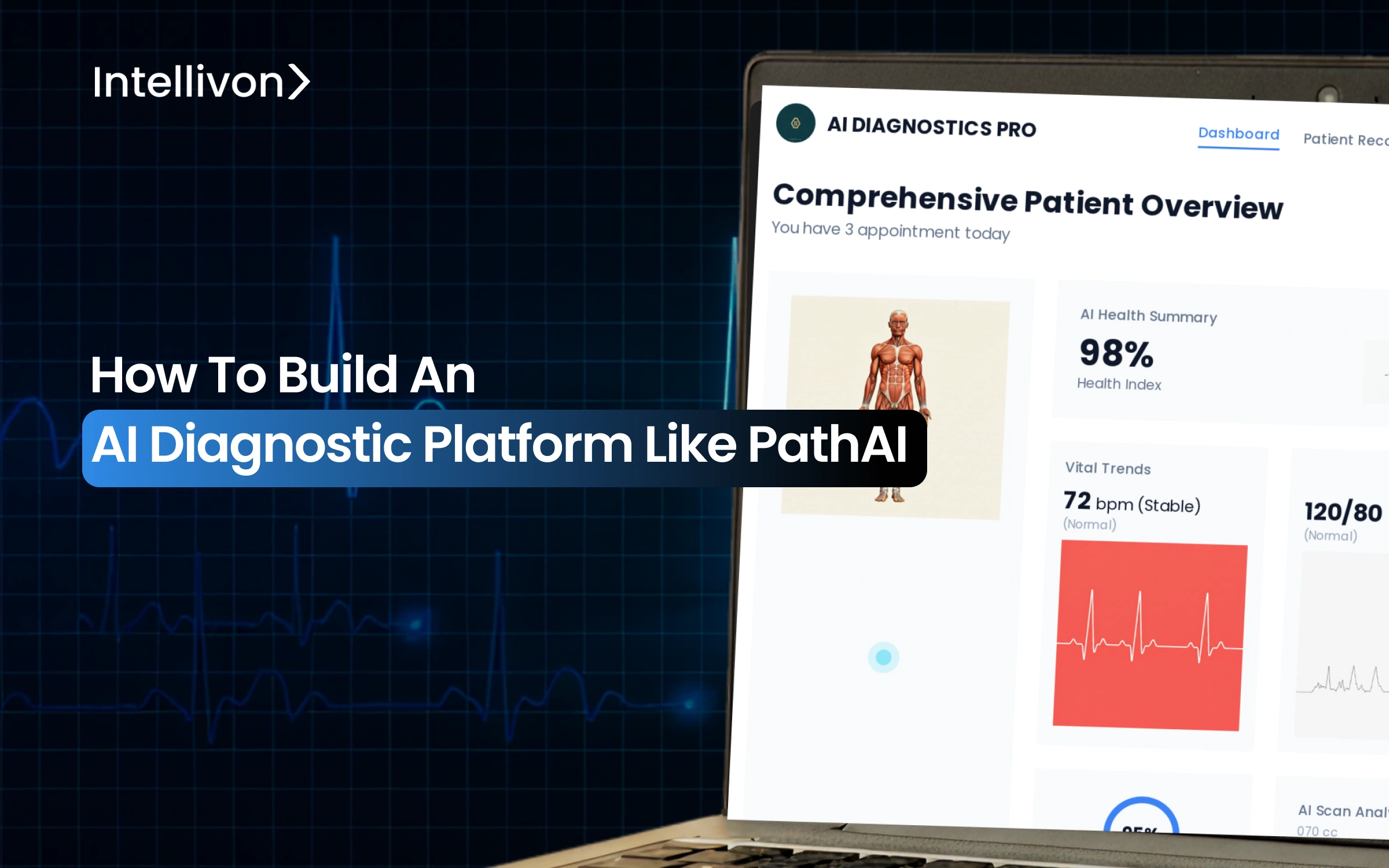
When critical diagnoses sit unread in backlogged trays, care delivery grinds to a halt, and the risk grows. For large enterprises, this affects compliance, referral speed, and patient trust. AI diagnostic platforms are shifting the paradigm, where they automate pathology workflows, prioritise high-risk cases, and bring clinical decision support into real-time.PathAI stands out with its scalable model, where more than 90% of the top-15 biopharma companies leverage its pathology AI toolkit.
At Intellivon, we build AI diagnostic platforms that not only deliver scalable AI but also embed full regulatory governance so clients meet enterprise-grade standards and drive measurable change. In this blog, we will explain why PathAI is the trailblazer in this space and guide you on how to construct a comparable AI diagnostic platform from the ground up.

Why Enterprises Need AI Diagnostic Platforms Now
Healthcare enterprises are under growing pressure. Diagnostic errors remain stubbornly high, costs are ballooning, and specialist shortages are slowing care delivery. AI diagnostic platforms are becoming strategic in tackling these issues with speed, accuracy, and scale.
The data tells a clear story.
1. Hidden Crisis in Diagnostics
Diagnostic errors are among the biggest patient safety threats today. Research shows 10–15% of diagnoses in clinical practice are wrong, delayed, or incomplete
In the U.S., reducing diagnostic errors by just half across five common conditions (stroke, sepsis, pneumonia, pulmonary embolism, and lung cancer) could prevent up to 150,000 cases of permanent harm or death every year. For enterprises managing hospitals and networks, this is more than a clinical issue. It is a reputational and financial risk that can no longer be ignored.
2. Financial Burden of Missed Diagnoses
Unsafe care drains enormous resources. According to the OECD, it consumes 13% of total health budgets, amounting to $606 billion annually across member countries. Even if diagnostic errors account for just 10% of that burden, enterprises face a hidden leak of $60 billion each year.
This financial strain isn’t abstract. Misdiagnosis leads to repeat imaging, unnecessary ICU stays, legal exposure, and delayed treatments, costs that stack up quickly. For leadership, improving diagnostic accuracy is both a patient safety imperative and a fiscal responsibility.
3. Growing Backlogs and Workforce Shortages
The capacity gap is widening. Some hospitals have admitted to backlogs of 50,000+ unread scans, delaying potential cancer diagnoses and urgent treatment .
Meanwhile, projections show a U.S. physician shortfall of 122,000 by 2032, while only 2% of UK radiology departments meet normal working-hour demand.
AI platforms cannot replace clinicians, but they can triage urgent cases, reduce reporting queues, and prevent life-threatening delays. For enterprises, this turns backlog management into a competitive differentiator.
4. Clinical Accuracy in Real Practice
AI platforms are already proving their value in live clinical settings. In real patient visits, AI copilots reduced diagnostic errors by 16% and treatment errors by 13%.
This is not “AI writing charts.” It’s ensuring the patient in bed four gets the right call faster, and avoids becoming a statistic.
5. Speed and Efficiency Gains
AI does more than improve accuracy. It accelerates the time to diagnosis. Leading platforms already draft structured reports in real time, flag critical findings, and push urgent cases to the top of the queue.
For enterprises, this translates into faster reads, quicker escalations, and earlier interventions, without adding more headcount. It’s operational resilience through automation.
7. Adoption Is Already Mainstream
Waiting is no longer an option. In a 2025 AMA survey, two-thirds of physicians reported using AI in their workflows, a 78% increase since 2023.
AI in diagnostics has crossed the adoption threshold. Enterprises that hesitate risk falling behind competitors and regulators, as standards of care evolve rapidly.
The Market Momentum
This momentum reflects two undeniable forces, which are workforce collapse and zero tolerance for diagnostic errors. Enterprises must respond now to capture efficiency, compliance, and trust advantages.
What Is an AI Diagnostic Platform Like PathAI?
An AI diagnostic platform is a connected system that powers accurate, scalable, and compliant diagnostics. PathAI represents one of the most advanced examples in this field. Its platform integrates AI algorithms, digital pathology workflows, and compliance-first design to reduce errors, increase efficiency, and deliver enterprise-wide value.
For enterprises evaluating these platforms, PathAI illustrates how AI can evolve from research pilots into everyday infrastructure that transforms diagnostics.
How It Works
1. Data Ingestion and Preprocessing
The platform begins with the ingestion of high-resolution pathology slides. Images are normalized and preprocessed to ensure consistency, regardless of lab or equipment variations.
2. AI-Powered Analysis
Deep learning and foundation models, trained on millions of annotated cases, scan the slides. They detect abnormalities, identify biomarkers, and prioritize urgent findings with high accuracy.
3. Clinician Oversight
Clinicians validate AI-generated results through an intuitive digital interface. Visual markers and confidence scores provide explainability, making decisions transparent and audit-ready.
Together, this creates a workflow where AI accelerates diagnosis but clinicians retain full control, balancing speed with trust. While the workflow defines its core, what truly makes PathAI stand out are its advanced features.
Features That Make It Stand Out
1. Large-Scale Annotated Data
The platform is built on one of the largest pathology datasets, annotated by hundreds of certified pathologists. This breadth ensures accuracy and reduces diagnostic bias.
2. Advanced AI Models
PathAI uses foundation models capable of analyzing slides at multiple scales. This enables the detection of subtle patterns that traditional methods or narrow AI models might miss.
3. Enterprise Workflow Integration
The system connects directly with existing hospital systems, like EHR, LIS, and PACS. This integration makes adoption smooth, without disrupting clinician routines.
4. Regulatory and Compliance Readiness
FDA clearance and CE-IVD certifications position PathAI’s platform for primary diagnostic use. Built-in audit trails and explainability reinforce enterprise trust.
These features establish PathAI as not just technically advanced but enterprise-ready, proven across clinical networks. Features alone don’t guarantee enterprise sustainability. To scale successfully, PathAI also follows a strategic business model.
Business Model PathAI Follows
1. Clinical Deployments
Hospitals and labs license the platform to digitize pathology and embed AI-driven diagnostics into their daily workflows. This creates efficiency gains and measurable ROI.
2. Biopharma Partnerships
PathAI partners with pharmaceutical companies to support biomarker analysis and clinical trials. These services accelerate drug development and expand the platform’s reach.
3. Precision Pathology Network
PathAI connects labs and research centers through its network, enabling data contribution, early access to algorithms, and revenue opportunities through real-world evidence generation.
This hybrid model allows PathAI to grow across clinical, research, and pharma markets simultaneously. By combining workflow integration, powerful features, and a robust business model, PathAI defines the benchmark for enterprise diagnostic platforms.
Key Takeaways Of The AI Diagnostics Market
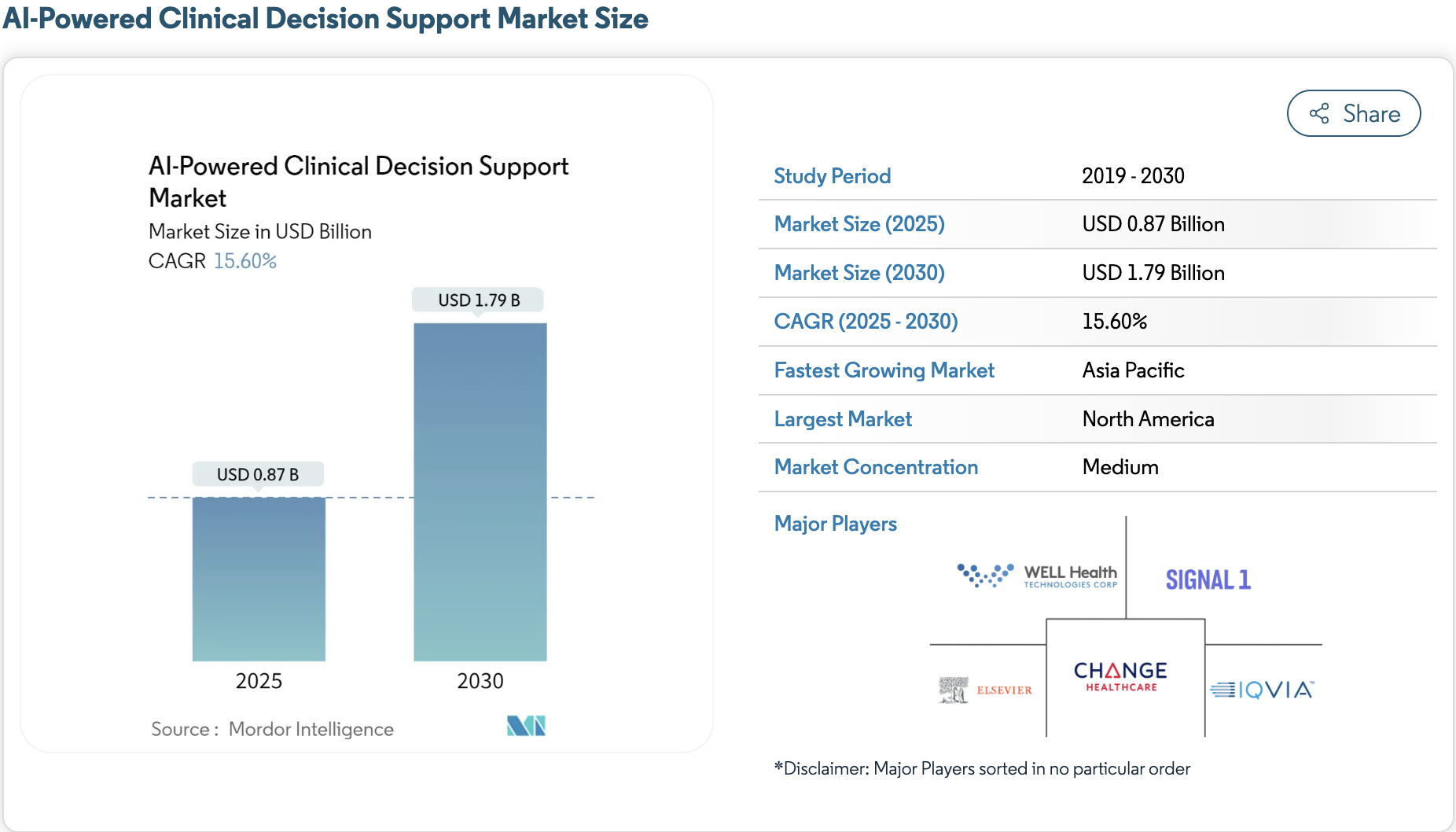
Key Takeaways
- The global AI-driven Clinical Decision Support (CDS) market was valued at USD 2.77 billion in 2024 and is projected to surpass USD 15 billion by 2032, growing at a CAGR of 23.9%.
- North America leads the global market with a 43.6% share, supported by advanced health IT infrastructure and significant digital health investment.
- The Asia-Pacific region is set to record the highest CAGR, driven by accelerated healthcare digitization and AI deployment across emerging economies.
PathAI: Market Momentum and Growth
- PathAI was ranked among the top 500 fastest-growing companies in North America in Deloitte’s 2024 Technology Fast 500, achieving an impressive 260% growth rate during the ranking period.
- This growth is attributed to rapid enterprise adoption of its AI pathology tools, which shorten clinical trial timelines and increase diagnostic precision.
- The AI pathology segment where PathAI operates is forecast to expand from USD 134.57 million in 2024 to over USD 1.1 billion by 2033, with a CAGR exceeding 27%.
ROI and Enterprise Adoption
- According to McKinsey and industry reports, 45% of organizations using clinical AI, including CDS tools, achieved ROI within the first year of deployment.
- Many enterprises report over 2x returns within 12 months, reflecting tangible value in both operations and financial performance.
- AI-powered CDS platforms improve diagnostic accuracy, accelerate time-to-diagnosis, and reduce operational costs for hospitals and labs.
- Healthcare providers report measurable gains in workflow efficiency, stronger patient outcomes, and fewer unnecessary interventions.
- Among professionals, 71% view large language models and AI-powered analytics as the most transformative tools, indicating strong trust in enterprise adoption.
The AI-powered CDS market is doubling in value roughly every five years, fueled by regulatory support, enterprise deployment, and proven ROI. Early adopters like PathAI are already capturing growth and clinical breakthroughs, making adoption no longer optional but strategically essential. For healthcare enterprises, these platforms deliver tangible ROI within a year, with measurable improvements in accuracy, efficiency, and financial outcomes.
Must-Have Features of an AI Diagnostic Platform Like PathAI
Building a successful AI diagnostic platform like PathAI requires more than advanced algorithms. It must combine accuracy, compliance, security, and scalability to deliver enterprise-grade results. These are the essential features every platform should include.
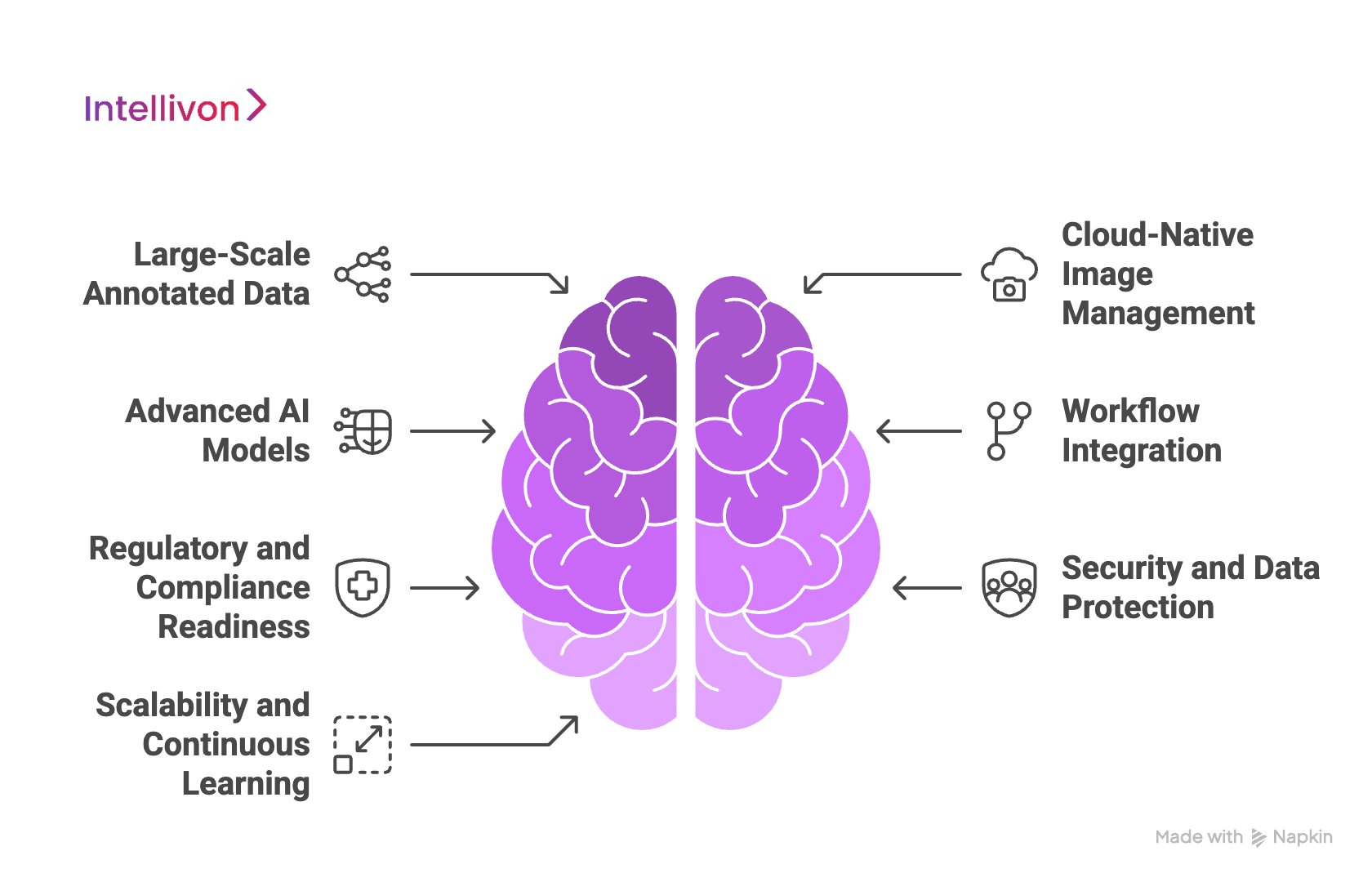
1. Large-Scale Annotated Data
The foundation of any diagnostic AI is the quality of its training data. A platform must be trained on millions of slides annotated by experienced pathologists to reduce bias and improve accuracy.
This diversity ensures reliable performance across populations, hospitals, and equipment types, making the system adaptable to real-world variability.
2. Cloud-Native Image Management
Hospitals handle massive volumes of pathology images daily. A cloud-native platform centralizes ingestion, storage, and case assignment, while enabling collaboration among clinicians.
This prevents bottlenecks, supports remote access, and ensures the platform can scale as diagnostic demands grow.
3. Advanced AI Models
Simple algorithms cannot capture the complexity of human tissue. Advanced deep learning and foundation models are needed to analyze slides at multiple scales, from tissue structures to cellular detail.
These models support use cases like tumor detection, biomarker quantification, and rare disease identification with high accuracy.
4. Workflow Integration
AI cannot disrupt clinical operations because it must integrate seamlessly with existing EHR, LIS, and PACS systems. A strong platform embeds triage, anomaly detection, and reporting directly into lab workflows.
This allows clinicians to adopt the system without changing their established practices, ensuring smoother enterprise-wide deployment.
5. Regulatory and Compliance Readiness
Healthcare is one of the most regulated industries in the world. An AI diagnostic platform must meet global standards such as FDA clearance, CE-IVD certification, HIPAA, and GDPR.
Compliance features like audit trails, explainability, and clinician-in-the-loop validation make the system trustworthy for regulators and enterprises alike.
6. Security and Data Protection
Patient data is highly sensitive, and security breaches can cause irreparable damage. Platforms must enforce end-to-end encryption, role-based access, anonymization, and secure APIs.
Enterprise-grade monitoring and logging are essential to safeguard data and maintain compliance with privacy regulations.
7. Scalability and Continuous Learning
Diagnostics don’t stand still. This is because new diseases emerge, biomarkers evolve, and workloads increase. A cloud-native, API-first platform must scale across hospital networks while supporting continuous model retraining. This ensures the system stays accurate, resilient, and future-proof as medicine advances.
These features define what separates a pilot project from a true enterprise-ready diagnostic platform. Without them, adoption stalls, but with them, AI becomes a trusted partner in modern healthcare.
Architecture of an AI Diagnostic Platform Like PathAI
An AI diagnostic platform is not a single model. It is a layered system where data, algorithms, compliance, and workflows connect to deliver real-world outcomes. PathAI’s architecture shows how these layers come together in practice.
1. Data Ingestion and Normalization
The platform ingests high-resolution slides and related clinical data. It standardizes formats, color profiles, and resolutions to ensure consistency across hospitals and labs. This prevents errors at the very first step and creates a clean pipeline for analysis.
2. Annotation and Data Governance
Expert pathologists annotate images to create reliable ground truth. Disagreements are resolved through consensus tools, and every label is versioned for traceability. This governance ensures datasets remain accurate, diverse, and compliant with medical standards.
3. AI Model Development and Validation
Deep learning and foundation models are trained on these annotated datasets. They capture both tissue-level structures and cellular details. Each model is validated against clinical benchmarks, with bias checks and error-rate tracking before deployment.
4. Compliance and Risk Controls
Healthcare AI must satisfy strict regulations. The platform embeds FDA, CE-IVD, HIPAA, and GDPR requirements directly into the design. Audit trails, explainability layers, and clinician sign-offs create transparency that regulators demand.
5. Workflow Integration
The system connects with EHR, LIS, and PACS to avoid disrupting daily operations. It routes cases, prioritizes urgent findings, and generates standardized reports. Clinicians continue working in familiar environments while AI quietly improves efficiency.
6. Security and Privacy
Patient data is encrypted in transit and at rest. Role-based access controls restrict visibility, while de-identification protects training pipelines. Continuous monitoring detects anomalies, ensuring resilience and enterprise-grade trust.
7. Monitoring and Continuous Learning
Dashboards track accuracy, turnaround times, and system performance. Drift detectors flag changes in data patterns, prompting retraining when needed. This feedback loop keeps the AI aligned with evolving medical knowledge.
8. Deployment and Scalability
The architecture is cloud-native and API-first. It scales seamlessly across hospitals, networks, and geographies. Containerized services ensure zero downtime, while disaster recovery safeguards critical healthcare operations.
Together, these eight layers turn algorithms into operational infrastructure. For enterprises, they represent the difference between a research pilot and a fully governed diagnostic ecosystem ready for clinical adoption.
How AI Powers AI Diagnostic Platforms Like PathAI
AI is the core engine that transforms raw medical images into actionable diagnostic insights. In a platform like PathAI, it doesn’t operate as a black box. Instead, AI works across the pipeline to enhance accuracy, speed, and reliability while keeping clinicians in control.
1. Preprocessing and Normalization
AI cleans and standardizes slides before analysis. It corrects for variations in staining, resolution, or imaging devices, ensuring that every case enters the workflow on equal footing.
2. Pattern Recognition at Scale
Deep learning and foundation models analyze slides at multiple levels, from tissue architecture to cellular changes. They detect tumors, quantify biomarkers, and highlight anomalies with consistency that reduces diagnostic variability.
3. Workflow Automation
AI triages cases, prioritizes urgent slides, and drafts structured reports. This automation accelerates turnaround times and frees pathologists to focus on complex or high-risk diagnoses.
4. Continuous Learning
The system evolves with new data. Every case and clinician feedback loop feeds back into retraining pipelines. This keeps the models current with emerging disease patterns and diagnostic standards.
5. Explainability and Trust
AI results are transparent. Platforms highlight regions of interest, provide confidence scores, and maintain audit trails. Clinicians see not only the output but also the reasoning behind it, which builds confidence and supports compliance.
In short, AI powers these platforms by combining automation, accuracy, and explainability. For enterprises, this means faster diagnostics, improved clinical outcomes, and a reliable system that scales across entire healthcare networks.
Overcoming Challenges in Building AI Diagnostic Platforms Like PathAI
Building an AI diagnostic platform is not just about developing powerful algorithms. It requires solving challenges that cut across data, compliance, security, workflows, and adoption. Below are the biggest barriers, and how Intellivon helps enterprises overcome them.
1. Data Quality and Diversity
Medical images differ across hospitals, labs, and geographies. Variations in staining, resolution, and equipment make data inconsistent. If AI models are trained on limited or biased datasets, diagnostic outputs will be unreliable and may fail in real-world use.
We partner with healthcare providers to curate diverse, multi-institutional datasets and build robust annotation pipelines. Our semi-automated labeling tools accelerate dataset creation, while expert pathologists validate annotations for accuracy. This ensures the AI learns from a broad, representative dataset and performs consistently across diverse populations.
2. Regulatory Compliance
Healthcare is one of the most tightly regulated industries. Platforms that ignore FDA, CE-IVD, HIPAA, or GDPR requirements risk costly delays and rejection. Regulatory approval determines whether the platform can ever be deployed.
Compliance is built into our architecture from the start. Every platform comes with audit trails, explainable AI layers, and clinician-in-the-loop workflows. We align with FDA, CE-IVD, HIPAA, and GDPR requirements, ensuring the platform is “regulatory-ready” rather than experimental. This approach shortens approval timelines and builds enterprise confidence.
3. Workflow Integration
Hospitals run on entrenched systems like EHR, LIS, and PACS. Adding new tools without integration creates friction, slows clinicians, and risks abandonment. If AI forces clinicians to change their routine, adoption will fail.
We design API-first, cloud-native platforms that plug directly into existing infrastructure. Features such as automated triage, artifact detection, and reporting are embedded into current workflows. Clinicians continue working within familiar systems, while AI quietly improves speed and efficiency in the background.
4. Security and Privacy Risks
Patient data is among the most sensitive assets. Breaches can result in fines, loss of reputation, and even patient harm. AI diagnostic platforms move, store, and process vast amounts of this data, making them prime targets for attacks.
We enforce enterprise-grade security standards with encryption at rest and in transit, strict role-based access, anonymization pipelines, and secure APIs. Real-time monitoring and intrusion detection protect data integrity, while disaster recovery ensures resilience. This guarantees compliance with global data protection laws and safeguards patient trust.
5. Clinician Trust and Adoption
AI cannot replace pathologists. If models operate as opaque “black boxes,” clinicians will not trust them. Lack of transparency leads to resistance, overrides, and stalled adoption.
Our platforms embed explainability into every decision. Each output comes with visual evidence, reasoning trails, and confidence scores. Clinicians validate AI findings instead of being replaced by them. This transparency builds trust, satisfies regulatory expectations, and strengthens adoption across enterprises.
6. Scalability and Maintenance
Many AI pilots succeed in one lab but fail to scale across hospital networks. Increasing workloads, geographic expansion, and evolving medical standards make platforms difficult to maintain. Static models quickly lose accuracy over time.
We build cloud-native, distributed systems designed for enterprise scale. Our platforms support thousands of concurrent cases, guarantee uptime, and include continuous retraining pipelines. Models are updated with new cases and clinician feedback, keeping performance sharp as diagnostic standards evolve.
Overcoming these challenges requires more than algorithms. Intellivon builds secure, compliant, and enterprise-ready ecosystems that scale beyond pilots, deliver measurable ROI, and earn long-term trust from both clinicians and regulators.
How We Build AI Diagnostic Platforms Like PathAI
At Intellivon, we approach AI diagnostic platforms as enterprise ecosystems, not isolated tools. Our eight-step framework ensures every build is accurate, compliant, secure, and scalable. Each stage is designed to deliver both clinical reliability and measurable business outcomes.
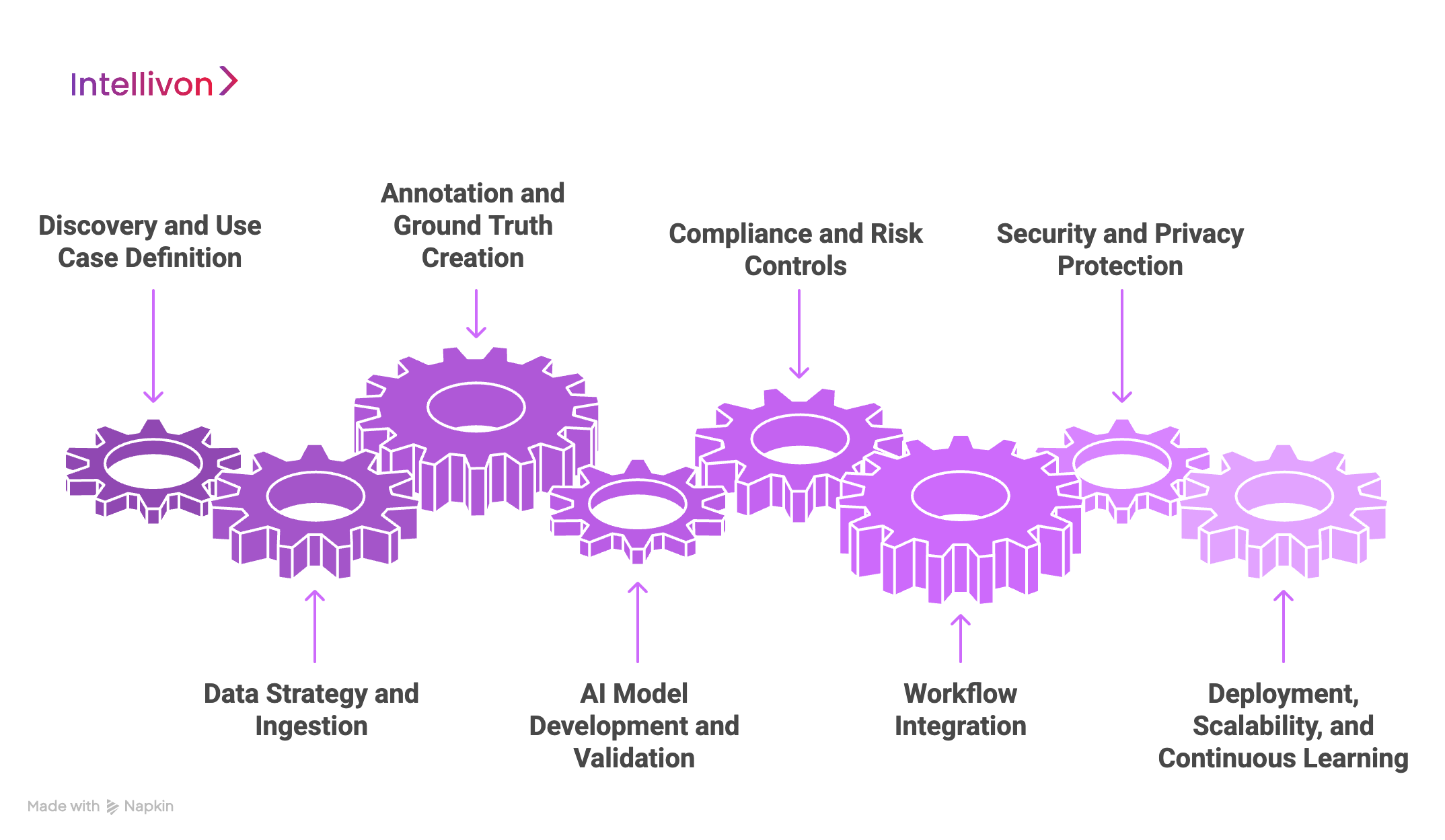
1. Discovery and Use Case Definition
We begin by aligning with healthcare leaders to identify the most pressing diagnostic challenges. This could include pathology backlog reduction, misdiagnosis risk, or trial-readiness for biopharma.
Instead of deploying generic AI, we tailor the platform around specific workflows and KPIs. The result is a clear strategy where AI solves enterprise pain points that directly affect cost, efficiency, and patient safety.
2. Data Strategy and Ingestion
Data is the foundation of every diagnostic platform. We create a structured strategy for sourcing, cleaning, and ingesting medical images from multiple hospitals, labs, and geographies.
Variations in staining, resolution, and equipment are normalized to create a consistent dataset. By removing inconsistencies early, we ensure downstream AI models perform reliably across diverse real-world conditions. This reduces bias and enhances adoption confidence.
3. Annotation and Ground Truth Creation
Accurate training data depends on expert annotation. Intellivon engages certified pathologists to create gold-standard datasets with consistent labeling. Semi-automated annotation tools accelerate the process while maintaining quality.
Governance frameworks track versioning, validate label accuracy, and resolve conflicts. This creates a trusted “ground truth” that strengthens clinical accuracy and provides audit-ready datasets for regulatory review.
4. AI Model Development and Validation
Our teams design deep learning and foundation models capable of analyzing tissue structures at both macro and micro scales. Models undergo rigorous validation against clinical benchmarks before deployment.
We test for accuracy, bias, error rates, and generalization across populations. Only models that meet enterprise-grade standards move forward. This approach prevents costly failures and ensures outcomes align with clinical expectations.
5. Compliance and Risk Controls
Regulatory compliance is baked into the architecture. We design platforms to align with HIPAA, GDPR, FDA, and CE-IVD from day one.
Built-in audit trails capture every action, while explainable AI and clinician-in-the-loop oversight ensure transparency. By embedding governance into the system, we reduce approval delays and make enterprise adoption faster, safer, and easier.
6. Workflow Integration
For adoption to succeed, AI must fit into existing clinical operations. Intellivon builds platforms that connect seamlessly with EHR, LIS, and PACS systems. Features such as automated triage, artifact detection, and structured reporting are embedded into the clinician’s workflow.
This minimizes disruption, reduces resistance to change, and ensures measurable improvements in efficiency. Clinicians continue to use familiar systems, with AI quietly enhancing productivity.
7. Security and Privacy Protection
Protecting sensitive patient data is non-negotiable. Our platforms apply enterprise-grade security through encryption, role-based access, anonymization, and secure API protocols. Real-time monitoring and intrusion detection safeguard against breaches, while disaster recovery plans guarantee resilience.
This not only ensures compliance with privacy regulations but also builds trust among patients, clinicians, and regulators, a critical factor in long-term adoption.
8. Deployment, Scalability, and Continuous Learning
Once validated, we deploy the platform as a cloud-native, API-first system designed for enterprise scale. It supports multi-hospital rollouts, thousands of concurrent cases, and global expansion.
Continuous retraining pipelines keep AI models updated with new data and evolving diagnostic standards. This ensures long-term accuracy and prevents model drift, allowing enterprises to adapt quickly to future demands in healthcare.
By following this eight-step process, Intellivon ensures every platform is not only technically advanced but also enterprise-ready. We deliver systems that are accurate, secure, and compliant, with proven scalability that turns AI from a pilot project into a core clinical infrastructure.
Cost of Building an AI Diagnostic Platform Like PathAI
At Intellivon, we know enterprises need diagnostic platforms that are powerful yet sustainable to build and operate. That’s why our pricing framework is flexible, aligning with compliance obligations, clinical priorities, and scaling ambitions, instead of locking you into a rigid model.
If initial estimates stretch your budget, we work collaboratively to refine scope while preserving core functionality. Accuracy, compliance, and clinical trust remain non-negotiable, even when adjustments are made to timelines or features.
Estimated Phase-Wise Cost Breakdown
| Phase | Description | Estimated Cost Range (USD) |
| Discovery & Strategy Alignment | Requirement gathering, compliance mapping (FDA, CE-IVD, HIPAA, GDPR), ROI modeling, and enterprise workflow assessments. | $6,000 – $10,000 |
| Architecture & Design | Layered blueprinting across data ingestion, AI model pipelines, compliance, and security modules with integration mapping. | $7,000 – $12,000 |
| Core AI Model Development | Training and validating multi-scale deep learning and foundation models with expert clinician input. | $10,000 – $18,000 |
| Data Annotation & Ground Truth | Expert pathologist annotations, semi-automated labeling, governance frameworks, and audit-ready datasets. | $8,000 – $15,000 |
| Workflow Integration | APIs for EHR, LIS, and PACS systems, automated triage, and structured reporting features. | $8,000 – $14,000 |
| Security & Compliance Framework | Encryption, anonymization, continuous monitoring, explainability dashboards, and regulator-ready audit trails. | $6,000 – $12,000 |
| Testing & Quality Assurance | Stress testing, compliance checks, bias evaluation, and validation across multiple clinical sites. | $4,000 – $8,000 |
| Deployment & Scaling | Cloud rollout, regional hosting, multi-hospital integration, monitoring dashboards, and disaster recovery planning. | $4,000 – $8,000 |
Total Initial Investment Range: $50,000 – $100,000
Ongoing Maintenance & Optimization (Annual): 15–20% of initial build cost
Hidden Costs Enterprises Should Plan For
Even with a clear roadmap, certain costs may emerge during the platform lifecycle:
- Integration Complexity: Legacy EHR and PACS systems often need custom middleware for smooth interoperability.
- Regulatory Overhead: Continuous monitoring, validation, and reporting for FDA, HIPAA, or GDPR add recurring costs.
- Clinician Training: Adoption requires structured onboarding and training programs for pathologists and clinical teams.
- Data Preparation: Cleaning, normalizing, and annotating diagnostic data can demand significant time and resources.
- Cloud & API Usage: Hosting, storage, and AI inference costs scale with case volume.
- Change Management: Hospitals and labs require adoption frameworks to align teams and workflows.
Best Practices to Avoid Budget Overruns
From our enterprise deployments, these practices consistently reduce costs and improve ROI:
- Start Narrow, Scale Fast: Pilot with one workflow or department, then expand once results are proven.
- Design Compliance Upfront: Embed regulatory alignment in architecture to avoid costly retrofits.
- Build Modular Features: Reuse the same AI pipelines and integrations across multiple use cases.
- Invest in Observability: Track accuracy, bias, and operational costs per case from day one.
- Human Oversight as Value: Position clinician-in-the-loop reviews as safeguards, not inefficiencies.
- Continuous Improvement: Update compliance modules, retrain models, and refine security on a rolling basis.
Request a tailored quote from Intellivon, and we’ll design an AI diagnostic platform that aligns with your budget, enforces compliance, and scales smoothly with your enterprise growth strategy.
Ensuring Compliance and Governance on AI Diagnostic Platforms
For healthcare enterprises, compliance is not negotiable. A diagnostic platform must satisfy regulators, clinicians, and patients before it can ever scale. At Intellivon, compliance and governance are embedded into the design from the first line of code.
1. Regulatory Framework Alignment
Our platforms are designed to meet FDA, CE-IVD, HIPAA, and GDPR requirements. These regulations are mapped into the architecture from day one, not patched later. This approach reduces approval delays, keeps audits smooth, and accelerates enterprise adoption.
2. Data Privacy and Protection
Patient data is among the most sensitive assets in healthcare. We protect it with anonymization, encryption, and strict role-based access controls. These safeguards reduce risks of breaches and ensure data governance remains intact across hospital networks.
3. Explainability and Transparency
AI cannot function as a black box in medicine. Our platforms deliver explainable outputs, including highlighted regions, reasoning trails, and confidence scores. Clinicians validate AI findings, while regulators trust transparent decision-making. This builds long-term adoption across enterprises.
4. Audit Trails and Governance Controls
Every data access and AI inference is logged in immutable audit trails. Compliance officers gain visibility through dashboards that track usage, performance, and approvals. This governance framework makes the system “audit-ready,” eliminating costly surprises during reviews.
5. Clinician-in-the-Loop Oversight
AI supports clinicians but never replaces them. Our platforms keep humans in control, allowing doctors to approve, override, or refine AI outputs. This hybrid model satisfies regulators, reinforces trust, and ensures safe deployment in enterprise environments.
6. Continuous Monitoring and Updates
Regulations and medical standards evolve. That’s why our platforms monitor for risks, track model drift, and support rapid updates. This adaptability ensures compliance frameworks remain intact while keeping pace with clinical innovation.
With these controls, Intellivon delivers diagnostic platforms that are transparent, compliant, and governance-ready. Enterprises gain a system trusted by regulators, embraced by clinicians, and built for scale.
Specific Regulations Our AI Diagnostic System Complies With
AI diagnostic platforms must prove they can operate under strict global regulatory frameworks. At Intellivon, we embed compliance directly into the architecture, ensuring systems are audit-ready and trusted across markets.
1. FDA
Our platforms are designed to meet FDA 510(k) clearance requirements for diagnostic AI. This ensures solutions can be safely deployed in U.S. hospitals, clinics, and research networks.
2. CE-IVD
We align with CE-IVD standards so platforms can be used for primary diagnostics across the European Union. This certification signals clinical reliability and regulatory approval for enterprise adoption.
3. HIPAA
Patient privacy is protected through HIPAA-compliant design. Encryption, access controls, and anonymization pipelines ensure sensitive health data is safeguarded in every workflow.
4. GDPR
Our systems are built with GDPR compliance to protect patient rights in Europe. Features like consent tracking, audit logs, and data portability ensure transparency and trust.
5. ISO Standards
We follow ISO 13485 for medical device quality management and ISO 27001 for information security. These certifications strengthen enterprise confidence in both platform reliability and data protection.
By embedding these compliance frameworks into every platform, Intellivon ensures healthcare enterprises can deploy AI confidently, knowing the system is secure, audit-ready, and regulator-approved.
Conclusion
AI diagnostic platforms are becoming the foundation of modern healthcare. By combining accuracy, compliance, and scalability, solutions like PathAI demonstrate how AI can transform diagnostics at enterprise scale.
Organizations that adopt these systems gain faster results, greater trust, and measurable ROI. The path forward is clear: healthcare leaders must embrace AI-driven platforms to stay competitive and deliver better patient outcomes.
Build Your AI Diagnostic Platform with Intellivon
At Intellivon, we design enterprise-grade AI diagnostic platforms that are secure, compliant, and built for the demands of global healthcare. Our solutions deliver measurable ROI by improving diagnostic accuracy, accelerating workflows, and ensuring regulatory alignment across hospital networks and research organizations.
Why Partner With Intellivon?
- Compliance-Embedded Architecture: Every platform is built with HIPAA, GDPR, FDA, and CE-IVD alignment, ensuring trust from regulators, clinicians, and patients.
- Regulator-Ready Workflows: Audit trails, explainability layers, and clinician-in-the-loop models make approvals faster while lowering compliance overhead.
- Enterprise System Integrations: Seamless connectivity with EHR, LIS, and PACS makes AI adoption smooth, embedding intelligence directly into existing workflows.
- Accuracy That Builds Trust: Multi-scale AI models trained on diverse datasets deliver consistent, unbiased results across populations and geographies.
- Security That Safeguards Data: End-to-end encryption, anonymization, and continuous monitoring protect sensitive patient records and institutional reputation.
- Proven Domain Expertise: With deep experience in healthcare AI, we bring frameworks tested in real-world enterprises, accelerating delivery while reducing risk.
Book a discovery call with Intellivon today and see how we can design an AI diagnostic platform that strengthens compliance, builds clinician trust, and transforms diagnostics into a growth driver for your enterprise.
FAQs
Q1. How does an AI diagnostic platform improve accuracy in healthcare?
A1. AI diagnostic platforms analyze medical images at multiple scales, detecting patterns that may be missed by the human eye. By reducing variability and bias, they deliver consistent, explainable results that strengthen diagnostic accuracy across hospitals and research environments.
Q2. What are the compliance requirements for AI diagnostic platforms?
A2. AI diagnostic platforms must align with global regulations such as FDA, CE-IVD, HIPAA, and GDPR. This requires features like audit trails, anonymization, explainability, and clinician-in-the-loop oversight to ensure regulatory approval and safe enterprise deployment.
Q3. How much does it cost to build an AI diagnostic platform like PathAI?
A3. The cost of building an AI diagnostic platform typically ranges between $50,000 and $100,000 for initial development. Ongoing maintenance usually adds 15–20% annually, covering compliance updates, data pipelines, and continuous model retraining.
Q4. What challenges do enterprises face when adopting AI diagnostic platforms?
A4. Enterprises often face challenges with data quality, workflow integration, regulatory approval, and clinician trust. Platforms that embed compliance, ensure interoperability, and provide explainable outputs are more likely to succeed at enterprise scale.
Q5. How does AI integrate into existing hospital systems?
A5. AI diagnostic platforms integrate through APIs with systems like EHR, LIS, and PACS. This allows automation of triage, reporting, and anomaly detection without disrupting clinician workflows, making adoption smooth and measurable at the enterprise level.