

Key Takeaways:
- An enterprise AML copilot assists across alert triage, KYC review, sanctions context, and SAR drafting.
- Entity resolution, graph analytics, explainable prioritization, governed RAG, and immutable audit logs are required.
- Role-based approvals, model monitoring, and human review ensure examination-ready compliance and accountability throughout.
- MVPs cost $60,000 to $100,000 while production-ready deployments reach $175,000 to $250,000 plus maintenance.
- Intellivon builds AML copilots around traceable evidence, accountable human review, and examination-ready compliance workflows.
Choosing an enterprise AML AI copilot based on product demos is the wrong frame. Instead, a production-ready platform requires five capability layers, which include alert triage automation, SAR narrative generation, case management, explainability controls, and a live regulatory knowledge layer. Those five decide whether your compliance team saves time or just does the same work in a different tool.
Without a RAG pipeline connecting it to live regulatory documents, every report the copilot generates risks becoming outdated within 12 months. A copilot without a live knowledge layer drafts SARs based on its previous training cycle. This is why Institutions that build the regulatory knowledge layer first while building the platform reduce investigation time from 2.5 hours to 30 minutes per case.
Our experts have spent over a decade building AI-powered AML copilots, and what we have observed is that platforms that start with the regulatory knowledge layer, not the feature set, end up scaling the most and generating ROI. This blog post talks about the features of such a platform in detail.
What Is an Enterprise AML AI Copilot?
An enterprise AML AI copilot is a digital software assistant for bank compliance teams. The software automatically gathers evidence, sorts alerts, and drafts regulatory reports. However, humans make all final decisions. Compliance officers must approve every report and make every risk choice to keep the bank safe and legally compliant.
1. Core Platform Capabilities
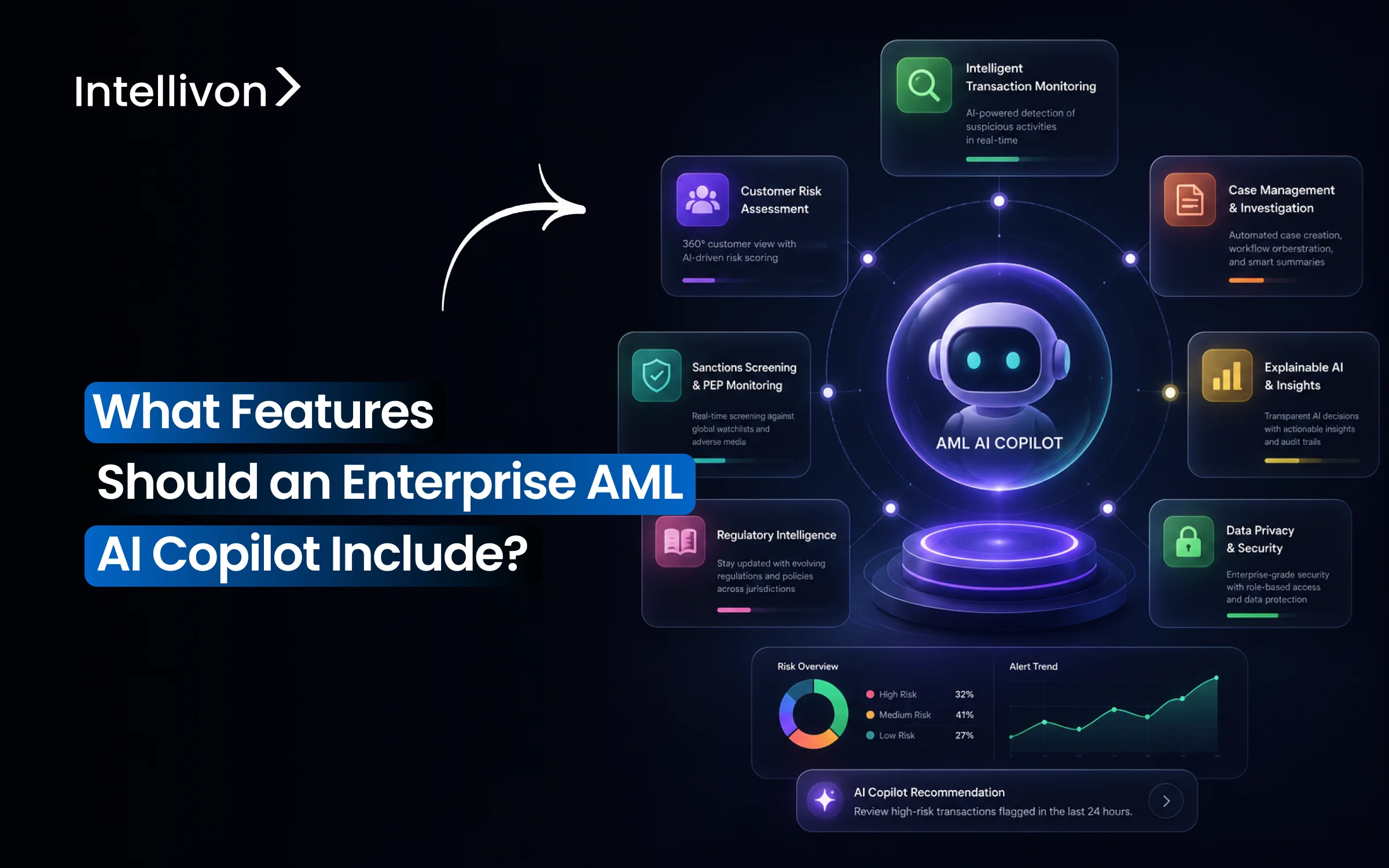
An enterprise AML AI copilot handles the repetitive work that slows down bank compliance teams. Therefore, the system allows investigators to focus on real financial crimes instead of digging through messy files. Specifically, what should an AML AI copilot do on a daily basis? It supports these core processes:
- Alert triage automation: The system analyzes new alerts and instantly filters out obvious false alarms based on past data.
- Investigation case summarization: It reads months of complex transaction data and writes a clear summary of the activity.
- AI-assisted evidence gathering: The software automatically pulls bank statements, identity checks, and public records for the investigator.
- Customer risk profile generation: It builds a complete picture of a customer’s normal behavior to spot weird changes easily.
- Compliance workflow review: The tool reviews Know Your Customer (KYC), Customer Due Diligence (CDD), and Enhanced Due Diligence (EDD) forms for missing information.
- SAR narrative generation: It drafts the formal Suspicious Activity Report (SAR) narrative text using the gathered evidence.
- Regulatory policy retrieval: It answers legal compliance questions by searching internal rulebooks and government databases instantly.
- Documentation and case routing: The assistant writes clear case notes and sends complex files to senior managers automatically.
2. Human-in-the-Loop Boundaries
Banks must set strict limits on what AI can do alone. For this reason, an intelligent AML copilot platform features a clear operational boundary between software assistance and human authority.
This table details how the system keeps compliance safe by splitting duties between AI capabilities and human oversight.
| How the Copilot Assists the Team | Actions the Copilot Is Blocked From Taking |
| Scores and prioritizes incoming alerts using clear, visible risk factors. | Drops or archives high-risk alerts without a manager’s sign-off. |
| Combines bank statements and corporate links into a simple text summary. | Declares whether an activity is officially illegal or fraudulent. |
| Fills out required regulatory forms using data found during the investigation. | Files a final report directly to the government without a manual review. |
| Scans global watchlists for matching names and negative news stories. | Whitelists a flagged name or clears a potential sanctions hit on its own. |
| Recommends the next investigative step based on past case resolutions. | Locks a customer out of their bank account or freezes funds. |
Ultimately, this clear boundary ensures the software acts as a helpful assistant rather than an independent decision-maker. Consequently, once this human-in-the-loop line is established, banks need a strict feature checklist to evaluate software vendors instead of relying on basic product demonstrations.
Why Banks Need an Enterprise AML AI Platform Feature Checklist Now
Banks need an enterprise AML AI platform feature checklist because raw detection metrics alone cannot justify buying or building technology. A production-ready digital assistant must guarantee evidence tracing, clear model explainability, strict data privacy, and verifiable compliance workflows before leaders can defend its deployment to bank examiners, internal auditors, and board directors.
1. Mounting Operational Demands
Compliance divisions face immense operational pressure to accelerate case review speeds without sacrificing investigative depth or missing complex financial crime typologies.
At the same time, traditional rules-based systems create massive amounts of false alerts, which drain analytical resources and increase overall operational overhead.
- Operational Strain: Investigators spend roughly 80% of their time collecting documents instead of analyzing actual financial risk.
- Capacity Limits: Growing transaction volumes often force banks to increase compliance headcount linearly, creating an unsustainable cost structure.
2. Growing Technology Stacks
Modern compliance systems run on mixed-model stacks that combine quantitative risk scoring, graph network analytics, document text extraction, and generative AI features.
Therefore, managing these distinct, multi-layered codebases requires strict architectural oversight to prevent system conflicts, data siloes, and invisible logic failures.
- Data Fragmentation: Transaction logs, identity records, and historical case archives live in separate corporate databases.
- Model Complexity: Teams must constantly balance structural data tracking with unstructured text processing engines.
3. Evolving Regulatory Directives
Regulatory guidance demands absolute clarity, robust data monitoring, active human oversight, and immediate evidence availability for every single automated compliance step.
For instance, the Federal Reserve, OCC, and FDIC issued revised model-risk management updates regarding quantitative and non-generative AI components, as outlined by the Federal Reserve Board.
- Model Risk Controls: Regulators require banks to thoroughly validate all quantitative model math and algorithm updates.
- Ownership Check Relief: FinCEN’s rule removes the need to verify beneficial ownership records multiple times for repeat customers.
- Continuous Monitoring Mandate: Banks must still run continuous transaction monitoring to catch sudden shifts in customer risk profiles.
- Program Effectiveness Audits: Federal examiners now check compliance platforms for real-world operational results rather than simple checkboxes.
4. Real-World Operational Impact
To see these pressures in action, consider Google Cloud’s reported deployment with global banking giant HSBC.
By replacing old rules-based frameworks with a supervised machine learning pipeline, HSBC found two to four times more true suspicious activity while reducing overall alert noise and false positives by 60%, according to the Google Cloud AML AI Case Study.
- Higher Detection Rates: Supervised machine learning pipelines discover twice as many true risk patterns compared to traditional static rules.
- Alert Noise Reduction: Smart filtering cuts false alarms by more than half, saving thousands of hours for analysts.
- Audit Trail Records: Systems must save full data histories so regulators can see why the AI flagged a transaction.
- Format Readiness: Automated files must align with standard federal reporting designs so teams can submit evidence without errors.
Ultimately, a detailed feature checklist changes procurement from a simple product demonstration into a strict audit of controlled decisions, data connections, and legal evidence trails. Consequently, establishing this core evaluation framework ensures that financial institutions choose a platform that satisfies both internal automation goals and external regulatory mandates.
AML Copilot Features Across Alert-to-SAR Workflow
Enterprise AML copilot capabilities must extend across the full investigation lifecycle: alert intake, prioritization, customer context, entity analysis, evidence gathering, investigator decisions, SAR drafting, reporting support, and audit retention.
A software tool that only produces text summaries or basic risk scores cannot function as a true enterprise assistant. Consequently, if a platform lacks full coverage, it leaves investigators stitching together fragmented evidence manually.
1. The Workflow Capability Matrix
When shopping for an AML assistant, banks must look past slick marketing screens. Therefore, use this comprehensive requirement checklist to evaluate what an AML AI copilot features for banks on a technical level.
| Workflow Area | Required Copilot Capabilities | Evidence the Buyer Should Demand |
| Alert Intake and Prioritization | Real-time alert processing, batch investigation processing, alert scoring and prioritization, false positive suppression, case prioritization engine | Clear risk drivers, scoring history logs, manual override tracking, and automated queue-routing rules. |
| Customer and KYC Review | KYC document review automation, CDD questionnaire automation, Enhanced Due Diligence workflow, customer risk rating engine | Extracted source fields from identity cards, document cross-references, and full approval history trails. |
| Investigation Assistance | Investigation case summarization, AI-assisted evidence gathering, transaction pattern summarization, alert disposition workflow, case management automation | Visible links to cited evidence, logs of analyst edits, and written text justifying the final case disposition. |
| Entity and Network Risk | Entity resolution capabilities, network analysis visualization, graph analytics, financial crime analysis, link analysis investigation, beneficial ownership mapping, shell company identification | Statistical relationship confidence scores, source lineage tracking, and history logs of graph-network updates. |
| Screening Context | Sanctions screening integration, OFAC compliance features, PEP screening automation, adverse media monitoring | Direct mapping to data-provider sources, detailed match rationale text, and internal escalation records. |
| Regulatory Reporting | SAR narrative generation, automated SAR drafting, SAR quality review, SAR filing workflow automation, CTR filing automation, BSA compliance workflow | Mandatory human approval buttons, narrative draft version histories, and a permanent supporting-document archive. |
| System Oversight | Human-in-the-loop review design, compliance officer workflow integration, investigation audit trail, immutable case documentation | Granular role-based controls, encrypted audit log exports, reviewer identity tracking, and clear timestamps. |
Ultimately, this functional matrix allows chief compliance officers and procurement leads to reject shallow vendor software claims that do not cover total investigation needs. Consequently, understanding these workflow touchpoints allows technology teams to examine the core AI models that power each distinct phase.
For a deeper breakdown of relationship-led investigations, see our guide on How Do Fintech Companies Build AI AML Investigation Systems?.
Which AI Models and Architecture Layers Support Each Capability?
An enterprise AML AI copilot needs a hybrid model architecture because no single artificial intelligence model can reliably handle every unique compliance task. Specifically, a bank cannot use a general Large Language Model (LLM) to perform numeric transaction scoring, map corporate structures, and handle regulatory reporting all at once. Instead, software engineers must build a modular platform that separates quantitative calculations, graph network maps, and text-generation engines into distinct, secure microservices.
Consequently, an intelligent AML copilot platform features a balanced tech stack where specialized models handle specific operational jobs under tight human controls.
1. The Modular Tech Stack Architecture
Building a production-ready assistant requires matching the correct machine learning or text engine to the appropriate workflow task. The following table highlights the essential software layers, model types, and mandatory compliance controls required for enterprise deployment.
| Architecture Layer | Technology Requirement | AML Capability Supported | Required Control |
| Data Ingestion | API-first copilot architecture, automated transaction and customer database normalization | Real-time alert streaming and nightly batch file processing | Continuous data validation scripts, full lineage tracking records |
| Entity Intelligence | Graph network analytics and deterministic entity resolution algorithms | Identifying beneficial ownership links and mapping hidden shell companies | Missing data confidence thresholds, source material evidence links |
| Risk Prioritization | Explainable machine learning scoring engines (e.g., XGBoost, LightGBM) | Intelligent alert scoring and obvious false positive suppression | Global and local feature transparency using SHAP values for risk decisions |
| Document Intelligence | Natural Language Processing (NLP) text extraction and tokenization models | Automated KYC document review and deep adverse-media text summaries | Extracted-field source traceability, raw document crop viewing |
| Regulatory Knowledge | Retrieval-Augmented Generation (RAG) pipelines for compliance data | Instant internal policy interpretation AI and global regulatory change monitoring | Hard restriction to approved compliance knowledge-base source documents |
| Narrative Assistance | Enterprise LLM-powered narrative generation engines via secure APIs | Generative AI investigation summaries and automated SAR text drafting | Strict source citations for every claim, mandatory human approval gates |
| Workflow Governance | Permission-based workflow design and role-based access control (RBAC) | Controlled analyst case review, manager escalation, and SAR quality checks | Immutable case documentation histories, cryptographic data hashing |
| MLOps and Monitoring | MLOps model management features and automated continuous evaluation | Tracking algorithmic model drift and scheduling controlled software upgrades | Central model drift monitoring dashboard, retraining automation, champion-challenger testing |
2. The Role of Large Language Models
An LLM must never function as the entire compliance system. Instead, it acts as an interface that reads structured data and drafts natural text.
For example, traditional math code calculates transaction variances, while the language engine simply translates those numbers into clear English prose for the analyst.
- Controlled Interface: The model acts only as a communication assistant rather than the primary core.
- Math Separation: Traditional database code calculates statistics because language models can easily make math errors.
- Prose Conversion: The assistant reads raw background files and turns numbers into readable sentences for analysts.
- Process Visibility: Keeping math separate from text ensures auditors can easily verify the steps behind every alert.
- Guardrail Safety: Tight boundaries prevent the AI from making up arbitrary guidelines or burying critical facts.
Ultimately, designing a hybrid tech stack prevents compliance blind spots by utilizing specialized tools for separate operational tasks. Scoring models focus on numerical math, graph models connect complex networks, NLP parses heavy files, and governed text engines assist with documentation.
Consequently, this multi-layered framework remains fully secure, stable, and transparent only when advanced security protocols and model validation tools protect the core data pipelines.
What Compliance and Security Controls Are Non-Negotiable?
An enterprise AML compliance copilot feature requirements framework must include evidence retention, SAR confidentiality, permission controls, model documentation, sanctions escalation, audit exports, encryption, and human approval.
A bank cannot rely on an AI output during an examination unless it can reproduce the source evidence, identify who reviewed it, and prove that unauthorized users never accessed restricted reporting material.
Consequently, compliance officers must view security safeguards as core functional features rather than legal footnotes added after software development.
1. The Security and Compliance Control Framework
Deploying automated intelligence into a banking infrastructure requires strict adherence to global safety and oversight rules. The following table outlines the essential data controls and specific legal reasons why compliance platforms must support them.
| Control Requirement | What the Platform Must Support | Regulatory / Operational Reason |
| SAR Evidence Retention | Automated supporting-document storage, narrative version tracking, and immutable case documentation archiving. | Suspicious Activity Report (SAR) supporting records may need long-term retention and immediate production on government request. |
| SAR Confidentiality | Heavily restricted access rights, permission-based workflow design, and comprehensive, unalterable user access logs. | Federal laws demand absolute confidentiality for SAR materials to prevent leaking investigation status to unauthorized parties. |
| Human Approval | Visible, named reviewer approval buttons that must be clicked before taking any formal reporting actions. | Maintains clear human accountability for filing decisions and protects the bank from rogue automation errors. |
| Sanctions Controls | Real-time OFAC screening integration, automated internal escalation paths, and complete match recordkeeping. | Sanctions risks must be identified, escalated, and permanently documented to comply with federal emergency economic powers laws. |
| Model Documentation | Complete model validation documentation, model interpretability AML tracking, and continuous monitoring histories. | Supports internal corporate governance audits and answers detailed supervisor questions during regular field examinations. |
| Enterprise Security | Granular role-based access control, secure SSO connections, data encryption at rest and transit, and a zero-trust architecture. | Protects highly sensitive consumer financial identities and active case files from external breaches and internal data theft. |
| Audit Evidence | A detailed investigation audit trail, complete audit log immutability, and an exportable case record file system. | Allows internal bank auditors and federal examiners to fully reconstruct the steps behind an automated alert. |
| Third-Party Governance | Strict data processing agreements, approved data-provider access keys, and continuous vendor tool performance monitoring. | Controls external technology risk and ensures third-party data handlers follow the bank’s strict internal security rules. |
2. Meeting Federal Examination Standards
Modern technology platforms must align perfectly with federal compliance benchmarks to survive rigorous banking reviews. For instance, platforms must offer FFIEC examination readiness features to help teams easily show examiners how machine learning models sort transaction records.
Additionally, software architectures must support OCC model risk compliance protocols, matching the revised joint interagency guidance (OCC Bulletin 2026-13 / Federal Reserve SR 26-02) that puts third-party vendor algorithms under the same tough validation rules as internal bank software.
- FFIEC Readiness: Systems must organize audit logs clearly so federal teams can quickly review historical alert decisions.
- OCC Model Compliance: Under the April 2026 guidelines, any vendor tool used for alert sorting faces full validation scrutiny.
- FATF Recommendation Alignment: Software workflows must enforce active human-in-the-loop controls to prove technology does not replace human judgment.
- Multi-Jurisdiction Compliance Support: Architecture modules must adjust reporting layouts automatically based on localized state, federal, or international banking rules.
- SOC 2 Type II Features: Cloud environments must track and prove data handling security over long, audited windows of time.
- Multi-Tenant Enterprise Architecture: Database layers must isolate customer files completely so data never mixes across corporate borders.
- Single Sign-On Integration (SSO): System access must tie directly to corporate directories to revoke user credentials instantly if an employee leaves.
Ultimately, designing these non-negotiable security controls directly into the platform prevents compliance breakdowns and protects the bank from severe regulatory fines. Consequently, turning these strict requirements into a clear evaluation framework allows banks to build a practical procurement test that competing pages fail to provide.
Can Your AML Copilot Pass a 20-Case Evidence Test?
A bank should not purchase an AML AI copilot based on polished vendor demonstrations alone. Instead, procurement teams should require the system to process a controlled set of historical cases in a sandboxed shadow mode.
This practical method ensures compliance leaders can verify evidence sourcing, permission boundaries, analyst correction patterns, and raw audit exports before granting production access.
1. The 20-Case Trial Blueprint
Evaluating actual performance requires testing the software assistant against a diverse, pre-selected set of past bank files. The following table highlights the exact breakdown of the historical case pack that your evaluation team should run through the candidate platform.
| Historical Case Pack | Number of Cases | What the Copilot Must Demonstrate |
| Closed alerts without SAR filing | 5 cases | The system must write clear text summaries and present a defensible closing rationale that matches internal bank rules. |
| Alerts that resulted in formal SARs | 5 cases | The tool must generate a source-grounded narrative draft that matches official reporting standards without adding fake data. |
| KYC, CDD, or EDD escalations | 4 cases | The software must accurately extract text from corporate documents and build clear maps of beneficial ownership hierarchies. |
| Sanctions, PEP, or adverse-media hits | 3 cases | The platform must show the correct global watchlist context while routing the file to restricted high-security analyst queues. |
| Network or linked-entity investigations | 3 cases | The underlying graph engine must correctly flag matching accounts and list hidden financial transactions between separate individuals. |
2. The Procurement Evaluation Scorecard
Rather than relying on vague impressions, your risk committee must track specific metrics during the shadow trial. Use this standardized scorecard to measure software accuracy and compliance readiness directly.
- Evidence Citation Accuracy: Track whether every text statement links to an actual, verified bank transaction file. This prevents the generation of unsupported claims.
- Unsupported Claim Rate: Count any instance where the language engine fabricates a fact or a number. This directly measures core model hallucination risk.
- Analyst Correction Effort: Measure the exact time and number of typed edits required by a human user to correct a draft. This tracks actual compliance officer productivity metrics.
- SAR Quality Review Outcome: Evaluate whether the final automated drafts meet internal completeness rules during a standard SAR quality review check.
- Disposition Rationale Traceability: Confirm that a third-party auditor can easily reconstruct why an alert was flagged for escalation or marked for closure. This supports long-term investigation audit trail health.
- Entity and Link Accuracy: Check whether connected individuals, corporate entities, and wire transfers are represented without spatial errors.
- Permission Behavior: Test if hidden or restricted identity details remain locked away from unauthorized users to verify built-in confidentiality safeguards.
- Audit Export Completeness: Verify that the software can instantly export the complete decision timeline, user timestamps, and source documents into a secure file.
3. Establishing Performance Thresholds
Your bank’s compliance leadership and formal risk committee must establish clear pass/fail thresholds before testing begins. These target numbers should vary based on your specific risk appetite, typical workflow volume, case materiality, and localized legal jurisdictions.
For instance, a bank may tolerate a higher edit rate for simple text summaries but demand a 0% error rate for cross-referencing watchlists.
- Risk Appetites: Set different performance baselines depending on the financial product type, case severity, and specific local legal jurisdictions.
- Watchlist Errors: Enforce a strict 0% error threshold for cross-referencing OFAC sanctions data compared to general media summaries.
- Baseline Benchmarks: Collect data points across 20 distinct files to build a firm baseline for performance benchmarking compliance.
- Time Tracking: Calculate your exact investigation time per case reduction to prove real-world team efficiency gains to stakeholders.
- Conversion Metrics: Use an internal false positive rate dashboard to analyze alert-to-SAR conversion rate tracking before final platform procurement.
Ultimately, running a structured case trial shifts the procurement process from a passive software viewing into an active, data-driven audit. Consequently, testing real workflow outputs ensures that the bank chooses a platform that actively protects its infrastructure.
How Should Banks Govern a Mixed AML AI Model Stack in 2026?
Banks must govern an AML AI copilot as a mixed model stack rather than as a single software product. Specifically, traditional transaction-scoring tools require formal mathematical validation data, whereas generative narrative generators require separate internal controls, trace maps, and human-in-the-loop validation blocks.
Consequently, compliance leaders must avoid using a single corporate governance label for software systems that mix completely different types of artificial intelligence.
1. The Interagency Regulatory Line
Understanding the exact legal boundaries for different software layers protects financial institutions from unexpected audit penalties.
In April 2026, the Federal Reserve, OCC, and FDIC issued their updated Interagency Guidance on Model Risk Management (OCC Bulletin 2026-13 / Federal Reserve SR 26-2), which completely changes how banks must treat automated tools.
- Quantitative Model Scope: The revised 2026 interagency guidelines apply directly to statistical calculations, risk scoring systems, and traditional non-generative machine learning components.
- Generative AI Carve-Out: The federal banking agencies explicitly stated that generative AI and agentic AI models are outside the official scope of this new model risk rule because the technology is evolving too quickly.
- Self-Governance Mandate: Despite the official exclusion, banks must still enforce strict internal governance over text engines because their written summaries directly impact day-to-day compliance decisions.
- Mixed Stack Scrutiny: When a single copilot contains scoring math, graph maps, and text tools, examiners will audit each underlying layer using separate regulatory expectations.
3. The Multi-Model Governance Map
To satisfy internal auditors and external examiners, banks should assign clear evidence requirements and internal owners to every component. Use this standard enterprise map to divide governance duties across your mixed software system.
| Software Component | Example System Output | Governance Evidence Required | Primary Internal Owner |
| Alert scoring model | Numerical priority score and visible mathematical risk drivers. | Formal validation report, performance back-testing, and drift monitoring histories. | Model Risk / AML Technology |
| Entity resolution model | Customer or corporate counterparty relationship match confirmation. | Match accuracy reviews, source data lineage, and manual override control tracking. | AML Operations |
| Graph analytics layer | Interactive network-risk visualizations and linked account structures. | Underlying relationship evidence records and clear investigator review trails. | Financial Crime Investigation |
| NLP extraction model | Text data pulled from physical KYC or EDD corporate documents. | Extraction quality benchmarking tests and clear source file traceability logs. | Compliance Operations |
| RAG knowledge layer | Relevant corporate policies or global banking regulations. | Securely approved source document libraries and update change-control governance logs. | Compliance Policy |
| LLM narrative assistant | Full investigation case summaries or finished SAR draft texts. | Source data grounding evidence, mandatory human approval buttons, and version records. | SAR Review Team |
Ultimately, a single compliance label cannot protect a software platform containing multiple types of data intelligence. Consequently, every automated output type needs its own verified evidence file, distinct internal owner, and clear human approval boundary.
Once these security boundaries are set, technology teams must focus on connecting the copilot platform securely to the core banking databases where actual transaction records live.
Which Integrations Separate a Copilot From a Standalone Assistant?
A bank-grade AML copilot must connect to transaction monitoring, customer onboarding, sanctions data, case management, identity access, reporting support, and analytics systems through controlled interfaces. Without these direct integrations, a software program might generate readable text summaries, but it cannot create a complete, legally valid investigation trail.
Consequently, a standalone chat window remains an isolated research tool rather than an active piece of enterprise compliance infrastructure.
1. The Critical Data Integration Matrix
Moving a software tool into production requires linking its underlying models directly to your primary financial ledgers and external risk databases. The following table maps out the core integration checkpoints that technology teams must establish to build a truly interconnected environment.
| Integration Requirement | Capability Enabled | Mandatory Procurement Test |
| Core banking system integration | Pulls real-time customer histories, account balances, and complete multi-asset transaction context. | Confirm strict data lineage trails and verify automated database access controls under heavy load. |
| Transaction monitoring integration | Drives automated alert intake, scoring reviews, and instant alert disposition workflow routing. | Force the system to reproduce historical alert logs and verify all background mathematical scoring inputs. |
| Case management system API | Supports rapid investigation case summarization, file storage, and official manager approval routing. | Verify that the platform can instantly export a complete, unalterable case decision trail to external files. |
| Refinitiv World-Check integration | Streams live global watchlists, Politically Exposed Persons (PEP) data, and active screening context. | Validate the provider’s raw data provenance records and check how the AI parses partial name matches. |
| LexisNexis integration | Pulls public identity registries, corporate links, and global adverse-media research feeds. | Confirm exactly how the text engine handles source citation links without creating broken references. |
| Dow Jones Risk integration | Supplies high-priority political risk profiles and specialized international economic crime intelligence. | Confirm that a positive database match triggers the correct, restricted internal escalation workflow. |
| Blockchain analytics integration | Delivers advanced crypto AML features, wallet clustering, and real-time digital asset monitoring. | Test how the system displays wallet address links and formats decentralized transaction evidence. |
| Identity, SSO, and role controls | Enforce restricted investigator access boundaries across separate department queues. | Attempt to access restricted files using a low-level account to verify built-in permission walls. |
| Reporting support layer | Powers automated SAR drafting, CTR preparation, and final regulatory filing workflow automation. | Verify that the interface forces a mandatory human approval step before any data leaves the bank. |
2. Connecting Modern Financial Networks
Building an effective corporate system means creating software that adapts fluidly to modern banking styles. For instance, teams deploying an intelligent system can use a highly configurable workflow design to alter data review steps without writing brand-new source code.
- Third-Party Data Provider Integration: Modern systems must combine incoming streams from multiple external vendors into a single, clean user interface.
- Neobank-Specific AML Features: Platforms must process rapid peer-to-peer payments and instantly verify international virtual account links.
- Embedded Finance Compliance Features: Software layers must track transactions passing through third-party retail apps or non-bank digital wallets.
- No-Code Rule Configuration: Compliance officers must be able to adjust risk filters manually using simple visual toggles instead of waiting for engineering tickets.
Ultimately, the underlying depth of your system integrations determines whether an AI platform becomes actual operational infrastructure or remains a disconnected research tool.
Consequently, defining these exact data connection lines allows bank procurement leads to accurately calculate the total financial investment needed to deploy a production-ready software system.
What Does an Enterprise AML AI Copilot Cost to Build?
An enterprise AML AI copilot typically costs $60,000–$250,000 to build, with annual maintenance budgeted at 18–25% of the initial build cost. The lower range supports a controlled workflow such as evidence retrieval, alert summarization, and draft assistance. Conversely, the upper range supports multiple integrations, entity and graph analysis, explainable prioritization, governed RAG, security controls, audit exports, model monitoring, and production rollout across regulated teams.
1. Cost Breakdowns by Scope
When budgeting for an intelligent system, financial institutions must match their target feature checklist against realistic production tiers. The following tables outline the estimated development costs based on platform complexity and specific engineering phases.
| Build Tier | Estimated Cost | Suitable Scope | Typical Timeline |
| Focused AML Copilot MVP | $60,000–$100,000 | Case summarization, basic evidence retrieval, controlled narrative drafting, and limited core database integration. | 10–16 weeks |
| Integrated AML Copilot | $100,000–$175,000 | Transaction-monitoring system integration, KYC/EDD context ingestion, risk prioritization, automated SAR workflows, and reporting controls. | 16–24 weeks |
| Production-Ready Enterprise Deployment | $175,000–$250,000 | Multiple external provider integrations, entity relationship graphs, advanced model governance layers, enterprise security hardening, and continuous monitoring controls. | 24–32 weeks |
2. Cost Breakdowns by Phases
| Development Phase | Estimated Range | What Is Included in This Phase |
| Discovery & Compliance Mapping | $5,000–$15,000 | Mapping internal workflows, defining human approval boundaries, outlining specific risk use cases, and locking down data security or regulatory requirements. |
| Data, Entity & Integration Foundation | $20,000–$55,000 | Constructing secure data pipelines, connecting internal APIs, normalising customer data, establishing permissions, and creating source lineage histories. |
| AI Models, RAG & Workflows | $25,000–$75,000 | Setting up alert prioritization math, natural language processing tools, graph network layers, policy retrieval systems, and draft SAR narrative generation engines. |
| Governance, Security & Controls | $10,000–$60,000 | Coding immutable investigation audit trails, setting up SHAP values for risk decisions, formatting validation evidence, and building examiner reporting views. |
| Deployment, MLOps & Testing | $5,000–$25,000 | Installing production performance monitoring, launching a sandboxed pilot deployment, gathering analyst feedback, and executing a controlled production release. |
| Controlled Implementation Reserve | $5,000–$25,000 | Managing legacy bank data remediation tasks, handling unexpected third-party provider integration work, or adjusting internal approval rules. |
3. Key Price Driving Variables
Understanding what pushes a platform from a basic model toward an enterprise-grade solution helps software teams optimize their development budgets. The ultimate cost variance depends primarily on the depth of infrastructure connections and security verification protocols.
- Integration Density: Connecting a standalone assistant to multiple external watchlists or a legacy core ledger increases pipeline testing costs.
- Data Quality Remediation: Cleaning fragmented transaction logs or standardizing messy corporate documents requires expanded data engineering time.
- Model Validation Rigor: Creating compliance documentation to survive formal federal exams adds explicit testing steps to the final timeline.
Ultimately, understanding these precise development phases helps financial institutions avoid unexpected budget overruns during software development. Consequently, connecting these capital costs to a structured deployment sequence ensures that the final platform operates safely within active banking networks.
For a deeper breakdown of development phases and budget assumptions, see our guide on What Does It Cost to Build an AI AML Compliance Copilot?.
Build an AML Copilot Requirements Roadmap With Intellivon
Intellivon helps banks, fintech platforms, payment networks, and regulated financial institutions define and build enterprise AML AI copilots around controlled investigation workflows.
Each roadmap begins with evidence access, integration scope, approval boundaries, model governance, examination readiness, security requirements, investment planning, and measurable pilot criteria before fully controlled production development starts.
With Intellivon, your team can:
- Define the correct AML workflow for the first controlled deployment.
- Map investigation, SAR drafting, evidence retrieval, and approval requirements.
- Design secure integrations across core banking and compliance systems.
- Separate scoring, graph analytics, RAG, and generative AI governance controls.
- Build a phased roadmap within the $60,000–$250,000 investment range.
- Test platform readiness through a controlled, evidence-based pilot.
Plan an AML copilot requirements roadmap with Intellivon built around your investigation workflows, evidence needs, governance boundaries, security controls, and implementation budget.
Conclusion
An enterprise AML AI copilot must be evaluated as controlled compliance infrastructure rather than a basic text assistant. Therefore, your feature checklist must rigorously cover multi-system integrations, clear model governance, and immutable audit trails. Running a 20-case trial gives banks a practical procurement standard to verify accuracy.
Ultimately, this investment becomes defensible because it improves documentation traceability while keeping all final risk decisions with compliance professionals.
Things To Know About Enterprise AML AI Copilots
Q1. What Compliance Controls Must SAR Automation Copilot Features Include?
A1. SAR automation copilot features must include source-grounded text drafting, named human approval steps, and restricted data access. Additionally, the software must track narrative version histories, retain supporting documents, and save unalterable review logs. Therefore, while the digital assistant prepares necessary reporting text, it is blocked from submitting forms or disclosing restricted case files without authorized controls.
Q2. Should a Bank Build or Buy an Enterprise AML AI Copilot?
A2. Banks should buy an existing platform if they need standardized screening tools and rapid deployment. Conversely, institutions must build a custom solution when complex investigation workflows, multi-system evidence gathering, or unique transaction data relationships require absolute integration control. Consequently, technology leads must evaluate external software vendors against a realistic three-year cost and evidence-readiness scorecard.
Q3. How Can Procurement Test AML AI Copilot Investigation Features Before Signing?
A3. Procurement teams must test AML AI copilot investigation features by executing a rigorous 20-case trial in shadow mode. Specifically, every shortlisted vendor must process the same de-identified historical file set to measure citation accuracy, human edit times, and audit export completeness. As a result, the bank establishes clear performance baselines before signing a software contract.
Q4. Can False Positive Suppression Reduce Work Without Weakening Detection?
A4. False positive suppression safely reduces operational workloads only when paired with continuous audit sampling and model-drift monitoring. Furthermore, banks must track analyst override rates and SAR conversion metrics to ensure true threat patterns are never hidden. Consequently, dropping alert volumes creates real value only when investigators can actively prove that material risk remains fully visible.

