Key Takeaways:
-
AI procurement platforms start with source-to-pay data models covering intake, sourcing, contracts, and PO automation.
-
ERP, GPO, EHR/FHIR, supplier portal, three-way match, and spend analytics are core production requirements.
-
HIPAA, BAA, FDA purchasing controls, vendor credentialing, RBAC, and explainable AI ensure compliant operations.
-
Healthcare MVPs cost $70,000 to $120,000 while production platforms reach $180,000 to $300,000.
-
How Intellivon builds AI procurement platforms as source-to-pay infrastructure from the ground up.
Building an AI procurement platform like Jaggaer starts with a unified source-to-pay workflow architecture connecting sourcing, supplier management, contract lifecycle, and purchase order processing.
Hospital networks and IDNs are running clinical and non-clinical procurement across disconnected ERP and GPO systems, and this architecture closes those gaps by giving every procurement step a single governed data model to run through. From there, NLP invoice extraction, ML spend classification, and generative AI contract review run as connected steps rather than isolated automations.
The workflow orchestration layer determines whether the AI produces usable output or surface-level recommendations. When NLP and ML models run on fragmented data from disconnected procurement modules, the recommendations they generate reflect partial information rather than the full procurement context. According to Gartner, 50% of purchase order lines undergo changes after issuance, meaning an AI layer without real-time workflow visibility works with stale data from the moment a purchase order is raised.
This blog builds the AI procurement platform the way Intellivon approaches it, starting with workflow architecture and data model design rather than feature selection. It covers sourcing automation, supplier management, contract lifecycle, GPO integration, AI model design, HIPAA compliance, and costs from $70,000 to $300,000.
What Is An AI Procurement Platform?
An AI procurement platform connects sourcing, supplier management, contracts, purchase orders, and invoices into one workflow. From there, machine learning and NLP automate spend classification, risk scoring, and invoice extraction.
Platforms like Jaggaer built this architecture first for complex enterprise procurement. A custom build replicates that foundation while adding healthcare compliance controls and GPO integrations.
- Source-to-pay lifecycle: Manages sourcing events, supplier onboarding, contract management, requisitions, approvals, purchase orders, invoices, payments, and supplier performance from one system.
- AI automation layer: Classifies spend, matches suppliers, extracts contract terms, captures invoice data, routes purchase requests, forecasts demand, and scores supplier risk automatically.
- System integration layer: Sits between ERP, accounts payable, supplier portals, GPO catalogs, inventory systems, and approval workflows, keeping data consistent across all of them.
- Procurement operating layer: Controls who buys, from whom, at what price, under which contract, and with what approval, with evidence recorded.
Why Jaggaer Became The Benchmark For Procurement AI
Jaggaer became the industry benchmark by consolidating complex enterprise purchasing workflows into a single, cohesive digital ecosystem. Consequently, it serves as the ultimate architectural blueprint for organizations investing in custom AI procurement platform development.
By unifying disparate supply chain operations, the platform demonstrates how centralized data improves spend visibility, regulatory compliance, and operational velocity across regulated environments.
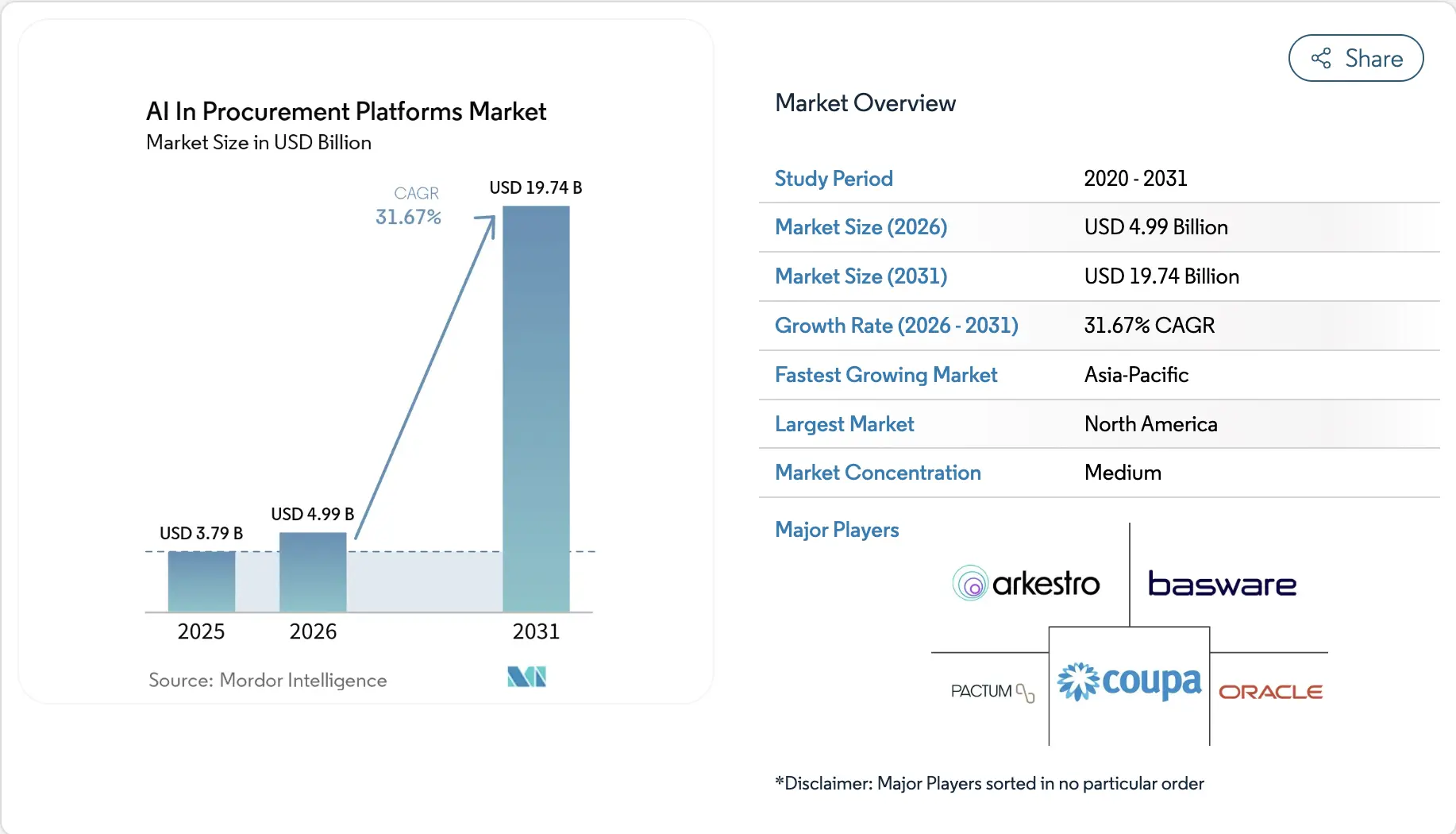
1. Jaggaer Covers Source-To-Pay In One Platform
Jaggaer integrates every phase of the corporate purchasing lifecycle into one centralized system. This unified approach provides deep structural inspiration for building an alternative AI-powered source-to-pay platform development matrix.
- Unified Sourcing Pipelines: Centralizes requests for proposal (RFP) automation software, vendor bidding, and supplier selection tools within a singular interface.
- Integrated Contract Suites: Connects a secure contract lifecycle management platform directly to purchase order automation software pipelines.
- Automated Financial Reconciliation: Ties accounts payable automation integration directly with real-time spend analytics platform development modules.
2. Jaggaer Shows The ROI Case Buyers Understand
The platform delivers measurable financial returns that clear corporate budgetary hurdles. For example, Emory University achieved a six-to-one return on investment using the software, realizing positive cash flow within 12 months.
- Balanced Savings Splits: Financial returns are divided between process efficiency gains and negotiated volume discounts.
- Rapid Cash Amortization: System deployment costs are fully recovered through aggressive tail spend management automation.
- Quantifiable Procurement Value: Clear metrics help teams justify building custom AI procurement management software over choosing rigid off-the-shelf alternatives.
3. Jaggaer Proves Cycle Time Reduction Matters
Operational velocity defines supply chain success. To illustrate, biopharmaceutical leader Alkermes projected over $30 million in cost savings while simultaneously cutting procurement cycle times by 32%.
- Reduced Processing Overheads: Transactional costs drop through a 23% reduction in PO processing expenses via autonomous procurement automation.
- Minimized Maverick Spend: Real-time procurement KPI tracking prevents unauthorized purchasing outside of preferred supplier catalog management systems.
- Accelerated Inventory Velocity: Faster workflows support just-in-time procurement automation that healthcare networks rely on to maintain critical clinical stock.
4. Jaggaer’s Healthcare Use Case Shows The Gap
Standard enterprise resource planning (ERP) systems frequently fail to handle complex clinical supply chains. For instance, one major healthcare provider deployed the system to over 8,000 active users because their legacy ERP lacked specialized healthcare procurement compliance software capabilities.
- Massive Multi-Site Scaling: Orchestrates decentralized procurement automation across large, complex hospital networks and integrated delivery networks.
- Clinical Integrity Controls: Manages formulary management procurement software restrictions that standard accounting systems cannot process natively.
- ERP Architecture Isolation: Keeps complex medical supply chain procurement platform logic distinct from baseline financial ledgers.
Traditional ERP tools lack the specialized workflows required to manage highly regulated clinical supply chains effectively.
While off-the-shelf software provides baseline functionality, it often struggles to adapt to unique corporate ecosystems. For a deeper breakdown of building specialized backend connections, see our guide on ERP procurement integration architecture. This integration gap is precisely why many healthcare networks now look toward custom development.
Revenue and Business Models of an AI Procurement Platform Like Jaggaer
Building a modern purchasing system requires a commercial strategy that aligns platform monetization with tangible operational savings. Therefore, a successful architecture combines classic software-as-a-service (SaaS) access with variable, utility-based processing fees.
As a result, this hybrid approach allows operators to capture steady recurring income while scaling monetization alongside the platform’s actual transactional volume.
1. Platform Subscription Revenue
The foundational layer of platform monetization relies on tiered recurring licensing fees billed on an annual basis. In practice, this model provides highly predictable baseline revenue from enterprise buyers, internal procurement offices, and financial administrators.
- Seat-Based Tiering: Charges fixed fees per active buyer, contract manager, and inventory administrator accessing the central system dashboard.
- Volume-Based Caps: Restrict subscription tiers by overall annual spend volume or total active vendor profiles managed.
- Core Ledger Stability: Establishes predictable recurring software revenue that covers baseline multi-tenant cloud hosting costs.
2. AI Usage And Automation Fees
Variable infrastructure costs are passed directly to users through consumption-based pricing models linked to automated workflows. Consequently, this model protects profit margins against the computational costs of background large language models procurement automation processing.
- Document Extraction Metering: Charges a specific fee per document during NLP purchase order processing and automated invoice data extraction.
- Model Inference Surcharges: Bills operators dynamically for intensive background processes like AI contract risk scoring and real-time supplier financial risk scoring.
- Agentic Execution Credits: Deducts processing tokens whenever autonomous procurement automation agents execute multi-step vendor queries.
3. Implementation And Integration Revenue
Enterprise software deployment requires extensive configuration, technical system alignment, and data migration services during the initial onboarding phases. Furthermore, these high-value engineering contracts provide upfront capital to offset initial customer acquisition costs.
- Legacy Ledger Coupling: Charges one-time structural fees to build custom ERP procurement integration architecture pipelines with SAP or Oracle systems.
- Regulatory Compliance Mapping: Captures engineering revenue by configuring specific HIPAA-compliant procurement platform data walls and PHI-safe procurement data architecture.
- Workflow Automation Routing: Builds tailored procurement approval workflow automation matrices to match the unique hierarchy of complex hospital networks.
4. Supplier Portal And Marketplace Revenue
Monetization extends past the primary purchasing enterprise to tap into the extensive network of downstream supply chain participants. By charging vendors for visibility and advanced platform functionality, operators open secondary revenue streams.
- Premium Discovery Fees: Charges suppliers for enhanced positioning within the AI supplier discovery and matching marketplace engine.
- Onboarding Verification Charges: Collects credentialing fees from vendors to clear healthcare vendor credentialing software compliance checks.
- Advanced Portal Logistics: Monetizes a specialized supplier portal development track that offers advanced supplier performance management software metrics.
5. Managed Procurement Intelligence Revenue
Many enterprise purchasing teams lack the internal analytical bandwidth to interpret deep systemic data patterns. Thus, offering expert advisory services layered on top of software outputs generates high-margin professional services revenue.
- Continuous Spend Auditing: Provides recurring human-in-the-loop validation of background maverick spend detection AI classifications.
- Strategic Category Reporting: Sells quarterly spend cube and category analytics reviews to identify hidden tail spend management automation opportunities.
- ML Pipeline Oversight: Offers a subscription service to oversee the MLOps procurement AI model pipeline and correct model drift.
Combining subscription baselines with consumption fees ensures that platform revenue scales directly with customer utilization.
Ultimately, structuring these multi-layered revenue streams correctly prevents infrastructure costs from eroding early software margins.
For a deeper breakdown of planning the financial projections of a platform, see our guide on How to Develop an Enterprise SaaS Management Platform.
By balancing these monetization engines, engineering teams can smoothly transition into planning the core functional architecture.
How AI Specifically Helps Procurement Teams
AI helps procurement teams by turning scattered supplier, contract, invoice, catalog, and purchasing data into faster decisions. It classifies spend, reads documents, recommends suppliers, detects risk, flags off-contract buying, forecasts demand, and routes exceptions for human approval.
McKinsey estimates agentic AI could improve procurement efficiency by 25% to 40% when teams use approved vendor lists, dynamic buying channels, and governed workflows.
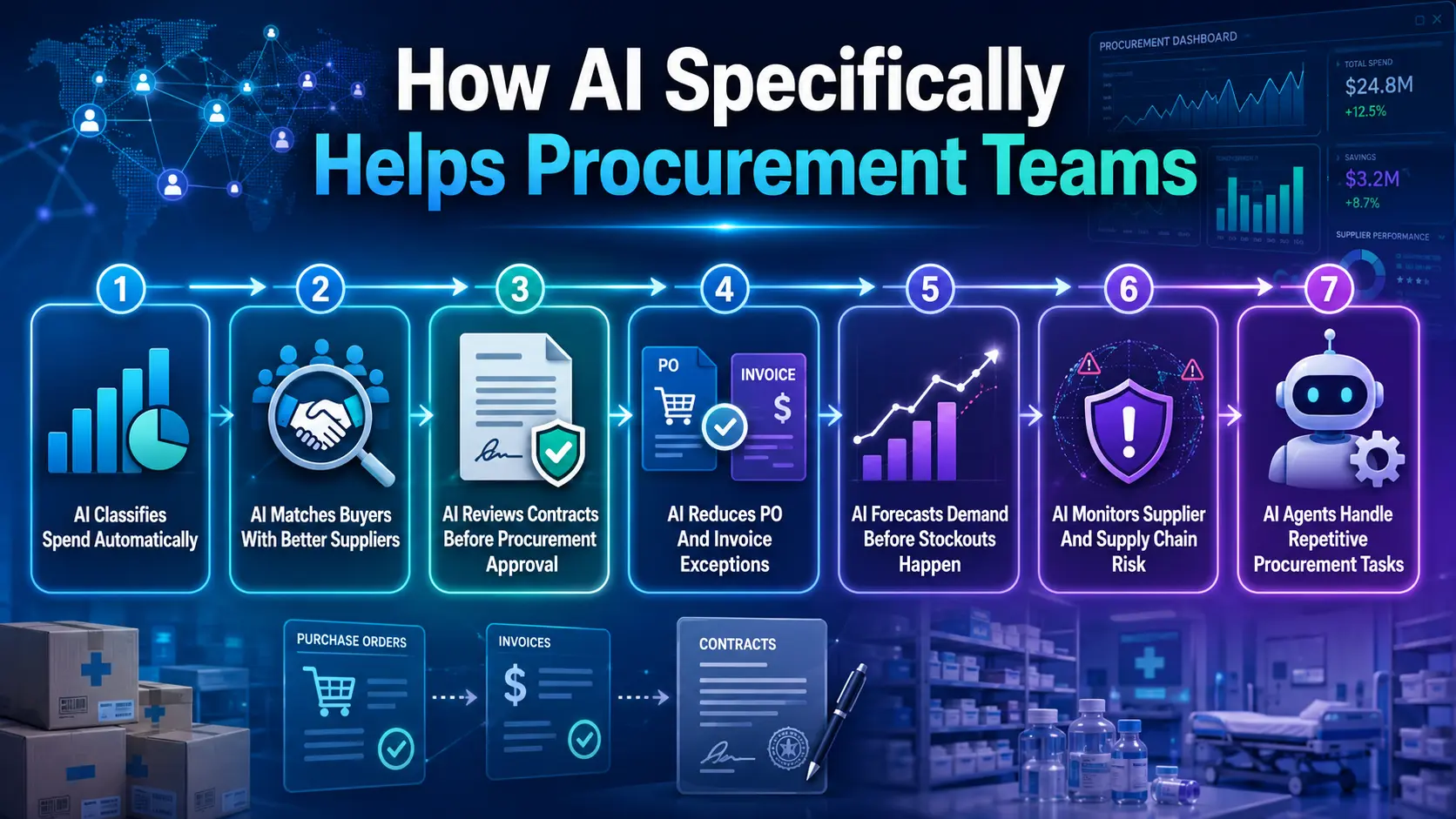
1. AI Classifies Spend Automatically
An AI spend classification engine reads GL codes, invoice descriptions, PO lines, supplier names, SKUs, and free-text purchase requests to classify spend by category.
This helps procurement teams build a cleaner spend cube and category analytics foundation without manually cleaning thousands of transaction rows.
- Leakage and Savings Tracking: Identifies duplicate vendors, category leakage, and clearly identifies cost savings and AI procurement opportunities.
- Maverick Purchasing Controls: Deploys maverick spend detection AI to flag unauthorized, off-contract purchases across the organization.
- Tail Spend Optimization: Introduces tail spend management automation to capture value from unmanaged, low-value supplier transactions.
- Clinical Category Isolation: Separates healthcare procurement data into surgical products, pharmaceuticals, IT contracts, facilities spend, and capital equipment.
2. AI Matches Buyers With Better Suppliers
The platform uses AI supplier discovery and matching engines to compare supplier capabilities, past performance, diversity status, risk signals, pricing history, contract coverage, and delivery reliability.
This helps procurement teams shortlist suppliers faster during sourcing events within a singular supplier relationship management platform.
- Database Consolidation: Eliminates the manual work of filtering disparate supplier spreadsheets and old supplier portals.
- Supplier Performance Monitoring: Scores ongoing vendor health through automated supplier performance management software modules.
- Socioeconomic Milestone Tracking: Measures compliance objectives natively via a built-in supplier diversity tracking module.
- Downstream Viability Analysis: Calculates a baseline supplier financial risk scoring metric before onboarding new vendors.
3. AI Reviews Contracts Before Procurement Approval
AI extracts contract terms, renewal dates, pricing clauses, termination rights, indemnity language, SLA obligations, BAA status, and compliance gaps.
This helps procurement and legal teams review supplier contracts faster using modern AI contract management software development frameworks.
- Contract Review Automation: Accelerates validation workflows through deep contract review and extraction AI models.
- Proactive Risk Analysis: Flags non-standard language and risky clauses utilizing automated AI contract risk scoring.
- Healthcare Regulatory Alignment: Ensures continuous compliance through contract compliance monitoring, with healthcare tools built directly into a contract lifecycle management platform.
4. AI Reduces PO And Invoice Exceptions
AI extracts invoice data, matches it against POs and receipts, detects quantity mismatches, checks pricing against contracts, and routes exceptions to the right reviewer.
Consequently, this lowers accounts payable workloads and prevents systemic vendor overpayment.
- Natural Language Document Ingestion: Uses NLP for purchase order processing to read unstructured files and generate digital entries.
- Touchless Financial Matching: Executes three-way match automation AI to reconcile invoices, purchase orders, and receiving receipts.
- Extraction and Invoicing Flows: Combine AI invoice data extraction with invoice processing automation software to feed central accounting tools.
- Upstream Requisition Guardrails: Power purchase order automation software to enforce preferred pricing models prior to ledger entry.
5. AI Forecasts Demand Before Stockouts Happen
The platform utilizes AI spend forecasting and budgeting engines to parse purchase history, usage trends, seasonality, inventory levels, facility demand, procedure volume, and supplier lead times.
This allows procurement teams to act before critical shortages or rush orders occur.
- Clinical Inventory Security: Optimizes the medical supply chain procurement platform by predicting localized demand spikes.
- Just-In-Time Pipeline Orchestration: Powers just-in-time procurement automation that healthcare networks use to lower holding costs.
- EHR Data Reconciliation: Integrates structural demand forecasting, procurement AI, healthcare algorithms, and inventory management procurement integration touchpoints.
6. AI Monitors Supplier And Supply Chain Risk
A modern procurement risk management platform watches supplier financial health, delivery delays, ESG signals, cybersecurity posture, contract breaches, regulatory alerts, and disruption risk.
This gives procurement teams early warnings before a vendor becomes a sourcing, compliance, or continuity problem.
- Disruption Mitigation Mapping: Employs supply chain disruption risk monitoring to flag regional logistical delays.
- Sustainability Compliance Analytics: Tracks carbon footprints and vendor environmental impacts with ESG supplier risk integration in procurement.
- Green Ledger Operations: Uses sustainable procurement software development blueprints to capture, evaluate, and audit vendor credentials.
7. AI Agents Handle Repetitive Procurement Tasks
Agentic AI procurement workflows can draft RFQs, recommend buying channels, chase supplier documents, summarize bids, answer policy questions, suggest approval paths, and prepare sourcing packs. This autonomous procurement automation lowers manual coordination without creating uncontrolled purchasing.
- LLM Purchasing Orchestration: Powers generative AI procurement platform interfaces using large language models and procurement automation tools.
- Human-In-The-Loop Traceability: Pairs autonomous operations with explainable AI procurement recommendations to keep final approvals with human owners.
Grounding AI agents in governed procurement workflows allows enterprises to automate manual coordination without losing regulatory oversight.
Transitioning from general automation benefits to real-world development requires a clear architectural blueprint.
For a deeper breakdown of building enterprise-grade data pipelines, see our guide on microservices procurement platform architecture. This technical baseline sets the stage for structuring your development roadmap.
What The MVP Should Automate Before Advanced AI
The minimum viable product (MVP) must automate core transactional processes like intake, approvals, supplier onboarding, purchase order creation, invoice matching, contract lookups, and spend visibility before deploying advanced autonomous agents.
Consequently, this keeps the initial build auditable, scalable, and highly affordable within a predictable $70,000 to $120,000 engineering budget. Furthermore, establishing this operational baseline creates the clean data foundation required to train advanced machine learning models later.
- Request Intake and Guided Buying: Orchestrates complex AI procurement workflow orchestration loops to guide corporate requesters toward preferred supplier catalog management systems. This module applies localized budget checks, validates procurement policy compliance engine rules, and runs automated approval routing workflows.
- Supplier Onboarding and Credentialing: Streamlines vendor engagement through targeted supplier portal development and automated supplier onboarding automation software. For healthcare systems, it manages critical healthcare vendor credentialing software parameters, tracks BAA compliance status, and organizes active FDA procurement compliance integration certificates.
- PO, Invoice, and Three-Way Match: Integrates purchase order automation software with modern AI invoice data extraction engines. This setup drives invoice processing automation software to execute touchless three-way match automation AI validations, instantly routing transactional exceptions straight to accounts payable teams.
- Spend Visibility and Maverick Spend Control: Couples a centralized spend analytics platform development layout with an automated AI spend classification engine. As a result, it structures a multidimensional spend cube and category analytics dashboard while using maverick spend detection AI to halt off-contract buying.
Focusing your initial product launch on foundational data automation removes the operational noise that typically dooms early enterprise software rollouts. Establishing this structural data layer guarantees that downstream intelligence applications receive clean, reliable inputs.
For a deeper breakdown of constructing software systems that coordinate complex, multi-site institutional requirements, see our guide on What Features Support Effective Multi-Hospital Coordination?.
Source-To-Pay Architecture For AI Procurement Platforms
Source-to-pay platform architecture should separate procurement records, workflow orchestration, AI services, integrations, security, and analytics into clear, decoupled horizontal layers. Consequently, this modular isolation prevents advanced AI features from becoming risky transactional shortcuts while giving engineering teams a highly maintainable blueprint.
By structuring independent modules, CTOs ensure the system can cleanly scale across source-to-pay, contract management, and complex healthcare compliance environments.
The table below illustrates the structural layout of a scalable source-to-pay platform architecture development model, defining the core components and data layers required for enterprise deployments:
Architectural Layer
| Architectural Layer | Core Components & Technical Scope | Foundational Data & Engineering Assets |
| Procurement Data Layer & Master Records | Centralizes the core database schemas and master records that ground all transactional software processes. | Houses the supplier master, item master, contract master, cost centers, approval roles, historical pricing indices, and critical ESG supplier risk integration procurement fields. |
| Workflow Orchestration & Policy Engine | Handles active purchase-to-pay workflow automation sequences and enforces structural corporate governance. | Evaluates approval thresholds, manages multi-entity exception handling, and coordinates clinical value analysis steps while maintaining immutable system audit states. |
| AI Services Layer & Human Review | Runs large language models procurement automation engines alongside deterministic natural language processing pipelines. | Drives NLP purchase order processing, automated AI bid scoring and evaluation, AI contract risk scoring models, and human-in-the-loop validation triggers. |
| API Gateway & External Connectors | Manages high-throughput, secure external connections via a centralized procurement platform API gateway design. | Operates SAP Ariba API integration hooks, Oracle Procurement Cloud integration points, punchout catalog integration development layers, and direct healthcare GPO integration software feeds. |
Decoupling the AI inference services layer from the core transactional ledger ensures that model updates never compromise structural accounting stability.
Maintaining this strict architectural separation dramatically reduces regression errors during continuous platform deployments.
AI Models That Make Procurement Decisions Safer
AI models improve classification, extraction, risk scoring, forecasting, supplier discovery, and workflow recommendations without making final regulated decisions alone.
In fact, McKinsey estimates agentic AI could improve procurement efficiency by 25% to 40%, but only when organizations pair automation with approved vendor lists, buying channels, and strict governance rules.
- Spend and Category Intelligence: Runs an AI spend classification engine to build a clear spend cube, accelerate category management software development, and drive cost savings identification in AI procurement.
- Contract Extraction and Risk Scoring: Powers contract review and extraction AI inside a contract lifecycle management platform, using automated AI contract risk scoring to handle contract compliance monitoring in healthcare tasks.
- Supplier Discovery and Matching: Deploys AI supplier discovery and matching across your supplier relationship management platform, combining supplier performance management software data with supplier financial risk scoring.
- Demand Forecasting and Price Intelligence: Executes demand forecasting and procurement AI healthcare models to maintain just-in-time procurement automation healthcare schedules while securing the medical supply chain procurement platform.
- Agentic Workflows with Human Approval: Runs agentic AI procurement workflows where autonomous procurement automation agents route explainable AI procurement recommendations to human reviewers whenever confidence scores fall.
Guarding model outputs with deterministic policy boundaries eliminates hallucinations.
Healthcare Integrations The Platform Must Support
A healthcare AI procurement platform must integrate with ERP, GPO, distributor, inventory, EHR, finance, AP, and supplier systems. Without these connections, the platform becomes an isolated dashboard instead of an operating layer that controls pricing, approvals, and facility-level purchasing.
- ERP and Finance Ledgers: Employs an ERP procurement integration architecture to sync SAP Ariba API integration, Oracle Procurement Cloud integration, and NetSuite procurement integration pipelines for multi-entity procurement consolidation.
- GPO and Distributor Contract Feeds: Use group purchasing organization platform integration and healthcare GPO integration software to automate distributor contract tier validation and detect pricing leakage.
- EHR, FHIR, and Clinical Data: deploy a FHIR API procurement healthcare integration layer alongside EHR procurement data integration feeds to power surgical supply procurement management and value analysis committee software integration modules.
- Punchout Catalogs and Marketplaces: Drives procurement marketplace platform development and punchout catalog integration development to enforce preferred supplier catalog management rules across a unified supplier portal development network.
- Accounts Payable Mapping: Coordinates an accounts payable automation integration workflow to handle three-way matches, resolve invoice exceptions, check cost-center budgets, and drive real-time procurement KPI tracking.
Decoupling your external connector fabric from core ordering logic prevents legacy ERP updates from breaking downstream supply chain workflows. Furthermore, utilizing standardized endpoints secures the data transit layer when exchanging sensitive clinical utilization records across hospital networks.
For a deeper breakdown of coordinating complex workflows across decentralized institutional locations without breaking legacy links, see our guide on What Features Support Effective Multi-Hospital Coordination?.
Compliance And Audit Controls To Build From Day One
Compliance must sit inside the core procurement workflow, not outside it. Healthcare procurement platforms require strict data boundaries, supplier control evidence, vendor credentialing, role-based access, zero-trust controls, immutable audit logs, explainable AI, and model monitoring before production deployment in regulated environments.
Consequently, incorporating these systemic safeguards directly into the initial software engineering lifecycle mitigates legal, financial, and operational liabilities.
The table below breaks down the foundational compliance frameworks and audit controls that engineering teams must build into the platform architecture from day one:
Compliance and Audit Controls
| Compliance Dimension | Regulatory & Security Requirements | System Engineering Execution |
| HIPAA, BAA, & PHI-Safe Data Boundaries | Meets HHS Business Associate guidelines to protect sensitive healthcare data. | Constructs a HIPAA-compliant procurement platform utilizing a PHI-safe procurement data architecture. Implements programmatic BAA tracking, end-to-end data encryption, and least-privilege access partitions. |
| FDA Supplier Controls For Device Buyers | Aligns with FDA 21 CFR 820.50 purchasing controls for medical devices and components. | Establishes automated FDA procurement compliance integration loops. The platform systematically evaluates vendors, defines item validation controls, and compiles immutable supplier evaluation records. |
| Joint Commission & Vendor Credentialing | Enforces facility access, safety, and operational standards mandated by clinical accreditation bodies. | Integrates dedicated healthcare procurement compliance software. This system automates vendor credentialing, tracks vaccination history, verifies active insurance files, and cross-checks federal exclusion lists. |
| RBAC, Zero Trust, & Core System Security | Eliminates inside threat vectors and layout drift using contemporary network defense standards. | Embeds a role-based access control procurement platform schema matched with zero-trust procurement platform security. Mandates enterprise SSO, multi-factor authentication, and an unalterable change log. |
| Explainable AI & MLOps Pipeline Audits | Protects algorithmic pipelines against hidden bias, bad extractions, and model decay. | Deploys a unified MLOps procurement AI model pipeline. Integrates live model drift detection procurement AI tools, maintains prompt logs, and documents human-override actions. |
Hardcoding compliance rules directly into your database schema prevents downstream buyers from bypassing institutional safety gates. Furthermore, treating audit tracking as an immutable system utility guarantees hassle-free regulatory reporting during annual institutional reviews.
How To Build An AI Procurement Platform Like Jaggaer
Building an intelligent purchasing system requires a systematic engineering strategy that moves from structural workflow mapping to enterprise-scale deployment. Therefore, this custom AI procurement platform development guide outlines a rigorous, seven-phase methodology designed to replace fragmented legacy workflows with an automated, auditable, and compliance-ready digital engine.
By following this sequential roadmap, organizations can build a resilient architecture that supports full source-to-pay, contract management, and complex healthcare compliance environments.
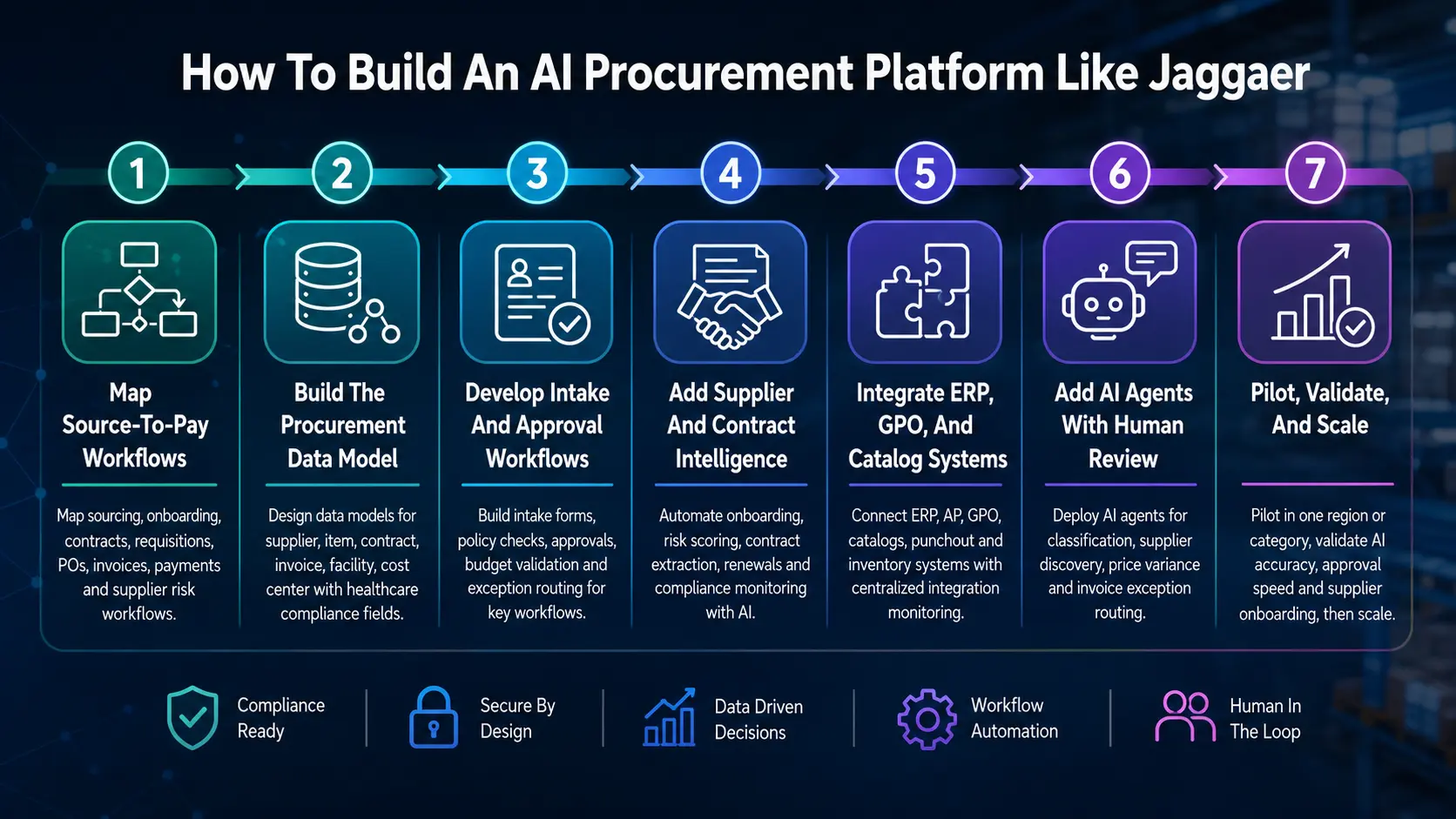
1. Map Source-To-Pay Workflows
Map sourcing, supplier onboarding, contract approval, requisitions, PO creation, invoices, payments, renewals, and supplier risk alongside clinical value analysis paths.
We document all underlying workflow rules and exception logic before writing a single line of frontend code, preventing the software from digitizing broken, inefficient processes.
2. Build The Procurement Data Model
Design database schemas for supplier, item, contract, purchase request, invoice, facility, department, and cost center entities, embedding structured healthcare fields for GPO tiers and BAA status.
We engineer the data model to function as an immutable corporate system of record rather than a secondary, post-transactional reporting database.
3. Develop Intake And Approval Workflows
Build guided intake forms, real-time corporate policy checks, role-based approvals, budget validation algorithms, preferred supplier suggestions, and automated exception routing loops for 4–6 high-volume workflows.
We prioritize a simplified consumer-grade intake interface for non-technical users while enforcing rigorous, unbypassable policy constraints in the backend.
4. Add Supplier And Contract Intelligence
Incorporate supplier onboarding automation software, automated supplier risk scoring, contract extraction, renewal alerts, pricing term extraction, and contract compliance monitoring modules.
We use background language models to drastically reduce human review times without ever bypassing established legal, compliance, or procurement authorities.
5. Integrate ERP, GPO, And Catalog Systems
Connect legacy ERP, AP, GL, GPO pricing matrices, distributor catalogs, punchout catalog systems, and inventory trackers, maintaining highly visible, centralized integration error logging.
We establish absolute backend integration reliability and transactional synchronization before layered machine learning models are deployed.
6. Add AI Agents With Human Review
Deploy dedicated agentic AI procurement workflows for automated spend classification, supplier discovery, price variance detection, and invoice exception routing governed by strict confidence thresholds.
We construct autonomous agent frameworks around tightly controlled actions and deterministic policy rules rather than open-ended, unmonitored autonomy.
7. Pilot, Validate, And Scale
Launch the platform across a single region, facility group, or purchasing category to validate classification accuracy, AI recommendation quality, approval speed, and supplier onboarding velocity.
We use the live pilot phase to harden system integration pipelines, test model monitoring tools, and verify audit logs before initiating a multi-site rollout.
Adhering to a decoupled, phase-by-phase engineering sequence guarantees that your infrastructure maintains data integrity during enterprise scaling. Furthermore, gating autonomous models behind deterministic human approval loops minimizes compliance risks across highly regulated operational landscapes.
AI Procurement SaaS Platform Development Cost
AI procurement SaaS platform development cost usually ranges from $70,000 to $300,000, depending on workflow scope, AI model depth, ERP integrations, GPO connections, healthcare compliance controls, supplier portal complexity, and whether the platform is built as an internal enterprise tool or white-label AI procurement SaaS.
Consequently, scoping variables dictate whether engineering resources sit within a controlled, data-focused MVP cycle or scale up to mirror an advanced, production-grade Jaggaer alternative platform development blueprint.
The table below outlines the end-to-end capitalization requirements broken down across every primary software development lifecycle phase:
AI Procurement Development Cost
| Development Phase | MVP Range | Production Range |
| Discovery and workflow mapping | $5,000–$8,000 | $8,000–$12,000 |
| Architecture and data model | $8,000–$12,000 | $14,000–$24,000 |
| Data and integration foundation | $12,000–$20,000 | $25,000–$45,000 |
| Core S2P and P2P workflows | $18,000–$30,000 | $40,000–$65,000 |
| Supplier and contract modules | $10,000–$18,000 | $28,000–$42,000 |
| AI models and MLOps | $10,000–$18,000 | $35,000–$60,000 |
| Security and compliance controls | $5,000–$10,000 | $18,000–$28,000 |
| Testing, deployment, and pilot | $2,000–$4,000 | $12,000–$24,000 |
| Total Build Cost | $70,000–$120,000 | $180,000–$300,000 |
Budget 15%–25% of the initial build cost per year for ongoing hosting, integration monitoring, AI model evaluation, security updates, regulatory changes, supplier data cleanup, and workflow enhancements.
Why Hire Intellivon For AI Procurement Software Development
Hire Intellivon when your AI procurement platform needs source-to-pay depth, governed AI automation, healthcare procurement logic, and enterprise integration beyond generic procurement tools.
- Built for source-to-pay control: Get intake workflows, supplier onboarding, sourcing events, contract management, purchase orders, invoice matching, approval trails, spend analytics, and supplier performance tracking.
- AI without procurement risk: Use spend classification, contract extraction, supplier risk scoring, invoice exception routing, demand forecasting, maverick spend alerts, and human review workflows.
- Healthcare procurement expertise: Support GPO pricing, vendor credentialing, BAA tracking, FDA supplier controls, clinical value analysis, pharmaceutical procurement, medical device purchasing, and multi-site buying rules.
- Enterprise-grade integrations: Connect ERP, AP, GL, inventory, supplier portals, punchout catalogs, GPO feeds, SAP Ariba, Oracle Procurement Cloud, NetSuite, and healthcare data systems.
- Production-ready engineering: Work with ex-MAANG engineers and teams backed by 500K+ engineering hours across complex AI, MLOps, workflow automation, and enterprise software builds.
- Cost clarity upfront: Plan MVP, enterprise, AI, integration, security, and maintenance budgets within the $70,000–$300,000 range.
Talk to Intellivon’s AI procurement software experts to scope your source-to-pay platform, estimate your build cost, and decide whether custom development is the right move.
Conclusion
AI procurement platform development works best when the build starts with clear workflows, clean supplier data, and controlled source-to-pay automation. Instead of copying Jaggaer feature by feature, teams should prioritize intake, approvals, supplier management, contracts, ERP integration, compliance, and governed AI.
As the platform matures, advanced models can improve spend visibility, risk detection, and forecasting. Therefore, the strongest build balances automation, auditability, and measurable procurement ROI over time at scale.
FAQs
Q1. Why Are Procure-To-Pay Tools So Expensive?
A1. Procure-to-pay tools are expensive because they manage workflows, supplier records, approval rules, integrations, audit trails, implementation, and change management across departments. Therefore, buyers pay for operational control, not just software screens. A custom AI procurement MVP costs $70,000–$120,000, while production healthcare platforms usually reach $180,000–$300,000 for complex regulated source-to-pay workflows.
Q2. Does ERP Already Handle Procurement Well Enough?
A2. ERP handles financial records, but it usually does not manage intake, supplier collaboration, contract intelligence, maverick spend, clinical approvals, or credentialing deeply enough. Therefore, teams need a procurement layer before ERP commitment. It should sync approved POs, invoices, vendors, budgets, and cost-center data back to finance without duplicating finance records.
Q3. How Long Does Custom AI Procurement Development Take?
A3. A focused AI procurement MVP takes 10 to 16 weeks when it includes intake, approvals, supplier onboarding, basic PO automation, and one ERP integration. However, a production healthcare platform takes 5 to 9 months when it adds GPO feeds, contract AI, supplier portals, invoice matching, MLOps, and compliance controls.
Q4. How Do You Build AI Supplier Management Like Jaggaer?
A4. Build AI supplier management like Jaggaer by starting with supplier profiles, onboarding, credentialing, contracts, risk feeds, performance metrics, diversity tracking, and ESG fields. Then, add AI supplier matching, financial risk scoring, document extraction, renewal alerts, and performance prediction. This creates a supplier intelligence layer instead of a static vendor database.
Q5. Can AI Compare Products Across Different Supplier Codes?
A5. Yes, AI can compare products across different supplier codes when the platform uses SKU normalization, product attribute extraction, unit-of-measure conversion, catalog mapping, and human review. However, clinical items need extra validation because similar products may differ by material, size, sterility, UDI, regulatory status, or approved facility use.
To Sum Up
- AI procurement platform development fails when teams build AI before they fix supplier, item, contract, and approval data.
- A $70,000 MVP should automate intake, approvals, supplier onboarding, POs, and basic spend visibility before it attempts autonomous procurement.
- Healthcare procurement platforms need GPO, FDA, BAA, vendor credentialing, and clinical value analysis logic that generic P2P tools rarely explain.
- Agentic AI belongs behind policy engines, confidence thresholds, audit logs, and human review in regulated procurement workflows.
- Custom procurement software is strongest when it protects strategic workflow ownership, not when it recreates standard ERP purchasing.