Managing SaaS applications has become one of the most pressing challenges for enterprises. What started as a few productivity tools has evolved into an ecosystem of over 275 applications spread across departments, each used to solve specific problems but collectively creating chaos. With the use of AI-powered tools in the mix, the challenge of managing usage, spend, and security becomes even sharper. A SaaS Management Platform (SMP) offers a way to bring structure to this chaos by centralizing visibility, optimizing costs, and embedding compliance directly into daily workflows.
At Intellivon, we’ve helped enterprises build SaaS management systems that function more than subscription dashboards. Our platforms combine discovery, automation, compliance, and analytics into a single framework. In this blog, we’ll break down what an enterprise SaaS management platform is, why it matters in 2025, the features and use cases that deliver the most value, the architecture behind it, development steps, challenges, costs, and the outlook for this fast-growing market.

What is an Enterprise SaaS Management Platform?
An enterprise SaaS Management Platform (SMP) is a control system designed to bring order to the growing stack of subscription-based applications inside large organizations. Instead of teams juggling dozens or even hundreds of tools in silos, an SMP centralizes oversight. It tracks what apps are in use, who has access, how much each license costs, and whether usage aligns with compliance and security policies.
A simple subscription dashboard shows billing and renewals. On the other hand, an enterprise-grade SMP goes further by connecting directly with identity systems, HR data, expense reports, and the apps themselves. By doing this, it gives enterprises visibility into shadow IT, enforces security, and streamlines license optimization.
How Do They Work?
SaaS Management Platforms work by connecting to the systems that enterprises already use, such as identity providers, HR databases, finance tools, and the SaaS applications themselves. Through APIs and secure integrations, they continuously pull in data about logins, permissions, license usage, spending, and user activity. This creates a live, unified view of the entire SaaS ecosystem.
Once the data is centralized, the platform normalizes it into a common structure. That makes it easier to compare usage across applications, enforce policies consistently, and run analytics. Automated workflows then act on this information in real time. For example, if an employee leaves the company, the platform can instantly revoke their access across all apps. If a license is sitting unused, it can be reclaimed before renewal.
The result is a closed-loop system, where you discover SaaS activity, analyze risks and costs, enforce policies automatically, and report back to leadership with clear dashboards.
Key Takeaways of the Saas Management Platform Market
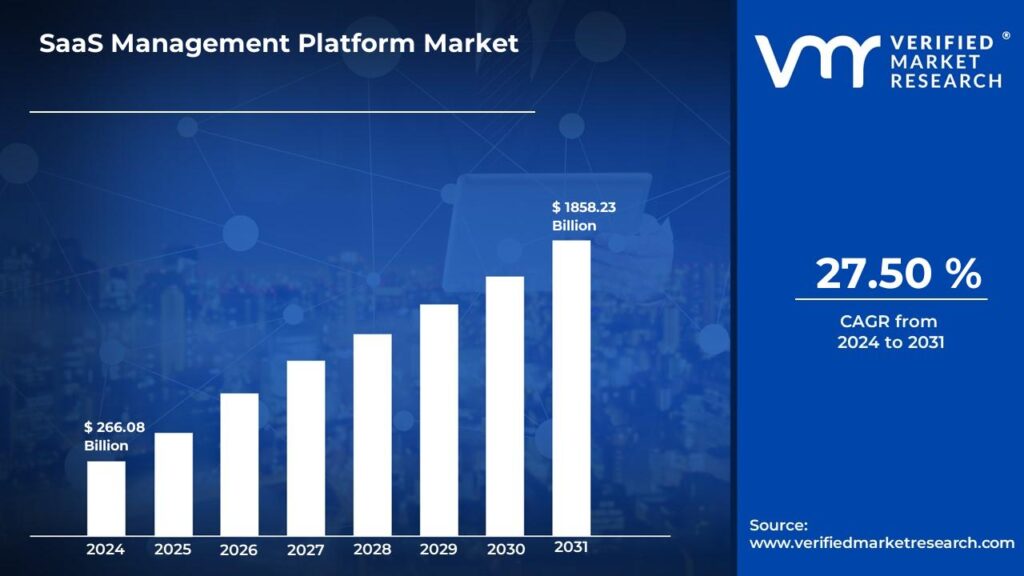
The SaaS Management Platform market was valued at USD 266.08 billion in 2024. It is expected to grow rapidly and reach USD 1,858.23 billion by 2031, with a strong CAGR of 27.5% during the forecast period.
- Enterprises are aggressively optimizing SaaS spend by eliminating unused and redundant licenses, often achieving savings in the double-digit percentage range.
- The average enterprise now uses more than 100 SaaS applications, creating challenges such as shadow IT, fragmented visibility, and scattered data sources.
- Gartner predicts that by 2025, more than 95% of organizations will adopt a SaaS Management Platform to streamline operations and reduce risks.
- Demand is rising for integration with identity providers, HRIS, and finance systems to establish unified governance across SaaS ecosystems.
- Security and compliance remain top priorities, with advanced monitoring and risk management increasingly embedded in SaaS Management Platforms.
- Self-service portals and APIs are improving usability, enabling decentralized teams to manage SaaS tools more effectively.
- The SaaS Management Platform market is accelerating toward AI-driven, automated, and integrated solutions that help enterprises optimize usage, reduce costs, and maintain compliance at scale.
Why Do Enterprises Need SaaS Management Platforms?
Enterprises rely on hundreds of SaaS applications, each handling critical functions from HR to finance to AI workloads. Without structured management, costs spiral, security gaps widen, and compliance becomes a recurring headache. This is where SaaS Management Platforms prove their value.
1. SaaS Sprawl and Hidden Costs
Enterprises often underestimate how many applications are active across teams. With licenses spread across departments, unused or duplicate subscriptions create silent budget drains. An SMP brings visibility, allowing enterprises to identify redundancies and optimize spend before renewal cycles eat into margins.
2. Security Risks from Shadow IT
Employees frequently adopt tools outside IT’s oversight, creating shadow IT. While convenient for teams, these apps bypass enterprise security controls. These platforms detect unauthorized applications, flagging risks before they lead to data exposure or compliance violations.
3. Compliance and Regulatory Demands
Regulators now expect continuous oversight of SaaS environments, particularly when sensitive data is involved. Manual tracking falls short against GDPR, HIPAA, SOX, or industry frameworks. SaaS management platforms embed compliance monitoring into daily workflows, reducing audit stress and ensuring enterprises meet evolving standards.
4. Usage-Based Pricing Pressures
The shift toward AI-driven tools and usage-based pricing has made cost predictability more difficult. A single team’s spike in activity can inflate costs overnight. To remedy this, SMPs track usage patterns in real time, alerting leaders and preventing billing surprises.
5. Need for IT Automation
IT teams spend countless hours provisioning and deprovisioning users, chasing license renewals, and reconciling spend data. These enterprise-grade platforms automate these processes, cutting manual work while improving the employee experience. Teams get faster access to tools, and IT regains capacity for strategic priorities.
SMPs reduce waste, secure the SaaS ecosystem, streamline compliance, and enhance both IT and employee efficiency. With the need established, the next step is exploring the core features that make these platforms effective at scale.
Core Features of an Enterprise SaaS Management Platform
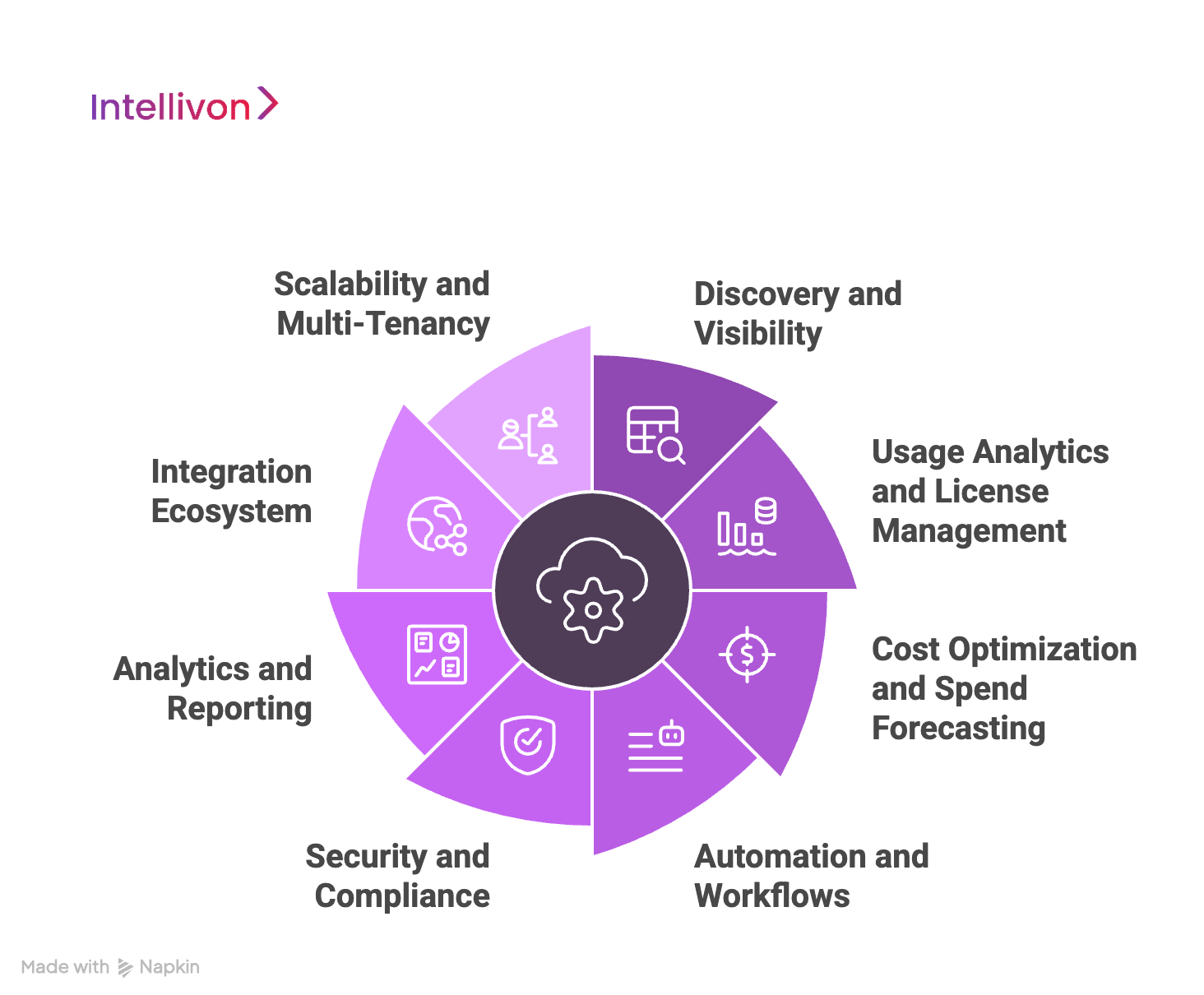
A SaaS Management Platform is effective because of the way its features combine. Each capability solves a piece of the SaaS anomaly, from visibility to automation to compliance. Together, they give enterprises full control over cost, security, and efficiency.
1. Discovery and Visibility
The first challenge in SaaS management is knowing what exists. SMPs integrate with single sign-on systems, HR databases, expense reports, and SaaS APIs to uncover every application in use. This visibility reveals shadow IT, redundant tools, and the true scale of the SaaS portfolio.
2. Usage Analytics and License Management
An SMP goes beyond listing apps and measures feature-level usage to show which licenses are active and which sit idle. By tracking user activity across tools, enterprises can rightsize licenses, reallocate them, and ensure every dollar spent delivers value.
3. Cost Optimization and Spend Forecasting
Without oversight, SaaS costs can skyrocket. SMPs cushion this by reclaiming unused licenses, benchmarking vendor pricing, and tapping into SaaS marketplaces for better deals. Predictive analytics also forecasts future spend, helping finance teams plan budgets instead of reacting to surprises.
4. Automation and Workflows
Manual tasks such as onboarding, offboarding, renewals, and compliance checks drain IT resources. The platform automates these processes, ensuring employees gain or lose access instantly, renewals are managed on time, and compliance rules are applied consistently across all tools.
5. Security and Compliance
SaaS tools hold sensitive enterprise data, and these platforms enforce access controls, monitor file sharing, and validate vendor certifications. They create audit trails automatically, making compliance with frameworks like GDPR, HIPAA, and SOX smoother and less disruptive.
6. Analytics and Reporting
Executives need clarity. For that, SMPs provide dashboards for finance, IT, procurement, and risk teams, showing usage patterns, costs, and compliance posture in real time. Custom reporting supports decision-making and accelerates audit preparation.
7. Integration Ecosystem
SMPs don’t operate in isolation. Instead, they connect through APIs and middleware to identity systems, HRIS, ERP, and financial platforms. This integration ensures that compliance, automation, and analytics cover the full SaaS ecosystem, not just a handful of apps.
8. Scalability and Multi-Tenancy
Global enterprises need platforms that grow with them. These enterprise-grade platforms support multi-tenancy, regional compliance requirements, and large user bases. This scalability ensures governance and cost control stay consistent as the SaaS stack expands.
Each feature plays a role, but the real strength lies in their combination. By unifying visibility, automation, cost control, and compliance, SMPs become the backbone of SaaS governance.
Architecture of an Enterprise SaaS Management Platform
The strength of a SaaS Management Platform lies in its architecture. Each layer performs a distinct function, and together they create a system that is scalable, secure, and capable of evolving with enterprise needs.
1. Data Ingestion and Integration Layer
The platform connects with identity providers, HRIS, ERP, finance systems, and SaaS apps through APIs. This constant flow of activity and expense data creates the raw material for governance.
2. Integration Middleware Layer
Many enterprises have legacy systems or niche SaaS apps that don’t connect easily. Middleware acts as a translator, orchestrating APIs, transforming data formats, and queuing requests to ensure smooth integration. This layer adds flexibility when ecosystems are diverse or complex.
3. Data Processing and Normalization Layer
Raw data from hundreds of sources is inconsistent. This layer cleans, deduplicates, and structures the data into a common format for users, licenses, and roles. It ensures policies and analytics can apply evenly across the SaaS stack.
4. Intelligence Layer
Once data is normalized, the intelligence layer applies analytics and rule engines. It maps SaaS activity against compliance standards and detects anomalies. Risk scoring and vendor performance evaluation also sit here, turning raw data into actionable insight.
5. AI Model Training Layer
This backend layer ensures the intelligence system improves over time. Here, the AI models are trained, validated, and retrained continuously with new data. This keeps risk detection accurate, adapts policies to new usage patterns, and responds to evolving threats.
6. Workflow Orchestration Layer
Insights only matter if acted upon. To fulfill this, the workflow orchestration layer automatically enforces policies, revoking access, reclaiming licenses, or triggering workflows across apps when risks or inefficiencies are identified. Automation reduces manual IT workload and closes compliance gaps in real time.
7. Policy Management Layer
A dedicated governance layer allows enterprises to define, version, and enforce policies centrally. It manages exceptions and ensures evolving frameworks, from GDPR to internal standards, are applied consistently across the SaaS portfolio.
8. Security and Compliance Layer
Every enterprise SMP must be security-first. This layer handles encryption, access controls, audit logging, and vendor certification checks. It ensures sensitive data stays protected while creating the evidence trail enterprises need for audits.
Together, these layers create a closed-loop system for SaaS governance. From ingestion and integration to AI-driven intelligence, automation, and reporting, enterprises gain a platform that evolves with scale and complexity.
How We Develop Enterprise SaaS Management Platforms
At Intellivon, we take a structured approach to building SaaS Management Platforms that scale with enterprise needs. Each stage of development balances technical precision with business value, ensuring the platform addresses today’s SaaS challenges while preparing for tomorrow’s.
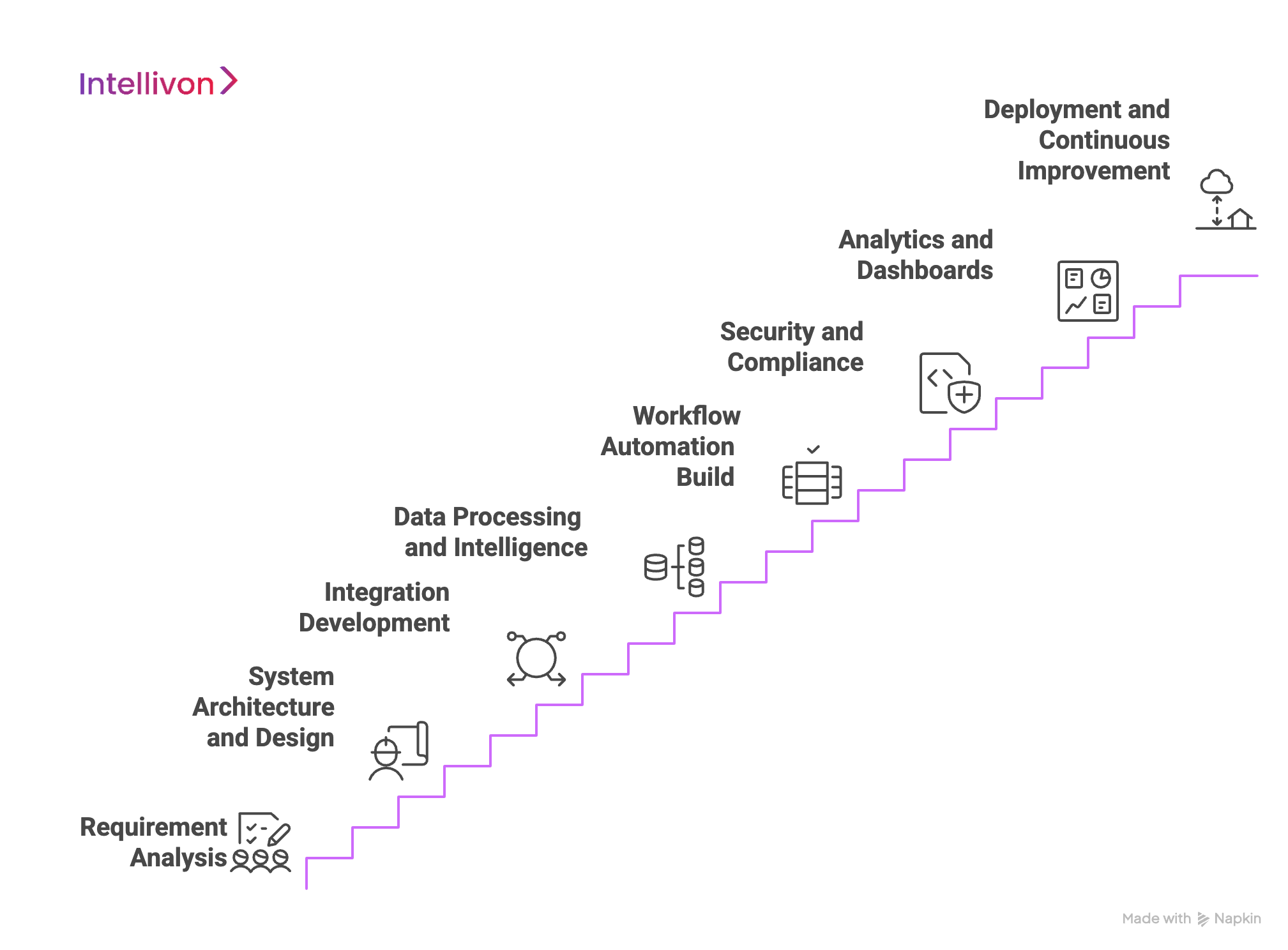
1. Requirement Analysis
We begin by engaging with stakeholders across IT, finance, and operations to understand priorities. This phase defines whether the project should start as an MVP or as a full enterprise-grade solution. We map compliance requirements, cost pressures, and SaaS adoption trends to create a strategy that aligns with long-term objectives.
2. System Architecture and Design
Our architects design a multi-layered, cloud-native framework capable of scaling with global enterprise operations. This blueprint ensures resilience, interoperability, and security are built into the foundation. We focus on designing for integration and automation from the start, so the platform adapts as new SaaS tools enter the ecosystem.
3. Integration Development
Connecting the platform to enterprise systems is critical. We build robust connectors for identity providers, HRIS, ERP, finance platforms, and the SaaS apps that matter most to your workflows. By prioritizing integrations, we ensure visibility spans the entire SaaS stack, not just isolated applications.
4. Data Processing and Intelligence
Data without structure has little value. We create pipelines to extract, transform, and normalize data across systems. On top of this, we implement machine learning models that detect anomalies, forecast spend, and benchmark vendor performance. This makes the platform not just reactive but predictive.
5. Workflow Automation Build
Automation is where the platform starts saving time. We create no-code workflows that handle tasks like onboarding, offboarding, license reclamation, and renewal management. These workflows run across applications, ensuring compliance policies are enforced consistently without manual intervention.
6. Security and Compliance
Every Intellivon platform embeds enterprise-grade security. We implement encryption for sensitive data, role-based access controls, and detailed audit logging. Compliance frameworks such as GDPR, HIPAA, SOX, and PCI-DSS are mapped directly into policies, giving enterprises continuous oversight and audit readiness.
7. Analytics and Dashboards
We design role-based dashboards that give IT, finance, and procurement teams the insights they need. From spend analysis to compliance reporting, every view is tailored to decision-making, ensuring data drives strategy rather than creating noise.
8. Deployment and Continuous Improvement
Finally, we deliver a cloud-native deployment optimized for scale. Using CI/CD pipelines and Kubernetes, we ensure the system grows with your needs. After deployment, we continue refining connectors, updating AI models, and supporting customer success, ensuring the platform evolves as your SaaS ecosystem expands.
By following this structured development process, Intellivon delivers SaaS Management Platforms that combine resilience, intelligence, and usability. Enterprises gain a system that scales globally, enforces compliance continuously, and optimizes spend in real time.
Cost of Developing an Enterprise SaaS Management Platform
At Intellivon, we understand that SaaS Management Platforms must be both cost-effective and enterprise-ready. That’s why our pricing model is designed to be flexible, aligning with your requirements instead of offering a rigid, one-size-fits-all package.
If projected costs risk exceeding your budget, we refine the scope while safeguarding the core value of visibility, compliance, and automation.
Estimated Phase-Wise Cost Breakdown
| Phase | Description | Estimated Cost Range (USD) |
| Requirement Analysis | Stakeholder interviews, SaaS ecosystem assessment, KPI alignment. | $5,000 – $10,000 |
| System Architecture | Designing the layered, cloud-native framework and integration planning. | $8,000 – $15,000 |
| Integration Development | Building connectors for identity systems, HR, finance, and core SaaS apps. | $10,000 – $20,000 |
| Data Processing | Normalizing data pipelines, deduplication, and compliance-ready structuring. | $6,000 – $12,000 |
| Automation Workflows | Onboarding, offboarding, license management, and renewal automation. | $8,000 – $15,000 |
| Security and Compliance | Encryption, RBAC, audit logging, and framework mapping (GDPR, HIPAA, SOX). | $5,000 – $10,000 |
| Dashboards and Reporting | Role-based reporting for IT, finance, procurement, and leadership. | $4,000 – $8,000 |
| Testing and Deployment | Performance, security validation, and enterprise rollout. | $6,000 – $10,000 |
- Total Initial Investment Range: $50,000 – $100,000
- Ongoing Optimization (Annual): $5,000 – $15,000
Factors That Influence Cost
- Number of integrations: More SaaS connectors increase development effort.
- Automation depth: Simple provisioning vs. complex, cross-app workflows.
- Compliance scope: Coverage for one framework vs. multiple global standards.
- Customization needs: Out-of-the-box dashboards vs. tailored enterprise reporting.
- Deployment model: Cloud-native, hybrid, or on-premises hosting.
By keeping costs within a defined, realistic range, Intellivon ensures enterprises get an SMP that balances affordability with enterprise-grade reliability.
Top Enterprise SaaS Management Platforms
The leading SaaS management platform solutions not only reveal which apps are in use but also help enterprises cut unnecessary costs, tighten compliance, and bring order to sprawling SaaS ecosystems.
What sets the top platforms apart is their ability to combine visibility with automation, security, and financial intelligence, transforming SaaS management into a strategic advantage rather than just an IT task.
1. BetterCloud
BetterCloud has established itself as the automation-first SMP. Enterprises use it to monitor activity at a granular level, from file sharing to permission changes, across collaboration and productivity apps like Google Workspace, Microsoft 365, and Slack. It automates user lifecycle management, so onboarding and offboarding happen instantly, without manual intervention. Its strongest value lies in security: by detecting risky file exposures or misconfigurations in real time, BetterCloud helps enterprises prevent data breaches before they occur.
2. Torii
Torii is recognized for making SaaS governance accessible to both IT and finance teams. Its analytics engine highlights unused licenses, underutilized features, and overlapping subscriptions across departments. This makes license optimization straightforward, often unlocking double-digit cost savings.
Torii also integrates with identity and expense systems to uncover shadow IT, helping enterprises bring rogue applications under governance. Its self-service workflows allow business units to request tools while IT retains final control, balancing autonomy with oversight.
3. Zylo
Zylo is the market leader in SaaS spend management. It gives finance leaders a detailed view of contract renewals, vendor usage patterns, and cost benchmarks against industry peers. This data enables stronger negotiations with vendors and prevents auto-renewals that drain budgets.
Enterprises also use Zylo to align software investment with business outcomes, ensuring SaaS spend supports strategic goals instead of ballooning unchecked. For large organizations with hundreds of vendors, Zylo acts as a procurement co-pilot.
4. Snow Software
Snow Software takes a broader approach by unifying SaaS with traditional IT asset management. This is particularly valuable for enterprises that still rely on hybrid or on-premise systems alongside their SaaS stack.
Snow provides a single pane of glass for all software assets, whether cloud or on-prem. This makes it easier for IT and finance teams to rationalize technology portfolios, identify redundant investments, and enforce compliance across multiple environments.
5. G2 Track
G2 Track leverages G2’s extensive vendor data and reviews to enhance SaaS decision-making. Beyond tracking spend and usage, it helps procurement teams understand how vendors perform in the broader market.
This intelligence supports smarter renewal negotiations and tool evaluations. G2 Track also provides health scores for applications, flagging which vendors may pose operational or security risks based on broader market insights.
Together, these platforms illustrate the maturity of the SaaS management ecosystem in 2025. With this landscape in mind, the final step is to consider why building or adopting a platform is no longer optional, but essential for enterprises preparing for the future.
Conclusion
Enterprises are reaching a tipping point in SaaS adoption. What was once a convenient way to deploy specialized tools has now grown into a sprawling ecosystem of hundreds of applications, each carrying costs, security risks, and compliance responsibilities. Managing this complexity without a dedicated system is no longer sustainable.
A SaaS Management Platform brings the clarity and control enterprises need, but building one that truly works at scale requires more than off-the-shelf dashboards. It demands deep integration expertise, strong knowledge of compliance frameworks, and the ability to design automation that fits enterprise workflows.
Choosing an experienced partner to build and tailor such a platform is the difference between reactive oversight and proactive governance. Enterprises that act now will position SaaS management as a source of efficiency, security, and growth.
Build Your Enterprise SaaS Management Platform With Us
At Intellivon, we design SaaS Management Platforms that go beyond tracking renewals. Our solutions combine deep integrations, AI-driven intelligence, and enterprise-grade automation to help you manage SaaS ecosystems at scale without compromising on compliance or security.
Why partner with Intellivon?
- Custom-Built for Your Enterprise: We design platforms that reflect your SaaS footprint, compliance scope, and operational needs, and not generic templates.
- Compliance Engineered from Day One: Our systems embed frameworks like GDPR, HIPAA, SOX, and PCI-DSS into workflows, giving you continuous audit readiness.
- Proven Enterprise Expertise: We’ve delivered platforms that reduce SaaS costs, uncover shadow IT, and accelerate audit cycles for global enterprises.
- Future-Ready Architecture: Cloud-native, API-first platforms that adapt as your SaaS ecosystem evolves and scales globally.
Book a discovery call with Intellivon today. Let’s build a SaaS Management Platform that gives you control over the growing number of SaaS applications, reduces risk, and turns into a driver of scalable enterprise growth.
FAQs
Q1. Why do enterprises need a SaaS Management Platform?
A1. Enterprises often run hundreds of SaaS applications, creating visibility gaps, rising costs, and compliance risks. A SaaS Management Platform brings everything under one roof, providing centralized control, automation, and security that scale with global operations.
Q2. How long does it take to implement an SMP?
A2. Implementation timelines vary depending on integrations and scope, but most enterprises see a working rollout within three to four months. Quick wins, such as identifying unused licenses or uncovering shadow IT, typically appear within the first few weeks, creating early momentum and proving ROI.
Q3. Can a SaaS Management Platform integrate with legacy systems?
A3. Yes. Modern SMPs are designed to connect with both cloud-native and older systems. Through APIs, middleware, and data transformation, they integrate with ERPs, HRIS, and finance platforms. This allows enterprises to centralize governance without disrupting existing operations or replacing legacy investments.
Q4. What ROI should enterprises expect?
A4. Enterprises often save between 10–30% on SaaS costs in the first year alone by rightsizing licenses and improving contract negotiations. Beyond direct savings, SMPs reduce audit preparation time, minimize compliance risks, and free IT teams from repetitive manual work, unlocking both financial and operational value.
Q5. How do SMPs handle evolving regulations?
A5. SMPs continuously update compliance rules and map them against enterprise activity. As new laws like GDPR, HIPAA, or emerging AI regulations evolve, policies are automatically adjusted. This keeps enterprises audit-ready without requiring IT or compliance teams to constantly chase changing frameworks.