Key Takeaways:
-
PO automation platforms create, route, approve, send, track, and reconcile purchase orders across enterprise systems.
-
Requisition intake, budget checks, contract enforcement, EDI 850/855, and three-way matching are core requirements.
-
AI extraction, vendor matching, anomaly detection, and spend classification add intelligent automation to PO workflows.
-
Custom builds cost $70,000 to $300,000 depending on integrations, compliance depth, and multi-entity scale.
-
How Intellivon builds purchase order automation as production infrastructure and not a standalone approval application.
Processing thousands of POs monthly across multiple facilities creates a workload that approval routing alone cannot solve. Purchase order automation software development starts with the three-way match engine, not the approval workflow UI. From there, approval routing, ERP integration, and anomaly detection all connect to that matching foundation. That sequencing is what determines whether the platform eliminates manual bottlenecks or simply relocates them.
The decision that determines this is how the exception routing engine handles three-way match failures. Without an ML-powered exception engine, every failed match goes into a manual review queue, recreating the exact bottleneck the platform was built to remove. Manual PO processing costs between $10 and $30 per invoice, compared to $2 with automation. Building the ML exception engine from day one is therefore what delivers that 80% cost reduction.
Intellivon has over a decade of experience building PO automation platforms for healthcare and financial services. The approach is always to build the match engine before the approval workflow is designed. This blog covers three-way match architecture, ML exception routing, GPO enforcement, and HIPAA compliance. By the end, you will have a clear picture of how we build these purchase automation systems from scratch.
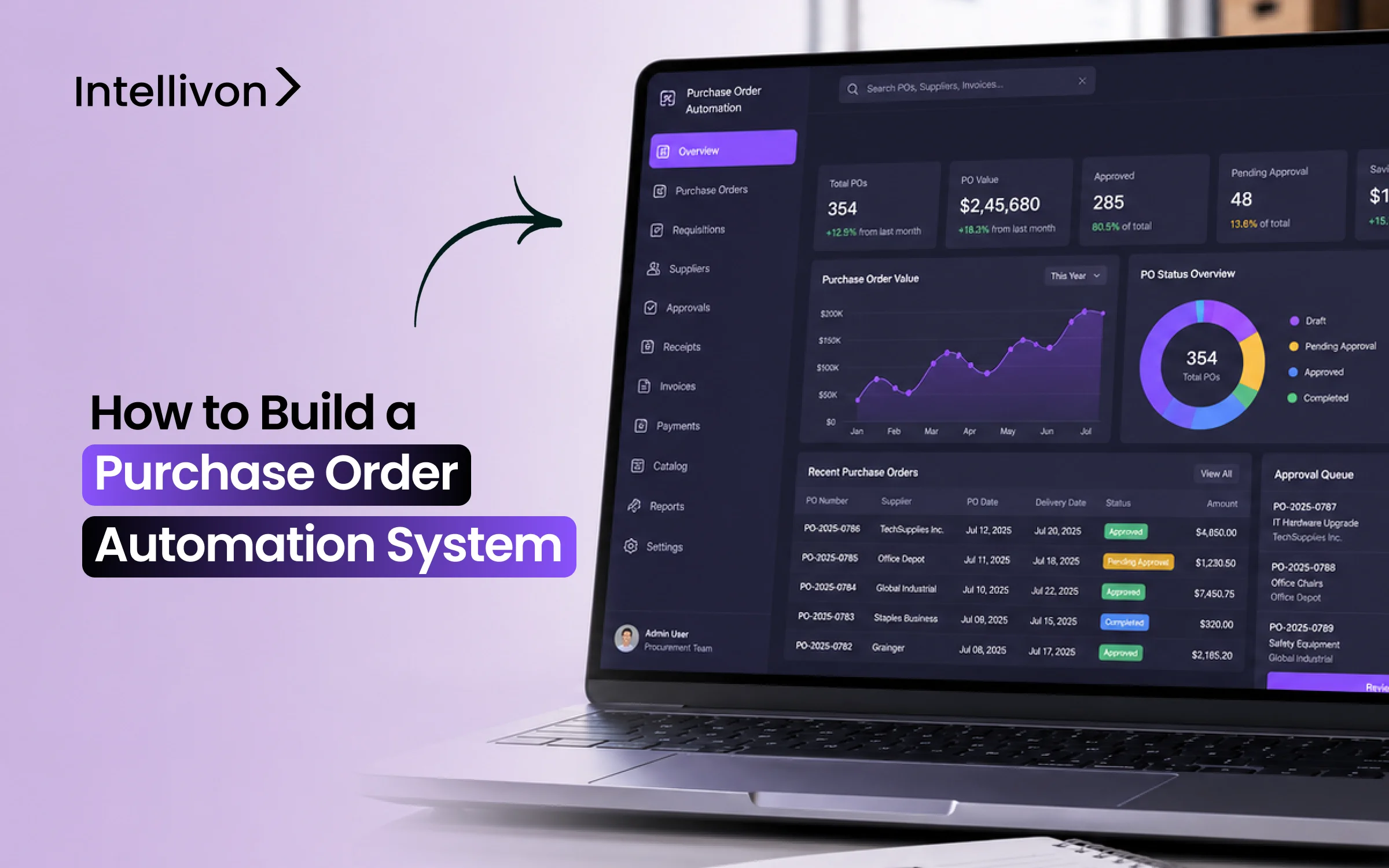
What Is A Purchase Order Automation System?
A purchase order automation system is a specialized software platform that digitizes and streamlines the entire lifecycle of a procurement request, from initial creation to final reconciliation.
By converting manual paper and email workflows into automated digital processes, it routes approvals, checks budgets, verifies contracts, and performs multi-way matching.
The software eliminates data entry errors, minimizes rogue spending, and integrates directly with existing enterprise resource planning (ERP) systems.
What Is A Purchase Order Automation System Built To Control?
A purchase order automation system controls how buying commitments move from request to approved supplier order, then into receipt, invoice matching, payment, and audit records.
It is not just a digital approval form. It is the centralized transaction-control layer between procurement, finance, suppliers, ERP, AP, inventory, and compliance teams.
Standardizing this data flow, it ensures fiscal compliance across every enterprise transaction.
1. Define The System Beyond Simple PO Creation
Effective purchase order automation system development moves past basic document generation to build a comprehensive data governance framework.
- Purchase order creation and generation automation: Translates approved requisitions into structured, error-free purchasing documents automatically.
- PO template management software development: Enforces standardized, dynamic layout fields customized by department, region, or vendor type.
- Purchase order numbering and sequencing system: Issues unalterable, unique alphanumeric strings to ensure absolute tracking and audit defensibility.
- Guided buying PO automation platform: Funnels non-technical buyers toward preferred vendors and pre-negotiated contracts automatically.
2. Explain The Difference Between Requisition, PO, And Invoice
A clear custom purchase order management system development guide must separate internal intent, external commitment, and final billing.
- Purchase Requisition: An internal request created by an employee seeking permission to buy goods or services.
- Purchase Order (PO): A legally binding external commercial document issued to a vendor detailing the explicit terms of the sale.
- Invoice: A bill sent by the supplier requesting payment after confirming the order fulfillment terms.
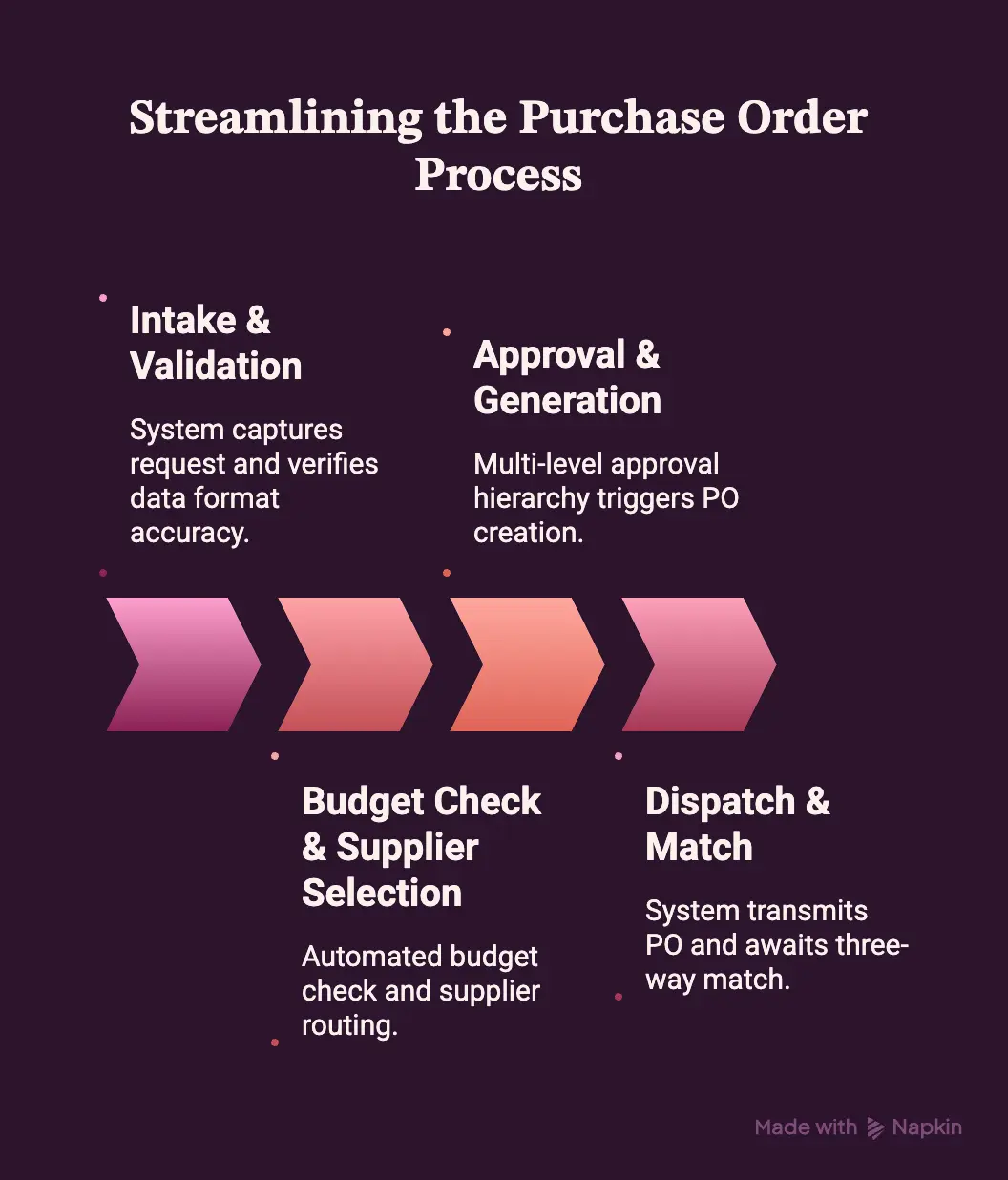
3. Show The Enterprise PO Lifecycle
An automated PO workflow management system build visualizes the linear journey of corporate spend to eliminate operational friction.
- Intake & Validation: The system captures the request and verifies data format accuracy.
- Budget Check & Supplier Selection: Automated PO budget check and encumbrance automation checks funds against preferred supplier PO routing automation.
- Approval & Generation: Multi-level PO approval hierarchy software routes the request before triggering purchase order creation.
- Dispatch & Match: The system transmits the document via EDI purchase order integration development and awaits a three-way match automation software verification.
4. Why ERP Alone Does Not Solve The Workflow
Legacy ERP systems act as transactional ledgers rather than dynamic workflow management systems.
- Missing Intake Governance: ERPs lack intuitive interfaces, causing employees to bypass the system and create unmonitored maverick spend.
- Rigid Approval Workflows: Modifying approval chains in an ERP often requires complex, expensive custom programming.
- Siloed Supplier Communication: Standard ERPs do not natively track automated PO acknowledgment management without manual input.
A purchase order automation system acts as a strict transactional controller rather than a simple document generator. Consequently, it plugs the visible gaps left by rigid ERP systems by governing buying workflows from initial intake to final reconciliation.
Why Enterprises Need PO Automation Before AP Automation Starts
Enterprises need PO automation before AP automation because invoice control starts when the company commits to spending, not when an invoice arrives. If requests, suppliers, prices, budgets, and approvals are not structured before the purchase order is issued, three-way matching becomes exception-heavy, and finance teams still chase missing context.
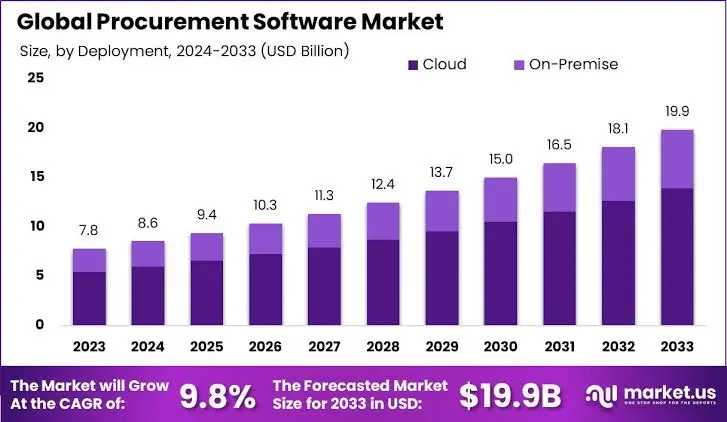
Looking at the broader administrative picture, the global procurement software market is charting a highly consistent upward trajectory. According to data published by Market.us, the market is expanding from an estimated $10.3 billion in 2026 to reach $19.9 billion by 2033, moving at a steady compound annual growth rate (CAGR) of 9.8%.
Consequently, treating accounts payable as the initial control point forces finance departments to reactively clean up bad data rather than proactively stop financial leaks.
1. Stop Maverick Spend Before It Becomes An Invoice
Controlling procurement at the point of origin prevents unapproved, off-contract spending from entering the downstream financial system.
- Purchase order policy compliance enforcement: Hard-code procurement rules into the digital intake layer, automatically blocking non-compliant purchasing attempts.
- Preferred supplier PO routing automation: Routes item requests specifically to negotiated vendors to secure pre-arranged enterprise discounts.
- Contract-based PO enforcement engine: Cross-references open requisitions against dynamic legal agreements to ensure pricing matches contractual terms exactly.
- Tail spend PO automation management: Automates low-value, unmanaged transactions that typically account for 80% of supplier volume but escape finance team oversight.
2. Reduce Approval Delays With Workflow Orchestration
Deploying an intelligent PO approval workflow automation platform resolves operational gridlock without sacrificing financial oversight.
- Automated PO routing and escalation engine: Dispatches purchasing requests to designated managers based on department, cost center, and threshold values.
- Multi-level PO approval hierarchy software: Sequences complex sign-offs in parallel across finance, legal, and operational leadership to reduce cycle time.
- Mobile PO approval application development: Allows enterprise executives to securely review, comment on, and sign off on high-value commitments while off-site.
3. Improve Budget Control Before Spend Is Committed
Enforcing transactional limits before issuing an order protects corporate capital far better than checking budgets during invoice processing.
- PO budget check and encumbrance automation: Evaluates real-time ledger balances and instantly places a financial hold on funds during the request stage.
- Cost Center and Project Code Syncing: Allocates expected expenses to specific operational units, keeping multi-site corporate projects strictly within financial parameters.
- Department Spend Limits and Grants: Validates requests against localized budget caps, which prevents over-allocation on seasonal campaigns or multi-facility clinical operations.
4. Create Audit Evidence Before Finance Closes
A rigorous purchase order audit trail management strategy preserves complete transactional context to ensure defensible accounting.
- Role-based access control PO platform: Restricts editing, approval, and viewing permissions based on specific user functions to maintain segregation of duties.
- Comprehensive Lifecycle Logging: Tracks every specific action, including comments, automated timestamps, structural changes, and exception overrides, within an immutable database.
- Strategic Metric: According to procurement benchmarks reported by Ivalua, building a mature, structured workflow layer prior to deploying advanced automation features directly accelerates transaction cycle times while eliminating process gaps.
For a deeper breakdown of how procurement workflows sit above ERP and P2P systems, see our guide on Building a Procurement Orchestration Platform.
Attempting AP automation without automated PO controls simply accelerates the processing of bad, unverified invoices. Ultimately, establishing front-end transaction governance ensures every downstream invoice matches a pre-approved financial commitment.
Where PO Automation Creates ROI
Purchase order automation creates financial return on investment by reducing transaction cycle times, preventing off-contract spend, improving invoice match rates, cutting manual administrative follow-ups, and giving finance teams better visibility into committed spend.
The strongest financial return comes when the software system actively prevents non-compliant purchases before they become invoice exceptions, supplier disputes, shipping backorders, or month-end accrual liabilities.
Consequently, establishing this preventative control layer allows growing organizations to scale transaction volumes without proportionally expanding administrative headcount.
1. Measure Cycle Time From Request To Approved PO
Deploying systematic intake tracking transforms buying cycle efficiency by highlighting hidden process friction points.
- PO cycle time optimization analytics: Tracks how long a purchase requisition remains within individual queues to identify organizational bottlenecks.
- Automated SLA Dashboards: Alert operations management when a high-priority procurement request approaches its specific approval deadline.
- Department-Level KPI Tracking: Isolates slow-moving transactional units to optimize internal procurement routing logic systematically.
- Industry Benchmark: According to efficiency studies published by ProcureDesk, deploying automated electronic purchasing software routinely cuts overall purchase order approval cycle times by up to 50%.
2. Reduce Invoice Exceptions Through Cleaner PO Data
Enforcing precise operational parameters during initial request creation ensures downstream billing documentation processes accurately without manual review.
- Two-way match PO automation system: Automatically reconciles unit prices and quantities between the vendor invoice and the issued purchase order.
- Three-way match automation software: Adds a critical data verification layer by comparing the invoice against the PO goods receipt invoice matching engine records.
- Invoice-to-PO reconciliation automation: Flags deviations in freight fees or line-item totals instantly to direct variances into isolated exception resolution tracks.
3. Improve Cash Planning With Open PO Visibility
An automated ledger system provides treasury teams with clear forecasting data regarding upcoming cash liabilities before bills hit the door.
- Purchase order accruals management software: Tracks unbilled transactional commitments to calculate accurate financial liabilities for closing periods.
- Open PO Reporting Systems: Aggregates all issued but unfulfilled commercial orders to map short-term cash flow constraints precisely.
- Goods Received Not Invoiced (GRNI) Tracking: Pinpoints items delivered but not yet billed to ensure precise balance sheet entries.
4. Track Supplier And Spend KPIs In Real Time
Centralizing purchasing data in an interactive database gives finance executives instant control over supplier network performance.
- Purchase order status tracking dashboard: Provides managers with self-service transparency regarding order transmission, acceptance, and estimated shipping timelines.
- Real-time PO monitoring and alerting platform: Triggers immediate text or email notifications when critical suppliers fail to meet delivery deadlines.
- PO spend analytics and reporting dashboard: Synthesizes category, vendor, and entity records to reveal cost opportunities.
- Financial Proof Point: Operational summaries from fintech platform Stampli demonstrate that replacing manual processing with comprehensive transactional tracking can displace $150,000 to $200,000 in annual administrative labor costs.
The ROI of purchase order automation extends far beyond simple administrative paper reduction. Ultimately, by accelerating overall cycles and stabilizing supplier match rates, organizations insulate their operating margins right at the moment a buying decision occurs.
The Enterprise PO Automation Architecture
An enterprise PO automation platform requires an independent intake layer, workflow manager, rules engine, document service, and event integration architecture. Each layer must operate independently because user approvals, ERP data synchronizations, and EDI exchanges fail under completely different conditions.
Consequently, isolating these functional blocks within a decoupled PO automation microservices architecture prevents a processing failure in a downstream ERP API from locking up the front-end guided buying interface or crashing active approval chains.
Enterprise PO Automation System Architecture
| Architectural Layer | Core Technical Components & Frameworks | Foundational Responsibilities | Data & Interface Touchpoints |
| User Intake & Guided Buying | • Dynamic schema-driven HTML forms
• OCI/cXML punch-out protocol engines • Elasticsearch catalog indexing services |
• Renders context-aware fields based on categories
• Drives non-technical users to preferred vendors • Controls punch-out catalog PO automation sessions |
• Direct B2B digital marketplace PO integrations
• Front-end API entry points for user requisition entry |
| Workflow & Rules Engine | • Event-driven finite state machines
• Hierarchical approval matrix routers • Automated escalation timers |
• Orchestrates multi-site spend thresholds
• Manages complex delegation and role rules • Executes automated PO routing and escalation |
• Local transaction databases
• Real-time ledger checks via active accounting links |
| PO Generation & Document Service | • Headless PDF rendering clusters
• Alphanumeric string sequencing engines • Version branching systems |
• Provisions blanket purchase order management software
• Controls scheduled order automation schedules • Manages change orders and dispatch layouts |
• S3 document repositories
• Outbound email networks and vendor delivery pipes |
| Integration & Event Architecture | • Kong/Apigee enterprise API gateways
• Apache Kafka / RabbitMQ event buses • Circuit breaker retry queues |
• Handles PO automation platform API gateway design
• Publishes internal asynchronous transactional events • Stabilizes downstream ERP connection drops |
• Legacy accounting system endpoints
• External trading network webhooks |
| Audit, Analytics, & Monitoring | • Write-Once-Read-Many (WORM) logs
• Vector spend analytics data pipelines • Change-history tracking storage |
• Enforces permanent purchase order audit trail management
• Flags transactional drift via anomaly monitoring • Calculates key pipeline efficiency metrics |
• Enterprise BI data warehouses
• Corporate legal compliance reporting exports |
Designing an enterprise transaction system using independent services coupled with an elastic PO automation platform scalability design guarantees total system resilience.
Ultimately, when an external supplier network or internal ledger node drops offline, the core ingestion architecture safely buffers incoming data without dropping active procurement requests.
Build Purchase Order Data Model Before Workflow Logic Starts
The purchase order data model must come before workflow design because approvals, matching, supplier rules, reporting, and audit trails all depend on clean entities. A weak model creates duplicate suppliers, broken match logic, missing receipts, bad accruals, and unreliable analytics across your foundational business systems.
Consequently, establishing an unyielding database schema at the onset ensures data consistency when transactions stream concurrently across ERP, AP, inventory, and supplier endpoints.
1. Model The Core Purchase Order Entities
Structuring your base schema around separate database entities prevents relational data conflicts during high-volume procurement runs.
- Core Entities: Establish distinct tables for request, requester, department, facility, cost center, supplier, and item catalogs.
- Transactional Entities: Define clear relationships between contract, budget, PO header, PO lines, and receiving records.
- Control Entities: Isolate exception logs, dynamic approval tracks, and permanent system audit events into standalone relational tables.
2. Design PO Line-Level Data For Matching
Granular line-level metadata provides the necessary validation inputs required for automated downstream multi-way matching engines.
- Identification & Unit Strings: Track unique SKUs, Global Trade Item Numbers (GTIN), and standardized Units of Measure (UOM).
- Financial & Delivery Data: Enforce explicit fields for item price, localized tax, base currency, and requested facility delivery dates.
- Governance Rules: Embed contract reference keys along with explicit percentage tolerance rules for quantity and price variances.
3. Build Supplier And Contract References
Binding compliance and vendor attributes directly to the supplier profile prevents non-compliant purchasing right at the ingestion layer.
- Contractual Guardrails: Link preferred supplier statuses, Group Purchasing Organization (GPO) contracts, and active formulary rules.
- Risk & Compliance Data: Store Business Associate Agreement (BAA) statuses, FDA supplier classes, risk tiers, and payment terms.
4. Create Change Order And Version History
A resilient transactional architecture tracks line modifications transparently without overwriting the original contractual record.
- PO change order management automation: Saves explicit version records whenever quantities, delivery dates, or item prices are adjusted.
- Status & Delivery State: Captures formal cancellations, partial receipts, and automated supplier PO confirmation tracking software updates.
5. Build Multi-Entity Accounting Fields
Enabling global enterprise commerce requires embedding corporate structural dimensions into every issued transaction.
- Structural Elements: Isolate the target legal entity, operational subsidiary, tax region, base currency, and intercompany flags.
- Financial Allocation: Map General Ledger (GL) accounts, dynamic project codes, and specific budget owners directly to line allocations.
Designing a unified data model prevents systemic integration breakages during subsequent workflow automation steps. Ultimately, clean database entities turn downstream matching and auditing from a complex software challenge into a predictable query.
How To Build A Purchase Order Automation Platform Step By Step
To build a purchase order automation platform, you must start with process mapping and data modeling, then assemble the intake layers, rules systems, and approval routing before building downstream integration engines. This explicit sequence prevents the software from becoming a disconnected procurement form that legacy ERP tools reject.
Consequently, building your core transactional services as a unified, logical pipeline guarantees data integrity from the moment a non-technical worker initiates a request through to final supplier ledger settlement.
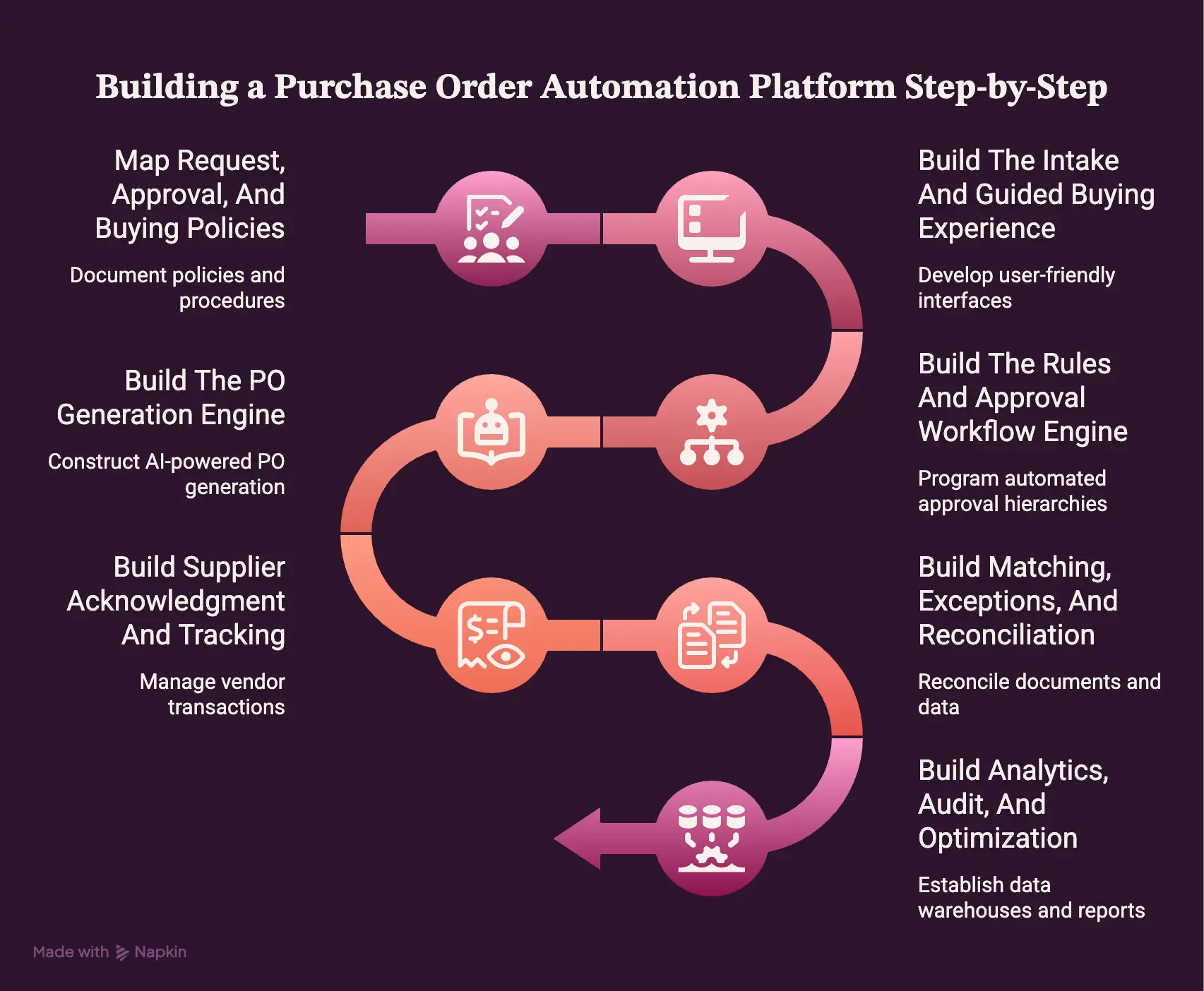
1. Map Request, Approval, And Buying Policies
Document every localized facility route, departmental spend limit, asset category threshold, and operational approval owner across your enterprise footprint.
At the same time, map out hidden exception paths, fallback managers, out-of-office delegation rules, and regulatory audit criteria to establish your software validation parameters.
2. Build The Intake And Guided Buying Experience
Develop dynamic, responsive web interfaces that integrate catalog management PO integration networks alongside standard punch-out modules.
At the same time, connect these frontend inputs to internal inventory databases, preferred vendor indices, and intuitive search functions that steer buyers toward contractually compliant goods.
3. Build The Rules And Approval Workflow Engine
Program an event-driven rules microservice that automatically applies multi-level approval hierarchies to incoming requests based on spend value or department codes.
Consequently, include systemic escalation loops, automated manager substitutions, and push notifications tailored for secure mobile PO approval application development.
4. Build The PO Generation Engine
Construct an AI purchase order generation engine that translates approved requisition strings into legally binding, unalterable commercial documents.
Consequently, implement unalterable sequencing nodes to issue unique purchase order numbers while formatting outputs into standardized XML, PDF, or EDI records.
5. Build Supplier Acknowledgment And Tracking
Create a secure vendor transaction tracking node that manages outbound dispatches and parses returning confirmation data streams cleanly.
At the same integrate automated systems to capture EDI 855 PO acknowledgment automation updates or extract raw email replies via intelligent parsing nodes.
6. Build Matching, Exceptions, And Reconciliation
Deploy a multi-way PO goods receipt invoice matching engine that reconciles line items across shipping documents, invoices, and your base order records.
Additionally, define hard configuration boundaries for cost or item count deviations, and route mismatched data into ring-fenced administrative exception resolution workflows.
7. Build Analytics, Audit, And Optimization
Establish dedicated analytical data warehouses that continuously parse your transactional timelines, spending distributions, and vendor compliance rates.
Also, export secure, read-only system tracking reports that verify process transparency for executive stakeholders and regulatory audit teams.
For a deeper breakdown of adjacent enterprise procurement architecture, see our guide on How to Build an AI Procurement Platform Like Jaggaer.
Developing a transaction-safe procurement platform demands a disciplined, step-by-step structural progression. Ultimately, securing your data modeling and validation layers before deploying automation components prevents systemic integration breakdowns when processing high-volume enterprise transactions.
Design AI Purchase Order Management Controls With Human Review
AI improves purchase order automation by extracting data, classifying spend, recommending suppliers, detecting anomalies, and routing exceptions faster.
However, it must never approve high-risk purchases without strict human-in-the-loop oversight. Consequently, the safest software architecture keeps operational policy decisions completely deterministic while deploying AI strictly for prediction, extraction, ranking, and exception support.
1. Use OCR And NLP For PO Data Extraction
Converting chaotic, unstructured inbound documents into structured database entries is the initial step in automating supplier interactions.
- AI PO data extraction and processing: Eliminates manual administrative keying by instantly identifying structural entity boundaries within documents.
- NLP purchase order document processing: Interprets conversational context within raw business communications to isolate intent, quantities, and delivery dates.
- OCR purchase order scanning and capture: digitizes flat image files and multi-page PDFs into readable, indexable text blocks systematically.
2. Use ML For Classification And Vendor Matching
Intelligent categorization algorithms organize operational spend data while optimizing the front-end guided buying path automatically.
- Machine learning PO data classification: Maps chaotic line-item descriptions to standardized corporate General Ledger (GL) accounts or global UNSPSC codes.
- AI vendor matching and suggestion engine: Cross-references open unassigned requests against active historical databases to highlight the optimal pre-vetted contractual supplier.
3. Use Anomaly Detection For Fraud And Policy Risk
Continuous automated transactional screening protects enterprise capital from external exploits and internal policy evasion.
- Purchase order anomaly detection AI: Establishes behavioral baselines to isolate duplicate requests, unusual price spikes, or suspicious off-hour velocity changes.
- PO fraud detection and prevention software: Cross-checks active bank accounts, routing codes, and supplier profiles against internal records to flag sudden unauthorized changes.
4. Keep Approval Authority With Rules And Humans
Maintaining deterministic boundaries ensures the software remains completely compliant, auditable, and isolated from algorithmic hallucinations.
- Deterministic Policy Rules: Enforce fixed, code-based spend limits and strict multi-facility routing pathways that machine models cannot override.
- Human-in-the-Loop Triggers: Forward transactions to human review queues whenever confidence scores fall below pre-configured thresholds.
5. Monitor AI With MLOps And Drift Checks
Enterprise software requires persistent structural evaluation pipelines to ensure automated categorization accuracy does not decay over time.
- Model Drift & Retraining: Evaluates classification performance against fresh evaluation sets to trigger automated retraining before false-positive rates spike.
- Feedback Integration Loops: Captures daily human exception overrides as structured training points to update downstream inference weights continuously.
Embedding machine learning into a transactional pipeline dramatically accelerates manual processing speeds without sacrificing structural control.
Ultimately, pairing deterministic business logic with predictive intelligence isolates operational risk while unlocking massive scaling efficiencies.
Automate Three-Way Matching, Accruals, And Close
Three-way match automation compares purchase orders, goods receipts, and invoices before a payment is released. The system must support exact matches, tolerance-based parameters, partial receipts, split invoices, missing receipts, price variances, quantity variances, and exception routing pathways.
Consequently, failing to build these flexible edge-case rules into your platform simply moves manual administrative work into another digital queue.
1. Build Two-Way And Three-Way Match Logic
Segmenting transaction validation based on asset types prevents unnecessary operational friction across your procurement categories.
- Two-way match PO automation system: Reconciles invoice pricing and quantities directly against the authorized purchase order for recurring digital services or software licenses.
- Three-way match automation software: Implements line-by-line validation across the PO, the physical goods receipt note (GRN), and the supplier’s incoming invoice for physical items.
2. Build Exception Handling And Resolution Workflows
Isolating discrepant invoices within structured processing tracks preserves operational velocity while protecting organizational capital.
- PO exception handling and resolution workflow: Renders variance logs instantly when unit pricing or line counts exceed pre-configured enterprise thresholds.
- Collaborative Dispute Resolution: Bridges internal buyers, warehouse receivers, and supplier portal networks to resolve shipping deviations transparently.
3. Support Partial Receipts And Split Invoices
A resilient transaction database expects real-world supply chain modifications rather than assuming perfect linear delivery fulfillment.
- Complex Document Mapping: Structures your system to handle one-to-many and many-to-one relationships between purchase orders, partial deliveries, and individual vendor bills.
- Backorder and Shortage Isolation: Keeps unmatched line amounts open for subsequent matching cycles while processing verified delivered values immediately.
4. Automate Accruals For Month-End Close
Replacing manual spreadsheet accounting with programmatic tracking ensures real-time visibility into active corporate liabilities.
- Purchase order accruals management software: Computes unbilled liabilities dynamically at the end of each closing period based on unfulfilled orders.
- Goods Received Not Invoiced (GRNI): Flags delivered items awaiting a final supplier invoice to balance accounting ledgers precisely.
5. Feed Reconciliation Data Back Into Procurement
Closing the looping ledger pipeline turns transactional exceptions into actionable sourcing intelligence for procurement teams.
- Supplier Compliance Scorecards: Aggregates price discrepancies, delivery delays, and quality errors to rate vendor execution over time automatically.
- Master Data Optimization: Flags recurrent item variances to update front-end catalog management systems and contract price frameworks systematically.
True financial automation requires an architecture that natively masters complex, non-linear matching exceptions. Ultimately, binding precise matching logic to month-end close systems transforms accounts payable from a reactive processing unit into a predictable strategic asset.
Healthcare PO Automation Software Development Rules
Healthcare purchase order automation software development must support hospital purchasing networks, clinical supply chains, GPO contracts, medical device tracking, pharmacy rules, capital equipment approvals, sterile processing supplies, PHI-safe workflows, and audit-ready procurement records.
Consequently, isolating your clinical compliance rules within an independent transactional layer ensures continuous patient care while strictly enforcing institutional purchasing governance.
Healthcare-Specific Procurement Compliance Matrix
| Regulatory & Supply Domain | Core Architectural Requirements | System Components & Logic Layers | Relevant Compliance Standards |
| Sourcing & GPO Contracts | Enforces real-time tier validation against group agreements to eliminate pricing discrepancies. | • GPO contract-based PO automation in healthcare
• Hospital purchasing system PO automation • Tiered-pricing logic validators |
• Healthcare Financial Management Association (HFMA)
• National Uniform Billing Committee (NUBC) |
| Clinical Supply Routing | Directs surgical, sterile, and clinical items based on medical necessity and strict hospital formularies. | • Clinical supply chain PO automation software
• Formulary-based PO routing automation healthcare • Surgical supply PO automation platform |
• The Joint Commission purchasing standards software
• Sterile processing PO management software |
| Controlled Substances | Monitors and audits medical device batches, serialization codes, and specialized pharmaceutical runs. | • Pharmaceutical purchase order management system
• Controlled substance PO compliance tracking • Medical device PO compliance tracking software |
• FDA purchasing compliance automation in healthcare
• DEA Controlled Substances Act (CSA) Title II |
| Data Privacy & Architecture | Restricts viewing, auditing, and storage parameters for items tied directly to patient details or clinical case codes. | • HIPAA-compliant purchase order data management
• BAA-compliant PO processing platform • PHI-safe PO data architecture design |
• HHS Business Associate Agreement (BAA) Rules
• HITECH Omnibus Rule provisions |
Developing a healthcare procurement application demands deep integration between compliance parameters and basic transaction engines.
Ultimately, building a system that natively enforces GPO contract boundaries and data privacy criteria prevents regulatory exposures while protecting razor-thin clinical operational margins.
PO Automation Development Cost: $70K-$300K By Build Phase Today
Purchase order automation software development usually costs $70,000–$300,000, depending on workflow complexity, ERP integrations, EDI requirements, AI models, healthcare compliance, SaaS architecture, and multi-entity scale.
A simple internal workflow build sits near the lower end, while AI-native healthcare or fintech platforms sit near the upper end.
Consequently, framing your initial capital allocation around explicit project parameters ensures predictable development timelines without scope creep.
Cost Breakdown By Development Phase
| Development Phase | Estimated Cost Range |
| Discovery, workflow mapping, and technical architecture | $7,000–$18,000 |
| PO data model and database architecture | $10,000–$28,000 |
| Intake, guided buying, and PO generation | $18,000–$45,000 |
| Approval workflow and rules engine | $15,000–$40,000 |
| ERP, P2P, AP, inventory, and CLM integrations | $20,000–$75,000 |
| EDI 850/855 and supplier portal workflows | $15,000–$45,000 |
| AI extraction, classification, anomaly detection | $18,000–$60,000 |
| Healthcare compliance, audit trails, RBAC, security | $15,000–$50,000 |
| Analytics dashboards and reporting | $8,000–$25,000 |
| QA, DevOps, CI/CD, deployment, UAT | $12,000–$35,000 |
1. MVP Cost Range: $70,000–$110,000
Building a minimum viable product works best for organizations operating under a single legal entity with a centralized procurement group.
- Functional Scope: Includes limited, single-threaded approval rules, standard PO document generation capabilities, and simple analytical dashboards.
- System Connections: Features one direct accounting or legacy ERP platform link without complex EDI communication pipes.
2. Production Platform Cost Range: $120,000–$220,000
A full production system scales to accommodate multi-site corporate operations and deep financial reconciliation processes cleanly.
- Functional Scope: Deploys sophisticated multi-step approval pathways, automated supplier acknowledgment capture nodes, and comprehensive three-way matching logic.
- Governance Layers: Enforce strict role-based access controls, unalterable system logs, and complete version histories for change orders.
3. Enterprise Healthcare Or SaaS Cost Range: $220,000–$300,000
Regulated enterprise architectures require dedicated security compliance infrastructure and advanced algorithmic tracking engines.
- Functional Scope: Implements dynamic GPO tiered-pricing contract logic, FDA purchasing controls, and automated clinical formulary-based routing pathways.
- System Integrity: Deploys white-label multi-tenant SaaS frameworks, active MLOps monitoring pipelines, and fully PHI-safe data security designs.
4. Ongoing Maintenance Cost: 15%–25% Per Year
Persistent system upkeep ensures your procurement infrastructure remains insulated from external framework changes and api breakage.
- Integration Stability: Covers continuous updates required by upstream ERP system version upgrades and external supplier network API modifications.
- System Security: Funds routine regulatory compliance tracking updates, server performance optimizations, and security patch deployment pipelines.
Download the PO Automation Build Cost Checklist to estimate your workflow, AI, EDI, ERP, healthcare compliance, and SaaS architecture budget before you scope development.
Allocating your software engineering budget by functional modules prevents cost overruns during the build phase. Ultimately, defining your integration requirements early ensures you select the correct cost track matching your specific operational footprint.
H2: Build Purchase Order Automation Software With Intellivon Now
Build purchase order automation software with Intellivon when your organization needs more than a generic PO approval tool.
Intellivon builds governed, integration-ready systems for enterprises and SaaS founders requiring AI-powered processing, ERP orchestration, healthcare compliance, fintech controls, and production-grade workflow automation.
- Architecture-First Engineering: We build event-driven microservices coupled with secure API gateways, ensuring absolute system uptime and unalterable audit trails.
- Healthcare Sourcing Depth: Our platforms natively enforce GPO tiered-pricing contract boundaries, clinical formularies, and fully PHI-safe data architectures.
- Resilient Ecosystem Integrations: We establish bidirectional synchronization pipelines across SAP MM, Oracle Fusion, Workday, NetSuite, and B2B EDI 850/855 trading networks.
Talk to Intellivon’s procurement automation experts to scope your PO workflow, estimate your build cost, and decide whether custom development is the right move.
Conclusion
Building a custom purchase order automation system shifts procurement from a reactive administrative burden into a proactive financial control center.
By designing a resilient data model, decoupling microservices, and integrating predictive AI alongside strict deterministic rules, large organizations can systematically eliminate maverick spend, accelerate approvals, and automate complex multi-way matching.
Ultimately, this tailored infrastructure ensures absolute ledger accuracy, complete regulatory compliance, and protected corporate operating margins with every transaction.
FAQs
Q1. Why Does ERP Not Already Solve Purchase Order Automation?
A1. Enterprise resource planning software efficiently stores final transactional records. However, it typically lacks intuitive front-end intake governance and flexible communication rails. Consequently, teams frequently find unmonitored orders floating outside the system because strict policy enforcement must happen before data entry occurs. Therefore, organizations use ERPs as static ledgers while deploying automation platforms as active workflow-control layers.
Q2. How Much Does Purchase Order Automation SaaS Platform Development Cost?
A2. A multi-tenant purchase order automation SaaS platform development cost usually scales from $120,000 to $300,000. Although a single-entity internal MVP can start lower, a commercial SaaS product demands tenant isolation databases, usage controls, and customer admin panels. As a result, building enterprise-grade multi-entity configuration options pushes capital requirements toward the higher end.
Q3. How Long Does It Take To Build Automated PO Processing?
A3. Engineering an initial functional procurement MVP typically requires ten to fourteen weeks of active development. Subsequently, a complete production enterprise build takes four to seven months to launch cleanly. Ultimately, implementing highly regulated healthcare architectures or multi-tenant SaaS platforms with complex EDI pipes extends the timeline to seven to ten months.
Q4. Can PO Automation Handle Blanket And Scheduled Orders?
A4. Yes, but the underlying system must explicitly model long-term release schedules, cumulative contract limits, and real-time consumption rates. This data depth is exceptionally critical when managing high-volume facility inputs or recurring clinical supply lines. Consequently, the architecture tracks rolling drawdowns systematically to prevent organizations from accidentally exceeding pre-negotiated contractual caps.
Q5. Should Founders Build Workflow-First Or AI-First?
A5. Founders should build workflow-first because enterprise buyers fundamentally require predictable control, hierarchical approvals, and reliable accounting syncs. Conversely, constructing an AI-first platform makes sense only if your core differentiation rests entirely on extraction or classification models. Ultimately, the most successful software products combine deterministic rule engines with assistive predictive layers.
Key Takeaways
- PO automation creates the most value before the invoice arrives because spend control starts at the buying commitment.
- A three-way match engine fails when PO line data, receipts, supplier acknowledgments, and tolerance rules are not modeled correctly.
- Healthcare PO automation needs GPO, FDA, formulary, BAA, and facility-level controls that generic tools rarely handle well.
- AI should classify, extract, recommend, and detect anomalies. It should not replace deterministic approval and compliance rules.
- A realistic enterprise PO automation build costs $70,000–$300,000, with maintenance at 15%–25% per year.