Key Takeaways:
- Clinician retention platforms must reduce scheduling friction, documentation burden, inbox overload, and unsafe workloads.
- Self-scheduling, workload balancing, ambient AI documentation, and predictive burnout scoring are core platform features.
- HRIS integration, EHR integration, HIPAA controls, and retention ROI dashboards are non-negotiable production requirements.
- Custom clinician retention platforms cost $120,000 to $420,000 depending on integrations and AI model depth.
- How Intellivon builds retention platforms as clinical workforce infrastructure, not generic HR employee engagement tools.
The retention platform features that reliably reduce clinician turnover fall into three categories, which include scheduling automation, AI-driven documentation reduction, and predictive burnout scoring. Together, these target the core operational pain driving attrition. Clinicians leave because of daily workflow friction, and the right retention platform features address that friction at the source.
Without those features sharing a single data layer, each one operates in isolation and misses the actual retention signal. Health systems that connect scheduling data, documentation time, and inbox volume into one integrated burnout risk score see turnover rates drop 18 to 24% within 12 months. That difference is what separates a platform that flags attrition from one that prevents it, and what rebuilds clinician trust in the institution that deploys it.
Intellivon has spent over 10 years building workforce intelligence platforms for health systems, using feature architectures where scheduling, documentation reduction, and burnout prediction share a unified data layer. That integration approach is what this blog maps out. By the end, you will know which features to prioritize, how they connect, and what outcomes to measure.
Why Generic Retention Platform Features Do Not Fit Healthcare
Generic retention platform features fail because they measure how employees feel rather than what the clinical workday demands. Therefore, healthcare workforce stability requires a specialized clinician retention platform feature checklist designed around live operational signals.
Clinicians do not resign over a lack of engagement surveys; consequently, they leave due to scheduling friction, documentation fatigue, and unsafe staffing ratios.
1. Clinical Retention Platform
| Generic Employee Retention Software | Clinician Retention Platform |
| Pulse surveys | Pulse surveys plus workload signals |
| Recognition | Recognition plus clinical milestone recognition |
| Performance reviews | Competency management and credentialing automation |
| Engagement dashboards | Retention risk dashboard features |
| Manager feedback | Clinical workload and burnout intervention workflows |
| HRIS integration | HRIS, payroll, EHR, scheduling, LMS, and credentialing system integration |
2. Advanced Scheduling Automation & Workload Balancing
This module replaces manual scheduling with predictive, fair shift allocation to stabilize clinical teams. Specifically, the platform ingests live EHR and HRIS data via secure APIs to track flexible scheduling features clinical teams require daily.
As a result, the core engine applies automated workload balancing to match live patient acuity with specific staff skill levels.
- Monitors staffing ratio and patient load distribution features automatically.
- Tracks overtime, which clinical leads use to evaluate fatigue risk management features.
- Intellivon builds custom scheduling engines that utilize deterministic machine learning models.
- This approach ensures shift allocations adapt instantly to real-time clinical demands.
3. Documentation & EHR Burden Reduction
This feature set deploys ambient AI documentation retention tools to eliminate exhaustive administrative tasks.
For example, the system integrates a secure ambient AI clinical scribe retention impact module that captures natural patient conversations. It then processes audio into structured, compliant clinical notes to ensure click burden reduction and EHR compliance.
- Features include inbox management automation and message management clinical features to sort messages.
- Includes prior authorization burden reduction protocols, order entry automation retention, and medication reconciliation features.
- Deploys clinical documentation improvement retention algorithms and specialized CDI workflow features automatically.
- Intellivon develops secure, HIPAA-compliant ambient audio pipelines that run on dedicated cloud instances.
3. Predictive Burnout Scoring & Sentiment Analysis
This system detects early attrition risks by analyzing passive operational signals across the hospital network.
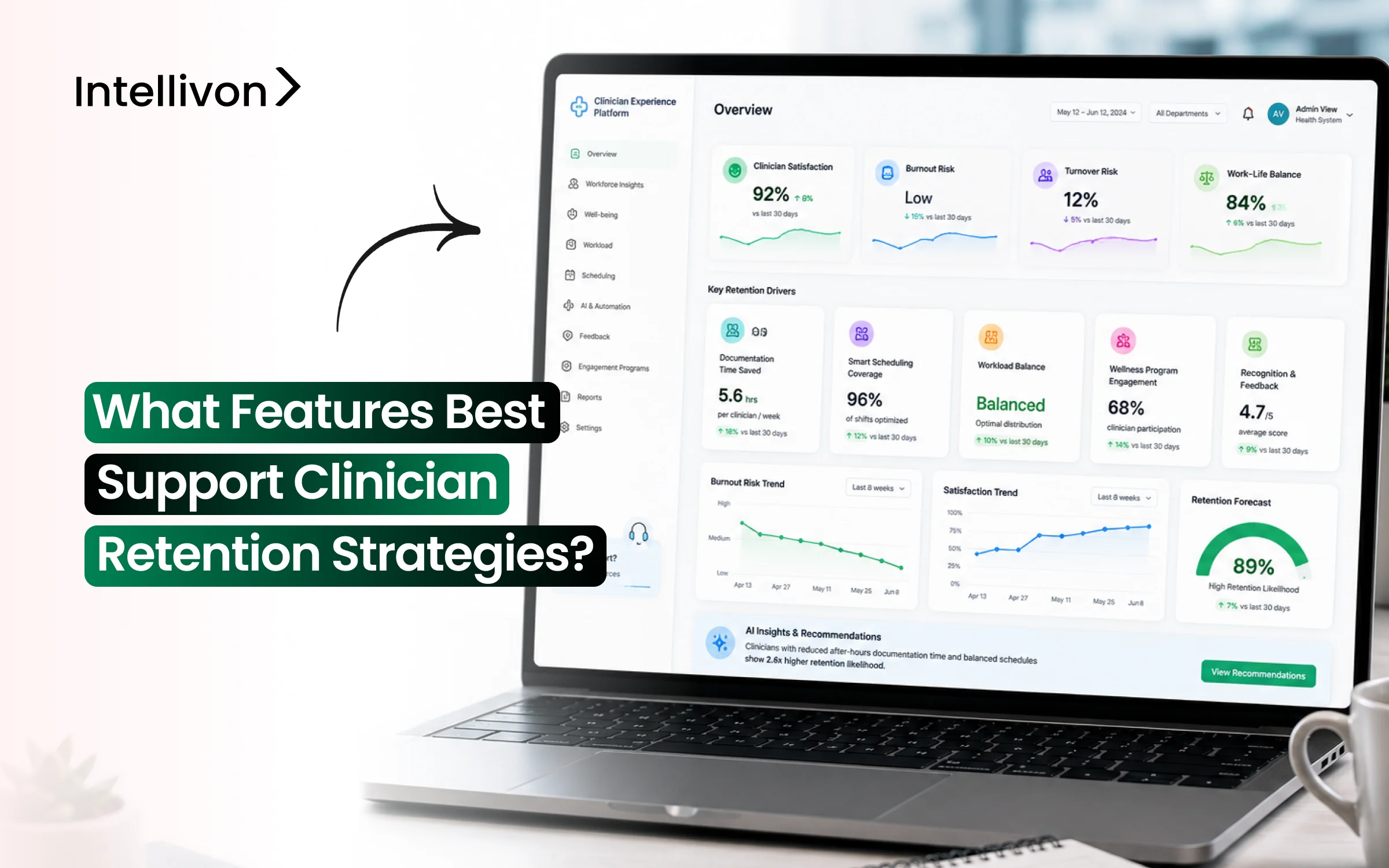
Consequently, the platform uses predictive burnout scoring features to flag clinicians experiencing high after-hours charting or denied leave. It combines these operational metrics with automated pulse survey platform features to generate a real-time burnout risk detection AI model.
- Uses clinician sentiment analysis features to monitor staff engagement measurement features securely.
- Aggregates data into comprehensive retention risk dashboard features and predictive turnover modeling.
- Automates stay interview automation and exit interview analytics features to measure attrition risk scoring features.
- Intellivon builds secure, non-intrusive sentiment pipelines that analyze workflows without tracking personal communication.
Standard HR tools fail in healthcare because they cannot track or fix the operational friction that drives clinicians to quit. Technology only improves workforce retention when it addresses actual workspace stressors like documentation weight and unfair scheduling.
Building a specialized feature framework around the clinical workday is the only viable path to long-term operational stability.
The Market Opportunity Behind Clinician Retention Technology Features
Clinician retention technology features are becoming a major infrastructure investment because healthcare workforce management is now an urgent cost, safety, and capacity issue. Therefore, the healthcare workforce management system market is projected to reach $4.5 billion by 2030, growing at a 13.2% CAGR from 2024 to 2030.
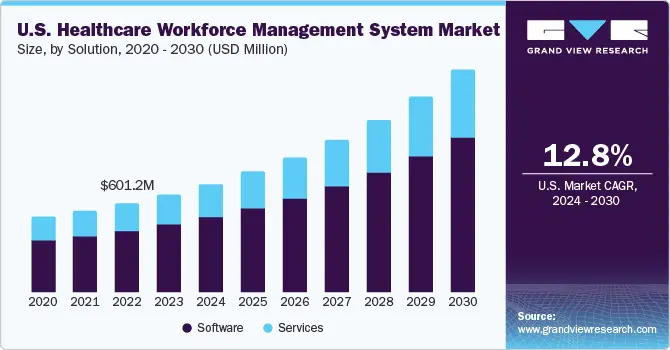
As a result, hospitals need comprehensive platforms that connect staffing, scheduling, workload, engagement, documentation, and career development so leaders can reduce turnover before it becomes a vacancy problem.
- Healthcare workforce retention protects operational margins, care continuity, patient satisfaction, and service-line capacity.
- Turnover costs $2,000–$6,000 per nurse in replacement expenses while directly impacting patient clinical outcomes.
- Hospitals are buying stability infrastructure that connects staffing patterns, burnout signals, and measurable financial outcomes.
- The platform delivers 9 interconnected feature groups spanning scheduling autonomy, workload balancing, and onboarding automation.
The market is moving away from basic engagement dashboards toward systems that fix real clinical workflow friction.
Consequently, technology only improves workforce retention when it addresses actual workspace stressors like documentation weight and unfair scheduling. Building a specialized feature framework around the clinical workday is the only viable path to long-term operational stability.
The Core Retention Platform Features Healthcare Leaders Should Prioritize
The best retention platform features for healthcare reduce turnover by acting on controllable workplace stressors. Therefore, the highest-impact features include scheduling automation, workload balancing, documentation support, inbox automation, burnout prediction, career development, onboarding, peer recognition, stay interviews, and retention ROI analytics.
When hospitals evaluate healthcare staff retention software features, they must focus entirely on clinical workflow features that reduce turnover. Consequently, evaluating these technology features for clinician retention based on daily utility ensures that the system directly prevents staff exhaustion.
| Feature Category | Must-Have Capabilities | Retention Impact |
| Scheduling | Self-scheduling, shift swap automation, on-call management features, leave request automation | Improves autonomy and work-life balance |
| Workload | Patient assignment optimization features, staffing ratio monitoring features, fatigue risk management features | Reduces unsafe load and burnout |
| Documentation | Ambient AI documentation retention, AI clinical scribe retention impact, click burden reduction EHR | Reduces after-hours work |
| Inbox and Admin | Inbox management automation features, message management clinical features, prior authorization burden reduction | Reduces cognitive overload |
| Burnout Prediction | Predictive burnout scoring features, attrition risk scoring features, predictive turnover modeling | Supports earlier intervention |
| Engagement | Clinician sentiment analysis features, pulse survey platform features, real-time feedback features, clinical | Gives leaders live signals |
| Career Growth | CME tracking features, competency management features, mentorship program management features | Reduces advancement-related exits |
| Onboarding | Clinical orientation automation, preceptorship management features, new hire integration features | Improves first-year retention |
| Communication | Clinical messaging platform features, SBAR communication features, handoff communication features | Improves team safety and trust |
| Governance | HIPAA-compliant retention platform features, role-based access retention platform, audit trail retention tools | Protects privacy and compliance |
The feature list should not be evaluated by quantity. It should be evaluated by whether each feature changes the work conditions linked to turnover. If a feature does not reduce friction, support autonomy, or improve safety, it belongs in the second phase.
Scheduling Automation Is the Highest-Visibility Nurse Retention Feature
The best features for nurse retention platform design include self-scheduling, shift swap automation, schedule fairness rules, overtime tracking, time off management, leave request automation, and staffing-ratio guardrails. Scheduling automation supports nurse retention because it gives staff more control without weakening unit coverage.
Consequently, hospitals must move away from manual spreadsheets toward flexible scheduling features clinical teams can use on demand. As a result, automated scheduling serves as a visible defense against the daily burnout that drives nurses away.
1. Shift Autonomy & Self-Scheduling Features
This structural capability gives nurses direct control over their time through modern self-scheduling platform features. Specifically, the system allows individuals to choose their shifts digitally while satisfying the unit’s core coverage rules. Therefore, this autonomy drastically reduces scheduling conflicts, which the NSI National Health Care Retention Report highlights as a primary driver of hospital resignations.
- Uses shift management automation features to open unassigned slots to qualified staff transparently.
- Maintains strict alignment with the flexible work frameworks found in Canada’s Nursing Retention Toolkit.
- Enables automated, rule-based shift swap automation so nurses can trade days without manager delays.
- Intellivon creates API-driven scheduling interfaces that sync smoothly with enterprise HRIS platforms.
2. Guardrails, Fairness, & Compliance Rules
This architectural layer checks every requested schedule change against complex operational constraints automatically. For example, according to implementation tracking by America’s Essential Hospitals, self-scheduling succeeds only when it balances nurse preferences with strict safety guardrails. Consequently, the platform enforces schedule fairness features by evaluating weekend, holiday, and on-call distribution across the entire department.
- Validates every single shift assignment against live union rules, licensure status, and core specialty skills.
- Monitors patient acuity data alongside staffing ratio monitoring features to keep nurse assignments completely safe.
- Uses overtime tracking features clinical leads rely on to block shifts that breach dangerous fatigue risk thresholds.
- Intellivon builds deterministic rule validation engines that process thousands of scheduling combinations in milliseconds.
3. Balanced Time Off & Balance Monitoring
This module uses leave request automation to handle vacation and time off management features without creating department shortages. Specifically, the software analyzes historical patterns to predict future coverage needs before approving time off requests. As a result, the system maintains work-life balance monitoring features by alerting leadership when a clinician has gone months without a break.
- Automates holiday request queuing based on past schedules to eliminate favoritism complaints.
- Maintains a real-time view of safe department staffing minimums during high-volume vacation seasons.
- Integrates on-call management features directly with leave requests to prevent unexpected coverage gaps.
- Intellivon engineers predictive coverage models that forecast seasonal staffing needs up to six months in advance.
Scheduling is the feature clinicians feel first. If the platform makes schedules fairer, easier to trade, and safer to approve, retention improves before any survey campaign begins. Silently optimizing this operational loop shows your staff that you respect their time and their well-being.
EHR Features That Improve Clinician Retention Reduce After-Hours Work
EHR features that improve clinician retention remove repetitive documentation work from the physician and nurse day. High-impact features include ambient AI documentation, clinical note drafting, message routing, order entry support, medication reconciliation features, care plan automation, and click burden reduction inside Epic or Cerner workflows.
Therefore, hospitals must implement documentation burden reduction features and EHR usability improvement features directly into the daily clinical experience. Consequently, these changes ensure that your healthcare providers do not spend their evenings typing notes at home.
For a deeper breakdown of documentation automation economics, see our guide on How Much Does It Cost To Build Ambient AI Documentation?.
1. Ambient AI Scribing & Direct EHR Usability
This system uses an advanced ambient AI clinical scribe retention impact module to draft accurate clinical notes automatically during patient visits. Specifically, the technology listens to the natural conversation and formats it instantly, which reduces the need for manual data entry.
Therefore, this capability delivers massive click burden reduction EHR benefits that allow clinicians to focus entirely on their patients.
- Enables highly reliable ambient AI documentation retention by capturing complex medical dialogues without a screen.
- Lowers cognitive task load significantly so doctors can remain present during physical examinations.
- Decreases overall time spent on note composition by over 15% according to UChicago Medicine.
- Intellivon creates custom ambient speech pipelines that integrate directly into existing mobile application environments.
2. Clinical Documentation Improvement & Quality Compliance
This layer automates clinical documentation improvement retention tasks to make sure every note meets necessary regulatory guidelines without extra effort. For example, the software runs specialized CDI workflow features to flag missing details before a chart is locked.
As a result, the platform satisfies complex quality measure documentation features automatically to protect hospital revenue.
- Simplifies MACRA MIPS documentation burden reduction by compiling performance metrics behind the scenes.
- Generates accurate data for value-based care documentation features without adding extra drop-down menus.
- Saves thousands of documentation hours, mirroring the 15,791 hours saved annually by Kaiser Permanente.
- Intellivon builds specialized verification algorithms that double-check compliance rules without interrupting clinical workflows.
3. Workflow Automation & Clinical Order Entry
This feature group uses advanced order entry automation retention tools to speed up standard data processing tasks for nursing teams. Specifically, the system manages intensive medication reconciliation features by cross-referencing past pharmacy data with current electronic records.
Consequently, these automated care plan automation features save precious minutes during highly critical transition periods.
- A recent JAMIA Open ambient AI study showed 81% found their workflow became easier.
- The same study noted 73% of clinicians reported less documentation outside clinical hours.
- Around 67% reported reduced burnout risk, while 64% experienced higher overall work satisfaction.
- Intellivon develops secure background automation scripts that safely sync clinical orders between multiple hospital databases.
Documentation automation should never remove clinician control. It should make clinicians editors and approvers instead of full-time note writers. That difference matters because retention improves when technology gives time back without creating new clinical risk.
Message Automation Reduces Hidden Burnout
AI features for physician retention should target the invisible administrative work that follows every patient encounter. Specifically, inbox triage, patient portal message drafting, refill routing, prior authorization evidence collection, and task escalation help reduce the cognitive load that often causes physicians to work after clinic hours. Therefore, deploying advanced message management clinical features ensures that doctors can focus completely on diagnosing and treating patients.
For a deeper breakdown of prior authorization automation, see our guide on How to Build an AI Prior Authorization Platform.
1. Smart Triage & Inbox Management Automation
This module implements inbox management automation features to clear out the constant noise inside clinical messaging platform channels. Specifically, the system processes incoming records using natural language algorithms to distinguish between critical medical concerns and simple administrative questions.
As a result, this intelligent categorization forms the foundation of clinical workflow automation features that save hours of manual sorting.
- Routes simple prescription refills, laboratory questions, and referral updates directly to the proper operational queue.
- Classifies patient portal messages dynamically based on context, urgency, source, and required medical action.
- Minimizes message clutter so urgent patient changes stand out clearly to the on-duty care team.
- Intellivon designs deterministic data routers that integrate securely with standard enterprise healthcare communication networks.
2. Prior Authorization & Document Pre-Check
This capability offers targeted prior authorization burden reduction by gathering necessary clinical evidence automatically from the patient chart. For example, when an insurance provider requests justification for a procedure, the software highlights the exact supporting text instantly.
Consequently, this automation reduces administrative delays without removing the physician from final medical review.
- Extracts relevant history and summarizes medical necessity according to insurance guideline rules.
- Flags missing documentation or diagnostic gaps before a claim is submitted to the payer.
- Accelerates approval workflows to keep complex care plans moving forward without structural delays.
- Intellivon creates background processing engines that parse unstructured chart notes with high clinical accuracy.
3. Compliant Safety Reporting Automation
This system deploys safety reporting automation features to make tracking medical anomalies effortless for frontline nursing staff. Specifically, the platform uses intelligent forms to capture incident reporting features and near-miss reporting features without long questionnaires.
Therefore, this streamlined approach encourages transparent data gathering while maintaining psychological safety features across all units.
- Connects care team collaboration tools with incident reporting logs to capture context automatically.
- Simplifies regulatory compliance reporting by autofilling standard institutional safety forms behind the scenes.
- Improves clinical team communication features by sharing resolved safety updates back with the floor.
- Intellivon builds encrypted, role-based safety pipelines that protect sensitive hospital quality improvement data.
Inbox work is retention work because it follows clinicians home. A platform that reduces message clutter and prior authorization friction directly protects physician time. That makes it one of the clearest AI workforce retention features healthcare leaders can fund.
Burnout Prediction Should Support Clinicians
Predictive burnout scoring features can support retention when they operate at the team and workflow level first. Specifically, the safest approach combines EHR activity logs, scheduling strain, overtime, message volume, sentiment trends, and workload signals while avoiding punitive individual surveillance or opaque employment decisions.
Retention analytics can easily feel like monitoring if handled badly. Therefore, hospitals must implement a burnout risk detection AI system built on trust and absolute transparency. As a result, tracking these trends helps leaders fix systems rather than blame individual clinicians.
1. Data Processing & Machine Learning Foundations
This analytical framework applies predictive turnover modeling to spot systemic workplace stress patterns across different hospital units. Specifically, the platform uses gradient boosting for attrition risk scoring alongside time-series models to evaluate overtime and workload trends.
It combines these operational metrics with NLP sentiment analysis to review anonymous pulse survey text securely.
- Uses specialized EHR activity models to track after-hours data entry burden without reviewing private communications.
- Deploys an explainability layer using SHAP (Shapley Additive exPlanations) values to highlight specific stress drivers clearly.
- Ensures a human-in-the-loop review occurs before leadership makes any system or operational adjustments.
- Intellivon designs explainable machine learning pipelines that isolate system-level friction without creating secret productivity scores.
2. Privacy-by-Design Governance & Regulatory Compliance
This system enforces strict privacy-by-design guidelines to make sure data collection never feels invasive to frontline workers. For example, the software displays team-level dashboards by default and requires minimum cohort thresholds to protect individual identities.
Consequently, this architecture fully aligns with trustworthy framework rules established by the NIST AI Risk Management Framework.
- Follows the EEOC algorithmic fairness guidance to prevent bias during workforce retention modeling.
- Protects patient privacy by managing EHR signals under strict HHS HIPAA compliance rules.
- Maintains immutable audit logs for dashboard access to control exactly who sees retention risk data.
- Intellivon embeds zero-knowledge data masking techniques within the core platform database layer.
3. Transparent Engagement & Support Tools
This operational layer combines clinician sentiment analysis features with work-life balance monitoring features to provide real-time support. Specifically, the platform replaces long annual questionnaires with brief, actionable staff engagement measurement features. Therefore, this live data gives leaders the exact insights they need to adjust heavy shift rotations instantly.
- Provides clear, clinician-facing transparency so staff members understand how the software calculates risk.
- Maintains a secure retention risk dashboard feature view that highlights resource shortages across units.
- Triggers voluntary wellness support outreach when department-wide fatigue metrics cross safe limits.
- Intellivon creates simplified, highly scannable dashboard views designed for busy nursing and medical directors.
Burnout prediction should act like an early-warning safety system. It should help leaders reduce workload strain, not rank clinicians. That distinction will decide whether staff trust or reject the platform.
Career Development Features Keep Clinicians From Leaving to Grow
Career development features healthcare leaders should prioritize include CME tracking, competency management, mentorship matching, clinical ladder visibility, 360-degree feedback clinical workflows, internal mobility, and credentialing automation. These features reduce turnover when clinicians can see a future without leaving the organization.
According to recent NSI National Health Care Retention data, lack of career advancement and education consistently rank among the top reasons clinicians resign. Therefore, making professional growth visible and structured directly counters these costly attrition trends.
1. Clinical Ladder Visibility & Skill Management
This module maps out professional progression paths by pulling data from human resource systems and learning platforms simultaneously. Specifically, the system displays what each clinician needs to reach the next tier on their clinical ladder.
For example, a med-surg RN can log in and immediately see the exact parameters required to transition into the ICU environment.
- Displays required competency management features and outstanding preceptor hours within a single view.
- Highlights open training slots and tracks ongoing continuing education integration features automatically.
- Calculates exact timelines to eligibility alongside expected pay-band changes for the new clinical role.
- Intellivon builds unified database schemas that link disparate hospital learning software to main employee profiles.
2. Continuing Education & Credentialing Automation
This feature set manages academic compliance by embedding CME tracking features directly into the clinician’s core scheduling dashboard. Specifically, the software alerts staff to upcoming certificate expirations before they cause scheduling conflicts on the floor.
Consequently, the platform uses advanced credentialing automation features to verify newly completed training modules without manual paperwork delays.
- Cross-references completed educational credits against state licensing board rules automatically.
- Reduces administrative friction for medical staff offices during annual credentialing review cycles.
- Allows clinicians to upload proof of compliance via a simplified mobile interface.
- Intellivon creates automated verification workers that parse educational transcripts with high accuracy.
3. Peer Support & Structured Performance Feedback
This system enhances workplace culture by organizing modern performance feedback features that clinical leads can deploy easily. Specifically, the platform runs anonymous 360-degree feedback clinical loops that focus on teamwork and professional capabilities.
As a result, these insights connect with peer recognition platform features to build psychological safety across shifts.
- Coordinates mentorship program management features to pair new hires with experienced clinical veterans.
- Automates clinical milestone recognition to celebrate career longevity and specialized certifications.
- Maintains a secure peer support network features directory to help staff manage workspace stress.
- Intellivon designs lightweight, non-intrusive feedback interfaces that take less than two minutes to complete.
Hospitals often lose clinicians because career movement is easier outside the system than inside it. A retention platform should make internal growth visible, structured, and achievable. By digitizing the clinical ladder, you allow your staff to build a long-term career right inside your network.
Onboarding and Preceptorship Features Protect First-Year Retention
Onboarding automation features protect retention because first-year clinicians are most vulnerable to overload, unclear expectations, and weak support. Therefore, a strong platform should manage clinical orientation automation, preceptorship matching, competency sign-offs, milestone check-ins, new hire integration features, and early burnout risk signals.
According to the 2026 NSI National Health Care Retention Report, 22.7% of all newly hired RNs leave within their first twelve months, while first-year exits account for 29% of all RN separations.
Consequently, failing to support new hires turns onboarding costs into recurring losses that compress your hospital’s operating margins.
1. Structured Timelines & Unit-Specific Paths
This operational layer establishes clear, step-by-step training milestones based on a clinician’s specific role and assigned unit. Specifically, the software builds an interactive onboarding timeline that guides new hires through critical compliance and learning check-ins.
As a result, this clear roadmap removes the daily confusion that frequently causes fresh graduates to exit during their first ninety days.
- Week 1: Manages digital access, compliance policies, and core unit workflows through automated portals.
- Weeks 2–4: Coordinates direct shadowing schedules and handles essential preceptor validation tasks.
- Months 2–3: Tracks regular competency management features and logs clinical sign-offs automatically.
- Months 4–6: Calculates precise workload readiness scoring metrics based on live charting activity.
- Months 6–12: Triggers stay interview automation and populates long-term professional development maps.
- Intellivon develops precise, rule-based tracking pipelines that integrate seamlessly with legacy hospital LMS platforms.
2. Preceptorship Management & Competency Validation
This feature group uses automated preceptorship management features to pair incoming clinical staff with the most suitable veteran educators. Specifically, the platform monitors teacher availability, shift alignments, and background competencies to prevent scheduling conflicts during the instruction loop.
Therefore, this proactive coordination keeps training pathways completely structured and consistent across all departments.
- Matches new hires with available unit mentors based on shift schedules and specific nursing specialties.
- Logs skill progression directly within the system to satisfy regulatory credentialing requirements.
- Provides automated prompts to preceptors for fast, objective review of a candidate’s clinical capabilities.
- Intellivon creates custom matching engines that evaluate multi-variable shift and certification data in real time.
3. Real-Time Feedback & Connection Networks
This system implements real-time feedback features clinical leads can use to spot early signs of new hire frustration. For example, the software deploys short, non-intrusive pulse checks at the end of an orientation block to gather immediate impressions.
Consequently, these quick checkpoints connect with a secure peer support network features directory to protect staff wellness from day one.
- Flags uncompleted milestones or high overtime patterns to identify individuals experiencing rapid exhaustion.
- Automates clinical milestone recognition to celebrate successful independent shift transitions and orientation completions.
- Allows frontline staff to request quick check-ins with their designated mentorship leads via a mobile device.
- Intellivon designs highly sensitive, non-intrusive sentiment tools that protect individual provider privacy during data collection.
Retention does not start when someone becomes disengaged. It starts the day they accept the offer. A platform that supports the first year can prevent turnover before it becomes a resignation.
Enterprise Clinician Retention Platform Features Need This Architecture
Enterprise clinician retention platform features require a modular architecture that connects clinical, workforce, HR, and AI systems. Therefore, the core layers include data ingestion, identity resolution, rules engines, AI models, workflow orchestration, dashboards, compliance controls, and MLOps monitoring.
When hospitals deploy modern stability software, they must ensure complete interoperability across all legacy software systems. As a result, this integrated approach converts siloed administrative data into live, actionable retention signals across the health network.
| Layer | What It Does | Example Inputs |
| Data Ingestion | Pulls structured and unstructured data | EHR, HRIS, payroll, LMS, scheduling, credentialing |
| Identity & Role Mapping | Links clinicians to roles and permissions | NPI, employee ID, unit, specialty |
| Workflow Rules Engine | Applies staffing and policy logic | Union rules, fatigue limits, credential rules |
| AI Model Layer | Predicts risk and automates support | Attrition, burnout, sentiment, documentation |
| Workflow Orchestration | Sends tasks to the right owner | Manager, HR, CNO, scheduler, educator |
| Dashboard Layer | Shows retention signals | Turnover, overtime, workload, engagement |
| Compliance Layer | Controls access and auditability | RBAC, audit logs, PHI controls |
| MLOps Layer | Tracks model drift and performance | Model versions, fairness metrics, alerts |
For a deeper breakdown of AI-enabled EHR infrastructure, see our guide on Building Smart EHR Systems with AI Capabilities.
1. Unified Ingestion & Deep System Integration
This architectural layer establishes reliable data pipelines by executing comprehensive HRIS integration features across your hospital network. Specifically, the system utilizes secure API managers to handle payroll integration, retention platform loops alongside learning management system integration pipelines.
Consequently, this deep synchronization powers the core engine by feeding historical workforce trends into the centralized analytics dashboard.
- Deploys real-time EHR integration retention features to monitor daily clinical activity loops without friction.
- Builds custom connectors to ingest data seamlessly from standard Epic workflow retention features.
- Maintains consistent background compatibility with legacy databases via targeted Cerner integration retention scripts.
- Intellivon creates highly optimized data pipelines that aggregate millions of transactional labor entries safely.
2. Intelligent Rules & Processing Foundations
This core engine evaluates live workforce behavior against complex organizational policies and local labor laws. For example, the software runs scheduling metrics through a strict validation block to guarantee compliance with union rules.
Therefore, the processing layer identifies individuals approaching extreme fatigue thresholds before additional shifts are assigned to their queue.
- Maps National Provider Identifiers (NPI) directly to individual employee IDs to track role permissions.
- Cross-references current scheduling assignments with credentialing system integration features to confirm compliance.
- Evaluates unit-specific staffing ratios dynamically based on live inpatient census adjustments.
- Intellivon engineers deterministic rule layers that validate operational compliance metrics in real time.
3. Accessible Delivery & Governance Frameworks
This final delivery tier provides secure mobile access retention features to keep frontline staff informed and connected. Specifically, clinicians can review schedules, request swaps, and access training pathways directly through targeted clinician app features.
As a result, this frontend framework uses role-based access control (RBAC) to fully safeguard private employee data.
- Restricts sensitive predictive retention dashboards to authorized nursing and medical directors exclusively.
- Maintains comprehensive, immutable audit trails to track every single internal data request securely.
- Monitors machine learning model drift continuously through advanced MLOps infrastructure logs.
- Intellivon designs lightweight, highly secure mobile application modules optimized for fast clinical deployment.
The architecture matters because retention signals live across disconnected systems. Without integration, leaders only see fragments. A production platform must connect the full clinician workday to predict and prevent staff vacancies successfully.
Compliance and Privacy Controls Healthcare Buyers Should Require
HIPAA-compliant retention platform features are required when retention analytics touches PHI, EHR activity, clinical messages, or patient-linked workload data. Therefore, the platform should include role-based access, audit trails, encryption, data minimization, consent-aware workflows, AI governance, and clear limits on employment decision use.
When assessing PHI security retention software, enterprise buyers must require strict adherence to standard infrastructure security frameworks. Consequently, maintaining these data guardrails ensures that workforce optimization never compromises compliance or provider trust.
1. Data Security & Technical Safeguards
This framework implements advanced HIPAA Security Rule safeguards across all operational data processing layers. Specifically, the system uses end-to-end encryption for all sensitive personnel records and patient-derived staffing signals.
Therefore, these protective structures maintain HITECH-aligned breach readiness while satisfying strict SOC 2 Type II auditing controls for SaaS deployments.
- Enforces a strict role-based access retention platform design to limit data visibility exclusively to authorized leadership.
- Deploys continuous audit trail retention tools to log every single managerial interaction with predictive dashboards.
- Meets rigorous HITRUST CSF enterprise requirements to guarantee the highest level of network infrastructure security.
- Intellivon builds zero-knowledge security architectures that isolate administrative analytics from raw patient health information.
2. Algorithmic Fairness & Model Governance
This layer enforces strict model governance to eliminate structural bias within predictive workforce analytics. For example, the software monitors background data trends to prevent EEOC compliance risks related to automated employment decisions.
Consequently, the entire predictive pipeline operates under the responsible deployment rules established by the NIST AI Risk Management Framework.
- Utilizes explainable AI methods to display the exact systemic factors driving a department’s stress score.
- Applies continuous bias monitoring to ensure risk models remain equitable across all demographic staff groups.
- Maintains immutable retention intervention logs to track the effectiveness of managerial support actions over time.
- Intellivon creates clear feature attribution layers so administrators can easily verify the logic behind system alerts.
3. Practical Guardrails & Team-Level Controls
This delivery module protects employee privacy by restricting manager-facing interfaces to minimum cohort reporting thresholds. Specifically, the software aggregates individual signals into team-level risk patterns to avoid harmful surveillance dynamics on the floor.
As a result, this design ensures that a human review always occurs before any workplace adjustments take place.
- Never auto-labels an individual clinician as “likely to quit” within any manager-facing platform interface.
- Hides unit data if the active staff count drops below safe anonymity limits to protect worker privacy.
- Focuses dashboard alerts on systemic work-life imbalances rather than tracking personal clinical performance.
- Intellivon designs lightweight, non-intrusive visualization layers that guide managers toward supportive, systems-level intervention strategies.
Retention technology handles sensitive workplace and clinical context. Therefore, governance is not a legal appendix. It is a product feature that determines whether clinicians trust the system.
Evaluating platforms on their architectural compliance ensures that your workforce data remains both useful and fully protected.
How To Build a Clinician Retention Platform Feature Roadmap
A successful clinician retention platform roadmap relies on an iterative, infrastructure-first approach that directly removes friction from the daily clinical workflow. Therefore, instead of building massive monolithic systems all at once, healthcare networks must deploy features in strategic, value-driven phases.
Consequently, this engineering approach addresses immediate operational pain points like documentation exhaustion and scheduling chaos while gradually expanding into advanced predictive modeling layers.
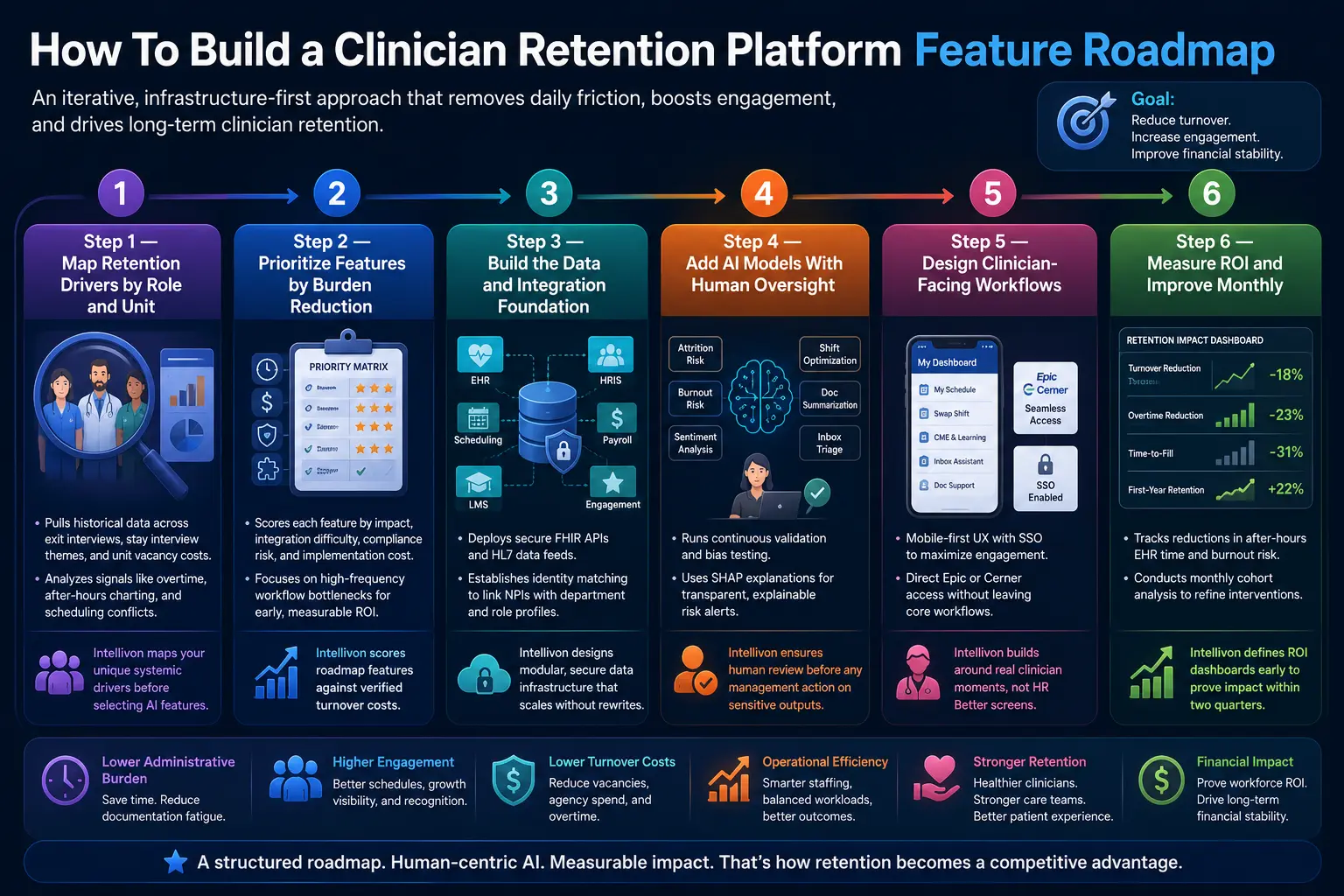
Step 1 — Map Retention Drivers by Role and Unit
Start by mapping why clinicians leave by role, unit, tenure, and specialty to establish a clear development baseline. Specifically, a useful roadmap separates nurse retention, physician retention, allied health retention, and first-year turnover because each group faces different scheduling, documentation, career, and workload pressures.
- Pulls historical data across exit interviews, stay interview themes, and specific unit vacancy costs.
- Analyzes structural operational signals like overtime patterns, after-hours charting, and scheduling conflicts.
- Intellivon maps your unique systemic drivers before selecting AI features to ensure targeted development.
- Once leaders know why staff leaves, the next step is ranking which features create the fastest operational relief.
Step 2 — Prioritize Features by Burden Reduction
Prioritize retention features by the amount of burden they remove from the clinician’s typical workday. Specifically, scheduling fairness, documentation automation, inbox management, workload balancing, and onboarding support should usually come before broad recognition tools because they change the conditions behind turnover.
- Scores each requested feature capability by impact, integration difficulty, compliance risk, and implementation cost.
- Focuses development resources entirely on high-frequency workflow bottlenecks to guarantee an early, measurable ROI.
- Intellivon scores prospective roadmap features against verified turnover costs to define a highly stable MVP.
- After feature priority is clear, architecture decisions become significantly easier and less expensive to execute.
Step 3 — Build the Data and Integration Foundation
The platform needs a highly secure, unified data layer before any complex AI features can work effectively. Specifically, hospitals should connect EHR, HRIS, scheduling, payroll, credentialing, LMS, employee engagement, and incident reporting systems into a single governed retention data model.
- Deploys secure FHIR APIs and HL7 data feeds to sync clinical systems with human resource software.
- Establishes precise identity matching protocols to link individual NPI records with corresponding department profiles.
- Intellivon designs the data foundation as modular infrastructure so later features can expand without rewrites.
- Once data is connected, the AI and workflow automation layer can begin safely across the network.
Step 4 — Add AI Models With Human Oversight
Add AI only where it supports better decisions, not where it replaces necessary leadership judgment. Specifically, suitable models include attrition risk scoring, predictive burnout scoring, sentiment analysis, shift optimization, documentation summarization, and automated inbox message triage.
- Runs continuous validation and bias testing on all active machine learning models across departments.
- Applies SHAP explanations to ensure all system-generated risk alerts are completely transparent and explainable.
- Intellivon keeps all employment-sensitive outputs fully auditable and reviewed by humans before any management action.
- AI features only create value when they flow smoothly into daily manager and clinician workflows.
Step 5 — Design Clinician-Facing Workflows
Clinician adoption depends entirely on whether the platform saves time without creating another separate system to manage. Specifically, mobile access, schedule control, transparent feedback, easy shift swaps, CME visibility, and simple documentation support should be available inside the tools clinicians already use.
- Utilizes a mobile-first UX design combined with single sign-on (SSO) to maximize system engagement.
- Integrates direct Epic or Cerner launch points to allow access without disrupting core charting screens.
- Intellivon designs around real clinician workflow moments rather than forcing users onto an HR admin screen.
- After user workflows are designed, the platform needs clear mechanisms to track measurable retention outcomes.
Step 6 — Measure ROI and Improve Monthly
Measure retention ROI through turnover reduction, overtime reduction, lower agency spend, faster time-to-fill, and lower first-year churn. Specifically, these metrics connect your workforce technology investment directly to financial outcomes to justify ongoing platform support.
- Tracks reductions in after-hours EHR time alongside positive shifts in departmental burnout risk scores.
- Performs regular monthly cohort analysis to evaluate the success of specific administrative retention interventions.
- Intellivon defines clear ROI dashboards before full deployment so leaders can prove impact within two quarters.
- The roadmap becomes easier to fund when leaders see the true build cost by phase.
Building a feature roadmap around operational burden reduction guarantees high system adoption from day one. By prioritizing data integration and human-centric AI design, healthcare networks can systematically prevent staff turnover.
Ultimately, this structured progression transforms workforce technology into a predictable engine for long-term clinical and financial stability.
How Much Do Retention Platform Features Cost To Build?
A custom clinician retention platform usually costs $120,000–$420,000+ to build, depending on feature scope, AI depth, EHR integration, scheduling complexity, compliance requirements, and rollout scale. Specifically, a narrow MVP can start near $80,000, while multi-facility platforms with predictive models and Epic or Cerner integration can exceed $500,000.
As a result, calculating these development costs beforehand helps healthcare networks allocate capital effectively.
Cost Table
| Development Phase | Typical Cost Range |
| Discovery, workflow mapping, and retention analytics audit | $8,000–$25,000 |
| UX, feature roadmap, and platform architecture | $15,000–$45,000 |
| Data foundation and integrations (EHR, HRIS, payroll) | $35,000–$120,000 |
| Scheduling and workload automation modules | $35,000–$110,000 |
| EHR burden reduction and inbox automation | $45,000–$160,000 |
| AI models for burnout, attrition, sentiment, and documentation | $50,000–$180,000 |
| Compliance, security, RBAC, audit trails, and governance | $25,000–$90,000 |
| Dashboards, ROI analytics, and reporting | $20,000–$70,000 |
| Testing, pilot launch, and deployment | $25,000–$85,000 |
1. Variables That Drive Platform Cost Upward
This technical tier evaluates the specific architectural complexities that increase overall development hours during a build. For example, deploying ambient AI documentation tools or real-time patient acuity integrations requires specialized machine learning engineers and extensive validation testing.
Consequently, these high-impact features move your platform toward the upper limit of the enterprise cost spectrum.
- Enforcing multi-facility rollouts across diverse hospital networks multiplies overall integration testing times.
- Connecting software directly to an active Epic or Cerner workflow requires extensive API mapping.
- Programming complex union scheduling rules adds highly intricate logical checks into the backend codebase.
- Intellivon builds scalable, component-based architectures that allow organizations to deploy advanced features sequentially.
2. Ongoing Maintenance & Infrastructure Upkeep
This operational framework ensures long-term platform stability by dedicating resources to routine system performance checks. Specifically, ongoing maintenance usually costs 18%–28% of the initial build cost annually to cover routine support tasks.
Therefore, this budget prevents software degradation while keeping your data pipelines fully compliant with changing healthcare laws.
- Monitors machine learning models continuously to catch and correct data drift issues before they impact scoring.
- Updates security patches and preserves deep integration links with external HRIS and payroll databases.
- Refines dashboard metrics and reporting outputs based on monthly feedback from unit leaders.
- Intellivon delivers comprehensive post-launch support agreements that keep your systems running at peak reliability.
3. Estimating Your Total Capital Investment
This planning layer connects your immediate operational goals with a predictable, transparent development budget. Specifically, the final price depends directly on the number of systems you choose to integrate during the initial MVP build phase.
As a result, starting with core workflows like scheduling fairness allows leaders to demonstrate immediate financial return.
- Alleviates upfront risk by matching capital expenditures directly with predefined engineering milestones.
- Reduces reliance on expensive external staff agencies by stabilizing internal nursing rosters early.
- Provides clear cost visibility across all internal technology stakeholders, including the CNO and CIO.
- Intellivon creates granular project breakdowns to ensure your initial build targets high-impact pain points first.
Planning a clinician retention technology build? Intellivon can help estimate your cost based on EHR integration, scheduling rules, AI models, HRIS connections, compliance scope, and rollout timeline.
Build Clinician Retention Technology With Intellivon
Intellivon builds clinician retention technology for hospitals, health systems, and healthcare product teams that need more than surveys or engagement dashboards.
The team helps design secure platforms that connect scheduling, EHR workflows, AI models, HR systems, workforce analytics, compliance controls, and ROI measurement into one retention infrastructure.
1. Map Retention Drivers Before Building Features
Intellivon starts by identifying the real reasons clinicians leave across roles, units, and facilities. This includes turnover by department, first-year churn, overtime, after-hours EHR use, scheduling conflicts, workload imbalance, documentation burden, and career progression gaps.
This helps leaders avoid building generic retention tools that look useful but do not reduce the daily friction behind clinical staff turnover.
2. Design AI Features Around Clinician Trust
AI features are designed with human review, explainability, privacy controls, and audit trails from the start. Predictive burnout scoring, attrition risk dashboards, and sentiment analysis should guide supportive interventions, not automated employment decisions.
This makes the platform useful for leaders while keeping clinician trust, transparency, and compliance at the center of the system.
3. Build Around Existing Clinical Systems
Intellivon designs retention platforms that connect with EHRs, HRIS tools, payroll systems, scheduling platforms, credentialing systems, and learning management tools. This gives leaders a complete view of workforce pressure without replacing core hospital systems.
The goal is to reduce fragmented decision-making and help clinical, HR, and operations teams act from the same data.
4. Measure Retention ROI From the Start
Retention dashboards are built around measurable outcomes such as turnover cost, overtime reduction, agency labor savings, documentation time, first-year retention, schedule satisfaction, and intervention completion.
This gives hospital leaders a clearer business case for retention investment and helps prove whether the platform is improving workforce stability over time.
Ready to Build a Clinician Retention Platform?
If your health system is evaluating clinician retention technology, Intellivon can help define the right feature roadmap, AI architecture, compliance model, integration plan, and cost range before development begins.
Build a clinician retention platform that reduces workload friction, protects clinician trust, and gives leaders measurable retention intelligence.
Conclusion
Retention platform features only create value when they improve the work conditions that help clinicians stay longer. For healthcare leaders, that means moving beyond surveys, recognition, and dashboards. Instead, the platform must reduce scheduling friction, documentation burden, inbox overload, workload imbalance, weak onboarding, and unclear career mobility.
It should also protect trust through HIPAA controls, transparent AI, human oversight, and clear governance. As a result, clinical operations, HR, EHR workflows, and workforce analytics work from one measurable system. Ultimately, retention improves when technology gives clinicians time, fairness, support, and a clearer path to grow inside the organization, not outside it.
Things To Know About Retention Platform Features
Q1. How much do retention platform features cost to build?
A1. A custom clinician retention platform usually costs $120,000–$420,000+ to build. However, a focused MVP with scheduling, surveys, dashboards, and HRIS integration can start near $80,000. Meanwhile, multi-facility builds with EHR integration, AI models, workload balancing, HIPAA controls, and advanced analytics can exceed $500,000 as scope expands.
Q2. How long does clinician retention platform development take?
A2. A focused clinician retention platform MVP usually takes 12–16 weeks when it covers one or two workflows. However, a production platform with EHR integration, scheduling rules, predictive burnout scoring, dashboards, and compliance validation usually takes 5–9 months. Meanwhile, multi-facility rollouts can require 9–14 months.
Q3. What features help retain clinical staff fastest?
A3. The fastest clinical staff retention features reduce daily workload friction first. Therefore, hospitals should prioritize scheduling flexibility, shift swap automation, documentation automation, inbox triage, prior authorization support, workload balancing, stay interviews, and onboarding support. Recognition can help, but it should support operational burden reduction instead of replacing it.
Q4. What are the best features for nurse retention platform design?
A4. The best nurse retention platform features include self-scheduling, schedule fairness rules, staffing ratio monitoring, overtime alerts, fatigue risk management, preceptorship tracking, competency management, time off visibility, shift handover automation, and clinical milestone recognition. Together, these features improve autonomy, safety, workload balance, onboarding quality, and growth visibility.
To Sum Up:
- Clinician retention platforms should not start with engagement surveys. They should start with the daily workflow burdens that make clinicians consider leaving.
- A nurse retention platform without schedule fairness, shift swap automation, and workload balancing is only measuring dissatisfaction after it has already formed.
- AI features for physician retention work best when they remove documentation, inbox, and prior authorization burden without removing clinician approval.
- Predictive burnout scoring should operate as a support system, not a surveillance system. Trust is part of the platform architecture.
- Retention ROI becomes easier to prove when turnover cost, overtime, agency labor, documentation time, and first-year churn live in one dashboard.