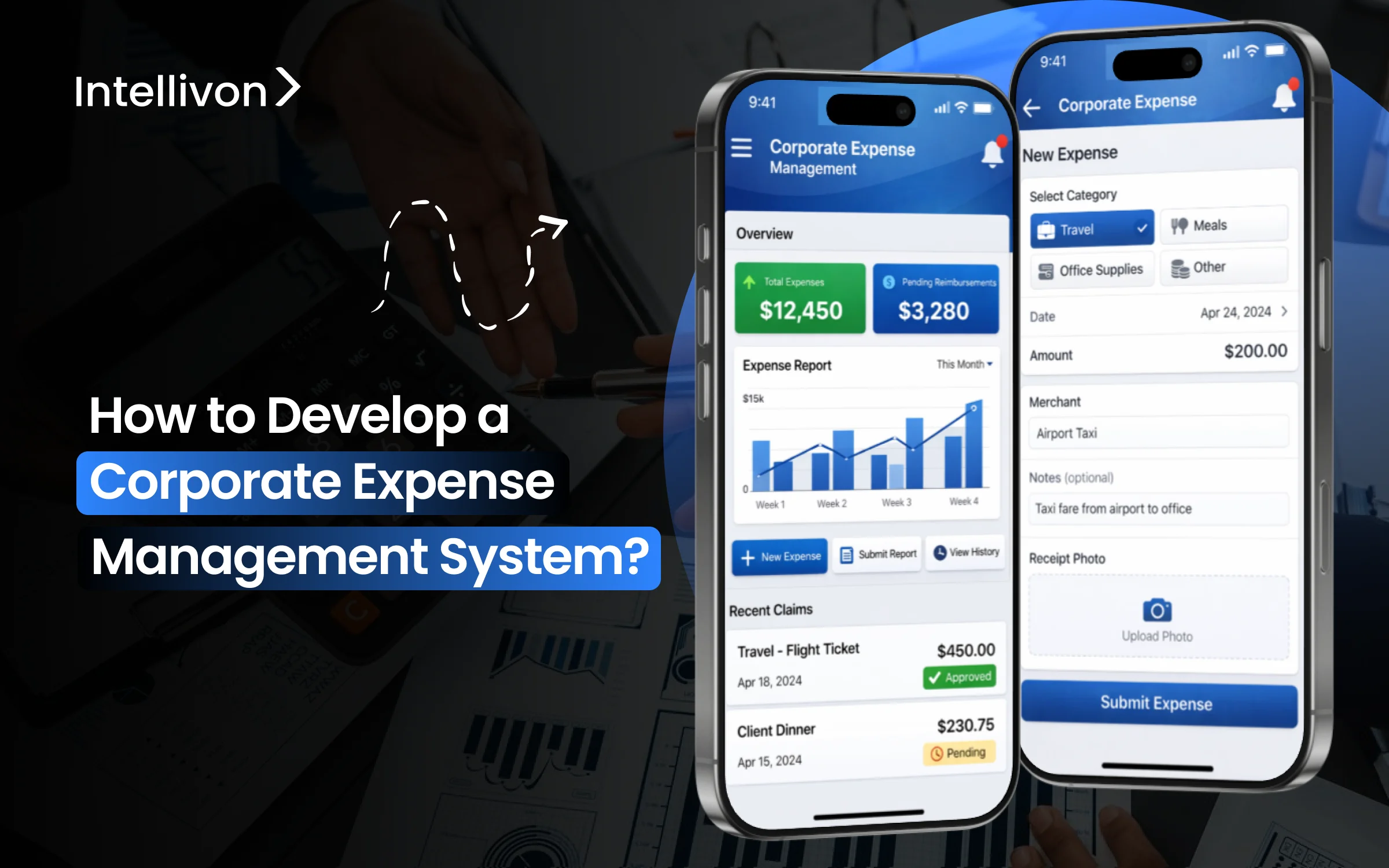
Building a custom corporate expense management system is a smart investment for fintech companies. This is because the difference between real-time spending visibility and outdated reports creates a significant gap. Leaders now face risks beyond just administrative issues. In that effect, they must also consider the slow decline of profits caused by outdated workflows that do not keep up with demands.
Many underestimate the complexity of this process. A simple reimbursement tool is very different from a complete system that can handle international tax rules, multiple bank API connections, and active policy enforcement. Overlooking these technical details during planning can lead to ineffective systems that do not address the unique needs of a business, resulting in low usage.
This blog offers a plan for building high-performance expense platforms. We go beyond basic features to look at the structural needs for growth and compliance. At Intellivon, we create high-quality AI solutions for complex financial systems where accuracy is essential. Our experience developing complex corporate expense management platforms informs all the insights shared here.
Why Are Expense Management Systems All The Rage Now
Enterprises are adopting expense management systems to replace manual work, enforce policies in real time, and gain clear visibility into spending.
These cloud-based platforms use AI to detect fraud, streamline reimbursements, and deliver faster ROI for banks and fintechs managing high expense volumes.
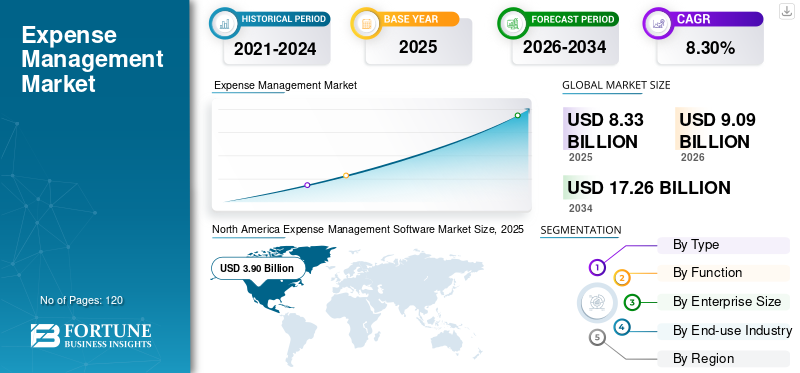
The expense management software market reached USD 8.33 billion in 2025 and is expected to grow steadily to USD 17.26 billion by 2034, at an 8.30% CAGR. North America led the market, accounting for 46.90% share in 2025.
1. The Shift Toward Real-Time Financial Visibility
Traditional accounting often relies on month-end reports, which are essentially financial autopsies. Today, leaders demand “live” data to navigate volatile markets. By developing a custom system, firms gain an immediate view of cash flow.
According to Goldman Sachs, automating these workflows can result in a 25% reduction in overall processing costs. This shift allows for dynamic budgeting rather than static, outdated financial planning.
2. Mitigating Risk through Automated Compliance
Regulatory environments are tightening, and manual audits are no longer sufficient to catch sophisticated fraud. Modern platforms integrate policy enforcement directly into the spending action.
Recent data from the ACFE suggests that organizations using proactive data monitoring reduce fraud losses by nearly 54%. Automated systems flag anomalies instantly, ensuring that compliance is a continuous process rather than a year-end hurdle.
3. Enhancing Employee Experience and Retention
Talent retention is a strategic priority. Cumbersome reimbursement processes frustrate high-performing teams and lead to “shadow spending.” A streamlined, mobile-first interface removes the friction of expense reporting.
Research by Oxford Economics indicates that improved internal tools significantly correlate with higher employee engagement scores. When spending is easy and transparent, professional satisfaction increases across the board.
Strategic spend management is no longer an optional luxury but a core pillar of operational excellence. Investing in these systems secures the agility required for long-term enterprise growth.
What Is a Corporate Expense Management System?
A corporate expense management system is a digital tool that tracks how a company spends money. It automates receipt filing, approves employee reimbursements, and connects directly to company bank accounts. This system helps leaders see exactly where money is going in real-time while stopping overspending before it happens.
In simple terms, this system is a central hub for all business spending. It replaces messy piles of paper receipts and manual spreadsheets with an automated digital process. When an employee spends money, the system captures the data, checks it against company rules, and sends it for approval.
Linking to your bank and accounting software, it gives you a clear, honest view of your cash flow. This setup turns a chaotic pile of receipts into a clean, organized stream of financial data.
How It Differs From SMB Expense Apps
Enterprise-level software is built for a completely different set of challenges than tools designed for small teams.
While an SMB app focuses on basic receipt logging, a corporate-grade system must handle massive data volumes and complex organizational hierarchies.
The primary difference lies in the back-office power. An SMB app usually works as a standalone tool for a few users. In contrast, a corporate system acts as a financial nerve center that talks to every other piece of software in your company.
| Feature | SMB Expense Apps | Corporate Expense Systems |
| Scalability | Built for 10–50 users. | Supports thousands across global offices. |
| Integrations | Basic (QuickBooks, Xero). | Deep (SAP, Oracle, Microsoft Dynamics). |
| Tax Logic | Simple, single-region tax. | Multi-currency and VAT/GST complexity. |
| Policy Control | Manual approval workflows. | Automated, AI-driven policy enforcement. |
| Data Security | Standard encryption. | Enterprise-grade (SSO, SOC2, Custom Roles). |
For a growing business, the transition from an SMB app to a custom corporate system is a move toward stability. It ensures that as your headcount grows, your financial oversight remains airtight rather than becoming a bottleneck.
Choosing the right scale of software prevents the need for a costly migration later. If you are planning for global reach, building with enterprise-grade foundations from day one is the only way to ensure long-term ROI.
Core Modules in an Enterprise Expense System
A robust expense platform is a synchronized engine designed to eliminate manual data entry. Each module serves a specific function in the lifecycle of a transaction to ensure no dollar goes unaccounted for.
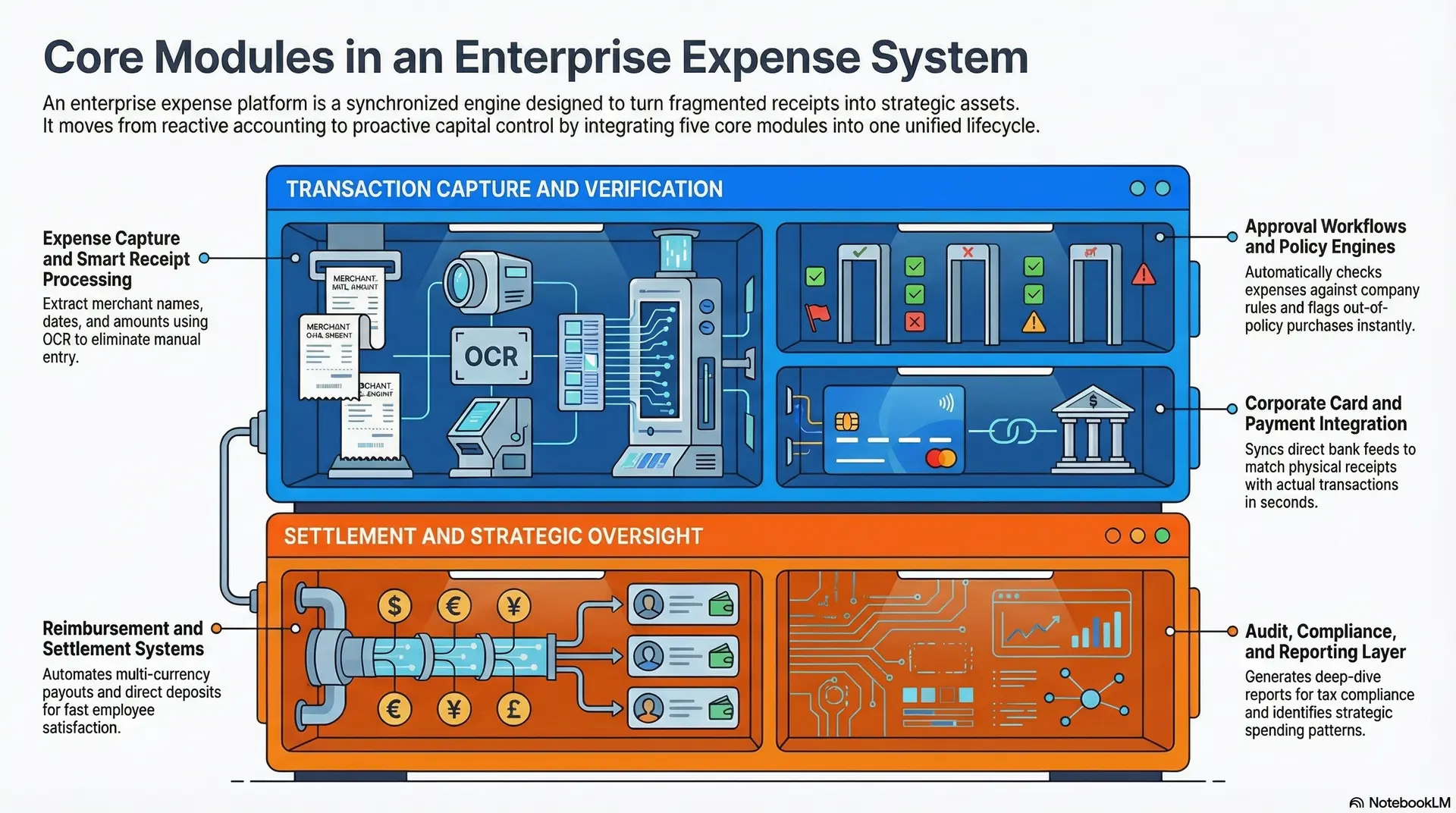
1. Expense Capture and Smart Receipt Processing
The system begins with high-accuracy data entry. Using Optical Character Recognition (OCR), the platform extracts merchant names, dates, and amounts from photos or digital invoices.
- Eliminates Manual Entry: Reduces human error by auto-filling reports.
- Instant Digitization: Captures data at the point of sale for real-time tracking.
2. Approval Workflows and Policy Engines
This is the “brain” of the system. It automatically checks every expense against your company’s specific rules.
- Custom Hierarchy: Routes approvals based on department or spend limits.
- Automated Flags: Instantly blocks or flags out-of-policy purchases before they are processed.
3. Corporate Card and Payment Integration
Direct feeds from banking institutions provide a single source of truth. By syncing corporate cards, the system matches physical receipts to actual bank transactions.
This reconciliation happens in seconds, providing a clear view of total liabilities without waiting for a monthly statement.
4. Reimbursement and Settlement Systems
For out-of-pocket costs, speed is essential for employee satisfaction. This module automates the payment pipeline.
- Global Payments: Handles multi-currency payouts across different regions.
- Direct Deposits: Integrates with payroll or ACH systems for seamless fund transfers.
5. Audit, Compliance, and Reporting Layer
This final layer creates a permanent, searchable record for tax and internal audits. It generates deep-dive reports that help leadership identify spending patterns, negotiate better vendor rates, and ensure global tax compliance without manual oversight.
These modules must work as one unified system rather than isolated features to provide true financial clarity.
Effective development ensures these components communicate flawlessly, turning fragmented receipts into a strategic asset. By building these modules correctly, an enterprise moves from reactive accounting to proactive capital control.
How Expense Systems Fit Into Enterprise FinOps
Financial operations in a large organization demand total architectural harmony. A modern expense system acts as a vital bridge between daily operational spending and the high-level strategic goals of the finance department.
1. Integration With ERP and Accounting Systems
The most critical role of an expense platform is its connection to the ERP (Enterprise Resource Planning) system. Instead of manual data exports, the platform uses secure APIs to push transaction data directly into systems like SAP or Oracle.
- Data Integrity: Eliminates “double-entry” errors that plague manual accounting.
- Unified Ledger: Ensures the general ledger is updated instantly, providing a single source of truth for the entire organization.
2. Sync With Payroll and Reimbursement Cycles
Employee satisfaction hinges on the speed of reimbursements. By syncing with payroll software, the system ensures that approved expenses are paid out in the next available cycle without extra paperwork.
This automation removes the burden from the HR department and ensures that tax-deductible reimbursements are handled with precision. It turns a traditionally slow process into a reliable, invisible background task.
3. Role in Budgeting and Forecasting
Decision-makers often struggle with “budget lag,” where they only see overspending weeks after it happens. A custom expense system provides a live look at departmental spend against set limits.
- Proactive Alerts: Management receives notifications when a team approaches 80% of its quarterly budget.
- Spend Control: Allows for the immediate adjustment of spending limits in response to shifting market conditions.
4. Connecting Expense Data to Financial Analytics
Raw data is only valuable if it leads to better decisions. By funneling expense data into analytics tools, leadership can spot trends that were previously hidden.
For example, you might discover that a specific vendor is used across ten different departments, giving you the leverage to negotiate a bulk corporate discount. This transformation of “cost data” into “business intelligence” is what separates a basic tool from a true FinOps asset.
These layers of integration ensure that every dollar spent is visible, categorized, and strategically utilized. When your expense system talks to your ERP and payroll, you eliminate the friction that usually slows down corporate growth.
This connectivity transforms a simple administrative task into a powerful engine for financial health and long-term stability.
Step-by-Step Corporate Expense Management System Development
Building a custom financial platform is a journey from operational chaos to structured intelligence. Following a disciplined development roadmap ensures that the final product is not just functional, but an asset that grows with your enterprise.
At Intellivon, we have refined a proprietary execution framework that mitigates risk while accelerating the time-to-value for complex financial builds.
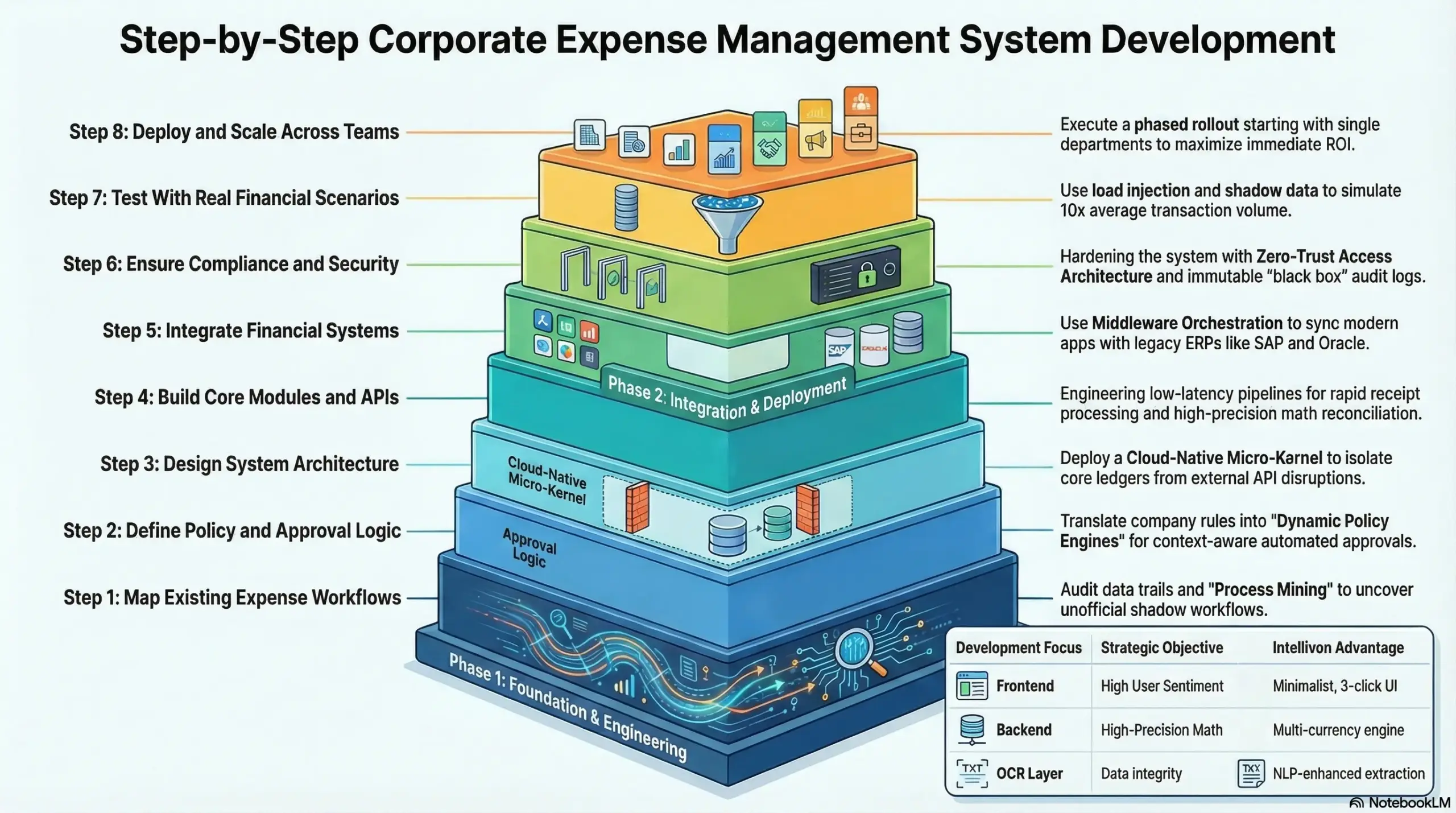
Step 1: Map Existing Expense Workflows
Before writing a single line of code, you must understand how money currently moves through your organization. This phase involves interviewing department heads and auditing past reports to find friction points.
- Identify Bottlenecks: Locate where approvals stall or where manual data entry leads to errors.
- The Intellivon Approach: We perform a “Process Mining” audit. Instead of just asking how things work, we look at the data trail of your existing expenses. This allows us to uncover “shadow workflows”—those unofficial workarounds employees use because the current system is too slow. By solving for the reality of your operations, we ensure high user adoption from the start.
Step 2: Define Policy and Approval Logic
Your company policy must be translated into “if-then” logic that the system can execute automatically. This includes setting spending limits by role, department, or project.
- Granular Control: Define exact parameters for what constitutes a “flagged” transaction.
- Intellivon Specialization: We design “Dynamic Policy Engines.” Most systems use rigid rules; our builds allow for context-aware approvals. For instance, the system can automatically increase a travel budget if it detects a last-minute flight change during peak season, reducing the need for manual overrides while maintaining strict oversight.
Step 3: Design System Architecture
The architecture is the foundation of your platform’s scalability. For an enterprise system, this usually involves a microservices approach to ensure different modules can be updated without crashing the whole system.
- High Availability: Designing for 99.99% uptime to ensure global teams can file expenses 24/7.
- Intellivon Technical Depth: We deploy a Cloud-Native Micro-Kernel Architecture. By isolating the core ledger from the user interface and third-party integrations, we ensure that even if a bank API goes down, your internal recording and compliance checks continue uninterrupted. This prevents the “system-wide blackout” common in monolithic legacy platforms.
Step 4: Build Core Modules and APIs
This is where the actual engineering happens. Development teams build the user interface and the backend engines that process data.
- API-First Development: Ensuring every module can “talk” to external services easily.
- Our Process: We utilize a “Low-Latency Data Pipeline” build. In finance, speed is security. We optimize how receipts are processed and stored to ensure that even during month-end surges, the system remains responsive.
While we keep our specific tech stack confidential, our focus is on building “future-proof” codebases that are easy to maintain and audit.
| Development Focus | Strategic Objective | Intellivon Advantage |
| Frontend | High user sentiment. | Minimalist, 3-click submission UI. |
| Backend | High-precision math. | Multi-currency reconciliation engine. |
| OCR Layer | Data integrity. | NLP-enhanced field extraction. |
Step 5: Integrate Financial Systems
A standalone system is a liability; an integrated one is a superpower. This step connects your new platform to your existing bank feeds, corporate cards, and ERP.
- Seamless Sync: Automated data flow into SAP, Oracle, or Microsoft Dynamics.
- Intellivon Specialization: We are experts in “Middleware Orchestration.” Connecting modern cloud apps to decades-old legacy ERPs is notoriously difficult. Our team builds custom “Adapters” that act as translators, ensuring data moves securely and accurately between different software generations without manual intervention.
Step 6: Ensure Compliance and Security
Financial data is a high-value target. This phase hardens the system against threats and ensures it meets global standards like GDPR, SOC2, or PCI-DSS.
- Encryption: Protecting data both at rest and in transit.
- The Intellivon Security Layer: We implement Zero-Trust Access Architecture. We verify every request within the system. At the same time, we also integrate immutable audit logs, essentially a digital “black box”, that records every change made to a transaction, making your next external audit a stress-free process.
Step 7: Test With Real Financial Scenarios
Generic testing isn’t enough for finance. We put the system through its paces using “Shadow Data” from your actual past transactions to see how it handles real-world complexity.
- Edge Case Testing: How does the system handle a receipt in a foreign currency with a missing tax ID?
- Our Stress-Testing Protocol: We perform “Load Injection” tests. We simulate 10x your average transaction volume to identify exactly where the system might slow down. This ensures that when your company doubles in size, your software doesn’t break under the pressure.
Step 8: Deploy and Scale Across Teams
The final step is a phased rollout. Instead of a “big bang” release, we recommend starting with a single department or region to gather feedback before scaling globally.
- Onboarding Success: Creating custom training modules to ensure high user sentiment.
- Continuous Evolution with Intellivon: Our relationship doesn’t end at deployment. We treat the system as a living product. As new AI capabilities or regulatory requirements emerge, we are already there to integrate them. Our deployment strategy is designed to minimize operational downtime while maximizing the immediate visibility of your ROI.
By following this structured, expert-led path, you transform a complex technical challenge into a streamlined, high-performance asset. This is how Intellivon helps enterprises reclaim their financial time and capital.
Architecture Behind Enterprise Expense Platforms
The technical foundation of an expense platform determines whether it will be a flexible asset or a rigid liability.
For an enterprise, the architecture must prioritize high availability and data integrity to ensure that global operations never experience a “blind spot” in spend visibility.
1. API-First Design for Financial Systems
In a modern financial stack, no application should exist as an island. An API-first design ensures that the expense platform can communicate effortlessly with third-party banks, travel booking engines, and tax verification services.
This approach allows developers to build “pluggable” features that can be swapped or upgraded without rebuilding the entire core. It turns the system into a collaborative hub where data flows securely and instantly between different business units.
2. Cloud-Native Infrastructure for Scale
Global enterprises require a system that can handle thousands of concurrent users across different time zones. Cloud-native infrastructure allows the platform to scale resources dynamically based on demand.
During peak periods, such as the final week of a fiscal quarter, the system can automatically allocate more processing power to handle the surge in submissions. This elasticity prevents latency issues and ensures that the user experience remains fast, regardless of the load.
3. Microservices for Workflow Flexibility
A monolithic software structure is dangerous in finance because a single bug can take down the entire accounting pipeline. Instead, modern platforms use microservices to break the system into independent parts:
- Independence: The “Receipt Capture” service can function even if the “Reporting” service is undergoing maintenance.
- Agility: Teams can update the “Tax Logic” module to comply with new regional laws without affecting the “Payment” module.
- Resilience: If one service fails, the rest of the system stays online, ensuring business continuity.
4. Data Pipelines for Real-Time Processing
Batch processing, where transactions are handled in large groups once a day, is becoming obsolete. Modern architectures utilize streaming data pipelines to process expenses as they happen.
As soon as a corporate card is swiped, the data is ingested, validated against policy, and pushed to the dashboard. This real-time processing provides leadership with a “live” view of cash outflows, allowing for proactive adjustments to budgets before overages occur.
The transition from traditional databases to these modern architectural styles is what enables a firm to handle global complexity. By prioritizing modularity and real-time connectivity, an enterprise can build a system that evolves alongside its growing reach and scale.
Key Integrations Required for Expense Systems
An expense management platform is only as powerful as its ability to communicate with the rest of your enterprise stack. Without seamless data movement between these systems, you are simply replacing one manual spreadsheet with another digital silo.
1. ERP Systems Like SAP and NetSuite
The integration with your ERP is the most vital connection in your financial infrastructure. A custom system must be able to map expense categories directly to your general ledger codes.
- Bi-directional Sync: The system should pull project codes from the ERP while pushing validated expense data back.
- Automated Reconciliation: This eliminates the need for manual “month-end” matching, ensuring your balance sheet is always accurate.
2. Corporate Card and Banking APIs
To achieve true real-time visibility, the platform must connect directly to banking institutions via secure APIs. Instead of waiting for a monthly statement, the system pulls transaction data the moment a card is swiped.
This allows the software to automatically match a physical receipt to a verified bank record, significantly reducing the window for fraudulent or accidental “double-dipping.”
3. Payroll and HRMS Systems
Integrating with HRMS platforms like Workday or BambooHR ensures that your organizational hierarchy is always up to date.
- Employee Lifecycle: When a new hire is added to HRMS, they are automatically provisioned with an expense account.
- Direct Reimbursements: By linking to payroll, the system can automate the payout of out-of-pocket expenses, ensuring employees are paid back quickly and accurately within their standard pay cycles.
4. Tax and Compliance Engines
Global organizations face a labyrinth of tax regulations, such as VAT in Europe. Integrating with specialized tax engines allows the system to automatically calculate deductible taxes based on the merchant category and location.
This ensures that your company is capturing every possible tax credit while remaining 100% compliant with regional government reporting standards.
These integrations transform a simple tracking tool into a unified financial nervous system. When your expense data speaks the same language as your ERP, payroll, and tax engines, you eliminate the operational friction that slows down enterprise growth.
Compliance and Security Requirements Explained
In the landscape of enterprise finance, security is the primary product feature. A system that manages capital must be designed with a “defense-in-depth” philosophy to protect sensitive financial data and maintain the trust of stakeholders and regulators alike.
1. GDPR, SOC 2, and Financial Regulations
Operating globally requires strict adherence to regional data privacy and financial laws. Compliance is not a one-time checkbox but a continuous architectural requirement.
- Data Privacy: GDPR and CCPA mandate how employee personal data, like banking details and travel history, is stored and deleted.
- Operational Integrity: SOC 2 Type II certification ensures that your internal processes for managing data are secure, available, and confidential over time.
2. Data Encryption and Access Control Layers
Protecting data means securing it at every stage of its lifecycle. This involves utilizing AES-256 encryption for data at rest and TLS 1.3 for data in transit.
Beyond encryption, modern systems implement multi-factor authentication (MFA) to prevent unauthorized entry. These layers ensure that even if a device is compromised, the core financial database remains shielded from external threats.
3. Audit Trails and Fraud Detection Systems
Transparency is the best deterrent against internal and external financial threats. An enterprise system must maintain an immutable audit trail, which is a permanent record of every submission, approval, and modification.
- Pattern Recognition: Modern systems use detection algorithms to spot duplicate receipts or unusual spending spikes in real-time.
- Transparency: Every action is timestamped and linked to a specific user, making it impossible to alter financial records without leaving a digital footprint.
4. Role-Based Permissions and Governance
Not every user should have the same level of visibility. Role-Based Access Control (RBAC) allows you to define exactly what a user can see and do based on their position in the company.
A junior employee might only see their own submissions, while a CFO has access to global spend analytics. This granular governance prevents accidental data exposure and ensures that sensitive financial information is only accessible on a “need-to-know” basis.
These security protocols turn your expense platform into a fortress of financial data. By embedding compliance directly into the code, you reduce the risk of legal penalties and create a stable environment for long-term capital management.
Custom vs SaaS Expense Systems: What Wins?
Choosing between a subscription-based tool and a bespoke build is a fundamental decision that dictates your long-term operational agility. While SaaS solutions offer rapid deployment, they often force your enterprise to bend its workflows to fit the software’s pre-coded limitations.
1. Limitations of Off-the-Shelf Tools
Standard SaaS products are built for the “average” company, which can become a liability for high-growth enterprises. These platforms often lack the flexibility to handle complex internal logic or hyper-specific regional compliance rules.
- Feature Rigidity: You are locked into the vendor’s roadmap; if you need a specific feature for an audit, you might wait years for an update.
- Hidden Integration Costs: While the software is “ready,” connecting it to a legacy ERP often requires expensive, custom-built “bridges” that negate the initial cost savings.
- Data Sovereignty: Your sensitive financial data lives on someone else’s servers, which can complicate internal security protocols and third-party risk assessments.
2. When Custom Systems Make Strategic Sense
A custom build is an investment in ownership and precision. It makes strategic sense when your expense processes are a competitive advantage or when manual workarounds in a SaaS tool are costing you more in human hours than a build would cost in capital.
If your organization operates across multiple entities with varied tax laws, or if you require deep, real-time synchronization with a proprietary backend, a custom-engineered solution is the only way to achieve 100% automation.
3. Cost vs Control Trade-Off Analysis
The decision ultimately comes down to whether you prioritize a “quick fix” or a “long-term asset.”
A custom system requires more upfront capital but eliminates the “per-user” monthly tax that makes SaaS incredibly expensive as your headcount scales into the thousands.
| Metric | SaaS Expense Solutions | Custom-Built Platforms |
| Initial Investment | Low / Subscription-based. | Higher / Capital Expenditure. |
| Long-term Scaling | Costs increase with headcount. | Fixed costs; scales without extra fees. |
| Customization | Limited to vendor settings. | Infinite; built to your exact specs. |
| Integration | Standardized / “Plug and Play”. | Native / Deep ERP synchronization. |
| Data Control | Shared with vendor. | 100% Internal Ownership. |
For a global enterprise, the “control” aspect of a custom system often outweighs the convenience of SaaS.
By building your own platform, you ensure that your financial infrastructure is a tailor-made engine designed specifically for your company’s unique trajectory.
Cost to Develop an Expense Management System
Building an enterprise expense management system is not a fixed-cost project. The total investment depends on how deeply the system integrates with financial workflows, compliance layers, and existing infrastructure.
Unlike basic expense tools, enterprise systems require real-time processing, policy enforcement, and multi-system integrations. As a result, costs are driven more by architecture, integrations, and scale than just features.
Key Cost Drivers in Enterprise Builds
Several factors directly influence development costs:
- System complexity: Multi-entity, multi-currency, global workflows increase scope
- Integrations: ERP, banking APIs, payroll, and compliance systems add effort
- Policy engine depth: Real-time rule enforcement requires advanced logic layers
- Data processing: Receipt OCR, categorization, and analytics pipelines
- Security and compliance: GDPR, SOC 2, audit trails, and access controls
- User scale: Systems built for thousands of users require stronger infrastructure
The deeper the system integrates into finance operations, the higher the cost, but also the higher the long-term ROI.
Cost Breakdown by Modules and Complexity
| Component | Scope | Estimated Cost |
| Expense Capture & OCR | Receipt scanning, AI extraction, categorization | $8,000 – $18,000 |
| Policy Engine | Rules, approvals, compliance logic | $10,000 – $22,000 |
| Approval Workflows | Multi-level approvals, automation | $8,000 – $15,000 |
| Corporate Card Integration | Bank APIs, transaction sync | $10,000 – $25,000 |
| Reimbursement System | Claims processing, payouts | $8,000 – $18,000 |
| Reporting & Analytics | Dashboards, insights, exports | $10,000 – $20,000 |
| Admin & Control Panel | Role-based access, configurations | $6,000 – $12,000 |
Estimated Total Development Cost:
$60,000 – $150,000+ (depending on complexity and scale)
Infrastructure and Maintenance Costs
Beyond development, ongoing costs play a critical role.
- Cloud infrastructure: $2,000 – $8,000/month, depending on scale
- Data storage & processing: High for receipt-heavy systems
- API usage costs: Banking, OCR, and third-party services
- Security monitoring: Continuous compliance and audit readiness
- System updates: Feature upgrades and performance optimization
Enterprise systems are long-term infrastructure investments, not one-time builds.
Timeline vs Cost Trade-Off
Development timelines directly impact cost and system quality.
- 3–4 months: MVP with basic workflows and limited integrations
- 5–7 months: Mid-level system with core integrations and automation
- 8–12+ months: Full-scale enterprise platform with advanced features
Faster timelines increase costs due to larger teams and parallel development. However, longer timelines allow better architecture and lower technical debt.
The right approach is not to minimize cost, but to align investment with long-term financial control, scalability, and compliance needs.
Request a custom quote and see what it takes to build a scalable, policy-driven expense management system for your enterprise.
Real Use Cases From Enterprise Expense Systems
Real-world enterprise expense use cases focus on large-scale reimbursement automation, proactive global policy enforcement, and AI-driven fraud mitigation.
These systems allow multi-entity organizations to maintain a unified financial ledger while managing diverse regional requirements and high transaction volumes.
1. Automating Employee Reimbursements at Scale
Manual reimbursement cycles often take weeks, leading to employee frustration and accounting backlogs.
A custom system automates the entire flow from receipt capture to bank transfer. Once a receipt is scanned, the system validates the data and routes it through the appropriate approval chain instantly.
- Impact: Reduces administrative overhead by up to 60%.
- Banking Example: J.P. Morgan Chase utilizes high-volume automated systems to manage internal employee spend across global branches, ensuring that disbursements are processed through internal ledgers with minimal human touch.
2. Real-Time Policy Enforcement for Global Teams
Global teams operate under varied local spending rules. An intelligent system enforces these policies at the moment of entry.
If a manager in London tries to book a flight that exceeds the “Premium Economy” cap, the system flags the violation before the booking is finalized.
- Impact: Eliminates 95% of out-of-policy spend before it occurs.
- Banking Example: Goldman Sachs employs sophisticated internal platforms that integrate regional spending mandates. These systems ensure that every dollar spent by their global workforce adheres to strict compliance and regulatory standards across different jurisdictions.
3. Expense Fraud Detection Using AI
Traditional auditing only catches fraud after the money has left the company. AI-driven systems analyze spending patterns to identify anomalies, such as duplicate receipts, “rounded” numbers, or unauthorized merchants, in real-time.
- Impact: Organizations using proactive monitoring reduce fraud losses significantly.
- Banking Example: HSBC utilizes advanced transaction monitoring systems that act as an expense-side equivalent to their customer fraud detection. These platforms use machine learning to flag suspicious internal employee spending patterns, protecting the firm from capital leakage.
3. Unified Expense Tracking Across Subsidiaries
For conglomerates with multiple subsidiaries, getting a single view of total spend is a nightmare. A unified platform pulls data from every entity into one dashboard, regardless of the local currency or accounting software they use.
- Impact: Provides the CFO with a “single source of truth” for the entire corporate group.
- Banking Example: Citigroup operates across hundreds of legal entities globally. They utilize centralized expense hubs that aggregate spend data from various subsidiaries into a unified reporting layer, allowing for top-down liquidity management and consolidated financial reporting.
These use cases demonstrate that a well-built system is more than just a convenience. It is a critical piece of financial machinery that protects capital and provides the transparency required to lead a global enterprise with confidence.
How AI Is Transforming Expense Management Systems
AI is the new backbone of financial infrastructure. By shifting from “rule-based” systems to “learning” systems, enterprises can move from simply recording expenses to intelligently predicting and controlling them before they impact the bottom line.
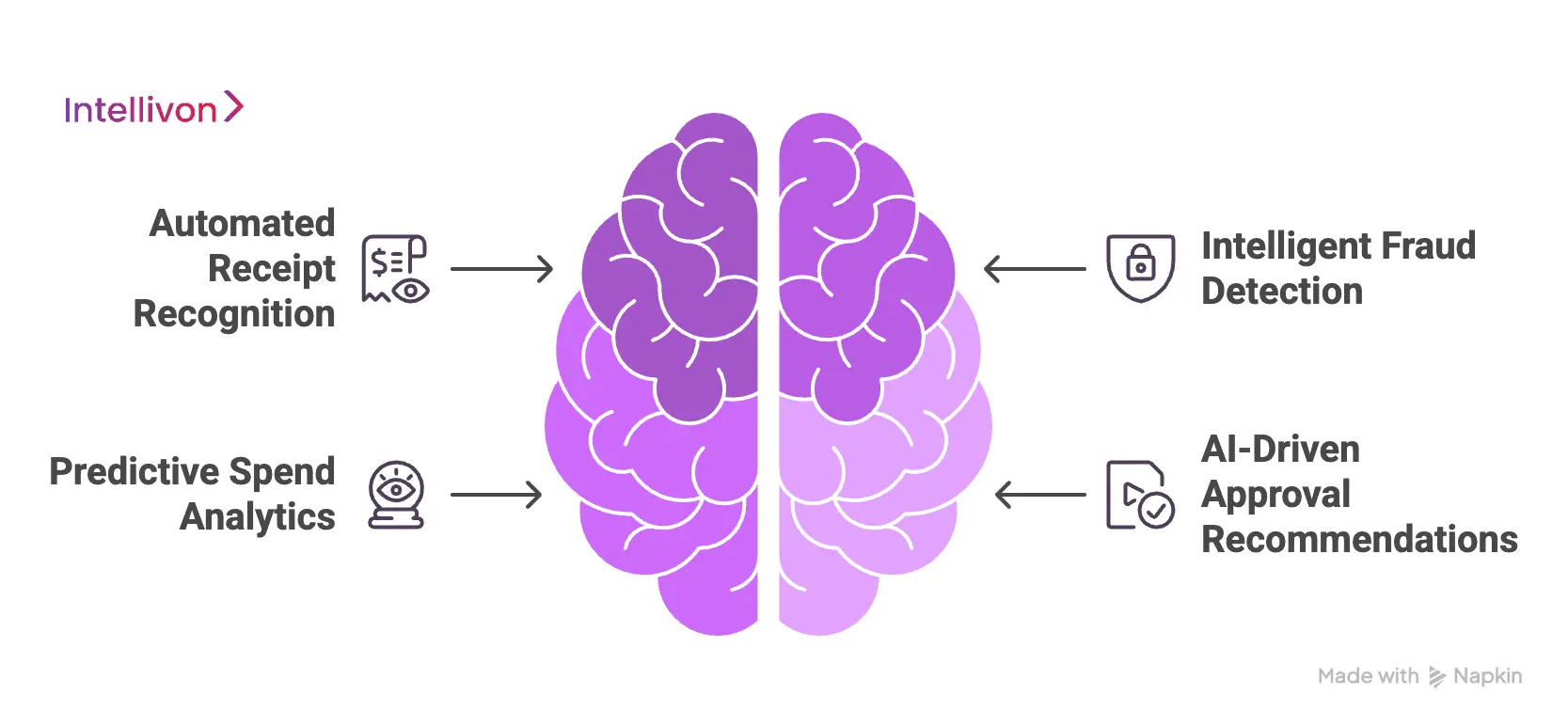
1. Automated Receipt Recognition and Categorization
Traditional OCR has evolved into AI-driven Computer Vision. Modern systems don’t just “read” text. Instead, they understand the context of a document.
- Deep Contextualization: The AI can distinguish between a “Value Added Tax” and a “Service Charge” even on a crumpled receipt in a foreign language.
- Smart Categorization: By analyzing merchant metadata, the system automatically maps an Uber ride to “Travel” and a Starbucks purchase to “Client Meals” with 99% accuracy, eliminating the need for employees to manually select categories.
2. Intelligent Fraud Detection Systems
Legacy systems can only flag what you tell them to look for. AI, however, identifies “unknown unknowns.” By establishing a baseline of normal behavior, machine learning algorithms can detect subtle anomalies that escape the human eye.
- Pattern Recognition: AI spots “split transactions”, where an employee breaks a large purchase into two smaller ones to stay under an approval limit.
- Merchant Scrutiny: The system cross-references merchant names against global databases to flag potential “shell company” invoices or high-risk vendors instantly.
3. Predictive Spend Analytics
Most financial reports look backward, whereas an AI-driven analytics look forward. By analyzing historical spending cycles, the system can predict future cash outflows with startling precision.
- Budget Forecasting: If travel costs traditionally spike 15% in Q3, the system alerts department heads to adjust their forecasts in Q2.
- Vendor Negotiation: The AI aggregates fragmented spend data to show you exactly how much you are spending with a specific airline or hotel chain globally, providing the data needed to negotiate massive corporate discounts.
4. AI-Driven Approval Recommendations
Approving hundreds of reports is a major bottleneck for management. AI acts as a first-level reviewer, assigning a “Confidence Score” to every submission.
- Streamlined Review: If a report is 100% compliant and matches bank data, the AI recommends “Auto-Approval,” allowing managers to focus only on high-risk exceptions.
- Risk Scoring: The system highlights specific items within a report that require human intervention, such as a missing attendee list for a dinner or a missing tax ID, significantly accelerating the reimbursement cycle.
The integration of AI transforms the finance department from a cost center into a strategic partner. By automating the mundane and highlighting the critical, AI ensures that your organization’s capital is managed with a level of precision that was previously impossible.
Future Trends in Expense Management Systems
The trajectory of financial software is moving away from standalone tools toward invisible, autonomous infrastructure.
For the enterprise, the future of expense management rests in reducing the need for human intervention entirely through deeply integrated, intelligent systems.
1. Embedded Finance and Expense Automation
We are moving toward an era of “invisible” expenses. Through embedded finance, corporate cards and payment rails are becoming natively integrated into the software. Instead of a “swipe and sync” model, the transaction and the accounting happen simultaneously.
This means policy checks, tax categorization, and ledger entry occur at the millisecond the payment is authorized. This level of integration eliminates the concept of an “expense report” entirely, as the data is born digital and pre-approved.
2. Real-Time Financial Decision Systems
Future platforms will act as co-pilots for the CFO. Rather than reviewing what was spent last month, these systems will provide real-time guidance on what should be spent today.
- Dynamic Liquidity Management: The system can suggest delaying certain non-essential expenses if it predicts a temporary cash flow tightening.
- Instant Opportunity Cost Analysis: When an employee books travel, the system can instantly compare the cost against the projected ROI of the client meeting based on CRM data.
3. Agentic AI in Expense Workflows
While current AI identifies patterns, “Agentic AI” takes action. We are entering a phase where AI agents can autonomously resolve disputes with vendors, negotiate better rates based on volume, and handle complex cross-border tax reclamation without human oversight.
- Autonomous Dispute Resolution: If a merchant overcharges a corporate card, an AI agent can automatically initiate a claim and follow up until the refund is issued.
- Policy Self-Correction: The AI can suggest updates to company spending policies by identifying recurring inefficiencies or changing market prices for travel and services.
4. Unified Financial Operations Platforms
The silo between procurement, accounts payable, and employee expenses is collapsing. The future lies in Unified Financial Operations (FinOps) platforms.
These systems provide a single, holistic view of every dollar leaving the organization, whether it is a multi-million dollar vendor contract or a $20 taxi ride.
This unification allows for a level of strategic oversight and treasury control that fragmented legacy stacks simply cannot provide.
The future of expense management is autonomous, proactive, and deeply strategic. Organizations that invest in these forward-looking architectures today will gain a significant advantage in capital efficiency and operational speed as these technologies become the global standard.
Conclusion
Developing a corporate expense management system is a transformative investment in operational intelligence. By shifting from manual workflows to automated, AI-driven architectures, enterprises reclaim lost margins and secure total spend visibility.
This infrastructure provides the strategic data needed for global scaling. As a leader in cutting-edge enterprise AI solutions, Intellivon is your trusted partner in engineering precision-grade financial platforms that turn complex spending into a competitive advantage.
Build a Corporate Expense System With Intellivon
At Intellivon, corporate expense systems are built as financial control infrastructure, not as standalone tools layered onto disconnected workflows. The goal is to create a unified system that connects expense data, policy enforcement, approvals, and financial operations into one scalable environment.
Each platform is designed around how your finance teams actually operate. This includes expense capture, policy validation, approval workflows, reimbursements, corporate card integrations, and real-time reporting, all aligned within a single architecture. As a result, enterprises gain full visibility into spending, reduce manual effort, and enforce financial discipline across teams.
Our engineering approach combines API-first, cloud-native architecture with intelligent automation layers. This ensures seamless integration with ERP systems, banking APIs, payroll platforms, and compliance tools without disrupting existing operations.
Why Build With Intellivon
- Infrastructure-First Approach: We design systems that become part of your financial backbone, not temporary tools that need replacement as you scale.
- Built for Real Finance Workflows: Every system reflects real-world expense operations, approval hierarchies, and compliance requirements across regions and entities.
- API-First, Integration-Ready: Seamless connectivity with ERPs, banking systems, HRMS, and tax engines ensures your system works within your existing ecosystem.
- Compliance Built In: From audit trails to role-based controls, every layer is designed to meet enterprise-grade financial and regulatory standards.
What You Get
- End-to-end expense management platform tailored to your workflows
- Real-time policy enforcement and automated approvals
- Deep integrations with financial and operational systems
- Scalable infrastructure built for global teams
- Continuous support, optimization, and upgrades
Get a Custom Cost Estimate
Get a tailored cost estimate for your expense management system based on your workflows, integrations, compliance needs, and scale.
FAQs
Q1. What is a corporate expense management system?
A1. A corporate expense management system is a platform that helps enterprises track, control, and automate employee spending. It manages expense capture, approvals, reimbursements, and policy enforcement in one system.
As a result, finance teams gain real-time visibility into spending while reducing manual work and errors across departments.
Q2. How long does development take?
A2. Development timelines depend on system complexity and integrations.
- Basic system: 3–4 months
- Mid-level system: 5–7 months
- Enterprise-grade platform: 8–12+ months
If you require deep integrations, advanced compliance, and global workflows, timelines increase. However, a well-planned build reduces rework later.
Q3. What integrations are required?
An enterprise expense system must connect with multiple financial and operational systems.
Key integrations include:
- ERP systems like SAP or NetSuite
- Banking and corporate card APIs
- Payroll and HRMS platforms
- Tax and compliance engines
These integrations ensure real-time data flow and accurate financial reporting across your organization.
Q4. How secure are these systems?
A4. Enterprise expense systems are built with multiple security layers to protect financial data. This includes data encryption, role-based access control, audit trails, and compliance with standards like GDPR and SOC 2.
In addition, fraud detection systems help identify suspicious transactions early. As a result, organizations maintain both data security and regulatory compliance.
Q5. How much does it cost to build one?
The cost to build a corporate expense management system typically ranges from $60,000 to $150,000+. Costs depend on:
- Number of features and modules
- Integration complexity
- Security and compliance requirements
- Infrastructure and scalability needs
While initial costs vary, a well-built system delivers long-term ROI through automation, cost control, and improved financial visibility.